Mr. Wright has accepted the new story, JULHI. (Pronounce it! I can’t.) All about a very peculiar one-eyed female of a hitherto unknown race, with an immovable mouth perpetually stretched open in a heart-shaped arch, thru which she speaks by humming in various keys and intensities. You’ve heard people make a violin talk, haven’t you? Saying “I don’t know,” and “What?” and that sort of thing, the way one does without opening the mouth. Well, anyhow, she lives on sensation, somewhat as the Alendar lived on beauty. Then there’s a city which exists simultaneously in two worlds thru some obscure sort of magic. Only in one world time moves faster than in the other, so , if you know the way, you can step out of crumbling ruins into the same city still standing in the other plane. All very complicated.
—C. L. Moore to R. H. Barlow, 10 Sep-9 Oct 1934, MSS. Brown Digital Repository
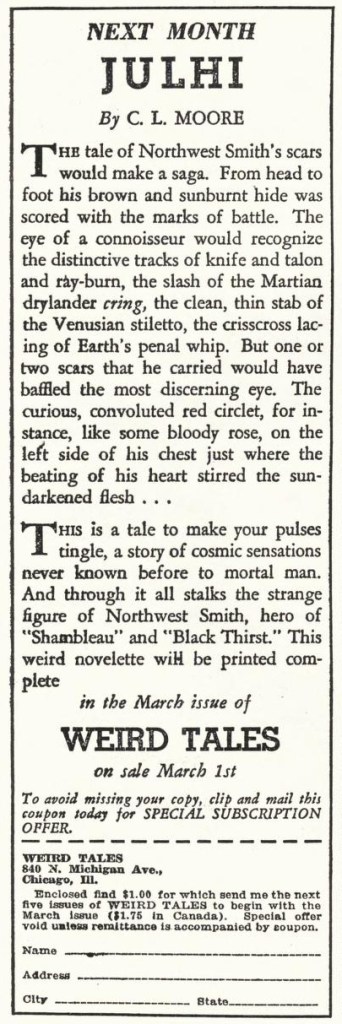
By 1935, C. L. Moore was fairly well-established at Weird Tales, having placed 5 stories in 1934 and establishing two series characters, Northwest Smith and Jirel of Joiry, both of whom were well-received by both the general readership and among her peers. At the same time, Moore was now in contact with R. H. Barlow, Lovecraft, Forrest J. Ackerman, and others in pulp circles, and receiving conflicting advice. The Great Depression was still going, she still needed to bring in money with her writing, but Lovecraft and Barlow were talking about her development as an artist.
The fifth published adventure of Northwest Smith, “Julhi,” seems another concession to Farnsworth Wright’s demand for more Northwest Smith stories than a tale that demanded to be told. Moore even provided one of her own illustrations for the story:
I’ve just sent in a drawing for JULHI which I really do think is good. Don’t know if he’ll take it, but darnit, it is one of the best I’ve ever done. She said modestly.
—C. L. Moore to R. H. Barlow, 10 Sep-9 Oct 1934, MSS. Brown Digital Repository
The story itself shows Moore’s continued flagrant flouting of any division between science fiction and fantasy. The opening is almost that of a hardboiled detective tale or Oriental adventure: back on Venus once more, Northwest Smith has been kidnapped and awakes, unarmed and with a local girl in the ancient ruins of Vonng, a city raised by sorcery. There is a distinct echo with “Black Thirst” and other Northwest Smith stories—the doomed young woman Apri; the supernatural alien Julhi with her strange, vampiric hunger; and Smith as the fly in the ointment.
Like every Northwest Smith story so far, this is a standalone episode; there is no reference to the events of “Shambleau” or “Dust of the Gods,” no comparison to Smith’s other weird adventures. There is a lot of exposition and little enough plot; long paragraphs of description and sensuous language, but not surfeit of characters and events. Names and details suggest a broader setting; perhaps not as coherent as Robert E. Howard’s Hyborian Age or Clark Ashton Smith’s Averoigne, but fairly consistent. And at the end, Smith has won the battle and lost the girl, so to speak.
There is a strong echo of stories like A. Merritt’s “The Metal Monster” (1920) in this comparatively brief tale—while Moore gets Smith into the action swiftly, once Smith crosses over to the other side, he acts as witness to something alien, beyond his understanding, and serves as the audience’s surrogate as he learns something of the secret of Julhi and ancient Vonng—the was Julhi’s vampiric qualities take on the shape of some new and unguessed cosmic sin or taboo. Even for readers who have already read similar confrontations in “Shambleau” and “Black Thirst,” it works:
And then — Julhi, by that writer of writers, C. L. Moore. The plot is terrible, yes — it smacks of his other stories — but oh ! the way in which Julhi is written! Of any stories of Mr. Moore’s I’ve read, Julhi — for its beautiful prose — certainly is a masterpiece. I’ve read it over several times, and every time I find more beautiftd phrases than before. Mr. Moore writes in such a quiet yet vivid style. One realizes that he is not showing off his use of an exceptional vocabulary, but that he writes naturally, easily and gracefully. I give Julhi my vote for first choice in the March issue of Weird Tales.”
—Michael Liene, ‘The Eyrie’ in Weird Tales May 1935
Reader response for “Julhi” was less universally positive than for previous tales, but all the more interesting for all that. Several readers had picked up on Moore’s use of ancient gods and alien terrors and made comparisons to the work of Lovecraft and other Mythos writers, such as Mrs. E. W. Murphy:
I have gotten so that I am even a little tired of the Old Ones, the whole family of them; and I am sincerely sorry, because so many of the best writers write about them. An exception is the Northwest Smith series; when Northwest encounters an elder race, it is not a formless, dark mind or a weird beast, but it is something unique.
—Mrs. E. W. Murphy, ‘The Eyrie’ in Weird Tales May 1935
One of the more interesting responses was from a young Henry Kuttner, who in 1936 would break into Weird Tales, and in five would marry C. L. Moore.
Best story was the shortshort, What Waits in Darkness by Loretta Burrough. Second best is C. L. Moore’s yarn. I note especially the great part adjectives play in Moore’s stories. Oddly, while they help achieve a weird effect, I chose Burrough’s story for the simple, direct manner in which the good story was told. […]
There is a wealth of top-notch material waiting to be converted into modern stories, as Cahill did with an old legend in his recent yarn, Charon, Maybe I’ll write one myself and send it to you. After all, C. L. Moore was your ‘find’ for 1934, and you’ll need a new find for the new year, won’t you?
—Henry Kuttner, ‘The Eyrie’ in Weird Tales May 1935
I also read “Julhi”, which is better than the B.I., though a bit sentimentalised, clogged by direct, continuous explanatory matter, & inclined to repeat the Shambleau formula. Klarkash-Ton isn’t greatly stuck on it, & expresses a fear that Catherine the Great may develop into a single-plot artist like Ed Ham, Ward, & Morgan.
—H. P. Lovecraft to R. H. Barlow, [16 Mar 1935], O Fortunate Floridian 218
Kuttner’s note of the difference between her style and Burrough’s would somewhat reflect the difference between Moore’s style and his own—though they would, as a writing team, learn to marry their personal strengths together as well.
In the Lovecraft circle, “Julhi” elicited several longer comments from H. P. Lovecraft than usual, who noted:
“Julhi” is pretty much a formula yarn, despite Miss Moore’s undeniable power to [evoke utter] strangeness, & to suggest monstrous ____________[. However,] Wright’s propaganda in favour of popular action stuff, plus the author’s own weakness for 1900-esque romantic slush, are combining with deadly effect—so that perhaps another single-plotter is to be added to the ranks already adorned by Messrs. Hamilton, Ward, Morgan, et al. Little Ar-E’ch-Bei—the premier Moore fan—is quite concerned about the slipping of the new luminary; & is urging the gang to find some excuse to shoot her tactful words of advice counteracting the tradesmanlike recommendations of Satrap Pharnabozus . . . . . & the philistinic suggestions of Prince Effjay of Akkamin, who has been volunteering collaboration!
—H. P. Lovecraft to Clark Ashton Smith, [26 Mar 1935], Dawnward Spire, Lonely Hill 595
(The letter was somewhat damaged, henced the blanks.) Ar-E’ch-Bei is R. H. Barlow; Satrap Pharnabozus is Farnsworth Wright, editor of Weird Tales; Effjay of Akkamin is Forrest J Ackerman; and the authors are Edmond Hamliton, Harold Ward, and Basset Morgan. Farnsworth Wright did indeed appear to be leaning more into pulpish weird-adventure stories in 1934 and 1935, and Lovecraft and Barlow feared that Moore was following suit.
If “Julhi” is a formula yarn, however, it was Moore’s own formula, which even Lovecraft would admit:
Regarding “Julhi”—I wouldn’t tend to give it an extreme classification in either direction. It certainly displays very well the author’s peculiar power to evoke images & conceptions of utter strangeness, & to suggest monstrous gateways from the tri-dimensional world to other spheres of entity, yet somehow doesn’t have quite the concentrated explanation, & the central idea is largely a repetition of “Shambleau” & “Black Thirst”. There is too much literal & concentrated power of the Shambleau them. I would tend to rate it above “Black God’s Shadow”, but below “Black God’s Kiss”. It is hard to measure a story absolutely—there are so many points to consider. The real test is simply that of ability to awake & sustain a certain mood in the discriminating reader. “Julhi” falls short of certain other Moore yarns because there is something just the least expected about the various twists & touches—of course a sort of conventional romanticism hovers over the whole thing. However—the story of course rises miles above the lifeless, mechanical tripe forming the bulk of W T’s contents. As for the illustration—it is of course nothing notable, though it would have to go a long way to take the cellar championship from some of the other “Art” work in the magazine.
—H. P. Lovecraft to William F. Anger, 27 Mar 1935, Letters to Robert Bloch et al. 230
Even with Lovecraft’s reservations, he rated it one of the best stories in the issue, second only to Robert E. Howard’s Conan yarn “Jewels of Gwahlur”:
March W T is pretty fair on the whole—honours divided among “Jewels of Gwahlur”, “Julhi”, & “The Sealed Casket”.
— H. P. Lovecraft to Duane W. Rimel, 16 Apr 1935, Letters to F. Lee Baldwin et al. 268
Because Moore was drawn into the circle of correspondents of Lovecraft and Weird Tales, we sometimes get details on her from other sources than her direct correspondence. E. Hoffmann Price, a friend of Lovecraft and Howard who had been trying to make ends meet as a full-time pulp writer, informed Lovecraft that Moore was considering joining the American Fiction Guild:
Also got a line from C.L. Moore in response to my solicitation in behalf of the American Fiction Guild. A very pleasant young lady, judging from her letter; and if she turned her talents to more profitable fields, I doubt not that she could do well—though I feel that a bit of discipline in plotting, in writing a “tighter” story would help. Still, I remember Shambleau as one of the outstanding weird tales, and N.W. Smith as one of the few interplanetary characters I can remember more than .0005 part of a second. And doubtless she knows what she is doing. But if she has any any [sic] ambitions to be a fictioneer—which I think she has—she would do well to make herself a few other markets to guard her against the day when the weird tales gods will boot her into the outer darkness and she will find out that writing and selling and living by the sweat of one’s typewriter is tough stuff, when one has become deeply rutted in the weird tales method of story telling. Somehow, one can’t very long do both kinds of fiction, and one can’t live on weird tales a-tall! Not unless some people get very much more “preferred” rates than I ever got!
—E. Hoffmann Price to H. P. Lovecraft, 19 Apr 1935, MSS Brown Digital Repository
Price was at this point a bit sour on Weird Tales for personal and professional reasons, especially how little they paid and how late they were in paying it. To which Lovecraft responded, in exactly the opposite attitude.
And so Miss Moore is considering the A.F.G.? Young Bobby Barlow is afraid she’ll go commercial & lose the potency & freshness which come of spontaneous, non-formula writing—which may be so, especially since she uses stock romantic characters & situations anyhow, as a result of a womewhat unclassical taste. Her work seems to be like that of Two-Gun Bob in spirit—accidentally suited to the herd’s taste, yet motivated by a genuine self-expressive instinct. If she became a general fiction-factory she’d lose the distinctive merit she now has—though possibly turning out an acceptable grade of formula-junk. One can never tell in advance about any given case.
—H. P. Lovecraft to E. Hoffmann Price, 4 May 1935, Letters to E. Hoffmann Price etc. 179
Moore was being tugged in different directions by several well-meaning but philosophically antipodal friends. The interplay of influences—from Barlow and Lovecraft on one hand, and Price and Ackerman on the other—would help shape her subsequent fiction as she struggled to find her own path between commercial necessity and artistic expression.
Whatever else was going on, everyone wanted to see what C. L. Moore would write next.
“Julhi” may be read online for free at the Internet Archive.
Bobby Derie is the author of Weird Talers: Essays on Robert E. Howard and Others and Sex and the Cthulhu Mythos.
Deep Cuts in a Lovecraftian Vein uses Amazon Associate links. As an Amazon Associate I earn from qualifying purchases.
 Deep Cuts in a Lovecraftian Vein