I wrote a story once, which I don’t believe you ever saw—starting out as my story “Greater Glories” started with a man lost in the interior of a giant body, being swept into its brain-chamber and finding himself in the presence of a god whose people have almost completed their race-goal. The people are of peculiar physical structure which permits their amalgamation into one immense and rather horrid-looking mass, like a great vine budded with individuals who by now have sunk their individuality into the whole, being drawn together by a common race-love which through the millennials [sic] of life has grown out of and taken the place of all other forms of attraction between individuals. The race has become a unit, but incomplete as the god is incomplete, because each lacks the essential attributes of the other. They are reaching their ultimate goal, which is the union of god and united people, into a perfect whole which is to go on, perhaps, as no more than an atom at the bottom of some tremendous scale of unknown evolution—somewhere. I didn’t sell the story, and finally cut it up into “Greater Glories” and “Bright Illusion” and another mass which I haven’t tried to recast.
—C. L. Moore to H. P. Lovecraft, 7 Dec 1935, Letters to C. L. Moore et al. 87-88Did I ever show you that story I wrote called TO WHAT DIM GOAL? I think I did. Anyhow, it wouldn’t sell so I cut it up into gruesome little pieces and each piece grew into another story. GREATER GLORIES, BRIGHT ILLUSION and another yet unfinished were portions of that dead tale, and I found ideas out of it cropping up in SHAPE OF DARKNESS. No doubt that murdered story will haunt everything I write for years to come, coloring with its dismembered theme all sorts of tales that have no connection with it whatever.
—C. L. Moore to R. H. Barlow, 12 Dec 1935, MSS. Brown Digital Repository
Readers would be forgiven for not being familiar with C. L. Moore’s “Greater Glories.” It was first published in Astounding Stories Sep 1935, and only reprinted twice—an uncredited (probably unauthorized) translation in Los Cuentos Fantásticos, No. 25 (1950), and in the reprint volume Miracle in Three Dimensions (2008). For all of its obscurity, “Greater Glories” represents another important early step in Moore’s career, a science-fantasy story for Astounding that tiptoed on the line between science fiction and weird fiction.
The story opens much like “The Bright Illusion,” with a random man alone in a wild desolation, this time framed as a traditional castaway story. The familiar setup falls away to weirder fare as the unnamed protagonist finds something in the jungle, and falls into another, stranger place—and here we get the next piece of Moore’s lost story:
AND THEN it came to him what this great hall had been built to represent. A heart. That tube corridor along which he had come was shaped into an artery-this chamber was a ventricle of a mighty heart. Even that tumult which had flung him headlong into the place was the valve-action controlling the inflow.
—C. L. Moore, “Greater Glories” in Astounding Stories Sep 1935
The prose is lush with sensual detail, but also with the sense of unseen things beyond the normal senses. At one point, the protagonist remembers a bit of verse:
A being who hears me tapping
The five-sensed cane of mind
Amid such greater glories
That I am worse than blind.
This is a slightly inaccurate rendition of the final verse of “Blind” (1920) by Harry Kemp, and serves to give the story its name and theme.
There is a woman; again, many of Moore’s women at this stage of the career, she is a being devoted to or under the influence of some greater being. An ephemeral yet poignant focus of intense romantic focus. A microcosm of tragedy unfolds, between the desire of the unnamed male protagonist and the woman called up into existence before her time, not yet ready for life or love. It feels like that should be a metaphor, perhaps for Moore herself—who was still stuck in that limbo place between her day job and her career as a writer, engaged to a fiancé she dare not marry for fear of financial ruin.
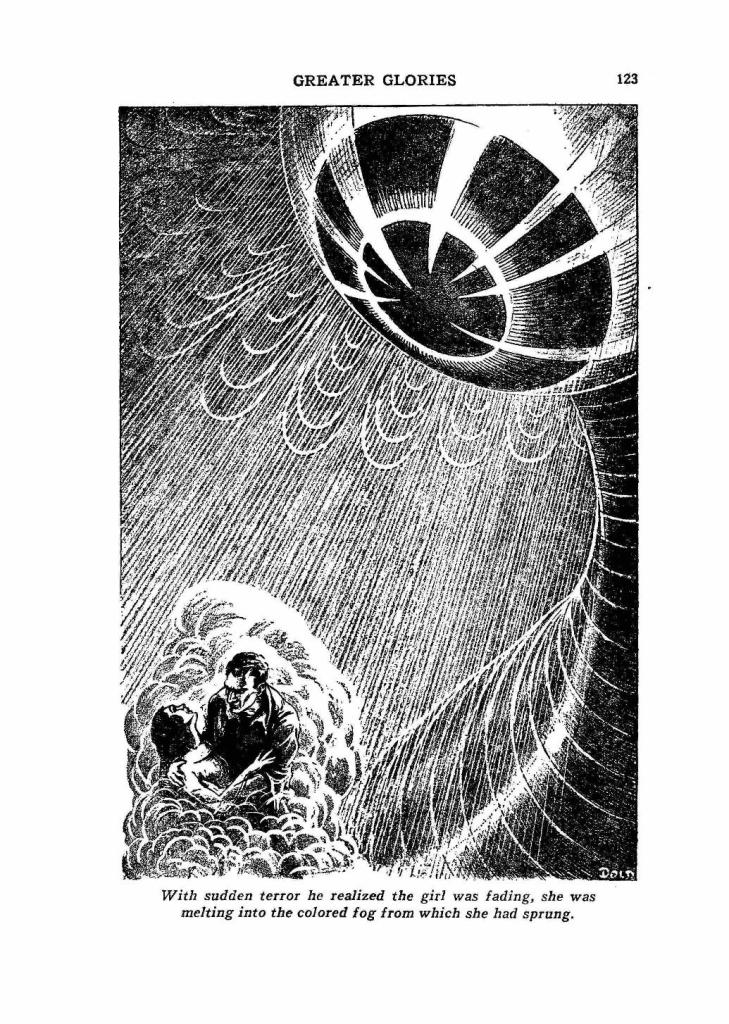
The denouement is not quite as romantic as “The Bright Illusion.” The nameless protagonist is still castaway; the implication is given that perhaps it was all a dream, a hallucination. It is not much of a science fiction story by the standards of the time, since there is little hard science in it; “Greater Glories” is a mood piece, a work of wonder, emotion, and sensations. Which is how many fans ultimately read it:
So few people can wrap a dream in star dust, breathe fairy life into it, and set it to the music of the spheres that C. L. Moore’s stories are always more than we dared hope. For sheer suggestive beauty and lingering memories of things that never were, this writer is equaled only by A. Merritt. Need I say I liked the story?
—Ramon F. Alvarez del Rey, ‘Brass Tacks’ in Astounding Nov 1935
Arch-fan Forrst J. Ackerman was uncharacteristically generous with his praise, possibly because he was still hoping she would collaborate with him on further stories:
Re paragraf four—a command from Moore: I shall clothe myself in a cloak of cosmic vibrations while reading GREATER GLORIES, so that none may disturb my marveling mind. Hail to Catherine, Queen of Queer-tales!
—Forrest J. Ackerman to C. L. Moore, 31 Jul 1935Haven’t you read that story you wrote, GREATER GLORIES? How could ever just a girl write such! Why, you make my English become just gibberish, trying to discuss it. Are you indeed not an Other World Entity, taken on a feminine form to come to earth and astound the senses of, say, a Scientifictionist? Cather, how could you write such a story as GREATER GLORIES?
You don’t doubt I liked your dream-tale, do you? I graded it “A”, and rusht my rating airmail to FANTASY. But that is little. Perhaps this will better bolster your belief I thot it was awamzing: I quote, following, a note I dasht off to Gilbert Brown, columnist of the L.A. Evening Post-Record. The paper has 77,000 circulation and Brown has thirce in print published his praises of the works of A. Merritt. So, “Brown,” I wrote, “If you would read a manuscript marvelous as a Merrittale, step to the nearest newsstand and purchase the Sept. Astounding. The spell-binding story is GREATER GLORIES. A first-water fantasyarn, incredible, staggering, overwhelming—Dizzily, FJAckerman.” I hope you don’t think my “first-water fantasy” line is hokumn, because I have used it several times; I really don’t know any other way to describe those stories of yours that hit me so hard. SCARLET DREAM is still my favorite, but GREATER GLORIES comes very close. I shall, of course, by ultra-happy about Nyusa, the Nymph of Darkness whom we created together.
—Forrest J. Ackerman to C. L. Moore, 27 Aug 1935Anyway, you deserve an extra “a” in your name for such outstanding and A-1 stories as SCARLET DREAM and GREATER GLORIES. That’s a swell title, I think, by the way, Crawford has chosen for the book form of your series “The Saga of Northwest Smith”. Right in the center of the book, about, I calculate, will be our co-creation, the nymph Nyusa. […] I don’t know whether the newspaper columnist read GREATER GLORIES, as per my recommendation, or not; I thot he might mention it in his column, but just after I wrote him, he left the paper on vacation, and hasn’t been back since.
—Forrest J. Ackerman to C. L. Moore, 2 Oct 1935
Lovecraft did not take Astounding regularly, and so apparently missed “Greater Glories,” though she described the story it grew from. Why it lay forgotten among some of her earlier stories for so many decades is unknown—perhaps it was too close to “The Bright Illusion,” or too slight a story in retrospect, and definitely much weirder than the usual “thought-variant” story taken for Astounding. Yet it is an outgrowth of that ur-story, that original idea that Moore had that was too big for any one tale to contain—and for that, at least, it has historical interest.
So too, while “Greater Glories” may seem out of place among Astounding, it does have a certain resemblance to the science fiction that would be published by Unknown in the 1940s. The emphasis on concept and emotion, wonder and the human element, are much more in line with the more humanistic science-fantasy of the 1940s than the space operas and gadget stories of the 1930s. In that sense, “Greater Glories” is something of a dry run for Moore’s later, more mature science-fantasies of that period, lacking a bit of the humor but with a poignant note that readers of her midcentury work will find familiar.
“Greater Glories” was published in the September 1935 issue of Astounding Stories. Scans of this issue are available on the Internet Archive.
For readers who want to read more about the origin of “Greater Glories” and its origins, Marcos Legaria has a detailed article: “C. L. Moore’s “To What Dim Goal” and Its Progeny” in Penumbra: A Journal of Weird Fiction and Criticism, 2023. Thanks to Marcos for his help with this one.
Bobby Derie is the author of Weird Talers: Essays on Robert E. Howard and Others and Sex and the Cthulhu Mythos.
Deep Cuts in a Lovecraftian Vein uses Amazon Associate links. As an Amazon Associate I earn from qualifying purchases.
 Deep Cuts in a Lovecraftian Vein