| Libre adaptación del relato escrito por Lord Dunsany | Freely adapted from the story by Lord Dunsany |
| Cthulhu #30 (2024) | English translation |
“On the Dry Land” by Lord Dunsany was first published in the small magazine Neolith #4 (Aug 1908), and was collected in The Sword of Welleran and Other Stories that same year. It is the last story in the book, and it is one of those Dunsany short-shorts that is more than a drabble but less than a tale. Call it a prose poem or flash fiction; it has a certain poetry to it, and there is more that is left unsaid than is said. It has a mythic quality, but it is not a story of any particular mythology, whether of Pegāna or any other tradition. A kind of story so universal in its outlines it might slip easily into the tradition of any culture that has the concept of love and death.
How do you illustrate that? How do you put into images and words, the unspoken understanding, the loneliness and heartache?
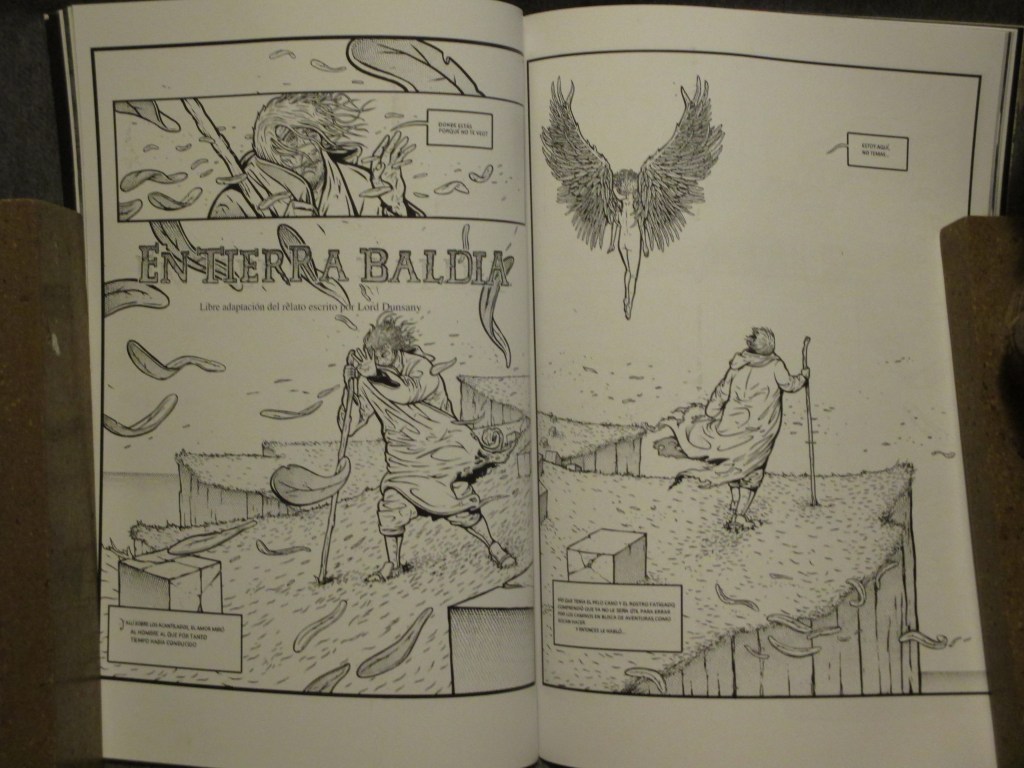
For one, the adaptation allows the text to be decompressed. Dunsany’s pithy text is stretched out by Miguel Almagro into 9 black-and-white pages. For two, the scene and many details are expanded to silently add to the storytelling. Rather than the marsh where Dunsany had first set the scene, the story unfolds on a cliff overlooking the sea; the blowing of grass and the stance of the unnamed man show the direction of the wind that blows strongly throughout, and blocks of stone suggest some ancient construction or ruin, marks of the passage of time. The layout of the panels helps control the pacing of the story.
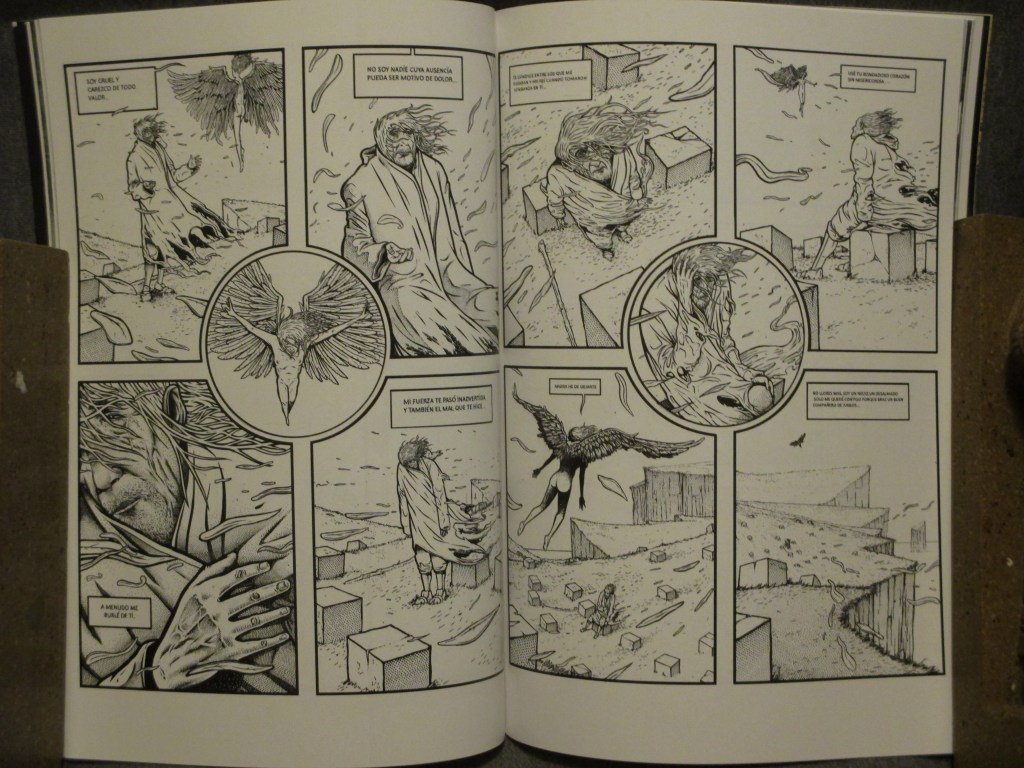
| Te conduje entre los que me odíaban y me reí cuando tomaron venganza en tí… Usé tu bondadoso corazón sin misericordia… Ahora he de dejarte No llores más, soy un necio, un desalmado, solo me quedé contigo porque eras un buen compañero de juegos… | I led you among those who hate me and laughed when they took revenge on you… I used your kind heart without mercy… Now I have to leave you Don’t cry anymore, I’m a fool, a heartless man, I only stayed with you because you were a good playmate… |
| Cthulhu #30 (2024) | English translation |
As a free adaptation, Almagro is not making an attempt at an exact replication of Dunsany’s text; lines are told out of sequence, rearranged to meet the needs of the artistic arrangement. Maintaining the core of the short short while shifting the representation. So for example, this scene as Dunsany wrote it:
And Love said to the old man, ‘I will leave you now.’
And the old man made no answer, but wept softly.
Then Love was grieved in his little careless heart, and he said: ‘You must not be sorry that I go, nor yet regret me, nor care for me at all.
‘I am a very foolish child, and was never kind to you, nor friendly. I never cared for your great thoughts, or for what was good in you, but perplexed you by leading you up and down the perilous marshes. And I was so heartless that, had you perished where I led you, it would have been nought to me, and I only stayed with you because you were good to play with.
‘And I am cruel and altogether worthless and not such a one as any should be sorry for when I go, or one to be regretted, or even cared for at all.’
And still the old man spoke not, but wept softly; and Love grieved bitterly in his kindly heart.
And Love said: ‘Because I am so small my strength has been concealed from you, and the evil that I have done. But my strength is great, and I have used it unjustly. Often I pushed you from the causeway through the marshes, and cared not if you drowned. Often I mocked you, and caused others to mock you. And often I led you among those that hated me, and laughed when they revenged themselves upon you.
—Lord Dunsany, “On the Dry Land”
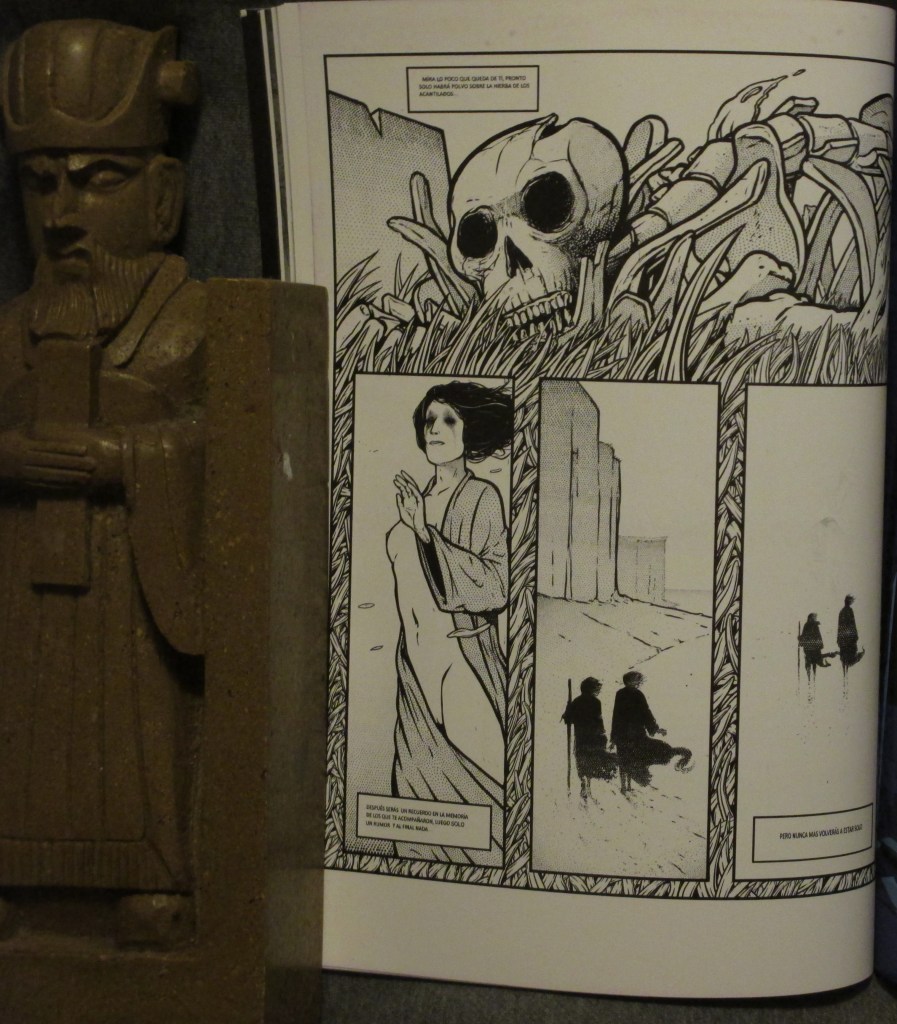
| Pero nunca mas volverás a estar solo | But you will never be alone again. |
| Cthulhu #30 (2024) | English translation |
As with “Donde suben y bajan las mareas” (1978) by Alberto Breccia, Carlos Trillo, and Lord Dunsany, we have to read this from the perspective of both a translation and an adaptation. Dunsany’s title “On the Dry Land” is a key to the story because the dry land represents the end of journey and parting of ways; the nameless man with Love has been wading through the marshes, the wet lands, and that trudge and effort and peril are metaphorically, life and hardship and struggle. The dry land is what comes after. The Spanish title, “La tierra baldía” translates most literally to “The Wasteland,” which isn’t quite the same meaning, suggesting as it does barrenness, though the metaphor still works: the nameless man has come to the undiscovered country:
To grunt and sweat under a weary life,
But that the dread of something after death,
The undiscover’d country from whose bourn
No traveller returns, puzzles the will
And makes us rather bear those ills we have
Than fly to others that we know not of?
—Shakespeare, Hamlet, Act III, Scene 1
Dunsany is putting his own spin on it; rather than clinging to life, the man is clinging to Love, despite all the pain that has come from clinging to love, and dreads the loss of it. Yet there is that reassurance, that final promise, of a more constant, faithful, and comparing companion—a character more akin to Death in Terry Pratchett’s Discworld novels than the medieval grim reaper, or even Death as sometimes personified in Dunsany’s other stories.
In adaptation, Miguel Almagro is taking that story in translation and moving it a bit further. It is not a wasteland in the sense that there is nothing living; there is grass, insects, but it is devoid of people or shelter, a land gone fallow and wild. Even the sky and sea are empty and desolate. Death, when she appears, is not frightening, merely a dark-eyed psychopomp—and the man has accepted Death, even as he has accepted the loss of Love. Dunsany wrote in the last line:
And after a while, with his face towards the morning, Death out of the marshes came up tall and beautiful, and with a faint smile shadowy on his lips, and lifted in his arms the lonely man, being gentle with him, and, murmuring with his low deep voice an ancient song, carried him to the morning to the gods.
Almagro foregoes the song, and the gods; the last we see of them are two shadows side by side on a new and different journey. There is something more poignant in that image, that acceptance and continuance. Perhaps a man literally cannot live without Love, but so too, now Love can no longer hurt him.
Thanks to Martin Andersson for his help.
Bobby Derie is the author of Weird Talers: Essays on Robert E. Howard and Others and Sex and the Cthulhu Mythos.
Deep Cuts in a Lovecraftian Vein uses Amazon Associate links. As an Amazon Associate I earn from qualifying purchases.
 Deep Cuts in a Lovecraftian Vein