Today I sent off a gory horror-tale to Kline for marketing, the first and only story I’ve had time to write since I got home. I don’t know if I’ll ever have time to write another.
—C. L. Moore to R. H. barlow, 19 May [1936], MSS. Brown Digital RepositoryMy own writing is practically at a standstill. Am making rather feeble efforts to write for the horror-tale and sugary love-story markets to get some money, and hve finished one story of the former type which Kline has very competently critciized for me and suggested specific revisions. I may get around to it someday. I have neither time nor inclination to write about anything any more. I suppose it will come back ,but the hour is not yet. Though there has been one opus of about 2000 words or so which I wrote about a month ago, with no thought of sale. All about mysterious doings in a holly wood. Once when I was very small a letter from relatives in California around Christmas time reported that someone had gone down to Hollywood to get some holly, and I quite naturally thought, how lovely and convenient, and pictured the aunt in question wandering thru the deep, dark glossy wood of holly, with the growing scarlet light of the berries reflecting from the shining leaves, a place of gloom and greenness and glows of crimson. The image has returned to me time and again, and I finally had to do something about it.
—C. L. Moore to H. P. Lovecraft, 26 May 1936, LCM 113My recent writings seem to have bogged down completely. In the last five months I have produced one trashy horror which Kline ages ago asked me to rewrite, thinking he could sell it in a revised form and which I haven’t touched since, and a drippy love-story which languished away and ceased half-finished some six weeks ago. The weather is partly responsible, but I must admit a sort of mental vacuum which shows no promise of change. I devote seven and a half hours daily to my secretarial duties and spend the rest of the time sewing desultorily, knitting a very handsome afg[h]an, attending about three movies weekly, induling in endless gossip with friends. How long this cloistered and nun-like seclusion will continue I wish I knew. I suspect that if my brain were functioning I would find myself bored to a horrible death, and rather dread the awakening. A few non-commercial attempts which I mentioned I should be very happy to have you read if I could ever get them finished to my satisfaction. I am writing and rewriting them over and over, in moments of comparative consciousness, and am far from satisfied even yet. However, to quote Mr. Penner once again, There’ll come a day.
—C. L. Moore to H. P. Lovecraft, 24 Jun 1936, LCM 143
Early 1936 was a tumultuous time in the life of C. L. Moore. In February, her fiancé of at least three years, (Herbert) Ernest Lewis, died from a self-inflicted gunshot wound to the head. In June just a few months later, her correspondent and fellow pulpster Robert E. Howard also died by a self-inflicted gunshot wound to the head. Moore understandably struggled to write anything during this time—kept going in part by a trip to Florida, during which H. P. Lovecraft sent her long letters, and she attempted to writer stories to order for Otis Adelbert Kline, a literary agent.
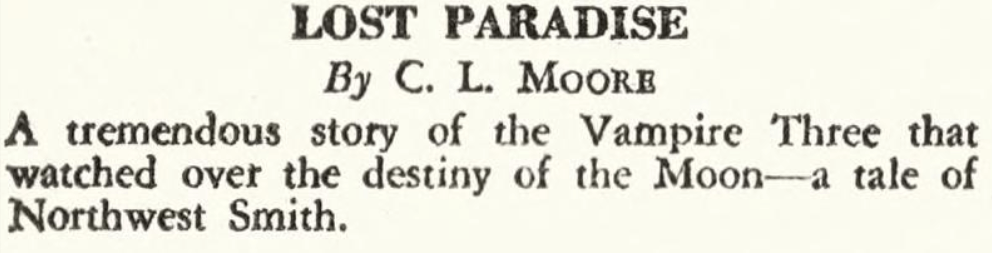
None of Moore’s letters from the period that I have seen give any insight into the origin of “Lost Paradise,” either when it was written and submitted to Farnsworth Wright, editor of Weird Tales, or what may have inspired it. In format, the story is a typical Northwest Smith tale—a drink at a bar, a sudden bit of action, uncovering an ancient mystery—but the idea it is wrapped around, the story-within-a-story, seems to owe more to “The Bright Illusion” (1934) and “Greater Glories” (1935). The central focus is around the Seles:
They live somewhere in the remotest part of Asia, no one knows exactly where. But they’re not Mongolian. It’s a pure race, and one that has no counterpart anywhere in the solar system that I ever heard of.
—C. L. Moore, “Lost Paradise” in Weird Tales Jul 1936
Race in Moore’s Northwest Smith stories is an odd point, and worth a moment’s consideration. The peoples of Earth, Mars, and Venus are all presented as essentially human in body and mind, if not culture; while we aren’t privy to interplanetary marriages, there is the implication that they are more or less one human species, even if separated into different races in 1930s terms. C. L. Moore generally avoids getting more specific; Northwest Smith is implicitly Caucasian, and she generally avoids depicting or referring to Black people, Asians (“Mongoloids” or “Mongolians” in 1930s racial parlance), Native Americans, or any other specific 1930s racial groupings. There are other sentient beings, more or less human-like, such as Shambleau (“Shambleau”) and the Alendar (“Black Thirst”), and at least some of the god-like entities can conceive children, such as Nyusa (“Nymph of Darkness”). For the most part, however, the majority of Northwest Smith’s interplanetary setting seems populated by human beings, and are treated more like exotic cultures and peoples in the 1930s than, say, the random inhabitants of the Mos Eisley cantina in Star Wars.
In the context of 1930s pulp fiction, “Lost Paradise” is a variation of the “Lost Race” or “Lost World” plot; the only difference is that instead of physically traveling to some isolated valley, cavern, island, or moon, Northwest Smith and Yarol are sent back in time—mentally, at least, a bit like Lovecraft’s Great Race of Yith in The Shadow out of Time (Astounding Stories Jun 1936).
Be it remembered that ail who come to pay the race’s debt and buy anew our favor that their world may live, must come to us willingly, with no resistance against our divine hunger—must surrender without struggle. And be it remembered that if so much as one man alone dares resist our will, then in that instant is our power withdrawn, and all our anger called down upon the world of Seles. Let one man struggle against our desire, and the world of Seles goes bare to the void, all life upon it ceasing in a breath. Be that remembered!
—C. L. Moore, “Lost Paradise” in Weird Tales Jul 1936
As in “Dust of the Gods” (1934), Northwest Smith once more confronts three ancient gods of a lost world—the story is, like all of the Northwest Smith tales so far, effectively standalone with no direct continuity to the others, so neither Smith nor Yarol make any comment about this coincidence. Moore sets up the eventual struggle with typical skill (Chekov’s prophecy: you can’t set a condition for the total destruction of a world without pulling the trigger).
And once again C. L. Moore puts a dream on paper—a lovely fantasy. Northwest Smith remains one of the greatest fiction characters yet created.
—Donald Allgeir, The ‘Eyrie’ in Weird Tales Nov 1936I do not like Lost Paradise. What I like is plain old-fashioned gjhost stories, werewolf stories and vampire stories.
—J. J. Hammond, The ‘Eyrie’ in Weird Tales Nov 1936
Response to “Lost Paradise” in The ‘Eyrie,’ Weird Tales‘ letter page, was slight and mixed; the story wasn’t bad, but it had the misfortune to be published in the same issue as “Necromancy in Naat” by Clark Ashton Smith and the first part of “Red Nails” by Robert E. Howard, which rather overshadowed it. Lovecraft was even more sparse with praise than usual:
Klarkash-Ton & C L M dominate the July issue.
—H. P. Lovecraft to Richard F. Searight, 27 Aug 1936, LPS 426
(The only reason Lovecraft doesn’t praise Robert E. Howard is because he never read serials until he had all the parts.)
While “Lost Paradise” is a fair story, in comparison with Northwest Smith’s other adventures it’s notable how passive he is here. It is Yarol that goes after the Seles, Yarol that wants the Secret, and Yarol who ultimately shoots the old priest in the back. Smith was just drinking segir-whiskey and people-watching in New York when he suddenly had to resist the vampiric impulses of some ancient alien entities. It really reads like a Northwest Smith frame wrapped around a different story altogether.
“Lost Paradise” was published in the July 1936 issue of Weird Tales. Scans of this issue are available on the Internet Archive.
Bobby Derie is the author of Weird Talers: Essays on Robert E. Howard and Others and Sex and the Cthulhu Mythos.
Deep Cuts in a Lovecraftian Vein uses Amazon Associate links. As an Amazon Associate I earn from qualifying purchases.
 Deep Cuts in a Lovecraftian Vein