Eldritch Fappenings
This review deals with a work of pornography, and the history of erotic art and writing. As part of this review, selected images with cartoon depictions of genitalia and/or sexually explicit contact will be displayed.
As such, please be advised before reading further.
In 1992, author William Gibson and artist Dennis Ashbaugh published Agrippa (A Book of the Dead), consisting of a book with a 3.5″ floppy disk. It was an art project as much as anything else: the book was treated with photosensitive chemicals so that the words would begin to fade as they were exposed to light; the disk would run once and then encrypt itself. Buyers were purchasing a not so much a physical product as an experience and a challenge: how did they want to experience this, knowing that it would be rendered unreadable by the act of reading? How would they preserve it?
It was a very cyberpunk stunt, and clever programmers eventually cracked the encryption; even before that, copies of the text were available on the web, shared through networks of pirates and fans. The text survives today, even though it was designed to be forgotten, and now on a near-obsolete physical media format, because of determined interest and repeated, if often shadowy, lines of transmission. If you download the text of Agrippa now, you will probably get an accurate copy of the original text—but how would you know? What would you compare it to? The digital archivist finds themselves in a position not unlike a scholar of ancient manuscripts, comparing different and fragmented versions of texts to discern clues as to the route of transmission.
Early digital works, more than most, tend to illustrate the difficulties of preservation. The lack of physical substrate means the technological end of things—what’s the file format? Do we have a program that can open that? What operating system does it use? Do we have a computer that can run that?—means that trying to experience these works as they were originally is increasingly difficult. In many cases, the original project files and source code of a digital work, the programs used to create it, may be long gone. All we have is the end product, which may have been compressed, reformatted, or translated in various ways across its route of transmission.
Which is to say that you’re probably never going to read Shatter (1985) on a Macintosh Plus in MacPaint, or see the magic of how Batman: Digital Justice (1990) was put together on a Macintosh II that boasted a whopping 8MB of RAM. However, you can still buy print collections of those comics—which is more than most digital works can say.
The internet provides a direct market for creators to sell their works, in many cases bypassing middlemen and brick-and-mortar stories; for artists in particular, having a website meant they could sell directly to their customers through various paradigms—memberships, purchasable files, mail order—and the product didn’t have to be physical. Potential buyers who wanted a digital comic could go to the website, fork over a credit card number, and access the gallery of images or download a .zip or .PDF with the images. There was piracy, and various attempts at anti-piracy measures, because nothing was perfect, but they were generally good enough, especially for honest merchants and customers. Systems like this still exist today, although many creators have, for ease and because of issues with payment processors, opted to use middleman websites like Itch.io or DriveThruComics.
There are a lot of benefits to this kind of digital ecosystem: niche artists who would struggle to find a publisher can self-publish and still find an audience for their works; customers interested in such niche works have a better chance of finding such materials, which tends to foster the creation of more of it. This is especially true for works of parody and erotica, which often struggle with traditional print distribution channels.
Digital artist Gonzo began (as near as I can tell) with his own website, Taboo Studios, circa 2008. Gonzo created erotic comics using 3D rendering software, which has become increasingly available as a in the early 2000s thanks to the release of graphic processing cards for home use and improvements in software, often with horror settings and narratives, and frequently focused on monster sex as the kink of choice. In 2014, Gonzo published the first part of one of the first of his erotic monster sex comics based on the work of H. P. Lovecraft, “Shadows over Innsmouth.”
Shadows of Innsmouth is an almost faithful retelling of the H P Lovecraft classic, ‘Shadow over Innsmouth’. I say ‘almost’ faithful as all of the core events in the original book happens in the comic, but this time with more sex, a female lead character and its set in 2014 not 1914 – But I’m sure you will consider these changes all good changes 🙂
The story starts with Jennifer the new assistant librarian at Miskatonic University who happens to be going through a rough patch in her life, she finds the Lovecraftian novel and quickly discovers that the Innsmouth of legend is based on a real town. Her curiosity intrigued she sets off to Innsmouth to discover which parts of the book are true and which existed only in Lovecrafts twisted imagination�
This 94 page storyline based comic is the first part and features, weird mysteries, kinky sex, stranger sex, the deep ones, amphibian creatures from the sea, tribal island girls, cheating, monster breeding, emotional turmoil, selling out the future of a town in a demonic pact� and much more.
A must for any Erotic Horror fan and the first in a series of re-imaginings of his work.
—Gonzo, read me.txt file that accompanies “Shadow over Innsmouth”
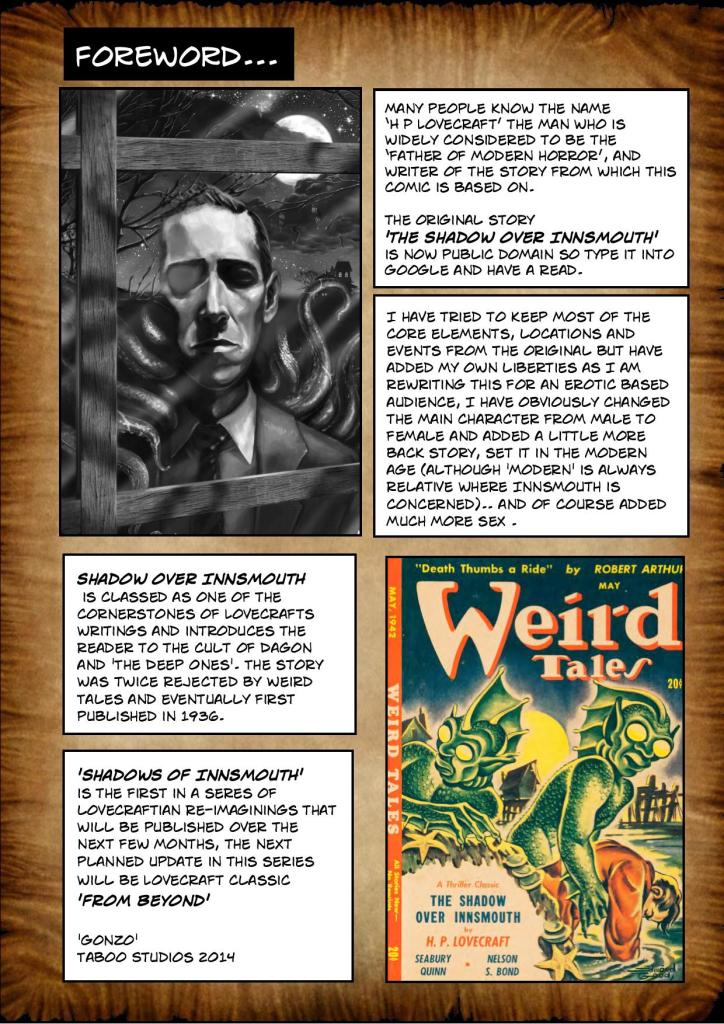
This is a work that should be seen in the same vein as “The Statement of Randolph Carter Twisted” (2024) by Lisa Shea or The Colour Out of Space (2024) by H. P. Lovecraft & Sara Barkat: artistic re-interpretations of the original work. “The Shadow over Innsmouth” is a likely suspect for an erotic adaptation in particular because the monster sex is already there—just off the page.
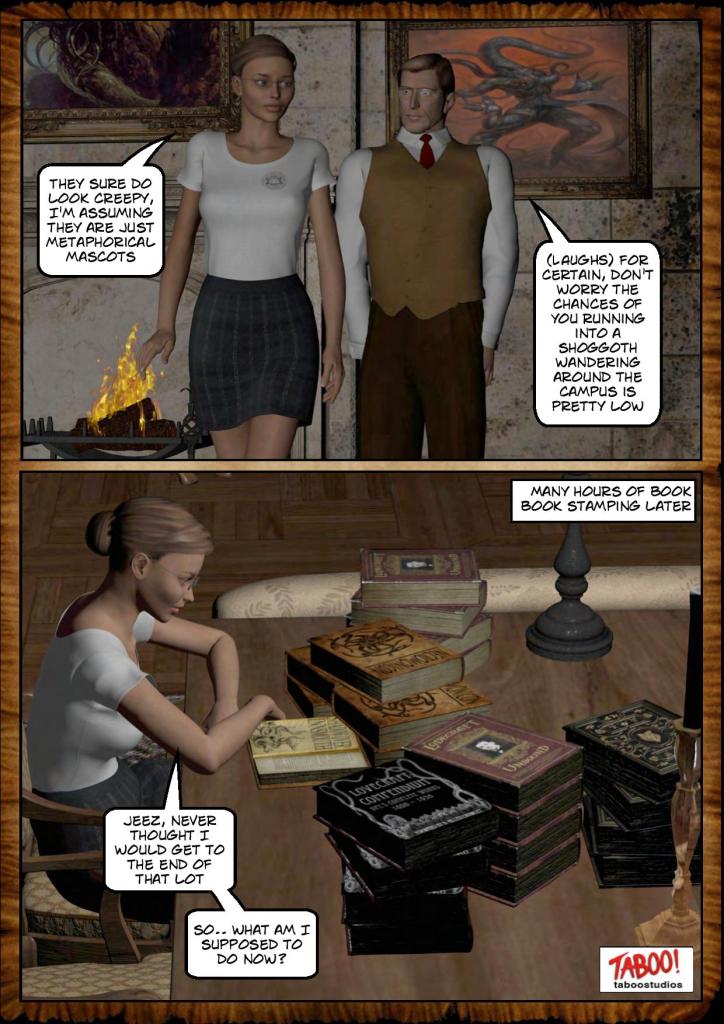
Gonzo’s style in this is reminiscent of 1970s European erotic comics, with two large panels taking up the entire page providing room for detail and dialogue or exposition, although Gonzo could and did juggle up his formats occasionally. Like most 2000s-era render artwork, the figures are relatively stiff, and Gonzo wasn’t above borrowing artwork to use as skins for books or wall art—you might recognize the cover of Lovecraft Unbound (2009) on the cover of the books stacked on the table, for example, and there are other borrowings as well.
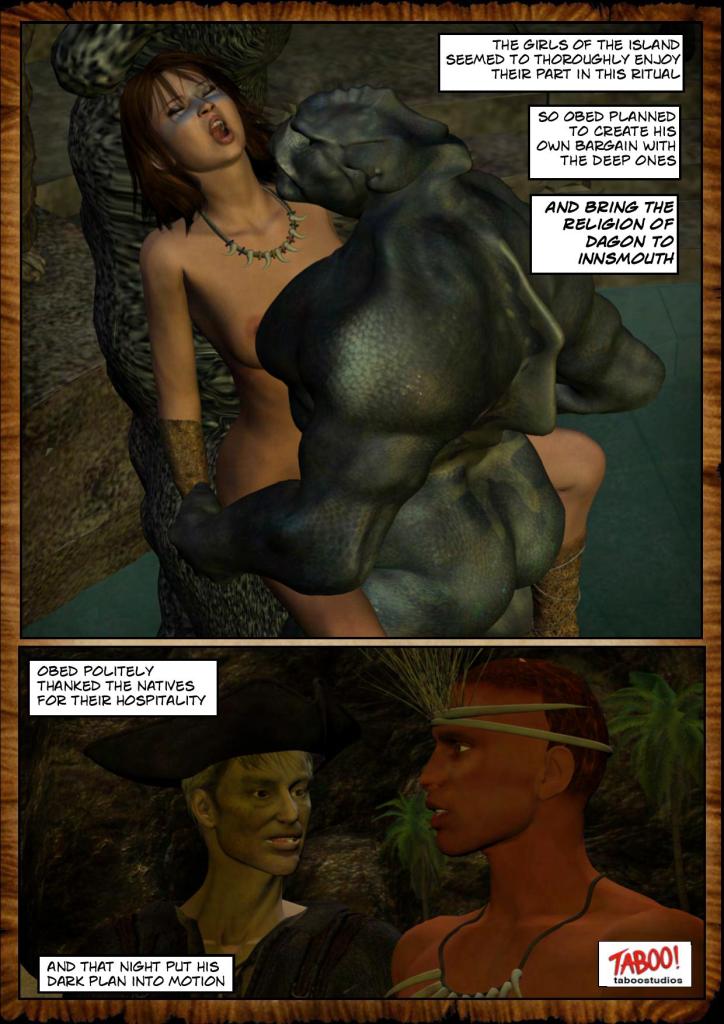
Gonzo included sexually explicit artwork—it is a pornographic work, after all—but most of the action builds up to the explicit scenes. As is typical, the limitations of the software and modeling tend to show in difficulty rendering non-Caucasian features, and many of the skin textures on objects are distorted.
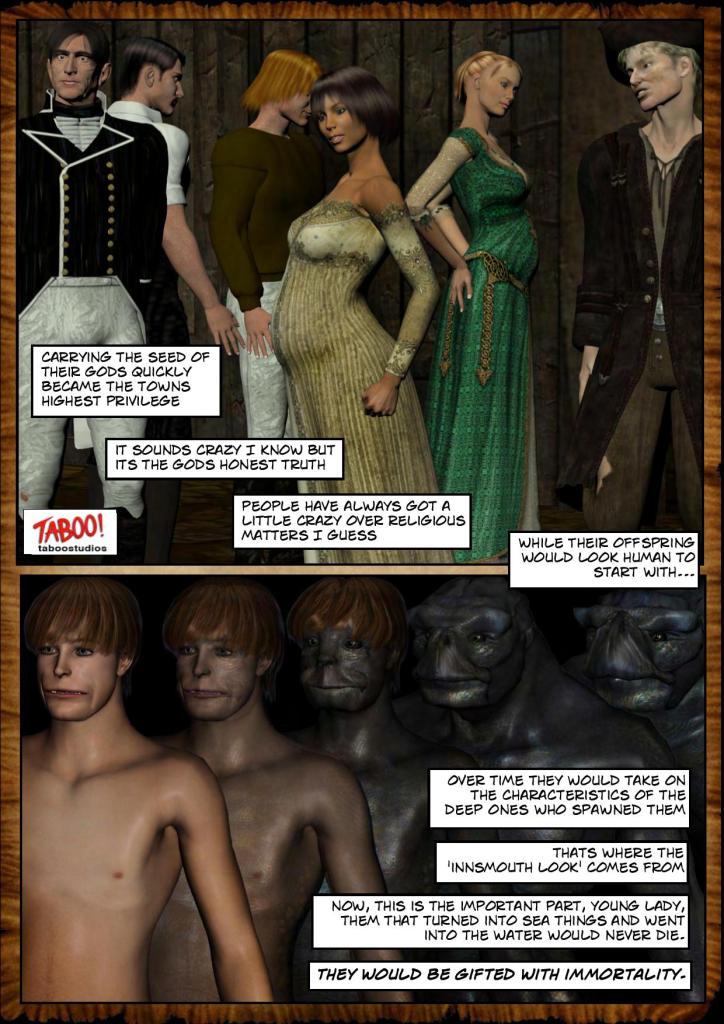
Gonzo also clearly took inspiration where he found it; the transition from human to Deep One may be reminiscent of an Animorphs, but is a familiar conceit to show the progress of time and transformation. The Deep Ones themselves tend to look a bit like cave trolls from The Lord of the Rings: The Fellowship of the Rings (2001), although Gonzo draws in the Gillman from the classic Creature from the Black Lagoon (1954) in the second part—as well as another Lovecraftian critter, this one with tentacles.
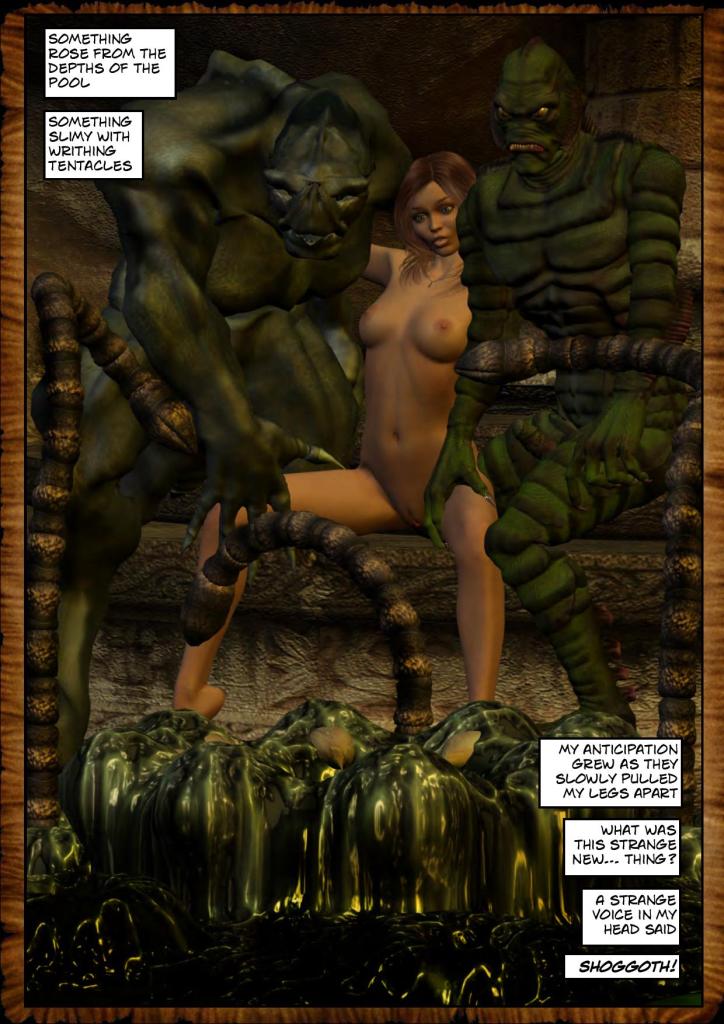
These erotic render artworks may seem a little strange and quaint today, because the state of the art has moved on. A decade of artists have worked creating custom textures, models, working with more advanced programs and faster hardware. Gonzo’s 2014 art reflects the time and tools with which they were made.
In their stated goal of creating an erotic adaptation of Lovecraft’s “The Shadow over Innsmouth,” Gonzo was largely successful. It is certainly no worse than similar efforts like The Adult Version of Dracula (1970) or Evil Head (2012). Gonzo hits the beats of the story, with their own little twists for the sake of titillation.
Nor was Gonzo alone in creating Lovecraftian erotic works using rendering software and available through much the same way. Artist Iopriest created two Lexi Crane comics, and the artist known as Jag27/Otto Maddox worked Lovecraftian entities into their horror-themed erotic horror comics as well. This was a niche that obviously found at least some audience.
Besides “Shadows of Innsmouth,” Gonzo (now Gonzo Studios) completed adaptations of “From Beyond,” “Dagon,” “Azathoth,” and “Call of Cthulhu.” While Taboo Studios’ web page is defunct, Gonzo has moved their wares to Renderotica, where they are still available for purchase and download.
For the moment.
It has to be emphasized that there is no guarantee that “Shadows of Innsmouth” will be available in a decade, or a year, or even tomorrow. An issue with a payment processor, an untimely death, an accident with a server…and the files will be gone, less accessible than the text of Agrippa. Like “The Fluff at the Threshold” (1996) by Simon Leo Barber, there isn’t really a dedicated archive for these kind of digital creative works. You can buy them, for now, and pirates probably still circulate copies, but the continued existence of these comics remains tenuous. They might disappear at any time.
The world will be a little less weird when that happens.
Bobby Derie is the author of Weird Talers: Essays on Robert E. Howard and Others and Sex and the Cthulhu Mythos.
Deep Cuts in a Lovecraftian Vein uses Amazon Associate links. As an Amazon Associate I earn from qualifying purchases.
 Deep Cuts in a Lovecraftian Vein