I don’t attend the cinema very often, but realise what a marvellous conveyer of weird images & impressions it could be if it would only utilise seriously its tremendous range of optical & mechanical potentialities.
—H. P. Lovecraft to Richard Ely Morse, 21 May 1934, LHB 81-82
Howard Phillips Lovecraft was born into a world where moving pictures were not yet a commercial reality. His youth would have seen Edison’s Kinetoscopes and nickelodeons give way to projection screens; plays and other acts would share space with silent films. Imagine the thrill of being in a darkened theater and hearing the voices of the actors come through the speakers for the first time, with the background hum of the reels clicking above and behind you. To be there at ground zero as the Phantom’s face was first revealed, as the suave Count relished the howl of wolves, as something stirred beneath the sheet in the doctor’s laboratory.
The first half of the 20th century launched two great franchises of horror. One was the Cthulhu Mythos, a literary game begun by H. P. Lovecraft and his contemporaries that eventually grew into the largest, most sprawling public domain shared universe since Arthurian myth. The other was the Universal Monsters, a franchise of cinematic creations that forged the identities of a pantheon of horror, which still influences how those monsters are seen and understood today. Many of the visual aspects of monsters like Dracula, Frankenstein’s Monster, and the Werewolf owe much to actors like Bela Lugosi, Boris Karloff, and Lon Chaney, Jr.; and even much of the popular lore of these entities was determined or popularized by their films.
That first generation of horror films was experienced entirely within the movie theater, or in associated media and advertising. There were no television stations to rerun the old films on; that was something for a later generation, the Monster Kid generation that could relish Famous Monsters of Filmland (founded by Forrest J Ackerman, who had sparred with Lovecraft in the pages of The Fantasy Fan in the 30s) and other magazines. There was no home video market. If you missed seeing a film in theaters during its initial run, you might never see it, unless it was run again. As amazing and influential as the Universal horror films were, they were also exceedingly ephemeral experiences. We are used today to having the lore of films at our fingertips, but in Lovecraft’s day such information was difficult to come by, scarce and disjointed memories supplemented by Hollywood propaganda.
This essay is an exploration to answer the questions “How many Universal horror films did H. P. Lovecraft see, and what did he think of them?” At the start, we have to acknowledge that we might never have definitive answers to these questions. While Lovecraft did attend the cinema, he didn’t do so regularly and he didn’t make a point about discussing every single film he saw. While his letters give us insights into some of the films he did see, especially between 1923 and his death in 1937, which coincides with the first wave of Universal Monster movies, there is no way to know if he missed some films or simply failed to mention them.
For the purposes of this essay, films that aren’t technically horror but have notable influence on later horror film like the romantic melodramas The Hunchback of Notre Dame (1923), The Phantom of the Opera (1925), and The Man Who Laughs (1928) are included. If for no other reason than Lovecraft’s reaction to these films somewhat colored his appreciation of Universal’s later monster films. Likewise, films which might make it onto horror lists, or are very influential like The Cat and the Canary (1927), The Unknown (1927), Secret of the Blue Room (1933), The Man Who Reclaimed His Head (1934), and Mystery of Edwin Drood (1935) are left out—although for anyone curious, there’s no evidence Lovecraft watched any of those films. At least, there are no mentions in his letters.
That said, we can at least examine the Universal Horror movies that Lovecraft could have seen, and what he did (and did not) say about them.
Dr. Jekyll and Mr. Hyde (1913)
Silent • 26 min. • Dir: Herbert Brenon • Prod: Carl Laemmle
The Universal Film Manufacturing Company was incorporated in 1912, a merger of several independent film companies under the leadership of Carl Laemmle, which bucked Thomas Edison’s attempts to control the motion picture industry. Dr. Jekyll and Mr. Hyde, from a screenplay by Herbert Brenon based on the novella “Strange Case of Dr. Jekyll and Mr. Hyde” (1886) by Robert Louis Stevenson, was one of Universal’s earliest films, and its first horror film. As such (and because prints survive), it is often considered the earliest of the Universal Monster films, while lost films like “The Werewolf” (1913) are often forgotten.
Early Universal star King Baggot had the dual role of Jekyll and Hyde, a transformation accomplished with greasepaint, buck teeth, crepe hair, and a slow dissolve. Effective stuff for the 1910s, though a far cry from the advanced prosthetics and camera techniques of later decades. Like many of Universal’s earliest pictures that derive from a literary source, considerable liberties are taken with the plot, which is simplified and Hyde/Jekyll’s death made manifest on the screen.
Lovecraft never mentions this film in his surviving letters; though he might have seen it either during its initial run or its 1927 re-release. He did see Paramount’s 1931 film Dr. Jekyll and Mr. Hyde, and since he draws no comparison with the Universal film, it seems likely that Lovecraft missed the dawn of Universal monsters at the theatre.
The Hunchback of Notre Dame (1923)
Silent • 133? minutes • Dir: Wallace Worsley • Prod: Carl Laemmle
Universal produced and distributed a number of horror films during the silent era, but their first massive financial and critical success was The Hunchback of Notre Dame. Actor and makeup artist Lon Chaney, who played the starring role of Quasimodo, obtained the rights to Victor Hugo’s 1831 novel in 1921, determined to play the role. The film showcases the makeup skills that earned him the moniker “The Man With 1,000 Faces,” including a plaster hump, facial prosthetics, etc. Chaney’s appearance and performance are the most-remembered aspects of the film, although the immense scale of the production—with the milling crowds of extras and a cathedral set that was used by Universal until destroyed by fire in 1967. Stage 28, which housed the opera house set, was demolished in 2014.
This was one of the films that Lovecraft confirmed he had seen.
Of the Chaney cinemas which you list, I have seen “The Miracle Man”, “The Hunchback of Notre Dame”, & “The Unholy Three.” I believe he would have appeared in “Dracula” has he lived.
—H. P. Lovecraft to J. Vernon Shea, 14 Aug 1931, LJVS 35
The screenplay by Edward T. Lowe, Jr. and Perley Poore Sheehan takes considerable liberties with the novel, most notably letting Esmeralda survive while Quasimodo dies. Lovecraft was normally a stickler about such things, preferring accuracy to the novel, but we don’t have any idea what he thought of the film as an adaptation.
The original print of the film, which Lovecraft would have seen, has been lost. Restored home video versions are based on shorter 16 mm prints. While the film was re-released in the 1930s with various soundtracks, there is no evidence that Lovecraft saw (and heard) these alternate versions of the film.
The Phantom of the Opera (1925)
Silent • 107 minutes • Dir: Rupert Julian (Uncredited: Edward Sedgewick) • Prod: Carl Laemmle
Lon Chaney’s reputation as a master of makeup did not begin with The Hunchback of Notre Dame (1923), but The Phantom of the Opera (1925) sealed his reputation as a monster actor. Laemmle bought the rights to Gaston Leroux’s 1910 novel The Phantom of the Opera in Paris in 1922, and even before his star turn as Quasimodo, Chaney was a natural choice for the role of the Phantom. Elliot J. Clawson wrote the first screenplay based closely on Leroux’s novel, with the addition of a lengthy flashback (later eliminated). The screenplay went through several versions, and changed again during a tense and complicated filming; though they were able to reuse the opera house set from The Hunchback of Notre Dame. The original ending tested poorly with audiences, and much of the film was re-shot under the direction of Edward Sedgewick, and then quickly re-edited. This version of the film premiered at the Astor Theater in New York City on 6 Sep 1925.
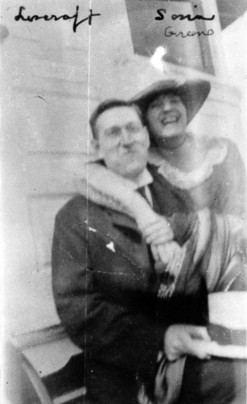
Not long after, H. P. Lovecraft and his wife Sonia H. Greene went to see it.
Having duly met S H, I accompanied her on a walk toward Times Square, in which we studied theatre facades with a view to the evening’s entertainment. We at length chose the new weird cinema, ‘The Phantom of the Opera’, for which we obtained 1st Balcony tickets. This has been extensively advertised, & I knew it must be good. We now proceeded to the Grand Central to get S H’s valise, checked it at the Hotel Astor near the theatre, & walked some more before the opening of the performance at 8:30. Then came the cinema (ticket stub enclosed)—& what a spectacle it was!! It was about a presence haunting the great Paris opera house—a Second-Empire (i.e., mid-Victorian) structure built by the architect Charles Garnier on a site honeycom[b]ed with mediaeval vaults—but developed so slowly that I actually fell asleep several times during the first part. Then the second part began—horror lifted its grisly visage—& I could not have been made drowsy by all the opiates under heaven! Ugh!!! The face that was revealed when the mask was pulled off . . . . . & the nameless legion of things that cloudily appeared beside & behind the owner of that face when the mob chased him into the river at the last! You must see it if it comes to Providence. That face is the one definitive triumph of the art of makeup—nothing so horrible has ever existed before, save unexpressed in the brain of such an one as Clark Ashton Smith.
—H. P. Lovecraft to Lillian D. Clark, 18 Sep 1925, LFF1.398-399, cf. CE 5.167
Lovecraft’s praise was also repeated to Clark Ashton Smith himself:
Apropos of the weird—I saw a cinema the other night which contained some of the best horror effects ever visualised by the camera. It is called “The Phantom of the Opera”, & contains a character whose face is worthy of your own artistic pencil. Ugh! It is a living shudder! You ought to see the film as a sheer spectacle, mediocre as the plot & melodramatic situations are.
—H. P. Lovecraft to Clark Ashton Smith, 20 Sep 1925, DS 81
As a film, The Phantom of the Opera (1925) is heavily melodramatic, slow in the beginning, and perhaps tries to appease too many tastes. Much of the nuance of Leroux’s novel is lost, both in the screenplay adaptation and the cutting room floor. The score for the premiere was by Eugene Conte, while the general release had the more familiar score by Gustav Hinrichs; it isn’t clear which Lovecraft heard. One has to imagine Lovecraft sitting in the balcony as the orchestra plays, eyes locked on the flickering screen, watching Chaney play the organ and hearing the house organ’s notes float through the darkness. In 1929, the film was re-released with a new soundtrack.
Like many early silent films, preservation of The Phantom of the Opera has been piecemeal, with no complete print of the 1925 original as Lovecraft would have seen it.
The Man Who Laughs (1928)
Synchronized sound • 110 minutes • Dir: Paul Leni • Prod: Carl Laemmle
The success of The Hunchback of Notre Dame (1923) led Universal to pursue a similar project: an adaptation of Victor Hugo’s The Man Who Laughs (1869), with Lon Chaney offered the lead of Gwynplaine, but an issue with the rights led to a delay in production. Chaney pivoted to The Phantom of the Opera (1925), and the success of that film caused Laemmle to focus on The Man Who Laughs as the next big Gothic-flavored romantic melodrama.
Chaney was not under contract to Universal at the time, and German actor Conrad Veidt was hired for the lead role as Gwynplaine. Veidt had previous horror credits, including Eerie Tales (1919), The Cabinet of Dr. Caligari (1920), The Hands of Orlac (1924), and Waxworks (1924). Instead of doing his own makeup Chaney-style, Veidt was placed into the hands of Jack Pierce, head of Universal’s makeup department, who handled the monstrous visage of Gwynplaine.
The Man Who Laughs was a transition film as Universal moved from silent to talkies; it was filmed without dialogue (Veidt had a notable accent), but with a synchronized soundtrack and sound effects as a “sound” film. Leni brought German Expressionist influences to a solid, if melodramatic, adaptation of Hugo’s novel by J. Grubb Alexander.
Unfortunately, Lovecraft missed it.
I’ll look for “Rome Express”—though I saw neither “The Man Who Laughs” nor “Caligari” in their respective days.
—H. P. Lovecraft to Arthur Leeds, 19 Jun 1934, LRK 342
While not a horror film unto itself, The Man Who Laughs was a strong influence on the later Universal Monster movies. Lovecraft missing it at the cinema was unfortunate, but also shows how easy it is to miss films before reruns and home video.
It is notable that Universal silent horrors in the 1920s do not feature any actual supernatural elements. Quasimodo, the Phantom, and Gwynplaine are disfigured or deformed, but not actually unnatural; U.S. audiences seemed to prefer a rational (even if incredible) explanation to a supernatural one, and this also applies to highly influential films like The Cat and the Canary (1927), a silent horror-comedy developed from a Broadway play that both established and lampooned many elements of the “old dark house” film; and the Lon Chaney vehicle The Unknown (1927), directed by Tod Browning, where he plays the murderous human oddity Alonzo the Armless in a circus. However, that would change.
Dracula (1931)
Sound • 85 minutes • Dir: Tod Browning • Prod: Tod Browning, Carl Laemmle, Jr.
Horror was not limited to the cinema in the 1920s. Bram Stoker’s novel Dracula (1897) was adapted to the stage in 1924 by Irish actor/writer Hamilton Deane. Florence Stoker, Bram’s widow, was engaged in a copyright lawsuit with the creators of Nosferatu (1922) and authorized the production. The play toured for three years, and was later revised by American writer John L. Balderston in 1927 for Broadway. The Broadway production included Hungarian-born actor Bela Lugosi in the role as Count Dracula, in his first major English-speaking role, dressed in what would become the iconic suit and opera cape. It was a major theatrical success, and opposite him as Abraham Van Helsing was Edward Van Sloan.
The makers of Nosferatu lost the legal battle with Florence Stoker in 1925; this opened the doors for an authorized version, and the success of the Broadway play, which began to tour in 1928, offered possibilities. Carl Laemmle, Jr., son of Universal Studios’ founder, became head of production in 1928, with his first films hitting cinemas in 1930. Inspired by the success of The Hunchback of Notre Dame (1923) and The Phantom of the Opera (1925), Junior Laemmle would be a major productive force behind Universal’s Monster films of the 1930s, starting with Dracula (1931).
Louis Bromfield was hired to pen the screenplay, but was swiftly replaced by Garrett Fort, who based his drafts largely on the 1927 stage play, and even borrowing some scenes from Nosferatu. The result doesn’t look a great deal like Stoker’s novel reads; for practical purposes, the play had left out the lengthy stagecoach journey at the beginning and severely condensed the book and plot, so that everything happens within England. The film, at least, opens with Dracula’s castle, and is heavy with Gothic atmosphere; though the rest of the film largely follows the play, with Dracula contending with Van Helsing as he attempts to secure his prey.
Lon Chaney might have won the role of Dracula, but he died on 26 Aug 1930; Conrad Veidt, star of The Man Who Laughs (1928), returned to Germany rather than try his English on sound films. Bela Lugosi campaigned hard for the role, and ultimately both he and Van Sloan ended up reprising their roles from the play on the screen.
Lovecraft, who had read Stoker’s novel, was not impressed:
Of the Chaney cinemas which you list, I have seen “The Miracle Man”, “The Hunchback of Notre Dame”, & “The Unholy Three.” I believe he would have appeared in “Dracula” has he lived. I saw that film in Miami on Whitehead’s recommendation, but didn’t get much of a kick except for the castle scenes at the very beginning.
—H. P. Lovecraft to J. Vernon Shea, 14 Aug 1931, LJVS 35
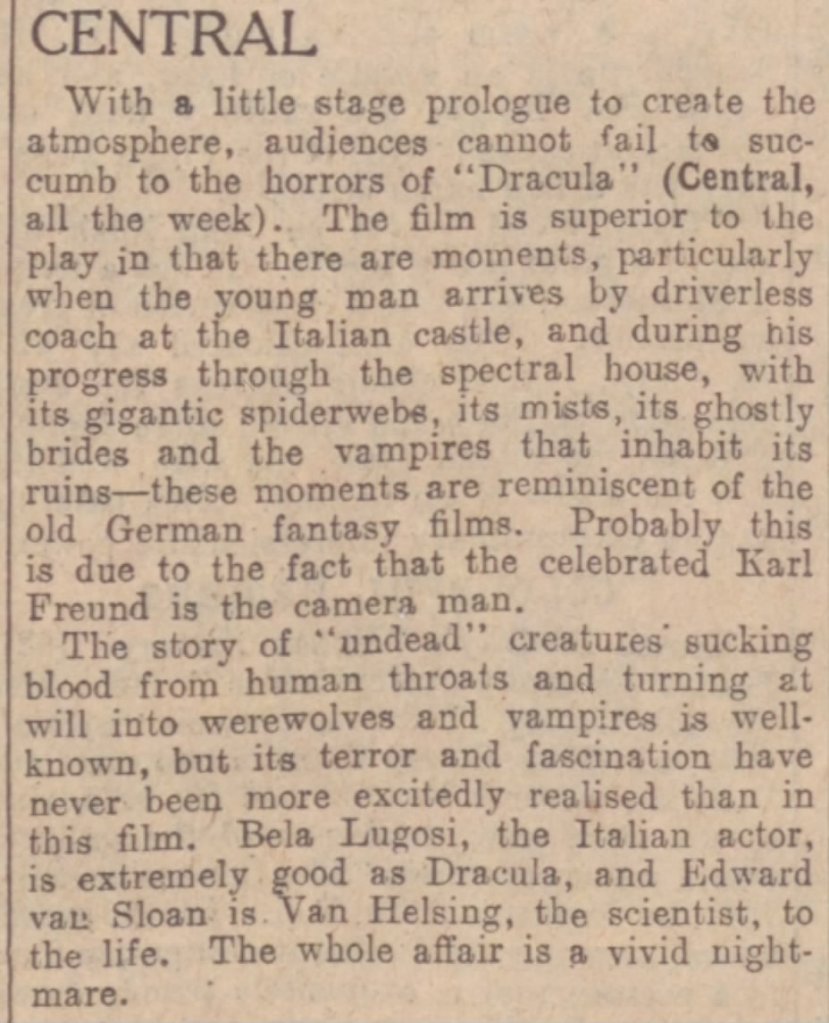
Lovecraft had gone down to visit his friend and fellow weird fiction writer the Rev. Henry St. Clair Whitehead in Dunedin, Florida in summer 1931, and traveled down to Miami (and then Key West). One can imagine the hot, stuffy theater, the house lights dimmed, the film opens…and few will argue that the opening scenes of Dracula are almost enough to make anyone fall in love with Universal horror; cinematographer Karl Freund wielded his camera expertly. However, Lovecraft was unhappy once the action left the castle, and so too did most semblance to Stoker’s novel:
What the public consider “weirdness” in drama is rather pitiful and absurd—according to one’s perspective. As a thorough soporific I recommend the average popularly “horrible” play or cinema or radio dialogue. They are all the same—flat, hackneyed, synthetic, essentially atmosphereless jumbles of conventional shrieks and mutterings and superficial, mechanical situations. “The Bat” made me drowse back in the early 1920’s—and last year an alleged “Frankenstein” on the screen would have made me drose had not a posthumous sympathy for poor Mrs. Shelley made me see red instead. Ugh! And the screen “Dracula” in 1931—I saw the beginning of that in Miami, Fla.—but couldn’t bear to watch it drag to its full term of dreariness, hence walked out into the fragrant tropic moonlight!
—H. P. Lovecraft to Farnsworth Wright, 16 Feb 1933, LWH 78
Unfortunately (and completely unknown to Lovecraft), by walking out before the end he missed the original epilogue of the film, where Edward Van Sloan emerged for a curtain speech. This scene was subsequently censored in the 1936 re-issue of Dracula, and is believed lost.
There are worse sins than walking out of what is now considered a cinematic horror classic to lay at Lovecraft’s door, and he was dedicated in his appreciation of the literary originals above the cinematic adaptations, so perhaps he can be forgiven. He made a note, in a later letter, that it was not Lugosi’s portrayal of the Count that he minded at all, only the script:
Yes—& kindred apologies for overrating your esteem for Signor Lugosi. However—if I recall the film “Dracula” aright, this bird is far from bad. The trouble with that opus was (a) the sloppiness of Stoker himself, & (b) the infinitely greater sloppiness of the cinematic adapters. The acting was fully as good as the lousy text would permit!
—H. P. Lovecraft to R. H. Barlow, 1 Sep 1934, OFF 173
Lovecraft calls him “Signor Lugosi” because of a mistaken impression (due to the last name), that Lugosi was actually Italian. In an era before the internet, such mistakes were not unknown:
At the same time as Dracula was being shot in English as Universal Studios, a Spanish-language version was being shot on the same sets. Lovecraft appears to have been unaware of this, and never mentions it in his letters.
Frankenstein (1931)
Sound • 71 minutes • Dir: James Whale • Prod: Carl Laemmle, Jr.
British playwright Peggy Webling approached Hamilton Deane, who had been touring Dracula on stage, with a stage adaptation of Frankenstein. This was a success, and American write John L. Balderstone, who had previously adapted the Dracula play for Broadway, also adapted Frankenstein: An Adventure in the Macabre with the intention of staging the show in the U.S. Carl Laemmle, Jr. was looking to begin work on more horror films after Dracula, and to this end, Junior bought the film rights for Balderstone’s Frankenstein—and approaching Bela Lugosi to play the Monster.
Lugosi played the Monster for a test reel, but the point was moot when director James Whale was brought to the project. Whale was a British director influenced by German expressionism, with a strong sense of the Gothic. He eventually cast relatively low-profile British actor Boris Karloff in the role. Jack Pierce provided Karloff’s makeup, including the flat-top and neck bolts that have become iconic elements of the Universal Frankenstein’s Monster. The production came together relatively quickly, and was released in theaters in December 1931.
Like Dracula (1931), Frankenstein (1931) greatly simplifies and veers strongly from the source material. The frame narrative and beginning of Shelley’s novel is ditched, opening with Henry (Victor in the novel) Frankenstein reanimating the monster using electrical apparatus. It is a thrilling and now-classic opening; but the Monster that emerges is not the terrifyingly intelligent and menacingly articulate entity from the novel, but a creature of almost childlike innocence and inhuman strength. The Monster then lurches through misadventures as Henry Frankenstein’s romance with his fiancée Elizabeth plays out, culminating in the Monster’s destruction and a wedding and a happy ending.
Lovecraft, who admired Shelley’s original novel, was not a fan of these changes. He was quite vocal about this, and it is ironic that we hear more about Universal’s Frankenstein than any other film in Lovecraft’s letters.
I haven’t been able to get around to any cinemas except “Frankenstein”—which vastly disappointed me. The book has been altered beyond recognition, & everything is toned down to an insufferable cheapness & relative tameness. I fear the cinema is no place to get horror-thrills!
—H. P. Lovecraft to J. Vernon Shea, 9 Dec 1931, LJVS 85
Also saw “Frankenstein” last month & was vastly disappointed. The film absolutely ruins the book—which indeed it scarcely resembles!
—H. P. Lovecraft to R. H. Barlow, 23 Dec [1931], OFF 18
“Frankenstein” was the only cinema I attended during the autumn of 1931, & was woefully disappointed. No attempt to follow the novel was made, & everything was cheap, artificial, & mechanical. I might have expected it, though—for “Dracula” (which I saw in Miami, Fla. last June) was just as bad. Last month “Dr. Jekyll & Mr. Hyde” came & went without my inspection.
—H. P. Lovecraft to Clark Ashton Smith, [28 Jan 1932], DS 344
As for cinemas—“Jekyll-Hyde” has been & gone, but I didn’t have the energy to attend it. I fancy “Frankenstein” somewhat discouraged the cinematic interest which “Street Scene” almost awakened.
—H. P. Lovecraft to J. Vernon Shea, 5 Feb 1932, LJVS 90
As for cinemas—I haven’t been to one since the “Frankenstein” disappointment! I have heard “Arrowsmith” well spoken of, & hope I can catch it on one of its returns to town. A friend of mine saw “Jekyll-Hyde” & was woefully disappointed.
—H. P. Lovecraft to J. Vernon Shea, 22 Mar 1932, LJVS 93
I saw the cinema of “Frankenstein”, & was tremendously disappointed because no attempt was made to follow the story. However, there have been many worse films—& many parts of this one are really quite dramatic when they are viewed independently & without comparison to the episodes of the original novel. Generally speaking, the cinema always cheapens & degrades any literary material it gets hold of—especially anything in the least subtle or unusual.
—H. P. Lovecraft to R. H. Barlow, 10 Jul 1932, DS 33
“Jekyll-Hyde” was Dr. Jekyll and Mr. Hyde (1931), a film adaptation from Paramount; Arrowsmith (1931) was a medical drama based on the 1925 Sinclair Lewis novel of the same name.
The last comment is perhaps the most telling; Lovecraft wasn’t complaining about Karloff’s performance, or Pierce’s makeup, or Whale’s direction—he was a stickler for literary accuracy, unable to avoid comparing the Universal film to its thrice-removed source material. There is some indication that Lovecraft appreciated elements of the film, particularly the elements taken from German Expressionism:
The re-named “Island of Dr. Moreau” is on exhibition here right now—but the advertisements kill any enthusiasm I might otherwise have for attending. I did see what bore the name of “Frankenstein” in the cinema—to my commingled rage & ennui. If any effective horror-film ever comes into being it will not be American. Germany might produce once—& I hope to see anything of the kind which does materialise.
—H. P. Lovecraft to Richard Ely Morse, 15 Jan 1933, LHB 54
Lovecraft refers here to Island of Lost Souls (1932), a Paramount film and a follow-up to their successful adaptation Dr. Jekyll and Mr. Hyde from the previous year. The actor, Boris Karloff, also impressed Lovecraft, or at least proved memorable:
You catch resemblances like a veteran—I can recognize the actor in the cinema version (or rather perversion!) of “Frankenstein” from the pen & ink sketch.
—H. P. Lovecraft to Robert Bloch, [c. 6 Dec 1933], LRBO 92
I’ve heard of that cinema “White Zombei”—in fact, I fear I let it split by under the impression that it wasn’t much good. A picture called “The Ghoul” (with Boris Karloff, the chief attraction of that “Frankenstein” fizzle as the star) is not running at a downtown theatre, but I have not seen it so far.
—H. P. Lovecraft to R. H. Barlow, [19 Mar 1934], DS 119
White Zombie (1932) was a United Artists film, starring Lugosi, strongly inspired by William Seabrook’s The Magic Island (1929). Parts of the production were actually filmed on Universal’s lots. The Ghoul (1933) was a Gaumont British film, starring Karloff. It is somewhat sad to think that Lovecraft missed both films; while not as acclaimed as the Universal horror films, they showcase both actors’ greater range and abilities.
In truth, the combined disappointment of Dracula and Frankenstein seems to have made Lovecraft rather critical of horror films in total:
Most radio and cinema versions of classics constitute a combination of high treason and murder in the first degree—I’ll never get over the cinematic mess that bore the name (about the only bond of kinship to the book!) of “Frankenstein”.
—H. P. lovecraft to Robert E. Howard, 3 Apr 1934, MF2.761
The censors had a go at Frankenstein when it came out, and it isn’t clear if Lovecraft saw the version where Frankenstein’s Monster accidentally drowns the young girl, or where Henry Frankenstein declares “Now I know how it feels to be God!”
Murders in the Rue Morgue (1932)
Sound • 62 minutes • Dir: Robert Florey • Prod: Carl Laemmle, Jr.
After Robert Florey and Bela Lugosi left the production of Frankenstein (1931), they became attached to another Universal horror project, a loose adaptation of Edgar Allan Poe’s “The Murders in the Rue Morgue” (1841). Like most of Universal’s horror films at this point, the film borrows literary cachet but makes significant departures from the source material; in this case, very little of Poe’s story remained in the screenplay by Tom Reed and Dale Van Every, and was further altered on-set with new dialogue added to replace stilted lines. Lugosi’s character, Dr. Mirakle, doesn’t appear in Poe’s story at all. The financial success of Frankenstein encouraged Universal to increase the film’s budget, and it went back for reshoots and editing before its 1932 release.
Even Karl Freund’s cinematography could not save this picture, however; and while not a box office bomb, it was a financial disappointment for Universal after the huge success of Dracula and Frankenstein. Ironically for Lugosi, who hadn’t wanted to be typecast playing monsters, he would go on to star in a number of films as a mad scientist, including in two more Poe adaptations (The Black Cat (1934) and The Raven (1935)). Hollywood had pegged Lugosi, and most of his career would be spent in sinister roles.
Censors had a go at Murders in the Rue Morgue, especially any scene the least sexually provocative and, perhaps surprisingly to today’s audiences, a scene about evolution. The 1925 Scopes Trial was still within living memory, and conservative and fundamentalist religious interests objected to the theory of evolution, or the idea that humans and great apes shared a common ancestor.
Given Lovecraft’s love of Edgar Allan Poe, he might have been interested in Murders in the Rue Morgue, but one of his younger cinema-going friends apparently warned him off of it:
I’ll be warned & remain absent from the “Rue Morgue.”
—H. P. Lovecraft to J. Vernon Shea, 22 Mar 1932, LJVS 93
Given Lovecraft’s reactions to Dracula and Frankenstein, this was perhaps for the best.
The Old Dark House (1932)
Sound • 71 minutes • Dir: James Whale • Prod: Carl Laemmle, Jr.
In 1927, British author J. B. Priestley published a novel titled Benighted, a quasi-Gothic novel where a number of travellers are caught in a storm and seek refuge in an old Welsh manor house. It was re-released in the United States in 1928 under the title The Old Dark House, to fair acclaim. H. P. Lovecraft mentions it a few times in his letters, although he never appears to have read it.
After the success of Frankenstein, Universal acquired the rights to the novel for Whale, who cast Boris Karloff as the mute butler Morgan, a “heavy” role that echoed the imposing physicality of Frankenstein’s monster. Benn W. Levy and R. C. Sherrif wrote the screenplay, which was largely faithful to the novel, albeit with more humor, making this the first of Universal’s horror-comedies. The film benefited strongly from Whale’s suspenseful direction, the relative fidelity of the script to the original, and a strong cast, but the lampooning of Gothic tropes didn’t click with U.S. audiences, although it did good business when released in the U.K.
The relatively poor performance in the U.S. likely meant that Lovecraft would have had limited opportunity to see it in the theater, and judging by the lack of references to it in his letters, he likely missed it.
The Mummy (1932)
Sound • 72 minutes • Dir: Karl Freund • Prod: Carl Laemmle, Jr.
It was a trend in Universal horror films that they were adapted from established novels or short stories; cinematic horror was rooted in literary horror, even if filtered through stage theater and then Hollywood conventions and sometimes colored by German Expressionism. When Junior decided on an Egyptian-themed film, however, Universal did not manage to find an appropriate literary property to license and adapt. The mummy of Imhotep would be the first original Universal monster, one that drew on a literary tradition of the undead of Egypt, but not any specific work.
Karl Freund moved into the director’s chair for this film; John L. Balderston, who had done the screenplays for Dracula and Frankenstein, adapted a treatment by Nina Wilcox Putnam and Richard Schayer. Boris Karloff once again plays the monster, with a legendary makeup by Jack Pierce for the opening sequence of the film. Karloff gives a strong performance, and the romance plot that is so common for Universal horrors of that period is actually much more effectively worked into the plot here, as the mummy seeks to reunite with his long-dead love through her reincarnation. (A lengthy flashback through various incarnations was filmed but cut, and is now sadly lost except for stills.)
The film opened to lesser numbers than Dracula or Frankenstein, though its popular legacy is extremely solid. Lovecraft, despite his modest interest in ancient Egypt and archaeological horrors, sadly does not seem to have seen this Universal horror either:
Most cinema ‘horrors’, however, are flat & mechanical. I have not seen “The Mummy.”
—H. P. Lovecraft to R. H. Barlow, 14 Mar 1933, DS 57
The Invisible Man (1933)
Sound • 70 minutes • Dir: James Whale • Prod: Carl Laemmle, Jr.
With the success of Dracula (1931), Universal was already looking at various projects, including an adaptation of H. G. Wells’ science fiction novel The Invisible Man (1897), but Frankenstein (1931) got the greenlight first. After The Old Dark House (1932), director James Whale signed onto the project, and brought writer R. C. Sherriff (also fresh from The Old Dark House) to write the screenplay. As The Invisible Man novel is not inherently horrific, Universal also bought the rights to The Murderer Invisible (1931) by Phillip Wylie, and the the film combines elements of both. Initially, Karloff was intended to play The Invisible Man, repeating his successful work with Whale from Frankenstein, but by the time production got going Karloff wasn’t available, and the Invisible Man is played by Claude Rains in his film debut.
The Invisible Man stands out among the early Universal horrors for its technical achievements. It is easily the most ambitious in terms of special effects, with the Invisible Man requiring a number of different practical and film effects to convincingly portray the illusion; this is reflected in the budget, which was almost as high as for Dracula. The film is also notable in centering the story on the Invisible Man himself, an anti-hero and a jovial bastard rather than a tragic figure like Frankenstein’s Monster or Imhotep, or a supernatural evil like Dracula.
It was a box office success, well regarded for the spectacle of its effects as well as its writing, acting, and direction. Lovecraft was no doubt wary of the whole horror film business at this point, but he did eventually get around to seeing it when it came back to theaters for a second run—and was suitably impressed:
I missed “The Invisible Man”, but will try to take it in when it returns, as it undoubtedly will.
—H. P. Lovecraft to Robert Bloch, [25 Dec 1933], LRBO 95
Also went to see “The Invisible Man”. Surprisingly good—might easily have been absurd, yet succeeded in being genuinely sinister.
—H. P. Lovecraft to J. Vernon Shea, 4 Feb 1934, LJVS 226
Lovecraft’s fellow pulp-author and correspondent Robert E. Howard also saw The Invisible Man, and reported back:
We had purchased our whiskey and intended to celebrate Saint Patrick’s in a fitting manner, after seeing a whimsical movie called “The Invisible Man” from a story by Wells, I believe, but the sandstorm was followed by a biting blizzard, with driving sleet and lightning and thunder, so we postponed the merry-making.
—Robert E. Howard to H. P. Lovecraft, c. Jul 1934, MF2.779
The Black Cat (1934)
Sound • 65 minutes • Dir: Edgar G. Ulmer • Prod: Carl Laemmle, Jr., E. M. Asher
While nominally inspired by Edgar Allan Poe, this is really an original story, and a vehicle for Universal to get two of its most bankable horror stars together in one economical picture. Boris Karloff and Bela Lugosi play opposite each other for the first time, and if the plot is somewhat overloaded—involving as it does a bus crash, revenge, a gallery of dead women, The Rites of Lucifer, murder, a black mass, and a black cat—there is something joyful in how both Karloff and Lugosi get to revel in their respective roles. Ulmer managed to make the film much more violent and lurid than typical for the period, and had a talent for making the most of subject matter, since he couldn’t rely on epic sets, huge casts, or expensive special effects. Unfortunately, he also began an affair with the wife of one of Carl Laemmle’s nephews, which led to this being his last film for Universal.
Karloff gets top billing and top dollar in this film, as his star had already begun to eclipse Lugosi. In truth, Karloff had the better part, playing the villain with relish while Lugosi is more the straight man. The pairing was successful; it was Universal’s most financially successful film in 1934, and led to seven more films featuring both Karloff and Lugosi.
Lovecraft was skeptical…
From what you say of “The Black Cat”, I don’t think I’ll make any special attempt to see it. Apparently it is a typical cinematic cheapening & distortion—on the order of the so-called “Frankenstein” film of a year or two ago. I don’t attend the cinema very often, but realise what a marvellous conveyer of weird images & impressions it could be if it would only utilise seriously its tremendous range of optical & mechanical potentialities.
—H. P. Lovecraft to Richard Ely Morse, 21 May 1934, LHB 81-82
As for “The Black Cat”—I guess Edgar Allan might very well have written the cinema version so far as any resemblance to the work of our friend Eddie Poe is concerned!
—H. P. Lovecraft to Arthur Leeds, 4 Jun 1934, LRK 340
Hope the new Poe mangling didn’t disappoint you too badly—I’ve seen neither it nor the so-called “Black Cat.” Just what the cinema would do to the “Tell Tale heart” is more than I can imagine at the moment!
—H. P. Lovecraft to Arthur Leeds, 19 Jun 1934, LRK 342
The “new Poe mangling” was The Tell-Tale Heart (1934) from Fox Film Co., which was nominally based on “The Tell-Tale Heart” (1843) by Edgar Allan Poe, but released in the U.S. as Bucket of Blood.
Life Returns (1934)
Sound • 60 minutes • Dir: Eugene Frenke • Prod: Lou Ostrow
TO WHOM IT MAY CONCERN: The actual experiment of bringing the dead back to life, which is part of the motion picture “Life Returns” was performed by myself and staff on May 22, 1934 at 11:45 P.M. in Berkeley, California. This part of the picture was originally taken to retain a permanent scientific record of our experiment. Everything shown is absolutely real. The animal was unquestionably and actually dead, and was brought back to life. May I offer my thanks to my assistants, Mario Margutti, William Black, Ralph Celmer and Roderic Kneder, who are shown carrying out their respective parts. Respectfully submitted, Dr. Robert E. Cornish.
—Opening card, Life Returns (1934)
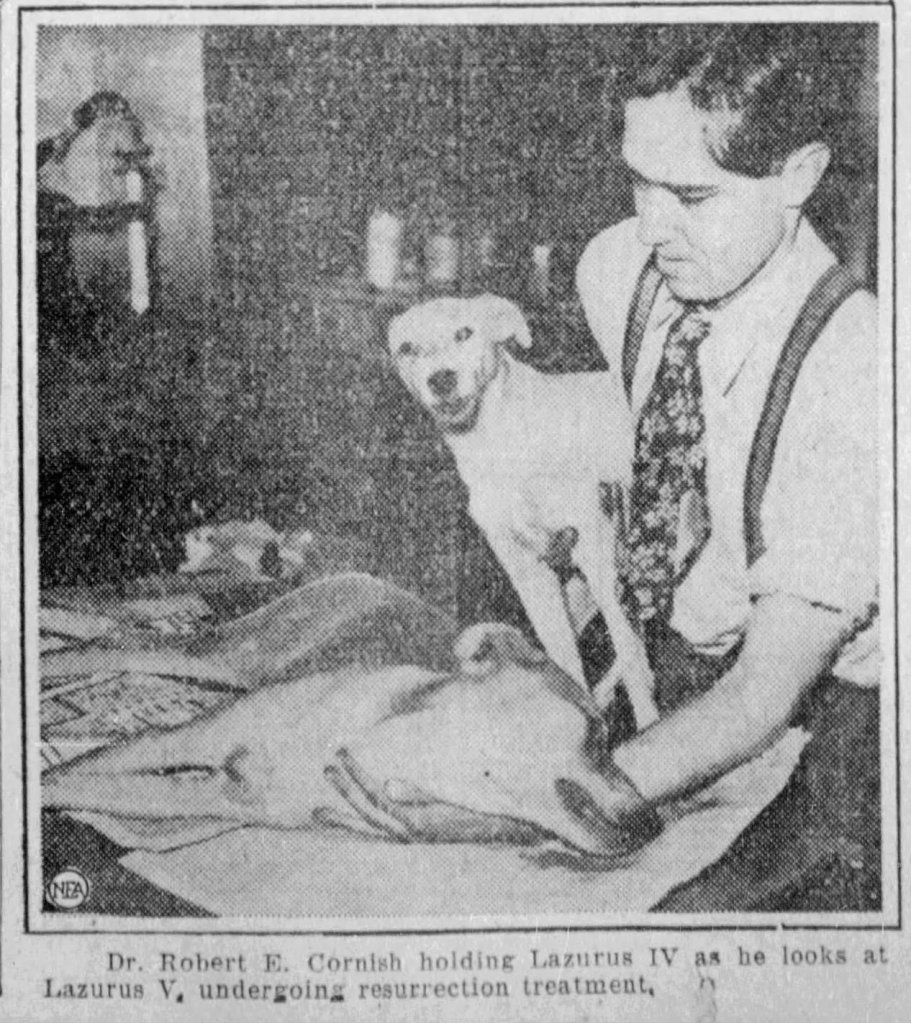
Robert E. Cornish was a child prodigy who became interested in medical resurrection, and claimed to achieve success in reanimating a series of dogs who had been put to death during a series of experiments at the University of Southern California in 1934. Director Eugene Frenke filmed the experimental operation, and incorporated the genuine medical footage into a short drama, with Cornish playing himself. Frenke made a deal with Universal to split costs and profit, with Universal lending some of their actors (including Valerie Hobson, who would also star in Bride of Frankenstein and Werewolf of London this year) and handling the distribution.
It would have been surprising if Lovecraft had seen Life Returns. The film was pulled from general release by Universal after a preview, limited to a roadshow. The drama isn’t very good, the production slapdash and amateurish, certainly not as stylish as Universal’s big-budget horrors. The genuine medical footage is both boring and arguably more horrific than any Lon Chaney or Jack Pierce makeup, because actual dogs were harmed in the making of this film. While it might have been interesting to see Lovecraft’s reaction to a real-life reanimator, that’s about the limit that can be said for this footnote in Universal horror history.
Bride of Frankenstein (1935)
Sound • 75 minutes • Dir: James Whale • Prod: Carl Laemmle, Jr.
Studios in the 1930s certainly understood the concept of the franchise; the Fu Manchu and Tarzan film series were, if not cinematic universes unto themselves, at least proof that studios recognized that movie-goers could and would spend their hard-earned coin to see more of the same. Several of Universal’s horror films were successful enough to warrant sequels, but the first to actually expand beyond a single film was Frankenstein (1931). Karloff’s profile had risen, and he was willing to replay the part of the Monster; Jack Pierce was still a master of makeup; James Whale was willing and able to direct. The only issue was the script and the budget.
Various treatments were written and rejected; in 1934, John L. Balderston returned to Shelley’s original novel and plucked out a plot point that wasn’t in the first film: the monster demanding Frankenstein build him a mate. This screenplay was polished by William Hurlburt and Edmund Pearson, and then presented to the Hays Office. Unlike previous films, production of Bride of Frankenstein would have to take place under the onus of the Hays Code; while previous Universal horrors had dealt with occasional censorship from various local bodies, this was a top-level of oversight that would challenge directors for decades.
The film went overbudget and suffered various production snafus. Karloff broke his hip. Clive Colin, playing Henry Frankenstein, broke his leg. The Hays’ office objected to various scenes and lines. None of that mattered once the film was released. The film was a financial and critical success, praised for the acting, the score, the cinematography and direction; for Jack Pierce’s makeup, Kenneth Strickfadden’s lightning bolt, and the rotoscoped homunculi in Dr. Praetorious’ jars. Elsa Lanchester’s look as the Bride was instantly iconic, and her dual role as Mary Shelley and the Bride was a poignant and wonderful link to the original story.
Unfortunately, it does not appear that Lovecraft saw it. Not surprising, given his poor opinion of Frankenstein (1931). Though he did not know it, it was his loss.
Werewolf of London (1935)
Sound • 75 minutes • Dir: Stuart Walker • Prod: Stanley Bergerman
Bride of Frankenstein (1935) was the last Universal horror film directly produced by Carl Laemmle, Jr. While Junior had not been the producer for all of Universal’s films, he had successfully midwifed Dracula, Frankenstein, Murders in the Rue Morgue, The Mummy, The Invisible Man, The Black Cat, and Bride of Frankenstein—impressive credentials for anyone. The Laemmles’ time at Universal was coming to an end; after the expensive box office bomb of Sutter’s Gold in 1936, investors would force both Carl and Junior from the company.
The Universal horror films of 1935-1936 thus represent a transition between the Laemmles’ style of production and the much more franchise-driven approach of the 1940s and 50s. This period is often less productive of classic characters; Werewolf of London, for example, is not The Wolf Man (1941), though it does help establish some of the cinematic werewolf lore that would be carried on for decades, such as the bite of a werewolf passing on lycanthropy, and the light of the moon controlling the transformation. It was, in fact, the first feature-length werewolf film.
The film was initially intended to be another Karloff/Lugosi vehicle. However, Karloff was working on Bride of Frankenstein (1935) and Lugosi on Mark of the Vampire (1935) for MGM, so director Stuart Walker cast Henry Hull and Walter Oland in their place. The story was original, with screenplay by John Colton. Jack Pierce provided the makeup for Hull’s transformations, accomplished with a stop-frame technique, so that as Pierce gradually adds more hair and prosthetics Hull seems to change before the viewer’s eyes. Effective stuff for the 1930s.
While entertaining enough, the film lacks the starpower of Unviersal’s big horror films like Bride of Frankenstein, which may be why it fared rather disappointingly at the box office. Still, word of mouth got around. We don’t know if Lovecraft managed to see it, but several of his friends urged him to do so:
Incidentally, I’ll keep “The Werewolf of London” in mind.
—H. P. Lovecraft to Robert Bloch, [c. June 1935], LRBO 143
I’ll be on the lookout for “The Werewolf of London”, despite my rather discouraging past experiences with alleged “horror” cinemas. Thanks for the tip!
—H. P. Lovecraft to William F. Anger, 22 Jul 1935, LRBO 241
Thanks for the warnings against allegedly weird cinemas. Someone has just recommended “The Werewolf of London” to me—but I have my doubts.
—H. P. Lovecraft to Richard F. Searight, 4 Aug 1935, LPS 386
The Raven (1935)
Sound • 61 minutes • Dir: Louis Friedlander (Lew Landers) • Prod: David Diamond/Stanley Bergerman
A spiritual sequel to “Murders in the Rue Morgue” (1932) and “The Black Cat” (1934), and the third and final film in Universal’s unofficial “Poe trilogy” of the 30s. Universal paired Boris Karloff and Bela Lugosi, the latter of whom once again plays a scientist. It took time and several writers to finally arrive at an acceptable screenplay, which David Boehm finally delivered. This was director Friedlander’s sixth film (counting earlier serials), and his first horror film.
Perhaps as a result of inexperience with horror, the film was not a critical success. Censors did not like the piling-on of horror on horror; the Poe element was prominent, but the story wasn’t particularly true to any of Poe’s tales or poems in tone or content; Karloff and Lugosi play their parts with characteristic professionalism, but the script was a bit of a mess. As with “The Black Cat,” there’s a strong theme of sadism that underlies the whole affair; the torture-dungeon has a distinct science fiction serial or comic strip aspect, exaggerated and theatrical.
Lovecraft does not mention “The Raven” in his letters; given that he apparently skipped “Murders in the Rue Morgue” and “The Black Cat,” and was critical of cinema’s approach to adapting Edgar Allan Poe, it seems unlikely he would have watched this one.
The Invisible Ray (1936)
Sound • 79 minutes • Dir: Lambert Hillyer • Prod: Edmund Grainger
After “The Raven” (1935), Karloff and Lugosi were intended to be paired together again for an adaptation of Bluebeard; production was delayed and they were shifted to another project, the science fiction horror The Invisible Ray, again under director Stuart Walker. However, Walker didn’t like the script and left, replaced by Lambert Hillyer, who was an experienced director, though mostly of westerns. Hillyer eventually delivered the film late and over-budget.
The end result is very much a work of its time; mad science and the wonders of radiation, which is both deadly and invisible, able to both harm and heal. The laboratory sets are particularly charming in retrospect, and would also appear in Flash Gordon (1936) and Dracula’s Daughter (1936); the special effects, while relatively sparse, are effective. However, this was a B-movie through and through, and doesn’t really pretend to be otherwise.
Lovecraft does not mention “The Invisible Ray” in his letters, and probably didn’t see it. He seems not to have gone to the cinema much in the last year of his life. Ironically, Karloff would star in another film involving a radioactive meteorite some decades later—Die, Monster, Die! (1965), an exceedingly loose adaptation of Lovecraft’s “The Colour Out of Space.” In both films, the strange invisible rays from the radioactive meteorite eventually consume Karloff’s character.
Dracula’s Daughter (1936)
Sound • 71 minutes • Dir: Lambert Hillyer • Prod: E. M. Asher
The sequel to Dracula (1931) took a while to get going, due to a complicated situation to the rights. The first film had run through the plot of the novel and play, and Stoker hadn’t written a sequel. After his death in 1912, a “lost chapter” titled “Dracula’s Guest” was published in 1914, which included a beautiful female vampire, and this was ostensibly the inspiration for the sequel. MGM bought the rights to “Dracula’s Guest,” with certain stipulations (because Universal still had rights to Dracula).
In 1934, Universal bought the rights to “Dracula’s Guest” (including Balderston’s scenario) from MGM with the stipulation that the rights would revert if product didn’t begin before 1935 (later extended to February 1936). , which were due to run out, and so rushed Dracula’s Daughter into production without a final script. The initial treatment was by John L. Balderston, from Dracula, Frankenstein, and other Universal horrors, but director James Whale, then attached to the project, brought in R. C. Sherriff. His screenplays found difficulties with censorship boards, and eventually he was passed over for Garrett Fort, whose name appears in the film’s credits. Whale left the project, and eventually Hillyer, who had previously directed The Invisible Ray (1936), was placed in the director’s chair.
Initial hopes of an ensemble cast with a returning Bela Lugosi, Boris Karloff, Colin Clive, etc. were ultimately dashed; Lugosi only appears as a wax bust in his likeness in a coffin, and the only returning character from the original Dracula (1931) is Edward Van Sloan, here playing “Von Helsing.” Gloria Holden plays the eponymous daughter, Countess Marya Zaleska, in her first starring role—which is a bit far and away from the Theda Bara-style vamps of yesteryear, with a degree of self-loathing that is almost palpable. Jack Pierce was again on makeup duties, and worked with the special effects people to light Holden to maximum effect.
Perhaps because of all of this, the film lacked the originality of many of the earlier horrors, and the rushed production shows in spots. Universal still had excellent crews and sets, but the script was a mess and performances often feature too much dialogue and too prosaic a tying-up of loose ends. One of the saving points of the film is the implicit lesbianism, in particular a sequence when the Countess has a young woman model for her, resulting in a kind of seduction that somehow made it past the censors.
It was the last gasp of Universal horror during Lovecraft’s lifetime. The Laemmles were forced out of Universal during production, and the new owners were not fond of horror films. Universal did not produce another horror movie until Son of Frankenstein (1939), long years after Lovecraft was dead. There is no mention of Dracula’s Daughter in Lovecraft’s letters, and considering his thoughts on Dracula (1931) and “Dracula’s Guest,” he most likely did not see it.
Curtain Call
H. P. Lovecraft barely lived long enough to be aware that the Universal horrors which he had seen or been aware of were on their way to becoming something else. He did not see any of the films of Kharis, the spiritual heir to Imhotep, who shambled through a series of mummy films. Never saw Lon Chaney, Jr.’s defining performance in The Wolf Man (1941), or the sequels to Dracula, Frankenstein, and The Wolf Man grow together into a cinematic universe of crossovers and cross-references that oddly reflected what was happening with his own literary legacy, culminating in the Abbott & Costello films. One could have wished that Lovecraft had at least survived long enough to see the Gill-man swim in the underwater acrobatic ballet of Creature from the Black Lagoon (1954)—but, that was far in the future. Cancer claimed him first.
We have the advantage of several decades hindsight, we know how successful and influential these films were and would be. Before we judge Lovecraft for his critical takes on films like Dracula (1931) and Frankenstein (1931), perhaps we should ask ourselves if we today are ignoring or misjudging the horror films that will be seen as classics in the future? Because not even the most dedicated cinephile can see everything, nor can anyone predict which films will enter the bargain bin of history, while others become enshrined as cinematic legends.
This little survey is not the totality of Lovecraft’s film-going experience, not even of horror films. This is a core sample into a particular strata of cinematic history, to showcase how Universal horror grew and intersected with Lovecraft’s life and experiences. We do not look for vampires with opera capes in Lovecraftian fiction, and in part that reason is because even during Lovecraft’s lifetime Lugosi’s distinct appearance influened how vampires were being portrayed, even in pulp fiction; as the decades wore on, the Universal monsters would become more and more fixed archetypes for others to play off of—much as the Cthulhu Mythos would become a sandbox for all to enjoy.
Those who grew up in the generations after Lovecraft were heirs to both legacies, which sould sometimes be combined together in works like Roger Zelazny’s A Night in the Lonesome October (1993). Kids who had read scholastic paperbacks of Lovecraft or books like Monsters Monsters Monsters would also stay up late to watch the re-runs of old Universal horrors flicker in black and white on late-night reruns . . . and today, kids might stream some of the same classic films, or snuggle with an e-reader to learn what Pickman’s model is all about. Both Lovecraft and the Universal monsters have become part of the world’s heritage of horror.
Sources and Acknowledgements
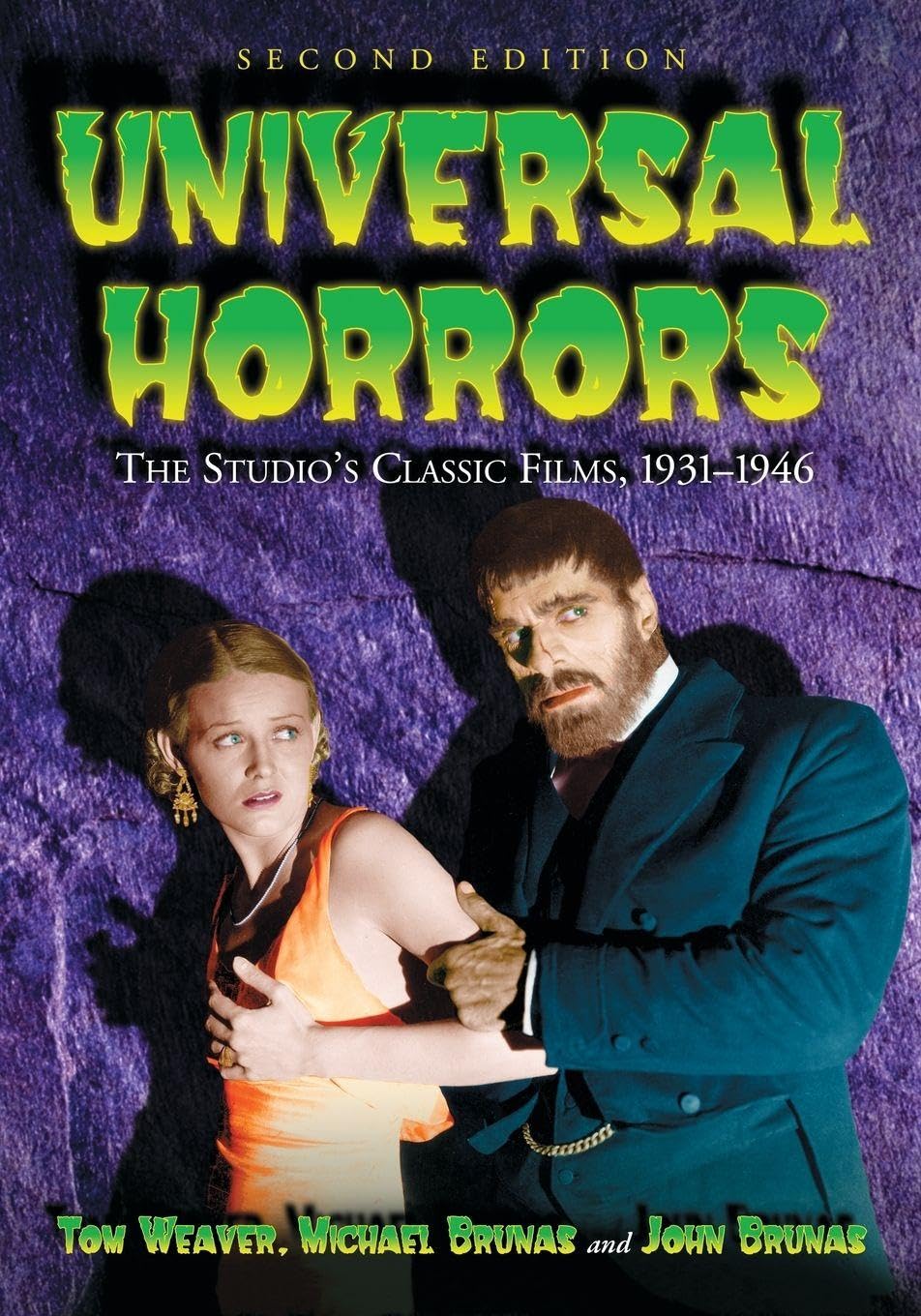
Entire books have been written on Universal’s horror movies and the history of the studio, far too much to recapitulate in detail here, so I’m borrowing on the scholarship of others and simplifying greatly. Facts on the films and the story behind them are drawn from the following reference works, for which please see for more information:
Bobby Derie is the author of Weird Talers: Essays on Robert E. Howard and Others and Sex and the Cthulhu Mythos.
Deep Cuts in a Lovecraftian Vein uses Amazon Associate links. As an Amazon Associate I earn from qualifying purchases.
 Deep Cuts in a Lovecraftian Vein