Her Letters To Robert E. Howard: Novalyne Price

Dear Bob,

Although you leave nothing for me to say, being a woman, I’ll say something anyway.

Novalyne Price Ellis, One Who Walked Alone 233

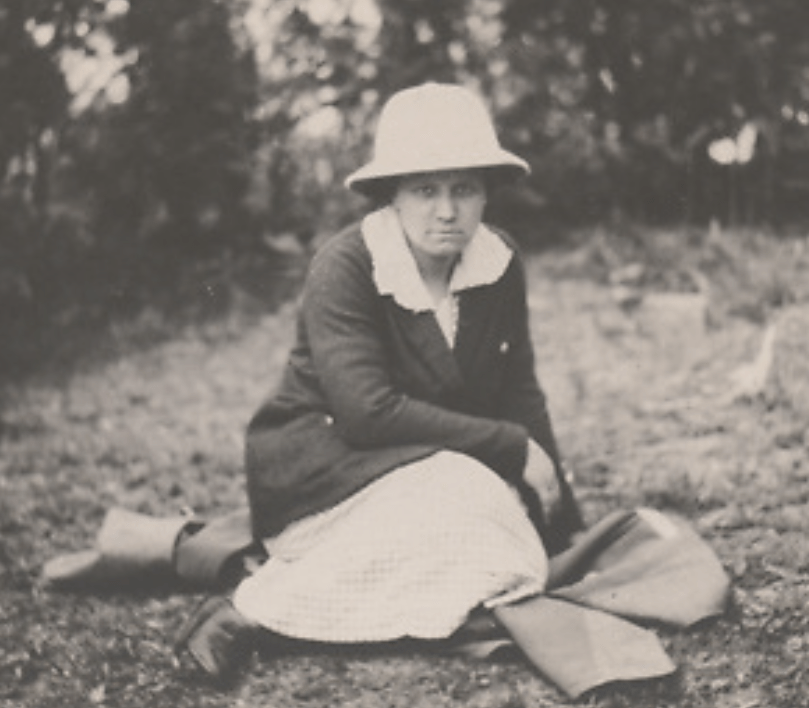
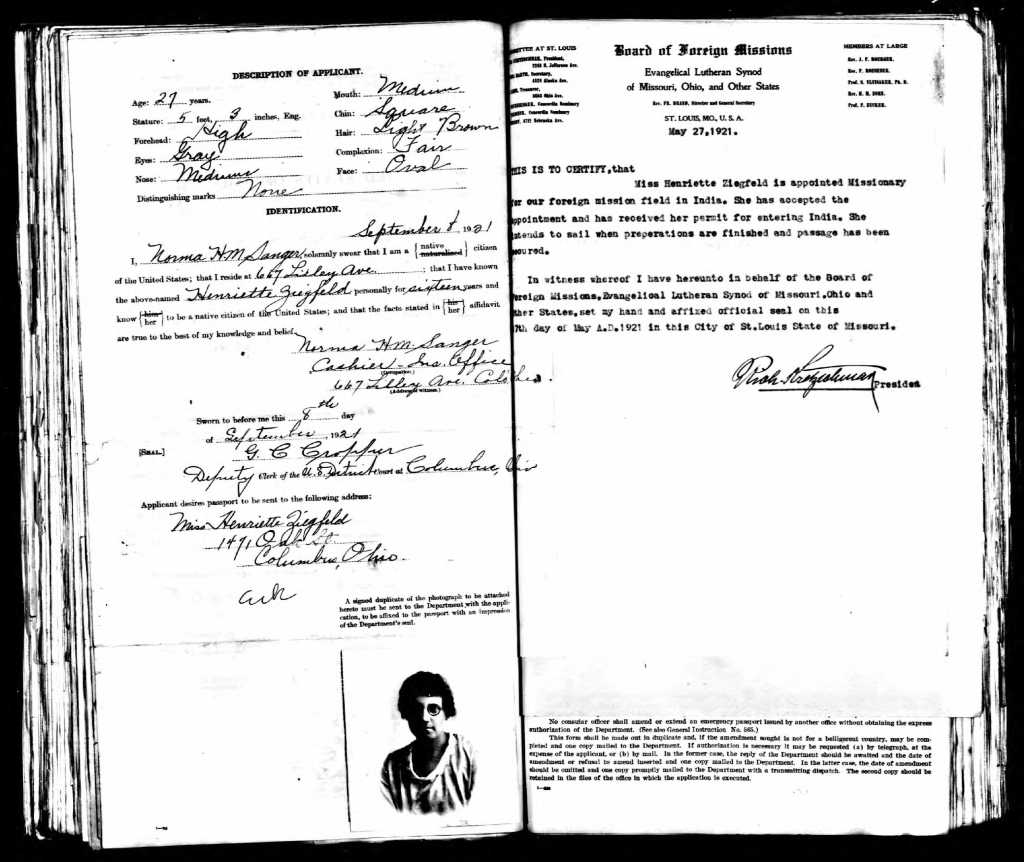
Novalyne Price was born to Homer and Etna Reed Price in Brownwood, Texas in 1908. Her parents’ marriage did not last through her childhood; in 1919 Etna remarried to Albert C. Sears, though this marriage would also end in divorce in the 1930s. She was two grades behind Robert E. Howard at Brownwood High, who finished high school at Brownwood because the school at Cross Plains stopped at 10th grade. She took classes at the local Daniel Baker College while still in high school, and finally graduated high school and entered as a full-time student in 1925 with a focus on Oratory and Literature.

It appears that working her way through college required her to alternate semesters, so she did not matriculate with her second diploma until Spring 1933—in the middle of the Great Depression. There were few options for educated women when it came to work; teaching was a respectable professional, but underfunded schools often paid teachers in scrip rather than cash…and had strict expectations:

“There will be no drinking, smoking, dancing, Sunday picture shows, or playing bridge by any member of this faculty.” […]

“You should not plan to go home every weekend either,” Mr. Williams went on. “You will be expected to stay here where your work is and attend church here. I want to make it clear that there will be no drinking by any member of this faculty.” He cleared his throat. “Furthermore, we want to keep the children from smoking if we can. No smoking on the school grounds or in the buildings. If they see you smoke, they will want to smoke, too. And this applies to the lady faculty members; we more or less accept the fact that men smoke, even if we don’t quite approve of it, but lady faculty members are not to smoke anytime, anywhere.” […]

“It has come to my attention that some teachers play bridge so late at night they cannot do their work the next day. You are not to play bridge, not even in your rooms at your boarding places.”

One Who Walked Alone 36

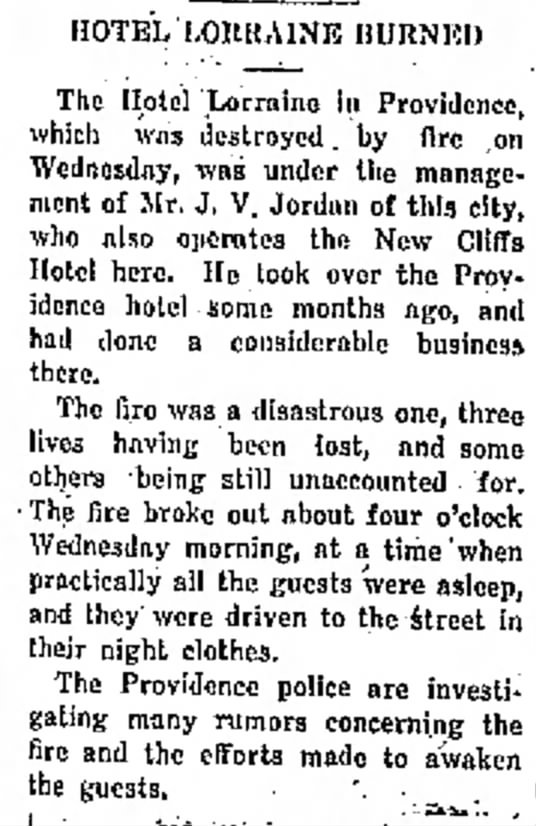
Nevertheless, Novalyne Price began her career as an educator in January 1934 in a small town outside of Abilene, Texas…but the next year she took a position at Cross Plains, closer to Brownwood where her mother and grandmother kept a farm…and where, perhaps not coincidentally, Robert E. Howard lived.

Novalyne had been aware of Bob Howard through their mutual friends in Brownwood; she had dated Howard’s good friend Tevis Clyde Smith, and he had introduced the two in 1932. Like Robert E. Howard, she was interested in becoming a writer. Now that they were both in Cross Plains, the two renewed their acquaintance…and began what would be a tumultuous on-again, off-again romance. The two dated, argued, exchanged gifts, flirted, met each other’s families, went on long drives in the country, debated, criticized each other’s fiction, quarreled and made up and quarreled again…a story chronicled in her memoir One Who Walked Alone, later made into the motion picture The Whole Wide World.

For the 1934-1935 and 1935-1936 school years, Novalyne Price lived in a boarding house within easy walking distance of the Howard home. Despite this, the two carried on their relationship in part by correspondence. While Howard was on no set schedule, he occasionally made trips for days at a time out of town, and they would keep in touch by letter; so too, Novalyne Price had to work full-time, and unpaid overtime as she worked to coach some of the school’s extracurricular activities, which left little time during the week for visits so Bob would mail her notes and letters. Ten of these letters from Bob to Novalyne survive, reproduced in Price’s memoir and subsequently in collections of Howard’s letters.

The first letter was sent 27 September 1934:

Dear Novalyne,

How about going to the show in Brownwood Sunday afternoon? I’ll be over about 1:30 p.m. Let me know by return mail.

Your friend,
Bob

One Who Walked Alone 68

Teachers in Cross Plains were not supposed to go out to picture shows on Sundays. Nor was Robert E. Howard the normal sort of fellow to date: his profession as a writer set him apart in what was still predominantly a farming and tradesman’s community, a little crossroads town that had grown up overnight due to an oil boom and was still very conservative…and Bob Howard had developed a reputation as someone eccentric. Weird.

If I date Bob, some people will tease me. Others will think I’m crazy or peculiar. So what?

You pay a price for everything in this life. You have to decide for yourself whether the price is reasonable or too high. […]

I went to my room, sat down at the typewriter and wrote three lines to Bob to tell him I’d be glad to go to Brownwood to see a show and that one-thirty would be fine. I took the letter out of the typewriter, got up, and told Ethel I was going to the post office to mail it. She thought she ought to go with me, but I insisted on going alone.

Outside, the stars were dim and far away. A soft wind touched my face. I ran most of the way to the post office.

One Who Walked Alone 69-70

The impression from Novalyne’s memoir is that there were more such notes, because sometime around October 1934 she writes:

The only letter in my box was from Bob. I didn’t have time to read it, but I glanced at it and burst out laughing right there in the post office. He didn’t write “Dear Novalyne” as he usually did. Instead he began: “My Cherished Little Bunch of Onion Tops.”

The letter was nearly two pages, typed, single spaced, and I knew it was going to be mostly about the story I’d gotten back which he had taken home to read.

One Who Walked Alone 106

Novalyne’s early stories aren’t known to survive but appear to have been mostly realistic stories aimed at the confessional or romance pulps, dealing with subjects like a woman with an illegitimate child. With her busy schedule at school, grading papers, and with extracurricular projects, Novalyne had little time for writing or revising her fiction to meet editorial standards…yet she was eager to see what a professional could tell her to improve her writing.

First, he explained that men made a terrible mistake when they called their best girls thier rose or violet or names like that, because a man ought to call his girl something that was near his heart. What, he asked, was nearer a man’s heart than his stomach? Therefore he considered it to be an indication of his deep felt love and esteem to call me his cherished little bunch of onion tops, and, judging from past experience, both of us had the highest regard for onions.

The rest of the letter was about my story—”Vixens CLimb Trees.” He said that he’d gotten the best laugh he’d had in a long time, for he understood perfectly the girl’s discomfiture riding a rough, ornery cayuse like the one I had described in the story.

Something he really liked, he said, was the background for the story. It was just there.

One Who Walked Alone 106

Howard offered to write to his agent Otis Adelbert Kline to look at the story, which he apparently did as later on Price writes about receiving an answer from Kline. This was, though she may not have known it, more than a friendly gesture on his part: like many agents, Kline could demand reading fees for work. Presumably, he didn’t charge Novalyne Price as a favor to Howard, who was on his way to becoming a good client.

Writing was like eating onions; the more you did, the better you liked it. Some day, soon, he was sure I’d find an appreciative editor. But the secret, he said, was to write, write, write.

That was discouraging. How could I write and write? I am behind with my paper grading and Enid is on my back constantly. But working with individual students after school, then going back at night to rehearse plays, how could I write more and more. These diaries and journals, of which he is so skeptical, take about all the time I have to give. Here it is after twelve o’clock, and I’m tired. All I want to do is go to bed and forget everything.

One Who Walked Alone 107

There were several disconnects like that between Novalyne and Bob. He had already made the leap and committed himself to be a full-time writer, and could write twelve hours a day if he had to. His advice was no doubt honest, as it had been what he himself had done: learn by doing. Yet Novalyne had a career already and struggled with her schedule as it was. She couldn’t afford to write like Bob did.

Bob Howard did encourage her, and busy as she was he also doted on her in his own fashion. Presumably, during the week she was often too busy to go out for a drive, see a picture, or even have a fizz at the soda fountain; probably they couldn’t spend hours on the phone either. Yet there was always the post office.

The only bright spot in the whole week has been the cutre little notes or letters I’ve gotten from him every day. All of them ebgin with “My very dear little Bunch of Radishes,” or “My very dear Beans, Cornbread and Onions,” or “My dear Sausage and Big, Brown, Fluffy Bisquits [sic].” He’s still on the kick that a man ought to call his girl names that are close to his heart—his stomach.

In one letter, Bob talked about how much it was raining and that neither man nor animal could keep his feet dry. But all this proved, he said, that he’d walk through floods for me. Then, in the postscript, he said he’d be over Saturday afternoon if it didn’t rain. That was the letter in which he called me sliced red beets with butter over them. […]

I wrote Bob, and he wrote me another goofy note to tell me he’d be over tonight, and we’d ride around and he’d shoot his mouth off. I had told him in th eletter that I loved to walk in the rain, and he said maybe I’d just as soon walk.

One Who Walked Alone 110

His “goofy note” came in an unsealed envelope; Novalyne chided him on this, which led to a small argument:

He was emphatic. “I did not forget to seal that letter. I never forget to seal a letter. That’s the damndest thing I ever heard of. Those bastards in the post office opened that letter and read it.”

My nerves were on edge, but I managed not to sound too irritable. “Oh, Bob, you know better than that. It’s against the law to open a letter and read it.”

“What makes you think people in the Cross Plains post office know what the law says?” he raged.

I laughed without mirth. “Just be sure you seal the next letter you write me.”

One Who Walked Alone 110

And on in that vein. Bob was sensitive to slights, real and perceived; Novalyne was sensitive to appearances. Small misunderstandings have a way, in Novalyne’s memoirs, to turn into more serious and sometimes ongoing arguments. Of course, in this case after their date, Bob went home, wrote her a letter, posted it, and then spent the rest of the night writing. Novalyne got the letter the next day…in an unsealed envelope. It began:

Dear Novalyne and Members of the Cross Plains Post Office Staff

One Who Walked Alone 118

The next letter we have the actual text for is a short note, c. December 1934, which included a poem from a fan (“Echo of the Ebon Isles” by Emil Petaja), and two of Howard’s own poems, “To A Woman” and “One Who Comes At Eventide” which had been published in Modern American Poetry 1933.

Though fahtoms deep you sink me in the mould,
Locked in with thick-lapped lead and bolted wood,
Yet rest not easy in your lover’s arms;
Let him beware to stand where I have stood.

I shall not fail to burst my ebon case,
And thrust aside the clods with fingers red:
Your blood shall turn to ice to see my face
Look from the shadows on your midnight bed.

To face the dead, he, too, shall wake in vain,
My fingers at his throat, your scream his knell;
He will not see me tear you from your bed,
And drag you by your golden hair to Hell.

Robert E. Howard, “To A Woman” (1933)

Not perhaps the most romantic poem to share, but she had asked for it. Their relationship continued in that vein, and perhaps there were weeks when they wrote more than they saw each other because in March 1935 Bob had to take his mother to Temple, Tx. to receive medical treatment. Hester Howard’s illness, probably tuberculosis, was one of long duration and which allowed periods of outward good health; medical care was expensive, and Bob’s doting on a mother that Novalyne couldn’t see physically ailing was another point of misunderstanding.

Bob is coming home. I had a card from him, saying that his mother was getting better, and he was bringing her home. I wanted to write him a letter, telling him how my students did, but he probably will be home before the letter could get to him.

One Who Walked Alone 182

On the way home from a County Meet (22 March 1935) where her students performed, Novalyne Price collapsed and was taken to the hospital at Brownwood (30-31 March 1935). The nature of the illness is unclear; Novalyne’s memoir indicates she was eating little and sleeping little, and had gone down to eighty-five pounds, but never reveals what precisely the diagnosis was (One Who Walked Alone 187). Dr. Dougherty, who treated Novalyne, recommended as part of her treatment she leave Texas for a time—recommending graduate studies out-of-state, which suggestion Novalyne Price would eventually take him up on.

Once back in Cross Plains, Novalyne and Bob’s relationship continued with its ups and downs. As the 1934-1935 semester wound down, a stack of papers that included many of Bob’s letters to her was mistaken for trash and burned. The timing was almost symbolic; in a downturn in her relationship with Bob, Novalyne had begun to date his friend Truett Vinson, without telling Bob. The fact came out while Bob and Truett had driven out to New Mexico (19-24 June 1935); Bob had punctuated the trip with two postcards to Novalyne.

I wrote to Bob in Cross Plains a very short note, telling him that I had gotten his cards and enjoyed them, except for the snake swallowing the rabbit […] The note I wrote was friendly, nothing more nor less.

One Who Walked Alone 229
A common tourist postcard

This was followed by a longer letter from Bob, dated 4 July 1935, that seemed to hint that he knew Novalyne had been hanging out with Truett. She debated how or if to answer him.

I wasn’t quite sure how to answer the letter or even whether I should answer. The more I thought about it, the more I wanted to write him and be very sweet and cut him as he had cut at Truett and me. It began to irritate me […] One other thought bothered me. No matter how irriated I became with Bob, I had enjoyed being with him, and I thought Cross Plains without him might be pretty dull.

Finally, I wrote him a short letter, and I tried to be as casual as I could possibly be. I even told him I was looking forward to seeing him again. His answer to that made me so mad I couldn’t see straight.

One Who Walked Alone 230

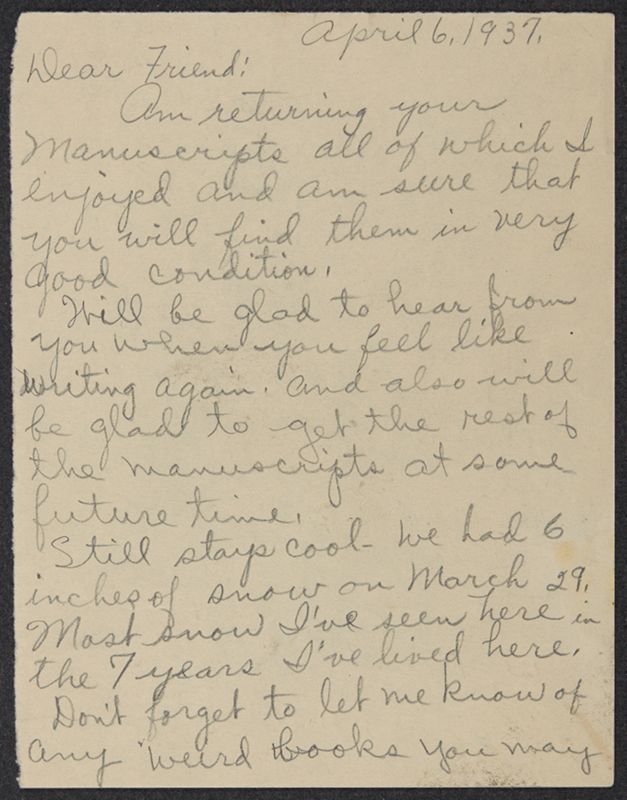
Robert E. Howard’s letter of 9 July 1935 to Novalyne Price while she was staying with her mother and grandmother in Brownwood is aggrieved: he sees himself as the butt of a cruel joke from two people he had seen as friends, but had concealed that they were going together from him for their own amusement. Novalyne, for her part, could not fathom this attitude: she had all but told him she was dating Truett. The “all but” is probably the heart of the break here, no doubt Bob was honestly hurt at the perceived betrayal, and Novalyne in not wanting to hurt him by telling him outright had worsened the miscommunication. Whatever the case, she did not take it well.

I had to read that letter twice to believe it. I was furious. […] My first impulse was to tear the letter up and go throw it in his face. I sat down at the typewriter and wrote him a letter, telling him to go to hel and take his mother with him! I told him that no other woman in the world but me would have put up with him, and that the only reason I did was because I could appreciate a person who had talent and a profession which he worked at hard enough to make the kind of success he had made. I told him I never wanted to see or speka to him again.

After I wrote it, I read it to Mother and Mammy. […]

“What do you think, Mother?” I asked.

“You’ve said it now,” she said quietly. “Tear it up.”

One Who Walked Alone 231-232

She did, eventually. Then, when she had calmed down a bit, Novalyne Price sat down to write Bob another letter, dated 12 July 1935. It begins:

Dear Bob,

Although you leave nothing for me to say, being a woman, I’ll say something anyway. You said that you didn’t care whom I went with. I know that, Bob. During the time that I went with you, I realized perfectly how you felt about women. Women chain a man down. You always wanted to be free and independent. Such an idea as being chained to a woman was obnoxious to you. Self-preservation was the first law which you recognize. Strange as it may seem, I, too, demand my freedom; self-preservation is also a law of my life. I’ll do anything which gives me pleasure and consider myself under no obligation to tell my friends my personal business.

One Who Walked Alone 233

There was more, about her relationship with Truett Vinson and Tevis Clyde Smith. For all their dates, Novalyne and Bob had never, apparently, defined their relationship. Though they obviously cared for one another, neither had been ready to commit to one another, at least not at the same time. Novalyne’s tone is still hurt, but perhaps not as angry as her first letter. She mailed it.

When I went to the mailbox this morning, I found an envelope with Bob’s name on it. I frowned. It really didn’t seem to me that my letter had had time to get to Cross Plains, yet here was a letter back from Bob, or else, I thought, as I walked slowly toward the house, this one had been written before he got mine. […]

Surprise! It was not a letter from Bob! It was my letter, the one I wrote last Friday! My letter was in the envelope; he had sent it back to me! There was not a single word or line from Bob…just my letter!

One Who Walked Alone 235

Readers today may argue whether or not Robert E. Howard and Novalyne Price were ever in love, but they certainly knew how to piss each other off. Because of Bob’s gesture, this is the only letter from Novalyne Price to Robert E. Howard that survives.

While they may have wounded each other with things said and left unsaid, this was not the end of Novalyne and Bob’s relationship. Her memoirs for the 1935-1936 school year at Cross Plains are less detailed; a bit of the bloom had come off the rose, and Bob Howard had made some long trips as he ferried his mother to hospitals and healthcare facilities in Marlin and San Angelo, Tx., and so he was sometimes away from Cross Plains for days or weeks at a time. But they had managed to forgive each other a little, if not forget. That was part of their dynamic. Novalyne doesn’t write much of their correspondence during this period, but in an entry dated 13 February 1936 she wrote:

“The way to interest a writer, I said to my roommate, “is to ask him about his writing. After you find out what he’s doing and selling, you ask him to help you with your writing.” […]

“So you’re going to ask him about his writing?” she laughed.

“The letter is written and mailed. I asked him where and how much he was selling these days. Then I asked if he had any suggestions about markets I might sell to.”

He answered so promptly Mary Beth put her hand to her mouth and began munching away—to show me I had him eating out of my hand.

One Who Walked Alone 261-262

Bob replied in a good-sized letter dated 14 February 1936; noting the date he added near the end:

This being Valentine Day, I suppose I should make the conventional request for you to go and join the army. That may sound a bit wobbly, but look: Valentine comes from the same word from which “gallant” is derived; a gallant may be a suitor, but is also a cavalier; a cavalier is a knight; a knight is a cavalryman; a cavalryman is a soldier. To ask one to be one’s Valentine is equivalent to asking him, or her, to be a soldier. And one can’t be a soldier without joining the army. So, a request to become a Valentine is approximately a demand to go and join the army.

One Who Walked Alone 264

Yet beneath the surface, all the same issues that had driven them apart before remained. Hester Howard’s health continued to decline, Novalyne continued to harp on Bob about his appearance—she made a particular point of impugning his mustache—and there were other little misunderstandings that often cropped up into disagreements. For all their mutual admiration, Novalyne had no understanding of the seriousness of Hester’s illness or how her decline weighed on Bob; nor did Bob seem to understand why when he was feeling so blue she would pick on him about his mustache of all things.

In late February Bob once again took his mother to Marlin, Tx. for further medical treatment. It meant standing up Novalyne for a date…and he wrote her a letter to apologize for it and explain why, but quickly broke down into a torrent of words over their last date (“My God, arguing over a mustache when my whole life is crumbling to powder under my hands!”), until at the end he summed up with “[…] all I ever wanted was to be allowed to enjoy your company, and I always did, when you gave me any kind of chance. Your friend, Bob” (One Who Walked Alone 274).

I read the letter twice. Then I went into the bathroom, sat down and cried with anger and frustration. He did a beautiful job of blaming me for being foolish and mean when his life was breaking up around him! I admit I handled the situation badly! Should I write to tell him I loved Truett and that it nauseated me to death to hear him say about his mother: “I changed her gown and bed three times last night.” I think that’s his dad’s job. Not Bob’s.

One Who Walked Alone 274

At this point, it’s worth recalling that we really have only Novalyne’s memoir to describe her relationship with Robert E. Howard. Bob wrote almost nothing about his relationship with her: why would he mention such things to H. P. Lovecraft, August Derleth, or Clark Ashton Smith? They were peers at Weird Tales, but not intimates of that sort. Many of the incidental details of Novalyne’s memoir can be verified in other details of Howard’s letters, like the fact that in January 1936 Hester Howard suffered from terrible night sweats that required changing her gown and bedding.

Novalyne’s honesty in her memoir is presenting it “warts and all”—she does not come across as the sympathetic party, being honest about her own mistakes and feelings at the time, including her lack of understanding and empathy for what the Howards were going through.

The day after he mailed that letter ot me from Marlin, he wrote me a card, a fairly cheerful card, saying his mother seemed to be doing well, and he, too, was feeling better. I didn’t answer. I wasn’t ready to say anything else to him. I had already written him a letter, trying to excuse myself for the silly things I’d said. In some ways I chickened out and said I was unhappy.

One Who Walked Alone 275

Bob’s reply is dated 5 March. A certain strain of fatalism runs through it, beginning with the first paragraph:

Dear Novalyne;

I just not read the letter you wrote me Monday, February 24th. None of my mail has been forward to me at Marlin and this letter was with the rest I got out of the post office this morning. I’m sorry I didn’t get it before I left. If I had, I wouldn’t have written you in what must have seemed like such a bitter strain, though I did not mean it that way. I can’t blame you for not answering the card I wrote you from Marlin. It’s hard, in the last analysis, to blame anyone for anything. We are all caught in a mesh of circumstances we cannot break.

One Who Walked Alone 276

The Cross Plains school year ended 22 May 1936; these were their last days together, as Novalyne had already applied for and been accepted at Louisiana State University for graduate school over the summer, though she would be back in Cross Plains for the 1936-1937 school year. In packing her things to leave, she returned one of the books Bob had given her as a gift…and he wrote what turned out to be his final letter to her, dated 27 May 1936:

Dear Novalyne,

You needn’t have bothered about returning the book. I intended for you to keep it, if you wanted it. I hope you enjoy your vacation, and that you’ll find Louisiana all you hope it to be. I’m sure the courses of study you’re taking will be interesting and helpful. With the best wishes for your health, prosperity and success, I am, as I always was,

Your Friend,
Bob

One Who Walked Alone 297

Two weeks before this, Howard had written to H. P. Lovecraft that he had “renewed an old love affair and broken it off again” (A Means to Freedom 2.953). On receiving the letter, Novalyne Price wrote:

Tomorrow, I promised myself, when I finish packing for LSU, I’ll write Bob a friendly letter—one that will make things all right between us again.

One Who Walked Alone 297

She never wrote that letter. Robert E. Howard would commit suicide on 11 July 1936, while Novalyne Price was at Louisiana State University; she would not return to Cross Plains until time for the 1936-1937 school term.

The correspondence of Novalyne Price and Robert E. Howard shows us how limited our understanding of relationships can be, not just because we have only an incomplete correspondence—ten letters and postcards from Bob to Novalyne, and one letter from Novalyne to Bob—but because so much of their relationship existed outside of that correspondence. While Robert E. Howard only ever interacted with C. L. Moore and H. P. Lovecraft through the mail, Novalyne and Bob would have interacted mostly face-to-face, talking, laughing, arguing, kissing, and enjoying a quiet moonrise as the case may be. For them, the letters were a buttress to their relationship, mostly during times when they couldn’t enjoy such facetime because of Novalyne’s busy schedule or because they were separated by distance (Novalyne going home to Brownwood during the school breaks, Bob’s trips around Texas and into New Mexico and Mexico).

We don’t have Robert E. Howard’s perspective on the relationship, but in comparison to his letters to friends and peers, his letters to Novalyne seem more intimate and unguarded; it was not unusual for Howard to shift his tone to display humor or pathos and self-recrimination, but the letters to Novalyne do seem to have a quality of pouring his heart out, at least as much as he can. Novalyne’s sole letter, and description of her other letters, show both honesty and her fierce independence. It was not a relationship where either Novalyne or Bob was solely at fault, both had flaws that prevented them from coming together…and punctuated, at last, with a single unanswerable letter.

It’s a feeling that I think everybody who knows a friend or family member who commits suicide feels. The feeling of guilt has this to do with it—you say, “If I hadn’t said thus-and-so, if I’d been more sympathetic, if I hadn’t sent that book back to Bob, if I’d gone by that morning, if I’d answered his letter”—all these things that you say. It doesn’t matter that maybe your reasoning mind can tell you “Oh, well, this would not have done it”—you still think it.

Novalyne Price Ellis, Day of the Stranger: Further Memories of Robert E. Howard 20

For more information on Novalyne Price Ellis and her relationship with Robert E. Howard, please see:


Bobby Derie is the author of Weird Talers: Essays on Robert E. Howard & Others (2019) and Sex and the Cthulhu Mythos (2014).

Editor Spotlight: Interview with Oliver Brackenbury of New Edge Sword and Sorcery Magazine

New Edge Sword & Sorcery is an upcoming magazine which hopes to showcase not just the sword & sorcery fiction of yesteryear, but what sword & sorcery can be. Editor Oliver Brackenbury has been kind enough to answer a few questions for us about what New Edge is, the new magazine, and their approach to editing. One note before we begin:

Oliver Brackenbury: Up front I want to stress that when I’m discussing my attitudes and methods in this interview, discussing them is all I’m doing. I’ve been reminded lately how easily this can come off as a critique of others, or my suggesting there is only one correct attitude and approach. If people take something valuable from what I say, great, but I’m not being prescriptive here.

What is the one-sentence pitch for New Edge Sword & Sorcery Magazine?

OB: New Edge Sword & Sorcery magazine will feature brand new sword & sorcery short stories as well as intriguing non-fiction related to the genre’s past, present, and future!”

If I can be cheeky and slip in a second sentence, this is our definition of the idea of New Edge Sword & Sorcery, which informs everything done within the magazine:

“New Edge Sword & Sorcery takes the genre’s virtues of its outsider protagonists, thrilling energy, wondrous weirdness, and a large body of classic tales, then alloys inclusivity, mutual creator support, a positive fan community, and enthusiastic promotion of new works into the mix.”

What are your favorite classic Sword & Sorcery stories and why?

OB: Ah, that’s a tough one! I’ll limit myself to three tales, with the caveat that on any given day I might slot one out and slot another in.

Going back to the big man himself, “People of the Black Circle” is my favorite Conan tale.While I suspect Howard had stage plays in mind, if any other storytelling medium, this is hands down the most cinematic of his tales—that pacing!—and as a screenwriter I appreciate that. Nobody in the story is without compelling motivation or some kind of arc, not even Conan’s “mad Afghulis” who lack individual names but are given great purpose and entertaining turns as their loyalty to Conan understandably wavers. The way Conan and Devi Yasmina part on terms of mutual respect, admiration, and competition is a moment I am absolutely chasing in my own writing, I enjoy it so much, and the strong thematic backbone to the tale, the classic “personal desire vs responsibility to others”, is explored with great skill.

C.L. Moore’s “Black God’s Kiss” deserves its excellent reputation, and it deserves to be more broadly known. Moore’s dreamland of an underworld is gripping, as is the emotional throughline of Jirel’s seeking revenge for that forced “kiss”, and the imagery—oh that imagery! The Ace Fantasy edition’s cover, by Stephen Hickman, with the blind horses galloping, fleeing, flowing around Jirel is the only one for me.

My third choice is “Ring of Black Stone” by Pat McIntosh—and really all five Thula tales in total. Bloody shame they haven’t been collected yet, you can only read them one at a time across the first five of Carter’s The Year’s Best Fantasy Stories anthologies. McIntosh’s war-maid protagonist, Thula, reminds me a little of Russ’s Alyx the pick-lock, both seemingly straightforward characters who reveal intriguing depths while inferring even greater ones, with seemingly simple motivations which you often realize are different than what they’re telling everyone, and who show a great deal more evolution in a few short tales than some S&S protagonists do in their whole careers, yet are still sufficiently recognizable as the person you started with—maybe she hasn’t really changed at all, maybe you’ve just gotten to know Thula better! I find myself thinking back on these stories often, Ring in particular for its touching tale about finding new family through tragedy, and the riot of feelings that entails.

Finally, I’ll give an honorable mention for Leiber’s “Lean Times in Lankhmar,” whose climax got the biggest laugh out of me S&S has managed so far.

In your guest post on Scott Oden’s blog discussing New Edge as a mode or evolution of Sword & Sorcery fiction, you emphasize “inclusivity.” What does that mean in the context of the stories and writers you’re looking to publish?

OB: What inclusivity means to me is making sure that people outside my own demographic—white, cishet, neurotypical, able-bodied males, or just “white guys” as, for the sake of brevity, I’ll use going forward—can see themselves in both the stories and the authors creating them, ideally making them feel welcome within the community. This is key for expanding the audience of our beloved fantasy sub-genre, as well as its pool of authors.

I’ve gained firsthand experience with this in my six years volunteering with a group dedicated to promoting the western Hemisphere’s largest publicly accessible speculative fiction genre archive—The Merril Collection. Through no malice of anyone involved, in the time I’ve been with them, our group has been made up almost or entirely of white people. Our selling old paperbacks to help raise funds would often combine with 20th century publishing trends to create the scene of a couple of white people sitting behind event tables coated in covers featuring white characters written by white authors, trying to encourage the full breadth of humanity to spend a few dollars in support of the collection, while hearing our pitch for it.

All that sameness was a significant obstacle to achieving our goals, as more than one non-white individual made clear when—quite reasonably—saying “I only see white faces here.” or “I don’t see myself in what you are doing.”

Even coming back to myself, I don’t hate my fellow white guys any more than I hate IPAs, but I get frustrated when the vast majority of shelf space is filled with the same thing, whether it’s beer or writerly perspectives. All of this has informed the approach I’m taking with the stories and authors I’m looking to publish.

Would you characterize New Edge as a reaction to the real or perceived lack of diversity in Sword & Sorcery fiction written by Robert E. Howard and others?

OB: In part, absolutely yes. Keeping in mind I can only speak for myself and the magazine I run, not the nascent “movement” which roared to life back in the spring of this year, I would say that is a significant part of the appeal, as well as its reason for being.

This does not mean burning down all that came before. Again, I’ve been a volunteer promoting a speculative fiction archive for six years! “We still study the art of Ancient Greece, yet we have ceased to wipe our behinds with small stones,” is my glib way of stating how I feel about studying the art that came before us, for all the old or objectionable attitudes which it may contain.

But whether looking through the canon or glancing around at the contemporary fan & creator community, I mostly see faces like my own. I think changing this not through exclusion, but through greater inclusion, is vital to increasing the popularity & longevity of sword & sorcery.

What do you think of Howard’s women warriors in his Sword & Sorcery tales such as Valeria of the Red Brotherhood (“Red Nails”) and Bêlit (“The Queen of the Black Coast”)?

OB: Dig’em both, including the stories. Like many others—judging by the number of additional adventures she’s had in various comics over the decades—I wish Bêlit had gotten to do more before dying in service of Conan’s story. I feel similarly with Valeria, an overall badass character who didn’t die but did end up chained to an altar so Conan could rescue her. It’s little surprise others have gone on to write more stories with her as well.

Clearly Howard succeeded in creating highly compelling women warrior characters, and I’ve enjoyed all the tales containing them. However, understandably for the period, they are often crafted as a kind of novelty—it’s right there in the title of “Sword Woman”—and one of the ways we can build on what Howard accomplished is by creating proactive, highly capable female characters for whom their gender is not a defining feature, or—as in the case with the 1970’s version of Red Sonja—requiring some kind of supernatural explanation for their skill & toughness. I think this is pretty much the norm these days, but it’s worth keeping in mind.

You specifically mention “Carbon Copy Conans”—do you think that it was authors who followed Howard in creating new Conan stories perpetuated some of the stereotypes of race, sex, and gender in Sword & Sorcery?

OB: Not all of them, but going by what I’ve seen of them so far, yeah, absolutely. Whether authoring direct Conan pastiche or writing a Conan-by-another-name, some of those works are very much surface reproductions of what Howard did, focusing on whatever the author was attracted to—and I think some of those second wave S&S guys writing this stuff in the 70’s, 80’s and even 90’s were attracted to the old fashioned attitudes of the 30’s.

This treatment also served to perpetuate the idea that there were no deeper notions behind Howard’s work. Not as damaging as focusing on and magnifying bigoted attitudes, but also a shame.

Much of Sword & Sorcery takes place within a quasi-medieval European setting; do you think that is essential to what makes Sword & Sorcery distinct from, say, Sword & Planet or historical fantasy fiction?

OB: Thanks to there being some pretty consistent storytelling conventions within sword & sorcery, excellently laid out by Brian Murphy in his book Flame & Crimson: A History of Sword & Sorcery, I feel safe saying that a quasi-medieval European setting isn’t strictly necessary. Certainly the “European” part isn’t mandatory, as authors like Saunders and Dariel Quiogue have demonstrated with great skill.

In terms of the era, I think once you’re past the point of flintlock showing up you’ve kind of hit your limits—it’s hardly sword & sorcery if nobody uses swords anymore. That said, part of my great love of the genre is that it can be oh so many things, and still be clearly recognizable as sword & sorcery. We may enjoy sub-sub-headings like Sword & Planet, Sword & Soul, Sword & Silk…but it’s all part of one big happy family, to me.

You mentioned Dungeons & Dragons as well. How does tabletop roleplaying gaming (TTRPG) influence New Edge?

OB: Well I do love me some TTRPG action, in particular Dungeon Crawl Classics and the Call of Cthulhu spin-off setting, Delta Green. That said, RPGs don’t influence NESS a whole lot beyond my having aggressively dug through Gygax’s increasingly well-known Appendix N Reading List, and finding myself mostly preferring the less highly codified fantasy which came before D&D blew up in the early 80’s.

It seems since then that while variations often occur, at the end of the day most fantasy authors—certainly those rooting their work in Western myth & folklore—like to play with the same demihuman races and creatures you’ll find in one monster manual or another. Outside of a game with its need for rules & definitions, why would you ever standardize the fantastic? It feels counter-intuitive to me, thus my love of the far less predictable, weird and wonderful fantastic elements you’ll find in sword & sorcery, past and present.

It’s fair to say this attitude influences my developmental editing when working with authors writing for the magazine, and will continue to do so moving forward. If there’s a classic fantasy creature in a story I publish, it’s likely because the author made an incredible case for it in their story, and/or it works because of how it deviates from what the creature’s name makes you expect. So yeah, I’d say that’s the main influence of D&D on the magazine thus far.

The field has changed a good deal from the Sword & Sorcery boom of the 1980s and 1990s. If Karl Wagner was alive and sent you a Kane story, or Jessica Amanda Salmonson sent you a Tomoe Gozen or Amazon story, would those have a place in New Edge?

OB: I confess I’ve not read Salmonson’s Gozen or Amazon tales yet, though they are high on my TBR list. That said, I imagine I’d review them the same as I have, say, Bryn Hammond’s tale in NESS #0 and decide accordingly. I gather Salmonson was something of a scholar on medieval Japan but, as I say, I need to read more by and regarding her.

Luckily I have read all the Kane novels and several of the stories. While I can see my own personal taste causing me to request any explicit descriptions of sexual violence be minimized,  I’d still potentially publish a story like “Cold Light,” where such violence illustrates character, while—as I recall—not being designed to titilate. Maybe I’d put a content warning on the first page, I confess I’m still deciding where I sit on such things.

But yes, despicable, villainous characters such as Kane absolutely have a home in New Edge Sword & Sorcery. Including challenging topics doesn’t equal endorsing them, and one of the purposes of literature is to explore difficult themes & ideas. As ever, skill and thoughtfulness make all the difference.

Women have written Sword & Sorcery too, from C. L. Moore’s Jirel of Joiry to Joanna Russ’ Alyx; how do these authors and their creations fit into your conception of New Edge?

OB: My opinion is that they are to be enthusiastically studied and promoted. I shan’t be ignoring the men of the genre’s history, however I can’t see myself rushing to publish profiles on the most frequently discussed fellas, like Howard or Leiber. Cora Buhlert is contributing a great profile of C.L. Moore to issue #0, which I hope will serve as a useful introduction to both the author and her most well-known creation. Joanna Russ, Pat McIntosh, and Jessica Amanda Salmonson are on my wish list for future profiles, as well as editors like Cele Goldsmith Lalli, who saved Fafhrd and Gray Mouser from oblivion, discovered Roger Zelazny, and published S&S when no one else did.

Another evolution of Sword & Sorcery that is aimed at greater diversity is Sword & Soul, as exemplified by Charles Saunders’ Imaro and Milton Davis’ Griots stories. How does New Edge relate to Sword & Soul? 

OB: It actively celebrates and promotes it! Issue #0 features a sword & soul tale by J.M. Clarke, I’ve already reached out to Milton Davis about his writing an author profile on Charles Saunders for a future issue, and have been in touch with a second sword & soul author about contributing a story to either issue #1 or 2, should our crowdfunding campaign for more issues succeed.

This also brings me to an important point, since sword & soul clearly predates New Edge S&S—whether the idea or the magazine of the same name, New Edge Swordy & Sorcery isn’t claiming to have invented the idea of diversity/equity/inclusion in S&S. What it does is add to diversity, equity, & inclusion in S&S, purposefully and with great vigor, while providing a rallying banner the various scattered parties already engaged in this work can choose to unite behind.

“What about [this person] who’s already doing [this thing related to more diverse S&S]?” I’ve heard one or two people say, and my response is always “They’re great, I dig what they’ve been doing, and maybe we’ll work together one day.” It’s not a zero sum game, or any other kind of competition, it’s a collective endeavor.

Many speculative fiction magazines in the past have had an issue with lack of diversity among the authors; it wasn’t unusual even well into the 90s for every author to be white, male, and heterosexual, and the contents of those magazines tended to reflect that. How do you as an editor plan to ensure the diversity of your magazine?

OB: Hell, you still see it today, now and then, or perhaps you see a ToC that’s all white guys but for one or two white women tacked on. Let’s be wary of thinking these issues are done and dusted.

My current plan to ensure diversity in the magazine is by being intentional about the authors whose work I solicit. I’m not doing subs, yet, and I suppose when I get there I’ll have to think about how to handle that. For now I’m limiting the number of white guys I publish in any given issue to one or two, out of six authors total.

Why the limit? Why not just focus on good stories?

Because if you are trying to effect positive change to the current status quo of homogeneity, as I am, then simply focusing on good stories isn’t enough. It ain’t shabby, there are far worse approaches, but it won’t do the trick.

This is because even if you request submissions without names on them, you are only being mindful of things on your end. The world in which your magazine exists, from which those stories are submitted, is not a meritocracy. It is a wildly uneven place where issues of race, gender, class, etc all affect who can even get to a place where they can tell good stories, and who feel welcome participating in any given literary scene. 

The latter is not necessarily because you personally have done anything to make them feel unwelcome, but because the scene as a whole looks extremely white guy-centric and doesn’t seem to be putting off enough signals like “Hey, come on over, you’re welcome here”.  Therefore, regardless of how pure your motives, as an editor you will likely, unintentionally replicate the demographic homogeneity of the scene in your ToC if you aren’t at least somewhat intentional about trying to compensate for this wildly uneven world we all live in, by making a point of spreading around the love, so to speak.

So diversity is a substitute for good stories then?

No. Good stories are assumed. If you’re in the magazine, it’s because I thought you told a good story. This can be a master of their craft, or it can be an emerging talent with promise that I want to support through publication/promotion/payment, but either way nothing has been substituted for a good story. Inclusion is a parallel concern of mine. Beware false choices, folks!

Along similar lines, I’m choosing to have a very clear, concise inclusion statement in the magazine. If the magazine is a restaurant then the inclusion statement isn’t the big neon sign on the roof that says “Burgers!” that brings you in off the highway, that’s the original fiction, non-fiction, and art. The inclusion statement is the wee sticker in the window, near the door, letting you know the appropriate government agency has made sure there isn’t any vermin in the kitchen.

Clearly stating “NOT WELCOME: People who think some humans are less than human because of what kind of human they are,” you know, no hate and no harassment please, has value. This is because for people other than white guys, the risks of entering or participating in the wrong fan community are higher, whether it’s tripping over posts laden with racial slurs & dog whistles, or being harassed for being a woman, and so on. 

Unambiguously letting people know that sort of thing isn’t welcome—and demonstrating as such through your actions—helps expand the pool of people who’ll submit to the magazine, read the magazine, engage with our social media community, and participate in the sword & sorcery scene in general.

One of the criticisms of Sword & Sorcery fiction is cultural appropriation and the misuse and misrepresentation of BIPOC by white authors. Is New Edge Sword & Sorcery Magazine looking for sensitivity readers to guard against that, or how do you plan to handle such issues if they come up?

OB: In regards to appropriation, the first thing I like to do is look at the author’s knowledge base. For example, Bryn Hammond will have a story in issue #0 that is in part based on historical / medieval Tangut culture specifically, and edge-of-steppe/steppe culture in general. Bryn is a white Australian woman, by no means of these cultures.

However she is an accomplished scholar of the steppe, published and well-reviewed, who has written a few blog posts about racism towards steppe cultures in SF and other popular media, as well as in popular and academic history books, and someone I know well enough to feel comfortable judging a considerate, thoughtful person. As I reviewed her story I saw only a deep respect and love for her real life historical inspiration, nary a whiff of “Look at this weird shit! How exotic.” And thus, I not only feel comfortable publishing her tale, I’m excited to see what people think of it.

I can see sensitivity readers being a tool I turn to, however indie publishing isn’t known for being highly lucrative, so I’ll have to see what I can accomplish within budgetary limits.

If, despite my best efforts, readers bring up issues of appropriation, then my plan is simple – I will listen, perhaps cross-reference with others more knowledgeable than myself, and adjust my methods for future issues accordingly.

Charles Saunders in his essay “Die Black Dog! A Look At Racism In Fantasy Literature” emphasized his dislike of tokenism in fantasy (“Who needs black hobbits?”)—do you agree with that?

OB: Well, as young Saunders said in that section of the essay “…it is better to be ignored than maligned.” , and I can also see why in 2011, looking back, Saunders said “…I was, perhaps simply venting my anger and frustration…”, though certainly young Saunders had plenty to be angry about, for good reason.

But yes, “maligned”. Tokenism is to malign others through the practice of making only a perfunctory or symbolic effort at inclusion. So to me it sounds more like Saunders was wary of having white writers include black characters because when they did, they were racist caricatures, and he’d rather they just be left out altogether. Fair!

Do I agree? As a white guy, I don’t think it’s really up for me to agree or disagree as it doesn’t affect me much, if at all. In terms of the magazine, certainly I will be doing my best to avoid tokenism in the stories I publish.

You’re working on a New Edge novel yourself. How do you as a writer work to put your ideas on inclusivity into practice?

OB: Being mindful as I can (ex. “Am I describing all the female characters in this chapter by how attractive they are?”), doing research, and, when it feels necessary, reaching out. “Necessary” being kind of a gut feeling based on how far I’m wandering from portraying someone like myself or a secondary world culture rooted in Western European history. 

For example, there’s an important character present for a good chunk of the novel that is bigender. There’s a great deal more to who they are, and making sure characters are never just “The [X] character” is another thing I’m doing, but that’s the relevant aspect for what we’re talking about here.

I’ve never felt any doubts about my gender identity, nor have I ever felt it fluctuate or like it’s on a gradient, so this was going far off from where I stand, demographically. I figured I should do more than read the Wikipedia article, you know?

So I decided to reach out to an online community, over at r/bigender, by explaining who I am, what I’m doing, the context of the character, and so forth, while also making it clear I was interested in hearing from as many people as were comfortable answering my questions. It was an immensely useful experience, both for my writing the character and just for better understanding my fellow humans.

I offered a little compensation for bigender members of the forum who provided me with useful advice, and was touched that none of the advice-givers felt that was necessary. Still, I’m glad I offered, as I strongly believe authors need to be mindful when asking for what amounts to unpaid research labour, especially when it relates to something as personal as identity.

Down the road I may seek a bigender sensitivity reader for the stories featuring that character. We’ll have to see what I can do within the limits of budget and opportunity. In terms of beta readers in general I’ll also try to make sure they aren’t all white guys, since that will help potentially catch issues that I’d not even think to look for.

Which brings me to an always salient point—doing this kind of stuff isn’t just about being thoughtful regarding the experience of your potential readers, it makes your work better.

As an editor, you must have a pretty decent grasp of the field. What writers would you recommend for readers who want to read new Sword & Sorcery fiction, and why?

OB: I always make people nervous when I ask for reading recommendations during my interviews hosting Unknown Worlds of the Merril Collection…and now I’m finally put in the hotseat! With the caveat that of course I can’t list everyone here who I’d like to, I’d recommend…

  • The Red Man and Others by Angeline B. Adams and Remco Van Straten
    I read this book, then bought two extra copies to give to friends. Early in my path through the genre, this book made me feel hope that sword & sorcery has a future beyond rehashes of its past, that it can expand and grow while still being recognizable. For more detail, here’s my Goodreads’ review.
  • Swords of the Four Winds: Tales of Swords and Sorcery in an Ancient East That Never Was by Dariel Quiogue
    Dariel has his own voice, no doubt, however it’s plain to me that he has truly studied the works of Robert E. Howard and REH’s great influence, Howard Lamb, before applying what he learned to his own tales. Outside of being centered on Asian characters, rooted in the history of Asian cultures, while being written by an Asian author, these tales are traditional sword & sorcery in the best possible sense—bold, fast-paced, and gilded with stunning surprises.
  • The Return of the Sorceress by Silvia Moreno-Garcia
    A novella-length tale pulling the unusual-for-S&S move of featuring a sorcerer protagonist, The Return accomplishes many things beyond the baseline of telling a compelling tale—including putting you in the head of the titular sorceress while walking the tightrope between telling enough of how magic works to follow her concerns & goals without going against the genre by demystifying the fantastic with a highly codified magic system.

Full disclosure, I’ve had the good fortune to interview the authors of the first and second books, and would love to interview the third, however that would not be sufficient cause for me to recommend their works. The stories do have to be good, ya know!

Last but not least, can you tell us about where readers can read New Edge Sword & Sorcery and what they can expect? 

OB: Issue #0 of New Edge Sword & Sorcery is due out for some point in September 2022. “Some point” because I’d rather get it right than rush for a Sept 1st launch date. At www.newedgeswordandsorcery.com you can learn more, as well as sign up for our mailing list that will alert members to the release of new issues, and crowdfunding campaigns to fund future issues. That’s all, it’s very low impact on your inbox.

Issue #0 will feature an original painted cover by Gilead, and each of our all-new stories will feature original B&W illustrations, to say nothing of the reprinted pieces kindly lent to us by their artists to enhance our non-fiction essays, book review, and long-form interview.

The magazine will be available in ePub, softcover, and hardcover via Amazon POD. Exclusive to issue #0, the ePub will be free, while the physical copies will be sold quite cheaply, exactly at the cost of production. This first issue is a passion project for all participants, who hope for it to take off like a rocket, that we might crowdfund issues #1&2. From those issues onward I will be paying people, and paying them as much as I can since the stretch goals for the campaign will be almost exclusively pay bumps for writers and artists.

And hey, if I’m being as thoughtful and intentional about inclusion in the magazine, then imagine how carefully I’m considering all the other aspects! The stories, art, and articles will be high quality, and shall only improve if we get to successfully crowdfund further issues.

Thank you Oliver for answering all of these questions, and best of luck to New Edge Sword & Sorcery!


Bobby Derie is the author of Weird Talers: Essays on Robert E. Howard & Others (2019) and Sex and the Cthulhu Mythos (2014).

“Phantasmagore” (2021) by H. K. Lovejoy

She gently unrolled the parchment, staining its edges with her filthy hands, then did her best to recite the strange serpentine text with the same guttural intonation the witch was so fluent with. She remembered the book this passage had been transcribed from, and that stark silver word embossed on its greasy black cover: Eibon.
—H. K. Lovejoy, “Phantasmagore” in Beyond the Book of Eibon 192

Eibon

The Book of Eibon in The Beyond (1981)

In 1980, Italian filmmaker Lucio Fulci directed City of the Living Dead (Italian title: Paura nella città dei morti viventi), the first of what would become known as his “Gates of Hell Trilogy,” the other two films of which are The Beyond (1981, …E tu vivrai nel terrore! L’aldilà) and The House by the Cemetery (1981, Quella villa accanto al cimitero). The films share little continuity of plot or setting: all involve one of the doorways to hell opening, resulting in hauntings, baroque and gory deaths, and the undead, and all contain references to or elements of the Mythos—the eponymous “City of the Living Dead” is Dunwich, and the Book of Eibon appears to prophesy or predict some of the events of the films.

Even these references are very slight; Fulci wasn’t quite trying to bring Lovecraft or Clark Ashton Smith directly to the big screen, and the films do not reference each other and can be viewed standalone. What unites them is Fulci’s style: visceral, weird, almost poetic compositions of color and sound. He was fond of eye trauma and smoking acid dissolving faces, but largely avoided sexual exploitation or the mondo excesses of, say, Cannibal Holocaust (1980).

Fulci’s trilogy became cult favorites among the horror movie buff scene, and remain so even today with remastered re-releases and commentaries. They’ve also inspired some other media, notably a series of comic adaptations form Eibon Press, and fiction including The Final Gate (2021) by Wesley Southard and Lucas Mangum, and the anthology Beyond the Book of Eibon (2021) edited by Perry Ruhland and Astrid Rose for Death Wound Publishing. Unfortunately, the latter company appears defunct so if you missed the kickstarter, finding a copy might be quite difficult.

“Phantasmagore” by H. K. Lovejoy is the final story in Beyond the Book of Eibon. The tale is brief, and Lovejoy enjoys an elaborate and detailed style reminiscent of Smith or Lovecraft’s more ultraviolet prose:

Mounds of her honey hair fell in an exquisite latticework across her bare breasts and stomach, only to be gently reshuffled by her lover.
—H. K. Lovejoy, “Phantasmagore” in Beyond the Book of Eibon 193

In the context of Fulci’s trilogy, however, it works. It evokes something of his style, of the artistry of horror, the beautiful moments that then break into desolation and decay. As with the films, the story is set in their orbit but independent of their plots: a Dunwich affair leads to ghastly supernatural revenge via the Book of Eibon. Lovejoy isn’t afraid to go full Fulci when it comes to describing the culmination of the affair, doesn’t let the reader’s eye drift away from the page. Which is, again, quite fitting.

Her eyes had reduced to frothing pools of blood, allowing the brains, which had taken on a gelatinous state, to plunge through her sockets from the blind momentum of nightcrawlers.
—H. K. Lovejoy, “Phantasmagore” in Beyond the Book of Eibon 194

“How Lovecraftian (or Klarkash-Tonian) is ‘Phantasmagore’?” is an interesting question. Fulci’s films themselves borrow little from the Mythos, and have their own aesthetic entirely. There are few explanations in Fulci’s films, and it is up to the reader to theorize and interpret the images and events that appear on screen, to try and make sense of what are ultimately irrational happenings. Lovejoy’s story is more straightforward than Fulci’s films, and outside the context of the anthology in which it appears could easily be taken as a brief Mythos tale—there, after all, is Dunwich, there is the Book of Eibon. You don’t need the whole eldritch pantheon in every story.

At the opening of the film Manhattan Baby (1982), Fulci gives an apocryphal (and most likely invented) quote from Lovecraft:

Il mistero non è attorno alle cose, ma dentro le cose stesse.
Mystery is not around things, but within things themselves.

Ultimately, it is up to the reader to decide where “Phantasmagore” lies…whether it “counts” as a Mythos story, or a story set exclusively in the Gates of Hell narrative universe, or perhaps neither or both at the same time. The story exists as its own work, and can be enjoyed as such; any greater meaning has to be supplied by someone else.

H. K. Lovejoy’s other writing includes The Black in Between (2020), and she is also a funerary artist; her website is https://www.charnelnectar.com/


Bobby Derie is the author of Weird Talers: Essays on Robert E. Howard and Others and Sex and the Cthulhu Mythos.

Deep Cuts in a Lovecraftian Vein uses Amazon Associate links. As an Amazon Associate I earn from qualifying purchases.
Cthulhu Scat Hangover & The Innsmouth Porno VHS (2014) by Adolf Lovecraft

In all of his stories, not one of H. P. Lovecraft’s characters ever pissed themselves in fright. No character soiled their britches as Great Cthulhu stumbled through the waves, or noisily vomited up a half-digested lunch on seeing the swiftly-decomposing remains of Wilbur Whateley. You might run across a reference to a man whose face has been bitten away, but never a dirty diaper; a suggestive smear of blood, but never a drop of menses. A character might be described as moving through filth, but you never get the actual description of the turds, or the rotting carcasses buzzing with flies, or the sudden desperate need for a restroom.

Weird fiction may be horrifying, but it is rarely disgusting. Fear and disgust are basic emotions that can both arise from transgressions, and can be quite intimately linked: a dead body may engender fear and disgust, a prude might find a Satanic orgy both horrifying and revolting. During the heyday of Weird Tales, there was a limit one could go in explicit description, and while later decades grew more lax in terms of actual censorship, many practical limitations remain. Nudity is still more acceptable in horror films than actual feces; a character might be shot a hundred times or bisected by a saw blade, but they probably won’t be drowned in a toilet full of urine.

Even in weird and horror fiction, there are many norms and mores…and transgressing these can result in quite powerful works of art and literature. Terrible, in their own way, but powerful.

This is the psychology of the exploitation films, underground comix, heavy metal and all of its many musical sub-genres and modes with their cover art, and of Splatterpunk fiction and its literary descendants Extreme Horror and Bizarro fiction. For writers and artists who embrace the transgression beyond mere fright, there are strange, vast opportunities to go beyond what any normal writer—even the normal Lovecraftian writer—has gone before.

Of course, it isn’t necessarily pleasant to read or write, but that’s the point. The visceral response, the new emotional sensation that you can’t get anymore. After reading “Innsmouth” or “Cthulhu” for the fiftieth or a hundredth time, do you really still feel the same dread? Or have you gotten used to it? Cthulhu, for many, has become a familiar horror. There are plushies. You can go buy dice and pillows, Cthulhu panties and sex toys. While a Lovecraft reader might be horrified at the mere existence of such merch, Cthulhu itself is far less a figure of terror to most. Cthulhu has become…cuddly.

That isn’t always the case, of course. Some Lovecraftian fiction is more transgressive than others, even in these jaded later days. “Necrophallus” by Makino Osamu (牧野修) is explicitly more visceral than the average Mythos tale; Insania Tenebris (2020) by Raúlo Cáceres pushes Mythos art to an explicit extreme; “The Vulviflora of Vuutsavek” (2008) by Charlotte Alchemilla Smythe is sexually explicit without letting go of the essential element of horror—yet none of these works really embrace disgust as equal to horror. None of them push that element of transgression.

For Lovecraftian works like that, you generally need to look for such works as Edward Lee’s “Hardcore Lovecraft” line including The Innswich Horror, The Haunter of the Threshold, Going Monstering, Trolley No. 1842, and The Dunwich RomanceThese are all stories that put the horror and disgust under a microscope, that don’t pan away or keep the nastier bits of the action off the page or buried under a metaphor, as Lovecraft did. In a more avant-garde vein, you might look at Jordan Krall’s bizarro classic Squid Pulp Blues, pedal-to-the-metal Tentacle Death Trip, and the surreal collection Nightmares from a Lovecraftian Mindor Kevin Strange’s McHumans.

Many of these works are now out of print and rare. Extreme fiction tends to have a limited audience, and self-publishing and small presses have been the norm; once it was Arkham House that published what the big publishers wouldn’t, but now the bleeding, gore-stained edge of extreme Lovecraftian fiction is mostly occupied in self-publishing…and there are some delightfully disgusting treats out on the fringes of known literature.

“Adolf Lovecraft” was the pseudonym for a bizarro writer who self-published three ebooks: Cthulhu Scat Hangover (2014), The Innsmouth Porno VHS (2014), and Cthulhu Bomb (In A Whore’s Guts (2016). While never destined for any best-of anthologies and largely ignored by critics, these are works that are exactly what they set out to be: nasty deep dredges where the balance is less on Lovecraftian horror than Lovecraftian disgust.

Cthulhu Scat Hangover contains two stories: “The Brown Eye From Beyond” and “Cthulhu Scat Hangover.” Both of these stories deal with very similar themes and visuals, and barely amount to more than a scene each; they may or may not have been inspired by a similar scene in chapter four of “The Apocalypse Donkey” in Squid Pulp Blues…

The wet sounds of shit-hitting-cement got louder. The tentacles got closer and before they wrapped around his leg, JImbo thought he saw the hypnotic and crystalline eyes of a squid. He blinked, thinking it was his imagination but when he looked again, they were still there.
—Jordan Krall, Squid Pulp Blues 146

…or perhaps not; independent invention has happened before and will again.

While some of the images are striking, the prose is rather straightforward, with an almost business-like low-budget horror movie earnestness than any effort to wax loquacious. Adolf Lovecraft does not try to ape Lovecraft’s loquaciousness and occasional ultraviolet prose.

The pain was indescribable as Angela from accounts slowly forced her entire fist into his sphincter. He was screaming gibberish, completely helpless, and she too was shouting something equally nonsensical—”Cthulhu R’lyeh wgah’nagl fhtagn!” or some such bollocks—as her wrist, then her forearm, strekaed with gore and faeces, disappeared past Donny’s torn, haemorrhaging anus.
—Adolf Lovecraft, “Cthulhu Scat Hangover”

The stories also have no wider Mythos to tie into; aside from the name and familiar incantation, we aren’t left with any idea of why Angela from accounts is doing this, exactly. We don’t see the cult, if there is one, we get one perspective of a life with all of its petty bullshit hopes, ambitions, fears, and insecurities, and then he dies on a toilet after shitting out a tentacled horror.

It isn’t even played for laughs.

The Innsmouth Porno VHS also consists of two short works: the eponymous “Innsmouth Porno VHS” and “Brown Shower Apocalypse.” The latter has more in common with the contents of “Cthulhu Scat Hangover” than the others, and again there’s that sense of familiarity of theme, if nothing else, with Krall’s Squid Pulp Blues: the looming apocalypse, the terrible mundane sordidness of human relationships, sexual paraphilia, and the use of drugs and alcohol to cope. While it isn’t wholesome to any degree, “Brown Shower Apocalypse” isn’t written as a story to cater to or condemn those who have a sexual desire for a woman to shit on their chest like that infamous scene in Ilsa, She-Wolf of the S.SAs kinks go, it’s disgusting but not horrorific…except, perhaps in this story where it blends from one into the other at the end.

“The Innsmouth Porno VHS” is a different approach: no scat, for one thing. For another, it engages in a bit of intriguing worldbuilding:

Mike and I, in our early 20s, had been born into a world in which the Innsmouth Condition already existed. The Innsmouth kids had been born about a decade earlier. It wasn’t exactly commonplace to us—I’d only ever seen a couple of people with it in my life, and that had been in large cities—but it definitely was part of the world.
—Adolf Lovecraft, “The Innsmouth Porno VHS”

Imagine a world where developing fishy attributes was like Thalidomide babies. Pornography is already intensely driven by genre and tags; the desire for new and different sees users browse by both specific sexual acts and kinks and types of performers. Race, sex and gender, hair color, body types, body modifications like tattoos and piercings are all fair game. It wouldn’t be that strange to imagine what adults with Innsmouth Condition might end up doing in front of the camera…

It is about as far from cosmic horror as you can get. If Joe Koch is correct that body horror is the opposite end of the spectrum from cosmic horror (A Transmusculine Horror Writers Looks At Lovecraft), then “The Innsmouth Porno VHS” might suggest that the spectrum has another axis, and that body disgust is the opposite end of the spectrum from cosmic disgust. The idea recalls Arthur Machen’s dialogue on sorcery and sanctity, the idea that there are transgressions of the mundane world that are more repellent than mere theft or murder, the kind of revulsion against reality hinted at in some weird tales:

And for three hundred years I have done his bidding, from this marble couch, blackening my soul with cosmic sins, and staining my wisdom with crimes, because I had no other choice.
—Robert E. Howard, “The Tower of the Elephant”

A tentacled entity sliding out of a broken rectum covered in shit into a toilet might evoke mingled disgust and horror, but there is nothing of the cosmic in a videotaped orgy featuring two women with birth defects. Weird, certainly; outside the mundane categories on your pornographic website of choice, but the physicality of a hardcore sex tape, with spitting, rough sex, and dirty talk spoken from mouths ill-adapted to human speech trends more toward disgust than horror…although there is still that strange fascination that accompanies anything unusual, bizarre, and taboo.

As the name implies, “The Innsmouth Porno VHS” is sexually explicit, but the real focus is on the mental or spiritual corruption of the protagonist. The eponymous VHS awakens something in him, and Adolf Lovecraft deftly captures that sense of utter fascination, of something beguiling in its wrongness, the shivering sensation of watching something you weren’t meant to see…trying to capture, in a sense, that liminal state of watching pornography for the first time, except with less explicit fear of being caught and more explicit visceral attraction mixed with disgust.

The orgy, gangbang, fish fry, whatever it was, began to wind down.
—Adolf Lovecraft, “The Innsmouth Porno VHS”

The difference between this story and the others in Adolf Lovecraft’s small corpus is that the dirtiness and disgust are on the inside. The other stories are gross-outs, violent, nasty, and viscerally disgusting in the acts they describe, and the point-of-view characters don’t survive to develop new kinks or learn any moral lesson. In “The Innsmouth Porno VHS” however, there’s something more…not in the sense of a greater extreme of physical disgust, but maybe in the sense of cosmic disgust. It isn’t just about jerking off to a new fetish for Innsmouth girls, it’s what that new and unnatural libido leads him to do…and that is, in many ways, more disgusting than all the scat-filled references in the other stories combined.

Cthulhu Bomb (In A Whore’s Guts) is an omnibus anthology of Adolf Lovecraft’s work, including all four stories from the previous two collections along with several new ones. The same themes are at play, but the stories don’t build on one another, there is no larger picture to grasp. Many of the same ideas, spinning out in variations, fucked-up situations that are brutal but never beautiful, that degrade but don’t enlighten.

Disgusting stories aren’t for everyone; it is a different kind of transgression, meant to invoke a different response, and while disgust and fear are closely related, the effects they have on mind and body can be very different. For those who think they have delved into the depths of cosmic horror…there may be some things out there that you aren’t ready for yet, and may never be. There are stranger and more terrible things than Adolf Lovecraft out there.


Bobby Derie is the author of Weird Talers: Essays on Robert E. Howard and Others and Sex and the Cthulhu Mythos.

Deep Cuts in a Lovecraftian Vein uses Amazon Associate links. As an Amazon Associate I earn from qualifying purchases.

A Jewish Poet Looks at Lovecraft

A Jewish Poet Looks at Lovecraft
by Norman Finkelstein

I

H. P. Lovecraft always seems to have been part of my literary imagination, but I must have begun reading him somewhere between the ages of twelve and fourteen. I still have my first paperback editions: the Lancer Books with exceptionally cheesy covers (“H. P. Lovecraft summons you to The Colour Out of Space…), the Beagle Horror Collection volumes (including stories by later Mythos writers), and the Ballantine Books Adult Fantasy series, with their charming but perhaps overly whimsical covers by Gervasio Gallardo. I read Lovecraft devotedly for a few years, while also reading a number of other fantasy and science fiction authors. Then I stopped, and began reading “serious” literature—Pound and Eliot, Hemingway and Fitzgerald, Pynchon and Roth. My interest in Lovecraft lay dormant for a long time, but looking back over a period of some fifty years, I realize that his stories provided me with my first, and still one of my most intense, experiences of what I now understand to be the uncanny [das Unheimlich]. 

I refer specifically to the concept as delineated by Freud in his phantasmagoric essay “The Uncanny,” a text which, as some commentators have pointed out, is itself an instance of what it seeks to explain. In regard to Lovecraft, I would stress three qualities of Freud’s uncanny that I believe I recognized even when I read him at an early age: (1) “intellectual uncertainty”; (2) a sense of that which “ought to have remained hidden and secret, and yet comes to light”; and (3) the pervasive influence of “silence, darkness and solitude.” Mark Fisher, who refines and extrapolates from Freud’s Unheimlich in his book The Weird and the Eerie, observes that Lovecraft is the preeminent author of weird fiction because his:

stories are obsessively fixated on the question of the outside: an outside that breaks through in encounters with anomalous entities from the deep past, in altered states of consciousness, in bizarre twists in the structure of time. (16)

Furthermore, “it is not horror but fascination—albeit a fascination usually mixed with a certain trepidation—that is integral to Lovecraft’s rendition of the weird” (17). The fascination with the weird which protagonists in Lovecraft’s fiction experience is mirrored by that of the reader of his work: in “The Dunwich Horror,” for instance, Armitage and his colleagues cannot take their eyes off the body of the dead Wilbur Whateley, and likewise, we cannot stop reading their increasingly compelling story. That was certainly the case for me, though my fascination with Lovecraft seemed relatively short-lived. But that proved not to be the case.

In my late twenties and early thirties, having finished a dissertation on modern poetry and begun my teaching career at Xavier University, I experienced a desire to return to my Jewish roots. Raised in a somewhat observant but mainly secular and assimilated Jewish family in New York City, I had drifted away from Jewishness. Literature had become my religion, and writing poetry (and criticism) was the practice of my faith. My “return” to Judaism was not primarily religious—it was literary. As I read intensely in modern Jewish literature, certain authors stirred up a vaguely familiar sense. These authors, such as Kafka, Bruno Schulz, and I. B. Singer, brought hidden things to light for me. Hardly Lovecraftian, they nevertheless summoned a distinct sense of an outside, twisting my personal experience of time in strange but fascinating ways, and above all, challenging a sense of stable identity. In the modern world, Jews are themselves insiders and outsiders; their sense of history is simultaneously continuous and full of traumatic ruptures. For me, Jewishness began to entail a feeling of the uncanny; Jewishness, as I experienced it, was both familiar and unfamiliar, heimlich and unheimlich, ancient and contemporary.

Add to this my discovery of Kabbalah through the work of Gershom Scholem, and Jewish history and culture became much more mysterious than I had been previously taught. Reading Scholem and other scholars of Kabbalah, I discovered that the rituals and customs I had taken for granted while growing up suddenly became portals through which I could enter other times and places. I began to see a deeper Jewish vision of cosmology, while at the same time learning that Judaism was as suffused with myth as any other faith. The question of belief, always problematic for me, was further cast in doubt. In his magisterial The Uncanny, Nicholas Royle notes that the concept, as delineated by Freud: 

demands or presupposes a new way of thinking about religion….The experience of the uncanny, as [Freud] seeks to theorize it, is not available or appropriate to, say, a Jewish or Christian ‘believer.’ (20)

This accounts in part for the poems I began writing, poems that are also (in proper Jewish fashion) darkly ambivalent commentaries on the texts that proved so fascinating to me. Was I inside or outside of these texts? They blurred my sense of time and self, even as I wrote about them. These poems found their way into my first collection, Restless Messengers. However comfortable, however pleased I was with my “return,” it had also proved to be a little…weird.

Fast forward once again, this time another twenty or twenty-five years. I published a number of books of poetry and of literary criticism. I have written about Jewish literature, and about various other religions and belief systems as they are manifested in modern poetry. I spent years studying psychoanalysis at the Cincinnati Psychoanalytic Institute. Increasingly interested in gnosticism and hermeticism, I began teaching works that engage the sacred and the transgressive, and, while still writing recognizably Jewish poetry, I incorporated elements of the magical and fantastic in my work as well. In an inevitable return of the repressed, my interest in Lovecraft came back to life, as I observed academic criticism engaging popular genres and authors with greater seriousness.

Reading Lovecraft with the same enthusiasm as my fourteen-year-old self, but now equipped with an array of critical tools, I have to acknowledge and come to terms with the ideologically unsavory aspects of his work, his neurotic prejudices and tragic life history. Needless to say, his racism and antisemitism are painfully troubling to me, though in some respects, no more or less troubling than the cases of Pound, Eliot, Wallace Stevens, and Jack Spicer, to name the modern poets about whom I’ve written, and who have unquestionably shaped my own poetry.

In my reading experience, Lovecraft’s case is closest to that of Pound, but the sheer quantity of Lovecraft’s hateful rhetoric exceeds even that of Pound’s correspondence and notorious radio broadcasts. Thus the question now arises, as it has for many writers in the past:  what does it mean to admire and to acknowledge the influence of an author who detests and vituperates the beliefs, behaviors, and customs that have, to a great extent, made you who you are? Who excoriates your “race” and denigrates its history and culture? Who might well find you personally unlikeable if not downright loathsome? And—here is the heart of the problem—who expresses his feelings in language that is often so hyperbolic, and yet so closely intertwined with his most remarkable literary achievements, that it calls upon you to engage with it. We return to that moment when we stare down at the body of Wilbur Whateley, horrified but inescapably fascinated by something repellent and wrong. But in this case, we are looking not at a half-human monster, but at a human, all too human body of morally reprehensible prejudices. Both are equally malevolent.

II

“I am an anti-Semitic by nature,” writes Lovecraft in 1915; he continues: 

The Jew is an adverse influence, since he insidiously degrades or Orientalizes our robust Aryan civilization. The intellect of the race is indisputably great, but its nature is not such that it may be safely employed in forming Western political & social ideas. Oppressive as it seems, the Jew must be muzzled.

H. P. Lovecraft to Rheinhart Kleiner, 10 Aug 1915, Letters to Rheinhart Kleiner & Others 39

Here, Lovecraft establishes the pattern for over twenty years of epistolary invective, though as has been observed by many readers, his racism and antisemitism grow increasingly vicious (and his prose grows more extravagant) after his sojourn in New York City and his firsthand experiences with the teeming streets of Manhattan and Brooklyn. In many respects, Lovecraft’s writing on race and ethnicity is an instance of the pseudo-biological and anthropological discourse that was prevalent from the mid-nineteenth through the mid-twentieth centuries in both the U.S. and Europe, culminating in Nazism. He observes that: 

It is now definitely known that many allegedly Semitic types of today are not in reality Semitic or even white at all, but derived from Asiatic Tatar-Mongoloids who were Judaised by missionaries before their entrance into Central Europe from the Thibetan plateaux in the 8th or 9th century A.D. Of these are the queer-eyed, yellow-red, thick-lipped flat-nosed types seen in Providence’s North End and in many parts of New York.

H. P. Lovecraft to Lillian Clark, 29 Sep 1924, Letters to Family & Family Friends 1.168

Like other American antisemites (again, I think of Pound in his correspondence), he sometimes affects a fake Yiddish accent, writing of Jewish merchants selling gentiles “ah nize pair uff $5.00 pents for $10.00” (A Means to Freedom 1.134). He maintains the longstanding belief, as prevalent today as it was then, that Jews control the media through their great wealth: 

I didn’t say that Jews own all the papers, but merely that they control their policies through economic channels. The one great lever, of course, is advertising.

H. P. Lovecraft to J. Vernon Shea, 8 Nov 1933, Letters to J. Vernon Shea et al. 170

This power, in turn, leads to an undue Jewish influence on the nation’s literary culture: 

But the Jews manage to get money and influence without losing a particle of their hard realism and unctuously offensive rattiness. They push brazenly ahead—in the intellectual and aesthetic as well as the practical field. Right now their control of the publishing field is alarming—houses like Knopf, Boni, Liveright, Greenberg, Viking, etc. etc. serving to give a distinctly Semitic angle to the whole matter of national manuscript-choice, and thus indirectly to national current literature and criticism.

H. P. Lovecraft to Robert E. Howard, 30 Jan. 1931, A Means to Freedom 1.134

And though he eventually came to disagree with Hitler and the Nazis in regard to antisemitic policy, and died before the Final Solution, he once unknowingly foreshadows the Holocaust. Writing of “the stinking Manhattan pest zone” full of “squint-eyed, verminous kikes,” he declares:

I’d like to see Hitler wipe Greater New York clean with poison gas—giving masks to the few remaining people of Aryan culture (even if of Semitic ancestry). The place needs fumigation & a fresh start. (If Harlem didn’t get any masks, I’d shed no tears… & the same goes for the dago slums!)

H. P. Lovecraft to James F. Morton, 12 June 1933, Letters to James F. Morton 324

The complex historical and psychological reasons behind racial and ethnic prejudice vary for every individual; in Lovecraft’s case, his racism and antisemitism appear to arise from a combination of a deeply-seated sense of the superiority of the (increasingly threatened) New England “aristocracy” from which he believed he had arisen, which was exacerbated by personal circumstances, especially, as I noted previously, his precarious circumstances while living in New York. Simple ignorance of the ways of other cultures is always a contributing factor as well, and where there is ignorance there is usually fear. Lovecraft himself admits in his letters that he has no knowledge of Jewish customs or of the Talmud (Letters to F. Lee Baldwin et al. 117); instead, what he observes in New York are: 

assorted Jews in the absolutely unassimilated state, with their ancestral beards, skull-caps, and general costumes—which make them very picturesque, and not nearly so offensive as the strident, pushing Jews who affect clean shaves and American dress.

H. P. Lovecraft to Lillian Clark, 29 Sep 1924, Letters to Family & Family Friends 1.168

“Picturesque” Jews (Lovecraft is almost certainly describing Hasidim) versus “strident, pushing Jews who affect clean shaves and American dress”: this is the extent of Lovecraft’s vision of modern Jewish American life, except when he is raving about “squint-eyed, verminous kikes.” Sonia Greene, the Russian Jewish immigrant to whom he was briefly married during his New York sojourn, is described as “so volatile a Slav” when she first visits him in Providence; he refers to her as “Mrs. Greenevsky” and “Mme. Greeneva” (Letters to Rheinhart Kleiner & Others 186-187,).  According to S. T. Joshi and David E. Schultz, in Lovecraft’s mind: 

Sonia was a properly ‘assimilated’ Jew, like his friend Samuel Loveman: she had adopted the mores of the prevailing Anglo-Saxon culture, so that her ethnic background was not an obstacle.

S. T. Joshi & David E. Schultz, Lord of a Visible World 13

The one area of Jewish culture which Lovecraft engages without prejudice and stereotyping—but still with a great deal of ambivalence—is that of Kabbalah, or Jewish mysticism. Bobby Derie has recently examined Lovecraft’s fascination with S. Ansky’s The Dybbuk, which he saw onstage in New York in 1925, and with the film of The Golem, based on Gustav Meyrink’s novel, which had not yet been translated into English. Lovecraft mentions both works in his essay “Supernatural Horror in Literature,” and has this to say about Jewish culture: 

A very flourishing, though till recently quite hidden, branch of weird literature is that of the Jews, kept alive and nourished in obscurity by the sombre heritage of early Eastern magic, apocalyptic literature, and cabbalism. The Semitic mind, like the Celtic and Teutonic, seems to possess marked mystical inclinations; and the wealth of underground horror-lore surviving in ghettoes and synagogues must be much more considerable than is generally imagined. Cabbalism itself, so prominent during the Middle Ages, is a system of philosophy explaining the universe as emanations of the Deity, and involving the existence of strange spiritual realms and beings apart from the visible world, of which dark glimpses may be obtained through certain secret incantations. Its ritual is bound up with mystical interpretations of the Old Testament, and attributes an esoteric significance to each letter of the Hebrew alphabet—a circumstance which has imparted to Hebrew letters a sort of spectral glamour and potency in the popular literature of magic. Jewish folklore has preserved much of the terror and mystery of the past, and when more thoroughly studied is likely to exert considerable influence on weird fiction.

H. P. Lovecraft, “Supernatural Horror in Literature”

Broadly speaking, Lovecraft’s understanding of Kabbalah as a complex mystical tradition that is both emanational and linguistic is fairly accurate, based on his readings in the tradition of Christian Kabbalah and Hermetic magic—as well as the Encyclopedia Britannica. Then again, there’s also something rather silly in his typically portentous “dark glimpses” and “spectral glamour.” This stereotypically dark and mysterious view of Kabbalah, which had already been studied carefully by non-Jews since at least the Renaissance, reinforces both Lovecraft’s cosmic horror and his antisemitism. For Lovecraft, Jewish magic (and some Kabbalistic rituals are unquestionably magical in their intent) is dark magic.

III

Lovecraft’s “The Horror at Red Hook” is an overt example of his prejudice regarding Jews and Jewish magic. The evil Robert Suydam, the subject of Thomas Malone’s ill-fated investigation, is known as the author of an “out-of-print pamphlet…on the Kabbalah and the Faustus legend.” Indeed, Suydam is something of a Faust figure. In the first part of the story, when Suydam is presented as old and decrepit, he is seen: 

loitering on the benches around Borough Hall in conversation with groups of swarthy, evil-looking strangers. When he spoke it was to babble of unlimited powers almost within his grasp, and to repeat with knowing leers such mystical words or names as ‘Sephiroth’, ‘Ashmodai’, and ‘Samaël.’

H. P. Lovecraft, “The Horror at Red Hook”

Later, at the time of Suydam’s wedding, when his youth and vigor seem to have been restored, Malone takes part in a raid of one of Suydam’s Red Hook properties, where horrifying paintings and words are found on the walls:

The paintings were appalling—hideous monsters of every shape and size, and parodies on human outlines which cannot be described. The writing was in red, and varied from Arabic to Greek, Roman, and Hebrew letters. Malone could not read much of it, but whathe did decipher was portentous and cabbalistic enough. One frequently repeated motto was in a sort of Hebraised Hellenistic Greek, and suggested the most terrible daemon-evocations of the Alexandrian decadence:

HEL • HELOYM • SOTHER • EMMANVEL • SABAOTH • AGLA • 

TETRAGRAMMATON • AGYROS • OTHEOS • ISCHYROS • 

ATHANATOS • IEHOVA • VA • ADONAI • SADAY • HOMOVSION • MESSIAS • ESCHEREHEYE.

Circles and pentagrams loomed on every hand, and told indubitably of the strange beliefs and aspirations of those who dwelt so squalidly here.

H. P. Lovecraft, “The Horror at Red Hook”

What Lovecraft calls “Hebraised Hellenistic Greek” is in some instances Hellenized Hebrew, or simply Hebrew. Without unpacking all the terms, we can note that “Sephiroth” are the emanations of the Kabbalistic Etz Hayyim (the Tree of Life), “Adonai” is Hebrew for Lord, frequently appearing in Jewish prayers; “Saday” is a corruption of “Shaddai,” Hebrew for “Almighty”; and “Heloym” is probably a corruption of “Elohim,” another designation of divinity, in the plural. “Iehova” (Jehovah) is an Anglicized pronunciation of the “Tetragrammaton,” in Jewish belief the unpronounceable four-letter name of God  (יהוה), and “Emmanvel” (Emmanuel) is a name associated with the Messiah, that is, “Messias.” “Samaël” and “Ashmodai” are indeed prominent figures in Kabbalistic demonology. 

Suydam’s associates, we are told, “were of Mongoloid stock, originating somewhere in or near Kurdistan,” which Malone notes “is the land of the Yezidis, last survivors of the Persian devil-worshippers.” The Yazidis are hardly devil-worshippers; their faith combines elements of Christianity and Islam, and they have been subject to genocidal persecution in recent years by the Islamic State in Iraq. Be that as it may, the black magic in “The Horror at Red Hook” seems primarily to be drawn from Kabbalah, despite Lovecraft having picked up these references from the Encyclopedia Britannica

The figure of Lilith arises during the crisis of “The Horror at Red Hook,” when Malone experiences what the “specialists” later call a “dream,” a dream that forces him to resign from the police force and leaves him with what today we would term PTSD. In a Tor blog post on Lovecraft’s story, the horror writer Anne M. Pillsworth flippantly but I think accurately comments on Lilith’s role: 

Lilith, supposedly Adam’s first wife and the consort of archangels! Here she’s sexuality in its most terrifying and least sensuous guise—she has become it, not even female, a naked and leprous thing. That titters. A lot. And paws. And quaffs virgin blood. And hauls male corpses around with insolent ease. Plus phosphorescent is so not the same as radiant or beaming, as a bride should be. Phosphorescence is what mushrooms put out, or rotting things, a fungal light.

The magically reanimated corpse of Robert Suydam flees from what appears to be his “wedding” with Lilith, destroying her golden pedestal (which Pillsworth accurately calls “phallic”) and dissolving into “jellyish dissolution”—whereupon Malone mercifully faints.

In his comprehensive article on Lilith (which appears in his compendium volume simply called Kabbalah), Gershom Scholem traces her origins to Babylonian demonology, and then on through thousands of years of biblical, Talmudic, midrashic, and kabbalistic texts. The common belief that she was Adam’s first wife, who insisted on her equality with him during sexual intercourse, is related in turn to her being regarded as a threat to women in childbirth and a strangler of infants. In Kabbalah, she eventually came to be seen “as the permanent partner of Samael, queen of the realm of the forces of evil (the sitra ahra). In that world (the world of the kelippot) she fulfills a function parallel to that of the Shekhinah (“Divine Presence”) in the world of sanctity: just as the Shekhinah is the mother of the House of Israel, so Lilith is the mother of the unholy folk who constituted the ‘mixed multitude’ (the erev-rav) and ruled over all that is impure.”

Lovecraft’s corrupt but essentially accurate understanding of Jewish concepts informs his sensational narrative, though it is Kabbalah itself, as a demonic set of figures, beliefs, and practices that comes to rule “over all that is impure.” Thus, the antisemitism which pervades his attitudes and correspondence insinuates itself into his fiction as well.

IV

Having briefly surveyed Lovecraft’s views of Jews, Judaism, and Jewish mysticism, and considered how these play out in one of his stories, I want to make a few observations about my engagement with Lovecraft in my own poetry. Lovecraft’s presence is different from that of other antisemitic writers who have had an impact on my work. Like most poets, I am in part an echo chamber, in which one hears the voices of those who have come before me, including such great but vexing modernists as Eliot, Stevens, and Pound. This is a matter of form or style: tone, cadence, turns of syntax, charged words, conscious or unconscious gestures and allusions. For me, Lovecraft’s poetry, with its eighteenth-century rhyme schemes and skillfully handled but deliberately antiquated rhetoric, is much less engaging than his fiction. Rather, I return again and again to his fascinating inventions, which means that it is the stuff of Lovecraft’s stories that I like to play with—selectively, gingerly, and no doubt due to its very loaded themes.

These occasional games coincide with my move, in recent years, to more narrative poetry. Unlike any number of recent writers in the Lovecraft tradition, I have not been inclined to directly revise his work in order to undermine and deconstruct his prejudices. But this is not to say that my appropriations have neglected to address his faults entirely. Irony is my mode, though there is always an underlying sense of transcendental desire. Lovecraft’s cosmic horror, including its morbidities regarding race, ethnicity, and gender is turned inside out.  

One episode in my book From the Files of the Immanent Foundation involves Emma, an Afro-Caribbean psychic who is sent by the Foundation to a conference in the “Summerland.” There, in her astral form, she has a one-night stand with a handsome fellow who may or may not be related to Wilbur Whateley. When Emma, whose handler is none other than Armitage (now retired from his post at Miskatonic University), discovers how she was set up, she creates a computer virus that wreaks havoc with the workings of the entire Foundation. In my poem The Adventures of Pascal Wanderlust (in the collection In a Broken Star), Pascal, an androgenous adventurer and sorcerer-for-hire, has a disturbing vision:

…So Wanderlust ascends—

“Past Midnight! Past the Morning Star!” Her Voice

rushes by in the wind. The tzinorot beckon.

Each Face gazes outward as Wanderlust approaches.

These are the boundaries of the infinite spaces,

the non-Euclidean forms, studied in Antarctica

and Provence. Elder Things hanging with Shimon

bar-Yochai among the hills of Galilee. L’cha Dodi!

The throbbing in Pascal’s temples is more painful

now as the Book opens, floating in the silent void.

The Zohar, aka The Necronomicon. Sacred fantasy.

Drawings by Steve Ditko. Story by Stan Lee.

Later, Pascal, depressed, will take a walk on the beach and meet up with an old friend:

Wanderlust takes the new express from Innisfree

to Innsmouth. Settles into the cushy seat. Please

enjoy our complimentary Wi-Fi. Old-fashioned

Pascal prefers telepathy, tunes in expecting messages

from the beyond. Comes up with nothing but static.

The maggidim have been strangely silent. They have

nothing to say in the face of self-doubt. Negative

capability? Magic, they insist, is an art of the will.

So what will you do now? Wanderlust walks along

the strand, looking out to Devil Reef. An old friend

swims in for a brief visit. Stares at Pascal coldly.

“Nice to breathe the air of upper earth now and then.”

Pascal Wanderlust is nothing but trouble! Sorry,

but that’s what great-great-grandmother said to me

before I left. Tries to right the balance and upsets it

every time. I told them the design was flawed ten

thousand years ago, but why listen to us? We dwelt

in the Abyss before the Beginning. What do we know?

And honestly, Pascal, all those Miskatonic researchers

following your last visit. Former Foundation agents,

every one. Take some advice from an old school chum.

You were a goth with eyeliner and your first pair of Docs.

I was a rich kid from Ohio obsessed with my ancestry.

I learned I could change—the hard way. You can too.”

Looking at these verses now, it occurs to me that Pascal, a sweet Jewish boy-girl who had a Bar/Bat Mitzvah attended by Deep Ones and Elder Things—and about whom I’m still writing—is in one respect Lovecraft’s spiritual descendent. This does not make Wanderlust, or Wanderlust’s author, altogether happy. But as the aquatic being that was once Robert Olmstead says to his old friend Pascal, “I learned I could change—the hard way. You can too.”


Norman Finkelstein is a poet and literary critic. His most recent book of poems, co-authored with Tirzah Goldenberg, is Thirty-Six / Two Lives: A Poetic Dialogue. He edits and writes the poetry review blog Restless Messengers.

Copyright 2022 Norman Finkelstein.

“The Murky Glass” (1957) as by August Derleth & H. P. Lovecraft

While men are thinking of the planets, other worlds may be thinking of us. At least the curious phenomena of that old New England house suggested that possibility… An unforgettable new story of uneathly wonder by two masters of the science-fiction terror tale.

Epigraph to “The Murky Glass” in Saturn: The Magazine of Fantasy & Science Fiction May 1957

August Derleth was one of the original creators of what became known as the Cthulhu Mythos. His contributions started while Lovecraft was alive with “The Lair of the Star Spawn” (1932) and “The Thing That Walked on the Wind” (1933). After the death of H. P. Lovecraft in 1937 and the creation of Arkham House in 1939 to publish Lovecraft’s work, August Derleth would continue to write a number of tales of the Cthulhu Mythos and in the Lovecraftian vein. These were not written immediately with an eye toward filling out the Lovecraft collections or even his own anthologies, but for sale to magazines, mostly Weird Tales, and published over a series of years. The stories can be divided into three groups:

  1. Older stories written with Mark Schorer that were not published until later (“Spawn of the Maelstrom” (1939) and “The Evil Ones” (1940, later reprinted as “The Horror from the Depths”).
  2. Pulpy horror tales (“The Return of Hastur” (1939), “Passing of Eric Holm” (1939), “The Sandwin Compact” (1940), “Ithaqua” (1941), “Beyond the Threshold” (1941), “The Dweller in Darkness” (1944), “Something in Wood” (1948), “The Whippoorwill in the Hills” (1948), “The House in the Valley” (1953), “The Seal of R’lyeh” (1957, also as “The Seal of the Damned”), and the Trail of Cthulhu series (“The Trail of Cthulhu” (1944, also as “The House on Curwen Street”), “The Watcher from the Sky” (1945), “The Testament of Clairmont Boyd” (1949, also as “The Gorge Beyond Salapunco”), “The Keeper of the Key” (1951), and “The Black Island” (1952)).
  3. “Posthumous collaborations” with H. P. Lovecraft: The Lurker at the Threshold (1945), “The Survivor” (1954), “Wentworth’s Day” (1957), “The Peabody Heritage” (1957), “The Gable Window” (1957, also as “The Murky Glass”), “The Ancestor” (1957), “The Shadow Out of Space” (1957), “The Lamp of Alhazred” (1957), “The Shuttered Room” (1959), “The Fisherman of Falcon Point” (1959), “Witches’ Hollow” (1962), “The Shadow in the Attic” (1964), “The Dark Brotherhood” (1966), “The Horror from the Middle Span” (1967), “Innsmouth Clay” (1971), and “The Watchers Out of Time” (1974); and Robert E. Howard: “The House in the Oaks” (1971).

The individual merit of these stories varies considerably, but it should be apparent that taken together they represent a substantial body of “Lovecraftian” fiction: 34 short stories, novelettes, and a novel—and Lovecraft’s own published fiction only amounts to 65 stories (plus ~33 revisions and collaborations like “Four O’Clock” (1949), “The Curse of Yig” (1929), “The Night Ocean” (1936), etc.)…and Derleth had, as well as his fictional input to the Mythos, a strong editorial influence on how Lovecraft’s fiction was interpreted, through his introductions to various anthologies and collections of Lovecraft’s work, analyses of his fiction, press releases etc. This is why after Derleth’s death in 1971 there was pushback from fans like Richard L. Tierney in “The Derleth Mythos”—and this in turn lent impetus to a Lovecraft purest movement in publishing and scholarship.

Much of the animus against Derleth is centered on his “posthumous collaborations” with Lovecraft. To better understand the reasoning behind these, it is important to understand what Derleth publicly claimed and presented these stories as:

Not for twelve years has the byline of the late, great Howard Phillips Lovecraft appeared on any new work–and it appears now only because, among the papers of the late R. H. Barlow are found Lovecraft’s notes and/or beginnings for the seven stories which go to make up this collection–all now completed by August Derleth, just as he completed Lovecraft’s unfinished novel, The Lurker at the Threshold.

Here are seven tales–two novelettes and five shorter stories–which belong to virtually every period of Lovecraft’s work–from the early fantasies (The Lamp of Alhazred), through the New England pieces (Wentworth’s Day and The Peabody Heritage) to the Cthulhu Mythos (The Gable Window, The Shadow out of Space, The Survivor). Taken together, these seven stories are a nostalgic backward look to the macabre world in which H. P. Lovecraft was supreme.

These are tales of terrifying witchcraft, of cosmic horror, of quaint magic, such as only H. P. Lovecraft could have conceived. Here in these pages Great Cthulhu walks again, the Dunwich-Arkham country lives once more, and, in a final allegory, Lovecraft himself is portrayed in a quasi-autobiographical manner.

August Derleth’s completion of these stories was a labor of love. Perhaps no other contemporary writer has so closely emulated the Lovecraft style as he–as these stories testify.

The Survivor and Others 1957, inside front jacket flap

Among the papers of the late Howard Phillips Lovecraft were various notes and/or outlines for stories which he did not live to write. Of these, the most complete was the title story of this collection. These scattered notes were put together by August Derleth, whose finished stories grown from Lovecraft’s suggested plots, are offered here as a final collaboration, post-mortem.

The Survivor and Others 1957, copyright page

The works in The Survivor and Others and the novel The Lurker at the Threshold were all presented as “unfinished” works, or works built up from Lovecraft’s notes. The truth was quite different: Lovecraft left no such incomplete stories. What he did leave was a commonplace book containing various bare ideas for stories, some fragments of prose, and a body of correspondence that included Lovecraft’s dreams and other ideas for stories never written during his lifetime. From these, Derleth wrote his “posthumous collaborations”—some of them (“The Lamp of Alhazred”) contained some genuine text from Lovecraft, but most of them were little more than stories vaguely suggested from Lovecraft’s commonplace book, as close to pure Derleth as most of Lovecraft’s “ghostwriting” efforts were pure Lovecraft. Derleth’s marketing of these works as “by Lovecraft and Derleth” was seen by some as dishonest…and worse than that, those that took Derleth at his word often took the works to be primarily Lovecraft’s, such as David Punter’s influential textbook The Literature of Terror (first edition 1980, second edition 1996).

It should be noted thas as much as the publication of these stories always emphasized Lovecraft’s name and contribution, this was first and foremost a marketing gimmick. In private, just as Lovecraft would acknowledge his own contributions in his revision and ghostwriting work, Derleth would frankly acknowledge the full extant of his authorship:

[…] & Ballantine’s paperback of THE SURVIVOR & OTHERS (emphasizing Lovecraft, understandably, over Derleth, who did 97% of the writing) […]

August Derleth to Ramsey Campbell, 23 Aug 1962, Letters to Arkham 79

The pushback against Derleth’s interpretation of and contributions to the Mythos has led to his stories being largely neglected by scholars and fans. Yet many of Derleth’s stories are worth at least a little study, and some understanding of how and why they were written and published can help elucidate the picture of Mythos publishing post-Lovecraft.

As should be clear, August Derleth didn’t start out writing “posthumous collaborations” as soon as Lovecraft’s corpse was cold. His first was The Lurker at the Threshold, which has the distinction of being the first Mythos novel, wasn’t published until 1945. Including Lovecraft’s name in this work can be barely defended—the ~50,000 word novel contains two unrelated fragments from Lovecraft’s papers, “The Round Tower” and “Of Evill Sorceries Done in New-England, of Daemons in No Humane Shape” which come to ~1,200 words—but it is clear that Derleth is using Lovecraft’s name predominantly for marketing purposes, and did not assay another “posthumous collaboration” until late 1953 or early 1954:

You already have “The Survivor,” which I hope can appear in the July or September issue. Three others are now ready–

“Wentworth’s Day,” at 4500 words

“The Gable Window,” at 7500 words

“The Peabody Heritage,” at 7500 words

There will be at least two more–or enough for an entire year of Weird Tales. And we might be able to turn up more thereafter, if the use of them has any noticeable effect on the sales of the magazine.

August Derleth to Dorothy McIlwraith, 24 Feb 1954, A Look Behind the Derleth Mythos 211

By 1954, Weird Tales under editor Dorothy McIlwraith was on its last legs, having switched to bimonthly and a digest format, and even re-instated reprints to cut costs—which included reprinting some of Lovecraft’s fiction. Derleth was a loyal contributor and could have resurrected the “posthumous collaboration with Lovecraft” gimmick in an effort to help save the magazine—or, considering that Derleth had married in 1953 and his wife was pregnant, perhaps he simply needed the money. In either case, it was too little, too late to save Weird Tales, which folded with the September 1954 issue, before any of Derleth’s “posthumous collaborations” except “The Survivor” (WT July 1954) could be published.

I have here: “The Gable Window,” “The Ancestor,” “Wentworth’s Day,” “The Peabody Heritage,” “Hallowe’en for Mr. Faukner,” also “The Seal of R’lyeh.” It might be that whoever takes over WT might see the value of the Lovecraft tie-in, but I don’t know…

Dorothy McIlwraith to August Derleth, 15 Nov 1954, A Look Behind the Derleth Mythos 219

Despite McIlwraith’s hopes, no one picked up publication of Weird Tales, and August Derleth was left with a handful of “posthumous collaborations” and very few markets in which to publish them. Eventually, Derleth would publish these stories through Arkham House in a volume titled The Survivor and Others (1957)…yet there is an interesting note in that book regarding one of the stories:

The Gable Window, copyright 1957, by Candar Publishing Company, Inc., (as The Murky Glass), for Saturn, May 1957.

The Survivor and Others 1957, copyright page

Derleth had managed to get “The Gable Window” published, albeit under a different title—which is no great surprise, many editors change titles to suit their tastes, and some editors go further: they might break up or combine chapters and paragraphs, revise wording, even excise extraneous text or revise endings. Lovecraft decried these practices and would in later years be adamant that the editor not even change a comma, but Derleth was probably more practical and less particular: weird fiction was, for Derleth, often more of a potboiler effort than a major form of personal expression as it was with Lovecraft.

As it happens, a close (line-by-line) comparison between the Saturn text of “The Murky Glass” and the Survivor text of “The Gable Window” shows a number of differences between the two texts, most relatively minor. Without access to surviving drafts, it’s difficult to reconstruct the exact sequence of revision or editorial interference, but by looking at a handful of the differences we might get an idea of the editorial thought behind those changes—and this is especially the case since “The Gable Window” text in The Survivor and Others is the basis for all other publications of the text. “The Murky Window” has never been reprinted as-is.

“The Murky Glass”“The Gable Window”
It seemed, therefore, that the first order of business was a restoration of the rightful way of existence in the house, a resumption of life on the ground floor. To tell the truth, I found myself from the beginning curiously repelled by the gable room; in part, certainly, because it reminded me so strongly of the living presence of my dead cousin who would never again occupy his favorite corner of the house, and in part, also, because the room was to me unnaturally alien and cold, holding me off as by some physical force I could not understand, though this was surely consistent with my attitude about the room, for I could understand it no more than I ever really understood my cousin Wilbur. (SA103)It seemed, therefore, that the first order of business was a restoration of the rightful way of existence in the house, a resumption of life on the ground floor, for to tell the truth, I found myself from the beginning curiously repelled by the gable room; in part, certainly, because it reminded me so strongly of the living presence of my dead cousin who would never again occupy his favorite corner of the house, and in part, also, because the room was to me unnaturally alien and holding me off as by some physical force I could not understand, though this was surely consistent with my attitude about the room, for I could understand it no more than I ever really understood my cousin Wilbur. (SO79-80)

One of the characteristics of Derleth’s pastiche style of Lovecraft is long, run-on sentences; a tendency that is more marked when sentences (and paragraphs) that were separate in “The Murky Glass” are conjoined in “The Gable Window.” Whether this was a result of an editor chopping up Derleth’s initial draft, or Derleth splicing together things to make longer sentences and paragraphs when preparing it for book publication is unclear, and either is likely. Derleth’s choice to omit “cold” from the description of the gable room probably reflects that he never refers to the room as particularly cold in the remainder of the story; a little clean-up.

My cousin’s will had been probated, the estate had been settled, and no one challenged my possession of the house. (SA105)My cousin’s will had been probated, the estate had been settled, and no one challenged my possession. (SO82)

Pulp writers typically had to shave words from a manuscript to meet tight wordcount limits, so the question here is: did Derleth include “of the house” originally and decide to excise it as unnecessary in “The Gable Window?” Or did the editors of Saturn think the line was unclear and add “of the house” to clarify?

Dear Fred, he wrote, The best medical authorities tell me I have not long to live, and, since I have already set down in my will that you are to be my heir, I want to supplement that document now with a few final instructions, which I adjure you not to dismiss and want you to carry out faithfully. There are specifically three things you must do without fail, and these are as follows:

One: All my papers in Drawers A, B, and C of my filing cabinet are to be destroyed.
Two: All books on shelves H, I, J, and K are to be turned over to the library of Miskatonic University at Arkham.
Three: The round glass window in the gable room upstairs is to be broken. It is not to be simply removed and disposed of elsewhere, but it must be shattered.


You must accept my decision that these things must be done, or you may ultimately be responsible for loosing a terrible scourge upon the world. I shall say no more of this, for there are other matters of which I wish to write here while I am still able to do so. One of these is the question… (SA108)
Dear Fred, he wrote, The best medical authorities tell me I have not long to live, and, since I have already set down in my will that you are to be my heir, I want to supplement that document now with a few final instructions, which I adjure you not to dismiss and want you to carry out faithfully. There are specifically three things you must do without fail, as follows:

“1) All my papers in Drawers A, B, and C of my filing cabinet are to be destroyed.
“2) All books on shelves H, I, J, and K are to be turned over to the library of Miskatonic University at Arkham.
“3) The round glass window in the gable room upstairs is to be broken. It is not to be simply removed and disposed of elsewhere, but it must be shattered.

You must accept my decision that these things must be done, or you may ultimately be responsible for loosing a terrible scourge upon the world. I shall say no more of this, for there are other matters of which I wish to write here while I am still able to do so. One of these is the question… (SO86)

The most notable changes between the two texts are format. The Saturn editors preferred italics to quotation marks, and spelling out words and months to abbreviations, The Survivor text is pithier. Which is better for reading is a bit of an open question; as a digest Saturn had to be divided into two columns per page, which might encourage shorter paragraphs, more frequent breaks, and the more streamlined experience italics give…or perhaps Derleth changed his mind.

What was I to make of these curious instructions? (SA108)What was I to make of these strange instructions? (SO86)

Case in point, “curious” and “strange” in this context are basically synonymous, so the changing from one to the other is essentially down to personal preference rather than any kind of artistic or editorial justification. These are the kind of changes in word choice that you might expect to see either from an editor determined to change something or a writer that just liked to fiddle.

Most of the differences in “The Murky Glass” and “The Gable Window” are like that: formatting, word choice, a little cutting or rearranging, mostly in The Survivor and Others text. There are a handful of typos as well: “scratching” (“Murky”) becomes “cratching” (“Gable”); “Shanteks” (“Murky”) becomes “Shantaks” (“Gable”), “myths” (“Murky”) becomes “Mythos” (“Gable”), “subterranean” (“Murky”) becomes “subterrene” (“Gable”) and other bits like that. There is one rather significant and noticeable difference, however, in a particular passage:

These books were in various languages; they bore titles such as the Pnakotic Manuscripts, the R’lyeh Text, the Unaussprechlichen Kulten of von Junzt, the Book of Eibon, the . Celano Fragments, the Cultes des Goules of the Comte d’Erlette, the Book of Dzyan a photostatic copy of the Necronomicon, by an Arabian, Abdul Alhazred, and many others, some of them apparently in manuscript form. (SA109)These books were in various languages; they bore titles such as the Pnakotic Manuscripts, the R’lyeh Text, the Unaussprechlichen Kulten of von Junzt, the Book of Eibon, the Dhol Chants, the Seven Cryptical Books of Hsan, Ludvig Prinn’s De Vermis Mysteriis, the Celano Fragments, the Cultes des Goules of the Comte d’Erlette, the Book of Dzyan a photostatic copy of the Necronomicon, by an Arabian, Abdul Alhazred, and many others, some of them apparently in manuscript form. (SO87)

Either Derleth decided to insert several eldritch tomes in “The Gable Window,” or whoever was setting text or type for “The Murky Glass” dropped a line; given the odd period right before Celano, I lean toward the latter. Little printing errors like that just happen sometimes.

Even taken all together, the sum of these small textual differences do not substantially impact the story; this is not a Mythos equivalent of the Wicked Bible, but it shows that you should not take a given version of a text for granted. How do you know that the text you are reading in a Lovecraft book is what Lovecraft set down—or is by Lovecraft at all? How many editors have had their hands on it? Textual errors and variations have propped up and been carried forward…sometimes for decades and through multiple versions. In many online versions of “Herbert West—Reanimator” for example, you will find the text prefaced with a spurious quote from Dracula—which was not in Lovecraft’s original text or any major subsequent printing; it appears to have been added on to a freely available text on the internet sometime in the 2000s and to have spread from there, even into print editions that use Wikisource as their source.

You might well imagine how a reader in the 1950s might have felt as they sat down with their “new” book of Lovecraft stories, and wondered to themselves: did Lovecraft write this?

The point is all the more cogent because “The Murky Glass”/”The Gable Window” is one of Derleth’s most poorly-received “posthumous collaborations.” We’ve focused so far on textual criticism and publishing history, but we haven’t discussed the content of the story or how it fits into the larger body of Mythos fiction. To understand that, let’s rewind back to how this story came to be.

After writing “The Survivor” (which was based on some actual notes Lovecraft left for a story of that name), Derleth turned to Lovecraft’s Commonplace Book, which had been preserved by R. H. Barlow, for inspiration. Two plot-germs probably inspired “The Gable Window”:

Something seen at Oriel window of forbidden room in ancient manor house. (29)

Pane of peculiar-looking glass from a ruined monastery reputed to have harbored devil-worship set up in modern house at edge of wild country. Landscape looks vaguely and unplaceably wrong through it. It has some unknown time-distorting quality, and comes from a primal, lost civilization. Finally, hideous things in other world seen through it. (41)

The Notes and Commonplace Book of H. P. Lovecraft

Derleth identified the second entry (“Pane of…”) as the genesis for the story in The Shuttered Room and Other Pieces (1959); Derleth scholar John Haefele adds the other (“Something seen…”) as a probable inspiration in A Look Behind the Derleth Mythos 224, and I have to agree (the distinction between “oriel” and “gable” in this case being close enough for amateurs to mistake one for the other). The story is, although this is not immediately apparent, a tie-in to Lovecraft’s “The Whisperer in Darkness,” since the protagonist’s uncle is Henry Akeley—Derleth would be the first pasticheur to exploit genealogical connections, adding cousins to Lovecraft’s family trees in stories like “The Shuttered Room,” though far from the last.

The set-up for the plot is familiar: a relation has died, and the heir must goes to the old house and finds they’ve inherited a bit of a Mythos mess. Lovecraft himself never used this exact formulation, though “The Moon-Bog” and “The Rats in the Walls” both involve an heir rebuilding an ancestral manse or castle. Derleth had already written something similar in “The Return of Hastur” and “The Whippoorwills in the Hills,” and would use the premise again in “The Seal of R’lyeh,” “The Peabody Heritage,” “The Shuttered Room,” “The Shadow on the Attic,” “The Horror from the Middle Span,” and “The Watchers out of Time.” It is ultimately a variation on the haunted house tale, or even of the Gothic inheritance of an ancestral house or castle, and there are a million different variations on that familiar theme, and Derleth was well-versed in such tales.

The pseudo-haunting takes its time to develop. While not every “posthumous collaboration” that Derleth wrote was explicitly part of the Mythos, “The Gable Window” was intended to be such a story, and so Derleth is careful to place it not far from Dunwich and Arkham, to drop references to Miskatonic University, and to build up to the succession of revelations. His prose doesn’t try to capture Lovecraft’s more ultraviolet style, and there is at least one passage which is very un-Lovecraftian:

No matter how I tried, I failed utterly to catch any sight of the cat, though I was disturbed in this fashion fully half a dozen times, until I was so upset that, had I caught sight of the cat, I would probably have shot it.

August Derleth, “The Gable Window” in The Survivor and Others 83

It is always difficult to tell with Derleth whether certain details are drawn from his great familiarity with Lovecraft’s correspondence and life and how many are original to him. The name of the cat “Little Sam,” for example, recalls “Little Sam Perkins,” one of the neighborhood cats that Lovecraft doted on while he lived at 66 College St. If Derleth had incorporated some of Lovecraft’s material from his letters about Sam Perkins, we could say for certain, but Derleth didn’t. Instead, Little Sam occupies largely the same purpose in the text as the cat in “The Rats in the Walls” does, as an animal attuned to the strange dangers in the house.

As the story progresses, Derleth presents his interpretation of the Mythos. Keep in mind, “The Gable Window” was originally intended for magazine publication, and not necessarily to an audience that would be immediately familiar with any of the preceding Mythos fiction, so this is a point he tends to bring up more often and more explicitly in his 1940s and 1950s fiction to introduce it to new audiences; when reading chunks of his fiction at once, it can get a bit repetitive:

It was the old credo of the force of light against the force of darkness, or at least, so I took it to be. Did it matter whether you called it God and the Devil, or the Elder Gods and the ancient Ones, Good and Evil or such names as the Nodens, Lord of the Great Abyss, the only named Elder God, or these of the Great Old Ones—the idiot god, Azathoth, that amorphous blight of nethermost confusion which blasphemes and bubbles at the center of all infinity; Yog-Sothoth, the all-in-one and one-in-all, subject to neither the laws of time nor of space, co-existent with all time and con-terminous with space; Nyarlathotep, the messenger of the Ancient Ones; Great Cthulhu, waiting to rise again from hidden R’lyeh in the depths of the sea; the unspeakable Hastur, Lord of the Interstellar Spaces; Shub-Niggurath, the black goat of the woods with a thousand young?

August Derleth, “The Gable Window” in The Survivor and Others 83

Derleth was capable of subtlety in his fiction and the slow and careful development of mood, but this recital or regurgitation of blasphemous names and casting the whole implicitly complex artificial mythology into a Manichaean dichotomy is not an example of it. This tendency to cram everything into a story is very fannish, but in the case of this story it also serves as build-up for the next section: the reader is basically given a crash course on the Mythos so that they can be prepped to see where the story is heading. Mythos fans can pat themselves on the back for catching the references, and new readers can at least sort of follow along.

In portraying the Mythos this way, Derleth also repeats many of the inherent prejudices in Mythos fiction in brief and in miniature. For example:

There were also more recognizable human beings, however distorted—stunted and dwarfed Oreintals living in a cold place, to judge by their attire, and a race born of miscegenation, with certain characteristics of the batrachian beings, yet unmistakably human.

August Derleth, “The Gable Window” in The Survivor and Others 90

The “stunted and dwarfed Orientals” are probably the Tcho-Tcho; the “race born of miscegenation” probably the inhabitants of Innsmouth. It’s notable that Derleth is more explicit in his language here than Lovecraft ever was in “The Shadow over Innsmouth,” and he gets even more explicit on the next page when he writes: “Deep Ones together with humans of partly similar origin: hybrid white” (91). The dry technical nature of the language robs the idea of Innsmouth hybrids of their mystery and mystique; he might as well be describing a creole colony…and that kind of misses the entire point of Lovecraft’s story. “Innsmouth” presented miscegenation (without ever using the word) as the intended accepted explanation for why the people of Innsmouth were hated and feared by their neighbors; racial discrimination was the red herring that concealed the much weirder revelation that the horror wasn’t a mixed race Pacific Islander or Asian community, but something altogether less homo sapiens.

Like many of Lovecraft’s stories, there isn’t an excess of plot. The use of the journal excerpts allows Derleth to indulge himself a bit in describing exotic landscapes and beings, and to build mood. The result is something of an orgy of evidence for the Mythos, touching on many different entities and places, some of which would be unfamiliar to Mythos fans. Yet at the same time, there’s a certain laziness to Derleth’s approach. Why would the words that activate the glass from Leng be “Ph’nglui mglw’nafh Cthulhu R’lyeh wgah’nagl fhtagn?” That is the motto of the Cthulhu cult in “The Call of Cthulhu,” but here Derleth uses it where another writer of a more mundane demonology might have used “abracadabra.”

Pedantic nitpicking aside, “The Gable Window” comes to a well-telegraphed end…and a relatively light legacy. Readers of “The Murky Glass” in Saturn might have been intrigued by the idea of an extraterrestrial glass that showed alien worlds, which has had its fair number of variations in fantasy already (e.g. “The Wonderful Window” by Lord Dunsany), but Mythos fans took very little notice of it. Derleth introduces the Sand-Dwellers in this story, for example, but never used or referenced them elsewhere again, and very few other authors have picked up the threads of this story (most notably Adam Niswander in his 1998 novel The Sand Dwellers). The biggest impact the story had has been on the Call of Cthulhu Roleplaying Game, which gladly incorporated both the Glass from Leng and the Sand-Dwellers into its version of the Mythos, and has continued to make some small use of them in every edition since.

While it is impossible to say if Derleth himself was unsatisfied with “The Gable Window” as written, but there is the suggestion that he might have been inspired to make another attempt:

This glass also has attributes similar to the tower window in The Lurker at the Threshold, which Derleth derived from Lovecraft’s “The Rose Window” prose fragment. Referring to the fragment as the “notes relative to the mysterious window or ‘carved surface with convex glass circle seven inches in diameter in centre’ related primarily to a story to be set on ‘Central Hill, Kingsport’ in the ancient house of ‘Edward Orne,'” Derleth admits how, “This story remains in essence to be written, since not enough was borrowed from this set of notes to invalidate a second story; and I mean to write it, possibly in novel length, time and circumstances permitting, under the title The Watchers Out of Time” (“Unfinished Manuscripts”).

John Haefele, A Look Behind the Derleth Mythos 228

Derleth would not live long enough to finish “The Watchers Out of Time,” but it may well be that the fragment of a story he did write owes something to “The Gable Window,” since he felt he hadn’t quite exhausted the possibilities of the glass from Leng. One had to wonder if the massive spread of televisions in United States homes after World War II played any influence in what was, in many ways, an eldritch audiovisual receiver.

Taken as a whole, “The Murky Glass”/”The Gable Window” represents much of what has soured Derleth’s reputation among Lovecraft fans and scholars: it is neither a terrible or a terrific weird tale, but a relatively average story that remixes some very familiar tropes and adds a smorgasbord of Mythos references, in addition to a somewhat preachy version of Derleth’s particular take on the Mythos (although it leaves out the elemental associations). Perhaps most damning, in every publication it was presented as a joint work with Lovecraft, who had nothing to do with it. Derleth was a competent weird fictioneer, and that’s what this story was intended to be when it was written with Weird Tales in mind: the Mythos as a reliable product, with Lovecraft’s name as a marketing draw.

Which is probably the most damning thing. Lovecraft was an auteur who took painstaking efforts with his stories, and whether or not you like his person or his prose, his stories represent a great deal of work from the initial plotting to the craft of writing. Derleth, by comparison, was much more restricted in the time and energy he could or would devote to his weird fiction, and while the stories might have been passable to pulp audiences in the 1950s, they are consistently outshone by Lovecraft’s actual fiction, and Derleth’s conception of the Mythos is shown to be much more limited and imperfect than that of his friend…as though viewed through a murky glass.

“The Murky Glass” was published in Saturn May 1957, and was not published again under that title. “The Gable Window” has been published in multiple anthologies and collections of Lovecraft and Derleth’s Mythos fiction, including The Watchers Out of Time (2008, Del Rey).


Bobby Derie is the author of Weird Talers: Essays on Robert E. Howard and Others and Sex and the Cthulhu Mythos.

Deep Cuts in a Lovecraftian Vein uses Amazon Associate links. As an Amazon Associate I earn from qualifying purchases.
Her Letters To Clark Ashton Smith: Ina Donna Coolbrith

THROUGH rifts of cloud the moon’s soft silver slips;
A little rain has fallen with the night,
Which from the emerald under-sky still drips
Where the magnolias open, broad and white.

So near my window I might reach my hand
And touch these milky stars, that to and fro
Wave, odorous. . . . Yet ’twas in another land —

How long ago, my love, how long ago!

Ina Coolbrith, “A Memory”

She was born Josephine (sometimes Josephina) Donna Smith in 1841, the niece of that Joseph Smith who was founder and prophet of the Church of Latter-Day Saints. After her father’s death a few months after she was born, her mother Agnes Moulton Coolbrith became the sixth of Joseph Smith’s wives. After Joseph Smith’s murder in 1844, Agnes fled with her children to California under her maiden name, and hid their past association with the Latter-Day Saints for fear of discrimination.

Ina Coolbrith was a poet from childhood, and published her first poem in 1856. A brief marriage at age 17 saw her the victim of spousal abuse, the death of an infant son, and finally a sensational divorce in 1861. The family moved to San Francisco, where Ina found herself in the leading literary circle, associating with luminaries such as Bret Harte, Ambrose Bierce, and Charles Warren Stoddard. She was lauded for her poetry, but struggled financially, and in time took a position as the first librarian of the Oakland Public Library, where she mentored a young Jack London. Coolbrith faced discrimination in her career because she was a woman, and eventually was replaced by her own nephew.

In 1906 Coolbrith’s home was destroyed by fire in the great San Francisco earthquake; friends managed to scrape together funds to build her a new house, including Mark Twain, who provided autographed photographs of himself to be sold for that purpose. She continued to gain fame and honors as California’s premier poet, and in 1915 was named California’s poet laureate…the first poet laureate of any American state.

Clark Ashton Smith probably read Coolbrith’s poems in the Overland Monthly, or if not there, was probably introduced to her work by his mentor George Sterling: in 1917 he had offered Smith a copy of the Poems of Charles Warren Stoddard (1917), which Coolbrith had edited (SU 152). Both Smith and Coolbrith appeared in Golden Songs of the Golden State (1917) and Literary California (1918), so they could hardly have missed each other’s work. Coolbrith had apparently heard of Smith, then a teenage prodigy, no later than 1918 (SU 164). They were not apparently in direct correspondence at this time, but through Sterling the young poet was hooked into Lovecraft’s Bohemian literary circle, and through these connections Sterling, Coolbrith, and Smith all benefited from the generosity of philanthropists like Albert M. Bender (SU 247).

It is possible they met during one of Smith’s infrequent trips to visit Sterling and San Francisco, but if so, no record has come to light…and Coolbrith would have been increasingly housebound due to arthritis in the 1920s, though Smith reported second-hand:

[Andrew] Dewing has returned from S.F. He met Sterling and Ina Coolbrith during his visit. He describes Miss Coolbrith as being bright and sprightly in defiance of her seventy (or is it eighty?) odd years. He even takes an interest in her free verse, and has her opinion on everything from Bolshevism to Amy Lowell!

Clark Ashton Smith to Samuel Loveman, 20 Apr 1919, Born under Saturn 161

It would have been natural enough for the two California poets to correspond; while they were of two different generations they shared friends and literary interests in common. However, only a single letter has been published; how many other letters there might have been are unknown, though Coolbrith certainly sent at least one to Smith. This letter does, however, give the flavor of the things they discussed:

Dear Miss Coolbrith:

Thank you for your kind letter, which I had meant to acknowledge long before this. Diffidence more than anything else, has restrained me: But I would have written a little sooner, if I had known that you had a birthday in March I was delighted by the account in the San Francisco papers: it is good to know that one true poet, at least, is “not without honour.” Surely you deserve it—and more.

Miss [Mary Eileen] Ahern tells me that you are having difficulty in finding a publisher. Truly, I am fitted to sympathize, since I am engaged in the same elusive and exasperating search. The publication of my last book was due to the generosity of a local printer who, I am afraid, has barely cleared expenses… In your case, surely the difficulty is due to the present day confusion of poetic values—or (one is tempted to say) the almost total lack of them. “Bedlam [is] loose, and the bars are down.” But perhaps there will be a lucid interval, some day.

I am very much on the shelf at present, with a lame foot (a truly Byronic impediment!) but some day I mean to send you a few of the local wild-flowers, if you will accept them.

With thanks for your appreciation, and all best wishes, I am, dear Miss Coolbrith,

Your admirer,

Clark Ashton Smith

Clark Ashton Smith to Ina Coolbrith, 12 Mar 1925, Selected Letters of Clark Ashton Smith 73

The letter was almost certainly occasioned by Ina Coolbrith’s birthday on March 10th, which was marked by great festivities and reported on in many papers. Smith had published a collection of poetry titled Ebony and Crystal (1922) through the Auburn Journal (the local newspaper), and prepared a second book titled Sandalwood (1925) to be published later that same year, and neither was particularly profitable. To help make up his bill, Smith worked part-time at the newspaper, providing poems, columns, and editing.

Mary Eileen Ahern was a librarian in Oakland. Coolbrith may have been looking for a publisher for Retrospect: Los Angeles (1925), a large folded broadside containing the poem of the same name, or possibly the collection of her later poems that would become Wings of Sunset (1929), which was published a year after her death in 1928.

Smith was “on the shelf” because of an accident during woodcutting, where he’d dropped a block of wood on his toe and apparently had broken it badly: he reported to Sterling that the injury happened ~13 January 1925, and couldn’t walk into town until the end of June (SU 247-253). The injury impacted Smith’s ability to do outdoor work such as picking fruit, which may have influenced his shift toward fantasy fiction: “The Abominations of Yondo” was written in 1925, and would be published in the Overland Monthly (which Coolbrith had co-edited) in April 1926.

It is a short and a sweet letter, from one California poet to another. While much of Smith’s latter-day fame rests on his weird fiction and fantastic poetry, it is important to remember that he was working within a tradition of California poets and interacting with their literary society—at least, as well as he could from Auburn, which was far from the literary centers of the Golden State. Smith’s admiration for her poetry appears to have been reciprocated: we know, for example, that only a year before her death she held or was present at a reading of Smith’s work:

One can imagine all the women writers gathered together, as the white-haired eighty-six-year-old woman painstakingly pried open a thin volume…perhaps with a dried wildflower between the pages to mark the place…and what would she read, from the young man who had been a friend of her friends, to who she had written and who had written her back?


Bobby Derie is the author of Weird Talers: Essays on Robert E. Howard and Others and Sex and the Cthulhu Mythos.

Deep Cuts in a Lovecraftian Vein uses Amazon Associate links. As an Amazon Associate I earn from qualifying purchases.
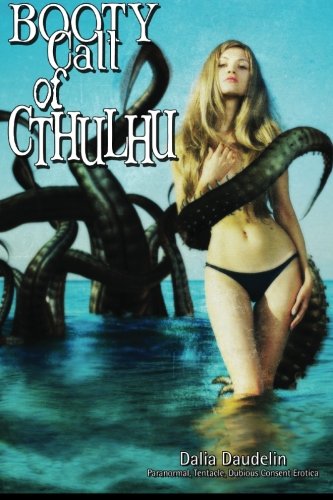
“Lines On Placing An Order With Arkham House” (1965) by Judy Reber

There was never any question about the name of our publishing house—the imprint to be used on what we then thought perhaps the first of three volumes. Arkham House suggested itself at once, since it was Lovecraft’s own well-known, widely-used place-name for legend-haunted Salem, Massachusetts, in his remarkable fiction; it seemed to use that this was fitting and that Lovecraft himself would have approved it enthusiastically. […]

Nevertheless, the buyers of our first book were sufficiently enthusiastic to persuade me to believe there might be a market for small editions of books in the general domain of fantasy, with emphasis on the macabre or science-fiction.

August Derleth, Thirty Years of Arkham House (1970) 3, 4

Before he was a professional writer of weird fiction, Lovecraft was an amateur. He came out of his shell in the 1910s with the amateur press movement, and his first weird fiction was published not in pulp magazines or anthologies, but in small amateur journals—and he carried that amateur attitude with him for the rest of his life. While Lovecraft did not disdain being paid for his work, he disliked writing for money rather than for art. He loved weird fiction, and that appreciation and passion became a part of his legend.

So too, it became a part of the legend of Arkham House.

It is easy today to consider Arkham House as a mere business venture. It was not the first small press in the United States, nor the first to publish anthologies and novels of weird fiction. The Popular Fiction Publishing Co., the publishers of Weird Tales, had tried their hand at a slim anthology titled The Moon Terror and Others (1927), culled from the magazine; it was a commercial failure that took decades to sell out. More success was found in the United Kingdom with the Not At Night series edited by Christine Campbell Thomson, which had its pick of the most gruesome Weird Tales, and brought writers like H. P. Lovecraft and Robert E. Howard into hardback publication.

Yet mainstream publishers, while they might tolerate H. P. Lovecraft in the occasional anthology like Creeps By Night: Chills and Thrills (1931), would never bring out a collection of Lovecraft’s fiction during his lifetime, or in the years immediately after. Nor was Robert E. Howard collected during his lifetime, except for the Western stitch-up novel A Gent from Bear Creek (1937). Popular as they might have been in the pages of Weird Tales, many of the most prominent Weird Talers lacked recognition outside of the pulps and the growing body of organized science-fiction/fantasy fandom.

Imagine for a moment that you were at a newsstand in July 1954, and you put down your thirty-five cents for the penultimate issue of Weird Tales. It was the 278th issue of the Unique Magazine, which during its initial run had been published since 1923. The first story in that issue you might have read was “The Survivor,” one of August Derleth’s “posthumous collaborations” with H. P. Lovecraft, worked up from a note in Lovecraft’s commonplace book.

If that story resonated with you—if you wanted to read more from this “Lovecraft” person—how would you do it? Try to buy back issues of Weird Tales? Hope for a reprint in another pulp? Or, perhaps, you would note the advertisement for Arkham House in the back of the issue, and write to them for a catalog, or mail off your check or money order for one of the advertised titles.

That is what Arkham House was, for much of its existence: for decades, it was practically the sole source for Lovecraft’s works and those related to him. As it expanded, it also published works by Robert E. Howard, Clark Ashton Smith, Lord Dunsany, Arthur Machen, Robert Bloch, Ray Bradbury, Henry S. Whitehead, Frank Belknap Long, and many more. These were relatively expensive books at the time, in limited print runs, but it was not the limited book market of today. These books took years and sometimes decades to sell through 2,000-4,000 copies.

August Derleth did not get rich off Arkham House. It was a business, to be sure, and he was by necessity a businessman as well as a writer, an editor, and a fan. Yet if it had just been about the money, or just about Lovecraft, Derleth could have stopped long decades before his death and focused more on his own writing. Instead…he inspired competition.

By the close of the first decade of publishing, the seeming success of Arkham House had brought into being a dozen other small houses in direct competition, following the lead of Arkham House.

August Derleth, Thirty Years of Arkham House (1970), 9

Derleth doesn’t name names, but Arkham House outlived erstwhile publishers like Fantasy Press (1947-1961), Gnome Press (1948-1962), and Macabre House (1954-1979). With longevity came the legend: Arkham House had not only been the first to publish many works by Lovecraft & co., but those books, once sold out, began to demand higher prices on the used & rare book market. A cycle which still feeds collectors paying fabulous prices even today, with no end in sight.

Like Weird Tales, Arkham House was not some faceless corporate enterprise. The readership was relatively small, and intimate, especially during the first period under August Derleth’s directorship—when Derleth would often personally take and fulfill orders, answer letters, put together newsletters and journals like The Arkham Sampler (1948-1949) and The Arkham Collector (1967-1971)…and it would have been Derleth who received a token of poetic appreciation from a fan toward the enterprise he was so closely associated with:

These are lines by a fan of weird fiction; what else could be “An infamous Abbey with Rat Things,| That leave human bones in their wake,” but a knowing nod to “The Rats in the Walls”? Who might have inspired “A long-dead voluptuous Leman,| Returned now to hold men in thrall” except Clark Ashton Smith? Poetry was a long favorite of fans to pay tribute in weird literature circles; and Judy Reber here follows in the tradition of “Shadow Over Innsmouth” (1942) by Virginia Anderson & “The Woods of Averoigne” (1934) by Grace Stillman, and “The Acolytes” (1946) and “The Cup-Bearer” (1951) by Lilith Lorraine.

In the Arkham House poetry book, The Dark of the Moon (1947), August Derleth inscribed Reber’s copy:

For Judy Reber,
the best of macabre verse,
Cordially, August Derleth

That was the connection between fantasy fans and the director of Arkham House; that was the kind of personal touch which built the legend of Arkham House, above and beyond their catalog. It was the weird community of spooky book lovers, and the experience of being able to order those strange and weird works which were otherwise inaccessible to the average fan which Judy Reber paid tribute.

“Lines On Placing An Order With Arkham House” by Judy Reber appeared on several of Arkham House’s promotional materials from 1965 until 1970. Being ephemera, these small pamphlets and folded sheets are often overlooked by cataloguers, so the exact publication history is obscure. The poem is in the public domain (no copyright registration or renewal could be found), and was last published in Leigh Blackmore’s ‘zine Mantichore vol. 4, no. 1 (2009).


Bobby Derie is the author of Weird Talers: Essays on Robert E. Howard and Others and Sex and the Cthulhu Mythos.

Deep Cuts in a Lovecraftian Vein uses Amazon Associate links. As an Amazon Associate I earn from qualifying purchases.

Magic of Atlantis: Sauthenerom: The Real Source of the Necronomicon (1985) by Frank G. Ripel & Necronomicon: Il Libro Proibito di Abdul Alhazred (2022) by Mirando Gurzo

Occult readings of Lovecraft’s fiction began while he was still alive, with correspondents like William Lumley and the unnamed Salem witch descendent and “Maine wizard” expressing interest or belief in the reality of the artificial mythology and lore that Lovecraft and his contemporaries concocted. As Lovecraft put it:

[William Lumley] is firmly convinced that all our gang—you, Two-Gun Bob, Sonny Belknap , Grandpa E’ch-Pi-El, and the rest—are genuine agents of unseen Powers in distributing hints too dark and profound for human conception or comprehension. We may think we’re writing fiction, and may even (absurd thought!) disbelieve what we write, but at bottom we are telling the truth in spite of ourselves—serving unwittingly as mouthpieces of Tsathoggua, Crom, Cthulhu, and other pleasant Outside gentry. Indeed—Bill tells me that he has fully identified my Cthulhu and Nyarlathotep ……. So that he can tell me more about ‘em that I know myself.

H. P. Lovecraft to Clark Ashton Smith, 3 Oct 1933, Dawnward Spire, Lonely Hill 449

Lovecraft, as an ardent materialist, always disabused those who wrote to him asking for the reality of the Necronomicon or for occult lore; while he was happy to play the game of terrible incantations and rites in fiction and in his letters, he did not wish to actually misinform or mislead anyone. The interest generation in such works did, however, present an interesting possibility:

I dont wonder that you recieve letters inquiring about the Necronomicon. You invest it with so much realism, that it fooled me among others. Until you enlightened me, I thought perhaps there was some such book or manuscript sufficiently fantastic to form the basis of fictionized allusions. Say, why dont you write it yourself? If some exclusive house would publish it in an expensive edition, and give it the proper advertising, I’ll bet you’d realize some money from it.

Robert E. Howard to H. P. Lovecraft, c. Apr 1932, A Means to Freedom 1.279

While neither Lovecraft or Howard pursued the idea, long after their death others acted on the idea. Two of the earliest and most prominent of these were the Necronomicon by Simon, first published by Schlangekraft in 1977 and in 1980 as an affordable mass-market paperback (which has never yet gone out of print) and in 1978 The Necronomicon: The Book of Dead Names edited by George Hay. These two books were both hoaxes that claimed to derive their text from a genuine manuscript; the Simon Necronomicon took as its inspiration Sumerian mythology and a dash of Aleister Crowley’s Thelema, while the Hay Necronomicon riffed off the European medieval grimoire tradition.

Of the two, the Simon book was more “serious” and aimed at fooling students of the occult, while the Hay book (with a lengthy introduction by Colin Wilson) was more fun. However, both books were embraced by burgeoning occult communities in the 1970s and 80s, were referenced by Kenneth Grant (a successor to Aleister Crowley) in his occult workbooks The Typhonian Trilogies (1972-2002), and continue to influence contemporary works of occultism such as Necronomicon Gnosis: A Practical Introduction (2007) by Asenath Mason. For more on the complicated Lovecraftian occult scene, see The Necronomicon Files by Daniel Harms & John W. Gonce III.

Nor were they the only such works; many occult Necronomicons have proliferated over the years…and not all of them in English. Many non-English language Necronomicons are, in whole or in part, translations of the popular Simon and Hay Necronomicons, sometimes with their rituals and imagery mixed together, sometimes interpolated with original material. Other works are largely original. Two particular works from Italy are good examples to compare and contrast how the occult Necronomicon tradition functions.

Magic of Atlantis: Sauthenerom: The Real Source of the Necronomicon (1985) by Frank G. Ripel

This Work is essentially divided into two parts. The first reveals the Text “Sauthenerom” whose source is lost in the Night of Times, and the other is an essay on particular esoterical matters that are related to the Ordo Rosae Misticae (The Order of the Mystic Rose) and connected with the Current of Occult Knoweldge that reaches back 4,000 years to the end of the Stellar-Lunar Cults and the beginning of the Lunar Cults. […]

I can assert that the Sauthenerom (The Book of the Law of Death) is the Text of the Real Necronomcion (The Book of Dead Names), i.e. the Text out of which later on the Necronomicon had developed.

Frank G. Ripel, “Introduction” to Magic of Atlantis 7

Frank Giano Ripel is an Italian occultist whose works primarily derive from Aleister Crowley’s system of ceremonial magic, whose best-known practitioners are the Ordo Templi Orientalis (O.T.O.). This system of ritual magic in turn grows out of the teachings of the Hermetic Order of the Golden Dawn, which in turn attempted to distill, codify, and systemize various occult practices such as the Western grimoire tradition such as The Sacred Book of Abramelin the Mage, Christian Kabbalah, and tarot (for more on which, see Eldritch Tarot (2021) by Sara Bardi).

After Aleister Crowley’s death, his last secretary Kenneth Grant sought to expand the system of Thelema through a series of books, starting with The Magical Revival (1972), which began to incorporate fictional elements—particularly the Lovecraft Mythos—into the already complicated system of occult correspondences. Other occultists picked up on this thread, and the Simon Necronomicon in particular included a table of correspondences suggesting that the Necronomicon and the Lovecraft Mythos were associated with Crowley’s teachings; Grant referred back to this in his later books, and like how the Cthulhu Mythos grew up from different authors pursuing their own writing goals and referencing one another’s work, the Lovecraftian occult began to expand. Ripel was part of that expansion.

As with many occultists and groups, the background is a little hazy. It appears that in the 1980s Ripel began self-publishing his own occult works for a relatively small and select audience; the principal volumes of these are the Sabean Trilogy which consists of three books, with the titles Magic of Atlantis, Red Magic, and Stellar Magic in English. Various translations of some of these were made in English, Spanish, and Serbian by small presses, and today several editions are available as ebooks, but the early English translations Magic of Atlantis are quite rare and it isn’t clear if the other books in the trilogy were ever translated into English, so Ripel’s influence on English-speaking Lovecraftian occultists appears to be minimal.

Ripel’s Magic of Atlantis is a sort of hybrid between Kenneth Grant’s and Simon’s approaches. The first part of the book, called the Sauthenerom, is implicitly a “received text” on the order of “The Book of the Forgotten Ones” (1977) by Nema Andahadna—or at least, unlike The Book of Dzyan (1888) by Helena Blavatsky there is no suggestion that Ripel was pretending to work off of a physical manuscript he had discovered. This Necronomicon ur-text borrows rather liberally from Lovecraft, though not without its original changes:

The Old Ones Are, the Old Ones Were and the Old Ones Will Be. From the Dawn of Times, in the Primordial Chaos, in ever Centre of the Infinite called Naxyr, the Gods Were and Were-Not; They were floating in the formless Waters of Darkness, in the Void of Naxyr. […]

At the Centre of Naxyr resideth his Manifestation in the form of that Protoplasmic Chaos, that Boiling Energy; the Manifested Father who is also the Son, the Projection of the Mother.

His Name is Azathoth,the Blind God who Explodes with no End, and out of his Death, the Manifested Worlds are born; and Planets and Stars and Suns and their inhabitants. He is the One that sits on the Double Throne. He is the One that clothes Yog-Sothoth of his Mother.

Frank G. Ripel, Magic of Atlantis 11

This mythological section borrows fairly heavily from Theosophy…too much, in that it reproduces some of the inherent racism of the “root races”:

There were divisions among the Races caused above all by climactic conditions. For example, the South Race developed the faculty of enduring the bruning Sun’s Rays through the emission of a substance which darkens the skin. In the span of Ten Generations, this factor became hereditary.

Frank G. Ripel, Magic of Atlantis 25

References to Lovecraft’s Mythos aside, the Sauthenerom section is relatively brief (26 pages) and divided into 13 chapters with a combination of myth, cosmology, and ritual. The bulk of the book is the second section, which details the magickal practices and beliefs of the Ordo Rosae Misticae, which presents itself as a splinter of the O.T.O.; Ripel both criticizes Grant’s publications while borrowing from them—like Crowley and Simon, Ripel borrows in Lovecraft’s creations to his system, though much of the Magic of Atlantis involves “correcting” Grant’s errors:

Talking of the relation between Lovecraft’s Cult and that of Crowley, we must point out an erroneus assertion of Kenneth Grant (see The Magical Revival) that Lovecraft did not know the Work of Crowley. Lovecraft’s letters, instead, demonstrate precisely the contrary. Besides, Grant’s comparative table between the Two Cults contains considerable mistakes.

Frank G. Ripel, Magic of Atlantis 56-57

The third part of the book is devoted to the grades of Ripel’s order, and the actual magickal operations are described in part four; these mostly involve fairly typical instructions for how to create various ritual tools and spaces, and variations of familiar Thelemic rites—in place of Crowley’s “Mass of the Phoenix,” for example, is given instructions for the “Host of Satan”:

To prepare the Host of Satan (Lucifer’s Bread of Light) various types of Blood could be used, the best is that of the Moon, that is the Menstrual Blood. One will have to burn the Blood making cakes out of it.

Frank G. Ripel, Magic of Atlantis 179

There is little to nothing of Lovecraft in this “operational” portion of the book, and that rather reveals Magic of Atlantis for what it is: a handbook for by and for practicing Thelemic magicians working within Ripel’s particular interpretation of Crowley and Grant’s system.

The fanciful pseudo-Lovecraftian material that fronts the book ultimately gives way to almost prosaic repetition of standard Hermetic ceremonial matters in the back half; despite grand claims to have at his access ultimate secrets, at least in this book Ripel’s imagination falls far short of expectations. Would-be Lovecraftian cultists may be disappointed not to find anything as weird or grand as in the Simon and Hay Necronomicons…but actual serious-minded occultists will probably appreciate Ripel’s criticisms of Grant (provided they agree) and his efforts at magical scholasticism.

Necronomicon: Il Libro Proibito di Abdul Alhazred (2022) by Miranda Gurzo

La versione di Hay e Wilson, ad esempio, è interessante per tutta la parte introduttiva, che tesse un intricato mistero attorno alla figura di John Dee e alle sue “comunicazioni angeliche”, ma il testo vero e proprio del libro maledetto è piuttosto breve e modellato senza tropa fantasia sull’impronta dei manuali magical medievali.Hay and Wilson’s version, for example, is interesting throughout the introductory part, which weaves an intricate mystery around the figure of John Dee and his “angelic communications”, but the actual text of the cursed book is rather short and modeled without too much imagination on the imprint of medieval magical manuals.
Miranda Gurzo, “Introduzione” in Necronomicon: Il Libro Proibito di Abdul Alhazred 7

Where Magic of Atlantis is a book for magicians by magicians, Miranda Gurzo’s Necronomicon is plain about being a work of fiction more in the vein of the Hay Necronomicon—but to go it one better and try and produce a work of fiction that is more in keeping with the spirit and scope of the Necronomicon-as-medieval-grimoire. Rather than overly concerning itself with contemporary Lovecraftian occultism, Gurzo focused on creating something closer to what the Necronomicon in Lovecraft’s stories might have looked like, if it was a real book.

There have been a few other books with similar approaches, but most of them are ultimately prop books—works that look the part, but without a particularly coherent or interesting original text. Italian publisher Libri Prohibiti for example creates beautiful, functionally unique works of book art, but the texts of these imaginary-books-made-flesh aren’t original, being often taken from some public domain text, sometimes with alterations to reflect the theme. Efforts to actually write the Necronomicon in whole or in part tend to run up hard against a lack of effort, lack of creativity, or both. L. Sprague de Camp, for example, famously published a version of the Al Azif in 1973 that consists only of a long narrative introduction and eight pages of the same pseudo-Duriac text, repeated to fill the space.

It looks the business, but you can’t actually read it.

Many other authors have tried to write pieces of the Necronomicon, as collected in the Chaosium book of the same name, but the results usually fail to meet expectations. In part, that has to do with the reputation that the Necronomicon was attributed by Lovecraft in his early fiction, and which has only grown over subsequent generations. It’s pretty much impossible to distill something sufficiently shocking, terrible, revelatory, occult, grotesque, and weird into a single book…and if you did manage that feat, it would still fail to live up to expectations, because the whole point of the Necronomicon is a book which is literally defined as being beyond your imagination. If you can pick it up and read it, how could it ever compare to that ancient, moldering tome kept under lock and key in the Miskatonic University library?

In a sense, Gurzo tries to get around this by tempering expectations.

Ma io, Abdul Alhazred, ho potuto con i miei stessi occhi scrutare i mistici caratteri delle Cronache di Nath, la cui antichita’ supera quella del nostro cosmo, e la cui origine si situa nel mondo da cui Quelli di Prima vennero in principio, che i mistici conoscono come Nath dei Tre Soli.But I, Abdul Alhazred, was able with my own eyes to scrutinize the mystical characters of the Chronicles of Nath, whose antiquity surpasses that of our cosmos, and whose origin lies in the world from which Those who First came in the beginning, which the mystics know as Nath of the Three Suns.
Miranda Gurzo, Necronomicon: Il Libro Proibito di Abdul Alhazred 16

Basically, the Gurzo Necronomicon is a kind of pseudo-medieval occult textbook, combining aspects of fantastical geography, cosmology, theology, metaphysics, and “functional” occultism. It is written in a pseudo-archaic style—as far as tone and format—although the actual language is contemporary Italian rather than another dialect (such as Venetian), and all the proper names (Abdul Alhazred, Shub-Niggurath, Cthulhu, etc.) are in recognizable contemporary forms. In this, it probably more closely resembles translations of actual medieval grimoires into contemporary languages than it does a genuine medieval product…but you can actually read it (or, if you don’t read Italian, translate it by hand or via an app).

If the Gurzo Necronomicon doesn’t promise the most terrible secrets of the universe, it does at least present a reasonable and readable facsimile of what a medieval occult textbook based on the Mythos might actually have looked like. It is relatively long (356 pages of text), detailed, and certainly a labor of love to gather bits and pieces of Mythos lore from across dozens of stories and try to weave them together into something like a coherent narrative. This goes beyond just Lovecraft, but borrowing from Clark Ashton Smith and other Mythos writers as well:

Compresi allora aldila’ di ogni dubbio che quello che avevo veduto altro non era che l’Idolo dei Ciechi, il simulacro di un mostruoso Essere venuto dall’Esterno; Egli dimora nel lago sotterraneo del deserto di Chaur, e nelle tenebre tartaree e’ adorato e servito da una razza degenerata di Aihai chiamati Yorhis, i quali sono costantemente mantenuti dall’Abitatore dell’Abisso in uno stato di oblio e inconsapevolezza, cosi’ che non possano ribellarsi alla tirannia del loro Signore.I understood then beyond any doubt that what I had seen was none other than the Idol of the Blind, the simulacrum of a monstrous Being who came from Outside; He dwells in the underground lake of the desert of Chaur, and in the Tartarean darkness he is worshiped and served by a degenerate race of Aihai called Yorhis, who are constantly kept by the Dweller of the Abyss in a state of oblivion and unawareness, so that they cannot rebel against the tyranny of their Lord.
Miranda Gurzo, Necronomicon: Il Libro Proibito di Abdul Alhazred 107; referencing “The Vaults of Yoh-Vombis.”

Probably the closest equivalent in English would be Necronomicon: The Wanderings of Alhazred (2004) by Donald Tyson, which was part of a series of Necronomicon-related works of dubious merit for the new spirituality shelves at your favorite local chain bookstore. Tyson’s books are almost the definition of cheap pop-occultism, utterly unambitious and aimed at a reader that doesn’t know much of anything about either magic or the Mythos. Gurzo at least delves deep into Mythos lore, to the point where you might want to keep the Cthulhu Mythos Encyclopedia handy to look up an obscure reference or two.

Gurzo hasn’t neglected the Lovecraftian occult elements, but the incantations, magic circles, and other instructions tend to be interspersed through the text; to give the flavor of it:

E le labbra degli stregoni, e con loro le mie, iniziarono a cantilenare le Parole proibite del Rituale Nero di Yaddith:

Gn’narh ng’gha w’zah hey m’nah k’ha nay Shub-Niggurath
R’ahay w’nah kbah t’agh tr’ogh b’naeh sh’baah Yog-Sothoth
Yah’hay t’lagh’ ph’nuy d’nah mnha ghaay ptha lw’ha u’nahy
Ia! Shub-Niggurath!
Ia! Ia! Shub-Niggurath!
And the sorcerers’ lips, and mine with them, began chanting the Forbidden Words of the Black Ritual of Yaddith:

Gn’narh ng’gha w’zah hey m’nah k’ha nay Shub-Niggurath
R’ahay w’nah kbah t’agh tr’ogh b’naeh sh’baah Yog-Sothoth
Yah’hay t’lagh’ ph’nuy d’nah mnha ghaay ptha lw’ha u’nahy
Ia! Shub-Niggurath!
Ia! Ia! Shub-Niggurath!
Miranda Gurzo, Necronomicon: Il Libro Proibito di Abdul Alhazred 348

Like the Hay Necronomicon, the Gurzo Necronomicon is not attempting to be a complete magical system or text in the sense of the Simon Necronomicon or Ripel’s Magic of Atlantis. What it is trying to do, more than the other books, is to present a Necronomicon that is reasonably accurate to the contents of the Necronomicon as Lovecraft and his contemporaries and heirs described it, with explicit and frequent reference to the Mythos entities, places, books, and magical operations that you can read about in Mythos fiction.

Which probably won’t stop some eager cultists from trying out a few of the tongue-twisting incantations on their own. The nature of the Lovecraftian occult is to spur the imagination of practitioners, who tend to borrow from myriad sources as they explore the weird world of magick. Ripel and Gurzo are coming from different perspectives, and in different ways: Magic of Atlantis is a relatively slim hardback that was published in a single edition in limited numbers, and the main illustrations are a series of line-diagrams of the Tree of Life and poorly-reproduced black-and-white photographs; Gurzo’s Necronomicon is a fat hardback published print-on-demand with relatively more diagrams…but the images show loss of resolution, blurring and pixelization. Both are primarily products of single creators rather than corporate products, but the publishing environment has shifted vastly in the nearly 40 years between the two books.

Ripel is attempting to appeal to occultists, and Gurzo to weird literature fans—but they have ended up in practically the same place, both of them crafting new recensions in the Necronomicon occult tradition. The line between “real” occultism and fiction is blurry, and the two influence one another all the time; the Necronomicon quotes that Lovecraft came up with in “The Dunwich Horror” have been assimilated into these fictional grimoires, and some of those practices have in turn inspired new Lovecraftian fiction like Trolling Lovecraft (2021) by V. McAfee.

How much influence these particular works will ever have on English-language Mythos fiction or the Lovecraftian occult is hard to say; the language barrier can be difficult to pass. Plus, the market is saturated: we are in the fifth decade of Lovecraftian occult publishing, and there is no end in sight, and would-be practitioners have a lot of raw material to choose from.


Bobby Derie is the author of Weird Talers: Essays on Robert E. Howard and Others and Sex and the Cthulhu Mythos.

Deep Cuts in a Lovecraftian Vein uses Amazon Associate links. As an Amazon Associate I earn from qualifying purchases.
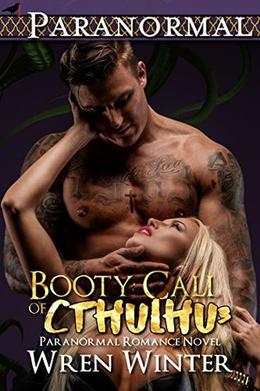
Flowers for the Sea (2021) by Zin E. Rocklyn

My stories always feature a Black woman lead, no matter how hard history tries to erase us and our contributions. I speak to my experiences in my stories as a way to flush them out as well as show the world that we are here, we matter, we are worthy.
Women in Horror Month Fiction Fragments: Zin E. Rocklyn (26 Feb 2021) by Michelle R. Lane

Perspective in any story is more than just the race or gender of the protagonist: it is a way of looking at the world. The history of slavery in the United States, for example, looks different from the perspective of the slave than it does from the perspective of the slaver and abolitionist. The experience and the stakes are different. It leaves its mark on individuals and generations in a way that is almost inescapable, and it shapes the way people understand and pass on their own stories and histories.

Persecution is not something Lovecraft thoroughly understood or expressed in his stories. While his life featured great hardships and poverty, he and his family never experienced systemic prejudice or discrimination. In stories like “The Festival,” he alludes to the hangings at Salem Village and the quiet diaspora of witches, but the witches are not sympathetic victims, even from the perspective of their descendants. There is no rancor at the injustice done, because to Lovecraft there was no injustice: they were witches, after all. Likewise, the fate of the people of Innsmouth is not presented as a crime amounting almost to genocide akin to the forced relocation of the Native Americans, though in all particulars it certainly approaches it.

Chronological distance offers one axis for reflection: “The Doom That Came to Innsmouth” (1999) by Brian McNaughton & “The Litany of Earth” (2014) by Ruthanna Emrys both shift the narrative on “The Shadow over Innsmouth,” seeing in the Innsmouth camps parallels to the Japanese internment camps and the Holocaust of World War 2. These stories deal with individuals who survived true persecution, the personal trauma and the breakup of families, and deal with the psychological and cultural consequences.

As a more diverse set of authors came to Lovecraftian fiction, they brought with them different points of view. The City We Became (2020) by N. K. Jemisin exists, in part, as a rejection and refutation of Lovecraft’s perspective and specific prejudices; “The Ballad of Black Tom” (2016) by Victor LaValle and “Jeroboam Henley’s Debt” (1982) by Charles R. Saunders focus on the perspective of the marginalized Black men who faced the discrimination in the 1920s and 30s that Lovecraft never knew or attempted to depict.

What Zin E. Rocklyn brings to her stories is not necessarily a need to counter, refute, reimagine, or even mention Lovecraft and his Mythos, but her existence and perspective as a Black woman writing weird fiction. As she puts it, when asked about whether she puts broader messages on race into her work:

By default, my presence within horror and writing horror is a message unto itself. Me showing up is message enough, so there’s no definitive way for me to divorce myself from that ongoing narrative.
Women in Horror Month Fiction Fragments: Zin E. Rocklyn (26 Feb 2021) by Michelle R. Lane

Which is absolutely the case for her short novel Flowers for the Sea (1921). Readers familiar with Lovecraft might well identify this story, which is set in an ambiguous time and place, as a left-handed descendant of “The Shadow over Innsmouth,” by way of ecological disaster fiction like “Till A’ the Seas” by R. H. Barlow with H. P. Lovecraft. Iraxi is one of the last survivors of a persecuted minority with rumored supernatual powers and ties to the sea, a literary cousin to the survivors of the Innsmouth diaspora in stories like “All Our Salt-Bottled Hearts” (2016) by Sonya Taaffe—but, the details aren’t quite right. There is a visceral reality to the persecution often missing from Innsmouth stories, ugly details like this one:

They called us nims. A word with hardly any meaning other than to spit upon its victim.

It morphed, much like forked tongues who spoke it, an encapsulating slure that reduced one to shreds, to the foam of the sea we feared, to nothing but the scent of a bowel movement.
—Zin E. Rocklyn, Flowers from the Sea 15

Slurs in science fiction and fantasy are not to be created lightly; too often they tend to mask real-world prejudices, and be substituted for them. Yet in this story, it serves the purpose of an introduction to the history of persecution that has brought Iraxi to this point, the beginning of the end of the pregnancy she didn’t want aboard a dying ship, hated by and hating those around her.

There is no calm, philosophical Lovecraftian indifference in this story. Anger is a major theme, sometimes ugly and sometimes righteous, but never unjustified. There is history behind that anger, long history, some of which is only hinted at…and it isn’t over. The people around her on the ship tolerate her, use her, but she is only and ever a resource to be managed, not a person to be respected…until, at last, it is too late.

Hate has its place in every life; it is a natural reaction to the pain of loss. An excess of hate can lead to terrible consequences; it is what leads to the transformation of Tommy Tucker in “The Ballad of Black Tom,” and nearly damns Maryse Boudreaux in her fight against the Ku Kluxes in Ring Shout (2020) by P. Djèlí Clark. Through Rocklyn’s prose, we get Iraxi’s struggle with her own hatred…but if she becomes a monster, it is because the monsters around her have made her one. The people that burned down her home, killed her family, called her people names for generations, and finally forced her to carry a child she didn’t want…it was their monstrous deeds that stoked the furnace of her rage and honed her cruelty to a sharp point.

There are counter-narratives that might be considered, since we only have Iraxi’s viewpoint for the whole novel. The ship is dying, women unable to bear children, and in this context Iraxi is an ungrateful madonna, given the best food while the others slowly starve. Should she not be thankful for the life she is to give birth to? Is she an unreliable narrator, self-centered and toxic, unable to appreciate what others sacrifice for her sake? Or how her individual sacrifice is for the greater good, for the survival of all?

The problem with these counter-narratives is that they run up hard against issues of bodily autonomy. How grateful should a slave be, to bear the child of her master to increase his wealth? Why should she submit herself and her own needs and desires for the good of a people who see her as little more than a particularly stubborn breeding cow? That is the presence Rocklyn brings to the tale. The arguments against Iraxi’s perspective are ultimately ugly because what Iraxi suffers is, by and large, an extrapolation of the horrors and indignities that women, especially Black women, have suffered for centuries in the United States and the Caribbean.

While we’re seen as sexual beings, we’re rarely seen as sensual beings. We’ve been used and abused for hundreds of years for the sake of personal slavery to the advancement of science, but never as human beings who own their bodies and their sexuality. Even in contemporary thought, there is the myth of the Strong Black Woman who needs no partner, no love, and it simply isn’t true. It’s a bastardisation of a mantra that means we won’t put up with bullshit. I want my fiction to make that distinction, that we crave and deserve love and nurturing.
Interview: Zin E. Rocklyn by Gordon B. White in Nightmare 107 (Aug 2021)

So it is with Inaxi, though her desire for love is never requited…hence the depth and intensity of her hatred. The issues of desire for love and bodily autonomy for women, especially within the context of pregnancy, are seldom made explicit in Lovecraftian fiction; stories like “In His Daughter’s Darkling Womb” (1997) by Tina L. Jens and “A Coven in Essex County” (2016) by J. M. Yales touch on them, but Flowers for the Sea is particularly vivid not only in its microscopic emphasis on the horrors of an unwanted pregnancy, approaching splatterpunk levels of grue when the chapter arrives for the birth, but in the implications. Iraxi is not just a Black Lavinia Whateley; her experience comes out of a very distinct experience of Black Womanhood.

Which is ultimately something that sets Flowers for the Sea apart from many other “Lovecraftian” tales. “The Shadow over Innsmouth” is not so much a distant ancestor as it is the raw material for a tube of Mummy brown that Rocklyn uses to paint her own distinct picture.

Flowers for the Sea by Zin E. Rocklyn was published in 2021 by Tor. Readers might also enjoy her fiction “teatime” (2020) and “The Night Sun” (2020).


Bobby Derie is the author of Weird Talers: Essays on Robert E. Howard and Others and Sex and the Cthulhu Mythos.

Deep Cuts in a Lovecraftian Vein uses Amazon Associate links. As an Amazon Associate I earn from qualifying purchases.