“O que dorme” (2016) by Bábara Garcia & Elias Aquino

“O que dorme” (“What sleeps”) by writer Bábara Garcia & artist Elias Aquino is the final entry in the comic anthology O Despertar de Cthulhu em Quadrinhos (“The Awakening of Cthulhu in Comics,” 2016) by Brazilian publisher Editora Draco. The book was edited by Raphael Fernandes, who introduces the volume on the inside cover flaps:

The cult work of H. P. Lovecraft is the main inspiration for this collection with eight comics that will transfer the imagination to the darkest side of the human mind, a cosmic horror in white and green.

[…] The Awakening of Cthulhu in Comics and the horror that cannot be uttered, get lost in images and stories that shouldn’t have been conceived. Now there’s no turning back for those involved by the tentacles of despair, it’s time to wake up to a decadent reality tinged with just two colors.

All of the comics, including “O que dorme” are done in black, white, and green—and the addition of the bright, almost sickly green against the otherwise stark noir black-and-whites significantly enhances both the effectiveness of the individual stories, and the uniformity of the overall book—readers might compare the glowing green Loc-Nar from the Heavy Metal (1981) film, or the sickly yellow in Frank Miller’s That Yellow Bastard (1996)—it’s not that the Mythos are color-coded, since any entities that appear on the page can be seen in black and white as well, but only that the splash of color is used by the artists to convey subtleties of mood and atmosphere. Like in the title page, where the green is a faint tinge against the night sky.

IMG_2571

The setting is contemporary. The sensibility is postmodern. Captions and word balloons, but no thought bubbles, no sound effects. A rural community in the mountains which produces coffee. A young woman named Greta who can’t sleep, but stays up all night reading Edgar Allan Poe, a Bauhaus poster on her wall…

I always planned to leave as soon as I had money or a place to stay. Time passed and neither happened.

IMG_2576

Here, the green frames figures and offers contrast. Varies in depth and intensity, fading into the shadows on the corners, but distinct. It gives texture to what would be a blank wall, but doesn’t bleed past the outlines. The atmosphere is aggressively normal, yet something’s off. People talk about the heat, a bad smell, it hasn’t rained, the panels darken as it shifts to nighttime…most of the storytelling is expressed in these little details, showing rather than telling. Ordinary scenes and remarks receive significance only because they are what are being shown to the reader, in the same way as a David Lynch film or Mike Mignola’s Hellboy.

But the fact is that, little by little, everyone stopped sleeping. An entire city sleepless.

Things move quicker. The timeline grows uncertain, but within a panel the corpses appear, and things shift from uneasy to macabre. There is a Poe-like quality to the rapid downward spiral…but the reader knows there are pages left. How much worse can it get?

IMG_2577

The rain comes.

There’s nothing explicitly Mythos to any of this yet, no ancient tomes, not a whisper of alien entities or black stars. Everything that’s happened to this point, it could a disease, a toxic gas, simple madness as the heat and lack of sleep take their toll on frail human psyches. Then the rules change.

IMG_2578

The green in the story to this point had been balanced, contained, a highlight; this deep splash shows it as pervasive, all-encompassing…and a herald of what’s coming. Maybe it was always that.

The only ones who were saved were those who were lucky enough to be already dead.

IMG_2582

As narratives go, the twenty pages go by swiftly. This is a story all about mood and atmosphere, not explanations. No one is at fault, no one went poking about where they shouldn’t, or read the wrong spell and awakened the eldritch horror. There is no cult to worship the things that crawl down off the mountain. It isn’t a deep dive into the lore of the Mythos, though there is definitely some artistic influence from the Call of Cthulhu Roleplaying Game on the design of the Dark Young of Shub-Niggurath. This is almost the definition of the Mythos as uncaring, not even necessarily malevolent, but simply destroying humanity by its very presence, like a tiger in the jungle stepping on so many ants.

“O que dorme” showcases the universality of the Lovecraftian experience. The liminal spaces we know are out there, the things that creep in from outside.

O Despertar de Cthulhu em Quadrinhos has not yet been translated into English.


Bobby Derie is the author of Weird Talers: Essays on Robert E. Howard & Others (2019) and Sex and the Cthulhu Mythos (2014).
“R. H. B.” (1978) by Andreas and Rivière


À Suivre (“To Be Continued”, 1978-1997) was one of the major Franco-Belgian comic magazines of the period, publishing such great European comics creators as Alexandro Jodorowsky, Milo Manara, Mœbius (Jean Giraud), François Schuiten, and Guido Crepax, a contemporary of magazines like Métal hurlant and Pilote, focusing on comics for a more mature audience.

“R. H. B,” by Andreas (Andreas Martens) and Rivière (François Rivière) was published in À Suivre 6-7, the July-August double issue for 1978. The title stands for Robert Hayward Barlow, friend and literary executor to H. P. Lovecraft. This coincides with the increased enthusiasm for Lovecraft in France, particularly the publication of LETTRES, 1 (1914-1926), which was published May 1978—a translation of Lovecraft’s letters, taken from volume I and part of volume II of Arkham House’s five-volume Selected Letters series. By comparison, Métal hurlant‘s Lovecraft special issue was published in September 1978.

metal

H. P. Lovecraft received a fan letter from a 13-year-old R. H. Barlow in June 1931; Lovecraft was then 41 years old, and the two continued corresponding for six years, until Lovecraft’s death in 1937. The two met in May 1934, when Lovecraft took a trip down to Barlow’s family home in DeLand, Florida, a visit which lasted seven weeks; they met again briefly in New York during the winter of 1934-1935, where Lovecraft was in the habit of meeting friends for New Years Eve, and Lovecraft repeated his trip to visit the Barlows in Florida in 1935, where he spent ten weeks with his hosts, but begged off the invitation to stay all summer. Their next visit was when Barlow came to visit Lovecraft in Providence, Rhode Island, 28 July 1936, when the teenager stayed more than a month at the boarding house behind Lovecraft’s residence. It was the last time the two would meet; Lovecraft would die of cancer on 15 March 1937. Lovecraft’s “Instructions in Case of Decease,” dating from 1936, named Barlow his literary executor…and it is through Barlow’s efforts that many of Lovecraft’s papers, unpublished stories, and letters were preserved at the John Hay Library.

The comic proper is presaged by an introduction by editor Marc Voline:

suiver-2

At the time the Ides et Autres (“Ides and Others”) fanzine published an unpublished poem by Lovecraft (3), (A Suivre) presents a comic strip approach of the great writer universe. “Biography of Robert H. Barlow and his relationship with HP Lovecraft” is the first of a five-part series, collected under the title Mythographies. Andreas and Rivière designed this as a kind of oblique exploration, referential and ironic, of sometimes poorly known literary universe. As for Lovecraft the famous “hermit of Providence,” we wanted—they say—to prove that the legend that he would, during his life, never leaves the perimeter of New England was all simply false. From the thick and rather indigestible biography of the author of La malediction d’Ansmouth (“The Shadow over Innsmouth”) written by Lyon Sprague de Camp, we briefly identify with the existence of an endearing and terribly pathetic “fan” most assiduous without doubt Lovecraft. Robert Barlow well deserved homage …

Marc Voline

Most of the material in the comic would come from L. Sprague de Camp’s H. P. Lovecraft: A Biography (1975); this would not be available in French until 1987 when Richard D. Nolane translated it as H. P. Lovecraft ; le Roman de sa Vie, so the creators of “R. H. B.” were working through some linguistic hurdles and miscommunications. As Lettres 1 doesn’t have any actual letters from Barlow, essentially all of the material for “R. H. B.” was drawn directly from de Camp’s book, with many phrases translated directly from the English edition.

suiver-4

Small issues of translation aside, this is a starkly beautiful comic, with fantastic linework by Andreas, who obviously referenced what photos of Lovecraft were available. Translation of the French above:

Robert’s is not a happy family. There are frequent conflicts between him and his father, who suffers from depression (he is paranoid and continually fears the coming of improbable enemies.) Bernice, the wife of the colonel, spoiled the only son and quarreled with his father.

In spring 1934, Robert makes a profit of the absence of his father to invite Lovecraft to De Land. In April this year, HPL makes this journey. Lovecraft, in contact with the hot climate of Florida, is in an unusual state. He presents himself to Barlow with hatless and coatless.

His first stay in the house of his admirer is as a dream thanks to Bobby, he will see for the first and last time in his life a river full of alligators, at Silver Springs!

By comparison, this is how de Camp described this encounter:

The family home was at De Land, Florida, seventeen miles inland from Daytona Beach. Barlow’s father, Everett D. Barlow, was a retired U. S. Army lieutenant colonel and something of a mental case. Subject to moods of intense depression, he suffered from delusions of having to defend his home against the attacks of a mysterious Them. He was cracked on religion and on sex.

Robert Barlow got on badly with his father. At this time, he told his friends that he hated the colonel; although later, after his parents had been divorced, he carried on a friendly correspondence with him. Robert Barlow’s mother, Bernice Barlow, spoiled and pampered her son (somewhat as Lovecraft’s mother had done with him) and quarreled with her husband over the boy’s upbringing.

In the spring of 1934, Barlow and his mother were at De Land while the father, in the North, recuperated with relatives from one of his attacks. In January, Robert Barlow began urging Lovecraft to come for a visit to Florida. By April, Lovecraft had planned the trip. […] At the Barlows’, the heat stimulated Lovecraft. In high spirits he went hatless and coatless and boasted of the tan he was working up. His one disappointment was in not being able to go on to Havana. He was consoled by a trip with the Barlows to Silver Springs. There he had his first view of a jungle-shaded tropical river and even glimpsed wild alligators.
—L. Sprague de Camp, H. P. Lovecraft: A Biography 393-394

There are some errors in de Camp’s portrayal, which were repeated by Rivière. Lt. Col. Everett D. Barlow had seen action during World War I, and may have suffered from post-traumatic stress disorder; Lovecraft was aware of the elder Barlow’s mental illness and was notably more sympathetic than de Camp:

I surely am sorry that your father remains under the weather psychologically. These depressed states may be troublesome to others, & may seem exasperating when coupled with good physical health, yet they are really every inch as painful & unavoidable as any other form of illness. The victim can’t help himself any more than a victim of indigestion or cardiac trouble can. The more we know of psychology, the less distinction we are able to make betwixt the functional disorders known as “mental” and “physical.”
—H. P. Lovecraft to R. H. Barlow, 10 April 1934, O Fortunate Floridian! 125

suiver-6

The narrative is, like most biographies, not some action-and-romance-packed account. Artist and writer manage to convey a sense time passing with the arrangement of the panels, particularly an extended shot of a kitten falling through perfect blackness that stretches out over several pages. While Lovecraft is the principal focus of the story because of the narrative, he dies in 1937…and Barlow’s story goes on, to his university education in Kansas, California, and then Mexico.

suiver-8

suiver-9

He unfortunately suffers the cruel intolerance due to his particular sexuality, at present known to all. It is the subject of an odious blackmail as a result of links with a Mexican youth. On 2 January 1951, it takes a large amount of sedatives and falls asleep forever. He is 33 years of age.

There are large parts of Barlow’s life that are not included in this brief but poignant bio-comic, because de Camp was more focused on those parts of Barlow’s life that concerned Lovecraft. We don’t read much about his career as a poet or writer of fiction; the issue of his sexuality and how de Camp came to publicize it was touched on in “The Night Ocean” (1936) by R. H. Barlow with H. P. Lovecraft, and here we see an example of how information spreads.

Notably absent from “R. H. B.” is an accurate depiction of R. H. Barlow himself. De Camp didn’t include any photographs in his biography for Andreas to base his depictions on, and few photos of Barlow at that point had been published.

1935-E

c. 1935

Left to right: H. P. Lovecraft, R. H. Barlow, Bernice Barlow, unknown cat, Wayne Barlow

“R. H. B.” stands as an artistic achievement, and one of (if not the first) graphic adaptations of Lovecraft’s life to feature R. H. Barlow, who did so much to preserve his legacy. Others appear in Alan Moore & Jacen Burrow’s graphic novel Providence (2015-2017); Henrik Möller & Lars Krantz’s Vägan Till NecronomiconCreation of the Necronomicon (2017); Sam Gafford & Jason Eckhardt’s Some Notes on a Nonentity (2017); and especially in Alex Nikolavitch, Gervasio, Carlos Aón, & Lara Lee’s H. P. Lovecraft: He Who Wrote in the Darkness: A Graphic Novel (2018), which showcases Lovecraft’s first encounter with Barlow in 1934…and all of these showcase how Barlow’s story has assumed its own mythical proportion, entwined with Lovecraft’s own.

While it was not uncommon for works in À Suivre to be reprinted, other than the publication in À Suivre, the only other publication of “R. H. B.”  that I have been able to confirm is in The Cosmical Horror of H. P. Lovecraft: A Pictorial Anthology (1991), a tri-lingual guide to Lovecraft comics published up to that point, which reproduces six of the eight pages of “R. H. B.” and Révélations posthumes (1980), a collection of Rivière and Andreas’ biographical comics from À Suivre.


Bobby Derie is the author of Weird Talers: Essays on Robert E. Howard & Others (2019) and Sex and the Cthulhu Mythos (2014).
Agents of Dreamland (2017) by Caitlín R. Kiernan

The Truth Is Out There
—X Files, “Pilot,” 10 September 1993

The Federal Bureau of Investigation was created in 1908, when H. P. Lovecraft was eighteen years old. In his youth, he had formed a detective agency with his friends, inspired by the Pinkerton National Detective Agency and similar private companies. The Secret Service was the arm of the U. S. Treasury department, set up to crack counterfeiting rings and protect the president; the Black Chamber, forerunner of the National Security Agency, wouldn’t be formed until 1919.

Lovecraft had grown up in a world without G-men. With the passage of the Volstead Act and Prohibition, that would change. Hardboiled pulp crime magazines demanded more than just Sherlock Holmes-style consulting detectives, police detectives, Texas Rangers, federal marshals, or Pinkertons, though all of those characters had their place in the pages of magazines like Black Mask. Dashiell Hammett cut his teeth with The Continental Op, who worked for a fictional Continental Detective Agency modeled after the Pinkertons that Hammett himself would work for. Yet it was the rise of organized crime that came with Prohibition, and the personage of J. Edgar Hoover as head of the new Bureau of Investigation, that put their stamp on the idea of government agents in pulp fiction.

Which is why the opening to “The Shadow over Innsmouth” starts off as it does:

During the winter of 1927–28 officials of the Federal government made a strange and secret investigation of certain conditions in the ancient Massachusetts seaport of Innsmouth. The public first learned of it in February, when a vast series of raids and arrests occurred, followed by the deliberate burning and dynamiting—under suitable precautions—of an enormous number of crumbling, worm-eaten, and supposedly empty houses along the abandoned waterfront. Uninquiring souls let this occurrence pass as one of the major clashes in a spasmodic war on liquor.

H. P. Lovecraft didn’t invent the idea that governments conceal certain things from the public; the Great War impressed on the whole nation the importance of some things remaining secret. Yet it is important to place “The Shadow over Innsmouth” in that context of the rise of the G-men, of government agencies concerned with finding secrets and keeping them…and to understand that the roots of spy fiction in the Mythos, the whole cloak-and-tentacle business in Bruce Sterling’s “The Unthinkable” (1991), Alan Moore’s “The Courtyard” (1994), Delta Green (1997), Charles Stross’ “A Colder War” (2000) and The Atrocity Archives (2004), “The Star that is Not a Star” (2016) by Lucy Brady—they’re all part of a continuing tradition, born out of changes in the United States government, world affairs, and the semiotic impact on an American culture that knows that its government is hiding things from it.

Which leads also to flavors and trends in spy fiction. Ian Fleming’s James Bond is flashy, emotionally damaged, fighting secret wars against terrorists with next-generation gadgetry; Len Deighton’s unnamed protagonist of The IPCRESS FILE is faced with something no less fantastic, but the syntax is different—James Bond doesn’t deal with paperwork and bureaucracy. Spy fiction tends to vacillate between the glamorous fantasy and the grungy reality. The staid George Smiley of John le Carré’s Tinker, Tailor, Soldier, Spy is not the psychologically damaged one-man-army of Robert Ludlum’s The Bourne Identity, but they’re two sides of the same fictional coin, different iterations of the concept of the government agent, the finders and keepers of secrets.

Which is all background to set Caitlín R. Kiernan’s Agents of Dreamland in it’s proper context: the here-and-now of 2015, with a hazy secret history that extends out of knowing into past and future alike. The post-Cold War zeitgeist married the pre-war concept of G-men with the burgeoning fields of Ufology, the Shaver Mystery, Men in Black and Black Helicopters, and the warehouse at the end of Raiders of the Lost Ark. Pulp fiction jumped the semiotic shark when conspiracy fantasies like Robert Shea & Robert Anton Wilson’s The Illuminatus! Trilogy and Umberto Eco’s Foucault’s Pendulum became more or less indistinguishable from the actual conspiracy theories being peddled in Fate Magazine. When The X-Files hit in 1993, based on the 70s journalistic exploits of Kolchak, the Night Stalker, it was a spike driven straight into the vein of the American collective unconscious.

People want to believe the truth really is out there…and that the government knows and is hiding it.

Post-X Files fiction in this vein is rife, everything from big-budget Hollywood blockbusters like Independence Day (1996), Men in Black (1997), and Paul (2011) to graphic novels like Groom Lake (2009). Some are played straight, others for laughs—the bigger the cover-up, the more people and resources at play, the more it stretches the suspension of disbelief that any government agency can keep a lid on anything for any period of time.

Yet at the same time, everyone accepts that governments do successfully cover up things all the time. Documents are unclassified over time and reveal the details of events that happened in the shadows…and we know there are files still sealed. Secret histories under lock and seal. Anything might be in there—and that’s the attraction of the government conspiracy mindset. The imagination can populate those locked binders with any secrets—never mind that most of them are probably mundane things, like the sexual escapades of past presidents now safely dead, or the schematics for encryption machines rusting away in some government warehouse.

While his parents sleep, the boy is treated to Ray Harryhausen’s Rhedosaurus, Charles Laughton’s Quasimodo, and, finally, English director James Whale’s little-known and once-believed-lost The Star Maiden (1934).
—Caitlín R. Kiernan, Agents of Dreamland (2017), 48

Agents of Dreamland is the first in her Tinfoil Dossier series, which will probably be compared to Charles Stross’s Laundry series by default: both involve the Men-in-Black end of a government cover up, agencies working behind the scenes to investigate and contain the Mythos. The two bodies of work are distinctly different beasts, however. Kiernan’s point-of-view character the Signalman is on the ragged end of a career out on the edge of the spook world, a veteran of too many horrors. Not the smartest or the most clever, no Jason Bourne-style action scenes, just a bone-weary tiredness and a looming sense of desperation hovering over all.

That’s the mood. This is a war that can’t be won, because the people fighting it don’t realize it is a war yet.

The lore is stripped down; this isn’t a roleplaying game supplement about the Men in Black and their valiant secret war against the Cthulhu Mythos. This is grungier, grittier, more homely and with an air of inevitability. There are scenes and themes reminiscent of Mexican Gothic (2020) by Silvia Moreno-Garcia. Lovecraft, for all that he created, was working within a late-19th/early-20th century frame of scientific understanding—and science has dug up some much stranger things since 1937.

Kiernan doles out the information from the black dossier in measured doses, switching point of view and time between chapters, balancing exposition and description. The idea isn’t to give the reader too much at once, to let the reader form their own connections, to feel the people that are in these places at these times. It’s a spy story written like a Cthulhu Mythos story, and by the time the reader finds out the truth about The Star Maiden, puts the pieces together and think they have a clue about where this is going…

The truth is weirder than you think.

Caitlín R. Kiernan’s Agents of Dreamland (2017) is the first in the Tinfoil Dossier series, and is followed by Black Helicopters (2018) and The Tindalos Asset (2020).


Bobby Derie is the author of Weird Talers: Essays on Robert E. Howard & Others (2019) and Sex and the Cthulhu Mythos (2014).

Jim Crow, Science Fiction, and WorldCon

No black fans had become active to any extent by 1957, but females without brothers or husbands in fandom became more numerous. The one who attracted the most notice was Lee Hoffman, whom everyone had assumed to be male until she appeared at a fan gathering for the first time and almost disrupted the New Orleans Worldcon in 1951 in the process.
—Harry Warner, Jr. “Fandom Between World War II and Sputnik” in Science Fiction Fandom 70

Nolacon I, held over Labor Day weekend (September 1-3) in New Orleans in 1951, was the ninth WorldCon. Harry Warner’s pronouncement that no black fans had become active in fandom by 1957 was not true: black fans bought pulps and science-fiction books, and some even participated in “active fandom” as members of science fiction fan clubs and organizations. Allen Glasser in “History of the Scienceers” recalled:

During the early months of the Scienceers’ existence—from its start in December 1929 through the spring of 1930—our president was Warren Fitzgerald. As previously mentioned, Warren was about fifteen years older than the other members. He was a light-skinned Negro—amiable, cultured, and a fine gentleman in every sense of that word. With his gracious, darker-hued wife, Warren made our young members welcome to use his Harlem home for our meetings—an offer we gratefully accepted.
(Science Fiction Fanzine Reader 49)

Attendees at Nolacon might be forgiven for thinking otherwise. While the convention itself made no formal statement regarding race, racial segregation was very much in effect in New Orleans in the 1950s. Public transportation, restrooms, and other facilities were segregated into “white” and “colored” under Jim Crow; restaurants, hotels, and other businesses simply refused to serve black customers, blacks and whites had separate beaches and parks.

There were less than 200 attendees. Nolacon Bulletin #2 (July 1951) lists 196 members; Harry Warner, Jr. in in his memoir of fandom in the 50s A Wealth of Fable says 183 were officially registered “and 300 or more persons were believed to be on hand at one time or another” (352). Membership at the door was $1; tickets for the southern chicken fried banquet, $2.50. The convention hall was at the St. Charles Hotel, which was air-conditioned—and traditionally white-only. Not all the rooms in the surrounding hotels were air-conditioned, and fans sweltered in the heat. Unable to sleep, they began an all-night poker game in room 770, which became a two-day room party that reached legendary proportions.

One highlight was a midnight showing of The Day the Earth Stood Still at the local Saenger Theater. Seating was segregated. Black attendees would have had to enter through a side door, to sit up on the balcony. Had any black science fiction fans done so, the film they watched could have stood as a metaphor for the mythic white space they found themselves in: a film of the possibilities of the future starring white people, for white people; the few non-white actors such as Rama Bai and Spencer Chan went uncredited.

day-the-earth-stood-still-people-watch-as-klaatu-approaches-crowd

Segregation had risen as an issue in science fiction fandom long before Nolacon I was a glimmer in the New Orleans Science-Fantasy Society’s eye. In Summer of 1944, archfans Forrest J. Ackerman and Jack Speer had published an 8-page one-shot periodical in the Fantasy Amateur Press Association titled Black & White [PDF]. Ackerman published an editorial denouncing Speer’s racial prejudice and support of Jim Crow; and recalled:

On our way to the Nycon [1939, the first WorldCon], Morojo and I felt distinctly uncomfortable, embarrass[ed] to be members of such a country, when we passed through a certain state wherein seats in the coaches were partitioned temporarily and marked “For Colored Only.” We resented this, we did not like to think any colored people were blaming us in their minds, looking at us accusingly. Beyond personal, selfish considerations, we considered the situation fundamentally unjust. (Science Fiction Fanzine Reader 92)

The other half of the ‘zine was Speers’ rebuttal; which is proof if any was needed that even science fiction fans could be prejudiced and close-minded. The best that can be said is that Speer’s position was soundly thrashed in the fanzines that reviewed the periodical. Seven years later, it was in another fan-periodical that the issue of Jim Crow and Nolacon was raised:

On the subject of this year’s World Science Fiction Convention: It will be of great interest to this editor to discover whether there were both WHITE and COLORED entrances to the convention-hall this year, for the tenets of the sovereign state of Louisiana and the noble city of New Orleans strictly forbid the mingling of ‘Caucasian and non-Caucasian races’ in such public buildings as are usually the sites of conventions. Just as a clinical study, let’s review the case.

We know that the basis for the persecution, discrimination, and segregation of and against the negro in the southern U.S. is an economic one. It is profitable for the Southern bourgeoisie (if we may borrow a work from the marxist lexicons) to oppress the Negro and other minority groups. The only way in which to fight this racist fascism is [to] make it extremely unprofitable for the South to pursue this racist policy.

Cities like Miami Beach and New Orleans derive a sufficient sum from the tourist trade (which includes the many convention dollars spent, not at the auction, but on such relative nonessentials as food and lodging) to make them review with alacrity the necessity of maintaining feudal laws in the face of a serious decrease in this income. Therefore, we must look upon the South’s financial dependency on the tourist trade as a weapon which democratic Americans from more e[n]lightented sections of the county must use, as a club if need be, against the forces of bourgeois reaction and open fascism in the South.

Many progressives are foregoing the annual vacation-trip to Miami Beach, in the hope that this will graphically inform the business interests in the south who profit from such vacation-trips that democratic dollars shall not be spent to uphold [and] strengthen an undemocratic system.

It is up to the fans who will vote on future convention site[s] to make sure that all fans will be able to have an equally good time, regardless of the racial, national, or religious differences that may be evident to the eye of a sovereign state or a noble city.

—Michael DeAngelis, Asmodeus #2 (Fall 1951), 5

The call to action may sound familiar. The World Science Fiction Convention still struggles with issues of making sure that all fans, regardless of race, gender, religion, sexual orientation, or ableness are able to fully participate, enjoy, and share their common love of science fiction art, literature, and media. While the Jack Speer of this generation may no longer be arguing explicitly and out loud for segregation, behavior which demeans, denigrates, and disenfranchises others based on such factors accomplishes much the same thing. Likewise, DeAngelis’ suggestion that fans vote with their wallets, choosing not to financially support racist policies, is still very much sound advice.

The editorial in Asmodeus #2 made little splash in fandom; by the time it came out, it isn’t clear that it would have been in time to affect attendance, even if it had achieved widespread distribution. Yet at least two fans chose to respond, in letter to the editors. The first is from L. Sprague de Camp:

Mr. DeAngelis’s attribution of Southern race-prejudice to the economic motives of the Southern reactionary bourgeoisie is the usual Marxian pseudo-scientific fertilizer, based on the ludicrous assumption that people mostly act in accordance with economic class interests. If he’d lived in the South he’d know that the strongest such prejudice is found among the Southern white proletariat, & and that it’s based not on economics but on a psycho-cultural attitude imbibed in childhood and derived from the former Southern caste system. Actually Southern segregational practices are highly unprofitable to all Southerners, but most Southern whites take the view they’d rather be poor than suffer what they consider spiritual defilement. I don’t approve of their attitude any more than deA, but to drag in Communist twaddle merely confuses the issue.
—L. Sprague de Camp, Asmodeus #3 (Spring 1952), 25

This is ultimately nitpicking without addressing the substance of the problem, something else that fans of science fiction today will recognize whenever the issue of discrimination rears its head. A penchant for pedantry often undermines any real progress, and carefully side-steps the issue of acknowledging a problem exists or what to do about it.

The second letter is from Redd Boggs, a prominent fan and fanzine publisher who has been nominated for several Retro Hugo awards for his fan-writing:

DeAngelis seems to be belaboring a dead horse with his remarks on the Nolacon. And after all, it was not the fault of the Southern fans themselves that Jim Crow exists down there. I might think more of them if I know they were doing what they could to break down racial barriers, but I don’t think less of them for putting on a convention despite the segregation that had to be observed. What else could they do? Should we have allowed the South to have a convention? I think we should have. They deserved the chance to have one, and to deny them one on the basis of racial prejudice smacks of another kind of prejudice. Sectional discrimination is almost as bad as racial discrimination. I don’t think fandom should ever allow a con to be held in a hotel where anti-Semitic rules are found, or—if it is anywhere but the South—where Negroes are barred, but if we go to the South there is little or no alternative. If there is an alternative, as there will be almost anywhere north of the Mason-Dixon, I trust we’ll take it. Otherwise, deAngelis’ analysis of the economic basis of segregation leaves much to be desired. I fail to see how an end to the tourist trade, if it affected the South very much, could accomplish anything but the opposite effect Mike desires: making the whites poorer and thus more in competition than ever with the Negro.
—Redd Boggs, Asmodeus #3, 27

“Sectional discrimination” in 1952 was the “reverse racism” of the 2020s—a fallacy used by those who claim that efforts to combat or reverse racial discrimination are themselves a form of discrimination. Boggs’ claims break down what might be the typical white fan’s mindset of the era: philosophically displeased with Jim Crow, but unwilling to actually do anything about it.

Implicit in all the Asmodeus debate are a number of implicit prejudices: that the culture of the American South was monolithic and unchangeable, that economics were a key factor in racial discrimination, that African-Americans were as a population disadvantaged by this discrimination, that science fiction fandom should not support racial discrimination…and that fandom as a whole was unwilling or unable to confront these issues with positive action.

We don’t know if any black fans tried to attend Nolacon I and were turned away at the door, but these issues were not simply theoretical—they were real, and affected real people. We know because there is at least one account of that actually happening:

[Gene Deweese had] been corresponding with a girl, Bev Clark, in northern Indiana, and wanted me to go with him to meet her, which suited me fine; I was finally finding girls I could talk to. Gene arranged things and we went up. It was the first time I’d met a black (or African-American, if you prefer) person socially. We got along fine, and later on we’d arranged that the three of us would drive to Midwestcon, again in my car; that car got a lot of use that summer; Juanita and her friend Lee Tremper would meet us there, and we’d have fun. We arrived at Beatley’s Hotel (or Beastley’s-on-the-Bayou, which was one of the fannish descriptions at the time) but Bev was refused admittance. No blacks allowed. None of us had even considered the possibility. On the way out, we talked to a few fans sitting on the hotel porch and some anger was expressed, especially by Harlan Ellison, who said that all fandom would hear about this outrage. We drove home, and as far as I know, nobody ever mentioned the episode again. Except me, of course.
—Buck Coulson, “Midwest Memories” in Mimosa #13 [PDF] (1993), 36

That was in 1953; Coulson added that later that year Bev attended the 1953 WorldCon in Philadelphia with them and there were “no room problems.” Juanita Coulson (she and Buck married in 1954), would add on to the account:

Lots of people commiserated and thought this was terrible and something should be done about it—but nobody did anything. We happen to know this particular instance pretty well. The convention hotel was Beatley’s at Indian Lake, a Midwestcon, and the Negro girl fan was Beverly Clark. She, Buck and Gene drove over from Indiana, had their reservations cleverly lost by the hotel management, much sympathy and no action from the other con attendees, and turned around and drove back that same night. A procedure I would not recommend. I didn’t find out about this until Saturday night, despite repeated inquiries of other people, some of whom were witnesses to the earlier incident. (I had come on the bus with Lee Tremper, expecting to meet the other trio. Obviously, I never did.) What could have been done? Well, at an outside guess I would say if the managers of the con and plenty of the fans had gotten together and promised the hotel keeper if she didn’t admit a guest with a reservation regardless of color they’d take their business elsewhere something might well have been accomplished. Nobody suggested this, and there was no indication that enough of the fans were willing to put their actions where their mouths were. They had lots of company in mundania at that time. […] It’s nice to think fans are slans and ahead of their times and farseeing and politically and socially advanced and all—but I’d take it with a healthy dose of salt. I been there. At least I got into fandom on the time-line edge, It was at that break point in the early-mid 50s that hotels began realizing there’d been an emancipation proclamation* or Buck and I would have missed a lot of cons. We wrote ahead to the hotel in Philly to make sure Bev Clark and her friend Eleanor Turner would be admitted, or we probably wouldn’t have gone.
—Juanita Coulson, Starling #14 [PDF] (1970), 19-20

Racial segregation in the United States has been officially over for some time; Supreme Court cases like Brown v. Board of Education (1954) and Heart of Atlanta Motel, Inc. v. United States (1964) and legislation such as the Civil Rights Act of 1964 helped end Jim Crow—though it was a long and uphill struggle, and far from bloodless. We still deal with the issues raised by segregation and its ends today, culturally and socio-economically.

The full effects of Jim Crow and racism both implicit and explicit prevalent on early fandom will never be known. How do you measure the effect of those fans who wanted to attend, but were denied access to the hotel where the convention was held? How many fans were turned off by the lukewarm response from fans like Redd Boggs, who didn’t agree with Jim Crow but were willing to implicitly endorse it so that Southerners could have their own science fiction conventions?

While Jim Crow is a thing of the past, it is a part of science fiction fandom history—and one which we forget only at our own peril. There was a time when white fans did nothing, while black fans had to use side entrances and were denied entrance. If we are to not be hypocrites, to embrace and celebrate our diversity and look ahead to the future, we must make sure that all science fiction fans are treated equally—not harassed or discriminated against, not made second-class citizens because of their ethnicity, religion, gender, or sexual orientation—and to not retreat when such remarks are made.

Remarks were made at the 78th WorldCon, CoNZealand, in 2020. George R. R. Martin has been criticized for his hosting of the Hugo Awards at the event, where he spent considerable time discussing historically important figures in science fiction like John W. Campbell—long time editor of Astounding (1937-1971) and a noted racist in the Jack Speer vein. Martin has also been criticized for disrespecting the award winners, mispronouncing names and undercutting accomplishments like N. K. Jemisin’s “hat trick” of three Hugo awards for best novel in as many years, and four in the last five (2016, 2017, 2018, and 2020). Several times, Martin reminisced about when fandom was so much smaller, and the convention was simply held in a hotel.

Many fans and writers, including Jemisin and other nominees and winners, tweeted, blogged, and essayed about the awards, but one observation from genre fiction scholar Jess Nevins stood out:

In their way, the SFF gatekeepers are the equivalent of the Lost Cause Southerners: clinging for dear life to this fantasy construction of the past that is at angle to the real thing, making secular saints of white men of reprehensible moralities and behavior. (tweeted by @JessNevins 11:17 AM · Aug 2, 2020)

It can be difficult to get away from the shadow of the past. John W. Campbell and H. P. Lovecraft were racist; that does not negate their accomplishments as editor and writer, respectively, but it does cast a shadow over their legacy. In 2011, Nnedi Okorafor’s response to winning the World Fantasy Award—then in Lovecraft’s likeness and nicknamed “The Howard”—sparked a petition for the replacement of the award, which happened in 2015. In her acceptance speech for the John W. Campbell Memorial Award for Best New Writer, Jeannette Ng called out the award’s namesake:

John W. Campbell, for whom this award was named, was a fascist. Through his editorial control of [Astounding Science Fiction], he is responsible for setting a tone of science fiction that still haunts the genre to this day. Sterile. Male. White. Exalting in the ambitions of imperialists and colonisers, settlers and industrialists.

Her words sparked change; the award was renamed to the Astounding Award for Best New Writer, and Ng herself earned the 2020 Hugo for Best Related Work for making that speech.

Positive change can happen, if people raise their voices and work for it.


Originally published in The Cromcast Chronicle #1 (Dec 2020).

Bobby Derie is the author of Weird Talers: Essays on Robert E. Howard & Others (2019) and Sex and the Cthulhu Mythos (2014).
“The Child of Dark Mania” (1996) by W. H. Pugmire

This story appeals to me more than most of the things I’ve written this past decade. I am fond of the image of the woman with her weird masked face, and was delighted when two pictorial renditions of that image were included in my first American collection, one by my editor and publisher, Jeffrey Thomas, and the other gracing the superb cover illustration by Earl Grier. There is a lot of peculiar passion in this story, and it gets me, deliciously. I was delighted to be able to write it in memory to HPL’s great buddy and fellow weird author, Frank Long. “The Child of Dark Mania” originally appeared in The Pnakotic Series.
—W. H. Pugmire, “Afterword” in Sesqua Valley & Other Haunts 113

Frank Belknap Long, Jr.’s “The Horror from the Hills” (Weird Tales Jan, Feb-Mar 1931) is one of his most famous additions to the Cthulhu Mythos—mostly because the novella incorporates a lengthy sequence borrowed from one of Lovecraft’s letters (with permission), describing a Roman dream in ancient Iberia. The main antagonist of the novella is Chaugnar Faugn, which in turn was inspired by a small statuette of the elephant-headed Hindu deity Ganesha that Long’s aunt Cassie Symmes had gifted him.

Long is busy on a horror tentatively called “The Elephant God of Leng”—based on a curiously carved idol his aunt lately brought him from Europe, plus a suggestion or two of mine.
—H. P. Lovecraft to Clark Ashton Smith, 2 Feb 1930, Dawnward Spire, Lonely Hill 204

The appropriation of an Indian religious icon was not uncommon in Weird Tales during the period. Readers might compare the elephant-headed Yog-Kosha from Robert E. Howard’s “The Tower of the Elephant” (Weird Tales Mar 1933), or the eponymous idol in Seabury Quinn’s “The Green God’s Ring” (Weird Tales Jan 1945). Inspiration comes where it does, and the “Exotic East” was an important inspiration for many pulp writers, and a draw for many pulp readers—and we can perhaps be grateful that Long drew a distinction between the benevolent Ganesha and the malevolent Chaugnar Faugn.

While “The Horror in the Hills” has been long recognized as a part of the Mythos, there has never quite been a distinct “Chaugnar Faugn Cycle.” Lovecraft would include Chaugnar Faugn among the deities in “The Horror in the Museum” (1933), and Long would revisit the character in his poem “When Chaugnar Wakes” (Weird Tales Sep 1932), and a few others have tried their hand at it, notably Robert Bloch with “Death is an Elephant” (Weird Tales Feb 1939), Joseph Pulver, Sr.’s untitled poem that begins “Elephant Lord, Chaugnar Faugn,…” (Cthulhu Cultus #12, 1998), Robert M. Price’s “The Elephant God of Leng” (Black Book #1, 2002), and W. H. Pugmire’s “The Child of Dark Mania” (1996).

Weird_Tales_v20n03_1932-09_sas_0123

As with “An Imp of Aether” (1997), “The Child of Dark Mania” is one of a series of stories that Pugmire wrote in the 1990s in homage to various weird authors that had come before; and as with “Imp” this one has been revised in its various publications, so that while the basic elements of the story remain, the details shift a bit depending on whether you read it in the original Pnakotic Fragments (1996) fanzine, the Tales of Sesqua Valley (1997) chapbook, or paperback publication in Sesqua Valley & Other Haunts (2008) or An Imp of Aether (2019).

Most of these changes are minimal—the consolidation of paragraphs, another word or sentence of description, etc. One notable change is the name of the protagonist, a writer of horror fiction who in the original is Frank or Franklyn, and in the 2019 version is “Sonny” or Francis—no doubt to more closely associate the writer with “Sonny” Belknap, as Lovecraft used to call his friend.

She went to a stand and unwrapped a piece of plastic, from which she removed a cone of incense. This she placed next to me on the bed, along with an incense burner shaped as an Eastern deity, an elephant god whose name I could not recall.
—W. H. Pugmire, “Child of Dark Mania” in An Imp of Aether 169

In keeping with his usual style, Pugmire is not so unsubtle as to name Chaugnar Faugn directly. The story is all the more effective for not being another gushing bit of fanfiction that tries to dump a vast chunk of Mythos lore on the reader. Nor does Pugmire try for anything grandiose; this is a quieter tale than “The Dunwich Horror” or “The Devil’s Hop Yard” (1978) by Richard Lupoff, somewhat closer to Arthur Machen’s “The Great God Pan” in scope—and Melissa is perhaps a close cousin to Helen Vaughn as portrayed in Helen’s Story (2013) by Rosanne Rabinowitz.

Instead, it is a very slight, intimate story, content to communicate the plot by image and intimation, and leave the reader’s imagination to fill in the rest. One of the most distinct such images is worth going into a little more deeply:

I tired but found it impossible not to study the grotesque cloth mask, and the bizarre shape that moved beneath it. I had known that Melissa had been born with birth defects, and we had assumed that this had been the result of Diane’s consumption of foreign opiates. (ibid. 168)

Savvy readers might draw any number of references: the masked high priest not to be described in The Dream-Quest of Unknown Kadath, perhaps—but also Joseph Merrick, the Victorian performer billed as “The Elephant Man,” who would wear a hood or mask to help conceal his features when in public.

There is that sense of empathy for Diane, the wild child who had “journeyed with a gang of lesbian witches” and returned pregnant, disapproved of by her family, and forced to raise her daughter alone…and now might lose her, as Melissa comes of age—which is the only odd part of the changes between editions. In the earlier versions of the text, Diane gave birth eighteen years before the start of the story, in the 2019 text this is shortened to eight. Whether this is an error or meant to invoke the quick growth of Wilbur Whateley is not clear, and doesn’t effect the final story much.

In conception, Pugmire’s Chaugnar Faugn is more intriguing than Long’s. Here, the deity has an aspect reminiscent of Pan, Bacchus, or Dionysus, who might attract very Lovecraftian maenads, drunk on the cosmic wonder of it all…and dance.

My blood froze as she bent low and kissed the shadow of the rigid god, and I inwardly cringed when that blasphemous silhouette began to blur and bend. (ibid. 171)

Why did Diane flee to Sesqua Valley? Perhaps because that was Pugmire’s corner of Lovecraft Country, and he wished to draw to himself those dark, shining jewels of the Mythos he prized. There is a jealous tendency to the valley, magnetic and sympathetic, like calling to like. The Child of Dark Mania fits in well among those shadowy residents.

The latest version of the text, titled “Child of Dark Mania,” can be read in An Imp of Aether (2019).


Bobby Derie is the author of Weird Talers: Essays on Robert E. Howard & Others (2019) and Sex and the Cthulhu Mythos (2014).
Her Letters To Lovecraft: Anne Tillery Renshaw

Having finally broken away from Dorchester & attained Copley Square, I at last met in person the celebrated leader of United affairs whom I have known in letters for seven years—Mrs. Anne Tillery Renshaw of Rocky Mount, N.C., & Washington, D.C. In aspect stout & homely, she is in conversation pleasant, cultivated, & intelligent; with all the force of mind & speech becoming a philosopher, poet, & professor of English, drama, & public speaking. […] At the School of Expression the only amateurs were Mrs. Renshaw & her travelling companion Miss Crist—a colourless young woman who acts as her secretary, typist, & general caretaker; reminding her when she leaves her handbag behind or fails to put on her hat—for Mrs. R. has all the absent-mindedness of genius. […] The conversation consisted almost exclusively of philosophical argument, in which Mrs. R. has all the facility & urbanity of James F. Morton Jr. […] Mrs. McMullen played & sang her “Bumble Fairy”, & Mrs. Renshaw sang two songs (of which she wrote the words) in an excellent controlato, with Miss Crist as accompanist. […] Mrs. Renshaw, who had evidently acquired some of that flattering tendency which is inherent in the air of country villages like Boston, insisted that I ought to write a textbook on English—offering to see to its publication & introduce it in classes at Research University, where she is not head of the English Department. This rather reminded me of the high-flown pipe-dreams of Alnaschar—but another of her commercial suggestions was really practical so far as appearances go. This latter was a plan for me to correct & criticise by mail a number of English themes each week—the exercises of Mrs. R’s classes at the University. Such a procedure would, if the price were sufficiently high, be rather less horrible than Bush work—but there was no time that evening to discuss details. Plans with financial features usually fall through, so I am not yet planning what make of automobile I shall purchase with the fortune gained by text book authorship & associate professorship!
—H. P. Lovecraft to Annie Gamwell, 19 Aug 1921, Letters to Family & Family Friends 1.37-40

In 1914, Anne Vyne Tillery and H. P. Lovecraft first encountered each other in the pages of amateur journalism. They were of an age; Tillery was born in 1889, and Lovecraft in 1890, and had both been recruited to the United Amateur Press Association, the smaller and younger of the two nationwide amateur journalism organizations in existence at the time, and from the first Lovecraft wrote admiringly of her poetry:

“A Garden of Silence and Roses” introduces to the firmament of amateur journalism a new star, in the person of Miss Annie Vyne Tillery, author of professionally published books and poems. Miss Tillery’s style is at once deep and delicate, pervaded throughout with a poetic fervour seldom observed in products of the youthful pen.
—H. P. Lovecraft, “Department of Public Criticism” United Amateur 14, no. 2 (Nov 1914), CE 1.14

“The Dirge of the Great Atlantic”, by Anne Vyne Tillery Renshaw, is a grim and moving bit of verse, cast in the same primitively stirring metre which this author used in her professionally published poem, “The Chant of Iron”. Mrs. Renshaw possesses an enviable power to reach the emotions through the medium of the written word.
—H. P. Lovecraft “Department of Public Criticism” United Amateur 14, no. 3 (Jan 1915), CE 1.20

Anne Tillery was educated at Mary Baldwin College in Staunton, Va., attended school in Baltimore and Dr. Curry’s Professional School (presumably Curry School of Expression, now Curry College). She had published a collection of verse, Moods, Mystical and Otherwise (1914), and was actively engaged as a writer and educator specializing in public speaking (then called “expression”) and English.

On 10 December 1914, Anne married Joseph Wilroy Renshaw, a lawyer, and became Mrs. Anne Tillery Renshaw. Her husband was either already involved in amateur journalism or became involved in it soon after, because in 1915 they launched their joint amateur journal Ole’ Miss (Anne having been raised in Mississippi, and both she and her husband were Southerners.) Lovecraft wrote of the new journal:

Ole’ Miss for March, edited by Mr. and Mrs. J. W. Renshaw, easily falls into the very front rank of the season’s amateur journals. In this number Mr. Joseph W. Renshaw makes his initial appearance before the members of the United, producing a very favourable impression with his pure, attractive prose. The introduction, credited in another column to Mr. Renshaw, is of graceful and pleasing character, recalling the elusively beautiful atmosphere of the Old South which is too soon passing away.
—H. P. Lovecraft “Department of Public Criticism” United Amateur 14, no. 5 (May 1915), CE 1.40

Both Lovecraft and Mrs. Renshaw quickly began to rise in the ranks of the United; when Lovecraft was elected first vice president in 1915, Renshaw was elected second vice president, and the two collaborated on efforts to recruit new members to the cause of amateur journalism. He also served as assistant editor to Renshaw in the amateur journal Credential, which was aimed at new members (the first piece published by a new member was referred to as their “credential.”)

Despite being perhaps Lovecraft’s oldest and longest-lasting woman correspondent who was not a member of his family, the surviving letters between Lovecraft and Mrs. Renshaw are few. However, we know they must have had a fairly robust correspondence for the first few years of their acquaintance, because aside from amateur affairs  Lovecraft had joined with Renshaw and her friend Mrs. J. G. Smith in the Symphony Literary Service, a revision service where Lovecraft handled verse. It isn’t clear how long this service lasted, but it seems to have been Lovecraft’s foot in the door to freelance revision work and ghostwriting, which would become one of his major sources of income in life. The first few letters we have from Lovecraft and Renshaw date to the 1918 period, a mix of amateur affairs, poetical disputes (Lovecraft disliked free verse, while Renshaw was an advocate for free expression), and current affairs.

Lovecraft supported Renshaw during her successful candidacy in 1919 as Official Editor of the United, and she seems to have been otherwise keeping busy in teaching and publishing:

Mrs. Anne Tillery Renshaw, with characteristic energy, has transferred her interests from State College, Pa., to Washington, D.C. During the autumn she was circulation manager of The Suffragist, a large illustrated monthly, whose subscription department she practically revitalised with her efficient management. She has now accepted a chair at Research University, becoming head of the English Department with the title of Professor. Mrs. Renshaw receives the sympathy of the Association upon the death of Mr. Renshaw in November, and upon the illness of her mother at the same time.
—H. P. Lovecraft, “News Notes” United Amateur 20, No. 2 (Nov 1920), CE 1.265

J. W. Renshaw died in November 1920, probably of pneumonia. We know little of their marriage; they had no children, and Mrs. Renshaw would never remarry. After his death, she was located primarily in Washington, D.C.; she met Lovecraft for the first time in 1921 in Boston. The suggestion she made that Lovecraft revise student work was apparently acted upon, because sometime later Lovecraft wrote:

Amateur journalism’s connexion with Penn State (circa 1919-22, if memory serves aright) was established through one of our members—a Mrs. Anne Tillery Renshaw, now head of a school of elocution in Washington—who went there as an associate professor. She organised her classes into a literary club connected with the United Amateur Press Association, hence we of the Association handled a good deal of their work & assisted them to some extent in a critical way. [Fred Lewis] Pattee was there at the time, & Mrs. Renshaw sometimes spoke of him—indeed, she sent me a copy of his weird novel, “The House of the Black Ring.”
—H. P. Lovecraft to J. Vernon Shea, 13 Feb 1935, Letters to J. Vernon Shea 258

Lovecraft and Renshaw met again in 1925 when he came as a tourist to Washington, where she drove him about on a sightseeing tour:

[…] our attention was distracted by a hail from the road, where was fast approaching the Renshaw car, with its owner, Sechrist, and a prepossessing gentlewoman of early middle age as occupants. Mrs. R. had, it seems, arriv’d at the Monument immediately after our departure; and having pickt up Sechrist, follow’d us along the course we had told him we wou’d take. With the years this lady hath become a person of much importance in Washington, being now a select teach of dramatic and oratorical method, and prominent in female political circles. (Republican) She is, however, wholly unspoilt; and shew’d extreme kindness in absenting herself from most of her guests and spending the whole day in the guidance of our party, despite the protests we mixt with our profound thanks. […] The car, being small, seated just the five persons present: Mrs. R. (Driving) and Miss D. in font, and myself, Sechrist, and Kirk (reading left to right) on the rear seat). […] There, in the mellow glow of an afternoon no longer young, Mrs. Renshaw deposited Kirk, Christ, and me upon the pavement for a pedestrian finale; herself driving off toward her ome with Miss Dashiel, accompany’d by the most profound and sincere gratitude of the voyagers. We apologised for our inability to accompany her and meet her other guests, as she had wished; but I regret that I have so far fail’d—amidst the rush of the past week—to write her and Sechrist those expressions of thanks and pleasure which urbanity demands.
—H. P. Lovecraft to Lillian Clark, 21 Apr 1925, Letters to Family & Family Friends 1.274-275, 286

We hear little of the Renshaw/Lovecraft correspondence over the next few years; both of them drifted away from the central role they had held in amateur affairs, and Mrs. Renshaw was herself busy with teaching and running her own school in Washington, D.C., where public speaking and oratory were key skills for politicians. It is possible that there were gaps in their correspondence, which might account for why so few letters survive; or that many of them simply concerned business matters which neither considered worth preserving; Lovecraft used the backs of some letters for writing drafts of his stories.

Still, she must have continued to push at least occasional revision work Lovecraft’s way:

[…] our old-time fellow-amateur Mrs. Renshaw has reappear’d on the horizon with a lot of overflow theme papers from her school to be criticis’d and graded. All this means cash for coach-drivers, of course—but it also means workand nothing repels and discourages me more than the latter.
—H. P. Lovecraft to Frank Belknap Long, 14 Mar 1930, Selected Letters 3.130

While revision didn’t pay much, the amounts that Lovecraft did receive no doubt helped in part to fund his excursions to Florida, Louisiana, and Quebec.

It is hard to say at this point what exactly the relationship was between Anne Tillery Renshaw and H. P. Lovecraft. They were friends, certainly, but they do not appear to have had the sort of mentor-mentee relationship that Lovecraft had with some of the younger women writers, professional or amateur, that he would get to know. There is little doubt that Lovecraft saw Renshaw as a peer, and if they did not agree on everything, he seems to have respected her intelligence and the force of her arguments. Unfortunately, it is difficult to say what common ground they might have shared being writing & poetry in general, as Renshaw does not seem to have had any particular interest in weird fiction.

The commercial side of their dealings is harder to pin down, although it would become the focus of their final and most substantial surviving communications. Anne Tillery Renshaw was at this point dean of the Renshaw School of Speech, whose curriculum was based on the Curry Method (a system of public speaking that included a combination of technical exercises and encouragement to express real emotion and natural gestures), and she availed on Lovecraft to help write a textbook for a new course—much as she had proposed some fifteen years earlier, when they first met in Boston.

Lovecraft was already busy with other jobs in 1936, but agreed to take the work on—he needed the money. 

I now made an attempt to go on with the one revision job which I have not yet returned—in the hope that I might be able to perform at least part of it & receive remuneration therefor. Results remain doubtful, since the more original parts will need leisure & concentration. It is a text-book on English usage by Mrs. Renshaw—& most of my time today was spent in straightening out historical & mythological errors in the section where certain familiar allusions are explained.
—H. P. Lovecraft to Annie E. P. Gamwell, Diary for 29 March 1936, LFF 2.991

Notes on the massive revision job reoccur in Lovecraft’s letters throughout 1936, and the stress built up as Lovecraft required extensions on the original deadline.

I had a hell of a siege getting that Renshaw ghost-writing job done on time—the deadline having been extended a bit. The last chapter—where I had to dope out a complete reading course in literature, the sciences, & the arts, mentioning the latest text-books in fields covering the rapidly changing sciences–was the really killing part. At the end I had to work 60 hours without sleep—but I finally got the damn thing into the mails. There may be more to do on it yet—& the trivial detail of price is not yet settled. If Mrs. Renshaw tries to drive me under 200 bucks, she’s a cheap skate!
—H. P. Lovecraft to R. H. Barlow, 30 Sep 1936, O Fortunate Floridian! 363

As a matter of fact, owing to the lateness, Lovecraft only requested $100 for the massive job…and got it.

RenshawLetter

Read the whole letter at the John Hay Library

In fact, much of what Lovecraft had written was seriously abridged or cut from the final book, which was published as Well-Bred Speech (1936). Lovecraft performed the final revisions amiably enough:

Well—I am still working on that Renshaw text-book. The manuscript, considerably abridged, came back once more for revision, & now (am reading the printer’s proofs & catching a number of errors therein.) The job is being handled by the Standard Press of 930 H. St., N.W.—perhaps you know of it. It will have to be done & delivered by Nov. 5th, since the course involving the book opens on the 6th. Haste has made this job more difficult than it would otherwise have been.
—H. P. Lovecraft to Elizabeth Toldridge, 29 Oct 1936, Letters to Elizabeth Toldridge 344

RenshawLetter2

Read the whole letter at the John Hay Library.

It is not clear whether Lovecraft and Renshaw corresponded during the final months of his life remaining to him, although his last, unfinished letter to James F. Morton in 1937 includes reference to the ordeal of getting the manuscript together.

Anne Tillery Renshaw continued to teach, lecture, and write until her death on 24 June 1944.

For twenty-two years of correspondence (1914-1936), very little survives. Ten letters from Lovecraft to Renshaw are published in The Letters of Elizabeth Toldridge and Anne Tillery Renshaw, along with the previously unpublished sections of Well Bred Speech that Lovecraft wrote but were cut from the final product. Portions of six of these letters were previously published in the Arkham House Selected Letters. Eight letters & cards from Anne Tillery Renshaw to Lovecraft, all dating from 1935-1936, have been scanned and may be viewed online at the John Hay Library website.


Bobby Derie is the author of Weird Talers: Essays on Robert E. Howard & Others (2019) and Sex and the Cthulhu Mythos (2014).
“The Night Ocean” (1936) by R. H. Barlow with H. P. Lovecraft

 For I have always been a seeker, a dreamer, and a ponderer on seeking and dreaming; and who can say that such a nature does not open latent eyes sensitive to unsuspected worlds and orders of being?
—R. H. Barlow with H. P. Lovecraft, “The Night Ocean” (1936)

From 28 July to 1 September 1936, R. H. Barlow visited H. P. Lovecraft for what would be the final time. Barlow had just turned 18 the previous May, and his parent’s marriage was on the point of deterioration; the young man was destined to stay with relatives in Kansas City, and a brief term at the Kansas City Art Institute. But for over a month he roomed at the boarding house near Lovecraft’s home on 66 College Street, and it was presumably at this time that Lovecraft made some revisions to Barlow’s story “The Night Ocean.”

A few paragraphs of this story had first been published as “A Fragment” in The Californian Winter 1935 issue. The Californian was the amateur journal of Hyman Bradofsky, one to which Lovecraft and a few of his friends such as Natalie H. Wooley also contributed, and Lovecraft was luring Barlow into amateur journalism, at least for a brief spell. Lovecraft mentions “The Night Ocean” among items he hadn’t seen before Barlow’s visit (O Fortunate Floridian! 353), so it seems clear that this was a story Barlow had been working on for quite some time. There is some evidence in Lovecraft’s letters that Barlow was at loose ends during this period, trying many different things—art, writing, printing, poetry—to see where his talents were best suited, and this included writing a passel of fiction, some of it carefully, some of it hastily.

Lovecraft apparently showed some of these fictional efforts to August Derleth during or shortly after Barlow’s stay, including an intriguing piece titled “I Hate Queers” which does not appear to have survived. After passing along Derleth’s criticism, Lovecraft wrote:

Barlow appreciates your criticism immensely, & will doubtless be guided by them in future attempts. He is now, of course, in a purely experimental stage—scarcely knowing what he wants to write, or whether he wants to write at all…as distinguished from painting, printing, bookbinding, &c. My own opinion is that writing best suits him–but I think he does better in fantasy than in realism. A recent atmospheric sketch of his—”The Night Ocean”—is quite Blackwoodian in its power of dark suggestion.—H. P. Lovecraft to August Derleth, 23 Sep 1936, Essential Solitude 2.748

Lovecraft’s suggested revisions for “The Night Ocean” were somewhat uncharacteristically light. While we often think of Lovecraft essentially re-writing stories, in this case his changes only amount to less than 10% of the work. A typed manuscript with Lovecraft’s handwritten revisions survives, and is reproduced in facsimile in Lovecraft Annual #8. Barlow then prepared a fresh typescript incorporating most (but not all) of Lovecraft’s suggested revisions, which was submitted and accepted by Bradofsky, who published it in Winter 1936 issue of The Californian. In his letters, Lovecraft praised Barlow and the story:

Glad to know that you’ve been in touch with Kansas City’s brilliant new citizen, & hope you’ll be able to meet the little imp in person before long. He is certainly one of the brightest & most promising kids I have ever seen—gifted alike in literature, art, & various forms of craftsmanship—& despite his present scattering of energies in different fields I think he will go far in the end. His studies at the Art Institute will undoubtedly be very good for him, & help him to establish a sort of aesthetic orientation. Hope he’ll meet your uncle amidst the academic maze—though the size of the institution doubtless minimises the chances of accidental contact. Barlow has been growing fast in a literary as well as artistic way—as you doubtless deduced from his “Dim-Remembered Story” in The Californian. A still later tale of his—”The Night Ocean”, also scheduled for The Californianshows an even greater advance, being really one of the finest atmospheric studies ever written by a member of the group.
—H. P. Lovecraft to Natalie H. Wooley, 21 Nov 1936, Letters to Robert Bloch & Others 213

As much as Lovecraft is sometimes held to include autobiographical elements in his stories, it’s hard not to see something of young Barlow in the the nameless narrator; a sensitive artist who holds himself apart from the crude masses of normal people. Whose sensitive soul opens him to vague fears when they finally achieve the isolation they had thought they wanted:

That the place was isolated I have said, and this at first pleased me; but in that brief evening hour when the sun left a gore-splattered decline and darkness lumbered on like an expanding shapeless blot, there was an alien presence about the place: a spirit, a mood, an impression that came from the surging wind, the gigantic sky, and that sea which drooled blackening waves upon a beach grown abruptly strange. At these times I felt an uneasiness which had no very definite cause, although my solitary nature had made me long accustomed to the ancient silence and the ancient voice of nature. These misgivings, to which I could have put no sure name, did not affect me long, yet I think now that all the while a gradual consciousness of the ocean’s immense loneliness crept upon me, a loneliness that was made subtly horrible by intimations—which were never more than such—of some animation or sentience preventing me from being wholly alone.
—R. H. Barlow with H. P. Lovecraft, “The Night Ocean”

Massimo Barruti, who has examined “The Night Ocean” in the greatest depth in his book Dim-Remembered Stories: A Critical Study of R. H. Barlow notes that the story is a “textbook example of the extreme sensitiveness and poetic attitude of Barlow’s personality” (102)—the mental degeneration brought by isolation and a too-active imagination causes the protagonist to question reality, even as he populates his nighttime seashore with nameless terrors. Imagine an Innsmouth without any Deep Ones, yet none the less haunting for their absence, to one of sufficient temperament to imagine croaking voices by night, or hear something sinister in the splash of water.

“The Night Ocean” is Barlow at his most Lovecraftian. He never tries to pastiche Lovecraft exactly, or to tie his artist’s strange fears, longing, and imagined horrors into anything from Lovecraft’s nascent Mythos, although readers can certainly draw such connections themselves. Instead, Barlow reproduces the atmosphere and themes of Lovecraft, tries to capture and express the cosmicism—perhaps in homage to his mentor, perhaps as a reflection to how much of an influence Lovecraft had on him. Brian Humphreys explored this in detail in “‘The Night Ocean’ and the Subtleties of Cosmicism” in Lovecraft Studies #30. One thing that Humphreys notes is: “He has left society to be alone, yet feels lonely in his solitude” (18).

Which could well be said of Barlow himself.

While he has achieved a posthumous notoriety as one of Lovecraft’s homosexual friends and correspondents, Barlow does not seem to have expressed his sexuality in his published fiction in any overt manner, or even by obvious metaphor or allegory. There might have been something in “I Hate Queers” that addressed his experience as a closeted homosexual growing up in a very homophobic society, but that piece no longer appears to be extant…and it is worth a little digression to ask what we know about Barlow’s sexuality and how we know it.

Like several of Lovecraft’s young proteges, Barlow became an active homosexual. His homosexuality, however, may not have developed until after Lovecraft’s death; at least, Lovecraft apparently never knew of his young friend’s deviation.
—L. Sprague de Camp, H. P. Lovecraft: A Biography (1975), 190

As far as I have been able to determine, de Camp was the first writer to publicly “out” Barlow as homosexual. Lovecraft never mentions this in his letters, nor does E. Hoffmann Price in his memoirs The Book of the Dead mentions Barlow in California, but gives no hint of homosexuality, and none of the memorial pieces after Barlow’s passing mention it. Given the atmosphere of prejudice regarding homosexuality at the time, if any of those who knew Barlow did know about his sexuality, they might have deliberately avoided mention to preserve his memory and reputation. That being said, rumors of Barlow’s sexuality had apparently been circulating for some time within some circles:

Barlow is for sure a homo; from what I have heard, so was the late minister-weird taler Henry S. Whitehead. Any anybody with a mandarin moustache is vulnerable to the kind of flattery, larding I can do very well.
—August Derleth to Donald Wandrei, 21 March [1937]

Derleth had not met either Whitehead or Barlow in person; it is possible that his intuition on Barlow’s sexuality was based entirely on the “I Hate Queers” manuscript and his own experiences. While this is speculative, it could be that the story dealt with a homosexual man who assumed a homophobic persona to better conceal his own sexuality. While this might seem like a stretch, in Barlow’s 1944 autobiographical essay he recalls something of this mindset:

Once I saw a man bring a sailor up to his room and thought of protesting to the management. A blond clerk and a Basque elevator boy—man, rather—caught my eye, and I took them out once or twice to drink at my expense.
—R. H. Barlow, “Autobiography” in O Fortunate Floridian! 411

This autobiographical essay is the most singularly definitive proof we have of Barlow’s sexuality; he very clearly describes his interests, even if he does not record any detailed encounters. When describing his stay with Claire and Groo Beck in California, he wrote:

I could not decide which of the Beck boys to fall in love with and vacillated continually. Claire had a mania for bathing, and I saw him once or twice quite naked. He had a nice prick, uncircumcised. At other times he found excuses to go downstairs from the bath to the living room, dressed only in skin-tight drawers, which also showed him off to advantage. (ibid. 410)

It’s not clear if de Camp read this essay among Barlow’s papers, or whether he picked up the rumors about Barlow’s sexuality. There are many inaccuracies in de Camp’s rendering of Lovecraft and other figures, so it is not beyond the pale to think that de Camp presented rumors as fact. His last word on Barlow in the book is a good example of what he could write without citing any sources:

All this time, however, Barlow energetically pursued his career as a homosexual lover. This was long before Gay Liberation, and Mexico has been if anything less tolerant of sexual deviation than the United States. On January 2, 1951, Barlow killed himself with an overdose of sedatives, because he was being blackmailed for his relations with Mexican youths.
—L. Sprague de Camp, H. P. Lovecraft: A Biography (1975), 431-432

This interpretation of Barlow’s death has since become generally accepted, mainly because no one else has come up with a better reason for Barlow’s suicide at about the height of his career. William S. Burroughs who was present in Mexico at the time and commented on Barlow’s suicide does mention that Barlow was “queer”, but does not mention blackmail. Barlow himself asserts in his autobiography that by 1944 he had “a good part of the material things I have desired—money, sex, a small reputation for ability […]” (O Fortunate Floridian! 407) so de Camp’s assertion is not impossible—merely unconfirmed, and perhaps unconfirmable.

Questions of how “out” Barlow was remain essentially unanswered. He did not, for the most part, grow up in any urban area which might have had an active homosexual subculture to be out in; and what can be reconstructed of his adult life shows him very candid about his sexuality but also not, apparently, flaunting it. The earliest possible hint of his burgeoning sexuality might have been an entry in his 1933 diary for May 23:

Back at George’s again, when he & Si arrived, Si went calmly about cleaning up, in a semi-nude condition. It is perhaps indiscreet to record such observations on paper, for my meaning might be misconstrued, but he looked lovely and young and strong and clean…He is a fine boy; the nicest, I believe, I have ever known. Too, he treats me decently, something no other has ever done.

It isn’t clear who “Si” is, although apparently George and Si are neighbors of the 15 year-old Barlow in or around Deland, Florida. If this is an indication of Barlow’s early awareness of his sexuality, it predated his first meeting with Lovecraft in 1934.

Which brings us back, after a long digression, to Barlow and “The Night Ocean.” Because however much of himself Barlow may have poured into the story, the mood he captured regards that which is not simply mysterious, but unknowable. There are secrets which we cannot fathom, no matter how hard we try…and the narrator accepts this as something essential to the very nature of the sea itself:

The night ocean withheld whatever it had nurtured. I shall know nothing more.
—R. H. Barlow with H. P. Lovecraft, “The Night Ocean”

There is much about R. H. Barlow’s life that we will never know; no matter what bits and pieces wash upon the beach for us to find, there are some things we cannot know. Why did he take his own life? Who did de Camp get his information from? Did Lovecraft ever pick up on his young friend’s sexuality? Shapes in the waves as the sun sets, shadows on the water that suggest more than they define. “The Night Ocean” is not a metaphor for Barlow’s life; he could not know when he wrote it in 1935-1936 what the skein of his career would be, in terms of who he would become Barlow had hardly been born yet. Yet it is a very Lovecraftian story…and R. H. Barlow lived, and ultimately died, a very Lovecraftian death.

“The Night Ocean” by R. H. Barlow with H. P. Lovecraft may be read for free online here.


Bobby Derie is the author of Weird Talers: Essays on Robert E. Howard & Others (2019) and Sex and the Cthulhu Mythos (2014).
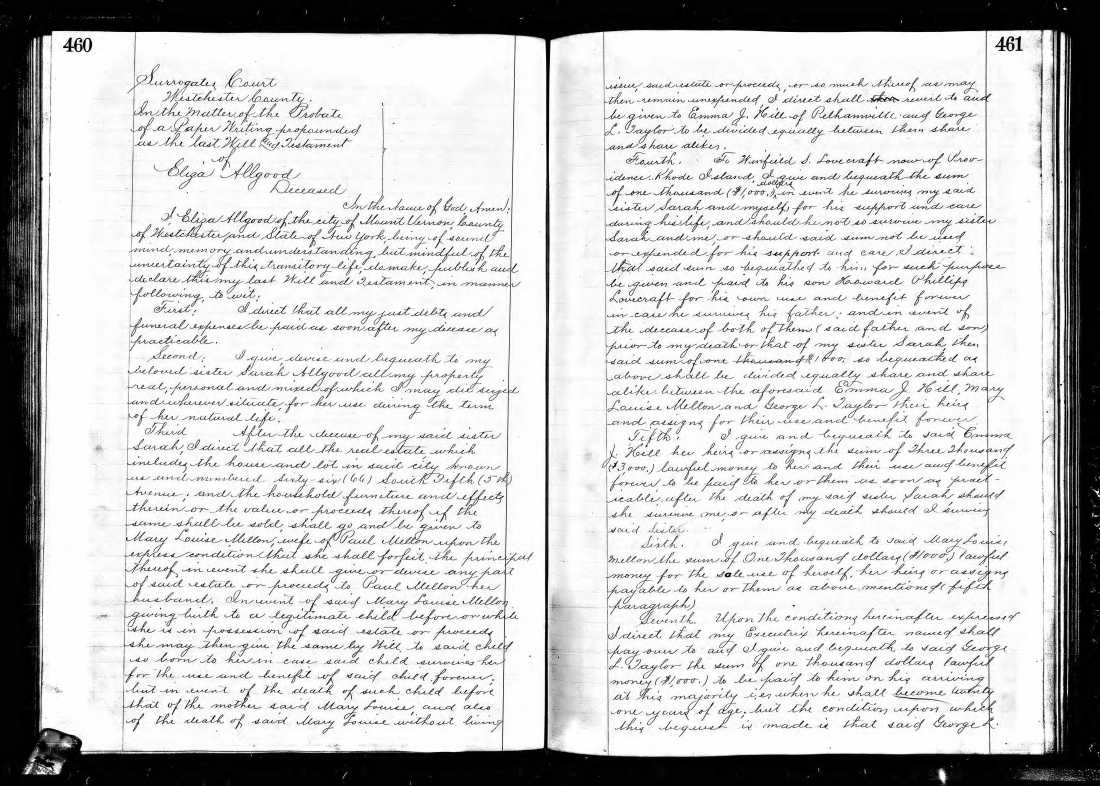
“The Were-Snake” (1925) by Frank Belknap Long, Jr.

My contributions to the Mythos were of assorted shapes and sizes, ranging from the tiny, flesh-devouring Doels, who inhabited an alien dimension shrouded in night and chaos, to the monstrous Chaugnar Faugn, whom only the suicidally inclined would have mistaken for a pachyderm. I also contributed one scenic vista, the mysterious, perpetually mist-shrouded Plateau of Leng, and one forbidden book, John Dee’s English translation of The Necronomicon, which I placed at the head of The Space Eaters when that story first appeared in Weird Tales […]
—Frank Belknap Long, Jr., Howard Phillips Lovecraft: Dreamer on the Nightside 23-24

To hear Long tell it, his first contribution to the Cthulhu Mythos—and the first stories written as part of the Mythos, outside of Lovecraft’s own pen—were “The Space Eaters” (Weird Tales July 1928) and “The Hounds of Tindalos” (Weird Tales March 1929). These stories have been enshrined in canon as much as anything written by anyone other than H. P. Lovecraft himself, and predate anything written specifically incorporating references to the Mythos by Clark Ashton Smith, Robert E. Howard, August Derleth, or others.

What most compilers of Mythos stories seem to forget is that the first published story with a Mythos connection by Long was actually his third story professionally published: “The Were-Snake” (Weird Tales September 1925). Looking at Long’s memoirs, and the collections of his fiction, one gets the impression that perhaps Long wished it would be forgotten. Although reprinted twice during his lifetime in anthologies, like “Mother of Serpents” (1936) by Robert Bloch this story has never been published in any Cthulhu Mythos collection, and remains absent from Long’s The Early Long and Arkham House anthologies.

Normally, when looking into such matters, Lovecraft’s letters are a great asset. However, in this case most of his letters to Long have not been published, and the references to the story in Lovecraft’s published correspondence is minimal:

Next month my “Temple” & Belknap’s “Were-Snake” will appear.
—H. P. Lovecraft to Lillian D. Clark, 6 Jul 1925, Letters to Family and Family Friends 1.306

Hope your friend will get some vignette & tailpiece jobs—you might tell Wright it’s about time he stopped using Brosnatch’s ancient designs for Belknap’s “Desert Lich” & “Were-Snake” & Seabury Quinn’s “Servants of Satan” in this capacity!”
—H. P. Lovecraft to August Derleth, 27 Jan 1932, Essential Solitude 2.444

Andrew Brosnatch was the artist that did the header-pieces for Frank Belknap Long’s stories; the art was re-used periodically in Weird Tales as filler for years afterward. Other than that, there is nothing much in Lovecraft’s correspondence: 1925 was before most of his pulp friends began to correspond with him, and if Lovecraft and Long discussed the story, those letters haven’t come to light yet. What we know of this story’s genesis, then, is mostly down to inference.

Shortly after Weird Tales hit the stands in 1923, H. P. Lovecraft wrote to the editor Edwin Baird—and was soon enmeshed in correspondence with both Baird and the pulp magazine’s owner, J. C. Henneberger. Several submissions from Lovecraft had been accepted at Weird Tales, and in 1924 Lovecraft encouraged his young friend in amateur journalism to submit his own stories to the magazine:

Now, Child, send Grandpa that horror story! If you will be good and write lots and lots of terrible things, I believe you may have a chance to land them in Weird Tales, for as you will see when I send you the Henneberger letter, they are desperately in need of material which is basically unconventional. Pray picture to yourself the curiosity of a fiend-loving Old Gentleman, and delay no longer in making Grandpa your nameless monstrosity! About the Ashton Smith reference in my Hound—I omitted that myself, on advice of Eddy (not Poe but my local protege C. M. Eddy), who said that the editor would object to such exploitation of an artist-poet whose work I am trying to push with Weird Tales. Now that I see how solidly I stand with both Baird and Henneberger, I am sorry I took the advice—but what’s done is done. Another time I may do some free advertising for Smith and Sonny Belknap and Mortonius and everybody!
—H. P. Lovecraft to Frank Belknap Long, Jr., Feb 1924, Selected Letters 1.292-293

“The Hound” was published in the February 1924 issue of Weird Tales; the surviving typescript shows Lovecraft made a few alterations from the original which appear in the published text:

A locked portfolio, bound in tanned human skin, held the unknown and unnamable drawings of Clark Ashton Smith.
—H. P. Lovecraft, “The Hound” (original text)

A locked portfolio, bound in tanned human skin, held certain unknown and unnamable drawings which it was rumoured Goya had perpetrated but dared not acknowledge.
—H. P. Lovecraft, “The Hound” (as published)

This would have been, if published, one of Lovecraft’s first literary in-jokes—Lovecraft was already in correspondence with Clark Ashton Smith at the time—and together with Lovecraft’s urge that Long write and submit his stuff to Weird Tales for publication is probably what led, ultimately, to “The Were-Snake.”

Long’s first stories published in Weird Tales were “The Desert Lich” (WT Nov 1924) and “Death-Waters” (WT Dec 1924); both tales can be said to be typical of his very early professional efforts, dealing with white people in exotic settings and stumbling across something dangerous and uncanny. Later Long would grow as a writer with more complex plots and characterization, but these short pieces were in good company for the early issues of Weird Tales, which was still feeling its way after the editorial shakeup that had seen Baird (and Henneberger) ousted and Farnsworth Wright in the editorial chair.

By the time “Death-Waters” was published, Lovecraft had come down to New York City, married Sonia H. Greene, and taken up residence; he was seeing a good deal of Long and the rest of the gang in the Kalem Club. Long’s third story in Weird Tales was “The Were-Snake” (WT Nov 1925)—published nearly a year after his last one. Why the long delay? Rejection, possibly, or backlog; even if Long wrote it in the spring of 1925, it likely wouldn’t be published until winter…and there are reasons to suspect it might have been written in the spring of 1925.

“The nethermost caverns,” wrote the mad Arab, “are not for the fathoming of eyes that see; for their marvels are strange and terrific. Cursed the ground where dead thoughts live new and oddly bodied, and evil the mind that is held by no head. Wisely did Ibn Schacabao say, that happy is the tomb where no wizard hath lain, and happy the town at night whose wizards are all ashes. For it is of old rumour that the soul of the devil-bought hastes not from his charnel clay, but fats and instructs the very worm that gnaws; till out of corruption horrid life springs, and the dull scavengers of earth wax crafty to vex it and swell monstrous to plague it. Great holes secretly are digged where earth’s pores ought to suffice, and things have learnt to walk that ought to crawl.”
—H. P. Lovecraft, “The Festival”

I sat and dozed, or stared drowzily into the darkness, and thought of the charnel worms which the mad Arab Alhazred bred in the bellies of slain camels.
—Frank Belknap Long, Jr., “The Were-Snake”

That is the sole line that connects “The Were-Snake” with the Cthulhu Mythos. Lovecraft’s “The Festival” was first published in Weird Tales January 1925 issue; if Long read it there…and he might have read it in manuscript, for all we know, before that due to his close association with Lovecraft during that period…it might make sense that “The Were-Snake” with its reference to Alhazred and worms was written later, sometime during early 1925, and submitted to Wright at Weird Tales. Nothing can be said for certain, until and unless more evidence comes to light, but the sequence of events makes sense.

As to the story itself… “The Were-Snake” is very similar to “The Desert Lich” and “Death-Waters.” American tourists in the Near East; more than a touch of exoticism and rather casual racial prejudice and sexism which is sometimes played for laughs:

Our consul has red hair, and he beats his wife and he judges men by the color of their skin
—Frank Belknap Long, Jr., “The Were-Snake

It’s a stilted joke, since the courageous American archaeologist sleeping in the haunted ruins is trying to bluff and bluster at what he thinks are a group of indigenous people playing a trick on himthere are some parallels in this story with Helena Blavatsky’s “A Witch’s Den” (1892), which had been published in Best Psychic Stories (1920), a book that we know Long had read and lent to Lovecraft. But whereas Blavatsky’s apparition was a group of clever natives pulling a ruse, Long’s were-snake is very real…

Robert E. Howard is not known for certain to have read this story; he apparently missed several early issues of Weird Tales. Yet it is notable that one of his early Conan stories, “The God in the Bowl,” was rejected by Farnsworth Wright, includes a man-headed serpent with hypnotic powers and deific connections—was Howard at all aware of “The Were-Snake” when he wrote “The God in the Bowl?” Did Wright reject the story because that element was similar to Long’s story? The latter seems unlikely; but it’s curious that both stories have such similar monsters. There is also a reference at the beginning to Dr. John Dee, which is notable only in that it was Long who attributed to Dee an English translation of the Necronomicon in “The Space Eaters.”

For the most part, however, it’s easy to see why Long might have wished to forget about “The Were-Snake.” The central protagonist and his fiance (?) Miss Beardsley are not terribly compelling. The descriptive material in the encounters in the dark ruins are interesting, but the final revelations lack punch, and little explanation is given as to the nature of the were-snake and her siren-like charms and habits.

The reference to Abdul Alhazred seems a little absurd in hindsight—but in context? Lovecraft hadn’t really established the cosmic scope of his Mythos yet, and the Necronomicon had appeared only in “The Festival” and “The Hound” in print. Long’s usage of Alhazred was no more than a literary in-joke at this point, and not out of keeping with the uses that Lovecraft had already made of the character. That’s how the Cthulhu Mythos started in many ways, with little throwaway references that slowly built up into something else. There were no rules, no planning, little effort to standardize and a great deal of encouragement to experiment.

In hindsight, it’s hard to see where “The Were-Snake” would have “fit” into the growing Mythos, especially after Lovecraft’s death when folks like Francis T. Laney and August Derleth were making an effort to codify the Mythos. Where would the were-snake have fit in their system? Nowadays, of course, fans might say that the were-snake was of the same species as Howard’s “God in the Bowl,” or perhaps a child of Yig, but those are both concepts that came up after Long had conceived and written his piece, and there is no evidence that either Howard or Lovecraft intended any such connection to this early work by Long.

Virtually all myth cycles, fictional or otherwise, include these “fringe-level” borrowings, which but to a minor extent enter into the main body of the cycle. The contributions of other writers did not diminish the genius-inspired originality of the Cthulhu Mythos; in its major aspects it remains entirely Lovecraftian.
—Frank Belknap Long, Jr., Howard Phillips Lovecraft: Dreamer on the Nightside 24

For those who like a bit of trivia, it’s worth noting that the first Mythos entity created by someone other than Lovecraft (and one of the first Mythos entities period) was indisputably female. Whatever else she might have been—god or human, witch or monster—Long’s were-snake was a woman.

Frank Belknap Long, Jr.s’ “The Were-Snake” may be read free online here.


Bobby Derie is the author of Weird Talers: Essays on Robert E. Howard & Others (2019) and Sex and the Cthulhu Mythos (2014).
The Supernatural in Modern English Fiction (1917) by Dorothy Scarborough & The Tale of Terror (1921) by Edith Birkhead

W. Paul Cook wants an article from me on the element of terror & weirdness in literature, but I shall take my time about preparing it.
—H. P. Lovecraft to Lillian D. Clark, 19 Nov 1925, Letters to Family & Family Friends 1.492

In November 1925, while living alone at 169 Clinton Street in Brooklyn, New York, H. P. Lovecraft was asked to write for his friend W. Paul Cook’s amateur journal, The Recluse. Up to this point, Lovecraft had been a fan of weird fiction and read many of the major works in the field, and a reader and contributor to Weird Tales for the last two years, but had never undertaken a systemic course of reading on weird fiction. Now without a wife or regular employment, he had an excuse to do so—as well as the resources of the New York Public Library and Brooklyn Public Library to draw on.

A significant chunk of this reading, and the initial chapters of what would become “Supernatural Horror in Literature” was completed by May 1926; in April of that year, he moved back to Providence, Rhode Island. The final sketching and typing of the long essay was delayed by further discoveries at the Providence Public Library, and Lovecraft continued to make last-minute alterations up until 1927; the essay was finally published in The Recluse in August 1927.

I want to get down to the publick library & read that Timothy Dexter book, (of which Tryout has just sent me another fine review) as well as Gemmill’s new work on the Salem witch trials, & a volume of two or three years ago on the tale of terror.
—H. P. Lovecraft to Lillian D. Clarke, 19 Nov 1925, LFF 1.493

[…] went out to the Bklyn. Library, got Birkhead’s history of “The Tale of Terror”, came home & read it through, & retired 7 a.m.
—H. P. Lovecraft to Lillian D. Clarke, 25 Nov 1925, LFF 1.495

Chapters III & IV of “Supernatural Horror in Literature” are devoted to Gothic literature, and while Lovecraft did peruse the Gothics, one of his major acknowledged sources for these early chapters was The Tale of Terror: A Study of the Gothic Romance (1921) by Edith Birkhead, an assistant lecturer in English literature at the University of Bristol. Birkhead’s study was pioneering in many ways, but as David Punter points out in The Literature of Terror, not only was it a very readable and accessible volume, but it was free of the defensive attitude toward genre fiction that characterized many other works on supernatural and Gothic fiction.

Even in the 1920s, there was something a little trashy and disreputable about such literary fare; penny dreadfuls and purple prose. Folks today still make fun of a novel starting “It was a dark and stormy night…” but that was the actual opening to Edward Bulwer-Lytton’s neo-Gothic novel Paul Clifford (1830), which Birkhead mentions in passing. Even Lovecraft was not above taking a shot at such works, referring in his essay to:

[…] the dreary plethora of trash like Marquis von Grosse’s Horrid Mysteries (1796), Mrs. Roche’s Children of the Abbey (1796), Miss Dacre’s Zofloya; or, The Moor (1806), and the poet Shelley’s schoolboy effusions Zastrozzi (1810) and St. Irvyne (1811) (both imitations of Zofloya) […]

While Lovecraft did read several Gothic novels in the course of his research, the ones listed above are not books which Lovecraft tracked down and read for himself: he was distilling Birkhead’s more detailed history of Gothic literature for his own purposes. No doubt Lovecraft also appreciated that Birkhead did not stint on attention to American Gothic authors such as Nathaniel Hawthorne and Edgar Allan Poe in her chapter on “American Tales of Terror,” and her description of Poe in particular has many echoes with Lovecraft’s own stylistic efforts:

But Poe’s psychology went deeper than that of the writers of romance. His art was much subtler, finer, and more self-conscious than theirs. He was a penetrating critic of his own work, and was deeply interested in craftsmanship. No doubt he analysed the structure of his tales as closely as that of his poem, The Raven, and studied constantly their precise effect on the mind of the reader. In his best tales we feel that he knows from the first sentence exactly what the end is to be. In choosing his subject, he intentionally shuns the normal and turns to the odd, the exceptional and the bizarre. He watches for the airy, gossamer filaments of sensation that float unrealised through most men’s minds and transfers them to his stories. He imagines obscure feelings as intensely as he imagines actual scenes. It seems as if he had brooded so long over his story and become so completely absorbed into its atmosphere that the fine shades of emotion are as real to him as the background he has conceived as a setting. He does not aim at depicting character. The people in his tales are little more than algebraical symbols. he prefers to follow the twists and turns of a brain working under some abnormal influence. His not interested in healthy human minds or hearts. […] His pictures are sometimes so vivid that they make the senses ache. Like Maturin, he even resorts to italics to enforce his effect. He crashes down heavily on a chord which would resound at a touch. […] While he was writing, Poe did not for a moment let his imagination run riot. the outline of the story was so distinctly conceived, its atmosphere so familiar to him, that he had leisure to choose his words accurately, and to dispose his sentences harmoniously, with the final effect ever steadily in view. the impression that he swiftly flashes across our minds is deep and enduring.
—Edith Birkhead, The Tale of Terror 219-220

Lovecraft’s opinion on Birkhead’s book was mixed. While he did not hesitate to recommend it to his friends and correspondents, notably August Derleth (who would write his thesis on “The Weird Tale in English Since 1890) and Donald Wandrei (who was taking an honors course in Gothic fiction at university), to Wandrei he admitted:

I read the Birkhead book on “The Tale of Terror”, but found it exceedingly ill-proportioned & imaginatively unappreciative.
—H. P. Lovecraft to Donald Wandrei, 11 Dec 1926, Letters with Donald and Howard Wandrei 22

No doubt, this was due to the relative narrowness of the scope of The Tale of Terror, and because Lovecraft’s own tastes—reflected in “Supernatural Horror in Literature”—were focused on the uncanny and supernatural, more than the merely terrible or gruesome phases of literature, and because Birkhead’s remit ran out before she tackled contemporary weird fiction or writers such as Arthur Machen or M. R. James. In other places, Lovecraft was more effusive in his praise:

Do you know Railo’s “The Gothic Castle” & Birkhead’s “The Tale of Terror”? Both are excellent exposition of the earlier phases of horror-fiction in English—the Walpole-Radcliffe-Lewis-Maturin type. I could lend you the Birkhead book.
—H. P. Lovecraft to J. Vernon Shea, 22 Mar 1932, Letters to J. Vernon Shea 92

Eino Railo was a Finnish scholar whose treatise The Haunted Castle: A Study of the Elements of English Romanticism was published in English in 1927. Lovecraft would count his work along with Birkhead as one of the default textbooks on Gothic fiction, although he read it too late to incorporate into the first publication of his own article:

Speaking of Gothic source material—Cook has just lent me a brand new book by one Eino Railo (never heard of him before) which for thoroughness throws Birkhead altogether into the shade—although its scope is even narrower.
—H. P. Lovecraft to Donald Wandrei, 22 Oct 1927, LWP 171

Lovecraft did not cease collecting material after “Supernatural Horror in Literature” was published, but continued to collect notes with an eye toward a revised version of the text, incorporating more material he subsequently found on important authors like William Hope Hodgson. In this, Wandrei was very useful in pointing Lovecraft toward some other sources:

By the way, in looking through the bookstacks of the University library the other [day], I came across “The Supernatural in Modern English Fiction”, by Dorothy Scarborough; it does not seem to be especially good as a monograph but it mentions a great many books and tales which I do not know. I have also discovered at the U. a professor whose speciality is the eighteenth century and who is fond of Gothic literature. He says a French book on the subject has just been issued, under the title, I think, “Le Roman de Terreur”. I don’t remember the author’s name, but I’ll find it out. The book apparently has not come into the library as yet; hence I can’t say how good it is.
—Donald Wandrei to H. P. Lovecraft, 28 Feb 1927, LWP 59-60

Dorothy Scarborough, PhD., was an English instructor at Columbia University, and her work The Supernatural in Modern English Fiction (1917) is an extensive survey of the entire field of supernatural works in English, though even with this vast scope and a bibliography of some three thousand titles, she admits in her preface that it isn’t possible to mention every title, the field is simply too vast. Still, her volume represents one of, if not the, first major assay of the field of supernatural fiction in English. Her general expertise on ghost stories was acknowledged in several collections, notably The Best Psychic Stories (1920), Humorous Ghost Stories (1921), and Famous Modern Ghost Stories (1921)

The other work Wandrei mentions is Le roman “terrifiant”: ou, Roman noir de Walpole à Anne Radeliffe et son influence sur la littérature française jusqu’en 1840 (The ‘Terror’ Story, or the Black Novel from from Walpole to Anne Radeliffe and its influence on French literature until 1840,” 1923) by Alice M. Killen, a revision of her 1920 thesis. This is a strictly French-language work on the Gothic novel in much the same vein as Railo and Birkhead, although again with a narrower focus. Lovecraft didn’t read French and never saw Killen’s book, though he continued to cite her as an expert in the field—but he did read Scarborough.

Thanks tremendously for the Scarborough book, which I read with keen interest & am going to return the first moment I can get to a post office. It was certainly kind of you to send it. The material is really of great value, & I am immensely glad I had a chance to go through it. As you say, the weakest parts are those dealing with later work. The author does not mention M. R. James, & her prim distaste for Machen’s macabre suggestions is rather amusing. Likewise, her efforts to be continually jocose & flippant become a little strained as one reads on. There is no conflict with my article, because the scope & method of the work are entirely different. This book covers not only horror but all forms of the supernatural, & includes the comic & the lightly whimsical as well as the grotesque & the terrible. Also, its plan of development & system of emphasis is entirely different. What I am trying to do is give a  list of especially notable works containing supernatural horror; listing them by periods & authors & allotting them notice on the basis of their strength & merit in the given field. Dr. Scarborough, on the other hand, is trying to trace certain types of subject-matter through literature in a less critical way—being interested in the mere mention of a certain superstition by an author, & listing items simply because they deal with such-&-such—not because they have a special power to influence the emotions. This system involves a radically different form of outline, as you see. Instead of going ahead chronologically & treating the most powerful books of each period, Scarborough follows first one stream of subdivided subject-matter & then another—i.e., ghosts, devil, vampire, werewolf, wandering Jew, metempsychosis, alchemy, folklore, science, &c. &c. In the course of this scheme she lists many things so pallid & inane that one can hardly think of their deserving a place except from the standpoint of academic scholarship. And yet, for all that it’s a valuable book. It certainly brings out many essential facts & tendencies amazingly well, & will bear comparison with anything else on this theme ever written. The separate & perhaps encyclopaedic bibliography edited by Dr. S. must be another item of great importance. Let me know any time you want to see the Birkhead book. […] I obtained several hints from Scarborough, & also copied two tributes to the weird as a genre from the introduction—Lafcadio Hearn’s & the author’s own. Whether I’ll ever get around to preparing a second & amended edition of my article, I’m sure I don’t know.
—H. P. Lovecraft to J. Vernon Shea, 31 Mar 1932, Letters to J. Vernon Shea 95

As it happened, Lovecraft did get that chance. Charles D. Hornig, the editor of The Fantasy Fan fanzine, serialized the revised essay in parts from 1933-1935…at which point the series ended, having only published up to the revised chapter VIII. The full revised text was not published until two years after Lovecraft’s death, in The Outsider and Others (1939, Arkham House).

The influence that Scarborough had on Lovecraft’s revised version of “Supernatural Horror in Literature” is hard to measure. A comparison of the original 1927 text and the 1939 text show some substantial revisions, some of which might be due to additional authors and insights provided by Scarborough, but others which concern contemporary authors that Scarborough’s book doesn’t touch upon. Yet for the rest of his life, Lovecraft generally acknowledged the authority of Birkhead and Scarborough in passages like:

Weird elements have permeated literature since prehistoric times—flourishing in Elizabethan drama & forming a distinct school since the middle of the eighteenth century. (cf. “The Tale of Terror” by Edith Birkhead; “The Haunted Castle”, by Eino Railo; “The Supernatural in Modern English Fiction”, by Dorothy Scarborough—all presumably obtainable at the public library […]
—H. P. Lovecraft to C. L. Moore, 12 Apr 1935, Letters to C. L. Moore 30

Perhaps the most remarkable thing about Lovecraft’s acknowledgement of the expertise of these two women is how unremarkable it is. Lovecraft at no point makes any issue of their gender, and while he does not agree with them in all particulars, he also does not associate the source of that disagreement with their being women. He acknowledged their expertise and scholastic efforts, at least in their letters. While “Supernatural Horror in Literature” only credits Birkhead and not Scarborough, that is no doubt because he leaned much more heavily on Birkhead’s scholarship in the early chapters on the Gothics.

Since his death, Lovecraft’s “Supernatural Horror in Literature” has probably become his most influential essay, a survey and definition of the field of weird fiction which, while not as exhaustive as that of Birkhead, Railo, Killen, and Scarborough, is more focused on what we think of as the “weird tale” today. If Lovecraft saw a little further than other weird talers during his lifetime, it was because he stood on the shoulders of giants like Birkhead and Scarborough, and all those who cite his essay are in turn being influenced by these great women scholars of the weird.

Edith Birkhead’s The Tale of Terror: A Study of the Gothic Romance may be read for free online here.

Dorothy Scarborough’s The Supernatural in Modern English Fiction may be read for free online here.


Bobby Derie is the author of Weird Talers: Essays on Robert E. Howard & Others (2019) and Sex and the Cthulhu Mythos (2014).
“Shambleau” (1933) by C. L. Moore

[…] it was a rainy afternoon in the middle of the Depression, I had nothing to do—but I really should’ve looked busy because jobs were hard to get! I didn’t want to appear that I wasn’t earning my daily keep! To take up time, I was practicing things on the typewriter to improve my speed—things like ‘the quick brown fox jumped over the lazy dog.” That got boring, so I began to write bits of poetry I remembered from my college courses…in particular, I was quoting a poem called “The Haystack in the Flood.” […] The poem was about a woman in 13th century France who is being pursued by enemies of some kind…she was running across a field and these men were after her. I had misquoted a line in my mind, as well as on the typewriter, and referred to a “Red, running figure.” […] At the time I thought, “Ha! A red, running figure! Why is she running? Who is she running from and where is she running to? What’s going to happen to her? Strangely enough, I just swung from that line of poetry into the opening of “Shambleau.”
⁠—”Interview: C. L. Moore Talks To Chacal” in Chacal #1 (1976), 26

Red running lions dismally
Grinn’d from his pennon, under which,
In one straight line along the ditch,
They counted thirty heads.
—William Morris, “The Haystack in the Floods”

Then into his range of vision flashed a red running figure, dodging like a hunted hare from shelter to shelter in the narrow street. It was a girl — a berry-brown girl in a single tattered garment whose scarlet burnt the eyes with its brilliance.
—C. L. Moore, “Shambleau” in Weird Tales November 1933

Catherine Lucille Moore was was 22 years old in 1933, and engaged to be married. The Great Depression had nixed her short-lived effort to go to college, and she had gotten a job as a typist at the Fletcher Trust Company in her native Indianapolis—where her fiance also worked. In her spare time, she read pulp magazines like Amazing Stories, Wonder Stories, Astounding, and Weird Tales—and began to write and submit stories to them.

“Shambleau” was the first tale of Northwest Smith to hit print; the protagonist was inspired by a depositor at her company, who signed their letters as “N. W. Smith.” (“C. L. Moore and Henry Kuttner” in Science Fiction Writers 161-167), and originally was meant for an entirely different genre:

I have remotest glimmers of memory about a wild, wild Western that never went beyond the idea that there ought to be a One-Eyed Jack, (possibly of hearts) and a Northwest Smith on a ranch called the Bar-Nothing. Thence the name, but whence the character no one knows, least of all myself. When I first began to consider him as a space-ranger, I was guilty of a saga which started out,

Northwest Smith was a hard-boiled guy
With an iron fist and a roving eye—

of which the less is said the better.
—C. L. Moore, Echoes of Valor II, 37

Northwest Smith would not be quite a space cowboy, but the literary genesis makes sense. The Martian town presented is the spaceport equivalent of a little town out west, maybe up by the Canadian border or down south near Mexicothe kind of place that attracts lean, hungry operators who reach for the heat-gun on their hips as easily as a shootist might reach for the big iron on their hip. Other details of the story were more prosaic; for instance, Moore maintained that the name “Yarol” had derived from the Royal typewriter she was using to type the story (C. L. Moore to R. H. Barlow, 10 Sep-9 Oct 1934).

The manuscript for the story ended up on the desk of Farnsworth Wright, editor of Weird Tales:

The peak was reached in 1933, when he handed me something by one C. L. Moore.

“Read this!” he commanded, the moment I stepped into the new editorial rooms at 840 North Michigan Avenue, in Chicago.

I obeyed. The story commanded my attention. There was no escape. I forgot that I needed food and drink—I’d driven a long way. […] The stranger’s narrative prevailed until, finally, I drew a deep breath, exhaled, flipped the last sheet to the back of the pack, and looked again at the by-line. Never heard of it before.

“For Christ’s sweet sake, who and what is this C. L. Moore?”

He wagged his head, gave me an I-told-you-so-grimace.

We declared C. L. Moore day. I’d met Northwest Smith, and Shambleau.
—E. Hoffmann Price, Book of the Dead 16

The story was ~11,000 words. Farnsworth Wright wrote to Moore and offered $100; a cent-per-word, payable on publication, was the average for a Weird Tales story.

[…] after I sent it off to WT, I more or less forgot about it. One day I came home from work and there was a long letter on the hall table for me. I opened it up and it said that they were going to pay me a hundred dollars. And that was like TEN THOUSAND dollars at that time. I screamed at the top of my voice! My father came charging downstairs thinking that I had been murdered or something (laughter) and nobody believed it until they read the letter. Then joy was completely unconfined—everyone was so happy about it.
⁠—”Interview: C. L. Moore Talks To Chacal” in Chacal #1 (1976), 27

It wasn’t her first publication, because Moore had a few things published during her brief time at college, but it was her first professional sale…but she couldn’t quit her dayjob just yet.

I used the initials “C. L.” simply because I didn’t want it to be known at the bank that I had an extra source of income. I wrote “Shambleau” in the midst of the Depression.  The bank was a very paternalistic organization. If was always firing those people whose services weren’t really needed. I had the feeling they might have fired me had they known I was earning extra income. Using my initials was simply a means of obscuring my identity.
Pulp Voices; or Science Fiction Voices #6 47

“Shambleau” saw print in the November 1933 issue of Weird Tales. Competition in the issue was stiff: regulars and fan favorites like Edmond Hamilton, E. Hoffmann Price, Clark Ashton Smith filled the issue…yet it was “Shambleau” and C. L. Moore which garnered the most attention, the most praise. For the sixteen years that Farnsworth Wright edited Weird Tales, he kept a tally of the most popular stories of all time—and not only was “Shambleau” the most popular story of the issue—it was the most popular story of 1933, and the second-most popular story to ever run in the magazine, beating out “The Outsider” by H. P. Lovecraft (3rd place), and second only to A. Merritt’s “The Woman of the Wood” (Weird Tales Aug 1926).

It was the most impressive arrival that any writer ever had at Weird Tales…and it’s easy to see why.

Shambleau! Vaguely of French origin, it must be. And strange enough to hear it from the lips of Venusians and Martian drylanders, but it was their use of it that puzzled him more. “We never let those things live,” the ex-Patrolman had said. It reminded him dimly of something … an ancient line from some writing in his own tongue . . .  “Thou shalt not suffer a witch to live.” He smiled to himself at the similarity, and simultaneously was aware of the girl at his elbow.
—C. L. Moore, “Shambleau” in Weird Tales November 1933

The world is rich, lived-in, and perhaps a little like the Martian stories that Clark Ashton Smith had begun to write, such as “The Vaults of Yoh-Vombis” (Weird Tales May 1932) and “The Dweller in the Gulf” (Wonder Stories March 1933). Aliens, Medusa, and Mars were all familiar to readers of weird fiction in the 1930s, and even the tentacle’d horror was no stranger to Weird Tales, though rarely in so sexually suggestive a manner; Robert E. Howard had beaten her to the punch with “The Slithering Shadow” (Weird Tales September 1933) just a couple months before, but both offered the readers suggestions of new and thrilling sins:

A dark tentacle-like member slid about her body, and she screamed at the touch of it on her naked flesh. It was neither warm nor cold, rough nor smooth; it was like nothing that had ever touched her before, and at its caress she knew such fear and shame as she had never dreamed of. All the obscenity and salacious infamy spawned in the muck of the abysmal pits of Life seemed to down her in seas of cosmic filth.
—Robert E. Howard, “The Slithering Shadow” in Weird Tales September 1933

And something . . . some nameless, unthinkable thing . . . was coiled about his throat . . . something like a soft snake, wet and warm. It lay loose and light about his neck . . . and it was moving gently, very gently, with a soft, caressive pressure that sent little thrills of delight through every nerve and fiber of him, a perilous delight—beyond physical pleasure, deeper than joy of the mind. That warm softness was caressing the very roots of his soul with a terrible intimacy. The ecstasy of it left him weak, and yet he knew—in a flash of knowledge born of this impossible dream—that the soul should not be handled. . . .  And with that knowledge a horror broke upon him, turning the pleasure into a rapture of revulsion, hateful, horrible—but still most foully sweet.
—C. L. Moore, “Shambleau” in Weird Tales November 1933

There were few hard lines between science fiction and fantasy in the 1930s, and C. L. Moore didn’t give a damn for any such distinctions; her Northwest Smith stories often involve encounters with alien gods, sorcerers, and other supernatural elements. Her characters are often driven to terrible experiences that tax and imperil the mind and spirit as much the physical body, seek to describe such states of mingled ecstasy in horror with fantastic, poetic language. In one letter she wrote:

I know now why my fiance looked at me in that peculiar way after he’d read “Shambleau”—the first and only one of my stories he was ever persuaded to read. I know now what he was thinking. What kind of a person is this who can think of such things?
—C. L. Moore to H. P. Lovecraft, 12 Nov 1935, Letters to C. L. Moore and Others 73

H. P. Lovecraft read the November 1933 issue of Weird Tales, and his initial reaction to the story was modest:

There is a germ of originality, despite much commonplaceness, in “Shambleau” […]
—H. P. Lovecraft to August Derleth, Nov 1933, Essential Solitude 2.613

The argument over “commonplaceness” probably has much to do with the general setting with its humanoid aliens and inhabitable planets; Lovecraft’s essay “Some Notes on Interplanetary Fiction” poo-pooed many of the tropes of Space Opera and Sword & Planet fiction which feature in “Shambleau.” However, to the editor of Weird Tales he offered effusive praise:

Shambleau is great stuff, too. It begins magnificently, on just the right note of terror, and with black intimations of the unknown. The subtle evil of the Entity, as suggested by the unexplained horror of the people, is extremely powerful—and the description of the Thing itself when unmasked is no letdown. Like “The House of the Worm”, it has real atmosphere and tension—rare thing amidst the pulp traditions of brisk, cheerful, staccato prose and lifeless stock characters and images. The one major fault is the conventional interplanetary setting. That weakens and dilutes the effect of both by introducing a parallel or rival wonder and by removing it from reality. Of course a very remote setting had to be chosen for so unknown  marvel—but some place like India, Africa, or the Amazon jungle might have been used…with the horror made more local. I trust your revisions may make Mrs. Moore’s second story as striking and interesting as this one.
—H. P. Lovecraft to Farnsworth Wright, 21 Nov 1933, Lovecraft Annual 8.38-39

Wright published an excerpt from this letter in the Jan 1934 issue of Weird Tales, along with other praise for “Shambleau.” The editor of Weird Tales  wrote to Moore requesting more of her work. By March 1934, she had sold two more stories (“Black Thirst” and “Scarlet Dream”) to Wright, and she had gotten in touch with her first fan—Robert H. Barlow. (C. L. Moore to R. H. Barlow, 8 Mar 1934)

Barlow was a friend and correspondent of Weird Tales writer H. P. Lovecraft and E. Hoffmann Price, and in the early 1930s had begun writing to authors like Robert E. Howard requesting copies of the manuscripts for their stories. Boldly, he asked her for the draft of “Shambleau,” but Moore told him the draft had been destroyed. (C. L. Moore to R. H. Barlow, 28 Mar 1934) Instead, she sent him a drawing she had made of Shambleau:

Shambleau original art

Lovecraft commented on this as well:

Yes—C. L. Moore is certainly the most powerful & genuinely weird new writer secured by W.T. in many years. She is indeed of the feminine gender, the C. standing for Catherine. It is her wish, however, not to have this widely known—since she hopes to conceal the fact of her writing from her regular employers. She has a secretarial job with some corporation in Indianapolis, & fears she will be fired if it is known that she has another source of income. Miss Moore is also an artist of ability—last month she sent Barlow a drawing of Shambleau which displays phenomenal power.
—H. P. Lovecraft to Duane W. Rimel, 17 June 1934, Letters to F. Lee Baldwin, etc. 184-185

As to Miss Moore’s drawings—“Shambleau” is extremely well done, though not as subtly horrible & richly potent as Howard Wandrei would have made it. It is pen & ink, & so far as I know all her other drawings are. She most certainly has great & enviable talents.
—H. P. Lovecraft to Duane W. Rimel, 23 July 1934, Letters to F. Lee Baldwin, etc. 195

Ar E’ch Bei shewed me the “Shambleau” sketch, which certainly displays vast cleverness even if it lacks the indefinable menace & cosmic remoteness that you or Howard Wandrei would put into it. As a writer, Miss Moore is certainly the discovery of the last few years. No other newcomers is even in the running.
—H. P. Lovecraft to Clark Ashton Smith, 30 Sep 1934, Dawnward Spire, Lonely Hill 571-572

Lovecraft’s admiration was by all accounts sincere, and he held “Shambleau” among the best stories Moore had written until the end of his life. In time they would collaborate on the round-robin “The Challenge From Beyond” (1935), and they would correspond briefly (see Her Letters To Lovecraft: Catherine Lucille Moore). He would comfort her after the death of her fiance in 1936, and introduce her to her future husband Henry Kuttner; she would inform him of the death of Robert E. Howard, create the Sword & Sorcery character Jirel of Joiry, inspire Robert A. Heinlein’s “The Green Hills of Earth” (1947), and go on to a writing career that would last decades…and all, perhaps, because of this story, “Shambleau” and its singular reception.

It is interesting to compare this tale with Lovecraft’s revision “Medusa’s Coil” (1939) by Zealia Bishop. “Medusa’s Coil” is often considered one of Lovecraft’s worst stories and “Shambleau” one of Moore’s best, so a comparison of the prose tells us little, but it’s interesting to see how develops their themes. Neither story makes any effort to lift straight from the the ancient Greek myth, except by visual inspiration: a woman with deadly hair. This sets these tales apart from stories like Clark Ashton Smith’s “The Gorgon” (Weird Tales Apr 1932). Both Lovecraft and Moore explore what makes these women dangerous, and yet attractive. They suffer prejudice, for different reasons, and we get only limited hints of the female characters’ viewpoints because the perspective comes from men…and mostly their victims relay what little we know of their words and character.

Like Lovecraft’s, Moore’s story is not a moral tale in any strict sense. Northwest Smith’s action in saving the persecuted Shambleau was heroic; his efforts to care for her without taking advantage of the situation sexually is, if not commendable, at least shows Smith as not the worst of criminals…but the purpose of the story is not to show that Smith should have let the mob have the alien woman, though some readers may take that away from the ending. The “no good deed goes unpunished” interpretation of the narrative is a rather weak “I told you so,” and it doesn’t stop Smith from getting into other troublesome situations in later stories. Likewise, the “transgression” of marrying Marceline Bedard is not the focus of “Medusa’s Coil”—it’s just how the Medusa-character is brought into the story.

The difference is, at the end of “Medusa’s Coil,” nobody is alive to marry the Medusa-character again. The act cannot be repeated. With “Shambleau,” the horror is not Shambleau’s alien appendages or strange appetites, but the addiction to her terrible feeding. What Northwest Smith knows and fears is that he has become a junkie, and if the opportunity comes again—he might embrace it. That is rare territory for a weird tale, especially with the feeding so explicitly pseudo-sexual in nature—and shows something of the different approach both brought to their respective works. With Lovecraft, the horror rises from the grave, but with Moore, it might dash through the next Martian alley, a red, running figure…and Northwest Smith unable to stop himself as it plays out again.

C. L. Moore’s “Shambleau” can be read for free online here.


Bobby Derie is the author of Weird Talers: Essays on Robert E. Howard & Others (2019) and Sex and the Cthulhu Mythos (2014).