Her Letters To Lovecraft: Jonquil Leiber

But first I must explain that my husband, Fritz Leiber, Jr, son of the Shakespearian actor, (who often played in Providence in time past) met Lovecraft through myself and formed a delightful friendship. We were the recipients of many letters now in the hands of the Wisconsin people, Eerleth [sic] et al. Many of the things you touched on in your article, we knew a little more in detail due to this correspondence – about his brief marriage for instance. And since I wa [sic] more interested in Lovecraft as a man or human than I was as a writer, (I lean to the Montague Rhode James, plus the weird man known as Summers type of mystery having been brought up in a draft old English castle – I’m an Englishwoman) so that I learned a number of things about him that his more well bred correspondents did. The man literally starved to death.
—Jonquil Leiber to William Townley Scott, 18 May 1944, MSS. John Hay Library

Jonquil Ellen Stephens married Fritz Reuter Leiber, Jr. on 18 January 1936. Fritz was working as an actor and pursuing a career as a writer; he had met and dated Jonquil at the University of Chicago in 1933-1934. They shared a love of supernatural fiction and poetry, and she encouraged her husband’s interests. On the 14th of October 1936, Jonquil wrote to Lovecraft.

Then in the late summer my wife, with a bold directness I had been unable to conceive for myself, wrote a letter to Lovecraft care of Weird Tales. A few days later the great man replied with what we thought was a long letter, until we had received some of his average-sized communications. That was the beginning of an orgy of letter-writing which lasted the few short months until his death. My wife wrote more letters herself and shortly we were joined by my friend and fellow enthusiast for the fantastic, Harry O. Fischer, then of Lousiville, Kentucky. Our letters were returned to us by Mrs. Gamwell afterwards. The entire correspondence was excerpted by Derleth for the volume of letters and later borrowed and retained, permanently as yet, by another individual who shall remain nameless here.
—Fritz Leiber, Jr. “My Correspondence with Lovecraft,” Letters to C. L. Moore and Others 375

Of the nine published letters from H. P. Lovecraft to Fritz & Jonquil Leiber, based off the Arkham House Transcripts created by August Derleth & co., four are addressed to “My dear Mrs. Leiber.” The originals letters, as far as I am aware, have not surfaced in the interim.

It is difficult to feel out who Jonquil was through these letters. As she told Scott, they show an interest in Lovecraft as a human being more than in his fiction; where Fritz and Lovecraft soon got deep into literary criticism and history, which would cause Fritz Leiber to revise his first Fafhrd & the Grey Mouser novella Adept’s Gambit, to her he answered questions on his life, who Lovecraft was and how he lived. Yet this was a real correspondence, a two-way channel of communication, and Lovecraft found out about her even as she was finding out about him.

It is interesting to know that you have a touch of piracy in your ancestry! I have a counterfeiter as a great-great-grand-uncle about whom I’ll tell you some time.
—H. P. Lovecraft to Jonquil Leiber, Letters to C. L. Moore and Others 317

The best picture of her probably came from her husband, writing decades later after thirty-three years of marriage which only ended with her death due to a combination of alcohol and barbiturates. He remembered her as she was when they married:

She was small (four foot ten; best weight, ninety pounds), had bright blue eyes that were at times violet; she was fast (at Cyfartha Castle school in Wales she’d been a great scorer in field hockey; her method: get the ball and dodge your way to the enemy goal, no teamwork needed—you can always dodge big girls) and a good apache dancer; she had natural grace and artistry (early on she’d done illuminated manuscripts just as had the hero of Machen’s The Hill of Dreams); in America she posed for silk stocking advertisements; she was a great party planner and giver, a gifted fortuneteller, enthusiastic, and friendly, but capable of sudden vast dignified reserves, again just like a kitten.
—Fritz Leiber, Jr., “Not Much Disorder and Not So Early Sex: An Autobiographic Essay”
in The Ghost Light 334

Fritz talks about how cold winter was that January and February in Chicago, and how he read to Jonquil “At the Mountains of Madness” by H. P. Lovecraft from the pages of Astounding Stories (the first part appeared in the February 1936 issue, which might have been on the stands the month before). Their correspondence itself is almost lost in his account of their life together. It was, after all, only about four months—though it would influence Fritz for the rest of his life, help inform his work and make connections with the circle of Lovecraft’s correspondents, and he would return the favor with literary analyses and appreciations such as “The Works of H. P. Lovecraft: Suggestions for a Critical Appraisal” (1944), “A Literary Copernicus” (1949), “Through Hyperspace with Brown Jenkin” (1963), and “To Arkham and the Stars” (1966).

Throughout his life, Fritz Leiber, Jr. never forgot his debt to Lovecraft—or to Jonquil.

Because without Jonquil, none of it would have happened. Perhaps Fritz would have found his voice eventually; sold his stories and made his name. Fafhrd & the Grey Mouser may yet have helped inspire Dungeons & Dragons and played their part in the sword & sorcery boom of the 1960s and 70s; Fritz may even have written his homages to Lovecraft without that personal connection and communication. Yet because she had the courage to write to Lovecraft, a torch was passed from one generation of weird writers to another—and the effects of her letters to Lovecraft are still being felt today. They can still be read today, thanks to her: his final hopes to get a job, his painful economic necessities to scrimp on food. Not always pleasant reading, but the kind of insight which Lovecraft did not always share with every correspondent.

Lovecraft’s letters to Jonquil & Fritz Leiber were published in part in volume five of the Selected Letters (Arkham House, 1976), published more fully in Fritz Leiber and H.P. Lovecraft: Writers of the Dark (2005, Wildside Press), and reprinted in Letters to C. L. Moore and Others (2017, Hippocampus Press).

To A Dead Lover

Your limbs lie quietly beneath the grey dust and mould
And I am done with you and all you were of old
The blind worms creep about that once lovely head
I held against my heart…once, when your blood ran red.

Long years ago I loved you, but now I smile
Having other men a long, long while
I have forgotten you, I say, and all you were….

….But why do I hear your slow step on the stair…
And wait, eyes closed, to feel your arms about me?
—Jonquil Stephens, Sonnets to Jonquil and All (1978) vii


Bobby Derie is the author of Weird Talers: Essays on Robert E. Howard & Others (2019) and Sex and the Cthulhu Mythos (2014).
“This Weave of Witchery” (2019) by W. H. Pugmire & Maryanne K. Snyder

I’ve been working with Maryanne K. Snyder on a book of collaborative work, and she has proved an absolute delight to work with.  I prefer to write alone, collaborating is a lot more work for me; but often writing with someone else can take you to places you would never otherwise discover writing on your own. 
—W. H. Pugmire, “New Story Sale” (6 Oct 2010)

On the surface, “This Weave of Witchery” feels almost unfinished. Bits of pieces of Sesqua Valley and Lovecraft Country, dovetailed together into a kind of prose poem, capturing echoes of old moods: “The Dunwich Horror” and “The Silver Key,” “Born in Strange Shadow” and “Some Distant Baying Sound.” Imagine treading old, familiar territory, only to look back and suddenly see it from an angle you’ve never seen it before. Familiar, yet strange. That’s the prevailing attitude of “This Weave of Witchery.”

The plot feels like a deliberate reworking of “The Silver Key,” but from a different angle. Many writers have worked around the theme of losing the ability to dream—either literally, or in the sense of losing some creative urge or muse. Lord Dunsany wrote a bit about that in the end of “Idle Days on the Yann”:

Long we regarded one another, knowing that we should meet no more, for my fancy is weakening as the years slip by, and I go ever more seldom into the Lands of Dream. Then we clasped hands, uncouthly on his part, for it is not the method of greeting in his country, and he commended my soul to the care of his own gods, to his little lesser gods, the humble ones, to the gods that bless Belzoond.

Dunsany had followed this up in “The Shop In Go-By Street,” where the protagonist seeks once more to return to the Lands of Dream, only to find:

I would have waited three more days, but on the third day I had gone in my loneliness to see the very spot where first I met Bird of the River at her anchorage with her bearded captain sitting on the deck. And as I looked at the black mud of the harbour and pictured in my mind that band of sailors whom I had not seen for two years, I saw an old hulk peeping from the mud. The lapse of centuries seemed partly to have rotted and partly to have buried in the mud all but the prow of the boat and on the prow I faintly saw a name. I read it slowly— it was Bird of the River. And then I knew that, while in Ireland and London two years had barely passed over my head, ages had gone over the region of Yann and wrecked and rotted that once familiar ship, and buried years ago the bones of the youngest of my friends, who so often sang to me of Durl and Duz or told the dragon-legends of Belzoond.

There is something of this in Lovecraft’s “The Silver Key,” and perhaps in Pugmire & Snyder’s story something of Arthur Machen’s The Hill of Dreams:

He strove to rise from his chair, to cry out, but he could not. Deep, deep the darkness closed upon him, and the storm sounded far away. The Roman fort surged up, terrific, and he saw the writhing boughs in a ring, and behind them a glow and heat of fire. There were hideous shapes that swarmed in the thicket of the oaks; they called and beckoned to him, and rose into the air, into the flame that was smitten from heaven about the walls. And amongst them was the form of the beloved, but jets of flame issued from her breasts, and beside her was a horrible old woman, naked; and they, too, summoned him to mount the hill.

He heard Dr. Burrows whispering of the strange things that had been found in old Mrs. Gibbon’s cottage, obscene figures, and unknown contrivances. She was a witch, he said, and the mistress of witches.

He fought against the nightmare, against the illusion that bewildered him. All his life, he thought, had been an evil dream, and for the common world he had fashioned an unreal red garment, that burned in his eyes. Truth and the dream were so mingled that now he could not divide one from the other. He had let Annie drink his soul beneath the hill, on the night when the moonfire shone, but he had not surely seen her exalted in the flame, the Queen of the Sabbath. Dimly he remembered Dr. Burrows coming to see him in London, but had he not imagined all the rest?

Compare with:

It came as a wall of liquid blackness, an inky abyss in which he felt he would be drowned. There was something almost beguiling in its churning sentience, and he felt the need to speak to it, to name himself. Parting lips, he moaned his name as the blackness spilled into his mouth and shook him awake. […] Early sunset washed the sky over Sesqua Valley with muted color, and Thorley stood for a little while to appreciate the orange and pink effects that tainted the white stone of the titanic twin-peaked mountain. He had never thought to see that mountain again, and did not remember its effect on him, how it captivated one part of his mind and troubled another. He gazed at it until he felt himself grow faint, and then he remembered his mother’s words of caution, “It’s not wise to stare at Mount Selta for too long a time. Turn your eyes away.”
—W. H. Pugmire & Maryanne K. Synder, “This Weave of Witchery” in An Imp of Aether 211

These are old themes, paths well-trod, familiar territory for weird fiction aficionados. Donald Wandrei touched on such confusions of dreams and reality in the obscure Mythos story “The Lady in Gray”; and maybe there’s something of that in this weave of witchery as well.

If Pugmire & Snyder had done no more than write a prose poem in that tradition, one more bridge between the waking world and the Dreamlands, “The Weave of Witchery” would be an unremarkable yet solid entry. Yet they did manage to find a new perspective, one which Dunsany, Machen, Lovecraft, & Wandrei had not played with. Think back to “The Silver Key,” and Randolph Carter’s lament of what he had lost—and think of how it would change the story if he was wrong.

“This Weave of Witchery” is the fourth published collaboration between W. H. Pugmire & Maryanne K. Snyder, the others being “The House of Idiot Children” (2008), “The Hidden Realm” (2011), and “The Seventh Eikon” (2012). “This Weave of Witchery” was first published in An Imp of Aether (2019).


Bobby Derie is the author of Weird Talers: Essays on Robert E. Howard & Others (2019) and Sex and the Cthulhu Mythos (2014).

Relatione del Reame di Congo (1591) by Filippo Pigafetta

The first object of my curiosity was a book of medium size lying upon the table and presenting such an antediluvian aspect that I marvelled at beholding it outside a museum or library. It was bound in leather with metal fittings, and was in an excellent state of preservation; being altogether an unusual sort of volume to encounter in an abode so lowly. When I opened it to the title page my wonder grew even greater, for it proved to be nothing less rare than Pigafetta’s account of the Congo region, written in Latin from the notes of the sailor Lopez and printed at Frankfort in 1598.
—H. P. Lovecraft, “The Picture in the House”

The Portuguese had begun their colonial empire in Africa in the 15th century, and the explorer Diogo Cão had made contact with the BaKongo people and explored the Congo River in 1482. After the Treaty of Tordesillas in 1494 restricted Portuguese colonial interests in the Americas, they focused more strongly on trade with and colonial possessions in Africa, as well as sending missionaries to spread Christianity. In the Congo River region, the Portuguese missions became embroiled in local politics, especially the independence movement of the Kingdom of Ndongo, which was a tributary state to the Kingdom of Kongo.

In 1571, the Portuguese led a third mission to the Congo region with the intent of conquering territory for a permanent colony. The Kingdom of the Kongo at this time was faced with not only the independent Kingdom of Ndongo, but raids from other peoples on the border referred to ambiguously as Jagas. The Portuguese established a permanent presence in what they now called Angola, establishing São Paulo de Loanda in 1575, and the Portuguese military force established alliances with both Ndongo and Kongo to assist them against the Jaga as the Portuguese established further forts, trading posts, and settlements with an emphasis on the slave trade for plantations in the Americas.

In 1578, a Portuguese tradesman named Duarte Lopez traveled to the new colony. He stayed there through 1584, which would have including the beginning of the First Portuguese-Ndongo War in 1579. Lopez became involved with local politics, and was made ambassador by the Kongo king Alvaro II, and returned to Europe with letters to Phillip II of Spain (at the time joined with Portugal) and Pope Alexander II. According to Filippo Pigafetta, it was in Rome that he met Duarte Lopez. Filippo Pigafetta’s uncle was Antonio Pigafetta, who had written Relazione del primo viaggio intorno al mondo (Report of the First Voyage Around the World). The Mgr. Antonio Migliore, the Bishop of St. Mark, charged Filippo Pigafetta with writing a similar report of the Congo, with Lopez supplying the necessary data. At this point, Lopez apparently returned to Angola, and no more is known of him.

Pigafetta translated Lopez’ account from Portuguese into Italian, expanded it to cover more of Africa, and in 1591 published it in Rome as Relatione del Reame di Congo et delle circonvicine contrade tratta dalli scritti & ragionamenti di Odoardo Lopez Portoghese. The book proved popular and was translated into many more languages. The German edition of 1597 included plates by the famous engravers Johann Theodor De Bry and his brother Johann Israel De Bry. Although the two never traveled beyond Europe, their engravings of the exploration of the Americas and Africa would become infamous—not the least because of their elaborate illustrations cannibalism and other practices which the European explorers claimed the indigenous peoples practiced.

The De Bry plates, from the German edition, was also reproduced in the 1598 Latin translation, which went under the title Regnum Congo: hoc est Vera descriptio regni Africani Quod Tam ab Incolis Quam Lusitanis Congus Appellatur… which is the supposed volume that Lovecraft placed in the ancient Massachusetts house. That image, minus the blackletter, is the eponymous “Picture in the House” that Lovecraft’s ancient cannibal and his guest would have seen.

anziques1

The remaining three are not of the fantastic but of the realistically gruesome type—the last, which I finished day before yesterday, being rather unique. I am wondering what Loveman will think of it. The title is “The Picture in the House”, & it hinges on a very old engraving by the brothers DeBry—Plate XII of Pigafetta’s “Regnum Congo”, printed in Frankfort in 1598.
—H. P. Lovecraft to Rheinhart Kleiner, 14 Dec 1920, Letters to Rheinhart Kleiner 201

Except, Lovecraft almost certainly never saw an actual copy of the Regnum Congo. His account in “The Picture in the House” contains several errors because he was not taking it directly from Pigafetta’s book in any translation. Lovecraft scholar S. T. Joshi in “Lovecraft and the Regnum Congo” (1984) traces the probable source of the weird taler’s data on the book to Thomas Henry Huxley’s Man’s Place in Nature and Other Anthropological Essays (1894). Huxley was “Darwin’s bulldog,” a strong proponent of evolution in the late 19th century—however, he was also a racialist whose essays provided some of the framework and language for Lovecraft’s statements on race in the 1920s and ’30s.

Huxley’s book does not contain a full reproduction of the de Bry plate XII, instead it includes a partial facsimile. So what Lovecraft would have seen, and what would have inspired “The Picture in the House” is this:

mansplaceinnatur00huxl_0096

The Regnum Congo exists in rare territory similar to The Witch-Cult in Western Europe (1921) by Margaret A. Murray: an authentic book which has become a part of the Mythos (“The Picture in the House” is the first story to mention Arkham). However, it’s also a case where the actual truth behind the eponymous picture has been almost lost behind several layers of translation and distortion. So it is important to break down not just how Lovecraft utilizes the Regnum Congo in this story, but how he got to that point.

What annoyed me was merely the persistent way in which the volume tended to fall open of itself at Plate XII, which represented in gruesome detail a butcher’s shop of the cannibal Anziques. […] The book fell open, almost of its own accord and as if from frequent consultation at this place, to the repellent twelfth plate shewing a butcher’s shop amongst the Anzique cannibals. My sense of restlessness returned, though I did not exhibit it. The especially bizarre thing was that the artist had made his Africans look like white men—the limbs and quarters hanging about the walls of the shop were ghastly, while the butcher with his axe was hideously incongruous. […] Thet feller bein’ chopped up gives me a tickle every time I look at ’im—I hev ta keep lookin’ at ’im—see whar the butcher cut off his feet? Thar’s his head on thet bench, with one arm side of it, an’ t’other arm’s on the graound side o’ the meat block.
—H. P. Lovecraft, “The Picture in the House”

They have shambles [slaughterhouses] for human flesh, as we have of animals, even eating the enemies they have killed in battle, and selling their slaves if they can get a good price for them; if not, they give them to the butcher, who cuts them in pieces, and then sells them to be roasted or boiled.
—Filippo Pigafetta, trans. Margarite Hutchinson,
in A Report of the Kingdom of the Congo (1881), 29

The infamous cannibal butcher shop is supposed to have belonged to the “Anziques” (the Anziku Kingdom, north of Kongo and Loango). Accounts of cannibalism in European travelogues in Africa, the Americas, and Polynesia are more often hearsay and imputation than not, and Lopez never claims to have seen these supposed butcher shops or slaughterhouses himself. Other accounts of cannibalism in the Regnum Congo involve the Jaga, who were also enemies of the Kongo, and likewise Lopez isn’t an eyewitness, but is depending on local accounts. Readers today might compare such tales of cannibalism to rumors of Germans making soap from human corpses during WWI; an exaggerated polemic against an enemy.

Jared Staller in Converging on Cannibals: Terrors of Slaving in Atlantic Africa, 1509–1670 points this out, and also that Pigafetta knew what he was doing: lurid accounts of cannibalism would shock and entice European readers, confirming implicit biases of “primitiveness” and brutality and the need to Christianize the indigenous peoples. The descriptions were already cliched by the 16th century, with the cannibals described as gluttonous for human flesh, the opposite of civilization. This kind of polemic toward indigenous peoples would survive for centuries, finding a home in the pulps in stories like Robert E. Howard’s “The Man-Eaters of Zamboula” (published as “Shadows in Zamboula,” Weird Tales Nov 1935), and even in mid-century cartoons where indigenous peoples put white explorers in great cooking pots.

So the indigenous peoples in the Regnum Congo were probably not cannibals. So why were they depicted as white?

And them men—them can’t be niggers—they dew beat all. Kinder like Injuns, I guess, even ef they be in Afriky. […] The especially bizarre thing was that the artist had made his Africans look like white men—the limbs and quarters hanging about the walls of the shop were ghastly, while the butcher with his axe was hideously incongruous. But my host seemed to relish the view as much as I disliked it.
—H. P. Lovecraft, “The Picture in the House”

Elmer Kolfin in “Tradition and innovation in Dutch ethnographic prints of Africans c. 1590-1670” notes the technical difficulties as well as artistic traditions of engraving indigenous Africans. Early woodcuts did not allow much depiction of skin coloration beyond some shading; in a flat, black-and-white medium, the difficulty of providing detail of the body when so much of the skin is dark would have been prohibitive (compare early depictions of the Drow in Dungeons & Dragons products). Relatione del reame di Congo was the first travel book with engravings of Africans; this involved 8 prints by Roman engraver Natale di Bonifazio. The de Bry brothers in their illustration for the German (and reused for the Latin) edition followed Bonifazio’s preference of anatomy over color, trying to capture the curly hair and using hatching to imply a darker skin tone.

So it isn’t so much that the Africans were depicted as white, as that skin color was not easy to depict with early print technologies and the artists focused on detail rather than color. Lovecraft would have likely been oblivious to the technical side of things, and there’s no evidence that he was familiar with early print efforts at depicting non-European skin tones. Even that bit of detail was lost when W. H. Wesley created his facsimile of a detail of Plate XII for Huxley’s Man’s Place In Nature, which grossly simplified the de Bry’s hatching and features.

Huxley takes Pigafetta’s account at face value; that and Wesley’s partial copy of a fragment of the de Bry’s work is all that Lovecraft had to go on. The Rengum Congo in “The Picture in the House” is as accurate as Lovecraft could make it given his limited and flawed information—although as Joshi notes, Lovecraft uses a little literary license in making the text a bit larger than it was in real life, and gave it metal fittings which wouldn’t have been standard. The acuteness of Lovecraft’s attention to detail can be seen in a reference to:

[“]Some o’ these here critters looks like monkeys, or half monkeys an’ half men, but I never heerd o’ nothing like this un.” Here he pointed to a fabulous creature of the artist, which one might describe as a sort of dragon with the head of an alligator.
—H. P. Lovecraft, “The Picture in the House”

Leslie Klinger in his The New Annotated Lovecraft notes that “Some strange creatures are depicted in the De Bry illustrations, but none that matches this description”—which he is wrong about; this creature, one of the strange animals described in Pigafitta’s text and mentioned by Huxley on page 3, is actually depicted on Plate XI, and can be seen on the middle-right.

regnvmcongohoces00piga_3_0111

So—”The Picture in the House” deals with an at least somewhat sensationalized account of Africa, transmitted from Portuguese to Italian, Italian to German, the etchings from the de Bry brothers taken from the textual descriptions, translated into Latin—and select parts of it quoted, summarized, and partially reproduced in a turn-of-the-century work of racialist essays. Any number of hands added their prejudices and biases to make the book that finally ended up in Lovecraft’s hands and so fired his imagination that in late 1920, he would sit down and write “The Picture in the House.”

What you say of the dark Saxon-Scandinavian heritage as a possible source of the atavistic impulses brought out by emotional repression, isolation, climatic rigour, and the nearness of the vast unknown forest with its coppery savages, is of vast interest to me; insomuch as I have often both said and written exactly the same thing! Have you seen my old story “The Picture in the House”? If not, I must send you a copy. The introductory paragraph virtually sums up the idea you advance.
H. P. Lovecraft to Robert E. Howard, 4 Oct 1930, A Means to Freedom 1.67

It is maybe a little odd to talk about how Lovecraft’s prejudices are expressed in the story, given that the only characters that appear are two white men, and even they recognize the Regnum Congo as something almost quaint and inaccurate in its depiction of indigenous Africans. Yet it is probably important that neither the nameless narrator or his rustic host ever question the validity of the book’s contents. Both white men are willing to accept the reality of Africans as cannibals, and between themselves, the older and less educated man shows no compunction about using the “n-word” (which is rare in Lovecraft’s published fiction).

The horror that the Regnum Congo gives rise to in “The Picture in the House” isn’t so much the cannibalism, which the bigoted white men accept as a matter of course—it’s the idea of white people committing cannibalism on members of their own race. The act which Pigafetta depicted so luridly as a contrast to “white” European civilization in the 16th century is the very same act that the rustic Yankee is implied to have degenerated to. So “The Picture in the House” is very similar in that respect to stories like “The Beast in the Cave,” “Facts Concerning the Late Arthur Jermyn and His Family,” “The Lurking Fear,” and “The Rats in the Walls”—the atavistic horror that white people, for all their supposed superiority, can fall back into the same habits and qualities that centuries of prejudice had attributed to black Africans.

What makes this somewhat ironic is that such prejudices proliferated thanks in no small part due to books like the Regnum Congo itself. While it may have been obscure by 1920 when Lovecraft wrote the story, the Regnum Congo in many ways helped spread the libel that Africans were inferior, savage, and cannibalistic. Such depictions would influence pulp fiction tales like “The Picture in the House” and “Mother of Serpents” (1936) by Robert Bloch, general fiction like Black Magic (1929) by Paul Morand with its cannibalistic African cult, and still influences depictions of Africa and Africans today.

In the wider sense of the Cthulhu Mythos, “The Picture in the House” is an outlier. It is the start of Lovecraft’s “Arkham Cycle,” but otherwise contains no overt connections to the Mythos and no supernatural elements beyond the suggestion of cannibalism leading to unnatural longevity. As a story, it has been effective enough to get a couple of graphic adaptations, and the de Bry print of Plate XII (or other de Bry cannibalism depictions) are relatively popular as illustrations. The Regnum Congo isn’t a “Mythos tome” in the sense of the Necronomicon, or even as The Witch-Cult in Western Europe is sometimes taken to be. The strongest effort to tie it in to Lovecraft’s greater body of work is in Alan Moore & Jacen Burrow’s Providence, where the idea of cannibalism as a potential method of immortality is presented as a viable option in the Kitab Al-Hikmah Al-Najmiyya (“The Book of Starry Wisdom”).

Many versions of the Regnum Congo are now in the public domain and can be read for free online. The 1598 Latin edition with the de Bry plates may be found here, and the 1881 edition of the English translation may be found here.


Bobby Derie is the author of Weird Talers: Essays on Robert E. Howard & Others (2019) and Sex and the Cthulhu Mythos (2014).

“Pale, Trembling Youth” (1986) by W. H. Pugmire & Jessica Amanda Salmonson

Dykes, kikes, spics, micks, fags, drags, gooks, spooks…more of us are outsiders than aren’t, and that’s what the dear young ones too often fail to understand.
—W. H. Pugmire & Jessica Amanda Salmonson, “Pale, Trembling Youth”
in An Imp of Aether 173

This brief story could be a memory—and probably it is, several memories, all bundled up together. Pugmire & Salmonson had history like that. Punks. Not pop-punk, queercore, or Riot Grrrl, but the older, original punk rock, the substratum on which the newer sounds and aesthetics and even politics are built. Patti Smith and William S. Burroughs. The same visceral rebellion that John Shirley would pay tribute to in A Song Called Youth trilogy (1985-1990), the same energy and themes that would show up in the early cyberpunk fiction of Pat Cardigan, Bruce Sterling, and William Gibson. Writers whose vision of the future would give inspiration to Cthulhupunk works like “Star Bright, Star Byte” (1994) by Marella Sands.

“Pale, Trembling Youth” isn’t Cthulhupunk. There’s nothing of the Mythos in its few pages, no dark cults or alien entities. It is a spiritual by-blow, the kind of story that feels like it should have inspired something. Reminiscent of “Beckoner of the Nightwatch” (1989) by Jessica Amanda Salmonson and Pugmire’s editorial vision on Tales of Lovecraftian Horror. There’s Lovecraft in the literary DNA, but not the part of Lovecraft enshrined in pop media as Cthulhu and the Necronomicon.

It’s “The Outsider.”

Unhappy is he to whom the memories of childhood bring only fear and sadness. Wretched is he who looks back upon lone hours in vast and dismal chambers with brown hangings and maddening rows of antique books, or upon awed watches in twilight groves of grotesque, gigantic, and vine-encumbered trees that silently wave twisted branches far aloft. Such a lot the gods gave to me—to me, the dazed, the disappointed; the barren, the broken.
—H. P. Lovecraft, “The Outsider”

Lovecraft’s universe is amoral, mechanistic, often antagonistic to human life. Yet it is not without empathy, nor is it incapable of inspiring sympathy. Wilbur Whateley was recast as a sympathetic figure in stories like Stanley C. Sargent’s “The Black Brat of Dunwich” (1997) and Robert M. Price’s “Wilbur Whateley Waiting” (1987). The sympathetic view of the Innsmouth residents is at the heart of “The Litany of Earth” (2014) by Ruthanna Emrys and “All Our Salt-Bottled Hearts” (2016) by Sonya Taaffe.

At it’s heart, there is horror in “Pale, Trembling Youth”—but not quite eldritch horror. The real, visceral, street-level horrors of kids burning bright, ignorant of history but starkly brilliant, the stars that flare twice as bright and half so long—runaways tired of getting beaten by their parents, living rough on the street, burning the candle at both ends with speed, finding beauty in noise, seeking and finding their own self-destruction. Nameless kids dying sad deaths far too young.

So there’s nothing new. Least of all pain. It’s the oldest thing around. I want to tell them, “Yes, you’re outsiders. Yes, this thing you’re feeling really is pain. But you’re not alone.” Or not alone in being alone. A poison-bad planet. For everyone.
—W. H. Pugmire & Jessica Amanda Salmonson, “Pale, Trembling Youth”
in An Imp of Aether 174

The narrator is nameless. The place is real, in Seattle. You can go and visit the park, see the pipes. There is a very Lovecraftian construction to the story, though a sneaky one. A chance meeting, a tale that Zadok Allen might have told for a bottle, but offered for free. Sudden impulse driving the narrator on…and after that…maybe a touch of M. R. James. Mythos? No. Lovecraftian? Absolutely.

“Pale, Trembling Youth” was first published in Cutting Edge (1986); it has been reprinted many times, most recently in the collection An Imp of Aether (2019).


Bobby Derie is the author of Weird Talers: Essays on Robert E. Howard & Others (2019) and Sex and the Cthulhu Mythos (2014).
“Somewhere To Belong” (2020) by Yolanda Sfetsos

The thing was like something out of a Lovecraft story.
—Yolanda Sfetsos, “Somewhere To Belong”
in Under Her Black Wings: 2020 Women of Horror Anthology Volume One

His name was Howard Phillips Lovecraft. Invoke it at your peril.

One of the side-effects of the rising awareness of H. P. Lovecraft is an increased number of references to the man and his work. What might have started out as a geeky in-joke or homage, such as “I Had Vacantly Crumpled It into My Pocket … But By God, Eliot, It Was a Photograph from Life!” (1964) by Joanna Russ or “The Discovery of the Ghooric Zone” (1977) by Richard Lupoff, would go on to become a deliberate effort to conjure associations with the man and his work, to inform a story by mentioning Lovecraft without necessarily drawing any tangible link to the Lovecraft Mythos into the narrative. This can be seen in works as wide apart as Brian McNaughton’s “To My Dear Friend Hommy-Beg” (1994) to the discreet use of a copy of The Shadow over Innsmouth as a prop in Aquaman (2019).

When Yolanda Sfetsos invokes Lovecraft in “Somewhere To Belong,” it tells the audience things, both explicitly and implicitly. That the story is set in a world where Lovecraft wrote and published his fiction; that the narrator (Enid), has read Lovecraft; and that, connection established, the reader should be primed for more subtle references. In this instance, the last bit is probably the primary point. The story would be Lovecraftian without any explicit reference to Lovecraft, but invoking Lovecraft sets the reader to look for the themes and parallels.

A good point of comparison might be “She Flows” by Takeuchi Yoshikazu (竹内義和). Both stories have a similar mood, and some common elements—the rain, children, a supernatural transformation, friendship and loneliness. Takeuchi’s story is more subtle in execution; Sfetsos’ more explicit, but they’re playing around with some of the same themes and building blocks. Water, childhood, transformation. The ghost of “The Shadow over Innsmouth” hangs over both stories, even if they never mention Innsmouth or anything explicitly connected to it. Sfetsos, by invoking Lovecraft, establishes a connection in the mind of the reader while keeping it out of the narrative itself. Enid doesn’t make the connection between the entity of Mother and Lovecraft’s Mother Hydra. The burden of such connections is placed on the reader.

We shall swim out to that brooding reef in the sea and dive down through black abysses to Cyclopean and many-columned Y’ha-nthlei, and in that lair of the Deep Ones we shall dwell amidst wonder and glory for ever.
—H. P. Lovecraft, “The Shadow over Innsmouth”

The ending of Lovecraft’s story is either horrific or wondrous, depending on your interpretation. A loss of self or a finding of ones true self, a true family. Somewhere to belong. Y’ha-nthlei is in that sense a promise of things to come, and for those who are lonely in their life—and there are few that have not felt like outsiders—finding such a place might be worth a few sacrifices. Loneliness is definitely one of the quieter sub-themes in many of Lovecraft’s stories, including “The Shadow over Innsmouth.” The protagonists tend to have few friends, to be disconnected from those around them. The nameless narrator wanders through the streets of Innsmouth, a stranger in a strange land, and yet he already has the Innsmouth Look…he already belongs there. He just doesn’t know it yet.

Enid’s journey in “Somewhere To Belong” focuses on that theme of loneliness and belonging, on a smaller, more personal scale. Enid thought about getting a dog or a cat, but she really needed was a friend…and got one. Yet this is not a bittersweet reflection on Mother Hydra’s promise, as in “All Our Salt-Bottled Hearts” (2016) by Sonya Taaffe. Sfetsos’ maintains the horror of it all, the loss. A bit more visceral and metaphysical than Lovecraft, because tentacles can squirm inside brains and souls can be plucked out. There’s not much beauty in it, but that might be the whole point. Sometimes we don’t feel we belong anywhere beautiful, and as Milton says in Paradise Lost:

The mind is its own place, and in it self
Can make a Heav’n of Hell, a Hell of Heav’n.

“Somewhere To Belong” by Yolanda Sfetsos was published in Under Her Black Wings: 2020 Women of Horror Anthology Volume One.


Bobby Derie is the author of Weird Talers: Essays on Robert E. Howard & Others (2019) and Sex and the Cthulhu Mythos (2014).
Black Magic (1929) by Paul Morand

677. Morand, Paul (1888-1976). Black Magic. Translated from the French by Hamish Miles. Illustrated by Aaron Douglas. New York: Viking Press, 1929. vi, 218 pp. [MS/NUC 394:35]
On African Americans. Given to HPL by Henry S. Whitehead (HPL to Lillian D. Clark, 10 May 1931; LFF). ES 341
—S. T. Joshi & David E. Schultz,
in Lovecraft’s Library: A Catalogue, Fourth Revised & Enlarged Edition 117-118

Whitehead has just made me a gift of Paul Morand’s “Black Magic”, & has most thoughtfully obtained Seabrook’s “Magic Island” from the public library for my benefit.
—H. P. Lovecraft to August Derleth, 23 May 1931, Essential Solitude 1.341

When I leave in about a week I shall bear away as gifts a jar of West Indian cherry marmalade, a copy of Paul Morand’s “Black Magic”, & a copy of Wakefield’s weird collection, “Others Who Return.” [sic]
—H. P. Lovecraft to Lillian D. Clark, 30 May 1931, Letters to Family & Family Friends 2.906

The Reverend Henry St. Clair McMillan Whitehead (1882–1934) was an Episcopal priest, one of the regulars of Weird Tales and Strange Tales of Mystery and Terror, and a correspondent of H. P. Lovecraft, Robert E. Howard, E. Hoffmann Price, Clark Ashton Smith, August Derleth, Bernard Austin Dwyer, and R. H. Barlow. Whitehead specialized in “jumbee” stories, drawing off the folklore of the U.S. Virgin Islands which he visited during the summers of 1920-1929, and which sometimes served as fodder for articles such as “Obi in the Caribbean” (1927) and “Negro Dialects of the Virgin Islands” (1932). On his southern travels to Florida in 1931, H. P. Lovecraft graciously accepted Whitehead’s hospitality, visited the Cuban enclave at Ybor City, got some sun…and took a few presents with him as he continued his travels.

Paul Morand was a Frenchman in diplomatic service; in 1925-1927 he visited the United States, including a tour of Harlem by negrophile Carl Van Vecht, who had made the nightlife of cabarets and sex shows the setting of his novel Nigger Heaven (1926). Morand traveled though the Southern U.S. and the Caribbean, including Martinique, Trinidad, Haiti, Jamaica, and Cuba. In 1928 Morand went to French colonial possessions in Africa, including Dakar (Senegal), French Guinea, French Sudan and Timbuktu, among other places. In his preface, he describes his journeys as: “30,000 miles. 28 Negro countries.”

The result of these travels on Morand’s imagination was Magie Noire (1928), translated into English in 1929 as Black Magic. The book is a collection of stories or vignettes, grouped together geographically into three sections: U.S.A., Antilles, and Africa. The theme is black people—race informs every story, character, and setting. The stories are, somewhat like Robert W. Chambers’ The King in Yellow (1895), not easy to qualify; some have distinct supernatural elements, many have reference to voodoo, with Morand drawing from William Seabrook’s book on Haitian Vodou The Magic Island (1929), and one is a long, speculative novelette that forecasts a possible black Communist future.

It is the only book on black people in Lovecraft’s library, and there are almost no references to Morand or Black Magic in his correspondence. The voodoo angle probably explains Whitehead’s interest, as he was still writing fiction in that line. Given that Whitehead had acquired The Magic Island for Lovecraft to read, and Lovecraft’s love of Charleston, South Carolina which one of the stories deals with, might explain why he gifted the book to his friend. Whether Lovecraft ever read the book, or what he thought of it, we do not know; nor is there any real indication that Black Magic substantially influenced Lovecraft’s fiction from summer of 1931 on…although we cannot rule that out completely, either.

What Black Magic represents is an opportunity to examine the context of literary racism during Lovecraft’s life. This was not pulp fiction along the lines of “The Tree-Men of M’bwa” (1932) by Donald Wandrei, “Mother of Serpents” (1936) by Robert Bloch, “The Vale of Lost Women”(1967) by Robert E. Howard, or even “Winged Death” (1934) by Hazel Heald & H. P. Lovecraft. Morand was not writing genre fiction specifically, this was general fiction, read and reviewed by literary critics, and Morand had actually been to many of the places he talks about and seen the people there at first hand. So when we normally think of racism in the pages of Weird Tales, or by pulp writers, it is important to have that context of what someone in the wider world was reading and writing about black people, how they expressed and examined those prejudices.

To this end, what follows will be a brief synopsis of every story in the book, followed by analysis and discussion.

Congo

Congo is eighteen years old, and has been dancing for eighteen years. She is a freak of nature. But her principal gift is not really her dancing, nor her comical powers, not her exotic grace, nor the grimaces that distort her features, so rounded when her face is in repose, into flashes of geometrical tattooing. No, it is simply the instantaneous transmission of her immense vitality, the discharge of a current more violent than the electric chair’s. She has only to show herself, and everything will start moving—people, lights, furniture. […]

And Paris laughs its tired, cynical laugh, ingratiated by the primitive merriness of these lively limbs, cheered by these stone-age gambollings, its blood quickened by this organic, unquenchable radiance: can she be ignorant of God’s gift to the Negroes of His most priceless treasure—the gift of joy?
—Paul Morand (trans. Hamish Miles), Black Magic 6, 8

“Congo” is about a young Creole dancer of that stage name in Paris. She believes she is being afflicted by voodoo, and seeks out protection. When her grandmother dies in Louisiana, she returns for the funeral—and falls victim to the doom she has felt stalking her when she plunges into the Mississippi.

The characterization is typical of Morand’s book. Black people of whatever background are largely painted as a race apart, primitive or primeval, superstition in their bones. Paris, jaded and civilized, is contrasted markedly with the rural black community she briefly returns to, though even Paris has its voodoo underworld on the Rue Fontaine. Readers might wonder at the point of the story—and there really isn’t one. Congo doesn’t have any enemies that are named; self-absorbed in living life and enjoying it, aware of an ending that comes abruptly and without any real explanation.

Ambiguous as this story is, Lovecraft might have at least been interested in the voodoo element, scant on detail as it might be. While not keen on such stories, Lovecraft had expressed his appreciation for “The Half-Pint Flask” (1927) by Dubose Heyward.

Charleston

I had no hatred for their race, but these new contacts made me feel better how much the individual among them horrified me. The mere idea of their smell, the shape of their mouths, revolted me. I could not look without a shudder at those French papers where you saw white nurses tending black wounded. I was alive to the poetic tragedy of these exiles, but as soon as a Negro came near me, I wanted to see him dead. I loathed them for being so prolific. Those millions of dark skins were not mere statistics for me; they were so many vile and hideous matings—out of sight. If someone suggested their castration as the only solution of the problem, I inwardly applauded. A friend who claimed to be free from prejudices, once declared in my presence that the hatred of the Whites for the Blacks is simply a jealousy of males. I cannot describe how insufferable I thought that. (ibid. 37)

“Charleston” also takes place in France; a chance encounter with a bloody woman on the roadside leads the unnamed narrator to take her back to his house, where she tells her story. She is a white woman from Charleston, South Carolina, who in her life had developed both a terrible prejudice against black people, and a sexual fascination with black men. The feelings come to a crux one night in a French club, where a visiting African-American Jazz musician—does something. She claims at first he tried to rob her; then she says he tried to rape her. Did she actually lead him on? She will not admit it. Other visiting Americans see the affair, and bloodily murder the Jazz musician (“found at dawn with eighty-six bullets in his body; besides that, a heavy automobile had been backed over his face”), leaving a note claiming it is the work of the Ku Klux Klan. The French press is abuzz with the news for a moment—and then sends for a new Jazz musician from the Rue Fontaine.

There is a fine distinction to be made in stories which are themselves racist, and those in which a character is racist. “Congo” is racist, the prejudice is casual, pervasive, and presented as truth or fact. “Charleston” is more complicated. The American woman telling the story is unabashedly racist, and that is the point: we are getting her prejudice from her lips, and it is obvious that her bigotry is mixed up and confused with lust, upbringing, critical experiences. The French narrator is comparatively neutral, relating the events as experienced and the woman’s story without much comment. In this sense, we can compare the American woman to the unnamed narrator of Lovecraft’s “Herbert West–Reanimator,” whose description of an African-American boxer is so particularly reprehensible; a point discussed in “Kanye West—Reanimator” (2015) by Joshua Chaplinsky vs. “Herburt East: Refuckinator” (2012) by Lula Lisbon.

Yet having a racist character in a story does not necessarily make a story racist. Victor LaValle has several racist white characters in “The Ballad of Black Tom” (2016), but that does not make the story itself racist. Paul Morand is playing a specific role here, one which his readership would have recognized: the disaffected European, offering without comment the psychosexual complexities and barbarities of a uniquely American prejudice:

It was a purely American tragedy, acted inside provincial France. (ibid., 44)

In his letters, H. P. Lovecraft definitely had the idea that the race relations in the United States of America were peculiar, a result in part of the long history of slavery and the continued separation of races under segregation and Jim Crow. In this sense, the idea of black equality with whites was also something Lovecraft saw as a particular extension of American race relations, and that Europeans were more impartial. Lovecraft wrote to his friend James F. Morton, who was an early member of the NAACP and had written a tract against race prejudice in 1906:

The black is vastly inferior. There can be no question of this among contemporary and unsentimental biologists—eminent Europeans for whom the prejudice-problem does not exist.
—H. P. Lovecraft to James F. Morton, 29 Dec 1930, Letters to James F. Morton 253

Morand’s point is a bit barbed: none of the white people are punished for the murder. The French make a hue and cry, but hypocritically do nothing to obtain justice. In their own way, it is not so much agreement with the American prejudice as apathy, but the results are the same. Given the sexual element, how poorly Morand portrays Lovecraft’s beloved Charleston, and the complete lack of any supernatural element, one has to wonder whether Lovecraft continued with the book beyond this point.

Excelsior

The Negro quarter, “Little Africa,” as it is called, begins at the eighth block. And there, in a little house of businesslike brick, shut in by a Spanish rough-cast wall with sunflowers looking over its top like sentries, there lives a white family. A stranger, at least, would take them for such, though everybody in Excelsior knows that the Blooms are black. The town register shows the letter “C” after the name of Victor Bloom—”coloured,” as opposed to the “W” to which the Whites are entitled.
—Paul Morand (trans. Hamish Miles), Black Magic 46

“Excelsior” is a story about passing. The “one drop rule” made those Americans with any distant non-white ancestor subject to the same social and legal discrimination as anyone else. The Blooms are “nearly white,” and travel north to a resort town where no-one knows them to pass as white. At first it works fine—and then, one by one, they become darker and darker, and the social niceties afforded to them disappear. Eventually, the white people move away, leaving the resort town entirely in the hands of the Blooms and their African-American employees and customers. There is a very slight voodoo element, but the main supernatural action of the story, the inexplicable darkening of skin and biological and behavioral changes whereby the passing Blooms become stereotyped caricatures of African Americans, goes unexplained.

The horror of passing was real in the 1920s, and has been discussed in regard to “Medusa’s Coil” (1939) by Zealia Bishop & H. P. Lovecraft. This is arguably one of the most egregiously racist stories in the book; it feels like a bizarre morality play where the Blooms lose what they hoped to gain by their slight deception, and them embrace their black identity and drive out the whites by their very presence. Morand prefaced the story with: “The zebra cannot lay down his stripes. Dahomey Proverb.” and perhaps that served as inspiration…yet for all that, it isn’t a tragedy in any normal sense. The Blooms do succeed, but not on their own terms; they only embrace their black identity when given absolutely no other choice, and in doing so they forfeit most of the audience sympathies along with it as they become a caricature of greedy, grasping black people with no dignity or cultivation.

Ironically, this might be the sole story that could be argued to have had any impact on Lovecraft at all, if he read it. During his trip to Florida in 1931, Lovecraft saw a coral reef and conceived the basic idea that would, some time later, be fleshed out as “The Shadow over Innsmouth.” Whether the idea of the sort of “reversion to type” in Morand’s “Excelsior” and the establishment of a racial enclave provided any inspiration to Lovecraft is unknown—Lovecraft had many other possible sources to draw from—but the possibility cannot be denied completely.

Syracuse, or The Panther Man

The great executive was surrounded by a hundred dark faces with white enamel eyes: colorados, claros, colorado-claros, etc. … Through all the dilution of blood, in spite of adulterated unions and inextricable adventures, they still bore a few scattered traces of their origin: the open look of the people of the plain, sociable and merry, or the defiant expression of those whose ancestors had lived in hiding amid the green tunnels of the jungle. (ibid., 64)

In “Syracuse, or The Panther Man” Doctor Lincoln Vamp is an African-American entrepreneur who has managed to, through diligence and hard work, carve out a space for African-American business in his native Syracuse, New York. As a sign of his achievements, he has been invited to the Pan-African Congress at Brussels, where he visits the Museum of the Belgian Congo at Tervueren. There, wandering alone through the exhibits that portray the life of indigenous Africans, Vamp undergoes a kind of hallucinatory return to a primeval state—and a sudden mental degeneration, emerging from the museum the next day “mad—and bellowing.”

If “Excelsior” concerned a kind of biological determinism, however unnatural, “Syracuse, or The Panther Man” is a kind of mental or spiritual determinism and devolution. Dr. Vamp and his achievements are played with bald and kind of sickening humor; the black characters in the civilized world are painted as grasping, greedy, tasteless, and petty buffoons, while the idealized indigenous Africans of Vamp’s vision are simple, happy, and untroubled except for superstitions and the threat posed by panthers. No matter how far removed Vamp is from Africa—which he has never visited—nor how firmly he has established himself in American life, the implicit lesson of the story is that black people are still close to those roots, and that it takes only a little nudge to push them back to how they were.

The implicit and explicit racism of the piece is all the worse when one considers the real horrors of the Belgian Congo during the 1920s, how horribly abused that the indigenous peoples of the Congo were and the atrocities they suffered at the hands of Leopold II. None of which is mentioned here; the white people of Europe appear to be about as blameless as in Tintin in the Congo (1931). What is galling is that in the early part of the story, Vamp recounts various injustices which African-Americans have suffered at the hands of white Americans—including lynchings and sundown towns—but the focus of the story is not on the real injustices against black people, but on the negative portrayal of black people in striving for economic success and political equality.

The Black Tsar

He had a tradition that traced his descent from African princes, but he felt himself the grandson of slaves, one of those fine “Indian pieces” that the old slavers used to value, and which they paid for in cowries, rolls of tobacco, guineas, shells—all the strange currency of the dark continent; a negro chained up ‘tween-decks; a negro branded with his owner’s initials, sold at auction, bartered for print cloth or Dutch pipes; a runaway nigger dragged along with a fork on his neck, his wrist in the pillory, with pepper on his wounds, nailed by the ear, or caught eating the sugar-cane during work and muzzled with an iron mask. … Hard dying, hard living. (ibid., 91)

“The Black Tsar” is a novelette, tracing the rise of a mulatto lawyer named Occide in Haiti during the American occupation (1915-1934) to when he sets himself up as dictator of a nominally Communist republic to his degeneration to banana republic despot and overthrow. Haitian Vodou features in the story, with Occide undergoing initiation and experiencing dreams and hallucinations, but without any actual supernatural occurrences. 

As a story, “The Black Tsar” can be compared with “Mother of Serpents” (1936) by Robert Bloch or Eugene O’Neill’s play The Emperor Jones (1920). It is a question of black character and equality: without white people, governing themselves, how would they act? Except this thought experiment takes place in Haiti, the great horror-lesson of the Caribbean for whites, a black revolt that consumed the entire colony. The political turmoils and civil strife of Haiti formed an object lesson for Americans such as Arthur J. Burks, whose early stories in Weird Tales are set on the island of Hispaniola and pursue some similar themes of racial conflict, endemic corruption, and the inscrutable character of the people.

Morand prefaces the story with a quote from Harriet Beecher Stowe’s Uncle Tom’s Cabin (1852):

“Greasy or not greasy, they will govern you, when their time comes; and they will be just such rulers as you make them. The French noblesse chose to have the people ‘sans culottes’ and they had ‘sans culottes’ governers to their heart’s content. The people of Haiti—”

“Oh, come! … The Haitians were not Anglo-Saxons; if they had been, there would have been another story…”

Haiti had been a French colony; the American occupation allowed Morand to put the shoe on the other foot, to showcase what might have happened if the Haitians revolted against them as they had done against Napoleon. To the mix, Morand adds the post-World War I fears of communism; Soviet Russia becomes an ally to revolutionary Haiti, just as Soviet Russia would in real-life become an ally to Cuba. Yet the focus of the story is only briefly global; it is focused on Occide, his experiences and hatred of whites and of blacks, how his power quickly corrupts him, the indifference and nature of the Haitians…and then the final bloody revolution as the Americans return and overthrow the despot.

Again, there’s not a real moral lesson here on the nature of the rise of despots or the corruption of power. Occide was a bastard and a terrorist before he became president, and the characterization of his rise and fall is little more than a portrait of an ugly characters. Yet he is only ugly because Morand makes him such; Occide is as much a stereotype of everything white Europeans saw as negative in black or mixed-race people as anything else.

Goodbye, New York!

“Come, come,” tittered Mr. Jonas. “You’re paying your ten thousand dollars to go and see niggers, and you complain, ladies, just because they show you one before the appointed date?” (ibid., 136)

“Goodbye, New York!” is another tale of passing. Pamela Freedman Orfei is rich, almost white, and boards a cruise ship from New York to tour Africa. During the passage she is “outed” as colored, and by a trick she is left ashore and misses the boat. Once in Africa, she penetrates deeper into the jungles and almost immediately “goes native.”

There is no weird element to the plot. The prejudice of the American passengers is robust, the nature of Pamela’s discovery, denial, abandonment, and acceptance blistering in pace and again, to no real greater purpose. Her fate is perhaps a little better than Dr. Vamp’s in “Syracuse, or The Panther Man” because she does not literally go insane, but at the same time she rapidly throws away everything of her previous life to join a very stereotypical jungle society of which she knows absolutely nothing but still feels an immediate belonging. Morand is playing here at variations on the same theme, that of black people connecting or re-connecting with some natural state, and it is very tiresome how everyone seems to approach this as a positive thing. The white passengers don’t have to deal with the woman they had no problem with before they discovered she was non-white, and Orfei is bizarrely happy at abandoning her entire life and “belonging” with people she’s never met before and has no connection to except in the sense of race.

The People of the Shooting Stars

“That is Krou, over there: it’s still in the Ivory Coast on French territory,” said Bishara. “Further over, it’s Liberia. But the frontier’s not very well marked. Anyway, you’re home.”

That was only a phrase. A Levantine trader has no home but his trade. When once he has found his way into the colony, thanks to the precautions of an older relative, he sticks there till he has made a few pence so that he can go further up-country and open a warehouse of his own. Even so with Bishara. He had been posted at Danane with the help of an old hand, had lived there alone for two years in native fashion, eating yams and sleeping on the ground, and had struck lucky in the kola-nut trade. He in his turn was sending out shoots; and now he was going to plant out his clerk and cousin Malek, lately arrived from Lebanon. (ibid, 160)

“The People of the Shooting Stars” is set in Africa proper. A “Levantine” trader sets up a trading outpost, trying to sell overpriced goods to the locals in exchange for kola-nuts. However, the kola-nut crop starts to diminish, the goods stop selling, and a great lethargy comes over the entire village—the result of a new and bizarre religious sect, which eventually burns down everything, so that both the traders and the indigenous Africans are left with nothing.

Again, it’s a story without any sort of moral center. The indigenous Africans are treated as culturally not much different from Haitians or African-Americans, being mostly simple, childlike, occasionally treacherous. Their actions are the result of superstition, their religion inscrutable. The traders aren’t morally any superior: bigoted, greedy, determined to wring some profit out of the people they’re there solely to exploit.

A comparison can be made to Lovecraft’s depiction of indigenous Africans in “Winged Death” (1934), but arguably Lovecraft does better than Morand there, which is a damning with faint praise you don’t read very often. At least some of Lovecraft’s African characters have names and exist in the story as supporting characters rather than faceless background elements against the play of the protagonists. Both stories are very much in the colonialist mold; outsiders venturing into Africa and dealing with jungles and natives and folk-beliefs which may be a bit more real and terrible than they let on—yet none of Lovecraft’s Africans is malicious or destructive, only the white people. Morand cannot even claim that.

The Goat With No Horns

While the eunuchs were on the look-out for alliances and preparing public opinion, the successor to the throne had virtually been decided on. It was he who already filled the place of the deceased, imitating his speech, his gestures, his clumsy walk; at night he slept in his bed, and possessed in succession all the women of the harem, his own mother includes. (ibid., 191)

“The Goat With No Horns” is the final story in the book. An African king in the French Sudan has been raised by the “secret society of Serpent-Men” to the throne, fattened, and now the omens are right that he should die. The little drama unfolds, the ghost of the murdered king quieted, and the deceased’s corpulent body is spirited away to be consumed in a cannibalistic feast by his brothers in the secret society.

The name of the tale comes from the supposed practice of human sacrifice in Haitian Vodou, notably covered in The Magic Island (1929) and Beale Davis’ novel The Goat Without Horns (1925). As with the other stories, the black society pictured in the story is an utter caricature of vice, corruption, and duplicity. Change the black faces to Asian and it immediately becomes a Yellow Peril despot; the depiction is utterly unoriginal and closer to Orientalist fantasy than anything else. Ironically, it feels like the kind of story Farnsworth Wright might have rejected for Weird Tales for having too little plot. There’s no drama or action, just one event flowing into the other, a parade of scenes without any deeper meaning.

Which could almost do as a review for the whole book.

The one cachet of Black Magic is that it focused very strong on black characters; it isn’t a story about white people going among black people, except for “The People of the Shooting Stars,” and plenty of Europeans and Americans wouldn’t have accepted the “Levantines” as white. However, it has to be remembered that “black” as an identity is pretty much a product of the slave trade; the group identities of the people taken from their homes was lost as they and their descendants spent their lives there, and ancestral cultural lost, adulterated, or forgotten. While Morand does sort of explore the concept of different black cultures and experiences…there is at once a terrible uniformity to his black characters. They are presented as different, set apart from white people, and often in very negative ways. Even the most sympathetic characters like Congo and Pamela Freedman Orfei are still presented as fundamentally apart from white people, regressing to the superstitious and the primitive.

So yes, it is a book that focuses on black people. It is not a positive or realistic portrayal of those characters. The prejudice displayed against those characters in the book is terrible, but there is no moral judgement regarding it. The discrimination simply is. Morand presents, but does not comment, and in the end almost doesn’t matter. In pulp fiction, stereotypes are often easy and garish, but not necessarily without purpose. When comparing “Black Cunjer” (1923) by Isabel Walker vs. “Black Canaan” (1936) by Robert E. Howard for example, racism is the driver of the conflict in the stories; in Morand’s Black Magic, it is simply the existence of black people that drives conflict, with or without white characters.

If these stories seem horrible to you just from the quotes and synopses, if you wonder at the implicit and explicit racism of the person that wrote them—remember that Morand’s book was not some penny-a-word cheap entertainment churned out for a pulp magazine. Black Magic was viewed as literature, reviewed and commented on in literary circles, which spurred debate and controversy over Morand’s portrayals of black people. The artist who did the black and white plates for the book—which are undoubtedly the best part of the whole production—was Aaron Douglas, part of the Harlem Renaissance.

Black Magic was high brow, at a time when pulps were low brow. Both could be, and were, racist. Race prejudice cut across delineations of class; and Morand shows they often cut across nationality as well. So when we look at the portrayal of black people in “Medusa’s Coil” or “The Call of Cthulhu”—when we think of Lovecraft in the context of his own period, the books and stories he would have read and drawn from—Black Magic is a hallmark. Lovecraft and Morand were separated in nationality, wealth, literary market…but both of them were drawing from similar views of race, expressed in their own way, and for their own purposes.

To say that Lovecraft was “a man of his time” is not an excuse for his racism. James F. Morton was a contemporary, and he opposed Lovecraft’s views on race, as discussed in “Concerning the Conservative” (1915) by Charles D. Isaacson. Discussing Lovecraft in the context of his time is to say: these prejudices did not come from nowhere, they were part of an ongoing discussion of race and portrayal of black people in literature that both the readers and writers of that period were having. Readers today do not always catch all the nuances of that conversation, because we see only a slim part of it. So when we consider “Medusa’s Coil,” is may help to keep in mind “Excelsior” or “Goodbye, New York!”—and remember that both Lovecraft and Morand were operating within a tradition of fiction about passing, not staking out new racist literary territory. 


Bobby Derie is the author of Weird Talers: Essays on Robert E. Howard & Others (2019) and Sex and the Cthulhu Mythos (2014).

“In the Gulf of N’Logh” (193?) and “Lair of Fungous Death” (193?) by Hazel Heald


Hazel Heald has the distinction of being Lovecraft’s most prolific weird revision client, their works together being “The Man of Stone” (1932)“The Horror in the Museum” (1933)“Winged Death” (1934)“Out of the Æons” (1935), and “The Horror in the Burying-Ground” (1937). While much of their relationship remains obscure, and the accounts of Muriel E. Eddy in The Gentleman from Angell Street (2001) not always entirely reliable, an inquisitive Lovecraft fan might wonder if they had any unpublished revisions which did not see the light of day—and the answer is: maybe.

Sorry I can’t dig up any more material at the moment—am wallowing in a morass of tasks & staggering under what seems like a variant of grippe. Hope you can assemble sufficient copy for #1, & am glad you have an illustration for future issues.[…] Glad you’ve received at least some material from those I recommended. Come to think of it, you might get a short story (fairly long as such things go) from Mrs. Hazel Heald, 15 Carter St. Newtonville, Mass. Ask her for “In the Gulfs of N’Logh” or some other tale which didn’t land professionally.
—H. P. Lovecraft to John Weir, 28 Jan 1937, MSS. John Hay Library

He was dying. A young fan named John Weir was putting together a new fanzine, to be entitled Fantasmagoria. The fanzine lasted five issues, from 1937 to 1940, probably in a very small number of copies. Issues one and two have been scanned and are available to read online; the second issue promising in upcoming numbers:

Fantasmagoria July 1937

Yet “In the Gulfs of N’Logh” never appeared in Fantasmagoria, or anywhere else. Weir obviously followed Lovecraft’s suggestion and wrote to Hazel Heald asking for the story, and she replied:

Please find enclosed my “In the Gulfs of N’logh”. It was rejected by Wright as being unsuitable for his magazine.
—Hazel Heald to John Weir, 10 Feb 1937, MSS. John Hay Library

In a letter to his collaborator John Baltadonis, Weir says of his fanzine:

Those that have contributed are Lovecraft, Rimel, Stickney, Kuttner, Heald, and Lowndes. [….] Lovecraft told me that Mrs. Hazel Heald might send me a story called “In the Gulfs of N’Logh”. Well, she sent me it and I almost fainted. It takes up thirty-three (sides) typewriter pages! You can bet that I’m not putting that in the small issues. I’m going to wait till I increase the pages and then I’ll run it as a serial. Can you imagine, though, Thirty-three pages! Whew!
—John Weir to John Baltadonis, 15 Feb 1937, MSS. John Hay Library

A month later, Weir would write to fellow fan and Lovecraft correspondent Willis Conover, most remembered in weird circles today for Lovecraft at Last (1975), where in discussing their collections Weir says:

I have a manuscript that almost beats yours. This is “In the Gulfs of N’Logh” by Hazel Heald. Besides that I’ve got an old poem of Lovecraft’s and another Hazel Heald story. The first story by Heald is composed of Thirty-two typewritten sheets.
—John Weir to Willis Conover, 16 Mar 1937, MSS. John Hay Library

Unknown to both Conover and Weir, H. P. Lovecraft had died the day before. As soon as he heard, August Derleth immediately set about writing to Lovecraft’s known correspondents, planning a posthumous publication of his work and letters. This included Hazel Heald, who wrote:

I have had several rejected tales I passed on to J. James Weird [sic] who is starting a new fan magazine. HPL advised me to keep myself in the public eye as much as possible. I am typing a tale now which I hope Wright will accept.
—Hazel Heald to August Derleth, 31 Mar 1937

Weir was obviously still in contact with Heald at this point, and must have passed on his assertion that “In the Gulfs of N’Logh” was too long for the fanzine to publish in a single issue, as she wrote in a subsequent letter:

I have a lot of rejected mss. and have given two to a fan magazine that will be printed soon. One of the tales will be used as a serial. John Weir is the editor. HPL recommended him to me.
Hazel Heald to August Derleth, 14 Apr 1937

The other story that Heald refers to was apparently “The Heir of the Mesozoic”, which was published in two parts in Fantasmagoria #4 (1938) and #5 (1939/1940). She was obviously keen to hear about these stories, because she wrote to Weir about them on May 18 1937, and then again later that year:

Will you please tell me if you have published my “An Heir of the Mesozoic” and “In the Gulfs of N’logh”? I haven’t heard from you since last Spring. If you aren’t going to use them please send them back as I have others who want them.
—Hazel Heald to John Weir, 21 Sep 1937, MSS. John Hay Library

The extant correspondence appears to end there. Weir never published “In the Gulfs of N’Logh,” probably due to its length, and appears to have returned the manuscript to Heald at some point. The manuscript itself appears to no longer be extant.

So what are we to make of “In the Gulfs of N’Logh”? Obviously, Lovecraft was aware of it; it was a weird tale, because it was submitted to Weird Tales and rejected by Farnsworth Wright sometime before January 1937, and it was fairly long—33 (or 32) pages is ~16,000 words, a genuine novella. The title “N’Logh” could allude to a location in Africa (like “Winged Death”), or equally a fantastically Lovecraftian location like R’lyeh. Was it an actual unsold Lovecraft revision? Unless the manuscript comes to light, we may never know.

In her letters to August Derleth, Hazel Heald mentions other stories which appear lost to time, though submitted to (and rejected by) Weird Tales and other pulps. The titles are not promising: “The Devil’s Jigsaw” and “Terror by Moonlight” do not seem particularly Lovecraftian. One story which did receive a bit more attention was “Lair of the Fungous Death.”

Do you think that WEIRD TALES would accept my “Lair of the fungous death” now? He rejected it several years ago as he said it was not up to my standard. I never could understand it for Mr. Lovecraft considered it very good. I sent it to you once to read, and your comments were favorable. I hate to have it rejected again, but on account of the war, and perhaps a shortage of writers, I thought it might be more acceptable. He might have forgotten by now that I ever sent it to him.
—Hazel Heald to August Derleth, n.d. (c. 1944)

Farnsworth Wright had been fired from his position as editor of Weird Tales in early 1940, and died soon after. His position at the helm of “The Unique Magazine” was taken by Dorothy McIlwraith, and Derleth undoubtedly told Heald of that:

Am sending my LAIR OF THE FUNGOUS DEATH to Weird Tales today. Hope she will like it.
Hazel Heald to August Derleth, 19 Sep 1944

I sent my story “The Lair of Fungous Death” to the editor of “Weird Tales” about a week ago, but haven’t heard anything as yet. Is she slower than Farnsworth Wright about her decision? I hope it is accepted, for money is an important factor with me as everyone else.
—Hazel Heald to August Derleth, 30 Sep 1944

At this time, Derleth was getting permission from Heald to include “Winged Death” and “The Man of Stone” in Marginalia (1944) as Lovecraft revisions; like some of the other Lovecraft revision clients, Heald was insistent on her own authorship of the stories, prevailing evidence notwithstanding. Which may be why she wrote to Derleth:

I have not heard from Miss McIlwraith as yet. I hope that my story will meet with her approval. Wright nearly accepted it, but might have been overcrowded with manuscripts at that time. HPL read it but did not revise it, but his comments on it were very favorable. I was discouraged at the rejection and just threw it in a drawer and forgot about it. Some time ago, I found it and sent it to several of the WEIRD TALES authors to read, and they did not recommend any changes.
—Hazel Heald to August Derleth, 6 Oct 1944

We don’t have good data on how long it took McIlwraith to make a decision on such things; but the weeks and months ticked by:

I haven’t had my story rejected as yet, so hope it will please the editor.
—Hazel Heald to August Derleth, 13 Oct 1944

How does a woman happen to take Wright’s place? I suppose on account of the shortage of men. How long does she usually take to make a decision on a story? I hope she will take mine. It is nearly three weeks since I submitted it.

Several years ago a man wrote to me and said he would like some of my unpublished tales for a book he was going to publish, and though he did not pay for them, it would be good advertising. I did not regard them as worth printing, but he insisted. I even forgot his name and thought no more about it until I received a letter saying they would be printed soon. From that day to this I have heard nothing. Do you think he was trying to get plots for stories, and went about it in that way? I did not care anything about the tales as I have carbon copies somewhere, but it seemed like a strange request, didn’t it?
—Hazel Heald to August Derleth, 14 Oct 1944

The latter comment is, in hindsight, almost certainly a reference to John Weir and Fantasmagoria, which had after a long delay published the shorter of two stories she had sent as “The Heir of the Mesozoic” in two parts.

How long does Miss McIllwraith take to make a decision on a story? If she isn’t considering it at all, do you get it back within a few weeks, or do you have to wait months? I know you said she was slow, but there must be some sort of time limit.
—Hazel Heald to August Derleth, 21 Oct 1944

Whether McIlwraith finally rejected the story or Heald simply gave up on hearing back from her, we hear no more on the matter. Divorced and unable to support herself with her writings, Hazel Heald took whatever work she could find to earn a living—but she never gave up on the dream of writing, and enrolled in a writing course to improve her skills. However, instead of focusing on original composition, she dug out the old typescript:

I went to school Thursday night and liked it very much. He wants us to bring manuscripts next time and he will correct them, so I am taking my “Lair of the Fungous Death.”
—Hazel Heald to August Derleth, 6 Nov 1944

Thanks very much for suggestions about my story. Would you like to see it first, or had I ought to send it to the magazines you mentioned? I know you are very busy but I dislike rejections perhaps more than an established writer, and get so discouraged I feel like giving up the ghost. If your opinion is that it is not worth sending, I will junk it. HPL read it and thought it OK, and didn’t think it needed revising, but Mr. Chadwick told me it should be cut down, and recommended cutting out some scenes entirely. He said in conclusion I didn’t explain everything. HPL said to keep the reader guessing, and let him use his own imagination. Mr. C. said it stretched the reader’s imagination too much, and also that I talked too much about the horror of the whole thing. HPL said to keep it alive in the reader’s mind. I feel as though I was between the Devil and the dark blue sea! I don’t think that a writer who doesn’t write weird stories themselves can understand another’s style.
—Hazel Heald to August Derleth, 29 Nov 1944

Am sending my story along as you suggested. I can’t see any great mistakes in it as Chadwick did. If HPL liked it, it must be OK. “Weird Tales” rejected it because it was too long. Chadwick said it was too impossible, and said no one liked to read impossible things. I may be a moron belonging to that “certain class” he mentioned, but I certainly like to read tales that stretch the imagination. He said, “You and I certainly wouldn’t read such stuff, would we?” and I told him I most certainly would! I didn’t go last Thursday night. HPL was so kind and understanding, and though he made me write things over and over, he was always ready to praise if I deserved it. Chadwick says that any branch of story would be more liable to sell than weird tales. I couldn’t write a love story to save my life for I am too cynical in that line. A detective or wild west story wouldn’t interest me, so how could I write one? I guess I have a one-track mind. […] I didn’t retype my story, but will if you think I should.
—Hazel Heald to August Derleth, 4 Dec 1944

We can empathize with Heald here, as she is basically defending Lovecraft’s position on weird fiction against what must have been a very condescending attitude toward the weird tale by Chadwick.

Derleth’s assessment of the story doesn’t survive, but we can imagine his hopes might have been moderated: a weird story from Hazel Heald that Lovecraft had at least passed his eye over, even if she insisted he hadn’t revised it, and which had been considered and rejected by Farnsworth Wright for Weird Tales on account of length—probably not unlike “In the Gulfs of N’Logh”—and the word fungous in the title, which recalled Lovecraft’s fungi from Yuggoths and other growths. If there was even a hint of Lovecraft in the story, it could probably have been salable—or at least publishable in an Arkham House book, as he had done with Marginalia. Heald’s last comment on the matter:

I know that I am “NG” now for I am entirely out of practice, for “The Horror in the Burying Ground” was my last real attempt. Guess its no use to try for you thought my tale I sent you a complete flop.
—Hazel Heald to August Derleth, 1 Feb 1945

This is not quite the end of the story. Apparently sometime in the late 1950s, Lovecraft collector Jack Grill managed to contact Hazel Heald and persuaded her to sell him a couple of manuscripts. The account is contained only in George Wetzel’s “A Memoir of Jack Grill”:

Two of the items were to have been unpublished stories by Hazel Heald—The Basement Room and Lair of the Fungus Death, 5 PP and 25 pp respectively, that Jack had purchased from Miss Heald along with a one page criticism of them by Derleth. 

“Re Hazel Heald stories—I gotta hunch that the Eddys, H. Heald & their writer friends follow yr HPL articles. Please don’t write up her stories until the old gal kicks the bucket, unless favorably. Perhaps she don’t give a damn what anybody thinks of her stories…[“]

As Douglas A. Anderson points out in The H. P. Lovecraft Collection of Jack Grill and (later) Irving Binkin” these two manuscripts and Derleth’s criticism are not listed among the other items in Grill’s catalog of Lovecraftiana. “The Lair of the Fungous Death,” like “The Lair of N’Logh,” has disappeared—though if some collector bought it, there remains at least the chance that it will appear again at some point.

The big question for most people is: were either of these actual Lovecraft pieces? Maybe. It is well-known that later in life Lovecraft’s stories were getting longer, which made them more difficult to sell to pulps; it wouldn’t be impossible for Lovecraft to have revised a couple stories for Heald which didn’t place for whatever reason—he spoke relatively little about any of the Heald stories in his letters unless they had sold.

Given her relatively precarious financial condition later in life, it seems unlikely that Hazel Heald might have entertained any thoughts of a collection of stories akin to Zealia Bishop’s The Curse of Yig (1953, Arkham House)—but if some of those rejected manuscripts had actually sold, or if Derleth had seen something in them that warranted preservation, perhaps we might have seen a second woman’s collection of Mythos tales in the 1950s.

It is easy to speculate about undiscovered Mythos tales, but for me the interest in these rejected stories is less “what might have been” and more what it tells us about those involved. Their existence points to a more complicated relationship between Heald and Lovecraft than the five submitted and accepted stories labeled as Lovecraft revisions or ghostwritten tales suggest. It suggests that the commercial aspect of their business would have had its highs and lows, above and beyond whether Heald was able to pay Lovecraft for his revision services, with stories written, revised, rewritten, submitted, and rejected again and again. Likely there is some truth that like Zealia Bishop, Heald saw Lovecraft as more of a teacher than a ghostwriter, and that the image of Lovecraft as the principal author of the revision tales may owe a bit more to August Derleth’s salesmanship in the 1940s and 50s than is commonly credited.


Bobby Derie is the author of Weird Talers: Essays on Robert E. Howard & Others (2019) and Sex and the Cthulhu Mythos (2014).
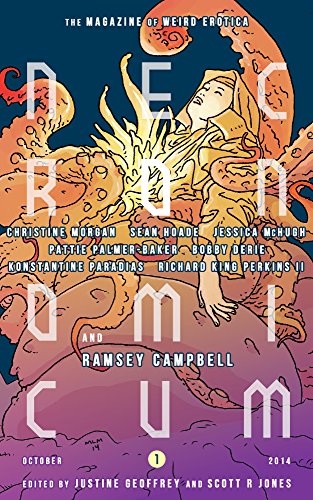
“Down into Silence” (2018) by Storm Constantine

We know the secrets of Innsmouth, or what the alleged witnesses told us were true so long ago. Nearly a hundred years has passed. […] Maybe none of it was true. The surviving records sound like witch trials to me, more imagination than fact. Yet standing here on the bridge over the tumbling River Manuxet, gazing out to sea, I wonder. The fact is, I want it to be true, all of it.
—Storm Constantine, “Down into Silence” in 
What October Brings: A Lovecraftian Celebration of Halloween 19

Salem, Massachusetts proudly advertises itself today as Witch Country. The 1692 trials have become fodder for tourists, something for the ancient city to hang its hat on. Sightseers gawk at Gallows Hill, take pictures of the Witch House to post on the internet. Lovecraft did some of that himself, nearly a hundred years ago, and it’s only gotten more commercial, more elaborate.

What if that happened to Innsmouth?

Kenneth Hite in his essay “Cthulhu’s Polymorphous Perversity” in Cthulhurotica commented on the advent of Cthulhu kitsch:

But Cthulhu is not unique in this. Everything that can be sold in the modern age will be sold, and in every form possible. Count Dracula, after all, not content with great movies, novels, mediocre movies, nonfiction tie-ins to novels, debunkings of non-fiction tie-ins to novels, worse movies, superb comic books, and the entire Romanian tourist industry, appears thinly disguised as a fictional children’s rabbit (Bunnicula) and a molar-corroding breakfast cereal (Count Chocula). There are bobble-heads, and illiterate T-shirts, and clever board-games, and plastic toys, and ridiculous cameo appearances devoted to Dracula, and James Bond, and Batman, and every other figure of modern myth. (You can also get a plush Cthulhu dresses as Dracula or James Bond.) (291-292)

We live in the now of Cthulhu kitsch; 3D-printed idols and plushies, action figures and posters, cereals and soda and beer. But we do not live in a world with a real Innsmouth, where the Gilman Hotel has been refurbished and dressed with Hallowe’en decor for the kind of guests that like seeing strands of dried corn and pumpkins strewn about the lobby for that Authentic Old New England™ flavor. How would that work, exactly, if you could read “The Shadow over Innsmouth” and then go drive to Arkham and Innsmouth in your car? If Robert Olmstead, instead of living forever in glory, died of a brain tumor in a sanitarium after publishing his narrative?

This is the kind of mood that Storm Constantine explores in “Down into Silence.” The desire for something real, something dark and magical, and being sold instead the licensed, authorized version of the experience. It is in many ways something of the other side of “The Nyarlathotep Experience™” (2019) by Miguel Fliguer, where we see someone trying to craft that kind of experience for others.

At the same time, it is also an interpretation of “The Shadow over Innsmouth”—and not necessarily a cynical one. What if there was some truth to the story? Not everything, not nearly everything. What would Innsmouth be like, if it had been a real place, a small town with an Esoteric Order of Dagon and a Devil’s Reef, and the g-men had come and there had been blood in the streets? What would it look like, if the town had survived that, and bore the scar proudly, and charged people to take photographs of it?

“If it hadn’t been him, then it would have been someone else, Kezia. Innsmouth couldn’t have stayed hidden for ever. The modern world doesn’t allow that. If Innsmouth had—or has—an enemy it is time, the changes in society, not merely the word of one man.”

“He was bitter,” Kezia says, in a voice craving for vengeance. “He wanted to be here, he was one of them, but he ruined it. They chased him out and then, like a mean little boy, he told tales.”
—Storm Constantine, What October Brings 32

Is Storm Constantine’s Innsmouth your father and mother’s Innsmouth? No. It’s a mark of a more mature phase of Lovecraftiana. You need a certain hit of commercialization and nostalgia, like Hallowe’en itself has become, to appreciate what she’s driving at. Before you could have “Down into Silence,” you needed the Cthulhu kitsch zeitgeist. So it has, and so here she is.

In the sense that Innsmouth is a real place—in the sphere of human ideas, not the physical world—it took a Lovecraft to mark it on the map. Once, perhaps, it was a bit of a secret. Fans of weird fiction were few, they shared their pleasure of discovery with each other…and word got out. Now everyone knows about Innsmouth, it seems. There are comics and erotica, entire anthologies dedicated to Innsmouth and its diaspora. Like a tattoo that fades in time, but keeps getting re-inked, the memories of the old lines distorted but still there like a shadow, adding depth. Innsmouth is in the now, constantly re-discovered, re-invented, re-visited—and the Mythos needs that to stay relevant, to grow and change rather than stagnate and sink into decay. Fans need not fear the tourists, the new readers attracted by films like Dagon or Innsmouth. New blood, new ideas, new media to keep the old concepts alive for another generation. Just so that one more crop of visitors can find Innsmouth, and leave wanting more of that strange town with its weird shadows and furtive mysteries.

“Down into Silence” was published in What October Brings: A Lovecraftian Celebration of Halloween (2018).


Bobby Derie is the author of Weird Talers: Essays on Robert E. Howard & Others (2019) and Sex and the Cthulhu Mythos (2014).
Her Letters to Lovecraft: Unnamed Salem Witch Descendant

The old gentry, representing the two or three armigerous families which came from Salem in 1692, have kept somewhat above the general level of decay; though many branches are sunk into the sordid populace so deeply that only their names remain as a key to the origin they disgrace. Some of the Whateleys and Bishops still send their eldest sons to Harvard and Miskatonic, though those sons seldom return to the mouldering gambrel roofs under which they and their ancestors were born.
—H. P. Lovecraft, “The Dunwich Horror” Weird Tales April 1929

Among the Salem witches in 1692, ‘this Rampant Hag, Martha Carrier, was the person, of whom the Confessions of the Witches, and of her own Children among the rest, agreed, That the Devil had promised her, she should be Queen of Hell.
—Margaret Murray, The Witch-Cult in Western Europe (1921) 47

Since 1924 when he first read Margaret Murray’s book on witches, H. P. Lovecraft had believed in the reality of the witch-cult, and that it had an American coven in Salem which had precipitated the famous witch-trials. So too, Lovecraft began to connect his stories with a fictional Salem diaspora, which included Joseph Curwen (“The Case of Charles Dexter Ward”), the ancestors of Randolph Carter (“Through the Gates of the Silver Key”), Richard Upton Pickman (“Pickman’s Model”) and the unnamed narrator of “The Festival.” Lovecraft even hinted at the events in his “History of the Necronomicon.” Yet when Lovecraft wrote “The Dunwich Horror” and “them witch Whateleys” little did he know that he was about to have an encounter with a real-life descendant of Salem.

By the way—that tale has just earned me a highly interesting letter from a curious old lady in Boston, a direct lineal descendant of the Salem witch Mary Easty, who was hanged on Gallows Hill Aug. 19, 1692. She hints at strange gifts & traditions handed down in her family, & asks me if I have access to any ancient secret witch-lore of New England. Also, she wants to know if Dunwich & Arkham are real places! I shall answer the letter, & see if I can get the good old soul to relate some of the whispered witch-traditions! A story of Salem horror based on actual “inside dope” from a witch-blooded crone would surely be a striking novelty!
—H. P. Lovecraft to Clark Ashton Smith, 22 Mar 1929, Dawnward Spire, Lonely Hill 171

Mary Towne Eastey (or Este, Easty, & other variations) was 58 when she was hanged for witchcraft. Her case is less famous than some of the other victims; Arthur Miller barely names her in The Crucible (1952). Two of her sisters were accused as well, with Rebecca Nurse hanged a few months earlier, but Sarah Cloyce was released the following year. Among the victims of the Salem Witch Trials, Mary Eastey was remembered as one of the most pious and eloquent, and in the end begged the court not for her own life, but for the lives of her fellow accused.

Before she died, Mary Eastey had eleven children, and many grandchildren—and in the 237 years between her death and the letter that H. P. Lovecraft received from “a curious old lady in Boston,” there is room for hundreds of potential descendants. Lovecraft never identifies his correspondent by name, nor does he appear to have kept any of her letters, so this particular correspondent has never been identified, and may never be, so brief was their relationship—so as with many of his lesser-known correspondents, we have to piece together what we can not from the letters themselves, but from Lovecraft’s references in his letters to others.

By the way—the publication of “The Dunwich Horror” has just earned me a curious & interesting letter from an old lady in Boston, a direct lineal descendant of the Salem witch Mary Easty, who was hanged on Gallows Hill Aug. 19, 1692. She claims to have heard some strange traditions handed down in the family, & to possess certain powers of peering into the future which she cannot explain. A quaint old soul, apparently—I shall write & see if any of her “inside” witch traditions have fictional value. She wants to know whether Dunwich & Arkham are real places, since they don’t appear on ordinary maps of Massachusetts!
—H. P. Lovecraft to August Derleth, c. 22 Mar 1929, Essential Solitude 1.189

It is likely that like many fans she wrote at first by way of Weird Tales, and that the editor Farnsworth Wright had forwarded the letter to Lovecraft, much as he would do with Robert E. Howard’s letter to Lovecraft the next year. Weird Tales had never shied away from tales of the Salem Witch Trials; Seabury Quinn had covered the trials in his series of nonfiction articles titled Servants of Satan, beginning with “The Salem Horror” (WT Mar 1925). Quinn, like Lovecraft in “The Dunwich Horror,” mentions tourists—Salem in the 1920s was beginning to appreciate its reputation as “witch country,” though not quite to the extant that it one day would.

While Quinn paints the victims of the Salem witch hysteria as innocent here, in his fiction he was more than happy to hint at real witches caught and burned by the trials. Lovecraft was far from alone in imagining a Salem witch diaspora, which caught on in the public imagination with films like I Married A Witch (1942) and eventually the television show Bewitched (1964-1972) and characters like Sabrina Spellman (Archie’s Mad House #22, Oct 1962). But at the time, these “real” witches of Salem were often depicted less positively, such as in Robert Bloch’s short story “Satan’s Servants” (written c. 1935) which Lovecraft had a slight hand in.

Yes—I may call on that venerable & genial witch-descendant before long. She is certainly the epitome of thoughtfulness & generosity—no sooner had I chanced to mention casually my long desire to read “The Wind in the Rosebush”, than the good soul sent it along as an unsolicited loan—she having owned it these 25 years, ever since it was published!
—H. P. Lovecraft to August Derleth, 1 Apr 1929, Essential Solitude 1.190

While we don’t know for certain what Lovecraft’s letter contained, his first letter would not doubt disabused her that any of his artificial mythology—including Arkham and Dunwich—were real, as this is what he always did whenever anyone asked him about the reality of of the Necronomicon, Cthulhu, et al. It is curious that Lovecraft would mention such a scarce volume as Mary Eleanor Wilkins Freeman’s The Wind in the Rose-Bush and Other Stories of the Supernatural (1903), but given that the unnamed correspondent was a reader of Weird Tales, it suggests she had some tastes in weird fiction, and Lovecraft had recently published his “Supernatural Horror in Literature” (1927), which mentioned Freeman’s book, so perhaps that formed a point of discussion.

Yes—that letter from a witch-descendant was rather unusual, & I am still hoping for dark data when she gets ready to unfold some real family history. It appears that her forbears were well acquainted with the Marblehead witches Edward Dimond & his daughter Moll Pitcher, (whose home, “The Old Brig”, still stands on Burying Hill) & that she herself, through the Easty or Este line, is a scion of the D’Estes of Ferrara, Italy, & a descendant of no less a malign character than Lucrezia Borgia! Some ancestry! The wildest progenitors on my own family charts seem pretty tame besides this array of glittering sinistrality.
—H. P. Lovecraft to Clark Ashton Smith, 14 Apr 1929, Dawnward Spire, Lonely Hill 172

Marblehead, Massachusetts, neighboring Salem, was a model for Lovecraft’s Kingsport just as Salem (or Salem Village, modern day Danvers) was the basis for “witch-haunted Arkham.” Edward Dimond was known as “the Wizard of Marblehead” or “Wizard Dimond”; his granddaughter Moll Pitcher gained some fame as a fortune-teller in nearby Lynn, and was the subject of a poem by famed poet John Greenleaf Whittier.

I’ve heard more from the Boston witch-descendant, who likewise turns out to be a lineal scion (through the Massachusetts Eastys, who were originally D’Estes of Ferrara, Italy) of Lucrezia Borgia & Pope Alexander the Sixth! Likewise, her forbears were intimately acquainted with Old Diamond & Moll Pitcher of Marblehead, about whom I told you some time ago. She has not yet related any specific dark tales transmitted down her family line, but still promises to do so.
—H. P. Lovecraft to Elizabeth Toldridge, 15 Apr 1929, Letters to Elizabeth Toldridge & Anne Tillery Renshaw 56

The connection with the House of Este of Ferrara appears fanciful—many amateurs in genealogy make assumptions based on common names. If that is fancy, or an error, it may be that the entire witch-genealogy of this unknown correspondent was so. Certainly, it doesn’t appear that the “dark lore” was apparently ever passed to Lovecraft, or at least he makes no mention of further correspondence with her after 1929, nor are there any specific mentions of his visiting her in Boston at any point. There is one likely reference to her in a letter from Zealia Bishop to Lovecraft:

The Boston witch-lady & the Maine wizard prove rather interesting—the latter in a somewhat amusing way.
—H. P. Lovecraft to Elizabeth Toldridge, 4 May 1929, Letters to Elizabeth Toldridge & Anne Tillery Renshaw 61

“The Maine Wizard” was a male occultist who corresponded with Lovecraft at roughly the same time and for roughly the same purpose: asking after the genuine lore behind the Necronomicon and all that. As with the “Boston witch-lady,” Lovecraft never gives his name, though the very few descriptions suggest he was not William Lumley, another occultist of Lovecraft’s acquaintance. The correspondence did not last:

As for my spectrally affiliated New England correspondents—I have not again heard from the grotesque Maine person, but hear frequently from the old lady descended from Salem witches. She sent several moderately gruesome legends lately, but in general I find it more natural to invent cosmic horrors of my own than to utilise actual folklore incidents.
—H. P. Lovecraft to Elizabeth Toldridge, 24 Oct 1930, Letters to Elizabeth Toldridge & Anne Tillery Renshaw 162

Both of these correspondents have in common that they wrote to Lovecraft, probably via Weird Tales, as essentially “serious fan letters”—and we might imagine their thrill at receiving a response from the author, even as we imagine their disappointment when Lovecraft revealed that it was all made up after all. In the case of the Salem witch descendant, the correspondence appears to have continued for some time, turning to other subjects. While we never learn her name, we do learn her ultimate fate:

An old lady in Bostom whom I knew—& who died just a year ago—was a direct descendant of Mary Easty, one of the Salem witches hanged in 1692—& therefore a collateral descendant of the more famous Rebecca Nurse (Mrs. Easty’s sister), whose ancient house (built 1636) in Danvers, Mass. [near Salem—formerly called Salem-Village] is still in existence & open as a public museum (I saw it in 1923).
—H. P. Lovecraft to R. H. Barlow, 19 Mar 1934, O Fortunate Floridian! 116

You perhaps did not remember that I sent The Mound to Sonny Belknap over two years ago—in fact immediately after the old Boston lady—I’m grieved to learn of her death—returned it.)
—Zealia Bishop to H. P. Lovecraft, 26 May 1934, The Spirit of Revision

One thing we can be relatively sure of is that Lovecraft did not have her copy of The Wind in the Rose-Bush in later years, because he did not have a copy when Samuel Loveman gifted one to him in 1935. Lovecraft tended to be punctual in such things, and his last published recollection of his former correspondent shows it is no longer in his possession:

It’s an achievement nowadays even to read “The Wind in the Rosebush”, for scarcely any library has a copy. I never saw it till a year & a half ago, when a nice old lady in Boston lent a copy to Munn & me.
—H. P. Lovecraft to August Derleth, 14 Apr 1932, Essential Solitude 2.472

H. Warner Munn was a fellow weird taler from Athol, Massachusetts who had famously written “The Werewolf of Ponkert” (WT Jul 1925) following a suggestion from Lovecraft; the Rhode Islander also noted Munn’s extensive weird library. Curiously, when Loveman gifted Lovecraft with a copy of the rare book, he noted:

Loveman brought me a copy of “The Wind in the Rosebush” which he had promised me so long. Now you, Munn, & I are all equipped!
—H. P. Lovecraft to R. H. Barlow, 5 Sep 1935, O Fortunate Floridian! 291

Where did Munn get his copy? Did he have a bit of luck and buy one in the book store or—perhaps—was he one of those bastards that borrow a book and never give it back? We don’t know; perhaps she sold or gifted the copy to Munn.

Even after his death, Lovecraft’s friends remembered her through his letters:

Another, a woman claiming descent from infamous New England witches and also from Lucretia Borgia, offered HPL some inside dope on the witch cult and its practices.
—Clark Ashton Smith to August Derleth,13 Apr 1937, Eccentric, Impractical Devils 256

That is all there is on Lovecraft’s correspondence with the unnamed descendant of Mary Towne Eastey, that innocent old woman killed in the witch-hysteria that gripped Salem Village in 1692. Seabury Quinn in “The End of the Horror” called the whole episode absurd and a tragedy, and so it was. Yet reading these lines over, I am given to wonder if in their brief correspondence Lovecraft might have touched on Mary Eastey’s sister Rebecca Nurse—and maybe he recalled a very singular experience he had in a trip to Danvers some years prior, before he read The Witch-Cult in Western Europe:

I now put the aera of Colonial refinement behind me, and hark’d back farther still to an age of darker and weirder appeal—the age of the dreaded witchcraft. Leaving Danvers, I struck out along the roads and across the fields toward the lone farmhouse built by Townsend Bishop in 1636, and in 1692 inhabited by the worthy and inoffensive old widow Rebekah Nurse, who was seventy years of age and wished no one harm. Accused by the superstitious West Indian slave woman Tituba (who belong’d to the Reverend Samuel Parris and who caused the entire wave of delusion) of bewitching children, and denounced blindly by some of the hysterical children in question, Goodwife Nurse was arrested and brought to trial. Thirty-nine persons sign’d a paper attesting to her blameless conduct, and a jury render’d a verdict of “not guilty”; but popular clamour led the judges to reverse the verdict (as was then possible), and on 19 July 1692 the poor grandam was hang’d on Gallows Hill in Salem for a mythological crime. Her remains were brought back from Salem and interred in the family burying-ground—a ghoulish place shadowed by huge pines and at some distance from the house. In 1885 a monument was erected to her memory, bearing an inscription by the poet Whittier.

As I approach’d the spot to which I had been directed, after passing through the hamlet of Tapleyville, the afternoon sun was very low. Soon the houses thinn’d out; so that on my right were only the hilly fields of stubble, and occasional crooked trees clawing at the sky. Beyond a low crest a thick group of spectral boughs bespoke some kind of grove or orchard—and in the midst of this group I suddenly descry’d the rising outline of a massive and ancient chimney. Presently, as I advanced, I saw the top of a grey, drear, sloping roof- sinister in its distant setting of bleak hillside and leafless grove, and unmistakable belonging to the haunted edifice I sought. Another turn—a gradual ascent—and I beheld in full view the sprawling, tree-shadowed house which had for nearly three hundred years brooded over those hills and held such secrets as men may only guess. Like all old farmhouses of the region, the Nurse cottage faces the warm south and slopes low toward the north. It fronts on an ancient garden, where in their season gay blossoms flaunt themselves against the grim, nail-studded door and the vertical sundial above it. That sundial was long concealed by the overlaid clapboards of Gothic generations, but came to light when the house was restored to original form by the memorial society which owns it. Everything about the place is ancient—even to the tiny-paned lattice windows which open outward on hinges. The atmosphere of witchcraft days broods heavily upon that low hilltop.

My rap at the ancient door brought the caretaker’s wife, an elderly unimaginative person with no appreciation of the dark glamour of the ancient scene. This family live in a lean-to west of the main structure—an addition probably 100 years less ancient than the parent edifice. I was the first visitor of the 1923 season, and took pride in signing my name at the top of the register. Entering, I found myself in a low, dark passage whose massive beams almost touched my head; and passing on, I travers’d the two immense rooms on the round floor—sombre, barren, panell’d apartments with colossal fireplaces in the vast central chimney, and with occasional pieces of the plain, heavy furniture and primitive farm and domestick utensils of the ancient yeomanry. In these wide, low-pitch’d rooms a spectral menace broods—for to my imagination the 17th century is as full of macabre mystery, repression and ghoulish adumbrations as the 18th century is full of taste, gayety, grace and beauty. This was a typical Puritan abode; where amidst the bare, ugly necessities of life, and without learning, beauty, culture, freedom or ornament, terrible stern-fac’d folk in conical hats or poke-bonnets dwelt 250 and more years ago—close to the soil and all its hideous whisperings; warp’d in mentality by isolation and unnatural thoughts, and shivering in fear of the Devil on autumn nights when the wind howl’d through the twisted orchard trees or rustled the hideous corpse-nourish’d pines in the graveyard at the foot of the hill. There is eldritch fascination—horrible buried evil—in these archaic farmhouses. After seeing them, and smelling the odour of centuries in their walls, one hesitates to read certain passages in Cotton Mather’s strange old “Magnalia (which you, little Belknap, shall see when you come to visit your old grandpa) after dark. After exploring the ground floor I crept up the black crooked stairs and examin’d the bleak chambers above. The furniture was as ugly as that below, and included a small trundle-bed in which infant Puritans (even as you, children) were lull’d to sleep with meaningless prayers and morbid hints of daemons riding the night-wind outside the small-paned lattice-windows. Poor little creatures! […]

I saw old Rebekah’s favourite chair, where she used to sit and spin before the Salem magistrates dragged her to the gallows. And the sunset wind whistled in the colossal chimney, and ghouls rattled ghastly skeletons from unseen attic rafters overhead. Tho’ it was not suppos’d to be open to the public, I persuaded the caretaker to let me ascend to that hideous garret of century’d secrets. Thick dust cover’d everything, and unnatural shapes loom’d on every hand as the evening twilight oozed though the little blear’d panes of the ancient windows. I saw something hanging from the wormy ridge-pole—something that swayed as if in unison with the vesper breeze outside, tho’ that breeze had no access to this funereal and forgotten place—shadows … shadows … shadows… And I descended from that accursed garret of palaeogean arcana, and left that portentous abode of antiquity; left it and went down the hill to the graveyard under the shocking pines, where twilight shew’d sinister slabs and rusty bits of fallen iron fence, and where something squatted in shadow on a monument—something that made me climb the hill again, hurry shudderingly past the venerable house and descend the opposite slope to Tapleyville as night came.
—H. P. Lovecraft to Frank Belknap Long and Alfred Galpin, 1 May 1923, Letters to Alfred Galpin & Others 247-249

What might she have made of that, if Lovecraft cared to retell that particular tale? Perhaps it would have thrilled her…or perhaps she would have taken more comfort in the lines of Whittier that adorn Rebecca Nurse’s monument:

O, Christian martyr! who for truth could die,
When all about thee owned the hideous lie!
The world, redeemed from superstition’s sway,
Is breathing freer for thy sake today.


Bobby Derie is the author of Weird Talers: Essays on Robert E. Howard & Others (2019) and Sex and the Cthulhu Mythos (2014).

“The Star that is Not a Star” (2016) by Lucy Brady

It all revolves around that star, and a damned thing it is! A star beyond the material universe, beyond space and time and all that is made by God. ‘The star that is not a star.’
—Lucy Brady, “The Star that is Not a Star” in Cthulhu Lies Dreaming 80

Accursed forevermore is Yamil Zacra, star of perdition, who sitteth apart and weaveth the web of his rays like a spider spinning in a garden. Even as far as the light of Yamil Zacra falleth among the worlds, so goeth forth the bane and the bale thereof. And the seed of Yamil Zacra, like a fiery tare, is sown in planets that know him only as the least of the stars ….
     —Fragment of a Hyperborean tablet
—Clark Ashton Smith, “The Infernal Star”

Spy fiction is a close cousin to Mythos fiction; they share a common descent from the detective fiction of Edgar Allan Poe, and a common concern with the keeping and discovery of secrets. Betimes these cousin modes of fiction have come together: “The Unthinkable” (1991) by Bruce Sterling; “The Courtyard” (1994) by Alan Moore; Delta Green (1997), a branching-off of the Call of Cthulhu Roleplaying Game where the players are agents for government intelligence organizations, their skills and focus shifted to esoteric matters; David Conyer’s Harrison Peel series, including The Spiraling Worm (2007); the Laundry Series by Charles Stross beginning with The Atrocity Archives in 2004 (or, for an earlier variant, his novella A Colder War in 2000) which in turn spawned its own roleplaying game The Laundry (2010); Caitlín R. Kiernan’s Tinfoil Dossier series beginning with Agents of Dreamland (2017). Expand beyond the strictly Mythos-influenced spy fiction, and you run across gems like Tim Powers’ Declare (2000).

Call it cloak-and-tentacle, if you’d like.

The form of the fiction is often a kind of investigation. Think back to “The Call of Cthulhu,” presented to the reader as a series of nested narratives and documents. It isn’t spy fiction, in that the occult groups and secretive individuals involved are not part of any government service above the level of the local police; there are no politics at play in Lovecraft’s story, not really. The G-men make an appearance in “The Shadow over Innsmouth,” and there we can catch a glimpse of the origins of Alan Moore’s “The Courtyard.” Yet for the most part, the Mythos remains unknown to the world and its government powers at large; the mysteries uncovered, no matter how global or cosmic their import, are intensely personal to the initiated investigator in Lovecraft’s fiction.

The trick is to marry the two frames of reference. The investigator is still the main focus or protagonist, but now their actions take place within a broader geopolitical framework—and for the Len Deighton-influenced fiction, a government bureaucracy that’s designed to compartmentalize and contain secrets, to constrain actions. They may be Cold War warriors or those whose small talent in languages brings them in to the orbit of a larger mystery; part of the game is often that the agent or spy can never comprehend the whole of the thing, can never know the whole truth.

Secrets that possess a certain magnitude seem to have their own affinity with one another.
—Lucy Brady, “The Star that is Not a Star” in Cthulhu Lies Dreaming 85

“The Star that is Not a Star” is not explicitly Mythos fiction in any sense; whatever tomes, entities, cults, etc. that Brady employs, they aren’t connections forged with Lovecraft’s corpus or the expanded Cthulhu Mythos. Nor is it a traditional spy-thriller; but that is a large part of the charm. It’s an investigation that spans years and continents with a kind of ennui, and the statement of Natasha Klein—addressed to whom, and why?—is a record of a woman who, after picking up the pieces of the story for a decade, has found her own kind of truth.

Which is a good enough place for an ending as any, in a story like this. It is moody; there is a lot that has to be inferred, and in the end the narrator herself begins to become unreliable, relying on dream-evidence to fill in the gaps. Which all fits. Detectives know not every case has a satisfactory conclusion, and Mythos investigators are often left with scraps of a story told in newspaper clippings and journals, unable to touch the terrible powers at work in the world, burdened by the knowledge of things that they know exist but are impotent to affect.

“The Star that is Not a Star” was published in Cthulhu Lies Dreaming (2016); Lucy Brady’s other Lovecraftian work includes “The Body Electric” in Dreams from the Witch House (2016).


Bobby Derie is the author of Weird Talers: Essays on Robert E. Howard & Others (2019) and Sex and the Cthulhu Mythos (2014).