“At the Mountains of Murkiness, or From Lovecraft to Leacock” (1940) by Arthur C. Clarke

Something about the scene reminded me of the strange and disturbing Asian paintings of Nicholas Roerich, and of the still stranger and more disturbing descriptions of the evilly fabled plateau of Leng which occur in the dreaded Necronomicon of the mad Arab Abdul Alhazred.
—H. P. Lovecraft, “At the Mountains of Madness” (1936)

Surely, I thought, the mad Arab, Abdul Hashish, must have had such a spot in mind when he wrote of the hellish valley of Oopadoop in that frightful book, the forbidden “Pentechnicon.”
—Arthur C. Clarke, “At the Mountains of Murkiness” (1940)

Four years after “At the Mountains of Madness” was published in the pages of Astounding, and three years after Lovecraft had died, his work was already being parodied (Clarke could not know that he was far from the first). “Murkiness” was only Clarke’s fifth story to see print, published in the amateur sci-fi zine Satellite #16 (vol. 3, no. 4, March 1940), and is a very respectable early work. Like many later pasticheurs, it focuses on the most obvious aspects of Lovecraft’s writing and imagery to lampoon; unlike many of them, it does so from a very British standpoint, with Clarke deliberately drawing inspiration from the humorist Stephen Leacock.

As a spoof, the work is quite fannish. One of the key plot points revolves around how the Elder Things authored the stories about themselves in Weird Tales, which is why no one believes in them—and at the end the explorers find and misapprehend a note:

Destroy human race by plague of flying jellyfish (?Sent through post in unsealed envelopes?). No good for Unknown – try Gillings.

Fans of science fiction would recognize Unknown as one of the premier fantasy pulps of its day; Walter Gillings was the editor of the British pulp Tales of Wonder. The explorers, unfamiliar with these nuances, take it for an actual insidious plot and flee. Exeunt, pursued by eldritch horror requesting whether they mind condensed milk in their tea.

It is difficult to say what lasting impact Lovecraft had on Clarke; certainly, he was a fan, but he never attempted to add to the Mythos as such, aside from noting that the Programming Manual for the HAL 9000 Computer: Revised Edition was published by Miskatonic University Press. Thematically, one could argue that Lovecraft’s science fiction may have been an inspiration for some of Clarke’s stories, particularly the sense of cosmic horror in stories such as “The Nine Billion Names of God” (1953), but “Murkiness” was the only time Clarke explicitly tried his hand at anything explicitly Lovecraftian. If there is a distinction to be had for Clarke’s “Murkiness,” it may be as one of the earliest Lovecraft-related works written by a homosexual author outside of Lovecraft’s immediate circle of friends such as Samuel Loveman and R. H. Barlow.

On New Year’s Day 1951, Robert H. Barlow, who had been Lovecraft’s friend, correspondent, and literary executor, took his own life. The motive is believed to have been the threat of exposure: Barlow was homosexual. It was a difficult time and place in which to be a homosexual; not just 1950s Mexico, but for most of the 20th century in most countries. In the United Kingdom a year after Barlow’s suicide, the British mathematician Alan Turing would be charged with “gross indecency” for having a homosexual relationship, and chemically castrated. Small wonder, then, that many homosexual men opted for extreme discretion, rather than submit themselves to prosecution. Turing would commit suicide in 1954.

This was the world of Arthur C. Clarke.

“At the Mountains of Murkiness or, From Lovecraft to Leacock” has nothing overtly to do with the fact that Clarke was homosexual—relatively little of Clarke’s fiction does. We will never know what quips or insinuations he might have made, without the hovering threat of discovery. Would he have made anything of the lack of women on Lovecraft’s expedition? Or the asexual reproduction of the Elder Things?

The chilling factor of the United Kingdom’s laws against homosexuality in 1940 cannot be measured, but no doubt it was far greater than whatever sub-zero temperatures populated the imaginary Antarctica of Poe, Lovecraft, and Clarke. What might he have written differently? Would it have been different at all? We will never know.

“At the Mountains of Murkiness” has been reprinted a number of times since it was first published, most notably in At the Mountains of Murkiness and Other Parodies (1973), The Antarktos Cycle: At the Mountains of Madness and Other Chilling Tales (2006), and The Madness of Cthulhu: Volume 1 (2014).


Bobby Derie is the author of Weird Talers: Essays on Robert E. Howard & Others (2019) and Sex and the Cthulhu Mythos (2014).



“The Leapers” (1942) by Carol Grey

“Carol Grey” was a pseudonym used by writer and editor Robert A. W. Lowndes for two stories, both initially published in the same pulp magazine: “Passage to Sharanee” (FUTURE combined with Science Fiction, April 1942) and “The Leapers” (FUTURE Fantasy and Science Fiction, December 1942). Why Lowndes chose this pseudonym is not, to the best of my knowledge, ever explained. While Sally Theobald and Justine Geoffrey were obvious literary references and made sense within the context of their respective stories, and Linda Lovecraft a persona adopted to fit an anthology, “Carol Grey” appears to have been a purely pragmatic pen-name: Lowndes also edited FUTURE, and did not want to appear cheap or biased in publishing his own fiction under his own name.

In any event, Lowndes got a taste of what it might be like as a female pulp writer from at least one ardent science fiction fan, Earl Andrews, whose letter was published in FUTURE combined with Science Fiction, August 1942) in response to “Passage to Sharanee”:

Ah, Carol Grey! Ah, spring! Ah! Prithee, my Lord Editor: wiltow kindly vouchsafe unto a fellow Lothario certain divers information. Tell me now of yon Carol. Doth she walk in beauty and so on? ((My dear fellow. !!! Ed.))

Lowndes’ reply is perhaps understandable given the circumstances:

This is going to hurt you more than it hurts us, Earl, my lad, but we’re under strict orders not to reveal Miss Grey’s address, or divulge any divers information about her. And we cannot see any reason for not adhering faithfully to those instructions.

Elsewhere in the same magazine, Lowndes had to assure a reader that Carol Grey was “not Helen Weinbaum or Leigh Brackett,” two actual female sci-fi pulp writers of the 40s.

There is no direct connection between the two “Carol Grey” stories; “Passage to Sharanee” is a space opera novelette concerning a missing jewel and an ancient shapeshifting alien called a vombis (no apparent connection to Clark Ashton Smith’s “The Vaults of Yoh-Vombis”). “The Leapers” by contrast is a tale of the Cthulhu Mythos, albeit very much of the science-fantasy varietal. It is tied by references to several other pieces of Lovecraftian fiction written and published by Lowndes, beginning with “The Abyss” (Stirring Science Stories, February 1941) in what might be loosely called “The Arkya Cycle” or “The Song of Yste” series, after the most characteristic elements of Lowndes’ additions to the Mythos.

In the early 1940s while editing FUTURE, Lowndes was a member of a New York-based group of science fiction fans and writers called the Futurians; many of their works were tapped by Lowndes for this and other pulps he edited. Another Futurian, Damon Knight, later wrote a book on their activities, which includes the genesis of Lowndes’ “The Leaper”:

Lowndes told me, “There was a Cabal⁠—Donald [Wollheim], Cyril [Kornbluth], John [B. Michel], Chet Cohen and myself. We met once a week. The Cabal was a literary wrokshop, really. We met at Cyril’s place once a week, and each one of us was supposed to bring a manuscript to read. […] And as it turned out,” Lowndes said, “a fair number of manuscrupts that were read at the Cabal were later sold and published. […] It was at a Cabal meeting that my story, ‘The Leapers,’ was read, and the only compliment I remember ever getting from Cyril Kornbluth—he read it, he sort of blinked and shook his head, and said, ‘It’s absorbing.'”
—Damon Knight, The Futurians

Lowndes himself would expand on this a little in his introduction to the story when it was reprinted in Crypt of Cthulhu #62 (Candlemas 1989):

One day when Don was visiting John [B. Michel] and me at the Futurian Embassy (103rd Street, Manhattan) he sayeth unto me: “Doc, do you think you could write a Lovecraft story? I’d like one for my next issue.”

I thought I could and behold I did, getting leave of absence from The Cabal not to write anything else until I had finished “The Leapers.” I shall never forget the night when the ms was passed around and read at a Cabal meeting. Cyril was the last to get it; when he finished he blinked, shook his head slightly as if to wake himself up, and said in an awed tone: “It’s absorbing.” That was the one and only time that Cyril Kornbluth had any kind words for any of my fiction. And since it had been written for Don Wollheim in the first place, there was no question of immediate acceptance.

Alas! It would have led off the fantasy section of the issue following the March 1942 Stirring Science Stories; but that issue never appeared.
Crypt of Cthulhu #62 (3)

Lowndes and Wollheim would both use Futurian stories in their respective magazines, and there are little in-jokes almost from the start. For example, when Lowndes writes in “The Leapers”:

One of the missing, for example, was an attractive blonde of 23, widely renowned among the devotees of the more imaginative and speculative of pulp fiction as an illustrator; another, a man of 27, was in the process of becoming a favorite in the field of fantastic, cosmic horror-fiction, the general type of narrative wherein Poe, Machen, and Lovecraft specialized.

Illustrator Barbara Hall, who Knight describes as “a good-looking blond woman” associated with Wollheim is obviously the former; Wollheim himself (born in 1914, so 27 in ’41 when the story was probably written) is almost certainly the latter.

In format, “The Leapers” owes much to an older style of horror fiction, large chunks of the text being supposed clippings from newspapers regarding Fortean phenomenon, assembled by the nameless narrator as they seek to piece together the puzzle of a very odd missing persons case. This leads them shortly to the Song of Yste, Lowndes’ own addition to the Lovecraftian library, and which first appeared in “The Abyss.” In a later reprinting of the story, Lowndes would note:

While written as a “Lovecraft story”, even the earlier version contained one fundamental departure from HPL—a matter about which your editor and The Master had argued back in 1936, shortly before he died: that reading “Forbidden Books”, etc. had to bring about dreadful and horrible events, and that such knowledge leads invariably to destruction. While we would not quarrel, even now, with Lovecraft’s statements that reading the Necronomicon would be the beginning of a Frightful End for you, we do assure you that, for a strong mind, the Song Of Yste need not be fatal—unless you’re bored to death.
—Robert A. W. Lowndes, The Magazine of Horror #23 (Vol. 4, No. 5), Sep 1968

Lovecraft and Lowndes had corresponded during the last year or so of Lovecraft’s life, while Lovecraft’s ideas appear to be based strongly on The King in Yellow play as used by Robert W. Chambers, “The Leapers” appears to be Lowndes counter-reaction to that, with lengthy passages of exposition about the reading of forbidden books and why they are forbidden. This was still that first generation of fandom where random literary arguments could be worked out in print on pulpwood paper, and Lowndes even alludes to this correspondence directly in the story:

I had, in fact, read a few of the tales of classic horror, written some more or less precocious speculations regarding them, and written a letter or so to a muchly-famed student residing in Providence, Rhode Island. he it was who had been the source of what little knowledge I possessed, and I had permitted my correspondence with him to lag; now, I could not be sure if he were still available at the old address.

The posthumous unnamed Lovecraft then makes an appearance via letter, with Lowndes doing a fair imitation of his style. Futurians such as Donald Wollheim, who had also corresponded with Lovecraft, would have recognized this immediately; whether the pulp readers of FUTURE picked up on it is less certain.

In the 1960s, Lowndes became editor of The Magazine of Horror, a small digest that focused mainly on classic and pulp reprints put out by Health Knowledge, Inc. The magazine gave him the opportunity to expand and republish some of his earlier works, including “The Abyss” (Winter 1965/66) and “The Leapers” (September 1968), this time under his own name. He later recalled:

It was while working at Health Knowledge that I had occasion to reread “The Leapers,” and found myself unsatisfied. So I rewrote and expanded it, making it a frame story.
Crypt of Cthulhu #62 (3)

Part of this general expansion includes a sort of preface, identifying the narrator as Arnold Grayson, and that it had originally been sent to Farnsworth Wright, editor of Weird Tales (who had died in 1940, two years before the story was initially published, a fact which Lowndes notes).

The other major addition is an expansion from the pseudo-Lovecraft letter, which goes to some odd places:

Well, I have a letter from Hannes [Bok] dated 1939, in which he tells me that Ray Bradbury is going to show some samples of his work to Farnsworth Wright at WEIRD TALES. I replied that I did hope that Wright would be impressed, for as delectable as Mrs. Brundage’s covers were to the more erotic-minded readers, few of them were truly weird. (I assure you that I have never objected to well-exposed depictions of delightful-looking young girls—but maintain stubbornly that a girl cannot be both delightful-looking and weird at the same time.)

Lovecraft died in ’37, Bok’s first art for Weird Tales was ’39, Wright died in ’40, the events of the story nominally take place in ’42…the timeline is a little screwy, but Lowndes mentions that in the preface. The comment on Brundage’s art is interesting because it recalls a similar comment made by Lovecraft in an actual letter:

I have no objection to the nude in art—in fact, the human figure is as worthy a type of subject matter as any other object of beauty in the visible world. But I don’t see what the hell Mrs. Brundage’s undressed ladies have to do with weird fiction!
—H. P. Lovecraft to Willis Conover, 16 Sep 1936, Selected Letters 5.304

Which raises an interesting problem: volume 5 of the Selected Letters of H. P. Lovecraft was published in 1976, the revised edition of “The Leapers” was published in The Magazine of Horror in 1968. So did Lowndes have access to this quote from Conover’s letters or…and this is a tantalizing possibility…did Lowndes cannibalize or paraphrase part of a letter that Lovecraft had sent to him? Until and unless Lovecraft’s letters to Lowndes are ever published, we may never know.

In any event, this second incarnation of “The Leapers” had one final evolution:

Few of the readers of the issue of Magazine of Horror had read the original version, and the revision went over quite well—except with one person who had read and remembered the original: Robert Silverberg. Silverberg wrote me a polite note, more in sorrow than in anger, and pointed out that my frame approach went far to spoil an excellent story. Thus I have revised the story for a third time and the final version, which follows, has (I hope) the best of both earlier versions.
Crypt of Cthulhu #62 (3)

Titled simply “Leapers” in Crypt of Cthulhu, the third-and-final revision starts by dropping the initial part of the “frame” mentioning Farnsworth Wright and Weird Tales. The added portion of the pseudo-Lovecraft letter remains, and at the end is tacked on an addendum containing the gist of the 1968 framing device, Wright and all. Whether this is actually better is a bit subjective—it gets at the story more directly, but the mention of Wright still feels problematic from a timeline point of view.

It’s difficult to judge the impact of Carol Grey and “The Leapers.” Even among devoted Mythos-fans, the Song of Yste is not exactly as popular as the Necronomicon, Unaussprechlichen Kulten, or the Book of Eibon. Robert Weinberg and Ed Berglund in the Reader’s Guide to the Cthulhu Mythos (1973) have marked the story as “integral to the Cthulhu Mythos”—a distinction they don’t give to items such as “The Cats of Ulthar” or “The Colour Out of Space.” Certainly, the theme of forbidden knowledge begun in “The Leapers” was something that stuck with Lowndes, as he wrote later about his correspondence with Lovecraft:

So I finally wrote him that winter, and in the course of my first letter told him what had bothered me about At the Mountains of Madness, and some of the other stories: the discovery of the unknown always led to madness and destruction. couldn’t some unknown things possibly be beautiful, leading to greater happiness, etc.?

His reply was that such stories must have such an ending, because the universe was really a terrible place and only our relative ignorance and limitations made it endurable to us; to seek to go beyond those limitations, to find the real nature of things, would inevitably be shattering. it is only our illusions of order and relative safety that protect us from madness. (That is, of course, a paraphrase of what he wrote me.) The seence of horror lay in abnormalities, in violations of what we consider to be natural law, dislocations of time and space, etc. […]

And when I got around to trying my hand at the Lovecraft type of story, I stuck by my guns. Awful things happened to some of the characters, of course, but everyone who had read the forbidden books was not destroyed nor turned into a monster. And while I still love HPL, I cannot but look at him as something of a vandal, at times—all those precious and priceless copies of the Necronomicon burned!
—Robert A. W. Lowndes, “On Forbidden Knowledge” in Crypt of Cthulhu #62 (56)

If there is anything to be said for the story, it is that it is almost a perfect encapsulation of Mythos fiction in the 1940s, with its odd pulpy plot and in-jokes, the convoluted history of reprints and revision. That first generation of post-Lovecraft fans, still coming to terms with Lovecraft and his philosophy.


Bobby Derie is the author of Weird Talers: Essays on Robert E. Howard & Others (2019) and Sex and the Cthulhu Mythos (2014).

Editor Spotlight: Linda Lovecraft

While at boarding school I discovered science-fiction and horror fandom and began corresponding with various other young enthusiasts including Ramsey Campbell. I decided to publish my own fanzine, which I called Cthulhu (I’d stumbled upon Lovecraft in an old Avon horror anthology when I was about 10.) This turned out to be a real underground publication because I was instantly forbidden use of the school’s printing and photocopying facilities for such an offensive project […] Somehow, Calvin Beck, the publisher of Castle of Frankenstein magazine in America, got hold of a copy of Cthulhu and reprinted some of the reviews and news items. […] Cal also announced that he’d appointed me the magazine’s “European Editor” (and had already described me as such in the mag!) How could I say no? […]
—”The Kiss of the Devil,” Pulpmania #1 (2006), 51

In 1976 Corgi Books in the United Kingdom released The Devil’s Kisses, a paperback collection of erotic horror stories. This proved successful enough that the next year they released a further collection, More Devil’s Kisses, also in paperback, but no further volumes were issued in the series. The nominal editor for both was “Linda Lovecraft”—a pseudonym adopted by horror editor Michel Parry solely for this project.

Parry had achieved success as an anthologist with the Mayflower Book of Black Magic series (6 volumes between 1974 and 1977); these were cheap paperback horror collections which were thematic descendants of the Not at Night series assembled by editor Christine Campbell Thomson. When Pulpmania asked him about the origin of Devil’s Kisses, Parry explained:

The idea was mine. Over the years I’d read a number of stories with a surprisingly suggestive subtext, and it seemed to me a viable commercial proposition to collect them together. Patrick Janson-Smith was by then the editor at Corgi and approved the idea right away. In a sense it was a continuation of the Mayflower series, but pushing the envelope further. It seemed innovative at the time, but now, of course, the erotic horror story has become an established sub-genre with various editors and publishers specialising in this kind of fiction. (ibid, 55)

TDKThe Devil’s Kisses consisted of 11 stories, nine of them reprints—including pulp stories from Weird Tales contemporary with H. P. Lovecraft, such as C. L. Moore’s “Shambleau” (Nov 1933), and Mindret Lord’s “Naked Lady” (Sep 1934). Two original stories were published in the volume for the first time, including Ramsey Campbell’s “The Other Woman.”

None of these are stories of the Cthulhu Mythos, although “Shambleau” certainly falls under the category of “Lovecraftian.” The stories are rarely sexually explicit, being much more suggestive and titillating than pornographic. A solid collection but one with a narrow focus. In the introduction, “Linda Lovecraft” noted, after describing the Devil’s penis:

Even with accessories like this, Satan found he simply didn’t have time to personally attend to all the dirty work his diabolic mind dreamt up (we can’t blame him, of course; he was just doing his job.) So he began to share his work-load with lesser devils and demons. One of their chief errands was to enter into the bodies of innocent young virgins and nuns and put them up to all kinds of unladylike activities of the kind shown in The ExorcistThis sort of devilry was so successful that eventually Satan had to organize a special team of demons specializing in the pleasant tasks of seduction and possession. He called these demons his succubi and incubi.
The Devil’s Kisses 5

The introduction’s focus on medieval Christian demonology, and The Exorcist (1973) all fit in with the idea of The Devil’s Kisses as an expansion of The Mayflower Book of Black Magic seriesand, to an extent, the popular series of Dennis Wheatley’s Library of the Occult, a paperback collection of classic horror which ran to 45 books from 1974 to 1977. Even the name is suggestive of the osculum infame, the kiss of shame with which witches supposedly greeted the Devil at Sabbats. And The Devil’s Kisses sold enough books to merit another entry in the series:

The first Devil’s Kisses anthology proved successful enough for a second volume to be commissioned. This was also initially successful, but then someone apparently complained to Scotland Yard about one of the stories, “Magic Show” by Chris Miller. I’d found this story in The National Lampoon, a glossy magazine of collegiate, mostly gross humour (miller went on to write National Lampoon’s Animal House and other gross-out comedies). The story concerns an entertainer who subverts a children’s party in unexpected ways. It’s very over-the-top and too ridiculous to be taken seriously for an instant. […] Scotland Yard warned Corgi that they might be liable to prosecution. Publishers always consult their lawyers and lawyers always embrace a “Worst case Scenario” to cover themselves. Result: the book was withdrawn and pulped.
—”The Kiss of the Devil,” Pulpmania #1 (2006), 56

MDK

The contents of More Devil’s Kisses are slightly more interesting than the first volume. While still predominantly reprints, there are four original stories, including “Loveman’s Comeback” by Ramsey Campbell, which isn’t strictly a Mythos story, but definitely adjacent to Lovecraftian interests. None of the others are Lovecraft-related.

To end things with a bang we finish with Chris Miller’s “The Magic Show” and a party. Admittedly it’s more of a children’s party than a stag party but things really start to swing once Dr. Fun takes charge of the games and shows the kids a new trick or two… A lot of people have told me that “Boxed In,” Chris Miller’s story in The Devil’s Kisses, is the most shocking story they have ever read. After they’ve read this new party-piece by Chris, “Boxed In” will be the second most shocking story the have ever read.
More Devil’s Kisses 13

“The Magic Show” by Chris Miller, which is what gained this book its infamy and ultimately killed the promising series, is exactly as Parry described it—ribald gross-out sexual humor, an over-the-top bit of jocular prose that combines touches of pedophilia, drug use, and a donkey show. Only explicit in parts, the story is transgressive and ribald but not exactly masturbation fodder (I hope). It’s hard to think of this kind of story being published today, but it’s possible to see Parry trying to one-up The Devil’s Kisses and overshooting the mark.

David Drake, whose story “Smokie Joe” also appears in More Devil’s Kisses, gave a slightly different take on events surrounding the publication, recalling:

I recall Michel saying that he’d wondered if he was going to have to appear in court in drag and blond wig after the raid. […] no sooner had the book hit the newsstands than the police impounded all copies on an obscenity complaint and briefly locked up the in-house editor. The charges were dropped when the publisher (Corgi) pulped the whole edition. Because the matter didn’t go to trial, there’s no certainty as to which precise matters were the subject of the complaint. The best bet is that the Chris Miller piece had caused the problem, but that was a reprint from a magazine which had been sold in Britain without objection. The only other evidence is that when the book was brought out in Germany, two stories were dropped; Miller’s and “Smokie Joe.”
Night & Demons (2013), 70-71

Parry, being closer to the source of things, almost certainly is correct in pointing to “The Magic Show” as the primary offender, but it’s possible that they took no chances with the German translation.

Which does raise the question: if none of these stories have anything to do with the Cthulhu Mythos, what’s with the name “Linda Lovecraft”?

I used the name “Linda Lovecraft” for the Devil’s Kisses anthologies: an obvious fusion of the names of porn star Linda Lovelace and writer H. P. Lovecraft. I was very surprised later on to discover an American comic devoted to the erotic exploits of Linda Lovecraft! […] With The Devil’s Kisses, I took the notion of using a pen-name a step further by writing the introduction in the persona of the putative editor. As “Linda Lovecraft” I was free to make outrageous jokes and puns and be as flippant as I pleased. In effect the introduction became as much a piece of fiction as any of the stories in the collection, and possibly a more convincing fiction. Ideally, I would have liked to have extended this deception further by hiring an actress to “be” Linda Lovecraft and go out and promote the book and do signings and the like. needless to say, Corgi’s promotional budget (if there was one) didn’t extend to such surreal endeavours!
—”The Kiss of the Devil,” Pulpmania #1 (2006), 56-57

Pornographic actress Linda Lovelace gained widespread fame in the 1970s for the films Deep Throat (1972) and The Confessions of Linda Lovelace (1974); Lovecraft was gaining popularity in the late-60s and early 70s with releases by Victor Gollancz and Panther in the UK. The other “Linda Lovecraft” was the creation of comic writer/artist Mike Vosburg, and premiered in the pages of the semi-pro comic magazine Star*Reach #3 (1975); in an interview with Vosburg in the Star*Reach Companion (2013), he gives essentially the same etymology for the name as Parry, both writers having arrived at it by coincidence (70-71). Vosburg would rebrand and relaunch the character as Lori Lovecraft in series and graphic novels of her own. Some sources appear to confuse the inspiration for Parry’s pseudonym with the owner of the Lovecraft sex shop, which formerly operated in London in the 1970s.

Parry’s persona as Linda Lovecraft was a bit thin; the copyright notices for the books cite both Linda and Michel Parry, but the German translations Teuflische Küsse (1978) and Zehn Teufelsküsse (1978) do not attempt to continue the deception. The idea of hiring a female actor for personal appearances recalls the Scottish weird author William Sharp, who engaged in such practices to disguise his pseudonym Fiona Macleod…and likewise recalls deceptions by authors of Cthulhu Mythos fiction including Carol Grey (Robert A. W. Lowndes), Sally Theobald (Robert M. Price), and Justine Geoffrey (Scott R. Jones).

There is a certain irony in considering these “female impersonators” with ties to Lovecraftian fiction, given the widespread idea of female writers needing to take on male pseudonyms to publish—James Tiptree Jr. (Alice B. Sheldon) being one example; for another, after her marriage Catherine Lucille Moore often wrote and collaborated with her husband Henry Kuttner, with the works mostly published under his name or a shared pseudonym such as Lewis Padgett.

The same pressures did not exist for Parry, Lowndes, Price, or Jones. For Price and Jones, the pseudonym served a purpose in the context of the Lovecraftian work; the assumption of the identity was of a piece with the fiction. For Parry, the name and persona became a convenient draw for the books—the name evoking at a glance both sex and horror, even as the personality was evocative of classic horror host Vampira and similar horror hosts.

While ultimately little more than a footnote to those interested in Lovecraftian fiction, it’s worth pointing out that while “Linda Lovecraft” was only nominally connected with H. P. Lovecraft—literally in name only—under his own name, Parry included a number of Lovecraft’s stories in other anthologies he edited throughout the 1970s, and so contributed to the general spread of Lovecraftian fiction…and occasional references to it have popped up in odd places. Simon R. Green in his novel The Bride Wore Black Leather (2012), for instance, references “The Linda Lovecraft Library of Spiritual Erotica.”

One final piece of advice before I go…whatever you do, don’t read this book alone at night. Make sure you have someone with you, someone you like. try reading the book together with the lights turned low. The stories are much more effective that way. If the atmosphere is right, I promise you they’ll scare the pants off the men and give the ladies the willies…

Love and Kisses,

LINDA LOVECRAFT

—Michel Parry, More Devil’s Kisses 13


Bobby Derie is the author of Weird Talers: Essays on Robert E. Howard & Others (2019) and Sex and the Cthulhu Mythos (2014).

Innsmouth (2019) by Megan James

I grew up reading the works of H. P. Lovecraft. I loved every fish monster, evil cult and doomed protagonist, frankly finding his affected writing style and weird creatures intrinsically hilarious because of how corny it all was.
—Megan James, Foreword to Innsmouth (2019)

H. P. Lovecraft, and to a degree his compatriot Mythos creators Robert E. Howard, Clark Ashton Smith, August Derleth, and Robert Bloch, have seen their life and works adapted to the medium of comic books and graphics novels since the 1950s. These range from fairly straight adaptations a la Alberto Breccia, Richard Corben, John Coulthart, I. N. J. Culbard, Gou Tanabe, and Ben Templesmith (to name a few) to original re-imaginings of the Mythos such as Alan Moore & Jacen Burrow’s Providence, Matt Howard’s Con and C’Thulhu, Mike Vosberg’s Lori Lovecraft, and dozens of other offerings in a number of languages.

Megan James is in good company.

The tone of the story is reminiscent of nothing else than a particular scene in Terry Pratchett and Neil Gaiman’s Good Omens:

Sister Mary Loquacious has been a devout Satanist since birth. She went to Sabbat School as a child and won black stars for handwriting and liver. When she was told to join the Chattering Order she went obediently, having a natural talent in that direction and, in any case, knowing that she would be among friends. (27)

The point being that at a certain point in the life of a church, the mundanity sort of grinds out the divine nature of the proceedings. Or, as is the case in Megan James’ Innsmouth, the end times when Cthulhu is summoned can’t be held on a Thursday because they’ve already got the potluck scheduled.

“Well, the Elder Gods clearly didn’t give the events committee proper notice.”
Innsmouth, issue #1

What we get in five issues is a re-imagining of Innsmouth where intermarriage with fish people is just accepted and maybe working toward the end times is not a major priority for most of them. But like certain outbreaks of Millenialism and Milleniarianism, a few folks are actually looking forward to (or actively trying to cause) the project of waking Cthulhu up in more than a theoretical Sunady-go-to-meeting sense. Which is a problem if you kind of like the world as it is, thank you very much.

The cast and crew assembled by the combination of slapstick and well-meaning anti-cult activities is not coincidental. The team that is assembled includes a female Innsmouth acolyte (Abigail), a female Muslim (Fatima Alhazred, descendant of that Alhazred), and a pair of homosexual African-American reanimators (Drs. Edward Herbert & Jason West). This well-rounded cast is a deliberate effort on James’ part:

While much of the book is inspired by Lovecraft, James said she did take a few of his common outdated themes and views on certain issues such as race and switch them up.

“I wanted to address that in how I’m treating these characters, updating that for 2016,” she said. “Kind of giving voice to some of the characters he shafted along the way.”

For example, in the author’s 1924 short story, “The Hound” he introduces the Necronomicon, which according to James is a book of evil which Lovecraft linked to Arabic heritage.

“That’s not really cool,” she said. “I have a character Fatima she’s Muslim and studies the Necronomicon and it’s part of her family heritage…kind of reclaiming the stuff that he’s messed up.”

—Amy David, Local Comic Book Artist Megan James Mixes Humor and Evil in Upcoming Book, Innsmouth (28 July 2016)

It’s worth pointing out, none of this feels forced. Having Abdul Alhazred’s descendant majoring in eldritch anthropology at Miskatonic University is a key plot point, especially since the Innsmouthian’s Pocket Necronomicon is only about 20% complete; she and Abigail score a couple of gags playing off of each other’s alienation to the culture at large. Each of the characters has their role to play and is a character in their own right, not a walking two-dimensional stereotype.

James expands on this in her foreword a bit:

Of course, Lovecraft stresses fear of the unknown. Unfortunately, as I realized more and more as I grew older, his unknowns included not only fungus planets and brain-snatching flesh spiders, but also anyone who did not fit the mold of a white, straight, educated, Anglo-Saxon. […] I wanted to pay homage to all the things I love about the Mythos, but I also wanted to reinterpret the more troubling aspects and have some fun along the way.
—Megan James, Foreword to Innsmouth (2019)

This is in many ways the meat of the book, and the issue that every contemporary writer and artist has to consider when working with Lovecraft and the Mythos today. There are things that Lovecraft wrote in the 1920s and 30s which passed for publication then, but would not and should not today. It is a good thing that new artists approaching the work are willing and able to engage with this aspect of his writing, to grapple with how best to approach the material and update it to fit the syntax of today.

With any luck…there will be more:

This is just the beginning of Randolph, Fatima and Abigail’s story. Ideally, by the end of Innsmouth, I’ll have crafted a story that Lovecraft would have detested…but truly, I have no interest in playing by his rules just because I’m in his sandbox.
—Megan James, Foreword to Innsmouth (2019)

H. P. Lovecraft is long dead, and cannot render judgment—but in the here and now, what matters is not what Lovecraft would have thought, but what the readers and audience think. Megan James has put together a fun, adventurous story with a group of likable (if not always competent) characters whose hearts are in the right place. Readers looking for seriously nihilistic cosmic horror would be better off looking elsewhere, but for those who can take enjoyment in something more light-hearted, it’s a good book.

Innsmouth ran for five issues from 2016 to 2018, published by Sink/Swim Press and available at the store on her website. The collected trade paperback edition, published by ComicMix in July 2019, is also available on Amazon.com.


Bobby Derie is the author of Weird Talers: Essays on Robert E. Howard & Others (2019) and Sex and the Cthulhu Mythos (2014).


“On A Dreamland’s Moon” (2017) by Ashley Dioses

The cats of Ulthar steal across my dreams
On paws of softest fur and blure the seams
Of my subconscious with their purrs and eyes
Of molten gold that twinkle and that gleam
Like Beacon lights toward where their kingdom lies.
—Opening stanza of “On A Dreamland’s Moon” by Ashley Dioses,
Diary of a Sorceress (2017), 120

Poetry is an inextricable part of the Mythos, there from the beginning. Lovecraft and many of his contemporaries were poets, from the sonnet-cycle “The Fungi from Yuggoth” published in Weird Tales by the grace of editors Farnsworth Wright and Dorothy McIlwraith, to Robert E. Howard’s “Arkham” and the verses of the mad poet Justin Geoffrey capture in “The Black Stone.” Fans got in on the act fairly early on, including “Shadow Over Innsmouth” (1942) by Virginia Anderson & “The Woods of Averoigne” (1934) by Grace Stillman, and the poetic tradition of the Mythos has continued down to the present day, through practitioners such as Ann K. Schwader, and to Ashley Dioses.

“On A Dreamland’s Moon” takes its most direct inspiration from Lovecraft’s The Dream-Quest of Unknown Kadathbut the object of this dreamer’s quest is not the hidden gods of dream, but Nyarlathotep, the crawling chaos. In language and imagery, however, the influence of Clark Ashton Smith is more evident, echoing some of his narrative poems such as “The Nightmare Tarn.” The purpose for which the narrator seeks out the soul and messenger of the Other Gods is revealed in such lines as:

Hail Nitokris, my patron, grant me skill
In amorous endeavors so the thrill
Of His enchantment will coil round my soul!
—”On A Dreamland’s Moon,” Diary of a Sorceress 121

Again, very much in the tradition of Clark Ashton Smith, whose work so often dealt with love, sorcery, and death. The carnality by contemporary standards is subdued and artistic; erotic fantasies are better hinted at for the imagination to paint than spelled out explicitly, and there is always beauty in it, nothing as gritty as “Cthulhu Sex (ahem!)—a poem—” (1998) by Katherine Morel.

One thing that jumps out in this work is the clever expansion of the role of Nitocris in the Mythos from her original appearances in both Lovecraft’s “The Outsider” and “Under the Pyramids” (as “Nitokris”). A relatively minor character, seldom-used by other Mythos writers (Brian Lumley’s “The Mirror of Nitocris” comes to mind), the idea of the ghoul-queen as a spiritual patron—someone to model yourself after—is both entirely appropriate and offers interesting possibilities. Dioses expands on the character further in the subsequent poem, titled simply “Nitokris.”

Diary of a Sorceress is based after the Sorceress in the poem. This is her diary.
—Ashley Dioses, “Afterword” in Diary of a Sorceress 166

For context, within the book itself “On A Dreamland’s Moon” is sandwiched between the poems “Nyarlathotep” and “Nitokris” in the fourth section of the book. The three poems together form a thematic unit, but not a narrative one, in that they share characters and can be seen to speak about the same setting, but are not linear entries in the same story. The same in general could be said for the book as a whole: this is a collection, and there is a thread of a narrative that binds some of the poems together, but it is not a case that every poem is an integral part of the eponymous sorceress’ descent, and most can be enjoyed on their own.

What is interesting in considering “On A Dreamland’s Moon” in the context of the collection is how the Sorceress in her dreams is drawn by dark attraction to seek an inevitable yet destructive meeting. This puts the shoe on the other foot compared to how she initially responded to the love letter in the waking world, where she herself was the object of attraction…and the consummation and dissolution that the Sorceress faces in dream perhaps foreshadows what is to come, in the diary’s final entries.

“On A Dreamland’s Moon” was first published in Black Wings VI: New Tales of Lovecraftian Terror (2017), and then collected in Diary of a Sorceress. Ashley Dioses has published a good deal of weird and Lovecraftian poetry in places such as Weirdbook, Vasterian, Necronomicum, Skelos, Hinnom, and Infernal Ink.


Bobby Derie is the author of Weird Talers: Essays on Robert E. Howard & Others (2019) and Sex and the Cthulhu Mythos (2014).


“To Mr. Theobald” (1926) by Samuel Loveman

To Mr. Theobald

(Upon His Return to Providence)

In Providence at fringèd eve
Old Theobald takes his cap and cane,
And where the antique shadows weave,
Dreams his Colonial dreams again.

Sees the pale periwigs that pass
Pause delicately by, then far
Past balustrades that shine like glass
To seek his eighteenth century there.

Dream, Theobald—close your tired eyes,
Forget the ruder world around;
Only these by-gone folks were wise,
Only the vaniquish’d world was sound.

Hold them an instant if you will,
Shadows of perfume, light and flowers—
We never knew their grace until
You, by your genius, made them ours!

—Samuel Loveman, The United Amateur (July 1926)
Reprinted in Out of the Immortal Night (2004), 111-112

It seems very likely that Samuel Loveman was H. P. Lovecraft’s first Jewish friend, and his first homosexual one. Loveman was a great link in the web of correspondence among weird writers in the early 20th century; he traded letters with Ambrose Bierce, George Sterling, Clark Ashton Smith, and in 1917 answered the call of H. P. Lovecraft to return to amateur journalism. Upon acceptance, Lovecraft wrote:

Loveman has become reinstated in the United through me. Jew or not, I am rather proud to be his sponsor for the second advent to the Association. His poetical gifts are of the highest order, & I doubt if the amateur world can boast his superior.
—H. P. Lovecraft to Rheinhart Kleiner, 8 Nov 1917 Letters to Rheinhart Kleiner 119

This began an association that lasted the rest of Lovecraft’s life, mostly carried out through letters and the occasional visit. In the dream that became “The Statement of Randolph Carter” (1919), the character of Harley Warren was based on Loveman; the manuscript of Lovecraft’s Grecian fable “Hypnos” (1923) is dedicated “To S.L.”; together in 1922-1923 Loveman and Lovecraft edited The Poetical Works of Jonathan E. Hoag. Lovecraft’s praise of Loveman’s poetry in the pages of the National Amateur (Mar 1922) led to a critical battle in the columns of the Oracle and the Conservative between Lovecraft, Michael Oscar White, Frank Belknap Long, and Alfred Galpin.

Through Loveman, H. P. Lovecraft met Hart Crane, and got his one and only job during his stay in New York City—stuffing envelopes, for a couple of weeks. They were both key members of the Kalem Club, a group of writers in New York so-called because the founding member’s last names all began with K, L, or M. One might add a hundred more little details and connections; they were close friends, booklovers, and fellow-poets.

Loveman wrote at least three poems specifically dedicated to H. P. Lovecraft: “To Satan” (1923), “Bacchanale” (1924), and “To Mr. Theobald” (1926). This last poem refers specifically to Lovecraft’s pseudonym “Lewis Theobald, Jr.”, which in Lovecraft’s letters was sometimes shortened to “Theobaldus” or “Grandpa Theobald.” The occasion of the poem was Lovecraft leaving New York to return to Providence. In 1924, Lovecraft had quietly eloped to Brooklyn to marry Sonia H. Greene—a friend and fellow amateur journalist. Sonia had even invited both of them down to visit, in 1922, and would later write in her memoirs:

Long before H. P. and I were married he said to me in a letter when speaking of Loveman, “Loveman is a poet and a literary genius. […] The only discrepancy I find in him is that he is of the Semitic race, a Jew.”

Then I replied that I was a little surprised at H. P.’s discrimination in this instance—that I thought H. P. to be above such a petty fallacy—and that perhaps our friendship might find itself on the rocks under the circumstances, since I too am of the Hebrew people—but that surely, he, H. P., could not have been serious, that elegance of manner, cultural background, social experience and the truly artistic temperament, intellectuality and refinement surely do not choose any particular color, race or creed; that these attributes should be highly appreciated no matter where they may be found!

It was only after several such exchanges of letters that he put the “pianissimo” on his thoughts (perhaps) and curtailed his outbursts of discrimination. In fact, it was after this that our own correspondence became more frequent and more intimate until, as I then believed, H. P. became entirely rid of his prejudices in this direction, and that no more need have been said about them.
—Sonia H. Davis, The Private Life of H. P. Lovecraft 26

By 1926, however, the marriage had fallen apart. Loss of her job and ill-health had forced Sonia to relocate to the midwest, where Lovecraft would not follow. Living alone in the city, unable to find steady employment, and finally robbed of his clothes (and an expensive radio set that Lovecraft had been holding for Loveman), the Old Gent returned to Providence in April of that year.

Hence Loveman’s letter; a cheery, intimate portrait of his friend, who he knew well enough to emphasize the Colonial architecture and history of Providence that Lovecraft so loved. A silver lining on a dark cloud that spelled the end of Lovecraft’s marriage, and a long absence from their physical company; meetings of the Kalem Club for Lovecraft would become fewer and farther between. In a memoir to his friend after his death, Loveman would write:

Lovecraft’s stay in New York, after the separation from his wife (a tragedy to those who knew the inside of the affair), was one of complete rebellion against everything that the huge city had to offer. He hated the noise, the interminable rudeness of the inhabitants, the rowdy and rancid slums. […] He declaimed with flushed cheeks and a rising voice against (so he called it) “the mixed mongrel population—the very scum and dregs of Europe and the Near East,” that filled and permeated the area of the entire city. He anticipated with a heart-breaking intensity and longing that only his closest friends knew—a liberation and return to New England—back to his beloved Providence with its antique gables and narrow streets, to the Colonial reconstruction of what is now known to the readers of his weird fiction as “Arkham country.”
—Samuel Loveman, “Howard Phillips Lovecraft” (1948)
Reprinted in Out of the Immortal Night 221

Later in Loveman’s life, when Lovecraft’s letters began to be published and after correspondence with Sonia H. Davis, he became aware of the depths of the Old Gent’s antisemitism in the 1930s and roughly denounced his old friend:

During that period I believed Howard was a saint. Of course, he wasn’t. […] Lovecraft had a hypocritical streak to him that few were able to recognize. Sonia, his wife, was indubitably his innocent victim. Her love for him blinded her to many things. Among the things he said to her was, “Too bad Loveman’s a Jew; he’s such a nice guy.” I was, in the early phase of our friendship, an easy mark. He was, however, loyal in his appreciation of me as a poet.
—Samuel Loveman, “Of Gold and Sawdust” in The Occult Lovecraft (1975) 22

It is impossible to appreciate “To Mr. Theobald” without understanding the larger context of how it came to be rewritten, the nature of their friendship at that point…a friendship that Loveman would later look back on with such evident disappointment, in himself and in Lovecraft. Fans of Lovecraft’s fiction and poetry can certainly relate; too close a look at one’s literary heroes often reveals flaws that were not immediately apparent on that first happy exposure to their work.

Loveman’s focus in later life is on Lovecraft’s antisemitism. No comment from Lovecraft was ever made in print about Loveman’s homosexuality, and it is not clear if he was even aware that Loveman was gay, although there are certainly hints in the letters that Lovecraft knew about Hart Crane, so it is possible. Still, there is something in these poems dedicated to Lovecraft—and the poems that Lovecraft wrote dedicated to Loveman—which are melancholy today, pressed flowers of a real friendship. Lovecraft was serious when he wrote:

So like in name, in art so much the less,
Let Lovecraft lines to Loveman’s Muse address:
How blest art thou, who thro’ thy pow’r of song
Beside Pierus’ sacred fount belong.
—H. P. Lovecraft, “To Samuel Loveman, Esquire, on his Poetry and Drama, Writ in the Elizabethan Style” (1915)
Reprinted in The Ancient Track 94


Bobby Derie is the author of Weird Talers: Essays on Robert E. Howard & Others (2019) and Sex and the Cthulhu Mythos (2014).

“Red Monolith Frenzy” (2012) by Justine Geoffrey

for Howard,
who would have hated it
and for Bob,
who probably saw it coming

Dedication to “Red Monolith Frenzy” (2012)

Robert E. Howard’s “The Black Stone” (Weird Tales Nov 1931) was one of the first expansions of Howard Phillips Lovecraft’s Mythos; it introduced the Black Monolith in the town of Stregoicavar; the mad poet Justin Geoffrey and von Junzt and his Black Book, Nameless Cults. Lovecraft enjoyed these new elements to the Mythos, particularly von Junzt and his book, which the Gent from Providence incorporated into his own stories, including “The Shadow out of Time,” “The Dreams from the Witch House,” “The Haunter of the Dark,” and “The Thing on the Doorstep,” and two stories ghostwritten for Hazel Heald:“Out of the Aeons” and“The Horror in the Museum.” Lovecraft even had a hand in creating a German name for the Black Book: Unaussprechlichen Kulten.

What Lovecraft largely did not comment on in the story was the lengthy flagellation scene that the protagonist in a dream-like vision witnesses before the phallic image of the Black Monolith. Robert E. Howard’s inclusion of this scene was plainly an effort to get on the cover of Weird Tales, which often went to stories with scenes of female nudity and flagellation, as beautifully illustrated by Margaret Brundage. Lovecraft’s refusal to include such scenes may explain why during his lifetime none of his stories ever received a cover illustration.

“The Black Stone” wasn’t the first hint of sex in the nascent Cthulhu Mythos, but for a long time it was one of the few stories that had anything like a sexual act on the page…and has inspired others. For one example, Spanish artist Estaban Maroto famously lifted the flagellation scene from “The Black Stone” to spice up his comic adaptation of Lovecraft’s “The Festival,” recently republished in Lovecraft: The Myth of Cthulhu (2018). For another, there’s “Red Monolith Frenzy” by Justine Geoffrey.

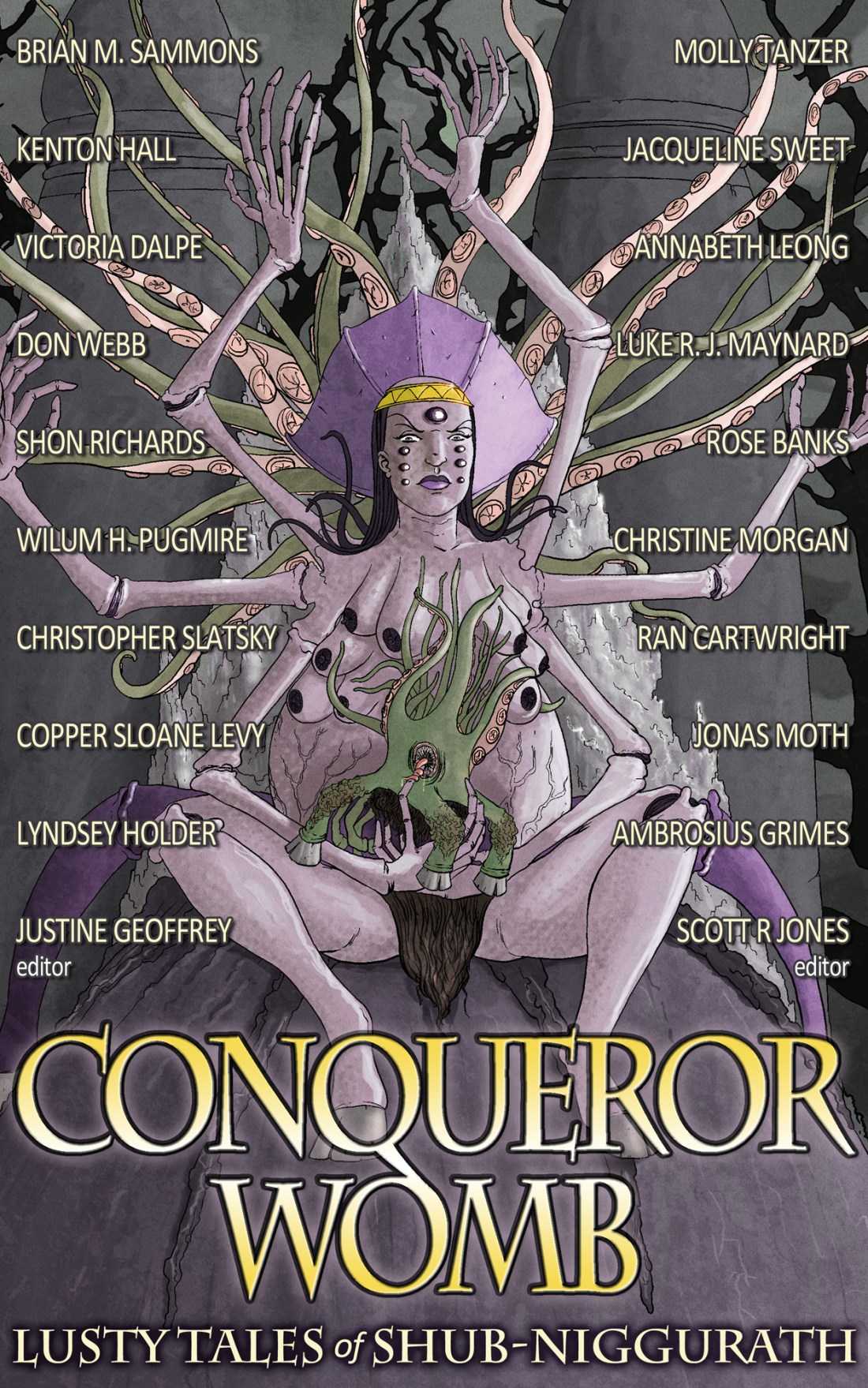
Inspired by Robert E. Howard’s mad poet, “Justine Geoffrey” is the female pseudonym of Scott R. Jones, author of books like When The Stars Are Right: Toward An Authentic R’lyehian Spirituality, a number of short stories, and the editor and publisher of the sadly defunct Martian Migraine Press, which produced evocative anthologies such as Conqueror Womb: Lusty Tales of Shub-Niggurath (2014), Resonator: New Lovecraftian Tales From Beyond (2015), Cthulhusattva: Tales of the Black Gnosis (2016), Chthonic: Weird Tales of Inner Earth (2018) as well as Necronomicum: The Magazine of Weird Erotica (2014, 4 issues).

The use of a feminine pseudonym by Jones is similar to the use of “Sally Theobald” by Robert M. Price for “I Wore The Brassiere Of Doom” (1986): a transparent hoax, not intended to deceive the audience. However, where Price never used that name for more than the single story, Jones found his alter ego an excellent editorial voice as well as author pseudonym. In adopting this voice for the editorial of the premiere issue of Necronomicum, “Justine” is able to make observations about her “co-editor”:

For instance, my co-editor Jones frequents any number of Lovecraftian and weird fiction groups on social media, and reports that all too often, when the subject of Sex and the Weird comes up, he is witness to a barrage of prudish voices protesting that there’s no place for sex in horror. “Lovecraft never wrote about sex!” they shriek while clutching at their pearls. (Never mind that sex and sexuality and weird blasphemous couplings are pretty much the foundation of HPLs horrific universe. Methinks the geeks protest too much!) These are the same voices that get inordinately upset when you mention Lovecraft’s racism, or chuckle with derision if you happen to misidentify a Gug as a Ghast during casual conversation. Basically, these are the to-be-expected thrashings of the Old Guard as they’re shown the door by the new fans, and the new voices with new things to say.

As an authorial and editorial poise, the assumption of an identity had value for Jones—and he is neither the first nor the last author to find refuge in a pseudonym, to take on those aspects and attitudes necessary for what has to be written.

Such as the Blackstone erotica series.

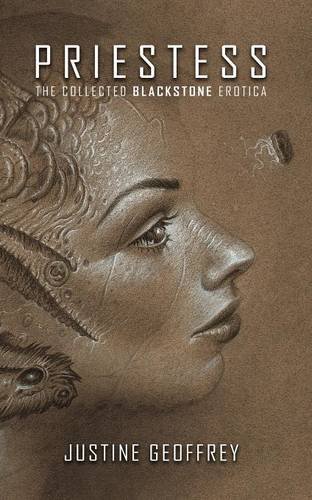
Taking its name from Robert E. Howard’s eponymous monolith, the Blackstone series of Lovecraftian erotica began with book 1: “Red Monolith Frenzy” (2012), and was followed by book 2: “Green Fever Dream” (2012); book 3, “Yellow Sign Bound” has not been published, although an excerpt appears in the printed collection Priestess (2014), which also contains the prequel story “Summonings: Anicka and Kamil” (2012) and the interqual “Summonings: Yvette’s Interview” (2013).

“Red Monolith Frenzy” is the start of things, chronologically and narratively. A novella in five parts, the narrative is a combination of the structure of “The Black Stone” and Lovecraft’s “The Statement of Randolph Carter,” at least initially. “Justine G.” is the narrator, the character that is the focus of the action, and Jones’ adoption of the pseudonym for these works lends strength to the idea that this is really her story (weirdly and unconsciously echoing the confessional style of “Sally Theobald.”)

There is a lot of deliberate homage, sometimes almost to the point of parody. But the work is not a remix in the sense of “Herburt East: Refuckinator” (2012) by Lula Lisbon; it is an original twist on the old material, keeping a sense of humor like “Koenigsberg’s Model” (2011) by Peter Tupper & “The Ape in Me: A Tale of Lovecraftian Lust” (2016) by Raine Roka. The pacing of the story is determined: contemporary erotica demands regular “beats” of titillation every couple of pages, much as action stories require hitting the right action beats to keep things moving, and keep the reader turning to see what happens next. A dull spot in a regular novella a reader might struggle through, but with porn they’re more likely to put the book down and never come back. So the flow of the story is a bit faster than Lovecraft, or even Howard writing at his Lovecraftian best. For the “omnisexual” Justine G., this means the fun and revelations keep on coming, usually more or less at the same time.

The sexual content is explicit and varied. It is difficult not to draw comparisons with Edward Lee’s “Hardcore Lovecraft” fiction such as Trolley No. 1852 (2010) and The Dunwich Romance (2013), which takes similar inspiration from Lovecraft but also doesn’t attempt Lovecraftian erotica pasticheOn the spectrum of erotic horror, this first episode in Priestess definitely leans toward the fun-loving erotic, and does so in a way that doesn’t involve rape, inhuman monsters, or even tentacles, which is rare enough for Lovecraftian erotica. The editorial for Necronomicum returns to mind when considering the direction of this story:

We want to showcase a kind of erotica that, though it draws a lot of its dark inspiration from, say, the work of H. P. Lovecraft and writers of his ilk, moves beyond the cheesy realms of “monster sex” or “tentacle smut” and into areas where our connection to ourselves, and to the Other (within us and outside of us) can be explored. Stories that thrill as much as they chill, that provoke thought in the head as much as they produce heat in the… well, elsewhere, let’s just say.

The character of Justine Geoffrey—both within this story and in a more metafictional way as the author and editor of works for Martian Migraine Press—is not that of a victim, a prostitute, or a sadistic slut. She enjoys sex, and gets sexually excited easily; emotional attachments in this first chapter are very ephemeral, so that sexual attraction and consummation does not necessarily equal love. By some standards, her behavior might certainly be considered evidence of hypersexual disorder, but Justine G. feels no inherent guilt or distress at her sexual desires and escapades.

At what point does a woman empowered by and embracing her sexual nature and actively pursuing sexual experiences cross whatever threshold separates a healthy sexual appetite into a mental health disorder? At what point does a character in a porn novella cease to be a believable character and become a wanton caricature, a fantasy of a nymphomaniac? Does the apparent gender and sexuality of the author influence how the audience reads these stories? These are the questions at the heart of the characterization of Justine Geoffrey, both in the stories and in the larger context as author and editor.

Answers are going to be subjective. The complexity of Scott R. Jones’ female anima is one of the more interesting aspects of a series that largely makes no bones about nor has any shame in being Lovecraftian erotica. “Justine G.” is not a patient to be analyzed, and as an editorial voice has grown beyond the role she experiences and enjoys in “Red Monolith Frenzy” and the other episodes in Priestess, where Jones would go on to draw inspiration from Mythos writers such as Ramsey Campbell and Alan Moore.

“Red Monolith Frenzy” was initially published as an ebook in 2012. It was collected in Priestess in 2014, which was translated into German and published as Die Chronik des Schwarzen Steins in 2018 in a limited edition of 999 copies.


Bobby Derie is the author of Weird Talers: Essays on Robert E. Howard & Others (2019) and Sex and the Cthulhu Mythos (2014).

“Red Stars/White Snow/Black Metal” (2018) by Fiona Maeve Geist

The comments frequently contain the cryptic couplet:

The wallowing darkness of rutting pigs
Suckling at the teat of a stillborn goddess

—Fiona Maeve Geist, “Red Stars/White Snow/Black Metal” in Ashes and Entropy 133

The weft of the story is built on the bones of Cyclonopedia: Complicity With Anonymous Materials and Lords of Chaos: The Bloody Rise of the Satanic Metal UndergroundThere are threads of Lovecraft and William Hope Hodgson in the warp, though nothing so garish as a direct callout to “The Rats in the Walls” or “The Hog.” Mostly, it is dense ideas fired at machine-gun speed but with great precision, perforating the paper targets of a pretty fundamental premise:

  • What if Black Metal got into something properly Lovecraftian?

Which is not to say that metal hasn’t already gotten pretty Lovecraftian at times, with everyone from Arkham Witch to Innzmouth, Morbid Angel to Nox Arcana getting in on the act. Bands have named themselves after Shub-Niggurath and Yog-Sothoth, and the Lovecraftian influence spreads across genres, from the 70s psychedelic band H. P. Lovecraft to the punkish Rudimentary Peni to the rocking Darkest of the Hillside Thickets. All that really binds them together is Lovecraft.

Black metal, though, has a certain appeal. While getting a little long in the tooth, it has always been a subculture that sought certain extremes, reveled in rebellion, wrestled with the consequences. Which is probably why Geist wisely doesn’t look to name-drop actual Lovecraftian metal bands, instead building a new mythology and symbolism for her protagonist to pursue. One that marks itself with ouroboros of twined maggots and the face of a corpulent sow.

Geist’s protagonist Kelsey is a journalist in the way Arturo Perez Reverte’s Lucas Corso from The Club Dumas is a book detective. Someone puts them on assignment, gives them money and tells them to sniff it out like a good truffle-hunter. It’s a classic plotline which has worked for everyone from William Gibson on down, and Geist makes good use of it. In the words of one famous journalist:

When the going gets weird, the weird turn pro.
—Hunter S. Thompson, The Great Shark Hunt 530

So much for the “Black Metal” of the title; the “Red Stars” gets into the Marxist connections of the Brotherhood of the Black, Corpulent Sow, the weird connections that metal music has had with politics over in Europe. This is closer to Cyclonopedia or Charles Stross’ Laundry Files than most anything else in the Lovecraftian milieu; old conspiracy theories, shades of cyberpunk, the occult underground of the Cold War gently unraveling in the present day.

This isn’t a mystery that you need a key to, although at least a passing familiarity to the bones of what the characters are referring to and experiencing certainly help. As prose goes it’s fairly dense, but there’s a texture to it. New flesh on old bones; the ending isn’t particularly surprising, but neither is it unsatisfying. Mythos readers often like works like this, spiritual heirs of John Carpenter’s Cigarette Burns and “The Shadow over Innsmouth,” where the search for something leads to a personal transformation or transfiguration.

“Red Stars/White Snow/Black Metal” was published in Ashes and Entropy (2018), it has not yet been reprinted. With Sadie Shurberg, Geist wrote the essay “Correlating the Contents of Lovecraft’s Closet” in Lovecraftian Proceedings No. 3 (2019).


Bobby Derie is the author of Weird Talers: Essays on Robert E. Howard & Others (2019) and Sex and the Cthulhu Mythos (2014).


“This Human Form” (2014) by Lyndsey Holder

(A BUZZING IMITATION OF HUMAN SPEECH)

Iä! Shub-Niggurath! The Black Goat of the Woods with a Thousand Young!
—H. P. Lovecraft, “The Whisperer in Darkness”

You call me black, but I am beyond black. I am the space between the stars, the darkness that lies on the edge of your dreams, the sound of death in small spaces.

You say I am from the woods, but my woods contain no trees or birds, no peaceful sounds of wind and stream, no quiet rustle of delicate creatures. My forest pulsates, vibrates, glistens. […]

You call me a goat, and sometimes I am.
⁠—Lyndsey Holder, “This Human Form” in Conqueror Womb: Lusty Tales of Shub-Niggurath

More of a prose-poem or an invocation than a short story, Lyndsey Holder’s “This Human Form” reminds me of “The Elder Sister-like One, Vol. 1” (2016) by Pochi Iida (飯田ぽち。)“Red Goat, Black Goat” (2010) by Nadia Bulkin, and “Cthulhu Sex (ahem!)—a poem—” (1998) by Katherine Morel. Works that take inspiration from the Mythos, but don’t lean heavily on them; they forge their own lore, not bound by any convention of the Mythos and yet still strongly connected to it thematically.

Holder’s first-person account is only implicitly that of the Black Goat of the Woods with a Thousand Young, reveling more in sensation and imagery than any concrete connections to any other story in the Mythos. The connection is stronger by association: the story is in a Mythos anthology, which makes the imagery more apparent. But stick this story in a dark fantasy or horror magazine and would people still get it? Would their minds still make the connection? Probably not, if they weren’t already initiated in Mythos-lore and familiar with Shub-Niggurath, her aspects and attributes. But they could still enjoy the story.

“This Human Form” is exemplary of how in a largely disorganized way, the Mythos has evolved organically into something which the SCP wiki has done by considered design. While it has been said there is no canon to the Mythos, it would be more accurate to say there is no one canon. Certainly, Lovecraft’s Dreamlands stories are fairly consistent in themselves, as are Ramsey Campbell’s Severn Valley tales, Brian Lumley’s Titus Crow stories, W. H. Pugmire’s Sesqua Valley, Charles Stross’ the Laundry Files, etc. Peter Rawlik has curated a canon centered around “Herbert West—Reanimator,” and Shane Ivey has spent considerable time doing much the same with the Delta Green setting.

Most of these works are independent, interconnected, sometimes conflicting. Myths do that. Conflict, arguably, might even be essential to the Mythos: it forces the reader to engage with it, to juggle different concepts, maybe try to reconcile them.

There is on thing you do not call me: mother. My body has sent a thousand children into this world, a thousand mewling, crawling things, suckling and whining, slithering down silvery dream-threads into the soft comfort of your warm beds.
—Lyndsey Holder, “This Human Form”

It is rare to get a first-person take from a Mythos entity, although far from unknown. Neil Gaiman famously did it with I, Cthulhu, or, What’s a Tentacle-Faced Thing Like Me Doing in a Sunken City Like This (Latitude 47° 9′ S, Longitude 126° 43′ W)? (1987) (later publications have quite reasonably shortened this to “I, Cthulhu”). Gaiman’s take, of course, is a quiet taking of the piss. The idea of Cthulhu addressing the user is the main joke. For Mythos entities that are largely defined as ineffable and unknowable, the first-person narrative rather kills the mystery…unless, as Holder does, the meat of the text is salacious, sensation-driven, and suggestive. Making telling feel like showing.

Lyndsey Holder’s “This Human Form” was published in Conqueror Womb: Lusty Tales of Shub-Niggurath (2014). Her other Mythos fiction includes “Parasitosis” (2015) and “Chosen” (2015).


Bobby Derie is the author of Weird Talers: Essays on Robert E. Howard & Others (2019) and Sex and the Cthulhu Mythos (2014).

“I Wore The Brassiere Of Doom” (1986) by Sally Theobald

He was a great reader, mostly of paperback westerns and dime romance novels. All this is well known, but what many readers probably do not ralize is that Howard wrote (under various pseudonyms) several stories and “confession” pieces for magazines of that type. Two of my own favorites were “Showdown at the OK Abyss” (written as “Hank Theobald”) and “I Wore the Brassiere of Doom” (under the by-line “Sally Theobald”). Sonia may have assisted him in some of these, but she would never admit it.
—”Lovecraft as I seem to Remember Him” (1983) by “F. Gumby Kalem” in Crypt of Cthulhu14

Those who chanced to read F. Gumby Kalem’s memoir “Lovecraft as I seem to Remember Him” (Crypt of Cthulhu 14) may recall Kalem’s surprising revelation that HPL, too, wrote for the confession magazines under the transparent pen-name Sally Theobald. Much checking with pulp colectors has turned up a copy of one of these tales, “I Wore the Brassier of Doom.” You will have to admit that Lovecraft could cover his tracks when he wanted to. But for Gumby Kalem’s information, it is a safe bet this work would never have been identified and restored to its rightful place among HPL’s oeuvre.
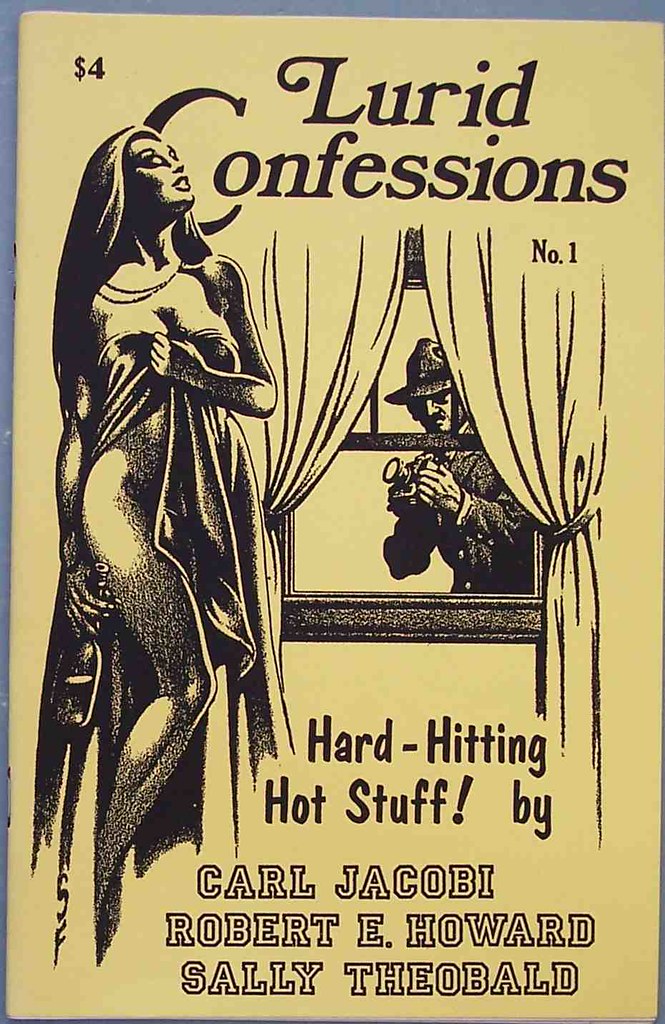
—”Scandal Sheet” (1986) by Robert M. Price in Lurid Confessions

“I Wore the Brassiere of Doom” is a playful hoax perpetrated by Robert M. Price, editor of both Crypt of Cthulhu and Lurid Confessions (among other ‘zines). The idea that a pulp writer might spread their wings and splash another field of fiction is not far-fetched—many did. Robert E. Howard wrote for example wrote weird fiction, westerns, detective, historical adventure, and spicy stories for the pulps; he tried to write science fiction and confession-style pulps too.

For spicy pulps in particular, Howard adopted the pseudonym “Sam Walser”—and Lovecraft was famous for his own pseudonyms, mostly in the amateur press, such as “Lewis Theobald, Jr.” which was his byline with Winifred Virginia Jackson (“Elizabeth Berkeley”) for “The Green Meadow” and “The Crawling Chaos.” Price, who wrote both “Lovecraft as I seem to Remember Him” and “I Wore the Brassiere of Doom,” was thus careful in picking a realistic pseudonym for the Providence pulpster in “Sally Theobald.”

The hoax was so convincing, that some folks actually fell for it.

Once I wrote a fake Lovecraft tale, as if he had written it for the confession magazines, “I Wore the Brassiere of Doom,” as by Sally Theobald. Without meaning to, I tricked a French Lovecraft scholar into listing it in his Lovecraft bibliography!
“Robert M. Price Interview” (2010)

The story was translated as “Le Soutien-Gorge Ensorcelé” (“The Enchanted Bra”) and published in Pulps No. 2 La Nurserie de l’Épouvante (“The Nursery of Terror,” 1987), a collection of translated pulp reprints, as by Lovecraft.

The broader point that the backstory “I Wore the Brassiere of Doom” emphasizes is not about the gullibility of readers or editors who fell for the hoax; Price’s tongue-in-cheek trail of breadcrumbs is transparent to any Lovecraft scholar (HPL did not read westerns or dime romance novels, no dates or titles of magazines are given, etc.) before they read the first line of the story. What is the point is that there was never anything stopping Lovecraft (or any other writer) from using a pseudonym of a different gender—and this presents a particular challenge at times when seeking to focus on works by female writers in pulps or weird fiction. While it is not clear that there were any women who wrote Mythos fiction under male pseudonyms (or vice versa) before the 1980s, it would not be surprising to find a few such works lurking in odd fanzines and forgotten pulps. Certainly there are plenty of examples of such genderbending nameplay in other genres, probably most famously James Tiptree Jr. (Alice Bradley Sheldon).

The story itself is not a pastiche of Lovecraft’s style, but certainly a pastiche of the confessional, a pulp genre inaugurated by True Story Magazine (1919- ). The moralistic atmosphere of these confessionals generally has women expressing grief for how they erredusually by engaging in inappropriate relationships, having children out of wedlock, drinking or drugs, etc.—providing a taboo thrill to the reader at being able to re-live their adventures while at the same time unsubtly re-affirming the decidedly misogynistic attitudes of the first half of the 20th century.

The story of a young and well-endowed country girl goes to the big city for the first time, intent on making it as a modern business woman is meat for a thousand stories…except in this particular Macy’s, she finds something strange:

As I placed the bra back in its box I noticed something else: the odd seam design. Across each cup, radiating out from the center, was a five-pointed star with an oval or eye-shape in the center.  thought little of this, except to guess that the design might have something to do with the nice way the bra seemed to uphold and almost carress me.
Lurid Confessions 31

The implication, of course, is that this is the Elder Sign as used by August Derleth in his own Mythos fiction:

Elder-Sign-Dearleth

The new brassiere certainly attracts a good bit of attention, and if there’s a fault in Price’s story, this is where it comes in, trying to channel some of the inherent racism of “The Call of Cthulhu” combined with the inherent sexism of the confession pulps:

Oh, I admit, soem of my gentlemen callers were not exactly dreamboats, but in a city populated by herds of rat-faced mongrels and ruffians, one had to make do. And if a girl waits until Mr. Perfect comes along, she’s liable to wind up an old maid. (ibid.)

Price would touch on similar issues in “Nautical-Looking Negroes” (1996) by Peter Cannon & Robert M. Price, and there is certainly something to be said for attempting to accurately capture the atmosphere of racism of the time and of the suggested author; whether Price goes too far or just far enough is a bit subjective, it is certainly not necessary to the story, but does help to tie it in a little closer to Lovecraft’s life and fiction.  While Lovecraft did not work racism into everything he wrote, the language Price uses here is directly influenced by Lovecraft’s.

Price, of course, is all about working in the little references to Lovecraft based on what little was published of the Providence pulpster’s own romantic life. When he wrote:

We would sit on the couch smootching and my sate would say something romantic like, “My dear, you have no idea how much I appreciate you.” Then his hand would begin to drift from my shoulders southward to hover above my breast. (ibid. 32)

The line was lifted wholesale from the memoir of Lovecraft’s former wife, Sonia Davis, The Private Life of H. P. Lovecraft (1985). Price makes a few more little quips like this (“The crinoid thing (or was it an echinodern? High school biology had scarcely prepared me for this!“), Lurid Confessions 34) as the story progresses toward an ending reminiscent of Lovecraft’s “The Diary of Alonzo Typer,” albeit with one last, final and perhaps thematically appropriate twist as Sally gives as a glimpse what might be Yog-Sothoth…

The original story has never been reprinted since Lurid Confessions, except in the French translation, but Robert M. Price allowed it to be republished by the Lovecraft eZine in 2013. So if you wish, prepare yourself and read “I Wore the Brassiere of Doom.”


Bobby Derie is the author of Weird Talers: Essays on Robert E. Howard & Others (2019) and Sex and the Cthulhu Mythos (2014).