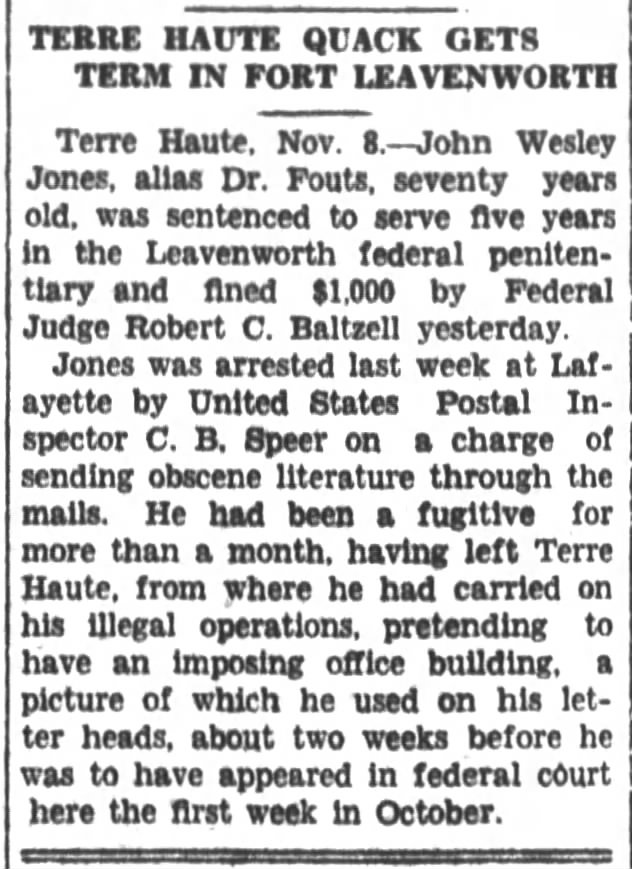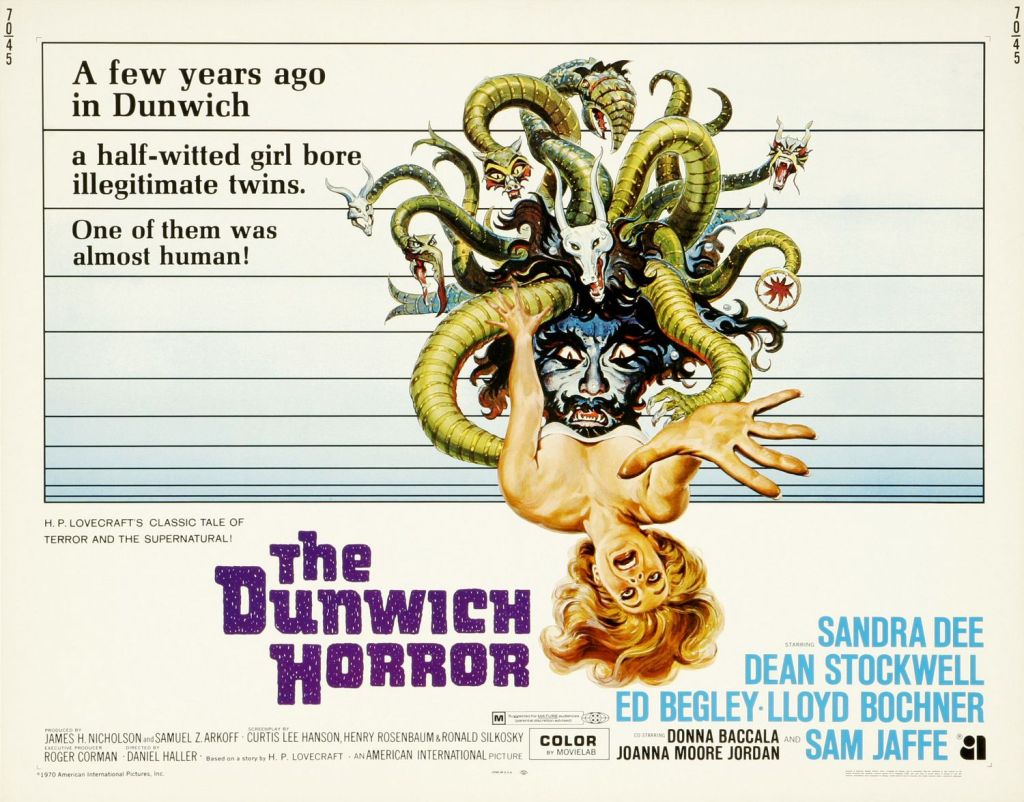
It is almost inconceivable that Bram Stoker wrote Dracula. Still, he must have done it. There is his name on the title page, and before the tale was bound up and offered us between covers it ran in length in various newspapers, and under the same name of authorship.
—“Bram Stoker’s Story” in the Detroit Free Press, 18 Nov 1899, p11
The research for Deeper Cut: Lovecraft, Miniter, Stoker: the Dracula Revision required an examination of the history of the Dracula manuscript and an evaluation of the textual variations in order to evaluate whether there was any place in the timeline for Edith Miniter, as Lovecraft alleged, and to judge Bram Stoker’s involvement with changes to the text before and after publication.
One of the most notable developments in Dracula studies in recent years has been the discovery of and translation into English of the 1899 Swedish translation Mörkrets Makter (translated into English as Powers of Darkness), which was serialized in the newspaper Dagen, and 1901 Icelandic edition Makt Myrkanna (also translated into English as Powers of Darkness) serialized in the newspaper Fjallkonan. However, there were also numerous Dracula serializations in English-language newspapers in the period 1899-1928.
Some of these have been discussed by previous scholars: John Edgar Browning in The Forgotten Writings of Bram Stoker listed serialization in the Washington Times (1917-1918) and the Charlotte Daily Observer (1899), drawing on information from the Bram Stoker Estate and researcher David J. Skal. Browning also mentions advertisements in the Fitchburg Daily Sentinel, Lowell Sun for a serial in the Boston Advertiser (1921); I have not been able to find an online archive for the Advertiser yet, but can confirm the ads.

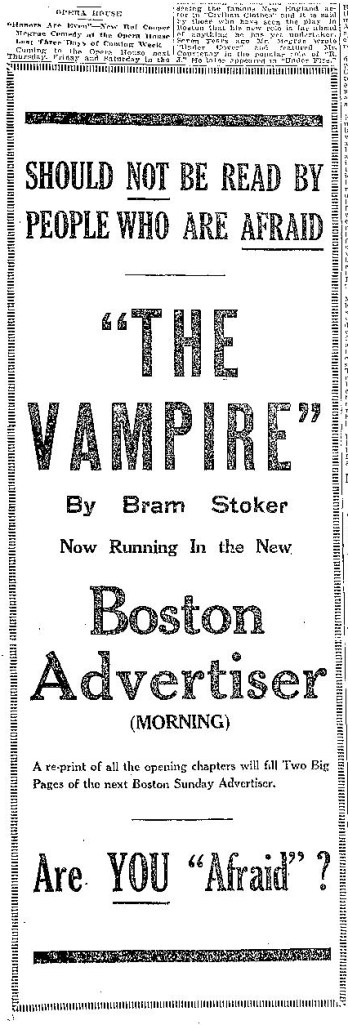
That advertisement also ran in Worcester Telegram, Berkshire Eagle, Biddeford-Saco Journal, Boston Jewish Advocate and Herald; Springfield Daily News, Republican, and Morning Union; Quincy Patriot Ledger; Fall River Evening Herald and Globe; Holyoke Transcript-Telegram; The Day (New London, CT), Daily Herald (Rutland, VT), Sun-Journal (Lewiston, ME), and Bangor Daily News around the same time.
Hans Corneel de Roos, searching for the origin of the Swedish and Icelandic newspaper serials, came across the 1899 Inter Ocean serialization—the first known Dracula serial—and also added the Buffalo Courier (“Next Stop: Chicago! Earliest U.S. Serialisation of Dracula Known so Far Discovered. Was it the Source of Mörkrets makter?”)
.Thanks to the digitization of old newspaper archives and online subscription services, these newspaper serials, which have received rather scanty attention, are more accessible today than they were previously. Enough that a survey of the extant texts is warranted.
Serialization of novels was nothing strange in the late 19th/early 20th century; many newspapers contained fiction, and ran short stories, poetry, and serials for the entertainment of their readers. Licensing serials was another source of income for authors (or their widows), and served as ready-made advertising, as newspapers often made much of the stories, at least in the first few installments, to drum up excitement for their investment. The problem with serializing Dracula, however, might be apparent to anyone that has read the book. The unabridged 1897 novel is rather long (~160,500 words), divided up into 27 chapters of unequal length, and is in epistolary format, further sub-divided into an assortment of letters, diaries, articles, phonograph recordings, and memoranda, which are also of varied length.
Trying to break that up into newspaper format would be an ordeal for any editor, and many ended up breaking up chapters, letters, and diary sections as they attempted to squeeze the text into space. Worse, from the newspaper person’s perspective, many of the individual sections mean little in themselves and contain little narrative action. Realistic as Dracula is, individual letters only gain meaning and import in the sum of their parts, and the plot progresses very gradually and not in any obvious direction. Imagine their frustration at trying to write synopses for chapters to aid readers trying to follow the story day-by-day or week-by-week! The serials ultimately ran from as few as 22 installments to as many as 131 installments, over the course of a single month or strung out over 5-6 months, but all of them start strong and enthusiastic but dwindle in excitement as the story nears the final chapter.
The first four serials all use more or less the identical text, an abridged version of the 1897 Dracula text that removes several sections (probably for space) but does not re-write any sections or correct any errors, as the 1901 abridged edition does. Aside from omissions, the main textual variations are typesetting or transcription errors, some of which are howlers—in the 30 June 1928 entry of the St. Louis Globe-Democrat, for example, the installment ends with the words “hands of oGd!” However, the editors did embellish the text in other ways, often adding synopses or interjecting subsection titles, presumably to punch up the text. Some of these are fun in and of themselves, being occasionally barely literate and often showcasing how tricky it is to improve Stoker’s prose.
The serializations covered in this survey are as follows:
- Inter Ocean (7 May 1899-4 Jun 1899)
- Memphis Commercial Appeal (14 Jun 1899-13 Jul 1899)
- Charlotte Daily Observer (16 Jul 1899-10 Dec 1899)
- Buffalo New York Courier (19 Feb 1900-1 Apr 1900)
- Washington D.C. Times Herald (13 Sep 1917-21 Jan 1918)
- Des Moines Tribune (25 Nov 1921-10 Feb 1922)
- St. Louis Globe-Democrat (20 Feb 1928-10 Jul 1928)
It is notable that there is no overlap between the runs of these serializations. While we don’t have the contracts between the newspapers and Stoker (or his widow, or their agent), that would seem to be deliberate, so that each paper had exclusive rights to the story for a set period, which may have affected the sectioning as well. There is also no known newspaper serialization during the period when the Argosy pulp magazine serialized Dracula (9 parts, Jun 1926 – Feb 1927). Whether this was intentional or coincidental is unknown.
There may well be additional newspaper serializations of Dracula besides these; these are just the serials available via newspapers.com as of the time of this writing. Links will be to the full pages, as clips tend to come out illegible.
The wisdom of putting this story into the newspapers may be questioned, from a humanitarian point of view, for the oerdinary reader will have to take a nerve tonic after its perusal, especially if inclined to timidity, and the newspaper public numbers thousands of nervous and superstitious people, some of whom are imbued with the particular legendary lore from which the conception of “Dracula” originally sprang.
—“A Grewsome Tale.”, Washington D.C. Times 21 Jan 1900, p20
Inter Ocean (7 May 1899-4 Jun 1899)
The first serialization of Dracula was announced in the Inter Ocean on 3 May 1899, on page 5:
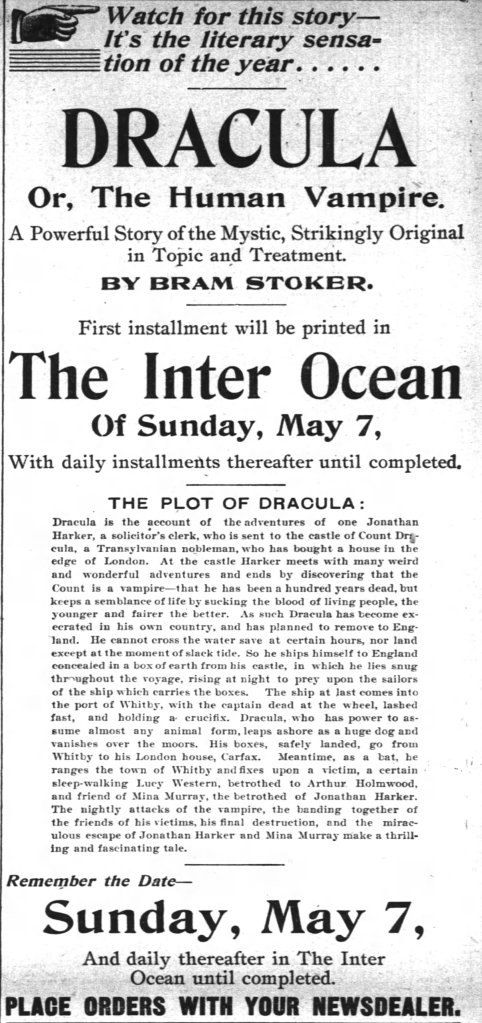
The title for the series was The Strange Story of Dracula, and ran for 28 installments from 7 May 1899 to 4 June 1899, or nearly a chapter a day. Although the text is taken from the 1897 edition, there has been some abridgement: Jonathan Harker’s prologue (“How these papers have been placed in sequence […]”) has been omitted, as well as parts of chapter V (“Dr. Seward’s Diary (kept in phonograph),” “Letter, Quincey P. Morris to Hon. Arthur Holmwood,” and “Telegram from Arthur Holmwood to Quincey P. Morris.”), chapter VII (Mina Murray’s journal for 10 August), the tail end of Dr. Seward’s Diary in chapters VIII and IX, Lucy Westenra’s Diary of 12 September at the beginning of chapter XI, a few sentences from Hennessy’s letter in chapter XII, both sections of Dr. Seward’s Diary and the Westminster Gazette excerpts in chapter XIII, parts of Mina Harker’s Journal in chapter XIV, etc. Chapters XV and XVI of the book have been excised completely, and as a consequence the chapter numbering was subsequently changes so that the story has 25 chapters instead of 27.
There are a number of small changes that represent either typographical or typesetting errors, too many to list, and a few that may represent editorial fiat. For example, in the Inter Ocean chapter XIV (chapter XVII in the book), “Mina Harker’s Journal” is rendered as “Nina Harker’s Journal” and in the Inter Ocean XXII (chapter XXIV in the book), “Dr. Seward’s Diary” is rendered as “Dr. Seward’s Story,” etc. The 15th installment (Sunday, 21 May 1899) provided readers with a summary of the preceding chapters; another summary appeared with the 22nd installment (Sunday, 28 May 1899).
Note: Until chapter XIV, chapter numbering is identical with the 1897 text, starting with Inter Ocean chapter XV the numbering changes. Equivalent chapters from the 1897 text are presented in parantheses.
| Part 1: 7 May 1899, page 17. Chapter I. “3 May” to “sharply to the right.” Link |
| Part 2: 8 May 1899, page 7. Chapters I-II. “Soon we were hemmed in” to “Peter Hawkins. So!” Link |
| Part 3: 9 May 1899, page 7. Chapters II-III. “We went thoroughly” to “up and said:” Link |
| Part 4: 10 May 1899, page 7. Chapter III. “Have you written” to “sank down unconscious.” Link |
| Part 5: 11 May 1899, page 7. Chapter IV. “I awoke in my” to “whom I am dear!” Link |
| Part 6: 12 May 1899, page 7. Chapters IV-VI. “30 June, Morning” to “this time tomorrow.” Link |
| Part 7: 13 May 1899, page 7. Chapters VII-VIII. “CUTTING FROM ‘THE DAILYGRAPH’” to “far over the sea.” Link |
| Part 8: 14 May 1899, page 17. Chapters VIII-IX. “Same Day, Noon.” to “an excuse and try.” Link |
| Part 9: 15 May 1899, page 7. Chapters IX-X. “25 August” to “knees begin to tremble.” Link |
| Part 10: 16 May 1899, page 7. Chapters X-XI. “There on the bed” to “God help me!” Link |
| Part 11: 17 May 1899, page 7. Chapter XII. “18 September” to “similar incoherent ravings.” Link |
| Part 12: 18 May 1899, page 7. Chapters XII-XIV. “The two carriers” to “WILHELMINA HARKER.” Link |
| Part 13: 19 May 1899, page 7. Chapters XIV-XV [XIV, XVII]. “25 September” to “that terrible story!” Link |
| Part 14: 20 May 1899, page 7. Chapters XV-XVI [XVII-XVIII]. “Then it was terrible” to “that giveth rest.” Link |
| Part 15: 21 May 1899, page 7. Chapter XVI-XVII [XVIII-XIX]. “Thus when we find” to “become itself corrupt.” Link Summary of Preceding Chapters: Jonathan Harker, an English solicitor, goes to Transylvania to close negotiations with Count Dracula for an estate which the latter wishes to buy in England. As he approaches the Count’s castle the peasantry indicate that he is going into great danger. He reaches the castle at night and is received by the Count, who warns him not to stray beyond certain rooms. The necessary papers for the transfer of the estate, called Carfax, are signed and the Count also makes arrangements for his own removal to England. Harker discovers that he and the Count are apparently the only inhabitants of the castle. He is also struck by the fact that the Count casts no shadow in a mirror and seems to have strange power over the wolves which range the forests about the castle. The Count forces Harker to write advance letters giving the dates of his own departure from the castle and arrival at a neighboring town. In exploring the castle Harker finds the Count lying in a coffin in the ruined chapel, apparently dead, yet alive. Harker falls asleep in one of the deserted rooms and apparently dreams that three beautiful women are about to kill him. Finally Harker escapes from the castle after the departure of the Count by climbing down the walls, and is next heard of with brain fever in a hospital. Meanwhile Harker’s fiancée, Mina Murray, has gone to visit Lucy Westenra, at Whitby. A Russian vessel driven ashore there with her dead captain lashed to the wheel. A dog, which jumps ashore and disappears, is the only living thing on board. The logbook shows that all but the captain have been driven to jump overboard by some terrifying specter. Lucy Westenra walks in her sleep and is found sitting on a bench with a dark shape hovering over her. Mina Murray brings her home and finds two tiny punctures in her throat, but thinks them made accidentally with a pin. Lucy’s health steadily declines. Dr. Seward, head of an insane asylum near the Carfax estate, notes peculiar conduct of a homicidal patient named Renfield. Dr. Van Helsing comes from Amsterdam to examine Lucy Westenra. He finds her condition critical and employes [sic] transfusion of blood. She is better for a day or two and then relapses. Van Helsing finds the wounds in her throat, again transfuses blood, and orders her to sleep only in a closed room hung with garlic. By a series of accidents these precautions prove unavailing, and Lucy dies. Meanwhile, Harker has returned to England, having married Mina Murray, who had gone to Hungary to nurse him. He sees Dracula on the streets in London. Van Helsing announces that Lucy has been killed by a vampire, and holds counsel with the Harkers, Lucy’s fiancée and Dr. Seward as to means to rid the world of the monster. |
| Part 16: 22 May 1899, page 7. Chapters XVII-XVIII [XIX-XX]. “Under ordinary circumstances” to “up to the door.” Link |
| Part 17: 23 May 1899, page 7. Chapters XVIII-XIX [XX-XXI]. “I thought that” to “few minutes join you.” Link |
| Part 18: 24 May 1899, page 7. Chapter XIX [XXI]. “The patient was breathing” to “clung to him fiercely.” Link |
| Part 19: 25 May 1899, page 7. Chapters XIX-XX [XXI-XXII]. “Van Helsing and” to “Is it not?” Link |
| Part 20: 26 May 1899, page 7. Chapter XX [XXII]. “Then let us come” to “the coming of the Count.” Link |
| Part 21: 27 May 1899, page 7. Chapter XXI [XXIII]. “3 October” to “sorrows have come!” Link |
| Part 22: 28 May 1899, page 7. Chaptera XXI-XXII [XXIII-XXIV]. “The men were” to “forms, he departed.” Link Summary of Preceding Chapters: Jonathan Harker, an English solicitor, goes to Transylvania to close negotiations with Count Dracula for an estate which the latter wishes to buy in England. As he approaches the Count’s castle the peasantry indicate that he is going into great danger. He reaches the castle at night and is received by the Count, who warns him not to stray beyond certain rooms. The necessary papers for the transfer of the estate, called Carfax, are signed and the Count also makes arrangements for his own removal to England. Harker discovers that he and the Count are apparently the only inhabitants of the castle. He is also struck by the fact that the Count casts no shadow in a mirror and seems to have strange power over the wolves which range the forests about the castle. The Count forces Harker to write advance letters giving the dates of his own departure from the castle and arrival at a neighboring town. In exploring the castle Harker finds the Count lying in a coffin in the ruined chapel, apparently dead, yet alive. Harker falls asleep in one of the deserted rooms and apparently dreams that three beautiful women are about to kill him. Finally Harker escapes from the castle after the departure of the Count by climbing down the walls, and is next heard of with brain fever in a hospital. Meanwhile Harker’s fiancée, Mina Murray, has gone to visit Lucy Westenra, at Whitby. A Russian vessel driven ashore there with her dead captain lashed to the wheel. A dog, which jumps ashore and disappears, is the only living thing on board. The logbook shows that all but the captain have been driven to jump overboard by some terrifying specter. Lucy Westenra walks in her sleep and is found sitting on a bench with a dark shape hovering over her. Mina Murray brings her home and finds two tiny punctures in her throat, but thinks them made accidentally with a pin. Lucy’s health steadily declines. Dr. Seward, head of an insane asylum near the Carfax estate, notes peculiar conduct of a homicidal patient named Renfield. Dr. Van Helsing comes from Amsterdam to examine Lucy Westenra. He finds her condition critical and employes [sic] transfusion of blood. She is better for a day or two and then relapses. Van Helsing finds the wounds in her throat, again transfuses blood, and orders her to sleep only in a closed room hung with garlic. By a series of accidents these precautions prove unavailing, and Lucy dies. Meanwhile, Harker has returned to England, having married Mina Murray, who had gone to Hungary to nurse him. He sees Dracula on the streets in London. Van Helsing announces that Lucy has been killed by a vampire, and holds counsel with the Harkers, Lucy’s fiancée and Dr. Seward as to means to rid the world of the monster. Dr. Van Helsing describes the character of the vampire, the conditions under which these damned souls are able to walk the earth and prey upon the living, and the means of destroying them. The boxes which the Count sent from Transylvania contain earth from the graveyard in which the vampire was originally buried, and these are necessary to afford a retreat from the monster. Armed with carnal and spiritual weapons, Van Helsing and the others search the Carfax house and are attacked by legions of rats. Some of the boxes of earth are gone. They are traced to their different houses in London which the Count has bought. Renfield protests his sanity and begs for release, to be allowed to go away to save his soul. He is found fatally injured in his room, and confesses that he has yielded to the temptations of the vampire, but rebelled when the monster attacked Mrs. Harker. The vampire is found at work on Mrs. Harker, and attempting to make her one of his own kind. Van Helsing drives him from the house with a consecrated wafer and he disappears in a mist. Mrs. Harker is in an agony of despair, but Van Helsing warns her that she must live until the monster is laid, unless she wishes to become like him. The vampire’s lair at Carfax is sterilized by placing in each box of earth a portion of the consecrated wafer. This operation is repeated at the Count’s other house in London, but one box of earth from Transylvania is not found. The Count appears at the house where the avengers are waiting for him, but escapes them. Mrs. Harker fears that she may become a vampire. |
| Part 23: 29 May 1899, page 7. Chapter XXII [XXIV]. “No one knew” to “She is calling to me.” Link |
| Part 24: 30 May 1899, page 7. Chapter XXIII [XXV]. “11 October, Evening” to “1 o’clock today.” Link |
| Part 25: 31 May 1899, page 7. Chapters XXIII-XXIV [XXV-XXVI]. “28 October” to “anything in his power.” Link |
| Part 26: 1 Jun 1899, page 7. Chapter XXIV [XXVI]. “30 October” to “hands of God!” Link |
| Part 27: 2 Jun 1899, page 7. Chapters XXIV-XXV [XXVI-XXVII]. “Later.—Oh” to “Come to us. Come! Come!” Link |
| Part 28: 4 Jun 1899, page 17. Chapter XXV [XXVII]. “In fear I turned” to “JONATHAN HARKER. (THE END.)” Link |
Memphis Commercial Appeal (14 Jun 1899-13 Jul 1899)
The serialization of Dracula in the Commercial Appeal for Memphis, Tennessee was announced in the 13 June 1899 issue, on page 1:
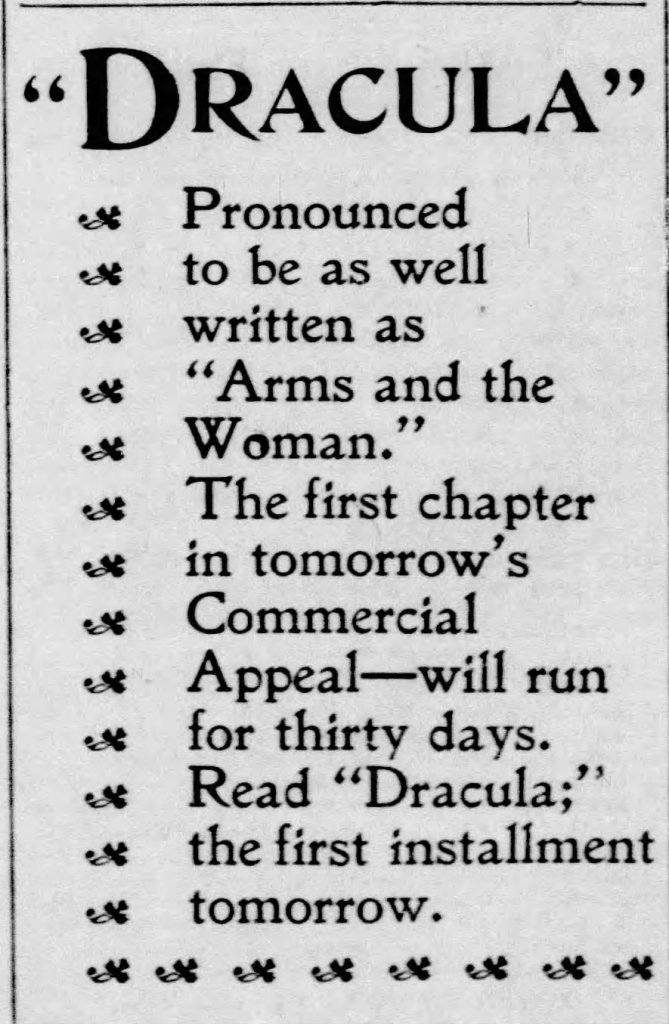
The title for the series was simply Dracula, and ran for 26 installments from 14 June 1899 to 13 July 1899. The text largely follows the Inter Ocean abridgement, including the chapter numbering, but without the two synopses and with some unique typesetting/typographical errors (for example, Chapter I opens with “Jonathan Barker’s Journal”) and slight changes to some titles (e.g. the Inter Ocean for Chapter XXII starts simply “This to Jonathan Harker” and in the Commercial Appeal Chapter XXII this is preceded by: “Dr, Seward’s Phonograph Diary, Spoken by Van Helsing. BY VAN HELSING.”)
One amusing incident was an announcement to readers that ran in place of Dracula on 4 and 5 July:
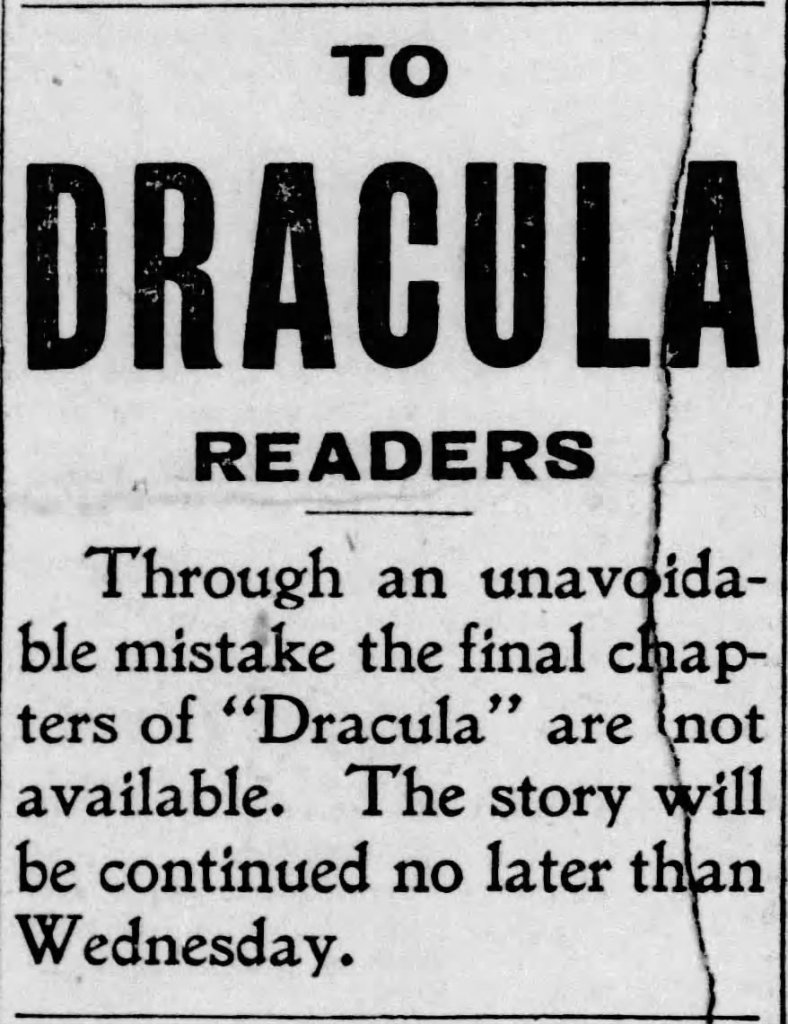
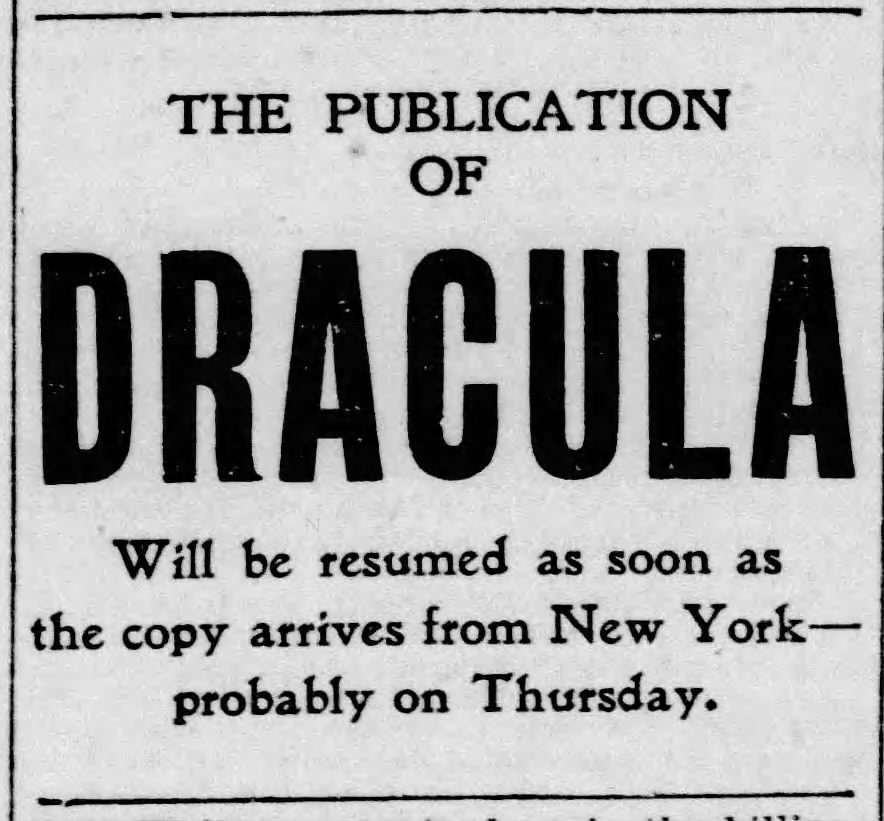
Publication resumed on 8 July. Given the text is nearly identical to that in the Inter Ocean, this raises the question: where did the Commercial Appeal get the text? Were they literally copying it from issues of the Inter Ocean, or did they receive it from the Inter Ocean editorial, or was there an approved newspaper abridgement that would have come from Stoker or whatever agency that brokered the sale?
Note: Until chapter XIV, chapter numbering is identical with the 1897 text, starting with Commercial Appeal chapter XV the numbering changes. Equivalent chapters from the 1897 text are presented in parantheses.
| Part 1: 14 Jun 1899, page 3. Chapter I. “3 May” to “the moonlit sky.” Link |
| Part 2: 15 Jun 1899, page 3. Chapter II. “5 May” to “I am a prisoner!” Link |
| Part 3: 16 Jun 1899, page 3. Chapter III. “When I found” to “sank down unconscious.” Link |
| Part 4: 17 Jun 1899, page 3. Chapter IV. “I awoke in” to “he stopped. ‘Hark!’” Link |
| Part 5: 18 Jun 1899, page 16. Chapters IV-V. “Close at haul” to “Good-bye.” Link |
| Part 6: 19 Jun 1899, page 3. Chapter VI. “24 July” to “this time tomorrow.” Link |
| Part 7: 20 Jun 1899, page 3. Chapter VII. “Cutting From ‘The Dailygraph,’” to “routine of her life.” Link |
| Part 8: 21 Jun 1899, page 3. Chapter VIII. “Same day, 11 o’clock p.m.” to “of good things?” Link |
| Part 9: 22 Jun 1899, page 3. Chapter IX. “My Dearest Lucy” to “till have seen you.” Link |
| Part 10: 23 Jun 1899, page 3. Chapter X. “7 September” to “Ho! ho!” Link |
| Part 11: 24 Jun 1899, page 3. Chapter XI [Mislabeled as Chapter XII]. “13 September” to “God help me!” Link |
| Part 12: 25 Jun 1899, page 11. Chapter XII. “18 September” to “Wait and see.” Link |
| Part 13: 26 Jun 1899, page 3. Chapters XIII-XIV. “22 September” to “you will,’ I said.” Link |
| Part 14: 27 Jun 1899, page 3. Chapter XV [XVII]. “When we arrived” to “to comfort him.” Link |
| Part 15: 28 Jun 1899, page 3. Chapter XVI [XVIII]. “30 September” to “convince you tonight.” Link |
| Part 16: 29 Jun 1899, page 3. Chapter XVII [XIX]. “1 October, 5 a.m.” to “sleep. Good-night.” Link |
| Part 17: 30 Jun 1899, page 3. Chapter XVIII [XX]“1 October, Evening” to “I must go at once.” Link |
| Part 18: 1 Jul 1899, page 3. Chapter XIX [XXI]. “3 October” to “its daily course.” Link Note: upper-left corner of page destroyed in this scan, data filled in from Inter Ocean text based on context. |
| Part 19: 2 Jul 1899, page 11. Chapter XX [XXII]. “3 October” to “coming of the count.” Link |
| Part 20: 3 Jul 1899, page 3. Chapter XXI [XXIII]. “3 October” to “in a faint.” Link |
| Part 21: 8 Jul 1899, page 3. Chapter XXII [XXIV]. “Dr. Seward’s Phonograph” to “She is calling to me.” Link |
| Part 22: 9 Jul 1899, page 11. Chapter XXIII [XXV]. “11 October, evening” to “the MS. to us.” Link |
| Part 23: 10 Jul 1899, page 3. Chapter XXIV [XXVI]. “29 October” to “every minute is precious.” Link |
| Part 24: 11 Jul 1899, page 3. Chapter XXIV [XXVI]. “Ground of Inquiry” to “always for him.” Link |
| Part 25: 12 Jul 1899, page 3. Chapter XXV [XXVII]. “1 November” to “but one word:” Link |
| Part 26: 13 Jul 1899, page 3. Chapter XXV [XXVII]. “DRACULA” to “JONATHAN HARKER. THE END.” Link |
Charlotte Daily Observer (16 Jul 1899-10 Dec 1899)
The serialization of Dracula in the Daily Observer for Charlotte, North Carolina follows the Inter Ocean abridged text, including the chapter numbering but minus the synopses, and was published in 22 parts from 16 July 1899 to 10 December 1899. Inevitably there were numerous misspellings, either from transcription or typesetting, such as “Yours always, JOHN SEAWRD.” in Chapter IX, “DR. SEWARD’S DAIRY” in Chapter XI, “JONATHAN HARKER’S JOURNNAL” in Chapter XXVII, etc. The subtitle for the serial was “A Strong Story of the Vampire,” and as “By Bram Stoker, the Dramatic Critic, Theatrical Manager and Author of ‘Miss Betty,’ ‘Under the Sunset,’ and Other Books.” although Miss Betty (1898) is sometimes mistranscribed as “Miss Betsy,” “Miss Belay,” etc.
Note: Until chapter XIV, chapter numbering is identical with the 1897 text, starting with Daily Observer chapter XV the numbering changes. Some chapters are unnumbered. Equivalent chapters from the 1897 text are presented in parantheses.
| Part 1: 16 Jul 1899, page 10. Chapter I. “3 May” to “the moonlit sky” Link |
| Part 2: 23 Jul 1899, page 10. Chapter II. “5 May” to “I am a prisoner!” Link |
| Part 3: 30 Jul 1899, page 10. [Chapter III.] “When I found” to “sank down unconscious.” Link |
| Part 4: 6 Aug 1899, page 10. Chapter IV. “I awoke in” to “Goodby, all! Mina!” Link |
| Part 5: 13 Aug 1899, page 10. Chapters V-VII. “My Dearest Lucy” to “routine of her life.” Link |
| Part 6: 20 Aug 1899, page 10. Chapter VIII. “Same day 11 o’clock p. m.” to “distribution of good things?” Link |
| Part 7: 27 Aug 1899, page 10. Chapter IX. “Budapest, 24 August” to “till have seen you.” Link |
| Part 8: 3 Sep 1899, page 10. Chapter X. “7 September” to “Ho! ho!” Link |
| Part 9: 10 Sep 1899, page 10. Chapter XI. “13 September” to “God help me!” Link |
| Part 10: 17 Sep 1899, page 10. Chapter XII. “18 September” to “Wait and see.” Link |
| Part 11: 24 Sep 1899, page 10. Chapter XIII-XIV. “22 September” to “will,’ I said.” Link |
| Part 12: 1 Oct 1899, page 10. [Chapter XVII]. “When we arrived” to “to comfort him.” Link |
| Part 13: 8 Oct 1899, page 10. [Chapter XVIII]. “20 September” to “convince you to-night.” Link |
| Part 14: 15 Oct 1899, page 10. Chapter XVII [XIX]. “1 October, 5 a. m.” to “sleep. Good night.” Link |
| Part 15: 22 Oct 1899, page 10. Chapter XVIII [XX]. “1 October, Evening” to “I must go at once.” Link to page 1 Note: Page 10 missing from online scan, data filled in from Inter Ocean. |
| Part 16: 29 Oct 1899, page 10. Chapter XIX [XXI]. “2 October” to “its daily course.” Link |
| Part 17: 5 Nov 1899, page 10. Chapter XX [XXII]. “3 October” to “coming of the Count.” Link |
| Part 18: 12 Nov 1899, page 10. Chapter XXI [XXIII]. “3 October” to “forward in a faint.” Link |
| Part 19: 19 Nov 1899, page 10. Chapter XXII [XXIV]. “DR. SEWARD’S PHONOGRAPH DIARY” to “She is calling to me.” Link |
| Part 20: 26 Nov 1899, page 10. Chapter XXIII [XXV]. “11 October, evening” to “brought the MS to us.” Link |
| Part 21: 3 Dec 1899, page 14. Chapter XXIV [XXVI]. “23 October” to “be always for him.” Link |
| Part 22: 10 Dec 1899, page 10. [Chapter XXVII]. “1 November” to “JONATHAN HARKER. [THE END].” Link |
Buffalo New York Courier (19 Feb 1900-1 Apr 1900)
The serialization of Dracula in the Courier for Buffalo. New York follows the Inter Ocean abridged text, including the chapter numbering (more or less) but with its own synopses, and was published in 37 parts from 19 February 1900 to 1 April 1900. The synopses begin with part 3 and are a regular feature of the daily Dracula until the finale in parts 36 and 37. Given the relatively slow pace of Dracula, many of the synopses are identical from segment to segment.

Of interesting note is the copyright notices; the first nine installments read simply “Copyright Bram Stoker,” but starting with the 1 March 1900 entry, the copyright notice changes to:

This would reflect the first U.S. publication of Dracula by Doubleday & McClure in 1899.
Note: Until chapter XIV, chapter numbering is identical with the 1897 text, starting with Commercial Appeal chapter XV the numbering changes. Some chapters are unnumbered. Equivalent chapters from the 1897 text are presented in parantheses.
| Part 1: 19 Feb 1900, page 5. Chapter I. “3 May” to “into strange relief” Link. |
| Part 2: 20 Feb 1900, page 5. [Chapter I]. “The ghost-like clouds” to “against the moonlit sky.” Link. |
| Part 3: 21 Feb 1900, page 5. Chapter II. “5 May” to “what strange things here may be.” Link. Synopsis: Count Dracula is a vampire. He lives in a deserted castle in the Carpathian Mountains. Finding existence somewhat monotonous, he writes to London with a view to procuring new victims. In this installment Jonathan Harker is on his way to the castle to pay a visit to the Count. |
| Part 4: 22 Feb 1900, page 5. [Chapter II]. “This led to ” to “I am a prisoner!” Link. Synopsis: Identical to part 3. |
| Part 5: 23 Feb 1900, page 5. Chapter III. “When I found” to “‘modernity’ cannot kill.” Link. Synopsis: Count Dracula lives in a deserted castle in the Carpathian Mountains. He desires to take up a residence in the vicinity of London. At his request Jonathan Harker of Exeter pays a visit to the castle, bringing with him papers describing a place which he believed would suit Count Dracula. Mr. Harker describes in a diary his remarkable experiences on his way to the castle and after arriving there. Yesterday’s instalment of the story closed with Harker a prisoner in Dracula’s home. |
| Part 6: 24 Feb 1900, page 5. [Chapter III-IV]. “Later: the morning of 16 May” to “new scheme of villany.” Link. Synopsis: Count Dracula lives in a deserted castle in the Carpathian Mountains. He desires to take up a residence in the vicinity of London. At his request Jonathan Harker of Exeter pays a visit to the castle, bringing with him papers describing a place which he believed would suit Count Dracula. Mr. Harker describes in a diary his remarkable experiences on his way to the castle and after arriving there. Yesterday’s instalment of the story closed with Harker practically a prisoner in Dracula’s home, the Count informing him that he desired him (Harker) to remain as his guest for thirty days. |
| Part 7: 26 Feb 1900, page 5. [Chapter IV]. “17 June” to “Goodby, all! Mina!” Link. Synopsis: Count Dracula lives in a deserted castle in the Carpathian Mountains. He concludes to take up his abode near London and writes to Peter Hawkins to find for him a suitable place. Mr. Hawkins sends Jonathan Harker to the castle with plans of the house he has selected. Mr. Harker keeps a diary of his extraordinary experiences. Dracula at the conclusion of the last instalment had made Harker a prisoner in his castle. |
| Part 8: 27 Feb 1900, page 5. Chapter V. “9 May” to “auditors put it.” Link. Synopsis: Identical to part 7. |
| Part 9: 28 Feb 1900, page 5. Chapter V-VI. “8 July” to “ship is steadier.” Link. Synopsis: Count Dracula lives in a deserted castle in the Carpathian Mountains. He concludes to take up his abode near London and writes to Peter Hawkins to find for him a suitable place. Mr. Hawkins sends Jonathan Harker to the castle with plans of the house he has selected. Mr. Harker keeps a diary of his extraordinary experiences. After witnessing many wierd [sic] and uncanny incidents Harker decides that he will return home, being now in mortal fear of his life. He finds, however, that he is a prisoner in the castle. His continued absence is causing uneasiness at home. |
| Part 10: 1 Mar 1900, page 5. Chapters VII-VIII. “29 July” to “if to herself:” Link. Synopsis: Identical to part 9. |
| Part 11: 2 Mar 1900, page 5. Chapters VIII-IX.“His red eyes” to “loving MINA HARKER” Link. Synopsis: Identical to part 9. |
| Part 12: 3 Mar 1900, page 5. [Chapter IX]. “20th of August” to “till I have seen you.” Link. Synopsis: Dracula lives in a deserted castle in the Carpathian Mountains. He concludes to take up his abode near London and writes to Peter Hawkins to find for him a suitable place. Mr. Hawkins sends Jonathan Harker to the castle with plans of the house he has selected. Mr. Harker keeps a diary of his extraordinary experiences. After witnessing many wierd [sic] and uncanny incidents Harker decides that he will return home, being now in mortal fear of his life. He finds, however, that he is a prisoner in the castle. His continued absence is causing uneasiness at home. Dracula has left his castle in the mountains and gone to his house near London. Harker has also left the castle and is recovering from a long illness. |
| Part 13: 5 Mar 1900, page 5. Chapters X-XI. “No sitting up tonight” to “Lucy’s phonograph.” Link. Synopsis: Count Dracula lives in an isolated castle in the Carpathian Mountains. An air of mystery surrounds him. Tiring of his secluded life he writes to Peter Hawkins to find him a place near London. Jonathan Harker is sent to the Count with plans of a place which Dracula accepts and goes to London, leaving Harker a raving maniac at the castle due to his weird and uncanny experiences. Harker partially recovers, however, and is married to Mina Murray. Mina’s friend Lucy Westenra is about to be married but becomes ill from loss of blood. Her case is extraordinary and is now under investigation by Dr. Seward who is the superintendent of a lunatic asylum and by a famous specialist, Dr. Van Helsing. Mr. Renfield, who is confined in Dr. Seward’s asylum is also a subject of much concern to the Doctor and his case is under investigation. |
| Part 14: 6 Mar 1900, page 5. Chapter XI. “17 September” to “That’s so.” Link. Synopsis: Identical to part 13. |
| Part 15: 7 Mar 1900, page 5. [Chapters XI-XII]. “And I guess” to “loving MINA HARKER” Link. Synopsis: Identical to part 13. |
| Part 16: 8 May 1900, page 5. Chapters XII-XIII. “20 September” to “he was speaking:” Link. Synopsis: Identical to part 13. |
| Part 17: 9 May 1900, page 5. Chapters XIII-XIV. “It is the” to “so I said:” Link. Synopsis: Identical to part 13. |
| Part 18: 10 Mar 1900, page 5. Chapters XIV-XV [XIV, XVII]. “Dr. Van Helsing” to “that terrible story!” Link. Synopsis: Count Dracula lives in an isolated castle in the Carpathian Mountains. An air of mystery surrounds him. Tiring of his secluded life he writes to Peter Hawkins to find him a place near London. Jonathan Harker is sent to the Count with plans of a place which Dracula accepts and goes to London, leaving Harker a raving maniac at the castle due to his weird and uncanny experiences. Harker partially recovers, however, and is married to Mina Murray. Mina’s friend Lucy Westenra is about to be married but becomes ill from loss of blood. Her case is extraordinary and is now under investigation by Dr. Seward who is the superintendent of a lunatic asylum and by a famous specialist, Dr. Van Helsing. Mr. Renfield, who is confined in Dr. Seward’s asylum is also a subject of much concern to the Doctor and his case is under investigation. Lucy Westenra dies mysteriously. |
| Part 19: 12 Mar 1900, page 5. [Chapter XVIII]. “All we have” to “addressing an equal:” Link. Synopsis: Identical to part 18. |
| Part 20: 13 Mar 1900, page 5. Chapter XVII-XVII [XVIII-XIX]. “Can you not” to “us go home.” Link. Synopsis: Count Dracula lives in an isolated castle in the Carpathian Mountains. An air of mystery surrounds him. Tiring of his secluded life he writes to Peter Hawkins to find him a place near London. Jonathan Harker is sent to the Count with plans of a place which Dracula accepts and goes to London, leaving Harker a raving maniac at the castle due to his weird and uncanny experiences. Harker partially recovers, however, and is married to Mina Murray. Mina’s friend Lucy Westenra is about to be married but becomes ill from loss of blood. Her case is extraordinary and is now under investigation by Dr. Seward who is the superintendent of a lunatic asylum and by a famous specialist, Dr. Van Helsing. Mr. Renfield, who is confined in Dr. Seward’s asylum is also a subject of much concern to the Doctor and his case is under investigation. Lucy Westenra dies mysteriously. It is discovered beyond doubt that Dracula is a vampire, and efforts are being put forth to destroy him. |
| Part 21: 14 Mar 1900, page 5. Chapters XVII-XVIII [XIX-XX]. “The house was” to “for the despite.” Link. Synopsis: Identical to part 20. |
| Part 22: 15 Mar 1900, page 5. [Chapter XX]. “An interview with” to “another of us:” Link. Synopsis: Identical to part 20. |
| Part 23: 16 Mar 1900, page 5. Chapters XVIII-XIX [XX-XXI]. “Quincey’s head is level” to “as he spoke:” Link. Synopsis: Identical to part 20. |
| Part 24: 17 Mar 1900, page 5. [Chapter XXI]. “There is no” to “to him fiercely.” Link. Synopsis: Identical to part 20. |
| Part 25: 19 Mar 1900, page 5. [Chapter XXII]. “3 October” to “may be strong.” Link. Synopsis: Count Dracula lives in an isolated castle in the Carpathian Mountains. He writes to Peter Hawkins, a barrister, to secure a place for him near London. Jonathan Harker is sent to him with plans for a place, which the County [sic] accepts. While at the castle Harker has the most weird and uncanny experiences. He leaves the castle a raving maniac. He recovers and marries Mina Murray. The Count moves to his new place near London and soon afterward Mrs. Harker’s friend Lucy Westenra dies mysteriously. Dr. Van Helsing a famous specialist and Dr. Seward, superintendent of a lunatic asylum investigate and learn beyond doubt that Miss Westenra was killed by a vampire. Further investigation shows that Dracula is the vampire. Renfield, a patient in Dr. Seward’s asylum is killed by Dracula and he has just been frustrated in attempting the death of Mrs. Harker. |
| Part 26: 20 Mar 1900, page 5. Chapters XX-XXI [XXII-XXIII ]. “Breakfast was a” to “Death, met Life.” Link. Synopsis: Identical to part 25. |
| Part 27: 21 Mar 1900, page 5. [Chapter XXIII]. “Harker groaned and” to “his sublime misery.” Link. Synopsis: Identical to part 25. |
| Part 28: 22 Mar 1900, page 5. [Chapter XXIII]. “We had a” to “into the rachet.” Link. Synopsis: Identical to part 25. |
| Part 29: 23 Mar 1900, page 5. Chapters XXI-XXII [XXIII-XXIV]. “What are you” to “want to know.” Link. Synopsis: Identical to part 25. |
| Part 30: 24 Mar 1900, page 5. [Chapter XXIV]. “They make known” to “glory of God.” Link. Synopsis: Identical to part 25. |
| Part 31: 26 Mar 1900, page 5. Chapters XXII-XXIII[XXIV-XXV]. “The Czarina Catherine” to “no need to speak.” Link. Synopsis: Identical to part 25. |
| Part 32: 27 Mar 1900, page 5. [Chapter XXV]. “I want you” to “doom, I trust!” Link. Synopsis: Identical to part 25. |
| Part 33: 28 Mar 1900, page 5. [Chapter XXV]. “26 October” to “that we think.” Link Synopsis: Identical to part 25. |
| Part 34: 29 Mar 1900, page 5. Chapters XXIII-XXIV [XXV-XXVI]. “Then, as he” to “anxiety and eagerness.” Link. Synopsis: Identical to part 25. |
| Part 35: 30 Mar 1900, page 5. [Chapter XXVI]. “30 October, evening” to “on, Russian fashion.” Link. Synopsis: Identical to part 25. |
| Part 36: 31 Mar 1900, page 5. Chapter XXIV-XXV [XXVI-XXVII]. “4 November” to “with my work.” Link. |
| Part 37: 1 Apr 1900, pages 17, 23. [Chapter XXVII]. “I knew that” to “Jonathan Harker. The End.” Link p17. Link p23. |
Washington D.C. Times Herald (13 Sep 1917-21 Jan 1918)
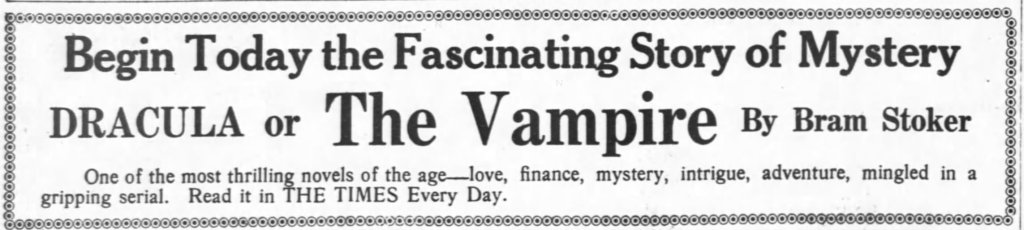
Bram Stoker died in 1912; subsequent serializations would have been authorized by his widow Florence. In the Washington, D.C. Times, the story was run as “Dracula, or The Vampire.” Unlike previous serials, this was for the most part the complete 1897 text, with only one notable cut: Jonathan Harker’s prologue. The spelling was also changed from British to American English (e.g. “labor” instead of “labour”), as well as some punctuation (many commas seem to have been left out), and there are the typical typographical or typesetting errors. The text is augmented by a number of key phrases which were interjected as sub-headings, presumably to give a sense of action. Starting with the 8th installment on 20 September 1917, the editors also began to run a synopsis, which ran until the 47th installment on 29 October 1917, at which point apparently the editors gave up; most of the synopses are identical in wording.
These additions, the largely unabridged text, and the smaller size of each installment account for its length: this is the longest-running of the newspaper Dracula serials, published in 131 installments from 13 September 1917 to 21 January 1918.
Note: Many parts do not contain chapter headings. Equivalent chapters from the 1897 text are presented in parantheses.
| Part 1: 13 Sep 1917, page 14. [Chapter I]. Link. “3 May” to “on without it.” ATTEMPTS TO LOCATE THE CASTLE DRACULA. To “Mem., I must ask the count [sic] all about them).” BEGINS A LONG JOURNEY ON A SLOW TRAIN. To “natural self-assertion.” FINDS LETTER FROM COUNT AT HOTEL. To “Your Friend, DRACULA.” REFUSED INFORMATION OF COUNT OR CASTLE. To “Here comes the Coach!” PEASANT SUPERSTITIONS CAUSE WORRY. To “about these superstitions.)” CROWD GIVES CHARM AGAINST ALL EVIL. To “right before us:” MEN AND WOMEN KNEEL BEFORE SHRINE. To “light his lamps.” PASSENGERS’ EXCITEMENT CAUSE FOR SPEED. To “in a white cloud.” |
| Part 2: 14 Sep 1917, page 8. [Chapter I]. Link. “We could” to “For the dead travel fast.” THE STRANGE JOURNEY INTO BUKOWINA BEGINS. To “sick feeling of suspense.” HOWLING WOLVES ADD TO THE TRAVELER’S PERIL. To “anything through the darkness.” THE DRIVE FIGURES IN A WEIRD [sic] DREAM. To “in a moving circle.” RING OF WOLVES SURROUND THE CARRIAGE. To “understand their true import.” |
| Part 3: 15 Sep 1917, page 5. [Chapters I-II]. Link. “All at once” to “the moonlit sky.” THE DRIVER SHOWS HIS MARVEL STRENGTH. To “was swung back.” BID WELCOME BY STRANGE OLD MAN. To “your supper prepared.” FEARS DISSIPATED BY COURTEOUS TREATMENT. To “into the other room.” |
| Part 4: 16 Sep 1917, page 21. [Chapter II]. Link. “I found supper” to “very marked physiognomy.” STRUCK BY THE COUNT’S PECULIAR APPEARANCE. To “and he said:” COUNT HEARS MUSIC IN HOWLING OF WOLVES. To “the Law List.” TELLS OF HIS LONGING TO VISIT ENGLAND. To “you speak excellently.” |
| Part 5: 17 Sep 1917, page 9. [Chapter II]. Link. “Not so,” to “what strange things there may be.” THE COUNT ANSWERS QUESTIONS FRANKLY. To “in the friendly soil.” DECLARES PEASANTS ARE COWARDS AND FOOLS. To “Peter Hawkins. So!” DETAILS FOR PURCHASING THE ESTATE ARRANGED. To “visible from the grounds.” |
| Part 6: 18 Sep 1917, page 11). [Chapter II]. Link. “When I had finished” to”jumping to his feet, said:” KEPT TALKING UNTIL DAWN WAS UPON HIM. To “except myself.” A MIRROR THAT MAKES NO REFLECTION. To “The castle is a veritable prison, and I am a prisoner!” |
| Part 7: 19 Sep 1917, page 11. Chapter III. Link. “When I found” to “coach that brought me here.” PAST EVENTS ARE NOW BEING PUT TOGETHER. To “whose blood is in these veins?” TELLS OF WARLIKE HISTORY OF HIS FAMILY. To “as a tale that is told.” |
| Part 8: 20 Sep 1917, page 11. [Chapter III]. Link. “It was by this time” to “be useful to me.” LEGAL SITUATION IN ENGLAND INTERESTS DRACULA. To “known by any one persons.” INQUIRIES REGARDING MAKING CONSIGNMENTS. To “find all things as you wish.” Synopsis: Jonathan Harker, a London solicitor’s clerk, takes a long journey to Bukowina to see Count Dracula and arrange for the transfer of an English estate to the count. In his diary, kept in shorthand, he gives the details of his strange trip the latter part filled with mysterious and thrilling happenings. Upon his arrival at Castle Dracula he is met by the count and finds himself virtually a prisoner. The castle itself is a piece of mystery with doors all barred, and no servants to be seen. The count greets him warmly, but his strange personality and odd behavior cause Harker much alarm. In order not to arouse suspicion Harker leads the count to tell of his estate and of the history of his family. |
| Part 9: 21 Sep 1917, page 9. [Chapter III]. Link. “At the door he turned” to “looked carefully out.” THE COUNT DESCENDS THE PRECIPITIOUS BASTION. “What I saw” to “the key was gone!” AN EXPLORING TRIP IN QUEST OF A KEY. “That key must” to “was a great precipice” Synopsis: Jonathan Harker, a London solicitor’s clerk, takes a long journey to Bukowina to see Count Dracula and arrange for the transfer of an English estate to the count. In his diary, kept in shorthand, he gives the details of his strange trip the latter part filled with mysterious and thrilling happenings. Upon his arrival at Castle Dracula he is met by the count and finds himself virtually a prisoner. The castle itself is a piece of mystery with doors all barred, and no servants to be seen. The count greets him warmly, but his strange personality and odd behavior cause Harker much alarm. In order not to arouse suspicion Harker leads the count to tell of his estate and of the history of his family. Later the Count orders him to write his employer he is to stay at the castle for a month. |
| Part 10: 22 Sep 1917, page 9. [Chapter III]. Link. “The castle was built on” to “a soft quietude come over me.” A MARKED CONTRAST WROUGHT BY TIME. To “what he may say.” IGNORES COUNT’S WARNING ABOUT PLACES TO SLEEP. To “that it was all sleep.” THE “DREAM” BEHINS TO UNWIND ITSELF. To “some deadly fear.” Synopsis: Jonathan Harker, a London solicitor’s clerk, takes a long journey to Bukowina to see Count Dracula and arrange for the transfer of an English estate to the count. In his diary, kept in shorthand, he gives the details of his strange trip the latter part filled with mysterious and thrilling happenings. Upon his arrival at Castle Dracula he is met by the count and finds himself virtually a prisoner. The castle itself is a piece of mystery with doors all barred, and no servants to be seen. The count greets him warmly, but his strange personality and odd behavior cause Harker much alarm. In order not to arouse suspicion Harker leads the count to tell of his estate and of the history of his family. Later the Count orders him to write his employer he is to stay at the castle for a month. castle for a month [sic] That night he sees the Count crawl down the castle wall like a lizard. |
| Part 11: 23 Sep 1917, page 19. Chapters III-IV. Link. “I felt in” to “with beating heart.” A RUDE INTERRUPTION AND AWAKENING. “But at that” to “work to be done.” A WELCOME ENDING TO A TERRIBLE SCENE. “Are we to have” to “suck my blood.” DOOR TO THE MYSTERY ROOM IS LOCKED. To “on this surmise.” Synopsis: Jonathan Harker, a London solicitor’s clerk, takes a long journey to Bukowina to see Count Dracula and arrange for the transfer of an English estate to the count. In his diary, kept in shorthand, he gives the details of his strange trip the latter part filled with mysterious and thrilling happenings. Upon his arrival at Castle Dracula he is met by the count and finds himself virtually a prisoner. The castle itself is a piece of mystery with doors all barred, and no servants to be seen. The count greets him warmly, but his strange personality and odd behavior cause Harker much alarm. In order not to arouse suspicion Harker leads the count to tell of his estate and of the history of his family. Later the Count orders him to write his employer he is to stay at the castle for a month. That night he sees the Count crawl down the castle wall like a lizard. |
| Part 12: 24 Sep 1917, page 7. [Chapter IV]. Link. “19 May” to “God help me.” OPPORTUNITY TO ESCAPE PRESENTS ITSELF. “28 May” to “again a shock!” NOT A ROAD TO ESCAPE IS LEFT OPEN. To “new scheme of villainy.” Synopsis: Identical to part 11. |
| Part 13: 25 Sep 1917, page 9. [Chapter IV]. Link. “17 June” to “ruthless villainy.” THE COUNT APPEARS IN MY STOLEN CLOTHING. To “and simply cried.” WOMAN’S AGONIZED CRY IN THE COURT YARD. To “Monster, give me my child!” Synopsis: Identical to part 11. |
| Part 14: 26 Sep 1917, page 13. [Chapter IV]. Link. “She threw herself” to “from the earth.” THE FIRST FATAL LETTER STARTS ON ITS COURSE. To “was covered with dust.” A GOLDEN HOARD IN THE COUNT’S ROOM. To “I made a discovery.” Synopsis: Jonathan Harker, a London solicitor’s clerk, takes a long journey to Bukowina to see Count Dracula and arrange for the transfer of an English estate to the count. In his diary, kept in shorthand, he gives the details of his strange trip the latter part filled with mysterious and thrilling happenings. Upon his arrival at Castle Dracula he is met by the count and finds himself virtually a prisoner. The castle itself is a piece of mystery with doors all barred, and no servants to be seen. The count greets him warmly, but his strange personality and odd behavior cause Harker much alarm. In order not to arouse suspicion Harker leads the count to tell of his estate and of the history of his family. Later the Count orders him to write his employer he is to stay at the castle for a month. That night he sees the Count crawl down the castle wall like a lizard. A series of mysterious incidents follow, and Harker gains an idea of the strange character of his host. One night three women appear in his room but are driven away by the Count in fury. Recognizing his danger he seeks to escape, but finds all avenues of escape closed. |
| Part 15: 27 Sep 1917, page 11. [Chapter IV]. Link. “There, in one of the great boxes” to “can look as he said:” THE MORROW BRINGS A WELCOME EVENT. To “Hark!” AGAIN THE AWFUL HOWLING OF THE WOLVES. To “I cried out.” Synopsis: Identical to part 14. |
| Part 16: 28 Sep 1917, page 13. [Chapter IV]. Link. “Shut the door” to “I left the Count.” A RESOLVE BORN OF DESPERATION. To “batten on the helpless.” PARALYZED BY THE FLASH OF UNEARTHLY EYES. To “the nethermost hell.” Synopsis: Identical to part 14. |
| Part 17: 29 Sep 1917, page 11. Chapters IV-V. Link. “I thought and” to “we shall see.” ONLY SCANT NEWS FROM JONATHAN. To “curly-haired man???” Synopsis: Identical to part 14. |
| Part 18: 30 Sep 1917, page 19. [Chapter V]. Link. Letter, Lucy Westenra to Mina Murray “17, Chatham Street, Wednesday” to “your sympathy.” THE OLD PROVERB AND THE MATRIMONIAL QUESTION To “to my present trouble.” REGULAR BOOK METHOD OF RECEIVING REPLY. To “though I am so happy.” Synopsis: Identical to part 14. |
| Part 19: 1 Oct 1917, page 11. [Chapter V]. Link. “Evening. Arthur has just gone” to “say it now.” NO. 2 IS FOUND INTERESTING TALKER To “very faithful friend.” AN EASY WAY OUT OF A DISTRESSING SITUATION. To “I was blushing very much—he said:—” AND SO PASSES OUT MR. MORRIS “Good-bye.” Synopsis: Identical to part 14. |
| Part 20: 2 Oct 1917, page 11. Chapters V-VI. Link. “May 25” to “he is coming this way. . . .” Synopsis: Identical to part 14. |
| Part 21: 3 Oct 1917, page 11. [Chapter VI]. Link. “He is a funny old man.” To “cuttin’ them on the tombsteans [sic].” Synopsis: Identical to part 14. |
| Part 22: 4 Oct 1917, page 13. [Chapter VI]. Link. “Look here all” to “took as evidence!” Synopsis: Jonathan Harker, a London solicitor’s clerk, takes a long journey to Bukowina to see Count Dracula and arrange for the transfer of an English estate to the count. In his diary, kept in shorthand, he gives the details of his strange trip the latter part filled with mysterious and thrilling happenings. Upon his arrival at Castle Dracula he is met by the count and finds himself virtually a prisoner. The castle itself is a piece of mystery with doors all barred, and no servants to be seen. The count greets him warmly, but his strange personality and odd behavior cause Harker much alarm. In order not to arouse suspicion Harker leads the count to tell of his estate and of the history of his family. Later the Count orders him to write his employer he is to stay at the castle for a month. That night he sees the Count crawl down the castle wall like a lizard. A series of mysterious incidents follow, and Harker gains an idea of the strange character of his host. One night three women appear in his room but are driven away by the Count in fury. Recognizing his danger he seeks to escape, but finds all avenues of escape closed. Harker discovers the Count wounded and believes him dead. Then the strange developments are told in a series of letters which throw new light on the Count’s wierd [sic] personality. |
| Part 23: 5 Oct 1917, page 11. [Chapter VI]. Link. “I do not know” to “to his room.” RENFIELD’S PECULIAR TASTE FOR UNUSUAL FOOD. To “with his food.” Synopsis: Identical to part 22. |
| Part 24: 6 Oct 1917, page 9. [Chapter VI]. Link. “19 July” to “and bearing:” A STUDY OF THE MAN SHOWS STRANGE MANIA. To “during the day.” ATTENDANT DISCLOSES RENFIELD’S CARNIVOROUS HABIT. To “habit of walking in her sleep.” Synopsis:Identical to part 22. |
| Part 25: 7 Oct 1917, page 20. [Chapter VI]. Link. “Her mother has” to “a very gentle way:” THE OLD MAN ATTEMPTS TO PLACATE MINA. To “at a strange ship.” A STRANGE VESSEL APPEARS IN THE OFFING. To “before this time tomorrow.” Synopsis: Identical to part 22. |
| Part 26: 8 Oct 1917, page 9. Chapter VII. Link. “Cutting from ‘The Dailgraph [sic],’” to “of a sensitive nature.” A SOLITARY VESSEL ACTS STRANGELY IN FACE OF STORM. To “storm-tossed sea bird.” Synopsis: Identical to part 22. |
| Part 27: 9 Oct 1917, page 11. [Chapter VII]. Link. “On the summit” to “away in its rush.” MYSTERIOUS SCHOONER DEFIES THE STORM. To “Tate Hill Pier.” IMMENSE DOG FLEES FROM STRANDED VESSEL. To “the binding cords.” Synopsis: Identical to part 22. |
| Part 28: 10 Oct 1917, page 11. [Chapter VII]. Link. “The poor fellow may” to “harbor in the storm.” SHIP’S IDENTITY AND CARGO FINALLY SOLVED. To “into archipelago.” Synopsis: Identical to part 22. |
| Part 29: 11 Oct 1917, page 11. [Chapter VII]. Link. “On 13 July” to “some trouble ahead.” CREW PANICKY OVER STRANGE HAPPENINGS. “On 17 July” to “ship is steadier.” ONE BY ONE, CREW DISAPPEARS FROM SHIP. To “have deserted us.” Synopsis: Identical to part 22. |
| Part 30: 12 Oct 1917, page 11. [Chapter VII]. Link. “3 August” to “air might hear:” MATE TELLS STORY OF STRANGE ENCOUNTER. “signal for help” to “leave my ship.” THE CAPTAIN DECIDES TO STICK BY HIS VESSEL. To “routine of her life.” Synopsis: Identical to part 22. |
| Part 31: 13 Oct 1917, page 11. Chapter VII-VIII. Link. “Early in the morning” to “by his dog.” MORE MATERIAL FOR LUCY’S WIERD [sic] DREAMS To “God bless and keep him.” ROUSED FROM SLUMBER BY DEEP FEELING OF FEAR. To “fear chilling my heart.” Synopsis: Identical to part 22. |
| Part 32: 14 Oct 1917, page 12. [Chapter VIII]. Link. “Finally I came to” to “our favorite seat.” IN THE CLOUD-HIDDEN RUINS. To “endless steps to the abbey.” A GHOSTLY ADVENTURE IN THE ABBEY. To “moaning and sighing occasionally.” LUCY AWAKENED IN THE CHURCHYARD. To “I thought I should faint.” LUCY SWEARS MINA TO SECRECY ABOUT EVENT. To: as it is so tiny.” Synopsis: Identical to part 22. |
| Part 33: 15 Oct 1917, page 11. [Chapter VIII]. Link. “Same day, night” to “any trouble tonight.” TWICE AWAKENED BY LUCY TRYING TO GET OUT. To “followed her eyes.” A STRANGE FIGURE WITH BLAZING EYES. To “some one to protect her.” Synopsis: Identical to part 22. |
| Part 34: 16 Oct 1917, page 11. [Chapter VIII]. Link. “Poor dear” to “Lucy’s sleep-walking.” A DREADFUL PALL DROPS OVER HAPPINESS. “17 August” to “recall it to herself:” Synopsis: Identical to part 22. |
| Part 35: 17 Oct 1917, page 11. [Chapter VIII]. Link. “I didn’t quite dream” to “SISTER AGATHA.” JONATHAN SEES WOLVES AND BLOOD IN DELIRIUM. To “if men only knew!” Synopsis: Identical to part 22. |
| Part 36: 18 Oct 1917, page 19. [Chapter VIII]. Link. “For half an hour” to “to know so well.” REFFIELD’S [sic] DISPOSITION UNDERGOES A CHANGE. To “door of the chapel.” THE “LUNATIC” TALKS TO AN UNSEEN MASTER. To “danger in good time.” Synopsis: Identical to part 22. |
| Part 37: 19 Oct 1917, page 13. Chapters VIII-IX. Link. “With strength” to “that is to be mad. JONATHAN PLACES SECRET IN MINA’S HAND To “my wedding present.” Synopsis: Identical to part 22. |
| Part 38: 20 Oct 1917, page 11. [Chapter IX]. Link. “When the chaplain” to “Tonight he will not speak.” RENFIELD HAS RECURRENCE OF VIOLENT MOOD. To “once more escaped.” Synopsis: N/A |
| Part 39: 21 Oct 1917, page 28. [Chapter IX]. Link. “Later—Another night adventure.” To “could see nothing.” HUGE BLACK BAT DISAPPEARS TOWARD WEST. To “have analyzed them.” LUCY UNBURDENS HER MIND TO THE PHYSICIAN. To “habit has not returned.” Synopsis: Identical to part 22. |
| Part 40: 22 Oct 1917, page 9. [Chapter IX]. Link. “I am in doubt” to “all you think.” DR. VAN HELSING WARNS OF SERIOUSNESS. To “anything of young ladies?” Synopsis: Identical to part 22. |
| Part 41: 23 Oct 1917, page 13. [Chapter IX]. Link. “He has his madams” to “but is not.” DOCTOR ORDERS VIGILANCE TOWARD HIS PATIENT. To “I cannot quite understand it.” QUEER PATIENT AGAIN RESORTS TO FLY-EATING. To “himself than to me:” Synopsis: Identical to part 22. |
| Part 42: 24 Oct 1917, page 15. Chapters IX-X. Link. “All over!” to “looked around him.” THE SUN AND MOON ARE STRUCK UPON AS CLUES. To “when the time comes.” Synopsis: Identical to part 22. |
| Part 43: 25 Oct 1917, page 15. [Chapter X]. Link. “I did not see” to “gently out of the room.” BLOOD TRANSFUSION IS IMMEDIATE DEMAND. To “in a kindly way:” Synopsis: N/A |
| Part 44: 26 Oct 1917, page 17. [Chapter X]. Link. “Young miss is bad” to “effort with success.” PREPARING FOR OPERATION THAT MEANS LIFE OR— To “you have have done. Good-by.” MARKS COME ON NECK IN FOR INVESTIGATION. To “sight pass from her.” Synopsis: Identical to part 22. |
| Part 45: 27 Oct 1917, page 11. [Chapter X]. Link. “Shall I have” to “wander where he wills.” Synopsis: N/A |
| Part 46: 28 Oct 1917, page 22. [Chapter X]. Link. “I know where my thoughts” to “being to tremble.” SAPPED OF HER BLOOD LUCY AGAIN NEAR DEATH. To “and half-whispered:” WARNED TO KEEP AFFAIR SECRET FROM FIANCE. To “amid her pillows.” TOLD TO EAT AND DRINK ENOUGH. To “It is coming.” Synopsis: Identical to part 22. |
| Part 47: 29 Oct 1917, page 11. Chapters X-XI. Link. “11 September” to “Good-night, everybody.” Synopsis: Identical to part 22. |
| Page 48: 30 Oct 1917, page 11. [Chapter XI]. Link. “13 September” to ‘his pipe, he said:” |
| Page 49: 31 Oct 1917, page 13. [Chapter XI]. Link. “Now, sir, you” to “fight in ‘im.” |
| Page 50: 1 Nov 1917, page 11. [Chapter XI]. Link. “This one ain’t” to “natural length with surprise.” “BERSICKER” MAKES APPAREANCE AT WINDOW OF HOUSE. “God bless me!” to “soon fell asleep.” AWAKENED AGAIN BY FLAPPING AT WINDOW. To “not to go to sleep.” |
| Page 51: 2 Nov 1917, page 15. [Chapter XI-XII]. Link. “Presently the door” to “hurled on the floor.” GAUNT GRAY WOLF CRASHES THROUGH THE WINDOW. To “room to look for them. THE FOUR MAIDS ARE FOUND DRUGGED. To “all to us now.” |
| Page 52: 3 Nov 1917, page 9. [Chapter XII]. Link. “We went round” to “and entered the room.” SCENE OF HORROR GREETS THE TWO PHYSICIANS. To “What’s the matter with me, anyhow?” AN OLD FRIEND APPEARS AT AN OPPORTUNE TIME. To “outstretched hands.” |
| Part 53: 4 Nov 1917, page 16. [Chapter XII]. Link. “What brought you here?” to “all myself again.” DR. SEWARD EXPLAINS OBJECT OF CALL. To “About ten days.” A PROBLEM THAT BAFFLES EVERYONE CONCERNED. To “and I’ll do it.” |
| Part 54: 5 Nov 1917, page 9. [Chapter XII]. Link. “When she woke late” to “round the house.” DAYLIGHT REVEALS SAD CONDITION OF PATIENT. To “Mr. Hawkins said:—” A HAPPY TURN OF EVENTS FOR THE LOVERS. To: “to swing for it.” |
| Part 55: 6 Nov 1917, page 11. [Chapter XII]. Link. “I opened the window” to “on another account.” |
| Part 56: 7 Nov 1917, page 13. [Chapter XII]. Link. “He says the amount” to “and said calmly:” DR. VAN HELSING WARNS THAT LUCY IS DYING. To “a tired child’s.” |
| Part 57: 8 Nov 1917, page 15. Chapters XII-XIII. Link. “And then insensibly” to “form her lips:” ARTHUR IS FORBIDDEN A FAREWELL KISS. To “at once it ceased.” FINALLY SUCCUMBED MYSTERIOUS MALADY. To “such as this.” |
| Part 58: 9 Nov 1917, page 13. [Chapter XIII]. Link. “As he spoke” to “looking at a corpse.” THE DEATH CHAMBER IS DECKED WITH GARLIC. To “new puzzle to grapple with.” |
| Part 59: 10 Nov 1917, page 9. [Chapter XIII]. Link. “The forenoon” to “sympathetic understanding.” LEAVES FOR VISIT TO LORD GODALMING. To “constraint with him.” ARTHUR SUFFERS BREAKDOWN UNDER DEEP STRAIN. To “is she really dead?” |
| Part 60: 11 Nov 1917, page 14. [Chapter XIII]. Link. “I assured him” to “he turned aside.” BID FAREWELL TO DEAD SWEETHEART. To “as Arthur.” ARTHUR APOLOGIZES AND ASKS FORGIVENESS. To “never thought of it.” VAN HELSING ASKS TO HOLD LUCY’S LETTERS. To “till the time comes.” ARTHUR WARNED TO BE UNSELFISH. To “an exercise anyhow.” FUNERAL SERVICES MARKED BY SIMPLICITY. To “that disturbed him.” IS MUCH DISTURBED BY A STRANGE LOOKING MAN. To “who it is?” |
| Part 61: 12 Nov 1917, page 9. [Chapter XIII]. Link. “No, dear,” to “as if to himself:—” COUNT DRACULA MAKES APPAEARANCE IN LONDON. To “your own dear sake.” SAD HOME-COMING FOR PARTY OF FRIENDS. To “He said:” VAN HELSING EXPLAINS CAUSE OF BREAKDOWN. To: “what it may be.” |
| Part 62: 13 Nov 1917, page 9. [Chapter XIII]. Link. “I did not like” to “am bigamist.” FAILS TO SEE JOKE IN THE SITUATION. To “imagine themselves—to be.” MISSING CHILDREN HAVE WOUNDS IN THROAT. To “which may be about.” |
| Part 63: 14 Nov 1917, page 15. Chapter XIII-XIV. Link. “The Westminster Gazette 25 Sept.” to “subject to him.” HESITATES TO TALK ABOUT RECENT EVENTS. To “how you love her.” VAN HELSING PLEADS FOR MINA’S AID. To “real truth now!” HORRIBLE PAST EVENTS RECALLED TO MIND. To “just at present.” FINDS GOOD CRY MAKES HER FEEL BETTER. To “upset him again.” GLAD JONATHAN NOW KNOWS FOR CERTAIN. To “record it verbatim.” |
| Part 64: 15 Nov 1917, page 17. [Chapter XIV]. Link. “It was half-past” to “at once began:” LUCY’S DIARY MENTIONS SOMNAMBULISM. To “handed it to him.” ASKS FORGIVENESS FOR SILICITIOUSNESS. To “by both hands.” VAN HELSING DELIGHTED BY CONTENTS OF DIARY. To “do not know me.” |
| Part 65: 16 Nov 1917, page 12. [Chapter XIV]. Link. “Not know you” to “I went on:” CONTENTS OF LETTERS DISTURBS PATIENT. To “study and experience.” PROMISES TO AID IN EVERY POSSIBLE WAY. To “mad or sane.” MINA GIVES VAN HELSING THE STRANGE JOURNAL. To “if I may.” |
| Part 66: 17 Nov 1917, page 11. [Chapter XIV]. Link. “Jonathan will be here” to “Yours the most faithful, Abraham Van Helsing.” THANKS DR. VAN HELSING FOR RELIEVING HER MIND. To “wrote down was true.” LETTER REVEALS COUNT IS IN LONDON. To “laughed as he said:” JONATHAN LISTENS TO DOCTOR PRAISE MIND. To “quite choky.” DOCTOR INQUIRES ABOUT TRIP TO TRANSYLVANIA. To “as ever I can.” |
| Part 67: 18 Nov 1917, page 15. [Chapter XIV]. Link. “26 September” to “into my hand.” READS OF CHILDREN BEING DECOYED AWAY. To “and went on:” TOO PREJUDICED, DOCTOR TELLS HIS FRIEND. To”the thought reading.” SOME ADVANCED MEDICAL THOUGHT INTRODUCED. To “the church lamps?” DOCTOR ASKS QUESTION THAT PUZZLES HARKER. To “who cannot die?” THEORY OF SUSPENDED ANIMATION EXPOUNDED. To “where I am going.” |
| Part 68: 19 Nov 1917, page 12. Chapters XIV-XV. Link. “That is good image” to “I cried.” COVERS FACE WITH HANDS AND SPEAKS. To “Dare you come with me?” STAGGERED BY THE WEIGHT OF THE AWFUL TRUTH. To “afternoon was passing.” CHILDREN HAD HAD SLEEP AND TAKEN FOOD. To “the ‘bloofer lady.’” WANTED PARTENS OF CHILD CAUTIONED. To “which could pass away.” WENT ABOUT HIS WORK SYSTEMATICALLY. To “week-old corpse.” |
| Part 69: 20 Nov 1917, page 13. [Chapter XV]. Link. “We doctors,” to “dreary, miserable time.” A STARTLING DISCOVERY IN THE CEMETERY. To “dismay shot through me.” LUCY’S BODY AGAIN IN ITS RESTING PLACE. To “showed the white teeth.” |
| Part 70: 21 Nov 1917, page 11. [Chapter XV]. Link. “See,’ he went on” to “take more blood.” TRANCE HOLDS VICTIM IN “UN-DEAD” STATE. To “snap, and said:” VAN HELSING SUDDENLY CHANGES HIS PLANS. To “my own way.” MEETING ARRANGED TO CONTINUE THEIR PLANS. To: “I shall learn it.” SUPERHUMAN POWERS OF THE UN-DEAD. To “I know not what.” |
| Part 71: 22 Nov 1917, page 13. [Chapter XV]. Link. “So that it be” to “intense gravity:” VAN HELSING AKS PERMISSION TO ACT. To “we are to do?” ANOTHER VISIT TO LUCY’S TOMB ARRANGED. To “what is it?” A REQUEST THAT CAUSES DEEP REVULSION. To “the head of dead Miss Lucy?” |
| Part 72: 23 Nov 1917, page 13. Chapter XV-XVI. Link. “Heavens and earth” to “may seem to me.” TO LET RESULT OF PLAN RECOMMEND ITSELF. To “looked in and recoiled.” AGAIN THE COFFIN IS FOUND UNOCCUPIED. To “which they shun.” VAN HELSING WARNS OF STRANGE HAPPENINGS. To “door behind him.” |
| Part 73: 24 Nov 1917, page 9. [Chapter XVI]. Link. “Oh! But it” to “as he answered:” A STRANGE SUBSTANCE TO KEEP OUT THE UN-DEAD. To “features of Lucy Westerna [sic].” THE APPARITION IS THAT OF LUCY WESTENRA. To “a voluptuous smile.” SPIRIT DROPS CHILD AFTER DRINKINK [sic] ITS BLOOD. To “enter the tomb.” HELD AT BAY BY THE POWER OF THE CRUCIFIX. To “by asking Arthur:” |
| Part 74: 25 Nov 1917, page 17. [Chapter XVI]. Link. “A newer me” to “like this of tonight.” LEAVE YOUNG VICTIM SAFE WITH POLICE. To “sufficient to work by.” FEELING OF LOATHING AGAINST FORMER SWEETHEART. To “and remained silent and quiet.” VAN HELSING PREPARES FOR GHOULISH OPERATION. To “so wicked mouth.” |
| Part 75: 26 Nov 1917, page 9. [Chapter XVI]. Link. “But if she die” to “has a better right?” GRUESOME WORK FOR A HOLY CAUSE. To “the Un-dead pass away.” ARTHUR DRIVES STAKE THROUGH LUCY’S HEART. To “terrible task was over.” TERRIBLE TASK AT LAST IS ACCOMPLISHED. To “Van Helsing said to him:—” |
| Part 76: 27 Nov 1917, page 12. Chapter XVI-XVII. Link. “And now, my child” to “you can help me.” WORK ACCOMPLISHED, VAN HELSING GOES HOME. To “as that of today.” DOCTOR LEAVES DIARIES FOR CLOSE STUDY. To “Here she is!” MINA PAYS VISIT TO DR. VAN HELSING. To “hear it say something?” |
| Part 77: 28 Nov 1917, page 8. [Chapter XVII]. Link. “Certainly,’ he replied” to “out of his embarrassment:” MINA SEEKS DETAILS OF FRIEND’S DEMISE. To “pallor as he said:” REFUSES TO TELL DETAILS OF DEATH OF LUCY. To “we can get.” RECORDS DISCLOSE LIGHT ON DARK MYSTERY. To “ears and listened.” SHOCKED BY RECITAL OF UNEARTHLY STORY. To “somewhat restored me.” |
| Part 78: 29 Nov 1917, page 11. [Chapter XVII]. Link. “My brain” to “when they come.” BEGIN TASK OF COLLATING DETAILS. “He accordingly” to “that way madness lies!” HARKER ADVISES TALK WITH ZOOPHAGUS PATIENT. “Harker has” to “vampire’s ultimate triumph?” RENFIELD RAVES MUCH OF STRANGE MASTER. “Stay; he is himself” to “consignment of boxes.” SIGHT OF COUNT’S LETTER STARTLES HARKER. To “and the harbormaster.” |
| Part 79: 30 Nov 1917, page 14. [Chapter XVII]. Link. “They had all” to “ex post facto manner.” DELIVERY OF BOXES TRACED TO CARFAX. “From there I” to “raised his terms.” SATISFIED THAT BOXES HAVE BEEN LOCATED. “Of one thing” to “order for tonight.” THRILLED AT PROSPECT OF HUNT FOR COUNT. “I feel myself” to “all this, Mrs. Harker?” LORD DOFALMING PROFESSES TO CONFUSION. To “heart was breaking:” |
| Part 80: 1 Dec 1917, page 9. Chapters XVII-XVIII. Link. “I loved dear” to “for Lucy’s sake!” OVERWHELMING GRIEF CAUSES BREAKDOWN. “In an instant” to “to comfort him.” MANUSCRIPT TO EXPLAIN ALL DETAILS. “He bore his” to “simply answered: ‘Why’?” THE ZOOPHAGANS [sic] MANIAC “CLEANS UP” HIS ROOM. To “held out her hand.” |
| Part 81: 2 Dec 1917, page 19. [Chapter XVIII]. Link. “Good evening, Mr. Renfield” to “shown contempt to me:” PHILOSOPHY OF THE INSANE PATIENT. “You will, of course” to “mentioned certain things.” RENFIELD DISCUSSES HIS PECULIAR APPETITE. “Why, I myself” to “astonishment, he replied:” A STRANGE METHOD OF SAYING FAREWELL. “Good-by, my dear” to “we go alone.” OBTAINS HOUSE THAT ADJOINS DRACULA’S. To “to this morning.” |
| Part 82: 3 Dec 1917, page 13. [Chapter XVIII]. Link. “But why not” to “a bright smile.” FINAL MEETING ARRANGED FOR WAR ON VAMPIRE. “And so now,” to “who did love her.” MUST WORK HARD TO SAVE OTHER SOULS. “But that is gone” to “come unknown.” PLANNING TO DESTROY THE INHUMAN MONSTER. “How then are” to “no other reason.” FRINEDS SOLEMNLY PLEDGE THEMSELVES TO COMPACT. To “tradition and superstition are everything.” |
| Part 83: 4 Dec 1917, page 16. [Chapter XVIII]. Link. “Does not the” to “men have been.” FIGHTING AN ENEMY OF THE WHOLE WORLD. “In old Greece” to “madman in his cell.” THE COUNT’S POWER CEASES WITH COMING OF DAY. “He cannot go” to “with our eyes.” VAMPIRE PERPETUATES SPIRIT OF POWERFUL MAN. To “we must trace—” |
| Part 84: 5 Dec 1917, page 17. [Chapter XVIII]. Link. “Here we were” to “resume his statement:—” MUST STERILIZE EARTH THAT GIVES COUNT LIFE. “We must trace” to “down the passage together.” INSANE PATIENT DEMANDS TO BE RELEASED. “We found him” to “saying in turn:—” RECALLS A DUEL HIS FATHER FAUGHT. [sic] To “of their liberties.” |
| Part 85: 6 Dec 1917, page 17. [Chapter XVIII]. Link. “And I am” to “its own charm.” MANIAC’S SPEECH CAUSES CONSIDERABLE SURPRISE. “I think we” to “he said slowly:” RENFIELD MAKES FOR FRIENDSHIP. “Then I suppose” to “The Professor went on:” DR. VAN HELSING FAILS TO GET RENFIELD’S AID. “Come, sir, bethink” to “efforts were unavailing.” RENFIELD CHANGES TACTICS TO OBTAIN WISH. To “keeping me here.” |
| Part 86: 7 Dec 1917, page 16. Chapters XVIII-XIX. Link. “I am speaking” to “the rest to us.” MEMORY OF RENFIELD STILL REMAINS. “We were, I think” to “Then he spoke:” VAN HELSING WARNS OF DANGER THAT LIES AHEAD. “My friends, we are” to “at Miss Lucy’s.” BOLT FINALLY YIELDS TO DOCTOR’S KEY. To “proceeded on our search.” |
| Part 87: 8 Dec 1917, page 9. [Chapter XIX]. Link. “The light from” to “I felt myself doing.” HOB-NAIL MARKS ON DUST-COVERED FLOOR. “The whole place” to “stagnant and foul.” ATMSPHERE LADEN WITH MYRIAD VIL EODERS.[sic] “There was an” to “no mistaking them.” STARTLED BY APPARITION OF COUNT DRACULA. “There were only” to “alive with rats.” LORD GODALMING FIRST TO ACT IN EMERGENCY. To “and we moved out.” |
| Part 88: 9 Dec 1917, page 19. [Chapter XIX]. Link. “Lord Godalming lifted” to “in our resolution.” SEARCH OF HOUSE REVEALS NOTHING NEW. “We close the” to “has gone elsewhere.” VAN HELSING SATISFIED WITH PROGRESS MADE. “Good! It has” to “not to disturb her.” ARISE FROM WELL-EARNED NIGHT’S REPOSE. To “Who knows?” |
| Part 89: 10 Dec 1917, page 13. [Chapter XIX]. Link. “I went on” to “Well?” RENFIELD TELLS PROFESSOR UNCOMPLIMENTARY THINGS. “I fear that” to “the terrible excitement.” EVENTS OF PAST SEEM HORRIBLE TRAGEDY. “Last night I” to “mystery of their own.” THIN VEIL OF MIST MOVES SLOWLY TOWARD HOUSE. “Not a thing” to “continued in dreams.” |
| Part 90: 11 Dec 1917, page 18. Chapters XIX-XX. Link. STRANGE POWER SEEMS SLOWLY TO MOVE ALL. “I thought that” to “we can imagine.” THICK VEIL OF MIST POURS INTO ROOM AT NIGHT. “The mist grew” to “out of the night.” MINA DETERMINES TO STRIVE AGAINST DREAMS. “I must be” to “important to communicate.” FEARFUL OF APPROACH OF MUCH-NEEDED SLEEP. “I was not so” to “headpiece of his own.” CLEW OBTAINED TO TWELVE BOXES OF EARTH. To “He replied:” |
| Part 91: 12 Dec 1917, page 17. [Chapter XX]. Link. “Well, guvnor” to “of our decision.” THE EARLY MAIL BRINGS INFORMATION. “2 October, evening” to “I asked.” OFF AGAIN WITH ONLY A SLENDER CLUE. “I’m the depity [sic]” to “which he replied:” JONATHAN LEARNS MUCH ABOUT MOVEMENTS OF COUNT. “Well, guv’nor,” to “earn a copper.” DRACULA LOSES TEMPER AND EXHIBITS STRENGTH. To “complete the task unobserved.” |
| Part 92: 13 Dec 1917, page 15. [Chapter XX]. Link. “At Piccadilly Circus” to “access to the house.” CARE INSPERTION [sic] FAILS TO REVEAL ANYTHING. “There was at” to “It is sold, sir.” RUN UP AGAINST STONE WALL IN AGENT. “Pardon me” to “He said:” LORD GOLDAMING CARD HAS MYSTIC RESULT. “I would like” to “our grim task.” MIND BECOMING RECONCILED TO APPARENT SLIGHTS. To “in the morning.” |
| Part 93: 14 Dec 1917, page 21. [Chapter XX]. Link. “Lord Godalming’s brows” to “he answered me:” DR. SEWARD BRINGS PHILOSOPHY FROM MANIAC. “The fly,” to “occupied spiritually!” LEARNED DOCTOR STUMPED BY LUNATICS WISDOM. “This was a poser” to “means of life!” PATIENT SUDDENLY LAPSES INTO SILENCE. To “with their souls!” |
| Part 94: 15 Dec 1917, page 9. [Chapter XX]. Link. “Something seemed” to “jaws was white.” THE PATIENT TURNS AGAINST HIS USUAL DIET. “It was evident” to “elephant’s soul is like?” [sic] RENFIELD LOSES TEMPER UNDER CONSTANT GRUELLING. “The effect I desired” to “Here they are:” SUMMARY OF OBSERVATION OF ASYLUM INMATE. “Will not mention” to “MITCHEELL [sic], SONS & CANDY.” SENTRY POSTED TO KEEP TAB ON PATIENT. To “was to call me.” |
| Part 95: 16 Dec 1917, page 19. Chapters XX-XXI. Link. “After dinner” to “in strait-waistcoats.” RENFIELD’S MOODS FOLLOW TOSE OF THE COUNT. “Later.—” to “I must proceed.” HEAPED ON THE FLOOR IN POOL OF BLOOD. “When I came” to “he whispered to me:” VAN HELSING DISMISSES ALL THE ATTENDANTS. To “just above the ear.” |
| Part 96: 17 Dec 1917, page ??. [Chapter XXI]. Link to page 1. “Without another word” to “he went on:—” Note: Would presumably have appeared on page 19, but that page is not available on scan. Data filled in from 1897 text. |
| Part 97: 18 Dec 1917, page 19. [Chapter XXI]. Link. “I didn’t know” to “instant to spare.” THE MANIAC IS HELPLESS IN HIS MASTER’S GRIP. “There was no need” to “in a stupor.” THE COUNT SUCCEEDS IN MAKING MINA A VICTIM. “Kneeling on the” to “and cowered back.” COUNT COMES BEFORE UPLIFTED CRUCIFIXES. To “beneath her shook.” |
| Part 98: 19 Dec 1917, page 19. [Chapter XXI]. Link. “But in God’s name” to “take counsel together.” TELLTALE TEETHMARKS EVIDENCE OF COUNT’S LUST. “She shuddered and” to “to the utmost:” DR. SEWARD RELATES STORY OF COUNT’S DEED. “And now, Dr. Seward” to “So Art went on:” HAD DESTROYED ALL THEIR PRECIOUS RECORDS. To “she began:” |
| Part 99: 20 Dec 1917, page 17. [Chapter XXI]. Link. “I took the” to “of some presence.” READ CREATURE APPEARS SIF [sic] FROM MIST. “I turned to” to “appease my thirst!” STRANGE POWER WITHELD ALL RESISTANCE. “I was bewildered” to “I was countermining them.” “LATER ON TO BE MY COMPANION AND HELPER.” To “them from pollution.” |
| Part 100: 21 Dec 1917, page 17. [Chapters XXI-XXII]. Link. “As she was” to “To work!” MAKE INQUIRY OF ATTENDANT. “When Dr. Van Helsing” to “the same result.” DECIDE TO TAKE MINA INTO CONFIDENCE. “When the question” to “stating a fact:” MINA PREFERS DEATH TO YIELDING TO DRACULA. To: “grim an interest.” |
| Part 101: 22 Dec 1917, page 7. [Chapter XXII]. Link. “As usual Van Helsing” to “his hand warningly.” VAN HELSING WARNS AGAINST PRECIPITATE ACTION. “Nay, friend Jonathan” to “I nodded.” THE SIMPLEST WAY WAY [sic] IS THE BEST. “Now, suppose that” to “of the house.” PRACTICABILITY OF PLAN BECOMES APPARENT. To “so it may.” |
| Part 102: 23 Dec 1917, page 11. [Chapter XXII]. Link. “Mina took a” to “time for fear.” DISCUSSIONS OF PROCEDURE REVEALS SOME WEAKNESSES. “When we came” to “him in force.” DEITY [sic] LIES IN PROTECTING MINA FROM HARM. “To this plan” to “to comfort her.” HORRIBLE RECOLLECTIONS INADVERTANTLY RECALLED. “Oh, Madam Mina” to “Father, the Son, and—” SACRED WAFER BURNS ITS MARK ON MINA. To “things outside himself:” |
| Part 103: 24 Dec 1917, page 9. [Chapter XXII]. Link. “It may be” to “heart we know.” MUST BEAR THEIR CROSS TILL DIVINE AID ARRIVES. “For so surely” to “their ghastly ranks.” FIND ALL THINGS JUST AS ON FIRST VISIT. “We entered Carfax” to “as he worked.” VAN HELSING STERILI⅝ES [sic] BLACK BOX OF EARTH. “One by one” to “may come along.” ARRANGE PLANS FOR GAINING ACCESS TO HOUSE. To “entered the hall.” |
| Part 104: 25 Dec 1917, page 9. Chapters XXII-XXIII. Link. “We sat still” to “in the house.” ONE MYSTERIOUS BOX STILL UNDISCOVERED. “In the dining-room” to “the other houses.” SET OUT TO DESTROY COUNT’S SOURCE OF STRENGTH. “When we had” to “here it is:” PROFESSORS DISCLOSES DATE ON DRACULA’S HISTORY. “I have studied” to “as he spoke:” HOW THE COUNT WORKS HIS INSIDIOUS WILL. To “they are hidden.” |
| Part 105: 26 Dec 1917, page 10. [Chapter XXIII]. Link. “He may have” to “absent once return.” STARTLED BY KNOCK ON DOOR TO HALL. “While he was” to “may not change.” A RACE BETWEEN FRIEND AND FOE. “It will take him” to “Be ready!” GRATING OF KEY WARNS OF PRESENCE OF COUNT. “He held up” to “he feared it.” THE COUNT SUDDENLY BURSTS INTO THE ROOM. To “through his heart.” |
| Part 106: 27 Dec 1917, page 10. [Chapter XXIII]. Link. “As it was” to “my left hand.” HELD AT BAY BY POWER OF CRUCIFIX. “I felt a” to “spoke to us:” THE COUNT SINGS HIS “HYMN OF HATE.” “You think to baffle” to “seen him depart.” MUST AWAIT RISING SUN TO RESUME THE HUNT. “It was now late” to “altogether without hope.” BRAVELY RECEIVES NEWS OF TERRIBLE DANGERS. To “outcast from God.” |
| Part 107: 28 Dec 1917, page 12. [Chapter XXIII]. Link. “’Jonathan,’ she said” to “as he spoke:” HARKER, PRAYS FOR OPPORTUNITY FOR REVENGE. “May God give” to “with their God.” VAN HELSING PREPARES MINA’S ROOM AGAINST VAMPIRE. “Before they retired” to “where it was.” MAY HIDE FOR YEARS IF NECESSITY DEMANDS. To “must try again.” |
| Part 108: 29 Dec 1917, page 7. [Chapter XXIII]. Link. “4 October, morning” to “me for nothings.” MINA MAKES STRANGE REQUEST OF PROFESSOR. “I want you to” to “Professor spoke again:” STRANGE FAR-OFF RESPONSE TO DOCTOR’S QUESTIONING. “Whare are you” to “called them back:” VAN HELSING REASONING GOOD, AS ALWAYS. To “We follow him.” |
| Part 109: 30 Dec 1917, page 17. [Chapters XXIII-XXIV]. Link. “Tally ho!” to “as he replied:” PROFESSOR BIDS FRIENDS BE CALM AND PATIENT. “Ask me nothings” to “sun go down.” FINAL PLACE OF SAFETY WHEN ALL ELSE FAILS. “It was his last” to “again and again.” STRENGTH OF PURPOSE SPURS HARKER’S ACTION. “Somehow, although the” to “see last night.” CLUE TO TYPE OF VESSEL AS REVEALED BY MINA. To “the Czarina Catherine.” |
| Part 110: 31 Dec 1917, page 17. [Chapter XXIV]. Link. “He swear much” to “want to know.” VAN HELSING OBTAINS NEWS OF DRACULA’S MOVES. “They make known” to “master amongst men!” PROFESSOR IMPRESSES UPON THEM NECESSITY OF PURSUIT. To “geologic and chemical world.” |
| Part 111: 1 Jan 1918, page 10. [Chapter XXIV]. Link. “There are deep” to “make you like him.” VAN HELSING REVEALS THE HORRIBLE TRUTH. “This must not” to “a great city.” THE DRACULA’S CUNNING EQUALED BY HIS LEARNING. “What does he” to “cause of action.” CONTENTMENT VANISHES AT GLIMPSE OF LOATHSOME MARK. “I feel a wonderful” to “beginning to work.” ALL PART OF WELL-LAID PLANS OF THE VAMPIRE. To “a noble woman!” |
| Part 112: 2 Jan 1918, page 14. [Chapter XXIV]. Link. “Van Helsing is” to “he went on:” AN ALARMING CHANGE NOTED IN MINA. “Madam Mina, our” to “as I expected.” VAN HALSING [sic] MAKES PLANS FOR CONFERENCE. “It is now” to “Quincey Morris added:” MORRIS OFFERS SUGGESTION BASED ON EXPERIENCE. To “me tenderly, said:—” |
| Part 113: 3 Jan 1918, page 8. [Chapter XXIV]. Link. “Jonathan, I want” to “right to make it.” MINA EXACTS SOLEMN PROMISE FROM HUSBAND. “But, dear one” to “a dreamless sleep.” MINA AWAKENS EARLY AND ASKS FOR VAN HELSING. “6 October, morning” to “said very gravely:” THE FOUR AVENGERS CONSENT TO TAKE MINA. “Madam Mina you” to “I hope he did.” NO SLACKERS WHEN TIME FOR ACTION COMES. To “shall have remainder.” |
| Part 114: 4 Jan 1918, page 14. Chapters XXIV-XXV. Link. “It is now drawing” to “inciting her to action.” MENTAL FREEDOM SUBJECT TO CONDITIONS OF SUN. “This mood or” to “may not take?” MINA COURTS DEATH TO ESCAPE HORRIBLE FATE. “That I may” to “low and strained.” AS THE ONLY ESCAPE FROM ETERNAL TORMENT. “When you shall” to “oh, my wife.” MINA EXACTS PROMISE THAT MEANS HER DEATH. To “slay them.” |
| Part 115: 5 Jan 1918, page 7. [Chapter XXV]. Link. “It is men’s duty” to “enemy against you.” ACQUIESCE N FINAL SOLEMN REQUEST. “One more request” to “f-fail m-me!” FIND SOLACE IN PATIENT’S MENTAL FORTITUDE. “She was right” to “in the box.” SUNRISE PRESENTS OPPORTUNE TIME FOR ACTION. To “have some report.” |
| Part 116: 6 Jan 1918, page 17. [Chapter XXV]. Link. “17 October” to “will be done.” PLANS COMPLETED FOR DISPOSING OF DRACULA. “We have already” to “in her presence.” LETHARGY GROWS DESPITE APPARENT STRENGTH. “In old days” to “ice-cold hand!” MINA LAPSES INTO STUPOR AFTER RESTLESS HOURS. “Van Helsing and I” to “signaled any moment.” NON-APPEARANCE OF SHIP CAUSES MUCH UNEASINESS. To “He added significantly:” |
| Part 117: 7 Jan 1918, page 17. [Chapter XXV]. Link. “I did not” to “will-o’-the-wisp to man.” MUST MAKE THE BEST OF BAD TURN OF FORTUNE “It was an odd” to “asked Lord Godalming.” VAN HELSING DELEGATES TO EACH MAN A TASKS. [sic] “Van Helsing shook” to “seeing me alone.” DRACULA TRANSPORTS SPIRIT TO READ MINA’S MIND. “You are in part” to “thinks not so.” VAN HELSING REALIZES HOPE RESTS ON HIGH. To “of her misery.” |
| Part 118: 8 Jan 1918, page 14. [Chapter XXV]. Link. “As she came in” to “to be empiric.” SAYS CRIMINALS HAVE CHILD-BRAINS. “The criminal always” to “as she spoke:—” MINA GAVE HYPNOTIC HISTORY OF EVENTS. “The count is a” to “that we think.” SEEKS SAFETY, ALL ELSE BEING FORGOTTEN. To “where he fail!” |
| Part 119: 9 Jan 1918, page 14. Chapters XXV-XXVI. Link. “That terrible baptism” to “gone Van Hel- [sic] said:” DREAMS PRESAGE NEARNESS OF HUNTED MONSTER. “You see, my friends” to “what is happening.” MRS. HARKER YIELDS TO HYPNOTIC INFLUENCE. To “with equal quickness.” |
| Part 120: 10 Jan 1918, page 14. [Chapter XXVI]. Link. “All is dark” to “an agonized voice.” THE RISING SUN DISPELS VAN HELSING’S POWER. To “meet his match!” |
| Part 121: 11 Jan 1918, page 17. [Chapter XXVI]. Link. “The skipper was” to “rid o’t althegither.” BROUGHT AN ORDER TO RECEIVE BOX. “We didn’t do” to “all he knew.” NO ONE KNEW WHERE SKINSKY HAD GONE. To “hotel to Mina.” |
| Part 122: 12 Jan 1918, page 9. [Chapter XXVI]. Link. “When we met” to “blindfold at Galatz.” EVERY DETAIL WORKED TO AID DRACULA. To “all shall do.” |
| Part 123: 13 Jan 1918, page 17. [Chapter XXVI]. Link. “I shall get a steam” to “the enemy’s country.” VAN HELSING PLANS A BOLD MOVE. To “a moment’s notice.” |
| Part 124: 14 Jan 1918, page 13. [Chapter XXVI]. Link. “Dr. Seward and” to “is firing up.” EXPERIENCED HAND ON STEAM LAUNCH. “He is an experienced” to “not to excite curiosity.” MAY BE NECESSARY TO JOIN FORCES. “When they dismiss” to “to ask or do.” NATIVES TELL OF SPEEDY ESSEL PASSING UP RIVER. To “coming back to me.” |
| Part 125: 15 Jan 1918, page 13. Chapter XXVI-XXVII. Link. “I wonder where” to “go on, Russian fashion.” LAUNCH DETAINED BY AN ACCIDENT. “4 November” to “the evil eye.” HAS MANAGED TO ESCAPE SUSPICIONS. To “or for myself.” |
| Part 126: 16 Jan 1918, page 14. [Chapter XXVII]. Link. “I write this” to “keep us comfortable.” HYPNOTIC TRANCE REVEALS NOTHING NEW. “At dawn Van Helsing” to “is not well.” VAN HELSING’S POWER SLOWLY DIMINISHING. To “all to her.” |
| Part 127: 17 Jan 1918, page 14. [Chapter XXVII]. Link. “I think I” to “may not sleep.” SPELL OF INTENSE SLEEP DESCENDS UPON MINA. “The sun rise up” to “that Vampire baptism.” Sleeps As He Travels over the Rough Road “’Well,’ said I” to “knowing her unavailingness.” Take Precautions to Guard Madame Mina “But I myself” to “her soul was safe!” HORSES BECOME PANICKY FROM UNKNOWN CAUSES “Presently the horses” to “with trailing garmnts [sic]” Horses Show Fear of Unknown Terrors. “All was in dead” to “Then, alas! I knew.” Misty Figures Keep Outside Holy Circle. To “Come! Come!” |
| Part 128: 18 Jan 1918, page 14. [Chapter XXVII]. Link. “In fear I” to “to me again.” HORRID FIGURES VANISH WITH COMING OF DAWN. “At the first” to “one of them.” VAN HELSING DISCOVERS ONE OF THE VAMPIRE WOMEN. To “ranks of the Un-dead!” |
| Part 129: 19 Jan 1918, page 11. [Chapter XXVII]. Link. “There is some” to “that I heard.” BRACES HIMSELF FOR HORRID TASK. “Then I braced” to “Un-Dead, for ever.” BEGINS TERRIBLE TASK OF DESTROYING VAMPIRES. “Then began my” to “sat down to rest.” LOOKS BACK UPON DRACULA’S CASTLE. To “not reproach me.” |
| Part 130: 20 Jan 1918, page 10. [Chapter XXVII]. Link. “Taking his field-glasses” to “God’s will be done!” THROUGH THE SNOW FLURRY THEY SAW FRIENDS APPROACH. “Down came another” to “desire to do something.” BATTLE BEGINS FOR POSSESSION OF GREAT CHEST. To “out the order.” |
| Part 131: 21 Jan 1918, page 14. [Chapter XXVII]. Link. “In the midst” to “cut at him.” SCARLET STREAM TELLS BLOW HAS REACHED HOME. “He had parried” to “turned to triumph.” JONATHAN DELIVERS DEATH STROKE TO DRACULA. “But, on the instant” to “Look! Look!” CURSE OF THE VAMPIRE FADES WITH THE SUN. To “for her sake. JONATHAN HARKER. THE END.” |
Des Moines Tribune (25 Nov 1921-10 Feb 1922)
When the Tribune of Des Moines, Iowa ran Bram Stoker’s story, they did it under the title The Vampire. The text is the unabridged 1897 text, minus Jonathan Harker’s prologue. As with the Washington, D.C. Times Herald edition, the editors added both frequent interjections to break up the text (which cease after part 12), and starting from the second installment, original synopses (which cease after part 55). The story ran in 64 or 65 parts (one installment appears missing from the scans, but the numbering continues as if it did not run) from 25 November 1921 to 10 February 1922, parts often split between two pages in the same issue.
The production was initially lavish by newspaper serial standards; the first section ran on the front page, and included a message from the editor (“Old Timer”) to the readers:
Des Moines, Ia., Nov. 24, 1921.
Dear Tribune Readers:
I honestly believe that “The Vampire,” which starts today in the Evening Tribune, is the greatest story this newspaper has ever published.
Even more than that—I’ll stake my reputation, as a newspaper man of nearly twenty-five years’ experience, on the assertion that no one who reads the first two or three installments and really gets into the story will lay it aside until it has been completed in its entirety.
You have heard of the stories that you sit up all night to read? I’ll venture the assertion that you will be unable to lay this one aside until you have followed the astounding tale of mystery, romance, adventure, love until “The End” is written.
This is a challenge made in perfect faith, for I have read “The Vampire” and I feel to a certainty that you will be impressed as I have been.
Sincerely,
Old Timer.
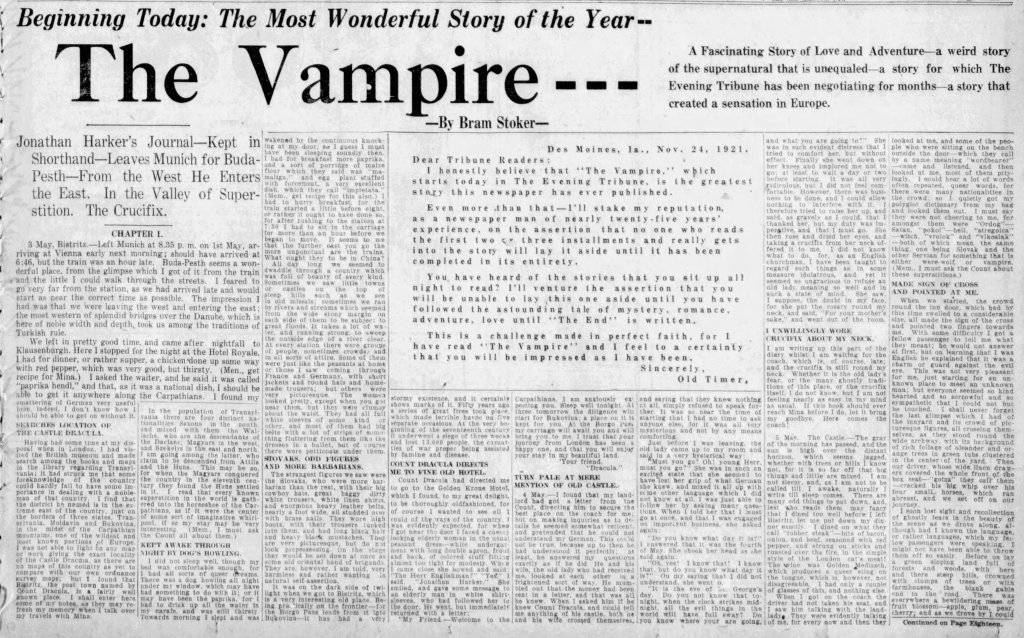
The story is also notable in that original illustrations were commissioned and published for the first two installments. The first appeared on 25 Nov 1921, page 14:
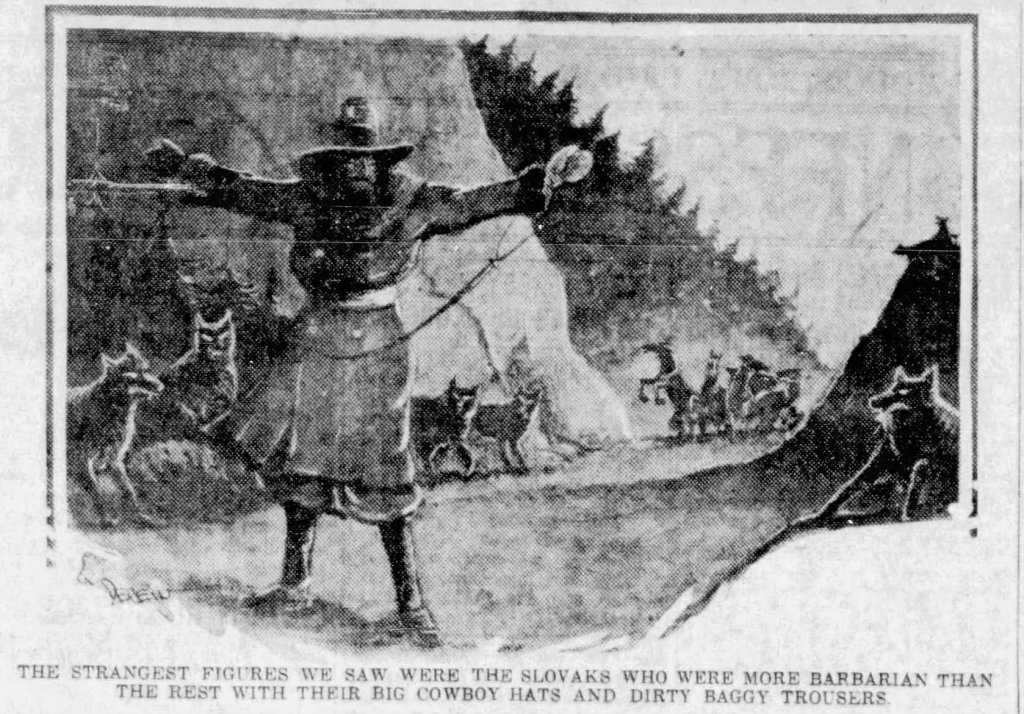
The second appeared on 26 Nov 1921, page 4, with a rare depiction of Dracula himself:
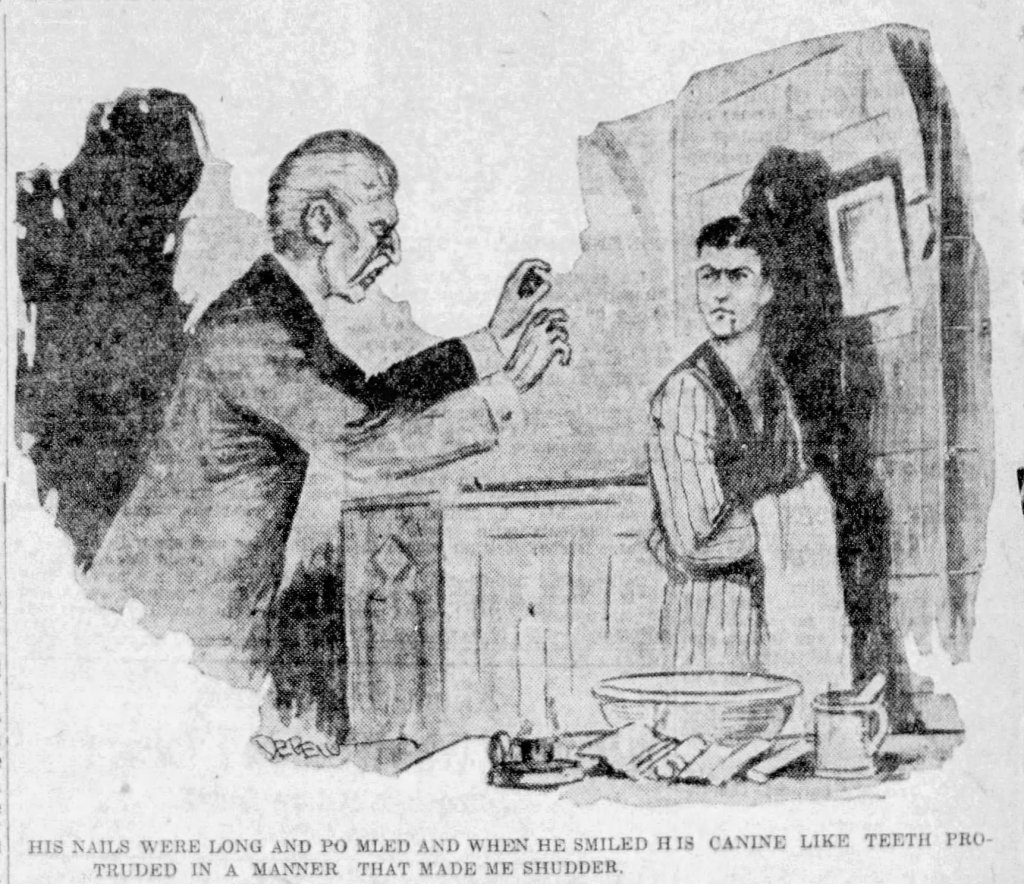
Note: Many parts do not contain chapter headings. Equivalent chapters from the 1897 text are presented in parantheses.
| Part 1: 25 Nov 1921, pages 1, 14. Chapter I. Link to page 1. Link to page 14. Jonathan Harker’s Journal—Kept in Shorthand—Leaves Munich for Buda-Pesth—From the West He Enters the East. In the Valley of Superstition. The Crucifix. “3 May, Bistritz” to “on without it.” SEARCHES LOCATION OF THE CASTLE DRACULA. “Having had some” to “all about them.)” KEPT AWAKE THROUGH NIGHT BY DOG’S HOWLING. “I did not sleep” to “petticoats under them.” STOVAKS, ODD FIGURES AND MORE BARBARIANS. “The strangest figures” to “famine and disease.” COUNT DRACULA DIRECTS ME TO FINE OLD HOTEL. “Count Dracula had” to “Your friend, ‘Dracula.’” TURN PALE AT MERE MENTION OF OLD CASTLE. “4 May” to “out of the room” I UNWILLINGLY WORE CRUCIFIX ABOUT MY NECK. “I am writing” to “about these superstitions.)” MADE SIGN OF CROSS AND POINTED AT ME. “When we started” to “by I could” Note: Says “Continued on Page Eighteen,” actually continued on page 14. “see the green” to “at loading point.” Mighty Forests Arose. “Beyond the green” to “crossed himself reverently.” Many Goiter Afflicted. “As we wound” to “late-lying snow.” Weird and Solemn Effect. “Sometimes, as the” to “expected, but though” None Could Explain. “I asked each” to “than my own:” Horses Began Plunging. “There is no” to “dead travel fast.’)” Gripped With Steel Hand. “The strange driver” to “feeling of suspense.” Weird Sounds of Night. “Then a dog” to “to the right.” Driver Disappears. “Soon we were” to “their true import.” Then the Wolves. “All at once” to “the moonlit sky.” Tomorrow—In the Old Castle of Dracula. |
| Part 2: 26 Nov 1921, page 4. Chapter II. Link. In the Castle of Dracula—Meets the Count—Night in the Place of Mystery—The Blue Flame—The Wolves in the Distance—Dracula’s London House. “5 May” to ”the dark openings.” Stood in Silence. “I stood in” to “of the morning.” Hear Heavy Step. “Just as I” to “Again he said: —” The Count’s Welcome. “Welcome to my” to “flamed and flared.” Ushered Into Great Room. “The Count halted” to “do not sup.” The Sealed Envelope. “I handed to” to “I had experienced.” Describes the Host. “By this time” to “dear to me!” One Night in Castle. “7 May” to “found it locked.” Finds Good Library. “In the library” to “certainly,’ and added:” The Locked Doors. “You may go” to “the friendly soil.” Canine Teeth Showed. “‘But how,’ said” to “I inscribe here:” The London House. “At Purfleet, on” to “from the grounds.’” Count’s Traditions. “When I had” to “the Yorkshire Coast. Synopsis (“What Has Gone Before”): Shorthand notes from Jonathan Harker’s Journal who has started out on a journey to Dracula castle. Through many adventures and mysterious incidents he reaches his destination. The first chapter leaves him alone at the entrance of the enchanted place. |
| Part 3: 28 Nov 1921, pages 9, 10. Chapters II-III. Link to page 9. Link to page 10. Mystery of the Mirror—The Count’s Attack—Stopped by the Crucifix—Prisoner in the Castle—Transylvania History. “It was the better” to “his feet, said:” Sat Up All Night. “‘Why, there’s the” to “or seem to.” Seized by Throat. “I only slept” to “was ever there.” Threw Mirror Away. “‘Take care,’ he” to “to get through.” I Am a Prisoner. “I had hardly” to “awake his suspicion.” Talks With Count. “Midnight—I” to “the Romanoffs can” Note: Continued on Page Ten. “never reach.” to “so he said:” The Count Explains. “I shall illustrate.” to “up and said:” Had Not Written. “Have you written” to “moment’s pause said:” Synopsis (“What Has Gone Before”): Shorthand notes from Jonathan Harker’s Journal who has started out on a journey to Dracula castle. Through many adventures and mysterious incidents he reaches his destination. The first chapter leaves him alone at the entrance of the enchanted place. Count Dracula, a peculiar man, keeps him prisoner in castle. |
| Part 4: 29 Nov 1921, pages 11, 16. Chapters III. Link to page 11. Link to page 16. The Count’s Warning—Lizard-Like Form of a Man Crawling Down Castle Wall—The Three Vampires—”I Feel Human Teeth at My Throat”—Unconsciousness. “Let me advise” to “it shall remain.” “Feeling on My Nerves.” “When he left” to “looked carefully out.” Crawling Like Lizard. “What I saw” to “not think of . . . .” Vanished Into Hole. “15 May” to “‘modernity’ cannot kill.” Now Fighting Insanity. “Later: the Morning” to “he may say!” Then I Fell Asleep. “When I had” to “was all sleep.” I Was Not Alone. “I was not” to “smells in blood.” Kisses for All. “I was afraid” to “with beating heart.” And Then the Count. “But at that” to “to answer him:” The Vampires Go. “You yourself never” to “sank down unconscious.” Synopsis (“What Has Gone Before”): Shorthand notes from Jonathan Harker’s Journal who has started out on a journey to Dracula castle. Through many adventures and mysterious incidents he reaches his destination. The first chapter leaves him alone at the entrance of the enchanted place. Count Dracula, a peculiar man, keeps him prisoner in castle. Count Dracula, wolf-like with canine teeth has supernatural powers over the wolves which infest the forest. Harker attempts to escape but has two letters thrown to some gypsies intercepted and returned to him by the count. In wanlering [sic] over the castle he comes upon the body of the count in a queer like box. he flees to his room and later the count appears. |
| Part 5: 1 Dec 1921, pages 7, 12. Chapter IV. Link to page 7. Link to page 12. Specks Floating in the Air—A Night of Terror—The Count in a Box—Mina’s Journal—The Wolves Again. “I thought I” to “the aerial gambolling” The Vampires Appear. “Something made me” to “and simply cried.” Agonized Cry of Woman. “As I sat” to “of all Mina.” Safely Returned. “Same day, later” to “old and stained.” Heavy Door Barred. “At one corner” to “made a discovery.” There Lay the Count. “There, in one” to “I fell asleep.” Still Prisoner. “I was awakened” to “Hark!” Hear Howling of Wolves. “Close at hand” to “the opening door.” Note: Continued on Page Twelve “I knew then” to “I cried out:” Wait Till Morning. “Shut the door” to “find me ready.” Ready for Flight. “At last I” to “monster I sought.” Like Filthy Leech. “The great box” to “above the forehead.” Synopsis (“What Has Gone Before”): Shorthand notes from Jonathan Harker’s Journal who has started out on a journey to Dracula castle. Through many adventures and mysterious incidents he reaches his destination. The first chapter leaves him alone at the entrance of the enchanted place. Count Dracula, a peculiar man, keeps him prisoner in castle. Count Dracula, wolf-like with canine teeth, has supernatural powers over the wolves which infest the forest. Harker attempts to escape but has two letters thrown to some gypsies intercepted and returned to him by the count. In wandering over the castle he comes upon the body of the count in a queer like box. He flees to his room and later the count appears. Harker goes to a room forbidden him. He sleeps and three vampires appear and are about to piece his throat and suck his blood when consciousness leaves him. |
| Part 6 [mislabeled as 5th installment]: 2 Dec 1921, pages 11, 12. Chapters IV-V. Link to page 11. Link to page 12. The Bloated, Bloodstained Face in the Box—I Strike as the Lid Closes Over—The Gypsies—My Second Resolve to Escape—Letters Between Mina and Lucy. “The shovel fell” to “much—he said.” Synopsis (“What Has Gone Before”): Identical to part 5. |
| Part 7: 3 Dec 1921, page 5. Chapters V-VI. Link. “Little girl.” To “leant over and read:” Synopsis (“What Has Gone Before”): Shorthand notes from Jonathan Harker’s Journal who has started out on a journey to Dracula castle. Through many adventures and mysterious incidents he reaches his destination. The first chapter leaves him alone at the entrance of the enchanted place. Count Dracula, a peculiar man, keeps him prisoner in castle. Count Dracula, wolf-like with canine teeth, has supernatural powers over the wolves which infest the forest. Harker attempts to escape but has two letters thrown to some gypsies intercepted and returned to him by the count. In wandering over the castle he comes upon the body of the count in a queer like box. He flees to his room and later the count appears. Harker goes to a room forbidden him. He sleeps and three vampires appear and are about to piece his throat and suck his blood when consciousness leaves him. Here begins a correspondence between Mina and Lucy touching upon the love affairs of the latter. |
| Part 8: 5 Dec 1921, page 9. [Chapter VI]. Link. The Insane patient—The Flies, the Spiders, and the Sparrows—The Revolting Discovery—Birds Consumed by the Maniac, Feathers and All—Reasoning of a Lunatic. “Sacred to the” to “of a suicide” [“]It Won’t Hurt Ye.” “That won’t harm ye” to “to his room.” Catching Spiders. “1 July” to “with his food.” Colony of Sparrows. “19 July” to “shall know more.” With the Maniac. “10 p. m.” to “ate them raw!” Gives Him Opiate. “11 a. m.” to “when he arrives.” No News from Jonathan. “27 July” to “for the key.” Synopsis (“What Has Gone Before”): Shorthand notes from Jonathan Harker’s Journal who has started out on a journey to Dracula castle. Through many adventures and mysterious incidents he reaches his destination. The first chapter leaves him alone at the entrance of the enchanted place. Count Dracula, a peculiar man, keeps him prisoner in castle. Count Dracula, wolf-like with canine teeth, has supernatural powers over the wolves which infest the forest. Harker attempts to escape but has two letters thrown to some gypsies intercepted and returned to him by the count. In wandering over the castle he comes upon the body of the count in a queer like box. He flees to his room and later the count appears. Harker goes to a room forbidden him. He sleeps and three vampires appear and are about to piece his throat and suck his blood when consciousness leaves him. Here begins a correspondence between Mina and Lucy touching upon the love affairs of the latter. Lucy hears the strange story from a Scotchman of the man who took his own life because of his unnatural hatred for his mother. |
| Part 9: 6 Dec 1921, page 4. Chapters VI-VII. Link. Mina Gets No Word from Jonathan—The Story of Old Mr. Swales—The Strange Ship—His Cobble or His Mule—The Shipwreck. “6 August” to “lashed to the wheel.” Synopsis: Jonathan Harkness goes to the wilderness of Transylvania with legal papers for Count Dracula who lives in an old castle. The count proves to be a mystery man, changing from man to part wolf and holding a peculiar spell over the wolves. He keeps Harkness prisoner in the castle. Harkness is terrorized by vampires trying to pierce his throat and suck his blood. The story veers to correspondence between Mina, Harkness’ wife, a friend, Lucy, in which an insane man enters the story. He also is believed to be unnatural in that he eats raw birds and sucks their blood. |
| Part 10: 7 Dec 1921, page 5. [Chapter VII]. Link. “It was no wonder” to “Will that ever be?” Synopsis: Identical to part 9. |
| Part 11: 8 Dec 1921, pages 16, 19. Chapters VII-VIII. Link to page 16. Link to page 19. “4 August” to “over the sea . . .” Synopsis: Identical to part 9. |
| Part 12: 9 Dec 1921, pages 8, 26. [Chapter VIII]. Link to page 8. Link to page 26. “Same day, noon.” to “again all night.” On the East Cliff. “14 August” to “it from cold.” Held Her Throat. “I did not” to “seeing about them.” Another Letter. “Letter, Samuel F. Billington” to “having teams ready” Note: Continued on page 24 [actually 26] “at King’s Cross” to “happy ending together.” Synopsis: Jonathan Harkness goes to the wilderness of Transylvania with legal papers for Count Dracula who lives in an old castle. The count proves to be a mystery man, changing from man to part wolf and holding a peculiar spell over the wolves. He keeps Harkness prisoner in the castle. Harkness is terrorized by vampires trying to pierce his throat and suck his blood. The story veers to correspondence between Mina, Harkness’ wife, a friend, Lucy, in which an insane man enters the story. He also is believed to be unnatural in that he eats raw birds and sucks their blood. From diary kept by Mina there is a story of a strange shipwreck in which the man at the wheel is dead and lashed to his post. Also details of her friend, Lucy, walking in her sleep and found in the ruins of an old abbey. |
| Part 13: 10 Dec 1921, page 4. [Chapter VIII]. Link. “19 August” to “turn and movement.” Synopsis: Jonathan Harkness goes to the wilderness of Transylvania with legal papers for Count Dracula who lives in an old castle. The count proves to be a mystery man, changing from man to part wolf and holding a peculiar spell over the wolves. He keeps Harkness prisoner in the castle. Harkness is terrorized by vampires trying to pierce his throat and suck his blood. The story veers to correspondence between Mina, Harkness’ wife, a friend, Lucy, in which an insane man enters the story. He also is believed to be unnatural in that he eats raw birds and sucks their blood. From diary kept by Mina there is a story of a strange shipwreck in which the man at the wheel is dead and lashed to his post. Also details of her friend, Lucy, walking in her sleep and found in the ruins of an old abbey. Lucy tells of mysterious happenings while walking in her sleep and gradually grows anemic as from a loss of blood. There are two little mystifying scars in her throat which Mina believes are pin pricks. At last Mina hears from Jonathan Harker. |
| Part 14: 12 Dec 1921, pages 8, 10. Chapters VIII-IX. Link to page 8. Link to page 10. “Just now he spoke” to “to see me so.” Synopsis: Identical to part 13. |
| Part 15: 13 Dec 1921, pages 4, 6. [Chapter IX]. Link to page 4. Link to page 6. “Albemarie hotel, 31 Aug” to “up to now.” Synopsis: Identical to part 13. |
| Part 16: 14 Dec 1921, pages 4, 16. Chapters IX-X. Link to page 4. Link to page 16. “The attendant tells” to “have knowledge of.” Synopsis: Identical to part 13. |
| Part 17: 15 Dec 1921, pages 16, 17. [Chapter X]. Link to page 16. Link to page 17. “I used my knowledge” to “into the room.” Synopsis: Identical to part 13. |
| Part 18: 16 Dec 1921, pages 8, 14. [Chapter X]. Link to page 8. Link to page 14. “The blind was down” to “grim purpose in all” Note: The section of paper on page 14 is missing in the scan. Based on context, the missing section was “I do” to “an evil spirit.” Synopsis: Identical to part 13. |
| Part 19: 17 Dec 1921, pages 4, 7. Chapters X-XI. Link to page 4. Link to page 7. “Perhaps I am” to “know for certing. [sic]” Synopsis: Identical to part 13. |
| Part 20: 19 Dec 1921, pages 15, 22. [Chapter XI]. Link to page 15. Link to page 22. “Did anyone else” to “look for them.” Synopsis: Identical to part 13. |
| Part 21: 20 Dec 1921, pages 8, 10. Chapters XI-XII. Link to page 8. Link to page 10. “My heart sank” to “Now go.” Synopsis: Identical to part 13. |
| Part 22: 21 Dec 1921, pages 6, 8. [Chapter XII]. Link to page 6. Link to page 8. “In the hall” to “Yours faithfully, Patrick Hennessey” Synopsis: Identical to part 13. |
| Part 23: 22 Dec 1921, pages 6, 8. Chapters XII-XIII. Link to page 6. Link to page 8. “18 September” to “at a corpse.” Synopsis: Jonathan Harkness goes to the wilderness of Transylvania with legal papers for Count Dracula who lives in an old castle. The count proves to be a mystery man, changing from man to part wolf and holding a peculiar spell over the wolves. He keeps Harkness prisoner in the castle. Harkness is terrorized by vampires trying to pierce his throat and suck his blood. The story veers to correspondence between Mina, Harkness’ wife, a friend, Lucy, in which an insane man enters the story. He also is believed to be unnatural in that he eats raw birds and sucks their blood. From diary kept by Mina there is a story of a strange shipwreck in which the man at the wheel is dead and lashed to his post. Also details of her friend, Lucy, walking in her sleep and found in the ruins of an old abbey. Lucy tells of mysterious happenings while walking in her sleep and gradually grows anemic as from a loss of blood. There are two little mystifying scars in her throat which Mina believes are pin pricks. At last Mina hears from Jonathan Harker. Later friends of Lucy found her in a faint from a mysterious loss of blood. It became necessary to resort to blood transfusion. She was restored, but could remember nothing during her lapse into unconsciousness. Her friends are greatly mystified although an old physician indicates that he understands the cause for Lucy’s illness. |
| Part 24: 23 Dec 1921, page 4. [Chapter XIII]. Link. “The Professor looked” to “she really dead?” Synopsis: Identical to part 23. |
| Part 25: 24 Dec 1921, page 6. [Chapter XIII]. Link. “I assured him sadly” to “me quite cheerfully:” Synopsis: Identical to part 23. |
| Part 26: 26 Dec 1921, pages 10, 14. [Chapter XIII-XIV]. Link to page 10. Link to page 14. “Why, Mina, have” to “save much questioning.” Synopsis: Identical to part 23. |
| Part 27: 27 Dec 1921, page 10. [Chapter XIV]. Link. “Later.—He has” to “dark, and distrustful.” Synopsis: Identical to part 23. |
| Part 28: 28 Dec 1921, pages 4, 6. Chapters XIV-XV. Link to page 4. Link to page 6. “But now that” to “in this direction.” Synopsis: Identical to part 23. |
| Part 29 [mislabeled as 28th installment]: 29 Dec 1921, pages 8, 12. [Chapter XV]. Link to page 8. Link to page 12. “For a week” to “or all objective?” Synopsis: Identical to part 23. |
| Part 30 [mislabeled as 29th installment]: 30 Dec 1921, pages 8, 12. Chapters XV-XVI. Link to page 8. Link to page 14. “I waited a considerable” to “coffin was empty!” Synopsis: Identical to part 23. |
| Part ??: 31 Dec 1921, page ??. [Chapter XVI]. Link to page 1. “For several minutes” to “of fair weight.” Note: The Saturday paper normally has 12 pages; the extant scan only has 10, none of which carry “The Vampire.” There is a gap in the story corresponding to a missing part, for all that the numbering continues without change. It is not clear if this part ran, or if somehow it was skipped during the serialization. The data has been filled in from the 1897 text via context. Subsequent installments will use the started part numbering. |
| Part 31: 2 Jan 1922, pages 14. [Chapters XVI]. Link. “When we were” to “a tempered joy.” Synopsis: Identical to part 23. |
| Part 32: 3 Jan 1922, pages 4, 6. Chapter XVII-XVIII [XVI-XVII]. Link to page 4. Link to page 6. “Before we moved” to “whilst I worked.” Synopsis: Identical to part 23. Note: Chapter XVII is erroneously listed as chapter XVIII. |
| Part 33: 4 Jan 1922, page 4. [Chapter XVII]. Link. “How good and thoughtful” to “there arter dark.” Synopsis: Identical to part 23. |
| Part 34: 5 Jan 1922, pages 8, 10. Chapter XVII-XVIII. Link to page 8. Link to page 10. “Having been in” to “and keep you!” Synopsis: Identical to part 23. |
| Part 35: 6 Jan 1922, pages 6, 10. [Chapter XVIII]. Link to page 6. Link to page 10. “When I went” to “men have been.” Synopsis: Jonathan Harker starts out for Dracula castle in the Transylvania with legal papers for the count. He is detained in the castle and later made prisoner by the count who transforms himself apparently at will into another character. Harker discovers three women vampires who seek his blood when he is in a stupor. The scene shifts to England, both the count and Harker having arrived, the count mysteriously. The fiancée of Harker and her friends undergo strange experiences due to the presence of Dracula. The girls are attacked by mysterious personages which seem to rise from the mist. An old German physician is attempting to solve the mystery. |
| Part 36: 7 Jan 1922, pages 4, 5. [Chapter XVIII]. Link to page 4. Link to page 5. “In old Greece” to “of their liberties.” Synopsis: Identical to part 35. |
| Part 37: 9 Jan 1922, pages 8, 10. Chapters XVIII-XIX. Link to page 8. Link to page 10. “I am sure that” to “on our search.” Synopsis: Identical to part 35. |
| Part 38: 10 Jan 1922, page 4. [Chapter XIX]. Link. “The light from” to “thoughts of pain.” Synopsis: Identical to part 35. |
| Part 39: 11 Jan 1922, pages 4, 6. [Chapter XIX]. Link to page 4. Link to page 6. “I came tiptoe” to “St. Mary’s church.” Synopsis: Identical to part 35. |
| Part 40: 12 Jan 1922, page 8. Chapters XIX-XX. Link. “Suddenly the horror” to “which he replied.” Synopsis: Identical to part 35. |
| Part 41: 13 Jan 1922, pages 6, 10. [Chapter XX]. Link to page 6. Link to page 10. “Well, guv’nor, I” to “I came away.” Synopsis: Identical to part 35. |
| Part 42: 14 Jan 1922, pages 4, 5. Chapters XX-XXI. Link to page 4. Link to page 5. “Late in the day” to “us these times.” Synopsis: Identical to part 35. |
| Part 43: 16 Jan 1922, page 6. [Chapter XXI]. Link. “I’ve been thinking that” to “became like water.” Synopsis: Identical to part 35. |
| Part 44: 17 Jan 1922, page 6. [Chapter XXI]. Link. “He slipped through” to “Lord Godalming answered.” Synopsis: Identical to part 35. |
| Part 45: 18 Jan 1922, page 6. [Chapter XXI]. Link. “I could not see” to “its daily course.” Synopsis: Identical to part 35. |
| Part 46: 19 Jan 1922, page 8. Chapter XXII. Link. “3 October” to “lock for me.” Synopsis: Identical to part 35. |
| Part 47: 20 Jan 1922, pages 8, 14. [Chapter XXII]. Link to page 8. Link to page 14. “And your police” to “stood before them:” Synopsis: Identical to part 35. |
| Part 48: 21 Jan 1922, page 4. Chapters XXII-XXIII. Link. “And now, my friends” to “of man’s stature.” Synopsis: Identical to part 35. |
| Part 49: 23 Jan 1922, page 12. [Chapter XXIII]. Link. “He is experimenting” to “a palpitating wound.” Synopsis: Identical to part 35. |
| Part 50: 24 Jan 1922, page 10. [Chapter XXIII]. Link. “The next instant” to “I must try again.” Synopsis: Identical to part 35. |
| Part 51: 25 Jan 1922, page 6. Chapters XXIII-XXIV. Link. “4 October, morning” to “we return. Van Helsing” Synopsis: Identical to part 35. |
| Part 52: 26 Jan 1922, pages 8, 10. [Chapter XXIV]. Link to page 8. Link to page 10. “4 October” to “a forgotten land.” Synopsis: Identical to part 35. |
| Part 53: 27 Jan 1922, page 14. [Chapter XXIV]. Link. “What more may he” to “still for her.” Synopsis: Identical to part 35. |
| Part 54: 28 Jan 1922, page 4. Chapter XXIV-XXV. Link. “Later—How strange” to “take me with you.” Synopsis: Identical to part 35. |
| Part 55: 31 Jan 1922, pages 4, 6. [Chapter XXV]. Link to page 4. Link to page 6. “We had dinner” to “get the manuscript?” Synopsis: Identical to part 35. |
| Part 56: 1 Feb 1922, page 6. Chapters XXV-XXVI. Link. “’No!’ said I” to “last her answer came.” |
| Part 57: 2 Feb 1922, page 8. [Chapter XXVI]. Link. “I can see nothing” to “in the river.” |
| Part 58: 3 Feb 1922, page 6. [Chapter XXVI]. Link. “I had to agry” to “possibly investigate further.” |
| Part 59: 4 Feb 1922, pages 4, 8. [Chapter XXVI]. Link to page 4. Link to page 8. “Now of these two” to “Mina, if required.” |
| Part 60: 6 Feb 1922, page 8. Chapters XXVI-XXVII. Link. “It is a wild” to “at every pause.” |
| Part 61: 7 Feb 1922, page 10. [Chapter XXVII]. Link. “Something whisper to me” to “unreal, and said.” |
| Part 62: 8 Feb 1922, page 6. [Chapter XXVII]. Link. “Fear for me!” to “endured too much.” |
| Part 63: 9 Feb 1922, page 12. [Chapter XXVII]. Link. “‘Come!’ she said.” to “from the north.” |
| Part 64: 10 Feb 1922, page 8. [Chapter XXVII]. Link. |
St. Louis Globe-Democrat (20 Feb 1928-10 Jul 1928)
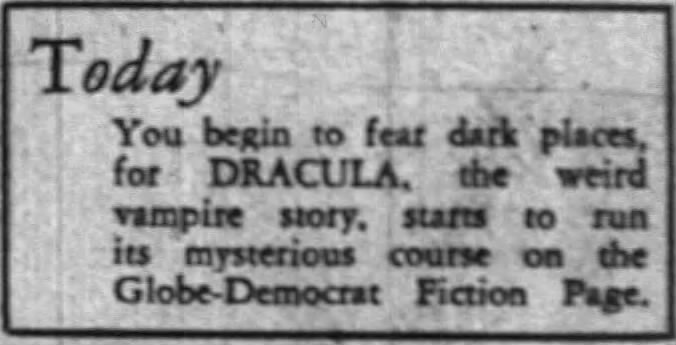
The Globe-Democrat of St. Louis, Missouri ran Dracula as a serial in 121 parts, from 20 February to 10 July 1928. The text was the unabridged 1897 text, including Jonathan Harker’s prologue. Like other newspaper serials, they began to run an original synopsis with the 5th installment, which would continue to run through the 119th installment, though many of the synopses are identical or near-identical. As is typical, there were many typesetting or typographical errors throughout. One particularly noteworthy difference is a misprinted line inserted in part 85 (29 May 1928):
[…] lowering myself in the eyes of the lunatic:—
,izdam dDtTbb6ntoi shm shm sh
“And why with Enoch?”
Aesthetically, the most notable aspect of this serial is the lovely art deco header that ran on every segment:
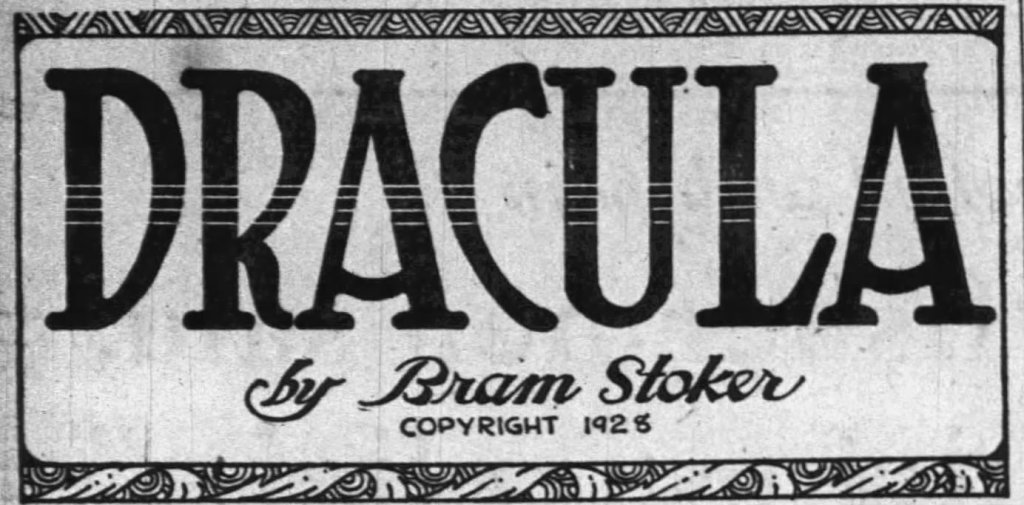
Note: Many parts do not contain chapter headings. Equivalent chapters from the 1897 text are presented in parantheses.
| Part 1: 20 Feb 1928, page 17. Chapter I. “How these papers” to “she said again” Link. |
| Part 2: 21 Feb 1928, page 18. [Chapter I]. “Oh, yes! I know” to “light his lamps.” Link. |
| Part 3: 22 Feb 1928, page 17. [Chapter I]. “When it grew” to “a moving circle.” Link. |
| Part 4: 23 Feb 1928, page 10. Chapters I-II. “At last there” to “replenished, flamed and flared.” Link. |
| Part 5: 24 Feb 1928, page 8. [Chapter II]. “The Count halted” to “the Law List.” Link. Synopsis: Jonathan Harker, a Londoner, leaves Munich by train, bound for the castle of Count Dracula, a Transylvanian nobleman, in the wilds of one of the least known sections of the Carpathian Mountains. He finds himself in a country ridden with superstition and queer customs he does not understand. Natives in picturesque costumes greet the train at little stations on the way until he arrives at Bistritz, where he must take a coach for the remainder of his journey. The Hungarian Count has arranged for his guest’s comfort, and after a night in an inn, Harker leaves for the castle in a coach which Dracula has sent for him. Just before the coach departs, an old woman begs him not to go, but when he makes known that his decision is final, she places a rosary around his neck to protect him from evil. Accompanied by only the driver whom the Count has dispatched, Harker sets out for the castle. Strange things happen along the route. Wolves howl and a mysterious blue light appears intermittently at the side of the road and an uncanny feeling overcomes Harker. Wolves circle the coach, but are frightened away, and at midnight Harker arrives at an ancient castle deep in the mountains. Admitted through a ponderous iron door, he is greeted by a tall old man, clad in somber black, who introduces himself as Count Dracula. The Count bids him welcome and escorts him to a room where a table is spread for supper. |
| Part 6: 25 Feb 1928, page 8. [Chapter II]. “Whilst I was” to “eaten with rust.” Link. Synopsis: Jonathan Harker, a Londoner, leaves Munich by train, bound for the castle of Count Dracula, a Transylvanian nobleman, in the wilds of one of the least known sections of the Carpathian Mountains. He finds himself in a country ridden with superstition and queer customs he does not understand. At Bistritz he must take a coach for the remainder of his journey. The Hungarian Count has arranged for his guest’s comfort, and after a night in an inn, Harker leaves for the castle in a coach which Dracula has sent for him. Accompanied by only the driver whom the Count has dispatched, Harker sets out for the castle. Strange things happen along the route. Wolves howl and a mysterious blue light appears intermittently at the side of the road and an uncanny feeling overcomes Harker. Wolves circle the coach, but are frightened away, and at midnight Harker arrives at an ancient castle deep in the mountains. Admitted through a ponderous iron door, he is greeted by a tall old man, clad in somber black, who introduces himself as Count Dracula. The Count bids him welcome and escorts him to a room where a table is spread for supper. After a pleasant supper and a refreshing sleep, Harker wanders about his rooms, considering the extraordinary evidences of wealth of the place. He finds a library, which, to his delight, contains a vast number of English books. |
| Part 7: 27 Feb 1928, page 16. [Chapter II]. “The estate is called” to “I am a prisoner!” Link. Synopsis: Identical to part 6. |
| Part 8: 28 Feb 1928, page 18. Chapter III. “When I found” to “so he said:—” Link. Synopsis: Identical to part 6. |
| Part 9: 1 Mar 1928, page 16. [Chapter III]. “When he left” to “mere ‘modernity’ cannot kill.” Link. Synopsis: Identical to part 6. |
| Part 10: 2 Mar 1928, page 8. [Chapter III]. “Later: the Morning of 16 May” to “work to be done.” Link. Synopsis: Jonathan Harker, a Londoner, leaves Munich by train, bound for the castle of Count Dracula, a Transylvanian nobleman, in the wilds of one of the least known sections of the Carpathian Mountains. He finds himself in a country ridden with superstition and queer customs he does not understand. At Bistritz he must take a coach for the remainder of his journey. The Hungarian Count has arranged for his guest’s comfort, and after a night in an inn, Harker leaves for the castle in a coach which Dracula has sent for him. Accompanied by only the driver whom the Count has dispatched, Harker sets out for the castle. Strange things happen along the route. Wolves howl and a mysterious blue light appears intermittently at the side of the road and an uncanny feeling overcomes Harker. Wolves circle the coach, but are frightened away, and at midnight Harker arrives at an ancient castle deep in the mountains. Admitted through a ponderous iron door, he is greeted by a tall old man, clad in somber black, who introduces himself as Count Dracula. The Count bids him welcome and escorts him to a room where a table is spread for supper. After a pleasant supper and a refreshing sleep, Harker wanders about his rooms, considering the extraordinary evidences of wealth of the place. He finds a library, which, to his delight, contains a vast number of English books. Harker, finding he is to be Count Dracula’s prisoner until he is ready to release him, decides to make the best of his ill fortune. Dracula, however, permits him to write letters to his friends, but warns him they must be of a business nature; he also cautions him not to wander from his rooms, lest he encounter things that would make it impossible for him to sleep. |
| Part 11: 3 Mar 1928, page 9. Chapters III-IV. “Are we to have” to “new scheme of villainy.” Link. Synopsis: Identical to part 10. |
| Part 12: 5 Mar 1928, page 11. [Chapter IV]. “17 June” to “of all Mina!” Link. Synopsis: Jonathan Harker, a Londoner, leaves Munich by train, bound for the castle of Count Dracula, a Transylvanian nobleman, in the wilds of one of the least known sections of the Carpathian Mountains. He finds himself in a country ridden with superstition and queer customs he does not understand. At Bistritz he must take a coach for the remainder of his journey. The Hungarian Count has arranged for his guest’s comfort, and after a night in an inn, Harker leaves for the castle in a coach which Dracula has sent for him. Accompanied by only the driver whom the Count has dispatched, Harker sets out for the castle. Strange things happen along the route. Wolves howl and a mysterious blue light appears intermittently at the side of the road and an uncanny feeling overcomes Harker. Wolves circle the coach, but are frightened away, and at midnight Harker arrives at an ancient castle deep in the mountains. Admitted through a ponderous iron door, he is greeted by a tall old man, clad in somber black, who introduces himself as Count Dracula. The Count bids him welcome and escorts him to a room where a table is spread for supper. After a pleasant supper and a refreshing sleep, Harker wanders about his rooms, considering the extraordinary evidences of wealth of the place. He finds a library, which, to his delight, contains a vast number of English books. Harker, finding he is to be Count Dracula’s prisoner until he is ready to release him, decides to make the best of his ill fortune. Dracula, however, permits him to write letters to his friends, but warns him they must be of a business nature; he also cautions him not to wander from his rooms, lest he encounter things that would make it impossible for him to sleep. Disregarding the warning not to wander about the castle, Harker begins exploring its gloomy recesses, and in the quarters occupied by the Count encounters three beautiful women, who have the same strangeness about them he has observed in the Count. They quarrel over which shall be permitted to kiss him. Later he retires to his own chambers and writes a series of letters to his friends in England, describing his experiences. One, written in shorthand, was discovered by the Count, who held it over the flame until it was consumed. Harker retire [sic], and when he awakened he found all his notes, letters and memoranda has been destroyed. |
| Part 13: 6 Mar 1928, page 18. [Chapter IV]. “Same day, late” to “not go tonight?” Link. Synopsis: Jonathan Harker, a Londoner, leaves Munich by train, bound for the castle of Count Dracula, a Transylvanian nobleman, in the wilds of one of the least known sections of the Carpathian Mountains. He finds himself in a country ridden with superstition and queer customs he does not understand. At Bistritz he must take a coach for the remainder of his journey. The Hungarian Count has arranged for his guest’s comfort, and after a night in an inn, Harker leaves for the castle in a coach which Dracula has sent for him. Accompanied by only the driver whom the Count has dispatched, Harker sets out for the castle. Strange things happen along the route. Wolves howl and a mysterious blue light appears intermittently at the side of the road and an uncanny feeling overcomes Harker. Wolves circle the coach, but are frightened away, and at midnight Harker arrives at an ancient castle deep in the mountains. Admitted through a ponderous iron door, he is greeted by a tall old man, clad in somber black, who introduces himself as Count Dracula. The Count bids him welcome and escorts him to a room where a table is spread for supper. After a pleasant supper and a refreshing sleep, Harker wanders about his rooms, considering the extraordinary evidences of wealth of the place. He finds a library, which, to his delight, contains a vast number of English books. Harker, finding he is to be Count Dracula’s prisoner until he is ready to release him, decides to make the best of his ill fortune. Dracula, however, permits him to write letters to his friends, but warns him they must be of a business nature; he also cautions him not to wander from his rooms, lest he encounter things that would make it impossible for him to sleep. Disregarding the warning not to wander about the castle, Harker begins exploring its gloomy recesses, and in the quarters occupied by the Count encounters three beautiful women, who have the same strangeness about them he has observed in the Count. They quarrel over which shall be permitted to kiss him. Later he retires to his own chambers and writes a series of letters to his friends in England, describing his experiences. One, written in shorthand, was discovered by the Count, who held it over the flame until it was consumed. Harker retire [sic], and when he awakened he found all his notes, letters and memoranda has been destroyed. Following a restless night, Harker gets up, to find his door fastened on the outside. From his window he sees a figure coming out of the Count’s room wearing his clothes that he wore the night he came to the castle. He hears a woman’s scream, only to see her being devoured by howling wolves. Harker decides to take a chance and crawl in through the Count’s window. |
| Part 14: 7 Mar 1928, page 10. [Chapter IV]. “Because, dear sir” to “me more closely.” Link. Synopsis: Jonathan Harker, a Londoner, leaves Munich by train, bound for the castle of Count Dracula, a Transylvanian nobleman, in the wilds of the Carpathian Mountains. At Bistritz he must take a coach for the remainder of his journey. The Hungarian Count has arranged for his guest’s comfort, and after a night in an inn, Harker leaves for the castle in a coach which Dracula has sent for him. Accompanied by only the driver whom the Count has dispatched, Harker sets out for the castle. Strange things happen along the route. Wolves howl and a mysterious blue light appears intermittently at the side of the road and an uncanny feeling overcomes Harker. Wolves circle the coach, but are frightened away, and at midnight Harker arrives at an ancient castle deep in the mountains. Admitted through a ponderous iron door, he is greeted by a tall old man, clad in somber black, who introduces himself as Count Dracula. The Count bids him welcome and escorts him to a room where a table is spread for supper. After a pleasant supper and a refreshing sleep, Harker wanders about his rooms, considering the extraordinary evidences of wealth of the place. He finds a library, which, to his delight, contains a vast number of English books. Harker, finding he is to be Count Dracula’s prisoner until he is ready to release him, decides to make the best of his ill fortune. Dracula, however, permits him to write letters to his friends, but warns him they must be of a business nature; he also cautions him not to wander from his rooms, lest he encounter things that would make it impossible for him to sleep. Disregarding the warning not to wander about the castle, Harker begins exploring its gloomy recesses, and in the quarters occupied by the Count encounters three beautiful women, who have the same strangeness about them he has observed in the Count. They quarrel over which shall be permitted to kiss him. Later he retires to his own chambers and writes a series of letters to his friends in England, describing his experiences. One, written in shorthand, was discovered by the Count, who held it over the flame until it was consumed. Harker retired, and when he awakened he found all his notes, letters and memoranda has been destroyed. Following a restless night, Harker gets up, to find his door fastened on the outside. From his window he sees a figure coming out of the Count’s room wearing his clothes that he wore the night he came to the castle. He hears a woman’s scream, only to see her being devoured by howling wolves. The next day he crawls through the Count’s window and finds the room empty. He goes down a long passage and finds the Count, with glassy eyes and apparently dead. He looks so horrid that Harker hurries back to his own room. That night the Count comes back and tells him he is to leave for England in the morning. |
| Part 15: 8 Mar 1928, page 19. Chapters IV-V. “As I write” to “have your sympathy.” Link. Synopsis: Jonathan Harker, a Londoner, leaves Munich by train, bound for the castle of Count Dracula, a Transylvanian nobleman, in the wilds of the Carpathian Mountains. At Bistriz he must take a coach for the remainder of his journey. Admitted through a ponderous iron door, he is greeted by a tall old man, clad in somber black, who introduces himself as Count Dracula. The Count bids him welcome and after a pleasant supper and refreshing sleep, Harker wanders about his rooms. Harker, finding he is to be Count Dracula’s prisoner until he is ready to release him, decides to make the best of his ill fortune. Dracula, however, permits him to write letters to his friends, but warns him they must be of a business nature; he also cautions him not to wander from his rooms, lest he encounter things that would make it impossible for him to sleep. Disregarding the warning not to wander about the castle, Harker begins exploring its gloomy recesses, and in the quarters occupied by the Count encounters three beautiful women, who have the same strangeness about them he has observed in the Count. They quarrel over which shall be permitted to kiss him. Later he retires to his own chambers and writes a series of letters to his friends in England, describing his experiences. One, written in shorthand, was discovered by the Count, who held it over the flame until it was consumed. Harker retired, and when he awakened he found all his notes, letters and memoranda has been destroyed. Following a restless night, Harker gets up, to find his door fastened on the outside. From his window he sees a figure coming out of the Count’s room wearing his clothes that he wore the night he came to the castle. He hears a woman’s scream, only to see her being devoured by howling wolves. The next morning he crawls through the Count’s window and finds the room empty. He goes down a narrow passage and finds there a hideous monster lying over a box with glassy eyes, looking very much like the Count. Harker hurries back to his room and that night the Count tells him he may leave the following morning. Harker asks him if he may leave that same night and the Count very suavely consents. At the front door he hears the angry howling of wolves outside and decides to stay until the next day. Returning to his room he overhears the three women whispering that tomorrow his end will come. The next morning Harker goes down the passage again. The wind blocks the iron door shut and he is locked in. |
| Part 16: 9 Mar 1928, page 8. [Chapter V]. “My dear, it never” to “I had been free:” Link. Synopsis: Jonathan Harker, a Londoner, leaves Munich by train, bound for the castle of Count Dracula, a Transylvanian nobleman, in the wilds of the Carpathian Mountains. At Bistritz he must take a coach for the remainder of his journey. Admitted through a ponderous iron door, he is greeted by a tall old man, clad in somber black, who introduces himself as Count Dracula. The Count bids him welcome and after a pleasant supper and refreshing sleep, Harker wanders about his rooms. Harker, finding he is to be Count Dracula’s prisoner until he is ready to release him, decides to make the best of his ill fortune. Dracula, however, permits him to write letters to his friends, but warns him they must be of a business nature; he also cautions him not to wander from his rooms, lest he encounter things that would make it impossible for him to sleep. Disregarding the warning not to wander about the castle, Harker begins exploring its gloomy recesses, and in the quarters occupied by the Count encounters three beautiful women, who have the same strangeness about them he has observed in the Count. They quarrel over which shall be permitted to kiss him. Later he retires to his own chambers and writes a series of letters to his friends in England, describing his experiences. One, written in shorthand, was discovered by the Count, who held it over the flame until it was consumed. Following a restless night, Harker gets up, to find his door fastened on the outside. From his window he sees a figure coming out of the Count’s room wearing his clothes that he wore the night he came to the castle. He hears a woman’s scream, only to see her being devoured by howling wolves. The next morning he crawls through the Count’s window and finds the room empty. He goes down a narrow passage and finds there a hideous monster lying over a box with glassy eyes, looking very much like the Count. Harker hurries back to his room and that night the Count tells him he may leave the following morning. Harker asks him if he may leave that same night and the Count very suavely consents. At the front door he hears the angry howling of wolves outside and decides to stay until the next day. Returning to his room he overhears the three women whispering that tomorrow his end will come. The next morning Harker goes down the passage again. The wind blocks the iron door shut and he is locked in. |
| Part 17: 10 Mar 1928, page 10. [Chapter V]. “Lucy, you are” to “your ears tingle. ART.” Link. Synosis: Identical to part 16. |
| Part 18: 12 Mar 1928, page 8. Chapter VI. “24 July, Whitby” to “and putting it down.” Link. Synopsis: Identical to part 16. |
| Part 19: 13 Mar 1928, page 20. [Chapter VI]. “It be all fool” to “a whole month.” Link. Synopsis: Identical to part 16. |
| Part 20: 14 Mar 1928, page 19. [Chapter VI]. “The same day.” to “the morning early.” Link. Synopsis: Identical to part 16. |
| Part 21: 15 Mar 1928, page 18. [Chapter VI]. “18 July.” to “will all last.” Link. Synopsis: Identical to part 16. |
| Part 22: 16 Mar 1928, page 10. [Chapter VI]. “3 August.” to “this time tomorrow.” Link. Synopsis: Identical to part 16. |
| Part 23: 17 Mar 1928, page 10. Chapter VII. “Cutting from ‘The Dailygraph,’” to “Tate Hill pier.” Link. Synopsis: Identical to part 16. |
| Part 24: 19 Mar 1928, page 18. [Chapter VII]. “There was, of course” to “not speak out.” Link. Synopsis: Identical to part 16. |
| Part 25: 20 Mar 1928, page 10. [Chapter VII]. “On 14 July” to “signal for help . . . ” Link. Synopsis: Jonathan Harker, a Londoner, leaves Munich by train, bound for the castle of Count Dracula, a Transylvanian nobleman, in the wilds of the Carpathian Mountains. Admitted through a ponderous iron door, he is greeted by a tall old man, clad in somber black, who introduces himself as Count Dracula. The Count bids him welcome and after a pleasant supper and refreshing sleep, Harker wanders about his rooms. Harker, finding he is to be Count Dracula’s prisoner until he is ready to release him, decides to make the best of his ill fortune. Dracula, however, permits him to write letters to his friends, but warns him they must be of a business nature; he also cautions him not to wander from his rooms, lest he encounter things that would make it impossible for him to sleep. Disregarding the warning not to wander about the castle, Harker begins exploring its gloomy recesses, and in the quarters occupied by the Count encounters three beautiful women, who have the same strangeness about them he has observed in the Count. They quarrel over which shall be permitted to kiss him. Later he retires to his own chambers and writes a series of letters to his friends in England, describing his experiences. One, written in shorthand, was discovered by the Count, who held it over the flame until it was consumed. The next morning he crawls through the Count’s window and finds the room empty. He goes down a narrow passage and finds there a hideous monster lying over a box with glassy eyes, looking very much like the Count. Harker hurries back to his room and that night the Count tells him he may leave the following morning. Harker asks him if he may leave that same night and the Count very suavely consents. At the front door he hears the angry howling of wolves outside and decides to stay until the next day. Returning to his room he overhears the three women whispering that tomorrow his end will come. The next morning Harker goes down the passage again. The wind blocks the iron door shut and he is locked in. |
| Part 26: 21 Mar 1928, page 8. [Chapter VII]. “It is nearly all” to “sleep-walking then.” Link. Synopsis: Jonathan Harker, a Londoner, leaves Munich by train, bound for the castle of Count Dracula, a Transylvanian nobleman, in the wilds of the Carpathian Mountains. Admitted through a ponderous iron door, he is greeted by a tall old man, clad in somber black, who introduces himself as Count Dracula. The Count bids him welcome and after a pleasant supper and refreshing sleep, Harker wanders about his rooms. Harker, finding he is to be Count Dracula’s prisoner until he is ready to release him, decides to make the best of his ill fortune. Dracula, however, permits him to write letters to his friends, but warns him they must be of a business nature; he also cautions him not to wander from his rooms, lest he encounter things that would make it impossible for him to sleep. Disregarding the warning not to wander about the castle, Harker begins exploring its gloomy recesses, and in the quarters occupied by the Count encounters three beautiful women, who have the same strangeness about them he has observed in the Count. They quarrel over which shall be permitted to kiss him. Later he retires to his own chambers and writes a series of letters to his friends in England, describing his experiences. One, written in shorthand, was discovered by the Count, who held it over the flame until it was consumed. The next morning he crawls through the Count’s window and finds the room empty. He goes down a narrow passage and finds there a hideous monster lying over a box with glassy eyes, looking very much like the Count. Harker hurries back to his room and that night the Count tells him he may leave the following morning. Harker asks him if he may leave that same night and the Count very suavely consents. At the front door he hears the angry howling of wolves outside and decides to stay until the next day. Returning to his room he overhears the three women whispering that tomorrow his end will come. The next morning Harker goes down the passage again. The wind blocks the iron door shut and he is locked in. Count Dracula has himself sent to England in a wooden box containing fresh clay. He travels in one, and when the rest of the boxes, looking very much like coffins, are invoiced as “clay.” |
| Part 27: 22 Mar 1928, page 12. Chapter VIII. “Same day 11 o’clock p. m.” to “living thing about.” Link. Synopsis: Identical to part 26. |
| Part 28: 23 Mar 1928, page 20. [Chapter VIII]. “When I bent” to “it from the cold.” Link. Synopsis: Identical to part 26. |
| Part 29: 24 Mar 1928, page 8. [Chapter VIII]. “I did not wake” to “very happy evening together.” Link. Synopsis: Identical to part 26. |
| Part 30: 26 Mar 1928, page 6. [Chapter VIII]. “19 August” to “the deserted house.” Link. Synopsis: Jonathan Harker, a Londoner, leaves Munich by train, bound for the castle of Count Dracula, a Transylvanian nobleman, in the wilds of the Carpathian Mountains. The Count bids him welcome and after a pleasant supper and refreshing sleep, Harker wanders about his rooms. Harker, finding he is to be Count Dracula’s prisoner until he is ready to release him, decides to make the best of his ill fortune. Dracula, however, permits him to write letters to his friends, but warns him they must be of a business nature; he also cautions him not to wander from his rooms, lest he encounter things that would make it impossible for him to sleep. Disregarding the warning not to wander about the castle, Harker begins exploring its gloomy recesses, and in the quarters occupied by the Count encounters three beautiful women, who have the same strangeness about them he has observed in the Count. They quarrel over which shall be permitted to kiss him. Later he retires to his own chambers and writes a series of letters to his friends in England, describing his experiences. One, written in shorthand, was discovered by the Count, who held it over the flame until it was consumed. The next morning he crawls through the Count’s window and finds the room empty. He goes down a narrow passage and finds there a hideous monster lying over a box with glassy eyes, looking very much like the Count. Harker hurries back to his room and that night the Count tells him he may leave the following morning. Harker asks him if he may leave that same night and the Count very suavely consents. At the front door he hears the angry howling of wolves outside and decides to stay until the next day. Returning to his room he overhears the three women whispering that tomorrow his end will come. The next morning Harker goes down the passage again. The wind blocks the iron door shut and he is locked in. Count Dracula has himself sent to England in a wooden box containing fresh clay. He travels in one, and when the rest of the boxes, looking very much like coffins, are invoiced as “clay.” A Russian schooner, the Demeter, docks in London without a crew and the captain dead, tied to the helm. |
| Part 31: 27 Mar 1928, page 20. Chapters VIII-IX. “I ran back” to “but the year,” Link. Synopsis: Identical to part 30. |
| Part 32: 28 Mar 1928, page 18. [Chapter IX]. “Well, my dear” to “an excuse and try.” Link. Synopsis: Identical to part 30. |
| Part 33: 29 Mar 1928, page 20. [Chapter IX]. “25 August” to “I am quite free.” Link. Synopsis: Jonathan Harker, a Londoner, visits Count Dracula, a Transylvanian nobleman. Harker, finding he is to be Count Dracula’s prisoner, who cations him not to wander from his rooms. Disregarding the warning not to wander about the castle, Harker begins exploring its gloomy recesses. The next morning Harker crawls through the Count’s window and finds the room empty. He goes down a narrow passage and finds there a hideous monster lying over a box with glassy eyes, looking very much like the Count. Returning to his room he overhears the three women whispering that tomorrow his end will come. The next morning Harker goes down the passage again. The wind blows the iron door shut and he is locked in. Count Dracula has himself sent to England in a wooden box containing fresh clay. He travels in one, and when the rest of the boxes, looking very much like coffins, are invoiced as “clay.” A Russian schooner, the Demeter, docks in London without a crew and the captain dead, tied to the helm. The scene shifts to a London hospital, where Dr. Seward is watching a maniac called Renfield. This patient has such obsessions as feeding flies to spiders, spiders to birds, birds to a cat and then finally eating the cat himself. |
| Part 34: 30 Mar 1928, page 18. [Chapter IX]. “I could easily” to “and suavely said:” Link. Synopsis: Identical to part 33. |
| Part 35: 31 Mar 1928, page 10. [Chapter IX]. “My dear young” to “till have seen you.” Link. Synopsis: Identical to part 33. |
| Part 36: 2 Apr 1928, page 18. Chapter X. “6 September.” to “not the last!” Link. Synopsis: Identical to part 33. |
| Part 37: 3 Apr 1928, page 14. [Chapter X]. “What shall I do?” to “sleep easy hereafter!” Link. Synopsis: Jonathan Harker, a Londoner, visits Count Dracula, a Transylvanian nobleman. Harker, finding he is to be Count Dracula’s prisoner, who cations him not to wander from his rooms. Disregarding the warning not to wander about the castle, Harker begins exploring its gloomy recesses. The next morning Harker crawls through the Count’s window and finds the room empty. He goes down a narrow passage and finds there a hideous monster lying over a box with glassy eyes, looking very much like the Count. Returning to his room he overhears the three women whispering that tomorrow his end will come. The next morning Harker goes down the passage again. The wind blows the iron door shut and he is locked in. Count Dracula has himself sent to England in a wooden box containing fresh clay. He travels in one, and when the rest of the boxes, looking very much like coffins, are invoiced as “clay.” A Russian schooner, the Demeter, docks in London without a crew and the captain dead, tied to the helm. The scene shifts to a London hospital, where Dr. Seward is watching a maniac called Renfield. This patient has such obsessions as feeding flies to spiders, spiders to birds, birds to a cat and then finally eating the cat himself. Miss Mina Murray, Harker’s fiancée, receives word that he is safe but sick in a hospital. She leaves at once to see him. Lucy Westenra, with whom Mina had been living, walks in her sleep every night. One night Mina followed her and found her unconscious on a stone bench on a hill some distance from the house. When Mina approached a dark figure disappeared in the darkness. Lucy’s throat seemed to be pricked by a pin. |
| Part 38: 4 Apr 1928, page 24. [Chapter X]. “8 September” to “woman he loves.” Link. Synopsis: Identical to part 37. |
| Part 39: 5 Apr 1928, page 21. [Chapter X]. “The Professor watched” to “like unshed tears.” Link. Synopsis: Identical to part 37. |
| Part 40: 6 Apr 1928, page 13. Chapter XI. “12 September” to “my own brain.” Link. Synopsis: Identical to part 37. |
| Part 41: 7 Apr 1928, page 13. [Chapter XI]. “17 September” to “got into his ‘ead.” Link. Synopsis: Identical to part 37. |
| Part 42: 9 Apr 1928, page 17. [Chapter XI]. “Now, Mr. Bilder” to “escapade at the zoo.” Link. Synopsis: Identical to part 33. (Possibly in error?) |
| Part 43: 10 Apr 1928, page 14. [Chapter XI]. “17 September” to “for a while.” Link. Synopsis: Jonathan Harker, a Londoner, visits Count Dracula, a Transylvanian nobleman. Harker, finding he is to be Count Dracula’s prisoner, who cations him not to wander from his rooms. Disregarding the warning not to wander about the castle, Harker begins exploring its gloomy recesses. The next morning Harker crawls through the Count’s window and finds the room empty. He goes down a narrow passage and finds there a hideous monster lying over a box with glassy eyes, looking very much like the Count. Returning to his room he overhears the three women whispering that tomorrow his end will come. The next morning Harker goes down the passage again. The wind blows the iron door shut and he is locked in. Count Dracula has himself sent to England in a wooden box containing fresh clay. He travels in one, and when the rest of the boxes, looking very much like coffins, are invoiced as “clay.” A Russian schooner, the Demeter, docks in London without a crew and the captain dead, tied to the helm. The scene shifts to a London hospital, where Dr. Seward is watching a maniac called Renfield. This patient has such obsessions as feeding flies to spiders, spiders to birds, birds to a cat and then finally eating the cat himself. Miss Mina Murray, Harker’s fiancée, receives word that he is safe but sick in a hospital. She leaves at once to see him. Lucy Westenra, with whom Mina had been living, walks in her sleep every night. One night Mina followed her and found her unconscious on a stone bench on a hill some distance from the house. When Mina approached a dark figure disappeared in the darkness. Lucy’s throat seemed to be pricked by a pin. Lucy, who is engaged to Arthur Holmwood, gets a very peculiar disease, which causes her mother and fiancé to become alarmed over her condition. Dr. Seward and a noted specialist are summoned to look at her, while Lucy grows steadily weaker. A blood transfusion is sorted to and Lucy regains some of her strength. The next morning she is again very pale and weak. Dr. Van Helsing, the specialist, is alarmed at her relapse and performs another transfusion. |
| Part 44: 11 Apr 1928, page 15. Chapters XI-XII. “The time did not” to “he said to me:—” Link. Synopsis: Identical to part 43. |
| Part 45: 12 Apr 1928, page 20. [Chapter XII]. “I can do this” to “when we want them.” Link. Synopsis: Jonathan Harker, a Londoner, visits Count Dracula, a Transylvanian nobleman. Harker, finding he is to be Count Dracula’s prisoner, who cations him not to wander from his rooms. Disregarding the warning not to wander about the castle, Harker begins exploring its gloomy recesses. The next morning Harker crawls through the Count’s window and finds the room empty. He goes down a narrow passage and finds there a hideous monster lying over a box with glassy eyes, looking very much like the Count. Returning to his room he overhears the three women whispering that tomorrow his end will come. The next morning Harker goes down the passage again. The wind blows the iron door shut and he is locked in. Count Dracula has himself sent to England in a wooden box containing fresh clay. He travels in one, and when the rest of the boxes, looking very much like coffins, are invoiced as “clay.” A Russian schooner, the Demeter, docks in London without a crew and the captain dead, tied to the helm. The scene shifts to a London hospital, where Dr. Seward is watching a maniac called Renfield. This patient has such obsessions as feeding flies to spiders, spiders to birds, birds to a cat and then finally eating the cat himself. Miss Mina Murray, Harker’s fiancée, receives word that he is safe but sick in a hospital. She leaves at once to see him. Lucy Westenra, with whom Mina had been living, walks in her sleep every night. One night Mina followed her and found her unconscious on a stone bench on a hill some distance from the house. When Mina approached a dark figure disappeared in the darkness. Lucy’s throat seemed to be pricked by a pin. Lucy, who is engaged to Arthur Holmwood, gets a very peculiar disease, which causes her mother and fiancé to become alarmed over her condition. Dr. Seward and a noted specialist are summoned to look at her, while Lucy grows steadily weaker. A blood transfusion is sorted to and Lucy regains some of her strength. The next morning she is again very pale and weak. Dr. Van Helsing, the specialist, is alarmed at her relapse and performs another transfusion. A few days later one of the gray wolves escapes from the Zoo. The only clue the keeper offers is that a tall, thin man with a hooked nose and red eyes was seen looking at the wolf the day before. |
| Part 46: 13 Apr 1928, page 12. [Chapter XII]. “Once again we” to “I’ll do it.” Link. Synopsis: Identical to part 45. |
| Part 47: 14 Apr 1928, page 12. [Chapter XII]. “When she woke late” to “going on well.” Link. Synopsis: Identical to part 45. |
| Part 48: 16 Apr 1928, page 16. [Chapter XII]. “The two carriers” to “sat watching her.” Link. Synopsis: Identical to part 45. |
| Part 49: 17 Apr 1928, page 20. [Chapter XII]. “Presently she woke” to “Wait and see.” Link. Synopsis: Identical to part 45. |
| Part 50: 18 Apr 1928, page 20. Chapter XIII. “The funeral was” to “bedside and said:” Link. Synopsis: Jonathan Harker, a Londoner, visits Count Dracula, a Transylvanian nobleman. On his arrival he is warned not to wander about the castle, but, disregarding this warning, he begins exploring its gloomy recesses, where he encounters many horrible things. When we hear of Dracula again he has himself shipped to England in one of many boxes containing clay, which he has invoiced as “clay.” The scene shifts to a London hospital, where Dr. Seward is watching a maniac called Renfield, who has queer obsessions, such as eating spiders and flies. Harker later escapes from Dracula’s castle, but, due to the horrors he has gone through, he suffers a long siege of illness. His fiancée, Mina Murray, goes to him and they are married. Lucy Westenra, a friend of Mina’s and engaged to Arthur Homewood, had taken to sleep walking. One night she walked too far and upon her return it was found she had been bitten by a vampire. Two little red teeth marks were on her throat. Dr. Seward called in Dr. Van Helsing, a noted specialist, and, after several blood transfusions. Lucy dies, but Van Helsing declares instead of being the end it is only the beginning. |
| Part 51: 19 Apr 1928, page 14. [Chapter XIII]. “You need not” to “Something now?’ ‘Certainly.’” Link. Synopsis: Identical to part 50. |
| Part 52: 20 Apr 1928, page 12. [Chapter XIII]. “You know that” to “what it may be.” Link. Synopsis: Identical to part 50. |
| Part 53: 21 Apr 1928, page 20. [Chapter XIII]. “I did not like” to “by the ‘bloofer lady.’” Link. Synopsis: Identical to part 50. |
| Part 54: 23 Apr 1928, page 17. Chapter XIV. “23 September.” to “‘Dr. Van Helsing.’” Link. Synopsis: Identical to part 50. |
| Part 55: 24 Apr 1928, page 13. [Chapter XIV]. “I rose and bowed” to “such infinite sweetness:” Link. Synopsis: Identical to part 50. |
| Part 56: 25 Apr 1928, page 14. [Chapter XIV]. “My life is a” to “laughed as he said:” Link. Synopsis: Jonathan Harker, a Londoner, visits Count Dracula, a Transylvanian nobleman. On his arrival he is warned not to wander about the castle, but, disregarding this warning, he begins exploring its gloomy recesses, where he encounters many horrible things. When we hear of Dracula again he has himself shipped to England in one of many boxes containing clay, which he has invoiced as “clay.” The scene shifts to a London hospital, where Dr. Seward is watching a maniac called Renfield, who has queer obsessions, such as eating spiders and flies. Harker later escapes from Dracula’s castle, but, due to the horrors he has gone through, he suffers a long siege of illness. His fiancée, Mina Murray, goes to him and they are married. Lucy Westenra, a friend of Mina’s and engaged to Arthur Homewood, had taken to sleep walking. One night she walked too far and upon her return it was found she had been bitten by a vampire. Two little red teeth marks were on her throat. Dr. Seward called in Dr. Van Helsing, a noted specialist, and, after several blood transfusions. Lucy dies, but Van Helsing declares instead of being the end it is only the beginning. Dr. Van Helsing, after Lucy’s death, goes through her personal belongings and finds letters from Mina Harker, which causes him to think she can help solve some of the mysteries which have begun to affect so many people. He visits the Harkers. |
| Part 57: 26 Apr 1928, page 20. [Chapter XIV]. “So! You are physiognomist.” to “waste of blood.” Link. Synopsis: Identical to part 56. |
| Part 58: 27 Apr 1928, page 10. [Chapter XIV]. “And how the blood” to “far, far worse.” Link. Synopsis: Identical to part 56. |
| Part 59: 28 Apr 1928, page 18. Chapters XIV-XV. “In God’s name” to “do?’ I asked.” Link. Synopsis: Identical to part 56. |
| Part 60: 30 Apr 1928, page 16. [Chapter XV]. “To open the coffin.” to “on another expedition.” Link. Synopsis: Identical to part 56. |
| Part 61: 1 May 1928, page 14. [Chapter XV]. “27 September.” to “snap, and said:” Link. Synopsis: Identical to part 56. |
| Part 62: 2 May 1928, page 18. [Chapter XV]. “I have been” to “Quincey Morris, laconically.” Link. Synopsis: Identical to part 56. |
| Part 63: 3 May 1928, page 10. Chapters XV-XVI. “‘Oh,’ said the” to “in and recoiled.” Link. Synopsis: Identical to part 56. |
| Part 64: 4 May 1928, page 20. [Chapter XVI]. “The coffin was empty!” to “would have fallen.” Link. Synopsis: Identical to part 56. |
| Part 65: 5 May 1928, page 18. [Chapter XVI]. “When Lucy—I” to “Van Helsing said:” Link. Synopsis: Identical to part 56. |
| Part 66: 7 May 1928, page 8. [Chapter XVI]. “Before we do” to “Said to him:—” Link. Synopsis: Identical to part 56. |
| Part 67: 8 May 1928, page 20. Chapters XVI-XVII. “And now, my child,” to “the wide world!” Link. Synopsis: Identical to part 56. |
| Part 68: 9 May 1928, page 20. [Chapter XVII]. “Why not?” I asked,” to “ears and listened.” Link. Synopsis: Identical to part 56. |
| Part 69: 10 May 1928, page 20. [Chapter XVII]. “When the terrible” to “case of need.” Link. Synopsis: Identical to part 56. |
| Part 70: 11 May 1928, page 14. [Chapter XVII]. “20 September” to “this, Mrs. Harker?” Link. Synopsis: Identical to part 56. |
| Part 71: 12 May 1928, page 12. [Chapter XVII]. “I nodded, and” to “himself a friend!” Link. Synopsis: Identical to part 56. |
| Part 72: 14 May 1928, page 10. Chapter XVIII. “20 September” to “to me, saying:” Link. Synopsis: Identical to part 56. |
| Part 73: 15 May 1928, page 14. [Chapter XVIII]. “Ah, friend John” to “What say you?” Link. Synopsis: Identical to part 56. |
| Part 74: 16 May 1928, page 18. [Chapter XVIII]. “Whilst he was” to “with our eyes.” Link. Synopsis: Identical to part 56. |
| Part 75: 17 May 1928, page 21. [Chapter XVIII]. “Thus when we” to “asked Lord Goldaming [sic].” Link. Synopsis: Identical to part 56. |
| Part 76: 18 May 1928, page 1. [Chapter XVIII]. “Me too?” said” to “Professor went on:—” Link. Synopsis: Identical to part 56. |
| Part 77: 19 May 1928, page 18. Chapters XVIII-XIX. “Come, sir, bethink” to “Then he spoke:—” Link. Synopsis: Identical to part 56. |
| Part 78: 21 May 1928, page 18. [Chapter XIX]. “My friends, we” to “alive with rats.” Link. Synopsis: Identical to part 56. |
| Part 79: 22 May 1928, page 20. [Chapter XIX]. “For a moment” to “to disturb her.” Link. Synopsis: Identical to part 56. |
| Part 80: 23 May 1928, page 21. [Chapter XIX]. “October 1, later” to “the terrible excitement.” Link. Synopsis: Identical to part 56. |
| Part 81: 24 May 1928, page 14. [Chapter XIX]. “Last night I” to “slept at all.” Link. Synopsis: Identical to part 56. |
| Part 82: 25 May 1928, page 21. Chapters XIX-XX. “2 October 10 p. m.” to “of our decision.” Link. Synopsis: Identical to part 56. |
| Part 83: 26 May 1928, page 18. [Chapter XX]. “2 October, evening” to “in Sackville street.” Link. Synopsis: Identical to part 56. |
| Part 84: 28 May 1928, page 11. [Chapter XX]. “The gentleman who” to “ineffably benign superiority.” Link. Synopsis: Identical to part 56. |
| Part 85: 29 May 1928, page 8. [Chapter XX]. “Oh no! Far” to “and said, apologetically:” Link. Synopsis: Identical to part 56. |
| Part 86: 30 May 1928, page 21. [Chapter XX]. “Forgive me, doctor;” to “go at once. . . .” Link. Synopsis: Identical to part 56. |
| Part 87: 31 May 1928, page 11. Chapter XXI. “3 October.” to “forget, and said:” Link. Synopsis: Identical to part 56. |
| Part 88: 1 Jun 1928, page 22. [Chapter XXI]. “I must not” to “my own heart.” Link. Synopsis: Identical to part 56. |
| Part 89: 2 Jun 1928, page 7. [Chapter XXI]. “Outside the Harkers’” to “with wonderful calmness:—” Link. Synopsis: Identical to part 56. |
| Part 90: 4 Jun 1928, page 16. [Chapter XXI]. “Do not fear” to “thoughts, she began:—” Link. Synopsis: Identical to part 56. |
| Part 91: 5 Jun 1928, page 21. Chapters XXI-XXII. “I took the” to “neck were broken.” Link. Synopsis: Identical to part 56. |
| Part 92: 6 Jun 1928, page 8. [Chapter XXII]. “Dr. Seward asked” to “sa? is it not?” Link. Synopsis: Identical to part 56. |
| Part 93: 7 Jun 1928, page 20. [Chapter XXII]. “Then let us” to “tears, said hoarsely:—” Link. Synopsis: Identical to part 56. |
| Part 94: 8 Jun 1928, page 14. [Chapter XXII]. “No, I shall” to “let you in.” Link. Synopsis: Identical to part 56. |
| Part 95: 9 Jun 1928, page 6. Chapters XXII-XXIII. “The advice is” to “to defeat him!” Link. Synopsis: Identical to part 56. |
| Part 96: 11 Jun 1928, page 20. [Chapter XXIII]. “He has all” to “alone after sunset.” Link. Synopsis: Identical to part 56. |
| Part 97: 12 Jun 1928, page 15. [Chapter XXIII]. “He will be” to “when he said:” Link. Synopsis: Identical to part 56. |
| Part 98: 13 Jun 1928, page 13. [Chapter XXIII]. “Let us go” to “go to bed.” Link. Synopsis: Identical to part 56. |
| Part 99: 14 Jun 1928, page 19. [Chapter XXIII]. “3-4 October” to “her shorthand notes.” Link. Synopsis: Identical to part 56. |
| Part 100: 15 Jun 1928, page 21. Chapters XXIII-XXIV. “I do not” to “after their investigations.” Link. Synopsis: Identical to part 56. |
| Part 101: 16 Jun 1928, page 17. [Chapter XXIV]. “The day is running” to “our own way.” Link. Synopsis: Identical to part 56. |
| Part 102: 18 Jun 1928, page 16. [Chapter XXIV]. “When Dr. Van Helsing” to “from me. Perhaps . . . ” Link. Synopsis: Identical to part 56. |
| Part 103: 19 Jun 1928, page 10. [Chapter XXIV]. “My surmise was” to “another of us.” Link. Synopsis: Identical to part 56. |
| Part 104: 20 Jun 1928, page 12. [Chapter XXIV]. “‘Of course!’ answered” to “hope he did.” Link. Synopsis: Identical to part 56. |
| Part 105: 21 Jun 1928, page 18. Chapters XXIV-XXV. “‘Good boy.’ said” to “his said solemnly:—” Link. Synopsis: Identical to part 56. |
| Part 106: 22 Jun 1928, page 22. [Chapter XXV]. “I’m only a” to “of the wire.” Link. Synopsis: Identical to part 56. |
| Part 107: 23 Jun 1928, page 6. [Chapter XXV]. “We had dinner” to “ice-cold hand!” Link. Synopsis: Identical to part 56. |
| Part 108: 25 Jun 1928, page 17. [Chapter XXV]. “Van Helsing and I” to “the time, however.” Link. Synopsis: Identical to part 56. |
| Part 109: 26 Jun 1928, page 8. [Chapter XXV]. “When the three” to “he went on:—” Link. Synopsis: Identical to part 56. |
| Part 110: 27 Jun 1928, page 19. Chapters XXV-XXVI. “Now you shall” to “blowing upon me.” Link. Synopsis: Identical to part 56. |
| Part 111: 28 Jun 1928, page 21. [Chapter XXVI]. “Here she stopped.” to “we came away.” Link. Synopsis: Identical to part 56. |
| Part 112: 29 Jun 1928, page 13. [Chapter XXVI]. “We found Hildesheim” to “The Count wanted isolation.” Link. Synopsis: Identical to part 56. |
| Part 113: 30 Jun 1928, page 17. [Chapter XXVI]. “My surmise is” to “hands of oGd! [sic]” Link. Synopsis: Identical to part 56. |
| Part 114: 2 Jul 1928, page 18. [Chapter XXVI]. “Later—Oh” to “Mina and me.” Link. Synopsis: Identical to part 56. |
| Part 115: 3 Jul 1928, page 8. [Chapter XXVI]. “2 November, morning” to “always for him.” Link. Synopsis: Identical to part 56. |
| Part 116: 4 Jul 1928, page 8. Chapter XXVII. “1 November” to “more of use.” Link. Synopsis: N/A |
| Part 117: 5 Jul 1928, page 9. [Chapter XXVII]. “So we came” to “soul was safe!” Link. Synopsis: Identical to part 56. |
| Part 118: 6 Jul 1928, page 10. [Chapter XXVII]. “Presently the horses” to “how it may be . . .” Link. Synopsis: Identical to part 56. |
| Part 119: 7 Jul 1928, page 10. [Chapter XXVII]. “5 November, afternoon” to “to meet us.” Link. Synopsis: Identical to part 56. |
| Part 120: 9 Jul 1928, page 16. [Chapter XXVII]. “6 November” to “of our presence.” Link. Synopsis: Identical to part 56. |
| Part 121: 10 Jul 1928, page 10. [Chapter XXVII]. “All at once” to “JONAHTAN [sic] HARKER. THE END.” Link. Synopsis: N/A |
Thanks to Dave Goudsward for his help and resources.
Thanks to Hans Corneel de Roos for a recommended addition.
Bobby Derie is the author of Weird Talers: Essays on Robert E. Howard and Others and Sex and the Cthulhu Mythos.
Deep Cuts in a Lovecraftian Vein uses Amazon Associate links. As an Amazon Associate I earn from qualifying purchases.