Her Letters to August Derleth: Christine Campbell Thomson

While Weird Tales found success on the newsstands of the United States, early efforts to publish hardback reprint anthologies stalled out after the first volume. In the United Kingdom, however, editor and literary agent Christine Campbell Thomson managed to launch a successful line of reprint anthologies, the Not at Night series, which drew heavily from Weird Tales—and inspired many imitators. August Derleth’s first story at Weird Tales, “Bat’s Belfry,” made it into the second volume, More Not at Night (1926), and other stories of his made their first hardback appearance in subsequent volumes. Though Derleth did not think highly of the series as a whole, he must have been aware of it as a market.

The file of correspondence at the Derleth Archive of the Wisconsin Historical Society between Thomson and Derleth covers the years 1934-1954, comprising 34 separate letters for a total of 43 pages, all from Thomson. It is not clear from extant correspondence if Derleth had heard directly from Thomson before 1934; presumably, Weird Tales editor Farnsworth Wright or their London agent handled most of the commercial details of reprints. However, on 12 Feb 1934 Wright returned Derleth’s story “The Metronome” again, and Derleth apparently decided to skip the middle man and submit it to Thompson and Not at Night directly.

Dear Mr. Derleth,

Thank you so much for your note. I am most interested in your criticism. The general opinion here in England is that the ninth issue is well ahead of most of its predecessors and equal to any of them. Incidentally, I notice that you choose in every case an American author and not an English one as coming up to standard. Here, the general run of opinion is the other way round. Interesting.

I have read “The Metronome” and like it. I am not making a final selection at the moment, but I want to keep this story by me—which is tantamount to my taking it, but I wait always to get out the agreement until we have got the volume complete. I am afraid Selwyn & Blount won’t let me pay more than £3.3.0 for the book rights over here. Is this possible for you? You retain the English magazine rights, of course.

Yours sincerely,
—Christine Campbell Thomson to August Derleth, 22 Jan 1934

The ninth entry in the Not at Night series was Keep on the Light (1933); it is difficult not to side with Derleth on this one, as the US entries reprinted from Weird Tales include Robert E. Howard’s “Worms of the Earth,” Mary Elizabeth Counselman’s “The House of Shadows,” and Clark Ashton Smith’s “Isle of the Torturers,” while many of the British entries are less well-regarded (and some have never been reprinted). It is possible the opinionated Derleth may have made a comment about “The Black Hare” by Flavia Richardson (a pseudonym of Thomson) or “Golden Lilies” by Oscar Cook (Thomson’s husband), which would not have endeared him to his potential editor. However, Thomson was a businesswoman first.

“The Metronome” was accepted for and published in Terror at Night (1934); Farnsworth Wright also changed his mind and accepted the story for Weird Tales, so it was published in the Feb 1935 issue, and Derleth was paid twice for the story—one of the benefits of foreign markets. Derleth inquired whether Thomson’s agency would work to play his other stories in British markets, rates involved, etc., and Thomson was willing. Most of their short, businesslike correspondence during 1934-1936 concerns issues of what rights to various works that Derleth retained and was willing to let Thomson attempt to market.
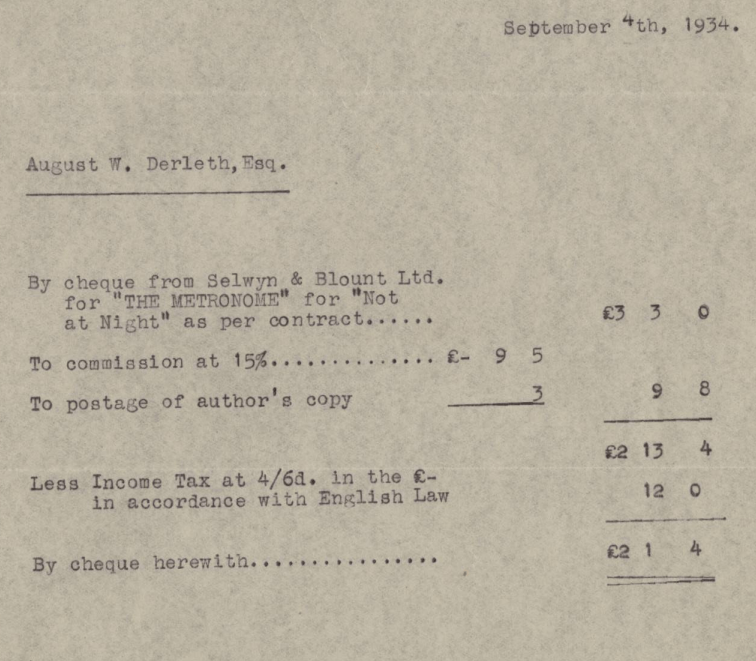
Accounts sheet for sale of “The Metronome”

The exchange rate for British pounds (pre-decimal) to U.S. dollars was about 1:4, so Derleth was perhaps a bit unhappy to find that his three guineas came out to only about $10.33 after fees, postage, and taxes. Still, Weird Tales only offered $20, or about half a cent a word, so Derleth didn’t do too bad overall.

Thomson scored a small coup when she sold Derleth’s story “Hawk on the Blue” (based on a story in a letter from Robert E. Howard) for 8 guineas (although after various costs, this came out to a bank draft for $26.94). Other stories were met with various comments; Regarding “Muggridge’s Aunt,” Thomson wrote: “I am not quite certain whether it is horrible enough for Not at Night, the readers of which like their blood laid on with a soupladle” (Thomson to Derleth, 24 Sep 1934). About “Gus Elker and the Fox,” Thomson wrote “we feel that it is too American to place over here” (Thomson to Derleth, 12 Oct 1934).

Through 1936, Thomson continued to act as Derleth’s British agent, generally failing to sell much of anything, though with the occasional success, and often a degree of unctuousness.

Dear Mr. Derleth,

We are going to have a Coronation Omnibus “Not at Night” next Spring and I want to include “THE TENANT”. The fee, being for purely reproduction work, is to be £1 per story, but I know that the money is of less importance to you than the publicity and I would dislike to have an Omnibus compiled from the previous eleven volumes without one tale bearing your name. I am contributing an introduction myself and shall refer to your other work, of course.

Yours sincerely,
—Christine Campbell Thomson to August Derleth, 17 Nov 1936

“The Tenant” did appear in the Not at Night Omnibus (1937), but the brief introduction doesn’t refer to that or any other work by Derleth (to be fair, it doesn’t mention any other author’s work either, and is dated February 1936; such things happen in publishing).

The final letter of the first part of Thompson’s correspondence to Derleth is dated 29 Apr 1937; there is then a gap. With the international postage rates and rather poor returns, it seems likely that Derleth gave up on Thomson as an effective British literary agent. Whatever the case, the correspondence was resurrected in 1941. In the intervening period, H. P. Lovecraft had died (1937), August Derleth and Donald Wandrei had formed Arkham House (1939), and Nazi Germany had invaded Poland, sparking World War II in Europe (1939). Derleth was apparently hoping Thomson might be interested in publishing an anthology he had put together: Someone in the Dark (1941).

You probably don’t know that even before the war I was trying hard to get a publisher to do pretty much what you are doing—a Library of authors of Weird Stories—I got one volume by Edmond Hamilton out but then life got too difficult. I have a collection of H. P. Lovecraft’s tales here, just waiting, and had planned to get in touch with you for a volume in due course. (By the way, I am sorry to see from your jacket flap that H. P. L. is no more. He was indubitably a master of his craft.)

I will go round and see what can be done about an English edition of this volume – though it will be difficult, owing to the paper shortage and the embargo on the importation of sheets. but I will certainly investigate the possibilities.
—Christine Campbell Thomson to August Derleth, 20 Oct 1941

The Edmond Hamilton volume was presumably: The Horror on the Asteroid and Other Tales of Planetary Horror (1936); a year or two later, Thomson divorced Oscar Cook, which seems to have ended the publishing arrangement for the Not at Night series and apparently put the kibosh on further weird publishing plans for a bit. The mention that Thomson had a manuscript collection of Lovecraft stories on hand must have come as a surprise, because in the next letter we read:

I am very much interest in the booklet and also in all that you tell me in your letter of your activities. I got the H. P. Lovecraft stories some years ago (about three or four at least) and my recollection is that I obtained them from Farnsworth Wright. At that time we sold the Edmond Hamilton tales to a small but satisfactory firm called Quality Press (still going) and at that time the Directors wanted to try and do a cheap popular line of horror stories, corresponding to the “Not at Night” series. The scheme fell through owing to the general slump and tightness of money, etc. but I have still got the Lovecraft stories here. There [sic] were all tear sheets. The Hamilton book was called “The Horror on the Asteroid” and I got it originally through David Hampton and subsequent dealings were with Dr. Schwarz, who appeared to be Hamilton’s agent. later on. [sic] I’ll try and get you a copy and send it over but so much stuff has been destroyed by enemy action that I may not be able to lay my hands on one.
—Christine Campbell Thomson to August Derleth, 31 Dec 1941

Farnsworth Wright had contemplated a collection of Lovecraft’s stories from Weird Tales as far back as the 1920s, but the dismal sales on The Moon Terror (1927) shelved any such plans indefinitely. In a later letter, Thomson says she may have gotten the tear sheets from Julius Schwartz, a teenage fan who was acting as Lovecraft’s agent in 1935-1936 and managed to sell At the Mountains of Madness and The Shadow Out of Time to Astounding Stories. In the same letter, she lets him know of her failure to sell Someone in the Dark due to wartime difficulties, and ads in response to Derleth’s dislike of Hamilton’s space opera stories:

I agree with you; I can’t do with interplanetary tales; I get giddy right away and feel that there is quite enough to deal with in and around this planet without bringing in the others. I could never care for the Edgar Rice Burroughes [sic] “Mars” stuff, which had some vogue years ago when I was very young!
—Christine Campbell Thomson to August Derleth, 2 Mar 1942

Never ask an editor her age; Thomson was born in 1897, and would have been in her teens when A Princess of Mars was published in 1912. Still, this might explain some of her choices for the Not at Night series, which tended toward the strictly supernatural, grisly, and earthbound over interplanetary fiction. The last letter of this part of the correspondence concerns the ongoing paper shortage and the war effort:

Dear Mr. Derleth,

We have been going through our stored MSS. and find we have a number of short stories by yourself, all of which I think are just copies. May we destroy these? The have been offered in all likely places without success. We have also the tear-sheets of the H. P. L. stuff; can I send these for the war effort also as they, again, are only copies; we have also tear-sheets of Seabury Quinn, are you looking after his work also and can you give me authority to destroy?

Yours sincerely,
—Christine Campbell Thomson to August Derleth, 11 Mar 1942

Derleth’s answer is unrecorded; though he probably cared little for tear-sheets (or the postage to have them shipped back to the United States) and had no involvement in Seabury Quinn’s affairs at the time. Here again, the correspondence breaks off, since the bid to find a British buyer for Someone in the Dark had failed, and the Lovecraft material Thomson had on hand was only copies of stuff Derleth already had.

The final letter in the file is dated 7 July 1954. The war had ended, the world upended, and Weird Tales would end its 31-year run later that year with the September 1954 issue. After WWII, editor Dorothy McIlwraith had made several attempts for a British edition of Weird Tales to be published, including a 28-issue run by Thorpe & Porter that ran from 1949-1953. Derleth’s Cthulhu Mythos tale “The Black Island” appeared in the January 1952 issue.

Dear Mr. Derleth,

It is many years since we corresponded, and the other day some one left a more or less current copy of ‘Weird Tales’ in the office and I took it out to read over lunch and found your firm still existing and good story by you called ‘The Black Island’. And so I am writing to you and hoping that you have not quite forgotten my name. I still have—and shall never part with—your ‘Place of Hawks’ and ‘Some One at the Door’ and the beautiful collected H. P. Lovecraft which you gave me. Now I am writing for information! I am doing a book on the Western tradition and mystery (chiefly of course the Celtic and the West referring to these islands and not to U.S.A.,) but for this I am doing a lot of reading round the subject and I am wondering you would let me know just how much of the Chtulhu [sic] myths are based on any fact. I am of course a believer in Mu, Atlantis and that sort of stuff; but so little is available about Mu, other than such books as ‘The Children of Mu’, that I wondering just how much of the Lovecraft-Derleth material is purely imagination based on scientific reading and how much is based on what you and I would reasonably call ‘fact’. If there is any of the latter, I shall go through the Lovecraft material again and if possible give a passing reference to his work and yours in the book in the introductory chapter of the sources, etc. of our mystery teaching in the West. If it is all fiction, it must go.

[…]

I would like to send you the best wishes for the Arkham Press and for the high standard of production which you had before the war and hope—and indeed am sure—that it is keeping its level.

Yours sincerely,
—Christine Campbell Thomson to August Derleth, 7 Jul 1954

This was presumably the early stages of what would become The Western Mystery Tradition (1968), published under her married name Christine Hartley. Whether or not Derleth took the time and postage to respond, there is no reference to Lovecraft in the book.

The Thomson-Derleth correspondence is superficially slight, since most of it is impersonal and concerns only the frustrating call-and-response of Derleth’s attempts to sell things to the British and Thomson’s typical replies that she tried and no one would bite. Yet what is interesting about this correspondence is that it gives at least some insight into what Thomson did—and did not—know about weird fiction, some of her attitudes on the kinds of stories she did and did not like, her awareness of the British markets and her general ignorance of what was happening on the other side of the Atlantic. To ask Derleth in 1954 if the Cthulhu Mythos was real shows how far Thomson’s finger was from that particular pulse.

Yet, despite a rocky start, this was apparently a professional and polite relationship, and a rare glimpse into several “what might have beens” in Lovecraft and Arkham House publishing.


Bobby Derie is the author of Weird Talers: Essays on Robert E. Howard and Others and Sex and the Cthulhu Mythos.

Deep Cuts in a Lovecraftian Vein uses Amazon Associate links. As an Amazon Associate I earn from qualifying purchases.

Her Letters to August Derleth: Lilith Lorraine

Lilith Lorraine was the pseudonym of Mary Maude Dunn Wright (1894-1967), a prolific poet, pulp fiction writer, editor, publisher, and early science fiction fan. It isn’t clear when exactly Lorraine and Derleth became aware of each other, though they shared interests in common, particularly fantastic poetry. If Derleth did not see any of her stories that were published in the 1930s, he would have heard of Lilith Lorraine at least in late 1943, when Clark Ashton Smith mentioned her to him in a letter (EID 341). Derleth would also probably have noticed her poems “The Acolytes” (1946) and “The Cup-Bearer” (1951), but they do not appear to have had direct contact with one another, since as late as 1950 Clark Ashton Smith was still offering to act as a go-between (EID 417). For her own part, based on Smith’s letters Lorraine was clearly aware of Derleth as the editor and co-founder of Arkham House.

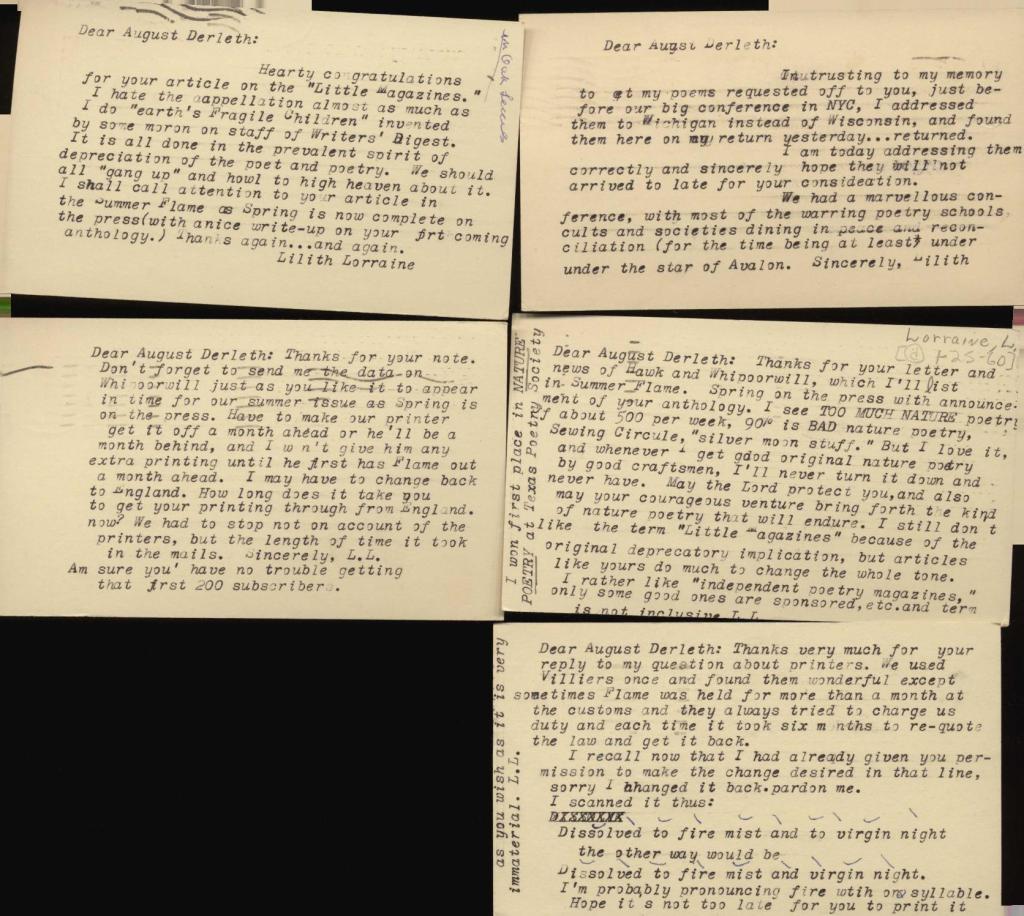
The file of correspondence at the Derleth Archive of the Wisconsin Historical Society is a bit thin: 11 pieces of correspondence, mostly notes and postcards, most undated, in Box 32, Folder 9. There may well have been other bits of correspondence over the years that was lost or misfiled, but based on the contents this correspondence seems to have covered roughly 1959-1963, which coincides with the latter years of publication of Lorraine’s poetry magazine Flame (1954-1963), which later merged with another ‘zine to become Cycle*Flame. At the same time, Derleth was trying to promote his own poetry ‘zine Hawk & Whippoorwill (1960-1963) and publish the anthology Fire and Sleet and Candlelight (1961, Arkham House), and the crux of the correspondence seems to cover their mutual selling of poems to each other and promoting their respective magazines.

Sample of Lilith Lorraine’s postcards to August Derleth.

The “article on the ‘little magazines'” that Lilith Lorraine mentions might be “Hawk & Whippoorwill: Poems of Man and Nature,” a form letter that was sent out to advertise Derleth’s new poetry magazine; curious readers can find it reproduced as Item 65 in Arkham House Ephemera.

It is not clear how many poems Derleth actually placed in Flame, as there is neither a complete index to the magazine nor a complete index to Derleth’s poetry. Three poems were definitely published: “Moon and Fog” (Summer 1959), “Fox by Night” (Spring 1960), and “Satelite” (Winter 1961). The letters and notes suggest the acceptance of “Lantern in the Winter Woods,” but if that was published in Flame, I have not yet located the issue.

For his part, Derleth solicited and accepted five of Lorraine’s poems for his poetry anthology Fire and Sleet and Candlelight, including “Case History,” with the correction she noted:


CASE HISTORY
by Lilith Lorraine

When all his seas with serpents were aflame
And he was God trapped in his universe,
A dark and shadowed loneliness, whose name
Wavered like plumes above a phantom hearse,

The hearse moved on and six phantasmal steeds,
Pawed the gray emptiness of outer space.
And scattered all his comets and his creeds,
With muted thunder and malignant grace.

His mind constricted to the planet’s core,
Dissolved to fire mist and virgin night,
Until upon a sea without a shore,
He stood ungarmented, a naked light,
Alone once more upon the terrible coasts,
And desperately tired of gods and ghosts.

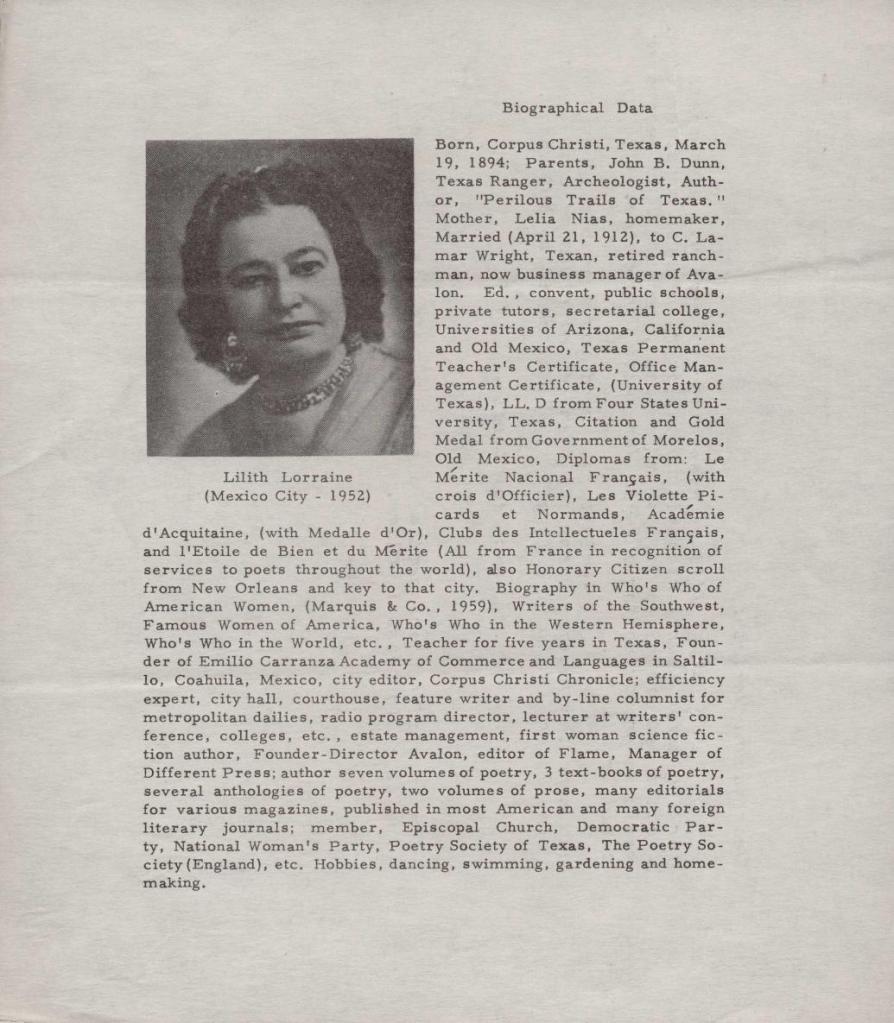
There is a printed biographical flyer in the folder of correspondence, and Lorraine may have sent this to Derleth in response to a request for biographical data for the back pages of Fire and Sleet and Candlelight, which includes the entry:

LILITH LORRAINE was born in Texas and still lives there, where she edits Flame and manages the Different Press. She has written extensively in the field of science-fiction, and is an active proponent of the best in poetry, at the same time serving as an exponent of the traditional in verse as opposed to obscurantist and incoherent experimentation. She is founder-director of Avalon. She is the author of several books, among them Wine of Wonder, Not for Oblivion, The Lost Word, and Character Against Chaos, and has for several years edited the annual Avalon anthology She has been distinguished for her activity all her life in behalf of poetry.
—August Derleth, Fire and Sleet and Candlelight 232

For the most part these brief letters and notes are cordial, but largely impersonal. Friendly, but not revealing great details of each other’s lives. These missives were written with a specific purpose, the horse-trading of poetry editors who are also poets themselves, and they seemed to get along well with one another.

Why did the correspondence cease? Perhaps time and energy in their personal and professional lives just led to a drop-off, since Derleth was no longer publishing a poetry journal or anthology, and Flame had gone on to its new incarnation. We are left with only a brief glimpse into the lives of two poets and editors, who ironically wrote little to each other of art or aesthetics, but who apparently appreciated one another’s work. After all, they each published the other.

Thanks to David E. Schultz for his help with this one.


Bobby Derie is the author of Weird Talers: Essays on Robert E. Howard and Others and Sex and the Cthulhu Mythos.

Deep Cuts in a Lovecraftian Vein uses Amazon Associate links. As an Amazon Associate I earn from qualifying purchases.
Her Letters to August Derleth: Everil Worrell

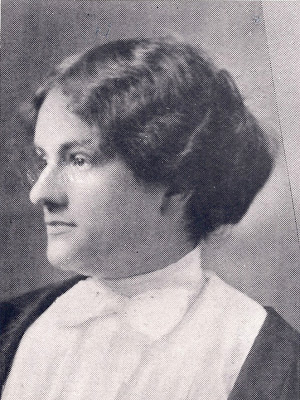
Everil Worrell (1893-1969) and August Derleth (1909-1971) were peers at Weird Tales, familiar names whose stories appeared in issues under both editors Farnsworth Wright and Dorothy McIlwraith. However, Worrell was never a member of Lovecraft’s circle of correspondents, never a player in the literary game that gave birth to the Cthulhu Mythos. As a consequence, it isn’t surprising that their correspondence seems to have been relatively sparse, and primarily involved business rather than personal matters.

The extant correspondence at the Derleth Archive in the Wisconsin Historical Society is relatively brief and incomplete: 8 letters, for a total of 15 pages, spread across two folders (Box 36, Folder 2 under her married name Everil Worrell Murphy; and Box 62, Folder 5 as simply Everil Worrell), covering the years 1947-1969, and all letters from Worrell. The sole 1947 letter concerns her story “The Canal,” which appeared in the Derleth-edited anthology The Sleeping and the Dead: Thirty Uncanny Tales (1947):

Dear Mr. Derleth:

Thank you for your most prompt reply. Of course I shouldn’t dream of reselling THE CANAL until after your stipulated period, since you are using it. The fact is that I thought maybe it had just gotten indefinitely pushed aside and you might not have any plans for it and might yourself be glad to resell it if I could not.

Thanks for the tip on cleaing with W.T., in case. Miss MacIlwraith’s manner both of acceptance and rejection is so extremely warm, that I imagine she will lean over backward to accommodate me in a small matter like that, should it come to that. Still on the other hand, since she and I are not in very close communion, she probably wouldn’t care what I did with it.

Of course, I am much more pleased to have THE CANAL come out in your anthology than in a paperback, and look forward to seeing it with the deepest pleasure. | By the way, the old girl I once spoke of as having porbably put in an oar vs. The Canal with Farrar & Rinehart (with which she claims the closest and tenderest ties, I’m told) is named Lillian McM. Meyer—believe it or not. I referred to her as Agnes Meyer, thus confusing her with a fine woman columnist here. Mrs. Lillian tells her name so frequently and with so much stress that one forgets what it is.

I must insist, however, that some of our Washington writers’ clubs are rather nice institutions. The Society of Free Lance Writers, of which I have been president these last two years, gets its members some pretty nice contacts—including for me some nice collaboration on my second try at a novel. Mr. Seabury Quinn gave us a very fine talk last week. I wish you were ever in Washington at a time when I could impose on your good nature; if ever you are and feel willing to be a martyr to a good cause, do please let me know.

Sincerely and cordially—
Everil Worrell Murphy

—Everil Murphy to August Derleth, 4 Mar 1947,

Worrell’s praise for the Society of Free Lance Writers is understandable; she was the president for some years.

There is a question about the first anthology appearance of “The Canal,” as the ending was substantially changed and abridged in The Sleeping and the Dead versus the original 1927 publication—and the 1927 text was also used in the 1935 reprint in Weird Tales, the 1948 Avon Fantasy Reader reprint, and most others that I’ve been able to lay hand or eye on. In The Weird Tales Collector #1 (1977), Robert Weinberg said that “August Derleth asked for a rewrite of the ending of ‘The Canal'” (14); the surviving letters do not mention a rewrite, but possibly some correspondence has been lost or was filed elsewhere. Derleth had a reputation for sometimes altering stories in some of his collections and anthologies; and suspicion has fallen on him for the severe abridgment. However, there are no answers in this or any other letter in the Worrell/Derleth correspondence, scanty as it is.

One more mystery.

The next chronological letter from Worrell to Derleth is dated 18 Feb 1963. The timing makes sense for a renewed correspondence; The Sleeping and the Dead: Thirty Uncanny Tales (1947) was split into two paperback reprint volumes: The Sleeping and the Dead: 15 Uncanny Tales (1963) and The Unquiet Grave: 15 More Uncanny Tales of Terror (1964), which included a reprint of “The Canal” (in its abridged form).

Several of the letters are Worrell submitting short fiction, novellas, or poetry, presumably for Derleth’s anthologies. Some of these works (“Last Return,” “The Jungle” (a poem), “The Liger,” “Believe in Tangibles,” “Woman from Peak Town,” “Hell is Murky,” “Magic Casements,” and “Night Should be Black”). None of these works are known to be published; it isn’t clear if any of the manuscripts survive, although the full text of “The Jungle” is included in one letter. Some of the synopses she provides are interesting, however:

  1. Believe in Tangibles.
    About 7-8,000 words (similar length to Canal). It has no vampire, but a demon doctor who is betrayed by his shadow on the wall, just in time to save the hero from a lobotomy because he has contacted extraterrestrial anti-demonic entities.
  2. Woman from Peak Town.
    About 20,000 words I have this labeled, but it is a straight story line uncomplicated enough to cut drastically at cost of “atomosphere” and mood stuff. This is a straight (and gruesome) vampire story, narrated by an observant slightly elderly doctor.
  3. Hell is Murky.
    20,000 words. I seem to have sent this to Fawcett’s Gold Medal Books, God knows why, becauseI have this comment which I enclose for info.

    This has a vampire (male) at the core of a Hellish Empire in a worn out part of the Capital of our Nation in which gangsters, voodoo worshippers, et al, cooperate.—There is so much cooperation it would not cut.
  4. Magic Casements.
    20,000 words, but could be much cut (not so much as Woman from Peak Town)—at same cost of atmospehre and mood. The story line would stand it.

    Spaceways Mag wanted to publish this but failed, and returned it. Said if he reopened would ask for it back, but didn’t ever reopen—to my knowledge at least.

    The scientist hero of Casements married a mysterious lady who turned out to be from Venus. On Venus, higher forms of life retain some of the fluid protean quality of our lowest forms of life. Sandra wears sari-like cover-all garments; she turns out to have a slight problem of tiger fur on her body. In Earth’s malefic magnetic field, she has only three months before going killer-tiger. This causes Horror to raise its ugly head, and calls for drastic measurs. Actually, a were-tiger with our Earth serving here as the full moon serves to change the were-man to were-wolf.
  5. Night Should be Black.
    20,000 words. Could be cut—some—but it might cut out the author’s heart.

    Gwen, nine years old, is left in a select boarding home when her mother is off to Europe to write a column for her paper. The lady proprietress is a witch. The visiting doctor is head of the coven. Two servants are cannibals from new Guinea (tribe of Mundogumors). They transfuse blood both in and out of the kids and have cannibal feasts, and select a few for training for witchcraft, and Gwen is one of the chosen lucky ones. The murdered mother of a boy of her age works a little white magic, and Gwen is a smart little girl and a nice child at heart, and she and the boy escape. (But the menace is still loose in the world.) There is a touch of medieavalism in this story.

—Everil Worrell to August Derleth, 1 Mar 1963

Given how relatively little we have from Worrell on her writing and unpublished works (a few letters published in Weird Tales and a short biographical essay written by her daughter Eileen), the letters to Derleth are an invaluable insight into what else she wrote.

There is another gap; after 1963 the letters jump to 1967. These letters seem a bit more personal, or at least conversational. In one, she describes a meeting of the League of American Pen Women, which concludes:

At the end of this meeting, I found myself trying to give them a slight glimpse into the Cult of Chulthu [sic]! Although I was never much more than a “Square” observer on the C of C, I did my best—since there seemed to be a “Need to Know.” I’m more at ease with ordinary witchcraft, vampirism and demonology—perhaps. But, leave us all hang together. (And now I’m one of the Old Ones myself, chronologically speaking.)

N’Gai ? ?
—Everil Worrell to August Derleth, 12 Mar 1967

Another letter that same year consoled Derleth on his divorce and having to raise his two children as a single parent (“a note of sympathy and understanding, on this deal of being father and mother both”), the death of her husband after only a few years of marriage (“Only 8 years later […] did I learn that he might have been murdered. The theory was it had to do with foreign cartel patents.”), her bad luck with magazines and publishing after Weird Tales ended in 1954 (“I’m sure I brought the curse on them. I even folded an English publishing house which was going to bring out the first of my two novels”), and memories of happier days:

When I think of things “gone with the wind,” we had in our NY apartment, all over the walls those sketches for the WT covers when you had the cover story, which F.W. let me have. When we brought the baby home we took them down—not wanting to over-weirdize her infantile sub-conscious.
—Everil Worrell to August Derleth, 17 May 1967

Farnsworth Wright, editor of Weird Tales, apparently often gave authors the cover painting or sketch, according to Seabury Quinn and others. She also recalled a less happy case of impersonation:

It was only an anti-climax when a man who had written for WT told a lot of people here that he had written all my stories anyway and, wanting a pen name for variety had begun using “Everil Worrell” when I was just a little girl, to give me a childish thrill.
—Everil Worrell to August Derleth, 17 May 1967

I haven’t been able to pinpoint this impostor in any period fanzines or convention reports; there was some speculation that O.M. Cabral was one of Worrell’s pseudonyms, which appeared in a couple of places, and this might have contributed to a general misconception. Terence E. Hanley touches on this in his excellent overview of her career at Weird Tales at the Tellers of Weird Tales blog.

Everill Worrell’s final letter to August Derleth is undated, little more than a note scrawled on a printed copy of “The Jungle,” a poem that is spiritually a successor to Lovecraft’s “Providence in 2000 A. D.” and depicts a Washington, D.C. overrun with Black people. A note in brackets says “[1969],” and Worrell’s note includes the phrase “Black is beautiful” (though she does not agree with the sentiment), which suggests she may have been reacting against the Civil Rights Act of 1968 that removed segregation in housing.

A sour note on which to end, but it must be remembered that such prejudices were all too common, and for all that we laud the progress achieved by the decades-long struggle of the Civil Rights movement, every legislative victory faced a reactionary backlash.

During the later part of her life, she became increasingly lame, the result of a fall when she was 17. When she reached the point where she needed two canes to walk, she left office work and settled down to full retirement. She missed Weird Tales very much then because she had plenty of time to write but no one to write for. She was always an enthusiastic reader and had become interested in the suspense story. At the time of her death, she was just getting into her third novel.
—Jeanne Eileen Murphy, “Everil Worrell” in The Weird Tales Collector #1 (1977), 14

Everil Worrell’s correspondence with August Derleth ended with her death on 27 November 1969. While she was one of the most prominent women in Weird Tales during its heyday, her difficulty placing later stories shows how difficult it was to catch and hold the zeitgeist, or perhaps how little relative name recognition she had outside of Weird Tales during the period. The synopses of her stories sound a bit old-fashioned by the standards of the 1960s, very pulpish plots—but also surprisingly dark and lurid. Who knows what lost diamonds in the rough readers might have missed, since they were never published?

These letters to Derleth, in the ultimately vain hope of further publication, show Everil Worrell as she was, warts and all—and with the resurgence of interest in her life and fiction, they should form a part of the understanding of her life and work.


Bobby Derie is the author of Weird Talers: Essays on Robert E. Howard and Others and Sex and the Cthulhu Mythos.

Deep Cuts in a Lovecraftian Vein uses Amazon Associate links. As an Amazon Associate I earn from qualifying purchases.
Her Letters to August Derleth: Dorothy McIlwraith

From 1926 to January 1940, Farnsworth Wright was the editor with whom August Derleth dealt at Weird Tales. Wright had bought Derleth’s first story, and while Derleth would never have the acclaim and popularity of Seabury Quinn, H. P. Lovecraft, Robert E. Howard, Clark Ashton Smith, or Edmond Hamilton, he was dependable and productive. While much of Derleth’s weird fiction consisted of workmanlike potboilers that lacked the delicacy and character development of his regional fiction, he seemed to almost always have something suitable to fill space in the Unique Magazine—and through diligence and competence, placed more work in Weird Tales than almost any other writer.

When Farnsworth Wright was fired, Dorothy McIlwraith (1891-1976) moved into the editorial chair, assisted by her secretary D. Lyn Johnson and associate editor Lamont “Monty” Buchanan. For the last fourteen years of Weird Tales‘ existence—and a little while after—August Derleth corresponded with Dorothy McIlwraith. While Wright had known Derleth as a tyro and help shape him as a pulp writer, McIlwraith would know him as a mature writer and businessman. Not just as a writer submitting stories, but as the publisher of Arkham House (who bought ad space in Weird Tales), an anthologist republishing stories from Weird Tales (which required permission to use, since Weird Tales had bought the rights), and as the unofficial agent for H. P. Lovecraft’s estate and Henry S. Whitehead.

During Dorothy McIlwraith’s tenure as editor, she published 63 stories by August Derleth, plus a couple of reviews and letters, and not counting the stories from Lovecraft and Whitehead. The file of correspondence at the Derleth archive at the Wisconsin Historical Society is relatively sparse and incomplete: 62 letters from Dorothy McIlwraith (at least one other letter exists in private hands), plus a handful of letters to Johnson and a dozen or so to Buchanan, and 3 copies of letters from Derleth to McIlwraith. Overall, about 101 pages of correspondence, which doesn’t cover nearly everything; notably there’s a massive gap between 1948 and 1954. What happened to this correspondence is unknown.

What correspondence we do have, covering 1940-1948 and 1954-1955 gives good insight into a professional working relationship between a pup editor and one of her most important writers/agents: cordial, polite, sometimes deeply insightful into Weird Tales‘ business practices, but also generally impersonal, succinct, and not afraid to reject Derleth on occasion. The first extant letter gives a good overview of the content:

Dear Mr. Derleth:

I was exceedingly glad to receive your letter of June 19th, and should like to think that we are going to see something of yours again as a possibility for WEIRD TALES. We all feel that it is unfortunate that we have had to make the magazine a bi-monthly, and we are all hoping that that condition is only temporary. Times are very difficult, of course, in the pulp paper field, and we are feeling it in every direction. We do hope to keep the magazine continuing however, on its present basis, and for better conditions before too long a time.

We plan to use “The Sandwin Compact” in the next issue which will be made up – that is, Novemeber, published September first. Meanwhile, if you have something else which you could send along for us to read, we should be very glad indeed to see it. We very definitely do not plan to make any great change in the magazine’s editorial policy, and most emphatically we do not plan to make it a horror magazine. Indeed, all our editorial selections have tended to be in the opposite direction.

Yours sincerely
WEIRD TALES
Dorothy McIlwraith
Editor
—Dorothy McIlwraith to August Derleth, 25 Jun 1940, MSS. Wisconsin Historical Society

The comment on “we do not plan to make it a horror magazine” was with regard to the direction of Weird Tales. Under Farnsworth Wright, Weird Tales had published a broad range of “off-trail” stories that wouldn’t fit in most other magazines, including stories of fantasy, the supernatural, science fiction, etc.—and while there were many ghost stories and the occasional weird crime tale, the magazine was never solely dedicated to horror, and it never catered solely to the more gruesome blood-and-bones, torture-heavy fair of the shudder pulps. McIlwraith was reassuring Derleth that Weird Tales wasn’t going to lower its standards or cater to the lowest tier of pulp reader.

In truth, there were changes coming. McIlwraith had neither Farnsworth Wright’s long experience with weird fiction, nor the leeway to chase trends which Wright sometimes did to try and attract new readers. With the sudden competition that had blossomed in the field, McIlwraith found herself unable to pay for the top talent, devoid of some of the biggest names in Weird Tales (Robert E. Howard, H. P. Lovecraft), and stuck on a bi-monthly schedule which made it difficult to run serials—a three-part serial would take six months to complete.

With magazines like Famous Fantastic Mysteries focusing on reprints, Unknown on the more contemporary style of fantasy, and Astounding focusing on science fiction, McIlwraith chose to center Weird Tales on what she perceived as its core audience and focus: Edgar Allan Poe-style tales of supernatural horror and the macabre. All original, with no reprints (at least at first). She invited some of the big name authors from her other magazine, Short Story, to submit; she wrote to past authors like August Derleth asking them to submit; she sought to develop new authors like Ray Bradbury and Manly Wade Wellman—and, to give readers what they wanted, she sought to publish Lovecraft. Which meant going through Derleth.

We have been much interested in reading the Lovecraft story “The Case of Charles Dexet Ward”, and certainly agree that it belongs in WEIRD TALES. It will constitue a problem, but we feel that it is one which can be solved. First of all the question of length is to be consdiered. And will you please tell us – are there likely to be other Lovecraft unprinted stories turn up, which might lessen the value of “The Case of Charles Dexter Ward” as a unique feature, and also be shorter – thereby being less of a makeup problem?

To use this story it will be necessary for us to break our policy of all stories complete – which we have felt to be wise for a bi-monthly magazine – and before we go to that length we should want to feel that this was indeed “the last of the Lovecrafts”. That point out of the way, our decision is that we can use “The Case of Charles Dexter Ward” on a basis of 40,000 words, in two parts – that would be at a price of $400.00. This will require some cutting but that actually will help the story – especially the early part. We should expect to use it in the May and July issues of WEIRD TALES next year. You see how difficuly it is to issue a bi-monthly!
—Dorothy McIlwraith to August Derleth, 8 Nov 1940, MSS. Wisconsin Historical Society

While the idea of cutting a Lovecraft story for length to fit might seem sacrilegious, it was business as usual in the pulp field; Farnsworth Wright was no less hesitant when dealing with Lovecraft himself, and it was Wright who began the process of buying and publishing Lovecraft stories from Derleth after Lovecraft’s death, for the aid of Lovecraft’s surviving aunt Annie Gamwell. As it happened, this was not “the last of the Lovecrafts”—not be a long shot. The unearthing of “new” material Lovecraft’s papers or old amateur journals fed into his posthumous fame, although it did mean the Weird Tales editorial team sometimes had to make excuses:

We are getting ready to use “The Shadow Over Innsmouth”, and in view of the fact that we talked last time a bit about “the last of the Lovecrafts”, we are going to have to do some covering. We shall say that we “discovered” “The Shadow Over Innsmouth” in a rare volume, and knowing that it had never had magazine publication we decided to withould no linger from our public this H. P. L. gem. I wonder if you wouldn’t give me some notes on the story to add to this statement – which we shall make in the Eyrie? If you would give me, perhaps, some of your impressions of this particular yarn in connection with other Lovecraft’s, I think it would be a good note.
—Dorothy McIlwraith to August Derleth, 7 Aug 1941, MSS. Wisconsin Historical Society

This was not technically a lie; the 1936 Visionary Press publication of The Shadow over Innsmouth was rare enough, and few of the readers would have known the story had previously been rejected by Farnsworth Wright, in part because of its length. McIlwraith actually managed to give Lovecraft his first cover illustration for Weird Tales. Derleth, for his part, provided the spiel that McIlwraith asked for:

The Shadow Over Innsmouth has never before seen publication in any magazine, or in any general form whatever, with the exception of once having been produced in book form in a privately printed and extremely limited edition. This tale is one of the best, the most exciting of the longer tales belonging to the Cthulhu Mythology. Reference to it was made in at least two of my WEIRD TALES stories ( The Return of Hastur, Beyond the Threshold), which more than anything I can say testifies to the powerful hold it has upon the imagination of its readers. The precise place of The Shadow Over Innsmouth in the Cthulhu Mythology is not certain, but Donald [Wandrei] and I have placed it between The Whisperer in Darkness and The Shadow Out of Time. It was written before The Haunter of the Dark, The Dreams in the Witch-House, and The Thing on the Doorstep, and only At the Mountains of Madness apart from The Shadow Out of Time followed it in the Cthulhu Mythos. That means that it followed closely in sequence upon some of the most successful of Lovecraft’s stories — The Dunwich Horror, The Call of Cthulhu, and The Colour Out of Space. It is a dark, brooding story, typical of Lovecraft at his best.
Weird Tales Jan 1942

In addition to the Lovecraft stories, Derleth sold his own pulpy Mythos and non-Mythos tales. As Arkham House ran through Lovecraft material, he turned to Weird Tales—and Lovecraft’s revision clients—for further material. As Weird Tales had the habit of buying all rights to stories when it could, that often meant reprint rights would be requested through McIlwraith, who appeared happy to grant them. While asking the original author for permission was polite, it legally wasn’t necessary unless they had retained reprint rights.

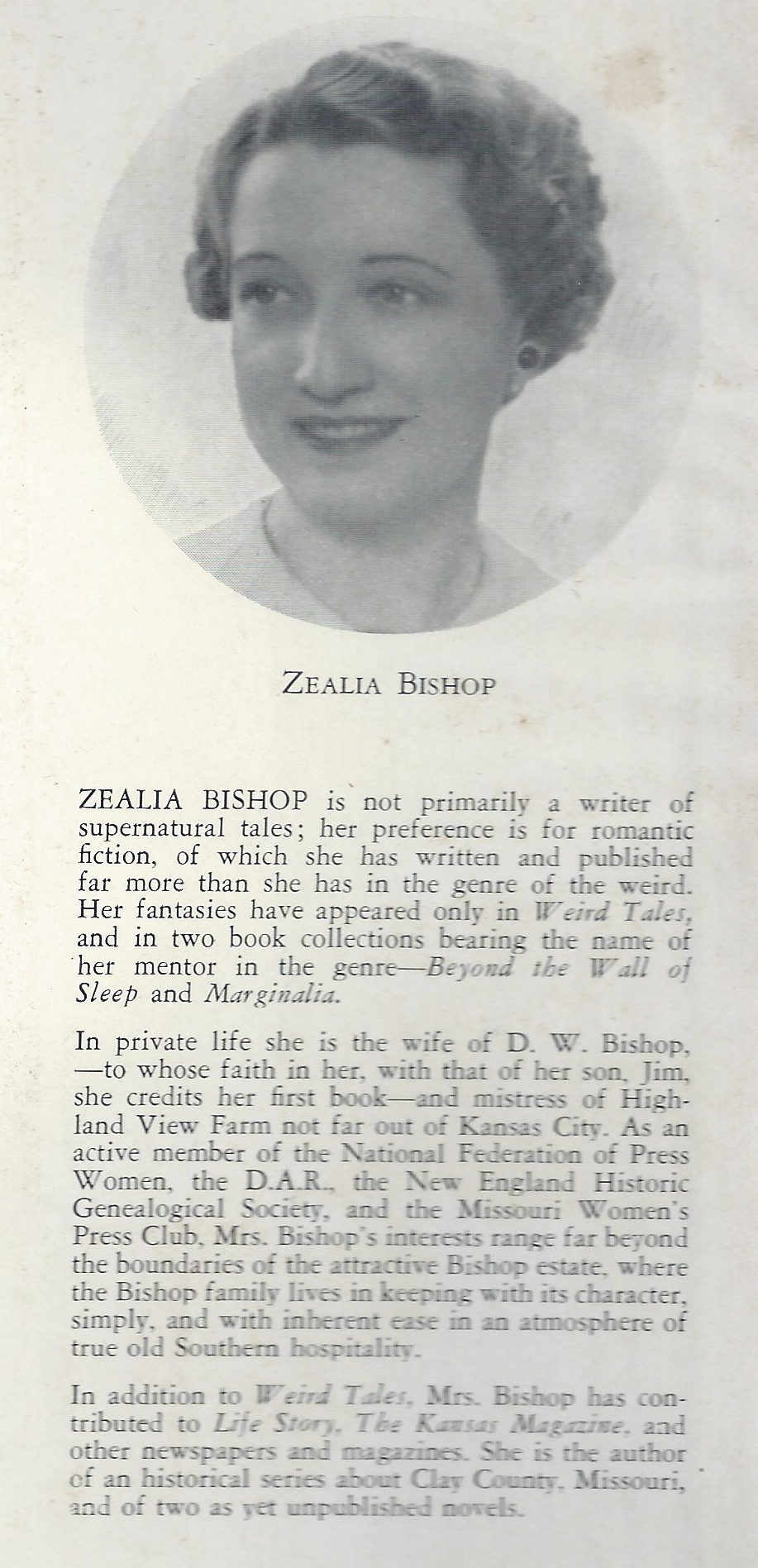
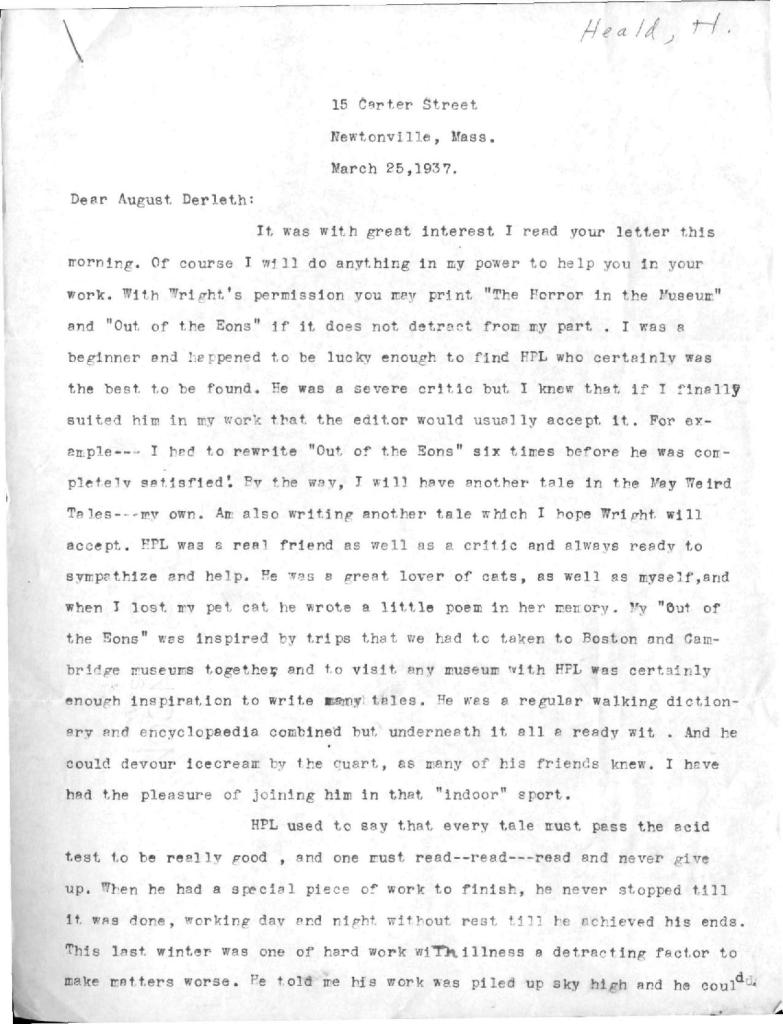
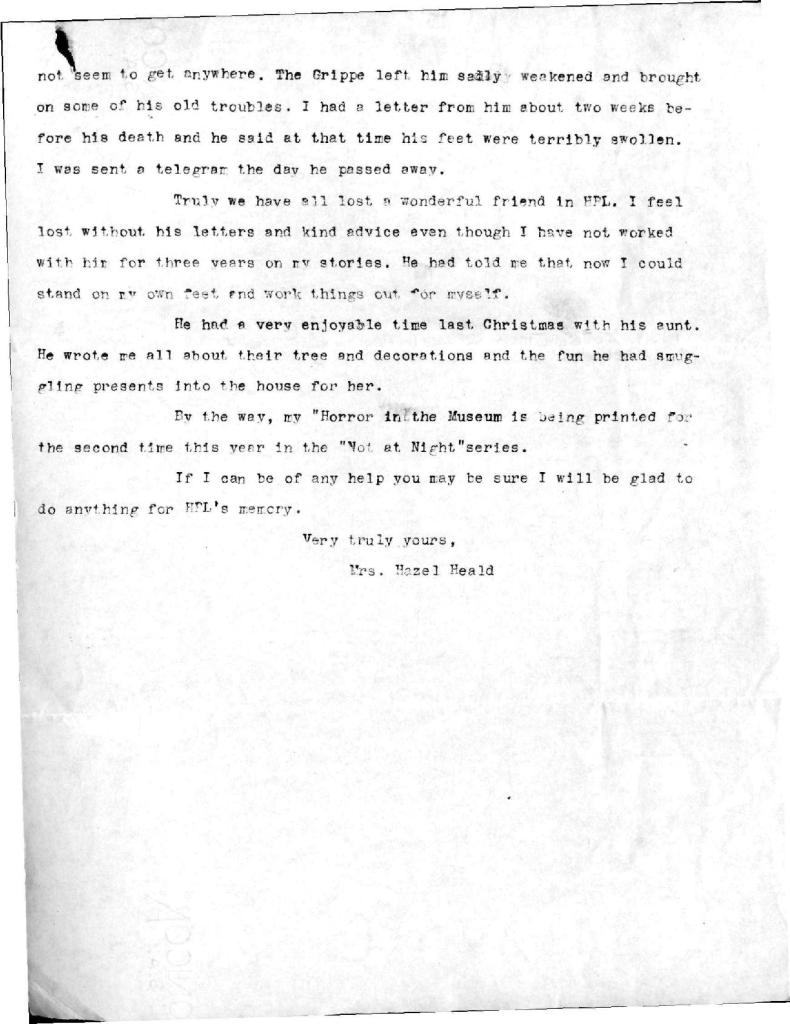
I should think you would be quite safe in assuming that the authors would be willing for you to use “The Diary of Alonzo Typer” by William Lumley, “The Mound,” “The Curse of Yig,” Medusa’s Coils” [sic] by Zealia Brown Reed (Bishop)[,] “The Horror in the Museum” and “Out of the Eons” by Hazel Heald even if you don’t hear from them direct.
—Dorothy McIlwraith to August Derleth, 14 May 1943, MSS. Wisconsin Historical Society

This permission paved the way for these stories to be included in Beyond the Walls of Sleep (1943), the second Lovecraft collection from Arkham House. Not all of Derleth’s projects necessarily came to fruition, however. In one letter, McIlwraith wrote:

Inasmuch as WEIRD TALES never bought any book rights, as far as I can make out, there would be no question about your being able to use the material in a book—”The Best From Weird Tales.” Of course we still hold the copyright, but your acknowledgement would take care of that.
—Dorothy McIlwraith to August Derleth, 27 May 1943, MSS. Wisconsin Historical Society

The idea of a “best of” collection of Weird Tales had been in circulation for a long time. The publishers of Weird Tales had tried it themselves with The Moon Terror & Other Stories (1927), a poor selection of tales that took over a decade to dispose of. The British Not at Night series edited by Christine Campbell Thomson did much better, and in the 1930s Weird Tales writers E. Hoffmann Price and Kirk Mashburn convinced Lovecraft, Howard, Derleth, and other writers to submit stories for a best-of anthology—Farnsworth Wright even appears to have given his blessing, but they failed to find a publisher that would take a risk on such a weird volume, and the project died.

Derleth mentioned The Best From Weird Tales in The Acoylte (Summer 1943), and described it as “20 to 30 tales representing the best from 1933 to 1943 ($3.00).” However, things didn’t work out. Wartime paper shortages, a lack of credit with the printer, some hold-up with the rights—the details aren’t available in the Derleth/McIlwraith letters. It wouldn’t be the last “Lost Arkham House” book, but it might have been the first. A glance at many of the other anthologies that Derleth had a hand in during the 1940s shows many stories from Weird Tales, perhaps the stars simply weren’t right yet for such a collection. One of the few copies of Derleth’s letters to McIlwraith preserved in the collection gives a prospective list of stories he wanted to use:

THE NIGHT WIRE, by H. F. Arnold
THE THREE MARKED PENNIES, by Mary Elizabeth Counselman
THE WOMAN OF THE WOOD, by A. Merritt
HERE LIES, by Howard Wandrei
THE SULTAN’S JEST, by E. Hoffmann Price
DEAF, DUMB, AND BLIND, by C. M. Eddy, Jr.
THE WIND THAT TRAMPS THE WORLD, by Frank Owen
THE WEIRD OF AVOOSL WUTHOQQUAN, by Clark Ashton Smith
THE HOUNDS OF TINDALOS, by Frank Belknap Long, Jr.
THE SPACE EATERS, by Frank Belknap Long, Jr.
IN AMUNDSEN’S TENT, by John Martin Leahy
REVELATIONS IN BLACK, by Carl Jacobi
MASQUERADE, by Henry Kuttner
THE PHANTOM FARMHOUSE, by Seabury Quinn
THE CANAL by Everil Worrell
THE TSANTSA OF PROFESSOR VON ROTHAPFEL, by Alanson Skinner
THE WAY BACK, by Paul Ernst
THE GHOSTS OF STEAMBOUT COULEE, by Arthur J. Burks
WAXWORKS, by Robert Bloch
BEETLES, by Robert Bloch
IN THE TRIANGLE, by Howard Wandrei
THE EYES OF THE PANTHER, by Howard Wandrei
WHEN THE GREEN STAR WANED, by Nictzin Dyalhis
INVADERS FROM OUTSIDE, by J. Schlossel
THE CHAIN, by H. Warner Munn
SHAMBLEAU, by C. L. Moore
THE TREADER OF THE DUST, by Clark Ashton Smith
THE THING IN THE CELLAR, by David H. Keller
—August Derleth to Dorothy McIlwraith, 3 Feb 1944, MSS. Wisconsin Historical Society

Several stories on this list are included among Lovecraft’s list of the the best stories from Weird Tales in his letters; notably absent are any stories from Lovecraft or Derleth—presumably Derleth figured he had those permissions covered. Many of these stories would show up in future anthologies by Derleth, but not all of them; it could be that the Best From Weird Tales was effectively spread out over several anthologies, interspersed with other material.

Not every interaction resulted in permission give or a sale made. When Derleth offered his first “posthumous collaboration” with Lovecraft, The Lurker at the Threshold, to Weird Tales for serialization, McIlwraith politely balked:

I just don’t see how we could manage it for WEIRD. I don’t feel serials in an every other month magazine are good, anyway, and such long installments are out for the durations–of the paper restrictions. Too bad from our standpoint.
—Dorothy McIlwraith to August Derleth, 17 Jan 1945, MSS. Wisconsin Historical Society

Over the years, the tone of the letters softens a little; “Dear Mr. Derleth” becomes “Dear August”; full signatures become replaced with a quickly scrawled “McI” or “Mac.” Yet there is always a reserve; this was business correspondence, first and foremost, and neither Derleth or McIlwraith ever raise a harsh word toward the other to spoil the relationship. On rare occasions, we get notice of some more personal sentiments and deeper insight into the philosophy of Weird Tales under McIlwraith:

Dear August:

Thank you very much for your letter of January 2nd about WEIRD. I certainly appreciated your interest and trouble in writing; also I most certainly agree with you that we do not want WEIRD to have a consistently flippant tone. We shall be careful on that score in lining up future issues.

Naturally, we have felt the magazine needs new blood from time to time, and are gratified that you agree with us that [Ray] Bradbury is a good addition to the list. [Harold] Lawlor is not such a consistent performer, but does seem popular with our readers; one thing which has always interested me is the fact that WEIRD TALES readers write us very much more frequently than those of SHORT STORIES. This holds true for the new people we are reaching in the present sellers’ market, as well as for the very vocal small body of self appointed fans.

Your friendship for the magazine is one of our most valued assets, so again thanks for your comments on the current issue.

With all best wishes for 1945, I am,

Yours sincerely,

WEIRD TALES
[Mac]
Doroth McIlwraith
Editor
—Dorothy McIlwraith to August Derleth, 10 Jan 1945, private collection

The November 1944 issue of Weird Tales was maybe a little more fun-oriented than most, but never reached the level flippancy of Unknown. Derleth presumably was afraid the two lead novelettes were a bit too unserious. At the other end of things, McIlwraith was still unclear about the community nature of Weird Tales fanbase—her changes to ‘The Eyrie’ distanced readers from writers and editor, and the implementation of the Weird Tales Club didn’t quite make up for the lack of direct feedback which made such a close and dedicated readership.

McIlwraith and the rest of the Weird Tales editorial team, however, was never driven by nostalgia, never backward-looking. Their vision of Weird Tales was always looking toward the future:

Miss McIlwraith and I were pleased to see the Robert E. Howard collection, “Skull Face and Others.” It is a pleasure to again read some of these yarns. One wonders, occasionally, where the Howards and Lovecrafts of the future will develop from. WEIRD TALES, of course, is always interested in new people and yet I find a story, for instance like [“]Mr George[“], just isn’t produced by the new boys but some of our old stand-bys.
—Lamont Buchanan to August Derleth, 30 Aug 1946, MSS. Wisconsin Historical Society

The post-war years saw Weird Tales struggle on, almost to the end of the pulp era. There is a gap in the archive that covers much of this period, as Weird Tales‘ competitors dropped out one by one, and the magazine struggled to retain readers and relevance. Despite the readers’ fondness for Lovecraft, McIlwraith wasn’t willing to buy any and all of Derleth’s Cthulhu tales.

Frankly, we like this latest Cthulhu the least of all our problem material, so it would seem logical to pass it up for WEIRD TALES. In any event, we couldn’t use it till well on in next year, and that is planning too far ahead for good magazine publishing practice. We don’t feel that we should so definitely commit ourselves on your own or sponsored material that we have no chance for future flexibility.
—Dorothy McIlwraith to August Derleth, 30 Jul 1946, MSS. Wisconsin Historical Society

Which is why there’s nearly a three-year gap between the publication of “The Watcher from the Sky” (Jul 1945) to “The Testament of Clairborne Boyd” (Mar 1949), which were the second and third parts of the “Trail of Cthulhu” series. Near the end, however, both Derleth and McIlwraith must have been willing to do what they could to shore up readership—and if that meant Lovecraft, then they would give them Lovecraft.

Dear Mac,

[…] Meanwhile, I’ve heard nothing from you about my proposal for a new series of Lovecraft-Derleth collaborations in Weird Tales. You already have THE SURVIVOR, which I hope can appear in the July or Septemeber issue. Three others are now ready—

WENTWORTH’S DAY, at 4500 words
THE GABLE WINDOW, at 7500 words
THE PEABODY HERITAGE, at 7500 words

There will be at least two more—or enough for an entire year of Weird Tales. And we might be able to turn up more thereafter, if the use of them has any noticeable effect on the sales of the magazines.

Do let me know about this as soon as you can, will you? I’ll send on the new stories whenever you’re ready for them; I’m not sending them along herwith because I’ve no assurance you want them.
—August Derleth to Dorothy McIlwraith, 24 Feb 1954, MSS. Wisconsin Historical Society

McIlwraith did want them. She was still looking ahead past the lean times. Yet of these stories, only “The Survivor” made it into print in Weird Tales July 1954—in what turned out to be its penultimate issue under Dorothy McIlwraith’s editorship. The Unique Magazine, which had run from almost the beginning of the pulp era to its end, finally shut its doors. As editor, and Derleth’s friend, it was McIlwraith’s sad duty to share the news:

Dear August:—

As a matter of fact, I am writing this at home, not from the office, the sad fact being that we have gone into receivership. As one of our editorial creditors, I think you will receive official notice to this effect, but am not quite sure of the procedure. It is a very sad time for us all; what the fate of the magazines—SS and WT—will be, we, of course, don’t know.

I have here: The Gable Window, The Ancestor, Wentworth’s Day, The Peabody Heritage, Hallowe’en for Mr. Faulkener * Also the Seal of R’leyh. It might be that whoever takes over WT might see the value of the Lovecraft tie-in, but I don’t know, and anyway you probably would be a better salesman than I, so let me know if I’ll return all the manuscripts. Personal mail will be forwarded.

I can’t tell you how sorry and grieved I am, so there’s no use trying—or crying.

Yours,
Mac
—Doroth McIlwraith to August Derleth, 15 Nov 1954, MSS. Wisconsin Historical Society

Sometimes, when a pulp magazine went bankrupt, the new owners would see the potential in the company and reinvest in the magazine. That had happened with Gernsback’s Amazing Stories in 1929, and Wonder Stories in 1936. However, it was the end of the pulp era. Pulp publisher Leo Margulies would end up buying both Weird Tales and Short Stories, but any attempt at revival was far in the future. McIlwraith’s last extent letter to Derleth is just an effort to pick up the pieces:

Dear August:—

I find that no sort of notification has gone out from the Receiver’s office to any author. I am sending on to them your last letter, and suggest that you write to the company at our last address—200 West 57th street—from which all mail not addressed personally is being forwarded to the proper authorities. Such a mess, and I am so sorry.

Yours,
Mac
—Doroth McIlwraith to August Derleth, 7 Jan 1957, MSS. Wisconsin Historical Society

As sparse as this correspondence may seem, it highlights several key aspects of the last phase of the original run of Weird Tales—McIlwraith’s efforts to produce a quality magazine of weird fiction, some of the restrictions she faced doing that, how Derleth fed her both his own work and that of Lovecraft and others, and in turn mined Weird Tales for material for his anthologies. It was a mutually beneficial relationship, and if McIlwraith did not always buy everything that Derleth was selling, that was just part of the pulp game and Derleth seems to have taken it in stride.

Would we have a Cthulhu Mythos if Weird Tales had ended up under another editor or ceased publication in 1940? While Derleth’s pulp Mythos tales weren’t up to the best of Lovecraft, they did keep Lovecraft’s name alive in a wide-circulating print magazine in a way that Arkham House’s expensive hardbound volumes could not. It certainly seems that McIlwraith’s initial unwillingness to serialize The Lurker at the Threshold led to Derleth to put off “posthumous collaborations” for several years—until the end, when they were desperate for anything to draw readers. Ironically, Derleth ended up with a number of stories and nowhere to publish them, so that most of the posthumous collaborations first saw print in the collection The Survivor and Others (1957).

Some of the gaps in the archive are unfortunate. We know C. Hall Thompson published two Mythos stories in Weird Tales: “The Spawn of the Green Abyss” (Nov 1946) and “The Will of Claude Ashur” (Jul 1947); we know Derleth put a stop to it, probably threatening legal action. It seems unlikely Derleth could have avoided mentioning the subject to McIlwraith, but there’s no letters about it in the archive, and the correspondence that does mention the affair is from years after the fact (cf. A Look Behind the Derleth Mythos 267-268, Letters to Arkham 201).

Since most of Derleth’s correspondence remains unpublished, any hints of his correspondence with McIlwraith in his letters to others is patchy at best. Comments in his letters with Clark Ashton Smith are about typical for pulp writers and editors—praising her when she buys something, bitter when she doesn’t. At one point, Derleth wrote:

Which reminds me that I’ll give Miss McIlwraith a line pushing your work, and hope it will stimulate her out of that peculiar lethargy which inevitably marks a woman who has for most of her active adult life edited an adventure stories magazine (SHORT STORIES).
—August Derleth to Clark Ashton Smith, 27 Apr 1943, Eccentric, Impractical Devils 328

Derleth would have been hard-pressed if Smith had challenged him to name any other women editors that fit that remark. Being editor of a pulp magazine wasn’t only a man’s game, but it was rare enough for a woman—and only Dorothy McIlwraith saw Weird Tales through its last 14 years, to the bitter dregs of its first run.


Bobby Derie is the author of Weird Talers: Essays on Robert E. Howard and Others and Sex and the Cthulhu Mythos.

Deep Cuts in a Lovecraftian Vein uses Amazon Associate links. As an Amazon Associate I earn from qualifying purchases.
Her Letters To August Derleth: Muriel E. Eddy

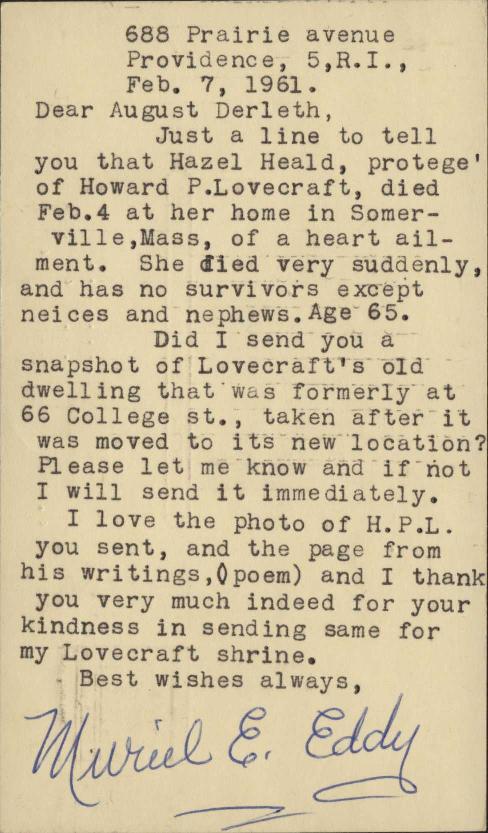
The correspondence of August Derleth with Muriel E. Eddy and her husband C. M. Eddy, Jr.—the two overlap and intertwine so much they have to be taken together, especially as later in life Muriel did the writing or typing for both of them—encompasses about 121 separate letters, postcards, and notes, for a total of approx. 222 pages. The bulk of this is spread out among three folders (5-7) in box 16 of the August Derleth archive at the Wisconsin Historical Society; a single letter is at John Hay Library.

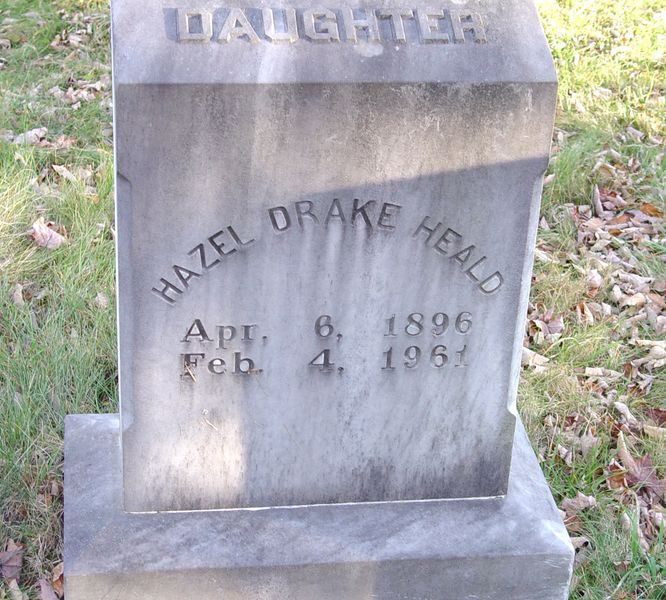
The correspondence ran from 1939 to ~1970. It appears to have begun from their mutual correspondent Hazel Heald, and from the publication of The Outsider and Others (1939) by Arkham House.

My dear Mr. Derleth—

Mrs. Hazel Heald, of Cambridge, Mass, told me that you had published a book of Howard P. Lovecraft’s weird stories—and I am wondering if you would please let me known just how much it is, where shall I send for it, if it contains a photo of our beloved H. P. L. and all about it.
—Muriel E. Eddy & C. M. Eddy, Jr. to August Derleth, 29 Nov 1939

Early correspondence was apparently either sporadic or not retained; there is almost a five-year gap between the 1939 letter and the next, in September 1944. After this, however, correspondence becomes more regular. Being in Providence and with access to the local newspapers, the Eddys kept Derleth apprised of relevant items that appeared in the papers during the critical 1940s period which saw important pieces published including Winfield Townley Scott’s “The Case of Howard Phillips Lovecraft of Providence, R. I.” (1943) and Sonia H. Davis’ “Howard Phillips Lovecraft As His Wife Remembers Him” (1948).

Besides local news, points of conversation included Derleth’s latest publications, Lovecraft’s ex-wife, C. M. Eddy, Jr. and H. P. Lovecraft’s work for Houdini (including The Cancer of Superstition), and some of the Eddy tales that Lovecraft had a hand in: “The Ghost-Eater” (Weird Tales Apr 1924), “The Loved Dead” (Weird Tales May-Jun-Jul 1924), and “Deaf, Dumb and Blind” (Weird Tales Apr 1925). Derleth would ultimately re-publish these stories, as well as a version of The Cancer of Superstition, in the Arkham House books Night’s Yawning Peal (1952), The Dark Brotherhood and Other Pieces (1966), and The Horror in the Museum and Other Revisions (1970), as well as The Arkham Sampler (Summer 1948).

Until the publication of Lovecraft’s own letters, these letters from the Eddys were the primary source of data on the revisions with Lovecraft, and likely influenced Derleth’s presentation of the stories. For instance, with regard to “The Loved Dead” and its putative banning:

The yarn started out to be a little short study in psychology under the tentative title of “The Leaping Heart”—i.e., a heart that leaped from sheer joy whenever in the presence of the dead. H. P. L. discussed it with me and we decided it might do for a W. T. story. One point we were agreed on was that as many of these tales told by a hero now deceased leave leave the reader completely up in the air as to how the story could ever have reached the public eye. H.P.L. calmly informed me that my hero was suffering from a medically-recognized mental ailment, and he couldn’t be blamed for anything he did during the course of the yarn. He even named the malady—a long Latin term which I had never heard before.

Once I had placed my hero in the graveyard, the story wrote itself. I asked H.P.L. to look over the first draft of the completed story, and decided only minor changes need be made.

Off it went to Weird Tales, but they, at first, were afraid to use it. Finally, the powers that be decided to include it in the big Anniversary Issue. They did!

Then the fun started!!

P.T.A. groups and church organizations in several parts of the country protested vigorously—and succeeded in having the issue removed from the newsstands in many cities and towns!

Some have been kind enough to say that this censorship stimulated enough of a demand for W.T. so that it helped save if from extinction! It’s always been my “pet” Weird Tales story!
—C. M. Eddy, Jr. to August Derleth, 12 Feb 1948

Derleth quoted this more-or-less verbatim in The Arkham Sampler (Summer 1948) when he reprinted “The Loved Dead,” Lovecraft had a slightly different recollection:

It may interest you to know that I revised the now-notorious “Loved Dead” myself—practically re-writing the latter half. […] I did not, though, devise the necrophilia portion which so ruffled the tranquility of parents & pedagogues on the banks of the Wabash.
—H. P. Lovecraft to Robert Bloch, [Mar 1935], Letters to Robert Bloch & Others 132

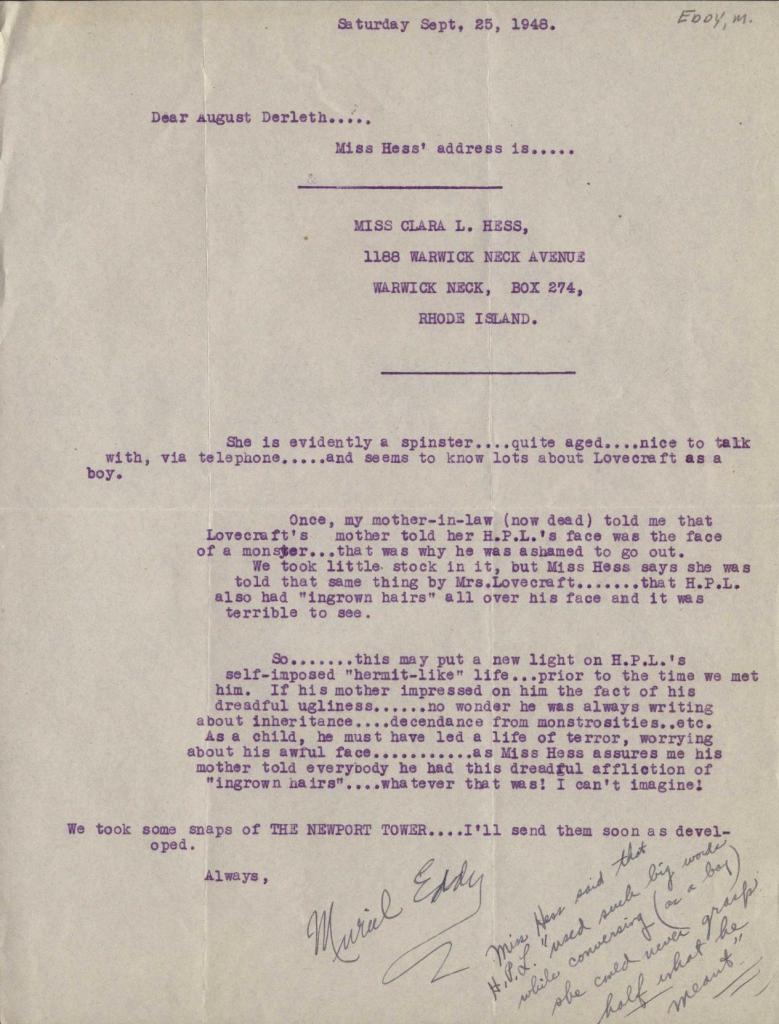
For all their ongoing interest in Lovecraft, which resulted in works like “Message in Stone” (1956) by Muriel E. Eddy and The Gentleman from Angell Street (2001) by Muriel E. Eddy & C. M. Eddy Jr., recollections in the surviving letters are fairly thin on the ground. As with some of Lovecraft’s other friends and correspondents, the Eddys only knew a part of Lovecraft’s life, and had a limited store of stories and insight to share. As an example, a letter dated 25 Sep 1948:

Clara Hess is the primary source for the idea that Lovecraft’s mother Susie Phillips Lovecraft found her son “hideous”; a letter from her was published in the Providence Journal 19 Sep 1948 by Winfield Townley Scott, and letters from Hess to Derleth survive that show Arkham House followed up on the lead for Lovecraftian lore.

For the most part, however, the letters from the Eddys to Derleth verge on the prosaic; for a while, she sent him clippings regarding the Newport Tower, and attempts were made to market some of C. M. Eddy, Jr.’s other weird tales, including “The Red Cap of Mara,” which was eventually published posthumously in The Loved Dead and Other Tales. Over the years, visitors to Providence stopped at the Eddys’, to talk about H. P. Lovecraft with someone that knew him.

Dear August Derleth—

I have erected a little shrine in my house in memory of Howard Phillips Lovecraft. I have so many visitors who are interested in Lovecraft that I decided to have a little corner devoted to “Lovecraftiana”—old “Weird Tales” with his stories, etc.—All I lack is a sutable photo of H. P. L. for the center. I wonder if you have one like that which appeared in one of his published books (published by you)—a picture of his face or profile—or a copy thereof which I might have? I only have the little snapshot of Lovecraft taken in N.Y. and it isn’t a very good picture for a memory-shrine!
—Muriel E. Eddy to August Derleth, 2 Dec 1960

Personal events made it in there as well; Muriel and Cliff would give their condolences on Derleth’s divorce, asked after his children, mourned the deaths of Hazel Heald and Clark Ashton Smith. The Lovecraft circle slowly shrank with the passing years.

One of the more notable anecdotes from this period involved fans visiting or writing:

Don’t you think, August, that it is amazing how so many young people love H.P.L.’s work? One young negro boy has written me that he has all of the H.P.L. stories and books, and loves them dearly!
—Muriel E. Eddy to August Derleth, 24 Feb 1965

While this happened a decade after the events of Lovecraft Country (2016) by Matt Ruff, it’s nice to think that there was a real-life Atticus Freeman out there enjoying H. P. Lovecraft.

Over the years, the Eddys dug through their accumulated correspondence for more material related to Houdini and Lovecraft, some of which was sold to collectors. C. M. Eddy, Jr. sent Derleth some extensive notes for “The Dark Brotherhood,” one of Derleth’s “posthumous collaborations” with H. P. Lovecraft, based on a dream Lovecraft recounted in one of his letters. The Eddys were getting older, and eventually were forced to retire and live off social security.

In 1964, C. M. Eddy, Jr. conceived the idea of a new story, based on the Dark Swamp incident, to be eventually titled “Black Noon”:

Now that I feel slightly improved as to my state of health I’m trying my hand at writing again. The story I’m working on is a novelette half fact and half fantasy—with the central character a prototype of the late H. P. L. Would you have any suggestion or recommendation as to the best possible market to try it on, as I’ve rather lost track of the fantasy market, during my years of non-writing.
—C. M. Eddy, Jr. to August Derleeth, 4 Jun 1964

While signed as by C. M. Eddy, Jr., the writing is Muriel’s. In truth, his health was on a downward spiral, as chronicled in Muriel’s letters to Derleth. Their daughter Ruth is frequently mentioned as trying to work and care for her aging parents.

Mr. Eddy finds it increasingly difficult to walk; he walks haltingly, with his cane. Since my operation, I find it quite hard to get out, much, but Ruth helps us both, in our dilemma. My operation was a tumor of the stomach—but not malignant! […] Mr. Eddy has not yet finished “Black Noon”, the H.P.L. yarn he has been working on—he seems to need encouragement. maybe you can give him the needed “mental stimulus.”
—Muriel E. Eddy to August Derleth, 27 May 1965

Cliff is on the waiting list to enter a hospital (ie: Doctor’s orders) as his stomach now is acting up.

I am pretty sad as he cannot hold anything; district nurses come now, to wash and dress him, and a “Sunshine lady helper” brought him an electric razor to help keep his face shaven. […] Cliff and I are now on “medicare”…saves money on prescriptions, anyway. […] Pray for Cliff. I hate to say “Goodbye” because we have been married so many years…since Feb. 10…1918.
—Muriel E. Eddy to August Derleth, 2 Nov 1965

Cliff rec’d letter and will send MSS. very soon.

He has written some of it by hand—His hand is shaky, but he may as well submit it “as is”, as his days are numbered.

He sleeps a very great deal—sometimes I can’t wake him easily. I am urging him on, to complete “Black Noon.”
—Muriel E. Eddy to August Derleth, 21 Dec 1965

Cliff needs cheering up, at this point. He is drowning in the sea of depression—I think a few lines from you might do wonders. I hope you will do a little favor for me. It’s “sneaky,” but God will forgive us both, I am sure—would you send Cliff a $5.00 check (made out to him) and I will re-imburse you. He must, however, never know I have re-imbursed you. With the check, you might just say: “This is to buy yourself more paper for ‘Black Noon.’ to which I still look forward, or whatever you need to complete the job!” (or say whatever you are prompted to say.”)

It may encourage him, as he has stopped short; he has H.P.L. almost in the swamp, the cat riding on his shoulder—now he says nobody cares, and he sometimes threatens to tear up the manuscript. […] The doctor says Cliff is depressed because his illness shuts him away from the world.
—Muriel E. Eddy to August Derleth, 19 Nov 1966

The Eddys had never asked Derleth for money before; to his credit, he appears to have acquiesced to this request.

Once more I have to tell you that Cliff is very sick again (complications) and doctor says if he pulls out of it, it will be a miracle. He has lost several pounds, and cannot remember very much of anything. […] Hospitalization is out of the question, because it is considered a chronic condition, incurable. So I am carrying on, with God’s help, hoping I am doing the right thing by him.

He cannot wear his dentures, so he can only eat soft foods, such as soft-cooked cereals, etc. that require no chewing.

He never did finish “Black Noon,” which I deeply regret.
—Muriel E. Eddy to August Derleth, 10 May 1967

C. M. Eddy, Jr. was hospitalized for a time, then spent the last few months of his life in a nursing home. He passed away in his sleep on 21 Nov 1967, at the age of 71. He and Muriel had been married 49 years.

With the death of her husband, Muriel E. Eddy carried on life as best she could. She was still interested in matters Lovecraftian, which formed her main bond with Derleth through the years:

It is terribly depressing to me not to have Cliff here. I got so used to talking with him, during the years of his illness. I still cannot imagine he has gone, beyond recall. So many things I want to talk over with him.

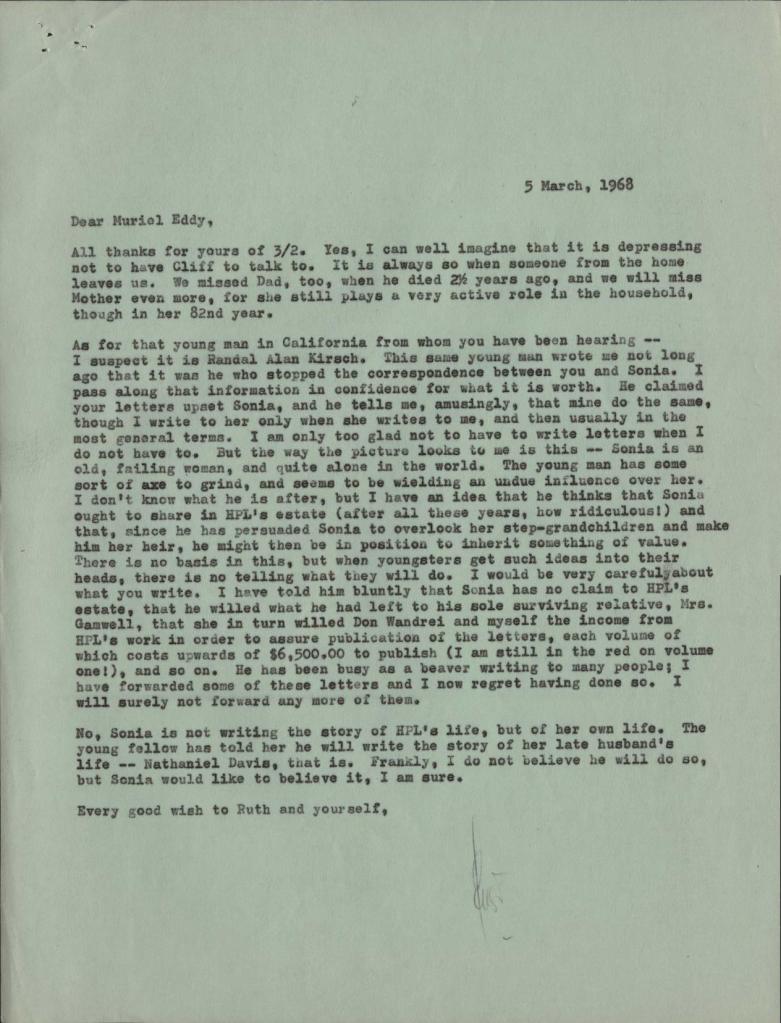
I have been hearing from a young man in California. Sonia (HPL’s ex) was writing to me, but suddenly she stopped. She had somebody in the Nursing Home write me that she was too ill with her heart condition to write, as she was writing the sotry of HPL’s life, or something like that. A thought came to me that it was because of a letter I wrote her mentioning Hazel Heald, for whom HPL used to revise material. I assured her that HPL did not ever speak of marriage to Hazel, but that Hazel (now at rest) DID very much like him. She typed some of his stories fro him to pay him for revising her work. She told me at the time she was going to write you and inquire if you wanted to incorporate it in anything you were writing about HPL, and that she would try to see if you would pay for it. believe me, that was not my idea at all, so if she did write, asking you, please do not blame me, August. Since then, she has not written to me. She just asked her room-mate to write me, letting me know she was financially at a low ebb, and that her health was very poor, and she wanted to reserve all her energy towards whatever she was writing or compiling.
—Muriel E. Eddy to August Derleth, 2 Mar 1968

The “young man” was Randall Allan Kirsch (who later changed his name to R. A. Everts). This was an ongoing headache for Derleth, as Everts made claims regarding Sonia H. Davis as a possible heir to Lovecraft’s estate, since their divorce was never finalized. Derleth kept carbon copies of his few letters to Muriel on the subject of Everts, possibly for safety.

Sonia’s autobiography would eventually be published as Two Hearts That Beat As One (2024) by Sonia H. Davis & Monica Wasserman (ed.).

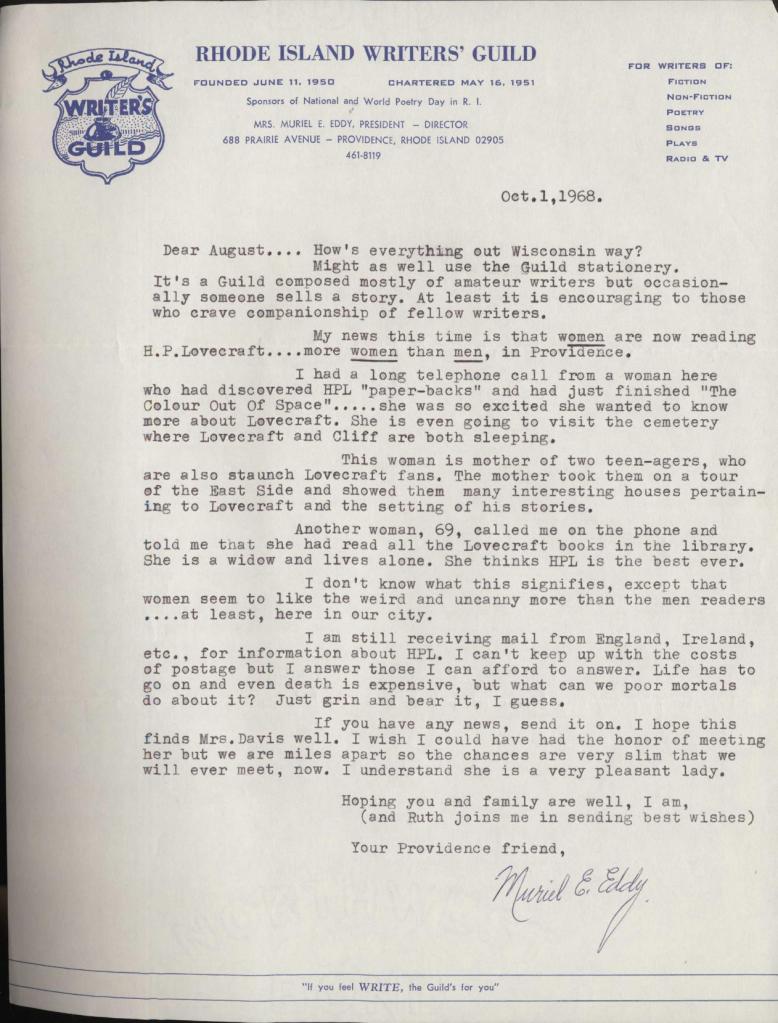
Another interesting late letter regarded women reading H. P. Lovecraft:

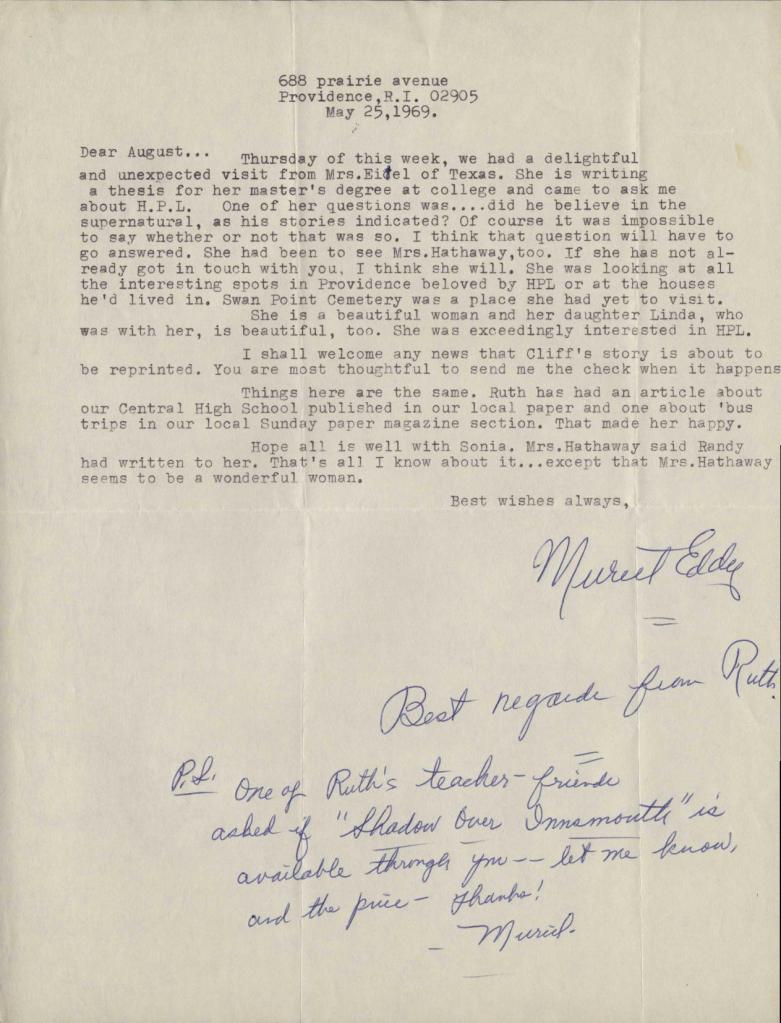
One of the women that Muriel heard from was Elaine Gillum Eitel of Texas, whose master’s thesis was The Sense of Place in H. P. Lovecraft (1970). Muriel E. Eddy had become a torchbearer for Lovecraft’s memory, and her letters with Derleth seemed to be a way for her to share her ongoing enthusiasm on the subject with someone else who could appreciate it.

One of the last items of correspondence in the Eddy folders at the Wisconsin Historical Society is a get-well card, signed by Muriel and Ruth Eddy, which must date to Sep-Nov 1969, when Derleth was hospitalized for 87 days, during which he had four operations. He survived until 1971, when a heart attack killed him and brought a final end to his long friendship with the Eddys. Derleth had set to publish the fragment of “Black Noon,” but those publishing plans died with him; it was eventually published in Exit Into Eternity (1973).

Muriel E. Eddy would live until 1978. It is difficult to summarize a friendship of twenty-odd years in letters in postcards; Derleth and the Eddys shared an interest in Lovecraft, but their correspondence went beyond just that, as they revealed more of their personal Iives to one another. It is difficult to extract Muriel from the men in her life; she wrote little in her letters to Derleth about her own writing and work, though she was a pulp writer and poet in her own right. Since she tended to focus on romance rather than weird fiction, perhaps Derleth had little interest, or perhaps she was simply diffident on the subject.

While some of Muriel’s letters appear gossipy to the extreme, it has to be remembered that Derleth would have been one of her major outlets for all things Lovecraft-related, and probably one of the few social outlets she had while caring for her ailing husband. If Muriel’s memories or deductions about Lovecraft were not always correct, she seemed at the least to never wish to tarnish Lovecraft’s posthumous reputation. The end of her correspondence with Derleth marked the closing in a chapter of the book of history, as one more voice that knew Lovecraft grew silent, never to share her memories again save by what had made it into print.


Bobby Derie is the author of Weird Talers: Essays on Robert E. Howard and Others and Sex and the Cthulhu Mythos.

Deep Cuts in a Lovecraftian Vein uses Amazon Associate links. As an Amazon Associate I earn from qualifying purchases.
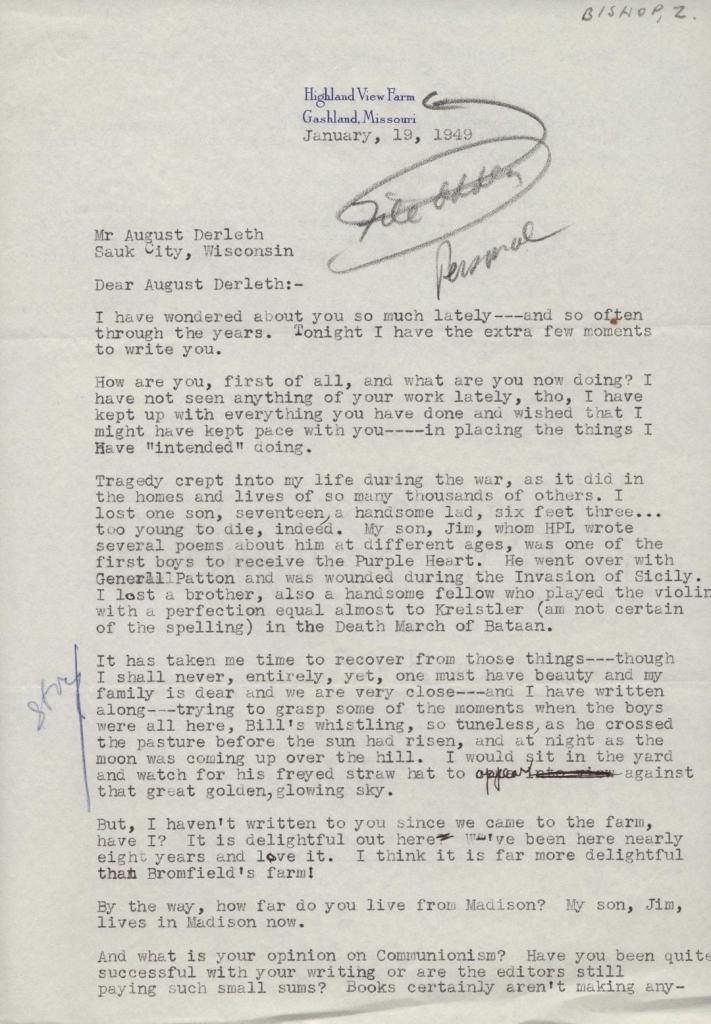
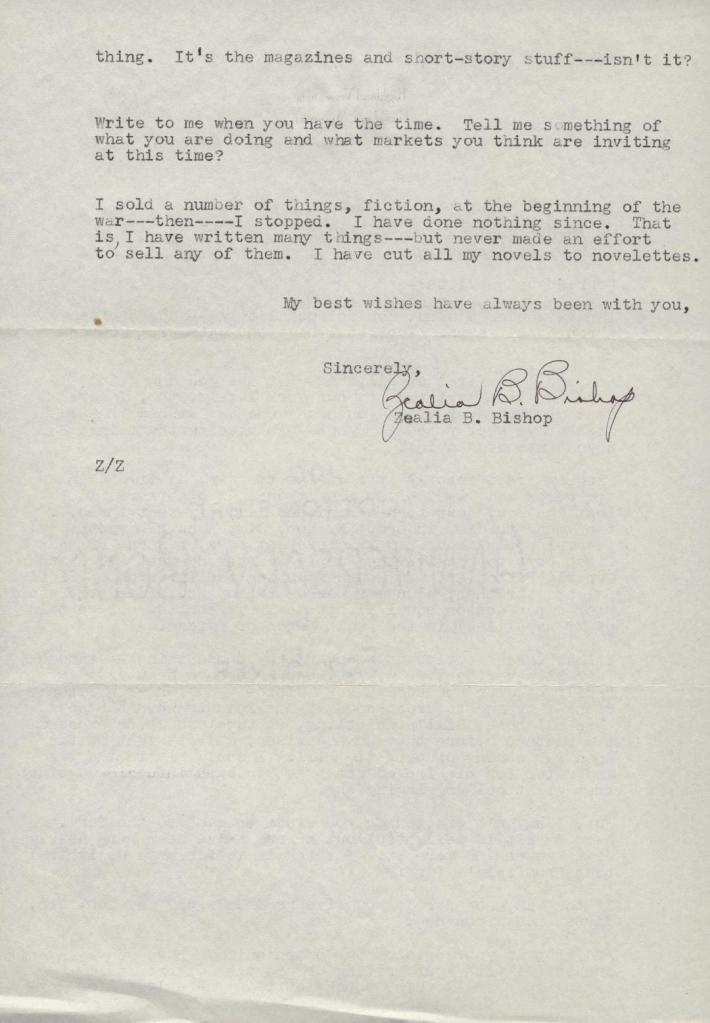
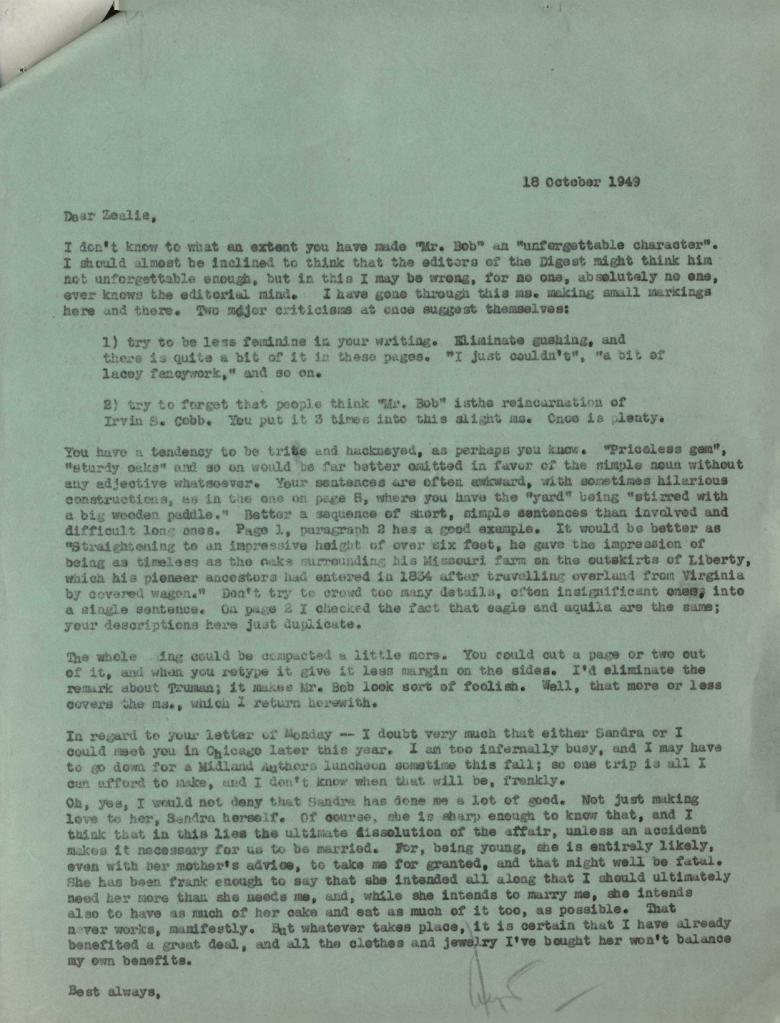
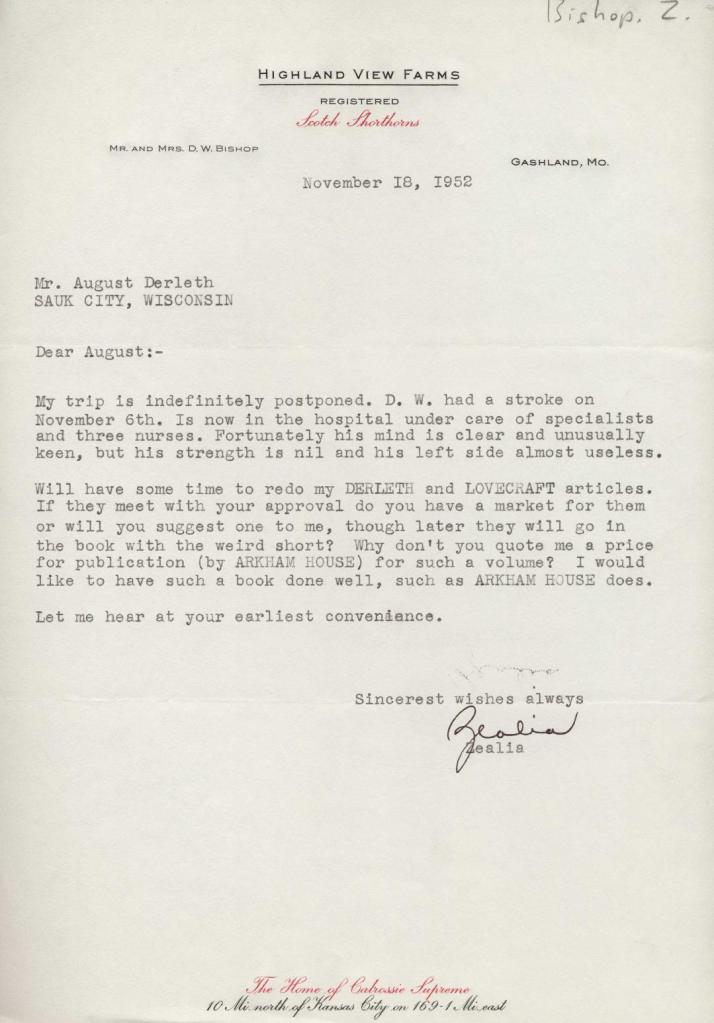
Her Letters to August Derleth: Zealia Bishop

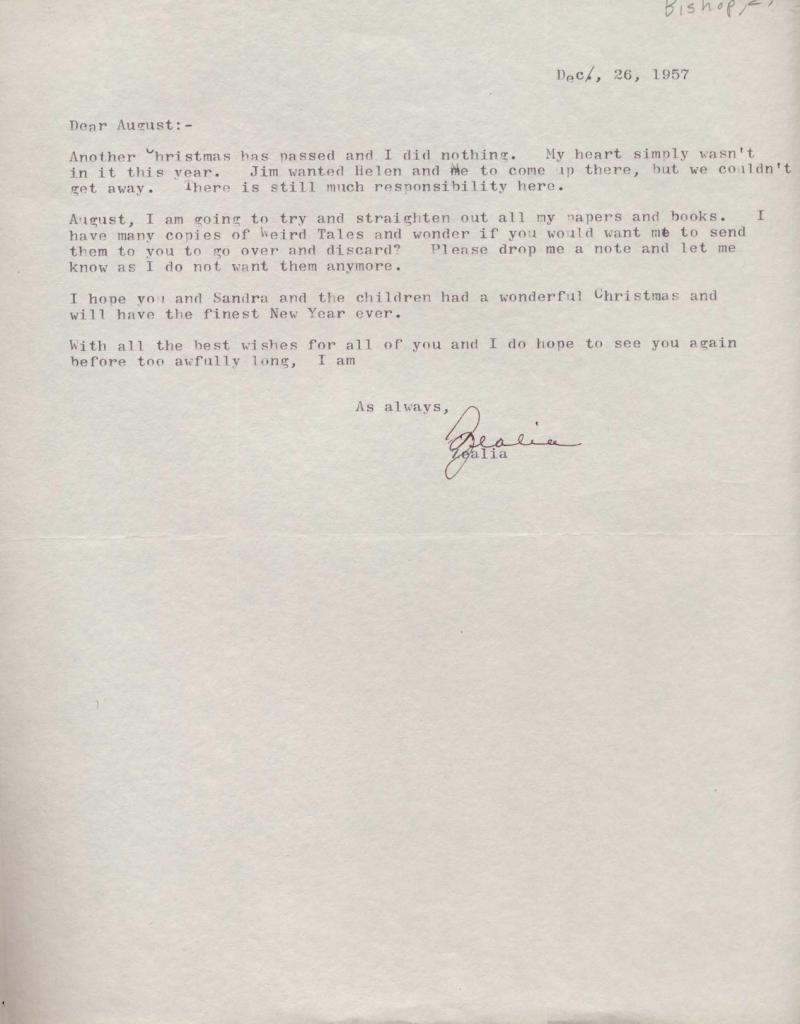
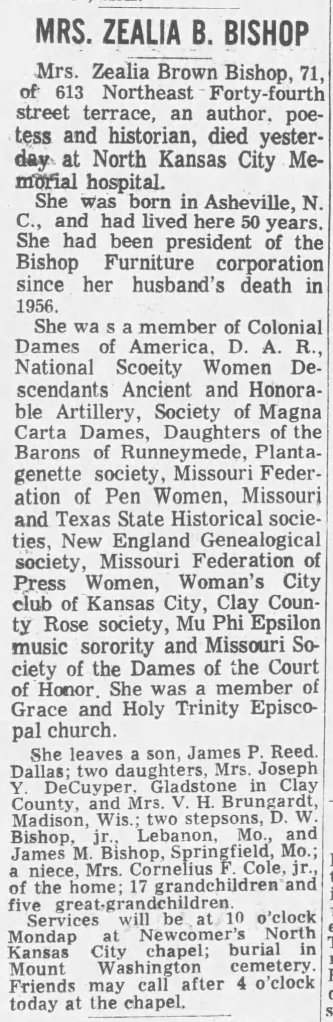
In the August Derleth (1909 – 1971) archive of the Wisconsin Historical Society, there is a fairly substantial file of correspondence from Zealia Bishop (1897 – 1968), comprising ~83 letters and postcards (192 pages) over a period of about thirty years (1937 – 1966, roughly; many letters are undated). The first letter is dated 8 Apr 1937, and is a reply from Bishop to Derleth:

Dear August Derleth:—

I am overwhelmed with shock & grief at the tragic message your letter conyed to me for I had not learned until then of Mr. Lovecraft’s death. No on can ever know what his means to me as it was he who steered me into the path of writing—who taught me the necessity & fascination of playing with words—taught me humbleness rather than arrogance—and it was always to him that I rushed when in difficulty—how willingly, patiently and kindly did he always pull me from the chaos—regardless of the sacrifice to himself—Poor Howard! What a beautiful spirit he possessed—& how insignificant the rest of us are beside his shining armor! How I shall continue without him I don’t know—for he was as an anchor in my stormy career. Anything—anything I can do for his old aunt—& to partially repay him for his goodness & patience, to me—let me know— His letters to me—I have hundreds & hundreds—are so beautiful & inspiring. Why could we not use excerpts from them? Also I have two stories which were never published—you might be interested in reading them— F. Wright—read one: Medusa’s Coil—but could not use it then—I never sent it again nor endeavored to place it with another publisher—Two years ago Howard helped me with a book—The Adopted Son—He liked it so very much—and urged my sending it out tirelessly—but after I’ve done a piece of work I can’t bring myself to struggle over the financial ends—the book is here—Would you care to read it?

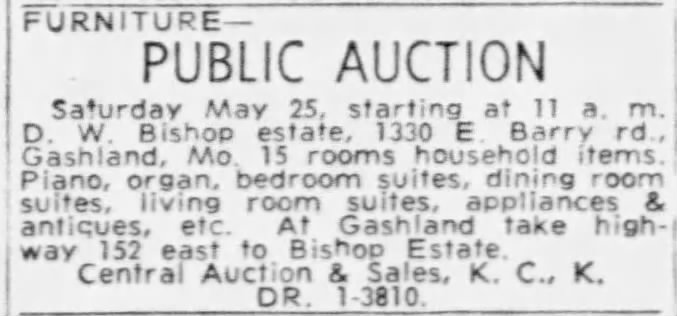
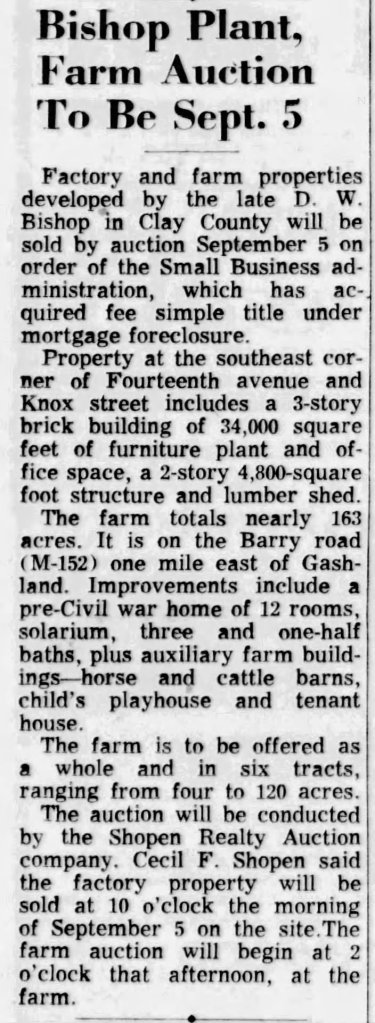
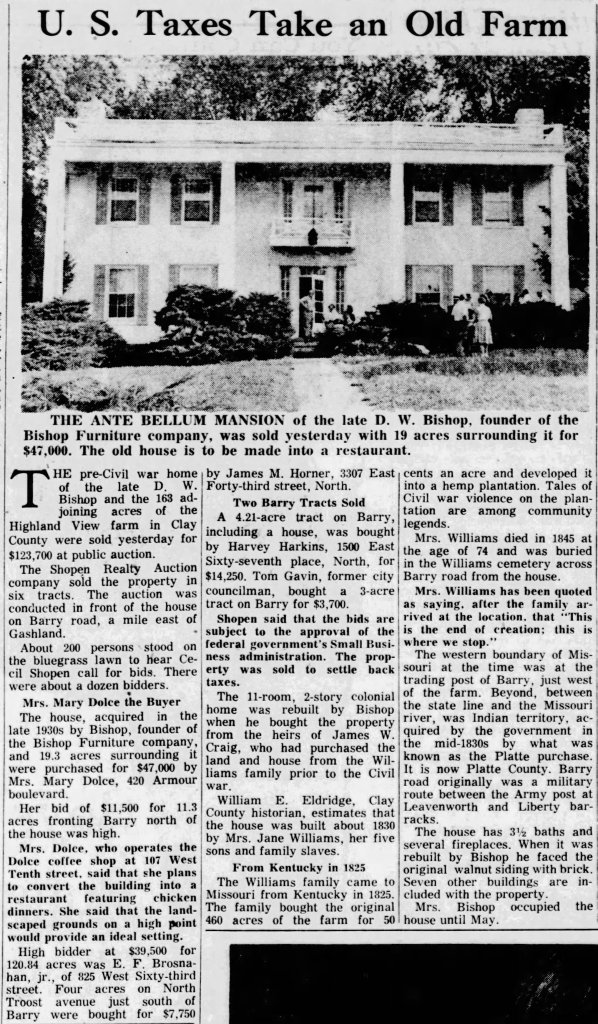
And on in that vein. In effect, Bishop’s correspondence with Derleth picks up where her correspondence with Lovecraft drops off. Zealia Bishop was at the time relatively comfortable with her husband Dauthard William Bishop in Missouri, where they owned a farm/ranch (and later a furniture manufacturing business). Their sons from previous marriages were now grown and out of the house, according to the 1940 Federal census, and they had not yet adopted their two daughters.

As with Hazel Heald, Derleth wrote to Zealia Bishop primarily in search of Lovecraftiana, as part of his nascent plan to publish the fiction and letters of H. P. Lovecraft. She had two weird stories revised by Lovecraft as yet unpublished: “Medusa’s Coil” (1939) and “The Mound” (1940), which Derleth would see published (and in the former case, whose ending he would bowdlerize). Bishop’s letters from Lovecraft were transcribed and some of them made it into the Selected Letters published by Arkham House. Derleth appears to have shown rather less interest in Bishop’s non-weird fiction.

The majority of the letters are from Zealia Bishop to Derleth, and this gives a different perspective, since we can read about her own life and experience with Lovecraft in her own words. These first 1937-1941 letters in particular deal considerably with her memories of Lovecraft and the publication of her stories at Weird Tales. After this, the correspondence appears to have fallen off for a space. The next letter from Bishop to Derleth is dated 19 Jan 1949, where she details the losses suffered during the war.

Her letters veer between reminiscences of Lovecraft and matters of the present, especially where they came together in the printing of her stories. Both “The Mound” and “The Curse of Yig” appeared in Beyond the Wall of Sleep (1943) from Arkham House, so presumably there would have been permission sought and granted, but Bishop did not apparently receive a copy of the book until after she wrote to Derleth in 1949, which prompted the comment:

He knew that I prefered lighter fiction, tho he encouraged my continuing on with weird stories for he thought I would gain more depth. He was delighted when I went to Oklahoma and became interested in folklore and wrote the story of Yig. This is strictly a story that came from my sister’s husband’s grandmother and the Indians around Binger. The names all authentic. The Mound also came from the same source and Medusa’s Coil originated from a tale told me by my negro maid.

I am wondering how the fact that it is listed as HPL’s story in this book will effected its being reprinted in a collection of my own? Was it your intention to make them appear as his stories?
—Zealia Bishop to August Derleth, 28 Jan 1949, MSS. Wisconsin Historical Society

When and how Zealia Bishop decided she might publish a collection of her stories isn’t clear, yet this became the trend of her correspondence with Derleth over the next few years, which resulted in The Curse of Yig (1953) being published by Arkham House as a more-or-less vanity press arrangement.

Business aside, their friendship improved when they actually met in person in 1949—her son Jim (James P. Reed) was out of the army and living in Madison, Wisconsin, Derleth’s home state, so they were close enough to visit. Her reaction was positive, if perhaps not exactly heartening:

Dear August:

A little late in telling how much Jim and I enjoyed the visit with you and how much it meant to me. That trip was exactly what I needed to get me back in harness and on the road again. Believe this time I shall continue on and, at least, get a peek at the bull’s eye. How foolish for me, with all the years of training I’ve had, to have let people discourage me. From now on—well, I’ll keep plugging. […]

I fell more at ease with you now. You’re just another boy—big, fat—spoiled as hell—

My best always,
Zealia
—Zealia Bishop to August Derleth, 6 Apr 1949, MSS. Wisconsin Historical Society

At the time, Derleth had some issues with his weight and hypertension; he was also “pitching woo” with a local teenage girl (Sandra Winters, whom Derleth would later marry), which Bishop found amusing. Much of the focus on her own life and writing in the letters surrounds Bishop’s critical lack of confidence in her own writing, her inability to finish things, and her concern over the perception of her work as her own:

It was just before Bill’s and my brother’s tragic deaths, that H. Hoffman Price [sic] (maybe I have that first initial wrong) turned me over to his agent August Lenninger. At that point when he was advising me my heart and mind seemed suddently to stand still. Oh, I always did some writing, kept notes religiously. That was simply second nature . . . . but it was difficult to settle down to creating anything in particular. Then suddenly things changed for me. I knew I must do everything I had been seeking (at least make the efort) But, for some reason, I began to feel, that possibly my writing weird tales and having HPL revise them had made it difficult for me to do things of any importance, without editors believing I had been unable to create alone. Is that true, or is that merely me own fancy? Now, I believe I should begin to sell—if I have developed characterization well enough. The plots are there . . . but— Of all the eight novels I wrote I never tried to sell any of them. The last time Professor Moe read my pottery novel ater my final revision, he said it was a ‘work of art’; that I ahd done a wonderful job and he thought it would sell; but I didn’t send it out. I had that feeling I still couldn’t sell my work to an editor. I would like to have you read one or two either short stories or nevels and tell me what you think of them and point out specifically what I should or shot not do.
—Zealia Bishop to August Derleth, 24 Apr 1949, MSS. Wisconsin Historical Society

E. Hoffmann Price and Maurice W. Moe were friends of Lovecraft’s; Price was a professional pulp writer during the 40s, and August Lenninger a hard-nosed agent, while Moe was primarily an English teacher. Bishop’s fear of rejection is almost palpable in these letters; for Derleth, who needed to publish constantly to survive, it was almost a matter of course that some stories or novels would be rejected—and rewritten, resubmitted, until they sold. That was how he worked.

Derleth was willing to be friendly, and even read and offer a few comments on her manuscripts, evident from a carbon of a letter that survives, with notes like: “try to be less feminine in your writing. Eliminate gushing, and there is quite a bit of it in these pages.” and “You have a tendency to be trite and hackneyed, as perhaps you know.” While these might seem a bit harsh, they’re also probably fair and well-meant.

The file of correspondence is spotty 1950-1952. The long-promised articles on Lovecraft and Derleth that Bishop had meant to write took a long time to actually come to fruition, and both were very busy with their respective lives. The adoption of the young women Helen and Frances May (“Frankie”) by Zealia and her husband apparently was completed in 1950. August Derleth and Sandra Winters were engaged to be married and Zealia congratulated them about it a little early (the letter of 10 Jun 1952 is addressed to “Mr. & Mrs. Derleth”; they would not be married until 6 Apr 1953—unless the letter is misdated, which is possible).

Then, disaster.

D. W. Bishop would live until 1956, but would never regain his full health. This was a major change to Zealia’s life and to the businesses that the Bishops shared. At the same time, she was determined to publish something; and Derleth was amenable for her weird fiction to come out through Arkham House. So the letters focus on the details of the publication of The Curse of Yig, which provided a relief from managing the farm and her life as caretaker:

Since D.W. is in this state—whether or not to be of long duration I shall be confined closely. Were I unable to keep busy and accomplish something, I could not exist. I cannot play or practice on the organ or piano. We have to whisper most of the time and slip about on tip-toe. Except on the surface, all idea of keeping the house clean by vacum [sic] or waxer is remote. Any noise seems to set him into a tantrum. Yes, it is very hard on one who has been so active and I would give my own life if I could give back to him his health and activity. Nothing could be worse or more heartbreaking than to watch his slow disintegration and one whom you love so dearly. So, you see, why I am especially eager to keep so busy and must not dwell too much upon the conditions about me.
—Zealia Bishop to August Derleth, 22 Dec 1952, MSS. Wisconsin Historical Society

D. W. is not now bedfast. He sits in a contour chair in a darkened library fourteen to eighteen hours a day—and never moves from there except to go to his meals, to the bath or, on occasion, to look out one of the windows in another room. For amusement or diversion he listens to a radio beginning at 5:A.M. and continuing until sometimes midnight. (I loathe a radio.) He likes only hillbilly msuic. He insists that I sit with him at all times. If I go upstairs or into another room he calls or starts ringing a bell for me. In three days I wrote exactly four words on the revision of the DERLETH article.
—Zealia Bishop to August Derleth, 14 Aug 1953, MSS. Wisconsin Historical Society

Things aren’t going so well here. Drs. have had to tell D.W. his true condition. I am going work of the day & night—so I am weary, very weary—and must do all the planning for this cattle sale Oct 21st.
—Zealia Bishop to August Derleth, 16 Sep 1953, MSS. Wisconsin Historical Society

Without D. W. Bishop at the helm to manage the business, the decision was made to close it out—sell the cattle at least—which in itself was a complicated process that involved some involvement with the Internal Revenue Service, according to Zealia Bishop’s 19 Jan 1954 letter to Derleth. The same year, their adopted daughter Frankie was married. The promotion for The Curse of Yig included a brief appearance on local television:

Anne Hayes had me on TV last Tuesday—with Frank Glenn—who has the more complete book stores in this aera [sic]. He gave a fine plug for the book, and immediately afterward had a number of calls for “YIG”—I am profoundly surprised that so much interest is being shown because I am not too elated. Had this come ten years ago I would have loved it and perhaps been a bigoted nit-wit—now, I feel only humility and gratitude for having the honor of being instructed by so great a man and teacher—In the interview your pitcutre was held before the camera and we discussed you—
—Zealia Bishop to August Derleth, 19 Jan 1954, MSS. Wisconsin Historical Society

As it happened, Zealia had misunderstood her contract with Arkham House, which probably exacerbated her financial difficulties at this trying time, due to having taken a short-term loan to cover the cost of printing the book and not understanding that the immediate receipts from initial sales would not begin to pay it back.

It was, it happened, a bad time for Arkham House. The Curse of Yig (1953) was followed by The Feasting Dead (1954) by John Metcalfe, but Arkham House did not publish another book until The Survivor and Others (1957), Derleth’s collection of his posthumous collaborations with Lovecraft. Derleth’s letters to Zealia Bishop during this period give a peak into Arkham House’s business, and the harsh realities of independent press publishing. The slowness in which The Curse of Yig sold probably discouraged any further publishing plans Bishop had.

There seem to be fewer letters from Zealia to August during this period, though they appear to have remained on good terms. A letter of congratulations was sent to August and Sandra Derleth on the birth of their first child, April Rose Derleth, in 1955. For herself, Zealia was still dealing with her husband:

D. W. is holding own. We still have three nurses and our income is rapidly vanishing. he is helpless, it requires two people to turn or move him. he doesn’t get up at all anymore, but we try not to let it discourage us. Rather, we endeavor to feel this is our God-given job and we must go about it happily and unselfishly. Such an attitude does wonders for us! I believe I feel younger and certainly do not feel one day older . . . tho my hair is quite silver!
—Zealia Bishop to August Derleth, 4 Jul 1956, MSS. Wisconsin Historical Society

D. W. Bishop died 11 Sep 1956; the death certificate lists immediate causes of death as pyelonephritis (kidney infection), uremia (high urea in the blood, from kidney failure), and pneumonia. Zealia announced her husband’s death in the same letter where she congratulated the Derleths on the birth of their second child, Walden William Derleth. The death meant more legal matters to deal with, including government audits of the furniture factory, and Zealia was a grandmother eight times over. She tried to keep in touch. Yet there are gaps in the letters, and signs of weariness from the years of caretaking which, now over, left her bereft of purpose.

Never a year went by without a letter or two from Zealia Bishop to August Derleth, but in 1963 her financial situation took a sudden and dramatic turn for the worse:

Have lost practically everything—through no fault of my own—Go over your books—See if you can send me a small check each month instead of semi-annually—Never needed help before in my life—& so desperately—Will tell you all later—Am living with my niece—
—Zealia Bishop to August Derleth, c. Jun 1963, MSS. Wisconsin Historical Society

What exactly happened isn’t clear from the letters; she wrote in 1959 that Kansas City absorbing Gashland changed the “tax picture” on her property—probably that meant higher taxes. There may also have been some business mismanagement, for she wrote that she was not often in the office, that her problems were placing her trust and confidence in others, and in one undated letter: “I had no debts—they were debts of others—”

Newspaper ads suggest that Zealia Bishop owed the government several years of back taxes, and when they came to collect the farm, factory, and house were all foreclosed on and had to be sold.

The letters to Derleth did not cease. Zealia Bishop did her best to go on with her life, though at times she would write things like:

Am so unsettled—so unaccustomed to living this way—my heart simply isn’t in anything. It’s difficult to realize this is actually “me”—
—Zealia Bishop to August Derleth, c. 1965, MSS. Wisconsin Historical Society

She was 68 years old and had lost her husband, her home, presumably most of all of her savings and many belongings. On top of which, there seems to have been a breakdown in her relationship with her son:

Never hear from Jim—& we were such truly good friends—as well as mother & son—& my only child! I shall never recover from all this—it was so tragic—so unnecessary
—Zealia Bishop to August Derleth, 8 Mar 1966, MSS. Wisconsin Historical Society

We do not have Jim Reed’s thoughts on his mother, or what the circumstances were; perhaps he had simply not called or written to her for a while, and there was no real break, only a lonely old woman who wanted to hear from her child more often than she did. The end of life is almost always tragic, if only because it is written out long beforehand, and cannot be avoided. Many of the later letters, where Zealia’s handwriting becomes noticeably more shaky, ask for Derleth to send her anything he can—any check, however small—and with every indication is that she was near the end of her resources. In an undated letter, she wrote:

To one who has tried to make life worthwhile for others I cannot believe so much has been put upon my shoulders—everything stripped from me with an hour’s warning—& not one bit of it my fault except trust & confidence.

How I would love to see & talk to you, August, & have your advice as a column.
—Zealia Bishop to August Derleth, n.d. [1964?], MSS. Wisconsin Historical Society

While the occasional small royalty check on The Curse of Yig was no doubt welcome, what she always asked for from Derleth was news of him and his children—what she always expressed was a desire to visit and see him once again. Friendship, as much as anything, was what Zealia Bishop seemed to crave in her extremity—and perhaps Derleth did his part to provide that.

Into every life comes ups and downs, and Zealia weathered her storms with whatever dignity she could manage. Lovecraft, no doubt, would have approved.

We are in the direct line of a tornado at the moment so I’ll stop & go to the basement with the rest—
—Zealia Bishop to August Derleth, n.d. [1965], MSS. Wisconsin Historical Society


Bobby Derie is the author of Weird Talers: Essays on Robert E. Howard and Others and Sex and the Cthulhu Mythos.

Deep Cuts in a Lovecraftian Vein uses Amazon Associate links. As an Amazon Associate I earn from qualifying purchases.
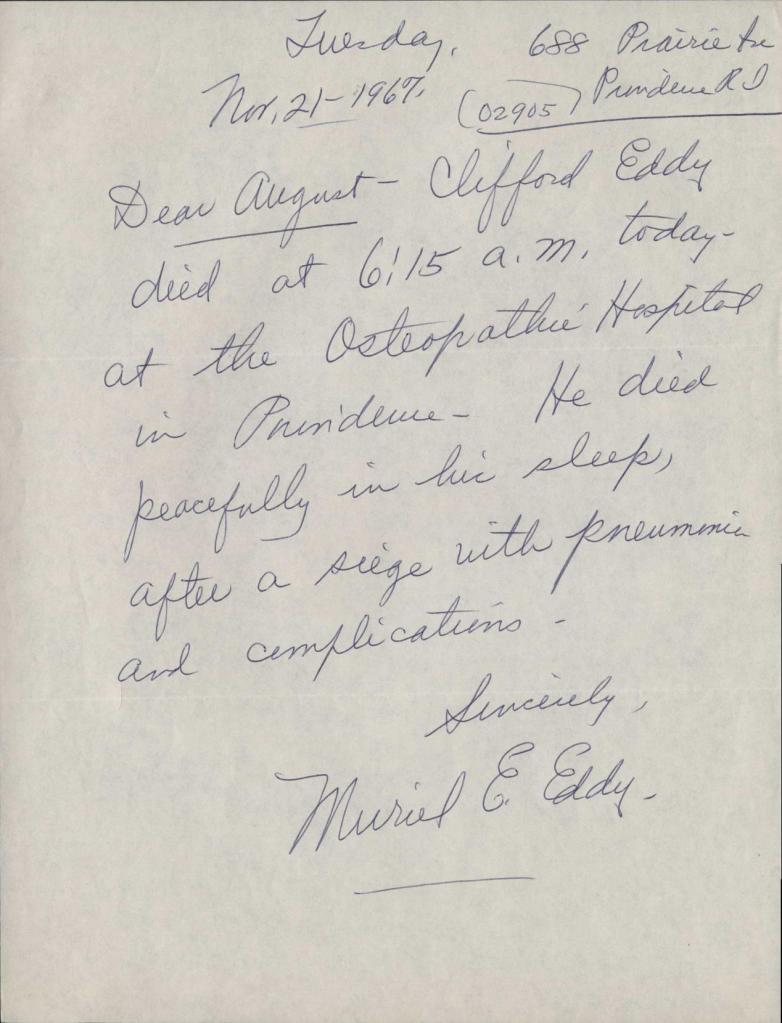
Her Letters To August Derleth: Hazel Heald

In the August Derleth (1909 – 1971) archive of the Wisconsin Historical Society, there is a slim file of correspondence from Hazel Heald (1896 – 1961), comprising 23 letters and postcards (41 pages) over a period of about twenty years (1937 – 1958). The first letter is dated only ten days after Lovecraft’s death, as August Derleth quickly moved to secure permissions for the prospective publication of Lovecraft’s fiction. Weird Tales editor Farnsworth Wright gave Derleth her mailing address in a letter dated 22 Mar 1937, so Derleth must have written her practically immediately.

Dear August Derleth,

It was with great interest I read your letter this morning. Of course I will do anything in my power to help you in your work. With Wright’s permission you may print “The Horror in the Museum” and “Out of the Eons” if it does not detract from my part. I was a beginner and happened to be lucky enough to find HPL who certainly was the best to be found.
—Hazel Heald to August Derleth, 25 Mar 1937, MSS. Wisconsin Historical Society

The first spate of letter-writing took place in 1937, as Heald discussed her work, relationship, and correspondence with Lovecraft, and a little about her own life. Derleth seemed to have been particularly interested in how much of the tales published under Heald’s name that Lovecraft had actually written, and whether she had kept any of his letters—when pressed on the subject, admitted Lovecraft had rewritten some of her stories, and that she hadn’t kept any of his letters.

Yet the most interesting parts of the letters are the tidbits about her own life:

HPL and I both had something in common—unfortunate marriages that ended in the divorce court. He sympathized with me all through that trying period (1928) and as he had had the same experience you can readily see that he fully understood. And since then he has known my troubles and his understanding heart gave me the courage to carry on. I miss him more than words can say and only hope that he is now at rest with the Heavenly Father I put all my trust in. It worries me because Howard didn’t believe in everlasting life and I pray the All-forgiving Father forgave that.

As story writing cannot make me a living, I have to take whatever work available to earn a living. I have always worked in an office but the younger generation have the preference, and as I am forty I have to take a back seat. At present I am housekeeper in a motherless home of five youngsters, so you see my spare moments are few. As I am not a servant type it humbles my pride, but what can one do? I would like to give all my time to writing but anyone must east and have a place to live, and I haven’t enough talent to ever be famous. I know it requires plenty of study and I have no spare time for that.

Our lives seem to be cut out for us and we have nothing to say about it. I have had business and musical education and am doing work that the humblest scrubwoman could do. My talents are few but they could be fully developed if I only had the chance. Even HPL with all his talents had a hard time to make both ends meet.
—Hazel Heald to August Derleth, 31 Mar 1937, MSS. Wisconsin Historical Society

Heald also discussed the stories she had placed with John Weir. The mention of Lovecraft’s marriage prompted further questions from Derleth:

About HPL and whether he was separated or divorced—I am certain he was divorced but have written to someone I know who will give me all the facts as her husband signed certain papers at that time. His wife’s name was Sonya Green [sic] and she is now a librarian in New York City. HPL gave me to understand it was a divorce for they had no similar interests. He talked it over with me to quite an extent, perhaps because I had received a divorce myself and fully understood.
—Hazel Heald to August Derleth, 7 Apr 1937, MSS. Wisconsin Historical Society

HPL’s wife was a tall, regal looking woman wearing black, large picture hats, etc. He met her as her critic for at one time he advertised for work and she answered. I guess she chased the poor man to death for that was what I was told.
—Hazel Heald to August Derleth, 15 Apr 1937, MSS. Wisconsin Historical Society

Heald’s source of data was Muriel E. Eddy (see The Gentleman from Angell Street); Hazel Heald was never in direct contact with Sonia H. Greene (who is not known to have worked as a librarian in New York at any point, and who met Lovecraft at an amateur convention, not through an advertisement). Derleth’s interest was no doubt piqued since Lovecraft had barely mentioned his marriage in their own correspondence.

The overwhelming atmosphere of Hazel’s early letters is sadness. Stuck in an unhappy situation, unable to sell her stories, and now with one of her few friends dead.

This is vacation week and I’m nearly crazy with the children. The two oldest boys are saucy and won’t mind me at all, and the younger ones copy them. If I could only make a living by my writing I would be happy indeed instead of existing in an atmsophere of discontent. HPL knew my trouble and his sympathy meant a lot. I do for these children like an [sic] own mother but they call me names and their father doesn’t make them mind me. When I tell them they can’t do something he will say they can.
—Hazel Heald to August Derleth, 14 Apr 1937, MSS. Wisconsin Historical Society

We get the title of two unpublished Heald stories—”The Devil’s Jigsaw” and “Terror by Midnight”—which she submitted to Weird Tales and Amazing Stories respectively, but were apparently not accepted and is now lost. Heald also states that she had to go through a lawyer to get the money from Gernsback for “The Man of Stone.” Yet for the most part, she was discouraged:

HPL told me I could stand on my own feet without help but I have no confidence in myself. I think it takes special talent and training to be a writer and I have neither. HPL studied all his life and his works proved it. And I know you have worked hard for success and succeeded, which is more than I can do. Do you live with your parents? If I had started when I was younger and had their encouragement I would have been better off. They planned a great future for me—and I’m doing what any ignorant fool could do!
—Hazel Heald to August Derleth, 28 Apr 1937, MSS. Wisconsin Historical Society

This first period of correspondence appears to have ended in May 1937, shortly after the June 1937 issue of Weird Tales came out, filled with letters about Lovecraft from grieving fans, including one from Hazel Heald.

Good luck with the new books and also the one about HPL. The Eyrie was good this month. I wish they had all told him these nice things when he was alive. He got plenty discouraged at times and said when things got too bad he was going to take the laudanum route to oblivion.
Sincerely,
Hazel Heald
—Hazel Heald to August Derleth, 6 May 1937, MSS. Wisconsin Historical Society

Why the break? We can only guess; though Derleth was certainly busy. Efforts to get a collection of Lovecraft’s fiction in print through established publishing houses failed, and in 1939 Derleth and Donald Wandrei combined their resources to found Arkham House for the specific purpose of publishing The Outsider and Others. The war also interfered with Arkham House’s publishing schedule, due to Wandrei being drafted (Derleth got a deferment for health reasons) and paper rationing.

Nevertheless, in 1943 Arkham House published Beyond the Wall of Sleep (reprinting “The Horror in the Museum” and “Out of the Eons”) and in 1944 Marginalia (reprinting “The Man of Stone” and “Winged Death.”) Derleth was also stretching his wings as an anthologist, and reprinted “The Horror in the Burying-Ground” in Sleep No More: Twenty Masterpieces of Horror for the Connoisseur (1944). This necessitated new correspondence because Heald was due monies and copies of the books.

Undated, c. Oct/Sep 1944

The 1940 Federal census lists Hazel Heald living as a housekeeper with the Curry family in Cambridge, Massachusetts, which consisted of James Curry (32), his sister Elizabeth Curry (35), and children James Curry, Jr. (10), Rita Curry (7), Ronald Curry (5), and Lillian M. Curry (1). The mother of the children, Lillian May Curry (née Hill), had died 16 Sep 1938—the same day listed as the younger Lillian’s birthdate.

Unfortunately, Hazel Heald was badly out of the loop: Farnsworth Wright was no longer editor of Weird Tales, and had in fact died in 1940, being replaced by Dorothy McIlwraith. Derleth apparently informed her of this. She also inquired about the business side of things—Heald had no formal contract with Derleth, who had gotten permissions and reprint rights for Lovecraft’s stories (and Heald’s, apparently) from Weird Tales (it was not uncommon at the time for a magazine to buy all rights for a story, unless there was agreement otherwise).

For Marginalia, Derleth sought out permission from Heald—although given the dates involved, this might have been a bit of an afterthought.

Contact with Derleth also informed Heald about the memoirs about Lovecraft, including those that touched on her own life. When she read W. Paul Cook’s “An Appreciation of H. P. Lovecraft” in Beyond the Wall of Sleep, for instance, she wrote:

I was interested in Paul Cook’s account of Lovecraft’s Boston visit, and how he made him rest up before coming over to my house. He certainly did not act tired, and ate very well, although Cook said he gave him a good meal before he came. I wonder if he thought that he would be starved at my house? He seemed to enjoy himself a lot. Soon after that he came again, and we visited all of the museums together. That was where I conceived the idea for OUT OF THE EONS.
—Hazel Heald to August Derleth, 14 Oct 1944, MSS. Wisconsin Historical Society

Once again, the letters go back and forth between Heald’s everyday life (in which the war and looming presidential election feature prominently), reminiscences of Lovecraft, and book-talk. Heald had begun an evening writing class, and:

Glad that “Sleep No More” is such a success. My hairdresser read my story while she was giving me a permanent. It is a wonder I didn’t end up burned to a crisp!
—Hazel Heald to August Derleth, 6 Nov 1944, MSS. Wisconsin Historical Society

Derleth expressed an interest in her unpublished tale “The Lair of Fungous Death”—probably out of the vague hope of an unknown Lovecraft revision—but nothing seems to have ultimately come of this. In publishing Heald’s stories, Derleth made little effort to hide his opinion that they were effectively Lovecraft tales under a different name:

The Man of Stone was Mrs. Heald’s first-published story. It was revised by Lovecraft to somewhat less an extent than her later stories. Under date of Septemember 30, 1944, Mrs. Heald wrote: “Lovecraft helped me on this story as much as on the others, and did actually rewrite paragraphs. He would criticize paragraph after paragraph and pencil remarks beside them, and then make me rewrite them until they pleased him.” There is conclusive evidence to indicate that Lovecraft’s revision-work divides sharply into two classes—the bulk of purely professional revision of the language and punctuation; and a certain small group of stories in which he took a keen personal interest, and which he managed to permeate with his own literary personality. This is less true of The Man of Stone, than it is of later work under the byline of Hazel Heald. Lovecraft also revised, in addition to work already printed by Arkham House, stories bearing the bylines of Sonia H. Greene (the lady who was for a short time Lovecraft’s wife) and Adolphe de Castro, appearing in Weird Tales. The Man of Stone is included here primarily as an example of early Lovecraft revision, which bears the marks both of a purely professional interest and in part of a personal one, as witness the injection of the Book of Eibon, etc.
—August Derleth, Marginalia 116

Heald would read this and reply:

By the footnote on “The Man of Stone” people might get the idea that HPL actually wrote my stories Of course he helped me a lot by his criticism, but I was the one who did the hard work.
—Hazel Heald to August Derleth, 1 Feb 1945, MSS. Wisconsin Historical Society

Whether Derleth headed this or not is unclear; the correspondence gets sporadic for the next few years. Derleth may have kept in touch periodically, since “Out of the Eons” was reprinted in The Sleeping and the Dead: Thirty Uncanny Tales (1947) and Avon Fantasy Reader #18 (1952), “The Horror in the Burying-Ground” was reprinted by Arkham House in Something About Cats and Other Pierces (1949). But this seems to have been less of the friendly correspondence of Yesteryear, and more business-like.

We can only speculate, but it seems likely that there was little more that Hazel Heald could offer Derleth in terms of reminiscences of Lovecraft or fiction revised by him; and he for his part could not (or would not) revise her stories and try to agent them as Lovecraft had done.

The final letter from Hazel Heald in the file is dated 19 Jan 1958, only a few years before her death.

The story was “The Adventure of the Man with a Broken Face” by August Derleth (Boston Globe, 19 Jan 1958, magazine supplement page 4).

Hazel Heald’s correspondence with August Derleth was friendly enough, but they do not appear to be friends in the strictest sense. They had a friend in common in Lovecraft, and his death provided the spark that began their correspondence—but they had little else in common. Heald’s brief reminiscences added to Derleth’s store of Lovecraftian lore and the stories he could publish, but Heald never wrote a proper memoir of her own, and there was little interest in her for her own sake.

Through Heald’s letters to Derleth, we get the only real glimpse into her own life in her own words, something quite different from the impersonal census data and odd newspaper clippings, or reading about her through odd comments Lovecraft dropped in his own letters.


Bobby Derie is the author of Weird Talers: Essays on Robert E. Howard & Others (2019) and Sex and the Cthulhu Mythos (2014).