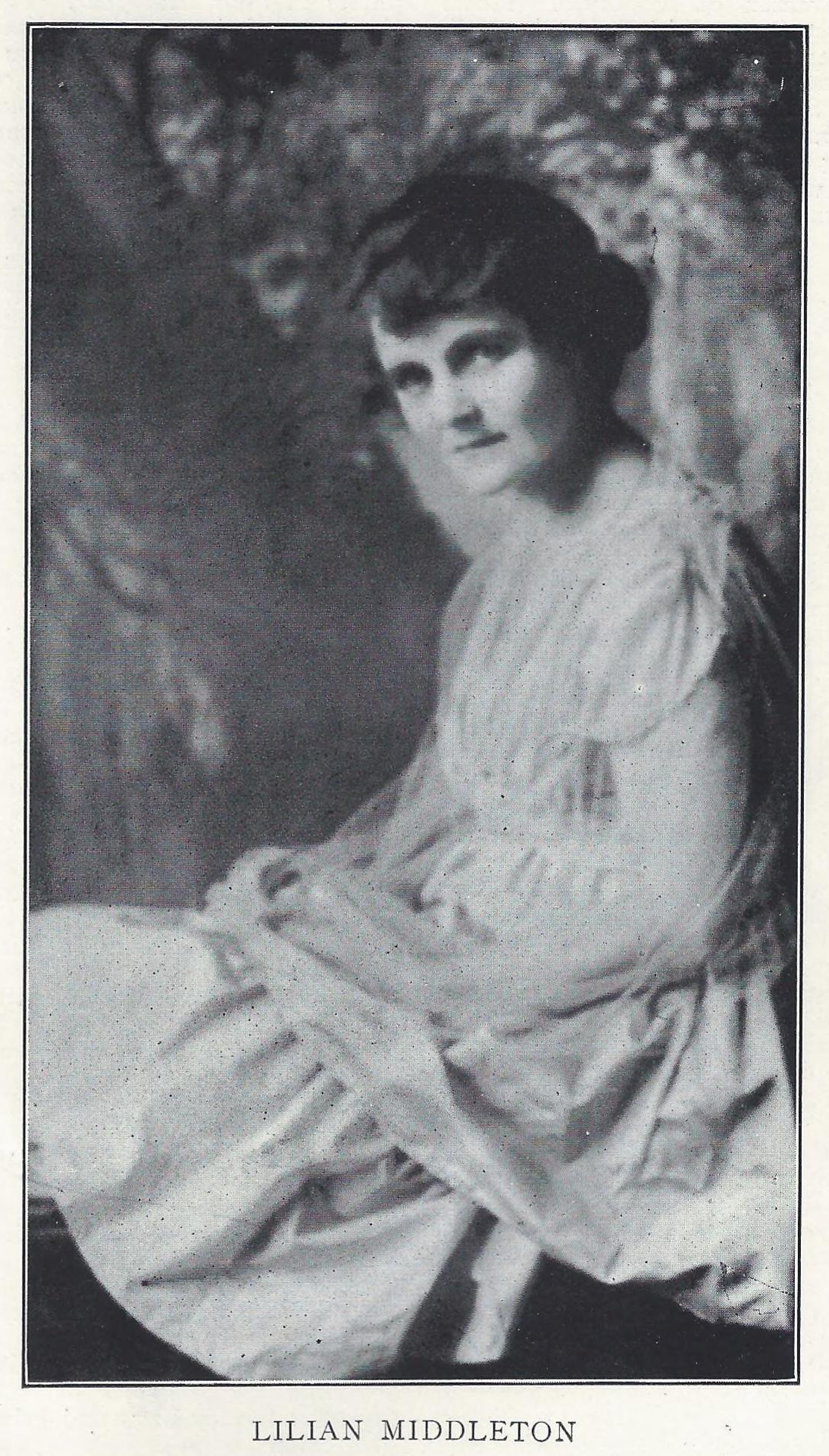
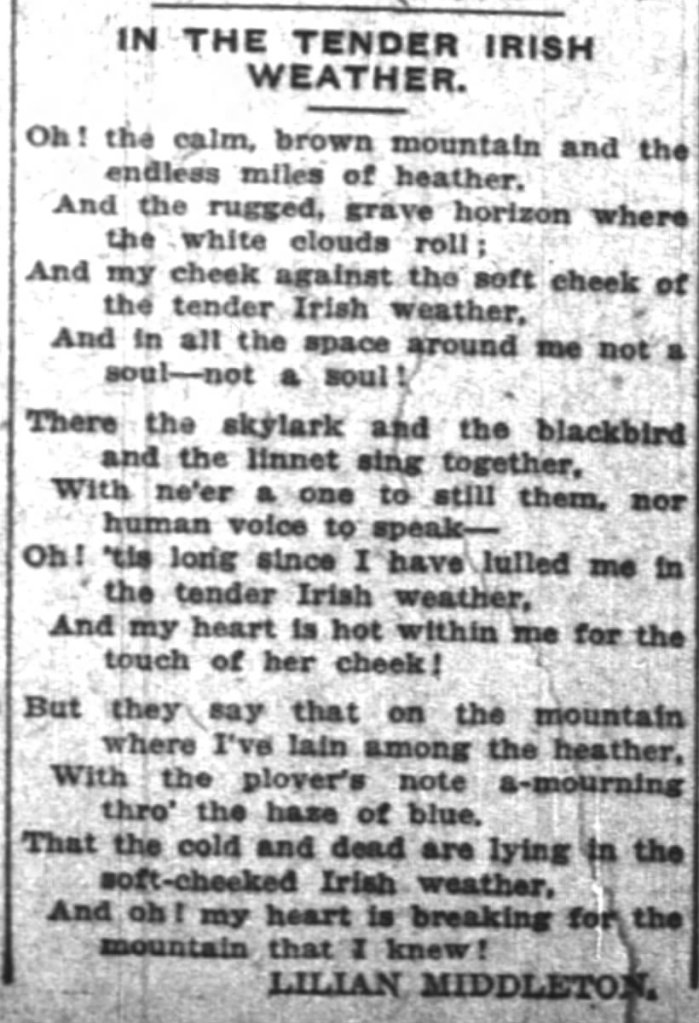
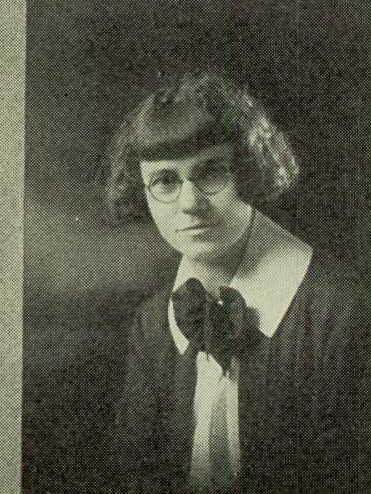
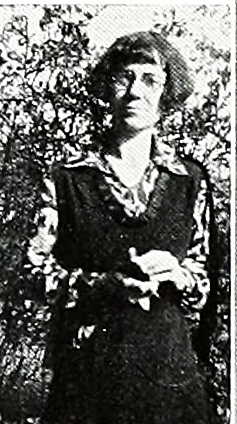
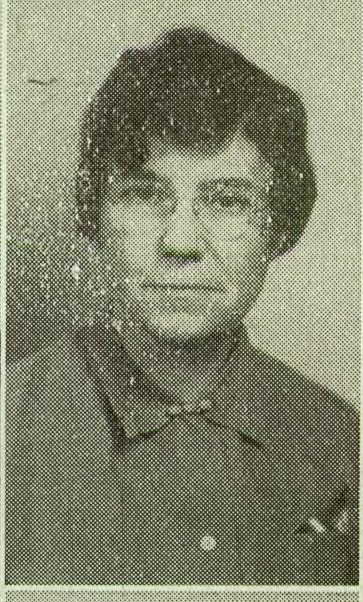
Muriel E. (Gammons) Eddy was born in Taunton, Massachusetts in 1896. She started to write poetry and fiction at a very early age. Muriel was educated in Attleboro Falls, Massachusetts; Redlands, California; and the Horace Mann School in San Jose, California, where she lived during her early teen years. Her father owned a movie theatre during that time, and it was there that she would spend many hours watching the motion picture shows, and writing stories and poems. Upon returning to Massachusetts, much of her poetry was published in her hometown newspaper, The Attleboro Sun.
Being the avid reader that she was, Muriel read all that she could, including the various magazines sold at the local newsstands. One of these held a letter to the editor from Clifford Eddy, Jr. Muriel wrote a letter to him and a correspondence ensued; they were both twenty-one. At the time, the two found they had many common interests: their love for writing, reading habits, their fertile imagination, and their almost twin birthdays (his, January 18, 1896; hers, January 19, 1896). They married the following year on February 10, 1918, eventually settling in Providence, Rhode Island.
Muriel continued writing, all the while raising three children. Her short stories in many different genres including romance, mystery, personal adventure, and suspense were published in the various magazines of the day such as Ghost Stories, Scarlet Adventuress, Complete Detective Novel Magazine, True Confessions, Midnight Magazine, and The Occult Digest. […]
Muriel and Clifford met H. P. Lovecraft and maintained a close friendship with him until his death in 1937.
—Jim Dyer, “Introduction” in In the Gray of the Dusk i-ii
A few letters from Lovecraft to Muriel, and to her husband C. M. Eddy, Jr., survive; so there is no doubt that they did correspond. Beyond that bald fact, the correspondence of Muriel E. Eddy and H. P. Lovecraft gets complicated.
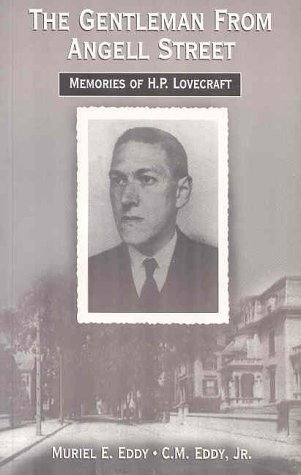
The difficulty comes from the fact that Muriel, more than most of Lovecraft’s friends, memorialized her and her husband’s relationship with Lovecraft. While her major memoir is “The Gentleman from Angell Street” (1961), she also published “Howard Phillips Lovecraft” in Rhode Island on Lovecraft (1945), “Message in Stone” in Fate Magazine (Oct 1956), “Memories of H. P. L.” in The Magazine of Horror (Winter 1965-1966), “Lovecraft’s Marriage and Divorce” in Haunted (Jun 1968), and H. P. L. “The Man and the Image” (1969) (also partially reprinted as “Lovecraft: Among the Demons”), not to mention miscellaneous letters, notes, and probably a few reprints under different titles.
While that sounds substantial, most of these are relatively minor pieces, largely repetitious or filled with Muriel’s own speculation. Digging into the minutiae of what Muriel wrote and when, and trying to cross-reference her statements made through several decades versus the facts given in Lovecraft’s letters and other sources, reveals a great deal of omission, correction, and even contradictions.
To give an example, take this snippet from one of her later, self-published memoirs:
One day he walked all the way up to the top of the First Baptist Metting House in Benefit Street to sign his name in the guest book. He wrote, “H. P. Lovecraft, Esq., Gentleman.” He signed many of his letters to my husband and me with that phrase, and also “your obedient servant.”
*********
Our friendship with Howard began with letter writing, although we also lived in Providence – because he hated to use the telephone or any other mechanical device such as the typewriter. He always wrote in longhand, and later I was to type many of his manuscripts.
We wanted very much to meet him in person, and he finally came to our house one afternoon in August, 1923.
—Muriel E. Eddy, H. P. L. “The Man and the Image” (1969) 3
There is no doubt that Lovecraft did often sign his letters in just this way; we have numerous surviving examples to attest to that. So far, so good. Several of Lovecraft’s letters also attest to how much he detested typing, and his penchant for writing longhand; this is also verified by surviving manuscripts in Lovecraft’s writing. How much Muriel E. Eddy did typing for Lovecraft is more debatable; we cannot point to a typescript and say “Yes, Muriel typed this for Lovecraft.” We do have letters from Lovecraft where he mentions that C. M. Eddy, Jr. typed for him:
I gotta new way to get all my old manuscripts retyped in double-spacing, too. It’s the new local boy Eddy, what I was tellin’ ya about. I revise his stuff; and for every story I jazz up, he types one for me.
—H. P. Lovecraft to Maurice W. Moe, 19 Oct 1924, Letters to Maurice W. Moe 139
Does this mean Muriel E. Eddy didn’t type Lovecraft’s manuscripts? No. But it also means that without supporting evidence, we’re left to take her word on the matter. This becomes important because some of the most interesting and critical points in Muriel Eddy’s memoirs of her friendship and correspondence with H. P. Lovecraft are less well supported by outside evidence.
All of Muriel E. Eddy’s memoirs agree, for example, that Lovecraft first came to visit the Eddys—who lived in Providence, Rhode Island, just a couple of miles from Lovecraft’s front door—in 1923. However, according to Muriel, they actually came into contact years earlier.
Cliff and I met Howard Philips Lovecraft in 1923. We were introduced by their mothers, who were both active in the women’s suffrage movement.
— Muriel E. Eddy, “Introduction” in Exit to Eternity (1973) iii
The 19th amendment granting women’s suffrage in the United States passed in 1919, and Sarah Susan Phillips Lovecraft died in 1921, so this hypothetical first contact would have been c. 1918-1919. Yet there is no mention of the Eddys in Lovecraft’s correspondence before 1923, and the earliest surviving letters from Lovecraft to the Eddys dates to 1923. There is no reference in Lovecraft’s letters of his mother ever attending a suffragette meeting. However, Muriel expanded on this early contact:
Meeting Howard Phillips Lovecraft “in person” was the culmination of months of letter writing. Though we lived but a few miles apart, it had been necessary to contact H.P.L. (as we later learned to call him) by mail, during his mother’s lifetime. […] She said she preferred that we enter into correspondence with Howard, as generally speaking, he hated to talk over the ‘phone, not caring for modern-day inventions or mechanical instruments. […] So we wrote to H.P.L., and found him a willing and eager correspondent. Letters flew thick and fast between us, and he invited us to join the United Amateur Press Association, to which he belonged. He also sent us many copies of The Tryout, a small monthly booklet for amateur writers published by C. W. Smith up in New Hampshire, to which he was a faithful contributor, writing for it under various pen names, one of which was L. Theobald, Jr. We, too, were soon steady contributors to this small magazine.
— Muriel E. Eddy, “The Gentleman from Angell Street” (1961) in The Gentleman From Angell Street (2001), 3, 4-5
While there are no letters from this period to attest to a “thick and fast” correspondence, Lovecraft was definitely keen to recruit fellow-writers to amateur journalism, and the United Amateur Press Association was his personal preference. That being said, The Tryout was associated with the rival National Amateur Press Association, and I’ve yet to find either of the Eddys on the rolls of the UAPA or NAPA. However, in 1918 Muriel E. Eddy did publish a few poems in The Tryout. That much, at least, seems to suggest that they may really have been in contact with Lovecraft as early as 1918.
August Derleth, who presumably got the data directly from C. M. Eddy, Jr. or Muriel Eddy, wrote a slightly more detailed account of Lovecraft coming into correspondence with the Eddys:
By one of those coincidences that are found so frequently in life, however much their incidence may be ridiculed in fiction, Mrs. Sarah Lovecraft and Mrs. Grace Eddy, two ladies of Providence, Rhode Island, who were allied in interest in the movement for women’s suffrage early in this century, had sons who were bending their efforts toward success at writing. Early in 1918, during a lull in a telephone conversation about the goal toward which both worked, the disclosure of their sons’ spare time activity was made, though Clifford M. Eddy Jr. was then courting and shortly married another writer, Muriel Gammons, and it was not until September of that year that Muriel Eddy sent H. P. Lovecraft a note, enclosing a poem of her own and one of her husband’s. Lovecraft responded out of his enthusiasm for fellow writers— and amateur pressdom— as he did in many other cases— with an application blank for each inviting them to join the United Amateur Press Association, and signed his note, “H. P. Lovecraft, Director.” The Eddys accepted Lovecraft’s invitation to join the association, but they did not actually meet one another until the summer of 1923.
— August Derleth, The Dark Brotherhood and other pieces (1966), 97
Muriel went on to write:
All of his letters were interesting and instructive and helped us a great deal. Then the letters became fewer and fewer, and it was evident that Howard was under some sort of stress about which he preferred not to talk. Finally, we knew the reason. His mother had become a patient at Butler Hospital, and his two aunts had taken over the running of the Lovecraft household. […] After her death, we began to hear from him again… and after over a year of intermittent writing back and forth, we had the temerity to invite him to visit us…never dreaming that he would accept the invitation!
— Muriel E. Eddy, “The Gentleman from Angell Street” (1961) in The Gentleman From Angell Street (2001), 5
Lovecraft’s letters after his mother’s death do show his great bereavement at her loss; at the same time, his involvement with amateur journalism and relationships with individuals like Winifred Virginia Jackson and Sonia H. Greene were undergoing a profound shift; it would not be unusual if a correspondence was allowed to lapse after a while, only to pick up again after things had settled for a period.
Two letters from H. P. Lovecraft to Muriel E. Eddy survive from this period, dated 5 September and 20 October 1923. Both of the Eddys were active writers during this period, though Muriel also had to keep house and watch the children (Clifford b. 1918, Fay b. 1920, and Ruth b. 1921—Muriel’s pregnancies might have been another reason the correspondence lapsed; it was a busy few years). C. M. Eddy, Jr. appears to have had at least occasional other employment as a theater promoter and other jobs. Still, money was obviously tight, and it was going to get tighter. There is evidence from city directories and other sources that the Eddys moved frequently in the 1920s.
The 5 September 1923 letter opens with Lovecraft enclosing several of his weird fiction manuscripts, and a discussion of the May 1923 issue of Weird Tales. This was obviously part of an ongoing discussion about pulps, because Lovecraft wrote:
I never saw The Thrill Book, & was distinctive tantalized by what you say of “The Sargasso Sea”.
—H. P. Lovecraft to Muriel E. Eddy, 5 Sep 1923, Miscellaneous Letters 156
Much of the letter is, unfortunately, not available; the partial transcription included in Miscellaneous Letters is taken from a dealer’s listing. The end of the letter, however, is a brief postscript that says simply: “P.S. Batch of new Tryouts just came—I’ll enclose a copy.” This would be another point in support of Muriel’s claim that Lovecraft had approached the Eddys about joining amateur journalism.
The 20 October 1923 letter opens “My dear Mrs. Eddy:—” and an enclosed story revision—”The Ghost-Eater” for C. M. Eddy, Jr. (which would be published in Weird Tales Apr 1924). The fact that Lovecraft is addressing this business matter through Muriel may suggest that she was the primary point of contact, at least at first, although as with the case of Fritz and Jonquil Leiber, perhaps Lovecraft alternated letters between the two, keeping up a parallel correspondence. The letter goes on to thank her for her comments related to The Poetical Works of Jonathan E. Hoag (1923), which Lovecraft had edited and written the critical preface to.
Taken together, these letters show an active and literary correspondence, mixed with a bit of revisory business. “The Ghost-Eater” is the earliest story of Eddy’s that Lovecraft is known to have touched-up, and might represent C. M. Eddy’s early attempt to crack Weird Tales as a market. Other stories Lovecraft had a greater or lesser hand in were “Ashes” (WT Mar 1924), “The Loved Dead” (WT May-Jun-Jul 1924), and “Deaf, Dumb, and Blind” (WT Apr 1925).
There is a gap in the extant Lovecraft-Eddy correspondence; this is no doubt due in part to Lovecraft’s elopement with Sonia H. Greene to New York in March 1924. Muriel wrote that she saw the announcement in the paper where Lovecraft advertised for the typescript of “Imprisoned with the Pharaohs” (for Harry Houdini), which he had lost on the trip:
I was so sorry for Lovecraft and so intrigued with the expected sight of the advertisement that, impetuously, I sat down, and clipping out the notice, I pasted it on a sheet of note-paper and drew a heavy black edge around it, writing underneath, “My deepest sympathy”.
In the very next mail came a printed announcement of Howard’s marriage to Sonia. They were married March 3, 1924, in St. Paul’s Church in New York City. Was my face red when that announcement arrived…after having just sent Lovecraft a note of sympathy! […]
[19] Lovecraft initially seemed overjoyed and exhilarated, sending us smiling snapshots of himself, also of Sonia, but not taken together. At first his letters were typical missives, then they dwindled, and finally, we did not hear from him at all.
— Muriel E. Eddy, “The Gentleman from Angell Street” (1961) in The Gentleman From Angell Street (2001), 15-16, 19
The Eddys were definitely included on the list of those to be sent the engraved wedding announcement:
About the announcements—the engraved cards ought to come today, and the envelopes are already here and addressed. Of Providentians I have remembered Harold, Ronald, and Eddy—the only ones I think would be really interested.
— H. P. Lovecraft to Lillian D. Clark, 18 Mar 1924, Letters to Family & Family Friends 1.113
The others mentioned are probably Harold Bateman Munroe and Ronald K. Upham.
We know that the correspondence with the Eddys continued during Lovecraft’s New York period (1924-1926), but also that there were gaps—understandable given Lovecraft’s often upset situation (and possibly the Eddys’ as well). For example, in his letters to his aunts, Lovecraft mentions:
I had a piquant note from Eddy today, and must answer it soon. My correspondence and amateur work, however, have had to be greatly neglected on account of this rush order for three chapters of a book of American superstition.
— H. P. Lovecraft to Lillian D. Clark, 30 Mar 1924, Letters to Family & Family Friends 1.131
And in the opening of a letter to C. M. Eddy, Jr., Lovecraft apologizes:
Once more a prodigal adopted grandfather sues for pardon anent epistolary delinquencies!
— H. P. Lovecraft to C. M. Eddy, Jr., 21 Jul 1924, Miscellaneous Letters 158
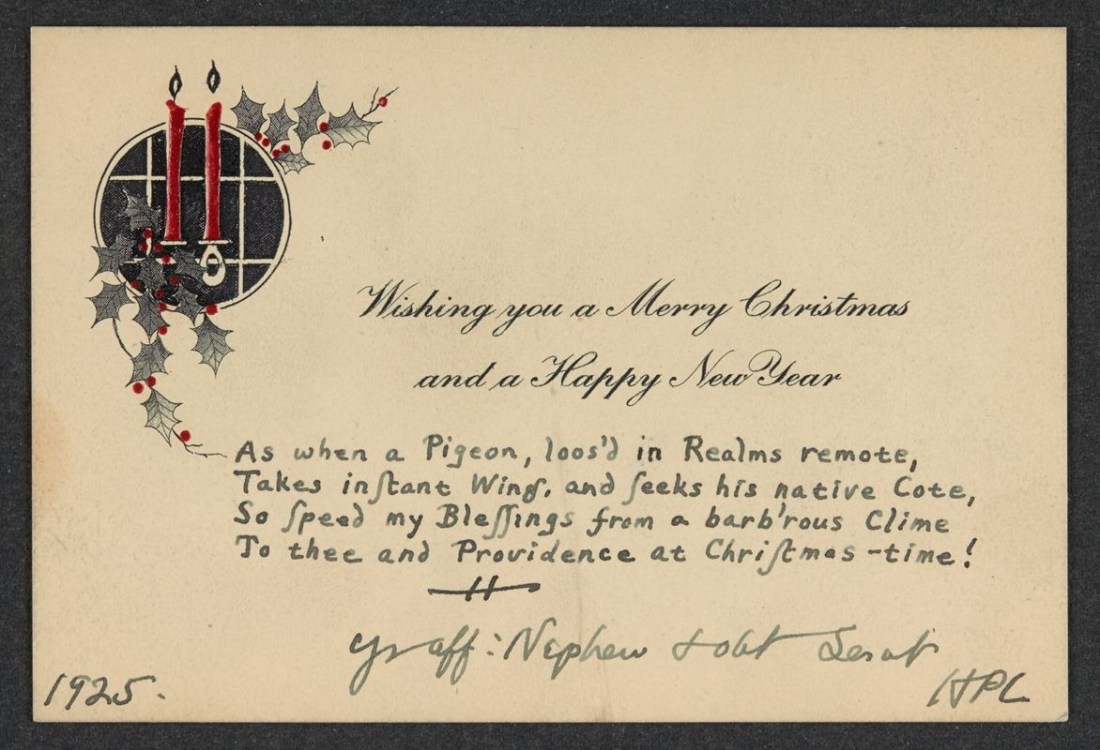
It is clear from the surviving letters that Lovecraft continued to have a relationship with the Eddys; after he left Providence, the Eddys’ absorbed some of Lovecraft’s furniture from his aunts (as well as dozens of postcards from Sonia H. Greene, which were sadly destroyed). Lovecraft wrote a letter of introduction for C. M. Eddy to Harry Houdini, and C. M. Eddy apparently did some work for Houdini. Lovecraft certainly helped revise or amend some of C. M. Eddy’s fiction for Weird Tales, and they were to collaborate on The Cancer of Superstition for Houdini, a project cut off by the magician’s untimely demise.
There is some indication that Lovecraft may have had a falling-out with, or at least frustration with, the Eddys in late 1925/early 1926. A pair of letters suggests frustration:
Strange case—but as I just wrote A E P G on a card, I’m through with freaks & paupers & plebeians & odd fish at last. It took a long time to shew me how profitless they all are—Arthur Fredlund, Herbert Benson, Eddy, &c—but I now see how asinine it is to bother with them. They give no pleasure in the end, & become an intolerable nuisance & parasitic pest.
— H. P. Lovecraft to Lillian D. Clark, 22 Dec 1925, Letters to Family & Family Friends 1.520As for me, I’m sick of Bohemians, odds & ends, freaks, & plebeians—C. M. Eddys & satellites & miscellany &c. They amuse me for a while, but begin to after a time to get frightfully on one’s nerves. People get one one’s nerves when they harbour different kinds of memories & live by different kinds of standards& cherish different kinds of goals & ideas.
— H. P. Lovecraft to Lilian D. Clark, 11 Jan 1926, Letters to Family & Family Friends 2.536
Without the Eddys’ end of the correspondence, we don’t really have an idea of what the problem was, but given the general impression of poverty that surrounds the Eddys from Lovecraft’s other letters of the period, it probably has to do with the straitened circumstances of the little family.
One thing we don’t get from this period, or after, is a real sense of Lovecraft’s relationship or correspondence with Muriel E. Eddy. With three kids under ten years old, she certainly had her hands full, on top of whatever other efforts she made to support the family while C. M. Eddy, Jr. tried to alternately write and work odd jobs, so it would not be surprising if C. M. Eddy, Jr. took over the bulk of the correspondence chores. We get a picture of the Eddys as a couple in a few letters from Lovecraft:
Orton is now attempting some writing—though of a popular & low-grade sort, for the Macfadden publications. (the same ones which honest Eddy’s wife writes for.)
— H. P. Lovecraft to Lillian D. Clark, 12 Apr 1929, Letters to Family & Family Friends 2.747He has so far managed to keep meagrely afloat—with a wife & three children—by undertaking outside work of various sorts; but recent economic conditions have left him jobless & reduced him to such depths of want & peril that nothing short of a miracle—or a flood of fairly lucrative literary chores—can keep him & his flock from actual freezing, starvation, & eviction during the interval before he can again secure some industrial affiliation.
— H. P. Lovecraft to Zealia Brown Reed Bishop, 16 Jan 1930, Letters to Woodburn Harris & Others 429I say the “House of Eddy” because C.M.E. Jr. made it clear last night that his wife does most of the adaptive revision in cases of this kind. He takes care of the grammatical & rhetorical side, while Mrs. Eddy supplies the “human-interest” hokum & blah for which the Macfadden editors are so avid. She, it seems, has produced much of this material, & has helped many beginners to develop into steady sellers. Her help, Eddy says, generally amounts to actual collaboration—although in your case, as I have just warned, you must not let it approach the status of instruction lest the results of Belknap’s lessons be undone. The rates charged by the Eddys for this collaborative revision of Macfaddenistic material would be very reasonable, & they would be glad to discuss the matter of placement with you whenever you wish to write.
— H. P. Lovecraft to Zealia Brown Reed Bishop, 29 Jan 1930, Letters to Woodburn Harris & Others 436-437
The last letter from Lovecraft to C. M. Eddy, Jr. is c. 1930, and mentions “The Mound” (1940) by Zealia Bishop. A checklist among Lovecraft’s papers suggest he was still in touch with the Eddys at least as late as 1934, as he apparently sent them postcards from St. Augustine, Charleston, and Nantucket, but these are not known to survive (Collected Essays 5. 267).
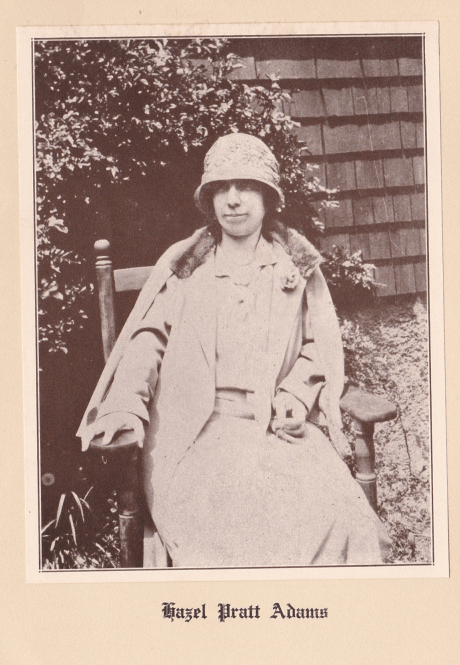
There is a notable gap in the correspondence, near the end of Lovecraft’s life. Muriel Eddy claimed that she was responsible for putting Lovecraft in contact with Hazel Heald, Lovecraft’s last major revision client. If Muriel E. Eddy did this by letter, those epistles do not appear to have survived and are not in evidence from what other correspondence we have. Then again, why would they be? Lovecraft seldom mentioned such correspondence to others.
How do we square this evidence for correspondence—solid (in the form of two letters to Muriel E. Eddy and ten to C. M. Eddy, Jr.) and circumstantial (references to the Eddys in Lovecraft’s other letters)—with Muriel’s own memoirs? Whether or not Muriel was misremembering or deliberately glossing over a few details, it seems clear that Lovecraft’s relationship with the Eddys was not quite as tight as she liked to present, and the impression given is of a friendship occasionally strained by time, distance, and business or financial matters, albeit not a friendship that was ever completely abandoned on either side.
Because so much of the surviving correspondence is between Lovecraft and her husband, it is difficult to get a bead on Muriel E. Eddy’s relationship with Lovecraft. There is a strong impression that at the beginning (c.1918-1924), Lovecraft was writing mostly to Muriel, as he would to any of a number of amateur journalists. As Lovecraft’s business with C. M. Eddy, Jr. waxes—first with revising his work and getting stuff typed, then the Houdini-stuff, and finally the Bishop revising/typing—we see less and less of Muriel.
While there are a few contradictory points in Muriel’s memoirs of Lovecraft, it’s important to point out that she was not necessarily dishonest—memory can get vague and fuzzy, and by the time Muriel was weighing in Lovecraft had been dead for years. As she told the stories over and over, they became more fixed, as evidenced by comparing the earlier memoirs to later ones; repeating narratives makes them clearer in the mind, but it also means a person teaches themself how to tell a story, sometimes adding or removing details, being informed by what other people wrote, etc. Most of Muriel’s comments on Lovecraft’s marriage, for example, are pure hearsay and speculation, and quite often wrong.
It is unfortunate that more of the Lovecraft/Eddy correspondence is not available. Muriel E. Eddy’s memoirs, even flawed, provide a fascinating insight into Lovecraft’s life and work, and also into her own life and that of her husband during this tumultuous but critical period. What drove a woman like Muriel E. Eddy to write to H. P. Lovecraft? What prompted him to write back? How long did they correspond, of and on? We do not have—will never have—all the pieces of the puzzle.
Imagine a young mother, bouncing a toddler on her knee, squinting at one of Lovecraft’s manuscripts and trying to type it out—or perhaps C. M. Eddy, Jr. was there, a rugrat at his foot, as he read aloud while she typed. Or that breathless expectation on a hot summer afternoon in Providence, as a tall man in a straw hat walked up to the door to introduce himself, with a name they had only read in letters up to that point…it’s easy to wax romantic about these relationships. Yet the whole point of tracing such correspondence and combing through these memoirs is to get a better sense of who these people were, and what their lives were like.
Thanks to Donovan Loucks for his help with this one.
Bobby Derie is the author of Weird Talers: Essays on Robert E. Howard and Others and Sex and the Cthulhu Mythos .
Deep Cuts in a Lovecraftian Vein uses Amazon Associate links. As an Amazon Associate I earn from qualifying purchases.











 Deep Cuts in a Lovecraftian Vein