If anyone speculated about Lovecraft’s sexuality while he was alive, they were polite enough not to publish about it. It wasn’t until Lovecraft was safely dead that the lockpicks of biographers went for his underwear drawer. When Winfield Townley Scott published “His Own Most Fantastic Creation: Howard Phillips Lovecraft” in The Providence Journal for 26 Dec 1943, he wrote:
His stories are sexless and one supposes the man was nearly so, all but mothered into impotency. One can say that almost all of his adult relationships were homosexual, if the word is intended in the blandest sense: there is no sign of strong sexual impulse of any kind. He was “not at ease” with women. His marriage was a mistake and a quick failure. He was disturbed by even mildly sexual writing. When he bought pulps at Douglass Dana’s Old College Book Shop, at the foot of College Street, he tore off the more lurid covers lest friends misunderstand his interests.
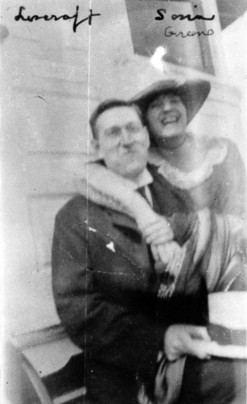
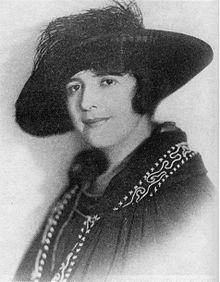
Speculation on Lovecraft’s sexuality picked up during the period of the Lavender Scare. Attention on that front shifted to his ex-wife, Sonia H. Davis, who was perhaps uniquely in a position to know. Her memoir does not go into any detail, but suggests Lovecraft was reserved, e.g.:
When I parted for the night, I said “Howard, won’t you kiss me goodnight?” His reply was, “No, it is better not to.”
—Sonia H. Davis, “The Private Life of H. P. Lovecraft” in Ave Atque Vale 143
This scene has been interpreted as an invitation to resume marital relations and Lovecraft’s decline; the morality involved is old-fashioned these days. But certainly Sonia implied that she and Howard engaged in normal heterosexual relations as a married couple. She implied further in the “pinkey” anecdote and the “asequately excellent lover” comments in Memories of Lovecraft (1969), and once, August Derleth asked her directly about it:
A propos your piece on Lovecraft, the question of HPL and sex had been bothering me for some time, especially in view of his violent reaction against Oscar Wilde as a person, however much he admired his work; so in 1953 when I was in Los Angeles, I asked Sonia Davis—the ex-Mrs. Lovecraft—rather bluntly about HPL’s sexual adequacy. She assured me that he had been entirely adequate sexually, and since she impressed me as a well-sexed woman, not easily satisfied, I concluded that HPL’s “aversion” was very probably nothing more than a kind of puritanism—that is, it was something “gentlemen” didn’t discuss, and so on.
—August Derleth, Haunted vol. 1, no. 3 (June 1968), 114.
The idea of Lovecraft as prudish, sexually repressed, asexual, or homosexual thus developed further in the literature; L. Sprague de Camp would synthesize several of these lines of thought in “Sonia & H. P. L.” (1973) and his biographical essay “Eldritch Yankee Gentleman” (1971), where he wrote:
He abhorred sexual irregularities and deviations, yet his own approach to sex was so prissy and inhibited as to make some wonder whether he, too, had a touch of lavender.
—L. Sprague de Camp, “Eldritch Yankee Gentleman” part 1, Fantastic Stories (Aug 1971) 98Writers have described Lovecraft as “sexless,” which does not seem to have been really the case. During the early months of his marriage, he seems to have performed his husbandly duties adequately if without great enthusiasm. The charge of “latent homosexual tendencies” has, however, becomes such a fad that it is leveled at almost any notable, including Lovecraft, whose love life is the lease unusual. As far as the evidence goes, it is probably true that Lovecraft had a low sexual drive. Otherwise, there is nothing to support the “latent homosexual” charge.
—L. Sprague de Camp, “Eldritch Yankee Gentleman” part 2, Fantastic Stories (Oct 1971)
Comments like this may have been what inspired R. Alain Everts to write up “Howard Phillips Lovecraft and Sex: or The Sex Life of a Gentleman” for Nyctalops #9 (1974), an article based on Sonia’s memories of her long-dead second husband and H. P. Lovecraft’s sexuality:
During the course of my friendship with Sonia Lovecraft, the topic of her sexual relationship with Howard Phillips Lovecraft came up not once—due more to the young age at that time of this author, than to the lack of his scholarship. Fortunately for me, however, several times Mrs. Lovecraft brought up the subject herself and this scholar duly recorded and filed away the pertinent data.
In several unpublished recollections of HPL, Sonia mentioned in passing that aspect of their relationship—of course, as was HPL, she was also a Victorian prude when it came to sex and sexual relations; however Sonia lived into an age of greater liberties regarding sexual matters and the revelation of them in publick. And, she also had given birth to two children prior to her 20th birthday, children by her first husband, only one of which survived. This experience, although somewhat traumatic and repressing to her at the time, was certainly much more than Howard had ever had, for he was a virgin at their marriage in 1924. His bride was hardly blushing, and although both were not enthusiastic in any sexual sense of the word, both were able to sustain satisfying sexual relations.
There are two immediate issues with this piece: first, the degree to which it tracks with (and thus was likely informed by) earlier works like Winfield Townley Scotts’s influential biographical essay make it suspect, and second, the source documents and conversations that Everts cites have never been published. While we know he was in contact with an elderly Sonia H. Davis for several years, this means that everything he’s reporting is being filtered through his own viewpoints and in his own words, and the veracity of the material is qualified by how trustworthy Everts himself is as a scholar and journalist (see The Curse of Cthulhu for some potential issues).
Even if Everts accurately presented Sonia’s comments on Lovecraft’s sexual reticience, she herself may have been influenced by posthumous publications on HPL. For example, when Everts quotes her as saying:
Sonia also reaffirmed a statement that I have heard from various sources—that when HPL was growing to young manhood, “his mother’s admonitions to him were ‘devastating.’” This possibly pertains to HPL’s looks—his mother did tell him that he was “grotesque” and that he should not go out at daytime for fear of scaring the neighbours. No doubt some sexual admonitions arose also, for the entire family, according to what Sonia recalls Annie Gamwell telling her, knew of Winfield Lovecraft’s paresis, and the adventures with prostitutes and women on his lengthy travels that gave him his affliction. In fact, Annie told Sonia prior to her marrying HPL that they could not have children—in fact this was a warning that Annie was giving to Sonia, and to me her choice of words was interesting—could not instead of should not.
The idea that Susan Lovecraft was concerned about her son’s appearance first appeared in the letters of Clara Lovrien Hess to Winfield Townley Scott, and were reported in his column in the Providence Journal. Sonia was in correspondence with Scott at the time (some of their letters remain at the John Hay Library) and would have learned of this; Scott’s research and speculations may well have influenced her memories. The story of Annie Gamwell confessing that HPL’s father had syphilis, for example, was written after Scott revealed Winfield Scott Lovecraft’s diagnosis and cause of death. It is impossible to tell, at this distance, how much if at all Sonia’s memories were fitted to the facts as reported, rather than straight recollections, with all their inherent inconsistencies and errors.
If this skepticism seems extreme, it is because the evaluation of historical evidence demands a certain amount of rigorous questioning of the sources: who is writing? When did they write it? Why did they write it? What sources influenced the writing? Both Everts and Sonia had their own biases when expressing views on Lovecraft’s sexuality, explicit and implicit, and this has to be understood when reading the essay. Without access to Everts’ source materials, we cannot tell if he was censoring Sonia by leaving out recollections that didn’t fit his theme (that of Lovecraft as heterosexual, capable of sexual intercourse, but of low sex drive), or if he was presenting everything she said and adding his own interpretation based on the then-current state of Lovecraft scholarship. The emphasis on Winfield Lovecraft’s syphilis, for example, appears to be an addendum to the discussion on WSL and syphillis in Dr. David H. Keller’s “Shadows over Lovecraft” (1948), Dr. Kenneth Sterling’s “A Reply to Keller’s Article on Lovecraft” (1951), and Arthur S. Koki’s “H. P. Lovecraft: An Introduction to His Life and Writings” (1962).
The degree to which “Howard Phillips Lovecraft and Sex” parallels or is in conversation with Lovecraft scholarship of the 1970s cannot really be overstated. While the quotes from Sonia’s unpublished memoirs or interviews are unique and original, the actual content strongly follows existing lines of thought. For example, when Everts quotes her as saying:
He was reared more like a girl evidently instead of being reared like a man; yet he was far from unsexed as someone has stated. But it was this sort of up-bringing, I believe, that made him squeamish and prudish about perfectly natural functions.
The “reared like a girl” comment dovetails some anecdotes in Sonia’s account that Susan Lovecraft had hoped to give birth to a girl, and that a young Lovecraft (who, as many infants in the 1890s, wore dresses and kept long hair) “looked like a beautiful little girl” and his mother cried bitterly when the long locks were cut off (Ave Atque Valley 121). Sonia and Lovecraft didn’t begin their relationship until after Susan Lovecraft’s death, so Sonia was reporting at best second-hand recollections, which were then quoted (hopefully accurately) by Everts—but the photographs of the infant Lovecraft in a dress were published in Rhode Island on Lovecraft (1945), and Lovecraft’s own recollections of his earliest years were published in the first volumes of the Selected Letters.
The degree to which Sonia’s memories were affected by such post-Lovecraft materials is unknown; that she speculated on such things seems clear, based on material that didn’t pass through Everts’ hands. Everts’ motivation for adding it in this essay seems clear enough: it’s relevant, even if speculative, and it helps sell the narrative of a young Lovecraft who was prudish and dominated by his mother, “all but mothered into impotency” as Winfield Townley Scott put it.
An interesting question to ask is: what is not in “Howard Phillips Lovecraft and Sex?” There is no reference to any speculations about Lovecraft as a homosexual or transgender. This was not a strong theme in Lovecraft scholarship at the time, although it would swiftly become one when L. Sprague de Camp’s Lovecraft: A Biography (1975) came out the following year. While Winfield Townley Scott had given short shrift to the idea of Lovecraft as a homosexual, de Camp would devote an entire chapter to Lovecraft’s sex life and speculation of HPL as a closeted homosexual. Whether this was a deliberate choice on Everts’ part (in some private correspondence, Everts evinced some homophobia), or simply accurate reporting of Sonia’s thoughts is unknown.
The idea of Lovecraft as transgender is relatively recent, and mostly based on the same evidence that was presented for HPL as a closeted homosexual; e.g. the idea that his mother attempted to raise him as a girl, as Sonia speculates in this essay. This harkens back to an older perspective on homosexuality that muddled sexuality and gender identity, with the idea that homosexual men were necessarily effiminate and possibly overly-influenced by women when young. Contemporary understanding of transgender identity does not follow this line of thought, but when reading older material out of context, misunderstandings can happen.
Also absent are any quotes from Lovecraft’s letters on the subject of sex. This may be more understandable as HPL’s more extensive discussions on the subject weren’t published until the later Selected Letters volumes published after this article came out. Some of Sonia’s further comments on Lovecraft and sex in her letters to August Derleth are also not present, but there is no reason to believe Everts would have had access to those letters and she may never have repeated those comments to him.
Today, “Howard Phillips Lovecraft and Sex” is probably more interesting for the snippets from Sonia H. Davis than for Everts’ speculations and interpretations on Lovecraft’s sexuality. Some of the estimations have held up as more evidence has been presented: the idea of Lovecraft having a low sex drive seems well-supported based on his letters, the impressions of friends, and especially Sonia’s estimation quoted here. Lovecraft the prude has shown to be more complicated; his correspondence doesn’t include any frankly explicit or erotic material, but he was not otherwise reticient in writing about sex, even if he never went into anatomical detail. There is some supporting evidence in the memoirs of Mara Kirk Hart for Lovecraft’s reticience in discussing sex verbally.
“Howard Phillips Lovecraft and Sex: or The Sex Life of a Gentleman” by R. A. Everts is ultimately a nonfiction work representative of a particular historical period and context, and understanding what works that Everts and Sonia were influenced by and responding to changes how we read and understand the essay. Its historical impact on Lovecraft studies hasn’t been dramatic; there are no terrific revelations here, mostly quite confirmations of ideas that had already been passed around before. However, it is one of the first works to discuss Lovecraft and Sonia’s sex life openly, quoting some of Sonia’s own words on the subject, and for that, at least, it has a place in the study of the lives of both H. P. Lovecraft and Sonia H. Davis.
Bobby Derie is the author of Weird Talers: Essays on Robert E. Howard and Others and Sex and the Cthulhu Mythos.
Deep Cuts in a Lovecraftian Vein uses Amazon Associate links. As an Amazon Associate I earn from qualifying purchases.
 Deep Cuts in a Lovecraftian Vein