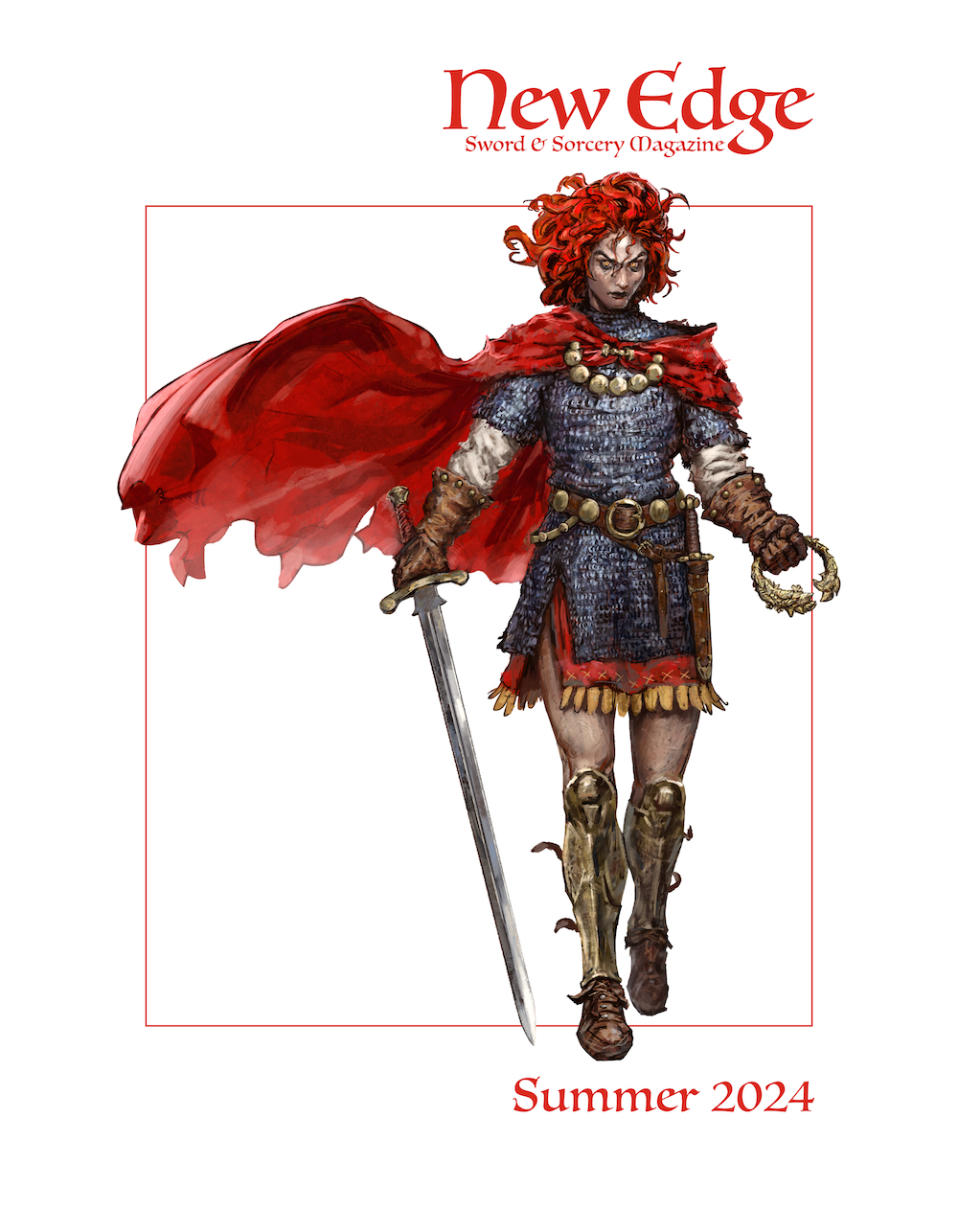
“Jirel and the Mirror of Truth” (2024) by Molly Tanzer

“You have succeeded today;” it said, “but you have lost yourself, Jirel, once of Joiry.[“]
—Molly Tanzer, “Jirel and the Mirror of Truth” in New Edge Sword & Sorcery #3

Jirel of Joiry appeared in Weird Tales with “Black God’s Kiss” (1934) by C. L. Moore. That style of story had no name yet, and very few peers to compare it to. Readers immediately saw in Jirel a warrior akin to Conan the Cimmerian and Kull of Atlantis, embattled against wizards and stranger foes that blended adventure and horror, might thews and magic, swords and sorcery.

As a consequence, the initial spate of adventures from C. L. Moore’s typewriter were a bit raw. There was little continuity and less worldbuilding. Jirel herself was a boldly sketched character, and her personal trials shaped her development—yet Moore never tried to portray her at different ages as Robert E. Howard had done with Conan, never sought to reconcile her fantastic France with the real world, and the adventures she went on were the definition of episodic. Where readers could look forward to Conan as a king and know he spent a varied career as a thief, pirate, and mercenary soldier, Jirel was little different in her last adventure than she was at her first.

Jirel of Joiry had no destiny, no future, almost no past to speak of.

So when Molly Tanzer received permission from C. L. Moore’s heirs to do a new authorized Jirel story, she had some decisions to make. Ninety years of steady development has refined heroic fantasy fiction far from its roots in pulp fiction. There have probably been a hundred stories about mystic Mirrors of Truth, not least because Robert E. Howard had a go at the idea with “The Mirrors of Tuzun Thune” (1929), and the pages of at least ten thousand paperback novels is stained with the blood of cunning wizards and magical gewgaws who learned, far too late, what the tip of the blade feels like as it cleaves their liver (or black heart, or festering brain, etc.) in two.

In this respect, “Jirel and the Mirror of Truth” reads like a fairly competent and well-written sword & sorcery story in a fairly old-school mode. If the heroine wasn’t Jirel, readers would still have no doubt that Jirel’s literary DNA was in the mix, much as most barbarians in fiction have a little bit of Howard’s Cimmerian in them. If it lacks something of the raw and sensual language of C. L. Moore, that’s because Tanzer is a smart enough writer not to fall in the trap of trying to pastiche Moore’s prose style. Better, it shows a solid understanding of one of Moore’s central themes: the Jirel stories are always about a contest of spirit as much (or more) than flesh.

It doesn’t take much genre savviness to glance at the title and decide the question will emerge, sooner or later, “Who is Jirel of Joiry?” The answer, however, might surprise a few folks. Molly Tanzer doesn’t regurgitate bits of old Moore stories, though she draws on elements of them; she illustrates who Jirel is through her actions and interactions with others, especially her new companion, Thevin Galois. Less a girlfriend and more than a sidekick, Thevin is a kind of Enkidu to Jirel’s Gilgamesh; the two are alike, but they complement each other. Perhaps they reflect one another’s strengths and weaknesses, their potentialities. Thevin is what Jirel might have been; Jirel is what Thevin might yet be.

When it came to amorous matters, Thevin preferred the company of women, and did not give much notice to men’s attentions.
—Molly Tanzer, “Jirel and the Mirror of Truth” in New Edge Sword & Sorcery #3

Tanzer likes LGBTQ+ characters in her stories, and in this respect Thevin as a lesbian works well. Her sexuality is stated, there’s a hint of tension and attraction with Jirel, but this isn’t Thirsty Sword Lesbians or Dagger Kiss where the question is whether they’ll kiss. If anything, it’s nice to just see the representation of a character where their sexuality is relevant to their character but not the main focus of the story or present just to fulfill a lurid scene or two—there is actual porn out there for folks that want erotic tales of lesbian swordswoman. Tanzer is focused on telling Jirel’s story.

For readers who start with “Black God’s Kiss” and read through the whole C. L. Moore-penned Jirel of Joiry saga to “Hellsgarde” (1939), “Jirel and the Mirror of Truth” might be a bit of a jolt in style. There’s a bit more of Michael Moorcock and Joanna Russ in the style than Robert E. Howard and C. L. Moore. Yet it is a well-written story, and a cut above the pastiche of yesteryear. With a little luck, Jirel’s new adventures may have just begun.

“Jirel and the Mirror of Truth” by Molly Tanzer was published in New Edge Sword & Sorcery #3 (Summer 2024).


Bobby Derie is the author of Weird Talers: Essays on Robert E. Howard and Others and Sex and the Cthulhu Mythos.

Deep Cuts in a Lovecraftian Vein uses Amazon Associate links. As an Amazon Associate I earn from qualifying purchases.
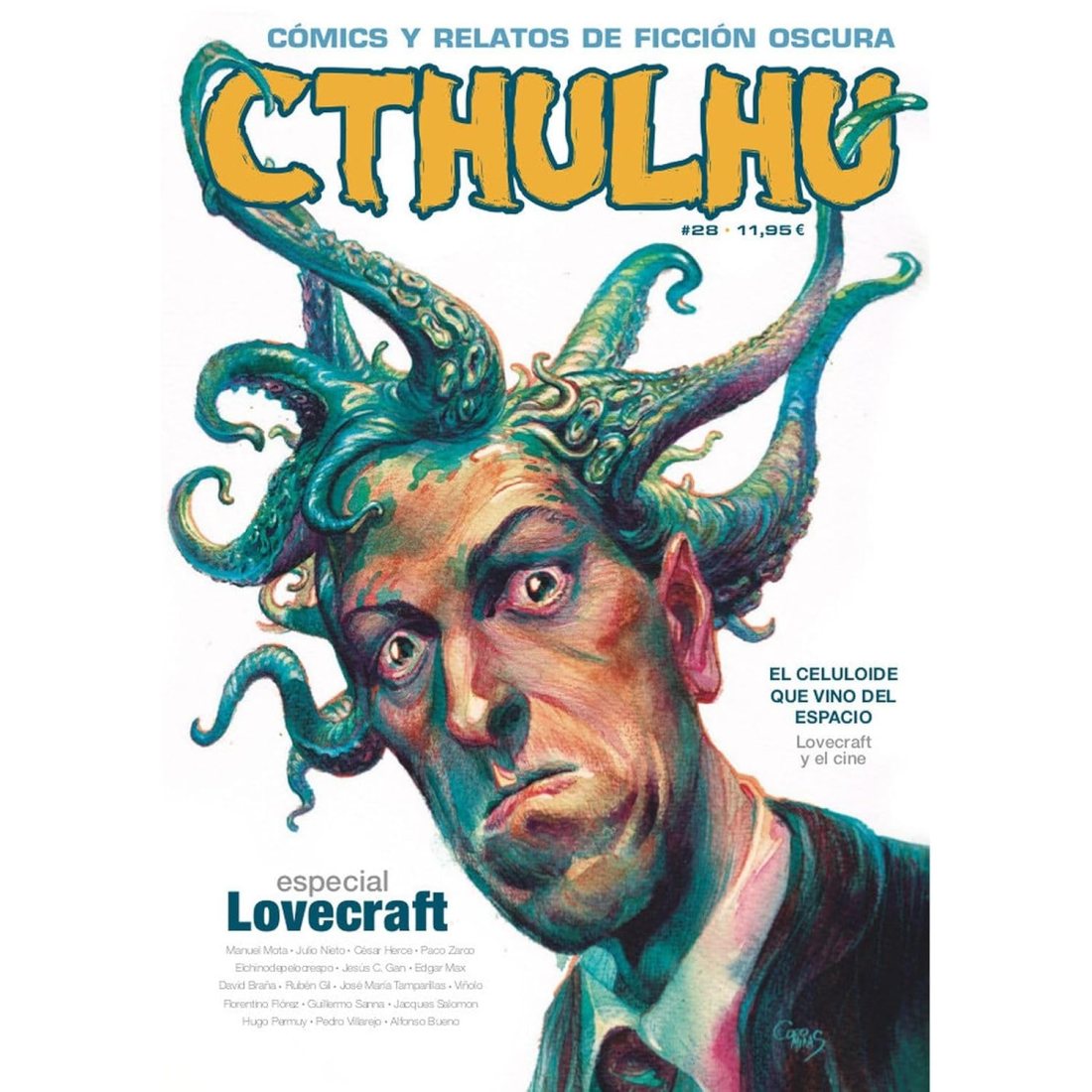
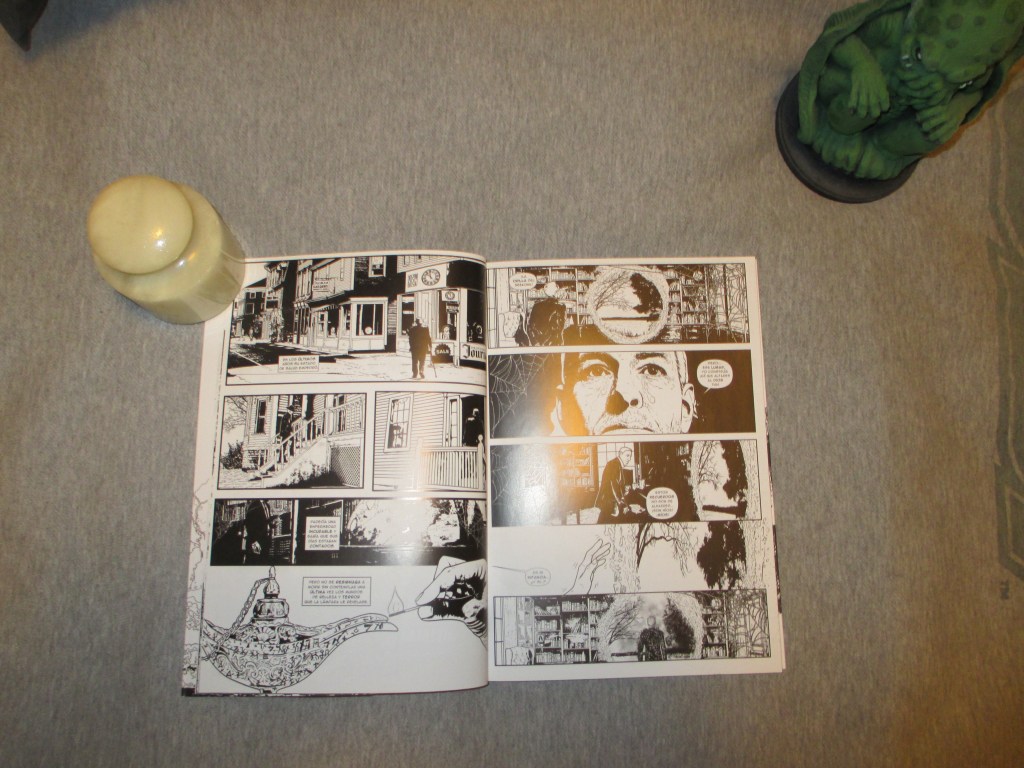
“La Lámpara de Alhazred” (2023) by Manuel Mota & Julio Nieto

Habían pasado siete años desoe la desparaición de su abuelo Whipple cuando Ward Phillips recibió la lámpara.Seven years had passed since the disappearance of his grandfather Whipple when Ward Phillips received the lamp.It was seven years after his Grandfather Whipple’s disappearance that Ward Phillips received the lamp.
“La Lámpara de Alhazred” (2023) by Manuel Mota & Julio Nieto,
Cthulhu #28.5
English translationAugust Derleth, “The Lamp of Alhazred” (1957), The Watchers out of Time 114

Many of August Derleth’s “posthumous collaborations” with H. P. Lovecraft have been derided as pastiches. Yet “The Lamp of Alhazred” is more homage—and more accurately a collaboration than most of Derleth’s stories, since it incorporates a large chunk of text from Lovecraft’s letter to Derleth dated 18 Nov 1936, where Lovecraft described coming across a previously unknown wood west of Neutaconkanut Hill.

On Oct. 28 I penetrated a terrain which took me half a mile from any spot I had ever trod before in the course of a long life. I followed a road which branches north 7 West from the Plainfield Pike, ascending a low rise which skirts Neutaconkanut’s Western foot & which commands an utterly idyllic Vista of rolling Meadows, ancient stone walls, hoary groves, 7 distant cottage roofs to the west & south. Only 2 or 3 miles from the city’s heart—& yet in the primal rural New-England of the first colonists!He penetrated a terrain which took him almost a mile from any spot he had ever before trod in the course of his life, following a road, which branched north and west from the Plainsfield Pike and ascending a lot rise which skirted Nentaconhaunt’s Western foot, and which commanded an utterly idyllic Vista of rolling Meadows, ancient stone walls, hoary groves, and distant cottage roofs to the west and south. he was less than three miles from the heart of the city, and yet basked in the primal rural New England of the first colonists.
H. P. Lovecraft to August Derleth, 18 Nov 1936, Essential Solitude 2.756August Derleth, “The Lamp of Alhazred” (1957), The Watchers out of Time 119

Derleth also took inspiration from an entry in Lovecraft’s commonplace book:

From Arabia Ency. Britt. II.–255. Prehistoric fabulous tribes of Ad in the south, Thamood in the north, and Tasm & Jadis in the centre of the peninsula. “Very gorgeous are the descriptions given of Irem, the City of the Pillars (as the Koran styles it) supposed to have been erected by Shedad, the latest despot of Ad, in the regions of Hudramant, and which yet, after the annihilating of its tenants, remains entire, so Arabs say, invisible to ordinary eyes, but occasionally, and at rare intervals, revealed to some heaven-favored traveler.” Rock excavations in N. W. Hejaz ascribed to Thamood tribe.It had once been the property of a certain half-mad Arab, known as Abdul Alhazred, and was a product of the fabulous trident of ad—one of the four mysterious, little-known tribes of Arabia, which where ad—of the south, Thamood—of the north, Tasm and Jadis—of the center of the peninsula. it had been found long ago in the hidden city called Irem, the city of Pillars, which had been erected by Shedad, last of the despots of Ad, and was known by some as the Nameless City, and said to be in the area of Hadramant, and, by others, to be buried under the ageless, ever-shifting sands of the Arabian deserts, invisible to the ordinary eye, but sometimes encounter by chance by the favorites of the Prophet.
The Notes and Commonplace Book of H. P. Lovecraft 21-22August Derleth, “The Lamp of Alhazred” (1957), The Watchers out of Time 115-116

While nearly every Lovecraft story has been adapted to comics at some point, rather fewer of Derleth’s stories have attracted the same treatment. Yet it makes sense that Manuel Mota (script) and Julio Nieto (artwork) would adapt “The Lamp of Alhazred” for Cthulhu #28, the Lovecraft special issue. Because there are homages which capture as much of the pathos of H. P. Lovecraft as well as this one.

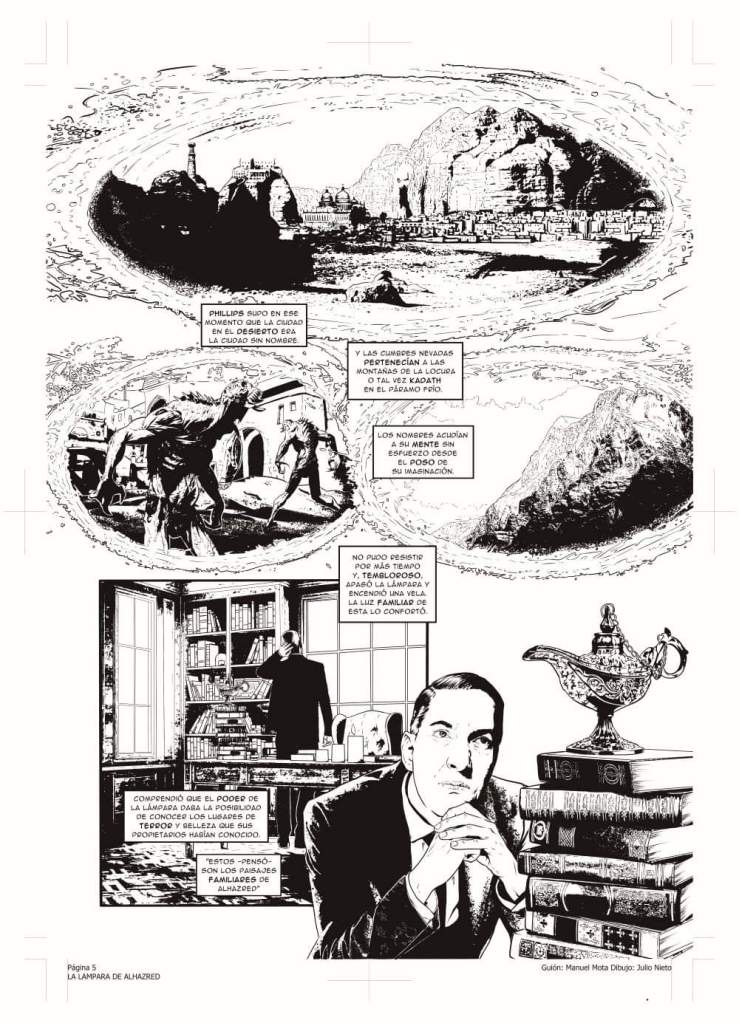
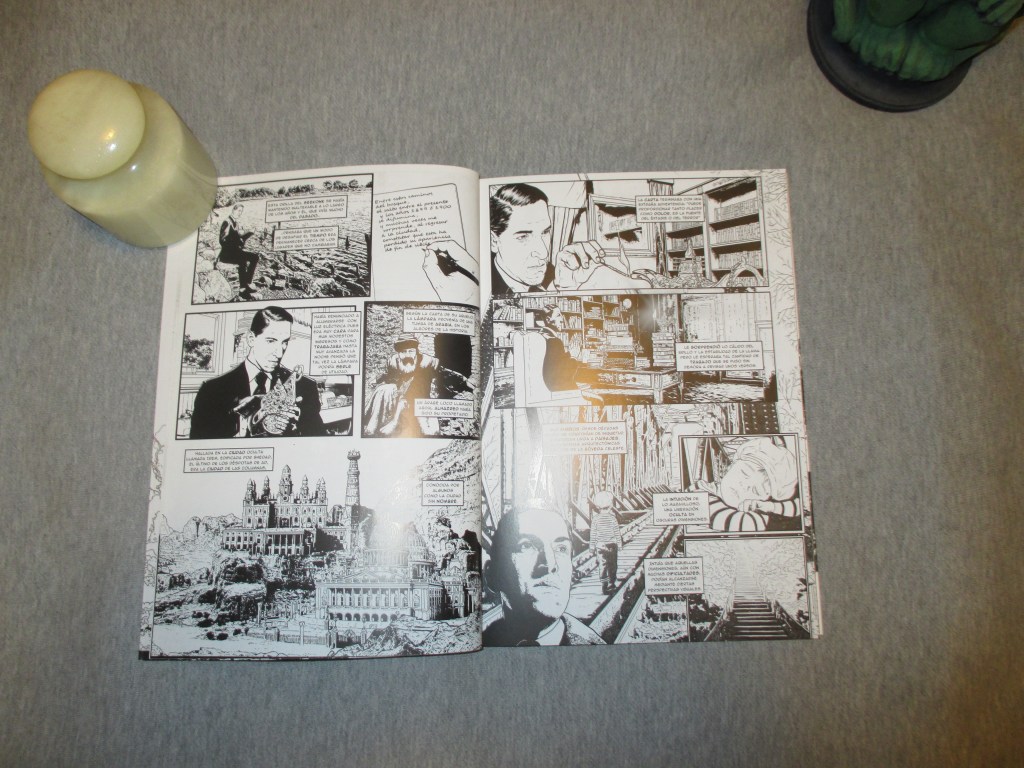
Manuel Mota’s script is a fairly straight translation of Derleth text, albeit truncated for space and with the illustrations serving in place of much of the description, which inadvertently cuts out most of Lovecraft’s text. Yet the presentation and framing of the words and Julio Nieto’s art does much to lend a sense of action to what is a largely contemplative story that draws on both Lovecraft’s life and the sentiment of “The Silver Key.” Readers feel Ward Phillips loss and loneliness, his refuge in his imagination, and the visions of other worlds, other times.

It is escapist in the most literal sense of the word, and one of several stories that reflect that quiet, profound desire to abandon the daily grind of life, with its quiet indignities, defeats, and injuries.

Nieto’s artwork is carefully realistic, the page layout traditionally grid-like; it is a straight-forward presentation that puts the more fantastic sequences, the break-outs where the panel cannot contain a wondrous scene, in context. The weirdness isn’t a part of Ward Phillips world; it is the way out.

Jamás se encontro el cuerpo de Ward Phillips.

La policía aún espera queue sus restos aparezcan en Alguno de los lugares queue solía frecuentar en sus solitarios paseos.

Con el paso de Los años, la vieja casa fue derribada, la biblioteca adquirida por librerías anticuarias y lo queue quedó gue vendido como chatarra incluida una vieja lámpara Árabe a la que nadie encontró utilidad alguna.
The body of Ward Phillips was never found.

Police are still hoping that his remains will turn up in one of the places he used to frequent on his solitary walks.

Over the years, the old house was demolished, the library was acquired by antiquarian bookstores and what remained was sold as scrap, including an old Arabic lamp that no one found any use for.
Though desultory searching parties were organized and sent out to scour the vicinity of Nentaconhaunt and the shores of the Seekonk, there was no trace of Ward Phillips. The police were confident that his remains would some day be found, but nothing was discovered, and in time the unsolved mystery was lost in the police and newspaper files.

The years passed. The old house on Angell Street was torn down, the library was bought up by book shops, and the contents of the house were sold for junk—including an old-fashioned antique Arabian lamp, for which no one in the technological world past Phillips’ time could devise any use.
“La Lámpara de Alhazred” (2023) by Manuel Mota & Julio Nieto,
Cthulhu #28.14
English translationAugust Derleth, “The Lamp of Alhazred” (1957), The Watchers out of Time 123-124

It is a story that almost demands a familiarity with Lovecraft to truly appreciate; those who have read his letters, who knows what Lovecraft struggled with during his life, can recognize more of the man in Derleth’s framing of the Nentaconhaunt narrative. Mota and Nieto do well to capture and depict as much of this atmosphere as they can, and the sensibility of the story is necessarily both sad and romantic in the older sense—this is not a Mythos story, despite the name “Alhazred.” it is a fantasy, a myth, so much more elegant than the reality that saw Lovecraft end his days in pain in a hospital as the cancer consumed him.

“La Lámpara de Alhazred” (2023) by Manuel Mota & Julio Nieto is an excellent overall adaptation of Derleth’s homage to Lovecraft, one that captures the spirit of the original—the echo of Lovecraft, as it were—for a new medium and a new audience.


Bobby Derie is the author of Weird Talers: Essays on Robert E. Howard and Others and Sex and the Cthulhu Mythos.

Deep Cuts in a Lovecraftian Vein uses Amazon Associate links. As an Amazon Associate I earn from qualifying purchases.
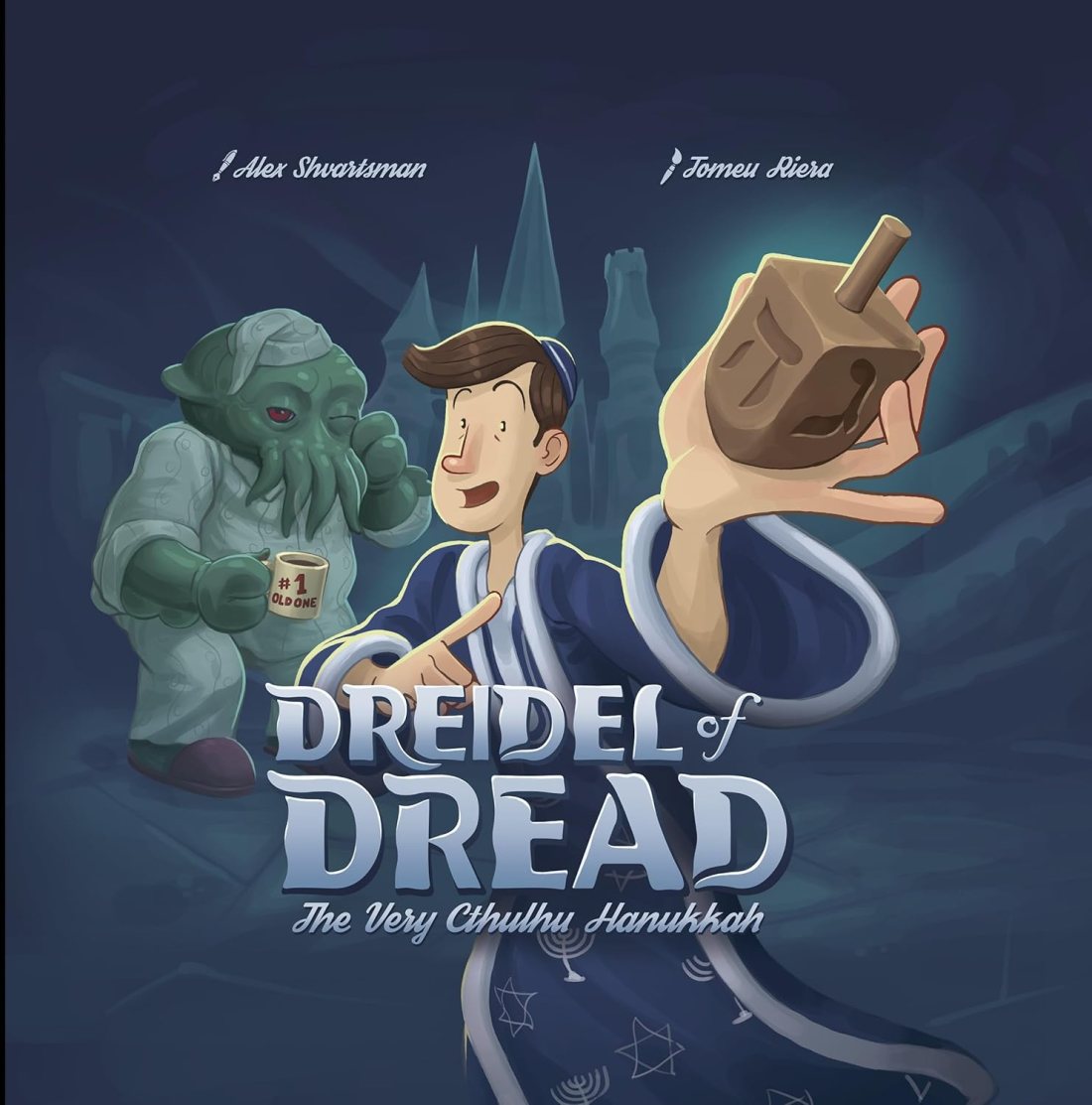
Dreidel of Dread: The Very Cthulhu Hanukkah (2024) by Alex Shvartsman and Tomeu Riera

Hanukkah is an ancient holiday, but a modest one. The holiday of the
Hasmoneans is new, yet it is full of spiritual exaltation and national joy. What
was Hanukkah forty years ago? ‘Al ha-nissim’ and Hallel; a short reading in
the synagogue; lighting the tiny, slender wax candles or oil lights; at home,
levivot [latkes–potato pancakes], cards for the older children, and sevivonim
[dreidels–spinning tops] for the little ones. But what is Hanukkah today? The
holiday of the Hasmoneans. A holiday of salvation. A great national holiday,
celebrated in all the countries of the Diaspora with dances and speeches,
melody and song, outings and parades, as if a new soul has been breathed
into the ancient holiday, another spirit renewed within it. One thing is clear:
if those tiny, modest candles had been extinguished in Diaspora times, if our
grandparents had not preserved the traditions of Hanukkah in the synagogue
and at home . . . , the holiday of the Hasmoneans could never have been
created. There would have been nothing to change, nothing to renew. The
new soul of our times would not have found a body in which to envelop itself.
—Chaim Harrari, Sefer ha-Mo’adim, Sefer Hanukkah (1938),
quoted in “Zionist Awareness of the Jewish Past: Inventing Tradition or Renewing the Ethnic Past?” (2012) by Yitzhak Conforti

On the 25th day of Kislev in the Hebrew calendar is the feast of Hanukkah. Originally a very minor holiday in the Jewish holy calendar, Hanukkah gained increasing prominence during the 20th and 21st centuries as it was embraced as a nationalist holiday by Zionists, and because Hanukkah often occurred near the major Christian holiday of Christmas. The massive increase of secular pop culture surrounding Christmas, especially in English-speaking countries, has led to the increased awareness of Hanukkah, and sometimes its depiction as an equivalent holiday among both religiously observant and secular Jews.

In some cases, elements of secular Christmas celebration have influenced or been adapted for Hanukkah, a process sometimes referred to as Chrismukkah. Jewish families might put up a Hanukkah Bush, or watch Hanukkah-themed movies and animated specials like A Rugrats Chanukah (1996) or Eight Crazy Nights (2002). The influence of Christmas pop-culture on secular Hanukkah media is often very notable. Even when things get a little weird and Lovecraftian.

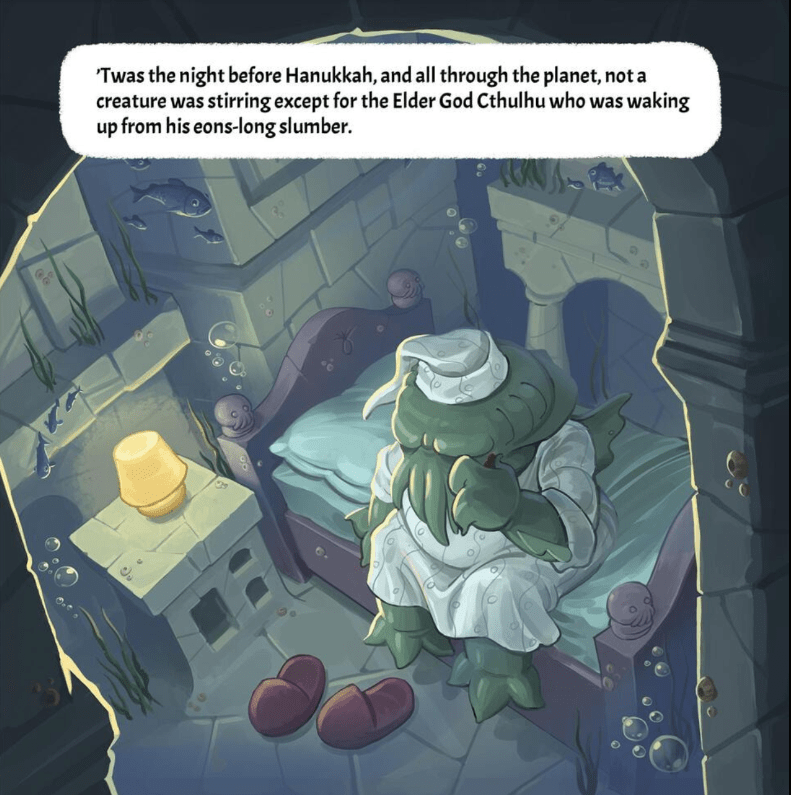
So, when Alex Shvartsman (writer) and Tomeu Riera (artist) set about making Dreidel of Dread: The Very Cthulhu Hanukkah (2024), they took as their initial model the classic Christmas verse “A Visit from St. Nicholas” (1823).

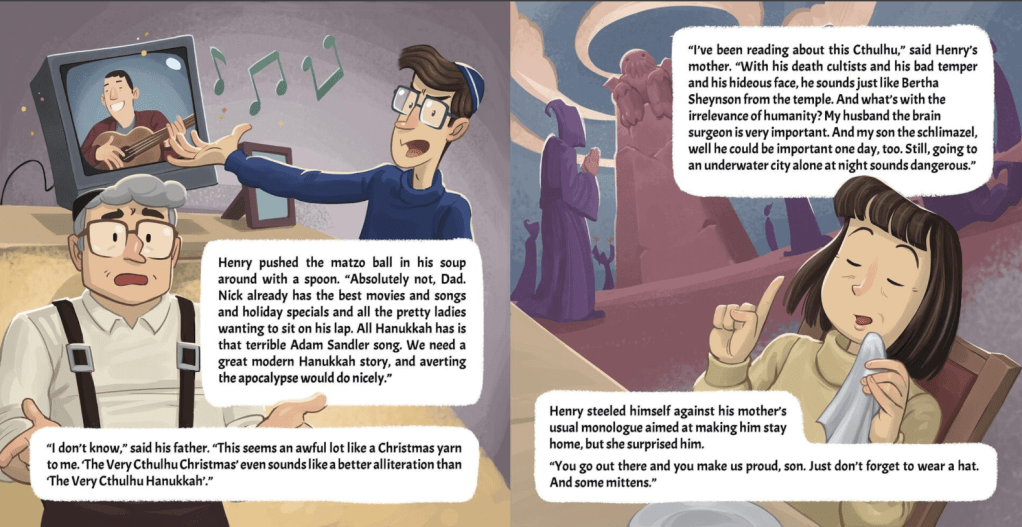
To be fair, Shvartsman and Riera are very aware of it. In fact, that’s quite the point. The book gets very meta very fast, directly addressing how much Hanukkah has played second-fiddle to Christmas in pop culture. Cthulhu is just the catalyst for an ongoing dilemma about the cultural footprint of Hanukkah in a world dominated by Christmas. So with a mix of Yiddishisms and Lovecraftian references, Hanukkah Harry goes off to save Hanukkah from the apocalypse of Cthulhu.

Which he does with a sly insinuation about Lovecraft’s antisemitism and a dreidel.

Riera’s heart is lovely, a soft-focus blend of stylized and detailed that could easily serve as the basis for an animated short. The colors in particular strike a fine balance between the traditional greens and purples favored for eldritch horrors and the more subdued coloring of Harry’s mother and father’s modest dress, while Harry himself favors blue and white. Implicit details of dress suggest the family are probably Reform Jewish, since Harry lacks the payot and none of them wear the typical clothing associated with the hasidim (whose distinct garb Lovecraft noted and commented on in New York City).

It is not a very long book, and thematically it’s not a very deep book. Cthulhu goes down without devouring so much as a latke. Cosmic horror takes a back seat to wanting to sort things about before Christmas comes for Cthulhu. While suitable for and probably geared toward a young adult audience, the youngster would have to be perspicacious enough to be aware of the cultural references for both Hanukkah and Cthulhu to really grok it—and maybe get a chuckle at some of the jokes.

Dreidel of Dread: The Very Cthulhu Hanukkah (2024) is a fun little book, but readers looking for something a little more serious or action-packed might want to check out Edward M. Erdelac’s Merkabah Rider or “The Chabad of Innsmouth” (2014) by Marsha Morman. As Jewish/Cthulhu Mythos mash-ups go, this is distinctly light-hearted and tongue-in-cheek, less concerned with either the details of Lovecraft’s Mythos or the origins of the holiday.

It’s about Hanukkah Harry saving Hanukkah from Cthulhu. Which is, really, all it claims or needs to be.


Bobby Derie is the author of Weird Talers: Essays on Robert E. Howard and Others and Sex and the Cthulhu Mythos.

Deep Cuts in a Lovecraftian Vein uses Amazon Associate links. As an Amazon Associate I earn from qualifying purchases.
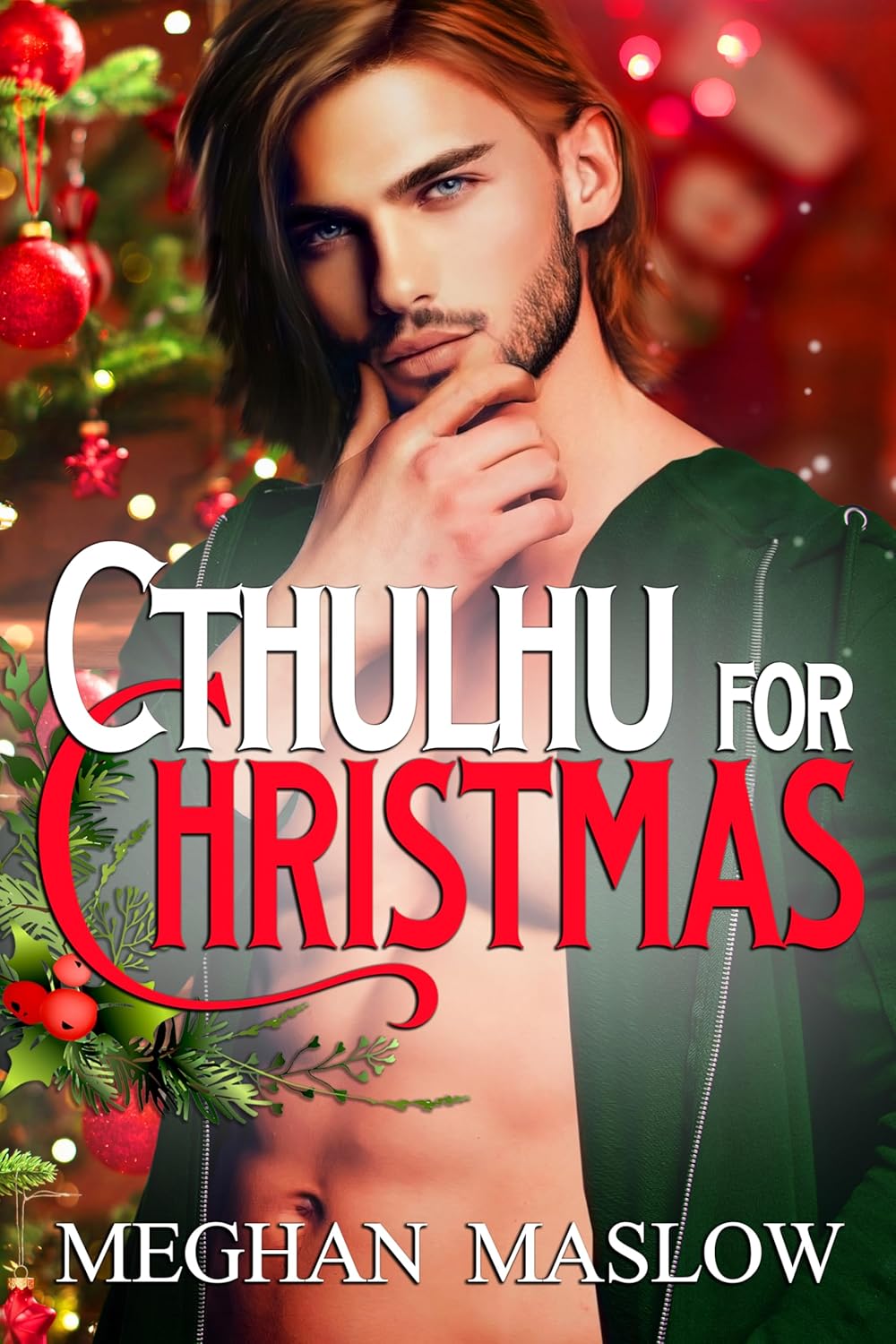
“Cthulhu for Christmas” (2023) by Meghan Maslow

Eldritch Fappenings
This review is of a homoerotic romance work which deals with mature themes and tentacle erotica.
Reader discretion advised.


Romance fiction is about the churn. Individual works often have minimal lasting value; only a rare few works of the sticking power or cultural cachet of Maurice (1971) by E. M. Forester. Yet the appetite for such works is constant. Consumers don’t just want porn, they want characters, settings, relationships, hardship, overcoming adversity, happy endings, unhappy endings—new stories, all the time. And creators need to eat, so they need to keep producing more and more to try and fill that demand.

Sometimes, this results in works that are less character-driven romance and more of erotica of dubious quality. Erotic ebooks like Booty Call of Cthulhu (2012) by Dalia Daudelin and its sequels might be produced rather quickly to hop on a trend. Creators might explore specific niches; Tentacles and Wedding Bells (2022) by Margaret L. Carter is about a young woman marrying into a family that just happens to be a bit inhuman, while Widdershins (2013) by Jordan L. Hawk explores a same-sex relationship in a fantasy steampunk setting, and “Moonshine” (2018) by G. D. Penman does much the same in a Prohibition-era gangster story.

There are times when a spate of Amazon erotic ebooks in a month are focused on bigfoot weddings, or older bosses (of either gender) seducing a new employee, or being isekai’d into a novel and now locked into a forbidden sexual relationship with a step-sibling. One month the flavor might be elves, another Regency-era settings, and sometimes a clever or ambitious author might combine the two. All’s fair in love and genre fiction.

Holiday-themed offerings are available in abundance. Hallowe’en, Thanksgiving, and Christmas are all well-represented…and probably also Boxing Day, Hanukkah, and Arbor Day too. Christmas, however, remains a particular favorite. There’s something about the immense cultural memeplex that extends far beyond the actual celebration of Christ’s birth. A jolly old elf has never stuffed so many stockings; kids who wished for new siblings for Xmas may well get them, Rudolf may be a well-hung were-reindeer with amorous intentions toward Mrs. Claus, and the mistletoe works overtime to trigger steamy kisses. The literary stakes of such works are often pitifully low, with writers and readers more or less satisfied so long as the product delivers the bare minimum of what it promises or hints at.

Content Warning: violence, mature content, brief discussion of child abandonment
—Meghan Maslow, “Cthulhu for Christmas” (2023)

To paraphrase Roger Ebert, I have a sneaky respect for anyone that goes much, much further than too far. With a premise that starts out with “Cthulhu-themed Christmas book” and then expands into: “A Winter Holiday MM Tentacle Romance,” it would have been easy—ridiculously easy—to do a minimalist job, check off the hashtags, and pump out a simple, quirky, and porntastic M/M tentacle erotica ebook in time for the Xmas sales boost. No one would have complained.

What readers get is so much more. Readers going in hoping to see tentacles stretch out holes like pre-lubricated o-ring orifices from page one will be disappointed to find themselves going through short chapters filled with with well-developed characters, in an interesting and evocative setting (with map!), as personal dramas and a murder mystery slowly unfolds. Many of the plot-beats might feel like a Hallmark Christmas movie mixed with your favorite detective show. Will gay cop Zen King tell his straight best friend he’s in love with him? What does Zak’s best friend Grey Criswell and his old money family have to do with the mysterious murder at Salem’s Tree Lot? And what the heck does any of this have to do with a break-in at the local library?

Cthulhu’s Compendium is a one-of-a-kind artifact. I can’t believe you glimpsed it! Please tell me you were able to read some of it! I’ve requested permission from the Special Collections numerous times, but they always inform me it doesn’t exist.”

“Cthulhu’s. Compendium.” Uh huh. “Like Lovecraft? It’s a work of fiction?”

I’d actually read some Lovecraft in high school when an emo kid recommended him.

She huffed. “It’s not fiction. And while it’s unsubstantiated, it’s well known that Lovecraft vacationed here on many occasions. Even visited the museum. You do the math.”
—Meghan Maslow, “Cthulhu for Christmas” (2023)

The Mythos elements of the plot don’t come exactly as a surprise (it’s in the title), but to Maslow’s credit the story takes the time to build up to the revelations. The tone is paranormal romance rather than horror—and because Lovecraft’s work is explicitly fiction within the setting, there’s room for Maslow to play fast and loose with what is “true” in terms of the Mythos. For the most part, that means that sometimes there are tentacles and sometimes they are frisky, though not always cooperative.

If you’d have told me I’d be cock-blocked by tentacles, I’d have laughed. But I wasn’t laughing now.

Fuck my life.
—Meghan Maslow, “Cthulhu for Christmas” (2023)

(For those interested in the steamier bits, the tentacles don’t cock-block for long. Quite the opposite.)

There’s a lot of little silly details that add up in the story to make it more charming. There’s a beaver that’s moved onto a houseboat like a stray dog. A pair of caribou driving a sleigh that work like a Uber service with an app called Caribou For You. An arranged marriage. An ugly sweater contest. If that sounds silly—that’s the point. Mundane weirdness tends to ground a story with more fantastical elements.

“Cthulhu for Christmas” (2023) by Meghan Maslow is not some quick and dirty romp churned out to meet a Yuletide theme and a couple keywords. There is a lot more heart to the story, and a lot more craft to the writing this tale of love, lust, and magic, than a reader might expect.

This story was written as part of a set of holiday-themed tentacle romance offerings: Tinsel & Tentacles.


Bobby Derie is the author of Weird Talers: Essays on Robert E. Howard and Others and Sex and the Cthulhu Mythos.

Deep Cuts in a Lovecraftian Vein uses Amazon Associate links. As an Amazon Associate I earn from qualifying purchases.
“Glory Be to the Father and Mother” (2024) by Bernadette Johnson

“Since you are a church-going type, I wanted to extend an invitation to our service.”
—Bernadette Johnson, Southern Fried Cthulhu 200

There are many cultural fault lines and divides in the United States, fuzzy though they have grown over time as the country becomes more integrated, the population more mobile. The Bible Belt is largely co-terminous with the Southern and Southwestern states and parts of the Midwest. Christian church attendance is high in this area, but the Christian churches involved are varied, multitudinous, and often evangelical, independent, fractious, and unregulated.

Anyone can buy a collar and a Bible. Anyone can preach and call themselves a preacher. The charismatic preachers may be itinerant or fixed; sermons may be preached from multi-million dollar megachurches or from tents or old rented commercial buildings. Some churches are part of large established denominations like the Southern Baptists and Methodists, and may have organized seminaries and organizations like the Southern Baptist Convention, but as many or more may be independent and idiosyncratic.

If you live and grow up in the Bible Belt, affiliation with a given church is a personal as well as cultural choice. Even small towns might support a number of independent churches, sometimes with unfamiliar names, quirks on ideology, theology, and ritual.

Good cover for older, stranger religions.

“”Glory Be to the Father and Mother” by Bernadette Johnson plays on the frisson of the unfamiliar-and-near-familiar. Set in an unspecified small town, a newcomer is courted by opposing congregations, and there is a space of wariness—which is the Mythos cult, and which is just a weird little independent church? Where’s the line between the two? It’s a tension that can’t last very long; especially in a short story, and before too long before the strange altars and human sacrifices come out. Old tropes die hard.

If there’s a criticism for the story, it’s that the premise has enough potential it would have been nice to see more done with it. A more developed setting that spent more time to flesh out the churches and temples involved, the cults, to give them more personality instead of relying on the familiar Mythos Cultist imagery, would have added welcome depth to the story, which races to try and get through its plot points before the end.

In general, few Lovecraftian stories really come to grips with what it means to be a part of a cult, to be recruited, to live inside the group. Stories like “The Book of Fhtagn” (2021) by Jamie Lackey, “The Well” (2023) by Georgia Cook, and “The Things We Did in the Dark” (2024) by Julia Darcey show different approaches to how Mythos cults can work, and it’s not all cowled robes and wavy daggers. The interaction with charismatic evangelical Christianity is rarer; Charles Stross played with the idea in The Fuller Memorandum (2010), and the idea crops up in other stories, but it is a rich and varied field, because of the wide array of churches in the region.

“”Glory Be to the Father and Mother” by Bernadette Johnson was published in Southern Fried Cthulhu (2024).


Bobby Derie is the author of Weird Talers: Essays on Robert E. Howard and Others and Sex and the Cthulhu Mythos.

Deep Cuts in a Lovecraftian Vein uses Amazon Associate links. As an Amazon Associate I earn from qualifying purchases.
“The Quickening of Ursula Sphinx” (2013) by W. H. Pugmire

 Yesterday I completely rewrote ye just-publish’d story, “The Quickening of Ursula Sphinx,” as I am nigh unhappy with the version that has been publish’d in STRANGE VERSUS LOVECRAFT and wanted to improve the story and then use it in the book I am writing with David Barker.
W. H. Pugmire’s Blog, 12 July 2013

Whoever compiles the full and complete bibliography of W. H. Pugmire will have their work cut out for them. Not only because much of Pugmire’s work is distributed in scarce fanzines and limited editions, but because Wilum had a penchant for re-writing that went beyond cleaning up a bit of purple prose or updating references that had aged unpleasantly. When Pugmire re-wrote a story, he could completely transform it in only a few sentences—and did.

“The Quickening of Ursula Sphinx” was published twice; the first time in the now-scarce Strange versus Lovecraft (2013) bizarro anthology, and then re-written for inclusion in the also-scarce In the Gulfs of Dream and Other Lovecraftian Tales (2015), written with David Barker. Finding either will be a hunt; but to truly appreciate how Pugmire could rework a story would require access to both.

The context of the publishing makes an interesting contrast. Strange versus Lovecraft is a collection of Lovecraftian bizarro fiction, and Pugmire is in the odd position of having not just the first story in the anthology, but the most straitlaced one—or perhaps more accurately, in a gathering of grindcore, anti-folk, and crust punks, Pugmire is the OG horror punk who sets the bar against which everything else is measured. Meanwhile in In the Gulfs of Dream, “The Quickening of Ursula Sphinx” is buried deep in the two-author collection, not an afterthought but also not a standout. Among a collection of other less experimental and irreverent Lovecraftian tales, the story finds its place more in relation to the shared characters and ideas of Pugmire and Barker’s other works.

The story by itself is a slight one, only about six pages long, and centers about one of Pugmire’s characters, Ephraim Kant, who has unearthed the thought-lost “talkie” film of silent film actress Ursula Sphinx—who has arrived at the viewing party. The atmosphere and mood opens with the Lovecraftian equivalent of The House on Haunted Hill (1959), just a smorgasbord of Lovecraftian and horror images, tropes, and in-jokes, all in a good-natured fun but marked by Pugmire’s love for the outré and decadent, the sensual and the surreal.

The first changes in the story are minor, mere tweaks on the language:

“Have you not read Ephraim’s second novel, In the Valley of Shoggoth? He mentions these Outer Ones there, in the third chapter, wherein his narrator discusses the queer influence of mortal blood upon cosmic daemons of an alternative dimension?”“Have you not read Ephraim’s second novel, In the Vale of Shoggoth? He mentions these Outer Ones there, in the third chapter, wherein his narrator discusses the queer influence of mortal blood upon cosmic daemons of alien dimension.”
Strange versus Lovecraft 8In the Gulfs of Dream 217

Later, the changes become more pronounced and impactful. The language refined, the ideas more clearly expressed—the equivalent of another draft.

I waved my hand to the others who milled about the room. “Have we all done time for lunacy? Are any of your evening guests slaves to sanity?”

“My dear, what a wicked imagination you have. Ah—but here is our Living Legend.”
Waving my hand to the others in the room, I continued. “We’ve all done time for lunacy, yes? We are none of us slaves to dull sanity.”

“He licked his lips. “I promised you that tonight would be a mad affair.” The babble in the room suddenly ceased, and when our host looked up an element of rare wonder entered into his eyes. “Here is our Living Legend,” he whispered.
Strange versus Lovecraft 10In the Gulfs of Dream 219

The climax of the story though, is where the story fundamentally pivots. Pugmire plays another variation of the magic of the silver screen, like “Pickman’s Other Model (1929)” (2008) by Caitlín R. Kiernan. There is the promise of something captured in the film as it begins to play. In another writer’s hands, this could have been drawn out into a full-blown novella, a legend of what happened that night, a la Fury of the Demon. Pugmire, though, doesn’t look away. Let’s the reader see what happens.

Ephraim took hold of my arm and guided me out of my chair, out of the row in which I had sat, toward the flickering image on the pale wall. I watched the image of the youthful Ursula Sphinx, that semi-human priestess, open her mouth, and I thought that she would buzz again; but instead, she sucked at aether, and the blurred bloody blotch fell, so as to encase her. I saw that cosmic essence sink into the texture of the young woman’s flesh, into her ears and nose and mouth. She stepped out of the screen, toward us. She stopped just before me, her fantastic eyes shimmering, and with the sweetest buzzing tone, she spoke my name with a mouth that wore one little stain of gore. Tilting to her, I kissed the blood from off her mouth.I sensed our host beside me and allowed him to help me to my feet. I liked the way his buzzing voice poured laughter into my ear as the young woman floated toward us. Ursula Sphinx stopped just before me, her fantastic eyes on fire, as in the sweetest droning purr she spoke my name, with that mouth that wore one little stain of my bloodshed. Tilting to her, I kissed my crimson liquid from her lips.
Strange versus Lovecraft 14In the Gulfs of Dream 222-223

The bloody mouth is a recurring image in Pugmire’s fiction, one he liked to return to, at once carnal and horrific. It’s easy to see why Pugmire cut down this paragraph a bit, as it is more effective to move Ursula Sphinx’s quickening to a little earlier—yet the key points, the big change between the two versions of the story is that in the second one, the strange actress tastes the blood of the protagonist. And so, the narrator becomes a part of the proceedings, not just a witness but a celebrant in the climax of the rite, partially captured on film.

For those most interested in the Mythos as setting and stories as sources of lore, this little piece would probably be classed as a minor work. Compared to many of Pugmire’s stories, it is; but it is a little gem of its kind. A look at how and why an author could revise a story, the way a few words’ difference can change the meaning so completely, while retaining the core of both texts.


Bobby Derie is the author of Weird Talers: Essays on Robert E. Howard and Others and Sex and the Cthulhu Mythos.

Deep Cuts in a Lovecraftian Vein uses Amazon Associate links. As an Amazon Associate I earn from qualifying purchases.
“A Lovecraft Postscript” (9 Jan 1944) by Philomena Hart

Winfield, do you ever think of Philomena Hart? She used to be so interested in H.P.L. and many’s the letters we exchanged…re: him. I always had the greatest of respect for BOTH the Harts … B.K.H. was HPL’s good friend. (By mail, at least. HPL used to adore BKH’s column.)
—Muriel E. Eddy to Winfield Townley Scott, 23 Sep 1947, Brown Digital Repository

Mary Philomena Hart (née Kelly) (1894-1944), journalist and book reviewer, was the wife of Bertrand K. Hart (1892-1941), who for many years was the literary editor of the Providence Journal. Betrand Hart had a long-running article series titled “The Sideshow,” known colloquially in Providence as “bekes” according to H. P. Lovecraft, because he would sign each article “B. K. H.” Sideshow articles tended to be relaxed, positive, and centered on small affairs local to Providence and Massachusetts (where the Harts made their home).

H.P.L. and B.K.H. became friends by mail. In 1929, “The Sideshow” had a discussion about the weirdest tales, and Lovecraft couldn’t resist writing in. Letters went back and forth, and excerpts from some of them ended up in “The Sideshow”; these are all reproduced in Miscellaneous Letters. Following B.K.H.’s death in 1941, his widow Philomena edited a collection of these columns into book form, published as The Sideshow of B. K. Hart (1941).

She didn’t stop there.

It is the business of the living to keep on living, and so Philomena Hart continued her own column in the Providence Journal. On 9 January 1944, a few months before her own death, she published an article on H. P. L. and B. K. H.:

A Lovecraft Postscript Based on Barnes Street Letters.—The Providence Poe and His Decade of Mail to “The Sideshow”

Of all the fascinating mail which made its way through the years to the desk of “The Sideshow” there was nothing more exciting than the frequent postcards and letters that carried the initials, “H. P. L.” Winfield Scott and I talked at length about them when he was preparing his rewarding paper on Mr. Lovecraft for the Book Page a fortnight ago. They were written in tiny, clear script, their message was always pertinent to something that had appeared in B. K. H.’s column and usually they dealt with the eldritch, the supernatural, the oblique.

Mr. Lovecraft hoped one day to compile an anthology of horror-tales meeting his own exact requirements. “I fight shy,” he wrote in a long letter on the theme, “of tales dependent on a trick ending. Best horror dwells in atmosphere—even in language itself—and not in obviously stage-managed denouments and literary cap-pistol shots.” Once he wrote for B. K. H. a Providence ghost story of such eerie wonder that speaking of it the next morning in the Journal B. K. H. said “Personally I congratulate him up on the dark spirits he has evoked in Thomas Street but I shall not be happy until joining league with wraiths and ghouls I have plumped down at least one large and abiding ghost by way of reprisal upon his own doorstep on Barnes Street. I think I shall teach it to moan in a minor dissonance every morning at three o’clock sharp with a clanking of chains.

* * *

Only a couple of days later came Mr. Lovecraft’s answer to this threat in the form of a sonnet dedicated to B. K. H.

“The Thing, he said, would come that night at three
From the old churchyard on the hill below.
And, crouching by an oak-fire’s wholesome glow
I tried to tell myself it could not be.
Surely, I mused, it was a pleasantry
Devised by one who did not truly know
The Elder Sign bequeathed from long ago
That sets the trailing forms of darkness free.
He had not meant it—no—but still I lit
Another lamp as starry Leo climbed
Out of the Seekonk and a steeple chimed
THREE—and the firelight faded bit by bit—
Then at the door that cautious rattling came
And the mad truth devoured me like a flame.”

* * *

It was an oddly enduring friendship, that of B. K. H. and Lovecraft, for they met only through correspondence. There was never through the years even a telephone conversation though they must have often been at shouting distance from one another. Sometimes there would be post-cards nearly every day, occasionally two long arresting letters in one week coming from Barnes Street, then when matters discussed in “The Sideshow” were out of the range of Mr. Lovecraft’s particular interests there would be a spell of silence. Then suddenly some allusion in the column, some provocative line would start the welcome flood in motion again.

B. K. H. always valued Lovecraft highly, always felt that one day our Providence Poe would meet the recognition he so richly deserved. B. K. H. would have been delighted indeed that the present literary editor of the Journal saw fit to devote an article to the personality and the writings of H. P. Lovecraft.

The correspondence did not last a decade; Lovecraft was only at 10 Barnes Street from 1926-1933, when he moved to 66 College Street, and the last “Sideshow” to mention Lovecraft was published in 1931. The excerpts from Lovecraft’s letters, and the poem “The Messenger,” are all borrowed from B. K. H.’s columns.

Winfield Townley Scott, the literary editor of the Providence Journal, had published “The Case of Howard Phillips Lovecraft of Providence, R. I.” on 26 Dec 1943, an extensive review of the first two volumes of Lovecraft’s fiction from Arkham House, The Outsider and Others (1939) and Beyond the Wall of Sleep (1943). Scott would go on to write the first extensive biographical treatment of H.P.L.: “His Own Most Fantastic Creation: Howard Phillips Lovecraft” (1944).

It is always the unexpected that jars loose old memories, and sometimes sets one to sit down and write it out before they are forgotten again. So it seems to have been with Philomena Hart, who recalled happier days when her husband was still alive, and strange letters and postcards would come in the mail to brighten their life.


Bobby Derie is the author of Weird Talers: Essays on Robert E. Howard and Others and Sex and the Cthulhu Mythos.

Deep Cuts in a Lovecraftian Vein uses Amazon Associate links. As an Amazon Associate I earn from qualifying purchases.
“Mrs. Hinckley’s Providence” (4 Jun 1967) by Anita W. Hinckley

While going through the letters from Muriel E. Eddy to August Derleth, one passage caught my eye:

Dear August Derleth,

The moment I saw this article I knew I had to send it to you! Her memories of H. P. L. do not coincide with ours—neighter of us remember that H. P. L. wore a black cloak (shades of Dracula!) or a wide-brimmed hat! Also, that he sat often in the railway station. (Only when he was about to meet one of his literary friends!)

—Muriel E. Eddy to August Derleth, 4 Jun 1967, MSS. Wisconsin Historical Society

The brief description was unfamiliar; I knew of no such published account of Lovecraft. The enclosure did not survive in the file, however Muriel often sent Derleth clippings from local papers. An online search quickly located the article she discussed: “Mrs. Hinckley’s Providence,” which ran in the 4 Jun 1967 issue of the Providence Sunday Journal. Running for six pages (with ads and photographs), this article consists of a slightly rambling memoir of Rhode Island native Anita Wheelwright Hinckley (1884-1972), who wrote a number of memoirs of Rhode Island, including Wickford Memories (1972).

Lovecraft fans will note many familiar street names as Mrs. Hinckley reflects on the changes that the city went through over the course of her life, including Angell St. and Benefit St. She was most definitely familiar with the same geography of where Lovecraft lived and worked, and reference to the Providence Art Club suggests their families probably moved within the same general social circles.

But what did Mrs. Hinckley have to say about Lovecraft?

Before I forget it I want to write about Mr. Lovecraft. He was an unusual person, medium height, always dressed in black, with a cape coat and a wide-brimmed hat winter and summer. He wrote gruesome stories rather like Edgar Allan Poe, and some charming poetry.

Dorothy Walter, a member of our Short Story Club, said Mr. Lovecraft used to call on her when she was young. About 20 years ago a stranger came from Baltimore and asked Miss Walter and me many questions. I only remember that my father knew Mr. Lovecraft and always spoke to him. When we came from Wickford to go to school, Mr. Lovecraft was usually sitting in the Providence railway station, probably because it was nice and warm there.

It isn’t clear when Mrs. Hinckley saw H. P. Lovecraft. The 1910 Federal Census has her living in North Kingston, Rhode Island; but that same year she married Frank Hinckley of Providence, and their first child was born there in 1911. On the face of it, Mrs. Hinckley’s residence in Providence seems to have covered most of Lovecraft’s adult life. Yet the recollection “When we came from Wickford to go to school” recalls one of her other memoirs:

One day a week [George Cranston] would go to Providence to replenish his stock. He went on the early train, the one we children took to go to school spring and fall, and the one my father always took as long as we lived in Wickford. Winters, when the weather was bad, we had governesses and studied at home.
—Anita W. Hinckley, “Wickford Tales” (1965)

This suggests that a school-age Hinckley saw Lovecraft at the train station in Providence sometime in the 1890s or early 1900s (her father died in 1906, and she would have graduated high school in 1902). The problem is that Hinckley is older than Lovecraft; unless she saw him hanging out at the train station when he was 10-12, it seems unlikely.

When comparing Mrs. Hinckley’s account, written thirty years after Lovecraft was in his grave and probably at least 60 years after she saw him, we can confirm very little and might wonder at the accuracy of her memory. Lovecraft wasn’t known to go about in a cape coat and wide-brimmed hat, though a 1905 photograph does show Lovecraft in a dark coat and hat, so it isn’t improbable that he could have been wearing something similar.

Dorothy C. Walter (1889-1967) was the author of “Lovecraft and Benefit Street,” which appeared in The Ghost and Rhode Island on Lovecraft (1945), and “Three Hours with Lovecraft” in The Shuttered Room and Other Pieces (1959). Walter doesn’t mention Hinckley in those pieces, but there’s not necessarily any reason why she would. Nor is there any mention in Lovecraft’s letters of David Sherman Baker (1852-1906), whom Mrs. Hinckley claims knew Lovecraft—but, then again, since Mr. Baker died when HPL was only 16, before we have many letters, that might be understandable. The inquisitive stranger might have been science fiction fan and Lovecraft scholar George T. Wetzel (1921-1983) of Baltimore, although the description is scanty.

Ultimately, there is very little we can confirm from Mrs. Hinckley’s brief memoir. Yet there is no reason to think it is a deliberately false or exaggerated account, as with “The Ten-Cent Ivory Tower” (1946) by John Wilstach. While Mrs. Hinckley may not have had much insight to give on Lovecraft’s life, tidbits like this are an example of the little invisible connections and influences that folks have on each other all the time.


Bobby Derie is the author of Weird Talers: Essays on Robert E. Howard and Others and Sex and the Cthulhu Mythos.

Deep Cuts in a Lovecraftian Vein uses Amazon Associate links. As an Amazon Associate I earn from qualifying purchases.
“The Obi Makes Jumbee” (1945)

Comic books arose during the peak of the pulp magazine era, and commonly shared writers, artists, and sometimes publishers. Given the crossover in creative talents, it is no surprise that several ideas and sometimes entire stories were lifted from the pages of Weird Tales and other pulps to appear in the pre-Code horror comics. Many of these stories were produced basically anonymously, with little or no credit given to the writers or artists involved, which makes it more difficult to determine who did what, or whether a particular idea was borrowed, stolen, or just carried over by a creator from one project to another.

This is the case for “The Obi Makes Jumbee,” an 8-page story that first appeared in Spook Comics, a one-shot horror comic from Baily. Though not dated, the issue is thought to be published in 1945 or 1946 (in one panel, a character reads a newspaper with the date December 1945). No writer is credited. The Grand Comics Database says the art is credited to Robert Baldwin (I can’t find a signature on any of the pages, so I’m not sure where that came from), but also claims the art was actually done by Munson Paddock. Based solely on the art style, I lean toward Paddock. Since Paddock is only known to have worked with Baily in 1945, that would support that date.

The one thing we can say about the script is that it probably came from a Weird Tales fan.

Spook Comics, p27

The U.S. invasion and occupation of Cuba (1906-1909, 1917), Haiti (1915-1934) and the Dominican Republic (1916-1924), and the purchase of the Danish Virgin Islands in 1917, brought more and more of the Caribbean into their sphere of influence. So too, more U.S. citizens gained contact with the island cultures, which differed radically from the hard racial limits of Jim Crow. More tantalizing to many would-be anthropologists or tourists were the syncretic African diaspora religions on these tropic isles—remnants of African indigenous religions, often hybridized and combined with elements of Roman Catholicism.

In the 1930s, zombies and Haitian Vodou were popularized in the United States through William Seabrook’s The Magic Island (1929), and works that were inspired by it like the film White Zombie (1931). Seabrook wasn’t the first to write about Vodou or Vodoun; novels like The Goat Without Horns (1925) by Beale Davis, but it was Seabrook who captured the imagination of a generation of writers, whose zombie stories trickled into first pulps and then comic books. H. P. Lovecraft read Seabrook, as did Seabury Quinn, August Derleth, and many others. While far from the only source of data on African diaspora religions—Zora Neale Hurston would write Tell My Horse (1938) and other works, to name one—Seabrook was the most sensational and popular, and his version of Haitian Vodou made a lasting impression on “voodoo” as it appeared in pulps, comics, and film.

“Jumbee” however, is something a bit different. As a category of supernatural being, jumbee is most often associated with the folklore and African diaspora religion (“Obi”) of the Virgin Islands, and Jumbee tales were told by a substantially smaller group of authors—especially Henry St. Clair Whitehead, H. P. Lovecraft’s friend, correspondent, and fellow Weird Tales writer. Although Whitehead died in 1932, in 1944 Arkham House published his first collection of supernatural fiction: Jumbee and Other Uncanny Tales. A follow-up collection, West India Lights (1946) includes Whitehead’s non-fiction article “Obi in the Caribbean.” Given how scarce Jumbee stories are in comics (“The Obi Makes Jumbee” is the only comic story with that word in the title on the Grand Comics Database), it seems likely the author of that comic script had to have read Whitehead.

They knew enough to differentiate Jumbee from zombies, Obi from Vodou. Yet they make what seems to be an odd mistake or artistic license. “The goat without horns” is a term used for human sacrifice in some works that discuss Haitian vodou. Seabrook didn’t originate the term, though he helped popularize it, and in his book he quotes from the March 1917 Museum Journal of the University of Pennsylvania, Philadelphia:

In Hayti the basis of Voodooism is the frank worship of a sacred green snake that must be propitiated to keep off the evil spirits. The meetings of the cult are held at night about bonfires in secret places in the forests. The presiding official is an old man “papaloi,” or woman “mamaloi” who has gained renown as a Voodoo sorcerer. After assembling, all present take an oath of secrecy and then the priest exhorts them to remember the sacred green snake, and to hate the whites. Prayer is offered to the divine serpent that is supposed to be present in a box placed near the fire. Then follows the sacrifice of a cock which the “papaloi” kills by biting off its head. With a great deal of drumming and incantation the blood is smeared over the faces of the worshipers and drunk by the officiating priest. A goat may be sacrificed with similar ceremony. After the goat there might be a human sacrifice, as was reported by a French priest. He said that it was the wish of some of the devotees that “a goat without horns,” that is a child, be sacrificed. This was done and the flesh, raw or partly cooked, was eaten by the members of the cult.

Readers familiar with blood libel will recognize the familiar tropes at work; similar accusations were made against witchcraft and against many non-Christian religions. For a horror comic dealing with Hollywood-style voodoo in the 1940s, a human sacrifice wouldn’t be unusual—but the odd thing is that the writer doesn’t use “the goat without horns.” Instead, the mamaloi dancer Caresse invokes “The Goat with a Thousand Horns.”

There’s no such figure in Seabrook’s book, or any other text or story on Vodou (and, in context, it is being used as another appellation for Damballah). But it is awfully close to the epithet of “the Black Goat of the Woods with a Thousand Young” associated with Shub-Niggurath in H. P. Lovecraft stories like “The Whisperer in Darkness” and “The Dreams in the Witch-House.” Is that a sub rosa reference to Lovecraft? Maybe. Certainly, it’s not the only oddity in the tale.

For example, the rival club is called the Belfry, and is owned by Batso…Batso’s Belfry… “Bat’s Belfry” (1926) by August Derleth. Coincidence? Or an Easter egg for Weird Tales readers?

Spook Comics, p28

The basic idea of the narrative seems to borrow very heavily from the beginning of Manly Wade Wellman’s “The Third Cry to Legba” (Weird Tales Nov 1943), where a new voodoo-themed club has a dancer (Illyria) that provides authentic Haitian dances for the clientele. In Wellman’s story, this is a plot by the evil magician Rowley Thorne to start a new cult, and he is thwarted by occult detective John Thunstone.

Interestingly, Wellman was inspired by real life, as he mentioned in ‘The Eyrie‘:

It is a fact that something appeared recently in New York newspapers that might be the public version of THE THIRD CRY TO LEGBA. Some may remember an account of how a certain singer chanted black magic songs and attracted big audiences, including at least one attentive being that she must have wished would stay away. We can’t check on that now, for the singer is untimely dead.

Wellman was probably referring to the case of Elsie Houston:

Ironically, the Brazilian singer was apparently claiming initiation in another African diaspora religion, Candomblé. To the general public of the United States of America, ignorant of the differences, it was all “voodoo” in their eyes. The Daily News article is actually fairly restrained; the American Weekly gave Houston an entire page to herself.

While the Weird Tales connections (real or apparent) are fun, “The Obi Makes Jumbee” also has a bit more plot than you might expect for a mere eight pages. The setup has readers expecting a zombie yarn—and they get gangsters, a fake death, a doublecross, a fake zombie, double murder, and then at the end—it’s all true. Which is as neat a bit of storytelling as you can expect. I might almost believe Wellman wrote it himself; he did a good bit of comic book scripting. Unless we find evidence to prove that, however, that remains speculative.

Does “The Obi Makes Jumbee” belong on the list of pre-Code Lovecraftian horror comics? It depends entirely on how much weight you place on “The Goat with a Thousand Horns” as a sneaky reference to Shub-Niggurath. The story has been reprinted a handful of times according to the Grand Comics Database, and can be read for free online at Comic Book Plus.


Bobby Derie is the author of Weird Talers: Essays on Robert E. Howard and Others and Sex and the Cthulhu Mythos.

Deep Cuts in a Lovecraftian Vein uses Amazon Associate links. As an Amazon Associate I earn from qualifying purchases.
Two Hearts That Beat As One (2024) by Sonia H. Davis & Monica Wasserman (ed.)

In the small village of Itchno, which is on the outskirts of the town of Konotop, in the small Province of Chernigov, on the cold and wintry night of March 16, 1883, with the temperature several degrees below zero, an infant girl was born.
—Sonia H. Davis, Two Hearts That Beat As One (2024) 1

In February 2022, when the Russian Federation invaded Ukraine, I noted the news as the invaders moved through Konotop, the birthplace of Sonia H. Davis, who had once been Sonia H. Lovecraft. In 2019, when I prepared my notes for a panel at NecronomiCon on Lovecraft’s ex-wife, I had wondered if there were any records of her early life still there in the city. As the Russians overran the city, any hope I had of some original documents about Sonia or her family surviving to fill in the gaps in her early life faded.

It was mid-October 2022 when I got in touch with Monica Wasserman (The Papers of Sonia H. Davis), and to my surprise found there were better sources closer at hand than Konotop. We shared a common interest in the former Sonia H. Greene, who had become Mrs. Lovecraft. However, Monica’s dedication to the subject far outstripped mine. Her considerable research on Sonia’s life included access to the papers of Sonia and her third husband at Brown University, tracking down some of Sonia’s books and the extremely scarce second issue of The Rainbow, and scouring newspaper archives and genealogical databases. She even managed to access photographs of Sonia that had never been published, and contacted Sonia’s living relatives for family lore.

My own research was more modest, though complementary: while Monica had focused on her subject, I’d been focused on everything else around Sonia. I had been meticulously reading H. P. Lovecraft’s letters for references to Sonia, and had obtained access to other correspondence from or related to Sonia in various archives. Monica had unearthed the goods: I could offer a bit of context and insight from the Lovecraftian side of things. When Monica followed through on her project of actually publishing Sonia’s autobiography, unearthed from the archive and supplemented by additional autobiographical materials like The Private Life of H. P. Lovecraft (1985) by Sonia H. Davis, she was very gracious in allowing me to be a beta reader and to comment on it before publication. Because a few of my suggestions found their way into the final product, I’m listed as a contributor.

Which is a very long way to say, I’m biased when it comes to Two Hearts That Beat As One.

Most readers come to Sonia H. Davis as an adjunct to their interest in her second husband, H. P. Lovecraft. Her memoirs of their marriage shed light on a critical period of Lovecraft’s life, and fans and scholars alike sought her out for what she could give them about him. Yet that interest never manifested in any profitable form. Lovecraftian scholarship and publishing in the 1930s-early 1970s was almost entirely a small-scale endeavor, dominated by amateurs and small presses like Arkham House that sometimes seemed more labors of love than businesses that could produce actual revenue. There was no major biography of Lovecraft released during Sonia’s lifetime, though every major biography since has depended at least in part on her memoirs.

Pretty much no one seemed interested in Sonia’s own story. Until Monica Wasserman, that is.

Sonia’s autobiographical manuscript is, first and foremost, the story of her life. Born to Jewish parents in Ukraine (then a part of the Russian Empire), the loss of her father, her travels to the United Kingdom and then the United States, the new family her mother made, her need to work at a young age, marry at a young age, to become a mother, a successful businesswoman, an amateur journalist…long before she met Lovecraft, Sonia lived a life worth telling about. Her story is the story of many immigrants that came to the United States, living by her wits and the sweat of her brow, striving for education to better herself, dreaming of her own business and financial freedom, and yes, even of love.

While Sonia is very honest in her autobiography, there are things she doesn’t talk about very much. This is where Monica added footnotes, stitched-in material from The Private Life of H. P. Lovecraft and other autobiographical writings, to fill in some of the gaps. The result is more complete than just the individual works by themselves would be; the formatting by Helios is carefully done so it is easy to see at a glance when another text is “pasted-in,” and perhaps most importantly, in a way that preserves the intent of the book:

To tell Sonia’s story in her own words.

To appreciate Monica’s work, it is important to realize that Sonia desperately needed an editor. While some of her autobiographical writings proceed in a fairly linear manner, she had a tendency to hop around in time, or to put down sudden thoughts and recollections as they occurred to her, and there is much that might be forgotten (or omitted) when writing for a general audience decades later. We see little of her daughter, Florence Carol Greene, who grew up to be the journalist Carol Welde, for example, though we know their relationship was fraught and eventually irrevocably sundered. Endings seemed to be particularly difficult for Sonia; she struggled to wrap things up. The raw manuscripts aren’t unreadable, but they benefit immensely from someone taking the time and care to put them in order and to clarify a few obtuse points with cogent endnotes.

Monica put in the work so that the reader can access Sonia’s story more easily.

Two Hearts That Beat As One is, as of the moment it saw print, the definitive text on Sonia’s life. In a format accessible to both scholars and casual readers, it provides a unique glimpse into the life of a woman who suffered, strove, and finally achieved much of what she hoped for—love, a degree of economic comfort, and purpose—with her third husband, Nathaniel Davis. In time, old age would take this all away. All lives end, and the last chapters are rarely pleasant. Here, at last, Sonia is the star and subject of her own story, not a brief and shadowy chapter in H. P. Lovecraft’s.

After a successful crowdfunding campaign, Two Hearts That Beat As One is available both as a standard edition and a collector’s edition (with handsome slipcase). Helios House has made a beautiful, well-laid out project that does great service to Sonia’s text and Monica’s scholarship and hard work bringing this project together.


Bobby Derie is the author of Weird Talers: Essays on Robert E. Howard and Others and Sex and the Cthulhu Mythos.

Deep Cuts in a Lovecraftian Vein uses Amazon Associate links. As an Amazon Associate I earn from qualifying purchases.