“Message in Stone” (1956) by Muriel E. Eddy

His funeral was held at High Noon at a funeral home, and, though the little gods of fate seemed to will that we should arrive there too late for the services, we did visit Swan Point Cemetery, with its many tombs, winding lanes and exquisite monuments—and did I imagine it, or did the spirit of our late beloved friend and fellow-writer hover over us as we bowed our heads in reverence and respect to the memory of one of the finest men—yes, and greatest geniuses, who ever walked this earth? A man little-known, perhaps, by the majority, but a man who, to those who came in more than casual contact with him, exemplified all that is fine and good in a fellow human being.
Muriel E. Eddy, “Howard Phillips Lovecraft” in Rhode Island on Lovecraft (1945) 21-22

From the very first, Muriel E. Eddy’s memoirs of H. P. Lovecraft were fairly rose-tinted—and, occasionally, given to flights of imaginative fantasy like the above. The Eddys did not make it on time to Lovecraft’s funeral; such things happen, but they did apparently visit his grave periodically. Lovecraft’s grave, initially unmarked, was not the point of pilgrimage for fans and admirers that it is today; but he had long known and expected this to be the resting place for his mortal remains, in the family plot, and it is clear from Lovecraft’s letters to the Eddys that they were well aware of that.

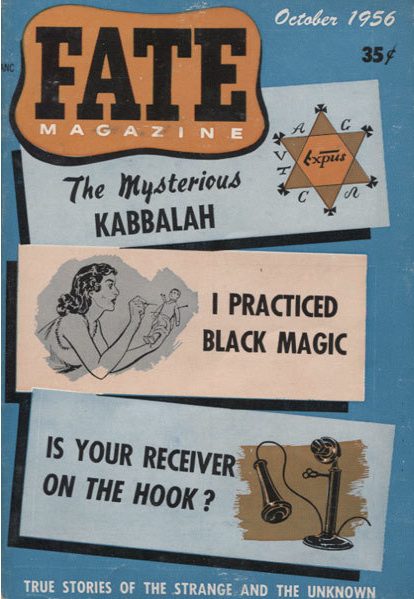
H. P. Lovecraft was an atheist and materialist; he had no expectations for survival of consciousness after death. His afterlife, as it is, lay in the publication of his work, the memories of his friends, and increasingly his appearance as a fictionalized character in various works. Muriel E. Eddy was, apparently, not a materialist, and was at least open to the idea of ghosts or consciousness that survived after death. At least, she was willing to write about it for Fate Magazine, which offered $5 for tales of evidence of existence after death. This was not exactly new territory for Muriel, who had sold a “psychic experience” to The Occult Digest in 1939. So it was that in the October 1956 issue of Fate, “Message in Stone” appeared.


Message in Stone

We were greatly saddened when Howard Phillips Lovecraft, the famous Rhode Island writer of weird and uncanny tales of the unknown, died in March, 1937. Mr. Lovecraft had been a friend of the family for years. He often had brought his weird writings, still in manuscript form, to our house, reading them aloud in his sepulchral voice and awaiting our approval or disapproval. He considered the Eddy family “good critics.” I still can see him, sitting in our humble abode and reading his famous horror tale, “The Rats in the Walls,” which has been reprinted frequently since his untimely demise.

We often discussed the mystery of death and one night Lovecraft expressed the opinion that the human brain was practically indestructible. He believed that, whether or not his body was embalmed, his brain would continue to function. He said that if his brain continued to “work,” as he believed it would after death, he would send a message in some material form that we could understand.

At that time he was in excellent health and death seemed distant. However, shortly afterward Howard Phillips Lovecraft suddenly became seriously I’ll and died in Jane Brown Hospital in Providence, R.I., in March, 1937. He was only 47 years old.

After the funeral I often visited his grave and placed floral offerings there. The grave is in Swan Point Cemetery and is marked by a tall granite shaft.

One night in September, 1937, I had a very vivid dream about Howard Phillips Lovecraft. In my dream I visited his grave, now covered thickly with grass, and was on my knees, parting the grass as I hunted for something.

My dreams haunted me and early the next day, a Sunday, I drove out to the cemetery. I felt driven by an invisible force.

As I stood beside Lovecraft’s grave, I seemed to hear his sepulchral voice again, intoning the words, “If my theory is correct, if my brain continues to function after my death, I will send you a message in some material form that you can understand.”

My eyes scanned the grass on the burial plot, still wet with dew, and then I glimpsed something white shining on Lovecraft’s grave. Stooping, I parted the heavy growth with my hands and picked up a heart-shaped stone, as smooth as satin and about two inches across. It was milky white and looked oddly like a quarried stone of the translucent variety. I recalled that Lovecraft’s grandparents, long dead, had owned a stone quarry in East Providence.

How the stone happened to be lying on Lovecraft’s grave may be only a matter of conjecture. However, he had known that I collected odd-shaped natural specimens, such as unusual shells, odd bits of wood and minerals, especially stones and rocks of unusual formation.

I could find no stone in the cemetery that resembled even remotely the one I found on Lovecraft’s grave. —Providence, R. I.

[Fate Magazine (Oct 1956), 103-105


Some of the details in the piece are correct, others likely honest mistakes. The description of the grave is accurate; at the time, there was no individual marker for HPL, only the granite shaft for the family plot. Lovecraft was 46 at the time of his death, but if Muriel E. Eddy was counting by year, it’s an easy mistake to make. The Phillips did not own a quarry in Providence, but they owned a small mortgage on such a quarry, and in Lovecraft’s letters he talks about sometimes getting mineral samples from there for his friend James F. Morton, who was curator of a museum of geology in New Jersey.

As for the more imaginative part of the Fate piece—there is no account in Lovecraft’s letters or other memories of him hoping for the functioning of his brain after death. However, it is notable that several of his stories for Hazel Heald, notably “Out of the Æons” (1935) and “The Horror in the Burying-Ground” (1937) both deal with a kind of living death, with the mind functioning in a paralyzed or petrified body. Muriel E. Eddy claims to have introduced Heald to Lovecraft, and Heald features prominently in Eddy’s later memoirs, so possibly she remembered either the stories or Lovecraft writing or talking about the stories.

Another likely influence on “Message in Stone” is the magician Houdini, whom both Lovecraft and her husband C. M. Eddy, Jr. had worked with:

I remember Mr. Eddy’s painstaking revision of Houdini’s “Thoughts and Feelings of a Head Cut Off”….an experience which the master magician had undergone in his youth. Harry Houdini said in his story that somewhere in his travels he came across an ancient supersitition that if a head was severed quickly and unexpectedly from a body, the brain in the head kept on thinking for several seconds! […]

I am quite sure this story was never offered for sale by Harry Houdini, as it lacked the ring of veracity . . . perhaps it was somewhat exaggerated! When we told H.P.L. about it, he exclaimed, “Oh, what I could have done with that story, but perhaps Houdini wouldn’t have liked it if I’d changed it too much. I took a lot of liberties with his ‘Pharaoh’ story and he seemed satisfied, but this one!” And a far-away look was in his eyes. . . .

Later on, were were discussing the possibility of the truth of a brain functioning after death, and Lovecraft averred that perhaps the brain did function . . . for a few minutes after the death of one’s body. It was a weird subject, and there I ended! I sometimes wondered what Lovecraft’s true feelings regarding this matter really were. […]

My husband spent some time investigating Spiritualism at Lake Pleasant, Massachusetts, for Harry Houdini, and when he returned home with much data about some of the mediums he’d met, Lovecraft came over to see us and seemed much interested in the subject. He scoffed at the idea of communion with the dead, and said that, in his opinion, death was the absolute end.
—Muriel E. Eddy, “A Gentleman from Angell Street” (1961) in A Gentleman from Angell Street 20-21

The Harry Houdini Circumstantial Evidence blog relates a possible manuscript related to this story, titled “Thoughts and Visions of a Head Cut Off.” Houdini is an important connection as well because of a tradition that began after his death; his wife Bess began to hold séances annually on Hallowe’en, in an attempt to contact her husband’s spirit. Muriel was aware of this:

By the way, Houdini’s last desire was that on every Hallowe’en his resting-place should be visited by friends to see if his (Harry Houdini’s) ghost appeared. . . . he made light of ghosts and Spiritualism, you jnow. As Lovecraft was a “ghost-writer” also for Harry Houdini . . . . . . well! Mrs. Harry Houdini . . . and Harry’s brother Hardeen . . . have joined the ranks of every human’s ultimate glory . . . . could not supervise the weird visition at Houdini’s grave this Hallowe’en. I supose that trek will now be abandoned . . . . Houdini proved his own point . . . he STAYED dead! Somtimes, in a joking mood, Lovecraft used to say that . . . . . PERHAPS . . . . the human brain NEVER stopped functioning . . . . . even after death. A weird thought, and, visiting H. P. L.’s grave one day recently . . . . . your friends the Eddys . . wondered . . . just vaguely. But OF COURSE H.P.L. was just joking!
—Muriel E. Eddy to Winfield Townley Scott, 2 Nov 1945, MSS. Brown Digital Repository

Muriel’s information was a little out of date; while Bess Houdini died in 1943 and Theodore Hardeen in 1945, Bess had passed the séance tradition on to Walter B. Gibson in 1936, who in turn would ask Doroth Dietrich to carry on the tradition, which is still ongoing.

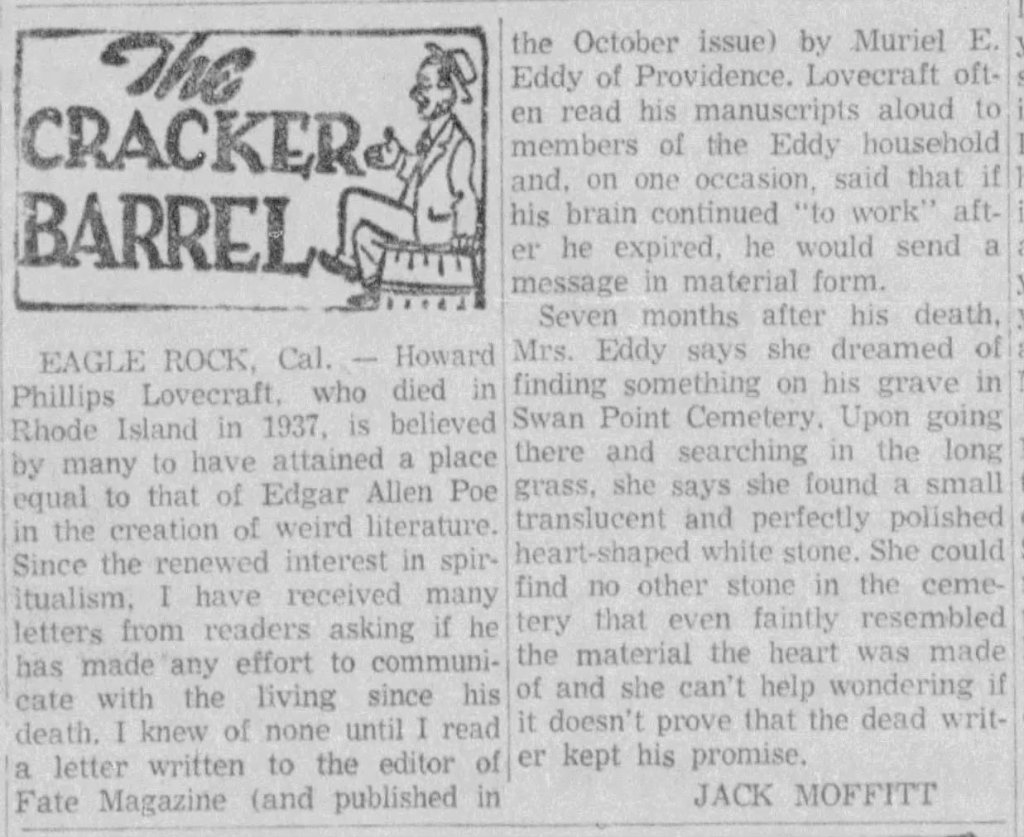
Something said in jest would definitely be more in keeping with what we know about Lovecraft, and of course Muriel E. Eddy would have had to play up the belief in his posthumous existence to get published in FATE Magazine. Her account, minor enough as it is, caught the attention of at least one journalist, who distilled it for a fluff piece to fill a few column inches:

The Register, Santa Ana, CA, 11 Oct 1956, p50
This item was reprinted in other papers as well.

“Message in Stone” was never republished, and the whole incident is largely ignored in Muriel E. Eddy’s most well-known memories. Yet in H.P.L.: The Man and The Image (1969), she ends a rambling collection of memories with the note:

On one of my visits to H.P.L.’s grave, I found a heart-shaped stone. I wondered if he had seen it there, what type of storey might have been concocted by his fertile brain.


Bobby Derie is the author of  Weird Talers: Essays on Robert E. Howard and Others  and  Sex and the Cthulhu Mythos .

Deep Cuts in a Lovecraftian Vein uses Amazon Associate links. As an Amazon Associate I earn from qualifying purchases.
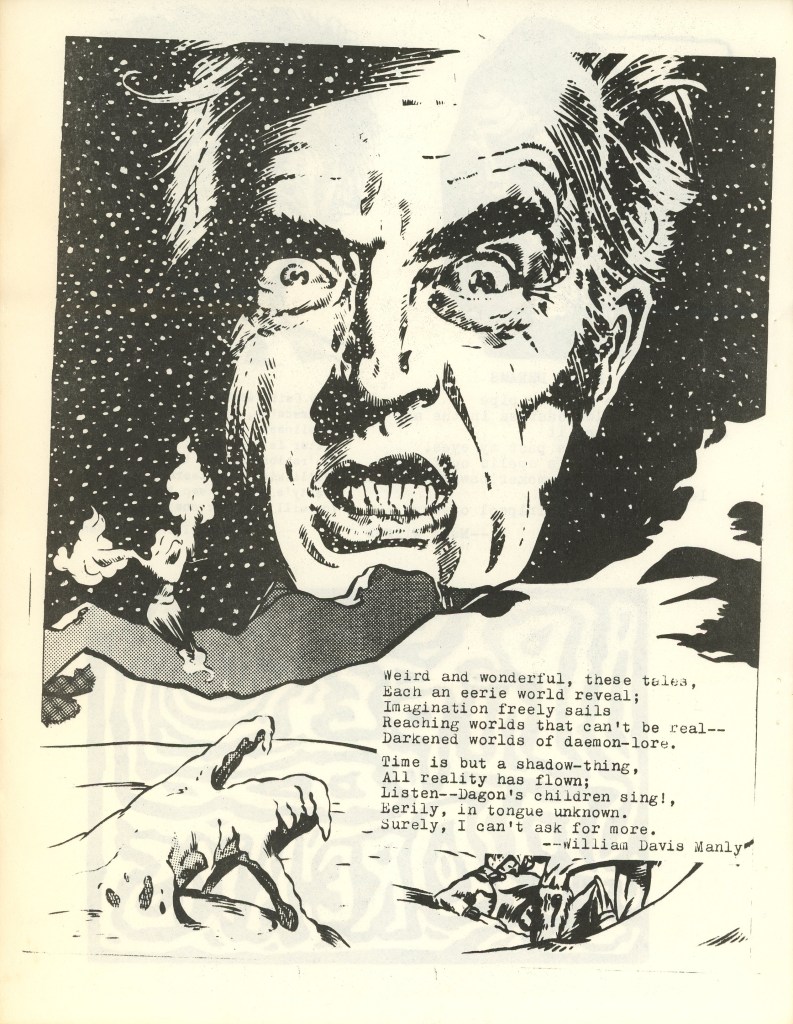
Untitled poem (1976) by William Davis Manly

In the summer of 1976, a one-shot ‘zine of of weird poetry and art emerged from 5115 South Mead St., Seattle Washington. The publisher titled it Visions of Khroyd’hon, which probably meant nothing to anyone at the time, and it was published in the spirit of good fun:

There are many interesting poetry publications popping up every now & then, and I thought it wou’d be fun if I join’d—if only for a moment—ye crowd and publish’d this first and only issue of VOK. I’ve assembled lots of good poetry here, with a number of talented youngsters contributing clever rhymes, love sonnets, and exciting verse. There’s something for everyone’ I’m sure each reader will be able to find some moments of entertainment.
—W. H. Pugmire, Visions of Khroyd’hon 1

Among the contributors were luminaries such as Brian Lumley, H. Warner Munn, J. Vernon Shea, Jessica Amanda Salmonson, and William Davis Manly, the latter of whom included several untitled verses, including this one:

Weird and wonderful, these tales,
Each an eerie world reveal;
Imagination freely sails
Reaching worlds that can’t be real—
Darkened worlds of daemon-lore.

Time is but a shadow-thing,
All reality has flown;
Listen—Dagon’s children sing!,
Eerily, in tongue unknown.
Surely, I can’t ask for more.
—william davis manly

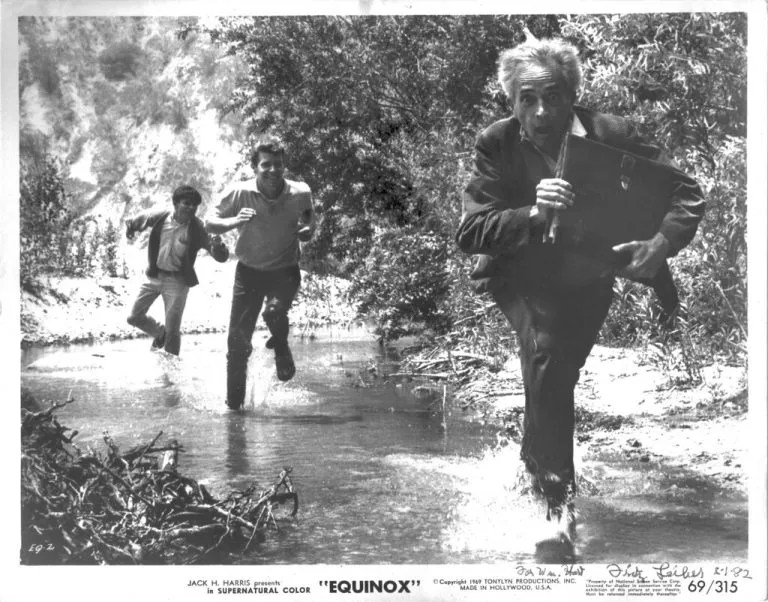
It is a poem in praise of weird fiction, from someone who loves the strange, eerie, horrific, and awesome. A paean from one Mythos fan to every other. The artist is unknown, but the subject is writer Fritz Leiber, Jr., and appears to be traced from a scene from the 1970 film Equinox.

Equinox has several parallels with Evil Dead II, including a recording of a professor (Leiber) who unwisely reads aloud an incantation from a very evil book…although the book in Equinox is not specifically called the Necronomicon.

The hidden joke is that William Davis Manly is, like Robert E. Howard’s Justin Geoffrey or H. P. Lovecraft’s Abdul Alhazred, not a flesh-and-blood poet at all, but a character in Pugmire’s stories—a staple name in what would become the Sesqua Valley stories. Pugmire had begun producing poetry under the name William Davis Manly in the 1970s, probably first “The Cryptic Power” in the ‘zine Bleak December #8. The first bit of fiction referencing Manly was “From ye Journal of William Davis Manly” (Old Bones #1, Summer 1976), and in “The Thing in the Glen” (Space and Time Sep 1977) the story begins with a poetic epigraph:

“Beneath the old narcotic moon
It preys upon mortality,
Hungry to devour hope,
And whispering to darkness.”
—William Davis Manly, Visions of Khroyd’hon
(quoted from Dreams of Lovecraftian Horror 57)

So Pugmire’s poetry ‘zine became, in the context of his Mythos fiction, a volume of poetry, much like Justin Geoffrey’s People of the Monolith in Robert E. Howard’s “The Black Stone.” William Davis Manly (or at least, his legend) would grow and develop in Pugmire’s tales, as would his slightly more diabolical counterpart, the sorcerer Simon Gregory Williams.

There is no definitive collection of W. H. Pugmire’s poetry, and maybe such a thing would be difficult to put together, given how much of it was published in ‘zines and scattered hither and yon. The quality and focus of it varies considerably, as Pugmire was equally disposed to either fulfilling some weird and fantastic corner of the Mythos or just praising his aunt in verse, but for readers who enjoy his fiction, Pugmire’s poetry is an indelible part of his larger body of work.

As far as I have yet been able to determine, the untitled poem from Visions of Khroyd’an has only ever been reprinted in the chapbook Sesqua Rising (2016) by Graeme Davis, which collects many other early Pugmire rarities.


Bobby Derie is the author of  Weird Talers: Essays on Robert E. Howard and Others  and  Sex and the Cthulhu Mythos .

Deep Cuts in a Lovecraftian Vein uses Amazon Associate links. As an Amazon Associate I earn from qualifying purchases.
“Lovecraft in Brooklyn” (2008) by The Mountain Goats

And then the girl behind the counter
She asks me how I feel today
I feel like Lovecraft in Brooklyn
—final chorus

“Lovecraft in Brooklyn” is the eighth track on Heretic Pride (2008, 4AD) the eleventh studio album by The Mountain Goats, an indie/folk-rock project by singer/songwriter John Darnielle and his collaborators. The song was written and performed by Darnielle, and produced by Scott Solter and John Vanderslice. The tense 3:49 recording is narrated by an individual in a city, expressing muted frustration and horrific fantasies. References to Lovecraft and his work are few and vague, beginning with the second chorus:

Rhode Island drops into the ocean
No place to call home anymore
Lovecraft in Brooklyn

And ending with a reference to what might be the Fungi from Yuggoth:

Someday something’s coming
From way out beyond the stars
To kill us while we stand here
It’ll store our brains in Mason jars

…or perhaps just a paranoid ramble from an undiagnosed schizophrenic. While nothing happens in the narrative of the song, there is the implicit promise of violence about to occur, and “Lovecraft in Brooklyn” is the narrator’s common reference point for how they feel, a reference that they expect others to understand.

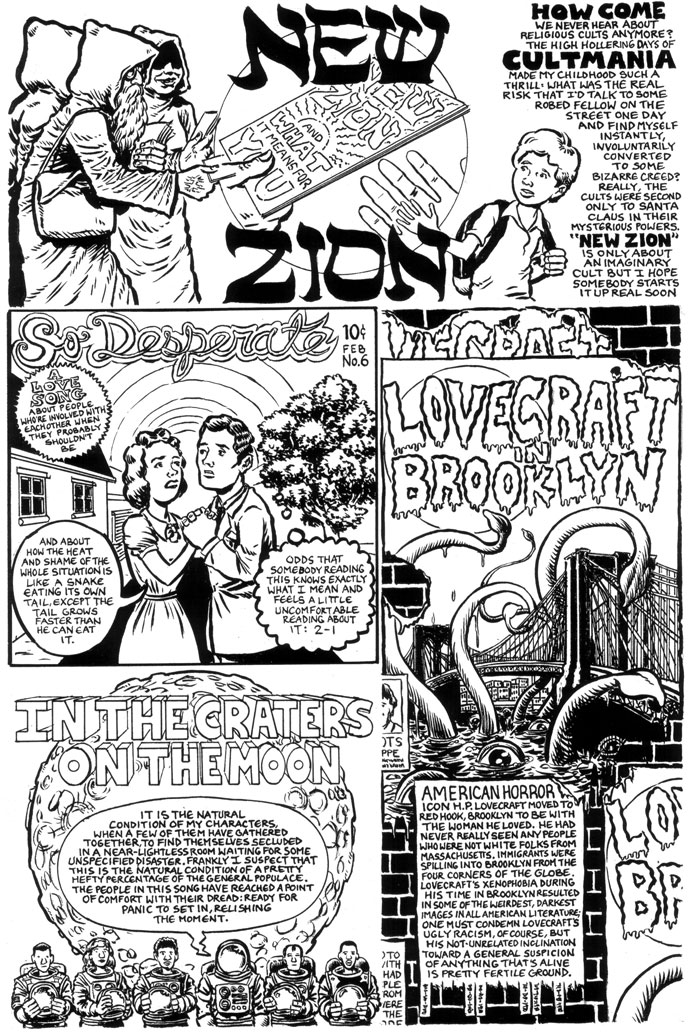
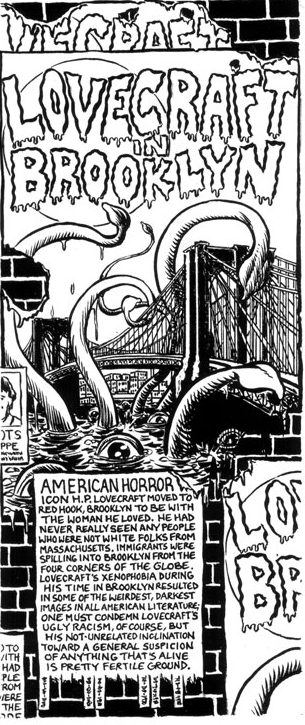
As part of the promotion of the album, comic book artist Jeffrey Lewis produced a three-page comic illustrating Darnielle’s notes about the songs.

American horror icon H. P. Lovecraft moved to Red Hook, Brooklyn to be with the woman he loved. He had never really seen any people who were not white folks from Massachusetts. Immigrants were spilling into Brooklyn from the four corners of the globe. Lovecraft’s xenophobia during his time in Brooklyn resulted in some of the weirdest, darkest images in all American literature; one must condemn Lovecraft’s ugly racism, of course, but his not-unrelated inclination toward a general suspicion of anything that’s alive is pretty fertile ground.

In a 2008 interview about the science fiction influence on his work, Darnielle was asked specifically about the song:

[Charlie Jane Anders]: Your new album includes a song about H.P. Lovecraft, “Lovecraft In Brooklyn.” Why should we identify with H.P. Lovecraft’s feelings of alienation and xenophobia during his exile in Red Hook? What about that image appeals to you? In Lovecraft’s case, that alienation leads to all his best speculative horror… do you think xenophobia creates better speculative fiction than xenophilia?

[John Darnielle]: Well the song is not really about Lovecraft — it’s sung by a guy who’s identifying with Lovecraft at his most xenophobic and terrified. Why does that appeal? I think I’m just attracted to hermits in general — to people who don’t feel like they’re part of the world, who have a hard time feeling like they’re really present in the same space as everybody else.
—Charlie Jane Anders, “The Mountain Goats Explain Why Ozzy Osbourne Is A Scifi Visionary” (Gizmodo, 27 Mar 2008)

An apocryphal account of the 22 March 2008 live session The Mountain Goats played at the Black Cat club in Washington, D.C. captures an opener John Darnielle gave before playing this song:

Once again, to express my affection for you, I’d like to play this song about a fellow who is really so filled with anger and rage that the mere sight of other human beings makes him feel even more angry. He’s angry already when he wakes up, before he remembers that there’s other people on the planet. But once he thinks of those other people, then he starts to really get going. And heaven help you if he should have to go and get some kleenex or whatever from the corner store, then he will really be filled with a special kind of contempt. Why? Because you have bodies and they make him sick. That’s what this song is about. I know everyone can relate to the tender feelings expressed in it.

John Darnielle is not a Lovecraft scholar; his understanding of Lovecraft as represented in the promotional materials, lyrics, and intra-show commentary reflects a popular depiction of Lovecraft as an angry xenophobe trapped in a place surrounded by people who weren’t like him, and it made him go crazy. “Lovecraft in Brooklyn” reflects the legend of Lovecraft’s 1924-1926 sojourn to New York, much like Victor LaValle’s “The Ballad of Black Tom” (2016) represents an interpretation of “The Horror at Red Hook,” one of the stories Lovecraft wrote during that period, with an emphasis on Lovecraft’s racism.

The reality was more complicated. 1924 wasn’t the first time Lovecraft had been to New York; it wasn’t the first time Lovecraft had been out of state, or seen people of color or different ethnicities. Lovecraft had experiences leading up to his 1924 elopement with Sonia H. Greene, who gave her version of their married life in The Private Life of H. P. Lovecraft (1985), which he thought prepared him for life in New York.

As it happened, Lovecraft was wrong. He failed to find employment; soon after marriage, his wife fell ill and required hospitalization and then rest. Without either of them working, money swiftly became an issue. Sonia eventually found a job out in the Midwest, but Lovecraft would not follow her there, so he was left alone, in the poor Red Hook neighborhood of Brooklyn. Largely alone, unable to make his own way, dependent on a wife he didn’t see for weeks and distant aunts, Lovecraft tried to make the best of it with his local friends.

Then thieves broke into his apartment.

Letters from Lovecraft to his aunts Lillian D. Clark and Annie Gamwell show how unhappy he was. While he never blamed the immigrants or people of color for his own failures, his letters to them during this period show how much Lovecraft’s prejudices were exacerbated during this final, stressful period in New York…until, at last, his aunts and wife prevailed upon him to return to Providence, Rhode Island, where he could be happier.

So he did.

Most of Lovecraft’s New York experiences did not make it into his fiction; not even the fiction he wrote while living in and set in the city. “The Horror at Red Hook” is unusual because through Lovecraft’s letters and various anecdotes in memoirs we can trace it back to a specific incident—overhearing some hardboiled toughs talking a little too loudly about criminal goings-on at a local cafeteria—from which Lovecraft spun out his fantasy of an immigrant gang-cum-cult involved in human trafficking, murder, and more esoteric activities.

“The Horror at Red Hook” reads pretty baldly racist; the equivalent today might be a story of an MS-13-type group that was also a survival of ancient Aztec religion that still practiced human sacrifice. That was very explicitly fiction, though—a play on contemporary prejudices, not Lovecraft just putting his own prejudices onto the paper. A fine distinction for a lot of readers who don’t always like to distinguish between what Lovecraft thought and how he portrayed things in the pages of Weird Tales.

New York-based rapper and producer Aesop Rock (Ian Matthias) did a remix of “Lovecraft in Brooklyn,” which at 3:31 retains all of Darnielle’s lyrics but quickens the beat and reworks the soundscape with added effects to add to the tension and air of alienation of the song, and providing a densely-packed fourth verse of his own. The added lyrics are grounded much more firmly in Brooklyn itself, and suggest a deeper understanding of Lovecraft’s time in New York (“Summer lovin’ snuck him toward the tarnished arms of liberty”), and perhaps reflect W. Paul Cook’s assessment that Lovecraft’s time in New York was pivotal toward his development as a writer (“Little Howie’s parachute has flowered down the rabbit hole”).

“Lovecraft in Brooklyn” is an expression of the pop cultural phenomenon that is Lovecraft; his legend used to evoke certain ideas, attitudes, and aesthetics completely rather than any attempt to relate a distinct biographical episode from his life. It showcases how Lovecraft’s reputation as a bigot and xenophobe has become so rampant; of course, the fact that he was racist (if not always to the degree or in the way folks like Darnielle portray) cannot be ignored and shouldn’t be downplayed.

While Darnielle’s particular impression of Lovecraft may be factually incorrect, Darnielle was right in that Lovecraft’s legacy continues to be fertile ground for artists to fuel their own imaginations.

“Lovecraft in Brooklyn” – The Mountain Goats (Youtube link)

“Lovecraft in Brooklyn” (remix) – The Mountain Goats / Aesop Rock (Youtube link)


Bobby Derie is the author of  Weird Talers: Essays on Robert E. Howard and Others  and  Sex and the Cthulhu Mythos .

Deep Cuts in a Lovecraftian Vein uses Amazon Associate links. As an Amazon Associate I earn from qualifying purchases.
“The Invaders vs. The Milford Mafia” (1967) by Joanna Russ

Most science fiction writers were once fans. There’s a habit they have, not of paying back, but of paying forward; I know of no other branch of literature where the established “names” so keenly encourage wannabe writers to become their competitors.
—Terry Pratchett, “Paperback Writer” (2003) in A Slip of the Keyboard 18

The development of organized science fiction/fantasy fandom in the United States during the 1930s was essential for the culture of writing that exists today. Fandom is older than those first fanzines, but the marriage of genre fiction and the amateur journalism organizational framework resulted in a movement that engaged people of all ages across a relatively narrow common interest, and encouraged recruitment, participation, and publication. Professional writers and fans didn’t just connect, they encouraged each other.

While not every fan was part of organized fandom, nearly every science fiction writer was a fan—and the extent of fandom networks in the United States, especially in the 1940s-1980s, is often remarkable. Big name fans and big name authors past, present, and future rubbed shoulders at conventions, corresponded, contributed to the same fanzines. Before the internet, social media consisted of the letters-columns of fanzines which might be read by as few as a handful or as many as dozens of people. It was smaller, more intimate, with all of its feuds and silliness that comes from people just being people, developing their own lingo and sharing an interest—which might include fiction, poetry, comics, radio, film, television—any media that existed, science fiction and media had touched, and so was fair game.

Over the past decade or so, efforts have been made to preserve and digitize some of these fanzines; to capture these communications (however poorly and cheaply printed) for future generations. While many pages have about as much interest as your average forum thread from the 1990s, there is gold dust among the spill, if you’re willing to sluice it out.

One nugget that emerged from the depths of the Fan History Project (fanac.org) is Lighthouse #15 (1967), which includes “The Invaders vs. The Milford Mafia” by Joanna Russ. For readers used to Russ’ professionally published fiction, stories like “I Had Vacantly Crumpled It into My Pocket … But By God, Eliot, It Was a Photograph from Life!” (1964) and “My Boat” (1976), this is something different. Fanfiction in the oldest sense of the word, not a story based on some fandom, but a story written by a fan, for fans. The title alone might clue savvy readers at the time what they’re in for: The Invaders (1967-1968) was a vaguely Hitchcokian science fiction thriller television series that ran for two seasons on the ABC network, a melodramatic cash-in on the UFO craze with perhaps a more than generous dollop of Red Scare paranoia thrown in.

Of course, alien invasion plots were standard fare for science fiction fans in the 60s and 70s—which is where the Milford Mafia comes in.

The Milford Science Fiction Writer’s Conference in 1956 was formed by three of Futurians: Damon Knight, James Blish, and Judith Merrill. Then as now, science fiction and fantasy fandom had a tendency toward cliquedom, and the Milford conference in particular addressed the literary quality of science fiction. Just as, thirty years before, H. P. Lovecraft had striven to raise the general literary level of amateur journalism, so too did the Milford attendees seek to raise the literary standards of science fiction, which eventually led to the formation of professional writers associations like the Science Fiction Writers of America. Those put out at the high-minded literary standards referred to attendees (or those pushing higher standards) as “the Milford Mafia”—and Russ would be using the term in a jocular fashion, counterpoising the rehashed plots of The Invaders episodes against the higher standards that some folks in science fiction were pushing for.

It’s a fun piece, silly and light-hearted, and in keeping with that spirit, Russ slipped in a little joke about Lovecraft:

Anyhow, here’s this poor slob of an architect, David Vincent, who alone knows that They are invading—though how he could find out, or why on earth he should be an architect, I can’t imagine, unless the Aliens have begun their plan to insidiously warp the human psyche by distorting the lines and angles of our better known architectural monuments like, for example, Grand Central Station. (Something of the sort happens in a Lovecraft story called The Call of Cthulhu, which I offer you free of charge, especially since it isn’t mine.)

Which is poking fun at a familiar element of Lovecraft’s story:

Without knowing what futurism is like, Johansen achieved something very close to it when he spoke of the city; for instead of describing any definite structure or building, he dwells only on broad impressions of vast angles and stone surfaces—surfaces too great to belong to any thing right or proper for this earth, and impious with horrible images and hieroglyphs. I mention his talk about angles because it suggests something Wilcox had told me of his awful dreams. He had said that the geometry of the dream-place he saw was abnormal, non-Euclidean, and loathsomely redolent of spheres and dimensions apart from ours. 

“Non-Euclidean architecture” has become a trope, sometimes parodied and sometimes taken quite seriously (H. P. Lovecraft and Non-Euclidean Geometry by Zeno Rogue). Nor was Lovecraft such a sacred cow he was beyond a little jesting; “At the Mountains of Murkiness, or From Lovecraft to Leacock” (1940) by Arthur C. Clarke had taken the piss on Lovecraft decades earlier.

For readers who are familiar with Joanna Russ only for her fiction or her writings about fiction, this is an example of the fannish side of her: more playful, with all the in-jokes one would expect of someone that’s been part of the scene for a while. A good-natured piece of fluff that jokes about how bad television writing could be…and, perhaps, how bad science fiction could be, if writers didn’t strive harder.


Bobby Derie is the author of  Weird Talers: Essays on Robert E. Howard and Others  and  Sex and the Cthulhu Mythos .

Deep Cuts in a Lovecraftian Vein uses Amazon Associate links. As an Amazon Associate I earn from qualifying purchases.
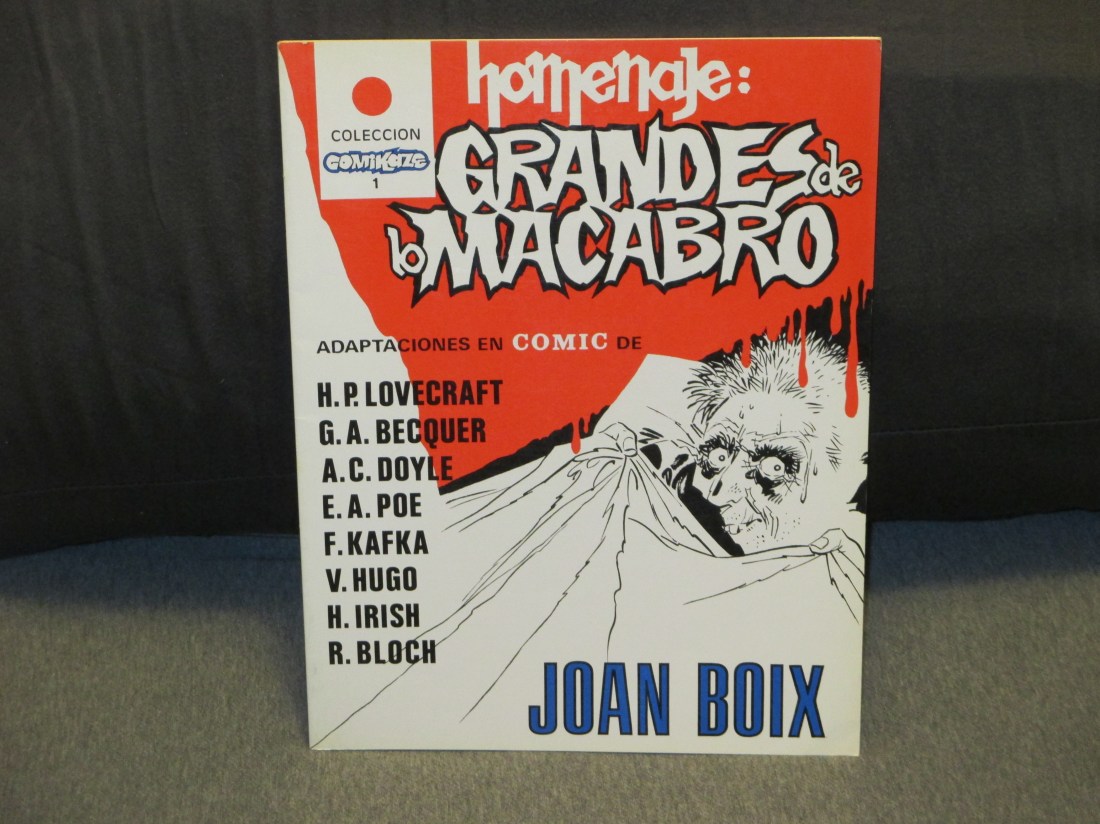
“La Maldición del Amuleto” (1985) by Joan Boix & H. P. Lovecraft

Hay quienes consideran el género de TERROR como un subproductio. Es cierto que, como en todo, a veces domina una calidad ínfirma, pero no sólo en los Comics. También en cinema, televisión, literature…

Tal vez porque el tema se ha explotado a fondo con abusos commerciales aprovechando que a la gente le gustan las emociones fuertes y muchos, sin saberlo, las utilizan para liberarse de sus propios miedos. Pero también es cierto que otros se han servido de sus miedos para expresar sus sentimientos y emociones segun su condición psicológica dando lugar a las mejores obras del género. Tal as el caso de POE, LOVECRAFT, KAFKA, y muchos más.

El experto en la materia no dejará nunca de reconocer que el TERROR es un tema de gran interés que además nos revela la personalidad más intrínseca de sus autores. Por eso, repito, el TERROR no se debe subestimar a la ligera sin un previo análisis.

Conociendo lo suficiente (presumo) sobre la vida atormentada y la obra de Los maestros del terror, he seleccionado una serie de relations pasándolos al Comic, Bien adaptando fielmente algunos, Bien dando mi toque personal a otros.

Y aquí está el resultado: Este libro con el que deseo rendir homenaje a los «GRANDES DE LO MACABRO».

Espero que lo pasen de miedo.
There are those who consider the TERROR genre as a by-product. It is true that, as in everything, sometimes a low quality dominates, but not only in Comics. Also in cinema, television, literature…

Perhaps because the topic has been thoroughly exploited with commercial abuse, taking advantage of the fact that people like strong emotions and many, without knowing it, use them to free themselves from their own fears. But it is also true that others have used their fears to express their feelings and emotions according to their psychological condition, giving rise to the best works of the genre. Such is the case of POE, LOVECRAFT, KAFKA, and many more.

The expert on the subject will never fail to recognize that TERROR is a topic of great interest that also reveals the most intrinsic personality of its authors. Therefore, I repeat, TERROR should not be underestimated lightly without prior analysis.

Knowing enough (I presume) about the tormented life and work of The Masters of Terror, I have selected a series of relations, transferring them to the Comic, either faithfully adapting some, or giving my personal touch to others.

And here is the result: This book with which I wish to pay tribute to the “GREAT OF THE MACABRE.”

I hope you have a scary time.
Introduction to Homenaje: Grandes de Los Macabro (1985)English translation

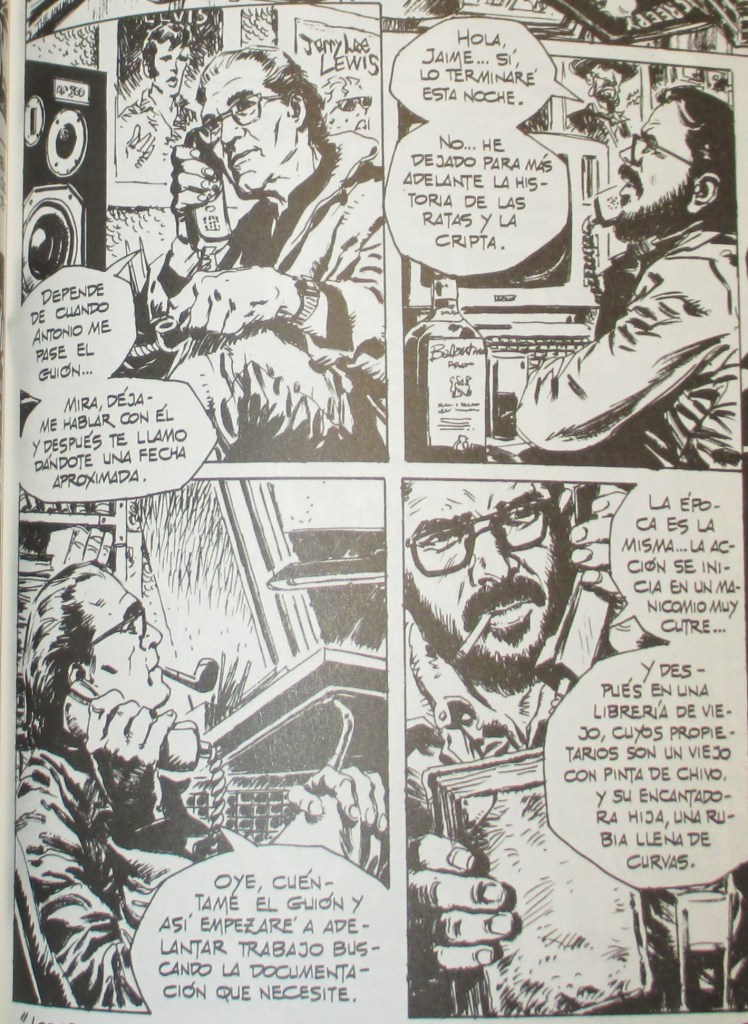
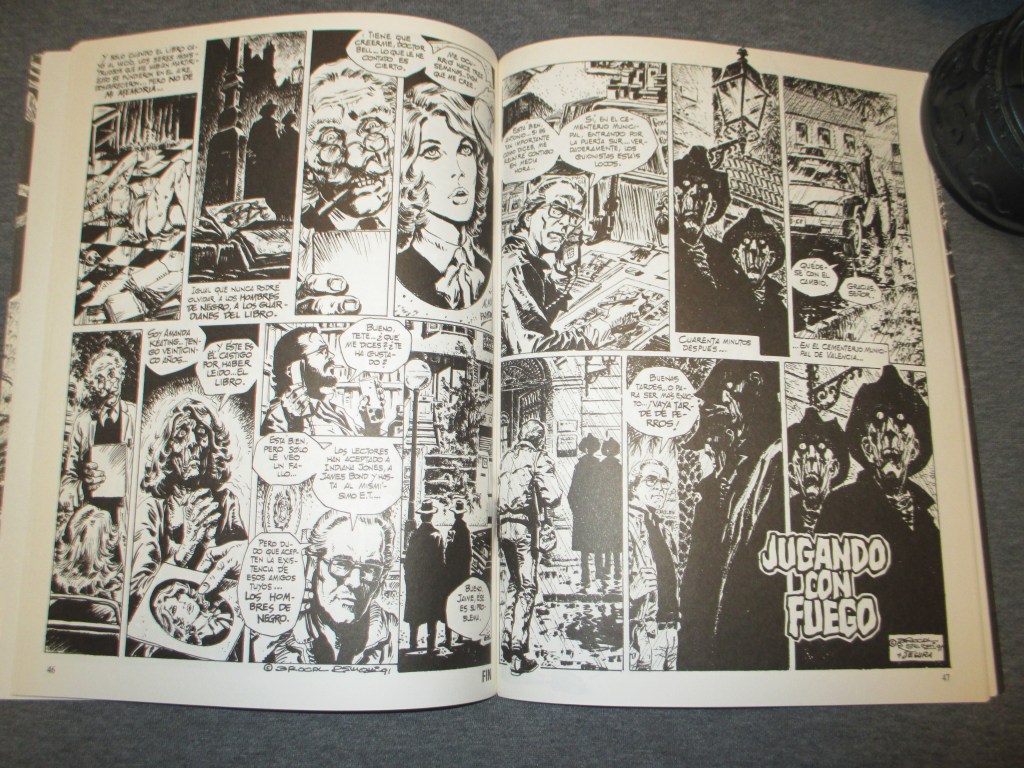
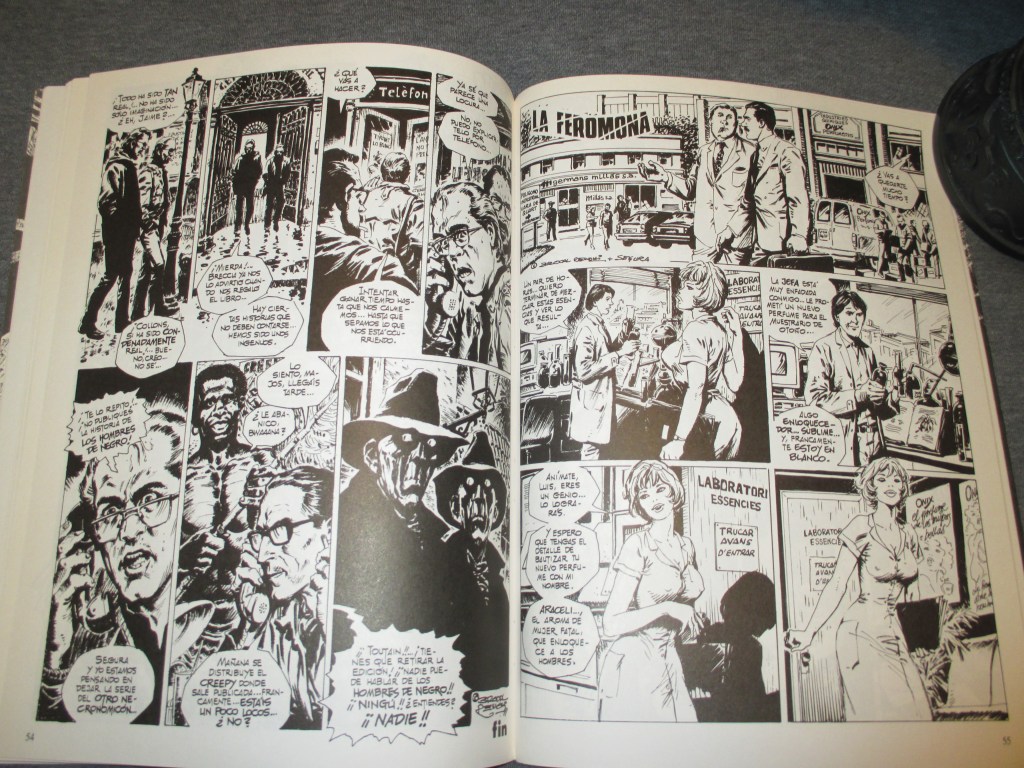
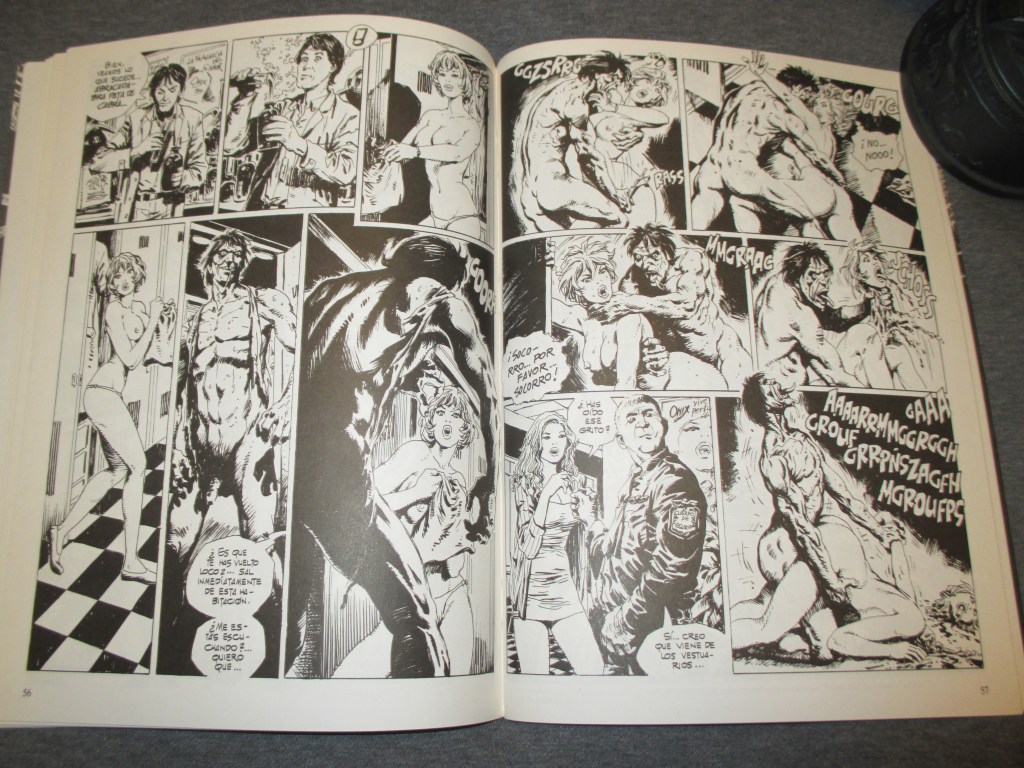
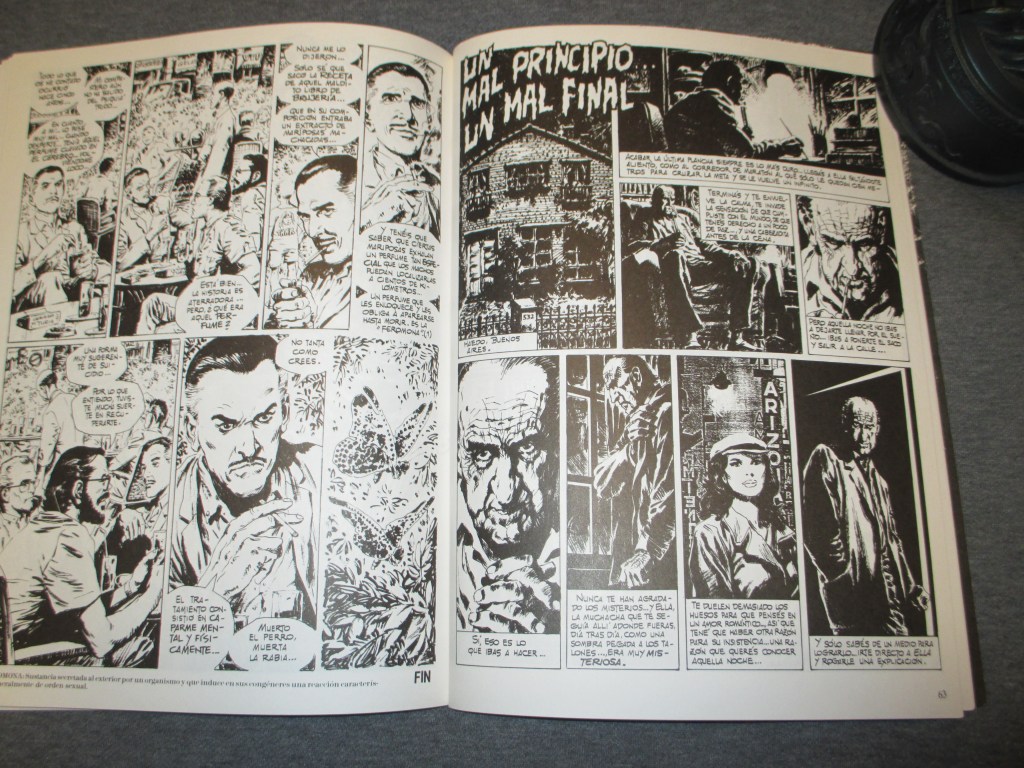
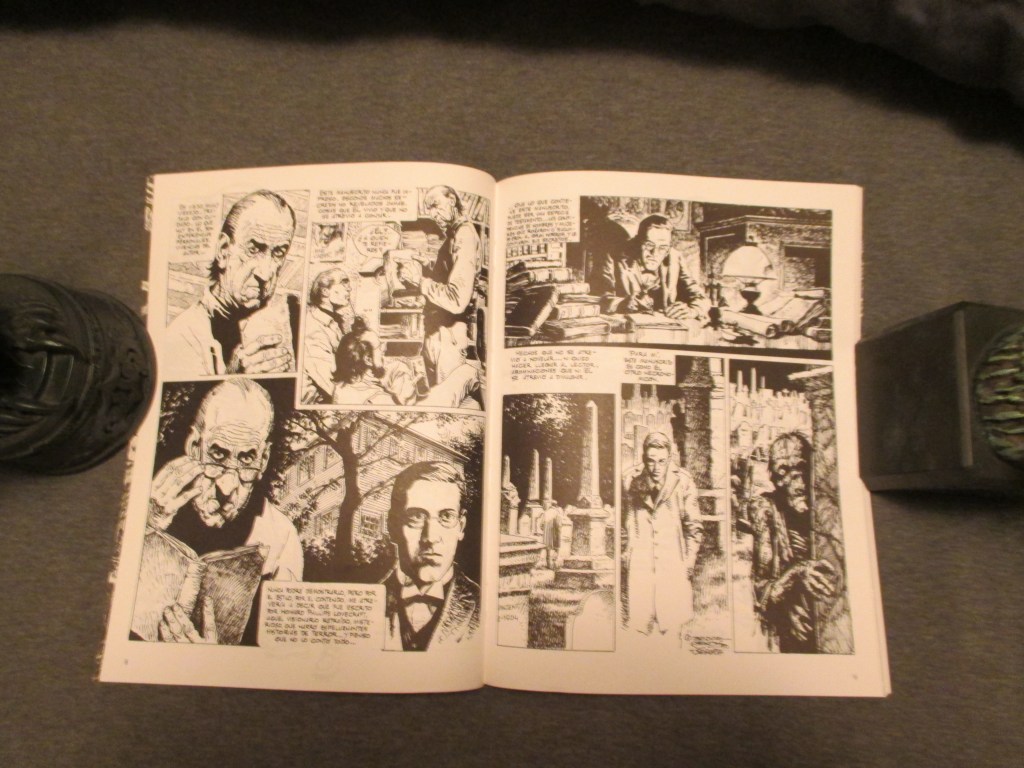
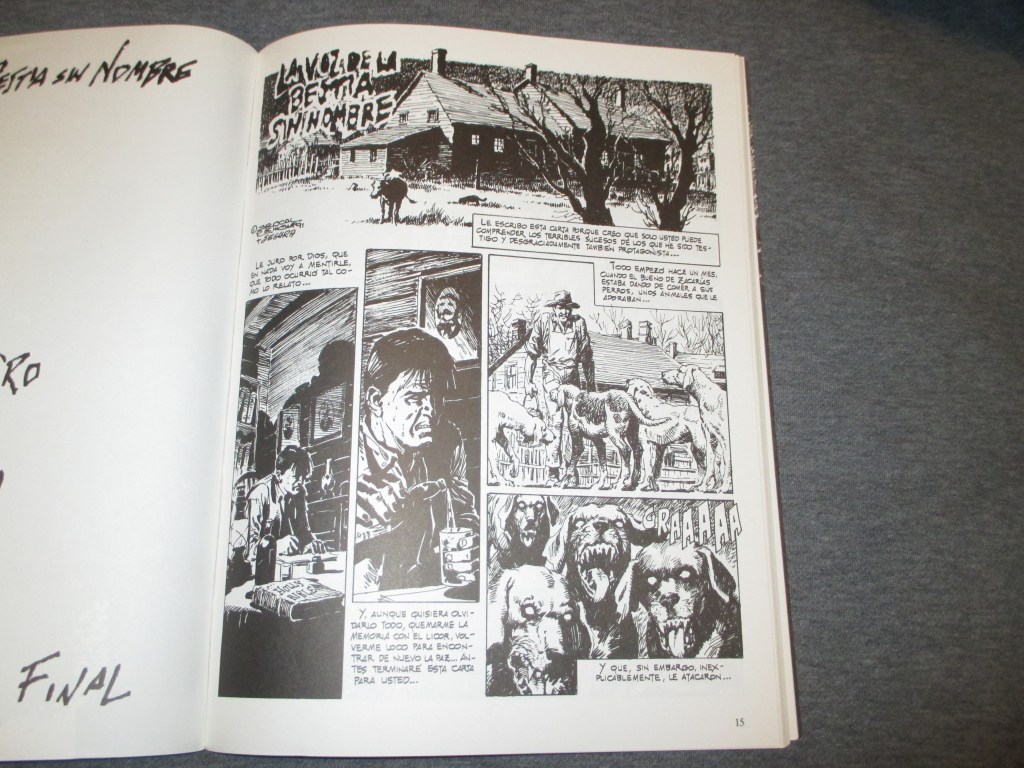
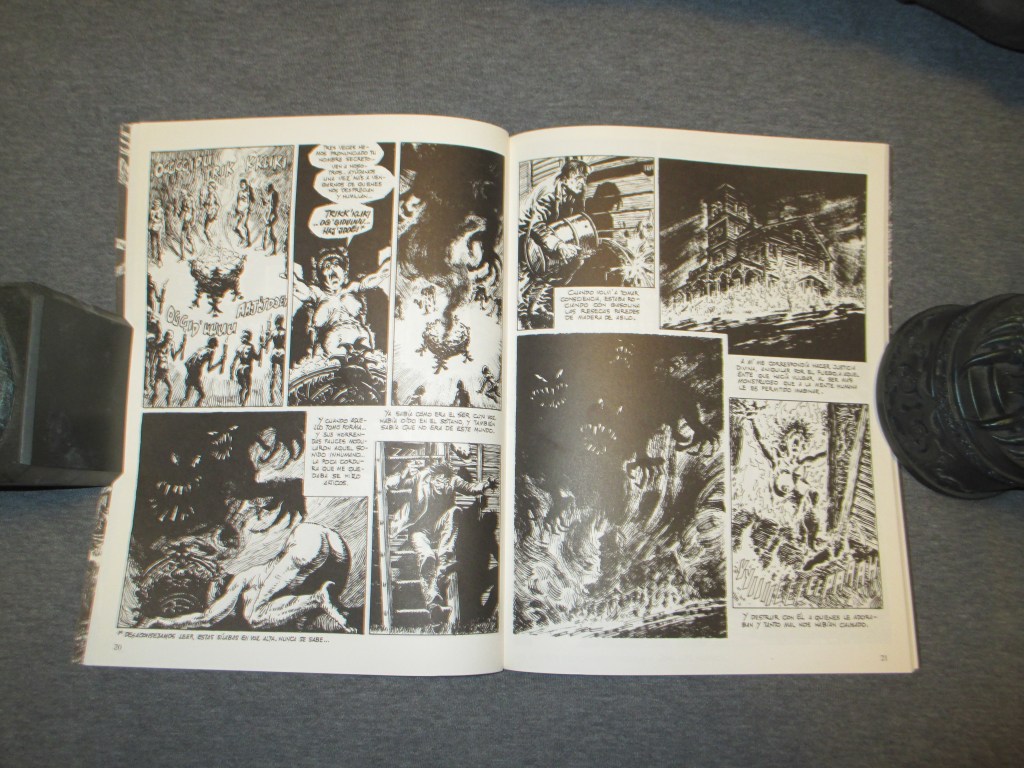
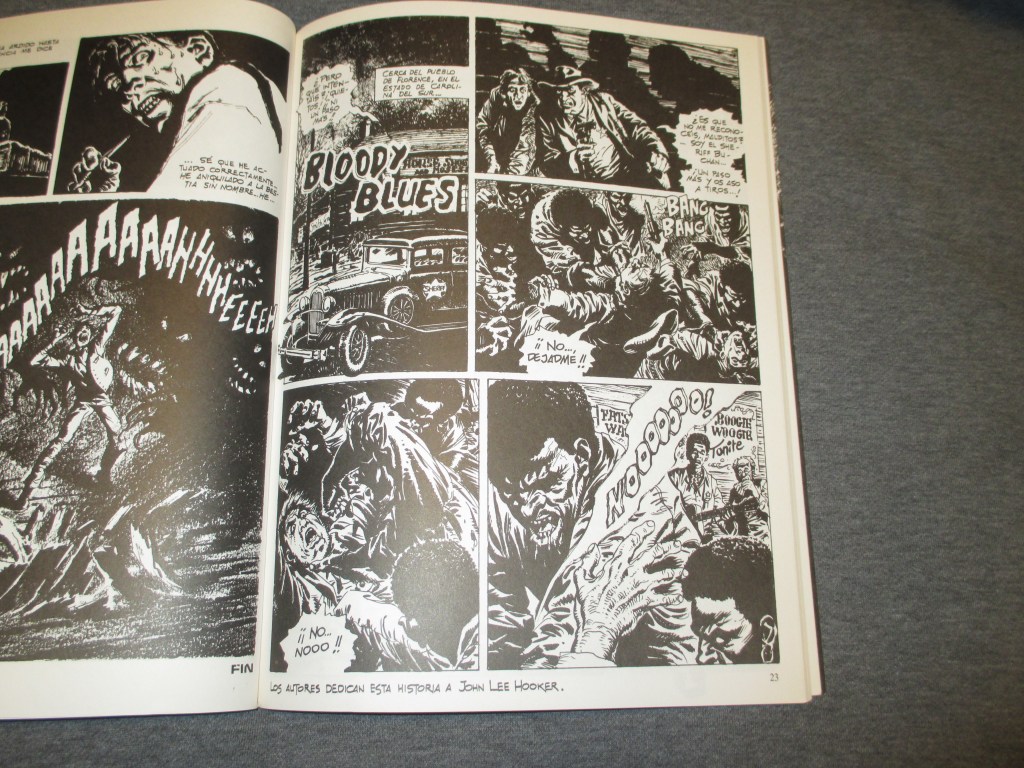
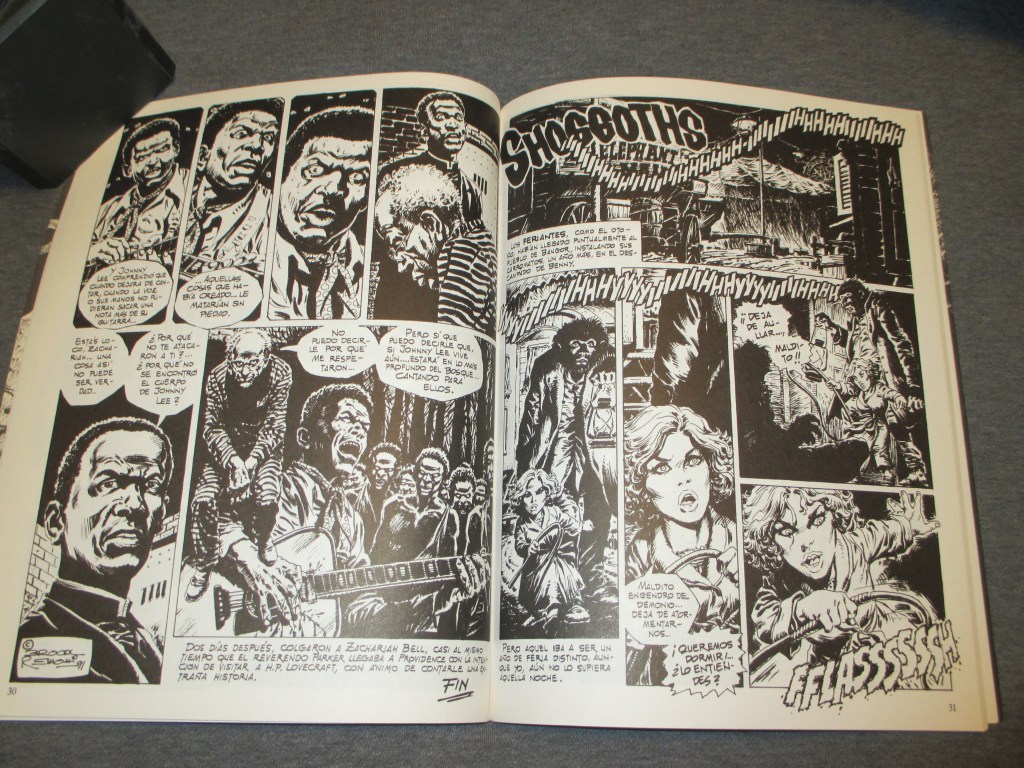
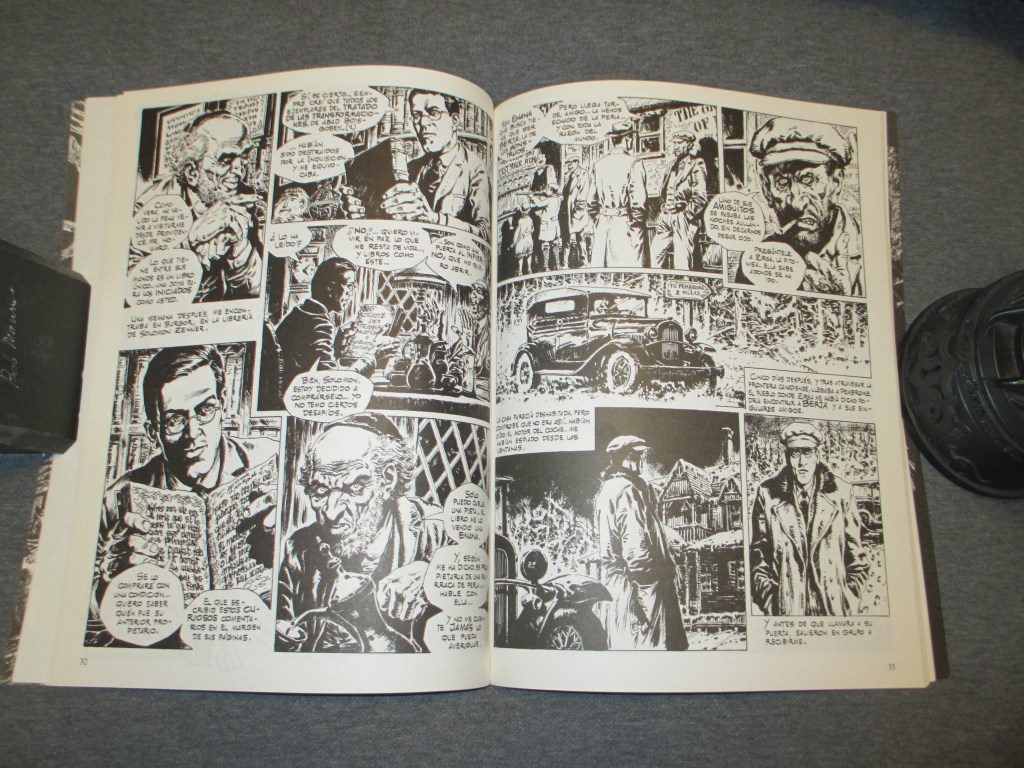
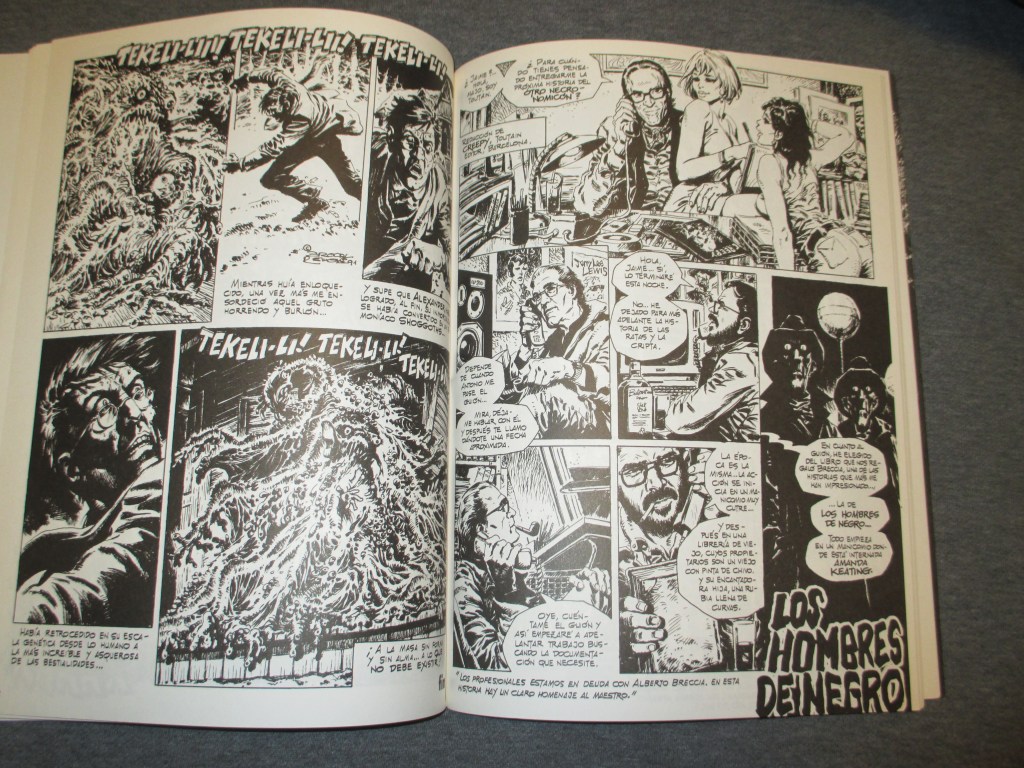
Joan Boix (born Juan Boix Sola Segales in Badalona, Spain) is not well-known to English-reading audiences, although he has had a long career both in Spain and internationally, able to turn his hand from everything from romance comics in the 1960s to being one of the artists that drew The Phantom comic strip in the 1990s. Yet for those who appreciate horror comics, Joan Boix holds a special place for his work in that field. Even there, in English his work is a bit of a footnote: a story in Marvel’s Monsters Unleashed #5 (1974), which was reprinted in the Monsters Unleashed Annual (1975). Yet his Spanish-language work, never translated into English, is his best. And in 1985 he published a collection of adaptations of classic horror fiction: Homenaje: Grandes de Los Macabro (Tribute: Greats of the Macabre).

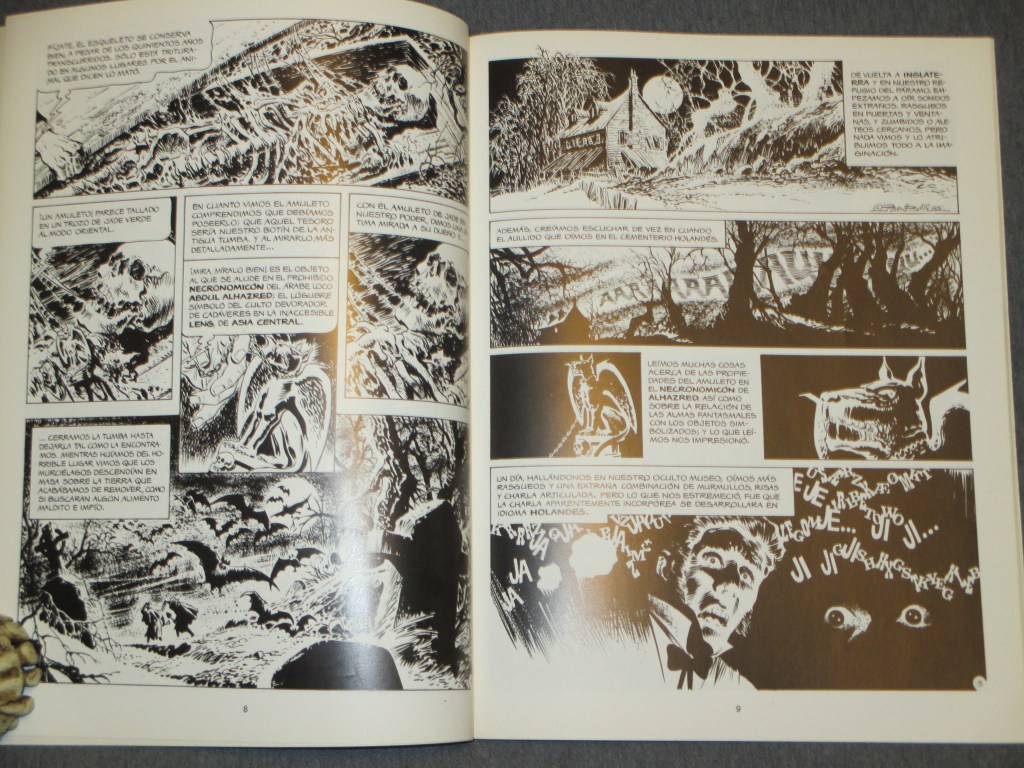
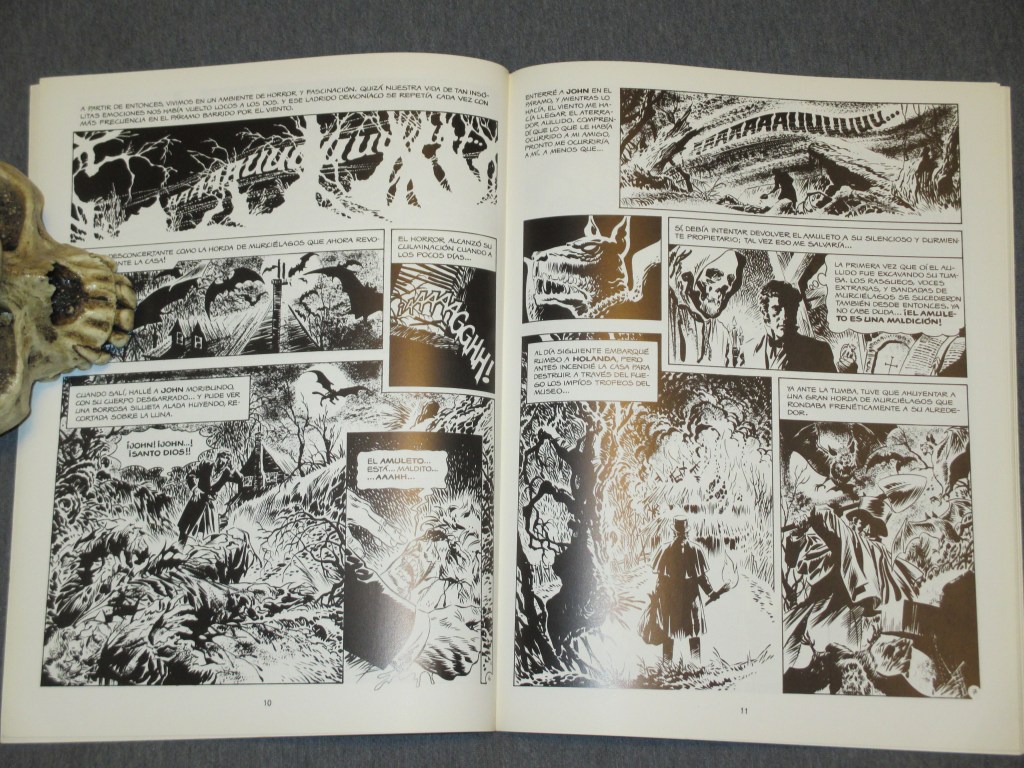
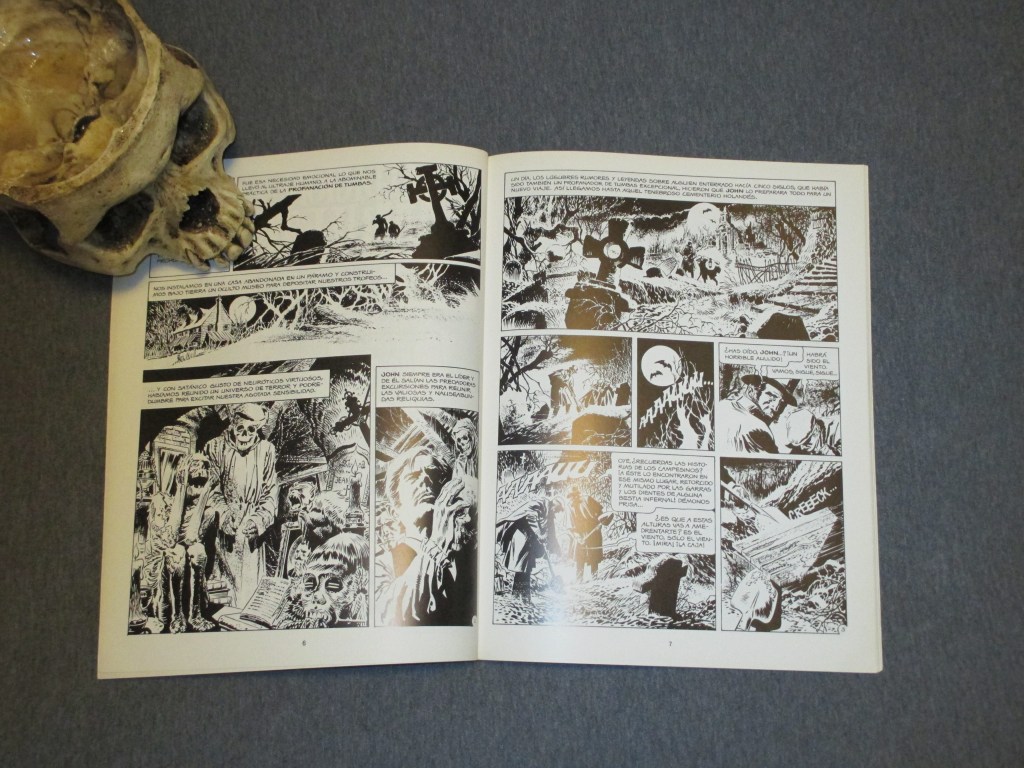
“La Maldicion del Amuleto” is an adaption of H. P. Lovecraft’s “The Hound.” In Spanish, the story is typically translated as “El Sabueso,” and while there are many words for dog in Spanish (perro, can or canino, cacharro (“puppy”), chandoso, etc.) “sabueso” has the specific meaning of a hunting dog; we might even say “bloodhound” in English. Which is a nice shade of meaning, given the context.

Boix’s tastes in terms of illustration are gloriously Gothic, redolent of an 18th-century macabre that recalls the horror films of Hammer Films in Britain and Profilmes in Spain. There’s that sense that Peter Cushing, Christopher Lee, or Paul Naschy could step onto the panel at any time, and be right at home.

The starkness of the black-and-white works to Boix’s advantage; there are single panels that could be glorious two-page spreads, with a lot of detail that might have been muddied by a careless colorist. The chiaroscuro effect is glorious, the kind of deep shadows that drink in the light which would inspire the likes of Mike Mignola’s signature aesthetic.

It is always tempting, when reviewing one of these adaptations of Lovecraft, to compare it against all the other adaptations. Jack “Jaxon” Jackson in Skull Comix #4 (1972), Stuart Gordon and Tula Lotay in The Thought Bubble Anthology #1 (2011), Chad Fifer and Bryan Baugh in The Lovecraft Anthology: Volume II (2012), Tanabe Gou in H. P. Lovecraft’s The Hound and Other Stories (2017)—and all of these have their charms and advantages, their different takes and take-offs on the material.

For sheer joie de morte, however, Boix’s tendency to revel in a single panel is hard to top. It’s a world where the moon is always full and glaring like the eye of some forgotten God, where every tombstone is encrusted with grave-mould, and the collection of the pair of necrophiles would put Hammer’s prop department into giddy ecstasies of macabre delight.

As horror comics have gained new appreciation, so too has awareness of Joan Boix’s work begun to grow, with new critical editions in Spanish like Grandes de la Macabro (2021), and Joan Boix. Antología: Relatos pasados, recuerdos presentes, maestría absolute (2022). Very fortunately for English-reading audiences, for the first time ever his horror comics have been translated into English: Terror! The Horror Comics Genius of Joan Boix (2022).


Bobby Derie is the author of  Weird Talers: Essays on Robert E. Howard and Others  and  Sex and the Cthulhu Mythos .

Deep Cuts in a Lovecraftian Vein uses Amazon Associate links. As an Amazon Associate I earn from qualifying purchases.
“To Clark Ashton Smith” (1951) by Evelyn Thorne

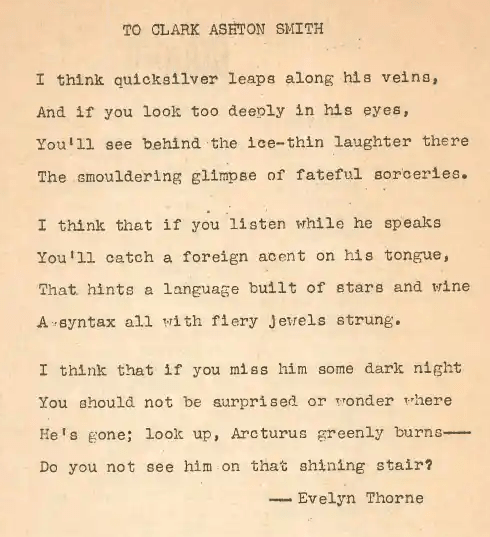
TO CLARK ASHTON SMITH

I think quicksilver leaps along his veins,
And if you look too deeply in his eyes,
You’ll see behind the ice-thin laughter there
The smouldering glimpse of fateful sorceries.

I think that if you listen while he speaks
You’ll catch a foreign ac[c]ent on his tongue,
That hints a language built of stars and wine
A syntax all with fiery jewels strung.

I think that if you miss him some dark night
You should not be surprised or wonder where
He’s gone; look up, Arcturus greenly burns—
Do you not see him on that shining stair?
—Evelyn Thorne

The second issue of Alan H. Pestetsky and Michael DeAngelis’ fanzine Asmodeus (Fall 1951) was devoted primarily to Clark Ashton Smith. Lovecraft had been receiving accolades in The Acolyte in the 1940s, so it was only fair. The issue republished a poetic tribute by Lovecraft to his friend, as well as “The Cup-Bearer” (1951) by Lilith Lorraine, and buried among other works was the above dedication by Eveyln Thorne.

While she is mostly forgotten now, in the 1950s Evelyn Aixa Thorne was actively involved with science fiction fandom, not necessarily a Big Name Fan, but not insignificant either. A brief biographical essay in Poets in the South says she was born in Nebraska in 1898, educated in the College of Puget Sound and the University of Arizona, and lived all over the country “working as an interior decorator, an X-ray txnician, and a botancial illustrator” (78). She married William Richmond Tullos in 1946, they divorced in 1952, remarried in 1954, and remained married until his death in 1974.

Thorne is probably best-remembered as co-publisher/co-editor of the New Athenaeum Press with Will Tullos, which published Epos: A Quarterly of Poetry, from 1949 until 1975, which published three of Clark Ashton Smith’s poems. She was also associate-editor of Challenge (1950-1951) under Lilith Lorraine, who also published some of Thorne’s poetry elsewhere. Her books of poetry were Design in a Web (1955), Ways of Listening (1969), and Of Bones and Stars (1982); she also published anthologies of poetry from Epos.

There is a certain incestuous quality to fantastic poetry in the 1950s, an intersection between the “little magazine” movement and science fiction/fantasy fanzines which echos the intersection between amateur journalism and science fiction fandom in the 1930s. That Evelyn Thorne knew and appreciated Clark Ashton Smith as a poet is clear. The reference to “Arcturus” in particular is curious; Smith refered to Arcturus in three poems first published in The Star-Treader and Other Poems (1912): “To the Sun,” “The Song of a Comet,” and “Saturn”—all cosmic poems that echoed or were influenced by Smith’s mentor George Sterling’s “The Testimony of the Suns” (1903).

A detail Smith no doubt appreciated, when he read that tribute.


Bobby Derie is the author of  Weird Talers: Essays on Robert E. Howard and Others  and  Sex and the Cthulhu Mythos .

Deep Cuts in a Lovecraftian Vein uses Amazon Associate links. As an Amazon Associate I earn from qualifying purchases.
Skinny Dipper (2023) by Sex and Monsters

Eldritch Fappenings

This review deals with a work of art that includes nudity. As part of this review, selected images with nudity will be displayed. As such, please be advised before reading further.


It was many and many a year ago,
   In a kingdom by the sea,
That a maiden there lived whom you may know
   By the name of Annabel Lee;
And this maiden she lived with no other thought
   Than to love and be loved by me.
—Edgar Allan Poe, “Annabel Lee” (1849)

Skinny Dipper was a successfully crowdfunded multimedia project by Sex and Monsters, who are best known for their retro chic combinations of horror, pulp fiction, and tiki culture to produce works like the comic/cocktail booklet Tiki Surf Witches Want Blood.

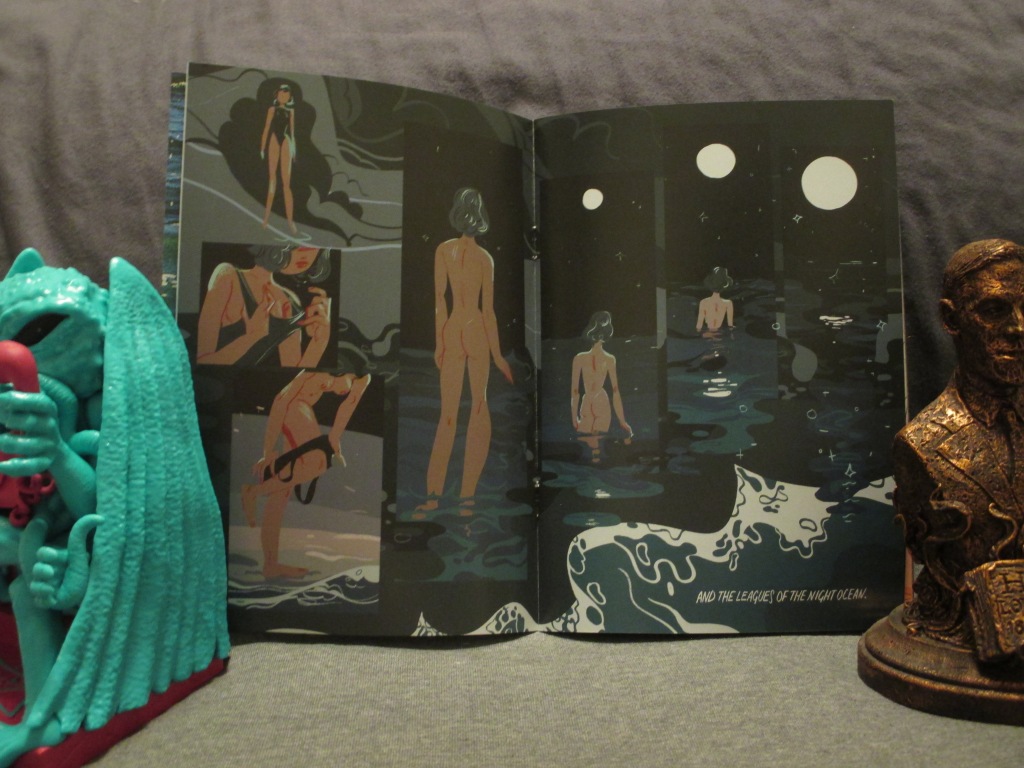
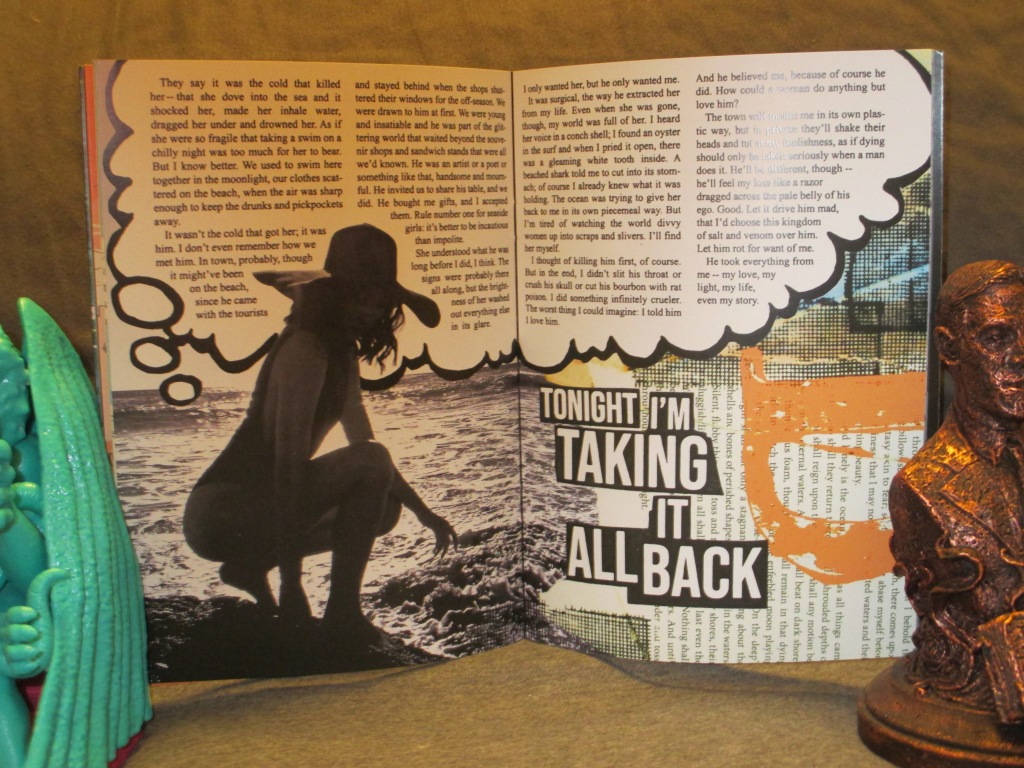
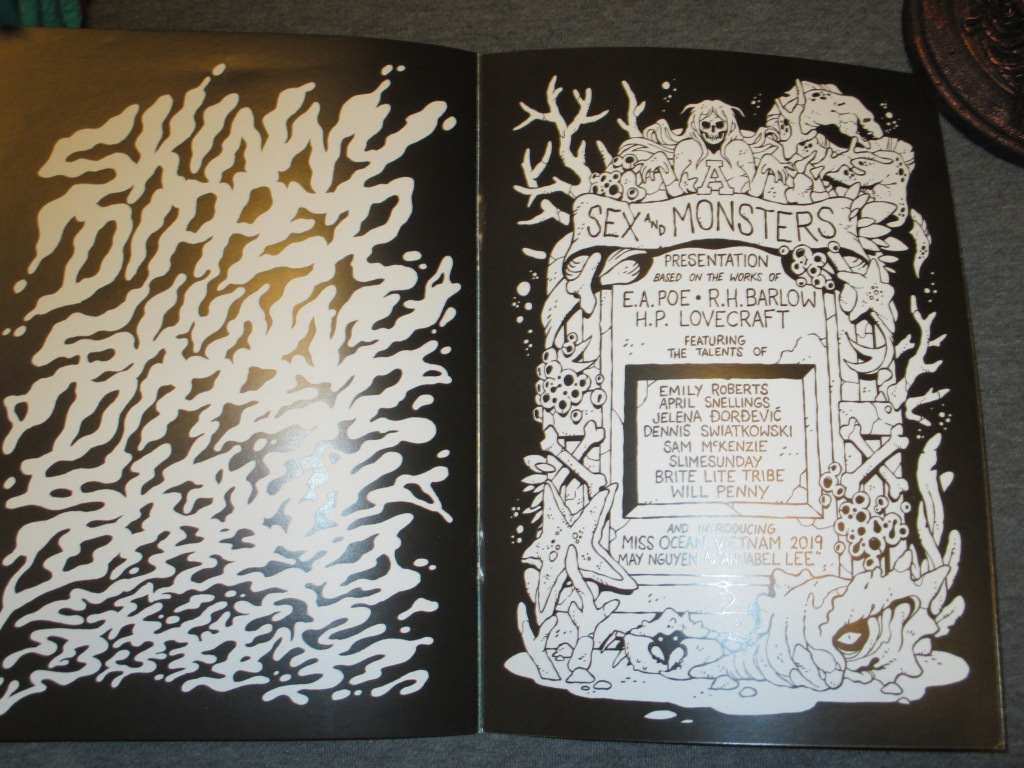
The form of this particular project is a 32-page mixed-media comic ‘zine that remixes Poe’s “Annabel Lee” and “The Night Ocean” (1936) by R. H. Barlow with H. P. Lovecraft, re-imagining them against a palette of mixed comic and photographic work by Emily Roberts, April Snellings, Jelena Đorđević, May Nguyen, Dennis Swiatkowski, Sam McKenzie, Slime Sunday, Brite Lite Tribe, and Will Penny; and a 7″ vinyl record by Nite Jewel that contains a soundtrack to accompany the piece. Various Kickstarter bonuses to the campaign add decals, instant film shots of May Nguyen, and other goodies.

The crux of the re-imagining is model May Nguyen, who appears both in photographs and as the character model for the character of Annabel Lee in the story. Told in sparse, evocative images, Annabel Lee shifts from the bright and crowded daylit beach to a lonely moonlit scene, to go skinny dipping alone in the night ocean.

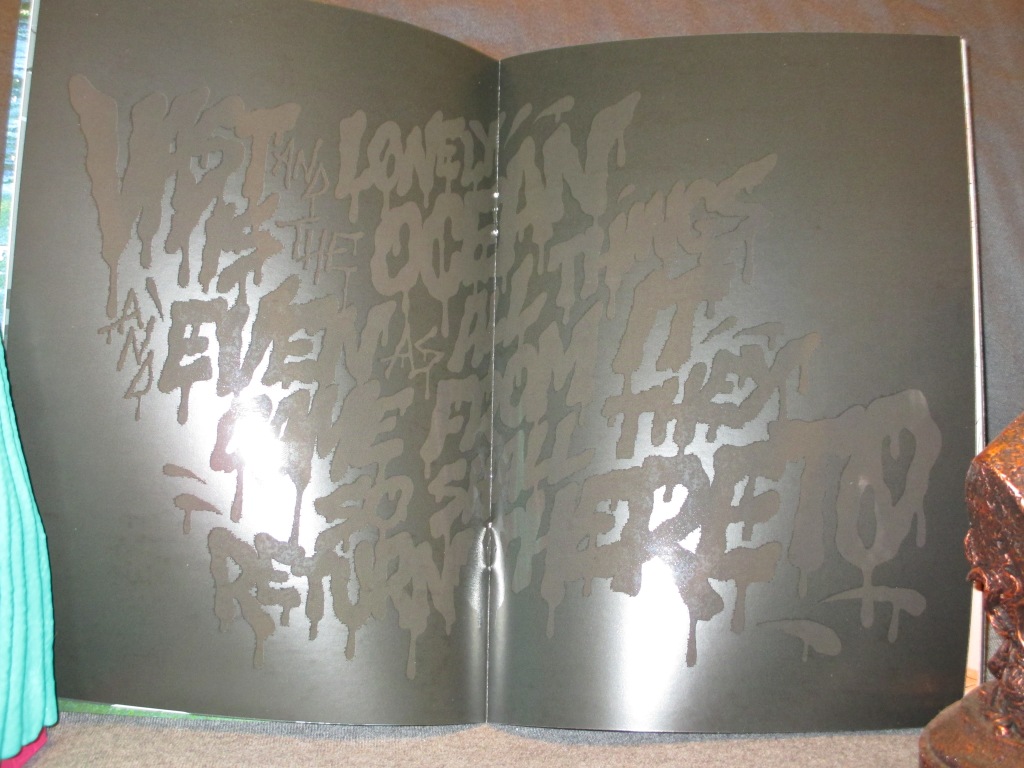
Chunks of Poe’s and Barlow and Lovecraft’s texts are taken out of context and reframed as poetry. The artists are each distinctive in their style and approach to the material; the center black-lettering on black-pages at the center of the story is incredibly evocative of the dark abysses hinted at in poem and short story, here rendered visually—and the combination of Poe’s verse and select snippets from Barlow and Lovecraft work well together with the visuals, terribly suggestive of far more than appears on the page.

Kitsch is a dirty word, but in this case the artists are trying to recapture specific moods and art styles, from the Charles Atlas bully-kicks-sand-in-your-face comics of the 50s to 80s glossy magazine photo spreads that are terribly suggestive of exotic vacations, where the sea foom can lap at your feet as you read and relax on holiday. It is a deliberate effort to reproduce an aesthetic that existed, even if that exact place never did.

One thing that both “Annabel Lee” and “The Night Ocean” capture is a sense of loneliness and longing; that may be why giving Annabel in Skinny Dipper such a distinctive face adds something to the text. May Nguyen provides a sense of reality that might have been missing if this a more traditionally-made comic book; there’s a fotonovella-style sense that these could be stills to some ancient straight-to-video movie that graced the shelves of mom & pop video stories.

It is not horror in any strict sense; not int he bloody bones and a shark coughing up a limb. It’s closer to a vacation where all the time away reminds you that the one thing ou can’t get a vacation from is yourself, can’t get out of your own head. That loneliness and the endless, ageless warm waters of the ocean might swallow you up forever, given half a chance.

Nite Jewel’s Skinny Dipper single is a soundtrack to the story; I’d call it synthwave or retrowave, while the tags for the album on call it chillwave and hypnogogic pop. Combined with the stylistic flourishes of the comic, it grounds the reader in that almost-never-when promised in a thousand 80s and early 90s magazines, comics, films, and music videos. The idea of the beach as this place of escape, the music a poppy invitation that’s a bit more upbeat than tiki exotica, but holds many of the same audio cues, just for a later generation.

At this time of writing, the album is the only thing available for direct purchase, although many stills and videos associated with the project are located on Sex and Monsters’ Facebook page.

Skinny Dipper is an interesting collaboration, one that showcases the abilities and visions of the individual artists that went into it. Copies are still available through the Kickstarter store (click “Order Now”), and will hopefully receive a wider release in the near future.


Bobby Derie is the author of  Weird Talers: Essays on Robert E. Howard and Others  and  Sex and the Cthulhu Mythos .

Deep Cuts in a Lovecraftian Vein uses Amazon Associate links. As an Amazon Associate I earn from qualifying purchases.
“Violet is the Color of Your Energy” (2015) by Nadia Bulkin

Absence of much conversation is probably a permanent feature of my style, because the tales I write concern phenomena much more than they concern people.
—H. P. Lovecraft to Natalie H. Wooley, 24 Oct 1933, LRBO 193

“The Colour Out of Space” is one of Lovecraft’s most evocative and best-loved stories. It has been interpreted by different folks as an environmental horror, as a rural Gothic, a precognitive flash of the dangers of nuclear radiation. It was not set in the far ago and the long away; H. P. Lovecraft set most of his horrors in his here and now. In the 1920s and 30s, close to home in Rhode Island, Massachusetts, and New York. They were horrors of the moment, and while he largely eschewed flappers and rumrunners, they took on the syntax of the time and place.

Which makes them interesting to update. How many horror stories would be different, if they took place after the invention of cell phones, or the advent of the internet, birth control pills, the Civil Rights Movement? How might that change the story? Not the phenomenon itself, but the people’s response to the phenomenon. Their perspective and understanding of it.

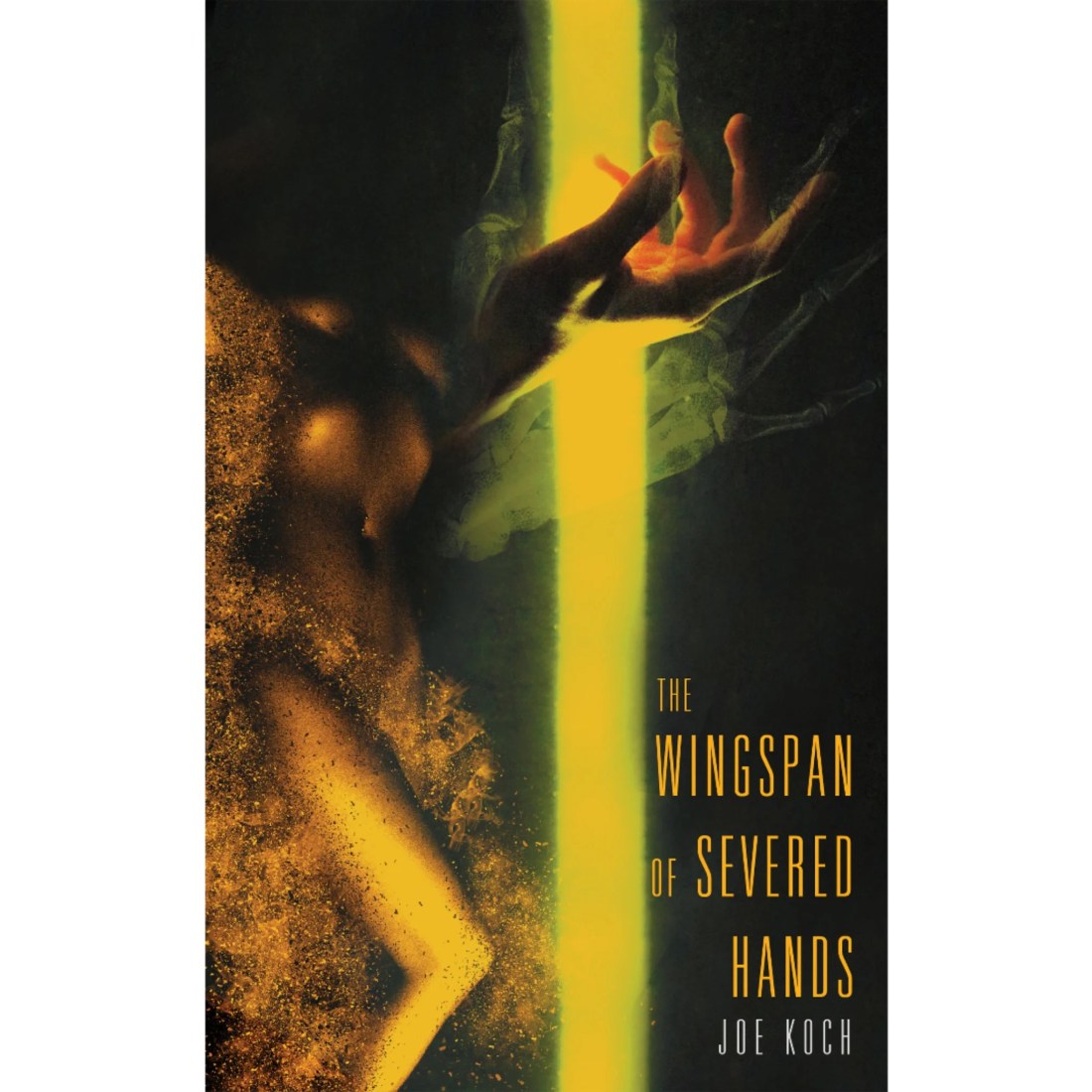
As is appropriate for a story that’s a reworking of H.P. Lovecraft’s “The Colour Out of Space,” “Violet is the Color of Your Energy” is named after two songs centered on color: 311’s laidback, beachy “Amber,” and Hole’s angry, feminist “Violet.” I doubt that MRA types would like this story. In my defense, though, “The Colour Out of Space” practically demanded a feminist revision. It’s fundamentally a story about a cranky farmer who keeps his family increasingly isolated, then imprisoned, resulting in the deaths of all. There’s a neighbor who seems to check in a lot. Oh yeah, and something’s off about the water and the crops. And the woman locked in the attic is the crazy one?
—Nadia Bulkin, “Violet is the Color of Your Energy” [The Playlist]

Nadia Bulkin’s “Violet is the Color of Your Energy” is, in effect, a contemporary re-telling of “The Colour Out of Space.” One that leaves out Arkham, and shifts the point of view focus to Abigail Gardner (née Cuzak), who followed her college-educated husband to Cripple Creek to try and make a go of an old-fashioned family farm. The shift in time and space and perspective skews the story from the phenomenon (Lovecraft’s interest) to the individual. Zeroes in from the impersonal observation of everything going on to the very personal look at how this phenomenon affects Abby and her relationship with her husband and children.

“Are you sleeping with him?”

“What?” her voice broke. “Nate, the boys are right . . . .”

His shout punched down like a hammer of God. “Answer me, Abby! Was this some whore’s bargain? Said you’d jump into bed if he’d just cut your poor idiot husband a break?”
—Nadia Bulkin, “Violet is the Color of Your Energy” in She Walks In Shadows 39

The result is something like Christina’s World by Andrew Wyeth in prose. Things said and unsaid. A woman trapped by the decisions she’s made, the man she trusted, until she has no decisions left at all; yet this is not a morality play about a woman who made the wrong decision. Something is happening, something he won’t tell her about. This isn’t just a tale of spousal abuse, or stress turned to paranoia. Something happened, in the opening paragraph, reverberating throughout the short story. Something that works, unseen, on the corn, the animals, the water, her husband…and her.

If you haven’t read “The Colour Out of Space,” the ending might be confusing. A Shirley Jackson-esque non sequitur, like a needle skipping across a record, jumping straight to the last track. It is like a variant telling of an old and familiar myth, reminiscent of “His Mouth Will Taste Of Wormwood” (1990) by Poppy Z. Brite in that sense. Not a replacement for Lovecraft’s story, but a complement to it; an old campfire tale told to a new generation of campers, a riff on the old motif, recycled and made new again.

Boys and dogs alike asked for things—food, drink—and eventually, after the sun began to set, Teddy put down his American History book and asked for an explanation of Croatoan.
—Nadia Bulkin, “Violet is the Color of Your Energy” in She Walks In Shadows 39

There is a certain synchronicity between “Violet is the Color of Your Energy” and the 2019 film The Color Out of Space; both seek to update and adapt Lovecraft’s text, both keep the story small, centered on what a small family farm looks like in the 2010s, the breakdown that occurs as something happens beyond their control or capability to understand. The beats are not the same, but they’re working in a similar groove with a sense of isolation and desperation. Of things that have suddenly and inexplicably gone wrong, and the added stress has cracked the facade of normality, to show that maybe, things weren’t right this entire time.

“Violet is the Color of Your Energy” by Nadia Bulkin was first published in She Walks In Shadows (2015), and republished in the paperback edition Cthulhu’s Daughters (2016), as well as Year’s Best Weird Fiction: Volume Three (2016), and Bulkin’s collection She Said Destroy (2017).


Bobby Derie is the author of  Weird Talers: Essays on Robert E. Howard and Others  and  Sex and the Cthulhu Mythos .

Deep Cuts in a Lovecraftian Vein uses Amazon Associate links. As an Amazon Associate I earn from qualifying purchases.
Conann (2023)

AIso I just thought it was interesting to make the character of Conan female to turn it on its head.
[Interview] Delving into the Surrealist World of SHE IS CONANN with Director Bertrand Mandico 

Conan the Cimmerian first appeared in “The Phoenix on the Sword” by Robert E. Howard in Weird Tales (Dec 1932); his immediate literary antecedents were Conan the Irish Reaver in “The People of the Dark” (Strange Tales of Mystery and Terror Jun 1932), and the Atlantean barbarian Kull, who last appeared in “Kings of the Night” (Weird Tales Nov 1930). Like most of Howard’s heroes, Conan was male, and the gender politics of the Hyborian Age tended to be a combination of 1930s Texas and various historical periods and cultures as Howard understood them. There were warrior-women in Howard’s stories: Bêlit, the Queen of the Black Coast; the Valeria of the Red Brotherhood; Red Sonya of Rogatino; and Dark Agnes de Chastillon—but savage as they might be with sword or pistol, these were not barbarians per se, and they were always exceptions in male-dominated settings.

Howard wasn’t alone in producing warrior-women for his fantasy and weird adventure stories, with C. L. Moore’s Jirel of Joiry (who first appeared in “Black God’s Kiss” (1934)) being a notable peer to Conan in the pages of Weird Tales. Yet the Cimmerian’s popularity won out, and influenced generations of later media, from pastiche stories and novels to comics, beginning with Marvel’s Conan the Barbarian in 1970, and film, with Conan the Barbarian starring Arnold Schwarzenegger in 1982.

Many of these adaptations included warrior-women as well. Red Sonja was created by Roy Thomas and Barry Windsor-Smith as a foil for the Cimmerian in the pages of Conan the Barbarian, and went on to an extensive career of her own. Valeria (played by Sandahl Bergman) in the 1982 film served as Conan’s ally and later lover. Later sword & sorcery works sometimes focused on female barbarians, such as Hundra (1983), Red Sonja (1985), Barbarian Queen (1985), Amazons (1986), Stormquest (1988), and Barbarian Queen II: The Empress Strikes Back (1990), but these were mostly poor pastiches that often captured the fur-bikini aesthetic but little to nothing of the character or power of Howard’s warriors, men or women.

So when French director Bertrand Mandico set out to make a film that took the popular conception of the ultramasculine figure of Conan and turned it on its head by making the barbarian female, that was an interesting premise. The resulting film is Conann, released to English audiences as She Is Conann, is a 2023 French-language film written and directed by Mandico.

However, the key aspect of this film is less Howard’s hero, and more Mandico’s definition of barbarism:

I wanted to make a film about barbarism, and tell what is for me the height of barbarism, it’s old age killing youth. So, in the figurative sense, physically, but at the same time, symbolically, by betraying convictions, etc. So I started with this idea and I invoked Conan, the character from Howard’s novels. I even went back to the source that inspired Howard. It’s a character from Celtic mythology named Conan with two n’s who was surrounded by dog-headed demons. I started from this mythology to traverse time, eras and to make a sort of survey of barbarism. All of this carried by a choir of actresses.
—Bertrand Mandico, interview with Sara Bradbury

In a purely factual sense, Mandico has erred here. The mythological Conann and the Cynocephali (Dog-Headed People) he refers to appears to be a reference to The Voyage to the Other World Island in Early Irish Literature by Christa Maria Loffler or equivalent source. In that work, Conann (or Conainn) is one of the Tuatha de Danann, and the Cynocephali are another name for the Fomorians whom the Tuatha de Danann overthrew in the conquest of Ireland, as recorded in works like the Book of Invasions. Howard was certainly familiar with some of the content of the latter, because he discusses it in letters to Lovecraft, but it isn’t clear that Howard ever read the Book of Invasions himself, and makes no reference to dog-headed people (or even Fomorians) in his stories of Conan.

Still, the point of this film is not pastiche of Howard, or even of the 1982 Conan the Barbarian film; it is a film concerned entirely with Mandico’s concept of the barbarian, which is radically different from Howard’s, and starring a largely female cast. The film stars Elina Löwensohn as Rainer; Julia Riedler as Sanja; and six actors that play the eponymous Conann at various ages: Claire Duburcq (15), Christa Théret (25), Sandra Parfait (35), Agata Buzek (45), Nathalie Richard (55), and Françoise Brion (Queen Conann and dead Conann).

The film “Conan the Barbarian” was the symbol of virilism, of virility. And I found it really interesting to take the complete opposite of this character. With “The Wild Boys” [“Les garçons sauvages”], I had already wondered about the masculine-feminine shift with fairly aggressive characters. And there, I wanted to work on this barbarity and make it feminine. Then also bring a great breath of romanticism. Because barbarism, in itself, does not interest me. What interests me is the contrast between barbarism and romanticism.
—Bertrand Mandico, Sur le tournage de Conan de Déviante, de Bertrand Mandico
cf. Le réalisateur Bertrand Mandico féminise « Conan le Barbare »

The Nanterre National Drama Center, well known for its hybrid and avant-garde exhibitions, will welcome the filmmaker from January to February 2021, for a theatrical performance on the border of living theater and cinema which “will also give birth to a film shot in film” , and “will invite the public to settle in the middle of its various paintings and stories, in a circus-hell of rocks studded with bursts of tears and blood”
Bertrand Mandico adapte « Conan le Barbare » pour le théâtre des Amandiers

While production details are a bit hazy, French media reports from 2020-2021 or so indicate that what would become Conann started out as much more focused on the 1982 film for inspiration, which can perhaps be seen in the first act with the 15-year-old Conann, which partially seems a response to the opening of the 1982 Conan the barbarian where Conan’s mother is killed and he is enslaved. The earlier version of what would be Conann seems to have been much more of a multimedia/performance space, which may have suffered delays or transformations due to COVID-19. Yet the final film(s) that resulted seem fairly true to Mandico’s original vision as expressed in interviews and press releases.

 I feel like a barbarian-adventurer myself in the way I built this project. As for Howard’s original novels, I have kept the esoteric impulse, the memory of an adaptation by Corben “Bloodstar,” but I especially see Conan as a pop figure, a war cry. In my project, Conan is girl(s) and woman(s), and they will evolve in a feminine world. I decided to offer actresses of all ages and all origins unusual characters and situations . There will be six Conans, as many as there are periods in his life. Each new Conan will come and kill the previous one because, for me, the height of barbarity is to kill one’s youth.
—Bertrand Mandico, « Conan la barbare » : Bertrand Mandico nous présente sa prochaine œuvre monstre

Mandico references Richard Corben’s novel Bloodstar, which is an adaptation of Robert E. Howard’s “The Valley of the Worm.” Understanding that Conann is not in any strict or even broadly metaphorical sense related to Howard’s Conan as put on paper is important, because viewers who go in hoping for something like an adaptation of Red Nails where a female Conan and Valeria might kiss are going to be disappointed.

Mandico’s approach to filmmaking is very much surrealist, gritty, and avant garde compared to Conan the Barbarian and its sequel and pastiches. Director Jim Jarmusch’s Dead Man (1995) has been described as an Acid Western, and Mandico’s Conann might be described as Acid Sword & Sorcery. It has that punk aesthetic, not just in the sets, the wardrobe, the props where swords look forged out of scavenged bits of rebar, but in the attitude of the characters, which is often nihilistic, focused on the moment, and ultimately self-destructive—just as the darkest part of punk has always been a disenfranchised generation preying on itself.

But is it any good?

I realized, almost while making this film, that it concludes a trilogy. A trilogy that began with “Les garçons sauvages” [The Wild Boys], and continued with “After Blue” [Paradise Sale/Dirty Paradise]. So “Les garçons sauvages” would be paradise, “After Blue” the purgatory, and “Conann” hell. So there’s hell in my paradise, but there’s also a romantic dimension in my hell.
—Bertrand Mandico, interview with Sara Bradbury

If you like Mandico’s other films, you’ll probably like Conann. If you haven’t seen his other films, it’s important to go into Conann with an open mind. There is a deliberate sense of theatricality: according to an interview, the sets were built inside a big warehouse in Luxembourg, and there’s a conscious sense that these are sets, not location shots. The camera moves, but it stays close, there’s no peeking around corners, and the narrative structure plays to that sense of place.

From the standpoint of pure cinematography, there are some beautifully shots, even when the subject is ugly; Mandico shot on film instead of digital camera, and that reality comes through in almost every frame. The contrast between the black-and-white and color segments works well. The practical effects come across very well, much like an 80’s horror film, and the visceral presence of the gore effects often blends with the rather surreal nature of the narrative. Costume and makeup deserve all due praise; the dog-like face mask of Ranier in particular is an effect that seems fundamentally simple but effective, as in the Twilight Zone episode The Masks. By contrast, the action sequences are not the best-choreographed; while there is plenty of bloodletting and bladework, the tone of the film and the shape of the narrative doesn’t build up much tension.

If there’s a major turn-off for audiences expecting something more akin to the nearly-dialogue-free first twenty minutes of Conan the Barbarian (1982), it is the script. There’s a lot of dialogue, a lot of philosophy, and a lot of narration, to the point where sometimes the best parts of the film are those rare moments when the characters stop talking and do something. Yet the philosophy is in a large sense why Mandico is here; the story is being told because this is how he puts barbarism—or at least his conception of it, the self-destructive Ouroboros that eats its own tail—on display. You either appreciate the film for what it is, or you don’t.

I want to adapt Conan the barbarian on stage. With only women. Several generations of women, who kill each other, fuck, betray each other, embrace, and love one another in a world doomed to disappear.
—”Rainer, A Vicious Dog in Skull Valley”

Filmed alongside Conann and featured on the BluRay as bonus features are “L’Emission a déjà commencé” (“The Show Has Already Started”), an introductory segment to three short experimental/surrealist/metafictional films: “Rainer, A Vicious Dog in Skull Valley”; “Nous le Barbares” (“We Barbarians”), and “The Last Cartoon -Nonsense, Optimistic, Pessimistic.” These are much more in the deliberately arthaus vibe, but can be seen as meta-commentary and interactive with Conann as a film. By their nature, they tend to showcase different aspects of the film and its lead actors’ performances. If you like Conann, it’s worth watching these short films too.

“Rainer, A Vicious Dog in Skull Valley,” for example, is a meta-commentary on the difficulties of filming during the COVID-19 pandemic. A director reading Lips and Conan (a fictional paperback) wants to produce a play and makes a deal with the dog-faced demon Ranier to produce Conann. “The show must go on. At all costs.” The short film can say outright things that the film itself cannot say without breaking character.

Conann is very consciously a queer narrative. The eponymous Conann, in all of her incarnations, is primarily sexually interested in women, but their sexuality is fluid, especially in the short films, with relationships marked by violence, death, and betrayal. While the majority of the cast are women, some of the cast is deliberately more ambiguous: Christophe Bier is presented in drag throughout; Elina Löwensohn’s Ranier is consistently described as male, and all of them have a sexuality, implicit or explicit.

The nudity in the film isn’t particularly egregious as far as Sword & Sorcery cinema goes, but unlike those films the titillation doesn’t seem to be solely targeted for the male gaze. Women aren’t stripped to show vulnerability, but to tease titillation with violence: a recurring image is a breast with a vicious spike growing from the nipple. Sex and violence are often combined, but not in the sense of rape, but more in a BDSM-inflected sense of pain as an enhancement or counterpart of pleasure. Mandico plays with certain fetishistic images, but steers clear of anything to explicit; whatever else Conann may be, it is not sexploitation.

Of all the weird cinema with some strand of Robert E. Howard in their literary DNA, Conann and its bevy of short films are probably the strangest to yet see widespread release—and it can be very difficult, if you haven’t gone back through the interviews and press-releases, to see how Bertrand Mandico got from Conan to Conann. Yet if you are willing to watch it with an open mind, and appreciate the spectacle and the craft, the performances and the ideas on display, then Conann is at least an interesting film, far more than just another Sword & Sorcery pastiche.


Bobby Derie is the author of  Weird Talers: Essays on Robert E. Howard and Others  and  Sex and the Cthulhu Mythos .

Deep Cuts in a Lovecraftian Vein uses Amazon Associate links. As an Amazon Associate I earn from qualifying purchases.
Red Sonja and Conan: Hot and Dry (1977) by Randy Crawford

Eldritch Fappenings

This review deals with a work of pornography, and the history of erotic art and writing. As part of this review, selected images with cartoon depictions of genitalia and/or sexually explicit contact will be displayed.
As such, please be advised before reading further.


It was a woman, dressed as von Kalmbach had not seen even the dandies of France dressed. She was tall, splendidly shaped, but lithe. From under a steel cap escaped rebellious tresses that rippled red gold in the sun over her compact shoulders. High boots of Cordovan leather came to her mid-thighs, which were cased in baggy breeches. She wore a shirt of fine Turkish mesh-mail tucked into her breeches. Her supple waist was confined by a flowing sash of green silk, into which were thrust a brace of pistols and a dagger, and from which depended a long Hungarian saber. Over all was carelessly thrown a scarlet cloak.
—Robert E. Howard, “The Shadow of the Vulture” (The Magic Carpet Magazine Jan 1934)

In his stories, Robert E. Howard had written a number of warrior-women. Bêlit, the eponymous Queen of the Black Coast; Valeria, the pirate; Dark Agnes de Chastillon, who rejected the role of woman in medieval France to take up the blade; and Red Sonya of Rogatino, a fiery-tempered mercenary in the wars against the Ottoman Empire.

In February 1973, Marvel Comics’ Conan the Barbarian was coming close to the end of its second year. Writer Roy Thomas had freely adapted some of Howard’s Conan stories, and written some original stories of his own, generally following the outline of Conan’s career. Now, with issue #23, Thomas and artist Barry Windsor Smith (inked by Sal Buscema, John Adkins, and Chic Stone, adapted one of Howard’s non-Conan tales—”The Shadow of the Vulture” as a Conan tale, following the example provided by L. Sprague de Camp. Where “The Shadow of the Vulture” was set during the Siege of Vienna in 1529, Thomas borrowed from Howard’s references to Turan in stories like “The People of the Black Circle” and set it during a series of Turanian wars.

So Red Sonya of Rogatino was re-envisaged as Red Sonja of Hyrkania.

Conan the Barbarian #23 (1972)

Only a couple of pages later, Red Sonja turned up—dressed in a mailshirt and something which can only be described as red “hot pants,” a type of skimpy garment worn briefly (in every sense of the word) by young women in the early 1970s. This wasn’t the way I had seen Red Sonja in my mind, but Barry was the artist, and I didn’t feel like second-guessing him. Besides, he was a good enough artist to pull it off.
—Roy Thomas, Barbarian Life: A Literary Biography of Conan the Barbarian, Vol. 1 (2018) 134

The new character elicited interest, with issue #24 titled “The Song of Red Sonja.” Then, she and Conan parted. She would not reappear until 1974, in the first issue of The Savage Sword of Conan, a full-sized comic magazine—where she played a prominent role. The cover features Conan and Red Sonja by Boris Vallejo; the first story “The Curse of the Undead-Man” was adapted by Roy Thomas from Robert E. Howard’s “The Mistress of Death” (a Dark Agnes fragment), with art by John Buscema, inked by Pablo Marcos, featured Sonja as a supporting character, and later on Red Sonja appeared in her first solo adventure “Red Sonja” written by Roy Thomas, and illustrated by Esteban Maroto, with inks by Neil Adams and Ernie Chau (often credited as Ernie Chan). Only this time, Red Sonja’s outfit had changed:

Maroto had never done any work for Marvel (he would later contribute to Vampire Tales #s 3 and 4), but he clearly admired its books and had seen the two issues of Conan the Barbarian in which Sonja had made her debut. maroto was fond of drawing fantasy women in revealing outfits and decided to send an illustration of Sonja, rendered in this fashion, to the Marvel offices. The response was huge, and Thomas saw no reason why Sonja couldn’t wear a chainmail bikini if Conan paraded around in a lioncloth. In terms of the practicality of it, Thomas “came up with a mildly twisted rationale for her wearing clothing that deliberately tempted men when of course she’d cut off their fingers if they tried to go touchy-feely on her” (“A Fond Look Back at Big Red”). […]

Thanks to his unsolicited illustration, Maroto was assigned the penciling chores of Thomas’ Sonja story, which featured the She-Devil’s new duds and was simply called “Red Sonja.”
—Matthew Stephen Sunrich, Drawn Swords: An Unauthorized Exploration of Red Sonja and the Artists Who Brought Her to Life (2017) 14

So Red Sonja traded her mail-shirt and hot-pants for what would become an iconic chainmail bikini. She also gained a vow:

Savage Sword of Conan #1

Sonja would continue to reappear periodically in the pages of Conan the Barbarian, Savage Sword of Conan, and the short-lived Kull and the Barbarians both as a recurring character with Conan and in solo stories like “Episode” in Conan the Barbarian #48 (script by Roy Thomas, art by John Buscema, inked by Dick Giordino) but while she had received a great deal of character definition—an iconic outfit, and non-romantic foil to Conan who could fight as well as he could but didn’t let him or anyone else manhandle her—she hadn’t developed much backstory or lore. Like Jirel of Joiry, Red Sonja’s adventures were fantastic and at the same time disjointed. Any fan could pick up any comic with a Red Sonja story and need not have read any of the others. Yet between the cheesecake outfit and serious attitude, Red Sonja developed a fanbase.

So it was that in Marvel Feature #1 (1975), “Red Sonja” by Thomas and Maroto was reprinted in color, with a new story “The Temple of Abomination” written by Roy Thomas with art by Dick Giordino (backgrounds inked by Terry Austin, colors by Michele Wolfman) to fill out the issue. These were still random episodes from an adventurous life, and most of the rest of the stories in Marvel Feature, which despite the title was essentially a soft-launch of a Red Sonja solo comic, are the same: random sword & sorcery adventures with little connective tissue to each other or the wider Hyborian world—except when Conan makes a guest-appearance in her comic for a change!

Yet in Kull in the Barbarians #3, Red Sonja got an origin story in “The Day of the Sword,” with a plot by Roy Thomas, script by Doug Moench, and art by Howard Chaykin. It’s not a pretty story: Sonja’s family is murdered, she’s raped, and then a goddess grants her the power for revenge…at a price. She cannot know the love of man unless defeated in battle. The origin of the vow mentioned back in Savage Sword of Conan #1.

Much ink has been spilled over this decision over the years. The rape-revenge origin was probably only possible because Kull and the Barbarians was a magazine and not a comic book, and so didn’t need to go through the Comics Code Authority; the divine vision is reminiscent of Joan d’Arc, the heroine of France, and there’s a touch of Dark Agnes in Sonja’s early desire to not be treated just like any other woman. The vow of chastity probably seemed like a good idea at the time, but it is needless to say the men writing and drawing Red Sonja probably didn’t ask any women what they thought of the idea.

In the years and decades to follow, Red Sonja’s origin—like her outfit—would be both iconic and problematic, and subject to redesign and reinterpretation from generations of creators, including Gail Simone, Nancy Collins, and Christopher Hastings. Through different series, Sonja has been both sexually active and celibate, worn the iconic chainmail bikini and exchanged it for different outfits, been saved by a goddess and saved herself without any divine help. Fans have alternately applauded Red Sonja’s strength and independence and lamented the focus on her sexuality, and the explicit idea that the only way to have sex with her was through violence.

The second issue of Marvel Feature (1976) was much of the same as the first, with a new Red Sonja story titled “Blood of the Hunter,” scripted by Bruce Jones with all art by Frank Thorne. As the series went on, Thorne would write as well as illustrate most of the Red Sonja stories for the remainder of Marvel Feature‘s 7-issue run. When the character got her own ongoing series Red Sonja in January 1977, it was Thorne who drew her—and would continue to do so through issue #11, when he left the series.

Thorne’s run on Red Sonja is notable for not using much of what was established in “The Day of the Sword,” and for his strong involvement with the Red Sonja fanbase, dressing up as a wizard at conventions and judging cosplay contests. Thorne’s Sonja doesn’t dwell over much on her origin or her oath, and continues on fighting monsters and more human villains, kicking ass and looking good while doing it. Thorne’s artistic take on Sonja was marked by eyes that seemed rimmed with kohl, and a warrior who was both vicious and voluptuous, but with a flirtatious sense of humor.

His last feature was “The Wizard and Red Sonja” in Savage Sword of Conan #29 (1978), a rather bizarre out-of-continuity story where a wizard (modeled on Thorne himself) accidentally summons several different versions of Red Sonja.

Savage Sword of Conan #29

This is, in part, meta-commentary, noting the many different ways that Red Sonja had been written and drawn at this point. She had been conceived without a real character arc, without even a comic of her own, and while she was popular, Red Sonja’s stories outside of her interactions with Conan had little continuity. Random fantasy adventures, often wildly different in tone and style.

Red Sonja #11 was Frank Thorne’s final issue; he left the series, and worked on others for which he had more creative control and artistic license…including Ghita of Alizarr, a fantasy swordswoman who was in many ways Red Sonja without the oath of celibacy and with graphic sexuality.

1984 issue 7

If Ghita of Alizarr was an X-rated Thorne’s Red Sonja with the copyrighted and trademarked serial numbers filed off, well…he wasn’t the only one thinking along those lines.

THORNE:  One of the prouder moments is when some guy advertised an eight-page Tijuana bible of Red Sonja in The Buyer’s Guide. [Groth laughs]. I ordered a dozen! [Laughs.]

The title: Red Sonja and Conan, Hot and Dry.

GROTH: [Laughs.] That’s great.  

THORNE: I keepin the first of my really big scrapbooks. I’m just finishing filling up the fourth. These scrapbooks are like two by three feet and two inches thick. Sonja got a ton of media attention.

—Gary Groth, “The Frank Thorne Interview”

Red Sonja and Conan: Hot and Dry was an 8-pager (also called a Tijuana bible or bluesie) put together by Randy Crawford, who released a number of other parody sex comics in 1977 including Star Trek: Spock in Heat and a Plastic Man 8-pager. Tijuana bibles had first emerged in the 1930s, often crudely written, drawn, printed, and bound together with a staple or two—but these sexually explicit comics were incredibly popular. They often featured the unlicensed use of existing comic strip characters, popular athletes, Hollywood stars, and politicians, and even early comic book superheroes like Superman, Batman, and the Captain Marvel family.

Interest and production waned during the 1940s and 50s, but still carried on sporadically; the later Tijuana bibles published after the institution of the Comics Code Authority often seem to have crossover with underground comix, and might feature established characters such as Captain Ameria, Jacqueline Kennedy Onassis, and the Archie gang, but publication and distribution were shifting. Within a year or so of Marvel publishing Conan the Barbarian in 1970, the first pornographic parody “Gonad the Barbarian” appeared in the San Francisco Ball, an adult-oriented underground newspaper in mocking parody of the San Francisco Call.

Red Sonja took a little longer. It’s clear from the cover image that Randy Crawford was looking at the Marvel Feature/Red Sonja (vol 1.) Frank Thorne-era Red Sonja for inspiration, with the straps, armlets, gloves, and pauldrons which would gradually be dropped from her wardrobe. There’s no mention of her origin, oath, goddess, or need to battle before the action begins.

Red Sonja #1 (1977)

Conan is an even rougher figure, although clearly John Buscema’s take on the character. Something of the notched nose and posture recalls Conan’s second meeting with Red Sonja.

Savage Sword of Conan #1

Readers can judge for themselves. Sorry for the roughness of these photos, these are the only ones I could get.

Erotica tends to be ephemeral: only 1,250 copies of Red Sonja and Conan: Hot and Dry were published, and they very rarely come onto the second-hand marketplace. Many have no doubt been lost or discarded, or damaged because of their fragile construction. Yet the crude content and art are the point. While today with the internet readers can find dozens of pornographic comics featuring Red Sonja, some lovingly rendered by digital artists, in the 1970s this kind of erotic fan-product was not just illegal (copyright violation, and possibly deemed obscene depending on the jurisdiction), it was representative of a seriously fringe commercial activity.

How the hell do you advertise a Red Sonja/Conan Tijuana bible? Without getting caught?

Randy Crawford apparently published an ad in the Comic Buyer’s Guide, but this was the sort of thing that would probably have been sold under the table at conventions, or by mail-order in severely plain envelopes. It was illicit fare for the true post-pubescent comic nerds to geek out over. It represents almost the opposite of Frank Thorne’s approach with Ghita of Alizarr—none of the characterization, the beautiful artwork, the erotic atmosphere—just a gonzo narrative, straight to sex and ending with a climax.

Frank Thorne, no doubt, got a good laugh out of it. Yet he was an artist; he may have wanted to see his favorite flame-haired swordswoman in flagrante delicto…but he also wanted to do right by her as a character. Nothing quite illustrates the difference between an avid fan’s pornographic fantasy and a dedicated artist’s erotic epic than to look at something like this, and see how crude the work could be, tossed out quick and printed on the cheap to make a few bucks.


Bobby Derie is the author of Weird Talers: Essays on Robert E. Howard and Others and Sex and the Cthulhu Mythos.

Deep Cuts in a Lovecraftian Vein uses Amazon Associate links. As an Amazon Associate I earn from qualifying purchases.