“Lady Chatterly’s Blowhole” (2022) by Beth W. Patterson

She was thrilled to a weird passion.

D. H. Lawrence, Lady Chatterly’s Lover (1928)

In the 1920s and 30s in the United States of America, erotica was technically illegal—groups like the New York Society for the Suppression of Vice worked hand in glove with the police and the government censors of the United States Post Office to crack down on anything that smacked of smut, from James Joyce’s Ulysses (1922) and Henry Miller’s Tropic of Cancer (1934) to Tijuana bibles, nudist magazines, or explicit works on birth control.

This did not stop the production or distribution of erotic works, but it drove it largely underground. Ambitious but shady individuals placed ads big and small in pulp magazines like Weird Tales, coding their books as works of medical or anthropological interest to skirt the laws. Pulp magazines with sex interest like Spicy Mystery and its sisters skated a thin line between being permissible or being deemed obscene and taken off newsstands and sometimes crossed it.

It took decades for the legal standards to loosen. Landmark cases like United States v. One Book Called Ulysses, 5 F. Supp. 182 (SDNY 1933) and Grove Press, Inc. v. Christenberry, 175 F. Supp. 488 (SDNY 1959) opened the door for people in the United States to publish and possess such works as Fanny Hill (1748) without fear of the books being seized and burned, and the publishers fined and imprisoned. With the new legalization of erotic literature came availability, as old classics were reprinted openly to meet a curious demand.

The artificial restrictions on publication had helped to create a kind of erotic canon; works like The Golden Ass of Apuleius, Giovanni Boccaccio’s Decameron, Leopold von Sader-Masoch’s Venus in Furs (1870), and the anonymous The Way Of A Man With A Maid (1908) weren’t necessarily the most transgressive or well-written erotic works, but in the grey market of erotic books, certain titles had by dint of age, popularity, or literary quality stood out above the rest and became a part of the culture.

It is this loose canon that many writers continue to call back to. Pluto in Furs (2019) and Pluto in Furs 2 (2022), anthologies of weird explicit fiction, is a deliberate reference to Venus in Furs. Peter H. Cannon’s jocular short story “Asceticism and Lust: The Greatest Lovecraft Revision” (1988) imagines a collaboration between Lovecraft and Henry Miller that results in “Tropic of Cthulhu”—a tongue-firmly-in-cheek reference to Miller’s censored novels Tropic of Cancer and Tropic of Capricorn (1939). Lovecraftian erotica, by the way, took a few decades to really get going in no small part because of the legal restrictions outlined above. The freedom to read Ulysses also brought with it the freedom to appreciate all the further extrapolations of sex and the Cthulhu Mythos.

So when a reader picks up the Nookienomicon and leafing through those austere pages reads the title of one story is “Lady Chatterly’s Blowhole” by Beth W. Patterson, there is a certain expectation that they will get the reference, even if they haven’t read the book. Like Mark Twain’s Huckleberry Finn or Shakespeare’s plays, a certain amount of cultural osmosis is assumed to have occurred.

The world is supposed to be full of possibilities, but they narrow down to pretty few in most personal experience. There’s lots of good fish in the sea…maybe…but the vast masses seem to be mackerel or herring, and if you’re not mackerel or herring yourself you are likely to find very few good fish in the sea.

D. H. Lawrence, Lady Chatterly’s Lover (1928)

The intention of “Lady Chatterly’s Blowhole,” however, is not to be a pornographic episode along the lines of “The Flower of Innsmouth” (2011) by Monique Poirier or an erotic paranormal romance novel like Tide of Desire (1983) by Sheena Clayton. The Nookienomicon promises “Bawdy Tales of the Cthulhu Mythos,” and Patterson delivers in a double-entendre-laden comedy that is more sizzle than steak. Working in the tradition of the period works that often had to couch any eroticism in euphemism to get past the censors, this honeymoon in Innsmouth tiptoes the fine line between discussing marital relations—and Innsmouth lore—openly and hinting at it as strongly as possible.

The tone is deliberately light, and Patterson manages to hit a certain comedic line that marks the spoof rather than the farce, although it’s damn close. This is a story that could sit fairly next to “At the Mountains of Murkiness, or From Lovecraft to Leacock” (1940) by Arthur C. Clarke or the Innsmouth episode from Mark E. Rogers’ The Adventures of Samurai Cat (1984). The puns come fast, furious, and often in an unrelenting stream. To give just the barest flavor of the narrative:

[“]Such is the way of people touched by the Old Ones.”

“Touched by the Old Ones?” Fannly looked delightedly aghast. “In what way? Can you show me on a doll?”

Beth W. Patterson, “Lady Chatterly’s Blowhole” in the Nookienomicon 71

To spoof something properly, you have to love it, and there’s a lot of love on display here. Patterson doesn’t just make the obvious jokes (although the stream of sexual innuendos and nautical euphemisms is relentless), and does more than just tease eldritch revelations.

“Is it normal for men to have five of those?”

“Not human men,” replied her husband. “His trousers must fit him like a glove…darling, are you disappointed?”

Beth W. Patterson, “Lady Chatterly’s Blowhole” in the Nookienomicon 68

Aficionados of the Cthulhu Mythos will have read any number of escapes, successful or attempted, from Innsmouth that have been published over the decades, but I can fairly guarantee that they haven’t read one quite like “Lady Chatterly’s Blowhole.”


Bobby Derie is the author of Weird Talers: Essays on Robert E. Howard & Others (2019) and Sex and the Cthulhu Mythos (2014).

“In the Name of Cavities” (2021) by Rajeev Singh

Eldritch Fappenings
This review deals with works of erotica, and the history of erotic art and writing. As part of this review, selected passages involving sexually explicit activites will be included.
As such, please be advised before reading further.


The nature of the said delights was a mystery that was sealed off with a picture of a nude, big-breasted woman lying prone on a greenish stone slab, her butt lifted up by an imposing figure in shadows, who seemed to be wearing some kind of costume and a cape that spread out like wings. A themed orgy? It had intrigued her to no end, the goblet of her unmet desires begging to be filled with a wine she had never tasted.

Rajeev Singh, “In the Name of Cavities” in Lustcraftian Horrors (2021) 239

Lovecraftian erotica is the fiction of transgression. Folks generally don’t write about the perfectly normal sex life of Edward Pickman Derby and Asenath Waite, or the raunchy but otherwise unremarkable wet dreams of Walter Gilman and the coeds he spied in the shower. When Innsmouth and R’lyeh come into play, people expect—not unfairly—for things to get properly weird. What qualifies as “weird” depends on your starting point. How much pornography and erotic fiction have you already consumed, how many sexual encounters have you had? What exactly is left that will shock you? What boundaries do you have left to transgress?

In that respect, the quest for greater titillation parallels and can overlap the quest for knowledge that marks much of Lovecraftian fiction. Protagonists draw closer to the central mystery, led there by an insatiable curiosity. Libido sciendi, the desire to know. Jaded seekers of the ultimate thrill who stumble onto the Mythos are an entire mode of Lovecraftian erotica. In that respect, “In the Name of Cavities” is part of a literary tradition with Robert M. Price’s “A Thousand Young” (1989). Except instead of a jaded libertine seeking greater carnal desires, it’s a bored housewife answering an internet advertisement for some excitement in a sexless marriage.

Any road up, as the saying goes. Rajeev Singh’s premise and characterization work in large part because they do start out very much with the starting point of utter mundanity: the neglected housewife decides to cheat. Yet this isn’t a morality play on the consequences of adultery; by chance, Anaïs has stumbled onto something more than the Eyes Wide Shut-style party she’d maybe hoped for.

Which is an aspect of the story that Singh doesn’t dwell upon: how much contemporary media has shaped our idea of what transgressive erotica really is. When we see the BDSM playroom in From Beyond and Barbara Crampton dawns her leather apparel, the audience is supposed to recognize that as a corruption of the character, or at least an awakening of darker sexual desires than missionary position with the lights off. Real bondage play, and the communities that develop around those desires, are strange and alien by comparison to those depicted in works like Fifty Shades of Grey, dealing as they do with issues of consent, safety, and roleplay.

So how much of what Anaïs saw should she have recognized? How much should the readers have recognized? When you read a passage like:

At first, she couldn’t say for sure but yes, the business end of each arm or tentacle did resemble a hard penis. And they weren’t just showpieces, those erections. Many of the feelers were busy plunging in and out of cavities all over a woman’s body as she lay flat on a green stone slab, similiar to what Anaïs had seen on the internet, only butt-downward.

Rajeev Singh, “In the Name of Cavities” in Lustcraftian Horrors (2021) 239

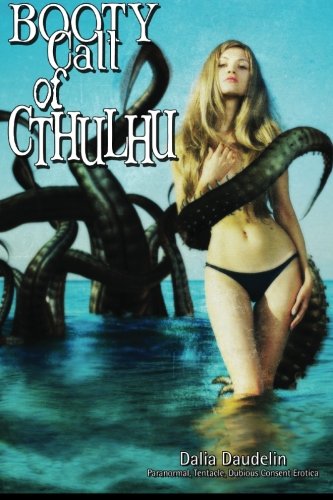
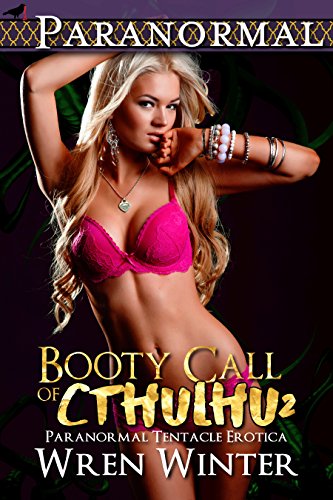
Anaïs does not make the immediate connection to Japanese hentai, works like La Blue Girl or Urotsukidoji. Naughty tentacles have become a trope in some circles for so long that the shock value has largely worn off…but the idea still has legs. Readers already familiar with works like Booty Call of Cthulhu (2012) by Dalia Daudelin and “The Flower of Innsmouth” (2011) by Monique Poirier probably won’t be shocked, but they might still be appreciative of the execution. Jaded sensibilities mean there are very few erotic impossibilities that haven’t shown up somewhere, in some media, and that is reflected in the frustrated Lovecraftian sex-quest.

It is very difficult to come up with something completely new and original.

To take another example from the story, Singh’s use of “cavities” is strongly reminiscent of Graham Masterton’s short story “Sex Object” (originally published in Hottest Blood, and then adapted to comics in Verotika #7), or even of the comic series Stranger Kisses. It’s hard to point out these works as inspirations, many writers stumble upon the same ideas completely independently of one another.

As a work of Lovecraftian fiction, “In the Name of Cavities” lives in a little universe of its own, relatively self-contained…but that’s okay because the last few pages take that idea and run with it, projecting the lusty present out into a post-apocalyptic future. That extension of the idea far beyond the length of the encounter, the duration of a climax, is a pleasant surprise…and a possibility that works within a Lovecraftian premise better than it does with most other erotic works.

“In the Name of Cavities” by Rajeev Singh was published in Lustcraftian Horrors: Erotic Stories Inspired by H. P. Lovecraft (2021).


Bobby Derie is the author of Weird Talers: Essays on Robert E. Howard & Others (2019) and Sex and the Cthulhu Mythos (2014).

Booty Call of Cthulhu (2012) by Dalia Daudelin

Eldritch Fappenings
This review deals with works of erotica, and the history of erotic art and writing. As part of this review, selected passages involving sexually explicit activites will be included.
As such, please be advised before reading further.


Joanne Lagrasse is a newly graduated college student living the life. Well, if the life is sitting in your apartment all day trying to research monsters for a novel. The strange book her favorite professor gave her is full of ramblings by what must be a mad man, which makes for uneasy reading and a loner lifestyle.

She pushes herself to go out to the beach, though the takes the tome with her. When she decides to not heed her professor’s warning and reads a chant out loud, she finds herself faced with a giant monster and its lewd tentacles, each one eager to fill her holes.

Booty Call of Cthulhu, back cover copy

Before the internet, erotic literature often left a literal paper trail. It wasn’t enough to write a story or book, if you wanted to sell it you had to advertise—small ads in appropriate adult newspapers or magazines (or, for erotic fanfiction, fanzines), mail-order catalogs or lists of other publications in the backs of books, and for particularly notable works perhaps even a published review in some suitable medium. By the early 2010s, the game had fundamentally changed: the cheap adult paperbacks of previous decades had largely fallen off with the rise of more readily-available pornography, and self-publishing became feasible thanks to print-on-demand publishing and ebooks. The internet was a great leveler, doing away with much of the traditional advertising—and with it, much of the traditional paper trail which historians and smuthounds alike relied on.

Now, scholars have to rely on search engines and internet archives, hoping for social media posts, blogposts, and the occasional interview:

ED: I see you write tentacle erotica, which has a soft spot in my heart as an anime geek. How did you get into that sub-genre?

DD: I love H. P. Lovecraft! I’ve been a member of 4chan’s /x/ for, well, probably 6 years now. That’s their paranormal board. Horror and tentacles are both very fun to write, especially when you can make them sexy.

EROTICA AUTHOR INTERVIEW: DALIA DAUDELIN, AUTHOR OF BOOTY CALL OF CTHULHU by Ellen Dominick

Booty Call of Cthulhu by Dalia Daudelin is a good example of the works of the period. Originally released as a Kindle ebook under the nom de plume Roxy Feurouge in 2012 (and as by Mia Lust on Barnes & Noble’s website), then as a thin print-on-demand softcover in 2013 (still available), the story is straightforward and geared toward specific, clearly indicated kinks: monsters, tentacles, dubious consent—and it delivers on all counts.

My jaw went slack. My mouth opened just enough for the tentacle to slide in. It went from a wool texture to something more slimy, a bit like another tongue.

Dalia Daudelin, Booty Call of Cthulhu 14

Readers hoping for an erotic re-telling of “The Call of Cthulhu” or a Cthulhu Mythos pastiche with a bit more explicit sex than usual will be sorely disappointed. While not quite Porn Without Plot, most of the twelve print pages are devoted to a detailed array of sexual acts, most involving tentacles. Comparisons with tentacle-themed Japanese adult animation like La Blue Girl fall a bit short: while the sex scenes cover much of the same material (penetrations anal, oral, and vaginal, etc.), there is quite a bit more story and character development in the Japanese manga and its anime adaptation. Booty Call of Cthulhu is written like a typical pornographic feature film, with the brief non-sexual interludes providing the set-up for the next carnal scene, with an abrupt finish after the final climax.

Short, sweet, and to the point—and when compared to similar works of the period like I Was Impregnated by Cthulhu! (2012) by Penny P. Zahn, The Tentacles of the Elder Gods (2012) by Lindsey Purl, Cthulhu’s Carresses (2013) by Amy Morrel, Uhluhtc’s Sacrifice (2013) by Grace Vilmont, I Fucked Cthulhu! (2013) by Deliah Fawkes, Cuckolded by Cthulhu (2013) by Lillian Jacobs, and Cthulhu Comes (2014) by Sandy Laws—Booty Call of Cthulhu isn’t particularly poorly written. If there’s a real criticism to be made, it’s that it is no more than it set out to be, and a much more engaging erotic narrative could have come from the same premise.

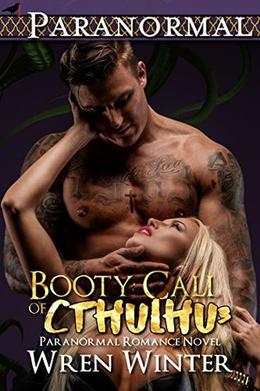
What differentiates Booty Call of Cthulhu from most of its contemporaries is that it was either popular enough or sufficiently tickled the imagination to elicit two sequels: Booty Call of Cthulhu 2 and Booty Call of Cthulhu 3 by Wren Winter—and neither of which is currently available (Wren has also written My Night With Cthulhu, which is not either of those two books under a new title).

Whether this is a licensing issue or Amazon removed the ebooks for violating one of their policies is unclear, and probably will remain so…because as with internet fanfiction, the internet’s archive is imperfect and there is no paper trail. Neither 2 or 3 ever received a hardcopy printing, at far as I’ve been able to determine, and unless you were fortunate enough to buy them during the window of opportunity they were available, those texts are essentially impossible to obtain. Should the files be corrupted or Amazon stop supporting them, they may well be lost forever.

Several of Booty Call’s contemporaries, including I Was Impregnated by Cthulhu! and Cuckolded by Cthulhu have already suffered the same fate. It’s not just that these works exist only on a handful of Kindle accounts, but unless you were aware they existed already it is exceedingly difficult to find out they ever existed. Posting an ebook to Amazon and letting the search engine handle discovery for a public apparently starved for sexually explicit Mythos-flavored content was often enough to sell a few copies…and then, for one reason or another, the ebooks were no longer sold, and there might not even be a page to point at to show where it had been for sale.

Given the ephemeral nature of pornography and the quality of the writing, few folks will lament this as a great loss to our shared cultural heritage—most erotica is treated as eminently disposable, to be enjoyed in the moment but not necessarily saved for posterity as with so many other books. Yet works like Booty Call of Cthulhu certainly represent a certain moment in time, and a literary trend which, in its perennial reflowering, means critics and fans of Lovecraft and the Cthulhu Mythos need to acknowledge two truths:

Some people want to read about having sex with Cthulhu, and a body of work has grown up to meet that demand.

The question that remains to be seen is how, if at all, these works might be preserved. It is fair to say that Booty Call of Cthulhu was not the first and will not be the last sexually explicit story about an amorous eldritch entity, but it is disturbing how easily such works can effectively fall off the face of the internet, perhaps never to be read again. Because it has a print edition, Booty Call of Cthulhu will probably linger on longer than most—and it is weird to think that in generations to come, a furtive Mythos fan may enter into a dusty bookshop and find among the dross of the 2010s an ancient example of Lovecraftian smut…

I entered, charmed, and from a cobwebbed heap
Took up the nearest tome and thumbed it through,
Trembling at curious words that seemed to keep
Some secret, monstrous if one only knew.
Then, looking for some seller old in craft,
I could find nothing but a voice that laughed.

H. P. Lovecraft, “The Book” from Fungi from Yuggoth

Bobby Derie is the author of Weird Talers: Essays on Robert E. Howard and Others and Sex and the Cthulhu Mythos.

Deep Cuts in a Lovecraftian Vein uses Amazon Associate links. As an Amazon Associate I earn from qualifying purchases.

“The Day He Met Lovecraft” (1972) by Lew Shaw

Sir: As if it were yesterday, I remember meeting H. P. Lovecraft on the corner of Benefit Street and College Hill about noon on a very warm, sunny day.

College Hill is a rather steep climb, but on that day, a friend of mine and I, both attending Classical High at the time, were climbng up it oward the campus. At the base of College Hill on Canal Street, a new courthouse had been built. By taking the elevators to the fifth floor, we could have emerged on Benefit Street and eliminated the climb. However, despite the warm day, we walked.

As we got to Benefit Street, my friend greeted a passerby and introduced me to him. It was H. P. Lovecraft.

Lewis Shaw, “The Day He Met Lovecraft” in Brown Alumni Monthly 72, No. 7 (Apr 1972)

Memoirs and anecdotes of H. P. Lovecraft tend to come from familiar names: his correspondents, friends like Clifford & Muriel Eddy (The Gentleman from Angell Street), and his wife Sonia H. Greene (The Private Life of H. P. Lovecraft) most prominent among them. Even the few unfamiliar names like Dorothy Tilden Spoerl (“Cosmic Horror”) prove to have some connection to Lovecraft with a little digging. The very few memoirs that don’t have any provable connection to Lovecraft are thus a little suspect; they are extraordinary, and extraordinary claims demand extraordinary evidence to prove them.

The geography of Providence is real, and while Lovecraft often kept late hours, he was also more active during the warmer months and went out of doors to write in the sunlight. So at least some of the details given are plausible. Yet the most interesting part of Shaw’s account is the least believable:

On that sunny afternoon, H. P. Lovecraft told us the strange story he wrote about a hotel on Benefit Street, a building which stands there no longer.

Lovecraft had written a story about a true incident. At one time there was a young woman, a chambermaid in the hotel on Benefit Street, who left and married into wealth. Sometime afterward, she returned to visit the hotel as a guest. When she found herself discourteously treated and snubbed, she departed but put a “curse” on the hotel, on all those who had humiliated her, and on everything concerned with the hotel. In short order, ill luck apparently befell all and the hotel itself burned down. Furthermore, it had never been possible, somehow, for anyone to rebuild on the site. Even on the day H. P. Lovecraft told us the story, the place where the hotel had stood was still a vacant lot.

Lovecraft had finished the story and, without making his usual carbon copy, made only one draft, which he then mailed to the publisher. His story never appeared in print. It was lost in the mails.

Lewis Shaw, “The Day He Met Lovecraft” in Brown Alumni Monthly 72, No. 7 (Apr 1972)

Lovecraft is not known to have written any story about a cursed hotel, nor is there a mention of a Lew Shaw in his voluminous published letters. Scholars might be suspicious—an account of a lost Lovecraft story by an unfamiliar name, decades after Lovecraft’s death, during the early 70s when paperback publication was raising Lovecraft’s public profile? It sounds a bit too good to be true. S. T. Joshi certainly was not convinced:

There is much reason to suspect this entire account. In the first place, the story sounds like nothing Lovecraft would have written—the idea is hackneyed, and the protagonist would uncharacteristically have been a woman. Secondly, it is inconceivable that Lovecraft would have prepared a story without his usual two carbons. In the case of his essay on Roman architecture in late 1934, he wrote the piece by hand and sent it to Moe without typing it at all. Lew Shaw claims to have actually met Lovecraft on the street, in the company of a friend “who was interested in science-fiction” and knew Lovecraft; this might conceivably have been Kenneth Sterling, but Sterling never mentions this matter in either of his two memoirs. Shaw also claims to be of the Brown Class of 1941; but there is no one of that name in that class listed in the Brown University alumni directory. There is a Lewis A. Shaw in the Class of 1948, and a Lew Shaw who received a Ph.D. in 1975, but that is all. My feeling is that Lew Shaw (probably a pseudonym) is perpetrating a hoax.

S. T. Joshi, I Am Providence (2010) 2.1001

Joshi’s arguments are well-reasoned—but there are a few counter-arguments. While none of Lovecraft’s surviving letters mention a cursed hotel story, the account does not mention when the story was written or sent out; so it could conceivably fall into a gap in the correspondence, especially if the story was an early one or written for a revision client. A story set in Providence on Benefit St. isn’t out of the question either, “The Shunned House” was based on a real-life house (the Stephen Harris House, 135 Benefit Street). Likewise, while it would be uncharacteristic for Lovecraft to write a story with a woman protagonist, it was not unknown: “The Man of Stone” (1932) for Hazel Heald and “The Curse of Yig” (1929) for Zealia Bishop are primarily focused on female characters, or told in part from their perspectives, so it isn’t entirely out of the question. The postal service has lost many manuscripts and typescripts, so that by itself isn’t unbelievable either. The most obvious evidence of a hoax appears to be the absence of Lew Shaw himself…

Lewis Irwin Schwartz attended Classical High School in Providence, RI and graduated from Brown University in the class of 1941 (listed on page 72 of the Liber Brunensis for 1941). “Lew Shaw” was his stage name (“He Crashed The ‘Crewcuts’,” Brown Alumni Monthly Jan 1962). So, Joshi was correct that there was no “Lew Shaw” among the names in the Class of 1941, and that the name was a pseudonym—but didn’t have access to the bits of the puzzle that would show that Lew Shaw really did exist; those parts of the narrative at least match what we know of his background.

Joshi was also likely correct in identifying Shaw’s unnamed friend interested in science fiction as Kenneth Sterling. In Providence, Sterling attended Classical High School. They were both born in 1920, but Shaw was born in November, so he would probably have been a year behind Sterling. That gives us time as well: Sterling met Lovecraft in March 1935, and in the autumn of 1936 began attending Harvard, so the encounter with Lovecraft could only have happened in the summer of 1935 or 1936. Lovecraft doesn’t mention Shaw/Schwartz in the surviving letters to Kenneth Sterling, but on the other hand, those surviving passages are all excerpts, not complete letters, and there are gaps of months in the correspondence.

Kenneth Sterling wrote two memoirs about Lovecraft: “Lovecraft and Science” (1944) and “Caverns Measureless to Man” (1975). The first is slight, and doesn’t go into detail about how they met; the second is substantial, and more personal and biographical, going into considerable detail. Some of these jive with Shaw’s account:

During the academic year, excepting Christmas and spring recesses, the Science Club met weekly. That meant I had a schedule of one scientist a week—all, with two exceptions, from the Brown University faculty—and every time I walked up College Hill toward the Brown campus I visited Lovecraft for several hours. The total number of hours I conversed with him was huge.

Kenneth Sterling, “Caverns Measureless to Man” in Ave Atque Vale 406-407

This would have been the path Shaw describes. Sterling doesn’t mention the cursed hotel story; the one anecdote Sterling tells about bringing a friend to meet Lovecraft doesn’t jive either, since it was at a gathering in New York City. Again, this doesn’t immediately rule out Shaw’s story, but it doesn’t fully confirm it either. Shaw’s account is shifted from obvious hoax to doubtful…and there’s one final bit of evidence to consider: was there a hotel, cursed or not?

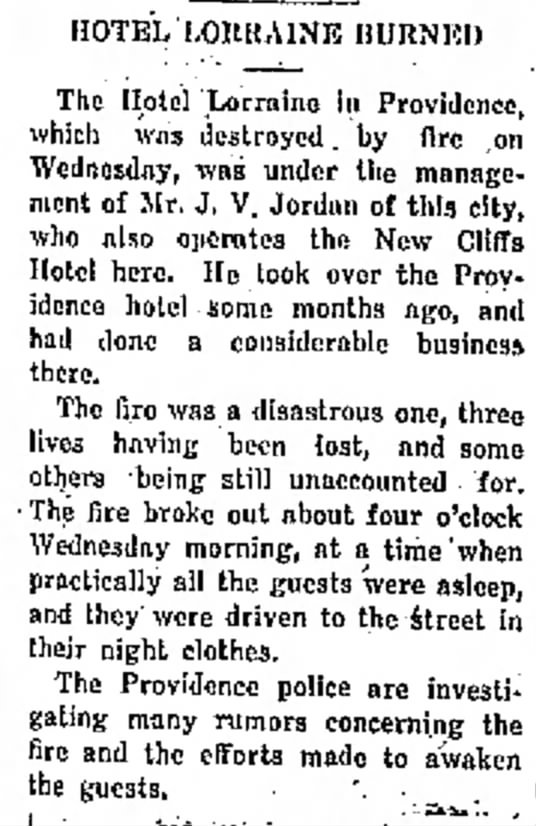
Newport Mercury, 21 Feb 1920

The Hotel Lorraine was on 18-28 Aborn Street, on the other side of the Providence River from Benefit Street, a geographic detail that Lovecraft would not have missed, but I’ve yet to find a notable hotel fire on Benefit St. during Lovecraft’s lifetime—and the 18 Aborn St. lot was still vacant according to the 1935 Providence City Directory, which does jive with Shaw’s story. No mention of a curse has turned up yet, but a lot of century-old folklore probably wasn’t written down, much yet made it onto the internet, where searches about cursed hotels in Providence point toward the Biltmore (now The Graduate).

The question then becomes: is this an error with Shaw’s memory, or did he fabricate the whole anecdote? The former might be understandable: a couple of decades can erode the details of many memories, or add details that weren’t there before. If the latter, why? As far as is known, Shaw never attempted to pass the anecdote off to a paying magazine or publisher or profit from the supposed association. It was of the nature of a brief letter to the editor to a college alumni journal about a local writer with ties to the college whose posthumous star had lately been on the rise and who had ties to Brown (Lovecraft’s papers are archived at the university library). In the Feb 1972 issue of Brown Alumni Monthly there had been an article on “Lovecraftmania at Brown” which probably suggested the letter.

Without any further evidence in Lovecraft’s letters to support the idea that the meeting actually took place, “The Day He Met Lovecraft” will have to remain classified as somewhere between doubtful and apocryphal. We have no absolute evidence that Shaw/Schwartz actually met Lovecraft, as there are no details in the incident that can be independently corroborated with sources that weren’t already published at the time. As Joshi noted, the plot sounds fairly hackneyed and un-Lovecraftian; not something he would write for himself, even with the local angle.

However, we also cannot entirely rule out that Shaw did not meet Lovecraft; we know Sterling had brought at least one friend to meet Lovecraft according to his later memoir. The plot of the apocryphal tale sounds un-Lovecraftian, but Lovecraft was willing to bend his artistic scruples a bit for revision clients. Is a lost revision story plausible? There’s evidence to suggest Lovecraft revised more stories than saw print, such as “In the Gulf of N’Logh” (193?) and “Lair of Fungous Death” (193?) by Hazel Heald, and his letters to Zealia Brown Reed Bishop. By 1935, Lovecraft had largely stopped revising fiction, but it is possible he was talking about an earlier story—Lovecraft didn’t discuss much of his revised fiction that didn’t get published.

While Lovecraft’s life is extraordinarily well documented by his letters, there are still little gaps in which things happened for which we have no record…and, perhaps, in which a clever fiction might be woven. Shaw’s account cannot be entirely ruled out, but neither can it be proved, unless more information comes to light.


Thanks and appreciation to Dave Goudsward for all of his help and assistance.

Bobby Derie is the author of Weird Talers: Essays on Robert E. Howard and Others and Sex and the Cthulhu Mythos.

Deep Cuts in a Lovecraftian Vein uses Amazon Associate links. As an Amazon Associate I earn from qualifying purchases.
“On the Pleasure derived from Objects of Terror; with Sir Bertrand, a Fragment” (1773) by Anna Laetitia Aikin & John Aikin

In England one of the first imitators was the celebrated Mrs. Barbauld, then Miss Aikin, who in 1773 published an unfinished fragment called “Sir Bertrand”, in which the strings of genuine terror were truly touched with no clumsy hand. A nobleman on a dark and lonely moor, attracted by a tolling bell and distant light, enters a strange and ancient turreted castle whose doors open and close and whose bluish will-o’-the-wisps lead up mysterious staircases toward dead hands and animated black statues. A coffin with a dead lady, whom Sir Bertrand kisses, is finally reached; and upon the kiss the scene dissolves to give place to a splendid apartment where the lady, restored to life, holds a banquet in honour of her rescuer. Walpole admired this tale, though he accorded less respect to an even more prominent offspring of his OtrantoThe Old English Baron, by Clara Reeve, published in 1777. Truly enough, this tale lacks the real vibration to the note of outer darkness and mystery which distinguishes Mrs. Barbauld’s fragment; and though less crude than Walpole’s novel, and more artistically economical of horror in its possession of only one spectral figure, it is nevertheless too definitely insipid for greatness.

H. P. Lovecraft, “Supernatural Horror in Literature”

Anna Laetitia Aikin was born in 1743; her father was a Presbyterian minister and the headmaster of a boy’s school, and both Anna and her brother John Aikin received solid educations, which led to their careers in letters—Anna being noted for working in multiple genres, and earned a reputation as a poet and author. One of her earliest publications was Miscellaneous Pieces in Prose (1773), published jointly with her brother. Among the contents of this volume is “On the Pleasure derived from Objects of Terror; with Sir Bertrand, a Fragment.”

The essay is one of the early English works on the subject of the horror story, and much of it is as insightful today as it was two and a half centuries ago:

A strange and unexpected event awakens the mind, and keeps it on the stretch; and where the agency of invisible beings is introduced, of “forms unseen, and mightier far than we,” our imagination, darting forth, explores with rapture the new world which is laid open to its view, and rejoices in the expansion of its powers. Passion and fancy co-operating, elevate the soul to its highest pitch; and the pain of terror is lost in amazement.

“On the Pleasure derived from Objects of Terror”

This essay is a literary forebear of Lovecraft’s “Supernatural Horror in Literature” (1925). At the end of the essay proper is given several examples of books and stories which exemplify this philosophy:

In the Arabian Nights are many most striking examples of the terrible, joined with the marvellous: the story of Aladdin, and the travels of Sinbad, are particularly excellent. The Castle of Otranto is a very spirited modern attempt upon the same plan of mixed terror, adapted to the model of Gothic romance. The best conceived, and the most strongly worked-up scene of mere natural horror that I recollect, is in Smolett’s Ferdinand Count Fathom; where the hero, entertained in a lone house in a forest, finds a corpse just slaughtered in the room where he is sent to sleep, and the door of which is locked upon him. It may be amusing for the reader to compare his feelings upon these, and from thence form his opinion of the justness of my theory. The following fragment, in which both these manners are attempted to be in some degree united, is offered to entertain a solitary winter’s evening.

“On the Pleasure derived from Objects of Terror”

What follows is “Sir Betrand, a Fragment.” The fast-moving fantasy owes much to the medievalisms of Horace Walpole’s The Castle of OtrantoA Gothic Story (1764), the latter of which is widely regarded as the first Gothic novel. Other influences may have included the 1,001 Nights or Thomas Malory’s Le Morte d’Arthur; the story has the style of an episodic adventure in that mode, like a loose couple of pages taken from a longer narrative. In the context of the essay, however, it becomes clear that the fragment is a heaping-up of horrors, image after image piled up one after another in a kind of breathless chain of wonder and terror. The purpose of the fragment was to provide an example for Aikin’s idea of how a horror story worked.

The individual contributions of Anne and John are not signed in Miscellaneous Pieces, but Horace Walpole wrote:

Miss Aikin flattered me even by stooping to tread in my eccentric steps. Her ‘Fragment,’ though but a specimen, showed her talent for imprinting terror.

Horace Walpole to Robert Jephson, 27 Jan 1780, The Letters of Horace Walpole (1880) 318-319

While Walpole (and many others) assert that “Sir Bertrand, a fragment” was Anna’s contribution, as mentioned in the Analytical Review (Dec. 1798) 612-613 (“We are inclined to think, that Dr. D. has erroneouſly attributed the fragment of Sir Bertrand to the pen of Mrs. Barbauld; we believe Dr. Aikin is the author of it.”); her niece Lucy Aikin in The Works of Anna Laetitia Barbauld (1825) clarifies that Anna was not the author of the fiction that accompanied the essay. This misattribution has continued down through the centuries. Luke R.J. Maynard did an excellent job detailing the convoluted history in “A Forgotten Enchantment: The Silenced Princess, the Andalusian Warlord, and the Rescued Conclusion of ‘Sir Bertrand'” (2010), including pointing out that a completed text of the fiction fragment was published as “Sir Bertrand’s Adventures in a Ruinous Castle” in Gothic Stories (1797).

In 1774, Anna married Rochemont Barbauld; subsequent publications of “Sir Betrand, a Fragment,” with or without the original essay that it served as an example for, were often published as by Anna Barbauld or Mrs. Barbauld. “Sir Bertrand, a Fragment” thus entered the corpus of English horror-story lore, albeit as a small, incomplete, but influential piece. This is the prose fragment which Lovecraft succinctly summarizes in “Supernatural Horror in Literature,” and one of the few works by women authors he praises.

Unfortunately, he probably never actually read “Sir Bertrand, a Fragment.”

None of Lovecraft’s published letters contain a reference to either Miss Aikin (or Barbauld), or “Sir Bertrand, a Fragment.” None of the books he is known to have read or were in his library include the tale. While it is not impossible that Lovecraft read the story at the library during his research into weird fiction while writing “Supernatural Horror in Literature,” the lack of any reference to the author or the tale outside that essay is thus suspicious—and we know for a fact that Lovecraft had at hand an easy reference:

When Walpole wrote disparagingly of Clara Reeve’s imitation of his Gothic story, he singled out for praise a fragment which he attributes to Mrs. Barbauld. The story to which he alludes is evidently the unfinished Sir Bertrand, which is contained in one of the volumes entitled Miscellaneous Pieces in Prose, published jointly by J. and A. L. Aikin in 1773, and preceded by an essay On the Pleasure Derived from Objects of Terror. Leigh Hunt, who reprinted Sir Bertrand, which had impressed him very strongly in his boyhood, in his Book for a Corner (1849) ascribes the authorship of the tale to Dr. Aikin, commenting on the fact that he was “a writer from whom this effusion was hardly to have been looked for.” It is probably safe to assume that Walpole, who was a contemporary of the Aikins and who took a lively interest in the literary gossip of the day, was right in assigning Sir Bertrand to Miss Aikin, afterwards Mrs. Barbauld, though the story is not included in The Works of Anne Letitia Barbauld, edited by Miss Lucy Aikin in 1825. That the minds of the Aikins were exercised about the sources of pleasure in romance, especially when connected with horror and distress, is clear not only from this essay and the illustrative fragment but also from other essays and stories in the same collection—On Romances, an Imitation, and An Enquiry into those Kinds of Distress which Excite Agreeable Sensations. In the preliminary essay to Sir Bertrand an attempt is made to explain why terrible scenes excite pleasurable emotions and to distinguish between two different types of horror, as illustrated by The Castle of Otranto, which unites the marvellous and the terrible, and by a scene of mere natural horror in Smollett’s Count Fathom. The story Sir Bertrand is an attempt to combine the two kinds of horror in one composition. A knight, wandering in darkness on a desolate and dreary moor, hears the tolling of a bell, and, guided by a glimmering light, finds “an antique mansion” with turrets at the corners. As he approaches the porch, the light glides away. All is dark and still. The light reappears and the bell tolls. As Sir Bertrand enters the castle, the door closes behind him. A bluish flame leads him up a staircase till he comes to a wide gallery and a second staircase, where the light vanishes. He grasps a dead-cold hand which he severs from the wrist with his sword. The blue flame now leads him to a vault, where he sees the owner of the hand “completely armed, thrusting forwards the bloody stump of an arm, with a terrible frown and menacing gesture and brandishing a sword in the remaining hand.” When attacked, the figure vanishes, leaving behind a massive, iron key which unlocks a door leading to an apartment containing a coffin, and statues of black marble, attired in Moorish costume, holding enormous sabres in their right hands. As the knight enters, each of them rears an arm and advances a leg and at the same moment the lid of the coffin opens and the bell tolls. Sir Bertrand, guided by the flames, approaches the coffin from which a lady in a shroud and a black veil arises. When he kisses her, the whole building falls asunder with a crash. Sir Bertrand is thrown into a trance and awakes in a gorgeous room, where he sees a beautiful lady who thanks him as her deliverer. At a banquet, nymphs place a laurel wreath on his head, but as the lady is about to address him the fragment breaks off.

Edith Birkhead, The Tale of Terror: A Study of the Gothic Romance (1921), 28-30

Lovecraft acknowledged leaning on Birkhead’s study when it came to the Gothics (see The Supernatural in Modern English Fiction (1917) by Dorothy Scarborough & The Tale of Terror (1921) by Edith Birkhead). Likewise, “Sir Bertrand, a Fragment” might not have been readily available in the 1920s. It seems likely, comparing that section of “Supernatural Horror in Literature” and Birkhead’s entry that Lovecraft largely condensed and summarized Birkhead’s account of both Anna (Aikin) Barbauld and her fragment.

Which is a pity, because there is a thematic vein that runs straight from “Sir Bertrand, a Fragment” through William Beckford’s Vathek (1786) to works like Machen’s “The White People” (1904) that Lovecraft likely would have recognized and appreciated. Lovecraft may not have had the time or opportunity to read every work he mentioned in his essay—his original assessment of The Golem (1928) by Gustav Meyrink, for example, was based on the film and not the book, an error which he worked to resolve once he had read the original. Perhaps Lovecraft would have a more genuine appreciation for Anna (Aikin) Barbauld if he could have read her essay on terror…but, as he never mentions this essay either, it seems likely he did not.


Bobby Derie is the author of Weird Talers: Essays on Robert E. Howard and Others and Sex and the Cthulhu Mythos.

Deep Cuts in a Lovecraftian Vein uses Amazon Associate links. As an Amazon Associate I earn from qualifying purchases.

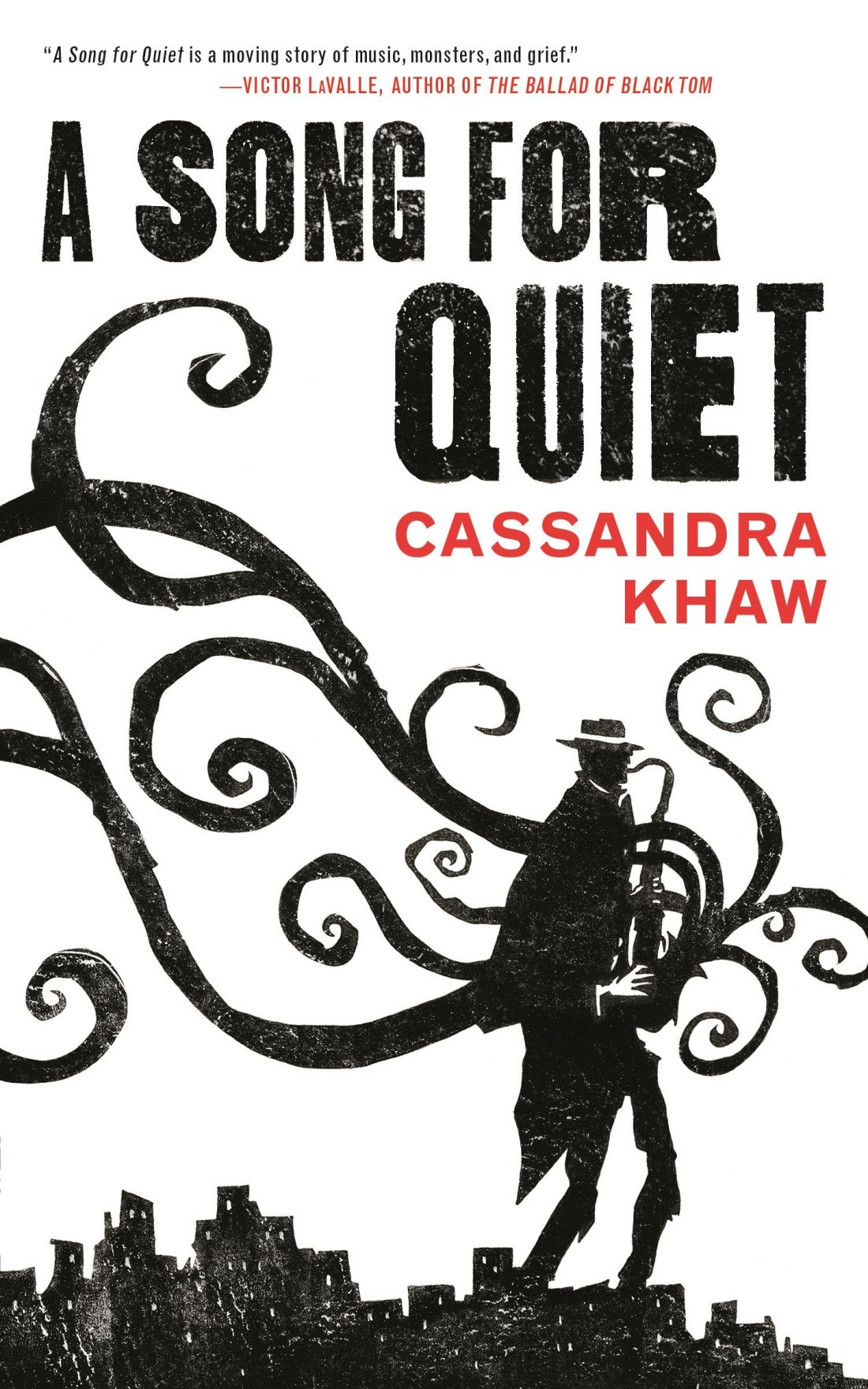
A Song for Quiet (2017) by Cassandra Khaw

Blues is about wanting and not having, about putting that need into someone else’s hands for a little while so you can pause and breathe.

Cassandra Khaw, A Song for Quiet 35

In Hammers on Bone (2016) by Cassandra Khaw, an eldritch abomination walks around in a human suit, playing hardboiled private detective John Persons, a monster who works against other monsters, working for its own inscrutable reasons against Lovecraftian incursions. A Song for Quiet is a standalone novella in the same setting, though a continent away and decades prior, with Persons relegated to an ambiguous supporting role as the narrative shifts to focus on rambling bluesman Deacon James.

Any more detail would give away the plot of the story, and it has little to spare.

In terms of theme and content, A Song for Quiet is a distant literary descendent of “The Music of Erich Zann,” the essential theme reworked and woven with considerable skill and imagination into a new context, a cousin to stories like “The Opera Singer” (2015) by Priya J. Sridhar and “While The Black Stars Burn” (2015) by Lucy A. Snyder—in part because music is the language and the medium by which the weirdness from Outside penetrates this reality, but because music doesn’t just happen. You need a figure on the threshold, like Erich Zann, who has the skills to play and faces the choice to do so. That places a very human conflict in the midst of what might otherwise be a very impersonal cosmic struggle. Ultimately, the musician on the threshold has to decide if to play.

Khaw’s choice to center the narrative on one such threshold-character, Deacon James, comes with advantages and drawbacks. The advantage is that Khaw is a skillful writer who really gets into James’ head, and the world seen through his eyes is a part of the world in stories like The Ballad of Black Tom (2016) by Victor LaValle, Lovecraft Country (2016) by Matt Ruff, and Ring Shout (2020) by P. Djèlí Clark—where Black people, even in a relatively unsegregated northern city like Arkham, have to step carefully, watch their words and actions, because any wrong step could mean violence and death. Jim Crow America was an ugly place with its very mundane horrors, without adding any Lovecraftian horrors to the mix.

The downside is, James knows nothing about the Lovecraftian aspect of the setting and doesn’t learn much of anything by the book’s end. Hammers on Bone worked so well in part because John Persons was an insider on the occult world of the Mythos, readers got their point of view and many things could be explained or accepted because of that. A Song for Quiet, seen mostly through the bluesman’s eyes, is like much in life a puzzle for which many pieces are missing and which will never be complete. John Persons in this book is one piece that doesn’t seem to fit (unless the reader has read Hammers on Bone at some point); he appears from nowhere, does things, explains almost nothing, and this is all perfectly in keeping with how the character might appear to James, but it’s as damnably frustrating as a poorly-played non-player character in a session of the Call of Cthulhu roleplaying game, enigmatic to a fault.

Another piece that doesn’t quite fit is Arkham itself. As a setting, Khaw does a tremendous job of expressing the unease a Black man might feel traveling to and being in a relatively unknown northern city; used to the more openly segregated South, Deacon James is only really at ease in Black spaces. Why it features in the story is another question entirely: Arkham is the backdrop, but it could almost as easily have been Boston, New York, or even London. While an American city makes sense, since blues music is an African-American creation, by the 1940s the geographic remit of blues music and players had gone global. There’s nothing special about Arkham in this regard—it is the place name to cement a Lovecraftian connection, but Deacon James isn’t playing to an audience of hip Miskatonic University students or anything like that. So the setting feels a bit superfluous; like a film that drops a few Lovecraftian place names but doesn’t really connect to Lovecraft’s stories about those places.

This isn’t a damning criticism: many stories have only peripheral connections to the wider Mythos, and that’s fine. The first and most important thing is whether or not the story is good, the amount of Mythos lore dropped is not a primary measure of story quality. The lament here is that it could have been better. Khaw’s take on Arkham through James’ POV is intriguing, it’s something that the novella could have used more of, and if that setting had tied more strongly into the plot it would have been smashing…or perhaps it would have turned a tightly written and fast-paced novella into a bloated short novel.

There is a lot to like about this story; Khaw’s prose is alternately poetic and grounded, using music metaphors to give shape and texture to things seen and unseen, and the characters are well-defined. As another episode of the Persona Non Grata series, it expands the world of Hammers on Bone without stepping on any toes, far enough away in time and space so that the two stories can work independently, but taken together suggesting a wider, more complex world. Thematically, the ending is a strong focus on the human conflict of the musician on the threshold, but the missing pieces of the puzzle leave a bit of tension, like a chord that refuses to resolve.

Cassandra Khaw’s A Song for Quite (2017) was published as part of Tor.com’s Lovecraftian novella series including Hammers on Bone (2016) by Cassandra Khaw, The Dream-Quest of Vellitt Boe (2016) by Kij Johnson, The Ballad of Black Tom (2016) by Victor LaValle, and Agents of Dreamland (2017) by Caitlín R. Kiernan.


Bobby Derie is the author of Weird Talers: Essays on Robert E. Howard and Others and Sex and the Cthulhu Mythos.

Deep Cuts in a Lovecraftian Vein uses Amazon Associate links. As an Amazon Associate I earn from qualifying purchases.
“The Old Ones Reborn” (2007) by Erin Donahoe

I. The Book

It all began because I was not afraid

and I told the bookseller so.

Horror tales never disturbed me

never elicited that much desired chill of terror.

Erin Donahoe, “The Old Ones Reborn” in H. P. Lovecraft’s Magazine of Horror Spring-Summer 2007, 36

There are no rules for the Mythos, but there are traditions. H. P. Lovecraft’s original works blazed a trail that many have tread, sometimes following in his footsteps, sometimes eschewing the increasingly well-beaten paths to branch off in their own directions. The route maps for these weird trails are written down in bibliographies, indices, and concordances…but there are too many. No one source can map them all, and even those dryly noted road markers can only point a reader in the right direction.

It is still up to individual readers to hunt down the sources if they want to follow some of these off-trails. There are little-tread and oft-overlooked byways, paths in danger of being forgotten and lost in the weeds. Works that never see reprinting, and aren’t likely to. Some day, the last copy of a magazine will fall apart, and some small part of the Mythos will be lost forever.

II. The Reading

I lifted the heavy tome

and placed it on the table before the window

moonlinght shining in upon the book’s dark surface.

Erin Donahoe, “The Old Ones Reborn” in H. P. Lovecraft’s Magazine of Horror Spring-Summer 2007. 37

The Internet Speculative Fiction Database entry for Erin Donahoe shows she was most active in the early 2000s; the page contains a link to the web archive of her long-defunct SFF.net profile, and links from there go to her long-defunct personal blog and a more extensive bibliography. Magazine publications, online publications, and involvements with various small publications. “The Old Ones Reborn,” published in 2007, is the latest work of hers listed. It may well have been her last work published.

More digging would probably find out more about Erin Donahoe, but the point is not to engage in digital stalking or necromancy, it is to illustrate a point: not all creators are in it for the long haul, not every literary or artistic path goes very far. For every writer, poet, artist, and fan-publisher who devotes their life to creation, there are many others whose careers cover only a handful of years when time and enthusiasm allow such efforts. Then other priorities shift to the fore: careers, relationships, kids and parents and pets to take care of, health issues, money issues, etc.

III. The Dream

My explanation at the time was

That it was some kind of hypnosis, that I was sleepwalking.

I only remember feeling that I had been submerged

in warm, nearly scalding water, but that,

in some manner, I was able

to breathe.

Erin Donahoe, “The Old Ones Reborn” in H. P. Lovecraft’s Magazine of Horror Spring-Summer 2007. 37

“The Old Ones Reborn” is a narrative poem in free verse, perhaps inspired by Lovecraft’s “Fungi from Yuggoth” sonnet cycle, and starting in a very similar manner—perhaps as homage—but Donahoe follows tradition only so far. She took it in a different direction, more stylistically similar to Caitlín R. Kiernan than Lovecraft or Derleth. More about the experience of being in that situation, that first encounter with the Mythos, the violation of that threshold, and what happened next.

Donahoe does not need to use the names Arkham, Dunwich, or Innsmouth to invoke something of them; does not need to name the Deep Ones, Cthulhu, or Yog-Sothoth to suggest their presence. The poem is more effective for its restraint; for suggesting connections instead of making them concrete. Making the reader draw their own conjectures, based on the paths they have walked.

IV. The Visions

The things I saw over the net several days,

and so many days since,

were terrifying in ways mre words

could never describe or explain;

but minding that inadequacy, I will attempt

to tell here of the most prominent of my visions.

Erin Donahoe, “The Old Ones Reborn” in H. P. Lovecraft’s Magazine of Horror Spring-Summer 2007. 38

“The Old Ones Reborn” was published in H. P. Lovecraft’s Magazine of Horror Spring-Summer 2007. It has not been reprinted, or collected. All the copies of it may well be contained in that print run, and when the grey, soft paper rots and molds…it may be lost. There are no ebooks, as yet, and may never be. Few libraries have copies. What efforts are being made to preserve it are collectors, and the people who sell to collectors. With luck, perhaps it will outlast living memory for a couple generations.

Other works are not so fortunate. Some are lost; others simply…obscure. Poems and stories that are not republished are generally not read, and that is another kind of death. Forgotten paths, some going nowhere, others leading into new dark places…and who is to say which is which? Should works like “The Fluff at the Threshold” (1996) by Simon Leo Barber or “Two Fungi From Yuggoth” (1977) by Alice Briley be lost forever to obscurity? It is always a thought, in retreading these rare paths, to think of what feet may yet follow, and what they will make of it.

V. The End (?)

[…]

I am not alone on this rocky pedestal;

the bookseller is here with me,

the gleam in his eye telling me

that while he may not be the father of the

burden in my womb

he certainly had the pleasure

of violating me.

Erin Donahoe, “The Old Ones Reborn” in H. P. Lovecraft’s Magazine of Horror Spring-Summer 2007. 39

Bobby Derie is the author of Weird Talers: Essays on Robert E. Howard and Others and Sex and the Cthulhu Mythos.

Deep Cuts in a Lovecraftian Vein uses Amazon Associate links. As an Amazon Associate I earn from qualifying purchases.
“The Day of the Stranger” (1947) by Novalyne Price Ellis

A couple of years after Bob’s death, I was standing on a street corner in Houston and I saw a man coming across the street that looked exactly like Bob. The incident stayed with me for several years. Finally, it wrote itself when I needed to hand in a radio script at LSU. I like the script, and it has briefly, some of the things we talked about almost as we talked them.

Novalyne Price Ellis to L. Sprague & Catherine Crook de Camp, 8 Jun 1978

Every biography ends the same way. A person dies, and whatever is left of them in this world is in the memories of those who knew them. A very few, however, take the next step. From memory to myth, from reality to fiction. Today, Robert E. Howard is as much a literary character as his creations and has appeared as versions of himself in stories (“Far Babylon” (1976) by L. Sprague de Camp, “Gilgamesh in the Outback” (1986) by Robert Silverberg), novels (Lovecraft’s Book (1985) by Richard Lupoff, Shadows Bend (2000) by David Barbour), comic books & graphic novels (The Adventures of Two-Gun Bob (2007) by Jim & Ruth Keegan), and even films (The Whole Wide World (2006), portrayed by Vincent D’Onofrio)—and that only begins to scratch the surface of Robert E. Howard’s many posthumous incarnations.

Though those characters shared Howard’s name, their characters differed. None of the writers knew Bob Howard; they had to work from letters and memoirs, biographies and anecdotes. Yet one of the earliest, if not the first, fictional character based on Robert E. Howard was drawn from the memory of one who knew him well: the eponymous stranger in Novalyne Price Ellis’ radio play “The Day of the Stranger.”

In 1947, my husband [William W. Ellis] and I were attending LSU, and my professor in radio assigned a script to be written and handed in for a semester’s grade. While I was trying to think what to write about, I remembered that incident (seeing Bob Howard get on the bus in Houston, when he’d been dead two years […]). I wrote it up as if it happened in New Orleans, got my grade, directed it for the school radio program, and sold it to a group producing amateur radio scripts.

It was copyrighted in 1949 by J. Weston Walch—Publisher of Portland, aine. I’m not sure he’s still publishing things. He published it in a book called Radio Player’s Scriptbook. It was for amateurs looking for scripts to produce. . . . The Stranger is Bob and it was as much of his regular talk as I could get it. The cry in Jeanne’s heart for a second chance was my cry. Jerry was Truett [Vinson]. The girls in the drug store were just necessary character to help put the story across.

THey changed my original title, which I thought was good. However, at that time, they were afraid that to say ‘New Orleans’ would be to give it a regional slant, and so they changed ‘New Orleans’ to ‘This.’ I’m sure they wouldn’t change it now, and I prefer the use of the city’s name.

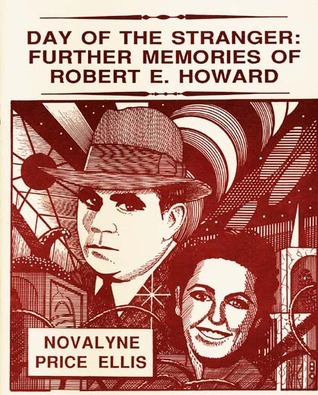
Novalyne Price Ellis to Rusty Burke, Day of the Strange: Further Memories of Robert E. Howard (1989), 31

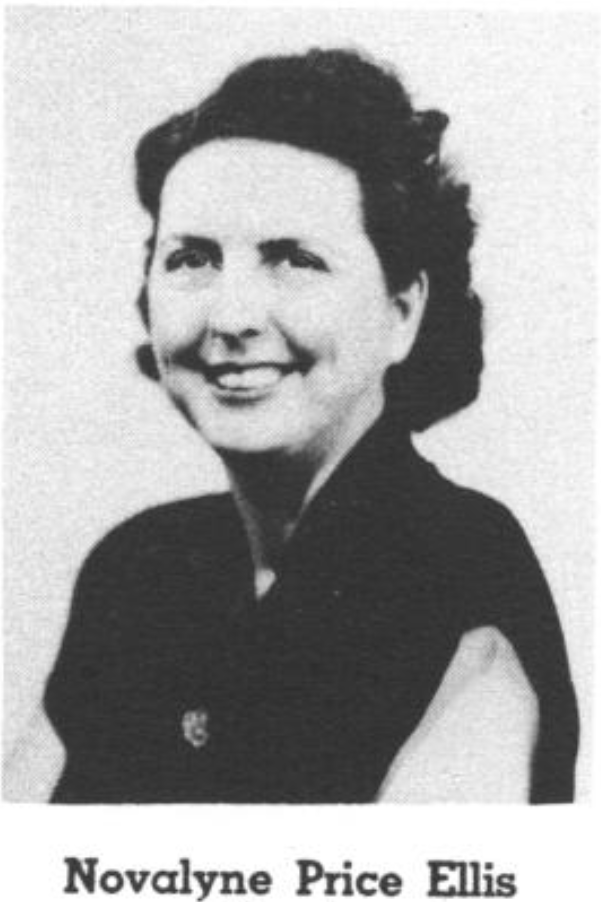
In 1936 when Robert E. Howard died, his sometime girlfriend Novalyne Price was attending school at Louisiana State University. She returned to Cross Plains to teach school, and for much of the next decade she continued teaching and attending courses in Texas and Louisiana. Novalyne had planned to write about Howard’s life, using her journals as material for the book—but life always got in the way. By the time of her marriage to William W. Ellis in 1947, Novalyne had extensive experience with drama, and even radio plays (“Daniel Baker College To Offer Enlarged Speech Program,” The Commanche Chief, 24 Aug 1945). “The Day of the Stranger” would be, in a sense, an early effort to capture some of the words and tone of Robert E. Howard’s character, decades before she could complete her book One Who Walked Alone (1986).

In an interview with Howard scholar Rusty Burke, she went into more detail about the play and the experience that inspired it:

BURKE: A lot of people who may read this interview may not know that there are other things you’ve written about Bob. In fact, a number [of] years ago you wrote a play in which Bob is a character, called “Day of the Stranger”. One of the things the stranger does is that, when he sees someone, he begins telling you what the person is like, what’s on his mind as he sits on the streetcar, and what he’s thinking about. Did Bob do that kind of thing?

ELLIS: All the time. That was his interest in people. Oh, ys. Fantastic stories. I remember very vividly one time, we passed a man—there was a very cold norther blowing—and we passed a man on a horse, riding along, and the man was all humped up over the saddle, trying to get away from the cold—you can imagine sitting ona saddle in a Texas norther—(shivers)—cold, yes—well, I don’t remember the story, but I remember that it was a fantastic story—pretty soon I knew everything that man thought. “Day of the Stranger” was the first thing that I had been able to write about him. I had to hand in a radio script, and all of a sudden it occurred to me. It came from an incident that had happened to me in Houston about two years after Bob’s death. It was a cold, rainy, drizzly day, and I had gone to Houston with some of my teacher friends. I was supposed to meet them somewhere, I’ve forgotten where, but it was in downtown Houston. It was time to go meet my friends. I was standing on the sidewalk waiting to cross a street, ready to step down off the crub. I looked up and there came Bob! Dressed in his brown suit with that tan hat—big man, heavy-set—and I couldn’t cross the street. There was Bob coming toward me! I’m sure, from the way people looked at me, that I made some kind of sound. But I backed up all the way across the sidewalk against a store window, and stood there until the man crossed the street. He stood on the edge of the sidewalk about 8 or 10 feet from me, and I still couldn’t get away from the fact that this was Bob. He turned around and looked at me, and I told myself I could see differences, but I couldn’t. That was Bob. He looked at me for a few minutes—I don’t know whether I was making a sound or not. Then he turned around, turned his back on me, and looked down the street. In just a moment his bus came down the street. Came down, stopped at the corner, and he got on the bus. I watched it. I watched as it went on, and I saw him take his money out and put it in the slot for the fare, and start toward the back of the bus. Then the bus moved on further. I watched it till it was out of sight. I stood there for a few minutes until I could get myself together. Then I went over and met my friends. That was a very vivid incident!

BURKE: That would certainly shock a person.

ELLIS: It shocked me! As I think about it now, I’m shocked by it, I can remember the strange feeling I had. TO see somebody coming across the street that you know has been dead about two years! When I got ready to write my play, I thought about that. I wrote “Day of the Stranger” in order to say some of the things I was still worried about—in order to get some of the old frustrations out of my mind. You say, “Now, in 1947 you were happily married and you had one beautiful child”—I just hadn’t gotten over the feeling of guilt. It’s a feeling that I think everybody who knows a friend or a family member who commits suicide feels. The feeling of guilt has this to do with it—you say, “If I hadn’t said thus-and-so, if i’d been more sympathetic, if I hadn’t sent that book back to Bob, if I’d gone by that morning, if I’d answered his letter”—all these things that you say. It doesn’t matter that maybe your reasoning mind can tell you “Oh, well, this would not have done it”—you still think it. I wrote that play to relieve my own heart. I used that play myself. It was produced a good many places, but after writing it, I felt better. After you were here earlier I read it again, while making the copy; I hadn’t written nearly as much about his Egyptian beliefs as I thought it had.

Day of the Strange: Further Memories of Robert E. Howard (1989), 19-20

At least by 1956, Novalyne had adapted the radio play into a script for a one-act play or dramatic reading suitable for high school dramatics:

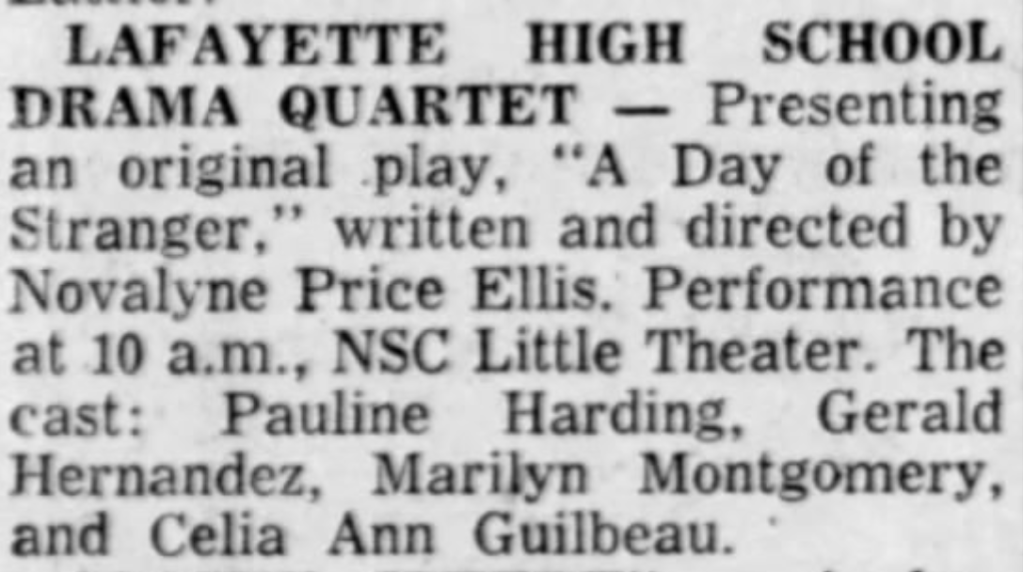
Lafayette High School’s Dramatics department has been experimenting with the “Readers’ Theatre” technique since the 1956-57 school year. That year they presented a drama quartet called “The Day of the Stranger,” a radio play written and adapted to the new medium by Novalyne Price Ellis. The quartet, composed of Celia Guilbeaux, Marilyn Montgomery, Gerald Hernandez, and Pauline Harding, performed for the Louisiana State University Workshop in drama and interpretation and at the Northwestern Theatre Festival at Natchitoches.

“Lafayette Drama Class To Present Five Readings,” The Daily Advertizer, Lafeyette, LA, 15 Nov 1966

At least one dramatic reading was directed by her husband William Ellis (The Daily Iberian, New Iberia, LA, 18 Nov 1957), and it it is likely there were several more, either carried out by the Ellises over the years or various amateur groups using the script in Walch’s book.

The script itself is very brief, for five characters with some bit parts and direction for music, appropriate for dramatic radio production. The crux of Novalyne’s eerie experience is retained, but the scene was shifted to a drug store on Canal Street in New Orleans. The character based on Novalyne was named Jeanne, the Robert E. Howard equivalent in the story was named Craig Blair…although it is only the Stranger who gives his voice.

MARY: Why, early this morning when there weren’t many customers in here, I was getting a chocolate malt ready for a fellow. I had my back to the bar. (SOMEWHAT DRAMATIC) Then all of a sudden a voice said: “Hey, my little bunch of onion tops, give me a cup of black coffee, the blacker and stronger the better.” (POINTED) WEll, you know who’d say it like that, don’t you?

JEANNE: (SUDDENLY ALARMED) No. No. I don’t.(t)

MARY: Well, honey, you could have knocked me over with your little finger because when I turned around…well, Craig Blair was sitting in that chair.

JEANNE: (EMOTIONAL) That’s not true. You know that’s not true.

Day of the Strange: Further Memories of Robert E. Howard (1989), 34

The real Robert E. Howard didn’t drink coffee, generally; but the line about “my little bunch of onion tops” could have come straight from his letters to Novalyne Price. Fact and fiction are thus mixed together in this scenario, but readers familiar with Novalyne’s later One Who Walked Alone or the film The Whole Wide World based on it can see many parallels between things the Stranger says in the play. For another example:

JEANNE: (WONDERINGLY) So you still think people live more than one life?(t)

STRANGER: (LAUGHS) Oh, well, I’ve always thought it was possible, if that’s what you mean. Who knows for sure? NOw, I didn’t go to school much—just to the eighth grade, but I’ve read a lot. The Egyptians used to believe you kept being born over and over until you got all your hopes and desires attended to. Pretty confusing thought, I think.

JEANNE: That’s a crazy thing to think, and you don’t really believe. You used… (CONFUSED) …that is… Craig Blair used to say the same thing, but he didn’t believe it. People talk and talk, and they never believe half of the things they say. I think—

Day of the Strange: Further Memories of Robert E. Howard (1989), 36

Robert E. Howard wrote many stories about reincarnation and past lives, from the James Allison tales like “The Valley of the Worm” and “The Garden of Fear” to the Conan the Reaver story “The People of the Dark.” How much he himself believed in reincarnation has always been and probably always shall be an open question. Novalyne Price Ellis would interpret such ideas through her own experiences.

ELLIS: TO me, what Bob said about that was just a fascinating idea. Just another fantastic story to weave. I was down in the dumps. So he says, “Now here I was in Brownwood. I met this man, and we disliked each other the minute we saw each other. Maybe way back yonder somewhere, maybe he stole my woman or the bear I’d killed for food”—which was the most important to him I don’t remember. How could anybody take him seriously? I mean, that was spur-of-the-moment.

Day of the Strange: Further Memories of Robert E. Howard (1989), 21

Whether or not the Stranger is the ghost or reincarnation of Robert E. Howard—or Craig Blair in the setting of the play—it is indubitably an effort to capture something of Howard’s character and mannerisms.

As a piece of drama, “The Day of the Stranger” has legs: the identity of the “stranger” is never revealed, and all of the conflict is in Jeanne’s head, the tumult of emotions as she is torn between the memory of a dead man and the more unimaginative man she’s dating now. Yet on another level, for those familiar with the outlines of Novalyne and Bob’s relationship, it reads as a kind of catharsis—a way for her to work out many of the lingering emotions she might have had, to put a sense of closure on a relationship which ended on an unresolved chord.


Bobby Derie is the author of Weird Talers: Essays on Robert E. Howard and Others and Sex and the Cthulhu Mythos.

Deep Cuts in a Lovecraftian Vein uses Amazon Associate links. As an Amazon Associate I earn from qualifying purchases.
“Last Rites for a Dead Druid” (1972) by Alvin Sapinsley

The 26th of January, 1972. Seventeen episodes into the second season of Rod Serling’s Night Gallery, the latest horror-anthology show from the acclaimed creator of The Twilight Zone (1959-1964). Already, this new Night Gallery series had proved a surprise for Lovecraft fans—while there was nothing Lovecraftian about “Miss Lovecraft Sent Me” in the first episode, viewers would be amused by the short burlesque “Professor Peabody’s Last Lecture” in episode 8, as well as serious adaptations of “Pickman’s Model” (episode 11) and “Cool Air” (episode 12). There were other adaptations from the Weird Tales too…Seabury Quinn’s “The Phantom Farmhouse,” a favorite of Lovecraft’s, was adapted in episode 5 and Manly Wade Wellman’s “The Devil Is Not Mocked” in episode 6, along with stories from August Derleth, Robert Bloch, Fritz Leiber, Margaret St. Clair, and others.

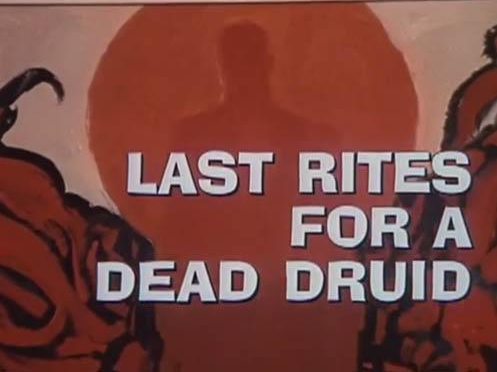
Yet if a viewer was tuning in on that particular January night, the eighteenth episode of the season, they would watch “The Waiting Room” and “Last Rites of a Dead Druid”—paired together because each episode featured one of the stars of the recently-canceled Beverly Hillbillies—and probably never guessed that in the latter they were warching yet another Lovecraft adaptation…albeit one so completely twisted by Hollywood as to be basically unidentifiable to Lovecraft fans. How it got that way is a bit of a story unto itself.

Scouring his shelves, [producer Jack] Laird was often guided in spirit by the hand of tireless anthologist August Derleth. His 1946 collection Who Knocks? produced “The Phantom Farmhouse” and “The Dear Departed,” and the original stories from which were adapted “The Painted Mirror,” “Death on a Barge,” and “Last Rites for a Dead Druid” came from a 1947 August Derleth anthology, The Sleeping and the Dead.

Scott Skelton & Jim Benson, Rod Serling’s Night Gallery An After-Hours Tour 92

No story “Last Rites for a Dead Druid” appeared by that title in The Sleeping and the Dead, but the book did include “Out of the Æons” (1935) by Hazel Heald & H. P. Lovecraft. Hazel Heald and August Derleth were both dead by 1971, so it isn’t clear who was paid for the rights to the story, but when it came time to adapt the story for television the producers of Night Gallery turned to a reliable name: Robert Bloch.

“LARSON/72: What screenplays have you done for NIGHT GALLERY?

BLOCH: I did two things; adaptations of “Logoda’s Heads (Derleth) and “Out of the Eons” (Heald). “Logoda’s Heads” was broadcast last season and apparently came over quite well, although I was unable to see it. “Out of the Eons” was broadcast under a new title (“Last Rites for a Dead Druid”), and with a new story which bears not the slightest resemblance to Hazel Heald’s—or mine; something about a Druid statue in Santa Monica!”

Randall D. Larson interviewing Robert Bloch, The Robert Bloch Companion 126-127

In discussing how he had adapted Derleth’s “Logoda’s Heads,” Bloch explained:

I tried to stick as closely as I possibly could to the original […] because I know very well from first-hand experience how authors resent having their material drastically changed.

Scott Skelton & Jim Benson, Rod Serling’s Night Gallery An After-Hours Tour 240

If Bloch tried the same thing with “Out of the Æons,” the resultant teleplay may well not have worked for the producers of Night Gallery. Budgets and shooting schedules were tight in the second season, with many episodes using borrowed sets from other productions and minimal special effects. The productions made do, or tried to, with good actors, excellent camerawork, and tightly-written scripts that packed the maximum tension into the allotted minutes…

…or played it all for laughs. One of the noted shortcomings of the second season of Night Gallery was Jack Laird’s efforts to inject humor into the dramatic series, most notably the short vignettes featuring classic monsters which he tended to place in between longer dramatic segments. In a post-The Munsters era, these efforts at levity were stale and trite, but there were more subtle and sardonic uses of humor in the series too. In “Professor Peabody’s Last Lecture” for example, the eponymous professor is lecturing on the Cthulhu Mythos—and the eager students are named August Derleth, Robert Bloch, and H. P. Lovecraft! Hazel Heald was supposed to appear too, but she was trimmed from the final cut.

In any event, Bloch’s script was given to Alvin Sapinsley, who had written for the show before. Sapinsley stripped out everything except the most basic idea of the story, and in his own words:

I tried to insert a little humor […] because, I must confess to you, there was not a great deal of humor in the people who ran the program—except Jack Laird, who can be a very funny man. […] It was called Out of the Eons. […] I forgot who wrote it, but my final version was so far removed from the original short story as to be unrecognizable. […] I used the statue I had at the bottom of my garden as a stepping-off point. […] In fact, the statue is still in my backyard.

Scott Skelton & Jim Benson, Rod Serling’s Night Gallery An After-Hours Tour 268, 269

There is a certain irony here: Hazel Heald’s original story, as submitted to Lovecraft, appeared to be about “the basic idea of a living brain discovered in an ancient mummy” (Dawnward Spire, Lonely Hill 603), from which Lovecraft expanded and wrote out his story of an antediluvian priest trapped in living death; Sapinsley, in adapting the story, did to Lovecraft what Lovecraft had done to Heald—and retained little more than Heald’s original idea in his rewriting. Sapinsley’s script was originally titled “Silent Partner,” but was eventually broadcast as “Last Rites for a Dead Druid”—and in that last ditching of subtlety, becomes almost the perfect example of how Hollywood can take a good story and turn it into something pretty much unrecognizable. If a reader didn’t know better, they might think it an adaptation of Seabury Quinn’s “The Stone Image” (1919)—about a wife who buys an ancient stone idol that torments her husband and moves at night—but given how obscure that story is, the parallels are probably coincidental.

“Last Rites for a Dead Druid” could stand as an archetype of the difficulties in tone that beset Night Gallery’s second season. It is a very Hollywood production: the dark druid is named Bruce the Black, like a four-color comic book character, and the scene has been shifted from Massachusetts in the 1930s to sunny suburban California in the 1970s, and in place of awesome antiquity the horrors being faced are marital infidelity and barbecuing cats. Horror and humor are so tightly intermingled that it’s obvious Sapinsley was writing very tongue-in-cheek.

Yet for all that, when considered on its own merits “Last Rites for a Dead Druid” isn’t bad television. While Sapinsley’s script has nothing on Heald & Lovecraft for cosmic horror, within the constraints of telling a slightly dark and twisted story in 22 minutes and 26 seconds under a tight budget, it is relatively effective. The most glaring fault—if fault it is—may be the ambiguity of character Mildred McVane (played by Donna Douglas), who appears at the beginning of the story to initiate the action, and is there at the ending in a Twilight Zone-esque twist. Sapinsley’s original title “Silent Partner” perhaps suggests that McVane was meant to be in league with the petrified druid…but the possibility is only raised, never made definite. Perhaps there was a key scene to this story that was excised at some point which would have tied up the loose ends.

For Lovecraftians, “Last Rites for a Dead Druid” represents a lost opportunity: what could have been another early Cthulhu Mythos adaptation becomes instead something of a footnote. In that sense, it greatly resembles The Shuttered Room (1966) by Julia Withers. One gets the impression that Hollywood simply didn’t know what to do with the Mythos at this period—for all that major films successfully incorporated bits and pieces of it, damn few Lovecraftian stories able to make it through the gauntlet of Hollywood producers and come out recognizable. Ironically, two of those were “Pickman’s Model” and “Cool Air” in Night Gallery…but not “Out of the Æons.”

As of this time of writing, episode 18 of Night Gallery is not legally available to stream, but the entire season is available on DVD.


Bobby Derie is the author of Weird Talers: Essays on Robert E. Howard and Others and Sex and the Cthulhu Mythos.

Deep Cuts in a Lovecraftian Vein uses Amazon Associate links. As an Amazon Associate I earn from qualifying purchases.
“Satan’s Servants” (1949) by Robert Bloch

As for young Bloch—give him plenty of time & leeway to fumble around & see what he really wants to do. He seems to want to do something, & there are many years ahead for him to develop in. His stories are of course imitative, overcoloured, & immature …. but what were most of the writers doing at 18?

H. P. Lovecraft to R. H. Barlow, [11? May 1935], O Fortunate Floridian 259

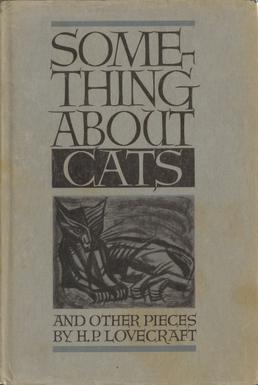
In 1949, Arkham House published Something About Cats and Other Pieces, an anthology that was the beginning of the scraping of what was then believed to be the bottom of the barrel of Lovecraftiana. Along with various essays, poems, and memoirs, the book also included several stories Lovecraft revised or ghostwrote, notably including “The Horror at Martin’s Beach” (1923) and “Four O’Clock” (1949) by Sonia H. Greene; “The Horror in the Burying-Ground” (1937) by Hazel Heald; “The Last Test” (1928) and “The Electric Executioner” (1930) by Adolphe de Castro, and almost as an afterthought, “Satan’s Servants” by Robert Bloch.

This was a decade before Bloch’s Psycho would be published; while a prolific pulp writer, he was not yet a household name, although his star was on the rise thanks to “Yours Truly, Jack the Ripper” (Weird Tales, July 1943), which was adapted for radio and broadcast nationally in 1944, and Arkham House had published his first hardcover collection The Opener of the Way in 1945. Bloch was in correspondence with Derleth, and Derleth was on the hunt for Lovecraftiana—including copies of Bloch’s letters from Lovecraft for the long-simmering Selected Letters project. Perhaps it was during that rummaging in the files that led Bloch to unearth something that was almost a Lovecraft collaboration—though not quite. As Bloch told the story:

Some while ago a statement appeared to the effect that there were “no more unpublished Lovecraft stories or collaborations.” While lamenting this pronouncement, I recalled that early in 1935 I had written and submitted a story entitled Satan’s Servants, which was rejected by Farnsworth Wright, then editor of Weird Tales on the grounds that the plot-structure was too flimsy for the extended length of the narrative.

At that time I was in constant correspondence with H. P. Lovecraft, and we frequently exchanged current manuscripts for suggestions and critical comment. Accordingly, I sent him my rejected sotry; and because the tale had a New England locale I made bold to ask if he would be interested in collaborating with me on a revision.

As the excerpts from his letter below will indicate, he refused a full-dress collaborative effort, but my manuscript came back copiously annotated and corrected, together with a lengthy and exhaustive list of suggestions for revision.

I placed the story in my files, fully intending to get at a new version when the time was right. Through the years the pages literally mouldered; I exhumed them from time to time when re-sorting material, moving, weeding out deadwood, and reviewing unpublished stories and outlines. Some years ago I utilized the name of the principal character, “Gideon Godfrey” when writing a tale in a modern setting. But Satan’s Servants gathered dust for fourteen long years until I fell to musing upon the sorry fact that there would be no more Lovecraft stories or stories inspired, revised, or partially-written.

Acting on impulse, I invaded the elephants’ graveyard at the bottom of my bureau and there, amidst a welter of outlines, novel fragments, radio scripts and assorted incunabula, I managed to disinter the yellowed pages of the original manuscript, with the marginalia in HPL’s familiar crabbed hand. I also unearthed Lovecraft’s lengthy letter in which he discussed the project of revision.

I determined to revise the tale forthwith, and spoke of my determination to August Derleth, Lovecraft’s biography, who suggested that I revise the story especially for the Arkham Sampler, and include a portion of the correspondence, plus some of the more pertinent critical commentary in the form of footnotes to the text of the tale. Excerpts from HPL’s letter accordingly follow, and the notes will be found at the conclusion of the story.

There is much to interest the student of Lovecraft’s work here; his comments mirror perfectly his own precise and erudite approach to his material. From the purely personal standpoint, I was often fascinated during the process of revision by the way in which certain interpolated sentences or phrases of Lovecraft’s seemed to dovetail with my own work–for in 1935 I was quite consciously a disciple of what has since come to be known as the “Lovecraft school” of weird fiction. I doubt greatly if even the self-professed “Lovecraft scholar” can pick out his actual verbal contributions to the finished tale; most of the passages which would be identified as “pure Lovecraft” are my work; all of the sentences and bridges he added are of an incidental nature and merely supplement the text. Certain major suggestions for plot-revision have been incorporated, but these in turn have been re-edited by a third party—myself, 1949 edition. For the Robert Bloch of 1935, as I painfully discovered during this revision process, is as dead as Howard Phillips Lovecraft is today. Peace to their mutual ashes!

Robert Bloch, Something About Cats 117-118

Versions of this anecdote were repeated by Bloch in interviews, his autobiography Once Around The Bloch, and a few other places; these various renditions are strongly consistent with one another, and what little evidence of the story there is in Lovecraft’s published Letters to Robert Bloch and Others corroborates the account. Bloch offers few additional details on “Satan’s Servants” and its creation—and why he let it molder for so long—but there are some pieces of information we can add to round out the story.

Bloch began submitting stories to Farnsworth Wright, editor of Weird Tales, in 1933 while still in high school. He didn’t receive an acceptance from Wright until after he graduated in June 1934, and his first publications were in fanzines like Marvel Tales, The Fantasy Fan, and Unusual Stories. When exactly “Satan’s Servants” was written and submitted isn’t exactly clear in the timeline of Bloch’s early fiction, but it may well have been one of his first attempts at novelette length (the finished product is ~11,500 words). Lovecraft’s first letter mentioning the story is believed to have been written in late February or early March of 1935, so the story may have been submitted to Weird Tales near the end of 1934.

The timing may be important: Bloch’s first professional publication was “The Feast in the Abbey” (Weird Tales Jan 1935), another story that deals with Satanism, and which perhaps borrows on or was inspired by Algernon Blackwood’s “Ancient Sorceries”—and in many respects, “Satan’s Servants” reads as though it might have been a more extended effort along this same theme, albeit transposed from the European setting to North America, and drawing a connection with the Salem Witch Trials. Too, it is important to note that this was just before Bloch’s proper “Lovecraftian phase” with stories like “The Suicide in the Study” (Weird Tales Jun 1935)—while Bloch was showing a bit of evidence of Lovecraft’s influence in his prose in terms of adjectivitis, there is no direct Mythos connection in the published version of the story, nor references to such in Lovecraft’s letters discussing the story, so it was probably not directly inspired by Lovecraft’s “The Dreams in the Witch-House” (Weird Tales Jul 1933) or any of his other references to a Salem diaspora as in “The Dunwich Horror,” The Case of Charles Dexter Ward, “The Festival,” etc.

Some reviewers, notably Evertt F. Bleiler in The Guide to Supernatural Fiction and Randall D. Larson in Robert Bloch Starmont Reader’s Guide 37, have drawn a connection between the Puritan protagonist Gideon Godfrey and Robert E. Howard’s Puritan adventurer Solomon Kane—and that is possible. In 1934, Bloch had publicly lambasted Howard’s Conan the Cimmerian in the pages of Weird Tales (see Fan Mail: Bloch vs. Conan), but Bloch’s denunciation of the barbarian did not extend to Kane. Certainly, Bloch took at least a little inspiration from Robert E. Howard at times, such as the reference to Set in “Mother of Serpents” (1936), and perhaps even in “The Black Lotus” (Unusual Stories Winter 1935). However, Bloch himself never drew this parallel, however, and the literal Bible-thumping Godfrey is far from the sword-wielding Solomon Kane.

When Bloch did finally resurrect this story from his files for August Derleth, he did so with extensive quotes from Lovecraft’s letter in reply to his collaboration suggestion. Since that time, the full contents of the letter have been published, including several bits that Bloch or Derleth mistranscribed or left out. Lovecraft’s fuller remarks on the story are as follows:

And now let me congratulate you most sincerely on the excellence of “Satan’s Servants”—which I read with keen pleasure & unflagging interest. Wright was an ass to reject it—for, as I have often pointed out, plot in the artificial sense has no place in a weird tale—which should be simply the reflection of a mood. I greatly appreciate the compliment of the intended dedication to me, & would have deemed it an honour to be mentioned in such a way.

Regarding the future treatment of the story—it certainly deserved touching up & further submission for publication. I have taken the liberty to add some marginal notes & made some changes which seemed necessary from an historical & geographical standpoint. Most of these explain themselves.

Roodford had to be outside the boundaries of teh Massachusetts Bay Colony, since the strict oversight prevailing within that rigid theocratic unit would never have suffered such a place to exist. Also–the location had to be shifted to some point on the coast where the settlement was not thick. Early New England was colonised with a rush, so that by 1690 the whole coastal region was dotted with thriving towns & almost continuous farmsteads. Two generations of settled life had removed every trace of the wilderness aspect, & (after King Phillip’s War in 1675-6) Indians were rarely seen. The only place in the coast where a village could exist relatively unknown, would be Maine—whose connexion with Mass. did not begin until 1663, & which was not an actual part of that province till July 1690. I have decided to locate Roodford between York & Wells if that is agreeable to you. Enclosed is a map of N.E. (which you can keep) shewing the new position. That any wilderness journey would have to start from Portsmouth & not Boston or Salem, will be obvious from an inspection of this chart. The narrative itself is splendidly vivid—my only criticism having to do with Gideon’s excessively quick discovery of the nature & horrors of Roodford. It would be much more powerful to have this revelation come with hideous gradualness, after days of hellish suspicion—as in Blackwood’s “Ancient Sorceries”. That is what I tried to do (though with a reduced time-scale) in “Innsmouth”. In going over the style, it would be well to be on guard against the tendency toward adjectival heaviness which besets both you & me. (In my present attempt I am pausing now & then to cut out bits of involuntary overcolouring which insist on creeping in—references to “monstrous & maddening arcana of daemoniac palaeogean horror” &c. &c.) Occasionally I have changed a word—either because of repetition or because of some doubtfulness in usage. If any such case seems unjustified, I’ll be glad to explain it—or the dictionary will shed light on most. Be very careful when representing archaic language—for the usual tendency is to overshoot the mark & make the diction too ancient. Study the spelling in actual specimens of 17th century printing. I’ve made a few changes in your principal sample—on page 1. Regarding Governor Phips—he was no witch-finder prior to 1692, but a voyager & soldier of fortune whose career makes interesting reading. Look up the long section devoted to him in Mather’s “Magnalia” (probably available at the public library), or read the interesting popular account in Hawthorne’s “Grandfather’s Chair”. At the end of the story I’ve brought up the point of whether you ought to have the action of the story take place before or after the 1692-3 Salem affair. Certainly, it ought to be afterward if you wish to convey the idea that this Roodford business ended witchcraft in New England. Byt the way—the leading wizard in the Salem trouble, Rev. George Burroughs, came from Wells, Maine, near the relocated site of Roodford. You could make something of that, perhaps, if you wished. Another thing—if you want Roodford farther removed from the outposts of civilisation—so that very little will be known about it—you could have it up some navigable river farther north in Maine. That would provide for a longer journey through the primal wilderness, & the dark charm of greater isolation. But it’s quite all right right as now relocated.

Now as to the idea of collaboration—this tale really tempts me more than any other I’ve seen lately, but I honestly don’t believe I could undertake any collaborative job at all at this time. Collaboration is for me the most difficult & exhausting of all work. It entails twice the labour of original writing, & tends to cut off original material which I would otherwise be producing. […] Under any circumstances collaboration is a harder task than original writing, & the only possible justification is that of wishing some idea to be properly developed which otherwise wouldn’t be. Now in the case of “Satan’s Servants”, I feel certain that you can develop the tale yourself just as well as I could—hence don’t feel guilty in suggesting that you try it. During recent months I have had to place a complete veto—sheer self-defense—on all collaboration projects. I have refused point-blank to do any more jobs for Mrs. Heald & old de Castro & others–& recently declined to collaborate with Price on a sequel to the “Gates of the Silver Key”. I simply can’t tackle so much when my time & nervous energy are so limited—& when so many stories of my own are veritably howling to be written.

But as I said before–in this case I feel sure that I’m not doing the tory any harm by staying out of it. It’s great stuff, & you can polish it up just as well as anybody else oculd. The descriptions of the Sabbat are splendid, & the climax is magnificent. The primary need is to make the traveller’s introduction to the horrors subtler & more gradual. One excellent story to follow as a guide is John Buchan’s novel “Witch Wood”—which you ought to be able to get at a library. I can lend you Blackwood’s “John Silence” (with “Ancient Sorceries”) if you like, but unfortunately I don’t own “Witch Wood.” If you want to introduce more events in the story, you could have Godfrey suspected by the evil folk before he unmasks. That episode of the stag could form a basis for such a development—Hell-Friar could come upon Gideon praying in the woods, or something like that. Or some lesser denizen (so as to save H. F. for the climax) could spy on Gideon, & be detected in so doing. Gid could shoot him (at a distance—across a river or something like that) & fail to find any body when he reaches the spot. There are all sorts of twists one could work in if necessary. But none of them is really needed. Just make the unveiling of the hellish conditions more gradual, & you’re all set! I surely hope the tale will achieve eventual placement–illustrations form your pen would make a mighty asset. Incidentally—I feel rather akin to Gideon, since I have an actual line of Godfrey ancestry. On Oct. 29, 1732, my ancestor Newman Perkins (b. 1711) was married to Mehitabel, daughter of John Godfrey of S. Kingston, R.I. We may well assume John to be Gid’s brother or nephew or cousin!

H. P. Lovecraft to Robert Bloch, [late Feb/early Mar 1935], Letters to Robert Bloch & Others 129-131

Some of these ideas Bloch clearly took to heart: the opening dedication to Lovecraft was replaced by a quote from Cotton Mather’s The Wonders of the Invisible World (1693). Readers might be surprised at Lovecraft’s caution against excessive color in the descriptions, but this is not that unusual—Lovecraft wrote something very similar when critiquing Henry Kuttner’s “The Salem Horror” the next year:

Another criticism I’d make is that the colour is laid on too thickly—strange things come too rapidly in succession, & with too great abruptness. In some cases there is not enough gradualness & emotional preparation. The best & most potent horror is the subtlest—what is vaguely hinted but never told. A certain kind of sensation of disquiet is usualy more effective than a scaly, tentacled monster—& in the greatest weird story ever written—Algernon Blackwood’s “The Willows”—virtually nothing visibly & openly happens.

H. P. Lovecraft to Henry Kuttner, 12 Mar 1936, Letters to C. L. Moore & Others 230

One has to wonder if Lovecraft recognized already that pasticheurs were distorting his style by accentuating the easily-imitatable bits while overlooking the underlying mood he intended to invoke in the reader.

In addition to these notes, Lovecraft had also sent back the annotated first draft and the map with Roodford marked on it; while the full extant of these notes is unclear, Bloch has given a bit of the flavor to them by including, as an appendix to the story, a set of 18 such notations. For example, the tale in Something About Cats opens:

It was quite evident that the inhabitants of Roodsford(1) did not come over in the Mayflower or any of her sister ships; that, indeed, they had not sailed from an English port at all.

Robert Bloch, Something About Cats 121

And the parallel footnote is:

(1) The original mss. Gives the name as Rood-ford. HPL suggests “Roodsford” saying, “The hyphenated place name would not have occurred in early New England.”

Something About Cats 146

Lovecraft’s letter clearly uses “Roodford” (no s), whether it was different in the annotation or if Bloch misread or mistranscribed those notes is impossible to say without the original—Bloch is otherwise very consistent in the name. Absent the original, the notes go to show the typical thought process which Lovecraft put into his own stories such as “The Shadow over Innsmouth,” with the great attention to detail and an eye toward historical accuracy, or at least as accurate as Lovecraft was aware of given his sources at the time. For example, another pair reads:

Again and again time was lost, till at length Gideon’s carefully arranged daylight travelling schedule seemed likely to prove of no avail. (7)

(7) The previous sentence was inserted by HPL with comment, “Travel was very slow in 1690.” And on the obverse side of the mss. Page, he lists four ferry passages by name, followed by such estimates as “On horseback—av. 5 MPH. With guides on foot—av. 3 MPH.Boston-Nemb.—40M. Newb.-Ports.—20 M. Ports-Roodf.—20 M. Tme from Ports to Roodf. Should be 8 or 9  h., allowing for rest, delays. Starting 6 AM, intending to arrive at 3 PM, delays adding 5 to 6 hours more—hence twilight or nocturnal advent would be correct.” This is an excellent example of HPL’s perfectionist approach to his own work.

Something About Cats 124 / 146

The question may well be asked at this point: to what degree does “Satan’s Servants” qualify as a revision or collaboration? Without the original version to compare, with or without Lovecraft’s annotations, it’s difficult to say with any exactitude how much Bloch took from Lovecraft. Certainly, Lovecraft gave notes to many young writers on their stories, some of which they accepted, but we would hardly claim that Fritz Leiber’s “Adepts Gambit” (1947) was a Lovecraft revision for all that he saw the first version and commented extensively on it, and some of those suggestions taken. Bloch himself was very careful to not call it full-on revision or collaboration, avoiding the kind of claim that August Derleth would make with stories like “The Murky Glass” (1957). Perhaps he had good reason to.

SCHWEITZER/75: Didn’t [Lovecraft] revise one of your stories?

BLOCH: That was a story called “Satan’s Servants” and he sent me a map locating my imaginary town of Roodsford, and he made several of these genealogical and historical references in the form of footnotes which I then incorporated into the sotry of referred to, but he did no actual rewriting of it whatsoever. I had written it, and Weird Tales wasn’t interested in it, so I put it away until August Derleth said, “Would you please let me print this?”

SCHWEITZER/75: Do you think that the fact that you did it yourself is the reason that of all the people Lovecraft did any revision for, you’re the only one who ever amounted to anything? For example, none of the heavy revision clients of his that you see in The Horror in the Museum ever sold anything by themselves or gained any reputation.

BLOCH: I think I was just lucky. I was fortunate to be able to break into print on my own, and there might be an element of learned the hard easy in the school of the Depression. You’ve got to do it on your own or else you have no inner security. If you have to rely on someone else, some exterior force, whether it’s a person or a talisman or a compulsive ritual that you have to indulge in before you can write, you’re really painting yourself into a corner. So I’ve tried to avoid those things.

Darrell Schweitzer, Interview with Robert Bloch, quoted in The Robert Bloch Companion 34

Although Bloch was probably ignorant of it, there was some rumination among the circle of Lovecraft’s former correspondents about how much Lovecraft had helped the young writer:

I cannot believe that Bloch had any outright jobs done for him by HPL, for the reason that Bloch is showing us all his letters from HPL, and they would reveal any such tinkerings. Bloch himself says he made changes on his first story—in which he killed HPL off—made suggestions on occasion, did no rewriting on any of his tales, says he never even saw The Manikin. Any proof of collaborations you have I shall be eager to examine; I know about Mrs. Heald’s work—she has forwarded a concise statement of his revisions for her.

August Derleth to R. H. Barlow, 5 Apr [n.d.; 1943?], MSS. Wisconsin Historical Society

You know about Heald. He rewrote Rimel until he was a new text, and I have a strong belief that he did Bloch. (Bloch is not necessarily sending you all letters, and anyway HP was very graceful about such things and might not make open statements. I’m indifferent to Bloch—not out to drag him down, but I think he gets unfair credit.) Belknap says that he is certain—on what grounds I don’t know—that HP wrote all of Bloch’s good stories.

R. H. Barlow to August Derleth, [n.d. 1943?], Wisconsin Historical Society

I’m sure that’s all wet about HPL writing Bloch’s earlier stories in toto. I saw some of the mss., and in spite of certain crudities and juvenilities, they had plenty of promise and did not need an unlimited amount of retouching. Bobby Barlow is full of prunes or tequila or something.

Clark Ashton Smith to August Derleth, 4 Jan 1944, Eccentric, Impractical Devils 344

Scuttlebutt and gossip. Ultimately, it is only of academic interest how much influence Lovecraft had on this particular story—Robert Bloch’s reputation does not rest on “Satan’s Servants,” nor did it ever. It would be of interest to unearth the original annotated manuscript, if it still exists—or perhaps that map that Lovecraft sent to Bloch still exists among his papers—but at the end of the day, taking the story on its own merits, the Lovecraftian connections are probably the most interesting thing about it.

Which may explain, in part, it’s rather limited publication history. After appearing in Something About Cats (1949), the story was reprinted in The Magazine of Horror #30 (Dec 1969) and Revelations from Yuggoth #2 (May 1988)…and that is it for English publications, although various non-English translations exist. “Satan’s Servants” never appeared in any collection of Bloch’s Mythos fiction, or in any ofhis collections of his early fiction. A letter preceeding the 1988 publication may explain things:

Dear Mr Ford:

Thanks for yours of the 13th—but it’s not proving to be a lucky number! I’ve already promised use of SATAN’S SERVANTS to someone else, and it will be appearing soon, I believe. Of course certain changes in the text—i.e. elimination of HPL’s comments—will be made, since Arkham House claims ownership of his literary estate and the original SOMETHING ABOUT CATS is copyrighted by Derleth, which further complicates matters. Sorry the timing of your request dodn’t work out—that all goes well with you!

Robert Bloch

Robert Bloch to Carl Ford, 28 Aug 1987, H. P. Lovecraft and His Legacy

If Derleth’s heirs were being tightfisted about the quotes from Lovecraft’s letters, that might account for the relative scarcity of “Satan’s Servants” in English.

“Satan’s Servants” is not some lost Lovecraftian masterpiece; it is a rather prosaic, even old-fashioned, tale of good-vs.-evil in a decidedly Christian mold. There is a bit of irony that a Jewish teenager might so successfully ape the tropes of the Christian fantasy story, but Bloch had attended the Methodist Church and was anyway quite familiar with the slant of Weird Tales, where it was not counted a sin to fight vampires with crucifixes and holy water, but which was notably short on dybbuks, golems, and other aspects of Jewish religion and folklore. It is, ultimately, a fairly minor early Bloch story, not one of his best and certainly not some of his worst writing for the period, and notable almost exclusively for the Lovecraft connection. For Bloch-heads and Lovecraftian completists, it is worth tracking down.


Bobby Derie is the author of Weird Talers: Essays on Robert E. Howard and Others and Sex and the Cthulhu Mythos.

Deep Cuts in a Lovecraftian Vein uses Amazon Associate links. As an Amazon Associate I earn from qualifying purchases.