Lovecraft y Negrito (2023) by Dolores Alcatena

Racist Language
This review concerns H. P. Lovecraft’s cat, whose name was a racial slur against Black people.
As part of this review, the cat’s name and variations are included. Reader discretion advised.


The first known reference to H. P. Lovecraft’s cat was in a letter from his grandfather when Lovecraft was only 5 years old:

You and Dumplin Mama must keep the Barn shut every night and take care of Nig.
—Whipple Van Buren Phillips to H. P. Lovecraft, 17 Oct 1895, Letters to Family & Family Friends 2.1046

“Nig” was short for “Niggerman.” It was a black cat, at a time when the N-word was relatively common for pets with black coats. Whether it was Lovecraft who named the kitten, or a family member or friend, is not recorded in any of Lovecraft’s letters. It was his childhood pet—and, as it happened, the only pet he could afford during his life, although he retained a great fondness for cats throughout his life, often petting or playing with strays. In 1904, Whipple Van Buren Phillips died. Lovecraft’s family home was sold, he and his mother moved away from his childhood home, and the cat disappeared during the tumult, never seen again.

Lovecraft remembered his feline companion in later years, and based two cats in his stories on his lost pet: Niggerman in “The Rats in the Walls,” and Nig in The Case of Charles Dexter Ward. Neither appearance caused any particular outcry at the time of publication; Weird Tales was no stranger to the N-word and other terms, and it was not until “The Rats in the Walls” (1956) that any serious effort was made to censor or bowdlerize the cat’s name. Works in translation and adaptation were more likely to change the name; different languages, with different histories regarding race relations and Black slavery, have their own nuances of language to give shades of meaning or seek to avoid giving offense.

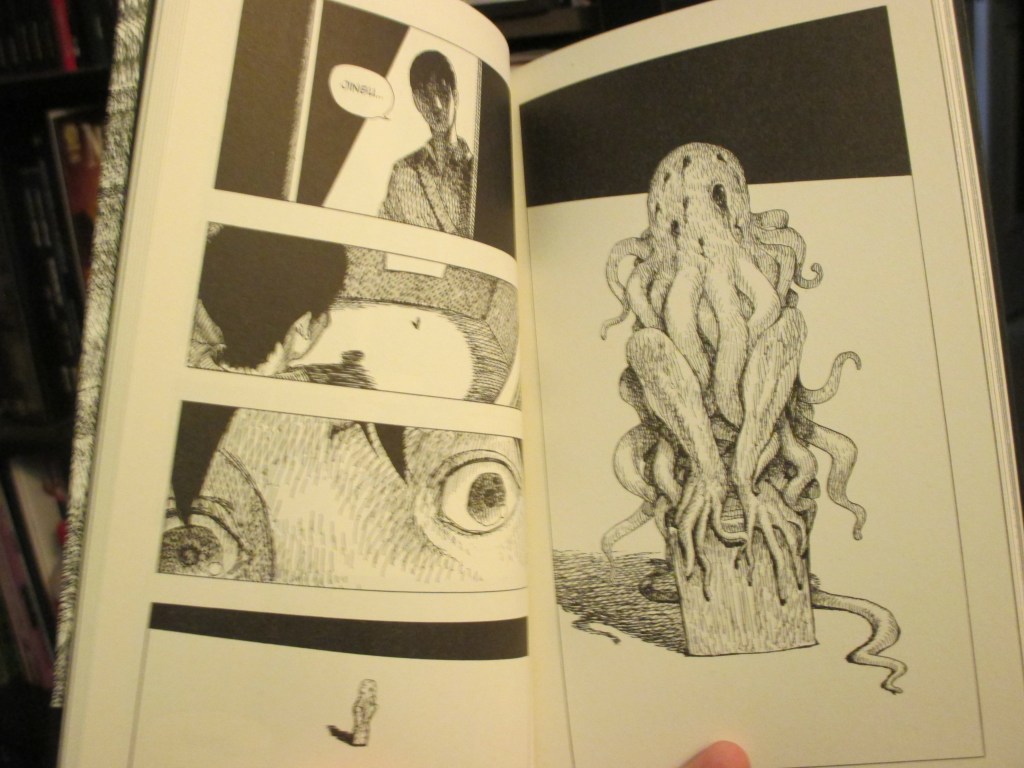
In 2023, Argentinian illustrator and writer Dolores’ Alcatena published Lovecraft y Negrito, a short graphic novel about Lovecraft’s friendship with his beloved pet. As she puts it in the opening:

Como amante de los gatos, Howard Philips Lovecraft frecuentemente incluía en sus relatos a estos elegantes y misteriosos animalitos. En su estilo deliberadamente desamorado y serio, los describía como símbolos de perfección, estética, libertad e independencia. Pero entre las cartas del escritor aparece Niggerman, un gatito negro que acompañaba a Lovecraft en su niñez. Al hablar de Niggerman (rebautizado ‘Negrito” para esta obra) las palabras del autor asumían un tono cálido, recordando con ternura cómo jugaban juntos en el jardín. Al hablar del gatito, el escritor no pudo, o no quiso, esconder sus sentimientos. El cariño que Lovecraft mantuvo a lo largo de su vida por Niggerman inspiró esta historia, permitiéndonos acceder a un costado más humano del gran autor del horror.As a cat lover, Howard Philips Lovecraft often included these elegant and mysterious animals in his stories. In his deliberately dispassionate and serious style, he described them as symbols of perfection, aesthetics, freedom, and independence. But among the writer’s letters appears Niggerman, a black kitten who accompanied Lovecraft in his boyhood. When talking about Niggerman (renamed “Negrito” for this work), the author’s words took on a warm tone, fondly recalling how they played together in the garden. When talking about the kitten, the writer could not, or did not want to, hide his feelings. Lovecraft’s lifelong affection for Niggerman inspired this story, allowing us to glimpse a more human side of the great horror author.
Dolores Alcatena, Lovecraft y Negrito (2023)English translation

“Negro” in Spanish is the color black, “-ito” is a diminutive suffix; context is important because in some usages “negrito” can mean bold type, or it can be a reference to certain Southeast Asian peoples, or a not-necessarily-kind reference to small Black children. In the context of this story, it might be best to think of it as a term of affection, like naming a black kitten “Blackie.”

Su gato, Negrito, lo acompaña.

Y, como siempre, lo cuida.
His cat, Negrito, accompanies him.

And, as always, takes care of him.
Dolores Alcatena, Lovecraft y Negrito (2023)English translation

The story is told in black and white, mostly from Negrito’s perspective. The cat aids and protects Howard through his journeys, including the events that would inspire “The Cats of Ulthar” and “The Shadow over Innsmouth.” From a cat’s perspective, the cat-killing couple in Ulthar are particularly horrific.

“Ningún hombre debería matar a un gato”
Pensó el niño mientras recordaba a Negrito ronroneando frente al fuego.
“No man should kill a cat,” the boy thought as he remembered Negrito purring in front of the fire.
Dolores Alcatena, Lovecraft y Negrito (2023)English translation

There is a somewhat fairy-tale quality to the retelling, the traipse through Lovecraft’s fiction. Most of Howard’s waking life we don’t see…but then his cat was not there to see that.

Qué suerte que Negrito siempre había estado en esos momentos.How lucky that Negrito had always been there in those moments.
Dolores Alcatena, Lovecraft y Negrito (2023)English translation

The Lovecraft of these stories is a scared, almost a traumatized kid, with Negrito as his only friend; parental figures are absent. It is a very sympathetic view of Howard as a child, but in comparison to El Joven Lovecraft by José Oliver & Bartolo Torres it does not show Lovecraft’s occasional joyfully morbid side. Readers are meant to empathize with a young Lovecraft.

The ending, a wordless reunion between the dead Lovecraft and his lost cat, is the kind of afterlife that every cat-lover might wish to experience themselves someday.

Es un tributo muy distintivo ser elegido como amigo y confidente de un gato.
H. P. Lovecraft.
It is a very distinctive tribute to be chosen as a friend and confidant of a cat.
H. P. Lovecraft.
 It is no compliment to be the stupidly idolised master of a dog whose instinct it is to idolise, but it is a very distinct tribute to be chosen as the friend and confidant of a philosophic cat who is wholly his own master and could easily choose another companion if he found such an one more agreeable and interesting.
Dolores Alcatena, Lovecraft y Negrito (2023)English translationH. P. Lovecraft, “Cats and Dogs”

Lovecraft y Negrito is a story about a boy and his cat. It is not a historical work that delves into the nuances of the cultural forces that went into such names, or how naming cats did or did not reflect Lovecraft’s racial prejudices in later life. If readers want a scholarly exploration of what we do and don’t know about the real animal, check out Ken Faig’s essay “Lovecraft’s Boyhood Cat” in Lovecraft Annual #19 (2025). If you want a heartwarming fantasy about Lovecraft and his beloved pet, which has gained a kind of literary immortality, then read Lovecraft y Negrito.


Bobby Derie is the author of Weird Talers: Essays on Robert E. Howard and Others and Sex and the Cthulhu Mythos.

Deep Cuts in a Lovecraftian Vein uses Amazon Associate links. As an Amazon Associate I earn from qualifying purchases.
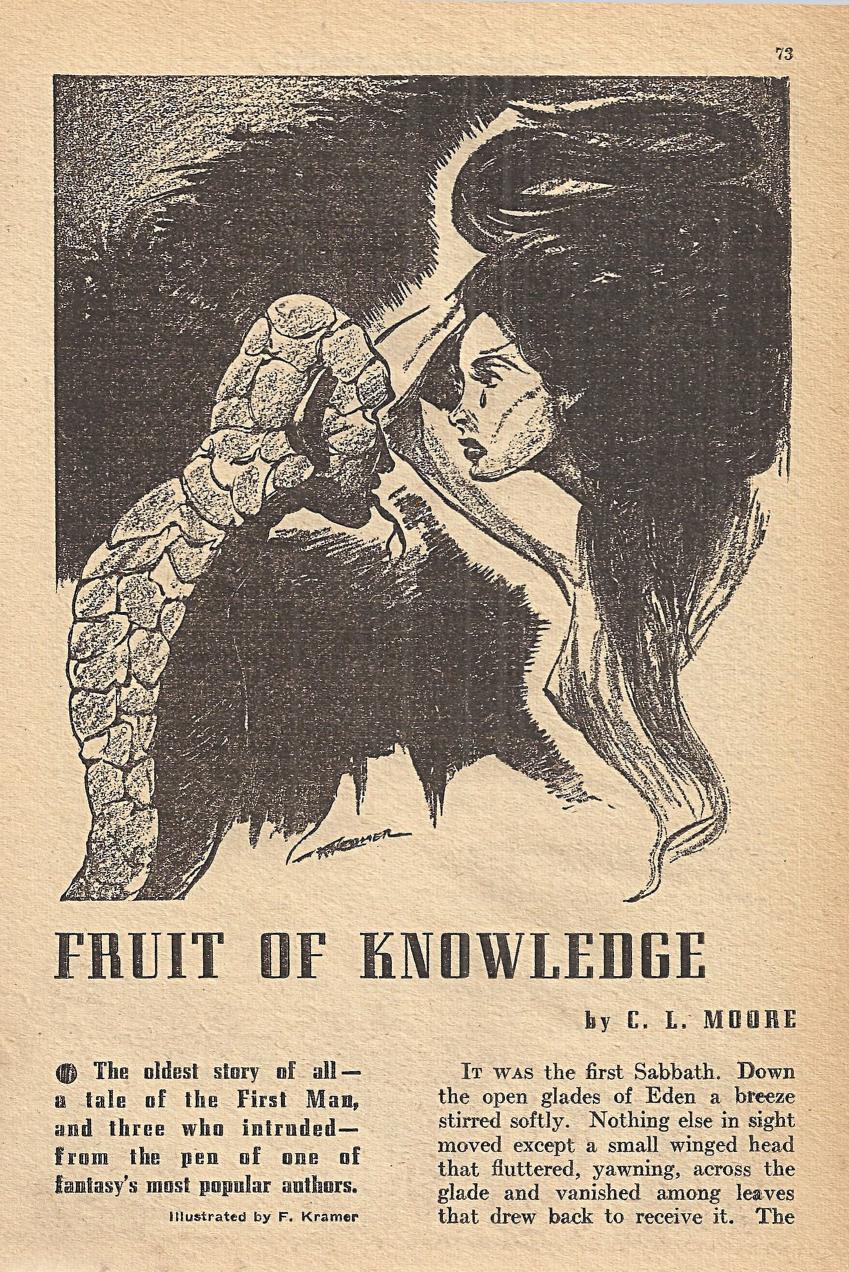
“Tryst in Time” (1936) by C. L. Moore

This is an odd reference in one of C. L. Moore’s letters, about a story never published:

Well, have just received my first flat rejection from Wright. A harmless little fable about a sorcerer king of antediluvian times, his mysterious witch-queen and a time-traveler with a startling resemblance to a certain Mr. Smith whom I may have mentioned once or twice before, tho no names were named in the story. Ah, well, life is full of disappointments.
—C. L. Moore to R. H. Barlow, 31 May 1935

We get no more than that—though Northwest Smith would eventually star in a time-travel story, “Quest of the Star-Stone” (Weird Tales Nov 1937), written with Henry Kuttner. However, before she collaborated with Kuttner, Moore published another time-travel story, one which features a very Northwest Smith-like protagonist: Eric Rosner, hard-bitten adventurer and world-traveler:

ERIC ROSNER at twenty had worked his way round the world on cattle boats, killed his first man in a street brawl in Shanghai, escaped a firing squad by a hairbreadth, stowed away on a pole-bound exploring ship.

At twenty-five he had lost himself in Siberian wilderness, led a troup of Tatar bandits, commanded a Chinese regiment, fought in a hundred battles, impartially on either side.

At thirty there was not a continent nor a capital that had not known him, not a jungle nor a desert nor a mountain range that had not left scars upon his great Viking body. Tiger claws and the Russian knout, Chinese bullets and the knives of savage black warriors in African forests had written their tales of a full and perilous life upon him. At thirty he looked backward upon such a gorgeous, brawling, color-splashed career as few men of sixty can boast. But at thirty he was not content.
—C. L. Moore, “Tryst in Time” (Astounding Dec 1936)

Did Moore take that rejected story and resubmit it for Astounding? Or did she just take the idea of the story and re-write it for the science fiction magazine (whose editor and fans were not fond of sorcerers and witch-queens)? There is a certain similarity between this tale and Moore’s previous work in Astounding, “The Bright Illusion” (1934) and “Greater Glories” (1935), a romanticism of a male protagonist finding or recognizing love under unusual and somewhat cosmically tragic circumstances. It wouldn’t be surprising if Moore had married the idea of a rejected tale to the general outline of what had sold successfully in the past.

The temporal physics behind the tale are no better or worse than that of many time travel stories, and if Moore isn’t necessarily erudite in physics, she is well-read in basic time travel literature, having no doubt read a great many stories in the pulps or elsewhere. When she writes, for example, of the idea of how moving through the fourth dimension (time) means the other three dimensions go along without you:

“Yeah, and find yourself floating in space when you let go.” Eric grinned. “Even I’ve heard that the universe is in motion through space. I don’t know about time, but I’m pretty sure space would block your little scheme.”
—C. L. Moore, “Tryst in Time” (Astounding Dec 1936)

Clark Ashton Smith had addressed just this problem in “The Letter from Mohaun Los” (Wonder Stories Aug 1932); Smith’s solution was that if you waited long enough, another planet would pass by the point in space you occupied and you’d have your adventure that way. She also addresses the idea of changing the past:

There must be many possible futures. The one we enter upon is not the only way. Have you ever heard that theory explained? It’s not a new one—the idea that at every point of our progress we confront crossroads, with a free choice as to which we take. And a different future lies down each.
—C. L. Moore, “Tryst in Time” (Astounding Dec 1936)

Murray Leister’s “Sideways in Time” (Astounding Jun 1934) had played with the idea of parallel timelines and alternate futures, so Moore wasn’t the first to address the idea, but the fact that she did further shows familiarity with the mechanics of time travel in fiction.

Moore squirms around that by letting Rosner stay on terra firma, even as the ages pass around him, skipping through time like a rock on a pond. The result is reminiscent of the Futurama episode “The Late Phillip J. Fry,” (or, if you prefer, the cyclical rise and fall of civilizations a la Olaf Stapledon’s classic Last and First Men (1930)), with Rosner zipping through future (and past) ages, from advanced civilizations to barbarisms and back again. At least one scene may involve a tongue-in-cheek poke at a certain Providence gentleman she corresponded with, who had a tendency to use the word “Cyclopean”:

Even at this distance he recognized those darker blotches upon the tremendous walls as the sign of a coming dissolution. It was a city more awfully impressive than any he had ever dreamed of, standing gigantic under the low, gray sky of this swamplike world—but its glory was past. Here and there gaps in the colossal walls spoke of fallen blocks and ruined buildings. By the thick, primordial air and the swamp smell and the unrecognizable architecture he knew that he gazed upon a scene of immortal antiquity, and his breath came quicker as he stared, wondering where the people were whose Cyclopean city this was. what name they bore and if history had ever recorded it.
—C. L. Moore, “Tryst in Time” (Astounding Dec 1936)

For the most part, however, this is a piecemeal narrative, a succession of brief, fragmentary scenes and images punctuated by a character that reappears, again and again—a woman, Maia, who is always separated from Eric Rosner by something. Until the end. Without ever using terms like “reincarnation” or “soul mate,” there is a distinct and heavy hint that these two were meant to be together, and that they will be—eventually.

While the story isn’t bad, it also apparently involved some editorial interference and a couple of cuts, which she complained about to her friend in Providence:

Which bring us to the memory of your distress over the butchery of your two tales in that magazine. I ahd somewhat miraculously escaped much injury in my experiences with them up to the publication of my last story, “Tryst in Time” which was so mangled and dismembered that I could scarcely bear to look upon the bleeding remnants. Typographical errors ranged from the careless to the ludicrous—I remember a brook ‘tickling’ through a meadow, for one. And with the most uncanny precision they eliminated and ruined the only two parts of the story for which I felt real affection. My paragraph referring to the mysterious urge which drives races upon migration was left out entirely. I had mentioned the great prehistoric hegiras of our remote fathers across vast areas of Europe, perhaps over the land-bridge into America, the recent fever to “Go West” that burned in our immediate ancestors, and hinting wisely that mayhap the fever which my hero felt to travel in time might be the beginning of a new race-migration somewhere. It didn’t mean anything much, but it was kinda fun and I bitterly resented its omission. And in the last of the story a sentence whose “well-greased perfection”, to quote yourself, gave me a great joy was utterly butchered. I had it, “Wherver you adventured the knowledge of my presence tormented  you, and through all my lives I waited for you in vain.” Perhaps it verges on blank verse in its extreme unctuousness, but who are they to cut it in their vandalism to—“Wherever you adventured the knowledge of my presence tormented you—and I waited in vain!”??? If they don’t like the way I write why don’t they go back where they came from? I am burning up.
—C. L. Moore to H. P. Lovecraft, 24 Oct 1936, Letters to C. L. Moore 195

“Race-migration” was a popular historical concept during the 1930s, and makes its appearance in stories like Robert E. Howard’s “The Children of the Night” (Weird Tales Apr/May 1931). The reference to time travel as a form of race-migration might be a nudge-wink-nudge reference to Lovecraft’s “The Shadow Out of Time” (Astounding Jun 1936). The cuts might have been for space, or because the editor disagreed with the ideas expressed—there are many possibilities, but no firm answers. Pulp editors could be merciless and incomprehensible.

There isn’t much feedback on this story; Lovecraft apparently never read it, or at least doesn’t mention it in surviving letters. Fans, however appreciated it, with one fan letter noting:

I was glad to see Miss Moore has begun to write ‘science-fiction. Everything else I have read by her was purely weird. Her story seemed real and plausible, in spite of the unusual plot.
—Richard Creecy, Astounding Feb 1937

Which shows how Moore’s reputation was developing.

“Tryst in Time” was published in the December 1936 issue of Astounding Stories. Scans of this issue are available on the Internet Archive.


Bobby Derie is the author of Weird Talers: Essays on Robert E. Howard and Others and Sex and the Cthulhu Mythos.

Deep Cuts in a Lovecraftian Vein uses Amazon Associate links. As an Amazon Associate I earn from qualifying purchases.
The Colour Out of Space (2024) by H. P. Lovecraft & Sara Barkat

It was just a colour out of space—a frightful messenger from unformed realms of infinity beyond all Nature as we know it; from realms whose mere existence stuns the brain and numbs us with the black extra-cosmic gulfs it throws open before our frenzied eyes.
—H. P. Lovecraft, “The Colour Out of Space”

Comic and graphic novel adaptations of prose and verse literary works have always held a fascination. Because while you might declare one text as canonical, as a true text, immutable and eternal, the graphic adaptations of that text will always be different, unique to their vision and skill and ability to realize that text in illustrated form. Every artist has to pick and choose what images to convey and how to convey them, how to frame the story and the text, what to leave in and out, what to emphasize and how to do it. Give three artists the same story to draw, and you have three variations on the same story.

This sometimes arouses—at least among some readers and critics—the urge to compare different variations on the same works to each other. Because it can be fascinating to see the divergence and the commonalities, to look at all the different flowers that may blossom from identical seeds. Not necessarily to point out any one graphic adaptation of Lovecraft as better than the others, but to enjoy the diversity of views and skills.

When it comes to “The Colour Out of Space” in particular, however, there’s a fundamental question that every artist has to struggle with: how do you depict a color that is outside the visible spectrum?

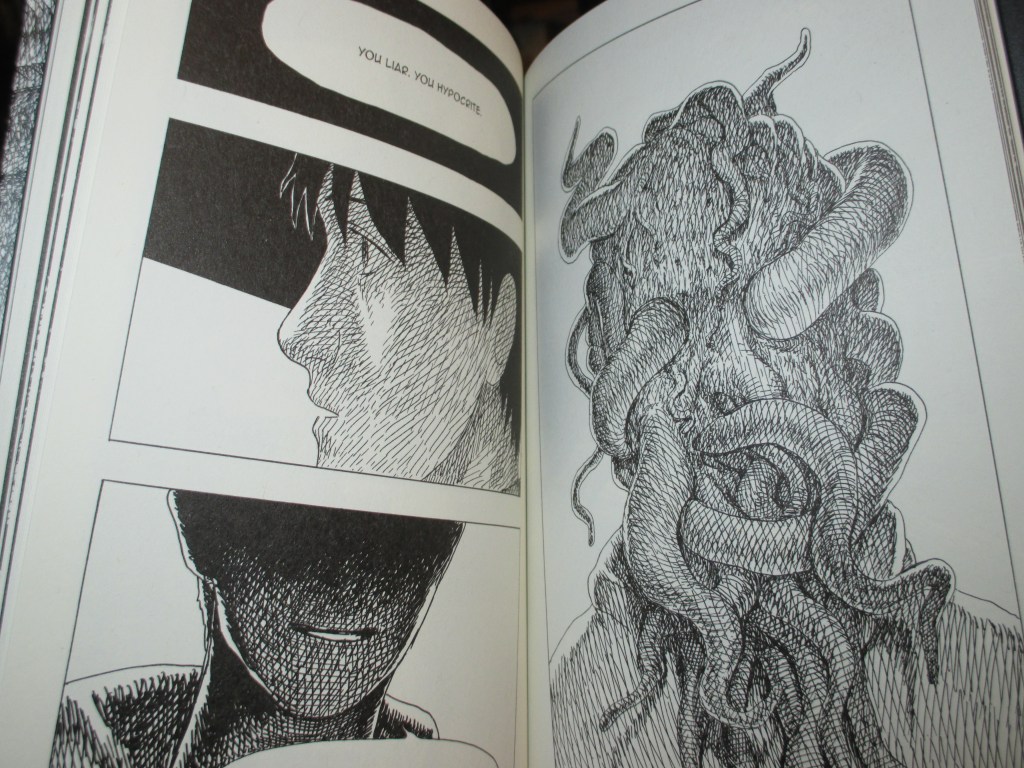
Strictly speaking, outside of a technical trick like polarized lenses, you cannot. What usually happens instead is that the artist has to use visual rhetoric to convey the sense of the unknown color, even while using the colors that are available for printing. In the case of Sara Barkat’s The Colour Out of Space (2024) this is mostly accomplished by having the majority of the art in black-and-white.

However, instead of having the colored portions represent just the color itself, the color is used to illustrate those people and objects that the color has infected. So the addition is not just a single splash of magenta or red in a monochrome world, it is a spectrum of colors in a landscape, or a room, or a person.

Barkat’s style isn’t a demonstration of technical excellence in the same sense of Gou Tanabe’s The Colour Out of Space (2025), nor does it have the minimalist book-as-object approach of Amy Borezo’s The Colour Out of Space (2016). What she has is a loose, sketchy but heavily detailed pencil that captures a certain underground aesthetic, the rawness of the art adding a certain texture to the text, especially with the use of mixed media (primarily watercolors) to add color. As with Alberto Breccia’s Cthulhu Mythos adaptations, the result is a more profound experience than either the art or the text would accomplish on their own.

Which is ultimately what a lot of people are looking for in any graphic adaptation. Not a simplification of a text, or the addition of some pretty pictures to look at, but a new way of experiencing the story.

The Colour Out of Space (2024) by H. P. Lovecraft and Sara Barkat was published by T. S. Poetry Press. Barkat’s other works include a graphic adaptation of The Yellow Wallpaper (2020) by Charlotte Perkins Gilman and Drawing Dracula Daily (2023).


Bobby Derie is the author of Weird Talers: Essays on Robert E. Howard and Others and Sex and the Cthulhu Mythos.

Deep Cuts in a Lovecraftian Vein uses Amazon Associate links. As an Amazon Associate I earn from qualifying purchases.
“Tree of Life” (1936) by C. L. Moore

C. L. Moore is an extremely gifted young woman of 25—a fact as well as fiction writer. Her stories are rivaled (now that Bob Howard is dead) only by Klarkash-Ton’s, & contain a highly unique element of convincing unreality—which could be still better but for a certain stereotyped romanticism & occasional concession to the pulp ideal.
—H. P. Lovecraft to Virgil Finlay, [25 Sep 1936], Letters to Hyman Bradofsky & Others 447

“Tree of Life,” published in the October 1936 issue of Weird Tales, isn’t technically the last of the Northwest Smith stories. Yet for many readers, it would have been seen as practically the last. Smith would not appear in print again until “Quest of the Starstone” (WT Nov 1937), a full year later, and the final brief coda “Song in a Minor Key” would only see print in a fanzine in 1940. So too, Moore’s star at Weird Tales was waning. This would be her 13th story published at Weird Tales in just three years, but in the next four years she would publish only three more stories in the magazine.

What changed? The death of Moore’s fiancé in early 1936, her ongoing need to provide for her family with her real job, Weird Tales‘ slow payments and her shift to other pulp markets likely all had their part to play. Yet that was in the future. For now, readers could enjoy this tale and imagine the many other adventures of Northwest Smith that the future might hold for them.

It was an unusually elaborate well, and amazingly well preserved. Its rim had been inlaid with a mosaic pattern whose symbolism must once have borne deep meaning, and above it in a great fan of time-defying bronze an elaborate grille-work portrayed the inevitable tree-of-life pattern which so often appears in the symbolism of the three worlds. Smith looked at it a bit incredulously from his shelter, it was so miraculously preserved amidst all this chaos of broken stone, casting a delicate tracery of shadow on the sunny pavement as perfectly as it must have done a million years ago when dusty travelers paused here to drink.
—C. L. Moore, “Tree of Life” (WT Oct 1936)

In broad strokes, “Tree of Life” looks like several other Northwest Smith stories. The opening is reminiscent of “Werewoman” (1938), with Smith on the run. A ruin that rests between two worlds, as in “Julhi” (1935). A pattern that transports Smith between worlds, as in “Scarlet Dream” (1934). The story lives in that space that Moore carved out between science and sorcery, between the interplanetary tale and sheer fantasy.

One of the things that stands out in the story is the strange and terrible Thag—who is reminiscent, thematically, of the monster Thog in Robert E. Howard’s “The Slithering Shadow” (WT Sep 1933), who likewise keeps an entire population in fear. So what are the odds of Robert E. Howard calling one of his tentacled horrors
Thog, and C. L. Moore calling one of hers Thag? Is it just coincidence, or was one borrowing from the other?

In many ways, Robert Ervin Howard and Catherine Lucille Moore were operating on the same wavelength. While he wrote for Weird Tales earlier and more prolifically, both of them had a way of lighting on similar themes. Erotic tentacles appear in Howard’s “The Slithering Shadow” (WT Sep 1933) and in Moore’s “Shambleau” (WT Nov 1933). Both would conceive of French swordswomen in “Black God’s Kiss” (WT Oct 1934) and “Sword Woman” (written c.1934, but not published until after Howard’s death), and create series characters that would be remembered by generations of Weird Tales fans

Technically they were in competition from 1933-1936, but in reality Howard wrote more, and sold more, during that period. Moore had a day job, while Howard was a full-time writer. They admired one another, and had similar themes. C. L. Moore’s “science fiction” stories of Northwest Smith, while set on distant planets and involving force-guns and spaceships, were written like fantasies with ancient gods, sorcerers, and creatures from Outside. Howard’s fantasies, by contrast, sometimes came up very close to science fiction: the city of Xuthal in “The Slithering Shadow” is lit by radium-lamps, and golden wine quaffed by Conan recalls super science medicines as much as some alchemical potion

Howard’s Thog is not exactly cast in the mode of any earlier entity, but the name might have been influenced by weird precursors like H. P. Lovecraft’s Yog-Sothoth and Clark Ashton Smith’s Tsathoggua; a similar entity named Thaug appeared in another Conan tale, “A Witch Shall Be Born” (WT Dec 1934). He would also use similar names for entirely different creatures, the ape-man Thak in “Rogues in the House” (WT Jan 1934), and the god Thak, the Hairy One, in the posthumously published Almuric (WT May-Jun-Aug 1939)—so perhaps he derived the name, or simply came up with it on his own and liked the sound of it.

If “Thog” and “Thaug” were inspired by Tsa-THOG-ga, it would not be a great surprise. Many of names in the early Mythos fiction invoke some of the same elements; the “-oth” ending for example appears in Sheol-Nugganoth (Lord Dunsany); Yog-Sothoth, Azathoth, Rhan-Tegoth, shoggoth (Lovecraft); Abhoth, Rlim Shaikorth (Smith); Gol-goroth, Bal-Sagoth (Howard). Lovecraft, Howard, and Smith also made a particular habit of working variations on their names—in Howard’s case, in “The Moon of Skulls” (WT Jun-July 1930) the ancient god is Golgor, in “The Children of the Night” (WT Apr-May 1931) and “The Gods of Bal-Sagoth” (WT Oct 1931) the god is named Gol-goroth.

C. L. Moore left no record of similar-sounding names for her horrors; her approach to naming was by her own account more spontaneous. She also did not, except for one round-robin story, play the kind of game that Lovecraft, Smith, and Howard did by putting references to one another’s works in her fiction of Northwest Smith or Jirel of Joiry. Yet at the same time, if Moore drew some thread of inspiration from that game and worked up a similar-named entity for her own fiction—she did make it her own.

While Thog and Thag both prey on their captive populations, that is about where the similarities end. Thog is monstrous but definitely material, able to be cut and chopped and stabbed, while Thag is something altogether weirder, vulnerable at only a single point. While both stories may be classed as science-fantasy, “The Slithering Shadow” leans more toward sword-and-sorcery than “Tree of Life”; as outclassed as Conan and Northwest Smith might be, there is more of a focus on battle and human drama in Howard’s story. Northwest Smith destroyed or defeated Thag, but Conan made Thog bleed.

Read together, the choice of names is less interesting than how each writer pursued a similar theme, each in their own way…and showcased how these two writers could, coming at similar ideas from different perspectives, create two different but equally enjoyable narratives—and in the end Northwest Smith returned to Mars, to live and fight another day.

I was glad to see the return of Northwest Smith.
—John V. Baltadonis, The ‘Eyrie’ in Weird Tales (Dec 1936)

Moore never disappoints, having that rare gift of imagination inexhaustible which keeps this author’s yarns different.
—B. M. Reynolds, The ‘Eyrie’ in Weird Tales (Dec 1936)

Fan response was positive, based on the letters published in The ‘Eyrie.’ Lovecraft’s appreciation was more muted, but honest:

C L M’s “Tree of Life” adheres more or less to her formula, though it has effective atmospheric touches
—H. P. Lovecraft to R. H. Barlow, 31 Sep 1936, OFF 367

“Tree of Life” runs a bit to the Moore formula, but is distinctive for all that.
—H. P. Lovecraft to Duane W. Rimel, 24 Oct 1936, LFB 334

Moore item is average, & “House of Duryea” has a clever ending.
—H. P. Lovecraft to August Derleth, 24 Oct 1936, ES2.752

In Oct. the high spots were C L M’s “Tree of Life” & Bloch’s yarn—the Quick, Peirce, & Kuttner efforts deserving honourable mention.
—H. P. Lovecraft to Richard F. Searight, 19 Nov 1936, LPS 432

Lovecraft, who was still corresponding with C. L. Moore all through the turmoil of 1936, probably had a better idea of what she was going through than most. It’s not clear what impact their correspondence had on Moore’s writing—was Lovecraft’s gentle suggestion to pursue writing for artistic sake rather than commercial reasons part of the reason why Moore would cease writing Northwest Smith and Jirel of Joiry? We may never know. Yet to describe “Tree of Life” as an “average” Moore story for the period is no insult. It is still a solid piece of writing, reflecting Moore’s interests and personality, showcases her effort to straddle the lines of multiple genres to produce something truly weird.

“Tree of Life” was published in the Oct 1936 issue of Weird Tales. Scans of this story are available on the Internet Archive.


Bobby Derie is the author of Weird Talers: Essays on Robert E. Howard and Others and Sex and the Cthulhu Mythos.

Deep Cuts in a Lovecraftian Vein uses Amazon Associate links. As an Amazon Associate I earn from qualifying purchases.
The Burning of Innsmouth, Part 1 (2019) by Tammy Nichols

‘The Burning of Innsmouth’ is a Lovecraftian-themed tale of eldritch horror and hidden corruption. In the all-too-quiet Massachusetts port-town of Innsmouth, nothing is quite what it seems and no one is who they say they are. The story takes place in 1927, just after the fictional events described by HP Lovecraft in his classic tale ‘The Shadow Over Innsmouth’. Beautifully illustrated, it’s a cat-and-mouse story explores how the town and its cultish denizens came to be destroyed by a shadowy branch of the American government.
—descriptor for The Burning of Innsmouth, Part 1 on DriveThruComics

Tammy Nichols is a UK-based graphic designer and illustrator (Tears of Envy). In 2019 she released The Burning of Innsmouth, Part 1, the first of what was proposed to be a three-issue series. The other issues have not yet been seen; such things happen. As a result, what we have is an inherently incomplete story. Characters are introduced, mysteries set up, but we have no idea how things would end. The first issue doesn’t end so much on a cliffhanger as on a promise: Innsmouth isn’t burning yet, but it is a pile of dry tinder waiting for the spark.

The art shows a careful aesthetic: deep shadows and heavy blacks, digital shading that’s made to look like halftone. Nichols explains some of her graphic language on her blog, including the customized font for the Gilman House hotel, as well as the film noir influence and the colour journey she intends to take the reader on. These are elements of visual rhetoric that inform a story and how it is told in ways that prose text cannot capture. The Facebook group dedicated to the comic also includes some behind-the-scenes of pages and panels in black and white vs. colored.

From a storytelling standpoint, the decision for the federal government to employ outside agents—two pairs of twins, one of whom is African-American, and another a sister-brother pair with ties to the infamous Waite family of “The Thing on the Doorstep” fame—is interesting. It gives us characters who are outsiders, agents of a bigoted government but not a part of it, sympathetic in their motivations, at least insofar as they are being coerced into this dangerous task. It also adds a welcome bit of diversity into a Mythos that tends heavily to the white and male.

If there’s a criticism of the story, it plays a little fast and loose with the Innsmouth lore. Obed Marsh is portrayed as still alive in 1927, when Lovecraft has him die in 1878. There are hints of further divergences, but these aren’t developed fully in this 32-page first issue. Such shifts from Lovecraftian “canon” aren’t necessarily bad—it being remembered that mythologies are by their nature often cycles of stories with similar settings, themes, and characters, not a single continuity or cohesive narrative universe. I would have liked to see where this one went.

For now, The Burning of Innsmouth is incomplete. Someday, perhaps, Nicholls will finish it. Or perhaps she won’t. Such fragments and the what-might-have-beens they inspire are still a part of the broader constellation of Mythos materials, a part of the shared narrative for readers to muse over and enjoy. And if you don’t like how Nicholls did it, or where the story was headed at the end of part 1…write your own.

The Burning of Innsmouth, Part 1 by Tammy Nicholls is available at DriveThruComics. There is also merch (including a nice map of Innsmouth) on the associated Redbubble store.


Bobby Derie is the author of Weird Talers: Essays on Robert E. Howard and Others and Sex and the Cthulhu Mythos.

Deep Cuts in a Lovecraftian Vein uses Amazon Associate links. As an Amazon Associate I earn from qualifying purchases.
“Lost Paradise” (1936) by C. L. Moore

Today I sent off a gory horror-tale to Kline for marketing, the first and only story I’ve had time to write since I got home. I don’t know if I’ll ever have time to write another.
—C. L. Moore to R. H. barlow, 19 May [1936], MSS. Brown Digital Repository

My own writing is practically at a standstill. Am making rather feeble efforts to write for the horror-tale and sugary love-story markets to get some money, and hve finished one story of the former type which Kline has very competently critciized for me and suggested specific revisions. I may get around to it someday. I have neither time nor inclination to write about anything any more. I suppose it will come back ,but the hour is not yet. Though there has been one opus of about 2000 words or so which I wrote about a month ago, with no thought of sale. All about mysterious doings in a holly wood. Once when I was very small a letter from relatives in California around Christmas time reported that someone had gone down to Hollywood to get some holly, and I quite naturally thought, how lovely and convenient, and pictured the aunt in question wandering thru the deep, dark glossy wood of holly, with the growing scarlet light of the berries reflecting from the shining leaves, a place of gloom and greenness and glows of crimson. The image has returned to me time and again, and I finally had to do something about it.
—C. L. Moore to H. P. Lovecraft, 26 May 1936, LCM 113

My recent writings seem to have bogged down completely. In the last five months I have produced one trashy horror which Kline ages ago asked me to rewrite, thinking he could sell it in a revised form and which I haven’t touched since, and a drippy love-story which languished away and ceased half-finished some six weeks ago. The weather is partly responsible, but I must admit a sort of mental vacuum which shows no promise of change. I devote seven and a half hours daily to my secretarial duties and spend the rest of the time sewing desultorily, knitting a very handsome afg[h]an, attending about three movies weekly, induling in endless gossip with friends. How long this cloistered and nun-like seclusion will continue I wish I knew. I suspect that if my brain were functioning I would find myself bored to a horrible death, and rather dread the awakening. A few non-commercial attempts which I mentioned I should be very happy to have you read if I could ever get them finished to my satisfaction. I am writing and rewriting them over and over, in moments of comparative consciousness, and am far from satisfied even yet. However, to quote Mr. Penner once again, There’ll come a day.
—C. L. Moore to H. P. Lovecraft, 24 Jun 1936, LCM 143

Early 1936 was a tumultuous time in the life of C. L. Moore. In February, her fiancé of at least three years, (Herbert) Ernest Lewis, died from a self-inflicted gunshot wound to the head. In June just a few months later, her correspondent and fellow pulpster Robert E. Howard also died by a self-inflicted gunshot wound to the head. Moore understandably struggled to write anything during this time—kept going in part by a trip to Florida, during which H. P. Lovecraft sent her long letters, and she attempted to writer stories to order for Otis Adelbert Kline, a literary agent.

None of Moore’s letters from the period that I have seen give any insight into the origin of “Lost Paradise,” either when it was written and submitted to Farnsworth Wright, editor of Weird Tales, or what may have inspired it. In format, the story is a typical Northwest Smith tale—a drink at a bar, a sudden bit of action, uncovering an ancient mystery—but the idea it is wrapped around, the story-within-a-story, seems to owe more to “The Bright Illusion” (1934) and “Greater Glories” (1935). The central focus is around the Seles:

They live somewhere in the remotest part of Asia, no one knows exactly where. But they’re not Mongolian. It’s a pure race, and one that has no counterpart anywhere in the solar system that I ever heard of.
—C. L. Moore, “Lost Paradise” in Weird Tales Jul 1936

Race in Moore’s Northwest Smith stories is an odd point, and worth a moment’s consideration. The peoples of Earth, Mars, and Venus are all presented as essentially human in body and mind, if not culture; while we aren’t privy to interplanetary marriages, there is the implication that they are more or less one human species, even if separated into different races in 1930s terms. C. L. Moore generally avoids getting more specific; Northwest Smith is implicitly Caucasian, and she generally avoids depicting or referring to Black people, Asians (“Mongoloids” or “Mongolians” in 1930s racial parlance), Native Americans, or any other specific 1930s racial groupings. There are other sentient beings, more or less human-like, such as Shambleau (“Shambleau”) and the Alendar (“Black Thirst”), and at least some of the god-like entities can conceive children, such as Nyusa (“Nymph of Darkness”). For the most part, however, the majority of Northwest Smith’s interplanetary setting seems populated by human beings, and are treated more like exotic cultures and peoples in the 1930s than, say, the random inhabitants of the Mos Eisley cantina in Star Wars.

In the context of 1930s pulp fiction, “Lost Paradise” is a variation of the “Lost Race” or “Lost World” plot; the only difference is that instead of physically traveling to some isolated valley, cavern, island, or moon, Northwest Smith and Yarol are sent back in time—mentally, at least, a bit like Lovecraft’s Great Race of Yith in The Shadow out of Time (Astounding Stories Jun 1936).

Be it remembered that ail who come to pay the race’s debt and buy anew our favor that their world may live, must come to us willingly, with no resistance against our divine hunger—must surrender without struggle. And be it remembered that if so much as one man alone dares resist our will, then in that instant is our power withdrawn, and all our anger called down upon the world of Seles. Let one man struggle against our desire, and the world of Seles goes bare to the void, all life upon it ceasing in a breath. Be that remembered!
—C. L. Moore, “Lost Paradise” in Weird Tales Jul 1936

As in “Dust of the Gods” (1934), Northwest Smith once more confronts three ancient gods of a lost world—the story is, like all of the Northwest Smith tales so far, effectively standalone with no direct continuity to the others, so neither Smith nor Yarol make any comment about this coincidence. Moore sets up the eventual struggle with typical skill (Chekov’s prophecy: you can’t set a condition for the total destruction of a world without pulling the trigger).

And once again C. L. Moore puts a dream on paper—a lovely fantasy. Northwest Smith remains one of the greatest fiction characters yet created.
—Donald Allgeir, The ‘Eyrie’ in Weird Tales Nov 1936

I do not like Lost Paradise. What I like is plain old-fashioned gjhost stories, werewolf stories and vampire stories.
—J. J. Hammond, The ‘Eyrie’ in Weird Tales Nov 1936

Response to “Lost Paradise” in The ‘Eyrie,’ Weird Tales‘ letter page, was slight and mixed; the story wasn’t bad, but it had the misfortune to be published in the same issue as “Necromancy in Naat” by Clark Ashton Smith and the first part of “Red Nails” by Robert E. Howard, which rather overshadowed it. Lovecraft was even more sparse with praise than usual:

Klarkash-Ton & C L M dominate the July issue.
—H. P. Lovecraft to Richard F. Searight, 27 Aug 1936, LPS 426

(The only reason Lovecraft doesn’t praise Robert E. Howard is because he never read serials until he had all the parts.)

While “Lost Paradise” is a fair story, in comparison with Northwest Smith’s other adventures it’s notable how passive he is here. It is Yarol that goes after the Seles, Yarol that wants the Secret, and Yarol who ultimately shoots the old priest in the back. Smith was just drinking segir-whiskey and people-watching in New York when he suddenly had to resist the vampiric impulses of some ancient alien entities. It really reads like a Northwest Smith frame wrapped around a different story altogether.

“Lost Paradise” was published in the July 1936 issue of Weird Tales. Scans of this issue are available on the Internet Archive.


Bobby Derie is the author of Weird Talers: Essays on Robert E. Howard and Others and Sex and the Cthulhu Mythos.

Deep Cuts in a Lovecraftian Vein uses Amazon Associate links. As an Amazon Associate I earn from qualifying purchases.
“Shadow over Darkcliff” (1993) by John Blackburn

Eldritch Fappenings
The following review of LGBTQ+ comic history includes images from selected works that depict cartoon nudity, sex, and violence. Reader discretion is advised.


Marriage and Sex

(1) Divorce shall not be treated humorously nor represented as desirable.
(2) Illicit sex relations are neither to be hinted at nor portrayed. Violent love scenes as well as sexual abnormalities are unacceptable.
(3) Respect for parents, the moral code, and for honorable behavior shall be fostered. A sympathetic understanding of the problems of love is not a license for morbid distortion.
(4) The treatment of live-romance stories shall emphasize the value of the home and the sanctity of marriage.
(5) Passion or romantic interest shall never be treated in such a way as to stimulate the lower and baser emotions.
(6) Seduction and rape shall never be shown or suggested.
(7) Sex perversion or any inference to same is strictly forbidden.
Comic Book Code of 1954

LGBTQ+ characters and themes received little coverage in the comic strips and comic books in the United States before 1954. When looking at the Pre-Code Lovecraftian Horror Comics, there are no characters or themes that jump out as explicitly gay or lesbian, transgender or genderqueer. After the Code was created in 1954, LGBTQ+ representation in commercial comics was implicitly forbidden.

Without access to mainstream publications, LGBTQ+ comics shifted to venues that were not controlled by the Comics Code Authority. Pornographic comics and underground comix formed a creative outlet for LGBTQ+ characters, stories, and creators—at the risk of being charged with obscenity. The late 60s and 70s in particular saw the birth of the underground comic scene, an outlet for readers and artists who wanted comics that were forbidden, transgressive, or mature—featuring themes of realism, sex, violence, drugs, politics, mysticism, and horror, often in some combination.

Tales from the Leather Nun (1973), for example, was an underground nunsploitation anthology comic. One of the episodes, “Tales of the Leather Nun’s Grandmother” by Spain Rodriguez, mixes Lovecraft’s Mythos with hardcore pornography, as Abdul Alhazred’s spells have accidentally turned the Leather Nun’s Grandmother’s vagina into a gateway to the realm of Cthulhu. Thus, one of the earliest appearances of Cthulhu in comics has the eldritch horror getting a face full of spunk.

Tales from the Leather Nun (1973); art by Spain Rodriguez

Cthulhu’s facial is a gag, not a homoerotic act. Tales from the Leather Nun isn’t the first LGBTQ+ Lovecraftian comic, just one of the first to begin to transgress in ways that combined sexual themes with Lovecraftian horror. It is difficult to say for sure what was the first LGBTQ+ Lovecraftian comic, if only because we have to look outside of the well-indexed mainstream.

“R. H. B.” (1978) by Andreas and Rivière is a likely candidate, because it focuses on R. H. Barlow, who was gay. However, Barlow’s homosexuality isn’t really the focus of comic, barely mentioned at the end. A later example is the Italian erotic comic Ramba #4 (1989), which features the bisexual Ramba facing down a demon named Azatoth summoned during a voodoo-esque ceremony:

Ramba #6 (Eros Comix), Marco Bianchini (script) and Fabio Valdambrini (art)

Of course, most of Europe never had an equivalent to the Comics Code Authority, so they had a freer hand to explore such themes. In the United States, works like Ramba appeared in translation in the early 90s, after the CCA had been weakened or ignored by independent publishers. If we can’t quite answer the question of who came first (whether into Cthulhu’s visage or elsewhere), we can at least say there was another notable work that emerged in that period that combined Lovecraftian horror and explicit LGBTQ+ characters and themes.

In the 1970s, comic writer and artist John Blackburn created the character Coley Cochran, a 19-year-old uninhibited bisexual character with a penchant for sex, violence, and the occult and antipathy to prudes and authority figures. In the late 80s/early 90s Blackburn self-published four books of Coley’s sex-drenched adventures, a combination of erotica, character-driven drama, and graphic violence. In the first book, Coley on Voodoo Island (1989), Coley is kidnapped and transformed into a sex god in a voodoo ceremony; this supernatural element would re-emerge periodically throughout Coley’s adventures, such as Breathless (1991), which includes an adventure at a ruined temple titled “Flowers of Evil.”

In the 1990s Fantagraphics picked up the Coley adventures under their Eros Comix imprint, publishing a series of 2-3 issue miniseries, beginning with Return to Voodoo Island (1991). The problem with the Eros Comix series is that they never reprinted Coley’s earlier adventures (except when Blackburn summarized them for reprints), so that new readers come into a series that has already been going on for hundreds of pages.

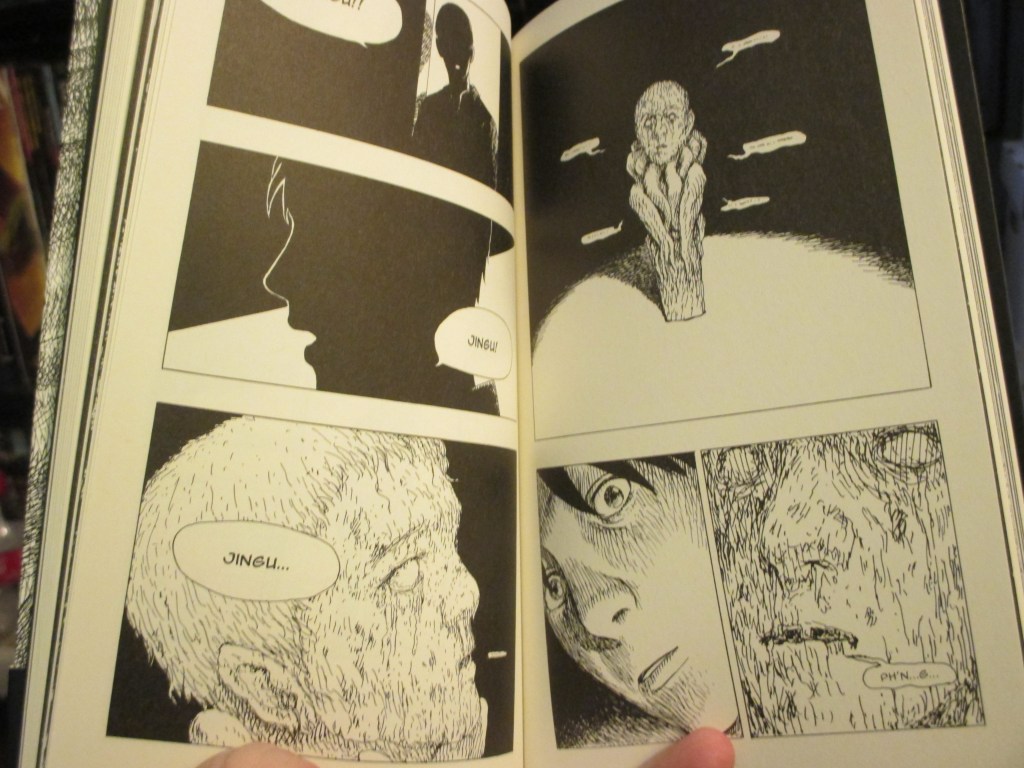
John Blackburn’s “Shadow over Darkcliff” is the second part of the two-issue series Idol of Flesh (1993), and sees Coley and friends return to the temple ruins of “Flowers of Evil”—but this time featuring a strange cult, led by a man named Garth. While the 32-page episode involves a bit of drama and a good bit of sex, the core story is explicitly Lovecraftian:

Idol of Flesh (1992) #2, by John Blackburn

Garth, it turns out, isn’t exactly human and wants Coley for sex and sacrifice. This isn’t the first or the last time Coley would be in this sort of position, the magnetic sexual attraction to both men and women is one of his supernatural traits throughout all of Blackburn’s series, as are scenes of flagellation, bondage, and sexual violence—especially the threat of castration, which appears in Return to Voodoo Island and reappears here. As in “Flowers of Evil,” Coley’s escape from this particular peril is somewhat miraculous—not a great storytelling trick, and one which Blackburn overuses a bit. Not that readers would know that unless they hunted out some of the stories that Fantagraphics did not reprint.

Blackburn would return to Coley and the Cthulhu Mythos in a longer, more involved, and even weirder storyline titled Dagger of Blood (1997), which makes brief reference to Garth and the events of “Shadow over Darkcliff.” Yet it reading the stories in order gives a better sense of the ideas that Blackburn was developing. Coley is presented as this perfect bisexual heartthrob, while characters like Garth and the antagonist of Dagger of Blood are both attracted to and hate Coley because of their own deformed bodies. There is a strong element of body dysmorphia to those characters, really only implicit here and more fully developed (and exploited) in Dagger of Blood, which fixates on genital mutilation.

It feels like Blackburn was working through some things, if only in art and writing, and perhaps only for his own entertainment. Certainly Blackburn was aware of the main focus of his comics—Coley has no shortage of sexual partners on the page, in explicit detail, both men and women—and the mundane drama of trying to keep his lovers happy is a counterweight to the more fantastic elements of Lovecraftian horror, even as the action and horror plots provide some relief from the soap opera.

When you look back at the history of LGBTQ+ characters and themes in comics, Blackburn’s work arriving when and where it did—first in self-published underground comix, and then after the CCA waned in series from an independent press which stressed the erotic angle—makes sense. It took decades after the Stonewall Riots for LGBTQ+ folks to gain greater recognition, acceptance, and basic rights in the United States, and such works were slow to find a place in mainstream comic books and strips. The underground was more willing to accept these nonconforming works with LGBTQ+ characters and to have discussions about subjects like homosexuality, polyamory, bisexuality, kink—and, yes, how the occasional bit of Lovecraftian horror fit into the mix. At the time, homosexuality in the Mythos was limited to stories like Ramsey Campbell’s “Cold Print” (1969), and those were few and far between.

Reading all of John Blackburn’s Coley saga is damn near impossible these days. Fantagraphic’s individual issues and reprint collections are long out of print and command collectors’ prices; the Idol of Flesh comics are reprinted in Coley Running Wild Book One: The Blade and the Whip. Several other adventures by Coley were published or re-printed in the gay comics anthology Meatmen, though there is no complete index for that series as yet.


Bobby Derie is the author of Weird Talers: Essays on Robert E. Howard and Others and Sex and the Cthulhu Mythos.

Deep Cuts in a Lovecraftian Vein uses Amazon Associate links. As an Amazon Associate I earn from qualifying purchases.
“The Dark Land” (1936) by C. L. Moore

Glad you liked “The Dark Land”. I made the drawing a long time ago, and wrote the story so I could bring it in, with the addition of a cadaverous head and a swirl of vagueness.
—C. L. Moore to H. P. Lovecraft, 30 Jan 1936, Letters to C. L. Moore and Others 108

We don’t know much about how C. L. Moore came to write “The Dark Land,” the fourth published adventure of Jirel of Joiry, and saw print in the January 1936 issue of Weird Tales, except that it drew on ideas Moore had at some point before she first conceived of Jirel, and which she now turned to for inspiration:

Jirel’s Guillaume whom I so ruthlessly slew in the first of her stories, yet whom I can’t quite let die, was patterned after the drawing of Pav of Romne with which I illustrated her latest story, “The Dark Land” in Weird TalesI made that drawing somewhere in the remote past, and have cherished it all these years in the confidence that someday it would come in handy. I meant to use it to illustrate “Black God’s Kiss,” first of the Jirel tales, but somehow the story got out of hand, and I’ve never since been able to introduce a situation it would fit until “The Dark Land.”
—C. L. Moore, “An Autobiographical Sketch of C. L. Moore,” Echoes of Valor 2, 37-38

Like most of Moore’s series stories, this tale was effectively a standalone episode; and like many of them, Jirel swiftly finds herself in another dimension, facing a supernatural threat wildly beyond her abilities.

“Our dear lady has dabbled too often in forbidden things,” he murmured to himself above the crucifix. “Too often. . . .”
—C. L. Moore, “The Dark Land” in Weird Tales (Jan 1936)

Once again, Jirel of Joiry is up against a dangerous, domineering suitor—an echo of the overbearing Guillaume in “Black God’s Kiss” (1934) by C. L. Moore. The central conflict is effectively a weird social drama, a contest of wills (literally) between Pav of Romne and Jirel of Joiry, as the alien king seeks to seduce or dominate Jirel without destroying her. In that, more than most of Jirel’s stories, there is a fierce resistance that is emblematic of the character that would become Red Sonja, who would give herself to no man who had not bested her in combat.

“Give me a weapon! There is no man alive who is not somehow vulnerable. I shall learn your weakness, Pav of Romne, and slay you with it. And if I fail—then take me.”
—C. L. Moore, “The Dark Land” in Weird Tales (Jan 1936)

It is sword & sorcery without much swordplay; Jirel is weaponless in the traditional sense, but then she is facing enemies that cannot be slain with a yard of steel. Like many of Moore’s stories, it deals with entities that are both vastly alien from human conception, and yet peculiarly attracted to either the human form or spirit. It is an aspect of sword & sorcery, the indomitable nature of the human spirit, that separates the swordswomen from the damsels in distress.

While the fans received “The Dark Land” positively, this tendency toward spiritual or psychic warfare was noted:

The Dark Land, by C. L. Moore, gets my vote for first place. . . . For originality of ideas in fantastic realms, Moore takes first place. However, can C. L. Moore discover something else instead of the hero’s (or heroine’s, as the case may be) tremendous will-power, to beat the foe?
—Michael Liene in The ‘Eyrie,’ Weird Tales (Mar 1936)

Another reader noted another running theme in Moore’s stories:

Can’t C. L. Moore write anything but woman-witch-halfbreed stories? Shambleau, The Dark Land, Yvala, ye gods!
—Willis Conover in The ‘Eyrie,’ Weird Tales (Mar 1936)

“The Dark Land” also aroused little comment from Moore’s peers, beyond polite acknowledgement. it wasn’t a bad story, but it lacked the vast originality of her earliest stories in Weird Tales.

I read your “Dark Land”, and liked it well.
—Forrest J Ackermann to C. L. Moore, 12 Feb [1936]

Jan. & Feb. W T issues very poor—saved only by Moore stories.
—H. P. Lovecraft to Emil Petaja, 1 Apr 1936, LEP 472

Have skimmed recent W T issues—though I suppose another is out today. Jan. & Feb. poor—each redeemed only by a Moore story.
—H. P. Lovecraft to Duane W. Rimel, 1 Apr 1936, LFB 316

Moore herself doesn’t comment on how she felt about this story; but there is a notable gap between “The Dark Land” and the next two (and final) Jirel of Joiry stories, “Quest of the Starstone” (WT Nov 1937) and “Hellsgarde” (WT Apr 1939) and when she returns to the character it is with a very different plot.

“The Dark Land” was published in the January 1936 issue of Weird Tales. Scans of this issue are available on the Internet Archive.

Thanks to Marcos Legaria for his help.


Bobby Derie is the author of Weird Talers: Essays on Robert E. Howard and Others and Sex and the Cthulhu Mythos.

Deep Cuts in a Lovecraftian Vein uses Amazon Associate links. As an Amazon Associate I earn from qualifying purchases.
“En Tierra Baldía” (2024) by Miguel Almagro & Lord Dunsany

Libre adaptación del relato escrito por Lord DunsanyFreely adapted from the story by Lord Dunsany
Cthulhu #30 (2024)English translation

“On the Dry Land” by Lord Dunsany was first published in the small magazine Neolith #4 (Aug 1908), and was collected in The Sword of Welleran and Other Stories that same year. It is the last story in the book, and it is one of those Dunsany short-shorts that is more than a drabble but less than a tale. Call it a prose poem or flash fiction; it has a certain poetry to it, and there is more that is left unsaid than is said. It has a mythic quality, but it is not a story of any particular mythology, whether of Pegāna or any other tradition. A kind of story so universal in its outlines it might slip easily into the tradition of any culture that has the concept of love and death.

How do you illustrate that? How do you put into images and words, the unspoken understanding, the loneliness and heartache?

For one, the adaptation allows the text to be decompressed. Dunsany’s pithy text is stretched out by Miguel Almagro into 9 black-and-white pages. For two, the scene and many details are expanded to silently add to the storytelling. Rather than the marsh where Dunsany had first set the scene, the story unfolds on a cliff overlooking the sea; the blowing of grass and the stance of the unnamed man show the direction of the wind that blows strongly throughout, and blocks of stone suggest some ancient construction or ruin, marks of the passage of time. The layout of the panels helps control the pacing of the story.

Te conduje entre los que me odíaban y me reí cuando tomaron venganza en tí…

Usé tu bondadoso corazón sin misericordia…

Ahora he de dejarte

No llores más, soy un necio, un desalmado, solo me quedé contigo porque eras un buen compañero de juegos…
I led you among those who hate me and laughed when they took revenge on you…

I used your kind heart without mercy…

Now I have to leave you

Don’t cry anymore, I’m a fool, a heartless man, I only stayed with you because you were a good playmate…
Cthulhu #30 (2024)English translation

As a free adaptation, Almagro is not making an attempt at an exact replication of Dunsany’s text; lines are told out of sequence, rearranged to meet the needs of the artistic arrangement. Maintaining the core of the short short while shifting the representation. So for example, this scene as Dunsany wrote it:

And Love said to the old man, ‘I will leave you now.’

And the old man made no answer, but wept softly.

Then Love was grieved in his little careless heart, and he said: ‘You must not be sorry that I go, nor yet regret me, nor care for me at all.

‘I am a very foolish child, and was never kind to you, nor friendly. I never cared for your great thoughts, or for what was good in you, but perplexed you by leading you up and down the perilous marshes. And I was so heartless that, had you perished where I led you, it would have been nought to me, and I only stayed with you because you were good to play with.

‘And I am cruel and altogether worthless and not such a one as any should be sorry for when I go, or one to be regretted, or even cared for at all.’

And still the old man spoke not, but wept softly; and Love grieved bitterly in his kindly heart.

And Love said: ‘Because I am so small my strength has been concealed from you, and the evil that I have done. But my strength is great, and I have used it unjustly. Often I pushed you from the causeway through the marshes, and cared not if you drowned. Often I mocked you, and caused others to mock you. And often I led you among those that hated me, and laughed when they revenged themselves upon you.
—Lord Dunsany, “On the Dry Land”

Pero nunca mas volverás a estar soloBut you will never be alone again.
Cthulhu #30 (2024)English translation

As with “Donde suben y bajan las mareas” (1978) by Alberto Breccia, Carlos Trillo, and Lord Dunsany, we have to read this from the perspective of both a translation and an adaptation. Dunsany’s title “On the Dry Land” is a key to the story because the dry land represents the end of journey and parting of ways; the nameless man with Love has been wading through the marshes, the wet lands, and that trudge and effort and peril are metaphorically, life and hardship and struggle. The dry land is what comes after. The Spanish title, “La tierra baldía” translates most literally to “The Wasteland,” which isn’t quite the same meaning, suggesting as it does barrenness, though the metaphor still works: the nameless man has come to the undiscovered country:

To grunt and sweat under a weary life,
But that the dread of something after death,
The undiscover’d country from whose bourn
No traveller returns, puzzles the will
And makes us rather bear those ills we have
Than fly to others that we know not of?
—Shakespeare, Hamlet, Act III, Scene 1

Dunsany is putting his own spin on it; rather than clinging to life, the man is clinging to Love, despite all the pain that has come from clinging to love, and dreads the loss of it. Yet there is that reassurance, that final promise, of a more constant, faithful, and comparing companion—a character more akin to Death in Terry Pratchett’s Discworld novels than the medieval grim reaper, or even Death as sometimes personified in Dunsany’s other stories.

In adaptation, Miguel Almagro is taking that story in translation and moving it a bit further. It is not a wasteland in the sense that there is nothing living; there is grass, insects, but it is devoid of people or shelter, a land gone fallow and wild. Even the sky and sea are empty and desolate. Death, when she appears, is not frightening, merely a dark-eyed psychopomp—and the man has accepted Death, even as he has accepted the loss of Love. Dunsany wrote in the last line:

And after a while, with his face towards the morning, Death out of the marshes came up tall and beautiful, and with a faint smile shadowy on his lips, and lifted in his arms the lonely man, being gentle with him, and, murmuring with his low deep voice an ancient song, carried him to the morning to the gods.

Almagro foregoes the song, and the gods; the last we see of them are two shadows side by side on a new and different journey. There is something more poignant in that image, that acceptance and continuance. Perhaps a man literally cannot live without Love, but so too, now Love can no longer hurt him.

Thanks to Martin Andersson for his help.


Bobby Derie is the author of Weird Talers: Essays on Robert E. Howard and Others and Sex and the Cthulhu Mythos.

Deep Cuts in a Lovecraftian Vein uses Amazon Associate links. As an Amazon Associate I earn from qualifying purchases.
“The Cold Gray God” (1935) by C. L. Moore

Was there ever such a duel in the whole universe as the one between Northwest Smith and the nameless being that fought him in that Martian room?—a gripping tale by the author of “Shambleau”
—Epigraph to “The Cold Gray God” in Weird Tales (Oct 1935)

Summer in the Midwest, before the widespread adoption of air conditioning, could be sweltering. The very air gets sticky, even nights could be stifling and sweaty. C. L. Moore hadn’t been slacking during the summer of 1935, but Northwest Smith had been absent from the pages of Weird Tales. Wright had the story that would be “The Cold Grey God” on hand at least as early as March, but he sat on it, apparently waiting for the right time, and thinking of the right title. That came with the October 1935 issue.

And WT is publishing in July either the Smith story which Wright has entitled THE COLD GREY GOD, all about a lovely Venusian named Judai, or else a Jirel story we have been revising for months. He hasn’t decided yet which to use.
—C. L. Moore to R. H. Barlow, 20 Mar 1935, MSS Brown Digital Repository

On the subject of titles, I envy you your ability. The most painful part of writing, so far as I’m concerned, is naming the stories. Mr. Wright more or less takes it out of my hands sometimes, as in the case of a story scheduled for mid-summer sometime, which he is calling “The Cold Gray God”. I’m getting a regular spectrum of colored gods, staring with black and working slowly upward thru grey toward goodness knows what.
—C. L. Moore to H. P. Lovecraft, 7 May 1935, Letters to C. L. Moore and Others 34

The story starts with snow on Mars. A femme fatale. Northwest Smith, unable to repress his curiosity, goes to her house. The aesthetic borrows aspects of hardboiled fiction, of Oriental stories, the details adapted to the extraterrestrial setting. The idea of an ancient religion buried in the hearts and minds of an exotic culture was not uncommon in stories like Robert E. Howard’s “Skull-Face” (WT Oct-Nov-Dec 1929) and Robert W. Chambers’ The Slayer of Souls (1920); here it was applied to Martians.

“The Cold Gray God” is not set up as an archaeological horror; it’s set up as a weird heist story, in the strange criminal underworld of Mars. As in “Dust of the Gods” (1934), he’s hired to do a not-quite-legal job. Unlike in that story, the job itself isn’t the problem. A noirish sensibility of a web of secrets unfolds the narrative, and once again ensnares Northwest Smith in a plot of ancient space gods, strange survivals from a dim and distant past, and one with an unspeakable name:

And he knew why the men of Mars never spoke their cold god’s title. They could not. It was not a name human brains could grasp or human lips utter without compulsion from Outside. […] Nor was the name wholly gone, even now. It had withdrawn, for reasons too vast for comprehension. But it had left behind it shrines, and each of them was a little doorway into that presence; so that the priests who tended them furnished tribute. Sometimes they were possessed by the power of their god, and spoke the name which their devotees could not hear, yet whose awful cadences were a storm of power about them. And this was the origin of that strange, dark religion which upon Mars has been discredited for so long, though it has never died in the hearts of men.
—C. L. Moore, “The Cold Gray God” in Weird Tales (Oct 1935)

Which is a neat way to get around coming up with a mouthful of letters like Cthulhu or Tsathoggua. While C. L. Moore never deliberately added to the Mythos of the Necronomicon and Unaussprechlichen Kulten, she very much absorbed the ideas of Lovecraft and co., and adapted those tropes to her own use. This is not unlike Northwest Smith’s version of “The Call of Cthulhu,” or an homage to the same. The stars were right—then came the raygun.

If there’s a criticism of the story, it’s that it is very similar to Smith’s other adventures. This isn’t the first god he’s faced down, or the first time he’s struggled against an alien will. It is a standalone episode; while there are elements of the setting that are shared with other stories, there is still no continuity. This encounter does not cause Smith to reflect on any other encounters; this experience does not hinge on any previous one. So while the setting expands a bit with each story, the series itself maintains the same episodic nature as that other great stalwart of Weird Tales, Jules de Grandin. Readers weren’t looking for character development, no origin or ending, and writers weren’t going for character arcs for the most part.

“The Cold Gray God” is well-written, a good example of a Northwest Smith story. It just lacks a bit of novelty.

Nor did readers complain about that, although they complained about other things:

I read “Cold Gray God” last night, and liked it good. My only objections are personal: I don’t like “cooed” as a word; and I can’t stand “clean death”. For some obscure reason, I don’t fancy a girl cooing; whilst during the past year or so it seems to me all the fictional characters have gone overboard about having a “good, clean death”—by a “cool, clean sword”, “clean, consuming fire”…or good clean, clean, clean—like a clank, clank, clank—will drive me clean coo-koo, so help me, if I come across it about oncemore!!!
—Forrest J. Ackerman to C. L. Moore, 2 Oct 1935

Readers in “The ‘Eyrie'” were more positive, with one writing simply:

I surely enjoyed The Cold Gray God by C. L. Moore. I like stories of Mars.
—Orby Martin, Weird Tales Dec 1935

Among Moore’s pulp peers, H. P. Lovecraft counted it among the best stories in the issue. A typical version of his response:

W T is rather lousy of late. In the Sept. issue “Vulthoom” & “Shambler from the Stars” barely save it from being a total loss, while “Cold Grey God” & “Last Guest” perform a similar service for the Oct. number.
—H. P. Lovecraft to Lee McBride White, 28 Oct 1935, Letters to J. Vernon Shea et al. 362

If he noted the similarity to some of his own ideas, it hasn’t survived in any letter that’s seen print. At some point, Lovecraft conveyed the essence of this to Moore herself:

I’m so glad you approved of my “Cold Grey God” (which is Wright’s title, not mine.)
—C. L. Moore to H. P. Lovecraft, 16 Oct 1935, Letters to C. L. Moore and Others 68

One thing seems clear: both the readers and Lovecraft had come to appreciate Moore as a reliable writer, one of Weird Tales‘ more familiar and recognizable names for quality. Farnsworth Wright, the editor, was content to keep buying her stories. With this, her 13th published story in a pulp magazine or fanzine, Moore herself seems to have achieved a comfortably high level of confidence and competence.

“The Cold Grey God” was published in the October 1935 issue of Weird Tales. Scans of this issue are available on the Internet Archive.

Thanks to Marcos Legaria for his help.


Bobby Derie is the author of Weird Talers: Essays on Robert E. Howard and Others and Sex and the Cthulhu Mythos.

Deep Cuts in a Lovecraftian Vein uses Amazon Associate links. As an Amazon Associate I earn from qualifying purchases.