“While The Black Stars Burn” (2015) by Lucy A. Snyder

It was the first and last time she had been glad to be a disappointment in the eyes of the universe.
—Lucy A. Snyder, “While the Black Stars Burn” in Cassilda’s Song (2015) 120

Rape has the primary definition of sexual trespass, but in the broader sense encompasses a variety of behaviors which force or take from a subject without their consent, and often against their direct wishes. Rapists often seek, not sexual gratification, but control and dominance. The sense of inevitability that accompanies the Yellow Mythos can play into such fantasies, sometimes literally as in “Yella” (2015) by Nicole Cushing, but more often a kind of metaphysical invasion and entrapment—as in Lucy A. Snyder’s “While the Black Stars Burn.”

At least half of this story is untold. Caroline Cage-Satin doesn’t know it, and the audience is left to guess at the cruelty of her father, drunk and sober; his fixation on her development of a violinist appearing to be more than an extension of parental ego. When the scar breaks open on Caroline’s palm, readers will have to wonder how much of the whole incident—from the Maestro pulling out the burning brand to the doctor who completed the sign—was planned, and who was in on it. How many people, knowing and unknowning, had pushed and pulled Caroline to that moment, to be that person, desperate enough to wrap her crippled hand around the neck of a violin and face the music?

Worst of all she knew—since she’d been repeatedly told so—that she was quite plain, good as a violinist but unremarkable as a woman. Her music was the only conceivable reason anyone would welcome her to a wedding.
—Lucy A. Snyder, “While The Black Stars Burn” 122

There’s a skill in the half-built nature of the story, in that it doesn’t feel incomplete—and in the characterization of the protagonist. Caroline never loses her agency. She can say no, and she does. Despite being raised by a cruel and egotistical father, Caroline does not demonstrate those traits herself. Her act of striking back against the world is self-sacrifice: to throw away her instrument, abandon the course charted for her. To seek a new life.

This is exactly what is denied her, choice ignored, as she finds herself playing the piece once again. Caroline does not consent to what happens at the end of the story…but it isn’t about what she wants. It’s about what others want, what they can make her do.

Rape.

A search for literary forebears and parallels turns up two interesting pieces: H. P. Lovecraft’s “The Music of Erich Zann” and Charles Stross’ The Annihilation Score (2015). Zann is the quintessential musical touchstone of Lovecraft’s Mythos, his music on the viol keeps whatever is outside at bay. In this sense, Snyder’s story is an inversion of Lovecraft’s: where Zann forces himself to play, Caroline is forced to play, and the results of their playing are exactly opposite.

Stross’ novel actually touches on Lovecraft’s story—the heroine’s bone violin is a Zann Special—but the violin itself and the score in question are tied to Carcosa; it represents a coincidental parallel to Snyder’s story. Stross also makes an explicit sexual tension between Dr. Dominique “Mo” O’Brien and her violin, and outside forces pressure and shape her toward specific ends against her will. Like in Snyder’s story, O’Brien in Stross’ work is ultimately forced to play…but she at least has the resources to find a way out.

“While the Black Stars Burn” was first published in Cassilda’s Song (2015), and also appeared in and lent its name to Snyder’s collection While the Black Stars Burn (2015). It has been reprinted in Turn to Ash, Volume 1 (2016), Apex Magazine (Sep 2017), and Pseudopod #574 (2017). Snyder’s other Mythos fiction includes “The Girl With the Star-Stained Soul” (2014), “The Abomination of Fensmere” (2015), “Cthylla” (2015), “Blossoms Blackened Like Dead Stars” (2017), “Sunset on Mott Island” (2017), “The Tingling Madness” (2018), and “Cosmic Cola” (2018). Many of these are included in her collection Garden of Eldritch Delights (2018).

Lucy A. Snyder has also written nonfiction articles/reviews about Lovecraftian fiction for Horror World, and the essay “Unreliable Narrators in Kiernan and Chambers” (7 Oct 2015, Apex Magazine).


Bobby Derie is the author of Sex and the Cthulhu Mythos (2014)

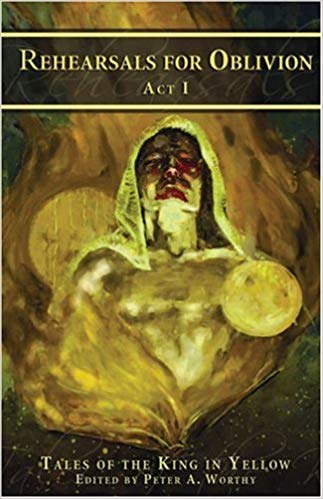
“Lilloth” (2006) by Susan McAdam

Now what if I told you that there is such a work available for study, but this particular body of knowledge is near impossible to correctly interpret because sheer madness is the irreversible result from the mere reading of it? That’s right. You know the text.
—Susan McAdam, “Lilloth” in Rehearsals for Oblivion: Act I (2006) 107

The stories in The King in Yellow are structured as tragedies, in the sense that there is a certain inevitability that accompanies them, with all the characters’ actions leading them inexorably on; their fates cannot be otherwise, because they cannot be or do otherwise. This has often found expression in the stories of the Yellow Mythos: sometimes they evince a quiet irresistible force, as in “The Viking in Yellow” (2014) by Christine Morgan and “Yella” (2015) by Nicole Cushing, or as a portentous foreboding of doom, as in “Slick Black Bones and Soft Black Stars” (2012) by Gemma Files and “Flash Frame” (2010) by Silvia Moreno-Garcia. There are rarely horrors to be fought in the sense of a raised fist, a drawn sword, or a loaded gun; no spell to ward off the inevitable. Though certain outward manifestations may be halted, the knowledge of the horror remains…and the terrible reality is there, waiting, in Carcosa.

In “Lilloth,” Susan McAdam takes advantage of both these approaches. The titular character’s name combines ‘Lillith’ from Jewish mythology and the -oth ending favored by Lovecraft in names like Yuggoth, Yog-Sothoth, and Azathoth, suggesting something of her nature—and she acts as both catalyst and focus for the story, narrated by an unknown, not-quiet-omniscient narrator, somewhat in the manner of Arthur Machen’s “The White People.” Lilloth is the beginning and the end of the story; the doom of her teenage friends is foreshadowed long before it is developed, and the nature of that doom is inevitable as it is, to a degree, self-inflicted. The teenagers act as they must, being who they are. The reader watches it unfold, like a horror movie, third-party witness to the event.

How a story is told matters at least as much as who the characters are, the setting, or the actual events of the plot. One of the advantages of operating within a specific Mythos is that a certain amount of the heavy lifting is already done: the reader is familiar with basic concepts, familiar names, disbelief is partially suspended already. The reader wants to read the story.

Such a pre-investment can allow room for experimentation, and so it is with McAdam: Lilloth’s story is told in fits and spurts, as though the narrator was piecing everything together from disparate newspaper accounts, interviews, police reports—all for the purpose of illustrating a point about reading between the lines, and the dangers of connecting certain dots.

It’s a familiar Mythos trope, as old as Lovecraft’s line “We live on a placid island of ignorance…” from “The Call of Cthulhu,” and there are many more old favorites in “Lilloth.” The actual plot of the story is less interesting than the way it is told, the connective tissue between the scenes somewhat thin, as might be expected of a piecemeal narrative. Most of the mysteries are left untold, and that’s perhaps more fun.

Lilloth joins the new generation with Helen Vaughn, Wilbur Whateley, and Hester Sawyer, and the circumstances of her conception are perhaps less of interest than that of her coming of age—and that is an aspect of these characters it is interesting to compare and contrast. Born of human women, they live for a time a changeling’s life, though often apart from humanity, teenage alienation made flesh—a theme sometime explored, as in Stanley C. Sargent’s “The Black Brat of Dunwich” (1997) or W. H. Pugmire’s “The Child of Dark Mania” (1997). Lilloth’s characterization is in between those of Wilbur Whateley and Hester Sawyer: conscious of her heritage, but ignorant of the details; she has to learn, to grow as a person before she can take the next step, to transition from childhood to adulthood, from humanity to whatever lies outside of it…and there are casualties along the way.

“Lilloth” was published in Rehearsals for Oblivion: Act I: Tales of the King in Yellow (2006). It has not been reprinted.


Bobby Derie is the author of Sex and the Cthulhu Mythos (2014)

“Yella” (2015) by Nicole Cushing

And he can’t help himself. He lets out a little, sissy-like wail and flinches at the noise.
—Nicole Cushing, “Yella” in Cassilda’s Song (2015) 39

Colors take on symbolic meaning, adapted to the syntax of their era. Robert W. Chambers’ seminal collection The King in Yellow (1895) was published during the “Yellow Nineties,” when publications like The Yellow Book (1894-1897) gained a reputation for decadence and eroticism, and that aesthetic can still be felt in stories like “Flash Frame” (2010) by Silvia Moreno-Garcia. Through the auspices of The King in Yellow, the color itself has become a byword and hallmark for activity in later fiction, giving its name to the “Yellow Mythos”—which might otherwise be the Chambers Mythos (to parallel the “Lovecraft Mythos”), the Cassilda Mythos (to parallel “Cthulhu Mythos,” yet keep it distinct from the “Hastur Mythos”), or the Carcosa Cycle (echoing Lovecraft’s reference to “the Arkham Cycle”).

Yellow can have many other connotations, however. “The Yellow Wallpaper” (1892) by Charlotte Perkins Gilman showcases a woman’s slow descent into madness, with certain thematic resonance to Chambers’ work. Yellow journalism is cheap, tawdry, sensational, and degrading; named after crumbling, fast-fading newsprint. Yellow is the color sometimes associated with fear and cowardice.

“Yella” by Nicole Cushing embraces the latter. Not the sudden fear of bodily harm, or of sudden climactic revelations, but the slow gnawing death by inches that comes from not wanting to act, to interfere. Fear of consequences, of being left alone, of what people will say and think of them. Adult fears, real and poignant, the kind that people bottle up inside and drown sip by sip from a whiskey bottle.

The basic premise of Cushing’s story echoes several other Mythos tales, particularly since it involves a male protagonist who appears unable to bring themselves to interfere with a female they are in a relationship with, even as she grows more distant from normal behaviors and closer to stranger things; August Derleth’s “Innsmouth Clay” (1971) and Ann K. Schwader’s “Mail Order Bride” (1999). The specter of fertility issues on relationships has been given a Mythos twist in stories like “In His Daughter’s Darkling Womb” (1997) by Tina L. Jens and “Prey of the Goat” (1994) by Margaret L. Carter.

What sets “Yella” apart is the focus on fear—and masculinity.

It’s enough to make any man prissy-prance his way outta there, but he ain’t gonna be scared off. He’s gonna do what he shoulda done days ago. Gonna be a fuckin man.
—Nicole Cushing, “Yella” 41

As in “Gilgamesh in the Outback” (1986) by Robert Silverberg, there’s a focus on both the internal narrative of masculinity and the external expression of it. Billy, the “empty man” protagonist of Cushing’s narrative, is hounded by the image of how he thinks a man should be and act, juxtaposed against his actual actions and inaction; his failures to confront his wife and his inability to impregnate her. His wife Patti uses those same fears against Billy, throwing his failures in his face, threatening his masculinity:

Yer gonna turn sissy fer him, ain’tcha? Ya turn sissy fer Him, He’ll give ya babies, too. Don’t make no difference if y’ain’t gotta pussy or a womb. He’ll make some fer ya, claw some into ya!
—Nicole Cushing, “Yella” 43

Billy’s fear that his wife will leave him for another man, that Patti has gone crazy, run up against a harsher reality. His fears, small and personal as they are, showcase the limits of his imagination—and what is really going on with Patti and her Yella Angel is much worse than what has Billy hitting the bourbon.

“Yella” plays with all these themes, stemming from and circling back around to the name, what it symbolizes and implies—the King in Yellow, Billy’s cowardice and its association with unmasculine behavior, sexual decadence, a woman’s descent into madness—and it does so quickly, pulling no punches, no graceful glances aside or slow build-up. Patti’s foul-mouthed speech is raw and perfect, brash and detailed where Billy is reticent and afraid to put his fears into words.

Billy is raped near the end of the story; and it is a rare event in the Mythos for a man to be penetrated. It is the culmination of Billy’s emasculation, and the fulfillment of Patti’s promise, at least from a certain point of view. Certainly, Billy didn’t ask for it—but in many of ways, that lack of choice may be the point. Rape is an expression of power and dominance, not sexuality; power and dominance are key aspects of patriarchal systems and cultures. Billy’s attempts to prove he is a man by dominating Patti, verbally and physically, ultimately fail…and ends up with roles reversed.

The real horror is that this isn’t Billy’s punishment, either for acting or failing to act. Getting raped, body and mind violated by the Yella Angel in its tattered robe, is not some vicious moral for failing to act up to a John Wayne standard of how a man is supposed to act. It would have happened anyway. There was nothing Billy could have done to prevent it—and there is nothing he or anyone else can do to prevent it from happening again. Billy’s reality is wakening up to how powerless he and everyone else is. A bleak and utterly appropriate nihilistic end, in the best traditions of the Yellow Mythos.

“Yella” was published in Cassilda’s Daughters (2015). Nicole Cushing’s other Mythos/Lovecraftian stories include “A Catechism for Aspiring Amnesiacs” (2012) and “Diary of a Sane Man” (2016); her story “The Company Town” appeared in the Thomas Ligotti-inspired anthology The Grimscribe’s Puppets (2013).


Bobby Derie is the author of Sex and the Cthulhu Mythos (2014)

“The Viking in Yellow” (2014) by Christine Morgan

My favourite moments are when the title and concept come to me in a kapow, often for a themed call like “The Viking in Yellow.” It was just bam all there.
—Christine Morgan, “Christine Morgan: The Closest Thing To Telepathy”

The foreign warriors that went a-viking harried the coasts of Europe, burned towns and looted monasteries of their treasures, raped, pillaged, and plundered…then climbed back into their ships and left, perhaps to return again next year. They were an intrusive force from outside, a force beyond prediction of control. Sometimes they could be bribed, rarely they could be fought off, but often they appeared before defense could be raised, and overwhelmed the coastal settlements…and there was little defense against them.

But when the striped yellow sails appear on the coast…and the grim silent warriors with the odd painted shields march to Marymeade Abbey, led by a chief in a tattered cloak… There are dearer things at stake than silver and golden, lives and virginities…and the Viking in Yellow will claim his own.

A mythos represents more than a collection of tales in the same setting or with shared characters, but variations on a narrative theme. Robert W. Chambers set “The Repairer of Reputations” in an alternate future, one strange to the eyes of 1895, but not unbelievable. The play The King in Yellow has fewer indications of when it is set, but that hardly matters. The Yellow Mythos can be adapted to almost any syntax and setting, by a writer with skill and imagination, the narrative echoes of Chambers’ play can repeat themselves in the far future or the distant past.

How many ages hence
Shall this our lofty scene be acted over
In states unborn and accents yet unknown!
—William Shakespeare, Julius Caesar, Act III, Scene 1

Christine Morgan has both considerable skill and imagination. The reality of the small community that exists to serve the abbey and its parent monastery is well-developed, full of small, realistic details. The fear of and reactions to the warriors from the sea is natural, and perhaps appropriate for any normal band of roving Norsemen—but not these gaunt sailors with the strange yellow glyphs on their shields, or the chief with the tattered cloak, a plume of pale yellow horsehair on his helm. When Sister Gehilde defies him, her words echo an old formula:

“You come here, nameless and face-hidden, and call them weak? Call them cowards? For shame! Take off your visor, then! Show yourself unmasked, if you have such strength and courage!”
—Christine Morgan, “The Viking in Yellow” in In the Court of the Yellow King 

The charm of “The Viking in Yellow” is both Morgan’s reflection of the scenes and elements from Chamber’s play and the original details she adds to subtly expand upon that narrative tradition…and she does it without once invoking figures directly in their familiar and ominous capital letters. This is a Yellow Mythos story without any mention of the Yellow Sign, though yellow signs abound; no King in Yellow, though there is a stranger who fulfills the role; no Cassilda and Camilla, though another pair of sisters echo their lines; no Carcosa either, though the lake of Hali makes a brief appearance at the end, with a city of strange towers and black stars.

In plot, it’s a viking raid with a twist; a premise that is laid out and fulfilled without complication. Morgan has written a number of viking previous to this, and teases mundane horrors which are ultimately subverted. The turn of the plot, when it comes, owes a bit more to the Call of Cthulhu roleplaying game than anything Lovecraft or Chambers wrote—the kind of stock madness that sees robed cultists crop up in stories like “ALL THIS for the GREATER GLORY of the 7th and 329th CHILDREN of the BLACK GOAT of the WOODS” (2012) by Molly Tanzer—but it works well enough in context, and faithful execution of a straight premise is satisfying in its own right.

“The Viking in Yellow” was published in In the Court of the Yellow King (2014) and has not yet been republished. Christine Morgan’s other Lovecraftian fiction includes “With Honey Dripping” (2014), “The Mindhouse” (2014), “Unfathomable” (2014), “The Ithiliad” (2014), “Lascivious Tongues” (2014), “Thought He Was A Goner” (2015), “Ninesight” (2015), “Professor Patriot and the Doom That Came to Niceville” (2015), “Incense and Insensibilty” (2015), “Aerkheim’s Horror” (2015), “The Arkham Town Musicians” (2015), “Pippa’s Crayons” (2016), “The Keeper of Memory” (2017), and “Fate of the World” (2017).

Christine Morgan’s viking fiction, including “Aerkheim’s Horror” but not “The Viking in Yellow,” is collected in The Raven’s Table: Viking Stories (2017).


Bobby Derie is the author of Sex and the Cthulhu Mythos (2014) 


“Cordelia’s Song from The King in Yellow” (1938) by Vincent Starrett & “Evening Reflections, Carcosa” (2011) by Ann K. Schwader

Along the shore the cloud waves break,
The twin suns sink behind the lake,
The shadows lengthen
In Carcosa.

Strange is the night where black stars rise,
And strange moons circle through the skies
But stranger still is
Lost Carcosa.

Songs that the Hyades shall sing,
Where flap the tatters of the King,
Must die unheard in
Dim Carcosa.

Song of my soul, my voice is dead;
Die thou, unsung, as tears unshed
Shall dry and die in
Lost Carcosa.

Cassilda’s Song in “The King in Yellow,” Act 1, Scene 2.
—Robert W. Chambers, The King in Yellow (1895)

The canon of The King in Yellow consists of a few fragments and tantalizing hints strung out over the first four stories of Robert W. Chamber’s strange collection. It is a play in two acts; there are at least two characters with speaking roles, Cassilda and the Stranger, and Camilla is mentioned besides, along with several odd names (Demhe, Hali, Carcosa, Yhtill, Hastur, etc.) Cassilda has a song. That is almost all.

Entire plays based on Chambers’ cryptic fragments have been written; a corpus of “Yellow Mythos” tales have spun out from the weird, decadent, almost nihilistic fin de siècle atmosphere. As with the Lovecraft Mythos, most of the energies of subsequent generations of writers and poets has revolved back around Chambers himself. Whatever expansions, interpretations, and embellishments other writers might add, there is that small, hard core of canon: Cassilda’s song.

One of the earliest such embellishments was by the noted bookman Vincent Starrett; his poem “Cordelia’s Song from The King in Yellow” was published in Weird Tales (Apr 1938):

The moon shines whitely; I shall take
My silk umbrella, lest the moon
Too warmly fall upon the lake
And cause my bridal flowers to swoon.

The sparrow’s sorrow is in vain,
And so does he his bride forget.
I wed the long grass and the rain,
And seven sailors dripping wet.

And shall not you and shall not I
Keep tryst beside this silent stream,
Who thought that we should rather die
Than wed the peacock’s amber dream?

The moon shines whitely; I shall take
My silk umbrella, lest the moon
Too coldly fall upon the lake
And chill my bridal flowers too soon.

The work is subtle; Starrett was too canny a reader to go for pastiche, or overt references to Carcosa or the Hyades; there is a lake, but not specifically the Lake of Hali. He does not specify where in the play this song is placed, either in the first act or the second…or does he?

The very banality and innocence of the first act only allowed the blow to fall afterward with more awful effect.
—Robert W. Chambers, “The Repairer of Reputations” in The King in Yellow

The “innocence” certainly seems to fit, though it may be Starrett was hinting at a connection with one of Chamber’s other weird works, “The Maker of Moons” (1896). Still, it introduces a third female character—Cordelia—to the cast alongside Cassilda and Camilla. By giving both Cordelia and Cassilda songs, it may suggest that Camilla has one as well.

The “missing song” is provided by Ann K. Schwader, whose poem “Evening Reflections, Carcosa” bears the subtitle “(Camilla’s Song),” which begins where Chambers ends:

Cassilda sings the dying twilight down
Again to me tonight from her soul’s tower
—Ann K. Schwader, “Evening Reflections, Carcosa” in Twisted in Dream 98

Schwader likely took inspiration directly from Chambers, just as Starrett did. Certainly, “Evening Reflections, Carcosa” references directly and explicitly the mythos of The King in Yellow—and builds on those cryptic hints, suggesting a lament. If Cassilda’s and Cordelia’s songs were in act 1, then Camilla’s song feels as though it might have a place in that second and final act. Perhaps the play ends with Camilla singing:

Cursed as we all are with his bitter Sign.
(ibid. 99)

—and leave the audience to decide whether she is addressing them as well.

Starrett and Schwader’s respective contributions are both inspired by “Cassilda’s Song”; it is the crucial bit of lore that both have fastened on, the well of inspiration for their respective imaginations in their individual ways—and they are not alone. It has given its name to an entire anthology of female contributors: Cassilda’s Song: Tales Inspired by Robert W. Chambers’ King in Yellow Mythos (2015), just as the song itself has inspired fiction such as “Slick Black Bones and Soft Black Stars” (2012) by Gemma Files.

“Cordelia’s Song from The King in Yellow” was first published in Weird Tales (Apr 1938), and subsequently republished in The Spawn of Cthulhu (1971), and Peter Haining’s Weird Tales reprint anthology (1976, 1990).

Ann K. Schwader’s poems relating to The King in Yellow include “Postscript: The King in Yellow,” “A Phantom Walks,” “Autumn, Lake Hali,” “Stargazing, Lake Hali,” “A Lost Song of Cassilda,” “Evening Reflections, Carcosa,” “A Queen in Yellow,” and sonnets XXIV-XXVI of “In the Yaddith Time” all contained in Twisted in Dream: The Collected Weird Poetry of Ann K. Schwader (2011); “The Queen’s Speech”, “At the Last of Carcosa,” “Outside the Chamber,” and “Finale, Act 2,” were collected in Dark Energies (2015). She has also written stories related to the Yellow Mythos, including “Tattered Souls” (2003) and “Dancing the Mask” (2015).


Bobby Derie is the author of Sex and the Cthulhu Mythos (2014)

“A Creak in the Floor” (2018) by Victoria Dalpe

Don’t you know there was a mill on Copp’s Hill in 1632, and that half the present streets were laid out by 1650? I can shew you houses that have stood two centuries and a half and more; houses that have witnessed what would make a modern house crumble into powder.
—H. P. Lovecraft, “Pickman’s Model”

A story doesn’t have to reference Richard Upton Pickman by name to invoke “Pickman’s Model.” When you boil Lovecraft’s story down to its essence, the soul of it’s core message is simple and perfect: there are monsters in the earth, and they eat the dead. So that is what Victoria Dalpe takes a her premise. No Necronomicon, no blasphemous artwork—just a bunch of art school kids renting a space in an old mill in Boston that’s been converted into illegal housing.

The art school kids tell each other stories, urban legend-building in real time, Dalpe working from her Lovecraftian substrate and layering on all the hints and suggestions. The girl who died in the elevator. The guy that got mugged. Where’s Pete? If this was drawn out to novella length or adapted to film, we might get the full Lovecraftian investigation, the secret history unveiled one onion skin at a time. The inexplicable rendered down, explained, pre-digested for the audience.

“A Creak In The Floor” is a short story. It doesn’t have time for that. Everyone knows what it’s about, or they should. Dalpe ends the story by going for the jugular. And she didn’t need a single reference to Pickman to do it, barely uses the g-word. Compared to a lot of Lovecraftian pastiche, it’s refreshing to see someone that can invoke the Mythos without calling the old names. It is reminiscent of “Pugelbone” (2010) by Nadia Bulkin in that way, though Dalpe’s tale hews a little closer to the Lovecraft canon.

If the things-beneath-the-mill are the crux of the story, Where is Pete? is the key to the plot. It is what drives the protagonist Charlie Chan deeper into the darkness. Pete is the reason Charlie is there. Pete is the boy Charlie is in love with. The human connection draws Charlie inexorably in after his friend, his hinted-at one-time lover. The missing Pete’s interpersonal connections with his flatmates is woven in and around the urban legends that Dalpe builds, much as Pickman himself has been built up from Lovecraft’s ghoulish artist, drawing bits of legend to his own personal Mythos as writers weave their stories around him—like “Pickman’s Other Model (1929)” (2008) by Caitlín R. Kiernan, or “Pickman’s Modem” (1992) by Lawrence Evans-Watt.

Victoria Dalpe turns the page before we see what crimson end is in store for Charlie, and that is appropriate. While his story could have gone on, the story that Dalpe was telling really ends with the final revelation. In a twist of irony that only Lovecraft readers will get, it once again involves a photograph from life…

“A Creek In The Floor” was published in Pickman’s Gallery (2018). Victoria Dalpe’s other Lovecraftian contribution includes “Mater Annelinda” in Conqueror Womb: Lusty Tales of Shub-Niggurath (2014).


Bobby Derie is the author of Sex and the Cthulhu Mythos (2014)

“The Sisters Derleth” (2017) by Michelle D. Sonnier

“Chin up and all that,” she muttered to herself. “How is this any worse than marrying a man older than my father and bearing him children?”
—Michelle D. Sonnier, “The Sisters Derleth” in EOM: Equal Opportunity Madness 58

Growing up is about facing adult fears. This applies to Mythos fiction as much as in human life: the talk of elder gods and strange creatures older than humanity have the timeless quality of a good fable, suitable for all ages. Not quite the same as the foreign markets tanking your father’s investments and now being a young woman stuck in a small town in Massachusetts, unable to make the rent, and the only thing to possibly barter a better life with being what’s between your legs.

Which is more literal than Edith Athney expects when she meets the Sisters Derleth.

The delayed adolescence of Edith is mimicked in the style of narration as well as the events of the story. The flowery, quasi-Brontë prose at the beginning gives way swiftly to a more natural, faster-paced flow of dialogue, back and forth. Trapped between forces she can barely comprehend, the protagonist of Sonnier’s tale nevertheless makes the heroically pragmatic choice—and if she bargains away her innocence, at least she strikes her own bargain on terms she sets, rather than being forced into an arranged marriage. The final sign of her coming-of-age is a very literal and bloody deflowering, though not the one she might have hoped for.

The issue of financial anxiety tied to marriageability is absent from the bulk of Mythos fiction. It is a very human, mundane, adult fear which relies on social conventions and expectations, and it is a rare writer that makes such fears the opening or centerpiece of a Mythos story. “In His Daughter’s Darkling Womb” (1997) by Tina L. Jens broaches the issue of reproductive horror, “A Coven in Essex County” (2016) by J. M. Yales focuses on how women feel when reduced to wombs for barter, “Prey of the Goat” (1994) by Margaret L. Carter touches on marriage fertility anxieties, but Sonnier focuses on the fear of the future: of being an old maid, of the consequences of not marrying well. Marrying for love isn’t even on the table: this is a horror story, and Edith loses such romantic ideas fairly early.

Why Derleth? The eponymous sisters of the story have no direct connection to Lovecraft’s friend and hagiographer, August Derleth; nor does it appear to be a reference to the Comte d’Erlette, the author of Cultes des Goules. It just is, a name to conjure by, an empty association. As much a lure to draw the reader in as the Sisters’ invitation to Edith brought them into their garden…and if the readers are left wondering where exactly the Sisters fit in to the grand scheme of the Mythos, that is not a fault. In Mythos fiction especially, less is sometimes more, and a bit of mystery is preferable to absolute certainty.

Much of the Mythos elements and tropes at play in the story verge on trite: Sonnier isn’t seeking to expand the Mythos substantially or score points with the more hardcore fan scholars by making excessive tie-ins to other works. If “The Sisters Derleth” plays fast and loose, inspired more by the Call of Cthulhu Roleplaying Game and its sanity-draining eldritch tomes than Lovecraft and his contemporaries’ original fiction, it is because it can do so—and is little different in that regard than “ALL THIS for the GREATER GLORY of the 7th and 329th CHILDREN of the BLACK GOAT of the WOODS” (2012) by Molly Tanzer.

“The Sisters Derleth” was published in EOM: Equal Opportunity Madness A Mythos Anthology (2017). It is her first Lovecraftian work.


Bobby Derie is the author of Sex and the Cthulhu Mythos (2014)


“Resonator Superstar!” (2015) by Anya Martin

But whatever you dub it, it’s not my father’s Lovecraft circle of white cis men anymore. Women, people of color and LBGTQ writers are reshaping and stretching the borders of the weird.
—Anya Martin, Q&A: Atlanta writer Anya Martin on her debut horror collection “Sleeping with the Monster” (8 Nov 2018)

The success of the film Reanimator (1985), based on H. P. Lovecraft’s short story “Herbert West—Reanimator,” led rather shortly to the production of another Lovecraft film adaptation, with the same director (Stuart Gordon), producer (Brian Yuzna), and leads (Jeffrey Combs and Barbara Crampton). From Beyond (1986) burned through the plot of Lovecraft’s story in the pre-title shots, and from the bare bones of the tale the filmmakers created a memorable, fast-paced horror film built on sensuality and practical effects, solid performances and evocative, memorable images. In some foreign markets, it was released as Resonator.

Anya Martin’s “Resonator Superstar!” is a story inspired not directly by Lovecraft, but from the adaptation of Lovecraft. While the literary DNA of Lovecraft’s original seven page story is there, the imagery and themes of the story are derived more from the film than the source text. Where many pastiches, sequels, and homages call back directly to Lovecraft’s, the different path of influence and inspiration have their stamp on Martin’s story. The most important difference is that “Resonator Superstar!” stands on its own: but it also allows readers to reflect back on what does and does not come from Lovecraft’s story, and why.

Thanks to director Stuart Gordon’s gloriously over-the-top film adaptation of From Beyond, it’s difficult to get away from pairing sex and the Resonator…and why would we want to? s there anything a Freudian in horror filmdom as the sight of Jeffery Combs’ pineal stalk thrashing around between his eyebrows? We think not!
—Scott R. Jones, “Magic Circles, Noxious Machines” in Resonator: New Lovecraftian Tales FROM BEYOND 3

Lovecraft’s “From Beyond” is essentially asexual, though some readers might find a buried homoerotic reading in two men in a small space, experiencing together a heightened, unnatural sensitivity. The lack of female characters on Lovecraft’s part was typical, and probably deliberate: romance is a human element, ultimately mundane, and Lovecraft was focusing on the weird element, the strange world beyond the normal senses of most human beings.

From Beyond grounds this focus back into the human realm, with a focus on sensuality and sexual stimulation: Tillinghast’s BDSM practices are recast as explorations into the limit of human experience, which the resonator device aims to bring him past. The cast is expanded to allow the interplay and interaction of more complex human relationships, especially as they each begin to feel the effects of the resonator.

Martin’s “Resonator Superstar!” starts where From Beyond leaves off: protagonist DiDi and her beau Curt offer a completely contrasting relationship than the nameless protagonist and Tillinghast in Lovecraft’s original tale, and the attitude and plots of the stories likewise diverge from that very basic difference. Curt is portrayed as intelligent, egotistical, controlling; DiDi as enamored, more self-conscious, sympathetic. Their relationship is explicitly sexual yet undefined (“the usual dance of we’re-fucking-but-are-we-a-couple-or-not”), and readers can read in their own warning signs from Curt’s treatment and behavior. The third, shadowy figure in the relationship is the object of Curt’s obsession.

DiDi’s inherent insecurity in the relationship is confirmed by an outside interloper: Hester Tillinghast, a living link to Curt’s obscure research into Andy Warhol, the Velvet Underground, and the resonator. Lovecraft had toyed with lover’s triangles in some of his ghost writing, but it is hard to imagine him writing a lover into “From Beyond”—much less to have them catch their partner in flagrante delicto—blazing with the full ultraviolet imagery of From Beyond…and DiDi trapped as, in an echo of the film, the resonator activates itself once again.

The key difference between Lovecraft’s story and Martin’s is not so much the phallic extension of the pineal glands or the well-researched background on Andy Warhol and the Velvet Underground, but the different focus and development of the plot and characters. Lovecraft’s plot impulse is spare and straightforward, one man hating another; Martin’s plot is dealing with more complicated relationships, emotions, and more people. Lovecraft’s narrator, faced with a need to act, shoots the resonator; Martin’s DiDi, striving to save her lover, shuts off the resonator program. They accomplish much the same actions, but their reasons for doing so are very different…as are, ultimately, the results.

The film From Beyond took three steps beyond Lovecraft’s narrative out of necessity: there really wasn’t enough raw material in the original short story to sustain a full-length feature film. “Resonator Superstar!” references From Beyond by choice: the story can stand on its own, even if the reader has never seen the film or read Lovecraft’s original tale. Readers who have experienced both will have a better appreciation for what’s going on in Martin’s work, but the story is sufficiently removed from the original context of Lovecraft’s tale that it isn’t necessary in the same way that reading “The Shadow over Innsmouth” is critical to appreciate “The Doom That Came to Innsmouth” (1999) by Brian McNaughton & “The Litany of Earth” (2014) by Ruthanna Emrys or “A Coven in Essex County” (2016) by J. M. Yales.

What is surprising about “Resonator Superstar!” is not that it takes more direct inspiration from From Beyond than “From Beyond,” but that this inspiration should be discernible in both imagery and theme. Because most of Lovecraft’s fiction is in the public domain, it is relatively accessible and available to refer back to it directly, or even remix it as in “Kanye West—Reanimator” (2015) by Joshua Chaplinsky & “Herburt East: Refuckinator” (2012) by Lula Lisbon. The callback to the film adaptations are comparatively rare in Lovecraftian fiction because relatively few of Lovecraft’s film adaptations have achieved the kind of success to warrant their images sticking in the popular consciousnessalthough as a counterpoint to that, Chaplinksy’s book obviously takes as its inspiration the iconic Reanimator film poster for its cover art.

“Resonator Superstar!” first appeared in Resonator: New Lovecraftian Tales FROM BEYOND (2015) and reprinted in Anya Martin’s collection Sleeping with the Monster (2018). Martin’s other Lovecraftian fiction includes “The Prince of Lyghes” (2015), and “Old Tsah-Hov” (2015); she also touches on H. P. Lovecraft in the essay “The H Word: The Weird at the World’s End” (2017) for Nightmare Magazine.


Bobby Derie is the author of Sex and the Cthulhu Mythos (2014)

Necronomicon Gnosis: A Practical Introduction (2007) by Asenath Mason

“He is firmly convinced that all our gang—you, Two-Gun Bob, Sonny Belknap, Grandpa E’ch-Pi-El, and the rest—are genuine agents of unseen Powers in distributing hints too dark and profound for human conception or comprehension. We may think we’re writing fiction, and may even (absurd thought!) disbelieve what we write, but at bottom we are telling the truth in spite of ourselves—serving unwittingly as mouthpieces of Tsathoggua, Crom, Cthulhu, and other pleasant Outside gentry.”
—H. P. Lovecraft to Clark Ashton Smith, 3 Oct 1933, Dawnward Spire, Lonely Hill 449

During their lifetimes, H. P. Lovecraft and his contemporaries received inquiries into whether or not the grimoires and entities in their pulp fiction were real—Lovecraft, ever the materialist, always admitted they were fiction. Yet in time occultists did begin to appropriate elements of the Mythos, and notable early works include Kenneth Grant with his Typhonian Trilogies, beginning with The Magical Revival (1972); Anton LaVey’s The Satanic Bible (1976). These works and others like them have in turn inspired further occult material, either expanding on previous work or adapting Lovecraftian elements to other magical paradigms. Lovecraftian occult literature has grown up alongside and occasionally interacting with Cthulhu Mythos fiction.

Much of the early occult interest centered around the Necronomicon, the most evocative of Lovecraft’s fictional grimoires, and in the 1970s it inspired a few prominent hoaxes, including editor George Hay’s Necronomicon: The Book of Dead Names (1978) and “Simon” with the ersatz Necronomicon (1977), which for the last several decades has been in print in a cheap and eminently affordable paperback edition.  These last two books were presented in the format of genuine grimoires, complete with ritual texts, sigils, talismans, etc. These books have formed the basis for a “Necronomicon tradition” in contemporary occult literature, with writers and practitioners attempting to reconcile, reconstruct, expand upon, and incorporate material from the various sources of the Lovecraftian occult into a cohesive system—or at least their personal system. It is only appropriate that Asenath Mason begins her work addressing this reality:

“[This book] refers to chosen published versions of the Necronomicon (by ‘the Necronomicon’ I will refer in this book to the general idea of the book and the particular lore of entities, not to any specific published text) as well as on some Necronomicon-related texts and grimoires which have appeared in the internet over the last few years. All these texts are generally considered hoaxes and if you do any serious research, you will find out that none of them is the ‘genuine’ Necronomicon. […] This fact, however, should not discourage us from working with these texts. […] Magical power is not contained within any written book but within our minds, and a mind of a creative individual can transform fiction into a genuine experience. In this sense we can use the Lovecraftian lore as a tool in exploration of dark labyrinths of our mind.”
—Asenath Mason, Necronomicon Gnosis 9

Mason’s statement here is derived from chaos magicians like Phil Hine, author of Prime Chaos (1993) and Pseudonomicon (1994). While “Simon” presented their hoax Necronomicon with a false backstory as an actual text which inspired Lovecraft, and Kenneth Grant asserted Lovecraft had stumbled upon some occult truth which he expressed through his fiction, chaos magicians owned the fact that Lovecraft invented the Necronomicon, that it was a fictional text—but chose to work with it anyway. Fictional concepts and ideas in their tradition can be as valid for magickal operations as those taken from factual mythologies; to an inhabitant of the 20th or 21st century, Cthulhu and Osiris are both essentially dead names to conjure with.

Necronomicon Gnosis is essentially an exegesis of Lovecraftian occult materials: Mason’s interpretation of the body of magical ideas presented in the original stories (focusing primarily on H. P. Lovecraft, Robert E. Howard, Clark Ashton Smith, and August Derleth’s “posthumous collaborations” with Lovecraft) and already-presented occult material (primarily the Simon and Hay Necronomicons, Kenneth Grant, Phil Hine, Peter J. Carroll, Stephen Sennitt, and Donald Tyson). The text is not exhaustive and aimed at beginners who have limited experience with the occult or Lovecraft; the result is a bit odd but workable, a combination of literary analysis followed by suggestions or instructions for occult rituals or exercises, with many references to occult works the readers aren’t likely to be familiar with (titles included in a handy bibliography in the back).

While Lovecraft or his contemporaries might include some impressive feats of magic in their fiction like raising the dead, Mason’s Necronomicon Gnosis rites are generally more modest in scope, and focus on the understanding and spiritual development of the practitioner—the gnosis aspect of the title. For example, part of the instructions for “The Black Communion” a rite to invoke Shub-Niggurath include:

While the priest recites the incantation, the priestess must concentrate on becoming possessed by the invoked force. She should envision the Goddess with all her attribute and fully identify with her, o that the consciousness of the entity and the priestess become one. She should also arouse her sexual energy of the Kundalini serpent and inflame herself until she feels the primal insatiable lust, embodied by Shub-Niggurath.
—Asenath Mason, Necronomicon Gnosis 134

The sexual aspect of this ritual is not unusual among Lovecraftian occult rites; Kenneth Grant was a disciple of Aleister Crowley, whose system incorporates ceremonial sex magick and the use of sexual fluids in rituals, for example. However, the vast majority of Lovecraftian occult materials are written by men, and there is a distinct androcentric and heteronormative approach to sex and sexual workings in the works of Grant, Simon, Tyson, etc., the material often focus either on lascivious depiction (like Grant’s infamous “Rite of Ku”) or on a male practitioner. In interpreting the material, Mason addresses some of the more obvious biases briefly:

[…] sex gives us power over ourselves because it is the ultimate expression of life. Thus, we have the conviction, characteristic of all monotheistic religions, telling us that sex is sin, as all mastery over life is reserved to God and man is not allowed to aspire to the divine power.
—Asenath Mason, Necronomicon Gnosis 127

Shub-Niggurath has been associated with any number of female mythological figures by various authors, and Mason spends quite a bit of time running through her accumulated symbolism. While Lovecraft described her as a “sophisticated Astarte”, occultists have associated her with Kali, Inanna, Ishtar, Lilith, Tiamat, Pan, and Bamphomet; with the moon, the planet Venus, and the elemental Earth…and so on and so forth. Mason makes a game effort to untangle the varied strands of symbolism and association with Shub-Niggurath, but as with efforts to “sort out” the Cthulhu Mythos itself, too many writers have contributed too many conflicting thoughts to produce a unified and consistent approach, except at a very high level: Shub-Niggurath is about sex, and exploration of your sexuality is a valid path to gnosis.

That is the point that Mason returns to, again and again, circling back to it through her readings of the Mythos and the Lovecraftian occult, the rituals and invocations. The desire for gnosis could be said to guide a number of Mythos readers who have no practical interest in the occult, and might well balk at the concept, but still thrill to the emotions evoked by a weird tale or look forward eagerly to a terminal revelation, or perhaps seek to broaden their horizons by reading Lovecraftian fiction that challenges the structure of the Mythos they are familiar with. It is a pursuit which, stripped of the occult trappings of spells and grimoires is explored in works like Scott Jones’ When The Stars Are Right: Toward An Authentic R’lyehian Spirituality (2014).

Necronomicon Gnosis: A Practical Introduction more or less fulfills its remit. While not as simple a magical system as presented in Donald Tyson’s Necronomicon series or as consistent a system as presented in the Necronomicon books by “Simon”, it is a solid effort at condensing the probably irreconcilable mystic mishmash of forty years of dedicated occult kitchensinking and presenting it while maintaining a consistent philosophy. For those who are interested in going deeper into the Lovecraftian occult, the Necronomicon Gnosis is a useful jumping-off point, naming key texts and authors to further their explorations.

The eternal temptation of such a combined approach is à la carte occultism—readers taking what they want or can use, and leaving the rest. This is effectively the same dilemma faced by readers and authors of the Cthulhu Mythos, and for many of the same reasons: with all these different stories, riffing off of the material created by Lovecraft and others, some of which is clearly incompatible with the rest—how do you decide what is true for you? What exactly are you as a reader or writer of Mythos fiction looking to accomplish? Perhaps we should all take a page from Mason’s book and consider not the trappings of the Mythos, but what we are trying to achieve through the use of the Mythos, what philosophy underlies it all. Do we seek escapism…or revelation and gnosis?

Asenath Mason is the founder of Lodge Magan, the Polish lodge of the Dragon Rouge magical order. Necronomicon Gnosis was published in both Polish and English editions by Edition Roter Drache in 2007. Those interested in a nonfiction history of the Lovecraftian occult and the Necronomicon tradition in particular should read The Necronomicon Files: The Truth Behind the Legend by Daniel Harms and John W. Gonce III.


Bobby Derie is the author of Sex and the Cthulhu Mythos (2014)

“Rising, Not Dreaming” (2011) by Angela Slatter

The chant meant only this: “In his house at R’lyeh dead Cthulhu waits dreaming.”
—H. P. Lovecraft, “The Call of Cthulhu”

Only the outlines of what the various cults believe are revealed in the course of Lovecraft’s fiction, snippets of translations from the Necronomicon, the names of the entities they revere, suggestions of a history that far outstretches anything of human record—and a promise, a prediction, as certain as the eventual demise of our own sun at some impossibly future date, that the stars will come right, and these entities will come again. That is the gospel according to Lovecraft.

“Rising, Not Dreaming” is the Mythos equivalent of apocrypha. Not exactly in agreement on every point of Lovecraft’s eschatology, presenting an alternate perspective on events. The narrative comes from a viewpoint that is much more personal and immediate than a quotation from a dusty tome:

I think of the wife I had, sweet and tender.
I think of her belly swelling, rich and round.
—Angela Slatter, “Rising, Not Dreaming” in Weirder Shadows over Innsmouth 276

The result is closer to dark fantasy than normal Lovecraftian horror, reminiscent of “The Litany of Earth” (2014) by Ruthanna Emrys or “Take Your Daughters to Work” (2007) by Livia Llewellyn in that respects—and it is worth considering how these “alternate Mythos” add to the overall experience of the reader.

Lovecraft and his contemporaries largely were working independently of one another, pursuing their own fiction, using references to each other’s fiction as more of a skein of connective tissue than collaborative plotting. While there were a few efforts to keep their material in agreement, these were largely focused internally—Lovecraft himself liked to use variations on the names of the various entities. For example, in “The Electric Executioner” the familiar Mythos entities appear with Nahuatl-influenced names like “Cthulhutl” and “Niguratl-Yig” and “Yog-Sototl.” These alternate names are never explicitly explained by Lovecraft: it was later generations of fans and writers that would work to “fill in the gaps” and attempt to write fiction that agreed with the “gospel” version in Lovecraft’s “canon,” worrying over details of spelling and consistency.

The literary game of writing fiction that agrees with Lovecraft & his contemporaries, that builds off his fiction and is in communion with it is one that many writers continue to play today, extending the Mythos in one way or another. Of course, many of these continuations themselves are taken in different directions, so while you might argue that “In His Daughter’s Darkling Womb” (1997) by Tina L. Jens“Objects From the Gilman-Waite Collection” (2003) by Ann K. Schwader, and “A Coven in Essex County” (2016) by J. M. Yales are all true to Lovecraft’s original stories, it is a little difficult to see them all co-existing within the same continuity. They are good stories, and each emphasizes or develops different aspects of the same material, but can they all be true for a particular canon without some baroque efforts on the part of the reader?

Slatter’s approach in “Rising, Not Dreaming” is deliberately apocryphal in this respect. Like Lovecraft, she emphasizes this in a subtle choice of words:

Too long had the dreams of men been troubled with the ructions of the star lords. Too often did they rise at whim from their undersea city, their R’lyeth, to walk the earth and bring darkness with them.
—Angela Slatter, “Rising, Not Dreaming” in Weirder Shadows over Innsmouth 275

R’leyth instead of R’leyh could be a slip of the keyboard, but Slatter’s spelling suggests antiquity, or perhaps the imperfect translation of inhuman speech. The story too contains within it a greater sense of human agency than typical for Lovecraftian horror—the unnamed Masters cast spells of immortality and water-breathing, and dare to pull an Erich Zann/Pied Piper play. Slatter is weaving a fable on the bones of Lovecraft’s mythology, but the approach given is very much not one that has to do with the alignment of the stars, volcanic activity in the Pacific Ocean, or ships in the night. There are echoes of his language and philosophy in the story, but it is clearly a world apart from the canon Mythos.

Which must be immensely freeing, to many authors. To not be slaved to follow the exact details of Lovecraft’s stories, but to use his creations and ideas to help tell the stories that they want to tell—as is perhaps exemplified by “Showdown at Red Hook” (2011) by Lois H. Gresh, where time and place can be freely distorted to achieve the right mood. Slatter has certainly worked to achieve a mood here, one of loss and rebellion, pride and regret, and finally a kind of diminution as the narrator realizes how small they are, physically and otherwise, in comparison to Cthulhu. That is the very Lovecraftian terminal revelation of the tale, a kind of gnostic wisdom, albeit too late.

“Rising, Not Dreaming” was first published in Innsmouth Free Press #3 (2011), and has been reprinted in the collection Weirder Shadows Over Innsmouth (2013), and was translated into Russian in 2015. Angela Slatter’s other contributions to Mythos fiction include “The Song of Sighs” (2013) and “Lavinia’s Wood” (2015).


Bobby Derie is the author of Sex and the Cthulhu Mythos (2014)