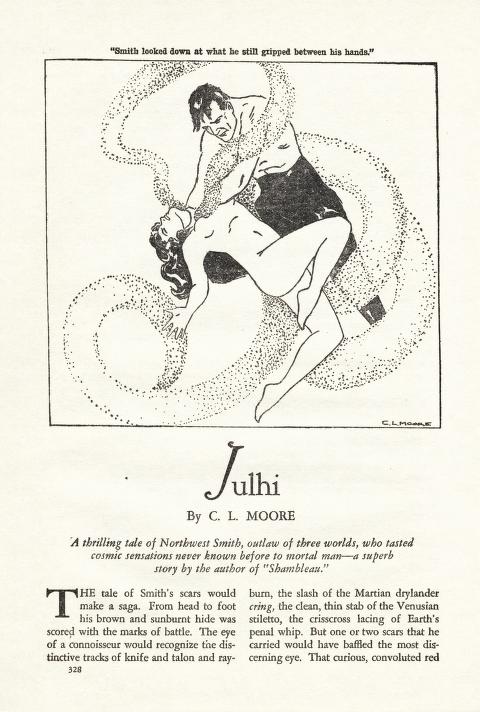
“Dust of the Gods” (1934) by C. L. Moore

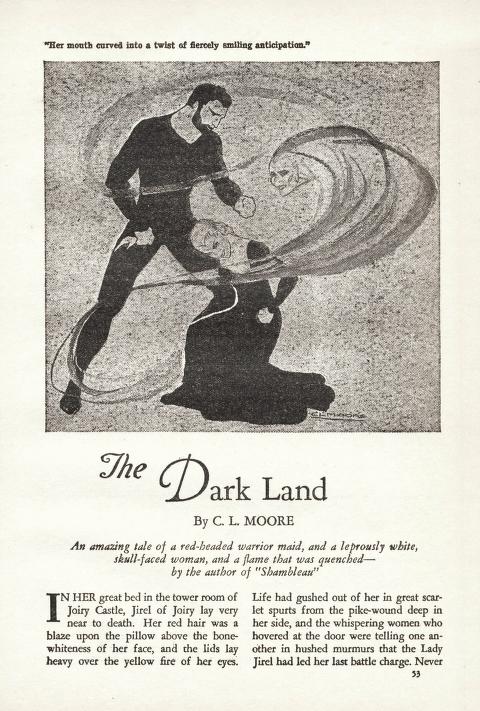
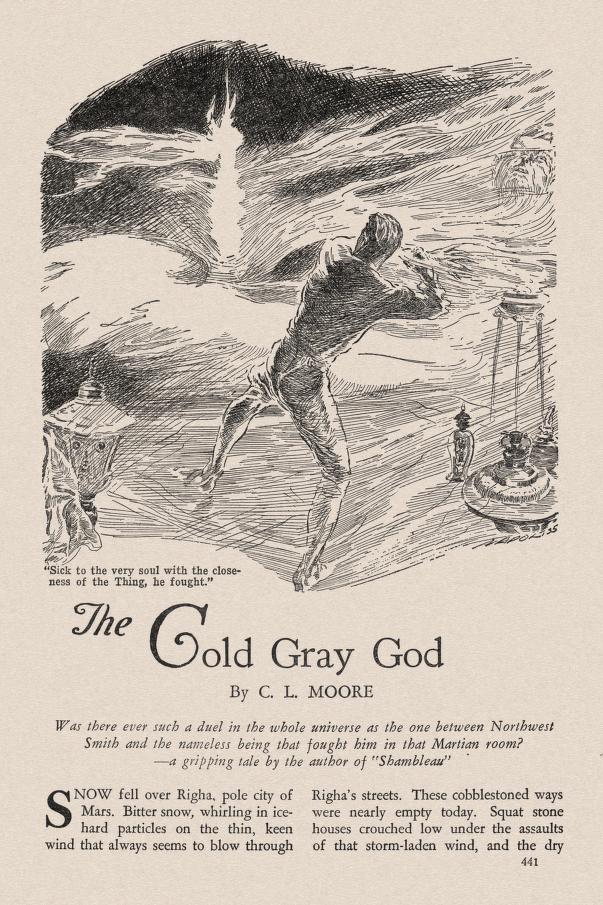
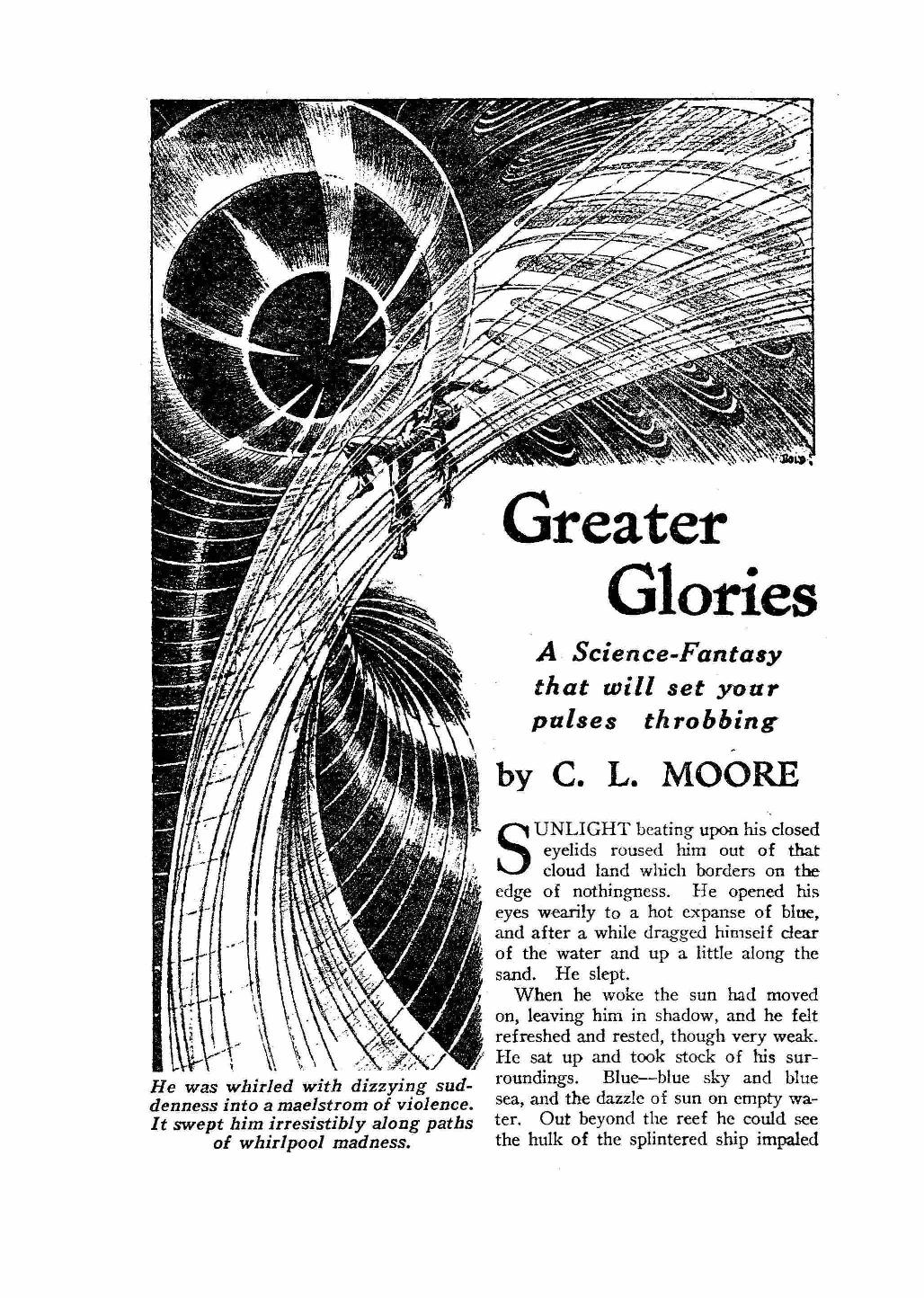
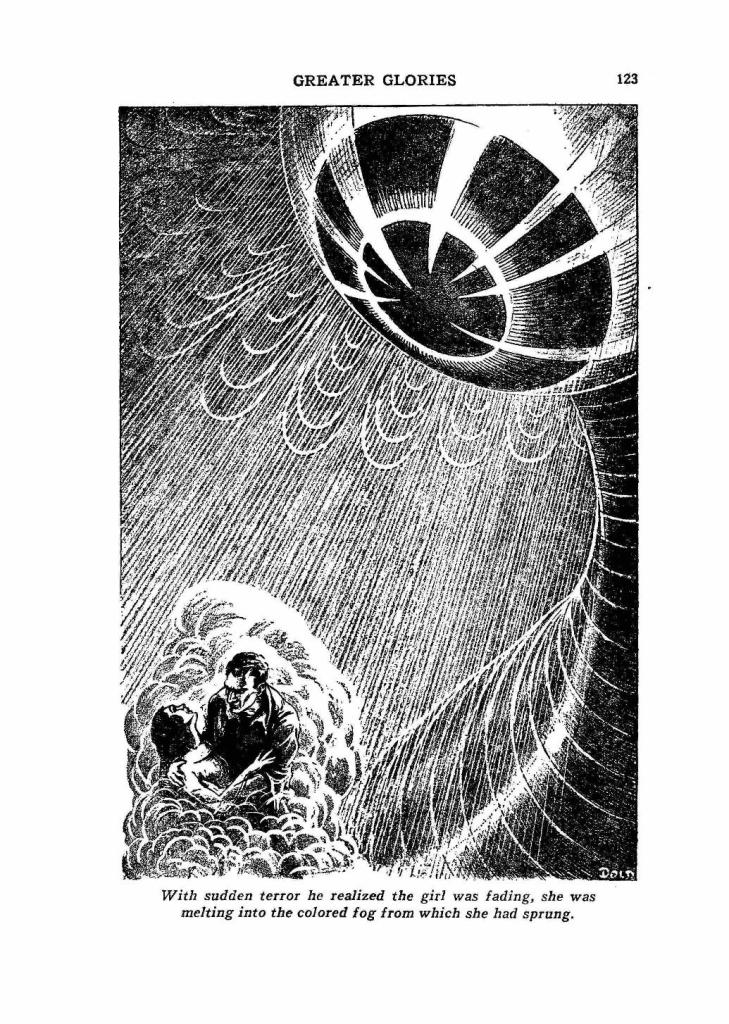
The fan-letters for “Scarlet Dream” were still being run in Weird Tales when the fourth adventure of Northwest Smith was announced, to appear in the August 1934 issue. While it sold readily enough to Farnsworth Wright, Moore herself had misgivings about the story:

An August tale, DUST OF GODS, is pretty poor, I’m sorry to say.
—C. L. Moore to R. H. Barlow. n.d. (early Apr 1934), MSS Brown Digital Repository

The young fan Barlow had been in touch with Moore for a few months,

Which brings us round to your query about revamping some of my tales. If you think they’re worth while, and if the necessity arises, I’ll try, tho it’ll be like pulling teeth. The mental sloven again. Yes, the Guardian of the cave in DUST OF GODS was rather unnecessary. You’re not telling me anything about my own defects that I don’t know already. That story was written just at the drag-end of a very blank period, and patched painfully together. Maybe that’s why I hate it so—it was so hard to write. The Guardian, I still think, could have been quite effective if handled more carefully. The idea came from no less a personage than the Sea-Hag’s Goon (I suppose Popeye graces your Floridan funnies?) Did you ever notice that the Goon, even in the darkest night, never seems affected by shadows at all? It’s as if the creature belonged to another state of being so remote from ours that the dark can’t touch it. I don’t believe “Segar” intended that effect, for he doesn’t shade his other characters either, but the Goon’s shadowless state so impressed me that I thought something should be done. You observe the sad result, tho if I’d been in a fresher state of mind I might have been able to write a whole story around such a being. It was a good idea, anyhow, don’t you think?
—C. L. Moore to R. H. Barlow, 5 Jul 1934, MSS Brown Digital Repository

C. L. Moore was still working a full-time job, writing stories whenever she could find the time. Like with many of her other stories at this point, she took impromptu inspiration from everyday events:

I think the funniest, tho, was the god Lsa who appeared briefly in DUST OF GODS. When I wrote that story I happened to see an ad for the L. S. Ayres & Company department story of Indpls. in a newspaper, and grabbed at the initials. Dust of Gods itself happened by accident. I was typing “Gold Dust” and accidentally left out the “l”, and it struck me how interesting “god dust” sounded.
—C. L. Moore to R. H. Barlow, 10 Sep-9 Oct 1934, MSS Brown Digital Repository

In “Shambleau,” “Black Thirst,” and “Scarlet Dream,” Northwest Smith falls into adventure essentially by random chance. By contrast, “Dust of the Gods” opens up like a hardboiled crime story, as Smith and his partner Yarol look for a job to afford their next bottle of segir-whiskey. They get an offer to find the dead gods of a lost planet, and embark on what in another context would be an epic fantasy quest. One with distinctly Lovecraftian overtones.

So you see the old gods have not died utterly. They can never die as we know death: they come from too far Beyond to know either death or life as we do.
—C. L. Moore, “Dust of the Gods”

Northwest Smith has a welcome skepticism and practicality to this revelation. He had, at this point, seen several alien species, had his mind and soul tugged at by different creatures that would have been eldritch entities in a Mythos story, and sought and found adventure on many worlds. Dead gods and fifty thousand dollars (plus expenses) was just another Tuesday.

The story quickly takes on an Indiana Jones-esque twist, with some gorgeous moments:

“I saw it once carved in the rock of an asteroid,” went on Yarol in a whisper. “Just a bare little fragment of dead stone whirling around and around through space. There was one smooth surface on it, and this same sign was cut there. The Lost Planet must really have existed, N. W., and that must have been a part of it once, with the god’s name cut so deep that even the explosion of a world couldn’t wipe it out.”
—C. L. Moore, “Dust of the Gods”

Moore plays a little fast and loose with the physics, and much of the story is pure description, speculation, and exposition. Yet it works well enough for its purpose. A small adventure into a fragment of Big Time, to find the fossils of ancient, pre-human gods lost in the wastelands of Mars. It veers from the formula of Moore’s previous stories—no sexy alien women here, to seduce Northwest Smith or fall in love with him—but it gives him more time and repartee with Yarol, to deepen the characterization of their partnership and to expand on the setting, the ancient Mars that was once green, and now is not, where even the most ancient and forbidden god is now little more than a common cussword.

By this point, Moore had established sufficient reputation that H. P. Lovecraft was looking forward to her next story:

I got the new W.T. yesterday, but have not had time even to glance at it. Doubt if it amounts to much except for the Moore & Howard offerings.
—H. P. Lovecraft to Robert Bloch, [11 Aug 1934], Letters to Robert Bloch & Others 109

Lovecraft was not disappointed:

Read the Aug. W. T., & fancy it is a trifle above the average. Howard, Moore, & Flagg items all notable from bizarre standpoint.
—H. P. Lovecraft to R. H. Barlow, [14 Aug 1934], O Fortunate Floridian 163

I’ve now read the August W T, & would say it stands a little above the average. I’d group the redeeming items in this order: Moore, Howard, Cave, Flagg. Miss Moore certainly is the discovery of the last half-decade—the most distinguished accession to the noble company since Howard appeared in 1925.
—H. P. Lovecraft to Richard Ely Morse, 15 Aug 1934, Letters to Hyman Bradofsky 89

Nor was Lovecraft alone:

C. L. Moore certainly must be a genius—I liked her Dust of Gods almost better than any of the tales so far published. My one objection is the omnipresent ray-gun, whose use seemed particularly unnecessary in this tale, since the dust could better have been ignited by some secret device installed aeons agao to protect it from desecration.
—Clark Ashton Smith to R. H. Barlow, 10 Sep 1934, To Worlds Unknown 256

Smith was being, perhaps, a little disingenuous here. He had done his share of interplanetary adventures for the pulps, including those set on Mars and dealing with brooding, ancient, alien horrors, such as “The Vaults of Yoh-Vombis” (Weird Tales May 1932), and if he didn’t use a lot of rayguns, he and more were both very much tapping into some of the same atmosphere of interplanetary horror, of a setting on distant worlds that were lived-in and grimy, not perfect and unblemished.

Average fans praised Moore, though “Dust of the Gods” took second place to Robert E. Howard’s “The Devil in Iron” for the best story in the issue. Still, Moore was cognizant of the quiet efforts by R. H. Barlow against falling into pulp conventions and formulaic stories.

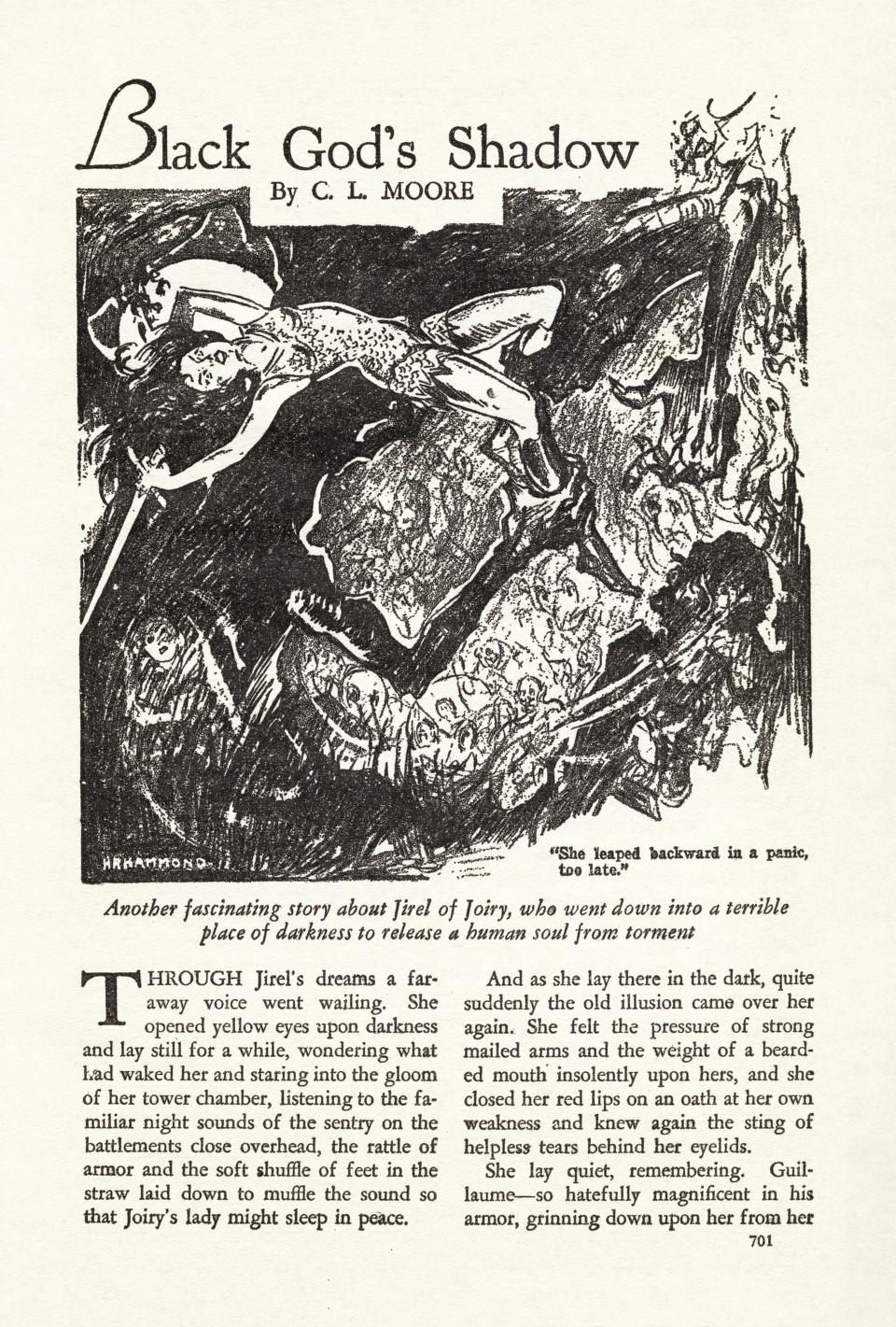
I’ve taken your advice at last about burying dear old Northwest Smith, temporarily at least. Just yesterday I had a letter from Mr. Wright accepting a new story with a medieval lady as the central character.
—C. L. Moore to R. H. Barlow, 16 May 1934, MSS Brown Digital Repository

“Dust of the Gods” may be read for free online here.


Bobby Derie is the author of Weird Talers: Essays on Robert E. Howard and Others and Sex and the Cthulhu Mythos.

Deep Cuts in a Lovecraftian Vein uses Amazon Associate links. As an Amazon Associate I earn from qualifying purchases.
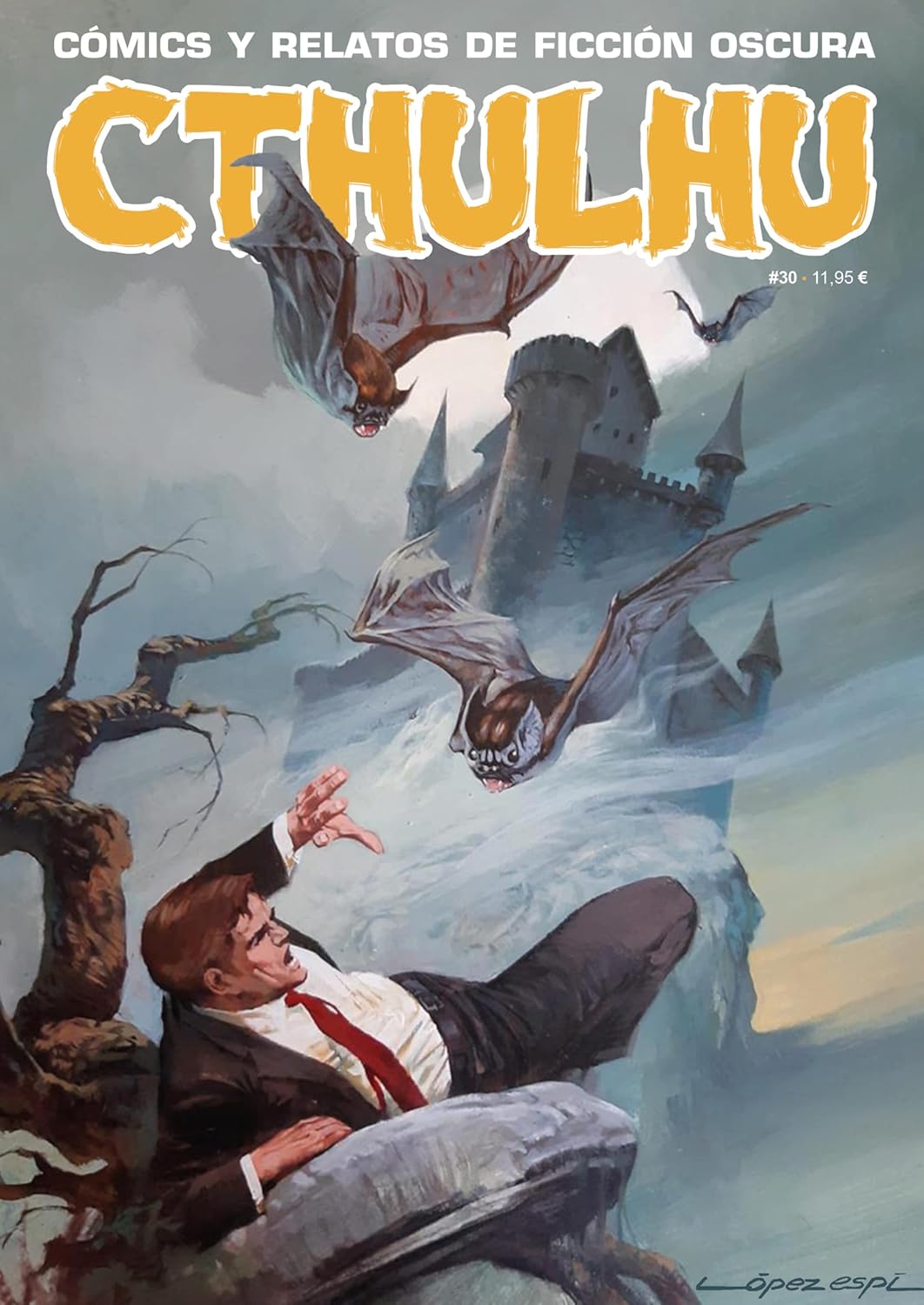
“A Resonant Darkness” (2025) by Nina Kiriki Hoffman

Her grandfather scared her, and sometimes did things to her.
—Nina Kiriki Hoffman, “A Resonant Darkness” in Cold War Cthulhu (2025) 76

Child protagonists are an interesting choice for horror stories. They are often innocent, ignorant of the way the world works, ignored by grown-ups, relatively powerless against threats they cannot name, prone to fantasy and flights of the imagination, yet credulous to their own senses and the existence of the supernatural. A child in danger tugs at the heartstrings of many, and often readers can sense and understand that a child is in danger before the character realizes it, which helps to build tension.

More than that, perhaps, adult readers know the ways that children are vulnerable to abuse. There is an intersection of real-world fears that underlies every interaction in a story told from a child’s point of view. Not just predation, but the need to grow up too soon, the way their childhood can be taken from them, how easily traumatic events can upend their lives and rob them of safety and security.

Home, where she helped Mom take care of the five younger children. Mom had weird moments where, if one of the babies was crying, she’d curl up in a corner with her hands over her ears. Then Twyla would go in and take the bay out of his or her crib and check and change the diapers and warm up formula and feed the baby, and the baby would relax, and eventually Mom would come out of her weird fit and pretend it never happened.
—Nina Kiriki Hoffman, “A Resonant Darkness” in Cold War Cthulhu (2025) 76

Adding a supernatural element to that mix can either be the nudge that turns domestic tragedy into dark fantasy or stark horror. In the hands of a skilled writer, it can sometimes redefine the nature of the seemingly mundane if terrible threat. Recasting child sexual abuse or the early shouldering of responsibilities for a failing parent into…something else, more disquieting.

Preparation, perhaps. Or initiation.

There is a history of Mythos fiction centered around a child protagonist or victim, the most famous stories of which are probably Robert Bloch’s “The Unspeakable Betrothal” (1949) and “Notebook Found in a Deserted House” (1951). Nina Kiriki Hoffman’s “A Resonant Darkness” is alike to these stories in some of the techniques: the child is often isolated; adults are either powerless to help them, or prove complicit in their victimization. Someone wants something from the children, and without any support network, they are left alone to face whatever seeks them.

In terms of plot, “A Resonant Darkness” feels more like a prologue than a complete story. Many questions are left unanswered, and while there is a beginning, middle, and end, the story feels like a beginning—certainly it is for young Twyla. The story earns its place in the anthology Cold War Cthulhu due to its setting: 1958, the World’s Fair in Denmark, where a visit to the U.S.S.R. exhibition to see Sputnik 2 prompts thoughts of the things in the outer darkness and the sacrifices made to them their, animals sent up as astronauts to die in space, far from home. It is a workable setting for the theme, although for plot purposes, the time and place matter less than the relationships and actions involved.

It’s the child in danger that matters, that keeps the reader on their toes, and keeps them reading to the last page.


Bobby Derie is the author of Weird Talers: Essays on Robert E. Howard and Others and Sex and the Cthulhu Mythos.

Deep Cuts in a Lovecraftian Vein uses Amazon Associate links. As an Amazon Associate I earn from qualifying purchases.
“Scarlet Dream” (1934) by C. L. Moore

And speaking of Cabell, wait till you read my May story! I hadn’t realized until I read over the proof-sheets they sent me last week how closely it follows the Cabell-Dunsany phraseology. For instance “—so it might have been no mortal twilight, but some strange and lovely evening in a land where the air was suffused with colored mists, and no winds blew”. It’s almost trite, it’s so Cabellian-Dunsanyesqe. (Heavens! Excuse that! I didn’t mean to coin words so flagrantly.)
—C. L. Moore to R. H. Barlow, 28 Apr 1934 MSS Brown Digital Repository

The third tale of Northwest Smith after “Shambleau” (Weird Tales Nov 1933) and “Black Thirst” (WT Apr 1934) followed in the very next issue after the second episode, appearing in the May 1934 issue of Weird Tales. Smith is once again on Mars, though at this point there is no strict chronology in the series, no reference to previous episodes. Each is essentially a standalone story, a separate episode in Smith’s checkered career, much as Robert E. Howard’s characters Conan the Cimmerian and Solomon Kane did not have episodes that followed in any strict chronological order.

In gist, “Scarlet Dream” follows several familiar tropes: an exotic market, a strange purchase, a fabulous dream. Yet the tropes are those of fantasy, adapted to the science fiction setting. There are hints of worldbuilding—a Martian emperor, ivory from Jupiter’s largest moon, a unit of currency called a cris that is more than five dollars—some of which have appeared in previous stories and will appear in future ones, and others which are throwaway details. The idea of a cloth or pattern as a focus of strangeness was nothing new either: “The Yellow Wallpaper” (1892) by Charlotte Perkins Gilman, “The Diary of Mr. Poynter” (1919) by M. R. James, and “The Cloth of Madness” (1920) by Seabury Quinn all being iterations of that idea.

Yet for Northwest Smith, the cloth does not bring madness, but transportation. This was the first of Moore’s stories that would feature the protagonist on a journey to a different world in the sense of another dimension rather than just another planet; a transition fundamentally different from rocketships and standard interplanetary tales fare. However, it is couched in the sort of imagery of Dunsany or Lovecraft’s Dreamlands tales, like “The Silver Key” (1929):

“There are many dream countries,” she said, “many nebulous, unreal half-lands where the souls of sleepers wander, places that have an actual, tenuous existence, if one knows the way. . . . But here—it has happened before, you see—one many not blunder without passing a door that opens one way only. And he who has the key to open it may come through, but he can never find the way into his own waking land again. Tell me—what key opened the door to you?”
—C. L. Moore, “Scarlet Dream”

There’s a woman; nameless and beautiful, tragic and doomed. While many fans and critics will point out the women in Howard’s Conan tales, Northwest Smith is seldom at a loss for a beautiful woman, whether human or otherwise, though his relationships tend to be brief and often marked by strangeness, she was not averse to the possibilities of romance that Lovecraft shunned in his own fiction, nor prone to the kind of nudity, bondage, or flagellation that marked the stories of Seabury Quinn and Robert E. Howard when they sought to make the cover of Weird Tales with a particularly enticing scene.

The nameless Thing that stalks the dream-world, preying as it will, recalls in part Robert E. Howard’s “The Slithering Shadow” (WT Sep 1933), where the amorphous Thog preys upon the dreamers of the city of Xuthal. Whether that was direct inspiration or coincidence, Moore never makes clear in any letter. It is interesting to think of this story as a kind of complement to Howard’s tale; as Conan deals with a city of sleepers and the horror that stalks them, Northwest Smith deals with a dreamer and the shadowy predator that hunts them, and both find a way to hurt their foe, and to escape. Yet it would probably be more accurate to say that without deliberately tying her Northwest Smith story to any Mythos of Lovecraft or Howard’s, Moore was drawing on familiar elements in crafting her own unique tale.

The fan-response was, once more, very positive, though there was a slight trend against interplanetary stories—the criticism being aimed more at Edmond Hamilton than C. L. Moore. “Scarlet Dream” was voted the favorite tale of the issue, beating out Robert E. Howard’s Conan tale “Queen of the Black Coast.” Among her writer peers, H. P. Lovecraft noted the story’s excellence in brief:

“Scarlet Dream” is also the real stuff—full of the tension & mystery needed by a weird tale.
—H. P. Lovecraft to Clark Ashton Smith, [May/June 1934], Dawnward Spire, Lonely Hill 557

The May W T was much above the average, with “Scarlet Dream”, “Queen of the Black Coast” & “The Tomb Spawn”.
—H. P. Lovecraft to Duane W. Rimel, 1 Jun 1934, Letters to F. Lee Baldwin, et al. 180

The plot of “Scarlet Dream” is relatively slight, though evocatively written; if there’s a criticism to be made, then it has to do with the episodic nature of what was now quite clearly a series. All three stories feature broadly the same three-act structure: Northwest Smith is minding his own business; falls into some strange business involving a beautiful woman, has a horrific encounter with some alien entity; and then emerges with the woman dead and Smith strangely affected by an experience beyond normal human ken. Beauty and vampirism are recurring themes. Something that her fellow-Weird Talers noticed:

I can’t get excited over Moore; too feminine stories, for one thing, and the effect rests too much on being outside this earth.
— August Derleth to CAS, 22 May [1934], Eccentric, Impractical Devils 221

Personally, I rather like the Moore stories; though I notice that the three already published all have the same recipe of ingredients. The ray-gun stuff is a drawback. What I do like is the hint of unearthliness. After all, very few writers achieve anything that even suggests the possibility of non-terrestrialism; and I admit that I value this particular imaginative quality.
— Clark Ashton Smith to August Derleth, 4 Jun 1934, Eccentric, Impractical Devils 222-223

Not that there’s anything wrong with that; far from it. The stories had sold and been well-received by fans. Formula by itself is often misinterpreted as a drawback, which it is when someone tries to define and follow it too rigidly. Moore was taking inspiration from her favorite weird fiction and filtering it through her own imagination. What she was concerned about, however, was growing stale.

I was tremendously pleased at your confidence about Mr. Lovecraft’s flattering opinion of me. So much so that I’m ashamed to have you read the sort of stuff I’m turning out now. Those first three of mine I did think were pretty fair, but I just don’t have ideas like that all the time, and meanwhile have got to eat, you know. I mean that quite literally.
—C. L. Moore to R. H. Barlow, 1 Jun 1934, MSS Brown Digital Repository

Farnsworth Wright, editor of Weird Tales, was apparently pleased with what he had read and published so far, and another Moore story would be published just a few months later.

C. L. Moore’s “Scarlet Dream” can be read for free online here.


Bobby Derie is the author of Weird Talers: Essays on Robert E. Howard and Others and Sex and the Cthulhu Mythos.

Deep Cuts in a Lovecraftian Vein uses Amazon Associate links. As an Amazon Associate I earn from qualifying purchases.
“Black Thirst” (1934) by C. L. Moore

JE: Did the success of “Shambleau” generate numerous requests for additional stories?

CLM: No, not really. The editor of Weird Tales, Farnsworth Wright, simply told me that he would like to see more of my work. No other editors, at the time, wrote to me requesting additional stories. My success in the science-fiction field came gradually and only after the publication of several other stories. […] I didn’t want it to be known at the bank that I had an extra source of income. I wrote “Shambleau” in the midst of the Depression. The bank was a very paternalistic organization. It was already firing those people whose services weren’t really needed. I had the feeling that they might have fired me had they known that I was earning extra income. So I kept it a deadly secret. Using my initials was simply a means of obscuring my identity.
—“C. L. Moore: POET OF FAR-DISTANT FUTURES” by Jeffrey M. Elliot in Pulp Voices (1983) 46-47

“Shambleau” (WT Nov 1933) struck like a lightning bolt—boldly original, and meeting almost universal acclaim. Yet the pages of Weird Tales are littered with one-hit wonders, authors who sold a single story and never made another sale, or who did sell again but could never recapture the power and promise of that first story. With C. L. Moore’s second tale, readers would find out whether “Shambleau” was a lucky accident or not. Within a few months, they found out.

BLACK THIRST
by C. L. Moore

Another weird and thrilling tale about Northwest Smith, by the author of “Shambleau”—an astounding story of ultimate horror.
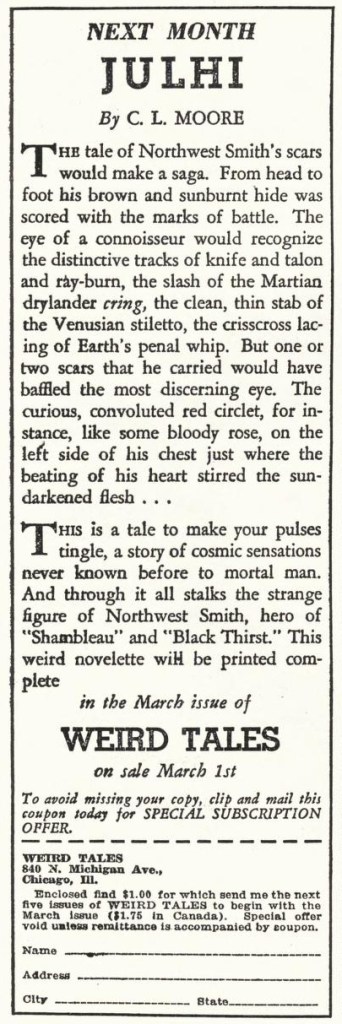
—”Coming Next Month,” Weird Tales Mar 1934

Between November 1933 and March 1934, C. L. Moore had not been idle. The Great Depression was still raging, she was still working in her secretarial position in Indianapolis, and she now had a new, unexpected source of income if she could continue to sell stories. According to a 1976 interview with Chacal, her second story, “Werewoman,” was rejected; whether or not this was quite the order of events is unclear as some of her later interviews are contradictory on this matter, but it seems clear that she was emboldened to write several new stories and submit them to Weird Tales; editor Farnsworth Wright bought some of them and relatively quickly brought them to press.

“Black Thirst” appeared in the April 1934 issue of Weird Tales. It is the second published tale of Northwest Smith; the one-off space outlaw was now officially a series character. Set on Venus rather than Mars, with Earth as no more than a green star in the sky, it follows a similar mix of beauty mingled with horror, ray-gun action, and alienation—not repeating the plot of “Shambleau,” but strongly evocative of the elements that had made that story work, somewhat remixed. From some subsequent comments, it is apparent that Moore was at this point more likely to write by the seat of her pants than plot, and take advantage of sudden bursts of inspiration:

You ask for manuscripts. If what you mean is the original draft, all scribbled over, the only one I have now is the medieval-lady opus. I’ll enclose it when I return your magazines. It’s not a very accurate original, tho, for when I typed it for publication I made a good many changes as I went along. And as I remember, I changed my mind in the middle a couple of times, and deflected the course of the story. You see, I never know until I’m half-way through how it’s going to end, and usually have to go back and alter the first a little to hitch up with the last. I was nearly thru with SHAMBLEAU before I had the remotest idea how I was going to rescue Smith from her clutches. And in BLACK THIRST the Alendar’s relapse into primeval ooze was as much of a shock to me as to any of the characters in the sotry. I didn’t know until I had actually begun that scene on the edge of the underground sea how I was going to overcome the Alendar. Smith’s hairbreadth escapes were quite literally harbreadth, for I’m usually breathless with apprehension as I snatch him just in time from the awful dangers that beset him. Tho that’s all past tense now, I suppose.
—C. L. Moore to R. H. Barlow, 1 Jun 1934, MSS Brown Digital Repository

By the way, speaking of the Alendar, I wonder how other people find the odd names they want for characters. I usually glance around ind esperation and seize on the first hting I see. Alendar is simply Calendar with the C left off. And N. W.’s friend Yarol is a transpostion of the name on the Royal typewriter I wrote the story on.
—C. L. Moore to R. H. Barlow, 10 Sep-9 Oct 1934, MSS Brown Digital Repository

There is also a suggestion that Farnsworth Wright, following his editorial habits (see “Bat’s Belfry” by August Derleth), was revising Moore’s manuscripts as they came in. The exact nature of these revisions is unclear, though typically he asked writers to tighten up overwordy passages or would silently remove references to sex.

I trust your revisions may make Mrs. Moore’s second story as striking and interesting as this one.
—H. P. Lovecraft to Farnsworth Wright, 21 Nov 1933, Letters to Woodburn Harris 86

The story is slightly more daring than typical Weird Tales entries. The third paragraph includes a bald reference to “Venusian street-walkers,” and the story deals with human-trafficking and eunuch-guarded harems in a way strongly reminiscent of Yellow Peril stories of white slavery and seraglios, an alien eugenics that treats the breeding of human beings like humans breeds cows or cats, and an almost homosexual element when the Alendar considers Northwest Smith:

“I realized how long it had been since I tasted the beauty of a man. It is rare, so different from female beauty, that I had all but forgotten it existed. And you have it, very subtly, in a raw, harsh way…”
—C. L. Moore, “Black Thirst”

More than “Shambleau,” the expanding Interplanetary setting that C. L. Moore sketches echoes fantasy as much or more than science fiction. She speaks of the three planets (Mars, Venus, and Earth), but there are kings, castles, courts, and courtesans; payment is expected in gold coins; and Smith looks for swords and daggers as much as rayguns. If “Shambleau” was drawing heavily on Westerns, then “Black Thirst” seems to draw as much from her quasi-medieval fantasy setting in her pre-pulp writing. If there is a criticism to the story, it might be that it hews a little too close to the plot of “Shambleau.” Once again, Northwest Smith finds himself facing an almost spiritual as well as physical peril from a vampiric alien. While not quite formulaic, readers could definitely see how strongly it echoed some of the notes of Moore’s first tale.

Yet they loved it.

Donald Allgeier, of Springfield, Missouri, writes: “This letter is written primarily because of Black Thirst. I have a thirst (black or not) for more like it. I hope the next story by Moore is as good as this. . . . Who is C. L. Moore, anyway? Surely he’s not a brand-new author—not when he can write as he does. Could he perhaps be a new pseudonym for some famous writer? I thought he had just about reached the ultimate in his first story, but the second proved my mistake. Most authors would carefully avoid description of all those beautiful girls, but Moore handles it beautifully, delicately, and marvelously. The Alendar, too, is a worthy creation. I’d like to see a novel by Moore.
—”The Eyrie,” Weird Tales June 1934

There were many more fan-comments in that vein, and Wright had already seen the promise of his new discovery and bought more stories from Moore–and Wright was careful at this point to follow her wishes and not reveal her gender, though that bit of gossip would soon make the rounds in fan-circles. Even her pulp peers were impressed by Moore’s sophomore effort; Lovecraft praised it to many of his friends. Though most of Lovecraft’s comments are brief, a few are fuller:

The present issue, I think, is far above the average—with your tale, the splendid Bruks reprint, the powerful Smith yarn with self-drawn illustration, and the strikingly potent, original, and distinctive “Black Thirst”.
—H. P. Lovecraft to Robert E. Howard, 3 Apr 1934, A Means to Freedom 2.727

The recent WT is distinctly above average—“Black Thirst” perhaps leading because of the utter originality of its conception, the vividness of its unfolding, & the ever-brooding air of hidden, transcendent horror just beyond one’s sight. A little less conventionality of the popular-romance setting & mood would increase the power of the tale.
—H. P. Lovecraft to R. H. Barlow, 10 Apr 1934, O Fortunate Floridian 129

“Black Thirst” has a lot of conventional stuff, but the atmosphere of utterly unknown evil & menace is extremely distinctive.
—H. P. Lovecraft to Clark Ashton Smith, [13 Apr 1934], Dawnward Spire, Lonely Hill 552

In 1935 when R. H. Barlow was thinking of re-printing the story for Moore through his small press, he apparently considered revising the tale—which Lovecraft disagreed with:

As for revision—some of the tales would take careful thought indeed. “Black Thirst” couldn’t be revised except by striking at its very core—cutting out the vapid idea of human-looking beauties on another planet (unless descent from a remote terrestrial source is suggested, &c.), &c. It might be wisest to let some of the tales alone, & hope that later specimens will avoid the flaws which they possess. But all that is for later consideration.
—H. P. Lovecraft to R. H. Barlow, [25 Mar 1935], O Fortunate Floridian 229

As a young man, Lovecraft had grown up on adventurous “planetary romances” like Edgar Rice Burrough’s A Princess of Mars, which featured lots of action and improbably human-looking aliens with princesses that could procreate quite readily with Earth-born heroes. Biologically, this is as bunk as Star Wars and Star Trek‘s rubber-forehead aliens, and as an adult Lovecraft was very critical of the idea of Earth-like worlds that evolved Earth-like humanoids, as expressed in Lovecraft’s “Some Notes on Interplanetary Fiction.” So Lovecraft was not strongly drawn to the Burroughs-esque elements that may have appealed to Weird Tales fans; for him, it was the sheer alien weirdness and horror that was the true appeal of Moore’s first couple stories.

There is every indication that Wright knew he had another hit on his hands with “Black Thirst,” because he had already bought other stories that was destined to appear in subsequent issues of Weird Tales. Yet the Unique Magazine brought with it more than acceptances and (eventually) welcome checks; Moore also made new friends, as fan-letters from Weird Tales turned into correspondences with folk like R. H. Barlow.

I hope you will not be too much disappointed in the stories that follow. Perhaps, when you have read those appearing in the April and May issues, you will write again to tell me what you thought of them.
—C. L. Moore to R. H. Barlow, 8 Mar 1934, MSS Brown Digital Repository

Through Barlow, Moore would come to correspond with Lovecraft, Robert E. Howard, and Clark Ashton Smith, among others. It connected her to a wider community of writers, whom she would both influence and be influenced by. If “Shambleau” marked C. L. Moore’s arrival on the scene, “Black Thirst” helped her swiftly gain acceptance into the world of weird and science fiction pulp writers.

C. L. Moore’s “Black Thirst” can be read for free online here.


Bobby Derie is the author of Weird Talers: Essays on Robert E. Howard and Others and Sex and the Cthulhu Mythos.

Deep Cuts in a Lovecraftian Vein uses Amazon Associate links. As an Amazon Associate I earn from qualifying purchases.
“The Corpse That Wouldn’t Die!” (1953) by Jack Cole

I have given the whole of a cloudy Sabbath to finish my dismembered corpse story—“The Return of Helman Carnby”. I shall enclose the carbon with this; and I hope you will like it. The thing became a sizable yarn, with all the details that I worked out . . . It goes to “Ghost Stories”, then to W. T.,—both of which will doubtless reject it. But I think myself that the tale is a pretty fair literary beginning for the New Year. I like to picture it in the sunny and lightsome pages of the “Ladies’ Home Journal.”
—Clark Ashton Smith to H. P. Lovecraft, c. early Jan 1931, Dawnward Spire, Lonely Hill 290

Needless to say, I perused the monstrous narrative of Helman Carnby with the most acute & shuddering admiration; &, having made the verbal changes indicated in your supplementary note, have forwarded to Derleth with instructions for return to you through Wandrei. It is certainly a great piece of work, & I am extremely flattered by the prominent part played therein by the Necronomicon. But God! If there is still a copy of the original Arabic version in existence, what safety can we guarantee for this unhappy planet? Is it not true that no copy was found when the police entered the seemingly deserted mansion of Carnby & observed those hideous & inexplicable conditions which the newspapers were not allowed to print? What of that utterly unthinkable foot-mark which seemed to be burned into the floor? But one must not think of such things! Anyway, it’s a great yarn, & the cumulative suspense & malign suggestiveness of the earlier parts are enough to set any outfit of teeth—even false ones on a dentist’s cupboard shelf—chattering! It looks to me quite all right as it is—if there were any way of piling on another shudder, I’d say it would be by veiling the final horror a little more obscurely from actual sight, & trying to hint or imply the blasphemous abnormality which sent the secretary fleeing from that accursed habitation. I certainly hope that the tale will find a typographical haven.
—H. P. Lovecraft to Clark Ashton Smith, c. 18 Jan 1931, Dawnward Spire, Lonely Hill 293

Ghost Stories did not take “The Return of Helman Carnby,” not even after Smith re-wrote the ending and sent it back for another look; nor was it published by Weird Tales. The story was published in Strange Tales of Mystery and Terror (Sep 1931), under the title “The Return of the Sorcerer.” This is arguably Smith’s most distinctly “Lovecraftian” story, being an explicit extension of Lovecraft’s Mythos rather than involving any of Smith’s own fabulous settings and entities, and one of the first uses of the Necronomicon outside of Lovecraft’s own works (compare “The Were-Snake” (1925) by Frank Belknap Long, Jr. and “The Picture” (1939) by Robert D. Harris).

“The Return of the Sorcerer” was reprinted in Smith’s first Arkham House collection Out of Space and Time (1942), and anthologist August Derleth selected it for inclusion in Sleep No More (1944), which meant it was included in the Armed Services Edition of that book issued to soldiers during World War II. One can just about imagine a marine en route across the Pacific Ocean idling away a sweltering hour reading of the dismembered corpse crawling from the grave. By the 1950s, however, “The Return of the Sorcerer” had been out of print for years—though not forgotten.

Web of Evil was a horror comic published by Quality in the years immediately before the formation of the Comics Code Authority, and which ran 21 issues. The product was typical of the era: often shoddy artwork and simple, quick stories that emphasized grue and taboo, shock and suspense. The stories were often unsigned and the creators weren’t above lifting a plot from an old pulp magazine from time to time.

“The Corpse That Wouldn’t Die!” in Web of Evil #2 (Jan 1953) by artist Jack Cole is very clearly based on “The Return of the Sorcerer.” The names were changed to hide the plagiarism, and the unnamed Necronomicon is in Sanskrit rather than Arabic, but the essentials of the story are clearly recognizable. It may no longer be a Mythos story, but for all that it has a distinct charm for those that recognize that Cole is, at least, lifting from the best.

At six pages, the action moves fast—and in almost every panel, Cole tries to add some dramatic element of lighting or motion to capture the eye or set the tone, which often leads to near-comical exaggeration. Though there is not so much grue as there might have been: after all the corpse of the deceased sorcerer is still intact when it returns from the grave.

Lifting stories from pulp writers was not unusual in the 50s, and “The Corpse That Wouldn’t Die!” sits neatly among the Pre-Code Lovecraftian Horror Comics. The tale has been reprinted a number of times, including a version in Tales of Voodoo vol. 5, no. 2 (Mar 1972), where the art was reworked by Oscar Fraga and the result retitled “The Deadly Corpse” (sample pages below). Fraga’s rework updates the art to match the sensibilities of Eerie Publications in the 70s, but doesn’t add anything new to the story itself.

The original Web of Evil version can be read for free at Comic Book Plus.


Bobby Derie is the author of Weird Talers: Essays on Robert E. Howard and Others and Sex and the Cthulhu Mythos.

Deep Cuts in a Lovecraftian Vein uses Amazon Associate links. As an Amazon Associate I earn from qualifying purchases.
“Lockbox” (2015) by E. Catherine Tobler

There are not a vast number of women mentioned in H. P. Lovecraft’s “The Rats in the Walls.” However, two stand out:

The worst characters, apparently, were the barons and their direct heirs; at least, most was whispered about these. If of healthier inclinations, it was said, an heir would early and mysteriously die to make way for another more typical scion. There seemed to be an inner cult in the family, presided over by the head of the house, and sometimes closed except to a few members. Temperament rather than ancestry was evidently the basis of this cult, for it was entered by several who married into the family. Lady Margaret Trevor from Cornwall, wife of Godfrey, the second son of the fifth baron, became a favourite bane of children all over the countryside, and the daemon heroine of a particularly horrible old ballad not yet extinct near the Welsh border. Preserved in balladry, too, though not illustrating the same point, is the hideous tale of Lady Mary de la Poer, who shortly after her marriage to the Earl of Shrewsfield was killed by him and his mother, both of the slayers being absolved and blessed by the priest to whom they confessed what they dared not repeat to the world.
—H. P. Lovecraft, “The Rats in the Walls”

While it wouldn’t be quite accurate to say that Lovecraft scholarship has ignored these women, it would be accurate to say that the picklocks of literary critics and historians haven’t turned up any particular connections or likely historical or literary inspirations for Margaret Trevor and Mary de la Poer. While we know Lovecraft drew inspiration for this tale from Sabine Bearing-Gould’s “S. Patrick’s Purgatory” in Curious Myths of the Middle Ages, and while there is no lack of mysterious ladies therein, one stands out as a possible inspiration:

It is worthy of remark that the myth of S. Patrick’s Purgatory originated among the Kelts, and the reason is not far to seek. In ancient Keltic Mythology the nether world was divided into three circles corresponding with Purgatory, Hell, and Heaven ; and over Hell was cast a bridge, very narrow, which souls were obliged to traverse if they hoped to reach the mansions of light. This was—

“The Brig o’ Dread, na brader than a thread.”

And the Purgatory under consideration is a reflex of old Druidic teaching. Thus in an ancient Breton ballad Tina passes through the lake of pain, on which float the dead, white robed, in little boats. She then wades through valleys of blood. (248-249)

This is speculative; Lovecraft borrows some of the imagery for “The Rats in the Walls,” and it includes a woman recalled in a ballad associated with pain and blood, which may have been the seed from which Margaret Trevor and Mary de la Poer (and their respective ballads) grew. One might also wonder if the legend of Elizabeth Bathory worked on Lovecraft’s imagination, or any of the prospective cultists included in Margaret Murray’s The Witch-Cult in Western Europe, and these are certainly possible. The image is, in both cases, of women of the line who do not shrink away from the family cult, but become active participants.

Trish Thawer in The Witches of BlackBrook (2015) famously wrote: “We are the daughters of the witches you weren’t able to burn.” While that may not be historically true (convicted witches during the Salem Witch hysteria were hung, not burned at the stake), there is a sentiment that applies to readers and writers in Lovecraft’s Mythos: who are the daughters and granddaughters of Lovecraft’s women cultists, who had such a bad reputation that they haunted the ballads of the country for centuries thereafter?

Which is the theme that E. Catherine Tobler assays in “Lockbox,” one of the stories in She Walks in Shadows. The brief story is a return to Exham Priory by a female descendant of the de la Poer (or Shrewsfield) line and her not-quite-trustworthy lover…and the thing that makes the story work is that it is her story, her reconnection with this ancestor and all the mystery and horror that Margaret Trevor of Cornwall represents, not as a member of the cult she was marrying into, but as a black saint in her own right:

The worst thing was, despite the horrors around her, Margaret Trevor was something to be worshipped, a glory even in the blood and ruin that streaked her. The stories said that she loved the old cults well, but had taken a passive role beside her husband. But here, in the horrible cellar with the collapsing girders, she was a gold-and-silver goddess while her husband cowered.
—E. Catherine Tobler, “Lockbox” in She Walks in Shadows 94-95

The story is told with many footnotes, many caveats, things that cannot be said and perhaps dare not be remembered. It gives the suggestion of a maddening experience that has snapped a thread of sanity and memory, but the title is the crux of the story, because it is a mystery and a memory that the narrator can choose to recall whenever she wishes—whenever she is ready to leave her placid isle of ignorance and remember what really happened down there, in the buried ruins of Exham Priory.

“Lockbox” by E. Catherine Tobler was first published in She Walks in Shadows (2015) and its reprints, and was also reprinted in Wilde Stories 2016: The Year’s Best Gay Speculative Fiction.


Bobby Derie is the author of Weird Talers: Essays on Robert E. Howard and Others and Sex and the Cthulhu Mythos.

Deep Cuts in a Lovecraftian Vein uses Amazon Associate links. As an Amazon Associate I earn from qualifying purchases.
The Long Shalom (2023) by Zachary Rosenberg

People have such queer ideas about private detectives.
—Raymond Chandler, The Long Goodbye (1953)

Hardboiled detective fiction has never ignored the existence of ethnic minority, BIPOC, and LGBTQ+ characters. The representation often wasn’t great; prejudices were common, and sometimes a plot point. Genre-blending mixes with hardboiled fiction tend to follow similar lines. In the made-for-tv movie Catch A Deadly Spell (1991), for example, a key plot point is that the man who stole the Necronomicon is in a relationship with a transwoman.

There has been a trend in contemporary works, however, to swing the other way. Instead of token diversification or showcasing prejudices while fixing on a white cisgender heterosexual viewpoint, there are stories that focus on minority viewpoints, and in particular on intersectional experiences. Winter Tide (2017) by Ruthanna Emrys has as a protagonist an Innsmouth woman during the 1950s, but her group includes two gay men, a brother and his Black girlfriend, and a Japanese-American woman; Ring Shout (2020) by P. Djèlí Clark focuses on a group of Black women, one of whom is gender-nonconforming and homosexual, another mixed-race; The City We Became (2020) by N. K. Jemisin has a group as cosmopolitan as New York itself.

The Long Shalom by Zachary Rosenberg is another entry in that mode—I asked a few folks for a pithy descriptive term, and they suggested “wokepunk” and “diversifiction”—focused on protagonist Alan Aldenberg, a bisexual Jewish WW1 veteran and ex-mob gunsel, now wise-cracking private detective, who ends up dealing with a Lovecraftian supernatural threat. Aldenberg teams up with his half-Japanese/half-Jewish bisexual ex-girlfriend and two fellow WW1 veterans: an African-American man and a transwoman.

Yet the most important thing about The Long Shalom isn’t the cast of characters; it’s how the story is fundamentally based on their experiences and the discrimination they face. As in Ring Shout, the racial, ethnic, and gender discrimination they face becomes embodied as both traditional and supernatural threats. These individuals, who each have to deal with intersectional discrimination for their particular identities, also now have bigoted cosmic horrors to deal with.

Which leads to a certain aspect of the protagonists taking these new horrors in stride. There is more to the complex interplay of identity as Alan, long non-practicing, returns to the Jewish neighborhood and finds himself an outcast among outcasts, than there is to him confronting an ancient horror that seems immune to bullets. As the fantasy aspects increase—thanks to ancient scrolls and some very Innsmouthian-flavored Jewish women in a remote seaside community—the impression becomes closer to a retelling of a game of Harlem Unbound (2017), albeit with more of a Jewish than Black focus, and the mundane antagonists become almost cartoonish in their bigotry.

Yet that is kind of the point: as much as some of these characters feel like a caricature, the real thing, whether they were police uniforms or Klan robes, was if anything more explicit and violent. Racism and prejudice is seldom nuanced or interesting at base; it’s dull, ugly, and stupid, a combination of ignorance and stereotypes, hot points of emotions that can flash into bursts of unbelievable violence over almost nothing.

Alan clenched his teeth, fighting for something inspiring to say and coming up emptier than a wine bottle after Purim.
—Zachary Rosenberg, The Long Shalom 90

While the novel is short and the fantastic elements get away a bit from the more grounded characterizations, Rosenberg does have a certain style and authentic understanding of the characters and their cultures, which is appealing. Like Ring Shout, the threat is Lovecraftian without being based explicitly on Lovecraft’s Mythos; this is fundamentally an effort to write a Jewish horror story, with a hardboiled setting and more than a taste of pulp action—and it succeeds at that.


Bobby Derie is the author of Weird Talers: Essays on Robert E. Howard and Others and Sex and the Cthulhu Mythos.

Deep Cuts in a Lovecraftian Vein uses Amazon Associate links. As an Amazon Associate I earn from qualifying purchases.
Conan de Cimmeria (2021) by Ángel Gª Nieto, Julio Rod, & Esteban Navarro

Derivative works all share a connection with the parent work. Every story with Cthulhu derives, directly or indirectly, from Lovecraft’s “The Call of Cthulhu.” Every story with Conan the Cimmerian derives from the original stories written by Robert E. Howard. From the humble pages of Weird Tales have spun out thousands of creative works in a dizzying array of media—short stories, novels, comics (strips, books, magazines, and graphic novels), cartoons, live-action and animated films, music, paintings, sculptures, toys, video games—and one of the key thing to remember about these works is that they aren’t being created in a vacuum, but in communication with one another.

The Atlantean sword in the film Conan the Barbarian (1982) owes nothing to anything in the stories of Robert E. Howard; the closest the Texas pulpster managed to a special weapon was in the first Conan tale, “The Phoenix on the Sword,” and that sword was broken in the course of the story. Some of the pastiche tales and comic book stories that followed included magic weapons, but none of them served as the immediate inspiration for the Atlantean sword in the film either. Nevertheless, the sword featured extensively in the poster and marketing materials for both Conan the Barbarian and its sequel Conan the Destroyer (1984)—and, unsurprisingly, was represented fairly faithfully in the Marvel Comic adaptations of the films.

Art by Bob Camp

For many years, outside the movie continuities, the Atlantean sword was not a key feature of most Conan media. While it continued to have lingering appeal because of the tie to the film—including multiple weapon makers providing official or bootleg versions of the sword for fans and collectors—publishers like Marvel and Dark Horse did not lean into that aspect of the film iconography.

More recently, however, the iconic Atlantean sword has seen increased placement in both official and unofficial Conan media. The latest Conan comics published by Titan have deliberately leaned into a melding of the iconic looks of previous incarnations of the Cimmerian, drawing both from the John Buscema/Ernie Chan era of Marvel Comics as well as the 1982 film. It’s little surprise that when Conan does actually go to Atlantis in Conan the Barbarian #11, the Atlantean sword—or at least a good facsimile—makes an appearance.

Art by Roberto de la Torre, Color by Diego Rodriguez

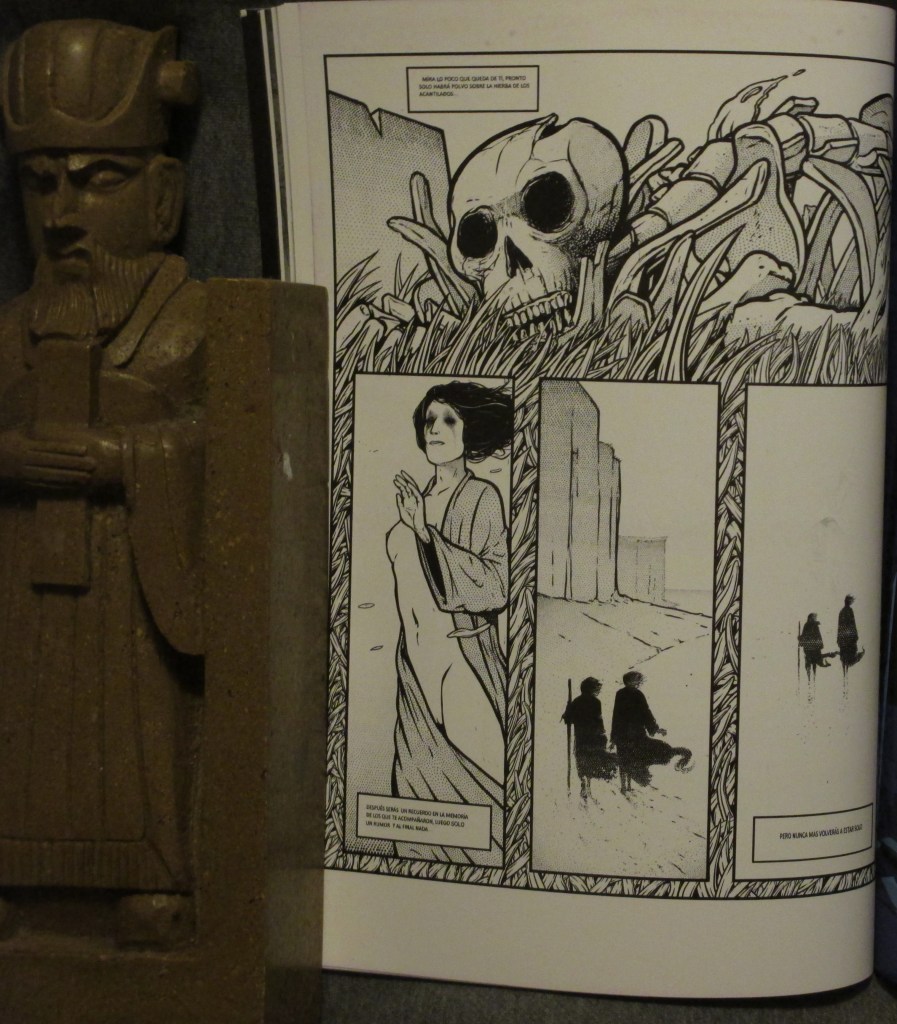
Outside of the official comics, works produced in areas where the Conan the Cimmerian stories by Robert E. Howard have fallen into the official domain have had fewer qualms about borrowing the iconic imagery of the Atlantean sword. Such is the case for Sangre Bárbara (2021) by El Torres, Joe Bocardo, & Manoli Martínez, and such is also the case for Conan de Cimmeria (2021) by the creative team of Ángel Gª Nieto (writer), Julio Rod (artist), & Esteban Navarro (colorist).

Hace mucho tiempo, en una era no soñada, caminó Conan, el Cimmerio, que a lo largo de su turbulent existential vivió multiud de fastuosas adventuras.

Dejadme que os cuente cual cronista de un tiempo olvidado sus grandes y magníficas hazañas, que lo convertieron en Leyenda.
Long ago, in an age undreamed of, walked Conan the Cimmerian, who throughout his turbulent life lived a multitude of magnificent adventures.

Let me tell you like a chronicler of a forgotten time his great and magnificent exploits, which made him a Legend.
Conan de Cimmeria, Back cover copyEnglish translation

Conan de Cimmeria is a standalone Spanish-language graphic novel that tells three original stories based on the Conan character created by Robert E. Howard, each one telling a brief adventure of the Cimmerian at a different point in his career. It is essentially identical in general form and intent to the majority of comics produced officially by the owners of the Conan trademarks, just produced independently. The prominent usage of the Atlantean sword in the first story, “La Forja del Destino” (“The Forge of Destiny”), is perhaps the most notable artistic callback to other Conan-related works, but the book also appears to draw inspiration from the classic Marvel comics, while still taking the opportunity to present an original—if recognizable—version of the barbarian.

The stories are a bit more violent and bloody than the classic Marvel Comics, but not so gore-filled as to detract from what are essentially pulpy adventure tales; there is one scene with the topless corpse of a woman, but other than that, there is no nudity or sex. It is the kind of Conan comics that could please everyone from 13 to 93 in terms of being exactly what it sets out to be: the kind of broad-appeal Conan comic that is reminiscent and evocative of what has come before, but which is distinctly original, an addition to the Conan cycle that is respectful of the source material.

In an era when properties falling into the public domain often leads to a splurge of derivative trash that pays little to no respect for the original, it’s nice to find examples of works where the creators basically want to use the stories to create new tales of character they like, int he style in which they’d like to read them.


Bobby Derie is the author of Weird Talers: Essays on Robert E. Howard and Others and Sex and the Cthulhu Mythos.

Deep Cuts in a Lovecraftian Vein uses Amazon Associate links. As an Amazon Associate I earn from qualifying purchases.
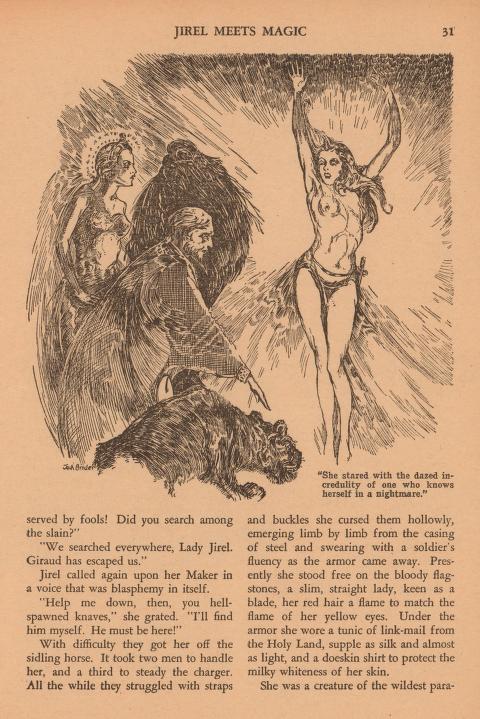
“The Ballad of Conan” (1983) by Anne Braude

Tune: “When I Was A Lad” (H. M. S. Pinafore)
—Anne Braude, “The Ballad of Conan” in Niekas #31 (1983), 41

The first fandom of Robert E. Howard’s Conan of Cimmeria arose in the 1930s, when the adventures of the barbarian were published in the pages of Weird Tales. Some fans, including R. H. Barlow, Emil Petaja, Charles B. Hornig, Alvin Earl Perry, and P. Schuyller Miller wrote to Howard—and the Texas pulpster wrote back, answering questions, sometimes gifting manuscripts of his stories, subscribing to fan publications like The Fantasy Fan, and providing unpublished stories and poetry for fanzines like The Phantagraph to publish as well.

This early interaction with fandom endeared Howard to his fans, and helped provide the basis for the first fan-publications, like Miller & Clark’s “A Probable Outline of Conan’s Career” in The Hyborian Age (1938), a one-shot zine published after Howard’s death by eager fans and containing Howard’s worldbuilding-essay of the same name. However, early desires to publish a collection of Howard’s Conan stories came to naught in the 30s; while the Texan had fans, he lacked anyone with the entrepreneurial spirit to start their own publishing business like August Derleth and Donald Wandrei did when they established Arkham House in 1939 to print the work of H. P. Lovecraft, who died the year after Howard passed away.

Following Howard’s death in 1936, his works passed to his father, Dr. I. M. Howard, who survived his son; Dr. Howard largely entrusted his son’s literary legacy to his agents, the Otis Adelbert Kline Agency, and several previously unpublished works appeared in the pages of Weird Tales, which continued to pay Dr. Howard the monies they owed his son. Still, within a few years publications dwindled, and no new Conan material was forthcoming in the 1930s. One by one, the first caretakers of Howard’s legacy passed: Farnsworth Wright, editor of Weird Tales, died in 1940; Dr. Howard joined his wife and son in 1944; Otis Adelbert Kline passed away in 1946. Dr. Howard willed the rights to his son’s material to his friends the Kuykendalls, and Kline’s agency was taken up by his associated Oscar Friend. Slowly, new published opportunities emerged.

In 1946, Arkham House published the collection Skull-Face and Others, and in 1950 Gnome Press published Conan the Conqueror, the first in a series of Conan titles. These collections in hardcovers weren’t just found new fans—and a more organized fandom. The first fanzine devoted to Howard’s creation was Amra, which began publication in 1956, and fan Glenn Lord got the ball rolling on Howard scholarship with The Howard Collector, founded in 1961. In the late 1960s and 70s, paperback reprints of these books exploded in popularity, part of the rise in paperback fantasy that included the Hobbit and The Lord of the Rings by J. R. R. Tolkien, and the Ballantine Adult Fantasy series that began in 1969.

In 1970, Marvel Comics published the first Conan the Barbarian comic, adapting and expanding his adventures into a new medium. The series and its sister magazine title Savage Sword of Conan would run for decades, drawing comic fans to read the stories as much as they drew fans of Howard’s fiction to buy the comics. In 1982 when the film Conan the Barbarian starring Arnold Schwarzenegger in the title role appeared on screens, it was swiftly followed by a tie-in comic from Marvel’s Conan creative team.

All of this increased fan activity, such as the Hyborian Legion and the Robert E. Howard United Press Association (founded in 1972). Conan was no longer an obscure hero from the pages of Weird Tales; the Cimmerian had become a staple of science fiction and fantasy, an archetype of barbarians, fighters, and rogues, a multi-media figure well-known and established in fandom—and the serious critical study of Robert E. Howard’s life and fiction were picking up, echoing the scholarly interest that Lovecraft had attracted a decade earlier.

Which is where things stood when fan Anne Braude wrote the jocular (but largely accurate) “Ballad of Conan” for the Conan-heavy issue of the fanzine Niekas in 1983. Drawing on the canonical Conan tales then widely available in paperback, rather than the comics adventures or the recent film. Unlike “I Remember Conan” (1960) by Grace A. Warren, this is tongue very much in cheek, showing someone familiar with the material but decidedly irreverent. All in good fun.


Bobby Derie is the author of Weird Talers: Essays on Robert E. Howard and Others and Sex and the Cthulhu Mythos.

Deep Cuts in a Lovecraftian Vein uses Amazon Associate links. As an Amazon Associate I earn from qualifying purchases.
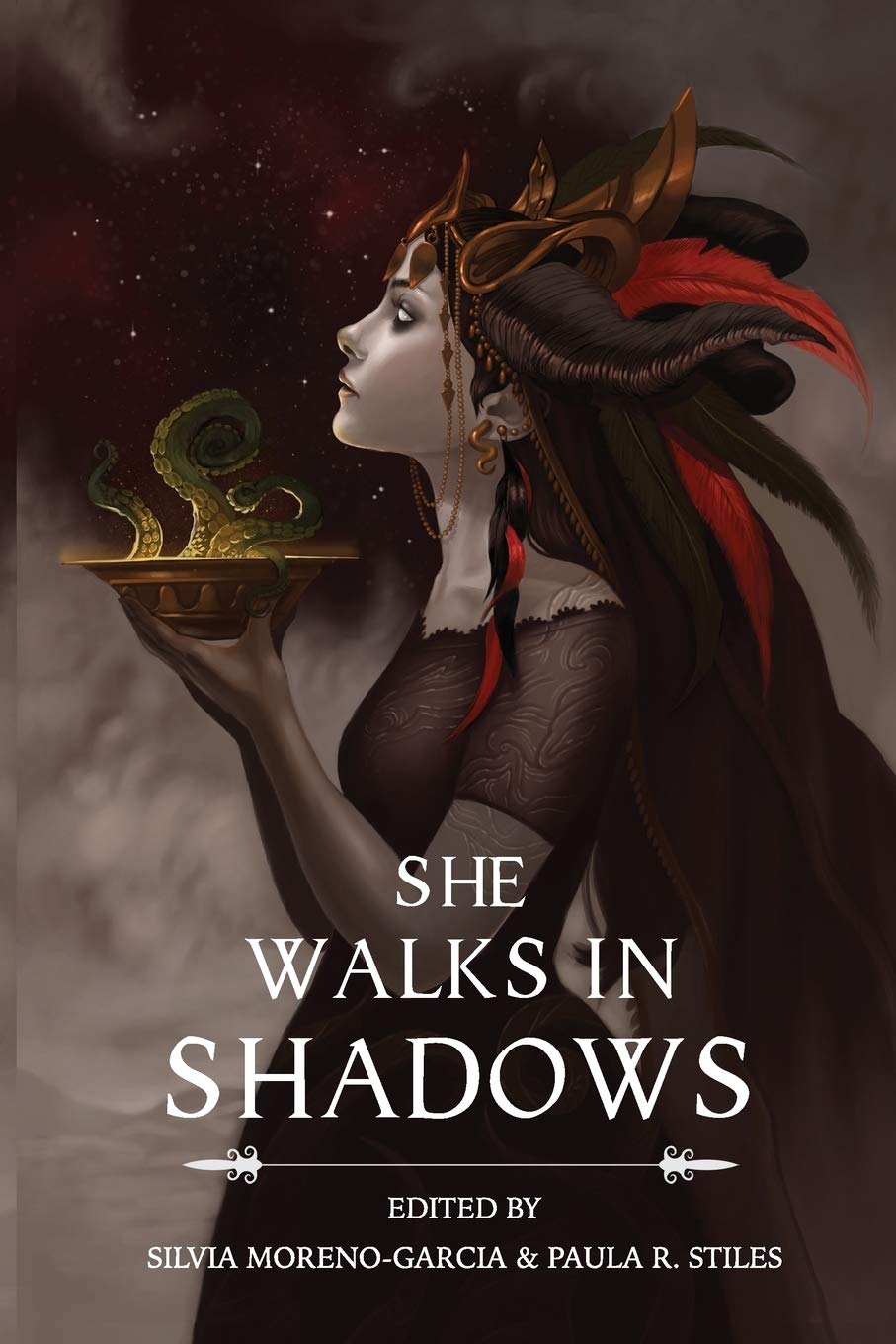
“U.S. Fish and Wildlife Services Inspection Report No. IF-32651” (2024) by Sarah Hans

Have any of these yokels even seen a Black woman before?
—Sarah Hans, “U.S. Fish and Wildlife Services Inspection Report No. IF-32651” in Arkham Institutions (2024) 137

“The Shadow over Innsmouth” is one of Lovecraft’s most quintessential tales, not just in the sense that it has become one of the core stories for his artificial mythology, but because when you strip down the story to its fundamentals it is one of the quintessential stories of its type: a civilized intruder tale. Someone from wider civilization travels to a liminal community, someplace that is, whether or not it is physically far away, somehow isolated culturally from the wider network of the world we know, and there’s something wrong there.

What is wrong and who does the intruding vary. In The Wicker Man (1973), a police officer finds a neo-pagan religion up to no good. In Midsommar (2019), tourists go to a remote Swedish village and find a pagan survival group up to no good. The essential framework is supremely adaptable, and most importantly, it leaves a great deal of room for novelty and reinvention. When Lovecraft used the idea in “The Shadow over Innsmouth,” the idea wasn’t new; he was riffing off stories like Herbert Gorman’s “The Place Called Dagon” (1927) and Algernon Blackwood’s “Ancient Sorceries” (1908). What Lovecraft added was the twist: that the intruder was not really an intruder at all, but was akin to the horrors.

Innumerable versions of this basic idea have played out through the Cthulhu Mythos, sometimes revisiting and recapitulating “The Shadow over Innsmouth,” sometimes with other locations. Stories like “Satan’s Servants” (1949) by Robert Bloch and “The Moon Lens” (1964) and “The Horror Under Warrendown” (1997) by Ramsey Campbell all riff on the basic concept, while La Planète aux Cauchemars (2019) by Mathieu Sapin & Patrick Pion, “The Chabad of Innsmouth” (2014) by Marsha Morman, and now with “U.S. Fish and Wildlife Services Inspection Report No. IF-32651” (2024) by Sarah Hans are examples of revisiting and updating the Innsmouth story itself.

With a few changes.

Before I exit the truck, I get my gun out of the glovebox. I do have a permit for it, but I’m not supposed to carry one while I’m on official duties. I can’t risk being caught in the middle of nowhere unarmed, though. I work alone most of the time and sundown towns don’t exactly advertise themselves
—Sarah Hans, “U.S. Fish and Wildlife Services Inspection Report No. IF-32651” in Arkham Institutions (2024) 138

The pitch for Arkham Institutions is “to explore how the people who run these towns and their institutions deal with the eldritch abominations of Lovecraftian terror” (back cover text). Which is as good a reason why a Fish & Wildlife Service agent will pop into Innsmouth for an inspection of the Innsmouth Fisheries as any other reason why someone might intrude on this liminal community.

Hans’ Innsmouth isn’t exactly Lovecraft’s, and the story doesn’t try to recapitulate the whole narrative. It is a contemporary setting, there’s no mention of the government raid of 1927, no reference to the Marsh Refinery. The business of the town is fishing, and Agent Cherise Brown has no ancestral links to the inbred locals. What plays out is a very different story that takes inspiration from Lovecraft—and probably wouldn’t be very comprehensible unless you’re familiar with that story—but tries to do something original with the idea.

The central idea is one I can dig: no liminal community can remain unvisited forever. Innsmouth was always going to receive some outside visitor who would cause problems. The question was not a matter of if it would happen, but who would intrude and when, and how the community would respond to that intrusion. It is an idea that suggests different possibilities—when would Innsmouth be no longer able to hide? As timeless as the locale seems in Lovecraft’s tale, in the context of how the world has developed after his death, it is easy to see how fragile Innsmouth’s isolation really was.


Bobby Derie is the author of Weird Talers: Essays on Robert E. Howard and Others and Sex and the Cthulhu Mythos.

Deep Cuts in a Lovecraftian Vein uses Amazon Associate links. As an Amazon Associate I earn from qualifying purchases.