Did Black people read Weird Tales during its golden age (1923-1940)?
At least some Black people in the United States wrote and read science fiction and weird fiction. W. E. B. DuBois published “The Comet” in his 1920 collection Darkwater: Voices from Within the Veil, Zora Neale Hurston’s “Spunk” (1925) appeared in Opportunity, A Journal of Negro Life, and George S. Schuyler’s novella Black Empire (1936-38) was serialized in the Pittsburgh Courier, to give just three examples. Black people’s quarters spent as well as anyone else’s at the newsstands.
There is no reason to believe that Black people did not read Weird Tales during the period. Proving that, however, is a bit tricky. Weird Tales never ran a demographic survey of readers. When researchers want to get a glimpse at who was reading the Unique Magazine, they need to look at more indirect data: who was writing letters that appeared in The Eyrie, and (after the departure of editor Farnsworth Wright in 1940, when Dorothy McIlwraith took the editor’s chair) whose names were listed as members of the Weird Tales Club? Unfortunately, names don’t generally give any hint of race—at best, it might give an overview of the gender balance of the readership (which are interesting in itself, see They Were Always Here on Turnip Lanterns).
Lacking the data to answer the question adequately, a deep dive into the archives of pulpdom suggests that while we can’t say how many Black people made up Weird Tales‘ readership, we can say that they certainly read weird fiction by some of Weird Tales‘ writers. A case in point is Edward Podolsky and “The Mummy’s Jest.”
Dr. Edward Podolsky (1902-1965) was a doctor and pulp writer whose early work included two stories in Weird Tales: “The Figure of Anubis” (WT Feb 1925) and “The Masters from Beyond” (WT Sep 1925). Both of these were fairly slight potboilers that failed to catch the reader’s attention; even Lovecraft doesn’t refer to them in his surviving letters, even though he had stories in both issues. Later, Podolsky would write science fiction stories and essays for science fiction pulps, and like his fellow weird tales writer Dr. David H. Keller, made money writing sex education books for an eager audience.
Among Podolsky’s fiction in the ’30s is “The Mummy’s Jest” (1931) for Abbott’s Monthly. Robert Sengstacke Abbott was a Black lawyer and newspaper publisher who founded The Chicago Defender in 1905; and later Abbott’s Monthly (1929-1933, changed name to Abbott’s Monthly Illustrated News, folded in 1934), a magazine combining a combination of news, fiction, and illustrations. This was a magazine primarily intended for a Black audience, and this shows in several of the topics addressed, the figures of the illustrations, etc. The illustrations for “The Mummy’s Jest,” for example, are by frequent Chicago Defender artist Jay Jackson and show a Black protagonist:
As it turns out, “The Mummy’s Jest” is well-named, and here’s the joke: give or take the occasional word, “The Mummy’s Jest” is “The Figure of Anubis,” reprinted almost verbatim from the pages of Weird Tales. Whether editor Lucius C. Harper knew he was buying an old story, or if Podolsky pulled a fast one and sold the same story twice to two different magazines isn’t clear, but I suspect the latter.
There is nothing about the text of the story to suggest a Black protagonist; Podolsky changed barely a word besides the title—and those changes that do exist between the two stories could reflect the different editorial choices of Farnsworth Wright and Lucius C. Harper in how they ran their respective magazines. So there is that sleight-of-hand there which the editor accomplished: by adding Jackson’s illustrations to Podolsky’s story, he could suggest and imply things to his presumably mostly-Black audience that aren’t in the story.
It is particularly notable that the figure of the mummy in both recensions of the story is described as having, when the bandages fall away, “skin as pale as beautiful marble.” In Weird Tales, where the default audience might expect the protagonist to be white, the discovery of a beautiful Caucasian princess from Egypt is a matter of course; it happens all the time, such as in Seabury Quinn’s “The Jewel of Seven Stones” (WT Apr 1928). In Abbott’s Monthly, however, this adds a certain frisson: the suggestion that the Black protagonist’s lost love was also white, and that they were in an interracial relationship.
It is difficult to express, at this remove, the degree to which the legal and social discrimination influenced science fiction and weird fiction in the United States during the Jim Crow period. No law expressly forbid people of one race from buying Weird Tales or Abbott’s Monthly, but the inherent biases of editors, writers, artists, and readers all factored in to influence how weird fiction was written, read, and received. “The Figure of Anubis”/”The Mummy’s Jest” is a good example of how with a little change of context, the whole reading of the story can change.
At the very least, however, while we can’t say whether anyone who picked up Abbott’s Monthly also read Weird Tales, we can definitely say that they read at least one story from the pages of the Unique Magazine.
“The Figure of Anubis” can be read here, and “The Mummy’s Jest” can be read here.
Mary Faye Durr was born on 17 May 1893, the youngest of three children born to Abraham and Mary Durr. Like many women of the period, details of her early life are sketchy. Is it known that she graduated high school and then college, graduating from the University of Ohio in 1915.
Durr’s entry from the 1915 University of Ohio yearbook.
In the same year, the young woman first pops up in the writings of H. P. Lovecraft, showing that she had at some point joined the ranks of amateur journalism, and in particular the United Amateur Press Association:
“A Best Book”, by Mary Faye Durr is a brief but delightful essay which reveals a just appreciation of the broader functions of literature. —H. P. Lovecraft, “Department of Public Criticism,” United Amateur Dec 1915, Collected Essays 1.87
Durr continues to appear sporadically in Lovecraft’s reviews of amateur journals, and much of what he says is relatively positive, speaking to her technical skill and taste, if not exactly praising Durr’s creativity, and tracing her taking on positions within the UAPA:
“At the End of the Road”, by Mary Faye Durr, is graphic and touching description of a deserted schoolhouse. The atmosphere of pensive reminiscence is well sustained by the judiciously selected variety of images and allusions. […][120] “The Melody and Colour of ‘The Lady of Shalott'”, by Mary Faye Durr, is a striking Tennysonian critique, whose psychological features, involving a comparison of chromatic and poetic elements, are ingenious and unusual. Miss Durr i[s] obviously no careless student of poesy, for the minute analyses of various passages give evidence of thorough assimilation and intelligent comprehension. —H. P. Lovecraft, “Department of Public Criticism,” United Amateur Jun 1916, Collected Essays 1.119, 120
“Beyond the Law”, by Mary Faye Durr, is a light short story of excellent idea and construction, whose only censurable point is the use of “simplified” spelling. —H. P. Lovecraft, “Department of Public Criticism,” United Amateur May 1917, Collected Essays 1.153
Miss Mary Faye Durr of Mount Sterling, Ohio, has accepted appointment as Secretary, her occupancy of that important office ensuring an efficient and business-like handling of the records. —H. P. Lovecraft, “Department of Public Criticism,” United Amateur Sep 1917, Collected Essays 1.172
“The Village”, a delightful study by our Secretary, Miss Durr, is replete with vividness of atmosphere and delicacy of touch; though it is closely rivalled by the masterly bit of psychology from the hand of the editor, entitled “An Interpretation”. —H. P. Lovecraft, “Department of Public Criticism,” United Amateur Jan 1918, Collected Essays 1.183
Mary Faye Durr first appears in Lovecraft’s private letters in 1918, and it seems as if they were about to come into correspondence—through a typically Lovecraftian 22-page letter—if they had not already come into contact:
Ye Gods! For ‘Eaving’s sake abstain from sending my “mission in life” letter to Mistress Durr. I recall saying in it that I thought she was minding other people’s business! I have given her a 22-page broadside, calculated to demolish any pragmatical notions which may still becloud her mentality, but have not gone into personal excuses for idleness beyond saying that my constitution does not permit of systematic endeavour, else (of course) I should be doing something the same as any other rational human being. What does she think I am—a corner loafer? She might know better—for if I were, the “work or fight” law would have “got” me long ago, and I should be toiling in some munition factory or shovelling sewers at some content. I am not particularly anxious to discuss my affairs with relative strangers—my letter was for you, not her. —H. P. Lovecraft to Alfred Galpin, 21 Aug 1918, Letters to Alfred Galpin & Others 202
Lovecraft says nothing of Durr’s personal life, and probably knew as little to nothing about her activities beyond amateurdom as she did about his. While Lovecraft was unemployed at this period, it appears that after graduating from university Mary Faye Durr became a schoolteacher; yearbooks and newspaper records track a long career in public education in Ohio that would last for decades. During the earliest part of her career (according to the Federal 1920 and 1930 census) she was apparently still living at home with her parents, a not-unusual situation for an unmarried young woman.
No letters survive from Lovecraft to Durr or Durr to Lovecraft, so the shape and extent of their correspondence is difficult to evaluate, but apparently Lovecraft lent one of her letters to James F. Morton:
I am glad Father Mo found Miss D’s epistle so interesting. She has a sort of pert, laconic humour or smartness, of which she is evidently fairly proud, & which she is not at all reluctant to employ. —H. P. Lovecraft to Alfred Galpin, 29 Aug 1918, Letters to Alfred Galpin & Others 208
Speaking of clients—you & Miss Durr will be satisfied at last. I am a real labouring man! In other words, I have undertaken to make a thorough & exhaustive revision of Rev. D. V. Bush’s long prose book—now called “Pike’s Peak or Bust”, though part of my job is to find another name. —H. P. Lovecraft to Alfred Galpin, 14 Nov 1918, Letters to Alfred Galpin & Others 222
Given Lovecraft’s correspondence with others, the start of their letter-exchange was probably fairly formal, slow to build a rapport.
Mary Faye Durr, 1919 Marietta (Ohio) Yearbook
Mary Faye Durr was secretary of the UAPA 1917-1918, elected treasurer for 1918-1919, and at the 1919 convention, was elected President of the United Amateur Press Association for the 1919-1920 term, only the third woman in that office. The popular history of amateur journalism marks this period as sort of the beginning of the end of the UAPA:
The poet Rheinhart Kleiner, of Brooklyn, N. Y., was chosen President in 1918, and another woman President in 1919, Miss Mary Faye Durr, of Marietta, Ohio. But its members began to relax, recruiting was not carried on, interest waned, and this branch of the United, though seeming to have the best claim to lineal descent from the original body, gradually ceased to function, and in 1926 it passed out of existence. —Truman J. Spencer, The History of Amateur Journalism 92 (online edition)
The truth is a little more complicated. Early in the year, Durr apparently realized that the UAPA desperately needed new members and set up an amateur journal specifically to do so, The Recruiter. Lovecraft reviewed it with high praise:
The Recruiter for January marks the advent to amateurdom of a new paper, which easily takes its place among the very best of recent editorial enterprises. Edited by Misses Mary Faye Durr and L. Evelyn Schump in the interest of the United recruits whom they are securing, its thoroughly meritorious quality speaks well for the new members thus added to our circle. […]
“Winter”, a brief poem by Hettie Murdock, celebrates in a pleasant way an unpleasant season. The lines are notable for correctness, spontaneity, and vitality, though not in the least ambitious in scope. […]
“Shades of Adam”, by Mary Faye Durr, is an interesting and humorously written account of the social side of our 1918 convention. Miss Durr is exceptionally gifted in the field of apt, quiet, and laconic wit, and in this informal chronicle neglects no opportunity for dryly amusing comment on persons and events. […]
The Recruiter’s is brief and business-like, introducing the magazine as a whole, and its contributors individually, Amateurdom is deeply indebted to the publishers of this delightful newcomer, and it is to be hoped that they may continue their efforts; both toward seeking recruits as high in quality as those here represented, and toward issuing their admirable journal as frequently as is feasible.
—H. P. Lovecraft, “Department of Public Criticism,” United Amateur Mar 1919, Collected Essays 1.224
Hettie Murdock was a fellow schoolteacher in Ohio; she and Durr would share a close friendship, to be detailed later, but Murdock’s involvement here may suggest that Durr recruited her for the UAPA around this time.
While no letters from Durr to Lovecraft (or vice versa) survive, one letter survives from Durr to Anne Tillery Renshaw among Lovecraft’s papers; Renshaw was at the time Official Editor for the UAPA under Durr. While the letter is only dated “Thursday, P.M.” it appears to have been during Durr’s period as president, and mentions that Halloween is the next day—and October 31st fell on a Friday in 1919. The letter deals in part with Durr’s correspondence with Lovecraft, and recruiting:
I supposed Recruiting committees were announced in Sept. no., but Lovecraft says not. If the two vice presidents have not notified their committees I will see what I can do about it.
I don’t remember if I told you about application blanks in my last, but this is the situation. Eddie told me in August that he was having Lovecraft look after them, and only last week I discovered that none had ever been ordered. Cook is getting them out now as fast as possible. —Mary Faye Durr to Anne Tillery Renshaw, Thursday [30 Oct 1919], Brown Digital Repository
Renshaw presumably forwarded this letter to Lovecraft, who later used it to compose some Christmas greetings (let us all be thankful for parsimonious packrats!)
With this letter and The Recruiter, it is clear that Durr was conscious of difficulties in recruiting…but she was still a working woman, with limited time to devote to amateur affairs. It also shows she must have been in semi-regular contact with Lovecraft for various duties related to amateurdom, such as the hunt for a laureate judge which netted Lord Dunsany. Lovecraft for his point appeared to point potential recruits at Durr:
Your failure to hear from the association officially is due to the negligence of the new Secretary, a rather eccentric elderly woman who was given the post merely because she happens to live in the next convention city. You might speak about it to the President—Miss Mary F. Durr, 526 Third St., Marietta, Ohio. —H. P. Lovecraft to James Larkin Pearson, 19 Sep 1919, Letters to Rheinhart Kleiner & Others 320
The secretary was Ida C. Houghton, who would herself be president of the UAPA during the 1921-1922 term, where she would butt heads with Lovecraft, who had taken on the position of Official Editor. At the 1920 convention where she handed off the office of president to Alfred Galpin, Durr gave a memorable speech riffing on Abraham Lincoln’s Gettysburg address (Fossil 341); her friend Hettie Murdock also attended the convention.
The last mention of Mary Faye Durr by Lovecraft is a brief review in 1921:
Miss Durr’s “As Ye Judge” is marked by distinguishable sanity and good sense—the ideal liberalism of a thoughtful mind—and lacks only originality of presentation to be remarkable. Not that it is in any sense unoriginal, but that it states in unornamented way truths which are universal among progressive students today. —H. P. Lovecraft, “The Vivisector,” The Wolverine #10 (June 1921), Collected Essays 1.288
Without access to more amateur journals of the period, it is impossible to trace Mary Faye Durr’s career in that field much further; she never again seems to have sought or held office in the UAPA, and may have dropped out of amateurdom altogether after a time; at the very least, that would seem to be the end of any regular communication with Lovecraft, as there are no further mentions of her in his letters after this date.
A little bit more information is available about Mary Faye Durr’s personal life—and this is where Hettie Murdock comes back into the picture.
Mary Faye Durr’s parents both died in 1936; in the 1940 Federal census, she is listed as living with Hettie Barton Murdock as a boarder. In the 1950 Federal census, Durr and Murdock are both living together, and one transcriber has Murdock listed as “wife”—although a look at the actual record establishes this was probably an error that was scratched out.
1950 Federal Census
Newspaper accounts offer additional details. Both Durr and Murdock were single, never married, working as teachers at West High in Akron, Ohio, and may have both been members of the Unitarian Universalist Church. In 1943, they appear to have shared a vacation cottage in Cape Cod.
What happened to the Cape Cod cottage isn’t clear, but in 1956-1957, Mary and Hettie built a small home in Stuart, Florida in 1956 (St. Lucie News Tribune, 3 Oct 1956; The Palm Beach Post, 9 Feb 1957). The articles state that Murdock and Durr were “retired schoolteachers,” but Durr’s obituary claims she didn’t retire from teaching in Akron until 1965, so possibly only one of them was retired, or they were semi-retired but still teaching in some capacity. Murdock was still active in the Akron social scene as part of the Quota Club through the 1950s, with Durr sometimes involved as well, according to newspaper accounts, and it seems likely that the pair were snowbirds (cf. The Stuart News, 28 Nov 1957). Hettie B. Murdock would pass away in Florida on 28 Dece 1965 (The Stuart News, 30 Dec 1965).
Were they just housemates? Was this a Boston marriage? That they must have been great friends is undoubted; the women cohabited for at least 16 years, not just in Ohio but in Massachusetts and Florida as well, and were active in each other’s hobby-groups to some extent. But was there more? Were they actually lesbians?
The framing every same-sex relationship as necessarily heterosexual, chaste, and platonic is a form of queer erasure; a popular internet trope where archaeologists and historians look at any same-sex couple and declare they were roommates or were otherwise not evidence of homosexual relationships. Reality is a lot messier. We have only impersonal data to go by. We have no intimate documentation on Mary and Hettie’s relationship—no letters, diaries, poems, or stories that might give hints of lesbianism. We know Elsa Gidlow was a lesbian because she declared it, but such open announcements were rare.
What we do have is context. Mary and Hettie were public school teachers; one of the few occupations readily available to educated women. The job came with a degree of public scrutiny and high expectations for standards of behavior. Married women were often forced out of the workforce, so it wasn’t unusual for women teachers to remain single, and any sexual scandal or impropriety would also have seen their dismissal. Novalyne Price Ellis recalled the strictly regimented lifestyle expected of single women teachers when she was hired at Cross Plains, Texas in 1934 in One Who Walked Alone (1986), and while Akron isn’t small-town Texas, some of the same expectations were probably in place.
In the economic atmosphere of the early-to-mid 20th century, two women who shared the economic burden of a household together wouldn’t be too unusual. A pair of spinster teachers who lived together would be relatively inconspicuous, whether they were in a closeted romantic relationship or simply platonic life-partners. While a rare few LGBTQ+ folks were open about their sexuality, they were outliers; the majority of such people could not afford the social or legal discrimination that came from being “out.” Even if Mary and Hettie were in love, and shared their life together, they could not openly acknowledge such love without serious ramifications.
All of this speculation is far and away from Mary Faye Durr’s correspondence with H. P. Lovecraft—but that is in itself kind of the point. Neither Lovecraft or Durr revealed all of themselves to each other in their letters, based on what scanty evidence we have of their correspondence, and neither would be expected to. Amateur journalism was the crux and driving point of their relationship, but their lives outside that were closed books. We always have to remember that there is more to Mary Faye Durr than just the words on the page, more to the lives of Lovecraft and his correspondents than what is just in their letters to each other.
More than we will ever know.
Unusually for one of Lovecraft’s correspondents, because Mary Faye Durr was in so many school yearbooks, as a student or a teacher, we have many more photos of her publicly available than others, so here’s a little gallery showing her over the years. There are probably many more in yearbooks yet unscanned.
Tabletop roleplaying has always had a performative aspect; the players and gamemasters were encouraged to embody their characters to some extant, and to be able to interact in character. The early community spaces around roleplaying games like Dragon Magazine (1976-2013) and Gen Con (1968-) were built on the shared experiences of gaming in small groups, and much of the early humor in gaming periodicals and associated media dealt with the peculiar quirks of players and rules interacting during a live session—as well as recounting the epic adventures characters underwent at those tables. This has been the basis of a good deal of media surrounding gaming, including comics like Knights of the Dinner Table (1990-) and Dork Tower(1997-), and the Japanese phenomenon of the replay, or transcripts of a gaming session packaged and sold for entertainment.
This performative aspect has been especially notable when gaming was done in public, before an audience, such as when participating in a tournament at a gaming convention or when doing live-action roleplay in any public space. There have been various efforts over the years to expand this practice in different media; for example some of the Knights of the Dinner Table strips were animated and voice actors brought in to provide short episodes like “Scream of Kachooloo,” based on the popular Call of Cthulhu Roleplaying Game. With the advent and popularity of YouTube (2005-), Twitch (2011-) and other streaming services, video and audio became increasingly popular media for gaming of all stripes, from video game let’s plays to various efforts to dramatize and/or capture the performance of a gaming session, which gelled into a format called actual play.
At its most basic, this can be as simple as group with a webcam and a cheap microphone recording a session at the kitchen table; at its most sophisticated, talented gamers/actors from around the world with their own high-end recording set-ups can collaborate on a gaming session together, and the whole professionally edited, produced, and with music or visuals into a viable product. The more high-end actual plays tend to have associated websites, social media, patreons, tipjars, and maybe even advertisements or sponsors to help defray the cost of production or run a modest profit for the gamers/actors involved. Shows like Critical Role(2015-) and its episodes CelebriD&D (2015-2020) have effectively migrated the concept from amateur or semi-professional to professional productions, but the community that generates and watches actual play primarily remains, first and foremost, dedicated hobbyist gamers who want to share the roleplaying experience.
While many actual plays focus on popular game systems like Dungeons & Dragons 5th Edition or particularly popular and notable published campaigns like Horror on the Orient Express, the format is democratic and allows for diverse gaming groups to run through any scenario or campaign, published or homebrew. This sometimes gives the rare opportunity to see, for example, a group of Black gamers play through roleplaying game designed for primarily Black player characters.
Queen’s Court Games (web, YouTube, Twitch, Bluesky, Patreon, etc.) is an award-winning actual play web series with a diverse cast; their byline is “Character-focused. Rules-light. Banter-free. Never D&D.” and they deliver. In 2023, the group (Noir Enigma, Jas Brown, Robert Madison II, Christian McKinzie, and Laura Tutu) played through the scenario Harlem Hellfighters Never Die by Chris Spivey, a scenario that came with Harlem Unbound (2017) by Darker Hue Studios (2nd edition). The actual play is spread out over six sessions/episodes, each of which is 2-3 hours long, with Noir Enigma playing the Keeper and the five gamers each as a single player character as they play through the scenario.
The performative aspect of actual play sometimes lends a scripted air to most proceedings, but the Queen’s Court Games group feels much more natural in their delivery. There is a conscientiousness to the performance, because the players all give each other space to talk, rarely trying to talk over one another, getting into little asides, etc. The Keeper, Noir Enigma, gets an oversized amount of attention because the Keeper is the driver for the scenario, the one which all the players have to interact with regularly and who has to set the pace and maintain the flow of the session for hours on end. Of the cast, Laura Tutu stands out as the most dramatic of the players. While they did practice some of their lines before play, there’s very much an improv group feel to the whole production, and the cast plays off each other well.
What sticks out the most is how much the players seem to enjoy the Harlem Unbound setting, and to inhabit those characters. It is not unusual to see Call of Cthulhu gaming groups that are all white people playing white characters and going through scenarios where anybody described as “dark” or “swarthy” is likely to wear a robe and wave a sacrificial dagger, so there is a different dynamic to having an all-Black group playing Black characters, the kind of humor they can bring (Christian McKinzie and Enigma Noir in particular get many of the funnier interactions, which have the other players in stitches with McKinzie’s self-deprecating humor and animated style). It is a playstyle that is conscious of and avoids the worst expressions of racism during the period, without playing down that racism and discrimination were prevalent at the time.
Spread out as Queen’s Court Games is over different channels, it is difficult to get a handle on viewership numbers and how well-received it was, but it is notable that the NZ Web Fest selected Harlem Hellfighters Never Die among its 2024 video actual plays.
In 2016, artist Amy Borezo published a very limited illustrated edition of H. P. Lovecraft’s story “The Colour Out of Space.” To quote from Shelter Bookworks’ original page:
This hybrid artist’s book/contemporary fine press edition of the 1927 horror/sci-fi story by HP Lovecraft includes an introduction by Lovecraft scholar S.T. Joshi and 14 color images by Amy Borezo. The artist lives near the supposed site of this fictional tale and frequently walks the old roads of the towns written about in this story. In creating the imagery for this work, the artist is interested in evoking the complexity of the local landscape in abstract form with the construction of the reservoir overlaid visually through geometric blocks.
The text for this edition was provided by S.T. Joshi from his recent publication, H. P. LOVECRAFT: COLLECTED FICTION: A VARIORUM EDITION [Hippocampus Press, 2015] and is derived from a typescript at Brown University, evidently prepared by F. Lee Baldwin for a proposed reprint of the story (c. 1934) that never happened. It has some revisions in pen by Lovecraft, so presumably it represents his final wishes for the story. _____________________
Relief printing on Zerkall Book paper from photopolymer plates on a letterpress. Body text set in Caslon, titles in Futura. Pages sewn onto a shaped concertina. Paste paper over boards with a buffalo suede spine. Housed in a presentation box. Special thanks to Lisa Hersey who assisted in printing and binding.
The edition, despite the relatively high cost (US$500 + shipping in 2016), sold out. It arrived in an attractive clamshell box, with a paper label. Inside, the colors on the paper are bright and vivid in a way that the light and the camera don’t really catch, the backstrip soft, the paper creamy and the text sharp. In your hands, the brilliant orange seems to leak through around the edges of the pages. A title page, a brief introduction by S. T. Joshi. The text and illustrations are on alternate pages, distinct, the images vivid but abstract. A word on the artist, a colophon and numbering page, and then the book is at an end.
Amy Borezo’s illustrated edition is, in a very real sense, a piece of art that you can read. The text itself is meticulous in its accuracy, but you can read the same text in Hippocampus Press’ variorum edition, you can read the same text for free online. If you must have a physical copy of a book in your hand, you are spoiled for choice: “The Colour Out of Space” is one of Lovecraft’s most reprinted works, and there are innumerable illustrations for the story from various artists, from J. M. de Aragon in the pages of Amazing Stories in 1927 and Virgil Finlay in Famous Fantastic Mysteries in 1941 to many others of the current day.
This massive plurality of choice, the sheer number of editions, touches on an issue that many readers and would-be readers of Lovecraft deal with: where do you start? What is the best edition? What if you want a really nice copy of a book? Which one of all the hundreds of titles should you go for, and why, and how much will it cost?
If that sounds like more of a collector’s issue than a reader’s issue, then congratulations, you’ve hit on one of the fundamental problems facing not only Lovecraft, but most popular authors in the contemporary period.
When Lovecraft was alive, he was primarily published in the amateur press, pulp magazines, some reprint anthologies like the British Not at Night series, and a couple of very small privately printed editions of The Shunned House (never bound or formally released during his lifetime) and The Shadow over Innsmouth (which was, but the binding was shoddy). There were no finely bound editions of Lovecraft with the embellishments of the bookmaker’s art available to the general public, no leather covers, no gilt lettering, no raised bands (caveat: one copy of The Shunned House was specially bound by R. H. Barlow as a gift for Lovecraft).
Early collectors of Lovecraft often focused on posthumous publications, like the first publications of Arkham House, and little obscurities like the edition of Lovecraft’s commonplace book put out by the Futile Press in 1938. Even ultra-small press editions were typically not “fine” in the sense of lavish materials, artwork, or presentation, but were often considered valuable simply because of the small size of their edition, the ease with which copies perished, and subsequent rarity in the face of growing demand. That demand came from Lovecraft’s own growing popularity; the mass market paperback reprints of Arkham House collections, the armed services editions, and foreign reprints in hardback and paperback vastly increased the audience for Lovecraft’s work.
Until quite recently, fancy fine press editions were not normal for living authors. Before mass literacy, books were often bought unbound and then the author could bind them however they liked; really rich people could commission books that were themselves works of art in every sense of the word, involving whatever costly materials or decorations they cared for. As the commercial basis of book reading and publishing became more egalitarian, fancy editions often became more about the skill of the bookmaker and/or any associated artist, for fine press editions, and the materials shifted.
So when you look at what constituted a really nice Lovecraft edition in, say 1980, you’re likely looking at the output of Roy A. Squires’ press. These were meticulously crafted letterpress editions, usually on high-quality handmaid paper, sometimes featuring tipped-in photographs or other illustrations. Where a normal chapbook from Necronomicon Press or a fan press might be published on an Apple II printer and stapled together, everything about Squires’ production was done by hand.
The slightly bourgeoisie desire for something fancier still nagged the science fiction and fantasy market. Arkham House paved the way in the late 1930s and 40s by showing that a small press publisher specializing in genre books was viable (the presses they inspired apparently didn’t know how often Arkham House founder August Derleth was running in the red, or how long it took for his small, relatively expensive books to sell). Most of these products weren’t fine press; they were solid books, aimed and priced at a select market. Very few of them produced anything that might be described as a luxury edition of Lovecraft; the choicest example might be the 1976 edition of Démons et Merveilles by French publisher Opta, which came bound in leather, with slipcase, and illustrations by Philippe Druillet. The translation has its issues (Lovecraft’s “ghouls” is rendered as “vampires,” to give one notable example), but compared to the rather plain but sturdy Arkham House editions, it’s gorgeous.
Easton Press (founded in 1975 as a division of MBI, Inc.) took up the gauntlet of producing, for lack of a better term, what not-rich people think of as rich people’s books: bound in letter, embossed in 22k gilt, very snazzy to look at. In practice, while Easton Press has consumed many acres of cowhide, the actual books they produce tend not to be very special: they’re reprints of existing books, often not anything particularly rare or obscure, with no additional editorial guidance or notes (and sometimes bad misprints). The books themselves are usually solid, but less than beautiful; their editions of Lovecraft show evidence of corner-cutting and mass production.
There is a niche market for really nice editions of books, at a price affordable to middle-class bibliophiles. Over the last twenty years or so, that niche market has exploded. Centipede Press, Subterranean Press, the Folio Society, etc. are names that are familiar now for deluxe editions of Lovecraft and/or other authors, typically reprinting older works instead of presenting anything original, and typically publishing in limited editions of a few hundred copies. Quality and presentation vary, although are generally pretty high—not quite the same production value as, for example, letterpress outfits like Pegana Press which continue the fine press tradition, but for high-end versions of books that you might otherwise buy at Barnes & Nobles…
…and that is kind of the rub. While there are some exceptions, most of these presses aren’t gambling on producing anything new. There might be new artwork, there might be a new introduction by Alan Moore or S. T. Joshi, but there is no experimentation, there is often nothing unique about these particular editions. There are some exceptions; Centipede Press has produced some original compilations like Conversations with the Weird Tales Circle that collects many rare, obscure, and out-of-print materials; and the art book A Lovecraft Retrospective is pretty much unparalleled. Helios House Press has published some original scholarship among the reprints (full disclosure: they’ve paid me for a few essays and other work).
For most of these companies, however, the text itself isn’t special. The production quality might not be much better than any other mass-produced hardcover. They might be pretty, but from a strictly objective standpoint they don’t offer much new or exciting. They’re just very expensive.
So what exactly are you, the reader, paying for?
Which is what you need to answer for yourself. If you’re a scholar or academic looking for a text that’s pure Lovecraft, you’re probably better off buying the Hippocampus Press variorum editions. If you’re a casual reader, the Penguin paperbacks are cheap and almost as good. If you’re a poor student, stick to the online editions at https://hplovecraft.com. If you want a fancy edition…well, you’ve got options. Lots of them, for every price point. Handmade Japanese paper, bound in leather, with silk bookmarks, signed in blood.
It’s all available for the right price.
So what sets Amy Borezo’s book apart? Normally, based on the materials, the quality of the printing and craftsmanship, I would qualify this as a fine press product. However, in the marketing, the presentation, this is a little different. It is a book, and can be read as a book, but it is also a work of art, and can be experienced and appreciated like buying a lithograph print from a series. If you’re a fan of Lovecraft, you know the words, you’ve read the story a hundred times. Many artists have tried to capture a colour that lies beyond human perception, to depict the events of the story in some fixed form. Only Borezo has gone to such effort to capture that feel in an entire book production, not just as isolated images.
The beauty of Borezo’s art is that it is abstract; it doesn’t try to impose meaning on the text, readers have to stare at it for themselves. Some might not like it, others might get it but not care for the idea, but for me there’s a certain tactile experience with that nearly radioactive orange that seems to seap through and around the pages at times. Yes, it could just be the collector in me, trying to justify the hundreds of dollars this book cost, but in a real way that is the experience we buy with every book, above and beyond the text itself. The feel of it in your hands, the smell of the paper, the crackle of the spine. It’s different, when you’re holding an old pulp whose brittle and yellowed pages are as fragile as a papyrus from a mummy’s tomb, or an old worn paperback whose tanned pages are as soft as toilet paper, or a crisply printed new edition with ink that almost looks still wet.
From a scholar’s perspective, from a historian’s perspective, the focus is usually on the text, not necessarily the visceral experience surrounding how the text is read and received. Yet it is important not to lose touch with that. In an age where Lovecraft is in the public domain, generative AI, and print-on-demand publishing, we are going to see a vast proliferation of books—many of which are going to be strictly hypothetical until someone orders them—and our eyeballs will see cover art generated by some pseudointellectual property theft engine and with text scraped off of somewhere online (errors and all), and pre-packaged to try and appeal to someone that wants to read Lovecraft—and whatever the end product is, the one thing I can guarantee is that it is not going to be anything like Amy Borezo’s edition of The Colour Out of Space.
Weird Tales debuted in 1923 with a cover price of 25¢, at a time when slick magazines like Time and Life would sell for 15¢, and pulp magazines like Argosy All-Story went for 10¢. The difference in price was partially a function of circulation numbers, but also of advertising. The lower prices on slick publications and more popular pulp magazines was at least partially subsidized by the ads that ran in every issue—and a look at the ads could tell you a lot about a magazine and its readership, or at least the readership that the advertisers hoped to reach.
In 1873, the United States Congress passed the Act for the Suppression of Trade in, and Circulation of, Obscene Literature and Articles of Immoral Use into law. This law, and other similar state laws, were known as Comstock Laws; named after U.S. Postal inspector Anthony Comstock, who was the founder of of the New York Society for the Suppression of Vice. The 1873 law made it illegal to send any obscene matter through the mail—and while this was primarily aimed at disrupting the trade in pornography, it was also aimed very specifically at suppressing the sale of or knowledge of any form of birth control or abortion. The full text of the original law can be read here.
The Comstock laws were so broadly drawn and ill-defined that “obscenity” was very much in the eye of the beholder—or, as it happened, the postal inspector. Did a magazine extolling the nudist life count as pornography? Or a medical text book with explicit illustrations of human genitalia? Books of historical European art where the subject is a nude human figure? What about pulp magazines like Weird Tales which might have a nude on the cover, or on an interior illustration? These aren’t hypotheticals, these were real cases. A 1933 case of the State of New York v. Ben Kornfeld involved Spicy pulp magazines, and there are more examples if one wants to dig through Westlaw or Lexis databases for caselaw about pulps and obscenity.
At the same time as these laws restricted the legal availability of such materials, they were faced with a growing population with a growing demand for not just pornography and prophylactics, but increased knowledge of sexual healthcare. The illegality of prophylactics also meant there was no governmental oversight, quality control, or user safety advocacy for their production or dissemination. Bad information about sexually transmitted infections was rampant; skin or rubber condoms and pessaries often failed; directions for herbal abortifacients could be effectively poisonous or ineffective.
Some individuals pushed back against the legal restrictions of the Comstock laws, such as eugenicist and sex educator Margaret Sanger. Eugenics and birth control often go hand-in-hand during the early 20th century; while in practical terms a woman might enjoy sex but not wish (or be able to afford) a child, the philosophy of eugenics often provided an intellectual justification that went beyond perceived hedonism, as Lovecraft put it:
Modern civilisation, however, has developed a sentimental protection of the weak which ensures the survival of the inferior as well as the superior; so that unless something equally artificial* is done to counteract the tendency, we shall be overrun with the unlimited spawn of the biologically defective & incompetent. For the competent, on the other hand, birth control has become a grim & absolute necessity; since the industrialisation of the social order has made it absolutely impossible to rear a large family in a comfortable & enlightened manner without a far greater fortune than the majority of moderately competent, decently-born, & well-bred people possess. There is no use at all in expecting the tastefully-living but non-wealthy middle-class citizen not to practice birth control. As long as he knows he never can bring up ten children decently, he is going to stick to one or two or three & see that they are brought up decently. For him the matter is an intensely practical one, no matter what he may think in vague theory. The better classes, then, are outside the argument. With them birth control is an accomplished fact, & it will always be so. Meanwhile, since the reproduction of good blood is so artificially cut off, shall we allow bad blood to multiply unchecked through ignorance, till the spawn of weak & unfit stock forms the bulk of our population? My answer is emphatically no! To hell with principle—our first duty is to save the fundamental biological quality of the race! —H. P. Lovecraft to August Derleth, 26 Mar 1927, Essential Solitude1.78-79
In practice a grey market emerged to meet the public’s demand to know more about sex—and they needed some way to reach their customers. Before the rise of the internet or television, print was the major medium for advertisement. A local newspaper could cover a city or county, further if it was national; a pulp magazine could also potentially reach coast-to-coast and beyond.
Doing this kind of business, however, required a deft touch. Because everything was going through the mails, that meant the seller and buyer both ran the risk of the postal inspector. Ads had to be relatively circumspect; they could sell the promise of sizzle, but not of steak. Works dedicated to flagellation and what readers today might call BDSM-oriented literature like A History of the Rod could be passed off as of historical or psychological interest, and other works might be passed off as of ethnological interest, like Voodoo Eros. How to perform an abortion at home, or a catalogue of marital aids to spice things up in a bedroom, was too explicit, however, and was liable to get the advertiser dragged before a federal judge.
Slick magazines wouldn’t normally court the kind of advertisement; the folks selling potential Comstock law violations needed folks that were desperate or ignorant enough to believe the promises, and the prices needed to match their resources. Automobile and household appliance manufacturers weren’t spending to put ads in Weird Tales, and the ads you do see are usually very modest: luck rings, cheap firearms, pimple cures and weight loss pills, self-help books and correspondence courses, trusses and tires.
Dr. Fouts Specialty Co. of Terre Haute, Indiana first advertised in the pages of Weird Tales in the triple-sized May-June-July issue that marks the transition of the editorship from Edwin Baird to Farnsworth Wright. There is no indication that readers took any particular notice of this advertisement, although arch-fan Francis T. Laney did when he was going through back issues in 1946, and copied it verbatim into Fandango #10 so that the post-war sophisticates could gawk—even though the Comstock Laws were still on the books.
The first example of Dr. Fouts advertising I’ve been able to find is a small, discrete want ad placed in a Kansas newspaper:
The need for a sales person is telling: it suggests Dr. Fouts is ready to expand into new territory, and has the stock and capital to do so (or, at the least, was doing the 1910s equivalent of talking people into selling Tupperware to their neighbors). The advertisement in Weird Tales was apparently typical; Dr. Fouts used an almost identical ad the next year in an Illinois newspaper:
The full scope of Dr. Fouts’ business is unclear; for the small ads, at least, it was clearly mail-order, and it was definitely dancing on the fine line of a Comstock law violation. “To prevent Delay” might have been a dog whistle about a woman’s period being late, “BIRTH CONTROL” in all caps was designed to erase any doubt from the reader’s mind. What did this Medical Book or pamphlet actually consist of? It could have been as innocuous as Birth Control, or, The Limitation of Offspring by the Prevention of Conception, or it could have contained actual instructions for the rhythm method, inducing abortions, or the use of prophylactics to prevent pregnancy. We don’t know…but we do know one thing.
John Wesley Jones is listed on the 1910, 1920, and 1930 Federal censuses; records of his birth and earlier movements are not online, and the census data itself is somewhat suspect. The 1910 census gives his profession as attorney, and a birth year of 1865, which would make him 60 or 61 in 1925 if accurate; the 1920 and 1930 census gives his occupation as real estate agent and list his birth year as “abt 1863” and “abt 1857,” respectively—if the age he gave to the court is correct, he’d have to be born c. 1859. The claim that “he hadn’t been at the business long” rings untrue, considering Dr. Fouts Speciality Co. was in business since at least 1919, but it is possible that Jones didn’t originate the business, only purchased it from someone else. Indeed, none of the 1925 newspaper clippings identify Jones with Fouts; that would come later.
Perhaps because of his contrition in confessing, his apparent age, or claims not to have prospered, John Wesley Jones was let off with a fine and no prison term. That would change in 1927, when he was caught at it again.
Notice at this point the newspaper claims Jones is 70 years old; he’s aged four years in the last one. Whether this is an issue of garbled communication or Jones lying about his age we may never know, but it becomes a recurring detail in subsequent newspaper clippings.
While Jones was the subject of a state-wide manhunt, another arrest happened in Chicago. Like the Don Corleone of sex education, Jones had apparently made birth control a family business.
According to his enlistment papers, Merle Roosevelt Jones was born 15 October 1901. He was the son of John Wesley Jones and his wife, Zolah or Zoe Clara Jones (maiden name unknown), who according to the 1910 census married c.1900. No marriage license or announcement has yet surfaced in online archives, but the young man apparently worked as the Chicago end of the business. Combined with the 1919 Kansas ad, we get a hazy picture of a multi-state distribution network for birth control texts.
Unluckily for John Wesley Jones, his case would be heard by Federal Judge Robert C. Baltzell—the exact same judge who had been in charge of his 1926 conviction. Presumably, Baltzell was not amused when the elder Jones was finally located and brought to trial, which he was by November.
As in 1926, John Wesley Jones pled guilty. Various newspaper clippings say that Baltzell either withheld or deferred the sentence; given that Jones pled guilty, withheld seems more likely, but without access to the actual trial record we are at the mercy of oftentimes inaccurate court reporting. Given that Jones was still in custody at this time, I think it is more likely that the judge accepted the guilty plea but postponed sentencing for another day. No mention is made of any additional charges such as flight to avoid prosecution; whether this reflected a plea deal with the district attorney’s office or some other reason is not clear.
A follow-up piece suggests it was ads in magazines like Weird Tales that proved the downfall of the Jones boys.
The choice of words is interesting here: mail fraud is a different charge from selling obscene matter. The problem lay in the Comstock law itself: selling birth control and pornographic materials through the mail was illegal, but this grey market existed. Some unscrupulous sellers tried to have it both ways, by advertising in ways that promised explicit materials, but delivering materials which were too tame or censored to fall under the auspices of the Comstock laws. In that case, however, the postal inspector could still get the seller for false advertising: after all, mailing birth control literature might be illegal, but taking someone’s money for birth control literature and then not delivering it was fraud.
Given what little we know of the facts of the case, this doesn’t seem likely for Dr. Fouts. The few details available, especially the emphasis on “letters” being mailed, suggests he was running something of a sex education correspondence course for adults. It is possible the Jones boys also sold some less specific materials under false pretenses, but if so, there’s no other record in the papers of them being charged for mail fraud—just Comstock laws.
Five years is the maximum penalty under the 1873 law; whatever leniency Baltzell had for the elder Jones’ age (whatever that was) vanished with his second offense. While readers of the paper probably imagine heroic postal inspector C. B. Speer heroically nabbing the fugitive as he went to mail yet more forbidden secrets of prophylactics, the arrest itself doesn’t seem to have made the papers, and the general implication from the number of detail of newspaper clippings is that now that justice was handed down, interest in Dr. Fouts rapidly dwindled.
Presumably, John Wesley Jones went to the federal penitentiary at Leavenworth, Kansas. We know nothing of his time there, but the 1930 census has him back in Terre Haute, Indiana with his wife Zoe. It seems likely he got time off for good behavior. How his son Merle fared in Chicago with his own obscenity case is also unknown. In the 1940 census, Merle was living with his mother Zoe, no record of John Wesley Jones. When she died in 1942, the death certificate read “widowed.” Merle himself would go on to serve during World War II, marry, and live his life until he passed away on 15 November 1980.
The small ads continued in Weird Tales under Farnsworth Wright’s editorship; the nature and prominence of the ads would shift over time, although readers from the beginning would still recognize certain adverts from the earliest issues. Birth control dropped out of prominence at the end of the 1920s, usually only cropping up in bookseller adverts trying to push curiosa. How much of this was due to Dr. Fouts getting put away in 1927? Or was someone at the Weird Tales office suddenly leery of guilt by association if they posted more such ads? More unanswered questions.
Who was Dr. Fouts? Was he a serial liar and conman who defrauded people and made money hand over fist in a multi-state criminal organization? A retired teacher trying to deliver accurate information on sex to desperate adults who were stuck in a culture policed by puritanical busybodies who wanted them to suffer for having a good time? Certainly, some of the other folks that broke the Comstock laws, detailed in books like Bookleggers and Smuthounds, were just profit-minded entrepreneurs that turned to pornography to make a profit. They weren’t all civic-minded culture-heroes fighting to bring knowledge to the people.
A century later, in an age when there is more information about reproduction available at the click of a button or at a public library than a single individual can absorb in a lifetime, running a correspondence course on birth control is so far removed from a crime in the United States that it is difficult to conceive of someone going to prison for it. Yet John Wesley Jones did.
It is important to remember that many Comstock laws are still on the books. While they have been deemed unconstitutional and are largely unenforced when it comes to birth control materials, cases such as Dobbs v. Jackson Women’s Health Organization show that there are still jurists attempting to put the genie back in the bottle, so to speak. A century of reproductive health progress could be just a Supreme Court decision away from being wiped out.
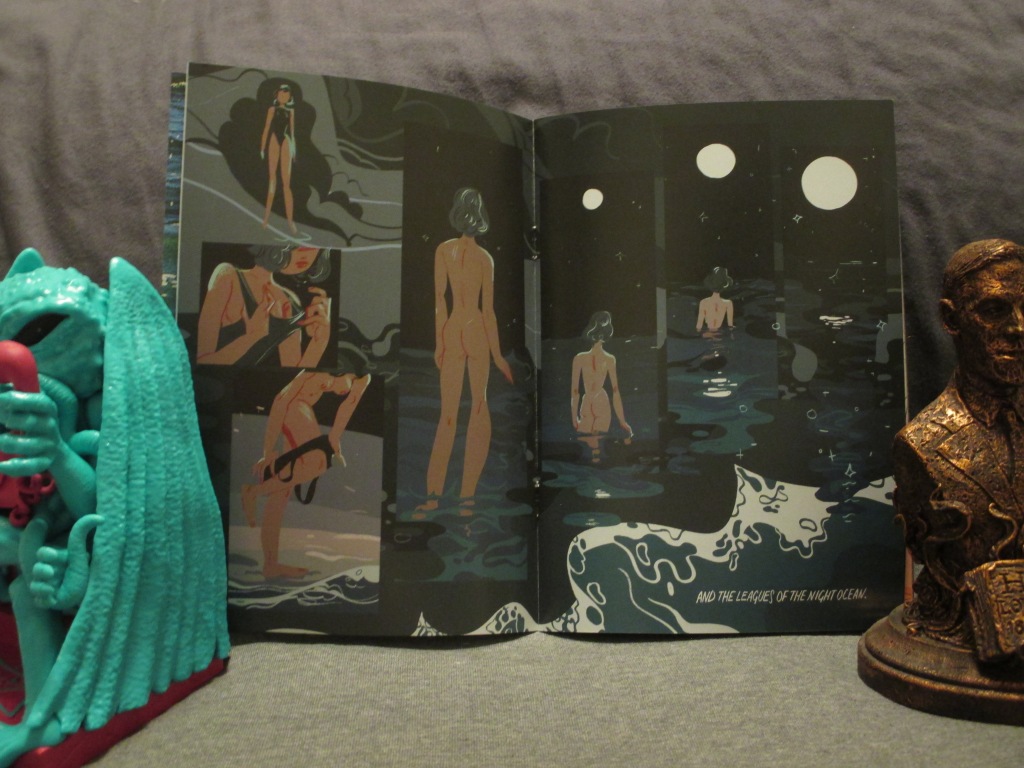
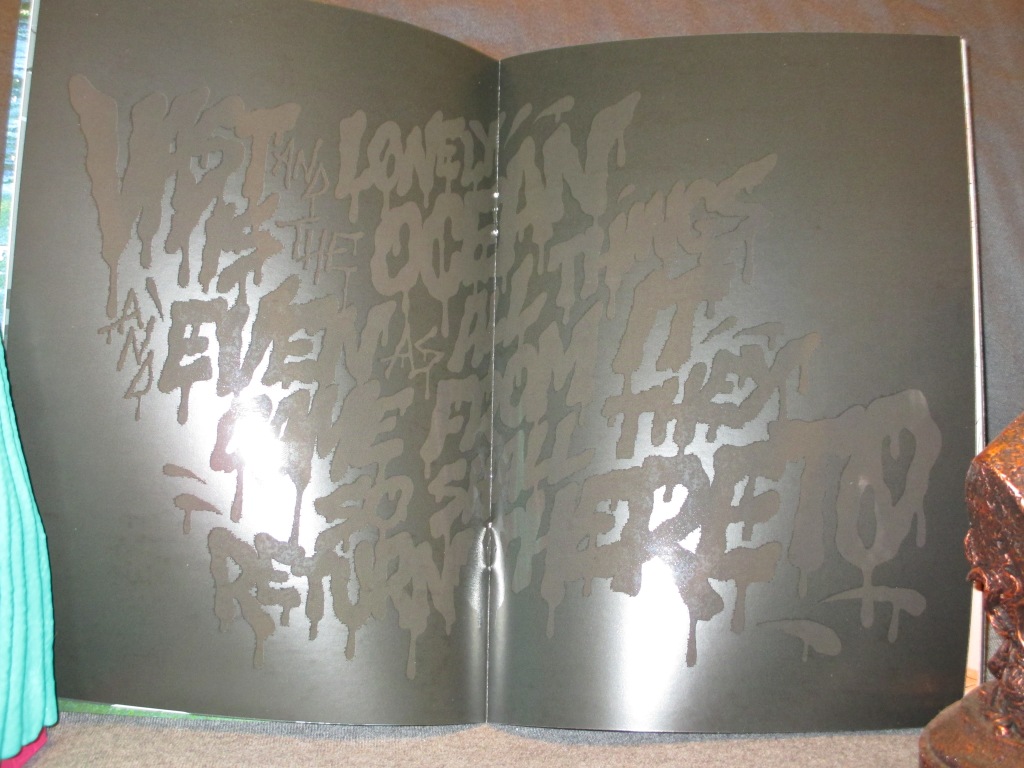
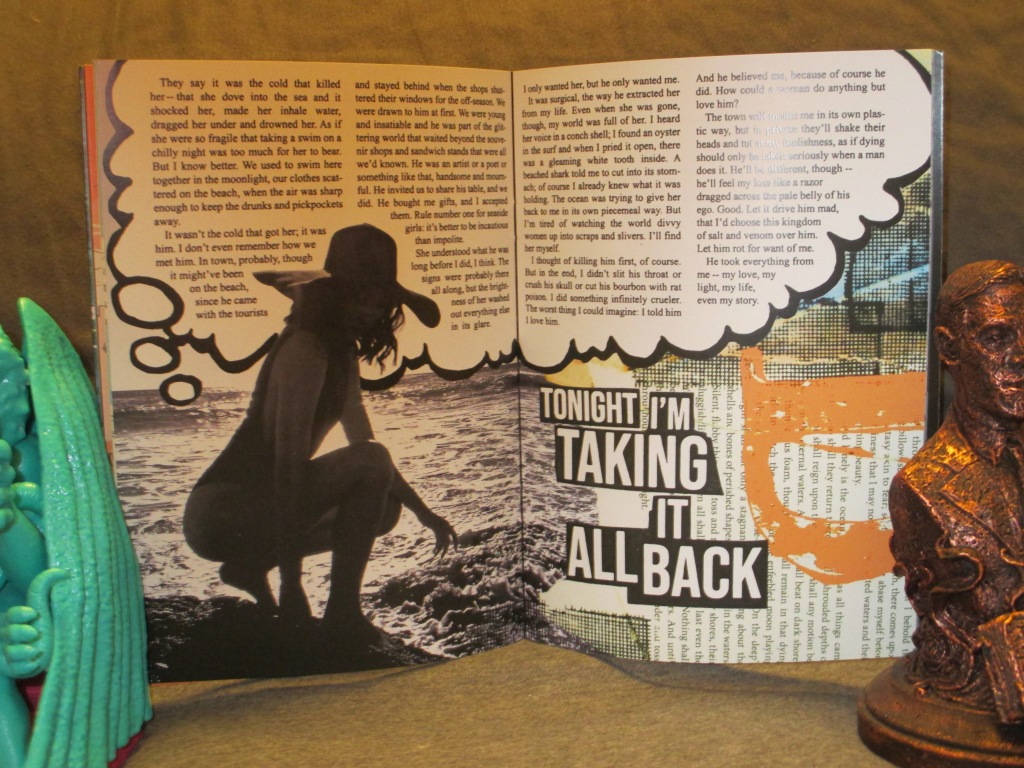
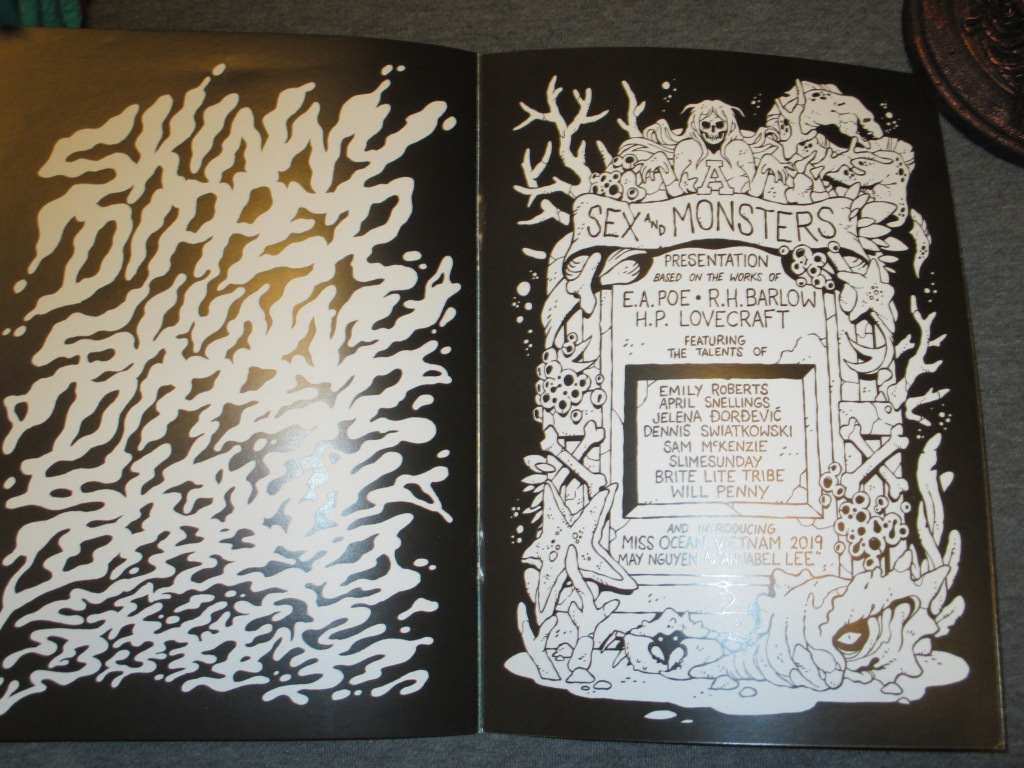
Os Mitos de Lovecraft (2020) is a crowdfunded Brazilian black-and-white graphic anthology edited by Douglas P. Freitas and published by Skript, probably best known for the deluxe hardcover edition which has a cover modeled on the bound-in-human-skin Necronomicon ex Mortis from Evil Dead 2 and Army of Darkness. Like its fellow Brazilian Lovecraftian anthology O despertar de Cthulhu em Quadrinhos (2016), while there is a common theme in terms of subject, the style and tone of the individual works inside varies considerably. Every style of comic art and horror can be represented under the broad remit of Lovecraftian comics, from straight adaptations of Lovecraft in exquisite realistic depiction to splatterpunk-esque gore fests with plenty of airbrush-style gore streaks to lighter works with more cartoonish tentacled Cthulhu-esque characters.
The anthology begins with an absolute masterpiece in two pages, by Argintenean artist Salvador Sanz, which originally appeared in the Spanish-language graphic horror anthology Cthulhu 23; for this anthology, it was translated into Brazilian Portuguese by Aline Cardoso and re-lettered by Johnny C. Vargas. This is a distillation of “Out of the Æons” (1935) by Hazel Heald & H. P. Lovecraft, subtracting all the human characters, the drama, and the fantastic history deciphered from the scroll in exchange for focusing on a masterful rendering of the mummy who caught a glimpse of Ghatanothoa—and paid the price.
In a cinematic journey, the reader is taken closer and closer to the ancient petrified horror. The panels zoom in on the one eye that peeks out between gnarled fingers. To the dark image that is still captured there, on the retina. The detail on the art, the pacing, and the execution of the concept, which boils down the essence of the Lovecraft/Heald horror story into two pages, is exquisite.
※
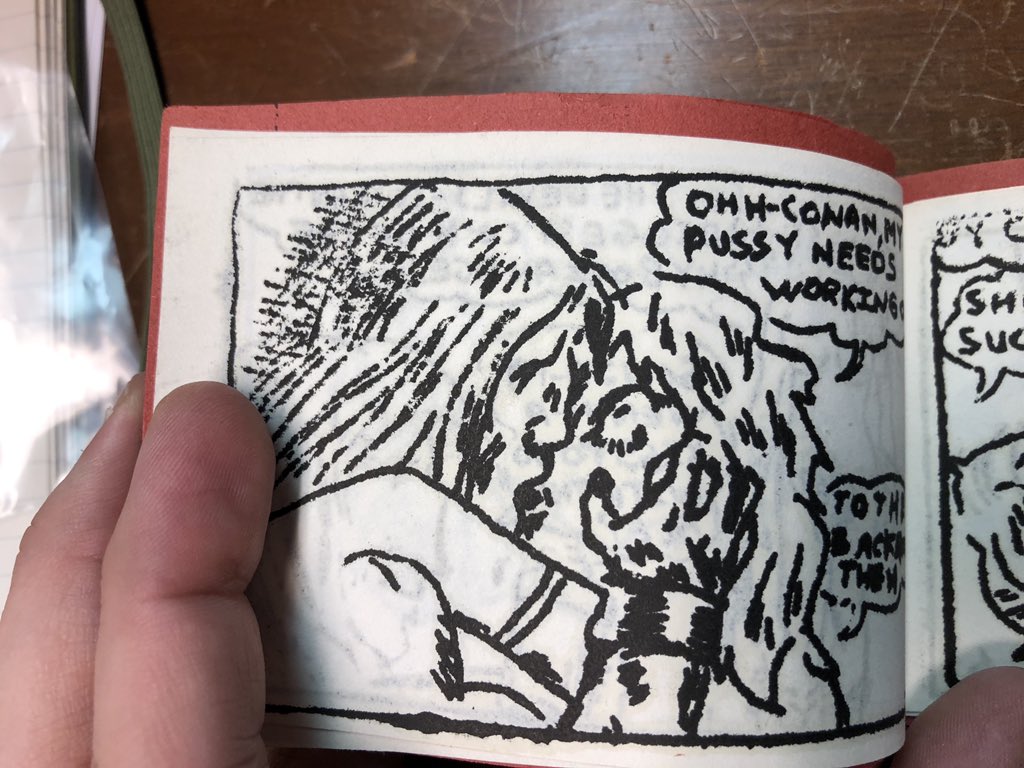
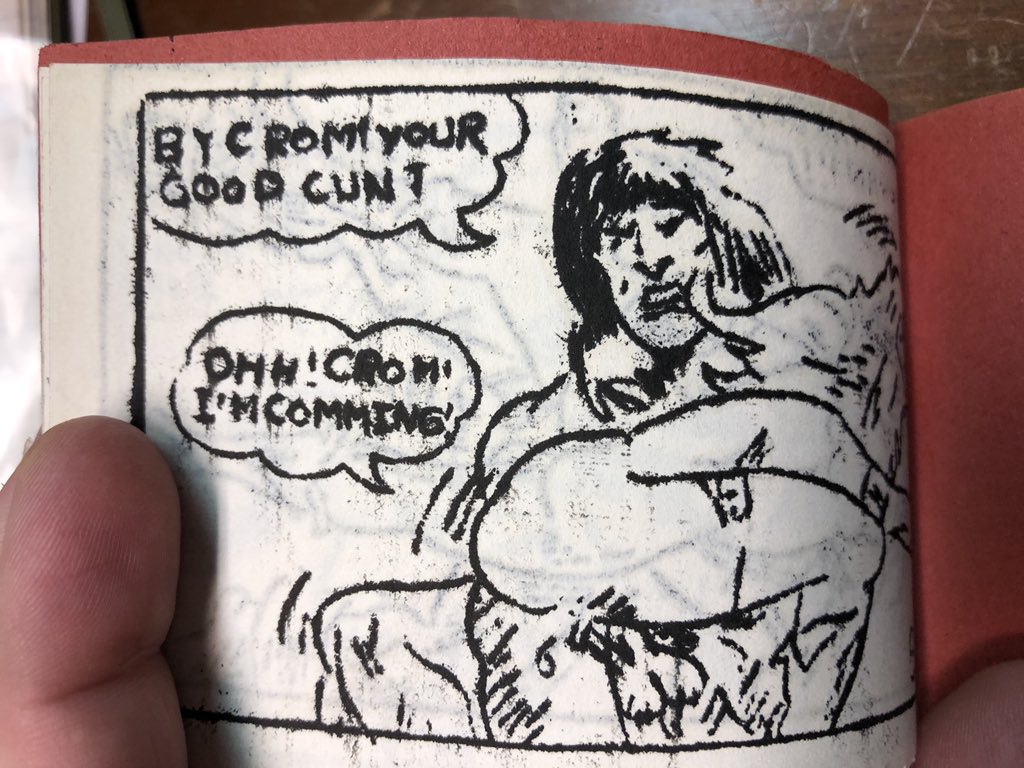
Freitas’ own contribution to Os Mitos de Lovecraft is “Sob As Trevas” (“Beneath the Darkness”), in collaboration with illustrator and comic creator Chairim Arrais. This is a tongue-in-cheek 8-page sword & sorcery story involving a nameless Cimmerian warrior and their female partner Ruivas (“Red”/”Red-hair”). Freitas & Arrais are clearly referencing Robert E. Howard’s most famous creation, Conan the Cimmerian, and aren’t coy about it:
Em algum lugar às margens do rio Estígio, sul da Aquilônia, ‘entre os anos em que os oceanos beberam a Atlântida e as cidades reluzentes, e os anos da ascensão dos filhos de Aryas’. Dois guerreiros buscam conforto após uma fuga.
Somewhere on the banks of the River Styx, south of Aquilonia, ‘between the years when the oceans drank Atlantis and the gleaming cities, and the years of the rise of the sons of Aryas’. Two warriors seek comfort after an escape.
“KNOW, oh prince, that between the years when the oceans drank Atlantis and the gleaming cities, and the years of the rise of the Sons of Aryas […]” —Robert E. Howard, “The Phoenix on the Sword”
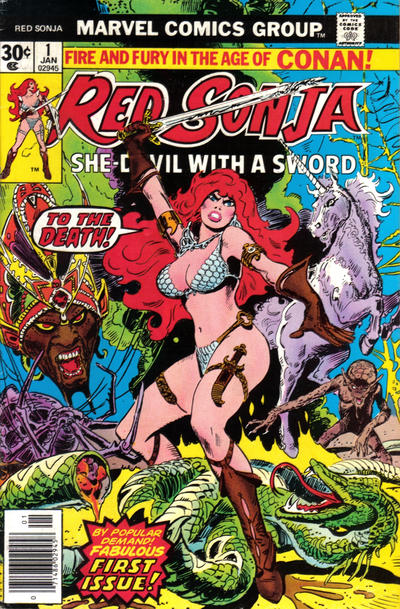
The character Ruivas is depicted similarly to the eponymous character in Arrais’ standalone comic “Red+18”; whether this is intended as an unofficial crossover, an Easter egg for fans of Arrais’ work, or just a coincidence—the character could as easily be a play on Red Sonja for the Marvel Comics, albeit sans the trademark mail bikini—is unclear, and maybe unimportant.
The story itself is fairly slight and straightforward: after successfully stealing a jewel, the pair of thieves hide out in a convenient cavern…which ends up being occupied by some nameless eldritch horror.
The story really wanted more pages; there’s little opportunity to really develop any atmosphere before the tentacles emerge from the darkness, and the action sequences are correspondingly cramped and staccato-like, crammed into increasingly more panels per page. With the in media res debut, the titillation, and the swift conclusion, this is strongly reminiscent of the kind of back-up feature that sometimes ran in Savage Sword of Conan, more of a sketch of an interlude than a full-fledged story.
Yet what there is there is fun. The writing is light-hearted, the chemistry between legally-not-Conan and Ruivas is alternately playful and rocky, and Arrais’ artwork does everything the script calls for. The brief sword & sorcery interlude sets a different tone than the other stories in the anthology, featuring more sex and action than horror or outright comedy. While I would have liked for it to delve more into the Howardian vibe of horror that permeated tales like “Xuthal of the Dusk” or “Red Nails,” limitations of space have to be acknowledged. Still, it would be nice if Freitas & Arrais had the opportunity to revisit the idea at a longer length more suitable to develop the characters and story at some point.
Eldritch Fappenings This review deals in part with artwork that includes nudity and/or sexuality explicit content. As such, please be advised before reading further.
In the 1985 Christmas supplement to the fanzine Fungi, W. H. Pugmire‘s story “Candlewax” first saw publication. This was one of Pugmire’s earliest efforts at Mythos fiction, and is a part of his Sesqua Valley cycle—his own corner of Lovecraft country set in the Pacific Northwest, populated by characters like Simon Gregory Williams. While Pugmire would go on to write many more tales of Sesqua Valley, which have been collected and published in various volumes, “Candlewax” is one of the comparatively rarer tales, having been reprinted only a handful of times—and, most interestingly, in an illustrated edition.
Discrete Ephemera (1990) is a limited edition (500 copies) book art project by Ashleigh Talbot, and illustrated texts by Steven J. Bernstein (“Face”) and W. H. Pugmire (“Candlewax,” as “W. F. Pugmire”), made possible by an art grant. Madame Talbot is presented throughout via a symbol:
The book exists in different states. My copy of 136 unnumbered sheets is bound between sheet metal plates with a small brass padlock, while others are bound in textured wallpaper; with a fingerprint imprint in gold ink (some listings say blood, but it looks like gold ink to me) on the limitation page, and a tipped-in photo of Pugmire in the nude. The overall aesthetic is strongly reminiscent of underground comix, punk zines, and copybooks of the 1960s-1980s, with an emphasis on cut-and-paste techniques, surreal imagery, the presentation of familiar images in unfamiliar contexts or subtly distorted, and a Burroughs-esque eye for the unfiltered and sometimes teratophiliac reality presented by medical textbooks and cabinets of curiosity.
The illustrated version of Pugmire’s “Candlewax” is distinct from the rest of the project, but mostly because it has a coherent, linear narrative, with a darker, more Gothic tone than the more stylized kaleidoscope of images that preceeded this section, or the much more comic-strip style collaboration “Faces” with Bernstein. While Talbot continues to use the same distinctive style, the illustrations work to complement the text, at times a strict depiction, and at times more abstract and evocative.
The story itself is a sketch in miniature of bibliomania, murder, necromancy, hubris, and revenge. A fitting snapshot of the kind of obsession that has characterized aspects of the Mythos (and readers of the Mythos) from the beginning.
At least two versions of the “Candlewax” text have seen print. Pugmire had a tendency to rewrite his stories when they were reprinted, and this seems to be the case here as well. To give the flavor of the difference:
The man was a dwarf. His bent and twisted frame, disfigured by age and nameless ailments, seemed perpetually trembling. Drool moistened thin black lips, and yellow pus oozed from reddened eyes. A skeletal finger tapped the book that lay before him, and he addressed his visitor in a whispered voice.
“His name was Simon Gregory Williams. He wrote this book of spells in the late 1960s. That in itself makes it unique. Most of my books are ancient tomes, crumbling and worm-infected. But, as you see, this looks almost new.”
The tiny man bent his twisted frame toward the curious tome. Drool moistened his thin grey lips; yellow pus oozed from his reddened eyes. A skeletal finger tapped the yellow cover of the book. He addressed his visitor in a low whispered voice.
“His name was Simon Gregory Williams. He wrote this book of spells thirty years ago, while visiting the poet William Davis Manly, in your curious Sesqua Valley.” Here he opened the book and turned to various illustrated pages. He stopped at a vivid depiction of a tremendous mountain of white stone, the twin peaks of which resembled wings folded up on a daemon’s shoulders. “The infamous Mount Selta, of which I’ve heard so much. And below, in purple ink, the name ‘Khroyd’Hon’; such a strange name.”
“Candlewax” in Discrete Ephemera (1990)
“Candlewax” in Mythos Tales & Others #1
The 1996 text deals much more with the Sesqua Valley cycle, probably to better incorporate it into the loose collection of stories and the Mythos that Pugmire would continue to build on in tales like “An Imp of Aether” (1997). Readers hunting this particular text may find themselves like the protagonist Oscar James, hunters of arcane lore about that mysterious vale and its even more mysterious occupants.
Left: Sesqua Rising, right: Discrete Ephemera
With an edition of only 500 copies, Discrete Ephemera and its illustrated version of “Candlewax” is very scarce and relatively expensive. Graeme Phillips reprinted the entire illustrated story in the chapbook Sesqua Rising (2016), but that was limited to only 50 copies, and is even scarcer, making this one of the rarest of Pugmire’s collaborations.
I was thrill’d when one of my early Mythos stories, “Candlewax”, appear’d fully illustrated in one of Ashleigh’s hand-made books. There is nothing more thrilling than working on projects with outstanding artists
W. H. Pugmire, “In Collaboration with Genius” (2016)
What is Discrete Ephemera and “Candlewax”? A collaboration of talents, a cross-pollination of ideas, attitudes, and styles. Discrete Ephemera is a kind of punkish grimoire, an art object to be experienced more than a text to be read and consumed, and in that sense “Candlewax” almost feels like a metatext…or, perhaps, a warning. For now, this copy is in my library. In time, it will be passed on to someone else. Hopefully, someone who gets it.
Whatever by the case, it is clear the African ethnology and history are a tangled and obscure affair; involving many a dramatic surprise for the future historian and archaeologist. It is not for nothing that Africa has been labelled a continent of mystery.
H. P. Lovecraft to Robert E. Howard, 30 Jan 1931, A Means to Freedom 1.141
We have better maps of Africa today than they did in 1931. Archaeologists have excavated the ancient cities, dug up the bones of primal ancestors. A few have even listened to the indigenous peoples, to take down their own history in their own words. With colonization and de-colonization, the myth of Africa has greatly retreated. Like the Old West, the period of the White Explorer Archetype and the Scramble for Africa is long over—and like the Old West, the tales spun out of that period have continued for far longer than the actual time when they might have held a grain of truth.
“The Adventurer’s Wife” by Premee Mohamed is a deliberate play on the established tropes. Details are deliberately a bit vague; if Mohamed drew any inspiration from any of the “African Mythos” stories like “Winged Death” (1934) by Hazel Heald & H. P. Lovecraft, she kept it largely off the page. There are old gods, and there are shoggoths, but no proper names to conjure by or places on the map a reader can point to and say “yes, this is where things happened.”
The vagueness is no doubt deliberate; in the great jigsaw puzzle of the Cthulhu Mythos, the story is a piece that can fit into many different puzzles, and become a part of many different pictures. The ambiguity plays to the strengths of the storytelling; the protagonist Mr. Greene, here to interview the adventurer’s wife, has preconceptions and prejudices that are set up and knocked down…and there is much that is hinted at but not spoken of openly, and some interestingly subtle subversion.
In many stories featuring the white explorer archetype, the focus is on the explorer: they are the protagonist, they are the adventurer. Allan Quartermain is one of the most famous, though Tarzan has likely eclipsed him. Even in stories where the explorer is dead, the focus is generally on their exploits, as revealed by journals or diaries, or as in the case of “Facts Concerning the Late Arthur Jermyn and His Family,” in wilder stories, gossip, and legend. Notably, we rarely get the viewpoint of the adventurer’s wife, someone who shared in the adventure and had their own viewpoint. It is hard to say more without giving the game away entirely, and the story is slight enough as it is that would be a disservice to those who haven’t read it.
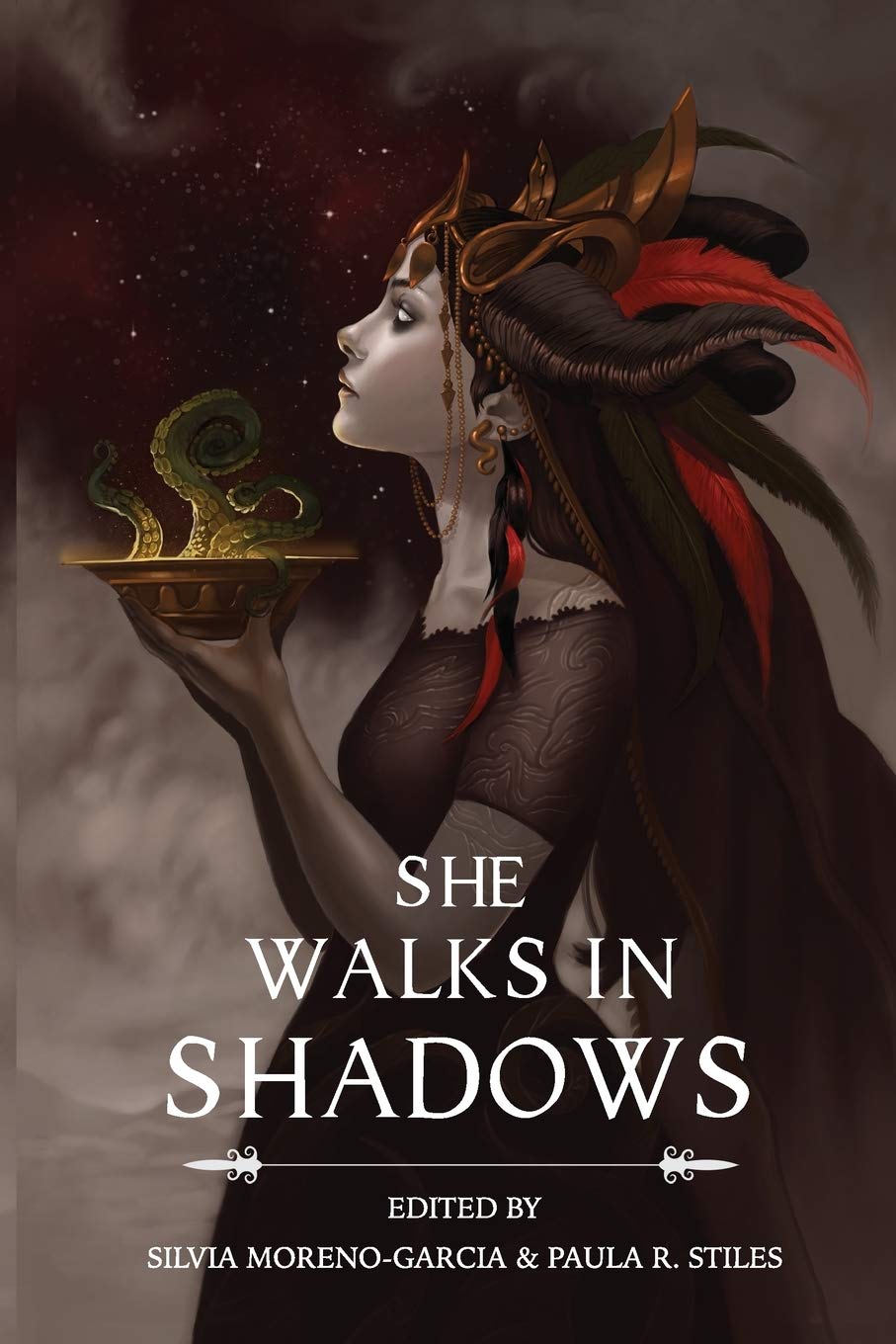
Published in She Walks In Shadows(2015), it is a story that benefits from its place in the anthology as much as the anthology benefits from its inclusion. The theme of this being a woman’s story, a woman’s perspective, an often ignored and unspoken side of the narrative, serves it well in relation to other stories of that type. If it wasn’t in a Mythos anthology, it might feel out of place, or having made too many assumptions for the casual reader; but in that context, alongside stories like “Magna Mater” (2015) by Arinn Dembo, it feels like another facet on a jewel, another piece in a puzzle that may never be complete, but which is all the more intriguing because a few pieces have gone missing.
Duane W. Rimel (1915-1996) was still in high school when he came into correspondence with H. P. Lovecraft in 1933. Rimel came from a working-class background and the Great Depression hit his family hard, but Lovecraft’s letters and science fiction fandom gave him a creative outlet that he might not otherwise have found. With Lovecraft’s encouragement (and sometimes a bit of Lovecraft’s help), Rimel published stories like “The Sorcery of Alphar” and “The Disinterment” in fan magazines and even in Weird Tales; “The Tree on the Hill” is often counted among Lovecraft’s revision stories.
Yet there is a gap in the published letters of H. P. Lovecraft and Duane W. Rimel; and a gap too in his published fiction. In the October 1936 issue of the Fantasy Fiction Telegram, Rimel’s short story “The Green Book” was published, with little fanfare. While there is no mention of the story in Lovecraft’s letters, Lovecraft did write that he received a copy of the fanzines:
The other day I received a copy of The Fantasy Fiction Telegram (hectographed), published in Philadelphia, which I had never seen before.
The Fantasy Fiction Telegramwas the organ of the Philadelphia Science Fiction Society. Fanzines of the period were often produced by amateur printers, who could not afford traditional letterpress printing and made use of cheap printing methods such as spirit duplication, hectograph, and mimeograph. All of these printing methods had their advantages (typically, low cost for set up) and drawbacks:
My first issue is hectographed, not mimeographed. Letters on the typewriter clog because the ink on the ribbon is very thick and such letters as “a”, “e”, “o”, “d”, “b”, “s”, “n” and etc. clog very easily. The letters “a” and “e” clog very much. An example of such a thing is found in the Fantasy Fiction Telegram.
Weir was himself a fan-printer whose publications would include Fantasmagoria, which published “An Heir to the Mesozoic” (1938) by Hazel Heald. His description of “clogging” letters is accurate, but this is frankly the very least of problems, at least in terms of durability and legibility.
The problem with hectographing is that the ink is impressed on the page very lightly, and worse, fades very swiftly under ultraviolet light. Combined with the often cheap and acidic paper that such ‘zines were printed on, and the text on the fragile pages is often illegible, or fades to almost transparency. Even scanning such paper can be troublesome and insufficient to read the text.
In March 2024, my friend Matthew Carpenter asked if I had a copy of Rimel’s “The Green Room”; the story had never been reprinted since its first appearance in 1936, and the only scan online was particularly poor on some of those pages. I did not have a copy of the Fantasy Fiction Telegram #1 then, but soon acquired one that was fortuitously on sale on eBay. Unfortunately, I soon ran into the exact same problem: parts of the story were almost completely illegible.
The header illustration is by John V. Baltadonis (JVB), and was probably produced by mimeograph; mixed printing methods were not uncommon in ‘zines during the 1930s. Nevertheless, between the two versions it is just possible to make out a more-or-less full transcription of this very obscure story…with a few caveats.
Any text in [parentheses] is largely illegible, but there is enough of the word to make a reasonable guess at what it is. Any text in [bold] inside parentheses represents words that are completely or almost completely illegible and are filled in based on context, length, and the few letter shapes that can be discerned. With the understanding that these may not be 100% accurate, but are as best as can be read under the circumstances.
※
The Green Book by Duane W. Rimel
“It is a curious book,” Arnold was saying, as he fingered the green-covered tome on the table, “I picked it up at a book store down town for a nominal sum.”
“And the title?” I inquired, eyeing the object with growing relish, since I had already recognized signs of great age upon it. One glance was enough to arouse my interest.
“Apparently the thing has none—though the subjects it covers might give a hint as to a name. So far I have read only two chapters, and both of these are about a sort of mystic symbol. In a sense it is a physical study—and in places not altogether pleasant.”
“Is the book dated?” I took my eyes from it and looked about the large room which served Arnold as a combination study and library.
“No,” he replied, “and that makes it all the more puzzling—though the value is greatly reduced in spite of its apparent age. It might have been written anywhere between the sixteenth and the seventeenth centuries, and the English is very crude and ponderous.”
“I would like to read it some time,” I said quite truthfully, “but surely you can tell me more after reading the chapters—”
“Well, it dwells at length upon an unseen God of vague description, and it even gives crazy formulae for communicating with it . . .”
“Very interesting,” I said, though inwardly I decided that I would not, after all, care to peruse the volume. I had heard of such nonsense before.
I left some time later, learning nothing more about the book, but making Arnold promise to call us immediately if he found any points of real interest, for though I still feigned a longing for it, I was, in reality, quite suspicious of the thing. Knowing Arnold’s sensitive temperament; his obsession for obscure mental experiments and kindred twaddle, I could not comfortably associate him with an unknown work on the subject. Despite my own disbelief in the practice, I nevertheless held a half-hearted respect for certain branches of the study. His reluctance to discuss the book’s contents was not a good sign either.
With these thoughts in mind, I proceeded homeward, and as it was already late evening, I secluded myself in the library to read. But I could not keep my attention on the novel and soon cast it aside. It was near midnight, I think, when the phone rang. As I expected, Arnold was on the wire, and in a considerable state of excitement which he tried unpretentiously to hide.
“I’ve been experimenting with those formulae,” he said.
“Cut it out,” I replied sternly, “and leave the book alone”.
“But [listen]”, he went on, “I am getting [results!] The symbol—in the form of a [tangled] cord about a heart—has resolved out [into the air!]”
“Good God,” I cried, “stop it or—.”
“And,” he continued, disregarding my frantic plea, “there seemed to be something [behind] the symbol, but I couldn’t make out make out [sic] what it was . . . I think I’ll try again. . . .”
My protests were out shone his by his act of hanging up. In some heat I dashed from the room and made my way to his house, several blocks down the street. Perhaps I [could] tell little more of that fateful [evening] for when I finally reached Arnold’s study he was dead, with the strange green book open [on] the table before him. On his forehead [was] the mark of a pale red heart, and about [his] neck were dark welts like a [twisted] cord might have left. There had been little [struggle].
My first act upon recovering from the shock of reality was to secret the green book in my clothing. Then [retreating] from his house, I went home once more, for I [did] not want to be discovered near the place [where] Arnold met his death. I met no one along the way.
I placed the book in a secluded [corner] of my library, where it will not be readily noticed. Since Arnold’s passing I have often wondered just how far he had read in that green-covered volume, and some day I shall take it from the shelf and find out. Perhaps I may be able to discover the real cause of my friend’s death. . . .
※
Even though some of the most interesting parts of the story are the least legible, Rimel’s nearly-forgotten story does have a bit of a Lovecraftian flavor to it, with the eponymous Green Book suitable for shelving next to the Necronomicon, Book of Eibon, or Unaussprechlichen Kulten. It is hard to imagine that Rimel wouldn’t have shown it to Lovecraft in some form, but unfortunately any letter commenting on the matter seems to have been lost with the passage of years.
The entire scan of Fantasy Fiction Telegram #1 can be downloaded as a zip file at this link. In practice, it’s better to work with the actual pages, since different angles of light on the paper sometimes highlight the shapes of faded and nigh-illegible letters better, but in the absence of the real thing, a scan is often the only thing to work with.
Thousands of pulp writers pounded out millions of words of pulp fiction during the 20s and 30s. Every week, hundreds of thousands of issues hit the newsstands of the United States of America, and found their way into Canada, the United Kingdom, and other countries. The vast majority of these writers and their work are utterly forgotten today—no more than a name and a list of titles in some dusty index or online database. A bare few have been remembered, as individuals and for their work. H. P. Lovecraft is an exception: the extensive investigation of his life and letters began shortly after his death in 1937, and continues to this day.
Early efforts by August Derleth and Arkham House were focused on identifying unpublished Lovecraft stories to get them into print. This included stories that were rejected during Lovecraft’s lifetime, such as The Case of Charles Dexter Ward (first published in Weird Tales May-July 1941), stories technically published but in obscure amateur journals or fanzines such as “The Alchemist” (Lovecraft’s first published story, from The United Amateur Nov 1916), to those works that Lovecraft revised or ghostwrote for others, such as “The Mound” (1940) by Zealia Bishop & H. P. Lovecraft, “The Horror in the Burying-Ground” (1937) by Hazel Heald & H. P. Lovecraft, and even those stories Lovecraft only had an oblique hand in, such as “Satan’s Servants” (1949) by Robert Bloch. Bits and pieces from Lovecraft’s letters were published as standalone works, such as “The Very Old Folk” (Scienti-Snaps Summer 1940) and “The Evil Clergyman” (Weird Tales Apr 1939). Even when Lovecraft’s files seemed exhausted, the demand remained—hence “posthumous collaborations” like “The Murky Glass” (1957) as by August Derleth & H. P. Lovecraft.
At this point, decades after Lovecraft’s death, there is little expectation of any new complete story to be discovered. While some interesting variant texts like “Surama of Atlantis” and “The Automatic Electric Executioner” (1953) by H. P. Lovecraft & Adolphe Danziger de Castro exist, a close study of Lovecraft’s letters and papers don’t suggest that many major “lost” stories remain to be found. Scholars might look for some juvenalia that Lovecraft claimed to have burned; meditate on the title of a novel that Lovecraft probably never started (or which turned into something else); read accounts of dreams which no one has yet excerpted as standalone works (e.g. the dream quoted in Frankenstein; or, The Modern Prometheus (1818) by Mary Wollstonecraft Shelley), etc. If there are any new works left to be discovered, they probably exist outside the corpus of Lovecraft papers—and consist of works associated with various revision clients.
There is no exhaustive list of Lovecraft’s revision clients, or what he worked on. Lovecraft typically only mentioned revision work in passing, and rarely named clients, unless they happened to overlap with other interests or appeared in Weird Tales, which was the case with Adolph de Castro, Zealia Brown Reed Bishop, and Hazel Heald. Others remain unidentified, and perhaps unidentifiable. For example:
Am utterly swamped with revision—from a rather quaint & interesting ex-westerner now living in Florida, whom Whitehead sic’d on to me. The fellow is fairly clever in a naive, semi-illiterate way, & I really think I can make something of one or two of his tales.
One of the more obscure scraps of Lovecraft’s revision works was offered for sale in A Catalog of Lovecraftiana: The Grill/Binkin Collection (1975), where entry 550 is listed as:
LETTER: HPL’s suggestions for revision of a detective story entitled “Robert Is Ill,” about which no more is known by this author. Two pages, written on the back of a letter to Lovecraft in Brooklyn from a European bookseller.
Nine years later, a second listing with more detail appears in The Book Sail 16th Anniversary Catalogue (1984), where entry 360 is listed as:
Two pages of suggestions for revision of an untitled mystery story, author unknown. 8 ½” x 11″, holograph, on the rectors of each page. Approximately 800 words. (No date, but the versos of each page comprise a letter to HPL from a Munich publisher dated November, 1926). Both pages twice folded. Fine.
Unfortunately, the manuscript appears to be in a private collection, so cannot be examined for further clues, but the catalogue did reproduce the complete text of these notes:
※
The Complete Text of Lovecraft’s Notes for Revision of an Unidentified Mystery Story, Author Unknown
Of course these are only vague suggestions—which you can use or not, just as you choose. I’m no expert in the field of the detective story.
Changes beginning with Chapter V Robert is Ill
Robert screams in the night and is found ill as stated—but don’t give any imputation of his guilt so far. Don’t use the words “supernatural fear” or “insane fire”. Sympathise with him, and even hint that his illness may be due to the same enemy who murdered his step-father.
Omit the long description of the illness by the specialist—having him merely say it is Rocky Mountain spotted fever, without reference to the medium of contagion. Do not permit Curtiss’s excitement to become manifest—mention his intense interest (as if he suspected that poison might be involved) but give no clue to the coming revelation. Remember that Curtiss has himself looked up the disease after having had the insect identified…and is quite convinced from the date and nature of the illness that the insect is the cause.
Of course, this opinion must flash over him only when the illness is announced: for before this he does not know that anybody has been bitten, and has therefore read about the disease only casually in connection with the general properties of the insect. The seizure of Robert, then, is a shock of surprise which connects in a moment with the previous conception and leads to the dawn of an idea. Grasp this psychological situation and make the most of it without giving anything away. Let the doctor state the gravity of the disease and let the mother’s grief be visible to the reader’s sympathy.
Chapter VI Knotting Up Loose Ends
Change the beginning to have the police strongly suspect Arnold. Introduce, if necessary, some bit of damaging appearance which leads the chief to insist on Arnold’s arrest. Have Curtiss protest that there are almost certain reasons to deem him innocent, but let the detective keep silent regarding those reasons, realizing that the chief would consider them flimsy.
Now have Robert Lester’s illness take a turn for the worse, so that the entire family—Arnold among them—is summoned to his bedside. The police have gone to Arnold’s office to arrest him; but upon hearing that he is at the Van Allen house, follow him there. Curtiss is with them and prevails upon them to give him time for an experiment before making the arrest. They arrive, and at Curtiss’s suggestion override the Doctor’s objections and enter the sick room where the family is all assembled. Robert sees the party, notes that one is in uniform and realizes what they are. Arnold displays uneasiness; but only such, of course, as the suspense and painfulness of the general situation call for.
Curtiss now advances to the bed and speaks to Robert with gentle firmness.
“Lester you can’t last long. That bug in the vial that broke in the laboratory on the night of the murder is pretty surely fatal nine days after it bites. We’ve pieced the whole thing out, and your sickness is the clincher. You might as well save us trouble before you pass out and tell us why you killed Professor Van Allen.”
Tableau
Lester turns pale despite his fever, nods helplessly and mumbles weakly—”There’s nothing to say—envelope in the safe deposit vault—”.
The police recognize the state of affairs and stand inactive. The doctor advances in alarm, feels the patient’s pulse and orders them out of the room. They retire to the library, and in a few moments a nurse emerges to say that Robert is dead. Curtiss says—”The case is closed”, and the police party leave, stopping at the safe deposit vault which Arnold tells them is the one used by the family. After getting Lester’s papers they return to the station where Curtiss explains the mystery to his colleagues. Make all this very brief, for the climax is over.
Now let Curtiss do his explaining as briefly as possible, telling of his inquiries in the West and of his researches anent the properties of the insect. After this, have Lester’s envelope opened and the confession read. Boil down this confession enormously, confining it wholly to skeletonic essentials. Have Lester say he wrote it for the sake of relieving his mind, etc. Cut out the conversation, etc. Let the key be in the envelope with the confession.
And have virtually nothing after the reading of the confession. That is logically
The End
Retain however the rumor about the insect being the detective.
P.S. If the existence of a written confession seems unconvincing to you, you can vary Robert’s response to a simple admission of guilt and have him write the confession then and there, just before he dies. Then—cutting out the stop at the safe deposit vault—you can end the tale just as in the synopsis with reading the confession at the very last. In that case, have the key found in the coat.
※
What can we make of all of this? Not much. The character names and bare plot outlined do not match with any known published tale, nor can they be conclusively tied to any published letters with known correspondents. The Munich publisher who wrote to Lovecraft is unidentified; however, November 1926 might be about the right date to have heard from such a publisher:
If I ever type “Sarnath” I’ll see that you have a copy. I did type it once, but that MS. is in the hands of the man (J. C. Henneberger of Chicago, connected with W.T.) who says he is trying to get my stuff placed with some book publisher.
While that doesn’t lead us any closer to the identity of the mystery author, it establishes that the revision notes probably date from December 1926 or later—it not being unusual for Lovecraft to re-use paper in this fashion, especially when writing to friends. That suggests this might not have been intended for a formal revision client, but for one of his friends or fans; Lovecraft was well known to freely offer feedback and suggestions for would-be writers. On the other hand, while Lovecraft is best known for effectively ghostwriting stories for his clients, in practice much of his work appears to have been simply giving detailed feedback, and letting the clients rewrite the story repeatedly until it made the grade.
While it is clear that this is essentially a pure detective story, Lovecraft’s suggestions for the plot echo some of his other revision stories: the element of murder-by-insect bite is reminiscent of “Winged Death” (1934) by Hazel Heald & H. P. Lovecraft, while the deathbed confession recalls “The Last Test” (1928) by Adolphe de Castro & H. P. Lovecraft. It is interesting to note that the suggestions for tightening up the wordcount are very practical, and the essential format—a climactic death/reveal, followed by an abbreviated denouement—echoes several of Lovecraft’s own stories, such as “The Dunwich Horror” (1929).
Which is perhaps more interesting than the bare outline of the tail-end of a story that appears to have never been published: the insight into Lovecraft’s process, his characteristic approach to the narrative. While we can’t read the original work he is critiquing, the impression given is something overwritten, a narrative bogged down in exposition and over-explanation, a common feature of amateur writers, and probably a common aspect of the stories that Lovecraft read for his friends and fans, as well as clients. How Lovecraft approached those corrections is an insight into how Lovecraft constructed his own stories, the way he looked at how a story was structured as much as the details (the key apparently being a key plot point).
Readers hoping for “The Statement of Randolph Carter II: Loveman’s Revenge” to turn up are probably doomed to disappointment, but if expectations can be moderated…perhaps, in some private collection, there are still a few scraps of Lovecraft waiting to be discovered.