Posts

“Hellsgarde” (1939) by C. L. Moore

“You’ll find it by sunset only, my lady,” Guy of Garlot had told her with a sidelong grin marring his comely dark face. “Mists and wilderness ring it round, and there’s magic in the swamps about Hellsgarde. Magic—and worse, if legends speak truth. You’ll never come upon it save at evening.”
—C. L. Moore, “Hellsgarde” in Weird Tales (Apr 1939)

The last Jirel of Joiry story came out 15 months after the previous story, “Quest of the Starstone.” In that time, Moore had been publishing less. The market was changing. New fantasy and weird fiction magazines were out, Weird Tales had been sold and the offices moved to New York City; the editor Farnsworth Wright would soon be fired and, in 1940, would die. Moore’s connections to the magazine were fraying. But there was this one last hurrah.

While it wouldn’t be quite correct to say that the Jirel of Joiry tales to this point were formulaic, they did share very similar plots: Jirel would travel to some other land or dimension, face a supernatural peril, and overcome it through ingenuity and sheer spirit. The details varied, and sometimes she faced sorceresses or wizards and other times alien spirits and gods, but it was a common theme, one largely shared with several early Northwest Smith yarns. “Hellsgarde” still has that theme, but it is developed in a very different way, and with much more style and plot, than the previous tales—and for a good reason.

This is a horror story.

There are strong Gothic setting elements, and readers might well see it as an old dark house tale, with the decaying castle and the creepy family. Yet without sacrificing any of the adventurous elements—Jirel of Joiry is a woman of action, even when trapped in a cell, and her escape is murderous and bloody—this is definitely a story that emphasizes the creepy above the fantasy. It is the darkest of the original Jirel stories, and with neither a typical ghost or typical ghost-hunters, but something much more deliciously weird.

“With the passage of years the spirits of the violent dead draw farther and farther away from their deathscenes. Andred is long dead, and he revisits Hellsgarde Castle less often and less vindictively as the years go by. We have striven a long while to draw him back— but you alone succeeded. No, lady, you must endure Andred’s violence once again, or—”
—C. L. Moore, “Hellsgarde” in Weird Tales (Apr 1939)

The peril to Jirel in this story is exquisite. Once again, she is in a scenario where swordplay is of limited use. She is bound by loyalty to her retainers, she is physically trapped in the castle by the hunters after Andred’s spirit, and her vitality is a beacon to Andred’s ghost itself. It isn’t the first time that something about Jirel’s violent life has attracted supernatural attention (cf. “The Dark Land” (1936) by C. L. Moore), but the threat is more visceral this time, more rapacious. That adds a sense of personal danger, a threat of sensual violence to a tale that is already designed to unnerve. And like a great writer of the weird, C. L. Moore knows enough to leave the last horror unknown, only hinted at.

It’s a wonderful story, and the readers thought so too:

Hellsgarde was the most welcome story of the current issue, for it has the qualities one associates with C. L. Moore: beauty of style, an owtré air, and narrative unpredictability […]
—J. Vernon Shea in “The Eyrie,” Weird Tales (Jun-Jul 1939)

Hellsgarde was a superb, grand and everything else kind of story; I loved it to the very last exciting word.
—Ethel Tucker in “The Eyrie,” Weird Tales (Jun-Jul 1939)

And C. L. Moore gives us the one and only Jirel of Joiry! Boy! Whatanissue! I hope that C. L. Moore delights us in future issues with more stories of Northwest Smith and Jirel.
—John V. Baltadonis in “The Eyrie,” Weird Tales (Jun-Jul 1939)

You do give us thrill-mad fans such nice ‘oogy’ stories. Look at Jirel of Joiry—she certainly does get around. How about getting her and Northwest Smith to meet again. They did quite some time ago. They should get better acquainted, don’t you think?’
—Elaine McIntire in “The Eyrie,” Weird Tales (Jun-Jul 1939)

There would be no sequel. Jirel of Joiry had run her course under Moore, and there was little left of Northwest Smith. Which doesn’t mean that the story of “Hellsgarde” ends here.

In 1967, “Hellsgarde” was reprinted in The Man from U.N.C.L.E. Magazine (Nov 1967). This digest was published by Leo Margulies, who had bought the rights to Weird Tales, and edited by Cylvia Kleinman Margulies, his wife. Back numbers from Weird Tales tended to fill out the issues in the “Department of Lost Stories.” However, probably for reasons of space, when “Hellsgarde” was reprinted it was significantly abridged, and in parts rewritten. This was likely done by the editor, as reprints of “Hellsgarde” in Moore’s own collections follow the 1939 text.

Did Moore intend “Hellsgarde” as a send-off for Jirel? Did she lose contact with the character, after so many years and stories? Or was it just that she lost contact with Weird Tales, and focused her energies on the future—to her upcoming marriage with Henry Kuttner, and the career they would build together? We may never know.

“Hellsgarde” was published in the April 1939 issue of Weird Tales. Scans of this issue are available on the Internet Archive.

A comparison of the 1939 vs. 1967 texts of “Hellsgarde” is also available on the Internet Archive.


Bobby Derie is the author of Weird Talers: Essays on Robert E. Howard and Others and Sex and the Cthulhu Mythos.

Deep Cuts in a Lovecraftian Vein uses Amazon Associate links. As an Amazon Associate I earn from qualifying purchases.
Deeper Cut: Muriel E. Eddy’s Selected Letters to the Editor

Muriel E. Eddy was a writer, poet, the wife of pulp writer C. M. Eddy, Jr., a mother of three, and a correspondent with H. P. Lovecraft. Today, she is most remembered for her several memoirs written about Lovecraft, including “The Gentleman from Angell Street” (1961), “Howard Phillips Lovecraft” in Rhode Island on Lovecraft (1945), “Message in Stone” in Fate Magazine (Oct 1956), “Memories of H. P. L.” in The Magazine of Horror (Winter 1965-1966), “Lovecraft’s Marriage and Divorce” in Haunted (Jun 1968), and H. P. L. “The Man and the Image” (1969) (also partially reprinted as “Lovecraft: Among the Demons”). The most recent publication of the Eddys’ memoirs of Lovecraft is The Gentleman from Angell Street: Memories of H.P. Lovecraft (2025) from Helios House.

Less well-known is that Muriel E. Eddy was an inveterate letter writer, often writing in to newspapers and pulp magazines, and having her missives published quite a few times. Many of these letters are of marginal interest for Lovecraft fans, since she wrote many letters about other subjects, often simply praising a magazine or giving advice, for example, her letter published in the Jan. 1926 issue of Weird Tales:

Muriel E. Eddy, of Providence, Rhode Island, writes: “Lukundoo, by Edward Lucas White, in your November issue, receives my vote, as it is by far the most noteworthy, really thrilling and chilling tale you have yet published. It calls to my mind a story I read years ago (by a titled Englishman), entitled The Hand of Fate, wherein the unfortunate hero was fatally marked by an Egyptian magician, before his birth, by a snake. The snake began its growth from the birth of the hero, slowly, bit by bit, out of his side, causing his death. In that story no one dared destroy the hideous monster growing from the man’s side, as to have done so (some thought) would have caused him to bleed to death.”

However, that does leave a collection of letters from Muriel E. Eddy to the editors that do deal with Lovecraft and related matters. Most of these are individually brief and necessarily repetitive. As an addendum to her body of memoirs about Lovecraft, however, they have interest and value, giving greater context to how she constructed and presented the narrative of her friendship with Lovecraft over the years.

  1. Providence Journal, 2 Jan 1944
  2. Thrilling Wonder Stories, Feb 1948
  3. Thrilling Wonder Stories, Jun 1948
  4. Famous Fantastic Mysteries, Aug 1948
  5. The Atlanta Constitution, 8 Aug 1948
  6. Providence Journal, 26 Aug 1948
  7. Providence Journal, 19 Sep 1948
  8. Fantastic Adventures, Oct 1948
  9. Fantastic Adventures, Dec 1948
  10. Startling Stories, Mar 1949
  11. The Boston Globe, 29 Apr 1962
  12. Fantastic, May 1962
  13. Magazine of Horror, Jan 1965
  14. Providence Journal, 8 Jan 1966
  15. Magazine of Horror, Summer 1966
  16. Fantastic, May 1966
  17. Worlds of If, Oct 1966
  18. Providence Journal, 19 Feb 1968
  19. Magazine of Horror, Jul 1968

[1] Providence Journal, 2 Jan 1944

H. P. LOVECRAFT

Editor:

I enjoyed the article about Howard Phillips Lovecraft in the Sunday Journal of Dec. 26, by W. T. Scott, inasmuch as the late Mr. Lovecraft was well known to our family. It was my husband’s uncle, Arthur Eddy, who owned the bookshop on Weybosset street where H. P. Lovecraft loved to browse. Incidentally, there was one great love of Mr. Lovecraft’s life, perhaps unknown, and therefore overlooked, by most of the public. H. P. Lovecraft adored black cats, and would never pass by a stray black feline on the street without stopping to pat it. Mr. Lovecraft often brought his manuscripts to our house to read aloud to us before submitting them to publishers. He was an excellent reader, as well as writer, of weird and macabre tales, calculated to send cold shivers up and down one’s spine He was a gentleman and a scholar, indeed, as Mr. Scott has said in his most interesting article.

H. P. Lovecraft’s wife, whose name Mr. Scott did not know, was Sonia Greene, who lived in Brooklyn, New York.

We are pleased and honored to have been intimate friends of this gifted author. I am convinced that, some day, in the not too distant future, Providence will be proud of having produced such a prolific writer of weird, uncanny yarns that are already known throughout the world.

MRS. CLIFFORD M. EDDY

Notes: Written in response to “The Case of Howard Phillips Lovecraft of Providence, R.I.” by Winfield Townley Scott in the Providence Journal of 26 Dec 1943.

[2] Thrilling Wonder Stories, Feb 1948

LOVECRAFTIANA

Dear Sir: In the OCTOBER issue of “Thrilling Wonder Stories” I was intrigued by a letter from B. De Revere, in which he (or she?) mentioned liking H. P. Lovecraft’s horror tales. As my husband and I knew H. P. L. personally, (he lived in Providence all of his life) I want to publicly thank B. De Revere for all the nice things said re: Lovecraft.

If you, dear editor, had known the man as we did . . . of his passionate love for cats, his dislike of all fish, and his hatred of daylight, you perhaps would realize that anything he wrote in the “weird” or fantastic line, he really “lived” . . . and I used the word “live” advisedly . . . even when he lay dying in the hospital, he asked the nurse for a pencil and paper and vividly recorded (for the doctor’s benefit) exactly how he felt while dying.

Lovecraft was a tall, spare man. His skin was the color of tallow. His handclasp was firm but his hands were always ice-cold. He despised sunshine, and adored utter darkness. He wrote his best horror tales after midnight. His favorite food was sweet chocolate . . . he consumed pounds of it, and cheese and fruit. He loved coffee smothered with sugar . . . as strong as love and as black as sin!

Lovecraft’s marriage was short-lived and his divorce was conducted quietly and without press notices. We sympathized with him in his every mood, because we knew him intimately and well—we often visit his unamrked grave in beautiful Swan Point cemetery in Providence, where a huge shaft in the center of the burial plot proclaims that his parents sleep there. His grave was somewhat sunken, last time we visited it, and covered with creeping green myrtle vines. His very spirit seemed hovering over his grave as we stood there in silent prayer for a man whose genius shall ever life, after his boens have crumbled into dust.

During his lifetime, we used to tell him that his stories rivalled those of Edgar Allan Poe. He “pooh-poohed” the very notion! He considered his work nothing at all, and never displayed any vanity. He wrote simply because he HAD to write . . . from an inner urger that would not let him sleep. May he rest in peace!

—125 Pearl Street, Providence 7, Rhode Island.

Notes: While Lovecraft was very much a night-owl by preference, he was not opposed to sunlight and often walked and wrote outdoors during the daylight hours. Lovecraft noted his own appreciation for coffee, chocolate, and cheese, but he rarely ate fresh fruit. Lovecraft’s death diary existed and has been partially published in various formats, most recently in Collected Essays 5. There was a brief press notice about Lovecraft’s divorce in the Providence Journal 26 Mar 1929.

Link to Thrilling Wonder Stories, Feb 1948.

[3] Thrilling Wonder Stories, Jun 1948

H. P. LOVECRAFT, GENTLEMAN

by Mrs. Muriel E. Eddy

Editor: I’ve been besieged with requests for more information about Howard Phillips Lovecraft, the late Providence writer of weird yarns—so here goes! Lovecraft used to come over to our house and read his manuscripts night after night. Once, he gave my husband a new kind of hair-cutter and advised him to learn how to cut his own hair. It would, he averred, save many a barber’s bill. He assured us he always cut his own hair and shaved himself.

Lovecraft was the soul of neatness, and always looked like the old-fashioned gentleman of culture he preferred to call himself! He once visited the oldest church in Rhode Island with Mr. Eddy and, while there, signed his name in the register—”H. P. Lovecraft, Esquire, Gentleman.”

My hubby’s uncle (now dead) owned and operated a huge second-hand bookstore on Webosset street in Providence. His name was Arthur Eddy. Lovecraft spent hours at night, talking to our ancient uncle and poring over many volumes in the basement. He never appeared in daylight—but always turned up around the Witching Hour of twelve. Uncle liked H.P.L. and stayed open until the wee sma’ hours of morning, to humor this then embryo writer. He once predicted that, with the years, Lovecraft’s fame would mount. How right he was!

Lovecraft asked us to do much of his typing. He used an old, old machine on which he occasionally typed a story—one of the “invisible type” variety, no longer made. It is to be regretted that this typewriter was sold to a second-hand man when some disinterested outsider was cleaning his apartment after his death. I’m sure it would have been a collector’s item, had it not been sold to this unknown person, to whom the name “Lovecraft” meant nothing!

I have pictures of H. P. Lovecraft as a small child, and also pictures of his mother and father. Last summer we ascertained where his grandfather had lived during his boyhood and took interesting snapshots of the yard in which H.P.L. used to play—when he was not ill, for he was not a rugged child. I have a photo of his grandfather (who had brilliant dark eyes, a Lovecraft characteristic) and of his birthplace as well as of the grave in which he is buried (his body was placed in the ground, not in a vault).

I feel that memories of this man are precious indeed—and I even have a letter he wrote to us, congratulating our cat when she presented us with several kittens—written just as one would write to a human mother—because Lovecraft was noted for his great devotion to felines!

By the way, my favorite story in FEBRUARY TWS is “THE SHAPE OF THINGS” by Rad Bradbury. It is written in such a manner that one wonders if—MAYBE—it couldn’t be true! Fantastic but truly fsacinating stuff to ponder over! I enjoyed all the stories and I loved the monstrous hairy spider (?) on the cover! I’ll keep reading TWS!

—125 Pearl Street, Providence 7, Rhode Island.

Notes: The reference to the “disinterested outsider” might be an aside on R. H. Barlow, Lovecraft’s literary executor, who helped deposit Lovecraft’s papers at Brown University, and some of Lovecraft’s books. The remainder of Lovecraft’s possessions were disposed of by his surviving aunt, Annie Gamwell; it’s possible she sold or gave away the typewriter along with other items she did not wish or could not afford to keep. Several of the photographs mentioned appeared in Rhode Island on Lovecraft (1945).

Link to Thrilling Wonder Stories, Jun 1948.

[4] Famous Fantastic Mysteries, Aug 1948

ABOUT H. P. LOVECRAFT

Dear Editor:

My hubby picked up a copy of April 1948 Famous Fantastic Mysteries on the newsstand, and brought it home to me; he was fascinated by the cover . . . somehow, the pointing finger of the old genii with the red eyes and blue face and hair, popping out of the magic beanpot (at least, it looks like a tiny red-brown beanpot, to me!) intrigued him endlessly. He read it on the trolley coming home, and had all the other strap-hangers gaping, open-mouthed, and wondering, no doubt, what it was all about.

As usual, I turned to the letter deparment, first of all . . . somehow, when a magazine conducts such a department, it seems a safer magazine to read, proving that it is not afraid to publish readers’ frank comments . . . and what did my eyes discover there? Mention of Howard P. Lovecraft, Providence, R. I.’s own native son and favorite author of weird stories, in a letter signed Donald L. Fox, of Bicknell, Ind.

This letter praised a sketch of Lovecraft that appeared in the August 1947 issue on page 113 which I , most unfortunately, missed. In fact, this April issue is, believe it or not, the first one we’ve seen. Lay the blame on other lovers of uncanny yarns here in our city . . . no doubt copies of Famous Fantastic Mysteries sell so rapidly that no newsdealer can keep them stocked sufficiently for their customers.

If any kind reader happens to have this issue, if they’ll loan me their copy, I’ll guarantee its safe return, once I’ve glimpsed the drawing of Lovecraft.

You see, my husband and I were literary buddies of H.P.L., as we always called this now famous writer. he used to bring his manuscripts over to our house, for criticism, though Heaven knows they were always letter-perfect in our opinions. Just the same, Lovecraft would read them aloud, munching on bars of sweet chocolate between paragraphs, for he loved this confection. H.P.L. hated cold weather with an intense hatred. He was a man of many idiosyncrasies, but withal a wonderful pal and a staunceh friend. He always made himself perfectly at home with us, loved to pet our cats, and hated fish—in fact, any kind of sea-food was hateful to this master of the macabre.

When H.P.L. died, it broke our hearts. He was buried in historic old Swan Point Cemetery, here in Providence, and we often visit his grave. Sometimes it seems he is very near, as we read over cards he sent us on his various travels.

As for the magazine: “City of the Dead” is a great story . . . kept us interested throughout. We enjoyed Robert W. Chambers’ novelette, “The Messenger”, and the sketch of Algernon Blackwood was wonderfully executed. But best of all I enjoyed the wonderful “Readers’ Viewpoint” with letters from readers everywhere! From now on, I’m taking no chances. I’m ordering my copies of F.F.M. in advance.

Glad to see a letter from August Derleth . . . We know him, too. We met him last summer during his hurried trip to Providence.

Mrs. Muriel E. Eddy
125 Pearl St.
Providence 7, Rhode Island.

Notes: Muriel E. Eddy also corresponded with August Derleth.

Link to Famous Fantastic Mysteries, Aug 1948.

[5] The Atlanta Constitution, 8 Aug 1948

I am pleased to see Joe Lee’s article on Houdini . . . whose real name was Erich Weiss. My husband, Cliff Eddy, was “ghost writer” for Houdini for many years. He also assisted Houdini in exposing fake mediums. I am proud to say that Houdini and his wife Beatrice (now dead) were personal friends of mine. They were remarkable people . . . I often wondered what happened to their pet parrot, Laura, after she flew out an open window in Hollywood (after Houdini’s death) and was last seen heading for the foothills.

Laura always accompanied her mistress on tour and I remember the pretty green bird with the red head perched on her mistress’ shoulder as we walked up a busy street in a sudden downpour of rain.

Laura seemed to enjoy the rain and laughed delightedly and when we entered the lobby of the hotel where we were staying, the bedraggled parrot was still laughing. But when folks started to laugh at her she hid her head under a wing and cried like a baby.

Mrs. Houdini ordered half a melon for the parrot as a special treat, but Laura much preferred sipping tea from a spoon.

Mrs. Muriel E. Eddy,

Providence, R. I.

Notes: Written in reply to “I Knew Houdini” by Joe Lee, Houdini’s former publicity director, published in The American Weekly magazine section of the Chicago Herald-American for the week of 20 Jun 1948. While not directly related to Lovecraft, this letter is relevant for its insight into the Eddy/Houdini relationship, which in turn was connected with Lovecraft’s relationship with Harry Houdini and his wife, Bess Houdini. This letter was published simultaneously in multiple papers, also appearing in at least the Pittsburgh Sun-Telegraph, 8 Aug 1948 and the San Francisco Examiner, 8 Aug 1948.

Link to the Atlanta Constitution, 8 Aug 1948.
Link to the Pittsburgh Sun-Telegraph, 8 Aug 1948.

[6] Providence Journal, 26 Aug 1948

Writer of the Uncanny

Editor:

I read the Sonia H. Davis article on H. P. Lovecraft on the book page of the Aug. 22 Sunday Journal. I thank Mrs. Davis for giving us her impressions of one of the finest writers Providence has ever produced. My husband and I knew Lovecraft so well that we often visit his grave at Swan Point Cemetery in memory of a very dear friend and a gentleman of the “old school.”

Often, we typed Lovecraft’s manuscripts, finding it a joy to assist this prolific writer of the weird and uncanny. Lovecraft lived in a world of his own making, a sort of “dream world” where night became day. Most of his writings were accomplished at night. Providence was Lovecraft’s first, last and only real love in my opinion. He derived his inspiration from Providence’s little-known alleys, back streets and ancient burying grounds. We knew Lovecraft I really believe, better than anyone else (outside of his two aunts), and no finer gentleman ever lived, I feel safe in saying, than this man who just could not reconcile himself to married life, perhaps because his writing meant his entire life to him.

MRS. MURIEL E. EDDY
Providence.

Notes: In response to “Howard Phillips Lovecraft as His Wife Remembers Him” by Sonia H. Davis in The Providence Journal, 22 Aug 1948.

Link to letter in Providence Journal, 26 Aug 1948.

[7] Providence Journal, 19 Sep 1948

First, from a letter from Lovecraft’s friend Mrs. Clifford Eddy:

“I was deeply impressed . . . but one thing I think the charming Sonia overlooked entirely. Writing was H.P.L.’s entire life . . . Lovecraft often used to ssay: ‘I never was young; I was born old!’ But thanks to Sonia for giving us even the vaguest insight into married life with this extraordinary man.

“Sonia perhaps was unaware that after the divorce H. P. L. traveled several times ‘Boston-ward’ to visit a very fine young lady, and to assist her in literary work. The visits were sources of pleasure to the young lady, for she wrote me of visits to museums with H. P. L., of candle-lit suppers on cheese sandwiches and chocolate cake, and of his gentlemanliness and courtesy. It was purely a platonic friendship, but it proves that at heart H. P. L. was surely not a recluse entirely! He was human, but always his literary work came first, last and foremost!”

Notes: This excerpt ran in Winfield Townley Scott’s column, “Bookman’s Gallery,” in the Providence Journal, and was a further response to Sonia H. Davis’ article. The entire letter is available at the Brown Digital Repository. The “young lady” referred to was almost certainly Hazel Heald, a revision client that Lovecraft got in touch with trough Muriel E. Eddy, who had a somewhat romantic and rose-tinted view of their potential relationship.

[8] Fantastic Adventures, Oct 1948

SHAVER AND LOVECRAFT

Sirs:

The May issue of FA was a pip! It bubbled with good reading! “Forgotten Worlds” by Lawrence Chandler was wonderfully illustrated and it held my attention all the way.

I agree with Milton Papayianis of Barstow, California, regarding Richard S. Shaver and H. P. Lovecraft. Lovecraft, a close friend of the family for years, loved red roses, sweet chocolate ice-cream, and soft dreamy music. My husband has composed music for years, and H.P.L. lovecraft to watch him at work.

To those of you who love the weird things in life, I’m sure you love weird music too, as much as the late master of the weird did. My hubby often talked with H.P.L. about setting some of his weird poems to music, but unfortunately H.P.L.’s untimely death prevented this.

Muriel E. Eddy
125 Pearl St.
Providence 7, R.I.

Notes: In the 1940s, some fans drew connections between Lovecraft and the Shaver Mystery; Richard Shaver’s stories and many letters about them were published in the pages of Fantastic Adventures. I have been unable to find independent confirmation that Lovecraft particularly enjoyed roses or “soft dreamy music”; in his letters, Lovecraft indicated his musical tastes tended toward the popular music of his youth. C. M. Eddy, Jr. did write and publish songs, although it isn’t clear he ever approached Lovecraft about such an adaptation; composer Harold Farnese, however, did set some of Lovecraft’s weird poetry to music, so the idea isn’t too far-fetched.

Link to Fantastic Adventures, Oct 1948.

[9] Fantastic Adventures, Dec 1948

LOVECRAFT’S WIFE

Sirs:

Since my letter appeared in the October FA I have been deluged by letters asking me whether or not HPL, the great weird master, was ever married. The answer is, emphatically, yes.

He had a beautiful wife, and she has just written an article pertaining to her married life with him, which appeared, with her photo, in our local paper. HPL was her second husband. They divorced, and she remarried. Her third husband has since passed on. She stated in her article that Lovecraft loved cheese souffle for breakfast, cared very little for foreigners, and that he really loved his native Rhode Isalnd. The article was very interesting, and Sonia H. Greene Lovecraft Davis is really a fascinating woman. Perhaps she’ll read this and write into FA herself!

The October issue of FA was wonderful, from “kiver to kiver.”

Muriel E. Eddy
125 Pearl St.
Providence 7, R.I.

Notes: While they never met, Muriel Eddy and Sonia H. Davis did develop a correspondence after Sonia’s memoir on Lovecraft appeared in the Providence Journal.

Link to Fantastic Adventures, Dec 1948.

[10] Startling Stories, Mar 1949

MORE LOVECRAFTIANA
by Mrs. Muriel E. Eddy

Editor Startling Stories: I’ve been so interested in the many letters re: Lovecraft. Here in Providence, R.I., folks call me an authority on Howard Phillips Lovecraft, because my husband and I knew him intimately for many years. We were aware of his many idiosyncrasies and we loved him!

We know he was allergic to fish—so we never served him fish or any sea food! We knew he enjoyed the white baked meat of chicken—and cheese. He loved chocolates and when he married Sonia Greene in 1924 his two aunts gave our children over 100 empty chocolate boxes to play with! (In fact, a bathtub full!) We used an old gas-plate Lovecraft formerly brewed his coffee on, for a long time.

We remember how dearly this famous author of the weird and uncanny loved coffee with many spoonfuls of sugar! Many a night we listened to Lovecraft reading his original manuscripts—and enjoyed the facial expressions that played over his unusually mobile features as he read aloud with many a theatric gesture!

I’d be glad to furnish readers with any information on Lovecraft I am able to—and in the meantime I’ll just say I do enjoy “STARTLING STORIES” and the November issue was EXCEPTIONALLY fine! I LOVE your illustrations and covers!

—125 Pearl Street, Providence 7, Rhode Island.

Notes: When Lovecraft moved to New York City in March 1924 and married Sonia, he instructed his aunts to send much of his furniture and belongings to him in New York, and some of the other items ended up with the Eddys, who at the time were in a straitened financial situtation. With regards to chicken, Lovecraft’s letters and other memoirs confirm he did enjoy it, and his friend Harry Brobst, when interviewed by Will Murray, claimed that Lovecraft especially liked white meat and disliked dark meat (Ave Atque Vale 313).

Link to Startling Stories, Mar 1949.

[11] The Boston Globe, 29 Apr 1962

They Remember Howard Lovecraft

To the Editor—The year 1962 marks the 25th anniversary of the death of one of New England’s most prolific writers of the weird and uncanny in literature . . . the late Howard Phillips Lovecraft, who was born Aug. 20, 1890, and who died Mar. 15, 1937, in Providence.

My husband and I were personal friends of H.P.L. (as he is known to many of his readers) and we read many of his yarns, which are now published all over the world in many different languages. We spent many hours with this genius, talking over his stories and criticizing them in the rough spots.

Here at 588 Prairie av., Providence, we have many mementoes of this talented writer, who some say rivalled Edgar All[a]n Poe with his weird ideas. My husband, Clifford Eddy, was a frequent pal on the long midnight walks Lovecraft used to take to get story ideas.

MRS. MURIEL E. EDDY
Providence

Notes: According to a 2 Dec 1960 letter to August Derleth, the Eddys had established a Lovecraft “shrine” in a corner of their home for visitors, including photographs of HPL.

Link to The Boston Globe, 29 Apr 1962 letter.

[12] Fantastic, May 1962

Dear Editor:

I was greatly interested in Feb. FANTASTIC because of the story “The Shadow Out of Space,” by H. P. Lovecraft and August Derleth. My husband and I were close personal friends of the late H. P. Lovecraft. This year makes the 25th anniversary of Lovecraft’s death, which occurred March 15, 1937. He is interred in beautiful Swan Point Cemetery, Providence’s finest, most exclusive burying-ground. We often visit the grave of this unusually gifted author of the macabre.

I would be pleased to hear personally from any Lovecraft fans. I have plenty of time and will answer all letters if a stamp is enclosed.

Mrs. Muriel E. Eddy
688 Prairie Ave.
Providence 5, R.I.

Notes: “The Shadow Out of Space” was one of August Derleth’s “posthumous collaborations,” with H. P. Lovecraft, though in fact Derleth wrote them all, often based on some inspiration from Lovecraft or some prose fragment or portion of a letter.

Link to Fantastic, May 1962.

[13] Magazine of Horror, Jan 1965

Mrs. Muriel E. Eddy of 688 Prairie Avenue, Providence, RI, 02905, writes, “Having known Howard Phillips Lovecraft very well, from 1923 to the year of his death, 1937, I would like to share my memories of “HPL” with any of your readers who would care to write to me.

“HPL was a constant nocturnal caller at our home during those years. We discussed manuscripts constantly with him. We knew his aunts, too, and we often visit his grave, here in Providence, R. I.”

Notes: The Magazine of Horror had published some Lovecraft-related material in previous issues, which may have inspired this letter, and this offer probably led to Muriel E. Eddy’s “Memories of H. P. L.” being published in Magazine of Horror (Winter 1965-1966).

Link to Magazine of Horror, Jan 1965.

[14] Providence Journal, 8 Jan 1966

A Tribute to Howard P. Lovecraft

During our many years of close association with the late Providence-born author of weird, uncanny and bizarre tales, Howard Phillips Lovecraft, who died on March 15, 1937, we learned much about this wonderful writer that is not too widely known to those who read his stories and shiver, loving every word of them, or the students who are writing theses on this now famous Providence author of the macabre.

Born August 20, 1890, he was the only child of Sarah Susan (Phillips) Lovecraft and Winfield Scott Lovecraft. As a young boy, H. P. L. (as he was affectionately known to us) became interested in the weird. he was a devotee of Edgar All[a]n Poe, Ambrose Bierce, Arthur Machen, and others in that category.

Knowing Lovecraft made us appreciate the wonderful city we live in. he loved the fan-shaped designs over ancient doorways, and he loved to explore old cemeteries such as St. John’s Churchyard. Many of his stories were inspired by his ramblings in ancient cemeteries.

On March 15, 1966, this now famous writer, born and brought up in our fair city, will have been gone from our midst 29 long years, yet his fame is spreading like wildfire. 

His work is now internationally known. During the past seeral years we have had callers from England and Sweden who wanted to discuss H. P. L. and his writings with us and to see his last resting-place in beautiful Swan Point Cemetery. It is considered a rare privilege by my husband and me to realize that we knew this wonderful man personally.

Long may his memory live!

Muriel E. Eddy
Providence

Notes: In 1959, the Swedish editor and radioman Torsten Jungstedt visited the Eddys at their home in Providence, R.I., as recounted in letters to August Derleth.

[15] Magazine of Horror, Summer 1966

“Thanks for publishing my brief Memoirs of HPL,” writes Mrs. Muriel E. Eddy of 688 Prairie Avenue, Providence, Rhode Island 02905, “in the Winter 1965/66 issue, and thanks to readers who’ve written me how much they liked it. As my husband (Clifford Eddy) and I knew this master of weird fiction so well, I had some photos of HPL copied, so that I can send them (as mementos) to sincere Lovecraft fans. To those who care to send me a self-addressed, stamped envelope, regular size, I’ll send a picture. . . . Call on me, if you wish. We even had a caller from Sweden and two from England, wishing information on HPL, which we gave to them gladly. We still remember how HPL loved ice-cream and hated fish! I still have a chair HPL’s aunt (now gone) gave to me when HPL left Providence to marry Sonia Greene in New York. I used to own the folding bed HPL slept in (his aunt also gave it to me) until one night it collapsed on me! His aunt gave me many souvenirs of HPL which I cherish—those I have left—after all these years. Memories of HPL will never cease!

“Glad to see so many fine stories in the Winter issue. I believe that Master Nicholas, by Seabury Quinn, was my favorite. The Faceless God, but Robert Bloch, was a close second.”

Notes: The aunt was Annie Gamwell.

Link to Magazine of Horror, Summer 1966.

[16] Fantastic, May 1966

Dear Editor:

In the January, 1966 issue of Fantastic the story which held the most appeal for me was Robert Sheckley’s “What a Man Believes.” It really “rang the bell” for me!

Being an “old-timer” when it comes to reading odd, strange and different stories, I feel I am qualified to judge a story pretty well . . . and having read thousands of manuscripts during my lifetime (I’m heard of the R.I. Writers’ Guild here in Providence, R.I., and I’m almost 70 years old!), I don’t mind adding a few more “unbelievable tales” while I’m still alive! Robert Sheckley truly made an “unbelievable” tale BELIEVABLE!

My husband and I were bosom friends of the late weird writer, Howard Phillips Lovecraft, who died March 15, 1937, in our city, and who lies sleeping in beautiful Swan Point Cemetery. One night, after reading an especially weird manuscript aloud to us, he remarked that he believed the human brain was practically indestructible. . .that (who [k]new?), the brain MIGHT keep on functioning even after death. . .at least, it was a subject worth thinking about!

His remark has haunted me for years. Every time we visit Lovecraft’s grave, I think about it, and I wonder if, after death, it is ever a possibility that the human brain MIGHT keep right on functioning. . .whether the heart stops or not. . . .Sheer fantasy, I’m sure. . .or. . . is it?

To get off the subject. . .ALL of the stories in the January, 1966, issue are well worth reading. . .and of course Virgil Finlay’s weird illustration of “Six and Ten Are Johnny” is great. By the way, Virgil has also illustrated many Lovecraft stories. . .he’s my favorite illustrator!

Many times I regret that H.P. Lovecraft died so young. . . he was only 47 at his demise. He’d be 75 if he’d lived. We cherish his memory and invite correspondence referring to H.P.L. and all weird, uncanny subjects! KEEP UP THE GOOD WORK and I’ll continue to be a FANTASTIC FAN!

Mrs. Muriel E. Eddy
Pres. R. I. Writers’ Guild
688 Prairie Avenue
Providence, R.I. 02905

Notes: The anecdote about a brain still living evolved over time, derived from “Thoughts and Feelings of a Head Cut Off,” a story ghostwritten for Harry Houdini, possibly by C. M. Eddy, Jr. The identification of the idea with Lovecraft appeared notably in “Message in Stone” (1956) by Muriel E. Eddy. The idea of an indestructible brain doesn’t sound very much like the materialist H. P. Lovecraft, but it is possible he contributed the idea at some point during a brainstorming session and the years transformed the incident in Muriel E. Eddy’s mind.

Letter to Fantastic, May 1966.

[17] Worlds of If, Oct 1966

Dear Editor:

Toys for Debbie by David A. Kyle rang the bell for me. What a story! And what toys! ALL the stories were well worth reading—the illustrations were wonderful—your “letters” department was fine!

If I sound extra enthusiastic it’s because I AM! I’m a lover of “different” stories from way back. I’m pushing 70 now. My birthday is January 19, hubby’s is January 18—do we have any “birthday twins” among your readers?

My hubby and I have one entire room lined with weird and fantastic books and magazines. We were intimate friends of the late author of the weird and uncanny, H. P. Lovecraft. We spent many pleasant nighttime hours with this fantastic man, listening to him read his manuscripts aloud under flickering gaslight. This was in the early ’20s, when everybody didn’t have electricity in their homes! Nights seemed darker, then . . . and as H. P. L. loved darkness, we three reveled in it, as we pictured monsters, hobgoblins, shapeless creatures of his own imagination and witches steeped in witchcraft, while Lovecraft nibbled on a chicken leg and enjoyed our hospitality!

I could ramble on and on about our association with this master of the weird. We visit his grave often, and we have many pictures of H. P. L. and even one of his parents! We revere his memory and in his honor we peruse all “different” publications on the newsstands. Yours wins top honors with us! Also your cover appealed greatly to me, and it illustrated your feature story, a corker—The Moon Is a Harsh Mistress, by Robert A. Heinlein—beautifully. You’ve got yourself a steady If reader! 

—Mrs. Muriel  E. Eddy, President, R. I. Writers’ Guild, 688 Prairie Avenue, Providence, Rhode Island 02905.

Notes: Link to Worlds of If, Oct 1966.

[18] Providence Journal, 19 Feb 1968

In Memoriam: Howard Phillips Lovecraft

March 15 of this year will mark the 31st anniversary of the death of the new famous Providence author, Howard Phillips Lovecraft. Mr. Lovecraft’s many books of weird literature may be found in many public libraries now throughout the land, and his works have been translated into many foreign languages.

My late husband, Clifford martin Eddy, and I, knew Mr. Lovecraft very well. He was a constant visitor at our home, and as he preferred nighttime to day, we called him “The Man Who Came at Midnight.”

He used to love to read us his original manuscripts before submitting them to an editor. he was not conceited; in fact, he thought but little about his talent for conceiving weird and uncanny plots. I think the story that caused the most shivers when Lovecraft read it aloud, many years ago, was his now famous: “The Rats in the Walls” . . . truly a macabre yarn, a real weird classic in literature.

Born on the East Side, (Angell street, to be exact) Mr. Lovecraft loved Providence dearly. Many of his stories have a Providence-inspired background. One recognizes Benefit Street and Federal Hill in at least two of his weird tales!

All honor to the memory of Howard Phillips Lovecraft, now sleeping the eternal sleep in historic old Swan Point Cemetery. When I visit my husband’s grave, I always pay tribute also at the last resting-place of a truly great Providence author, recognized all over the world since his untimely death, (he died at only 47 years of age) the unforgettable Howard Phillips Lovecraft!

Mrs. Muriel E. Eddy
Providence

Notes: Ruth M. Eddy’s memoir of Lovecraft was “The Man Who Came at Midnight” (1949), recalling her childhood in the 20s when he came to visit.

[19] Magazine of Horror, Jul 1968

Mrs. Muriel E. Eddy writes from 688 Prairie Avenue, Providence, Rhode Island, 02905: “I am deeply sorry to tell you and interested readers of your esteemed magazine (which has always been a welcome visitor to our home) that my dear husband, author of several stories published in the now defunct WEIRD TALES, etc, such as The Loved Dead, Deaf, Dumb and Blind, etc., passed away on Tuesday, November 21, 1967, at the Osteopathic Hospital in Providence, R.I., after a long and painful illness. Death came to him as he slept. The doctor attending him telephoned me at quarter past six a. m., saying my husband had expired at about six a. m. Death came peacefully, after months of suffering.

“My husband, Clifford Martin Eddy, was a bosom pal of the late Howard Phillips Lovecraft, as so many people know, as since a letter of mine appeared in these columns a year or so ago, I received and answered much mail concerning our friendship with the late master of the macabre in fiction. Now my dear one lies sleeping in the same cemetery in which Howard P. Lovecraft sleeps, beautiful Swan Point Burial Ground, here on Blackstone Blvd., in Providence, R.I., where both Lovecraft and Eddy were born.

“Memories of HPL filled Mr. Eddy’s life, and we talked much about the happy times when Lovecraft came to visit us at our humble abode. Now that Mr. Eddy has left this earth I shall always recall those precious moments. To alleviate the loneliness incurred by my dear husband’s demise I shall be glad to answer any letters regarding HPL or my husband’s writings. Mr. Eddy and Mr. Lovecraft often discussed plots of their stories before writing them, and I was always an interested listener, although at times I, too, have tried my hand at weird stories. But these two men (I think you will agree) were tops in their field! August Derleth of Sauk City, Wisconsin, has re-published a few of my husband’s stories in anthologies, and I hope some of your readers remember the name ‘Eddy’ as well as that of Lovecraft! My husband was not as prolific a writer as was HPL, but what he did write was bloodcurdlingly readable! He was 71 at his death, and on February 10, 1968 we would have observed our Golden Wedding . . . but God saw fit to take him . . . and who we are to question God? Nevertheless, I miss him . . . sorely. Letters will help assuage my loneliness! I visit his grave (and Lovecraft’s) very often.”

Notes: Link to Magazine of Horror, Jul 1968.


Bobby Derie is the author of  Weird Talers: Essays on Robert E. Howard and Others  and  Sex and the Cthulhu Mythos .

Deep Cuts in a Lovecraftian Vein uses Amazon Associate links. As an Amazon Associate I earn from qualifying purchases.
“Miracle in Three Dimensions” (1939) by C. L. Moore

Strange Stories (1939-1941) was one of the rivals that rose during a fantasy boom in the waning years of Farnsworth Wright’s term as editor of Weird Tales. While many of the rivals had little in the way of style to offer, there was one thing they did that WT didn’t—pay. The magazine had gone a long period delaying payment, even to its most prolific and popular authors, while other pulp magazines often paid at least as well and often sooner than WT did. While we don’t know if that was a consideration for C. L. Moore, it might explain why she was writing a science fiction tale for one of Weird Tales‘ rivals instead of another Northwest Smith or Jirel of Joiry tale.

Strange Stories, of all the rivals, seemed to have collected Weird Tales‘ also-rans, and only ran for 13 issues. Most of the stories are nearly forgotten today, but a few have been reprinted, by dint of their authors’ later fame as their individual quality. Such is the case with “Miracle in Three Dimensions” by C. L. Moore, which was never quite a lost story, although seldom reprinted and never in any of her own collections during Moore’s lifetime.

Fundamentally, “Miracle in Three Dimensions,” published in the Apr 1939 issue of Strange Stories, is a gadget tale: inventor Blair O’Byrne has developed a prototype of the Star Trek holodeck, a kind of three-dimensional motion picture. Harboiled movie mogul Abe Silvers finds himself projected into Shakespeare’s A Midsummer Night’s Dream. Wright, a great Shakespeare fan who had tried to publish a pulp library of Shakespeare plays a few years before—of which A Midsummer Night’s Dream was the only one to make it to print—might have shown interest in the scenario, if he had seen it.

Yet the way that Moore develops the story is very different from any of her previous tales, even science fiction stories like “Greater Glories” (1935) and “Tryst in Time” (1936). While framed as a science fiction story, it has a certain fantasy logic:

Did you ever hear—” broke in Blair softly, as if he were following some private train of thought and had not heeded a word of Silvers’ harangue—”of savages covering their faces when explorerers bring out their cameras? They think a photograph will steal their souls. It’s an idea so widespread that it can’t have originated in mere local superstition. Tribes all over the world have it. African savages, Tibetan nomads, Chinese peasants, South American Indians. Even the ancient Egyptians, highly civilized as they were, deliberately made their drawings angular and unlifelike. All of them declared and believed that too good a likeness would draw the soul out into the picture.”
—C. L. Moore, “Miracle in Three Dimensions” in Strange Stories (Apr 1939)

Colonialist rhetoric aside, that particular style of writing, the combination of science fiction trops, fantasy logic, and contemporary setting, is something that would become very characteristic of the early 1940s pulp magazines like Unknown. It is a remarkable shift away from her previous style that the question must be asked: is this even a C. L. Moore story?

A glance at the names on the table of contents of Strange Stories (Apr 1939) includes familiar names like Henry Kuttner, August Derleth, Robert Bloch, Tally Mason, Marc Schorer, and Tarleton Fiske. Except…Tally Mason was one of Derleth’s pseudonyms. Tarleton Fiske was one of Bloch’s pseudonyms. Marc Schorer was a writing partner of August Derleth, and was republished in their collection Colonel Markeson and Less Pleasant People (1966) as by both. The use of pseudonyms by authors to fill out a table of contents and make it look like more writers were contributing than there were is an old pulp trick. Since Kuttner was already in the book with a story of his own, I suspect what happened is that they left his byline off of “Miracle in Three Dimensions,” and that this is actually the second Moore/Kuttner collaboration to see print. More was, as noted elsewhere, sometimes somewhat reluctant to reprint collaborations.

Was that the case here? Maybe, maybe not. There are no definite answers forthcoming, unless more evidence comes to light. So, whether the shift in style represents collaboration with Kuttner, or Moore’s own developing style in that direction is difficult to distinguish. Certainly, there’s a touch of the old sword-&-sorcery even in this tale which may have come from either:

Puck lured the spell-bewildered lovers into the fastnesses of the forest. They went stumbling through the fog, quarreling, blinded by mist and magic and their own troubled hearts. Swords flashed in the moonlight. Lysander and Demetrius were fighting among the veiled trees. Puch laughed, shrill and high and inhuman, and swept his brown arm down. And from Lysander came a choked gasp, the clatter of a fallen sword.
—C. L. Moore, “Miracle in Three Dimensions” in Strange Stories (Apr 1939)

Not quite Robert E. Howard, but then Moore and Kuttner seldom wrote gruesome or fierce action scenes.

The hybrid nature of the tale works; the ability to enter and leave the Shakespearian setting predates works like the Harold Shea stories of L. Sprague de Camp and Fletcher Pratt. It is, more importantly, a step away from the style of fiction of Weird Tales; there’s nothing really of Lovecraft, Robert E. Howard, Clark Ashton Smith, or A. Merritt in this tale. Whatever influences Moore (or Moore & Kuttner) had drawn from these authors, this story was now pushing into a new era, which would be dominated by writers like Ray Bradbury, Robert Bloch, and Margaret St. Clair, who straddled science fiction, fantasy, and horror, but often with a more ironic tone and contemporary viewpoint.

“Miracle in Three Dimensions” was published in the April 1939 issue of Strange Stories. Scans of this issue are available on the Internet Archive.


Bobby Derie is the author of Weird Talers: Essays on Robert E. Howard and Others and Sex and the Cthulhu Mythos.

Deep Cuts in a Lovecraftian Vein uses Amazon Associate links. As an Amazon Associate I earn from qualifying purchases.
“A Loobelier Licking” (1998) by Maxi Dell

Lois Gresh writers her erotic fiction under the nom de plume Maxi Dell. […] She says about her story: “Perception marks the boundaries of reality. What seems strange to us, what we fight the most, may be the only thing that matters. In a world of cold darkness the heat of love ignites sex even if the lover is a so-called demon.”
Demon Sex (1998), 45-46

Some writers of Cthulhu Mythos fiction approach the project with the care of a pasticheur working another episode into a series of canonical tales—like writing an unofficial sequel to a classic Sherlock Holmes story, they might write “what happened next” for Lovecraft’s “The Dunwich Horror” or “The Shadow over Innsmouth”; such is the case with “The Shuttered Room” by August Derleth. Other writers prefer to reinterpret the story, providing an alternate take on what really happened, this is what you see with “The Black Brat of Dunwich” (1997) by Stanley C. Sargent.

In her Mythos fiction career, Lois H. Gresh’s approach is closer to that of a DJ, remixing familiar songs and beats but putting her own spin on it. She doesn’t re-tell old stories, she doesn’t try to abide by anyone’s canon, and the result is something that at once has a lot of familiar elements, but is nothing like what you’ve heard before—and perhaps not what you would expect, either. None of which is a bad thing, unless you go into her stories expecting something else.

You’ll be twenty tomorrow, Emilie. It’s time for us to share The Gift.” Rolfe’s voice was hoarse, gravel grating against the fishdead air.

She said, “The Gift is something I definitely don’t want for my birthday. How about if we just say here in Innsmouth and never have sex?”
—Maxi Dell, “A Loobelier Licking” in Demon Sex 48

The story is set in Innsmouth, though not quite the same Innsmouth readers will find familiar. It deals with Yog-Sothoth and Eihort, the latter an eldritch entity that was created by Ramsey Campbell for his Mythos stories. Emilie and Rolfe are best friends, 19 years old, irrepressibly horny, outsiders among outsiders—and is stuck in a tricky situation. Emilie is the cosmic equivalent of an ugly duckling, physically unlovely and ostracized because she carries the genes of a Great Old One. The Innsmouthers want to kill her. The brood of Eihort, the Loobeliers, Yog-Sothoth, and most especially her friend Rolfe want to impregnate her.

Except if she gets pregnant, she dies and Cthulhu gets loose and ends the world.

If that sounds a little complicated—well, yes. It’s also sexually explicit, more than slightly surreal, and probably doesn’t make too much sense if you think about it too long. Emilie’s negative body image, search for love, and the apparent fact of her imminent demise or translation to another reality if she gives in to her teenage lust plays as very nearly a parody, a kind of cosmic teenage sex comedy. While it plays a little more serious than that (at least from Emilie’s point of view), in an era when “monsterfucker” is a tag for a vast swathe of fiction, I think audiences today might have more sympathy for Emilie.

It’s not just that she wants to get laid. She wants love, too.

Rolfe, on the other hand, is utterly inept. By his logic, he and Emilie are two of a kind, and he’s the only option for her to survive—his every effort to get laid, however, reinforces the problem. In the end, he’s been friendzoned so hard the reader would almost feel sorry for him, if he wasn’t so utterly without romance.

[“]Our only chance is to mate with each other before they get to you.”

He was being ridiculous. As if her only choices were sex with Rolfe or sex with a fish. What an absurd thought. Of course, if it came down to it, she’d choose Rolfe. He wasn’t a fish, after all, and he did have a certain raw masculinity that she found appealing. Plus, she’d known him since they were children, and he was her only friend. But still…

Maybe it was the way he put it: mating.
—Maxi Dell, “A Loobelier Licking” in Demon Sex 49

(Readers may, at this point, wonder what the heck a loobelier is. As near as I can tell, they appear only in this story and nowhere else, so it would be a terrible spoiler to reveal that. Trust me, knowing what they are does not significantly make much more sense in context.)

As an erotic horror story, if you don’t invest too much time in thinking about it, this is fun. Gresh has a knack for entertaining prose and slightly surreal situations (see “Showdown at Red Hook” (2011) by Lois H. Gresh), and this is no exception. While probably never going to appear in any list of canonical Innsmouth tales, I think the subversion of expectations, as much as the anticipation of Emilie’s final decision, is what makes this story work.

“A Loobelier Licking” as by Maxi Dell was published in Demon Sex (1998). It has not been reprinted.


Bobby Derie is the author of Weird Talers: Essays on Robert E. Howard and Others and Sex and the Cthulhu Mythos.

Deep Cuts in a Lovecraftian Vein uses Amazon Associate links. As an Amazon Associate I earn from qualifying purchases.
“Quest of the Starstone” (1937) by C. L. Moore & Henry Kuttner

Glad to hear that you & C L M are collaborating on a dual masterpiece. The result certainly ought to be powerful enough! Staging a meeting betwixt the mediaeval Jirel & the future Northwest Smith will call for some of your most adroit time-juggling—but with two keen imaginations at work no obstacle is likely to be unsurmountable. Good luck to both of you aesthetically & financially!
—H. P. Lovecraft to Henry Kuttner, 8 Feb 1937, Letters to C. L. Moore & Others 262

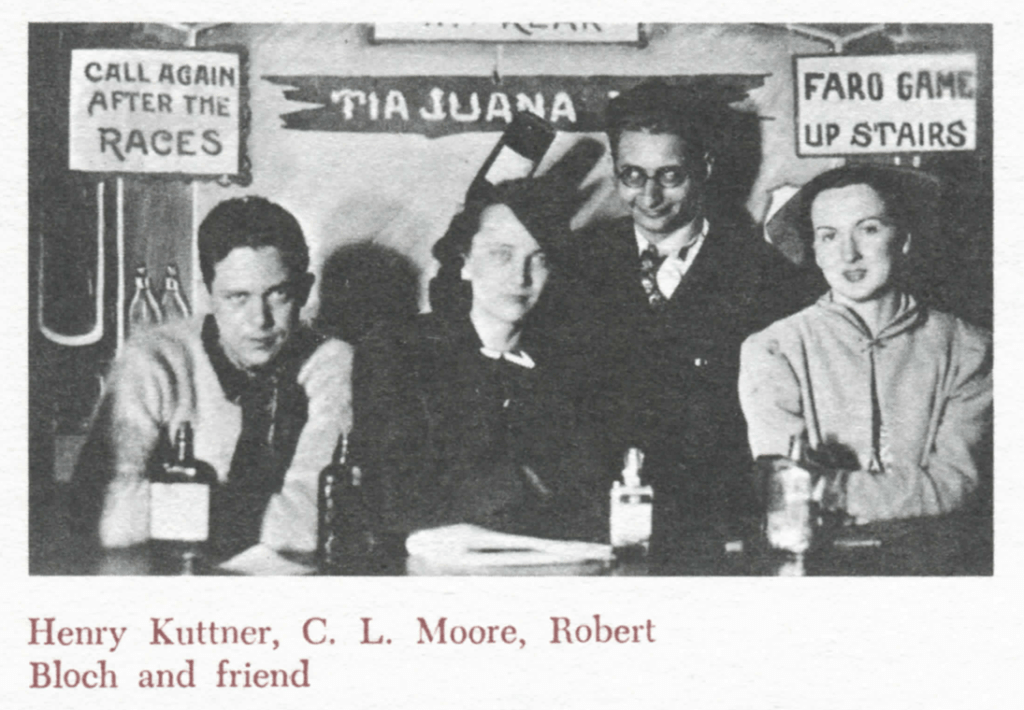
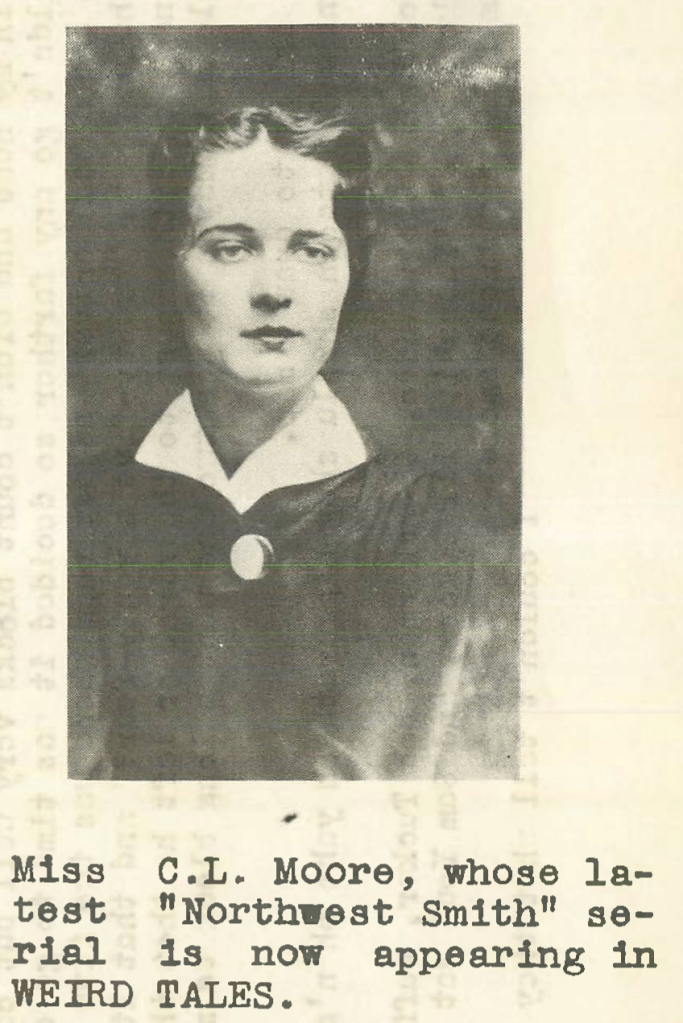
In May 1936, just three months after the death of C. L. Moore’s fiancé, H. P. Lovecraft wrote to his correspondent Henry Kuttner and asked if he could forward some material to C. L. Moore. This began a correspondence between Kuttner and Moore that would, in 1940, lead to their marriage. Yet during Lovecraft’s brief time together, he heard about their forthcoming collaboration—even if he didn’t live to see it.

The collaboration came at an odd time in both of Kuttner and Moore’s careers. Moore’s output for Weird Tales was declining; the last Jirel of Joiry tale was “The Dark Land” (WT Jan 1936), the last Northwest Smith story was “Tree of Life” (WT Oct 1936). So when “Quest of the Starstone” was published in Weird Tales Nov 1937, it had been over a year since either character had appeared. A year since C. L. Moore had graced the Unique Magazine.

Kuttner got his professional start in the pulps in 1936. In the space of less than two years, 27 stories from him appeared in the pulp magazines, 11 in Weird Tales. In his early career, Kuttner struggled to find his own voice; while prolific, he put out pastiche work like “The Salem Horror” (WT May 1937), riffing off of Lovecraft’s Mythos, and collaborated with Robert Bloch on “The Black Kiss” (WT Jun 1937). It was Kuttner, devoting much of his time to writing, who recommended the collaboration with Moore:

Chacal: Rumor has it that you didn’t particularly care for the story in which Jirel met Northwest, “Quest of the Star Stone.” Could you give us a little background on the tale: the how and why of it? 

Moore: I’d forgotten that I maybe like “Quest of the Star Stone ” least—that doesn’t mean dislike. If I said so, I expect it’s true. And if true, my guess would be that in this first Kuttner/Moore collaboration the machinery of working together had to be refined and worked over more before it functioned well. Hank and I had met, I think, a short time before this. Or had we met at all? Or only corresponded? Anyhow, he was urging me to do another Jirel and sent on a kind of opening situation to see if I would feel any interest. I did and we sent the ms. back and forth to the best of my very dim recollection until we were ready to submit it. Remember this was all 40 years ago and a lot has happened since.

[…]

Chacal: Did you ever have any reservations about collaborating with Kuttner? 

Moore: Nope. “The Quest of the Star Stone,” our first, worked out well enough to show us we could do it and after that we never gave it much thought. We just went ahead and wrote, either separately or together, depending on how that particular piece of work progressed. Remember, we weren’t turning out stories for posterity, but for this month’s rent. I so often hear of collaborators who tear down each other’s work—even successful, long-established collaborators. We didn’t have time for that kind of nonsense. We just traded typewriters; when one got stuck the other took over with a minimum of rewriting. Often none at all. Usually none at all. With us, at least, it worked out fine. It was also very nice to have somebody who could take over when the other guy got stuck. We sincerely loved each other’s writing and enjoyed tremendously what came out of the other guy’s typewriter. It was a fine relationship. 
—”Interview: C. L. Moore Talks To Chacal” in Chacal #1 (1976), 30

Crossovers of series characters were rare in the pulps, but not unheard of. Robert E. Howard’s Kull of Atlantis and Bran Mak Morn had met in “Kings of the Night” (WT Nov 1930). This crossover, however, also involved a collaboration, and ends up somewhat disjointed. The opening rhyme is uncharacteristic of Moore’s work, while the Jirel segment is very characteristic of stories like “Jirel Meets Magic” (1935). However, there are references there which seem to owe more to Kuttner than Moore:

“Bel’s curse on you, Joiry! […] Me you may not fear, Joiry,” the wizard’s voice quavered with furty, “but by Set and Bubastis, I’ll find one who’ll tame you if I must go to the ends of space to find him—to the ends of time itself![“]
—C. L. Moore & Henry Kuttner, “Quest of the Starstone” (WT Nov 1937)

Bel and Set were gods from Robert E. Howard’s Hyborian Age stories of Conan the Cimmerian. The Egyptian god Bubastis were notably used in the early Mythos fiction of Kuttner’s collaborator Robert Bloch, especially in “The Brood of Bubastis” (WT Mar 1937). The second section, with Northwest Smith and Yarol on Mars, drinking segir-whiskey and listening to The Green Hills of Earth was certainly in keeping with Moore’s style for stories like “Dust of the Gods” (1934)—but how much of that was driven by Moore’s habit, or Kuttner’s more fannish tendencies to repetition? It’s hard to tell; Moore was still herself, and Kuttner an effective mimic. Working as they did, their styles tend to blend.

The story moves fairly quickly, establishing the essential conflict, introducing the leads, and then effecting the meeting of the dual protagonists in short order via a bit of magic. Unusually for a Jirel story, it is peppered with bits of French—for all that it is set in medieval France about the year 1500 (the only time we get a hard date), Moore rarely bothered with trying to insert the language into the stories. There is a certain fun interplay here; neither Smith or Jirel are stupid, both are formidable, and both are, in their way, rogues. It is neither love or hate at first sight, but a kind of chess match of greed and wits.

Then they are somewhere else, in one of those transports to other dimensions that showcases so many stories of Jirel and Smith. Perils are faced and overcome, a warlock gets their just desserts, a macguffin is unleashed, and it all ends, if not happily, then with a kind of melancholy correctness of everything back in its accustomed place. Unusually for a Northwest Smith story, Jirel survives—or at least, presumably goes back to her own time and place, as Smith did. Yet in the end he thinks:

Behind the closed lids flashed the remembrance of a keen, pale face whose eyes blazed with some
sudden violence of emotion, some message he would never know—whose red streaming hair was a banner on the wind. The face of a girl dead two thousand years in time, light-years of space away,
whose very dust was long lost upon the bright winds of earth.
—C. L. Moore & Henry Kuttner, “Quest of the Starstone” (WT Nov 1937)

Well, light-minutes, but that’s a quibble. While technically a story where fantasy meets science fiction, where Northwest Smith learns a spell but still carries a raygun, the story leans more heavily toward magic; and while the viewpoint switches, it is mostly a Northwest Smith story in which Jirel appears, since most of the viewpoint is Smith’s. Maybe that is part of the reason it feels “off” compared to the previous Jirel stories. Or maybe it’s just the literal deus ex machina, as the Starstone gives up its secret.

When compared to “Tryst in Time” (1936), Moore’s previous time-travel story, there are certain similar elements in common: an adventurer is bored, an offer is made and accepted, a trip through time results in an encounter with a beautiful woman—but here, there is no instant bond, no sense of soul-mates or reincarnations. Jirel and Smith are alike and respect each other, but there is no sense that they complete each other or need each other. It is a meeting of equals.

Gertrude Hemken, one of the most vocal fans and a prolific letter-writer to Weird Tales, praised the story:

The story of the issue is all I’ve expected it to be—and more. I’ve been curious all these months to learn by what methods and under what circumstances would Jirel and Northwest Smith meet. The story is somewhat lovely—seems as though I awakened from a fantastic dream after I had read it. The abstract lives bro’t to mind the yarns of Aladdin’s lamp and its genie. The illustration is superb. Jirel looks like a screen heroine—and the two men seem rather 20th Century in attire and general aopearance. The dancing flame-stars seem like a very strange rain. Needless to say—The Quest of the Starstone is outstanding, in my opinion.
Weird Tales Jan 1938

Clifford Ball, who had published some sword & sorcery stories for Weird Tales himself, added:

The Quest of the Starstone was a fast-moving, interest-holdiqg, well-balanced piece of work and easily the best story in the current issue even if the famed charaaers of Smith and Jirel are possibly unknown to the later readers. I trust these two authors will be encouraged to continue their partnership. They have the knack of producing masterpieces. But I wish to humbly suggest that
they do not attempt to bring N. S. or J. J. together again, for that might spoil the superb effect of this last story. Not that I mean they should discontinue the characterizations; either one is too magnificent to allow extermination.
Weird Tales Jan 1938

How little he knew. “Quest of the Starstone” was voted the best tale in the November 1937 issue, and readers wanted more. Well, they would get more of Moore & Kuttner—this collaboration proved that they could work successfully together, combining his swift plotting and Moore’s imagination and style—but not much more of Jirel of Joiry or Northwest Smith.

“Quest of the Starstone” was published in the November 1937 issue of Weird Tales. Scans of this issue are available on the Internet Archive.


Bobby Derie is the author of Weird Talers: Essays on Robert E. Howard and Others and Sex and the Cthulhu Mythos.

Deep Cuts in a Lovecraftian Vein uses Amazon Associate links. As an Amazon Associate I earn from qualifying purchases.
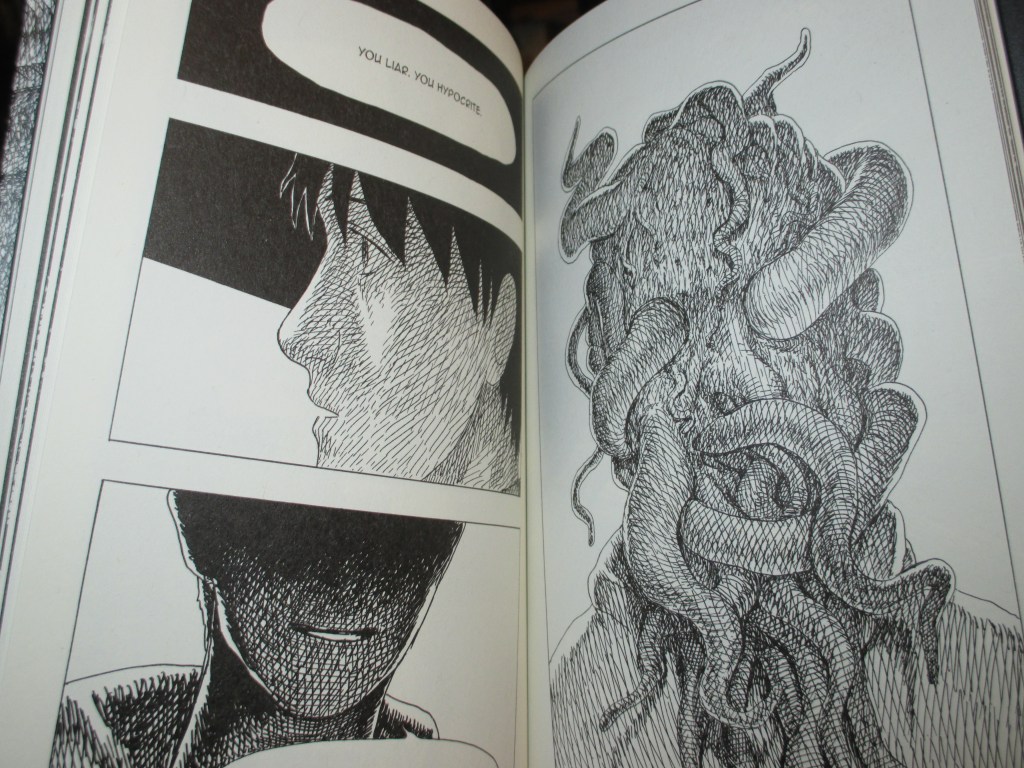
Lovecraft y Negrito (2023) by Dolores Alcatena

Racist Language
This review concerns H. P. Lovecraft’s cat, whose name was a racial slur against Black people.
As part of this review, the cat’s name and variations are included. Reader discretion advised.


The first known reference to H. P. Lovecraft’s cat was in a letter from his grandfather when Lovecraft was only 5 years old:

You and Dumplin Mama must keep the Barn shut every night and take care of Nig.
—Whipple Van Buren Phillips to H. P. Lovecraft, 17 Oct 1895, Letters to Family & Family Friends 2.1046

“Nig” was short for “Niggerman.” It was a black cat, at a time when the N-word was relatively common for pets with black coats. Whether it was Lovecraft who named the kitten, or a family member or friend, is not recorded in any of Lovecraft’s letters. It was his childhood pet—and, as it happened, the only pet he could afford during his life, although he retained a great fondness for cats throughout his life, often petting or playing with strays. In 1904, Whipple Van Buren Phillips died. Lovecraft’s family home was sold, he and his mother moved away from his childhood home, and the cat disappeared during the tumult, never seen again.

Lovecraft remembered his feline companion in later years, and based two cats in his stories on his lost pet: Niggerman in “The Rats in the Walls,” and Nig in The Case of Charles Dexter Ward. Neither appearance caused any particular outcry at the time of publication; Weird Tales was no stranger to the N-word and other terms, and it was not until “The Rats in the Walls” (1956) that any serious effort was made to censor or bowdlerize the cat’s name. Works in translation and adaptation were more likely to change the name; different languages, with different histories regarding race relations and Black slavery, have their own nuances of language to give shades of meaning or seek to avoid giving offense.

In 2023, Argentinian illustrator and writer Dolores’ Alcatena published Lovecraft y Negrito, a short graphic novel about Lovecraft’s friendship with his beloved pet. As she puts it in the opening:

Como amante de los gatos, Howard Philips Lovecraft frecuentemente incluía en sus relatos a estos elegantes y misteriosos animalitos. En su estilo deliberadamente desamorado y serio, los describía como símbolos de perfección, estética, libertad e independencia. Pero entre las cartas del escritor aparece Niggerman, un gatito negro que acompañaba a Lovecraft en su niñez. Al hablar de Niggerman (rebautizado ‘Negrito” para esta obra) las palabras del autor asumían un tono cálido, recordando con ternura cómo jugaban juntos en el jardín. Al hablar del gatito, el escritor no pudo, o no quiso, esconder sus sentimientos. El cariño que Lovecraft mantuvo a lo largo de su vida por Niggerman inspiró esta historia, permitiéndonos acceder a un costado más humano del gran autor del horror.As a cat lover, Howard Philips Lovecraft often included these elegant and mysterious animals in his stories. In his deliberately dispassionate and serious style, he described them as symbols of perfection, aesthetics, freedom, and independence. But among the writer’s letters appears Niggerman, a black kitten who accompanied Lovecraft in his boyhood. When talking about Niggerman (renamed “Negrito” for this work), the author’s words took on a warm tone, fondly recalling how they played together in the garden. When talking about the kitten, the writer could not, or did not want to, hide his feelings. Lovecraft’s lifelong affection for Niggerman inspired this story, allowing us to glimpse a more human side of the great horror author.
Dolores Alcatena, Lovecraft y Negrito (2023)English translation

“Negro” in Spanish is the color black, “-ito” is a diminutive suffix; context is important because in some usages “negrito” can mean bold type, or it can be a reference to certain Southeast Asian peoples, or a not-necessarily-kind reference to small Black children. In the context of this story, it might be best to think of it as a term of affection, like naming a black kitten “Blackie.”

Su gato, Negrito, lo acompaña.

Y, como siempre, lo cuida.
His cat, Negrito, accompanies him.

And, as always, takes care of him.
Dolores Alcatena, Lovecraft y Negrito (2023)English translation

The story is told in black and white, mostly from Negrito’s perspective. The cat aids and protects Howard through his journeys, including the events that would inspire “The Cats of Ulthar” and “The Shadow over Innsmouth.” From a cat’s perspective, the cat-killing couple in Ulthar are particularly horrific.

“Ningún hombre debería matar a un gato”
Pensó el niño mientras recordaba a Negrito ronroneando frente al fuego.
“No man should kill a cat,” the boy thought as he remembered Negrito purring in front of the fire.
Dolores Alcatena, Lovecraft y Negrito (2023)English translation

There is a somewhat fairy-tale quality to the retelling, the traipse through Lovecraft’s fiction. Most of Howard’s waking life we don’t see…but then his cat was not there to see that.

Qué suerte que Negrito siempre había estado en esos momentos.How lucky that Negrito had always been there in those moments.
Dolores Alcatena, Lovecraft y Negrito (2023)English translation

The Lovecraft of these stories is a scared, almost a traumatized kid, with Negrito as his only friend; parental figures are absent. It is a very sympathetic view of Howard as a child, but in comparison to El Joven Lovecraft by José Oliver & Bartolo Torres it does not show Lovecraft’s occasional joyfully morbid side. Readers are meant to empathize with a young Lovecraft.

The ending, a wordless reunion between the dead Lovecraft and his lost cat, is the kind of afterlife that every cat-lover might wish to experience themselves someday.

Es un tributo muy distintivo ser elegido como amigo y confidente de un gato.
H. P. Lovecraft.
It is a very distinctive tribute to be chosen as a friend and confidant of a cat.
H. P. Lovecraft.
 It is no compliment to be the stupidly idolised master of a dog whose instinct it is to idolise, but it is a very distinct tribute to be chosen as the friend and confidant of a philosophic cat who is wholly his own master and could easily choose another companion if he found such an one more agreeable and interesting.
Dolores Alcatena, Lovecraft y Negrito (2023)English translationH. P. Lovecraft, “Cats and Dogs”

Lovecraft y Negrito is a story about a boy and his cat. It is not a historical work that delves into the nuances of the cultural forces that went into such names, or how naming cats did or did not reflect Lovecraft’s racial prejudices in later life. If readers want a scholarly exploration of what we do and don’t know about the real animal, check out Ken Faig’s essay “Lovecraft’s Boyhood Cat” in Lovecraft Annual #19 (2025). If you want a heartwarming fantasy about Lovecraft and his beloved pet, which has gained a kind of literary immortality, then read Lovecraft y Negrito.


Bobby Derie is the author of Weird Talers: Essays on Robert E. Howard and Others and Sex and the Cthulhu Mythos.

Deep Cuts in a Lovecraftian Vein uses Amazon Associate links. As an Amazon Associate I earn from qualifying purchases.
“Tryst in Time” (1936) by C. L. Moore

This is an odd reference in one of C. L. Moore’s letters, about a story never published:

Well, have just received my first flat rejection from Wright. A harmless little fable about a sorcerer king of antediluvian times, his mysterious witch-queen and a time-traveler with a startling resemblance to a certain Mr. Smith whom I may have mentioned once or twice before, tho no names were named in the story. Ah, well, life is full of disappointments.
—C. L. Moore to R. H. Barlow, 31 May 1935

We get no more than that—though Northwest Smith would eventually star in a time-travel story, “Quest of the Star-Stone” (Weird Tales Nov 1937), written with Henry Kuttner. However, before she collaborated with Kuttner, Moore published another time-travel story, one which features a very Northwest Smith-like protagonist: Eric Rosner, hard-bitten adventurer and world-traveler:

ERIC ROSNER at twenty had worked his way round the world on cattle boats, killed his first man in a street brawl in Shanghai, escaped a firing squad by a hairbreadth, stowed away on a pole-bound exploring ship.

At twenty-five he had lost himself in Siberian wilderness, led a troup of Tatar bandits, commanded a Chinese regiment, fought in a hundred battles, impartially on either side.

At thirty there was not a continent nor a capital that had not known him, not a jungle nor a desert nor a mountain range that had not left scars upon his great Viking body. Tiger claws and the Russian knout, Chinese bullets and the knives of savage black warriors in African forests had written their tales of a full and perilous life upon him. At thirty he looked backward upon such a gorgeous, brawling, color-splashed career as few men of sixty can boast. But at thirty he was not content.
—C. L. Moore, “Tryst in Time” (Astounding Dec 1936)

Did Moore take that rejected story and resubmit it for Astounding? Or did she just take the idea of the story and re-write it for the science fiction magazine (whose editor and fans were not fond of sorcerers and witch-queens)? There is a certain similarity between this tale and Moore’s previous work in Astounding, “The Bright Illusion” (1934) and “Greater Glories” (1935), a romanticism of a male protagonist finding or recognizing love under unusual and somewhat cosmically tragic circumstances. It wouldn’t be surprising if Moore had married the idea of a rejected tale to the general outline of what had sold successfully in the past.

The temporal physics behind the tale are no better or worse than that of many time travel stories, and if Moore isn’t necessarily erudite in physics, she is well-read in basic time travel literature, having no doubt read a great many stories in the pulps or elsewhere. When she writes, for example, of the idea of how moving through the fourth dimension (time) means the other three dimensions go along without you:

“Yeah, and find yourself floating in space when you let go.” Eric grinned. “Even I’ve heard that the universe is in motion through space. I don’t know about time, but I’m pretty sure space would block your little scheme.”
—C. L. Moore, “Tryst in Time” (Astounding Dec 1936)

Clark Ashton Smith had addressed just this problem in “The Letter from Mohaun Los” (Wonder Stories Aug 1932); Smith’s solution was that if you waited long enough, another planet would pass by the point in space you occupied and you’d have your adventure that way. She also addresses the idea of changing the past:

There must be many possible futures. The one we enter upon is not the only way. Have you ever heard that theory explained? It’s not a new one—the idea that at every point of our progress we confront crossroads, with a free choice as to which we take. And a different future lies down each.
—C. L. Moore, “Tryst in Time” (Astounding Dec 1936)

Murray Leister’s “Sideways in Time” (Astounding Jun 1934) had played with the idea of parallel timelines and alternate futures, so Moore wasn’t the first to address the idea, but the fact that she did further shows familiarity with the mechanics of time travel in fiction.

Moore squirms around that by letting Rosner stay on terra firma, even as the ages pass around him, skipping through time like a rock on a pond. The result is reminiscent of the Futurama episode “The Late Phillip J. Fry,” (or, if you prefer, the cyclical rise and fall of civilizations a la Olaf Stapledon’s classic Last and First Men (1930)), with Rosner zipping through future (and past) ages, from advanced civilizations to barbarisms and back again. At least one scene may involve a tongue-in-cheek poke at a certain Providence gentleman she corresponded with, who had a tendency to use the word “Cyclopean”:

Even at this distance he recognized those darker blotches upon the tremendous walls as the sign of a coming dissolution. It was a city more awfully impressive than any he had ever dreamed of, standing gigantic under the low, gray sky of this swamplike world—but its glory was past. Here and there gaps in the colossal walls spoke of fallen blocks and ruined buildings. By the thick, primordial air and the swamp smell and the unrecognizable architecture he knew that he gazed upon a scene of immortal antiquity, and his breath came quicker as he stared, wondering where the people were whose Cyclopean city this was. what name they bore and if history had ever recorded it.
—C. L. Moore, “Tryst in Time” (Astounding Dec 1936)

For the most part, however, this is a piecemeal narrative, a succession of brief, fragmentary scenes and images punctuated by a character that reappears, again and again—a woman, Maia, who is always separated from Eric Rosner by something. Until the end. Without ever using terms like “reincarnation” or “soul mate,” there is a distinct and heavy hint that these two were meant to be together, and that they will be—eventually.

While the story isn’t bad, it also apparently involved some editorial interference and a couple of cuts, which she complained about to her friend in Providence:

Which bring us to the memory of your distress over the butchery of your two tales in that magazine. I ahd somewhat miraculously escaped much injury in my experiences with them up to the publication of my last story, “Tryst in Time” which was so mangled and dismembered that I could scarcely bear to look upon the bleeding remnants. Typographical errors ranged from the careless to the ludicrous—I remember a brook ‘tickling’ through a meadow, for one. And with the most uncanny precision they eliminated and ruined the only two parts of the story for which I felt real affection. My paragraph referring to the mysterious urge which drives races upon migration was left out entirely. I had mentioned the great prehistoric hegiras of our remote fathers across vast areas of Europe, perhaps over the land-bridge into America, the recent fever to “Go West” that burned in our immediate ancestors, and hinting wisely that mayhap the fever which my hero felt to travel in time might be the beginning of a new race-migration somewhere. It didn’t mean anything much, but it was kinda fun and I bitterly resented its omission. And in the last of the story a sentence whose “well-greased perfection”, to quote yourself, gave me a great joy was utterly butchered. I had it, “Wherver you adventured the knowledge of my presence tormented  you, and through all my lives I waited for you in vain.” Perhaps it verges on blank verse in its extreme unctuousness, but who are they to cut it in their vandalism to—“Wherever you adventured the knowledge of my presence tormented you—and I waited in vain!”??? If they don’t like the way I write why don’t they go back where they came from? I am burning up.
—C. L. Moore to H. P. Lovecraft, 24 Oct 1936, Letters to C. L. Moore 195

“Race-migration” was a popular historical concept during the 1930s, and makes its appearance in stories like Robert E. Howard’s “The Children of the Night” (Weird Tales Apr/May 1931). The reference to time travel as a form of race-migration might be a nudge-wink-nudge reference to Lovecraft’s “The Shadow Out of Time” (Astounding Jun 1936). The cuts might have been for space, or because the editor disagreed with the ideas expressed—there are many possibilities, but no firm answers. Pulp editors could be merciless and incomprehensible.

There isn’t much feedback on this story; Lovecraft apparently never read it, or at least doesn’t mention it in surviving letters. Fans, however appreciated it, with one fan letter noting:

I was glad to see Miss Moore has begun to write ‘science-fiction. Everything else I have read by her was purely weird. Her story seemed real and plausible, in spite of the unusual plot.
—Richard Creecy, Astounding Feb 1937

Which shows how Moore’s reputation was developing.

“Tryst in Time” was published in the December 1936 issue of Astounding Stories. Scans of this issue are available on the Internet Archive.


Bobby Derie is the author of Weird Talers: Essays on Robert E. Howard and Others and Sex and the Cthulhu Mythos.

Deep Cuts in a Lovecraftian Vein uses Amazon Associate links. As an Amazon Associate I earn from qualifying purchases.
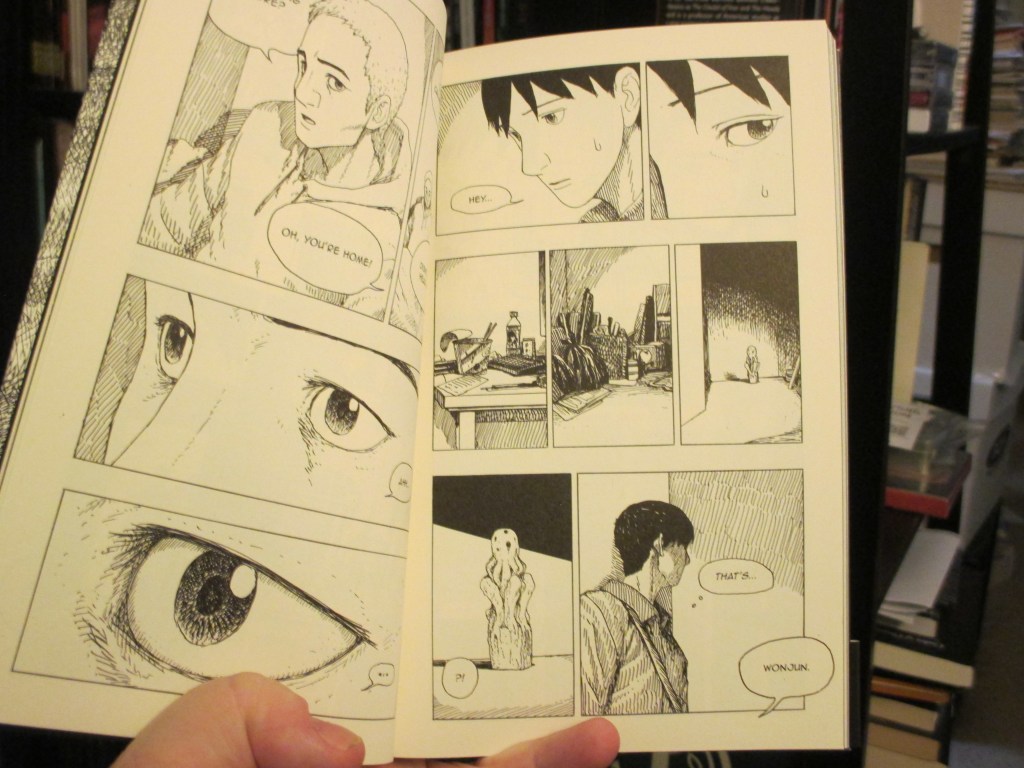
The Colour Out of Space (2024) by H. P. Lovecraft & Sara Barkat

It was just a colour out of space—a frightful messenger from unformed realms of infinity beyond all Nature as we know it; from realms whose mere existence stuns the brain and numbs us with the black extra-cosmic gulfs it throws open before our frenzied eyes.
—H. P. Lovecraft, “The Colour Out of Space”

Comic and graphic novel adaptations of prose and verse literary works have always held a fascination. Because while you might declare one text as canonical, as a true text, immutable and eternal, the graphic adaptations of that text will always be different, unique to their vision and skill and ability to realize that text in illustrated form. Every artist has to pick and choose what images to convey and how to convey them, how to frame the story and the text, what to leave in and out, what to emphasize and how to do it. Give three artists the same story to draw, and you have three variations on the same story.

This sometimes arouses—at least among some readers and critics—the urge to compare different variations on the same works to each other. Because it can be fascinating to see the divergence and the commonalities, to look at all the different flowers that may blossom from identical seeds. Not necessarily to point out any one graphic adaptation of Lovecraft as better than the others, but to enjoy the diversity of views and skills.

When it comes to “The Colour Out of Space” in particular, however, there’s a fundamental question that every artist has to struggle with: how do you depict a color that is outside the visible spectrum?

Strictly speaking, outside of a technical trick like polarized lenses, you cannot. What usually happens instead is that the artist has to use visual rhetoric to convey the sense of the unknown color, even while using the colors that are available for printing. In the case of Sara Barkat’s The Colour Out of Space (2024) this is mostly accomplished by having the majority of the art in black-and-white.

However, instead of having the colored portions represent just the color itself, the color is used to illustrate those people and objects that the color has infected. So the addition is not just a single splash of magenta or red in a monochrome world, it is a spectrum of colors in a landscape, or a room, or a person.

Barkat’s style isn’t a demonstration of technical excellence in the same sense of Gou Tanabe’s The Colour Out of Space (2025), nor does it have the minimalist book-as-object approach of Amy Borezo’s The Colour Out of Space (2016). What she has is a loose, sketchy but heavily detailed pencil that captures a certain underground aesthetic, the rawness of the art adding a certain texture to the text, especially with the use of mixed media (primarily watercolors) to add color. As with Alberto Breccia’s Cthulhu Mythos adaptations, the result is a more profound experience than either the art or the text would accomplish on their own.

Which is ultimately what a lot of people are looking for in any graphic adaptation. Not a simplification of a text, or the addition of some pretty pictures to look at, but a new way of experiencing the story.

The Colour Out of Space (2024) by H. P. Lovecraft and Sara Barkat was published by T. S. Poetry Press. Barkat’s other works include a graphic adaptation of The Yellow Wallpaper (2020) by Charlotte Perkins Gilman and Drawing Dracula Daily (2023).


Bobby Derie is the author of Weird Talers: Essays on Robert E. Howard and Others and Sex and the Cthulhu Mythos.

Deep Cuts in a Lovecraftian Vein uses Amazon Associate links. As an Amazon Associate I earn from qualifying purchases.
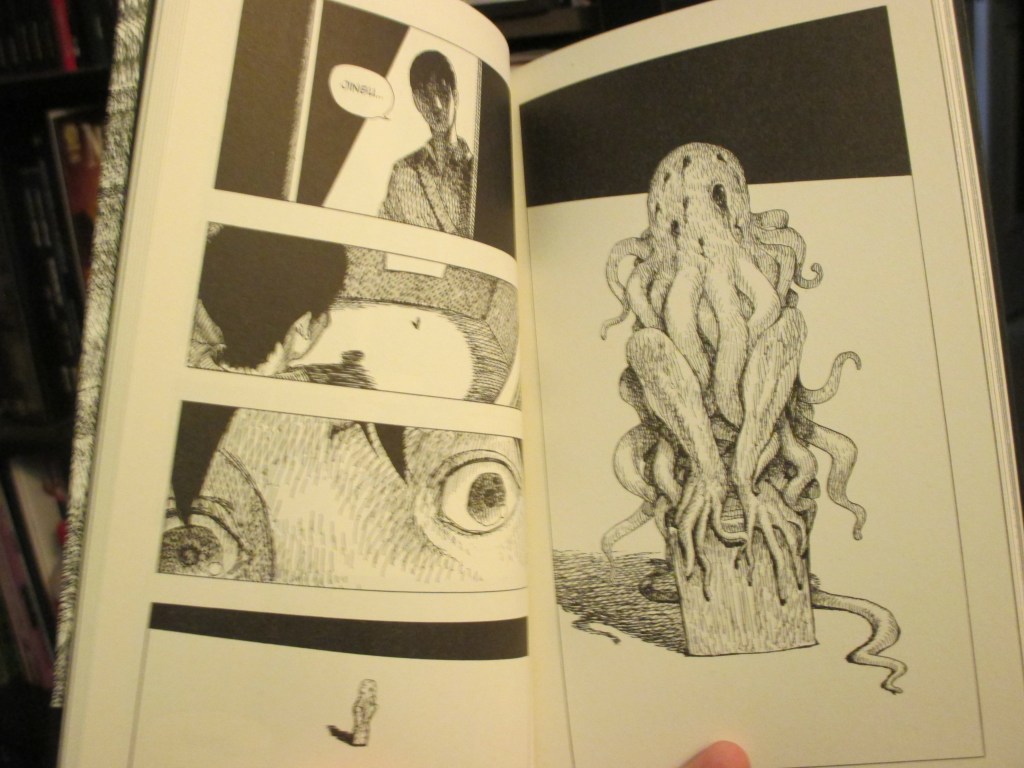
“Tree of Life” (1936) by C. L. Moore

C. L. Moore is an extremely gifted young woman of 25—a fact as well as fiction writer. Her stories are rivaled (now that Bob Howard is dead) only by Klarkash-Ton’s, & contain a highly unique element of convincing unreality—which could be still better but for a certain stereotyped romanticism & occasional concession to the pulp ideal.
—H. P. Lovecraft to Virgil Finlay, [25 Sep 1936], Letters to Hyman Bradofsky & Others 447

“Tree of Life,” published in the October 1936 issue of Weird Tales, isn’t technically the last of the Northwest Smith stories. Yet for many readers, it would have been seen as practically the last. Smith would not appear in print again until “Quest of the Starstone” (WT Nov 1937), a full year later, and the final brief coda “Song in a Minor Key” would only see print in a fanzine in 1940. So too, Moore’s star at Weird Tales was waning. This would be her 13th story published at Weird Tales in just three years, but in the next four years she would publish only three more stories in the magazine.

What changed? The death of Moore’s fiancé in early 1936, her ongoing need to provide for her family with her real job, Weird Tales‘ slow payments and her shift to other pulp markets likely all had their part to play. Yet that was in the future. For now, readers could enjoy this tale and imagine the many other adventures of Northwest Smith that the future might hold for them.

It was an unusually elaborate well, and amazingly well preserved. Its rim had been inlaid with a mosaic pattern whose symbolism must once have borne deep meaning, and above it in a great fan of time-defying bronze an elaborate grille-work portrayed the inevitable tree-of-life pattern which so often appears in the symbolism of the three worlds. Smith looked at it a bit incredulously from his shelter, it was so miraculously preserved amidst all this chaos of broken stone, casting a delicate tracery of shadow on the sunny pavement as perfectly as it must have done a million years ago when dusty travelers paused here to drink.
—C. L. Moore, “Tree of Life” (WT Oct 1936)

In broad strokes, “Tree of Life” looks like several other Northwest Smith stories. The opening is reminiscent of “Werewoman” (1938), with Smith on the run. A ruin that rests between two worlds, as in “Julhi” (1935). A pattern that transports Smith between worlds, as in “Scarlet Dream” (1934). The story lives in that space that Moore carved out between science and sorcery, between the interplanetary tale and sheer fantasy.

One of the things that stands out in the story is the strange and terrible Thag—who is reminiscent, thematically, of the monster Thog in Robert E. Howard’s “The Slithering Shadow” (WT Sep 1933), who likewise keeps an entire population in fear. So what are the odds of Robert E. Howard calling one of his tentacled horrors
Thog, and C. L. Moore calling one of hers Thag? Is it just coincidence, or was one borrowing from the other?

In many ways, Robert Ervin Howard and Catherine Lucille Moore were operating on the same wavelength. While he wrote for Weird Tales earlier and more prolifically, both of them had a way of lighting on similar themes. Erotic tentacles appear in Howard’s “The Slithering Shadow” (WT Sep 1933) and in Moore’s “Shambleau” (WT Nov 1933). Both would conceive of French swordswomen in “Black God’s Kiss” (WT Oct 1934) and “Sword Woman” (written c.1934, but not published until after Howard’s death), and create series characters that would be remembered by generations of Weird Tales fans

Technically they were in competition from 1933-1936, but in reality Howard wrote more, and sold more, during that period. Moore had a day job, while Howard was a full-time writer. They admired one another, and had similar themes. C. L. Moore’s “science fiction” stories of Northwest Smith, while set on distant planets and involving force-guns and spaceships, were written like fantasies with ancient gods, sorcerers, and creatures from Outside. Howard’s fantasies, by contrast, sometimes came up very close to science fiction: the city of Xuthal in “The Slithering Shadow” is lit by radium-lamps, and golden wine quaffed by Conan recalls super science medicines as much as some alchemical potion

Howard’s Thog is not exactly cast in the mode of any earlier entity, but the name might have been influenced by weird precursors like H. P. Lovecraft’s Yog-Sothoth and Clark Ashton Smith’s Tsathoggua; a similar entity named Thaug appeared in another Conan tale, “A Witch Shall Be Born” (WT Dec 1934). He would also use similar names for entirely different creatures, the ape-man Thak in “Rogues in the House” (WT Jan 1934), and the god Thak, the Hairy One, in the posthumously published Almuric (WT May-Jun-Aug 1939)—so perhaps he derived the name, or simply came up with it on his own and liked the sound of it.

If “Thog” and “Thaug” were inspired by Tsa-THOG-ga, it would not be a great surprise. Many of names in the early Mythos fiction invoke some of the same elements; the “-oth” ending for example appears in Sheol-Nugganoth (Lord Dunsany); Yog-Sothoth, Azathoth, Rhan-Tegoth, shoggoth (Lovecraft); Abhoth, Rlim Shaikorth (Smith); Gol-goroth, Bal-Sagoth (Howard). Lovecraft, Howard, and Smith also made a particular habit of working variations on their names—in Howard’s case, in “The Moon of Skulls” (WT Jun-July 1930) the ancient god is Golgor, in “The Children of the Night” (WT Apr-May 1931) and “The Gods of Bal-Sagoth” (WT Oct 1931) the god is named Gol-goroth.

C. L. Moore left no record of similar-sounding names for her horrors; her approach to naming was by her own account more spontaneous. She also did not, except for one round-robin story, play the kind of game that Lovecraft, Smith, and Howard did by putting references to one another’s works in her fiction of Northwest Smith or Jirel of Joiry. Yet at the same time, if Moore drew some thread of inspiration from that game and worked up a similar-named entity for her own fiction—she did make it her own.

While Thog and Thag both prey on their captive populations, that is about where the similarities end. Thog is monstrous but definitely material, able to be cut and chopped and stabbed, while Thag is something altogether weirder, vulnerable at only a single point. While both stories may be classed as science-fantasy, “The Slithering Shadow” leans more toward sword-and-sorcery than “Tree of Life”; as outclassed as Conan and Northwest Smith might be, there is more of a focus on battle and human drama in Howard’s story. Northwest Smith destroyed or defeated Thag, but Conan made Thog bleed.

Read together, the choice of names is less interesting than how each writer pursued a similar theme, each in their own way…and showcased how these two writers could, coming at similar ideas from different perspectives, create two different but equally enjoyable narratives—and in the end Northwest Smith returned to Mars, to live and fight another day.

I was glad to see the return of Northwest Smith.
—John V. Baltadonis, The ‘Eyrie’ in Weird Tales (Dec 1936)

Moore never disappoints, having that rare gift of imagination inexhaustible which keeps this author’s yarns different.
—B. M. Reynolds, The ‘Eyrie’ in Weird Tales (Dec 1936)

Fan response was positive, based on the letters published in The ‘Eyrie.’ Lovecraft’s appreciation was more muted, but honest:

C L M’s “Tree of Life” adheres more or less to her formula, though it has effective atmospheric touches
—H. P. Lovecraft to R. H. Barlow, 31 Sep 1936, OFF 367

“Tree of Life” runs a bit to the Moore formula, but is distinctive for all that.
—H. P. Lovecraft to Duane W. Rimel, 24 Oct 1936, LFB 334

Moore item is average, & “House of Duryea” has a clever ending.
—H. P. Lovecraft to August Derleth, 24 Oct 1936, ES2.752

In Oct. the high spots were C L M’s “Tree of Life” & Bloch’s yarn—the Quick, Peirce, & Kuttner efforts deserving honourable mention.
—H. P. Lovecraft to Richard F. Searight, 19 Nov 1936, LPS 432

Lovecraft, who was still corresponding with C. L. Moore all through the turmoil of 1936, probably had a better idea of what she was going through than most. It’s not clear what impact their correspondence had on Moore’s writing—was Lovecraft’s gentle suggestion to pursue writing for artistic sake rather than commercial reasons part of the reason why Moore would cease writing Northwest Smith and Jirel of Joiry? We may never know. Yet to describe “Tree of Life” as an “average” Moore story for the period is no insult. It is still a solid piece of writing, reflecting Moore’s interests and personality, showcases her effort to straddle the lines of multiple genres to produce something truly weird.

“Tree of Life” was published in the Oct 1936 issue of Weird Tales. Scans of this story are available on the Internet Archive.


Bobby Derie is the author of Weird Talers: Essays on Robert E. Howard and Others and Sex and the Cthulhu Mythos.

Deep Cuts in a Lovecraftian Vein uses Amazon Associate links. As an Amazon Associate I earn from qualifying purchases.
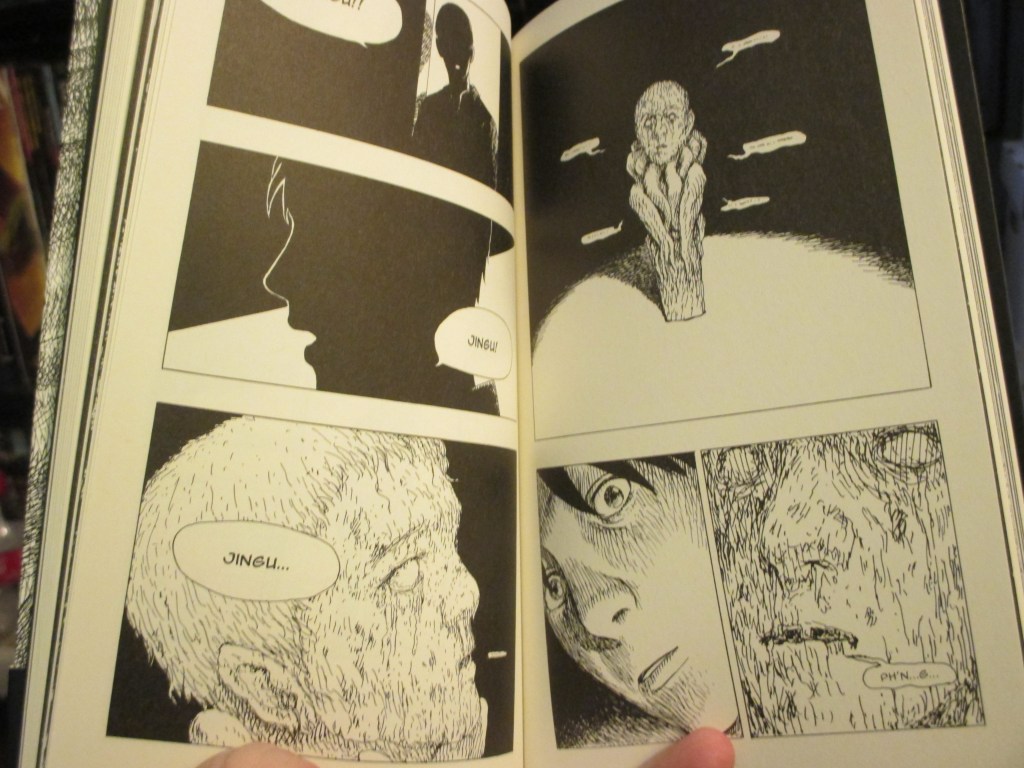
The Burning of Innsmouth, Part 1 (2019) by Tammy Nichols

‘The Burning of Innsmouth’ is a Lovecraftian-themed tale of eldritch horror and hidden corruption. In the all-too-quiet Massachusetts port-town of Innsmouth, nothing is quite what it seems and no one is who they say they are. The story takes place in 1927, just after the fictional events described by HP Lovecraft in his classic tale ‘The Shadow Over Innsmouth’. Beautifully illustrated, it’s a cat-and-mouse story explores how the town and its cultish denizens came to be destroyed by a shadowy branch of the American government.
—descriptor for The Burning of Innsmouth, Part 1 on DriveThruComics

Tammy Nichols is a UK-based graphic designer and illustrator (Tears of Envy). In 2019 she released The Burning of Innsmouth, Part 1, the first of what was proposed to be a three-issue series. The other issues have not yet been seen; such things happen. As a result, what we have is an inherently incomplete story. Characters are introduced, mysteries set up, but we have no idea how things would end. The first issue doesn’t end so much on a cliffhanger as on a promise: Innsmouth isn’t burning yet, but it is a pile of dry tinder waiting for the spark.

The art shows a careful aesthetic: deep shadows and heavy blacks, digital shading that’s made to look like halftone. Nichols explains some of her graphic language on her blog, including the customized font for the Gilman House hotel, as well as the film noir influence and the colour journey she intends to take the reader on. These are elements of visual rhetoric that inform a story and how it is told in ways that prose text cannot capture. The Facebook group dedicated to the comic also includes some behind-the-scenes of pages and panels in black and white vs. colored.

From a storytelling standpoint, the decision for the federal government to employ outside agents—two pairs of twins, one of whom is African-American, and another a sister-brother pair with ties to the infamous Waite family of “The Thing on the Doorstep” fame—is interesting. It gives us characters who are outsiders, agents of a bigoted government but not a part of it, sympathetic in their motivations, at least insofar as they are being coerced into this dangerous task. It also adds a welcome bit of diversity into a Mythos that tends heavily to the white and male.

If there’s a criticism of the story, it plays a little fast and loose with the Innsmouth lore. Obed Marsh is portrayed as still alive in 1927, when Lovecraft has him die in 1878. There are hints of further divergences, but these aren’t developed fully in this 32-page first issue. Such shifts from Lovecraftian “canon” aren’t necessarily bad—it being remembered that mythologies are by their nature often cycles of stories with similar settings, themes, and characters, not a single continuity or cohesive narrative universe. I would have liked to see where this one went.

For now, The Burning of Innsmouth is incomplete. Someday, perhaps, Nicholls will finish it. Or perhaps she won’t. Such fragments and the what-might-have-beens they inspire are still a part of the broader constellation of Mythos materials, a part of the shared narrative for readers to muse over and enjoy. And if you don’t like how Nicholls did it, or where the story was headed at the end of part 1…write your own.

The Burning of Innsmouth, Part 1 by Tammy Nicholls is available at DriveThruComics. There is also merch (including a nice map of Innsmouth) on the associated Redbubble store.


Bobby Derie is the author of Weird Talers: Essays on Robert E. Howard and Others and Sex and the Cthulhu Mythos.

Deep Cuts in a Lovecraftian Vein uses Amazon Associate links. As an Amazon Associate I earn from qualifying purchases.