Posts

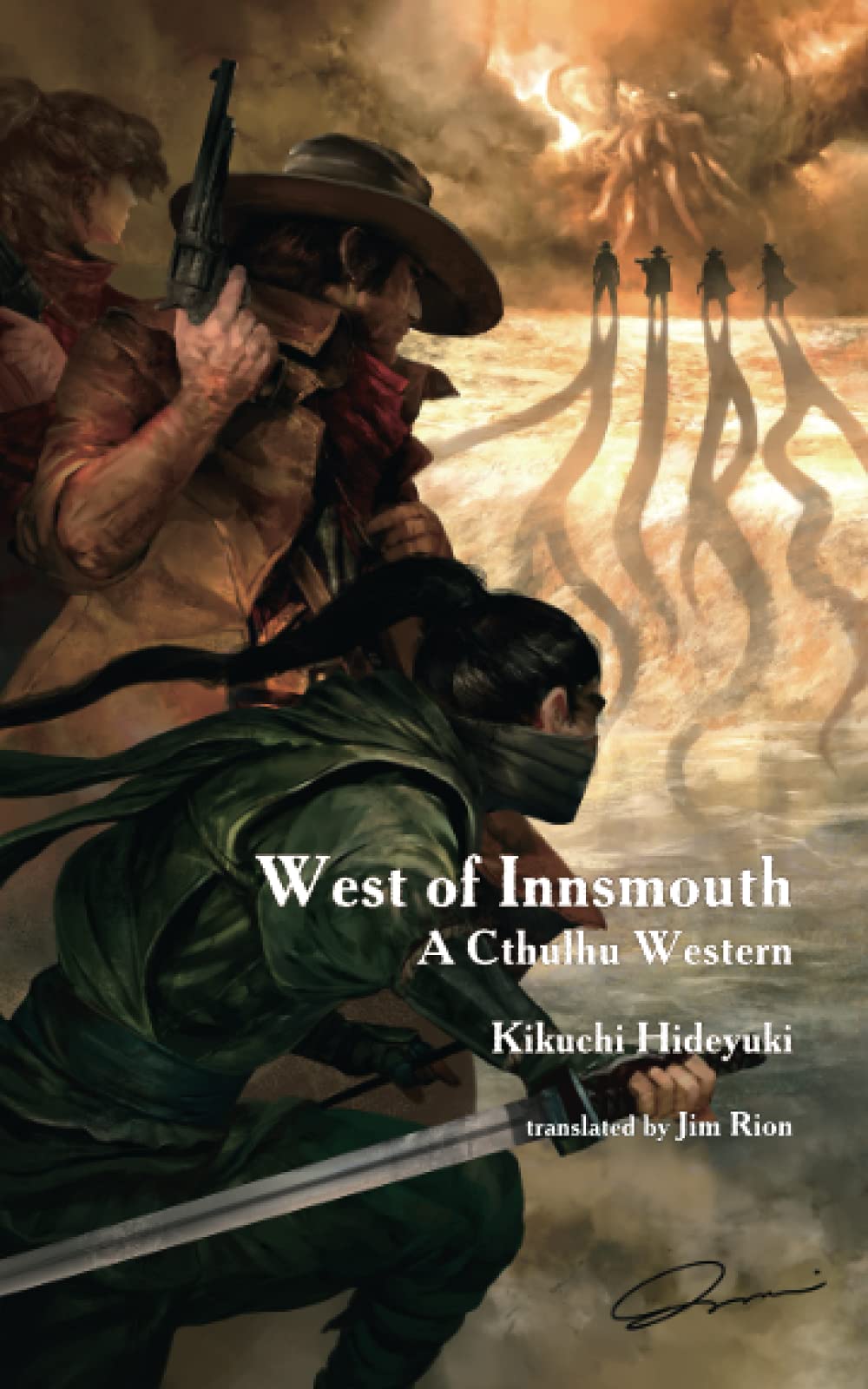
West of Innsmouth: A Cthulhu Western (2021) by Kikuchi Hideyuki (菊地 秀行)

I had long thought I wanted to crate an authentic Western. […] Japan has a similar genre in the jidai shōsetsu (historical samural novels), but their high point, the sword duel, can take such a huge variety of shapes that the wirten word can easily match movies when it comes to tension. […] Even so, I never gave up that dream of writing a Western. I wanted to capture the blood-pounding, muscle-flexing excitement I’d felt as a kid watching famous Westerns in novel form.
—Kikuchi Hideyuki (trans. Jim Rion), “Afterward” in West of Innsmouth 211

Kikuchi Hideyuki (菊地 秀行) may be one of the most prolific and original Japanese authors of Cthulhu Mythos fiction. Unfortunately, like a lot of the popular fiction created for Japan, almost none of it is translated for English-speaking audiences. Fans of anime may recognize him as the author behind the series of Vampire Hunter D novels, or the mind behind Wicked City and Demon City Shinjuku which have become classics of horror anime films and Original Video Animation.

West2

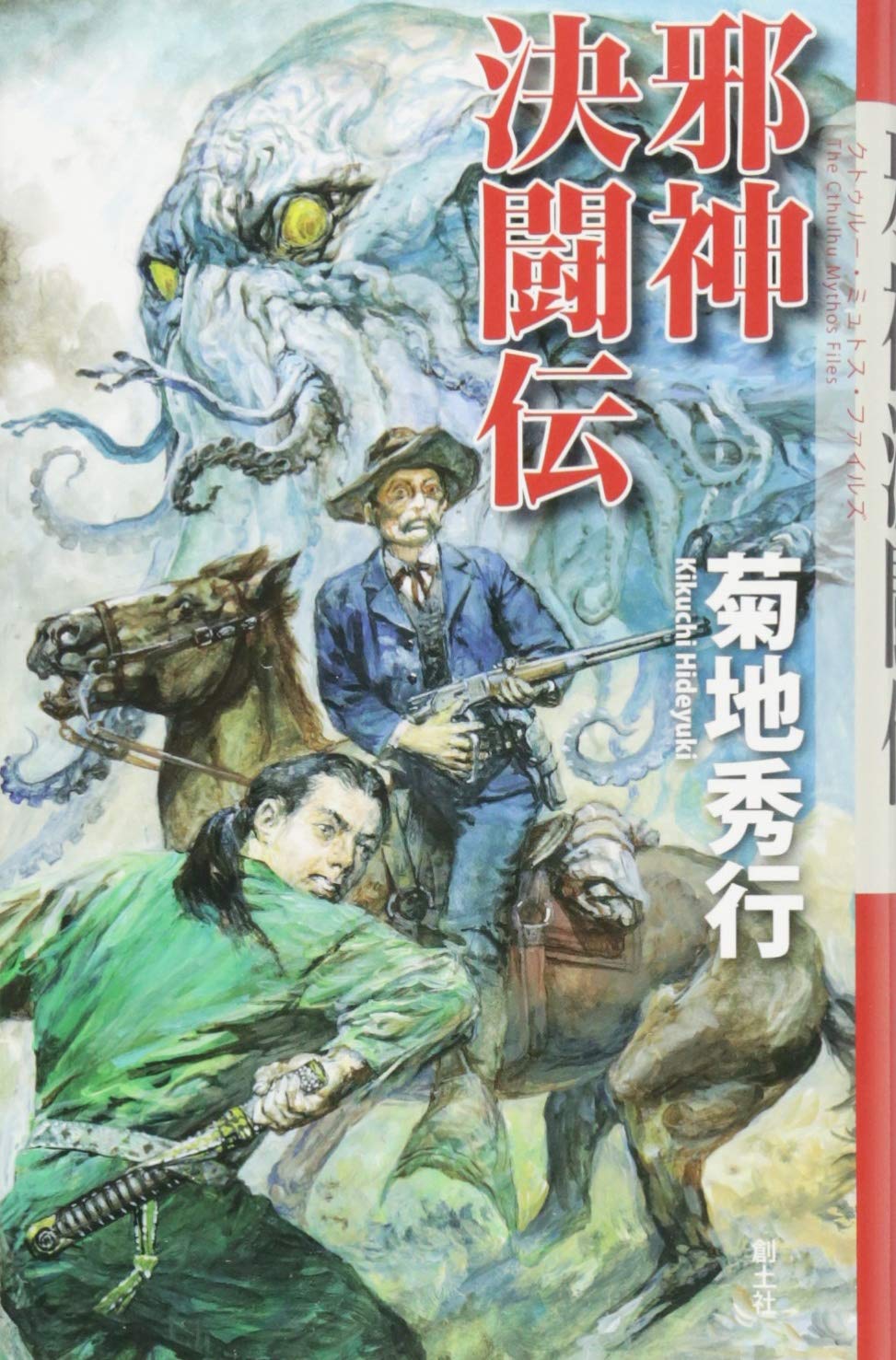
In 2015, his novel Jashin Kettō-den (Legend of the Duel of Evil Gods) was published, a Weird Western which sees a a ninja and a bounty hunter mixed up in a bit of occult business with the Esoteric Order of Dagon…and along the way they pass through Dodge City and Tombstone, and places in between. In 2021 the novel, translated by Jim Rion, was published by Kurodahan Press, who have also published many other Mythos works, such as Kthulhu Reich (2019) by Asamatsu Ken (朝松健).

Kikuchi Hideyuki has done his homework, and if some of that research was done reading classic Westerns, it still shows. This is not an historical samurai epic in an exotic locale; this is a post-Unforgiven Western, gritty and realistic in parts, with an eye for detail…but with allowances for a few specific callbacks to stories and details that Western fans would recognize. For example, in real life Wyatt Earp probably did not carry a Buntline special—but he does here, and the character is none the worse for.

While the addition of a ninja to a Western milieu may seem odd—or perhaps an episode out of the 1970s Kung Fu television series—there’s no anachronism involved. Japan has had contact with North and South America for centuries, and while that contact was lessened during the isolationist sokaku period, by the 1870s gunboat diplomacy had re-established trade and travel, and some Japanese were among the many Asian peoples that immigrated to North America. A more serious and interesting question is the addition of weird elements.

Iä! Iä! Ph’nglui mglw’nafh
Cthulhu R’lyeh wgah’nagl western!
—Kikuchi Hideyuki (trans. Jim Rion), “Afterward” in West of Innsmouth 214

Does West of Innsmouth actually work as a novel? As a weird western, it plays a balancing act between the realistic and the fantastic. Supernatural entities appear, but many of them are perfectly susceptible to a .45 caliber bullet between the eyes or through the heart. The essential plot—what is going and and why the characters do what they do—is actually very solid, with only one quibble: the Japanese co-protagonist is hunting four unusual characters because they killed his brother in Japan at the orders of the Marshes of Innsmouth…but the same characters are being hunted by the American co-protagonist who is working for the Esoteric Order of Dagon. Not an irreconcilable plot hole, but it feels like this is a detail that was overlooked. 

Where the narrative sometimes trips is the extraneous weirdness that tends to crop up along the way. The reader doesn’t need (or get) an explanation for everything, but this ends up being a much more magical Wild West than most readers may be used to, somewhat similar Edward M. Erdelac’s Mekabah Rider series, and there’s perhaps a bit too much of an element of chance in the plot than strictly necessary; too many coincidences, and perhaps too many odd elements that show up briefly and unnecessarily. For example, one antagonist turns out to have learned muay boran from a Thai martial artist in St. Louis…and what are the odds of that?

The Cthulhu Mythos elements are ultimately handled in a very thematic way, with strong visual images for given scenes and repeated motifs that are consistent and have some very effective scenes of horror, but the lore itself handled lightly. The name of Cthulhu is thrown around more often, there is more open talk of spells and incantations, but no one breaks out a Necronomicon or starts giving detailed geneaologies of Innsmouth families; nor does anyone go insane from the revelations. The odd result is that the use of Mythos elements is somewhat restrained, but also much more openly “magical” than you might expect.

In the afterward, Kikuchi Hideyuki admits The Kouga Ninja Scrolls as an inspiration, and you can see some definite thematic resonance there. This is a novel which I think would almost benefit from being longer, or perhaps serialized as a few novellas. The pacing is almost too quick, the challenges all end up being rather short and bloody…but then, this is the Old West, and gunfights often don’t last more than the end of a paragraph, nor should they.

“I can’t figure women for the life of me,” I said. “They give me more fright than Cthulhu himself, maybe.”
—Kikuchi Hideyuki (trans. Jim Rion), West of Innsmouth 194

Sexism and racism were realities in the American Old West, but with today’s audiences a certain balance has to be maintained. So in contemporary Western cinema and literature it’s a fine line between accuracy to the period and necessity to the plot. West of Innsmouth does fairly well overall; the various Native American characters depicted are generally antagonistic, but they aren’t stepping straight out of Hollywood Westerns of the 1950s, 60s, or 70s (although ironically given Hollywood’s penchant for redface, a couple of times Asian characters are mistaken for Native Americans in the novel.) Black characters are mostly absent, and figure very little into events, but aren’t depicted as caricatures. There are several women supporting characters, including a brief but memorable cameo by Belle Starr. Overall, it is a balancing act, and I would say Kikuchi Hideyuki leans on the side of being less prone to putting old-timey racism in his characters’ mouths, although keeps enough prejudice in the story to demonstrate that yet, it was present in the Old West.

There are few enough Weird Westerns that deal with the Cthulhu Mythos, and compared to works like “Showdown at Red Hook” (2011) by Lois H. Gresh, or Weird Trails (2004)West of Innsmouth is certainly more ambitious than most. As a novel it compares favorably with works like Cthulhu Armageddon: A Post Apocalypse Western (2016) by C. T. Phipps, and if it is not perfect, it is never boring, nor does it devolve into white hats versus black hats. Overall, it’s fair to say that Kikuchi Hideyuki succeeded in writing a real western.


Bobby Derie is the author of Weird Talers: Essays on Robert E. Howard and Others and Sex and the Cthulhu Mythos.

Deep Cuts in a Lovecraftian Vein uses Amazon Associate links. As an Amazon Associate I earn from qualifying purchases.

“In the Garden of Ibn Ghazi” (2021) by Molly Tanzer

 I can see it a little when I make the Voorish sign or blow the powder of Ibn Ghazi at it, and it is near like them at May-Eve on the Hill.
—H. P. Lovecraft, “The Dunwich Horror”

Libido sciendi is the desire to know; the pull that drives people to squint through keyholes, pry up rocks and flagstones, to pick the lock on your sister’s diary. It is a very Lovecraftian drive, and one that applies equally well to the investigators of a Cthulhu Mythos story and to many readers themselves. How many young men and women have sat down to make lists of strange titles in Lovecraft’s stories, tracked hints between stories, read dead men’s letters, searched online to ferret out connections? It is not too much to say that generations have persisted in plumbing the Lovecraftian debts…and yet exciting would it be to find one more mystery to uncover?

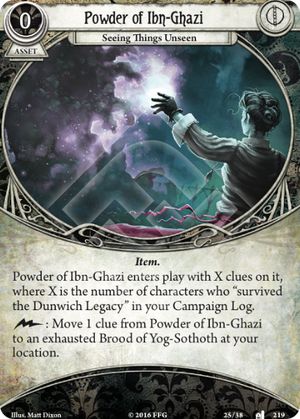
Molly Tanzer wants readers to know that “this story is based on a true experience of mine. I really did have the thought, Oh, I loved that story, ‘In the Garden of Ibn Ghazi,’ when I picked up that card in Arkham Horror, years agao now. But after many, many deep Googles and queries to editors whom I thought might have published it later, I was forced to conclude that no such story exists. Last year, I picked up that card again in the game, and after doing yet another deep dive into the annals of the internet, I thought to myself, ‘I should just write it, then.”
—epigraph to “In the Garden of Ibn Ghazi” in
The Magazine of Fantasy & Science Fiction (Mar/Apr 2021), 126

If you want to get technical about it, Molly Tanzer is playing a very old game in this story. A person in the real world finds a hint that something in Lovecraft’s fiction might be real. Lovecraft would mention his friend Clark Ashton Smith among the artists of the Mythos, August Derleth put copies of Arkham House’s Lovecraft books on the same shelf as the Necronomicon in some of his stories, Joanna Russ had a fan run across a genuine Lovecraftian horror in “I Had Vacantly Crumpled It into My Pocket—But By God, Eliot, It Was a Photograph from Life!“, Robert Bloch in Strange Eons has someone run across an original Pickman painting. The fun of the game is guessing where the dividing line is—how much of what Lovecraft wrote is real? How did he know?

Tanzer teases the reader a better than most. The themes are play are so hoary and well-worn they’re like an old ratty pair of slippers, so easy and comfortable to slip into you almost wouldn’t wear anything else. The protagonist knows that the set-up has to be fake, recognizes the theatricality of it, even reels off the names of familiar works like The Wicker Man and Murder on the Orient Express as a knowing wink to what is about to happen—and the reader keeps reading anyway. It isn’t that Tanzer is being unoriginal, it’s just that it’s almost a ritual with readers at this point. They recognize all the signs, and appreciate the set up, but what they want…what they need…is to know the secret of the ending.

A large part of the appeal of the story will be for Lovecraftian enthusiasts. The nameless protagonist is not explicitly Molly Tanzer herself, but in the sense of “write what you know,” enough of Tanzer is stamped on the character’s backstory to lend verisimilitude. It gives room for little in-jokes. When Tanzer writes:

And it was actually S. T. Joshi who first called me a minor Lovecraftian author, so the scales balance out on that one. I think he was trying to hurt my feelings, but there’s no point to being offended by the truth.
—Molly Tanzer, “In the Garden of Ibn Ghazi” in
The Magazine of Fantasy & Science Fiction (Mar/Apr 2021), 140

S. T. Joshi is a noted Lovecraft scholar, biographer, writer, and critic who is somewhat famous for being acerbic. If he doesn’t like something, Joshi makes no bones about it. For fans of Lovecraftian fiction, two sentences is enough to invoke the image of S. T. damning someone with faint praise. This isn’t so much a jibe at the Old Man of Lovecraft Studies so much as a wink-and-a-nod at the realities; whether or not Joshi actually said something like this to Tanzer is less important than this is something he might well say. Lovecraft fans familiar with Joshi will recognize the hint; like many real-life people who found fictional versions of themselves appearing in Lovecraftian stories, Joshi has crossed that threshold a few times—most notably in the final issue of Alan Moore & Jacen Burrows graphic novel Providence.

There is a lot to like about the story. Tanzer has a great deal of skill in creating convincing snippets of authentic-sounding antique prose, and an awareness of how language and tone reveal little slip-ups when you’re trying to make a text sound old to an audience. The nested narrative structure is a complicated one, the kind of thing Lovecraft would use to good effect in stories like “The Dunwich Horror,” “The Call of Cthulhu,” and The Case of Charles Dexter Ward. At one point, I thought one of the key nested episodes was paraphrasing one of the tales of the Scheherazade—but no, it was something of Tanzer’s own design, though with a hint of the folktale about it.

There is a lot that is Lovecraftian about “In the Garden of Ibn Ghazi,” but there are no tentacles or blasphemous names, no Necronomicons, and the gnosis that reader and unnamed protagonist seek is, in the end, not another nugget of Mythos lore. This is not a locked-room mystery where you guess who the killer is on page three, nor a standard Cthulhu yarn where you’re waiting for the cultists in the funny robes and wavy daggers to come out of the literary woodwork. But if the reader is willing to suspend their disbelief a little, and enjoy the ride, they may find find it worth the journey.

“In the Garden of Ibn Ghazi” (2021) by Molly Tanzer was first published in The Magazine of Fantasy & Science Fiction (Mar/Apr 2021).


Bobby Derie is the author of Weird Talers: Essays on Robert E. Howard and Others and Sex and the Cthulhu Mythos.

Deep Cuts in a Lovecraftian Vein uses Amazon Associate links. As an Amazon Associate I earn from qualifying purchases.

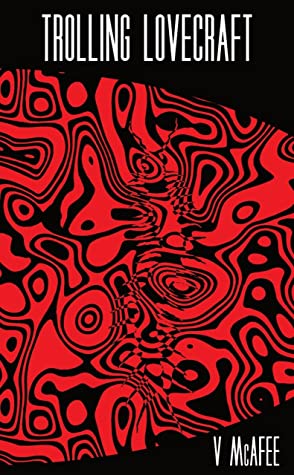
Trolling Lovecraft (2021) by V. McAfee

As for seriously-written books on dark, occult, & supernatural themes—in all truth, they don’t amount to much. That is why it’s more fun to invent mythical works like the Necronomicon & Book of Eibon. The magical lore which superstitious people really believed, & which trickled down to the Middle Ages from antiquity, was really nothing more than a lot of childish invocations & formulae for raising daemons &c., plus systems of speculation as dry as the orthodox philosophies.
—H. P. Lovecraft to Willis Conover, 28 July 1926, Letters to Robert Bloch & Others 378

People have always believed in magic, even if they haven’t always called it magic. This was rarely the kind of magic we might associate with fantasy fiction today; practitioners generally weren’t throwing fireballs. The form and goals of magic have always changed to match the syntax of the era. In ancient Rome, someone might scratch a curse on a tablet of lead, or have a diviner root around in entrails to answer a personal question, or wear an amulet to ensure an easy childbirth. In Lovecraft’s lifetime, they might check their horoscope in the newspaper, carry a rabbit’s foot on their keychain, or let someone hypnotize them.

When most people think of “real” magic, they think less of this kind of superstition and pseudoscience, as Lovecraft would put it, and more on specific tropes of grimoires, spellcasting, magic circles, maybe witchcraft and cults as described in The Witch-Cult in Western Europe (1921) by Margaret A. Murray. Ancient traditions passed down, either in oral traditions or crumbling books and manuscripts, or both. Lovecraft lived and wrote during the period called the Third Great Awakening which saw the rise of organized occultism (in the form of the Hermetic Order of the Golden Dawn, the Theosophical Society, and other groups), an increased focus on Spiritualism and other new religious movements, increased interest in ancient religions thanks to advances in archaeology, scientific interest in supernatural phenomena (as explored by the Society for Psychical Research and other groups), and wider publication of occult literature to an increasingly literate public. Owen Davies explores the magical world of Lovecraft’s era in his book A Supernatural War: Magic, Divination, and Faith during the First World War.

After World War II, magic continued to be popular. Aleister Crowley, a member of the Hermetic Order of the Golden Dawn, had developed its system of ceremonial magick into an influential system of belief called Thelema. Gerald Gardner and Doreen Valiente, among others, formulated and organized contemporary witchcraft as Wicca. Interest in psychic phenomena, Eastern spirituality, and more new religious movements increased during the 1960s. Aleister Crowley’s secretary Kenneth Grant rose to prominence by expanding the system of ceremonial magic—and incorporating in elements of Lovecraft’s fictional Mythos. Anton LeVay, who founded the Church of Satan in 1966, also worked some Lovcraftian material in. In New York City in 1977, a Necronomicon appeared that purported to be a genuine grimoire. For more on such developments, check out The History of British Magick After Crowley and The Necronomicon Files.

While some might argue that all occult literature is in some sense fiction, the development of the Lovecraftian occult was different from claims to have found an ancient magical manuscript and translated it, or to have received a communication from some spirit from “outside.” While some of it (like the Simon Necronomicon) was deliberately fraudulent, the Lovecraftian occult proved to be no different, in the end, to any material derived from traditional sources. A little weird, maybe, and consciously derived from the works of a dead pulp writer rather than some medieval magician, but for people who found defined gods as ideas, concepts, and symbols—what was the difference between a traditional goddess such as Isis and a fictional one like Shub-Niggurath? If you believed enough, and if the rituals you worked around the idea worked well enough for you—why not be a Lovecraftian magician?

This postmodern approach to magick, where prospective magicians were not restricted to traditional systems but pursued a more individual, personal, even eclectic and experiential approach has sometimes been called Chaos magick. Lovecraftian occultism has incorporated by many chaos magicians (or chaotes) into their personal mythology, most notably by Phil Hine in The Pseudonomicon. This approach has in turn inspired takes on Lovecraftian spirituality, notably When the Stars Are Right: Toward an Authentic R’lyehian Spirituality by Scott R. Jones, and Lovecraftian occultism has influenced Lovecraftian fiction.

Which is a very long prologue to begin talking about Trolling Lovecraft by V. McAfee.

I’m not really familiar with his history
enough to do that…
but I guess I could give it a shot. Like go
back to when he was a kid and haunt him
with weird bs?
—V. McAfee, Trolling Lovecraft 5

McAfee’s debut novel is told from the perspective of Dyl, a working chaos magician. It is occult fiction in the sense that it follows the precepts of chaos magic, without explaining the terminology or many of the concepts. Readers who aren’t familiar with sigil-making, or how you might charge an orgone accumulator, are going to miss a few things. While I wouldn’t be surprised if McAfee was very familiar with Hine and the Pseudonomicon, the focus of the novel is not some exegesis on Lovecraftian occultism…it’s the use of chaos magic for a very specific purpose: trolling Lovecraft.

There are a lot of ways for dealing with life, the things it throws at you, and historical figures like H. P. Lovecraft. Many writers have addressed Lovecraft and his work in many ways in fiction, from reverence to revulsion, ridicule to reimagining. None of these are wrong; a writer might express their appreciation for Lovecraft by creating a fictional version of them in their story, as Robert Silverberg did in “Gilgamesh in the Outback”, or work out frustration by calling out his racism as N. K. Jemisin did in The City We Became. Chaos magic is as valid an approach as any other—and maybe as valid a goal for chaos magic as any other operation.

He took his copy of a collection of Lovecraft’s prose off the shelf and found Beyond the Wall of Sleep, one of his favorites and one of the original pieces that he was going to mess with. He read through it quickly and found it unchanged, just as Her Greatness had said. Then, Dyl pulled up a transcription on the web and found that the phrase ’empire of Tsan-Chan’ had in fact been changed to ’empire of Fiat-Nox’.
—V. McAfee, Trolling Lovecraft 67

While trolling Lovecraft is the premise of the novel, the focus is on Dyl and the consequences of his actions. Like many magicians, he’s young, male, egotistical, often horny, and perpetually getting himself into deeper and deeper shit through poor life choices. This is not a magical adventure in the sense that Dyl has to find an ancient grimoire bound in human skin and has to defeat Cthulhu before the evil cult can summon him into the real world; this is an extraordinarily personal journey about someone who becomes unmoored from his personal reality because he decided to troll Lovecraft…and while many other people might not believe in it, it’s real for him.

Which is what chaos magic is all about.

Trolling Lovecraft was written by V. McAfee for NaNoWriMo 2020, and a print edition was successfully funded and delivered on Kickstarter in 2021. Digital copies can be purchased at the Gate Zero shop on Etsy and Gumroad.


Bobby Derie is the author of Weird Talers: Essays on Robert E. Howard and Others and Sex and the Cthulhu Mythos.

Deep Cuts in a Lovecraftian Vein uses Amazon Associate links. As an Amazon Associate I earn from qualifying purchases.

Editor Spotlight: Betty M. Owen & Margaret Ronan

How young is too young to read H. P. Lovecraft?

Fear and horror are universal. No matter how old—or young—the audience may be. Yet weird fiction and supernatural horror have not always been universally available. From the 1920s to the 1950s, copies of Weird Tales might expect an audience of both teens and adults. Expensive hardcopy Arkham House editions were no doubt beyond the range of most teens; and the Armed Forces Editions no doubt weren’t read by anyone below recruitment age. In the 1960s and 1970s, paperback editions of H. P. Lovecraft’s fiction were beginning to be available in bookstores, but these were mostly marketed toward a grown-up audience: Lin Carter included two Lovecraft collections among the Ballantine Adult Fantasy series.

Yet there was a younger audience for horror fiction. Not necessarily the more sexually explicit or gruesome horrors of the shudder pulps, or the sophisticated psychological horrors like Robert Bloch’s Psycho, but there was certainly a market for spooky stories—and not stories bowdlerized or dumbed down for a younger audience either.

Enter Scholastic Book Services.

Scholastic started out in the 1920s publishing educational magazines aimed at a younger audience; as the company grew and diversified, they moved into book publishing as well, aiming affordable cheap paperbacks at a school-age audience, through book clubs and mail-order catalogs. By the mid-to-late 1960s, Scholastic began to offer original anthologies of supernatural horror fiction, mostly reprints of older material, and the number of reprint editions of individual titles suggests that they found some success.

Screenshot 2021-12-14 3.31.48 PM

Betty M. Owen was a Scholastic editor whose credits include Stories of the Supernatural (1967), Nine Strange Stories (1974), Teenspell (1974), The Ghostmasters: Weird Stories by Famous Writers (1976), and StarSreak: Stories of Space (1979).

11 Great Horror Stories was the first Scholastic anthology to include a Lovecraft story, and “The Dunwich Horror” is featured prominently. Probably the first introduction to Lovecraft for many young readers.

Owen as an editor has a light touch; while she selected and arranged the contents, she had no introduction or opening remarks for the stories, so her reasoning is opaque to us. However, Lovecraft is not in bad company, front of a queue that includes Edgar Allan Poe, Bram Stoker, John Collier, and L. P. Hartley. Considering Owen would got permission from Arkham House to use “The Dunwich Horror,” and how prominent it is on the cover, we can assume that someone at Scholastic thought it was the real selling point of the book.

Among Scholastic’s associate editors was Margaret Ronan—who, before she married and took her husband’s name in 1940, was Margaret Sylvester, a teenage correspondents of H. P. Lovecraft. Ronan was a prolific editor and writer for Scholastic, first in their magazine Practical English and later especially prominent for her film reviews. Her work for Scholastic would include a combination of fiction anthologies and nonfiction works on macabre subjects, with titles like Astrology and Other Occult Games (1974), Hunt the Witch Down: Twelve Real Life Stories of Witches and Witchcraft (1976), Death Around the World: Strange Rites & Weird Customs (1978), House of Evil and Other Unsolved Mysteries (1978), The Dynamite Monster Hall of Fame (1978), Master of the Dead (1979), Curse of the Vampires (1979), The Dynamite Book of Ghosts and Haunted Houses (1980), and Dark and Haunted Places (1982). Yet the book Margaret Ronan is most remembered for is The Shadow over Innsmouth and Other Stories of Horror (1971).

Shadows1

Ronan centers her editing on her personal experience with Lovecraft, drawing forth an anecdote from his letters to her. The portrait she paints of Lovecraft is an informed one—the reference to Fritz Leiber, Lovecraft’s Selected Letters, and the repetition of the “black magic” quote suggest that Ronan was fairly current on Arkham House releases, which was the focal point of Lovecraft studies at the time—yet it is also a sympathetic, affectionate portrait:

He looked like a writer of weird sories. He was tall and gaunt, with a bony face that could have been a composite of the faces of actors Boris Karloff and Max von Sydow. But although the face might at first seem forbidding, the eyes gave away the real man inside. They were warm and friendly, interested in everything and everybody.

The choice of stories in this book is odd. “The Shadow over Innsmouth” is one of Lovecraft’s most iconic stories, but also a fairly long novella; “The Festival” is a classic alternative to the Christmas ghost story, and “The Colour Out of Space” and “The Outsider” are among Lovecraft’s best work. “Imprisoned with the Pharaohs” is an odd choice, but Ronan highlights Lovecraft’s connection with Houdini in her brief foreword to the story. “In the Walls of Eryx,” co-written with Kenneth Sterling, is very outside the norm—and “The Transition of Juan Romero” is far from Lovecraft at his best, with Ronan herself noting that it is “Short, and to the point!”

We don’t know what constraints Ronan operated under in selecting these stories, or what criteria she went by; budget for licensing the stories from Arkham House or limits on pagecount are both probable. Yet for the intended audience, this isn’t a terrible selection, and at a cost of only 75¢ was very affordable: Ballantine’s The Doom That Came to Sarnath (1971) was 95¢ for 208 pages. Any kid that got a copy was getting a good deal.

WW4Scholastic continued to publish magazines, even as they continued to expand their book sales beyond book clubs and mail-order catalogues into book fairs at schools. One of their odder offerings was Weird Worlds, a pop-culture/comic magazine edited by R. L. Stine (as Bob and Jane Stine).

Weird Worlds #4 (1980) includes among its features a reprint of “The Outsider.” Ronan is present with articles on The Omen (1976) and UFOs; whether she had any hand in getting Lovecraft into one more Scholastic publication or not is unclear…but it would have been one more chance to give a younger audience that first taste of the Old Gent.

Children’s literature, like pulp fiction, tends to be ephemeral. Kids grow out of it, childish things are put aside. Scholastic books, generally unavailable in stores, cheaply printed and bound, and hard-used by the young readers, survive only because they were sold in such vast numbers that many still turn up at garage sales and thrift shops, and are often overlooked. These books are not, for the most part, expensive collectibles…but they did play their part in spreading Lovecraft’s legacy to a new generation.

Toward these pen friends he was unfailingingly generous—not only with what little money he had, but with his time and his encouragement. Without this encouragement, many of us would never have gone on hoping and trying to be writers.
—Margaret Ronan, The Shadow over Innsmouth and Other Stories of Horror


Bobby Derie is the author of Weird Talers: Essays on Robert E. Howard and Others and Sex and the Cthulhu Mythos.

Deep Cuts in a Lovecraftian Vein uses Amazon Associate links. As an Amazon Associate I earn from qualifying purchases.

Her Letters To Lovecraft: Margaret Sylvester

Dear Miss Sylvester:

[…] Regarding the Necronomicon–I must confess that this monstrous & abhorred volume is merely a figment of my own imagination! Inventing horrible books is quite a pastime among devotees of the weird, & ….. many of the regular W.T. contributors have such things to their credit–or discredit. It rather amuses the different writers to use one another’s synthetic demons & imaginary books in their stois–so that Clark Ashton Smith often speaks of my Necronomicon while I refer to his Book of Eibon..& so on. This pooling of resource stents to build up quite a pseudo-convincing background of dark mythology, legendary, & bibliography–though of course none of us has the least wish actually to mislead readers. ….

Yrs. most cordially & sincerely,

H. P. Lovecraft
—H. P. Lovecraft to Margaret Sylvester, 13 Jan 1934, Selected Letters 4.344-346, Letters to Hyman Bradofsky and Others 393-396

Margaret D. Sylvester was born in 1918, which made her fifteen years old when she wrote to H. P. Lovecraft, care of Weird Tales, in late 1933 or early 1934. We know little about her life: at the time she was living in Denver, Colorado with her parents and two younger brothers, no doubt going to school and reading pulp magazines for entertainment. She seems to have had a taste for the macabre, and like many fans that wrote to Lovecraft, found that he wrote back. While we don’t know how regular their correspondence was, Lovecraft included her on his list to mail postcards to during his travels, and on his list of correspondents in his instructions in case of decease.

That letter from 13 January 1934 may well be the first; it has something of the tone of an answer, and questions about the Necronomicon was common early on in correspondence with Lovecraft. A long passage before this discusses the witch-cult and Walpurgisnacht, with Lovecraft borrowing from The Witch-Cult in Western Europe (1921) by Margaret A. Murray in his answer. “The Dreams in the Witch House” had been published in the July 1933 issue of Weird Tales, so perhaps that had precipitated the teenaged Margaret to pen a letter to him, filled with questions.

The best insight we have into Margaret Sylvester’s early correspondence with Lovecraft is in the few letters where he mentions her to others; in particular a long passage from mid-1934:

Am still shudderingly admiring the saponaceous monolith–& before I forget it, let me pass on a request for your charitable sculptorial services which I fancy you may wish to grant. A very bright young western correspondent–a damsel of precisely your own years who wrote me through W.T. & is interested in everything weird, especially art–has seen many of your drawings & the Cthulhu photograph (but not Ganesa), & has heard of your powers in clay-modelling & marionette work. Needless to say, her admiration of the Lord Ghu is boundless. Now it happens that she is herself an inveterate puppeteer, having given performances of “Dracula” & other horrors with figures made by herself; & contemplating such future triumphs as “Dr. Jekyll & Mr. Hyde” & “Beauty & the Beast.” Here is where you come in. Filled with respect for your fertile fancy, she will not be content till she gets a hellish clay head of your conception & workmanship for the Beast figure of “Beauty & the Beast.” Evidently she prefers a typically Barlovian nameless Thing to any conventional phiz. I’ve told her to write you direct–but if she doesn’t, & if you think the honour of representation & credit in an undoubtedly clever & probably oft-repeated marionette show would be sufficient reward for the sculptural effort, you’d better drop her a line yourself asking for mechanical particulars & further ideas. Address: Miss Margaret Sylvester, 4515 East 25th Ave., Denver, Colorado. I’d do it if I were you–since such modelling is an intrinsic pleasure. You’ll probably find this kid an interesting correspondent, too–very bright, though not a writer so far as I know. And a great admirer of your cinema hero Signor Lugosi.
H. P. Lovecraft to R. H. Barlow, 22 Aug 1934, O Fortunate Floridian 166

“Lord Ghu” was one of Lovecraft’s nicknames for Barlow, who had taken to modeling figures in clay, including a tablet-image of Cthulhu and a statue of the Hindu god Ganesha. “Signor Lugosi” would be actor Bela Lugosi, whose filmography included Dracula (1931), Murders in the Rue Morgue (1932), White Zombie (1932), Chandru the Magician (1932), The Black Cat (1934), and The Return of Chandru (1934).

As it happened, Barlow declined the project. However, Barlow did agree to loan “Little Maggie” his copy of Gustav Meyrinck’s The Golem, which was currently being read by Catherine Lucille Moore; one can imagine the young Margaret Sylvester’s surprise to get a package from Weird Tales author C. L. Moore in the mail one day. Margaret Sylvester would in turn forward the book to Lovecraft’s correspondent Duane W. Rimel when she was done with it.

In about May 1935, a chain letter was sent to Lovecraft—Margaret Sylvester is the name immediately before Lovecraft’s. He forwarded the chain letter, including a few judicious remarks, to Barlow for his amusement.

So you’ve had several of the chain things come, eh? I’ve seen only two so far–Bro. Hadley’s & Little Maggie’s. The latter child seems to be in the business–indeed, according to press reports it started in her town.
H. P. Lovecraft to R. H. Barlow, 24 May 1935, O Fortunate Floridian 275

No doubt the letters in 1935 would have included mention of her poetry:

Yearbook_full_record_image

Angelus, 1935 East Side High School Yearbook, page 135

There are some indications that Lovecraft may have recruited Margaret for the National Amateur Press Association c. 1936, and three of her poems were published in the amateur journal The Californian. No doubt the letters from 1934-1936 were filled with a mix of Lovecraft’s typical accounts of news & travel and whatever topics that the two found of interest to share and discuss…such as Margaret Sylvester’s graduation from North Side High School in Denver, Colorado, and her aims at higher education.

You missed little Maggie Sylvester by only a few days, since she set out for the metropolis on the 11th. I’m telling Leedle Meestah Stoiling to extend her a welcome. Her address is now 157 E. 57th St., N.Y.C.
H. P. Lovecraft to R. H. Barlow, 16 Sep 1936, O Fortunate Floridian 360

And little Maggie Sylvester of Denver is in New York for an art course or something–to be addressed at 157 E. 37th St.
H. P. Lovecraft to Clark Ashton Smith, 29 Sep 1936, Dawnward Spire, Lonely Hill 649

Leedle Meestah Stoiling cut the Harvard Tercentenary in order to stay longer in N Y with his parents. He tried to see little Maggie, but had to proceed to Cambridge before he could find her at home.
H. P. Lovecraft to R. H. Barlow, 30 Sep 1936, O Fortunate Floridian 363

“Leedle Meestah Stoiling” was Kenneth Sterling, another of Lovecraft’s young correspondents, with whom Lovecraft would collaborate on “In the Walls of Eryx.” It is not clear where in New York Margaret Sylvester attended art school, but her 2010 death certificate reads: “Some college credit, but no degee.” so for whatever reason she did not graduate. Perhaps she found a job; we know that in 1940 she married Frank Ronan, and took his name as Margaret Ronan. She was employed by Scholastic Publications as a critic, writer, and editor, publishing both anthologies and nonfiction books with a distinct horror bent aimed at the children/young adult market. In 1971 she edited The Shadow over Innsmouth and Other Stories of Horror, which may have been many a teen’s first introduction to Lovecraft, and there she wrote:

With his correspondents, Howard Lovecraft could relax. His letters, written in tiny, crabbed writing, are full of sly humor. Instead of a return address and a date, they could bear such headings as “Black Marsh of Gthath, Hour that the Ooze Stirs,” or “Black Cylinder Floating between Two Universes, Hour of the Burning Galaxy.” In one letter he sent to me, he refers to a description of himself given by a mutual friend: “As it happens, several points in Mr. Sterling’s word-picture are misleading. It is out of my right, not left shoulder that the ropy tentacles grow. What grows out of the left shoulder is one of my four eyeless heads. This head is not to be confused with the one growing out of my right elbow (the one with the green fangs).”
Margaret Ronan, “A Word to the Reader,” Letters to Hyman Bradofsky and Others 411

An extract from a single letter to Margaret Sylvester (13 January 1934) was published in Lovecraft’s Selected Letters IV. Graduate student Arthur S. Koki obviously contacted Margaret Ronan, because he cites and quotes from several of her letters in his 1962 M.A. thesis H. P. Lovecraft: An Introduction to His Life and Writings. Most of these are fairly small and give little of the flavor of their correspondence, but two fragments stand out, the first on the death of Robert E. Howard (which occurred on 11 June 1936) and the second on the issue of marriage:

I doubt whether there was any definite cause aside from Mrs. Howard’s approaching death. As I see it, it was simply the disastrous combination of a certain kind of temperament with one sharp blow. Probably it would never have occurred if good old Two-Gun hadn’t been watching sleepless by his mother’s bedside for endless weeks. He was nervously & physically exhausted by those weeks of overwork, sleeplessness & tension–brooding deeply (as shown by poems like ‘The Tempter’) even though putting up a brave front to the outside world. Then came despair–& the consciousness that the fight for his mother’s life was hopeless. With no energy to resist the shock–no fund of healthy life-clinging, nerve-twisting strain–poor REH reacted in what must have seemed the shortest & simplest way. And what a damned shame! But of course I suppose general temperament was a factor. Despite his violent, assertive contempt for the “artistic attitude,” Two-Gun was essentially of the neurotic aesthetic type–that is, a person filled with imaginative concepts of certain conditions unrelated to reality which he would like to see around him, & correspondingly resentful of the pressure of the actual world.
H. P. Lovecraft to Margaret Sylvester, October 1936, Koki 247-248, Letters to Hyman Bradofsky and Others 397-398

I do not regard marriage as a social superfluity, but believe it has extreme stabilizing value in the organization of a state Its advantages are numerous & varied–& are indeed so apparent to the unbiased anthropologist that even Soviet Russia (where no traditional institution is kept up for tradition’s sake alone) is beginning to urge its systematic maintenance & more faithful & universal practice.
H. P. Lovecraft to Margaret Sylvester, n.d. (Jan 1937?), Koki 178

Presumably, most of the surviving letters from Lovecraft to Margaret Sylvester are in private hands. It is known that there are three letters at the John Hay Library, including the full 13 January 1934 letter that is excerpted in the Selected Letters. Also included is a letter believed to date from February 1937—one of the last letters that Lovecraft would write—with the address given as “Cave of the Crumbling Bones.” A copy of this letter was in the collection of actor Christopher Lee, who brought it out during the episode “Demons” on the series 100 Years of Horror (1996). A few quotes are included in Margaret’s introduction to The Shadow over Innsmouth and Other Stories of Horror (1971). All of these known surviving letters and quotes from Lovecraft’s letters to Margaret Sylvester are collected in Letters to Hyman Bradofsky and Others.

We can only speculate how much the correspondence with Lovecraft shaped a young Margaret Sylvester’s life. No doubt she was already on her macabre path, but no doubt too that he gave her encouragement to pursue those interests.


Bobby Derie is the author of Weird Talers: Essays on Robert E. Howard and Others and Sex and the Cthulhu Mythos.

Deep Cuts in a Lovecraftian Vein uses Amazon Associate links. As an Amazon Associate I earn from qualifying purchases.

“Women Who Live Between the Worlds” (2021) by J. Lily Corbie

“The only times women are even mentioned in these books, we’re…sacrifices or vessels. We’re things, tools to use, a means to an end.”
—J. Lily Corbie, “Women Who Live Between the Worlds” (2021)

2021 marks a century of women being involved with the Cthulhu Mythos. From “Falco Ossifracus” (1921) by Edith Miniter to She Walks In Shadows (2015) and Dreams From The Witch House: Female Voices of Lovecraftian Horror (2015), through all of the women who Lovecraft collaborated with and ghostwrote for, the women fans who wrote poems and stories and novels of the Mythos over the decades expanding and exploring the shared world. Women were there from the beginning…and they are still here, still writing, still creating new art, fiction, poetry, etc.

For all that women have made their mark in the literature of Lovecraftian fiction, the place of women within the Mythos has been less explored. Many authors have expanded on Lovecraft’s original stories and characters in various ways. “The Head of T’la-yub” (2015) by Nelly Geraldine García-Rosas offers a new way of looking at “The Mound”; “A Coven in Essex County” (2016) by J. M. Yales explores patriarchy in Innsmouth; “Magna Mater” (2015) by Arinn Dembo posits a matriarchial twist on “Arthur Jermyn”; “The Devil’s Hop Yard” (1978) by Richard Lupoff & “The Cry in the Darkness” (2011) by Richard Baron offer two different interpretations of Mamie Bishop from “The Dunwich Horror.” The story of women in the Mythos has been recast, reexamined, expanded and elaborated upon; their legacies continue to grow.

Yet very rarely is this a case of women within the stories on a journey of discovery for the women that came before them. We don’t often see female characters confront the fact that the stories of Keziah Mason, Lavinia Whateley, and Marceline Bedard within the fictional universe are few, and mostly related by men. A hypothetical woman student, searching for women cultists, might be hard-pressed to find anything definitive about what role women played in the rites and ceremonies of the cult of Cthulhu. Historical sexism is alive and well in Lovecraft country.

As we walked between them, she said, “It wasn’t deliberate.” She glanced at me sideways. “Most of the time, at least. Our works have been discarded and destroyed because they were simply considered unimportant or uninteresting. They were lost to history through accident and neglect as often as malice. They’ve gone unarchived in libraries, uncollected in museums for those same reasons. But the dreamlands are ours.”
—J. Lily Corbie, “Women Who Live Between the Worlds” (2021)

In The Witch-Cult in Western Europe (1921) by Margaret A. Murray, the Salem Witch Trials are attributed to the persecution of an actual coven. Those Salem witches, both the real women who died and the fictional counterparts they inspired, like Keziah Mason in “The Dreams in the Witch House,” have left descendents—and a stamp on the collective memory. To some, like Lovecraft’s unnamed correspondent who claimed descent from Mary Easty, witchcraft was real—or at least something she wanted to be real. A spiritual heritage that she could be a part of.

Corbie’s “Women Who Live Between the Worlds” is similar to “Down into Silence” (2018) by Storm Constantine in that there is a wistfulness to it. In a contemporary, mundane world with smartphones and the internet, the legends of Arkham’s witch-haunted streets seems far away, and perhaps a bit silly. In her version of Arkham, which could easily fit in the same world as Constantine’s Innsmouth, students grown at failed rituals and wonder if the fault is in them…or if there just isn’t any magic in the first place. No deeper truth to learn.

Is it the case that the Mythos isn’t real—or is it just not for women?

In many ways, Corbie’s answer to that reflects the truth of women’s continued contributions to the Mythos. While their work may be overlooked or forgotten for a time, it is still there—and they are still there, waiting to be discovered. Sometimes with a little help from their friends, sisters, fellow initiates and would-be-cultists. It’s not just that women are an intimate and vital part of creating the Mythos, but they are an intimate and vital part of the fictional universe of the Mythos. You do not have a Dunwich horror without Lavinia Whateley.

Corbie’s approach to the story is multi-layered, bordering on the metafictional. While she’s keeping it strictly within the confines of the fictional universe where Arkham and Miskatonic University are real, there are contemporary sensibilities at play in how she re-interprets some of the events and characters. Marceline Bedard of “Medusa’s Coil” (1939) by Zealia Bishop & H. P. Lovecraft, for example, is described as:

“Murdered,” she said, “for perceived sins of ancestry rather than the sins of her voluntary commission.”
—J. Lily Corbie, “Women Who Live Between the Worlds” (2021)

As a narrative, “Women Who Live Between the Worlds” is ultimately an extended induction, both for the protagonist Lizza and for the readers. No Merlin is here to guide a young Arthur to the sword in the stone, no Hagrid appears to say: “You’re a wizard, Harry.” If Lizza and her friends want to be witches in the Lovecraftian vein, they have to find out how to open that door themselves…and it is every bit as perilous, damaging, and difficult one might expect. It’s not enough to copy the words from the old books and say them at the right time.

The real question we are left with…the stories yet to be told…are what Lizza might do with her Silver Key, once she gets it. Those should be worth reading.

J. Lily Corbie’s “Women Who Live Between the Worlds” was published on her blog on 1 May 2021.


Bobby Derie is the author of Weird Talers: Essays on Robert E. Howard and Others and Sex and the Cthulhu Mythos.

Deep Cuts in a Lovecraftian Vein uses Amazon Associate links. As an Amazon Associate I earn from qualifying purchases.

“Lovecraft Thesis #5” (2021) by Brandon O’Brien

The man you say brought us here is a kind of prophet.
—Brandon O’Brien “Lovecraft Thesis #5” in Can You Sign My Tentacle? (2021) 59

Every Lovecraftian thesis in O’Brien’s collection includes a soundtrack; for #5 it is Visions of Bodies Being Burned (2020), Track 6: Make Them Dead, by clipping. An experimental hip-hop piece of carefully constructed distortion, slow to start, building in speed and lyricality. The track provides added context for the thesis; one should be read with the other, not rushing through O’Brien’s free verse, but savoring the way the lines scan. Like good poetry, and good lyrics, there is something more there than just a clever bit of wording or an evocative image.

Lovecraftian is a state of mind. There’s no hard definition, and it means different things to different people. For folks like W. H. Pugmire, “Lovecraftian” was an aesthetic, a mood, an attitude. You don’t need Cthulhu or tentacles to be Lovecraftian;  you don’t even need Lovecraft. The idea is bigger than the man or his fiction, and sometimes it can be crafted in a poem or found by chance in the verse of a song. Every person who comes to Lovecraft and his work brings with them their own experience, their own syntax through which to view and define what “Lovecraftian” means for them—and can put their own stamp on what is Lovecraftian.

Does it bear repeating that the caliber of racism he espoused in his heyday of the 1910s to the 1930s was not uncommon among white Americans? Of course—but it would be a sorry excuse, as if to imply racism was some unaboidable product of circumstance rather than the deliberate ideology of spiteful people, some of whom may be honestly otherwise remarkable (much to the benefit of that spite). There is no shame or cruelty in observing this. He was a truly remarkable creative mind, but one whose creativity was colored by a misguided value of monoculturalism.

Science fiction is a radical genre, but that fact is a neutral one.
—Brandon O’Brien “Author’s Note” in Can You Sign My Tentacle? (2021) 68

The “Lovecraft theses” in Can You Sign My Tentacle? are meditations on a theme, but deliberately ambiguous, letting the reader fill in the gaps. The language is evocative of Lovecraft’s themes, but there are no proper names to hang certainties on. In other poems in this collection, like “Kanye West’s Internet Bodyguard Aks Hastur to Put Away the Phone,” the specificity and pop culture references are played for laughs, surreal humor masking the darker reflections, in the vein of Kanye West—Reanimator (2015) by Joshua Chaplinsky.

how they huddle around warped symbols,
pledge fealty to idols long since dust,
—Brandon O’Brien “Lovecraft Thesis #5” in Can You Sign My Tentacle? (2021) 59

For myself, reading these lines about the hooded figures, listening to this track, I’m reminded of Ring Shout (2020) by P. Djèlí Clark. Yet one could just as easily read this as a poem of the fantastic, of any group of cultists; even absent its context, the track, the author’s note, the other poems in the collection, it speaks to familiar themes, people staring into the past, defined by hate and a kind of fanatical devotion. The tenor of the thesis has that kind of Lovecraftian universality to it, picking up its color and timbre from its context.

O’Brien knows what he is doing.

This is not the only work that has taken the most recognizable parts of the Cthulhu mythos and reshaped them for thoughtful and critical effect.
—Brandon O’Brien “Author’s Note” in Can You Sign My Tentacle? (2021) 70

One of the key points of the 2010s and 2020s has been not necessarily a rising awareness of Lovecraft’s racism—that was never a secret, and no serious biography has ever shied away from the subject—but a rising awareness that there is a body of literature in response to that, whether it be “Jeroboam Henley’s Debt” (1982) by Charles R. Saunders, “The Ballad of Black Tom” (2016) by Victor LaValle, Harlem Unbound (2017) by Darker Hue Studios, or The City We Became (2020) by N. K. Jemisin. Anyone that accuses these writers of whipping a dead horse is missing the point: the issue at hand is not berating Lovecraft for his racism, but demonstrating that Black people have a voice in Lovecraftian fiction too. They get to have their part in defining what “Lovecraftian” means to them, to tell Cthulhu Mythos stories in their own way, reflective of their own interests and experiences, just as white people have been doing for decades.

After all, in terms of Cthulhu, it doesn’t matter what color your skin is. There is no reason a Black character cannot be the protagonist of a Lovecraftian story, cannot experience the same sense of cosmic horror and insignificance that Lovecraft’s white protagonists did. The experience of cosmic fear should ultimately be colorblind.

“Lovecraftian thesis #5” is a little different.

The end goal of this collection is in the same spirit as those works, but hoping to accomplish the inverse: for Blackness ot be seen as radically significant.
—Brandon O’Brien “Author’s Note” in Can You Sign My Tentacle? (2021) 70

You can see that in a close reading of the verse. The identity and the perspective of the speaker is critical: they are not among the group of hooded figures, they are apart, watching, questioning. In the first line, the speaker specifies “The man you say brought us here”—the speaker is addressing the audience, and identifying as part of a group that was brought somewhere against their will, set against these hooded figures—you don’t have to see the speaker as a former slave set against the Ku Klux Klan, but you can see how that experience could have informed those words.

What else than to own the carcass
of a land already bought in blood?
—Brandon O’Brien “Lovecraft Thesis #5” in Can You Sign My Tentacle? (2021) 59

All five “Lovecraft theses,” along with other poems by Brandon O’Brien can be found in Can You Sign My Tentacle? (2021).


Bobby Derie is the author of Weird Talers: Essays on Robert E. Howard and Others and Sex and the Cthulhu Mythos.

Deep Cuts in a Lovecraftian Vein uses Amazon Associate links. As an Amazon Associate I earn from qualifying purchases.

Deeper Cut: Hugo Gernsback

Antisemitism

The following article deals explicitly with antisemitism in a historical context. Frank discussion of these matters requires the reproduction of at least some samples of antisemitic speech from historical sources (e.g. Lovecraft’s letters). As such, please be advised before reading further.


Unfortunately, the prevailing approach in science fiction studies has been to dismiss the Gernsback magazines as embarrassingly simplistic, tasteless, and even detrimental to the eventual emergence of a mature literature. This is an ironic and all-too-casual judgment of a Jewish immgirant who throughout his life was in search of the respect as a technologist and editor that always seemed to elude him. A certain tone seems to have been set early on by the spectacularly racist H. P. Lovecraft’s moniker for Gernsback: “Hugo the Rat.”
—Grant Wythoff, The Perversity of Things (2016), 8-9

Hugo Gernsback is a central figure in the development of science fiction pulp magazines and on science fiction fandom. His direct dealings with Lovecraft were very few, mostly limited to the purchase of “The Colour Out of Space,” which ran in the September 1927 issue of Gernsback’s magazine Amazing Stories. Yet Gernsback’s reputation among Lovecraft and his circle of correspondents was low, and the moniker “Hugo the Rat” which Lovecraft coined has continued to stick, in fan-circles and to a degree among scholars, for decades.

Hugo Gernsback was Jewish; H. P. Lovecraft was an antisemite. Many readers and even scholars might take it as a given that Lovecraft’s prejudices were at play in his antipathy to Gernsback, and there is some truth to that. The real history of why and how this antipathy came about is a bit more complicated than it might first appear, and Lovecraft was not the only pulp writer involved with Gernsback in the series of exchanges that turned Hugo Gernsback into “Hugo the Rat.”

It’s not a pretty history; the most critical events in this narrative take place against Hitler and the Nazi’s rise to power in Germany in 1933, and antisemitic language in the period letters will be presented as it was, uncensored. Reader discretion is advised.

Gernsbacher & Modern Electronics

Hugo Gernsbacher was born in Luxembourg in 1884, into a Jewish family. His father was a successfull wine wholesaler and Hugo had been educated by private tutors, able to read, write, and speak German, French, and English fluently, and had attended L’Ecole Industrille et Commerciale in Luxembourg and the Technikum in Bingen, Germany. Before the age of 18 he had developed a significant amount of practical experience with electricity (even receiving a papal dispensation to complete the telephone wiring of a Carmelite convent), and had a penchant for invention. In 1904 at age 19, the industrious young man emigrated to the United States of America and simplified his name to Hugo Gernsback.

For the next several years, Gernsback was notable as an electrical experimenter, inventer, and businessman. The full scope of his engineering and business enterprises is too long to go into here, but chief among them was co-founding the Electro Importing Company in 1905, the foundation of Modern Electronics magazine in 1908, and the creation of the Wireless Association of America in 1909. Gernsback encouraged amateur experimentation with electricity and especially with early radio, profited from the sale of wireless sets and other components, helped spread technical knowledge of electricity and radio, and invested his profits in further developments of the technology.

Modern Electronics was Gernsback’s first magazine. Nominally, Modern Electronics was a mail-order catalog for the Electro Importing Company, but it carried much more than a list of goods for sale and their prices. The magazine was designed for the amateur enthusiast, full of practical technical knowledge in plain English, with the occasional fiction clearly marked and entertaining. Gernsback’s first science fiction novel was Ralph 124C 41+serialized in the pages of Modern Electronics from 1911-1912.

In 1913, Gernsback began publication of a new magazine, The Electrical Experimenter, which dropped the catalog and focused on a combination of science fact and fiction. Modern Electronics continued until 1914, when it was merged with Electrician and Mechanic (1890-1014) to form Modern Electrics and Mechanics—which in 1915 changed its title to Popular Science Monthly, which is still published today.

By 1915, the Electrical Experimenter was published through Gernsback’s Experimenter Publishing company. Hugo’s older brother Sidney Gernsback had emigrated to the United States and joined his brother’s businesses c.1913. In addition to the magazine, Experimenter Publishing published a number of correspondence courses for electricity, and proved successful enough that he introduced a new magazine, Radio News, in 1919. “Scientific stories” (science fiction) had their place in the Electrical Experimenter as well, and Gernsback encouraged the readersamateur experimenters, mostly—to imagine new possibilities and write and submit stories. In 1920, the Electrical Experimenter became Science and Invention, but the solicitation of science fiction continued despite the new title.

Science fiction already existed, but Hugo Gernsback was set to popularize it.

Lovecraft & Amazing Stories

If there is one issue that clings closest to the memory of Hugo Gernsback it is that he was very bad at paying authors.
—Mike Ashley & Robert A. W. Lowndes, The Gernsback Days (2004), 123

Pulps like The All-Story had been running “scientific romances,” such as Edgar Rice Burroughs novels of John Carter of Mars, since the 1910s. In 1920, the Argosy and All-Story combined to form The Argosy All-Story; the consolidated magazines meant one less market for prospective science fiction in the pulps.

Weird Tales was founded in 1923, and H. P. Lovecraft quickly found a place in the magazine, making several sales to editor Edwin Baird and owner J. C. Hennenberger. The first year or so of the magazine was unstable, with an irregular schedule and changes in size and format; in 1924 the magazine was reorganized. Baird was out, and Farnsworth Wright assumed the editorial role. While still favoring Lovecraft, Wright was more cautious in what he would buy, and would end up rejecting many of Lovecraft’s stories—but Weird Tales did run science fiction on occasion, putting it into slight competition with Science and Invention.

In 1924, Gernsback tested the waters for a new, all-science fiction pulp magazine, with the proposed title Scientifiction. Response was lukewarm, and the idea was set aside as Gernsback focused his attention and money on a new project—WRNY, a radio station (with occasional television broadcasts) which raised its antenna in 1925. Once the station was successful,  Amazing Stories was issued by Hugo Gernsback’s Experimenter Publishing company beginning in 1926. It was the first pulp magazine devoted entirely to science fiction (“scientifiction”), although the term was so new and ill-defined that could mean almost anything; Amazing’s first issue included stories from H. G. Wells, Jules Verne, and Edgar Allan Poe. In practical business terms, however, instead of per-word rates Gernsback and Amazing Stories preferred to pay on a per-story basis. Mike Ashley and Robert A. W. Lowndes noted in The Gernsback Days (123-130) that the rates Gernsback offered were reminiscent of the many writing contests his magazines would run with cash prizes for the winners, ranging fro $100 to $1.

It is difficult to talk about exact rates, since Amazing Stories seemed to negotiate on a per-piece basis except when it had contracted for a number of stories at once, but it appears short stories typically went for up to $50, and novels for $100. Depending on the exact wordcount, this could be either very fair or very bad. For example, if a 1,000 word “short” story sold to Amazing for $50, then ther effective per-word rate of 1/2¢ per word—the “average” rate for Weird Tales (cf. The Weird Tales Story 2)—not terrible if a pulp writer has no where else to place a science fiction story, and possibly good if they can turn out several short pieces in quick succession, but you would rarely reach Weird Tales’ top rate of 1¢ or 1.5¢ per word…and Weird Tales’ rates were relatively low compared to other pulps. If a 60,000 word novel is sold to Amazing for $100, however, the effective per-word rate is 1/6th of a cent per-word, below Weird Tales‘ lowest rate—and that was the price Gernsback paid to reprint H. G. Wells’ The War of the Worlds in Amazing Stories Aug-Sep 1927 (The Gernsback Days 125).

In March 1927, H. P. Lovecraft had completed “The Colour Out of Space,” a 12,000-word novelette (Dawnward Spire, Lonely Hill 127). By June, it had been submitted and accepted by Amazing Stories (DS 134). Lovecraft duly reported this to his friends, which occasioned a bit of scuttlebutt:

Congratulations on having sold “The Colour Out of Space”. I wish it had been W.T., because Amazing Stories pays poorly, and is not going so well as its backers believed it would. But it will probably extend your audience by some thousands.
—Donald Wandrei to H. P. Lovecraft, 6 July 1927, LWP 136

As for “The Colour Out of Space”—Wandrei tells me that Amazing Stores doesn’t pay well, so that I’m sorry I didn’t try Weird Tales first.
—H. P. Lovecraft to Clark Ashton Smith, 15 July 1927, DS 136

There are a few things to unpack here: first, we have no idea where Wandrei was getting his information on Amazing Stories. None of his own fiction appeared in its pages up to 1927. The second is that “it is not going so well”—this is a point that Ashley & Lowndes delve into in The Gernsback Days, and it is true that Hugo Gernsback claimed that Amazing Stories was not yet on a paying basis in 1927, despite a circulation in excess of 100,000 (much more than Weird Tales)…and came to the conclusion that Hugo Gernsback was using the profits from his magazines to fund his lifestyle and prop up his radio station WRNY (130-132).

What this meant in practical terms was that in 1927 the rates per story were low:

Amazing Stories, being still in its infant stage, our rates per story are hardly based on the story’s merit—rather on the extent of our budget for the year. Our rates for short stories just now range from $15 to $30 per story…
Amazing to Edmond Hamilton, 28 Sep 1927, quoted in The Gernsback Days 129

So whomever was the source of Wandrei’s data on Amazing Stories, it jived with what Amazing was telling its own authors. There are a two more points which are tied up together: payment was supposed to be on publication, and both Wandrei and Lovecraft suggest that Lovecraft tried “The Colour Out of Space” on Amazing first, instead of Weird Tales. This is significant because of a point of confusion that arose later:

“Colour out of Space” was sent to Gernsback because of Wright’s rejections of other things which L. esteemed, and in anger at this! It brought only $25.00, and that after three dunning letters!
—R. H. Barlow, “Memories of H. P. Lovecraft” (1934), O Fortunate Floridian! 404

Here, Lovecraft’s friend Barlow appears to be misinformed—Lovecraft apparently did not send “Colour” to Farnsworth Wright at Weird Tales—and he suggests that Lovecraft was not paid promptly. This latter issues seems to be confirmed by other letters:

The cheque ought to be very respectable, since the text covered 32 pages.
—H. P. Lovecraft to August Derleth, June or July 1927, Essential Solitude 1.98


[…] “The Colour Out of Space” appears in the current Amazing Stories. They sent me two copies of the magazine, but I am still awaiting my cheque.
—H. P. Lovecraft to Donald Wandrei, 6 Aug 1927, LWP 143


Speaking of payment—beware of Amazing Stories! I haven’t received anything yet for “The Colour out of Space”, & shall have to make inquiries soon.
—H. P. Lovecraft to August Derleth, November 1927, Essential Solitude 1.114


Amazing Stories has just promised to remit before the end of this month—though I fear, from what everyone tells me of their rates, that it won’t be an impressive sum.
H. P. Lovecraft to August Derleth, 13 Jan 1928,Essential Solitude 1.125


[…] I haven’t forgotten that his skinflint magazine gave me only $25.00 (& that after long months & repeated requests!) for a story (“The Colour Out of Space”) of the same length as one for which Weird Tales paid me $165.00.
—H. P. Lovecraft to Lillian D. Clark, 10 May 1928, LFF 2.655

$25.00 at 12,000 words works out to a little over 1/5¢ per word—the other story that Lovecraft mentions is “The Call of Cthulhu” (Weird Tales Feb 1928), which at 11,200 words was being paid the top rate of 1.5¢ per word. So even if Barlow was incorrect about Lovecraft submitting “Colour” to Weird Tales, all the other particulars check out…and we can well imagine Lovecraft begrudging the “skinflint” magazine that paid him so little, and so late.

We can only speculate for Amazing’s part of the whole business. $25 would have been just in line with the rates quoted in the 1927 letter to Hamilton; and in keeping with their general policy of paying relatively low rates for fiction. The lateness of the payment could be anything from a clerical error, unethical business practices, or a temporary shortage of funds…we have no idea. What we do know is that Lovecraft wasn’t the only one: creditors were piling up, and authors were going unpaid:

I never collected a single payment on time, and when it got so that they ran several months behind, and I had a tip they were on the verge of bankruptcy and changing hands, I quit.
A. Hyatt Verrill to Forrest J. Ackermann, quoted in The Gernsback Days 132

What’s notable is at this point Lovecraft was not directing any animosity at Hugo Gernsback, either as the magazine’s publisher or as a Jew. Lovecraft’s letters from this period don’t mention Gernsback, which is easily understandable when Lovecraft wouldn’t have been dealing with him at all, but with the editor C. A. Brandt. Whatever the case, Lovecraft made no effort to submit to Amazing Stories again.

Clark Ashton Smith & Wonder Stories

Hugo Gernsback’s creditors moved in, and in 1929 they forced Experimenter Publishing into bankruptcy. This was the end of Hugo Gernsback’s involvement with Amazing, but not Amazing Stories itself:  the creditors re-invested in the company, recognizing the sci-fi pulp as a viable business, and Amazing would outlast Gernsback and the pulp era.

For his part, Hugo Gernsback was not done with science fiction. As the bankruptcy was proceeding, Gernsback was already planning three new magazines: Radio-Craft, Air Wonder Stories, and Science Wonder Stories. The two new publishing companies, Stellar Publishing and Techni-Craft Publishing, were family affairs, with his brother Sidney, with his wife Dorothy and her sister Harriet Kantrowitz. David Lasser, the son of Russian Jewish immigrants and a recent M.I.T. graduate, became editor. Lasser knew little of science fiction, but he knew science and writing, and Hugo Gernsback still saw his magazines as primarily educational as well as entertaining.

In addition to regular monthly magazines, Amazing Stories had published a companion quarterly issue; Stellar Publishing continued this practice with Science Wonder Stories and also issued a Science Wonder Quarterly from Fall 1929 to Spring 1930; in May 1930 Air Wonder Stories and Science Wonder Stories merged into a single magazine titled Wonder Stories, and Science Wonder Quarterly became Wonder Stories Quarterly. In that last Spring 1930 issue of Science Wonder Quarterly before the merger took place, Lovecraft’s friend Frank Belknap Long, Jr.’s story “The Thought Materializer” appeared.

As for Wonder Storieshave you seen anything of Belknap’s in that lately? He had one story accepted, but has not been paid—hence assumed that it had not appeared. Dwyer, however, says he distinctly recalls such a tale 2 or 3 months ago—though his memory is indistinct about it. The matter forms quite an enigma. Apparently Gernsback continues his old financial habits in his new company!
—H. P. Lovecraft to Clark Ashton Smith, 23 Jun 1930, DS 220

Thanks for the definite information about Belknap’s tale in the Wonder Stories Quarterly. I had just received a letter from the firm stating that they had never carried any Long story in any of their publications, when your news arrived. I at once wrote again—& finally they admitted that the tale was published. I have now sent a half dollar for the magazine, & am hoping for the best. Meanwhile Belknap has received no cash. Undoubtedly this Gernsback outfit is something which it is well to have as little as possible to do with!
—H. P. Lovecraft to Clark Ashton Smith, 17 Jul 1930, DS 222-223

What you tell me about Belknap’s experience with the Gernsback crowd is indeed amazing. I don’t see how they do business on a basis of that sort. Certainly Dr. Keller, Arthur B. Reeve, Starzl, and a lot of other people whose work they use aren’t writing just for the glory of seeing their names in print. I suppose their game is to cheat the more obscure or occasional contributors, if they can “get away” with it. There ought to be some way of getting at them. Anyway, let me know how the affair works out! They have not yet reported on my “Andromeda” (after nearly two months) and I am writing to make a rather curt inquiry.
—Clark Ashton Smith to H. P. Lovecraft, 30 Jul 1930, DS 224

I’ve lately received the Wonder Quarterly with Belknap’s tale, but he has not yet heard from the editors despite a fresh inquiry on his part a fortnight ago. As you suggest, it probably takes real prominence to get satisfactory dealings from the Gernsback organisation! Good luck with “Andromeda”!
—H. P. Lovecraft to Clark Ashton Smith, 6 Aug 1930, DS 225

Clark Ashton Smith had achieved early recognition as a poet in California, but had never been able to translate that into financial success. Living with his aged parents and doing considerable seasonal work to make ends meet, Smith was able to sell several stories and poems to Weird Tales in the 1920s, and determined to try his hand as a full-time pulpster, sending stories to several outfits, including Wonder Stories and another Gernsback magazine, Amazing Detective Storiesand his stories were accepted.

What had changed from Lovecraft’s initial encounter with Amazing is that Wonder Stories could not be differentiated from Hugo Gernsback; the bankruptcy had thrust his name prominently into the news in science-fiction and science-fiction fandom circles. While the market for science fiction pulps was now growing, with fiercer competition, Lovecraft and Smith were focusing on Hugo Gernsback as the personality behind Wonder Storiesnot the editor David Lasser. This was a very different relationship than both men had with Weird Tales and its editor Farnsworth Wright.

As it happened, though Smith was cautious, Wonder Stories bought “Andromeda” at 3/4¢ per word (not great, but not bad either), and sent a check promptlywith a request for more. Smith conveyed this information to Lovecraft…with one more note:

By the way, the Gernsback outfit has just remitted a sizable check ($90.00) for “Andromeda”, and they seem anxious to see the new story, which I am now submitting. They may have taken me for a compatriot, from the tone of my letter to them! And they are saying to each other, “We will not bamboozle our Jewish brother even if we could.”
—Clark Ashton Smith to H. P. Lovecraft, Sep 1930, DS 232-233

In some previous letters to Smith, Lovecraft had made some antisemitic remarks regarding Jewish people in New York, so Smith may have felt “safe” in expressing this opinion. As it happens, this is the first reference in the extant letters that either Smith or Lovecraft made to the Wonder Stories staff being Jewish. Explicit here is the stereotype of Jewish greed or unethically sharp business practice; certainly uncalled for considering that Smith had been paid in full and fairly promptly.

Smith needed the money and was happy to write if they would buy, though the relationship was not always so enthusiastic. No one else could write like Smith, his poetic language and prodigious vocabulary were inimitable, and his mind tended more toward the weird and horror than to bright shining futures or action-adventure space operas. Editorial requests from Lasser thus brought about a bit of friction:

The Jews want some more “ekshun” in the first part of “The Red World”, which they criticize as being “almost wholly descriptive”. It looks as if they were trying to compete with “Astounding Stories.”
—Clark Ashton Smith to H. P. Lovecraft, c. 21 Oct 1930, DS 251

Astounding Stories had begun publication in January 1930, an immediate competitor to both Amazing Stories and Science Wonder Stories, and those three magazines would top the science fiction pulp market for the rest of the 1930s. The syndication of the Buck Rogers comic strip in 1929 spurred readers interest for space opera, and the pulps responded; Smith himself was asked to write such stories, and his Captain Volmar tales “Marooned in Andromeda” (Wonder Stories Oct 1930) and “A Captivity in Serpens” (Wonder Stories Quarterly Summer 1931, under the title “The Amazing Planet”) are examples of this type. However, action (“ekshun” to mimic a New York Yiddish accent phonetically) was not Smith’s strong type…and Lovecraft was not one to correct Smith about “the Jews.”

So Meester Gernspeck vants someding more should heppen by de “Red Voild” a’ready! Oy, should ah poor men pay oudt good money by ah story vere efferyding stend still ent dunt say it nuddings? I fear that I shan’t find the gentleman’s periodical much of a haven for my stuff—though he did take my “Colour Out of Space” in the old Amazing days . . . . paying all of 25 dollars like the generous philanthropist he is!
—H. P. Lovecraft to Clark Ashton Smith, 30 Oct 1930, DS 252

Which reminds me that I am beginning another Volmar yarn for the Jews—“Captives of the Serpent.” I’ll give them their “action” this time!!!
—Clark Ashton Smith to H. P. Lovecraft, 10 Nov 1930, DS 266

I hope I may soon see “Captives of the Serpent”, in spite of the specially ordered overdoses of “ekshun”. Which reminds me that young Belknap is meditating a complaint to the Author’s League concerning the dishonesty of Meestah Goinspeck’s outfit. They haven’t paid him a cent for his story of last spring, & utterly ignore the courteous inquiries he has written them. I advise him to make a final try for payment by sending Gernsback an advance carbon of his letter to the League—announcing that the original will be despatched if no satisfactory word is received within five days.
—H. P. Lovecraft to Clark Ashton Smith, Nov 1930, DS 268

I am glad that Belknap is planning to bring a complaint against that gang of Yiddish highbinders.
—Clark Ashton Smith to H. P. Lovecraft, c 17 Nov 1930, DS 271

The rhetoric was already getting very acerbic. Perhaps encouraged by Lovecraft’s response, Smith would begin to write more openly of these prejudices to others as well.

No, I have not signed (and could not be induced to sign) a contact with that Gernsback gang of Yiddish high binders. They merely suggested the writing of a series of astronomical tales, dealing with the adventures of a space-ship and its crew; and they have paid ¾ a cent per word for such material of mine as they have used. My chief grievance against them is that they are putting so many restrictions on my work, and have shown themselves utterly oblivious or disregardful of literary values.
—Clark Ashton Smith to August Derleth, 22 Nov 1930, EID 30

I have been feeling rather punk lately, and have done nothing but hack-work—another piece of junk for the Jews. I’ll recommend the Gernsback outfit for quick action in publishing material—the novelette that I wrote for them in December is out in the issue (April) now on the stands. But if I were a vain person, I’d sue them for criminal libel because of the alleged picture of me that they are using. It makes me look as if I had been on a forty-day debach; of all the cock-eyed caricatures!
—Clark Ashton Smith to August Derleth, 8 Mar 1931, EID 39

Ashley & Lowndes in The Gernsback Days noted an apparent misapprehension of the situation on the part of Wonder Stories: Lasser thought with his directions and prompts he was helping to develop Smith as an author, while Smith thought he was churning out hackwork for an illiterate bunch of moneygrubbers (173-175). This and other editorial high-handedness such as changing titles arbitrarily were slowly alienating Smith from Wonder Stories.

Yet they continued to pay in full and on time, so Smith kept writing. However, at this point the idea of Gernsback’s personal involvement, his supposed sharp business practices, and the lack of any pushback on antisemtic comments meant that the latter were continuing to spread:

Glad “Beyond the S.F.” landed with Shylock ben Gernsback. I shall have my eyes open for the Novr. W.S.—for I must own this tale, in conjunction with its predecessor.
—H. P. Lovecraft to Clark Ashton Smith, 11 Sep 1931, DS 322

Beginners have far more chance with the Shylock Gernsback outfit-chance to “land”, that is, not chance of getting prompt or adequate remuneration.
—H. P. Lovecraft to J. Vernon Shea, 13 Sep 1931, Letters to J. Vernon Shea 49

“The City of the Singing Flame” (Wonder Stories July 1931) and its sequel “Beyond the Singing Flame” (Wonder Stories Nov 1931) by Clark Ashton Smith are two genuine classics of the period, but Lovecraft’s depiction of Gernsback as quite literally the stereotype of a greedy Jew show that he was fixed on Gernsback as personally responsible for both his own issues with Amazing Stories and Frank Belknap Long’s issue with Science Wonders Quarterly. Isolated incidents and existing prejudice had come together…and then there began to be a delay of payments.

Too bad about the delay in your checks. Even at that, the Clayton system is vastly preferable to that of Gernsback, who doesn’t seem to have any time-limit at all on the settlement of arrears. The blighter still owes me about 250 djals.
—Clark Ashton Smith to August Derleth, 10 Feb 1932, EID 97

Gernsback has taken a hunk of tripe, The Invisible City, which is scheduled for appearance in the June Wonder Stories. They certainly take the palm for promptness in printing accepted matter—but they make up for it on the payment end.
—Clark Ashton Smith to August Derleth, 15 Mar 1932, EID 105

As it happened, circumstances weer a bit different than when Amazing Stories began delaying payments in the late 1920s. The Wall Street Crash of 1929 which started the Great Depression took time to hit the pulp market, but it did; Weird Tales suffered considerable delays in paying authors after its bank closed, owing some authors hundreds of dollars (see Scott Connor’s “Weird Tales and the Great Depression” in The Robert E. Howard Reader for details).

In December 1932, the bank for Stellar Publishing closed, delaying payments to many authors, including Smith. The problem was compounded by in mid-1932 when the Eastern Distributing Corporation, which was the distributor for Wonder Stories, went bankrupt. The result was that Gernsback’s publishing companies likely lost a vast chunk of money, taking a substantial hit to their liquidity (The Gernsback Days 202-203). Nevertheless, Smith continued to sell to Wonder Stories in the hopes of being paid.

Gernsback has written to tell me that he can’t pay for any of my material at present, since he claims to have lost huge sums of money through the bankruptcy of a firm that had been distributing his magazines. All this helps to make the financial outlook as bright and sunny as a cloud of sepia fifty fathoms down in the undersea.
—Clark Ashton Smith to August Derleth, 5 Apr 1933, EID 171

Assessments of Gernsback/Wonder Stories in the letters of Lovecraft & co. were not uniformly negative during 1932-1933, but were often hedged with casual antisemitism, e.g.:

Glad the Invisible City is due in the near future, & that Gernsback has some appreciation of what he is offering. It’s odd, but in spite of that damn’d kike’s financial remissness & sharp dealings, I really think he offers a better & more vital range of scientifiction than either of his two competitors. He is not quite so rigid in his demand for the commonplace & the stereotyped.
—H. P. Lovecraft to Clark Ashton Smith, 4 Apr 1932, DS 360

The Chance story offers infinite possibilities. And so the eckshun-luffing management of W.S. suggested the idea! I’m hanged if those damn kikes aren’t brighter & more sensible in many ways than the philistines controlling Astounding & the technologists in charge of Amazing! Really, there is little doubt but that Wonder is the most generally interesting of the scientifiction magazines. Sorry the space-limit has gone down so annoyingly.
—H. P. Lovecraft to Clark Ashton Smith, 27 Aug 1932, DS 381

As to Wonder Stories, I am somewhat in a quandary. I can recommend the mag. For ultra-prompt publication of material; but they seem to make up for it on the payment end. They have, so far, paid for seven of my stories at ¾ of a cent per word, but are in arrears on the last five or six, and protest their inability to pay at present together with their anxiety to do so. I don’t know whether to gamble any more stuff on them or not, since I more than suspect that they are capable of sharp dealing. My worst apprehension is that old Hugo may pull another bankruptcy stunt, as he did with Amazing Stories several years back. Undoubtedly the magazine—Wonder Stories—is having a hard time just at present. Their treatment of Belknap is pretty raw, I’d say. The chief reason that I’ve had anything to do with them is, that Gernsback has had the perspicacity to print some of my more out-of-the-way stuff which no one else would touch. And I have had, after all, about five hundred bucks out of the old highbinder.
—Clark Ashton Smith to Donald Wandrei, 10 Nov 1932, Selected Letters 195-196

The final straw for Smith came with “The Dweller in the Gulf,” published in Wonder Stories march 1933 as “The Dweller in the Martian Depths.” In addition to changing the title, the editors had taken a hacksaw to Smith’s prose and bowdlerized the ending. Editor David Lasser wrote to Smith that the changes had been made “at Gernsback’s express order” (DS 408)—and Smith would submit no more to the magazine, which already owed him over six hundred dollars, although two previously submitted stories would still be published after this.

Hazel Heald & Hugo the Rat

I suppose Gernsback is still withholding ‘eckshun’ on his debts. One of my clients is about to write an indignant letter to the Authors’ League concerning his financial shortcomings—though I imagine its effect will be close to zero.
—H. P. Lovecraft to Clark Ashton Smith, 2 Feb 1933, DS 403

Yes—my Gernsback-mulcted client is Mrs. Heald—whose story was nothing extra, although it surely deserved some remuneration.
—H. P. Lovecraft to Clark Ashton Smith, c.10 Feb 1933, DS 404

“The Man of Stone” by Hazel Heald had been published in Wonder Stories Oct 1932. On 30 January 1933, Adolf Hitler became chancellor of Germany. Even at that point, Hitler and the Nazis were a byword for antisemitism, and while few may have believed the full extent of Hitler’s plans in Mein Kampf, which would see its first abridged English translation published in October 1933, the rhetoric was clear…and influential.

I await sight of the “Weaver” & “Flower Women” with keen interest, & shall try to get sight of the misnamed “Secret of the Cairn” in Hugo the Rat’s kosher mekasin. Hope his ekshun on debts won’t be delayed beyond all reason—I’d like to set Adolf Hitler on the scoundrel!
—H. P. Lovecraft to Clark Ashton Smith, 8 Apr 1933, DS 414

As for Hugo the Rat—probably he’s waiting for the dollar to get as low as the German mark did in the early 1920’s. Then—oy, he shood pay it up by his condribudors a’ready!
—H. P. Lovecraft to Clark Ashton Smith, 3 May 1933, DS 415

This is the first appearance of the epithet “Hugo the Rat.” Whether this was in a reference to Gernback’s “greedy” nature or an allusion to his Jewishness is unclear; Lovecraft had elsewhere referred to “rat-faced Jew[s]” (LFF 1.256) and Jewish “rat-like temperaments” (LWP 84), so either is feasible. However Lovecraft intended, the nickname stuck.

Unrestricted prejudice, stereotypes, and delay or denial of payments to Lovecraft, Smith, and their friends and clients had soured both men on Hugo Gernsback, who they now held personally to blame for a situtation which might honestly have been somewhat out of his hands to control, as the Great Depression worsened and Wonder Stories began to make economic cuts in length, and moved to a bi-monthly rather than monthly schedule.

Incidentally—I’ve passed on to him, & will pass on to Mrs. Heald, the information about the bad-debt collector. This certainly sounds promising, & I hope you yourself can ultimately employ her to advantage. Anyone who can extract cash from Hugo the Rat is an expert!
—H. P. Lovecraft to Clark Ashton Smith, 12 Jul 1933, DS 425

Yes, I have heard that Gernsback has a doubtful reputation in matters of payment. Though I disapprove strongly of the Hitler regime, I think that it might be administered, not unjustifiably, on a Jewish gyp and literary sweat-shop keeper such as H. G. I have a suspicion that he may try another of his bankruptcy stunts before long. I have the address of a lawyer in N.Y. who is said to be good at collecting money from backward publishers and shall at least try holding the threat of legal action over Gernsback.
—Clark Ashton Smith to Donald Wandrei, 6 Aug 1933, Selected Letters 218

The lawyer in New York City was Ione Weber, a female attorney. Not much is publicly available on her career; she was a charter member of the Fiorello LeGaurdia chapter of Phi Delta Delta at the Brooklyn Law School in 1922, and in 1924, Ione Weber was listed editor of the magazine for Phi Delta Delta operating out of the Eagle Building in NY, and she is listed as author of New York Pleading and Practice (1930). It’s not clear if Weber was in normal practice, or part of a firm, but being asked to recoup relatively small claims from a pulp publisher suggests she must have had some other source of income. Still, she apparently had some success:

Hope Miss Webber [sic] has been able to collect you something from Hugo the Rat—as she has for Mrs. Heald. Hugo still manages to get decent stuff in spite of his delinquencies—I don’t buy W S now, but Comte d’Erlette has just sent me a fine story by Carl Jacobi—“The Tomb from Beyond”—clipped from the November issue. If you haven’t seen it I’ll send it to you.
—H. P. Lovcraft to Clark Ashton Smith, 29 Nov 1933, DS 483

Some magazines pay much less—especially Wonder Stories, whose editor Gernsback is a veritable Shylock. Hugo the Rat (as Clark Ashton Smith & I affectionately call him) never pays at all except under pressure—in fact, one New York lawyer makes a speciality of Gernsback bad debt collection!
—H. P. Lovecraft to F. Lee Baldwin, 13 Jan 1934, Letters to F. Lee Baldwin 25

A woman lawyer in New York—a Miss Weber, whose address I’ve forgotten but who could be located through Clark Ashton Smith—makes a speciality of collecting bad debts from Gernsback, & actually did extort $35.00 from him on behalf of a revisions lenient of mine. I’d probably try something on the old reprobate just for the fun of it if I had any unsold MSS. of the right length & character!
—H. P. Lovecraft to Richard F. Searight, 15 Jan 1934, LPS 298

Searight’s story “The Cosmic Horror” had appeared in Wonder Stories Aug 1933, and he had not been paid, hence Lovecraft’s advice. Clark Ashton Smith dithered as he contemplated legal action. Lovecraft, who had no skin in this particular game since he had settled accounts with Amazing Stories, encouraged him to act.

I am, by the way, giving the Gernsback outfit a broad hint that some legal action will be forthcoming unless they pay up a good installment of their arrears at an early date. Wandrei recommends Nat Schachner, one of the star scientifictionists, as a capable lawyer for such collections. Schachner must have had some experience with old Hugo, since he contributed a number of stories to W.S. some time back. I must admit that the idea of setting a Jew to catch a Jew is one that appeals to me. But, on the whole, I’d prefer to collect something without legal bother and expense, if I can.
—Clark Ashton Smith to H. P. Lovecraft, Mar 1934, DS 535

Let us hope you can eventually arrange to get something out of Hugo the Rat. Eh deedn’t know it Meestah Schechner vass ah smart lawyer a’ready. Oy! He shood make Hugo pay det money ef he hass to boin his shop to get it!
—H. P. Lovecraft to Clark Ashton Smith, 9 Mar 1934, DS 540

I think seriously of putting the collection of my arrears from Gernsback in the hands of a New York lawyer before long. That Yiddish highbinder makes me boil. I have it on good authority that he draws down one hundred bucks a week for adorning Wonder Stories with his name, while the real editor, doing all the work, receives only twenty per. In rough figures, he owes me about $750.00, representing a lot of blood and sweat, which is too much to lose.
—Clark Ashton Smith to August Derleth, 17 Apr 1934, EID 219

At this point, David Lasser was out as editor of Wonder Stories and Charles D. Hornig, the former editor of The Fantasy Fan and a friend of Lovecraft and Smith, had been installed as editor—so Smith actually did finally have an inside line on Wonder Stories. Gernsback, meanwhile, was seeking to diversify his pulp line with Pirate Stories and High Seas Adventure—and even was contemplating a Weird Tales rival titled True Supernatural Stories. A “dummy issue” of the latter was filed with the Library of Congress to secure rights to the title, and included reprints of of Smith and Lovecraft’s work from The Fantasy Fan; whether they were ever compensated for this is unknown (see Sam Moskowitz’ “The Gernsback ‘Magazines’ That No One Knows” in in Riverside Quarterly v.4, #4).

Finally, Smith took the legal plunge:

I have written to a New York attorney about the little matter of collecting from gernsback. His arrears total $769.00, and I do not intend to be robbed of it all by low-class Jewish business morality.
—Clark Ashton Smith to August Derleth, 16 May 1934, EID 221

Miss Ione Weber, New York attorney, has undertaken the collection of my arrears from Gernsback but does not seem to be overly optimistic about getting anything at an early date. I’m not eager to press the matter with an actual lawsuit: one has to pay the legal expenses in advance, and the lawyer gets 25%, or perhaps even 50% of the proceeds. Oh hell….. I never was very enthusiastic about laws, lawyers, et al.
—Clark Ashton Smith to August Derleth, 4 Jun 1934, EID 222

Miss Ione Weber, the attorney in whose hands I placed the matter of collecting from Gernsback, has evidently not succeeded in compelling him to disgorge, so far. I fear me he’s a hard-boiled Hebrew hellion, if there ever was one; and I’d gladly turn him over to the ministrations of Herr Hitler.
—Clark Ashton Smith to August Derleth, 28 Jun 1934, EID 223

Much to my surprise, the New York attorney, Miss Weber, has succeeded in prying fifty dollars out of Gernsback. This, according to G’s own accounting dept, leaves only $691 more to pay! I hope that I’ll receive at least part of it before the onsent of inflation or the forming of a proletariat government in the U.S.A.
—Clark Ashotn Smith to August Derleth, 22 Jul 1934, EID 225

My lawyer, Miss Weber, succeeded in extracting another 50 from Gernsback; also, a promise to pay the balance of arrears in trade acceptances, at 75 per month.
—Clark Ashton Smith to August Derleth, 29 Sep 1934, EID 237

Liquidity was obviously still an issue with Gernsback’s magazines—launching several new ventures no doubt didn’t help that—but Weber seems to have reached an out-of-court agreement for payments to be made on the debt. A trade acceptance is, effectively, a type of IOU—a bill of exchange acknowledging a debt, which can in turn be sold, traded, or redeemed for cash at a future date. Ashley & Lowndes write:

Ione Weber cautioned Smith that she was “not optimistic about how soon collection can be made. The last few months I have been having more than the usual difficulty in collecting from them.” She explained further. “Gernsback himself told me that these magazines were not paying but made an arrangement with me by which he would pay my other author clients at stated intervals. However, this promise was not kept.”
(The Gernsback Days 243)

Smith wasn’t the only author that Gernsback hadn’t paid. Although Smith did eventually recoup all that he was owed, many more authors went without. Richard F. Searight suggested a joint lawsuit (LPS 226, 330), although nothing came of this. E. Hoffmann Price quoted science fiction writer Edmond Hamilton in a letter to Lovecraft:

You speak of Fantasy being connected, via editor, with Wonder Stories. From all I gather, their rates, when they pay off, are indeed nominal! Something like 1/4 ¢, and rumored but never realized 1/2 ¢ payoffs. I’m afraid I couldn’t spend much time trying to seduce the fancy of an outfit like that—or have I confused them with the nest of vipers assembled under the Gernsbach [sic] standards? Hamilton assures me no one is a scientifiction writer until he has been defrauded at least once by Hugo Gernbach! [sic]
—E. Hoffmann Price to H. P. Lovecraft, 21 Nov 1933, Mss. John Hay Library

In October 1934, Hornig optimistically wrote that Wonder Stories would shortly be able to pay promptly, and repay its past debts…and there are some signs that Gernsback & Wonder Stories was trying to do this (The Gernsback Days 243). Lovecraft wrote of his young Jewish friend Kenneth Sterling:

He has already sold stories to Wonder . . . .& collected from Hugo the Rat (it takes a Yid to catch a Yid!) . . . . & is bubbling over with ideas.
—H. P. Lovecraft to Clark Ashton Smith, 26 Mar 1935, DS 596

However, more problems lay ahead.

Donald A. Wollheim & Thrilling Wonder Stories

Nofor Jesu’s sake don’t mention that Klarkash-Ton & I call Gernsback “Hugo the Rat.” That would form a thoroughly unjustifiable attack, despite the fact that the damn skunk undoubtedly deserves it!
—H. P. Lovecraft to F. Lee Baldwin, 16 May 1934, Letters to F. Lee Baldwin 86

“Hugo the Rat” was a pet name, of the kind that Lovecraft reserved for many. Farnsworth Wright was often “Pharnobozus” or “Farney” in his letters; William Crawford, editor/publisher of the fanzine Marvel Tales, was “Hill-Billy Crawford.” The nicknames were sometimes slightly derogatory, but were basically meant in fun…and in private. Lovecraft never called him “Hugo the Rat” in public, or made any public statement about the financial situation of Gernsback not paying his authors. Others did.

Donald Wollheim published “My Experience with Wonder Stories” was published in the April 1935 Bulletin of the Terrestrial Fantascience Guild. Wollheim’s story “The Man from Ariel” had been published in Wonder Stories Jan 1934, and not paid for. Up to this point, the science fiction fandom aspect of Gernsback’s career hasn’t been terribly relevant, but it should be remembered that it was Gernsback who, pursuing his enthusiasm for amateurs, encouraged science fiction fans to write to oen another by publishing their names and addresses in the pages of Amazing Stories in the 20s, and in 1934 founded a fanclub called the Science Fiction League through Wonder Stories. Now, Wollheim’s public airing of the dirty laundry caused an uproar in fandom, made all the worse when Gernsback banned Wollheim from the Science Fiction League, leading to a splintering in the group (see Up To Now: The ISA-SFL Clash).

Lovecraft commented on the affair, which was still spooling out:

I saw the Wollheim article dealing with Hugo the Rat—through the kindness of a bright young member of the Science Fiction League, Kenneth Sterling, who has recently moved to Providence. It was nothing new to me—for more than one friend of mine has been robbed by that thieving son-of-a-beachcomber. He printed a story by Frank B. Long in the Spring 1930 Wonder Stories Quarterly, & neither paid the author nor gave any attention to letters about the matter. I advised Long to take drastic steps, but he thought the sum wasn’t large enough to bother about. Others I know—including C A S—have recovered cash from the Rat only through legal action. There’s no real answer that Gernsback can make to the Wollheim expose—all he can do is to kep quiet. But his shifty tactics will overreach themselves & wreck him in the end. Meanwhile he relies on suckers, pays two or three contributors whom he can’t afford to lose, & counts on the MSS. of writers who don’t care whether they’re paid or not. I wouldn’t mind a non-paying magazine if the editor would honestly call it such—like the F F [The Fantasy Fan], F M [Fantasy Magazine], & M T [Marvel Tales]. It is his masquerading as a remunerative publisher which makes Hugo such a damn’d thief! Fortunately he is an exception.
—H. P. Lovecraft to William Anger, 24 Apr 1935, Letters to Robert Bloch & Others 233

Regardless of whether the issue of payments was due more to circumstances of the Great Depression or sharp business tactics, Wollheim’s expose and the resulting fan-feuding, coupled with professional pulpsters who now shunned Wonder Stories and other Gernsback magazines, sank Gernsback’s reputation. Eventually, the situation was untenable.

Wonder Stories sold by Hugo the Rat to the Margulies group which Belknap likes so well.
—H. P. Lovecraft to R. H. Barlow, 11 Mar 1936, O Fortunate Floridian! 326

Leo Margulies was the chief editor of Standard Publications, sometimes called “Thrilling Publications” because they published titles like Thrilling Adventures, Thrilling Detective, Thrilling Love, Thrilling Mystery, Thrilling Sports, and Thrilling Western. In August 1936, when they purchased Wonder Stories, Margulies renamed it Thrilling Wonder Stories. Charles D. Hornig was laid off as editor. Hugo Gernsback left science fiction to its own devices for a while.

Although Lovecraft and Gernsback never met, and it isn’t clear if they ever even corresponded, the publisher’s reputation remained with Lovecraft for the short time remaining to him. Even into 1937, barely a month away from death, Lovecraft wrote:

By the way—Hugo Gernsback is a notorious sharper who ought never to be trusted. He tries to sensationalise pseudo-science, and is so dishonest in his non-payment of contributors that reputable authors have virtually blacklisted his magazines.
—H. P. Lovecraft to Nils Frome, 8 Feb 1937, Letters to F. Lee Baldwin 352

If you think the pay is bad, pray be informed that Hugo the Rat often parallelled it in the old days, & that according to some reporters Amazing Stories now does little better.
—H. P. Lovecraft to Richard F. Searight, 14 Feb 1937, LPS 437

In January 1936, Lovecraft and Kenneth Sterling collaborated on “In the Walls of Eryx” (Weird Tales Oct 1939), a story which incorporated several punning references to personalities in science fiction pulpdom. There on the jungled Venus they conceived:

I was always slashing ugrats and stepping on skorahs, and my leather suit was all speckled from the bursting darohs which struck it from all sides.

“Ugrats,” “Hugo the Rat.” A bit of a petty immortalization for Gernsback, who despite his infamy in regards to business practice, editorial tastes in science fiction, etc. is still today recognized as a critical figure in the popularization of science fiction, and the namesake of the Hugo Awards.

Conclusion

The question may fairly be asked: Why has “Hugo the Rat” stuck in the consciousness of fans and writers of science fiction history? I suspect that it is Lovecraft’s own posthumous popularity, and the publication of his letters, that have spread the epithet far beyond the limits of personal correspondence that Lovecraft ever intended. Other writers may well have said things as bad or worse about Gernsback, but their letters haven’t been published, studied, or folded into the history of pulp publishing in anything like the same way Lovecraft’s have. I haven’t been able to find any usage of the term in fanzines of the 40s and 50s so far. The epithet was most prominent in volume 5 of Lovecraft’s Selected Letters (1965), and usage of it picks up in science fiction scholarship in the 1970s.

Whether or not you consider “Hugo the Rat” as an antisemitic label or a playful jab at a non-paying publisher, it is undeniable that antisemitic prejudice colored Lovecraft and Clark Ashton Smith’s views. That the views were expressed particularly sharply in 1933, when Hitler was coming to power and antisemitism was gaining increased traction makes their particular prejudice all the worse, especially in hindsight.

It didn’t start out that way. Which is probably as close as a we might get to a lesson from this episode. This post doesn’t contain every single instance where Lovecraft or Clark Ashton Smith referred to Gernsback as “Hugo the Rat,” or made an antisemitic comment regarding him; a full list would be tedious rather than informative. Neither Lovecraft or Clark Ashton Smith started out lambasting Hugo Gernsback for being Jewish. One made a comment, the other didn’t censure them for it, and before long the two men were jocularly passing back and forth antisemitic quips that neither would ever air in public. If there is a lesson to this exchange, it’s that allowing prejudice to go unchallenged, even in joking fashion, makes prejudice more acceptable over all…and that has shaped how we see and talk about the past.

Grant Wythoff in The Perversity of Things felt the need to address Lovecraft’s characterization of “Hugo the Rat” because that epithet has become so strongly identified with Gernsback, even though no more than a dozen people likely ever knew Lovecraft said it during his lifetime. The name and characterization have been repeated so many times, that most people assume it was true, and that Hugo Gernsback was a “sharper” who didn’t pay his authors. Of course, Gernsback wasn’t alone in this; Weird Tales faced its own difficulties and delays in paying authors; when Robert E. Howard died in 1936, Farnsworth Wright owed him more than Gernsback ever owed Clark Ashton Smith. While Gernsback certainly exacerbated some of his own troubles in his dealings with Wollheim and other authors, and there were likely poor business decisions that were responsible for delays and nonpayments, it seems likely that much of the negative characterization of Gernsback carries at least a whiff of antisemitism, intentional or unconscious. It is a very weird aspect of Lovecraft’s legacy that this nickname should stick, to a man he never met and had very little to do with directly…but, here we are.

For the facts of Hugo Gernsback’s life and publications, and details on his magazines I have relied primarily on Hugo Gernsback: A Man Well Ahead of His Time (2007) edited by Larry Steckler, and The Gernsback Days (2004) by Mike Ashley and Robert A. W. Lowndes, and recommend them both for learning more about Gernsback’s life and his involvement with science fiction publishing.

A Final Word on Clark Ashton Smith’s Antisemitism

The vermin is a very Jew, and will have his last ounce of brain and marrow.
—Clark Ashton Smith, “The Corpse and the Skeleton” (1965)

While H. P. Lovecraft’s antisemitism is fairly well-documented, with dozens of instances in his letters regarding Jewish persons, race, and religion; the antisemitic comments that Clark Ashton Smith made towards Hugo Gernsback and his company may come as something of a surprise to many readers. Smith’s comments on Jewish people are very few in his published letters, and the bulk of his antisemitic comments were directed solely against Gernsback & co.—with an occasional swipe at other Jewish publishers, e.g.:

I return the Ullman–Knopf communication herewith. Knopf should remove the Borzoi from his imprint, and substitute either the Golden Calf or a jackass with brazen posteriors. I wish Herr Hitler had him, along with Gernsback.
—Clark Ashton Smith to H. P. Lovecraft, Oct 1933, DS 456

Too bad about Knopf. I wish Hitler had him, along with Gernsback.
—Clark Ashton Smith to August Derleth, 19 Oct 1933, EID 196

The tone and wording of the comments suggest frustration with publishers in general, which focused in on their being Jewish as a convenient target for abuse—even though their being Jewish had nothing to do with, say, editorial changes in Smith’s tales in Wonder Stories or Knopf turning down a collection of Lovecraft’s fiction.

In terms of fiction, Clark Ashton Smith had very few Jewish characters or references in his fiction, and so few occasions to express any antisemitism. Smith’s usual line was fantasy & horror set in imaginary worlds, and science fiction set in the far future, so references to Jews in his work are rather rare—there is no more need for Jewish characters in Zothique, Atlantis, Xiccaraph, Hyperborea, or Mars than there would be for Christians or Buddhists or run-of-the-mill Satanists—so absence of Jewish characters isn’t particularly unusual or necessarily reflective of antisemitism on Smith’s part.

Those few stories which do feature Jewish characters rely almost entirely on Jewish stereotypes that were old when Shakespeare wrote The Merchant of Venice, the same stereotypes Smith expressed in negative terms in his anti-Gernsback commentary. Clark Ashton Smith’s unpublished story “The Parrot” is the most prominent example, with Ben Stein as a veritable caricature of a “greedy Jew”…and the only good thing that can be said about the sketch is that it wasn’t published until after Clark Ashton Smith’s death.

In general, it must be acknowledged that casual antisemitism was sadly common among many members of the Weird Tales circle; in addition to Lovecraft and Smith, Robert E. Howard and August Derleth at least are also known to have made antisemitic comments in letters. Smith also never (as far as I can find) made any such comments to Jewish correspondents like Robert Bloch or Samuel Loveman. While it is dangerous to generalize, and certainly never a major aspect of any letter, this kind of antisemitic commentary against Jewish publishers appears to have been generally tolerated among the non-Jewish members of the Weird Tales circle of correspondents. This kind of discrimination was no doubt someting that Hugo Gernsback and other Jews in the United States faced frequently during the 1930s.


Bobby Derie is the author of Weird Talers: Essays on Robert E. Howard and Others and Sex and the Cthulhu Mythos.

Deep Cuts in a Lovecraftian Vein uses Amazon Associate links. As an Amazon Associate I earn from qualifying purchases.

The Song of Bêlit (2020) by Rodolfo Martínez

Believe green buds awaken in the spring,
That autumn paints the leaves with somber fire;
Believe I held my heart inviolate
To lavish on one man my hot desire.
—The Song of Bêlit

Robert E. Howard’s novellette “Queen of the Black Coast” was published in Weird Tales May 1934. It was the ninth story of Conan the Cimmerian published in Weird Tales, and is notable as one of the most popular, critically lauded, and most influential of the Conan adventures. The story by itself is very tightly contained, with Conan and Bêlit meeting, falling in love, and being separated by death all within five quick-paced chapters. The story and characters have been adapted several times in comics, with the writers and artists stretching out the narrative inserting additional episodes so that more of the adventures (and romance) of Conan and Bêlit can be explored. The story provided the inspiration for the first Conan comic, La Reina de la Costa Negra, and in 2019 Marvel Comics published a prequel series Age of Conan: BelitPoul Anderson wrote an entire authorized novel, Conan the Rebel (1980) which similarly takes part between the first and second parts of “Queen of the Black Coast.”

In that dead citadel of crumbling stone.
Her eyes were snared by that unholy sheen,
And curious madness took me by the throat,
As of a rival lover thrust between
—The Song of Bêlit

As the name implies, and the “Song of Bêlit” that opens each chapter, Bêlit herself is a character coeval with Conan for this story—it is her story as much as it is his, and can be compared to “The Phoenix on the Sword” in how she is presented through her song as already a legend to the readers. While Conan would be involved with many women throughout the series as written by Howard (and expanded on by various others), Bêlit represents his first, and for most of his initial run in Weird Tales, only real equal: a woman, warrior, and queen as fierce as himself. In authorized and unauthorized materials, writers and artists have explored and expanded on her character and characterization.

Was it a dream the nighted lotus brought?
Then curst the dream that bought my sluggish life;
And curst each laggard hour that does not see
Hot blood drip blackly from the crimsoned knife.
—The Song of Bêlit

Fandom and literary criticism have both borrowed the term canon to refer to those texts in a particular series or body of works which are considered, for whatever purposes may be put to them, to be “true” in any given sense. The idea of canon gets murkier when you consider that anyone can potentially write their own sequel, prequel, etc. to a given story, they can take an established character and put them in an entirely new story of their own invention, or take their character and put them into an established setting. Different writers can draw connections between their work, as Lovecraft and Robert E. Howard did by slipping references to each other’s fictional worlds into their own stories, so that Howard’s Hyborian Age is technically a node of the Cthulhu Mythos shared universe…

How much of that is canon? It depends. Pretty much everyone agrees that what Robert E. Howard wrote and published during his life is as “canon” as Conan gets. What about his unpublished works, like “The God in the Bowl?” What about unfinished works, which were completed by later authors? What about works that were officially commisioned and licensed by Conan’s estate or their agents, like the aforementioned comic books and Conan the Rebel? What about works which are set in the period but don’t feature Conan at all, like The Leopard of Poitain (1985) by Raul Garcia-Capella?

The question closely parallels (and in places, overlaps) with questions of canonicity in the Cthulhu Mythos. Lovecraft’s fiction is generally considered as canonical Mythos as you can get, and Lovecraft includes references to Howard’s stories: does that make Conan & company Mythos-canon by extension? All or none of these might be “canon,” depending on whom you ask. In terms of fandom, you yourself as the reader are the final arbiter for what you consider canon.

The intellectual property lawyers might have other ideas.

The shadows were black around him,
The dripping jaws gaped wide,
Thicker than rain the red drops fell;
But my love was fiercer than Death’s black spell,
Nor all the iron walls of hell
Could keep me from his side.
—The Song of Bêlit

Intellectual property law is complicated, and there is money invested in copyrights and trademarks. It’s not just a question of publishing collections of Howard’s original stories: all the writers, artists, inkers, colorists, letterers, editors, etc. who produce new works of Conan are contributing to the total body of Conan-related work, and there are rights, percentages, and real money, issues of creative control and branding that are at stake. While it’s nice to think that Conan and Bêlit’s ongoing appeal is due to Robert E. Howard’s original story alone, the reality is that there decades of work by many individuals that have gone into the ongoing promotion, adaptation, and development of the Conan properties…but, eventually, copyrights expire and a work falls into the public domain.

In the European Union “Queen of the Black Coast” is in the public domain. That doesn’t just mean that publishers can freely translate and publish it, but that authors can take the original text and transform them into original works in various ways. Which is exactly what Rodolfo Martínez did.

Now we are done with roaming, evermore;
No more the oars, the windy harp’s refrain;
Nor crimson pennon frights the dusky shore;
Blue girdle of the world, receive again
Her whom thou gavest me.
—The Song of Bêlit

Martínez is a Spanish fantasy and science fiction writer and translator, perhaps most notable to English-language audiences for his Sherlock Holmes pastiche The Wisdom of the Dead (2019). The Song of Bêlit is a pastiche of and expansion of Howard’s “Queen of the Black Coast”—literally reproducing essentially the entirety of the text of Howard’s novelette, but wrapped around and combined with original chapters that extend and expand the scope of the original story.

Except for the chunks of pure Howard, the story is a pastiche in the purest sense: Martínez is familiar with Howard’s entire Conan ouevre, including the stories that had not yet been written when “Queen of the Black Coast” was, and in addition to Conan and Bêlit other familiar characters poke their head in to the narrative, which is considerably lengthened and convoluted. It’s a fun story, and doesn’t come up to Howard’s original prose, but then no one but Howard could do that. There are a few errors, no doubt more from translation issues than anything else; the wizard Thoth-Amon from “The Phoenix on the Sword” is here as “Toth-Amon.” There are a few references to Isis and Osiris that might have made even Howard wince—but then again, perhaps not.

Rodolfo Martínez was cognizant of all the criticism he might receive for doing this, and discusses the issues involved in some depth in an essay at the end of the book. One of the most interesting things is that Martínez did not just sit down and write the novel; he mapped out the blank space between the beginning of “Queen of the Black Coast” and the end, the three years which Howard had said separated Conan and Bêlit’s meeting and their parting. Howard later alluded to some of the events that happened during this period in later stories, and those had to happen, but beyond that Martínez wished to deliberately avoid the plot that Roy Thomas had written when he expanded on that missing period during his run on Marvel’s Conan the Barbarian.

The approach is very Sherlockian: finding the gaps in the existing canon, trying to fill it with something new while not reproducing someone else’s work. Which is what makes The Song of Bêlit a kind of recension—a variation on a text, part of a group of texts. Martínez was trying to fill in the gaps without contradicting anything that Howard wrote (although he does a little judicious shuffling of paragraphs for narrative purposes). So consider this a “might have been”…and, perhaps more importantly, a glimpse at what might yet be.

Believe green buds awaken in the spring,
That autumn paints the leaves with somber fire;
Believe I held my heart inviolate
To lavish on one man my hot desire.
—The Song of Bêlit

By itself, The Song of Bêlit is an oddity: a Spanish fantasy novel based on a public domain English pulp novelette, now translated into English and available to buy and read. Yet in making that transatlantic crossing to the United States of America where copyright law is different, it gives readers a first taste of what is to come.

Because when they enter the public domain, that means that anyone can play with Howard’s original text, and write original stories with Howard’s characters. We’ve already seen something of the explosion of creativity that has led to with regard to Lovecraft and his Mythos. Who can forget Kanye West—Reanimator (2015) by Joshua Chaplinsky & “Herburt East: Refuckinator” (2012) by Lula Lisbon? We have seen far from the last of Bêlit, whether in her own adventures or with Conan by her side, readers will no doubt see much, much more of their characters…and then they will have to decide for themselves which stories fit into their canon.


Bobby Derie is the author of Weird Talers: Essays on Robert E. Howard and Others and Sex and the Cthulhu Mythos.

Deep Cuts in a Lovecraftian Vein uses Amazon Associate links. As an Amazon Associate I earn from qualifying purchases.

Ring Shout (2020) by P. Djèlí Clark

I think whether one reads Lovecraft or not, his influence is all over genre—from television shows like Buffy to Marvel concepts of cosmic world-devouring beings like Galactus. So you grow up with it. Then you read Lovecraft and you’re like, uhhh, this guy is pretty problematic. And some of the xenophobic meanings behind unknowable horrors lurking on the edge of human civilization give you serious pause. But you still dig tentacles. What are you to do? Give up tentacles altogether? Now you got no tentacles to like, because the guy from way back was a serious ass? Thing is, marginalized people have been ingesting problematic things in SFF, from dark elves on down, and loving it through our gritted teeth—since forever. This isn’t a new thing for us. So when we’re fortunate enough to get the chance to flip the script, to use those same tentacles to tell stories from different perspectives, we take it. And I think there are lots of readers, consumers of Genre of all backgrounds, who with relief are like, “finally…”
—P. Djéli Clark interviewed by Daryl M,
Interview With an Author: P. Djeli Clark (17 Dec 2020)

In 1905, Thomas Dixon Jr.’s novel The Clansman: A Historical Romance of the Ku Klux Klan was published, the second in a trilogy of novels set in the South during the period of Reconstruction. That same year, it was adapted into a play and premiered on the stage. A full decade later, the play and novel were adapted into an epic film, The Birth of the Nation (1915)—and on the night of its release, a second Ku Klux Klan was founded. Within a few years, chapters would spread throughout the country; membership would escalate into the millions by the 1920s, and even expand into Canada at the height of the new Klan’s power and influence. Fractious groups descended from or inspired by the Klan persist to this day.

The persistent lies and historical revisionism of The Clansman and The Birth of a Nation did not go unopposed. Protests were held against both play and film, the nascent NAACP made an organized effort to get the film banned from theaters, reviews criticized the historicity of the film. At the Forrest Theatre in Philadelphia, a brick thrown through the plateglass window of the box-office spurred armed police to charge the crowd protesting the screening. In a pair of self-published magazines, two amateur journalists briefly argued over the film, among other issues of race and prejudice (see “Concerning the Conservative” (1915) by Charles D. Isaacson).

Ring Shout is not a novel concerned with what H. P. Lovecraft thought about the Ku Klux Klan. P. Djéli Clark centers his fantasy novel on those whom the revived Klan aimed themselves against: Black people, immigrants, communists, LGBTQ+ folks. The style borrows from urban fantasy: it is a recognizable contemporary period, and a secret war is being waged. The enemy is not white people, at least, not all white people. There are monsters that lurk beneath the white hoods; people that have let themselves become so consumed by hate that an otherworldly infection has set in. The heroes who fight them still live under Jim Crow, face persecution for the color of their skin, their gender, their sexuality, even their politics.

Clark weaves together fact and fiction, real elements of Gullah culture and fictional folklore. The combination is compelling; Ring Shout does not need to drop familiar names like Cthulhu or Yog-Sothoth, and if it draws inspiration from Clive Barker’s “The Hellbound Heart” (1986), it is only that: inspiration. Ring Shout weaves its own mythos together, carves out its own space…and it works all the better for that. It builds off many of the ideas that have been popularized in the Mythos, but does so in its own way, unbeholden to any previous writer. In this way, it is more free than efforts to depict the Black experience of the Mythos in stories like “Jeroboam Henley’s Debt” (1982) by Charles R. Saunders or “The Ballad of Black Tom” (2016) by Victor LaValle.

In less skilled hands, Ring Shout could easily have become a mere power fantasy. The KKK, because of their militant prejudice and involvement with racial violence are almost as easy targets as the Nazis. Little sympathy is wasted for men who dressed up in white hoods to burn crosses, terrorized Black people and immigrants, and participated in numerous murders and lynchings over a period of decades. That all of this was in service to the rather banal evil of promoting racism as a profit-making enterprise doesn’t engender any additional sympathy, either (see Hatred and Profits: Getting Under The Hood of the Ku Klux Klan). As it is, Clark’s characters show little sympathy for human members of the Klan—but they do not go out of their way to kill and terrorize them either. Their fight is with the monsters, and that raises the conflict conflict to a philosophical level.

He who fights with monsters should be careful lest he thereby becomes a monster. And if thou gaze long into an abyss, the abyss will also gaze into thee.
—Friedrich Nietzsche, Beyond Good and Evil 

Maryse Boudreaux fights monsters in Ring Shout, and her struggle is a pulpy, action-heavy fantasy where she can literally use a magic sword forged from centuries of pain to fight back against the literal monsters that have fed the hate against her, her family, and everyone that looks like her. Yet the philosophical struggle she faces is one which many people of color have faced, and continue to face: whether to allow the hate and pain inflicted on her to define who she is. Whether to meet racism with more racism, hate with more hate, violence with more violence…and where and how do you draw the line?

At the every end of the novel, a brief setup is given for a potential sequel:

“A new threat rises,” Auntie Ondine goes on. She leans in. “You must go on a quest! To an isle within the Province of Rhodes!”
I stop mid-sip. “You mean Providence, Rhode Island?”
She blinks. “Isn’t that what I said? The enemy has their eyes fixed there—on a man they believe can help them further infilitrate your world, open doors to worse than their Grand Cyclops. They’re inculcating him with their vileness and he appears a willing vessel. He has been named their Dark Prince and—”
—P. Djéli Clark, Ring Shout (2020) 180

This is neither the first time Lovecraft has been tied to the KKK in posthumous literature: Richard Lupoff had Lovecraft become entangled in a plot involving the Nazis and KKK in his novel Lovecraft’s Book (1985), later republished as Marblehead (2015), to give one example. Clark is being tongue-in-cheek with this little reference, and Ring Shout has nothing to do with Lovecraft’s thoughts on the Klan…but Lovecraft may help readers better understand an aspect of this novel, if we read what he wrote about the Ku Klux Klan in 1914 in his amateur journal The Conservative:

Mr. Isaacson’s protest is directed specifically against a widely advertised motion picture, “The Birth of a Nation”, which is said to furnish a remarkable insight into the methods of the Ku-Klux-Klan, that noble but much maligned band of Southerners who saved half of our country from destruction at the close of the Civil War. The Conservative has not yet witnessed the picture in question, but he has seen both in literary and dramatic form The Clansman, that stirring, though crude and melodramatic story by Rev. Thomas Dixon, Jr., on which “The Birth of a Nation” is based, and has likewise made a close historical study of the Ku-Klux-Klan, finding as a result of his research nothing but Honour, Chivalry, and Patriotism in the activities of the Invisible Empire. The Klan merely did for the people what the law refused to do, removing the ballot from unfit hands and restoring to the victims of political vindictiveness their natural rights. The alleged lawbreaking of the Klan was committed only by irresponsibile miscreants who, after the dissolution of the Order by its Grand Wizard, Gen. Nathan Bedford Forrest, used its weird masks and terrifying costumes to vein their unorganised villainies.
—H. P. Lovecraft, “In A Major Key,” Collected Essays 1.56

There is no evidence Lovecraft ever did any “research” into the KKK, and his statements make it clear that any reading he could have done on the subject must have been from sources promoting the Lost Cause. He makes no reference to the violence that accompanied the political intimidation, the loss of life and property, and unspoken but implicitly stated is the disbelief in the validity of the fourteenth and fifteenth amendmants. Lovecraft is parroting the anti-Reconstruction myth propogated by the United Daughters of the Confederacy and the Dunning school.

The horror in this statement is not that it’s Lovecraft that said it in 1915—it is that this is what millions on millions of people in the United States believed was true during the early 20th century, even long after Lovecraft was dead. Lovecraft was ignorant and racist, but he was one man. Ring Shout is set during a time when any white person in the United States might have made, and believed, similar claims. Lovecraft never put the KKK into any of his stories, never joined the Klan, never participated in a lynching, and in later life changed his views (at least on the second incarnation of the Ku Klux Klan), but in this instance we may turn to Lovecraft as an example of how those ideas were put into words. What people thought and believed.

They took The Birth of a Nation not as propaganda, but as history.

Ring Shout is a novel about people fighting monsters under the guise of the Ku Klux Klan. It is also a novel about how people subject to pain and discrimination struggle to not let that hate define who and what they are. Yet neither of these things is the same as fighting and overcoming racism. That is the ultimate horror that Ring Shout leaves us with. Even if a sequel is written, and Lovecraft is a willing vessel to terrible entities from beyond, and the heroes win through in the end…there will still be millions of Americans that continue to believe the same lies, to propogate the same hate, to cast the oppressors as the victims and the victims as monsters who must be defeated.

You cannot kill racism with a magic sword.


Bobby Derie is the author of Weird Talers: Essays on Robert E. Howard and Others and Sex and the Cthulhu Mythos.

Deep Cuts in a Lovecraftian Vein uses Amazon Associate links. As an Amazon Associate I earn from qualifying purchases.