Posts

The Burning of Innsmouth, Part 1 (2019) by Tammy Nichols

‘The Burning of Innsmouth’ is a Lovecraftian-themed tale of eldritch horror and hidden corruption. In the all-too-quiet Massachusetts port-town of Innsmouth, nothing is quite what it seems and no one is who they say they are. The story takes place in 1927, just after the fictional events described by HP Lovecraft in his classic tale ‘The Shadow Over Innsmouth’. Beautifully illustrated, it’s a cat-and-mouse story explores how the town and its cultish denizens came to be destroyed by a shadowy branch of the American government.
—descriptor for The Burning of Innsmouth, Part 1 on DriveThruComics

Tammy Nichols is a UK-based graphic designer and illustrator (Tears of Envy). In 2019 she released The Burning of Innsmouth, Part 1, the first of what was proposed to be a three-issue series. The other issues have not yet been seen; such things happen. As a result, what we have is an inherently incomplete story. Characters are introduced, mysteries set up, but we have no idea how things would end. The first issue doesn’t end so much on a cliffhanger as on a promise: Innsmouth isn’t burning yet, but it is a pile of dry tinder waiting for the spark.

The art shows a careful aesthetic: deep shadows and heavy blacks, digital shading that’s made to look like halftone. Nichols explains some of her graphic language on her blog, including the customized font for the Gilman House hotel, as well as the film noir influence and the colour journey she intends to take the reader on. These are elements of visual rhetoric that inform a story and how it is told in ways that prose text cannot capture. The Facebook group dedicated to the comic also includes some behind-the-scenes of pages and panels in black and white vs. colored.

From a storytelling standpoint, the decision for the federal government to employ outside agents—two pairs of twins, one of whom is African-American, and another a sister-brother pair with ties to the infamous Waite family of “The Thing on the Doorstep” fame—is interesting. It gives us characters who are outsiders, agents of a bigoted government but not a part of it, sympathetic in their motivations, at least insofar as they are being coerced into this dangerous task. It also adds a welcome bit of diversity into a Mythos that tends heavily to the white and male.

If there’s a criticism of the story, it plays a little fast and loose with the Innsmouth lore. Obed Marsh is portrayed as still alive in 1927, when Lovecraft has him die in 1878. There are hints of further divergences, but these aren’t developed fully in this 32-page first issue. Such shifts from Lovecraftian “canon” aren’t necessarily bad—it being remembered that mythologies are by their nature often cycles of stories with similar settings, themes, and characters, not a single continuity or cohesive narrative universe. I would have liked to see where this one went.

For now, The Burning of Innsmouth is incomplete. Someday, perhaps, Nicholls will finish it. Or perhaps she won’t. Such fragments and the what-might-have-beens they inspire are still a part of the broader constellation of Mythos materials, a part of the shared narrative for readers to muse over and enjoy. And if you don’t like how Nicholls did it, or where the story was headed at the end of part 1…write your own.

The Burning of Innsmouth, Part 1 by Tammy Nicholls is available at DriveThruComics. There is also merch (including a nice map of Innsmouth) on the associated Redbubble store.


Bobby Derie is the author of Weird Talers: Essays on Robert E. Howard and Others and Sex and the Cthulhu Mythos.

Deep Cuts in a Lovecraftian Vein uses Amazon Associate links. As an Amazon Associate I earn from qualifying purchases.
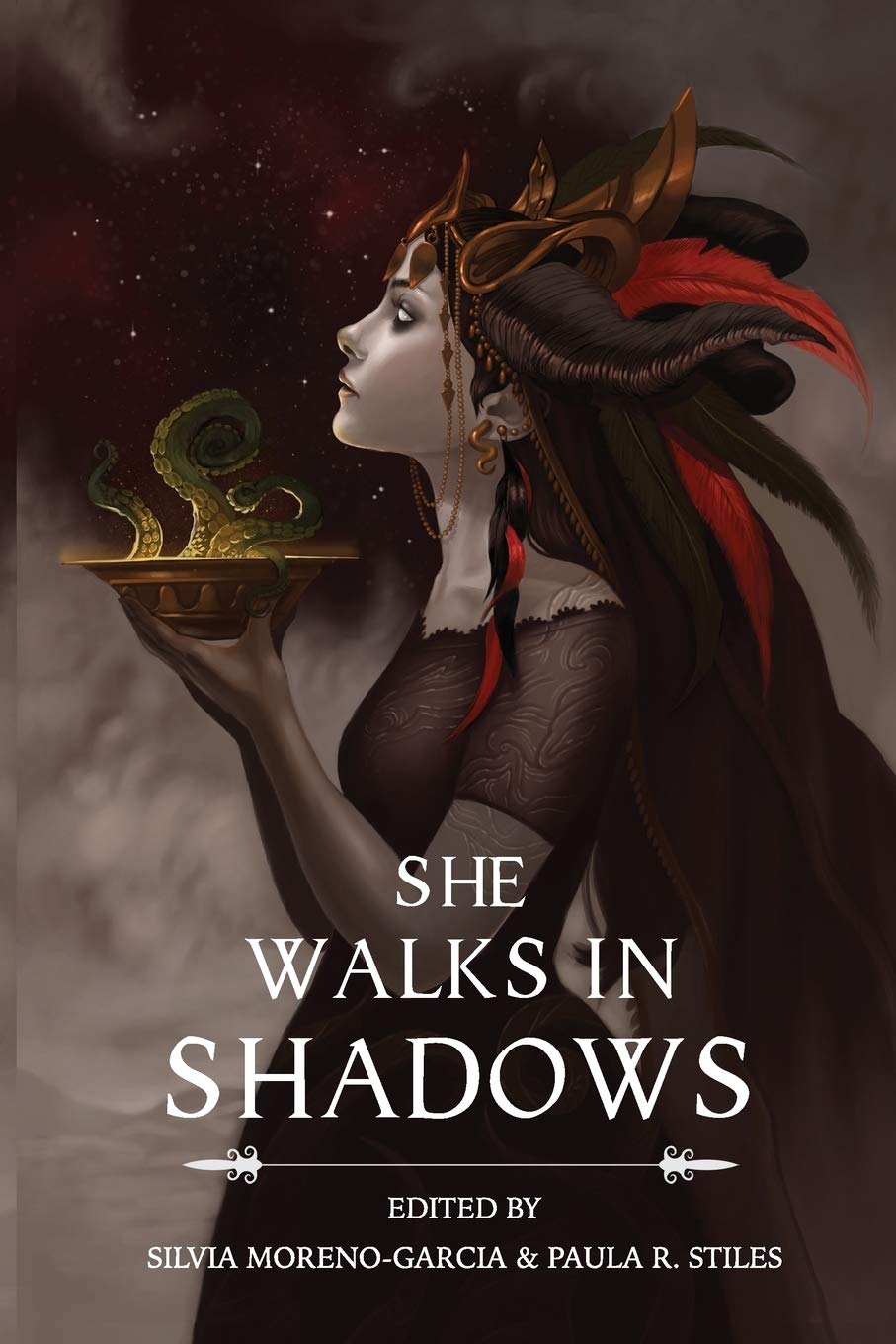
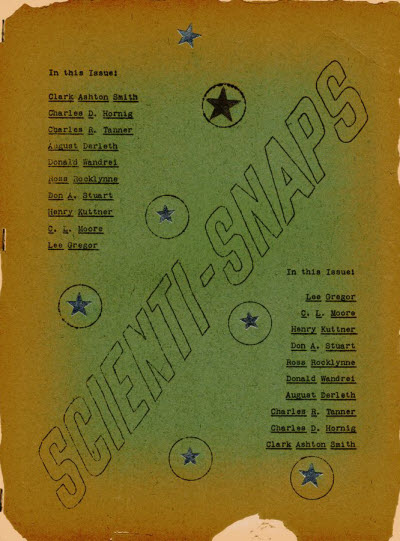
“Lost Paradise” (1936) by C. L. Moore

Today I sent off a gory horror-tale to Kline for marketing, the first and only story I’ve had time to write since I got home. I don’t know if I’ll ever have time to write another.
—C. L. Moore to R. H. barlow, 19 May [1936], MSS. Brown Digital Repository

My own writing is practically at a standstill. Am making rather feeble efforts to write for the horror-tale and sugary love-story markets to get some money, and hve finished one story of the former type which Kline has very competently critciized for me and suggested specific revisions. I may get around to it someday. I have neither time nor inclination to write about anything any more. I suppose it will come back ,but the hour is not yet. Though there has been one opus of about 2000 words or so which I wrote about a month ago, with no thought of sale. All about mysterious doings in a holly wood. Once when I was very small a letter from relatives in California around Christmas time reported that someone had gone down to Hollywood to get some holly, and I quite naturally thought, how lovely and convenient, and pictured the aunt in question wandering thru the deep, dark glossy wood of holly, with the growing scarlet light of the berries reflecting from the shining leaves, a place of gloom and greenness and glows of crimson. The image has returned to me time and again, and I finally had to do something about it.
—C. L. Moore to H. P. Lovecraft, 26 May 1936, LCM 113

My recent writings seem to have bogged down completely. In the last five months I have produced one trashy horror which Kline ages ago asked me to rewrite, thinking he could sell it in a revised form and which I haven’t touched since, and a drippy love-story which languished away and ceased half-finished some six weeks ago. The weather is partly responsible, but I must admit a sort of mental vacuum which shows no promise of change. I devote seven and a half hours daily to my secretarial duties and spend the rest of the time sewing desultorily, knitting a very handsome afg[h]an, attending about three movies weekly, induling in endless gossip with friends. How long this cloistered and nun-like seclusion will continue I wish I knew. I suspect that if my brain were functioning I would find myself bored to a horrible death, and rather dread the awakening. A few non-commercial attempts which I mentioned I should be very happy to have you read if I could ever get them finished to my satisfaction. I am writing and rewriting them over and over, in moments of comparative consciousness, and am far from satisfied even yet. However, to quote Mr. Penner once again, There’ll come a day.
—C. L. Moore to H. P. Lovecraft, 24 Jun 1936, LCM 143

Early 1936 was a tumultuous time in the life of C. L. Moore. In February, her fiancé of at least three years, (Herbert) Ernest Lewis, died from a self-inflicted gunshot wound to the head. In June just a few months later, her correspondent and fellow pulpster Robert E. Howard also died by a self-inflicted gunshot wound to the head. Moore understandably struggled to write anything during this time—kept going in part by a trip to Florida, during which H. P. Lovecraft sent her long letters, and she attempted to writer stories to order for Otis Adelbert Kline, a literary agent.

None of Moore’s letters from the period that I have seen give any insight into the origin of “Lost Paradise,” either when it was written and submitted to Farnsworth Wright, editor of Weird Tales, or what may have inspired it. In format, the story is a typical Northwest Smith tale—a drink at a bar, a sudden bit of action, uncovering an ancient mystery—but the idea it is wrapped around, the story-within-a-story, seems to owe more to “The Bright Illusion” (1934) and “Greater Glories” (1935). The central focus is around the Seles:

They live somewhere in the remotest part of Asia, no one knows exactly where. But they’re not Mongolian. It’s a pure race, and one that has no counterpart anywhere in the solar system that I ever heard of.
—C. L. Moore, “Lost Paradise” in Weird Tales Jul 1936

Race in Moore’s Northwest Smith stories is an odd point, and worth a moment’s consideration. The peoples of Earth, Mars, and Venus are all presented as essentially human in body and mind, if not culture; while we aren’t privy to interplanetary marriages, there is the implication that they are more or less one human species, even if separated into different races in 1930s terms. C. L. Moore generally avoids getting more specific; Northwest Smith is implicitly Caucasian, and she generally avoids depicting or referring to Black people, Asians (“Mongoloids” or “Mongolians” in 1930s racial parlance), Native Americans, or any other specific 1930s racial groupings. There are other sentient beings, more or less human-like, such as Shambleau (“Shambleau”) and the Alendar (“Black Thirst”), and at least some of the god-like entities can conceive children, such as Nyusa (“Nymph of Darkness”). For the most part, however, the majority of Northwest Smith’s interplanetary setting seems populated by human beings, and are treated more like exotic cultures and peoples in the 1930s than, say, the random inhabitants of the Mos Eisley cantina in Star Wars.

In the context of 1930s pulp fiction, “Lost Paradise” is a variation of the “Lost Race” or “Lost World” plot; the only difference is that instead of physically traveling to some isolated valley, cavern, island, or moon, Northwest Smith and Yarol are sent back in time—mentally, at least, a bit like Lovecraft’s Great Race of Yith in The Shadow out of Time (Astounding Stories Jun 1936).

Be it remembered that ail who come to pay the race’s debt and buy anew our favor that their world may live, must come to us willingly, with no resistance against our divine hunger—must surrender without struggle. And be it remembered that if so much as one man alone dares resist our will, then in that instant is our power withdrawn, and all our anger called down upon the world of Seles. Let one man struggle against our desire, and the world of Seles goes bare to the void, all life upon it ceasing in a breath. Be that remembered!
—C. L. Moore, “Lost Paradise” in Weird Tales Jul 1936

As in “Dust of the Gods” (1934), Northwest Smith once more confronts three ancient gods of a lost world—the story is, like all of the Northwest Smith tales so far, effectively standalone with no direct continuity to the others, so neither Smith nor Yarol make any comment about this coincidence. Moore sets up the eventual struggle with typical skill (Chekov’s prophecy: you can’t set a condition for the total destruction of a world without pulling the trigger).

And once again C. L. Moore puts a dream on paper—a lovely fantasy. Northwest Smith remains one of the greatest fiction characters yet created.
—Donald Allgeir, The ‘Eyrie’ in Weird Tales Nov 1936

I do not like Lost Paradise. What I like is plain old-fashioned gjhost stories, werewolf stories and vampire stories.
—J. J. Hammond, The ‘Eyrie’ in Weird Tales Nov 1936

Response to “Lost Paradise” in The ‘Eyrie,’ Weird Tales‘ letter page, was slight and mixed; the story wasn’t bad, but it had the misfortune to be published in the same issue as “Necromancy in Naat” by Clark Ashton Smith and the first part of “Red Nails” by Robert E. Howard, which rather overshadowed it. Lovecraft was even more sparse with praise than usual:

Klarkash-Ton & C L M dominate the July issue.
—H. P. Lovecraft to Richard F. Searight, 27 Aug 1936, LPS 426

(The only reason Lovecraft doesn’t praise Robert E. Howard is because he never read serials until he had all the parts.)

While “Lost Paradise” is a fair story, in comparison with Northwest Smith’s other adventures it’s notable how passive he is here. It is Yarol that goes after the Seles, Yarol that wants the Secret, and Yarol who ultimately shoots the old priest in the back. Smith was just drinking segir-whiskey and people-watching in New York when he suddenly had to resist the vampiric impulses of some ancient alien entities. It really reads like a Northwest Smith frame wrapped around a different story altogether.

“Lost Paradise” was published in the July 1936 issue of Weird Tales. Scans of this issue are available on the Internet Archive.


Bobby Derie is the author of Weird Talers: Essays on Robert E. Howard and Others and Sex and the Cthulhu Mythos.

Deep Cuts in a Lovecraftian Vein uses Amazon Associate links. As an Amazon Associate I earn from qualifying purchases.
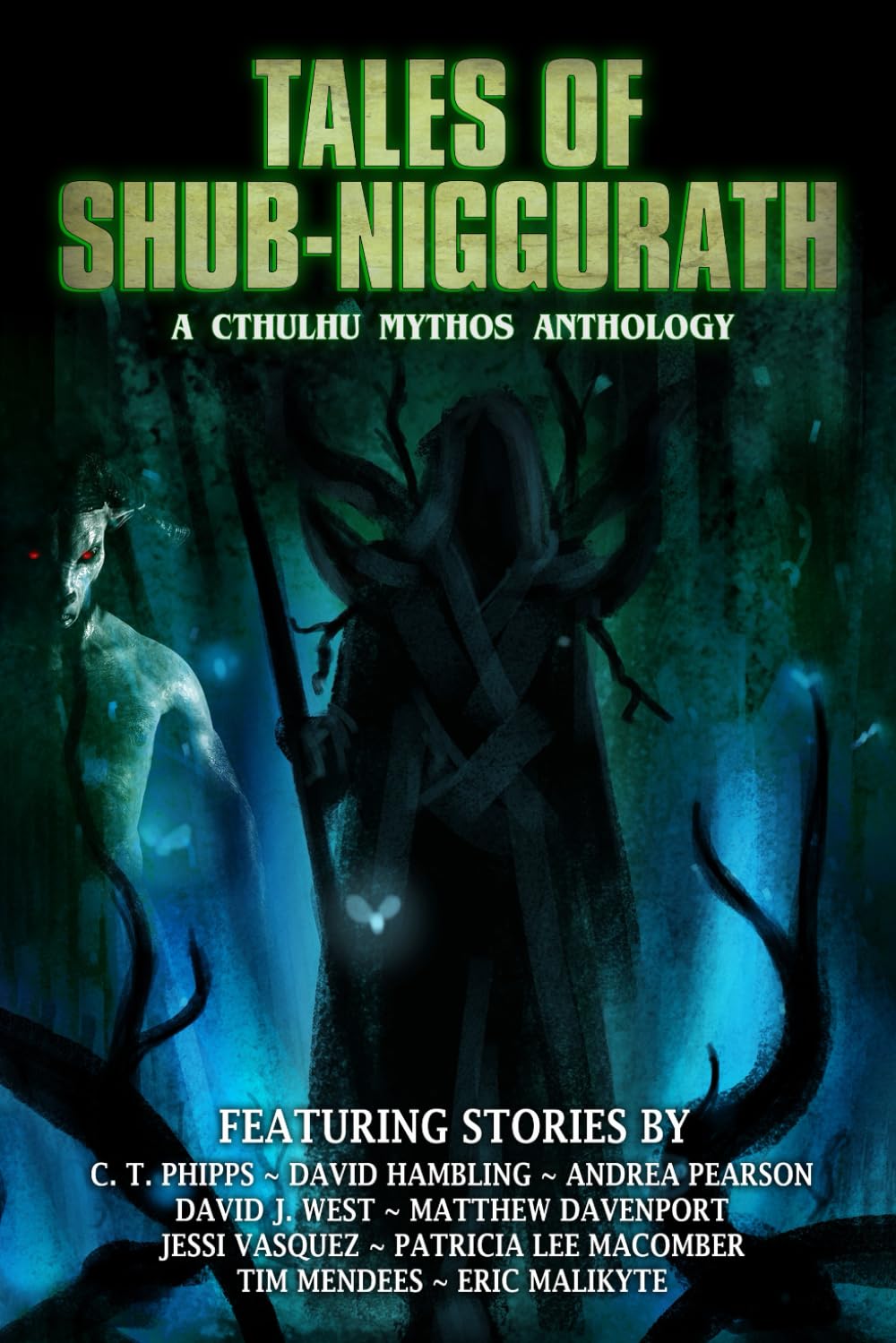
“Shadow over Darkcliff” (1993) by John Blackburn

Eldritch Fappenings
The following review of LGBTQ+ comic history includes images from selected works that depict cartoon nudity, sex, and violence. Reader discretion is advised.


Marriage and Sex

(1) Divorce shall not be treated humorously nor represented as desirable.
(2) Illicit sex relations are neither to be hinted at nor portrayed. Violent love scenes as well as sexual abnormalities are unacceptable.
(3) Respect for parents, the moral code, and for honorable behavior shall be fostered. A sympathetic understanding of the problems of love is not a license for morbid distortion.
(4) The treatment of live-romance stories shall emphasize the value of the home and the sanctity of marriage.
(5) Passion or romantic interest shall never be treated in such a way as to stimulate the lower and baser emotions.
(6) Seduction and rape shall never be shown or suggested.
(7) Sex perversion or any inference to same is strictly forbidden.
Comic Book Code of 1954

LGBTQ+ characters and themes received little coverage in the comic strips and comic books in the United States before 1954. When looking at the Pre-Code Lovecraftian Horror Comics, there are no characters or themes that jump out as explicitly gay or lesbian, transgender or genderqueer. After the Code was created in 1954, LGBTQ+ representation in commercial comics was implicitly forbidden.

Without access to mainstream publications, LGBTQ+ comics shifted to venues that were not controlled by the Comics Code Authority. Pornographic comics and underground comix formed a creative outlet for LGBTQ+ characters, stories, and creators—at the risk of being charged with obscenity. The late 60s and 70s in particular saw the birth of the underground comic scene, an outlet for readers and artists who wanted comics that were forbidden, transgressive, or mature—featuring themes of realism, sex, violence, drugs, politics, mysticism, and horror, often in some combination.

Tales from the Leather Nun (1973), for example, was an underground nunsploitation anthology comic. One of the episodes, “Tales of the Leather Nun’s Grandmother” by Spain Rodriguez, mixes Lovecraft’s Mythos with hardcore pornography, as Abdul Alhazred’s spells have accidentally turned the Leather Nun’s Grandmother’s vagina into a gateway to the realm of Cthulhu. Thus, one of the earliest appearances of Cthulhu in comics has the eldritch horror getting a face full of spunk.

Tales from the Leather Nun (1973); art by Spain Rodriguez

Cthulhu’s facial is a gag, not a homoerotic act. Tales from the Leather Nun isn’t the first LGBTQ+ Lovecraftian comic, just one of the first to begin to transgress in ways that combined sexual themes with Lovecraftian horror. It is difficult to say for sure what was the first LGBTQ+ Lovecraftian comic, if only because we have to look outside of the well-indexed mainstream.

“R. H. B.” (1978) by Andreas and Rivière is a likely candidate, because it focuses on R. H. Barlow, who was gay. However, Barlow’s homosexuality isn’t really the focus of comic, barely mentioned at the end. A later example is the Italian erotic comic Ramba #4 (1989), which features the bisexual Ramba facing down a demon named Azatoth summoned during a voodoo-esque ceremony:

Ramba #6 (Eros Comix), Marco Bianchini (script) and Fabio Valdambrini (art)

Of course, most of Europe never had an equivalent to the Comics Code Authority, so they had a freer hand to explore such themes. In the United States, works like Ramba appeared in translation in the early 90s, after the CCA had been weakened or ignored by independent publishers. If we can’t quite answer the question of who came first (whether into Cthulhu’s visage or elsewhere), we can at least say there was another notable work that emerged in that period that combined Lovecraftian horror and explicit LGBTQ+ characters and themes.

In the 1970s, comic writer and artist John Blackburn created the character Coley Cochran, a 19-year-old uninhibited bisexual character with a penchant for sex, violence, and the occult and antipathy to prudes and authority figures. In the late 80s/early 90s Blackburn self-published four books of Coley’s sex-drenched adventures, a combination of erotica, character-driven drama, and graphic violence. In the first book, Coley on Voodoo Island (1989), Coley is kidnapped and transformed into a sex god in a voodoo ceremony; this supernatural element would re-emerge periodically throughout Coley’s adventures, such as Breathless (1991), which includes an adventure at a ruined temple titled “Flowers of Evil.”

In the 1990s Fantagraphics picked up the Coley adventures under their Eros Comix imprint, publishing a series of 2-3 issue miniseries, beginning with Return to Voodoo Island (1991). The problem with the Eros Comix series is that they never reprinted Coley’s earlier adventures (except when Blackburn summarized them for reprints), so that new readers come into a series that has already been going on for hundreds of pages.

John Blackburn’s “Shadow over Darkcliff” is the second part of the two-issue series Idol of Flesh (1993), and sees Coley and friends return to the temple ruins of “Flowers of Evil”—but this time featuring a strange cult, led by a man named Garth. While the 32-page episode involves a bit of drama and a good bit of sex, the core story is explicitly Lovecraftian:

Idol of Flesh (1992) #2, by John Blackburn

Garth, it turns out, isn’t exactly human and wants Coley for sex and sacrifice. This isn’t the first or the last time Coley would be in this sort of position, the magnetic sexual attraction to both men and women is one of his supernatural traits throughout all of Blackburn’s series, as are scenes of flagellation, bondage, and sexual violence—especially the threat of castration, which appears in Return to Voodoo Island and reappears here. As in “Flowers of Evil,” Coley’s escape from this particular peril is somewhat miraculous—not a great storytelling trick, and one which Blackburn overuses a bit. Not that readers would know that unless they hunted out some of the stories that Fantagraphics did not reprint.

Blackburn would return to Coley and the Cthulhu Mythos in a longer, more involved, and even weirder storyline titled Dagger of Blood (1997), which makes brief reference to Garth and the events of “Shadow over Darkcliff.” Yet it reading the stories in order gives a better sense of the ideas that Blackburn was developing. Coley is presented as this perfect bisexual heartthrob, while characters like Garth and the antagonist of Dagger of Blood are both attracted to and hate Coley because of their own deformed bodies. There is a strong element of body dysmorphia to those characters, really only implicit here and more fully developed (and exploited) in Dagger of Blood, which fixates on genital mutilation.

It feels like Blackburn was working through some things, if only in art and writing, and perhaps only for his own entertainment. Certainly Blackburn was aware of the main focus of his comics—Coley has no shortage of sexual partners on the page, in explicit detail, both men and women—and the mundane drama of trying to keep his lovers happy is a counterweight to the more fantastic elements of Lovecraftian horror, even as the action and horror plots provide some relief from the soap opera.

When you look back at the history of LGBTQ+ characters and themes in comics, Blackburn’s work arriving when and where it did—first in self-published underground comix, and then after the CCA waned in series from an independent press which stressed the erotic angle—makes sense. It took decades after the Stonewall Riots for LGBTQ+ folks to gain greater recognition, acceptance, and basic rights in the United States, and such works were slow to find a place in mainstream comic books and strips. The underground was more willing to accept these nonconforming works with LGBTQ+ characters and to have discussions about subjects like homosexuality, polyamory, bisexuality, kink—and, yes, how the occasional bit of Lovecraftian horror fit into the mix. At the time, homosexuality in the Mythos was limited to stories like Ramsey Campbell’s “Cold Print” (1969), and those were few and far between.

Reading all of John Blackburn’s Coley saga is damn near impossible these days. Fantagraphic’s individual issues and reprint collections are long out of print and command collectors’ prices; the Idol of Flesh comics are reprinted in Coley Running Wild Book One: The Blade and the Whip. Several other adventures by Coley were published or re-printed in the gay comics anthology Meatmen, though there is no complete index for that series as yet.


Bobby Derie is the author of Weird Talers: Essays on Robert E. Howard and Others and Sex and the Cthulhu Mythos.

Deep Cuts in a Lovecraftian Vein uses Amazon Associate links. As an Amazon Associate I earn from qualifying purchases.
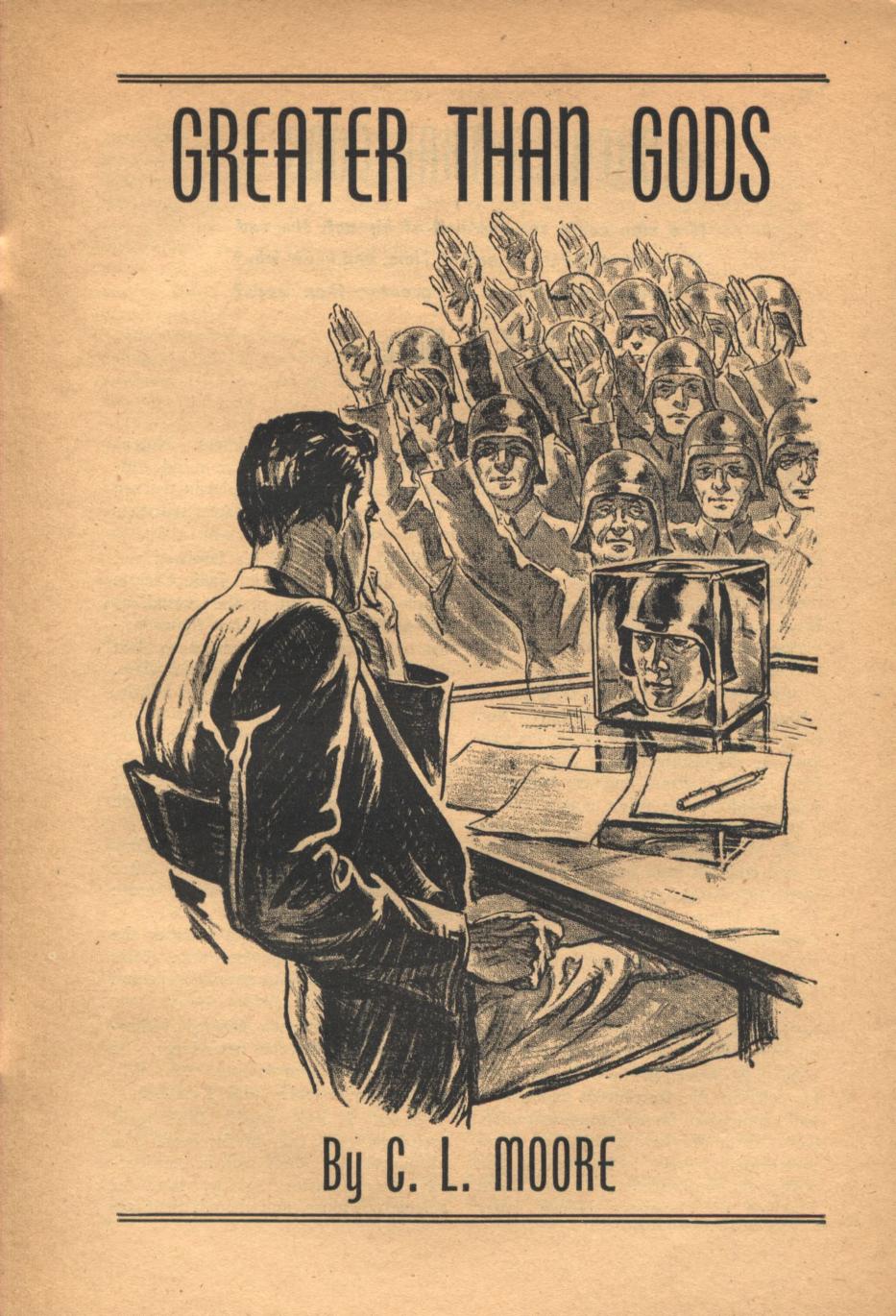
“The Dark Land” (1936) by C. L. Moore

Glad you liked “The Dark Land”. I made the drawing a long time ago, and wrote the story so I could bring it in, with the addition of a cadaverous head and a swirl of vagueness.
—C. L. Moore to H. P. Lovecraft, 30 Jan 1936, Letters to C. L. Moore and Others 108

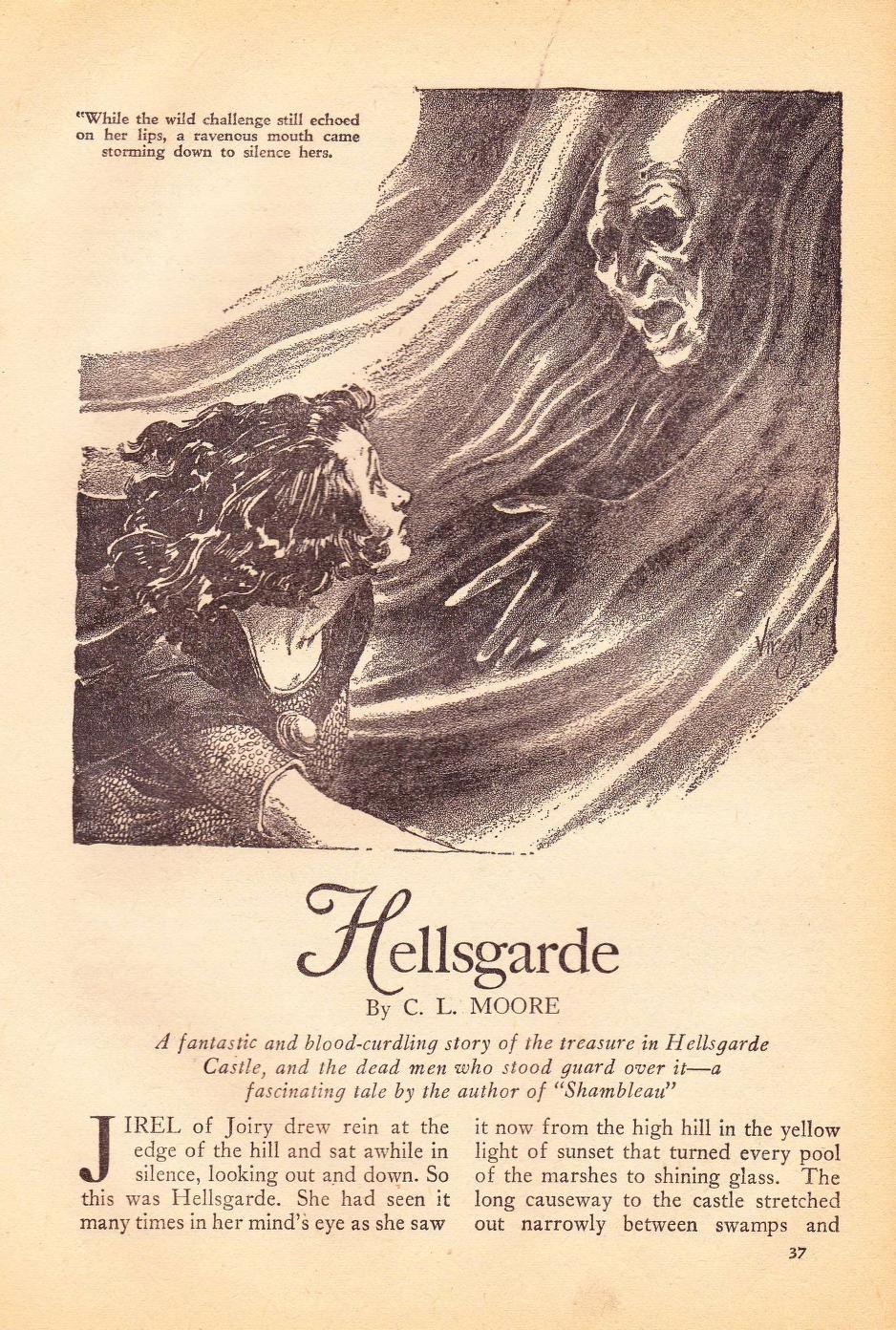
We don’t know much about how C. L. Moore came to write “The Dark Land,” the fourth published adventure of Jirel of Joiry, and saw print in the January 1936 issue of Weird Tales, except that it drew on ideas Moore had at some point before she first conceived of Jirel, and which she now turned to for inspiration:

Jirel’s Guillaume whom I so ruthlessly slew in the first of her stories, yet whom I can’t quite let die, was patterned after the drawing of Pav of Romne with which I illustrated her latest story, “The Dark Land” in Weird TalesI made that drawing somewhere in the remote past, and have cherished it all these years in the confidence that someday it would come in handy. I meant to use it to illustrate “Black God’s Kiss,” first of the Jirel tales, but somehow the story got out of hand, and I’ve never since been able to introduce a situation it would fit until “The Dark Land.”
—C. L. Moore, “An Autobiographical Sketch of C. L. Moore,” Echoes of Valor 2, 37-38

Like most of Moore’s series stories, this tale was effectively a standalone episode; and like many of them, Jirel swiftly finds herself in another dimension, facing a supernatural threat wildly beyond her abilities.

“Our dear lady has dabbled too often in forbidden things,” he murmured to himself above the crucifix. “Too often. . . .”
—C. L. Moore, “The Dark Land” in Weird Tales (Jan 1936)

Once again, Jirel of Joiry is up against a dangerous, domineering suitor—an echo of the overbearing Guillaume in “Black God’s Kiss” (1934) by C. L. Moore. The central conflict is effectively a weird social drama, a contest of wills (literally) between Pav of Romne and Jirel of Joiry, as the alien king seeks to seduce or dominate Jirel without destroying her. In that, more than most of Jirel’s stories, there is a fierce resistance that is emblematic of the character that would become Red Sonja, who would give herself to no man who had not bested her in combat.

“Give me a weapon! There is no man alive who is not somehow vulnerable. I shall learn your weakness, Pav of Romne, and slay you with it. And if I fail—then take me.”
—C. L. Moore, “The Dark Land” in Weird Tales (Jan 1936)

It is sword & sorcery without much swordplay; Jirel is weaponless in the traditional sense, but then she is facing enemies that cannot be slain with a yard of steel. Like many of Moore’s stories, it deals with entities that are both vastly alien from human conception, and yet peculiarly attracted to either the human form or spirit. It is an aspect of sword & sorcery, the indomitable nature of the human spirit, that separates the swordswomen from the damsels in distress.

While the fans received “The Dark Land” positively, this tendency toward spiritual or psychic warfare was noted:

The Dark Land, by C. L. Moore, gets my vote for first place. . . . For originality of ideas in fantastic realms, Moore takes first place. However, can C. L. Moore discover something else instead of the hero’s (or heroine’s, as the case may be) tremendous will-power, to beat the foe?
—Michael Liene in The ‘Eyrie,’ Weird Tales (Mar 1936)

Another reader noted another running theme in Moore’s stories:

Can’t C. L. Moore write anything but woman-witch-halfbreed stories? Shambleau, The Dark Land, Yvala, ye gods!
—Willis Conover in The ‘Eyrie,’ Weird Tales (Mar 1936)

“The Dark Land” also aroused little comment from Moore’s peers, beyond polite acknowledgement. it wasn’t a bad story, but it lacked the vast originality of her earliest stories in Weird Tales.

I read your “Dark Land”, and liked it well.
—Forrest J Ackermann to C. L. Moore, 12 Feb [1936]

Jan. & Feb. W T issues very poor—saved only by Moore stories.
—H. P. Lovecraft to Emil Petaja, 1 Apr 1936, LEP 472

Have skimmed recent W T issues—though I suppose another is out today. Jan. & Feb. poor—each redeemed only by a Moore story.
—H. P. Lovecraft to Duane W. Rimel, 1 Apr 1936, LFB 316

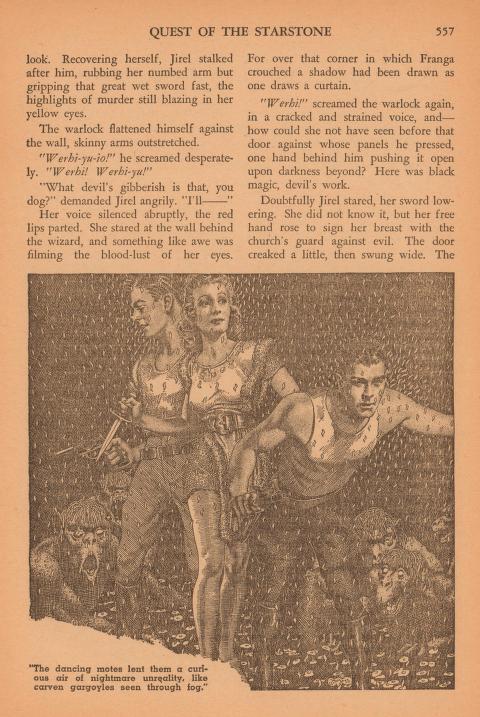
Moore herself doesn’t comment on how she felt about this story; but there is a notable gap between “The Dark Land” and the next two (and final) Jirel of Joiry stories, “Quest of the Starstone” (WT Nov 1937) and “Hellsgarde” (WT Apr 1939) and when she returns to the character it is with a very different plot.

“The Dark Land” was published in the January 1936 issue of Weird Tales. Scans of this issue are available on the Internet Archive.

Thanks to Marcos Legaria for his help.


Bobby Derie is the author of Weird Talers: Essays on Robert E. Howard and Others and Sex and the Cthulhu Mythos.

Deep Cuts in a Lovecraftian Vein uses Amazon Associate links. As an Amazon Associate I earn from qualifying purchases.
“En Tierra Baldía” (2024) by Miguel Almagro & Lord Dunsany

Libre adaptación del relato escrito por Lord DunsanyFreely adapted from the story by Lord Dunsany
Cthulhu #30 (2024)English translation

“On the Dry Land” by Lord Dunsany was first published in the small magazine Neolith #4 (Aug 1908), and was collected in The Sword of Welleran and Other Stories that same year. It is the last story in the book, and it is one of those Dunsany short-shorts that is more than a drabble but less than a tale. Call it a prose poem or flash fiction; it has a certain poetry to it, and there is more that is left unsaid than is said. It has a mythic quality, but it is not a story of any particular mythology, whether of Pegāna or any other tradition. A kind of story so universal in its outlines it might slip easily into the tradition of any culture that has the concept of love and death.

How do you illustrate that? How do you put into images and words, the unspoken understanding, the loneliness and heartache?

For one, the adaptation allows the text to be decompressed. Dunsany’s pithy text is stretched out by Miguel Almagro into 9 black-and-white pages. For two, the scene and many details are expanded to silently add to the storytelling. Rather than the marsh where Dunsany had first set the scene, the story unfolds on a cliff overlooking the sea; the blowing of grass and the stance of the unnamed man show the direction of the wind that blows strongly throughout, and blocks of stone suggest some ancient construction or ruin, marks of the passage of time. The layout of the panels helps control the pacing of the story.

Te conduje entre los que me odíaban y me reí cuando tomaron venganza en tí…

Usé tu bondadoso corazón sin misericordia…

Ahora he de dejarte

No llores más, soy un necio, un desalmado, solo me quedé contigo porque eras un buen compañero de juegos…
I led you among those who hate me and laughed when they took revenge on you…

I used your kind heart without mercy…

Now I have to leave you

Don’t cry anymore, I’m a fool, a heartless man, I only stayed with you because you were a good playmate…
Cthulhu #30 (2024)English translation

As a free adaptation, Almagro is not making an attempt at an exact replication of Dunsany’s text; lines are told out of sequence, rearranged to meet the needs of the artistic arrangement. Maintaining the core of the short short while shifting the representation. So for example, this scene as Dunsany wrote it:

And Love said to the old man, ‘I will leave you now.’

And the old man made no answer, but wept softly.

Then Love was grieved in his little careless heart, and he said: ‘You must not be sorry that I go, nor yet regret me, nor care for me at all.

‘I am a very foolish child, and was never kind to you, nor friendly. I never cared for your great thoughts, or for what was good in you, but perplexed you by leading you up and down the perilous marshes. And I was so heartless that, had you perished where I led you, it would have been nought to me, and I only stayed with you because you were good to play with.

‘And I am cruel and altogether worthless and not such a one as any should be sorry for when I go, or one to be regretted, or even cared for at all.’

And still the old man spoke not, but wept softly; and Love grieved bitterly in his kindly heart.

And Love said: ‘Because I am so small my strength has been concealed from you, and the evil that I have done. But my strength is great, and I have used it unjustly. Often I pushed you from the causeway through the marshes, and cared not if you drowned. Often I mocked you, and caused others to mock you. And often I led you among those that hated me, and laughed when they revenged themselves upon you.
—Lord Dunsany, “On the Dry Land”

Pero nunca mas volverás a estar soloBut you will never be alone again.
Cthulhu #30 (2024)English translation

As with “Donde suben y bajan las mareas” (1978) by Alberto Breccia, Carlos Trillo, and Lord Dunsany, we have to read this from the perspective of both a translation and an adaptation. Dunsany’s title “On the Dry Land” is a key to the story because the dry land represents the end of journey and parting of ways; the nameless man with Love has been wading through the marshes, the wet lands, and that trudge and effort and peril are metaphorically, life and hardship and struggle. The dry land is what comes after. The Spanish title, “La tierra baldía” translates most literally to “The Wasteland,” which isn’t quite the same meaning, suggesting as it does barrenness, though the metaphor still works: the nameless man has come to the undiscovered country:

To grunt and sweat under a weary life,
But that the dread of something after death,
The undiscover’d country from whose bourn
No traveller returns, puzzles the will
And makes us rather bear those ills we have
Than fly to others that we know not of?
—Shakespeare, Hamlet, Act III, Scene 1

Dunsany is putting his own spin on it; rather than clinging to life, the man is clinging to Love, despite all the pain that has come from clinging to love, and dreads the loss of it. Yet there is that reassurance, that final promise, of a more constant, faithful, and comparing companion—a character more akin to Death in Terry Pratchett’s Discworld novels than the medieval grim reaper, or even Death as sometimes personified in Dunsany’s other stories.

In adaptation, Miguel Almagro is taking that story in translation and moving it a bit further. It is not a wasteland in the sense that there is nothing living; there is grass, insects, but it is devoid of people or shelter, a land gone fallow and wild. Even the sky and sea are empty and desolate. Death, when she appears, is not frightening, merely a dark-eyed psychopomp—and the man has accepted Death, even as he has accepted the loss of Love. Dunsany wrote in the last line:

And after a while, with his face towards the morning, Death out of the marshes came up tall and beautiful, and with a faint smile shadowy on his lips, and lifted in his arms the lonely man, being gentle with him, and, murmuring with his low deep voice an ancient song, carried him to the morning to the gods.

Almagro foregoes the song, and the gods; the last we see of them are two shadows side by side on a new and different journey. There is something more poignant in that image, that acceptance and continuance. Perhaps a man literally cannot live without Love, but so too, now Love can no longer hurt him.

Thanks to Martin Andersson for his help.


Bobby Derie is the author of Weird Talers: Essays on Robert E. Howard and Others and Sex and the Cthulhu Mythos.

Deep Cuts in a Lovecraftian Vein uses Amazon Associate links. As an Amazon Associate I earn from qualifying purchases.
“The Cold Gray God” (1935) by C. L. Moore

Was there ever such a duel in the whole universe as the one between Northwest Smith and the nameless being that fought him in that Martian room?—a gripping tale by the author of “Shambleau”
—Epigraph to “The Cold Gray God” in Weird Tales (Oct 1935)

Summer in the Midwest, before the widespread adoption of air conditioning, could be sweltering. The very air gets sticky, even nights could be stifling and sweaty. C. L. Moore hadn’t been slacking during the summer of 1935, but Northwest Smith had been absent from the pages of Weird Tales. Wright had the story that would be “The Cold Grey God” on hand at least as early as March, but he sat on it, apparently waiting for the right time, and thinking of the right title. That came with the October 1935 issue.

And WT is publishing in July either the Smith story which Wright has entitled THE COLD GREY GOD, all about a lovely Venusian named Judai, or else a Jirel story we have been revising for months. He hasn’t decided yet which to use.
—C. L. Moore to R. H. Barlow, 20 Mar 1935, MSS Brown Digital Repository

On the subject of titles, I envy you your ability. The most painful part of writing, so far as I’m concerned, is naming the stories. Mr. Wright more or less takes it out of my hands sometimes, as in the case of a story scheduled for mid-summer sometime, which he is calling “The Cold Gray God”. I’m getting a regular spectrum of colored gods, staring with black and working slowly upward thru grey toward goodness knows what.
—C. L. Moore to H. P. Lovecraft, 7 May 1935, Letters to C. L. Moore and Others 34

The story starts with snow on Mars. A femme fatale. Northwest Smith, unable to repress his curiosity, goes to her house. The aesthetic borrows aspects of hardboiled fiction, of Oriental stories, the details adapted to the extraterrestrial setting. The idea of an ancient religion buried in the hearts and minds of an exotic culture was not uncommon in stories like Robert E. Howard’s “Skull-Face” (WT Oct-Nov-Dec 1929) and Robert W. Chambers’ The Slayer of Souls (1920); here it was applied to Martians.

“The Cold Gray God” is not set up as an archaeological horror; it’s set up as a weird heist story, in the strange criminal underworld of Mars. As in “Dust of the Gods” (1934), he’s hired to do a not-quite-legal job. Unlike in that story, the job itself isn’t the problem. A noirish sensibility of a web of secrets unfolds the narrative, and once again ensnares Northwest Smith in a plot of ancient space gods, strange survivals from a dim and distant past, and one with an unspeakable name:

And he knew why the men of Mars never spoke their cold god’s title. They could not. It was not a name human brains could grasp or human lips utter without compulsion from Outside. […] Nor was the name wholly gone, even now. It had withdrawn, for reasons too vast for comprehension. But it had left behind it shrines, and each of them was a little doorway into that presence; so that the priests who tended them furnished tribute. Sometimes they were possessed by the power of their god, and spoke the name which their devotees could not hear, yet whose awful cadences were a storm of power about them. And this was the origin of that strange, dark religion which upon Mars has been discredited for so long, though it has never died in the hearts of men.
—C. L. Moore, “The Cold Gray God” in Weird Tales (Oct 1935)

Which is a neat way to get around coming up with a mouthful of letters like Cthulhu or Tsathoggua. While C. L. Moore never deliberately added to the Mythos of the Necronomicon and Unaussprechlichen Kulten, she very much absorbed the ideas of Lovecraft and co., and adapted those tropes to her own use. This is not unlike Northwest Smith’s version of “The Call of Cthulhu,” or an homage to the same. The stars were right—then came the raygun.

If there’s a criticism of the story, it’s that it is very similar to Smith’s other adventures. This isn’t the first god he’s faced down, or the first time he’s struggled against an alien will. It is a standalone episode; while there are elements of the setting that are shared with other stories, there is still no continuity. This encounter does not cause Smith to reflect on any other encounters; this experience does not hinge on any previous one. So while the setting expands a bit with each story, the series itself maintains the same episodic nature as that other great stalwart of Weird Tales, Jules de Grandin. Readers weren’t looking for character development, no origin or ending, and writers weren’t going for character arcs for the most part.

“The Cold Gray God” is well-written, a good example of a Northwest Smith story. It just lacks a bit of novelty.

Nor did readers complain about that, although they complained about other things:

I read “Cold Gray God” last night, and liked it good. My only objections are personal: I don’t like “cooed” as a word; and I can’t stand “clean death”. For some obscure reason, I don’t fancy a girl cooing; whilst during the past year or so it seems to me all the fictional characters have gone overboard about having a “good, clean death”—by a “cool, clean sword”, “clean, consuming fire”…or good clean, clean, clean—like a clank, clank, clank—will drive me clean coo-koo, so help me, if I come across it about oncemore!!!
—Forrest J. Ackerman to C. L. Moore, 2 Oct 1935

Readers in “The ‘Eyrie'” were more positive, with one writing simply:

I surely enjoyed The Cold Gray God by C. L. Moore. I like stories of Mars.
—Orby Martin, Weird Tales Dec 1935

Among Moore’s pulp peers, H. P. Lovecraft counted it among the best stories in the issue. A typical version of his response:

W T is rather lousy of late. In the Sept. issue “Vulthoom” & “Shambler from the Stars” barely save it from being a total loss, while “Cold Grey God” & “Last Guest” perform a similar service for the Oct. number.
—H. P. Lovecraft to Lee McBride White, 28 Oct 1935, Letters to J. Vernon Shea et al. 362

If he noted the similarity to some of his own ideas, it hasn’t survived in any letter that’s seen print. At some point, Lovecraft conveyed the essence of this to Moore herself:

I’m so glad you approved of my “Cold Grey God” (which is Wright’s title, not mine.)
—C. L. Moore to H. P. Lovecraft, 16 Oct 1935, Letters to C. L. Moore and Others 68

One thing seems clear: both the readers and Lovecraft had come to appreciate Moore as a reliable writer, one of Weird Tales‘ more familiar and recognizable names for quality. Farnsworth Wright, the editor, was content to keep buying her stories. With this, her 13th published story in a pulp magazine or fanzine, Moore herself seems to have achieved a comfortably high level of confidence and competence.

“The Cold Grey God” was published in the October 1935 issue of Weird Tales. Scans of this issue are available on the Internet Archive.

Thanks to Marcos Legaria for his help.


Bobby Derie is the author of Weird Talers: Essays on Robert E. Howard and Others and Sex and the Cthulhu Mythos.

Deep Cuts in a Lovecraftian Vein uses Amazon Associate links. As an Amazon Associate I earn from qualifying purchases.
Deeper Cut: The Letters of Clara Lovrien Hess

When Providence, R.I. journalist Winfield Townley Scott published his first biographical essay on H. P. Lovecraft in the Providence Journal in 1943, it was with the caveat that he had not been able to contact Lovecraft’s wife, Sonia H. Davis. After publication, they got in touch, and through Scott’s efforts Sonia’s memoir of her marriage to Lovecraft was published in the 28 August 1948 edition of the Providence Journal as “Howard Phillips Lovecraft As His Wife Remembers Him.”

Providence Journal 19 Sep 1948 (95)

The publication of Sonia’s memoir drew immediate responses from those who knew Lovecraft, some of which Scott published in his regular column in the 19 Sep 1948 issue of the Providence Journal. Letters had come in from Muriel Eddy, Hazel Heald, and seven long paragraphs from Clara L. Hess about her childhood with Lovecraft and his family.

Clara Lovrien Hess (2 Jun 1889 – 5 Apr 1950) was the eldest child of John R. Hess, a newspaper editor for the Providence Journal, and Clara Maud Lovrien Hess, a housewife. Her family lived in the same neighborhood at the same time as H. P. Lovecraft did; Federal censuses from 1900-1920 place her family on Oriole Avenue, one street over from Angell St. where Lovecraft lived until 1924. None of Lovecraft’s letters mention Clara Hess, although this is not unusual, as very few of his letters mention any of the children in the neighborhood he grew up in, and when they do it is the boys. Lovecraft does mention her younger brother Jack Hess (John R. Hess Jr., 28 Apr 1894 – 7 Jan 1954) in Letters to J. Vernon Shea et al. 193 and Letters to Family & Family Friends 1.35.

According to Federal census data, after graduating from school Hess became a schoolteacher; and according to newspaper accounts, remained active in various clubs. She never married or had any children.

1908 Map showing the Hess home on Oriole Ave. The Phillips house of Lovecraft’s cousin is on Angell St. nearby.

In 1928, Clara L. Hess moved to Warwick Neck, R.I.; she was there when Sonia’s memoir of Lovecraft was published, and was inspired to write a letter about her own experiences that ended up on Winfield Townley Scott’s desk, who subsequently published a part of it. This in turn caught the eyes of others; a letter survives from Margaret M. Wallace to Winfield Towley Scott, 24 Sep 1948, where she wrote:

I liked Clara Hess’s letter about Mr. Lovecraft. I didn’t live as near as she did to him, but I remember seeing him on the streets, and I thought he had a very disagreeable face. One should know that he would write the kind of books he did. Did Miss Hess know that you were going to quote her?

August Derleth apparently wrote to Muriel E. Eddy about Hess, who provided an address:

For the remaining 18 months or so of her life, Clara L. Hess and August Derleth conducted an intermittent correspondence, mostly focused on Lovecraft, his mother, and Derleth’s writing. Derleth quotes from Hess’ letters in his essay “Lovecraft’s Sensitivity” was that was published in Something About Cats (1949). The original letters themselves, however, have never been published in full, and are split between the John Hay Library at Brown University in Providence and the August Derleth archive at the Wisconsin Historical Society. The small cache of 9 letters is in many cases our only source for certain details on Lovecraft’s childhood, and his mother’s illness.

Larger memorial image loading...
Pawtucket Times, 6 Apr 1950 (2)

[0] Clara Hess to the Providence Journal (n.d.)

It was with great interest that I read the story of Howard Phillips Lovecraft as written by Sonia Davis for the Sunday Journal.

Howard Lovecraft and I grew up in the same “old time” East Side neighborhood in Providence when there was often fields covered with butterflies and daisies in the Butler Avenue—Angell Street-Orchard Avenue area. Although of a younger generation, I knew Howard’s mother better than I knew Howard who even as a young boy was strange and rather a recluse, who kept by himself and hid from other children because, as his mother said, he could not bear to have people look upon his awful face. She would talk of his looks (it seemed to be an obsession with her) which would not have attracted any particular attention if he had been normal as were the other children in the community who because of the strangeness of his personality kept aloof and had little to say to him.

I first remember meeting Mrs. Lovecraft when I was a very little girl at the home of the late Mr. and Mrs. Theodore Phillips on Angell Street where I visited often.[1] At that time Mrs. Lovecraft was living in the corner of Angell Street and Elmgrove Avenues.[2] She was very pretty and attractive, with a beautiful and unusually white complexion which it was said she obtained by eating arsenic, although whether there was anything to this story I do not know. She was an intensely nervous person.

Later when she moved into the little downstairs flat in the house on Angell Street [3] around from Butler Avenue I met her often on the Butler Avenue cars, and one day after many urgent invitations I went in to call upon her although she was considered as becoming rather odd. My call was pleasant enough but the house had a strange and shut up air and the atmosphere seemed weird and Mrs. Lovecraft talked continuously of her unfortunate son who was so hideous that he hid from everyone and did not like to walk upon the streets where people could gaze at him.[4] When I protested that she was exaggerating and that he should not feel that way she looked at me with a rather pitiful look as though I did not understand about it. I remember that I was glad to get out into the fresh air and sunshine and that I did not repeat my visit! Surely it was an environment suited for the writing of horror stories but an unfortunate one for a growing youth who in a more wholesome environment might have grown to be a more normal citizen.

Howard used to go out into the fields in back of my home to study the stars. [5] One early fall evening several of the children in the vicinity assembled to watch him from a distance. Feeling sorry for his loneliness I went up to him and asked him about his telescope and was permitted to look through it. But his language was so technical that I could not understand it and I returned to my group and left him to his lonely study of the heavens.

After a time one did not meet Mrs. Lovecraft very often. There was a mail box at the corner of Butler Avenue and Angell Street. (probably still is) Sometimes when going around the corner to mail a letter on an early summer evening one would see a dark figure fluttering about the shrubbery of her home and I discovered that it was Mrs. Lovecraft.

Sometimes I would see Howard when walking up Angell Street but he would not speak and would stare ahead of him with his coat collar turned up and his chin down.

After awhile I heard that Mrs. Lovecraft was ill and was away and that the aunts had taken over. [6] I knew nothing more about them until I heard of Howard’s marriage [7] which was wondered at by some of those who had known him.

c. l. h.

Notes: Sent before 19 Sep 1948, when selections were published in the Providence Journal. Available at the Brown Digital Repository.

[1] Theodore Winthrop Phillips (24 Jun 1836 – 26 Jun 1904) and his wife, Sarah Marsh Phillips (16 Feb 1835 – 4 Mar 1904) lived at 612 Angell St., the lot almost directly behind Clara L. Hess’ childhood home on Oriole Ave. Theodore Phillips was the son of Whipple Phillips, the great-great-uncle of H. P. Lovecraft.

[2] 454 Angell St., the Phillips family home where Lovecraft was born in 1890.

[3] 598 Angell St. After the death of Lovecraft’s grandfather Whipple Van Buren Phillips, Lovecraft and his mother were forced to move into smaller quarters.

[4] Many of Hess’ memories cannot be verified against other sources. R. Alain Everts in “Howard Phillips Lovecraft and Sex: or The Sex Life of a Gentleman” apparently asked Lovecraft’s ex-wife Sonia about these assertions and took her comments as confirmation; however, it must be remembered that Sonia only began courting Lovecraft after his mother’s death, so her memories may have been influenced by Clara Hess’ published accounts.

[5] Hess never gives any dates, but the 1908 map of Providence shows what appears to be open fields in that section, which would have been better for stargazing. Howard’s appreciation of astronomy from a young age is well known, so this could presumably have been any period from ~1900-1907.

[6] Sarah Susan Phillips Lovecraft (17 October 1857 – 24 May 1921) was admitted to Butler Hospital on 13 Mar 1919, after an apparent nervous breakdown. She died there two years later, following surgery to remove her gallbladder.

[7] H. P. Lovecraft left Providence, R.I. and married Sonia Haft Greene in New York City on  3 March 1924.

[1] Clara Hess to August Derleth, 9 Oct 1948

Warwick Neck,
Rhode Island,
October 9th, 1948.

My dear Mr. Derleth:—

Of course, you may quote from my letter to the Sunday Journal about Howard Lovecraft and his mother. I feel greatly honored.

I do not know that Mrs. Lovecraft ever spoke to her son directly about his “ugliness” but I think he must have known how she regarded him. Howard resembled his mother. She had a peculiarly shaped nose which rather fascinated me as it gave her a very inquiring expression. Howard looked very much like her.

In looking back I cannot ever remember to have seen Mrs. Lovecraft and her son together. I never heard one to the other. It probably just happened that way but it does seem rather strange as we were neighbors for a considerable period of time.

I remember the aunts who came to the little house on Angell Street often, as I recollect, quiet, determined, little New England women, quite different from Mrs. Lovecraft, although Mrs. Lovecraft was a very determined person.

I remember that Mrs. Lovecraft spoke to me about weird and fantastic creatures that rushed out from behind buildings and from corners at dark and that she shivered and looked about apprehensively as she told her story. She asked me what I thought it and I told her it wasn’t so!

The last time I saw Mrs. Lovecraft we were both going “down street” on the Butler Avenue car. She was excited and apparently did not know where she was. She attracted the attention of everyone one. One old gentleman acted as if he were going to jump out of the car every minute. I was greatly embarrassed as I was the object of all of her attention.

Mr. Ronald K. Upham, 51 Adelphi Avenue, Providence might be able to throw some light upon the tragic Lovecraft story. [1] I believe that at one time he used to visit Howard at the little Angell Street flat.

I have not read you biography of Howard Lovecraft [2] but intend to do so and I am now looking forward to the publication of the Selected Letters.

Also, I am looking forward to reading your book “Sac Prairie People”. [3] I have never been west and Wisconsin, I know, is a very beautiful state.

If I come across any additional information about the Lovecraft family I’ll be glad to send it on to you.

To you
Sincerely,
Clara L. Hess

Notes: Available at the Brown Digital Repository.

[1] Ronald Kingsley Upham (4 Aug 1892 – 30 Jan 1958), one of Lovecraft’s boyhood friends. See also Letters to Rheinhart Kleiner & Others 192, Letters to J. Vernon Shea et al. 193, Miscellaneous Letters 111, Essential Solitude 1.323, Letters to Family & Family Friends 1.42, 113, 378

[2] H. P. L.: A Memoir (1945).

[3] Sac Prairie People (1948), a collection of short stories, part of Derleth’s Sac Prairie Saga about his native region of Sauk City and Prairie-du-Sac, Wisconsin.

[2] Clara Hess to August Derleth, 18 Oct 1948

Warwick Neck,
Rhode Island,
October 18th, 1948.

Mr dear Mr. Derleth:—

Your letter of October 12th has been received—Certainly, you may quote from anything I may write to you. It won’t be necessary for you to send me copy to read although of course, I would like very much to see it. If I do not find the published biography I’ll let you know.

I was much interested in what you wrote about Mrs. Gamwell [1] and it was very nice that you were able to help her in placing some of Howard’s work after his death. [2] I did not know that she was in straitened circumstances although I realize that fortunes often have a way of disappearing. [3]

I do not remember how Howard obtained his education. He had a cultured background. His people were old fashioned gentlefolk which meant considerable in the old aristocratic Providence East Side neighborhood prior to World War I. He was a real student and a great reader. I thought of him as a genius and believed that he would make a name for himself as an astronomer.

I hope that you will hear from Ronald Upham as I think he will have some information to give about Howard.

The Lovecraft story is an intensely interesting story and I am glad that I have been able to be of some help to  you. If I can be of any further assistance let me know. I’ll be glad to help in any way that I can.

Sincerely,
Clara L. Hess

Notes: Available at the Brown Digital Repository.

[1] Anne Emeline Phillips Gamwell (10 Jul 1866–29 Jan 1941), H. P. Lovecraft’s younger aunt, who survived him.

[2] After Lovecraft’s death, Derleth acted as agent with Weird Tales to publish some of his fiction, sending the monies to Annie Gamwell.

[3] After the death of Whipple Van Buren Phillips, none of the Phillips women worked or had living husbands to support them, and H. P. Lovecraft was unable to hold a regular job, so they lived off of the savings with meager income until the family entered a state of genteel poverty.

[3] Clara Hess to August Derleth, 31 Jan 1949

Warwick Neck
Rhode Island
January 31st, 1949

My dear Mr. Derleth:—

For several weeks I have been intending to write you that I obtained a copy of your book about Howard Lovecraft at the Providence Public Library, also a collection of Howard’s stories and a copy of “Village Daybook” [1]—I was not able to obtain your Book of the Month club story [2]—

Of course, I was greatly interested in your account of H.P.L.—It was very beautifully written and I am looking forward to your coming publication about Howard—the collection of stories—but by special permission with a possible charge of 10 cents a day (if kept too long) I did not find too satisfactory of the print was so fine that I could only read it with the aid of a magnifying glass! And so was not able to read very much of it.

I am still reading “Village Daybook” which is quite delightful and unusual, we have many birds, rabbits, fox and an occasional deer here at Warwick Neck. But we do not have wild strawberries. [3] Some years ago I was in Connecticut for a summer and one day came across a large meadow almost completely covered with them. I spent many hours gathering the berries and made most of them into jam to take home for the family food shelf. But sad to relate, a school chum of my brother came by to visit and when he discovered my jam he refused to eat anything but bread and butter and strawberry jam all through his visit (although we had very good meals) and when the jam was all eaten up he decided to go home—I had not thought of Elliot for some years until I read your account of Wisconsin berries but I suddenly remember his visit at Putnam Heights—the last I heard of  him he had become very successful in the journalistic field down in Washington.

I believe that your coming book about Howard Lovecraft will be of great interest in Rhode Island—All at once everyone is talking about Howard—the stories about him in the Sunday Journal Book page have excited a great deal of interest.

Please be sure to let me know the date of publication of your book as, of course, I am looking forward to it.

Sincerely,
Clara L. Hess

Notes: Available at the Wisconsin Historical Society.

[1] The “Lovecraft collection” is probably Best Supernatural Stories of H. P. Lovecraft (1945); Village Daybook: A Sac Prairie Journal (1947) by August Derleth, a Sac Prairie Book.

[2] Sac Prairie People (1948) was recommended by the Book-of-the-Month Club in 1948.

[3] “Another new experience was picking strawberries—& in late August. I had never before seen these well-known commodities in the process of growth.” —H. P. Lovecraft to Annie E. P. Gamwell, 27 Aug 1921, LFF1.45

[4] Clara Hess to August Derleth, 24 Feb 1949

Warwick Neck,
Rhode Island,
February 24th, 1949

My Dear Mr. Derleth:—

Your gift of the autographed copy of “Village Year” and the collection of Howard Lovecraft’s Supernatural Stories came as a very welcome surprise. They are quite the nicest gift I have received for a long time and I very much appreciate your thought in sending them to me.

Your foreword about Howard was kindly and beautifully written. I have not as yet read all of Howard’s stories the collection but “The Outsider” made a great impression upon me. It is one of the most remarkable stories I have ever read. I have re-read it several times and I am going to read it again. of course, Howard knew nothing of our Atom Bomb and the more recent frightful inventions of man. Yet all I could think of was the Atom Bomb when reading “Colour Out of Space”.

The day that your books came I heard from the librarian at our Warwick Neck Library—the Old Warwick League Library—that your Book of the Month Club book which the book committee had ordered at my request had finally come in and that she had saved it for me but that someone had gotten off with it after all. So people in this vicinity are becoming acquainted with Sac Prairie People in Wisconsin. Mrs. Jerrett—our librarian—said there was evidently some difficulty in obtaining your book as it took so long to come through.

I’ll have to admit that I turned with relief from Howard’s dark and sombre tales to your book of village and country life. I’m enjoying reading it very much. You wrote that you consider it better than its successor—I like them both—they are books that are good to own and to have to re-read. Your story of the Dragonflies—(“Glowing Needles”)—The seeing of fireflies legs together—I was told as a child here in Rhode Island and I believed it for sometime! But my father who told the story came from Erie, Penn. so settlers not in Pennsylvania evidently knew that old saying, too.

Again thanking you for your gifts of two such unusual books—one dark and fantastic—the other, real and beautiful—I am

Sincerely, Clara L. Hess

Notes: Available at the Wisconsin Historical Society.

[5] Clara Hess to August Derleth, 27 Mar 1949

Warwick Neck,
Rhode Island,
March 27th, 1949

My dear Mr. Derleth:—

I am looking forward to reading your copy—I know that anything I have written about Howard will be all right to quote—I am glad that I have been of some assistance and feel quite proud to have your quote from my letter. [1]

The book “Sac Prairie People” I have gotten from our little library and I like your short stories very much. I especially like “Expedition to the North”, “Moonlight in the Apple Tree”, “Now the Time for All Good Men” and “The Night Light at Vorden’s”—(There are many women like Bianca—I have known several—One wonders how they happen to become like that.) It’s a sad and tragic tale and very beautifully written.

I made the mistake about the Book of the Month Club Book—But why wasn’t it—I made the error when reading the folder which I have to our librarian for our book committee. Now I am going to read some of your novels. My robins disappeared after a late blizzard but I think they are with other song birds in the brush in the swampy land below me. I did not know we had killdeer her but I am told that there are a few around although I have to see one.

Last evening I heard frogs piping in chorus so I know that spring has really come to Warwick Neck— I hope that spring has arrived on time in Sac Prairie, Too.

Sincerely,
Clara L. Hess

Notes: Available at the Wisconsin Historical Society.

[1] Regarding “Lovecraft’s Sensitivity” by August Derleth in Something About Cats (1949), which quotes from Hess.

[6] Clara Hess to August Derleth, 6 Apr 1949

Warwick Neck,
Rhode Island,
April 6, 1949

My dear Mr. Derleth:—

I had just finished reading “The Thing on the Doorstep”–a story as powerful and disturbing as Howard’s own powerful and disturbing personality—when your letter and draft of the paper, Lovecraft’s Sensitivity came. It was all intensely interesting to me and it makes me feel very important. Mrs. Wright (Virginia Williams) a younger neighbor—I knew well and I was impressed by her recollections of Howard. [1] I met her a short time ago (after some years) at a Sunshine Society auction in our little Warwick Neck library and immediately we began to visit about old times and about H. P. L. Unlike Virginia I never was afraid of Howard but to young children he must have appeared a dark spectre when rushing through the dusk—a weird figure in the quiet New England setting of that period.

I wonder what Howard would think of the old fashioned New England neighborhood now with stores and apartment houses and newer homes built close together—there are many people of Jewish extraction in the Providence old  East Side to-day. I felt sorry that H.P.L.’s former wife wrote of his racial prejudice, especially at this time when there is so much made of racial prejudice—a thing as cruel as it is unjust. But in the environment of Howard’s youth (and of mine) it would have been impossible To escape the teachings of the time and it is quite understandable that youth of a naturally kind and gentle disposition should have absorbed the ideas of the older generation about him.

I had a friend who grew up in the vicinity who continued to live in her family homestead after an almost all Jewish settlement sprang up around her. She would watch the children going by to school and noticed one child who was shoved about and pushed into the gutter time after time. Finally she went out and indignantly asked why that little boy was being treated in such fashion and the answer was, “Oh, we can’t walk with him, he isn’t a Jew”So there can be two sides to a story after all.

You asked me to comment on your chapter about H. P. L.’s Sensitivity. I have re read it very carefully several times and it all seems very right to me—I repeat that I am very glad to have been of help in your study of Howard’s life and that I am looking forward to the publication of your book.

We are having a wild Southeast storm here this morning but the birds are singing in the rain. I heard a minister speaking over the radio Sunday morning who stated that if a man could become a bird and teach the birds how to live and take care of themselves how wonderful it would be for the birds. I thought of the story ( whose I do not remember but you probably know) “Who is the greatest of all God’s creatures?”—The answer, “man”—the question, “Who says so?” and the answer, “man”—

Wishing you continued success with your writing I am

Sincerely
Clara L. Hess

Are all the characters in your stories real people or do you just make them all seem real—

Notes: Available at the Wisconsin Historical Society.

[1] Virginia Williams Wright (30 Dec 1901 – 9 Oct 1993), born on Paterson St. in Providence, R.I., was a neighbor of H. P. Lovecraft’s. She sent a letter from Wright to Winfield Townley Scott which survives at the Brown Digital Repository, dated 23 Sep [1948]; Scott published an excerpt from it in the Providence Journal for 3 Oct 1938:

As a little girl I was scared to death of him for he used to walk rapidly up & down Angell St. at night just as a group of us were playing “Hare & Hounds” at the corner of Angell & Paterson Strs. His appearance always frightened me. he was certainly the neighborhood mystery—He never would speak to me or any of us but kept right on with his head down. Once in a while I would pass him in the daytime but never could get him to say hello.

[7] Clara Hess to August Derleth, 17 May 1949

Warwick Neck,
Rhode Island,
May 17th, 1949.

My dear Mr. Derleth:—

Inclosed [sic] is a story about H. P. L. which was forwarded to me by a friend who knew that I am interested in the study of the life of H. P. L.—you may have it—anyway, I thought it might possibly be of some interest to you–

Sincerely,

Clara L. Hess

Notes: Available at the Wisconsin Historical Society. No enclosure in the file, so unclear who or what this was.

[8] Clara Hess to August Derleth, 7 Jan 1950

1188 Warwick Neck Avenue,
Warwick Neck,
Rhode Island,

January 7th, 1950.

My dear Mr. Derleth:—

“Something About Cats and Other Pieces” I am reading with great interest and I am learning much about Howard Lovecraft that I did not know before—you have given a great deal of time and thought in assembling so much interesting material and the result is certainly most satisfactory. You must feel very much pleased with the result of all of your work.

The volume came on Monday December 26th as I was leaving to have a second Christmas dinner with friends in Warwick Neck who have a New York City background and who did not know Howard. I took my book with me—my host spent a good half of the evening reading about Howard and in telling us about his visit in New Orleans—then he insisted upon keeping my book. But I went over for it several days later and I have asked our Warwick Neck librarian to obtain a copy for our library as I know there are many people here who will want to read it. Also it will be of value for the library to own.

Again may I repeat that I am honored to be in such distinguished company and that I am glad to have been able to contribute something of interest about Howard and his family. With all good wishes to you for the year 1950 I am

Sincerely Clara L. Hess

Notes: Available at the Wisconsin Historical Society.

How reliable are Clara L. Hess’ recollections of Lovecraft and his mother? We can confirm from census data that she was in the right place at the right time, so there is little doubt that she was a neighbor of H. P. Lovecraft and Susie Lovecraft as a child, teenager, and adult. Some of her observations agree with other accounts of the Lovecraft’s life—such as H. P. L.’s interest in astronomy, and the move from 454 to 598 Angell St.—for all that she was looking back 40+ years, the material we can verify show Hess’ recollections appear to be fairly accurate.

Several of Hess’ personal anecdotes cannot be verified, including her various encounters with Susie Lovecraft. How accurate is the image that Hess paints of a mentally unstable woman rumored to take arsenic, hallucinating, and who finds her son’s appearance disturbing? At this point (1948), the most that had been written of Susie Lovecraft was by Winfield Townley Scott, who painted her as a “weak sister,” and Lovecraft as a “mama’s boy.” Hess’ comments did not help Susie Lovecraft’s image, and most subsequent portrayals of Lovecraft’s mother in biography and fiction are based on that image that Hess and Scott had presented, and which Derleth helped codify in “Lovecraft’s Sensitivity” (1949).

Probably the most revealing section of Hess’ letters that did not make it into print is her comment on racial prejudice. The anecdote reveals more about Hess than it does Lovecraft; the impulsive desire to push back against accusation of racial prejudice by saying “Hey, these Jews can be racist too!” speaks more to the pervasiveness of antisemitism among Lovecraft’s environment than a counter to Sonia H. Davis’ allegations about her ex-husband.

While we lack Derleth’s letters to Hess—it is not clear what happened to her papers after she died—it doesn’t appear that he pressed her closely on details regarding dates, etc., though he was careful to get permission for what he quoted from her. Read in context, we can perhaps better appreciate how near the end of her life, Clara L. Hess cast her mind back to younger days in the old neighborhood, and the strange kid who stood out from among the others.

Thanks to Donovan Loucks for his help.


Bobby Derie is the author of Weird Talers: Essays on Robert E. Howard and Others and Sex and the Cthulhu Mythos.

Deep Cuts in a Lovecraftian Vein uses Amazon Associate links. As an Amazon Associate I earn from qualifying purchases.
“Greater Glories” (1935) by C. L. Moore

I wrote a story once, which I don’t believe you ever saw—starting out as my story “Greater Glories” started with a man lost in the interior of a giant body, being swept into its brain-chamber and finding himself in the presence of a god whose people have almost completed their race-goal. The people are of peculiar physical structure which permits their amalgamation into one immense and rather horrid-looking mass, like a great vine budded with individuals who by now have sunk their individuality into the whole, being drawn together by a common race-love which through the millennials [sic] of life has grown out of and taken the place of all other forms of attraction between individuals. The race has become a unit, but incomplete as the god is incomplete, because each lacks the essential attributes of the other. They are reaching their ultimate goal, which is the union of god and united people, into a perfect whole which is to go on, perhaps, as no more than an atom at the bottom of some tremendous scale of unknown evolution—somewhere. I didn’t sell the story, and finally cut it up into “Greater Glories” and “Bright Illusion” and another mass which I haven’t tried to recast. 
—C. L. Moore to H. P. Lovecraft, 7 Dec 1935, Letters to C. L. Moore et al. 87-88

Did I ever show you that story I wrote called TO WHAT DIM GOAL? I think I did. Anyhow, it wouldn’t sell so I cut it up into gruesome little pieces and each piece grew into another story. GREATER GLORIES, BRIGHT ILLUSION and another yet unfinished were portions of that dead tale, and I found ideas out of it cropping up in SHAPE OF DARKNESS. No doubt that murdered story will haunt everything I write for years to come, coloring with its dismembered theme all sorts of tales that have no connection with it whatever.
—C. L. Moore to R. H. Barlow, 12 Dec 1935, MSS. Brown Digital Repository

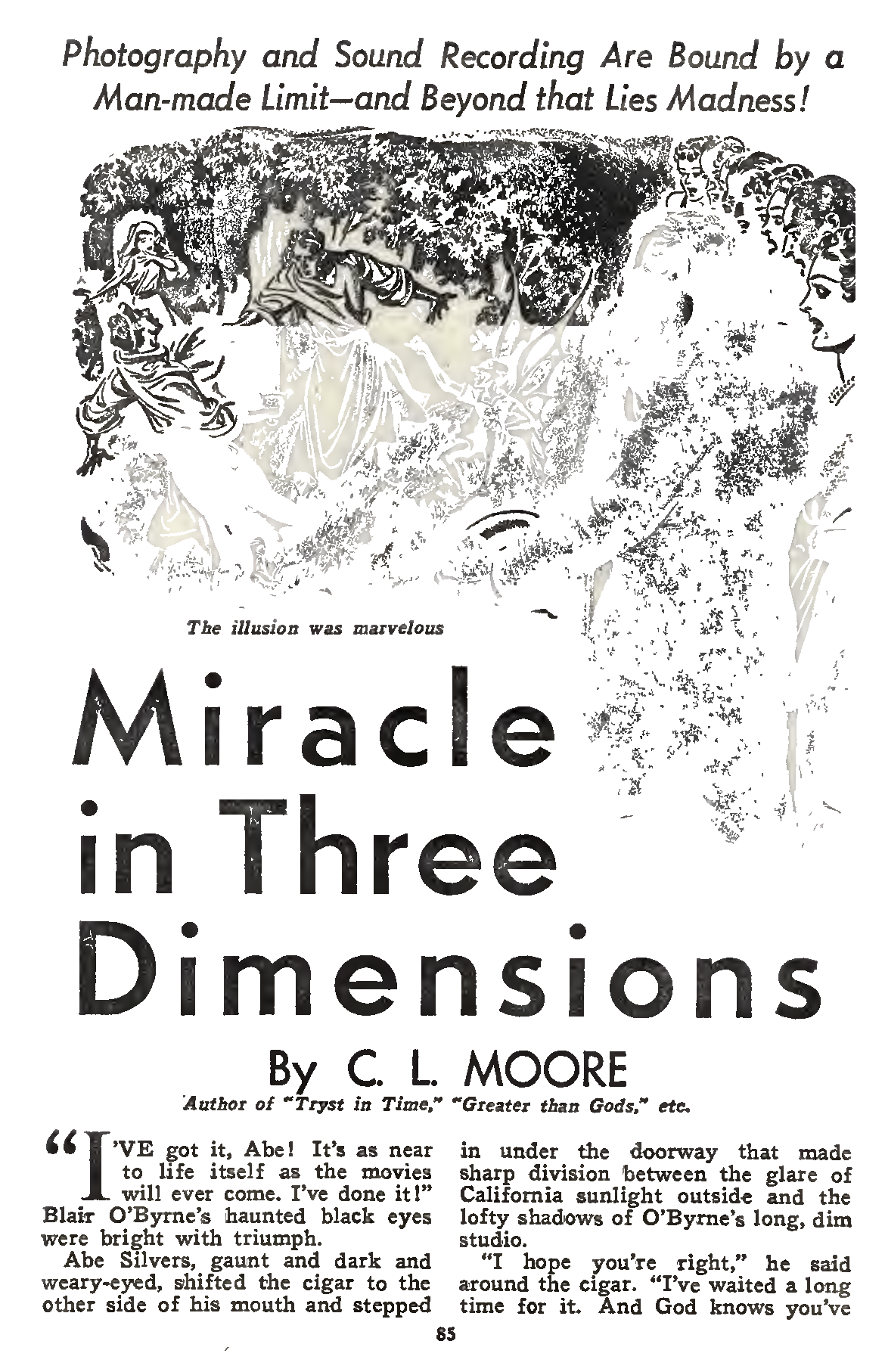
Readers would be forgiven for not being familiar with C. L. Moore’s “Greater Glories.” It was first published in Astounding Stories Sep 1935, and only reprinted twice—an uncredited (probably unauthorized) translation in Los Cuentos Fantásticos, No. 25 (1950), and in the reprint volume Miracle in Three Dimensions (2008). For all of its obscurity, “Greater Glories” represents another important early step in Moore’s career, a science-fantasy story for Astounding that tiptoed on the line between science fiction and weird fiction.

The story opens much like “The Bright Illusion,” with a random man alone in a wild desolation, this time framed as a traditional castaway story. The familiar setup falls away to weirder fare as the unnamed protagonist finds something in the jungle, and falls into another, stranger place—and here we get the next piece of Moore’s lost story:

AND THEN it came to him what this great hall had been built to represent. A heart. That tube corridor along which he had come was shaped into an artery-this chamber was a ventricle of a mighty heart. Even that tumult which had flung him headlong into the place was the valve-action controlling the inflow.
—C. L. Moore, “Greater Glories” in Astounding Stories Sep 1935

The prose is lush with sensual detail, but also with the sense of unseen things beyond the normal senses. At one point, the protagonist remembers a bit of verse:

A being who hears me tapping
The five-sensed cane of mind
Amid such greater glories
That I am worse than blind.

This is a slightly inaccurate rendition of the final verse of “Blind” (1920) by Harry Kemp, and serves to give the story its name and theme.

There is a woman; again, many of Moore’s women at this stage of the career, she is a being devoted to or under the influence of some greater being. An ephemeral yet poignant focus of intense romantic focus. A microcosm of tragedy unfolds, between the desire of the unnamed male protagonist and the woman called up into existence before her time, not yet ready for life or love. It feels like that should be a metaphor, perhaps for Moore herself—who was still stuck in that limbo place between her day job and her career as a writer, engaged to a fiancé she dare not marry for fear of financial ruin.

Art by Elliott Dold

The denouement is not quite as romantic as “The Bright Illusion.” The nameless protagonist is still castaway; the implication is given that perhaps it was all a dream, a hallucination. It is not much of a science fiction story by the standards of the time, since there is little hard science in it; “Greater Glories” is a mood piece, a work of wonder, emotion, and sensations. Which is how many fans ultimately read it:

So few people can wrap a dream in star dust, breathe fairy life into it, and set it to the music of the spheres that C. L. Moore’s stories are always more than we dared hope. For sheer suggestive beauty and lingering memories of things that never were, this writer is equaled only by A. Merritt. Need I say I liked the story?
—Ramon F. Alvarez del Rey, ‘Brass Tacks’ in Astounding Nov 1935

Arch-fan Forrst J. Ackerman was uncharacteristically generous with his praise, possibly because he was still hoping she would collaborate with him on further stories:

Re paragraf four—a command from Moore: I shall clothe myself in a cloak of cosmic vibrations while reading GREATER GLORIES, so that none may disturb my marveling mind. Hail to Catherine, Queen of Queer-tales!
—Forrest J. Ackerman to C. L. Moore, 31 Jul 1935

Haven’t you read that story you wrote, GREATER GLORIES? How could ever just a girl write such! Why,  you make my English become just gibberish, trying to discuss it. Are you indeed not an Other World Entity, taken on a feminine form to come to earth and astound the senses of, say, a Scientifictionist? Cather, how could you write such a story as GREATER GLORIES? 

You don’t doubt I liked your dream-tale, do you? I graded it “A”, and rusht my rating airmail to FANTASY. But that is little. Perhaps this will better bolster your belief I thot it was awamzing: I quote, following, a note I dasht off to Gilbert Brown, columnist of the L.A. Evening Post-Record. The paper has 77,000 circulation and Brown has thirce in print published his praises of the works of A. Merritt. So, “Brown,” I wrote, “If you would read a manuscript marvelous as a Merrittale, step to the nearest newsstand and purchase the Sept. Astounding. The spell-binding story is GREATER GLORIES. A first-water fantasyarn, incredible, staggering, overwhelming—Dizzily, FJAckerman.” I hope you don’t think my “first-water fantasy” line is hokumn, because I have used it several times; I really don’t know any other way to describe those stories of yours that hit me so hard. SCARLET DREAM is still my favorite, but GREATER GLORIES comes very close. I shall, of course, by ultra-happy about Nyusa, the Nymph of Darkness whom we created together.
—Forrest J. Ackerman to C. L. Moore, 27 Aug 1935

Anyway, you deserve an extra “a” in your name for such outstanding and A-1 stories as SCARLET DREAM and GREATER GLORIES. That’s a swell title, I think, by the way, Crawford has chosen for the book form of your series “The Saga of Northwest Smith”. Right in the center of the book, about, I calculate, will be our co-creation, the nymph Nyusa. […] I don’t know whether the newspaper columnist read GREATER GLORIES, as per my recommendation, or not; I thot he might mention it in his column, but just after I wrote him, he left the paper on vacation, and hasn’t been back since.
—Forrest J. Ackerman to C. L. Moore, 2 Oct 1935

Lovecraft did not take Astounding regularly, and so apparently missed “Greater Glories,” though she described the story it grew from. Why it lay forgotten among some of her earlier stories for so many decades is unknown—perhaps it was too close to “The Bright Illusion,” or too slight a story in retrospect, and definitely much weirder than the usual “thought-variant” story taken for Astounding. Yet it is an outgrowth of that ur-story, that original idea that Moore had that was too big for any one tale to contain—and for that, at least, it has historical interest.

So too, while “Greater Glories” may seem out of place among Astounding, it does have a certain resemblance to the science fiction that would be published by Unknown in the 1940s. The emphasis on concept and emotion, wonder and the human element, are much more in line with the more humanistic science-fantasy of the 1940s than the space operas and gadget stories of the 1930s. In that sense, “Greater Glories” is something of a dry run for Moore’s later, more mature science-fantasies of that period, lacking a bit of the humor but with a poignant note that readers of her midcentury work will find familiar.

“Greater Glories” was published in the September 1935 issue of Astounding Stories. Scans of this issue are available on the Internet Archive.

For readers who want to read more about the origin of “Greater Glories” and its origins, Marcos Legaria has a detailed article: “C. L. Moore’s “To What Dim Goal” and Its Progeny” in Penumbra: A Journal of Weird Fiction and Criticism, 2023. Thanks to Marcos for his help with this one.


Bobby Derie is the author of Weird Talers: Essays on Robert E. Howard and Others and Sex and the Cthulhu Mythos.

Deep Cuts in a Lovecraftian Vein uses Amazon Associate links. As an Amazon Associate I earn from qualifying purchases.
Interview with Starspawn Studios

Your scholarship is in danger, your friends aren’t human, and something ancient is awakening in the dreamlands.

As reality itself becomes uncertain, questions of identity and transformation become matters of survival.

Just another finals week at Miskatonic University.

Starspawn: A Miskatonic Mystery website

The Lovecraft Mythos has provided the inspiration for games since the 1980s, from early references in Dungeons & Dragons and other tabletop roleplaying games to collectible card games like Mythos, board games like Arkham Horror, and various console and computer-based video games including Call of Cthulhu: Dark Corners of the Earth. While many of these games focus on the horror the Mythos, each game brings something new, highlights different aspects of the Mythos, and allows the creators to use their imagination to explore and expand on the Mythos in new ways.

Starspawn: A Miskatonic Mystery is a forthcoming Lovecraftian visual novel/adventure/mystery game with elements of dating sim romance, puzzle solving, self-discovery, and transformation, exploring the Mythos through a queer lens. The demo is available on Steam and Itch.io, and the crowdfund campaign for the full game, along with tie-in fiction anthology and other perks, is now live on Kickstarter.

Starspawn Studios developers John Burke and Daniel Pennypacker (creator of Polemic) have agreed to answer a few questions about the game.

What is the one-sentence pitch for Starspawn: A Miskatonic Mystery?

John: You investigate an ancient mystery that’s threatening reality itself while navigating the personal connections that make life worth living, exploring themes of love and resistance in the face of overwhelming opposition and inevitable decay.

How did you get into Lovecraft and cosmic horror?

John: The first thing that comes to mind is watching John Carpenter’s The Thing in early high school. The gore was fun, of course, but the isolation and paranoia were what hooked me. I know Alien doesn’t really count, but I saw it around the same time, and it left a similar impression. Seeing skilled characters doing their best and still failing–or nearly so–is just really exciting. Cosmicism itself didn’t click until later; it just read as another apocalyptic threat. I started looking into cosmic horror more specifically after reading Blindsight and a couple Laundry Files books.

Daniel: During the collectible-card-game craze of the ’90s, I bought a starter deck of the Mythos card game. It was so different and confusing, and planted a seed of fascination deep in my brain. I learned more about H.P. and cosmic horror over time just by being into nerdy things.

In my early 20s, I had a horror movie phase and then read a couple of H.P.’s short stories. I was really impressed by how ahead of their time they felt, but I also bounced off because of the overt racism. I’d say at this point, my head was wrapped around what cosmic horror really was. I don’t like gore, so cosmic horror felt like the cool, artsy, subtle horror subgenre.

More recently, I had a Gothic literature phase, which led me back to listening to all of Lovecraft. This time, I was able to view his writing more from an art history lens and could push past his bigotry.

What Lovecraft story resonates the most with you and why?

John: The Shadow out of Time. It’s almost inverted from his usual stories–the freaky thing happens at the beginning, and the investigation is largely internal. The mounting dread isn’t from being trapped in a weird town or learning things you’d rather not about the history of Earth. It’s entirely about self-knowledge. Lovecraft was no stranger to mental illness, and I imagine his own moods, and maybe family history, served as some inspiration here. If not, he really nailed it, because that’s why Shadow so resonates with me. When you go a little funny in the head, afterwards, you have to figure out what happened, and who you are, and who you want to be. You might take medicine that changes your brain. You might try several! It’s not fun. The story uses a frank discussion of mental illness to make sure we know that that isn’t what’s going on, but it’s still ultimately about the terror of learning who you are and what you’ve done.

Daniel: At the Mountains of Madness deserves to be in the sci-fi canon. It has some flaws, but in the context of when it was written, it’s just so original. It’s also pretty free of any bigotry, as far as I can remember? There’s some imagery that’s really great too—the isolation of the Arctic, and the descriptions of the mountains really stick in my mind. 

I’m also a big history buff, and knowing so much has happened before can cause some existential dread, so the revealing of a secret history really resonated with me. I’ve even had moments in my life where I think “Oh boy, I don’t wanna share a relevant weird history thing I know; it’ll ruin someone’s day.”  After reading it, I spent a week imagining what a modern movie of Mountains would be like. The core story is so good, and straightforward forward, it seemed like it could use a modern adaptation that smoothed over some of the wordy narration. The big character arch I kept thinking of was regret and guilt about going on the expedition at all. 

It’s also surprising how much the story actually tells about the Elder Things. He looks at reliefs in their old city, and it pretty much lays everything out. Also: the giant penguins!

What’s your background in gaming and game development?

John: I’ve been gaming consistently since the NES days. I like all sorts of stuff. If I had to list current favorites: Metal Gear Solid 3, Danganronpa 2, Final Fantasy VII… innovative games with great stories that strike a balance between somber and wacky. And old point-and-click puzzlers like Day of the Tentacle. You’ll see all of that in Starspawn’s DNA. For game development, in elementary school I made a text adventure with QBasic. It probably wasn’t very good. I’ve fiddled with a lot of different stuff since then, but I never sat down and made a real game start to finish until now. I never had an idea I liked well enough to justify all those hours. I stuck to writing stories. 

Daniel: I’ve been developing physical card and board games on the side for a while, with one successful self-published game so far. I’ve always loved video games, my day job is programming. I’d always wanted to make a game, but it was always hard to do everything on my own. Having a co-dev was really instrumental in getting the game made. 

Some of my favorite games are Shadow of the Colossus, Metal Gear Solid 2, and Resident Evil 4. So I wanted our game to have a clear and obvious interface, action mixed with exploration, and an interesting story. I think if a game is too story-heavy, it’s easy to get bored, but if there’s a boring story, it’s hard to stay interested in a game. One of my favorite parts of JRPG’s has always been entering a new town and just walking around and talking to NPC’s, so a 2D world with lots of talking, interspersed with some action, fit right into what I like in games. 

How did you decide to develop Starspawn together? What’s the background of the game development?

Daniel: I tried making a narrative game a couple of years ago and learned a ton. But I hit a wall when it came to actual writing. Then John suggested working on a visual novel together, and it clicked: “Oh yeah, I was missing a writer—we could actually do this!” John does coding too, so it was nice to know I wouldn’t be stuck with technical problems.

John: Daniel was rereading some Lovecraft at the time and one of his suggestions was a dating sim where you go to school with the various monsters. This didn’t quite make sense—why would they be in school?—so I said okay, maybe you go to school with a bunch of half-monsters and you can date them.

Daniel: Gameplay- and story-wise, this made a lot more sense. It’s hard to come up with relatable characters that are incomprehensible gods.

John: Then we needed to reckon with why there are a bunch of half-monsters. It doesn’t seem like it would be a priority for the great old ones. I came up with a backstory to explain it that ended up being like, part Borges story, part Cold War spy thriller. Which meant pulling in some additional genres…

Daniel: There was a bit of feature creep.

John: I like the old LucasArts puzzle games, so we added a point-and-click mode.

Daniel: And arcade-style minigames.

John: And we needed a way to move around the world, which meant either a map that took you to different settings, or…

Daniel: A full-on 2D world. And we had to make that interesting, so we added stealth gameplay.

John: And finally made ourselves stop.

When you decided on a Lovecraftian theme, did that prompt a Lovecraft re-read?

Daniel:  When we started working on the game, I was mid-read, and John re-read a bunch of the stories. I also ended up reading some other Gothic classics (Frankenstein, Wuthering Heights) and some classic sci-fi (Dying Earth, Conan). Reading Conan was especially interesting, as it made me realize how H.P. was broadly part of a pulpy genre.

John: My reread wasn’t going so well at first. The ideas I was getting while reading him were too lugubrious for my taste, and my other ideas were so whimsical that they felt unfaithful. Then I got to The Dream-Quest of Unknown Kadath, which I’d never even heard of. It was when everything clicked for me–how to tell the kind of story I’d want to read, with cosmic horror and whimsy, where you explore beyond the usual claustrophobic settings you find in a lot of mythos games. Carter is too chill about everything, but having a template for a real adventure was what I was missing.

Do you feel that being you (queer, a game developer) has shaped your understanding of Lovecraft and approach to cosmic horror?

John: It feels weird when there isn’t something deeper going on in a cosmic horror story. Even Lovecraft did it, right? Lots of his stories tie in to various preoccupations of the era. The best horror gets its hooks into you by speaking to something that’s already on your mind. And in order to do that, it has to speak to something. Otherwise all you have is tentacles. You don’t have to be queer to have that insight, obviously, but it can help.

My contribution to the Kickstarter short story collection is about a gay American who moves to Iceland around 1960 to help industrialize their fishing industry under the Marshall Plan. He’s expecting a relatively enlightened Danish-style approach to homosexuality there, but it turns out that LGBT life there was even harder than it was in America. It was legal in theory, but the country was so small and gossipy that stigma was more powerful than law. Being queer meant knowing the right secret incantations and hidden meeting places. And if you found something terrifying happening there, you might not report it. You’d be too paranoid and compromised. Some things are more frightening than cults.

Fiction doesn’t have to be about interrogating prejudice or speaking truth to power. But the better you understand yourself and your place in society, the easier you’ll find it is to write a good story. This Iceland idea came naturally to me since I knew about the broad strokes just from being myself, and knew from my life how effective it would be at creating a mood of strangeness and alienation.

Daniel: Both The Case of Charles Dexter Ward and Herbert West—Reanimator felt extremely queer to me! In Ward he literally brings a dark-dandy version of himself to life, who then takes over his life, all while avoiding his parents so he can go out at night. Herbert West feels like it touched on gay men having obsessive crushes that only get them into more and more trouble they can’t explain. I can’t make any judgments about Lovecraft’s sexuality, but we do know he was deeply alienated, and adopted an attitude of a snobbish outsider; a role gay men often occupied before Gay Rights. I suppose Lovecraft was touching on feelings of otherness that might be universal. 

Does gaming offer a new way to explore and experience the Mythos?

Daniel: Yes! Just like any medium, there are certain feelings that games are good at evoking. Specific to cosmic horror, I think we did a good job making the mini-games anxiety-inducing, and providing lots of exploration, mystery, and investigation. 

The classic clever video game for cosmic horror is Eternal Darkness on the GameCube. It did some really fun meta tricks where you thought the game was glitching. That sort of reality-questioning surprise would be impossible to do in any other medium.

Video games can also be really good at vibes and atmosphere, which are such a big part of cosmic horror. Elden Ring is probably the best recent example of a game that’s hard to describe other than the mood of playing it. Sure, it’s hard, but the majority of the game is spent walking around feeling a vague sense of dread. Maybe a more Lovecraft version would be that you can’t actually beat the monsters and can only run away. 

John: “Only being able to run away” is a really great mechanic. There’s a game called Subnautica where you’re stranded on an alien planet and have to explore increasingly deep oceans full of weird fish and some giant monsters, and you basically only have a knife. It’s incredibly good at making you feel insignificant and alone. That game hits most of the Lovecraftian notes, actually, and the gameplay limitations really amplify the vibe.

Another thing unique to games is that you are actually sitting there making the character do things. When you’re watching a horror movie, you can say, you know, “Don’t open that door! In a video game, you actually have to hit the button to open the door. Undertale does this on the genocide route, making things increasingly unpleasant as you enter commands. Papers, Please consists almost entirely of this, though I do consider it almost too unpleasant to play as a result.

I’ll mention one last mechanic that you see in a lot of games. You build up a big inventory of powers and items and travel abilities, then the game takes that all away from you and traps you somewhere. It’s frustrating if it’s done wrong, but it can be a really effective way to induce feelings of isolation and powerlessness. If you’re reading a story, you might empathize with the character, but if you’re playing a game, the buttons don’t do the same things they used to. You are the one who has lost the powers.

How does Starspawn explore queerness through a Mythos lens?

John: I’m going to let one of our contributing writers start this one. (Em wrote one of the novelettes we’re including as a Kickstarter reward, and she came up with one of the main characters.)

“[Cosmic horror] stories provide a ripe foundation for exploring non-heteronormative identity because both involve recognizing that consensus reality is more fragile and constructed than it appears. Cosmic horror traditionally focuses on themes of transformation, hidden knowledge, and the inadequacy of established categories, all of which create natural space for examining gender and sexual fluidity without requiring explicit positioning.

The genre frequently features characters discovering their true nature, often something that existed before their conscious awareness or something that has been heavily suppressed. Both resonate strongly with non-binary and trans experiences of self-discovery.

To cap it off, the horror elements can effectively capture both the terror and liberation that can accompany stepping outside normative social structures.”

‘Terror and liberation’ summarizes it pretty well. All of our characters have something like this going on. There’s always something about themselves that they don’t understand or don’t accept. Sometimes part of that is about being queer, but we never sat down and decided to write a queer story, if that makes sense. Starspawn deals with learning to accept yourself and love others, and self-knowledge and transformation and the weight of history. It would be weird if it weren’t at least a little queer.

We have a Yith mindnapping victim who comes back full of knowledge about other ways of being. This makes him reflect on who he was, who he is, who he wants to be–and some of the things he’s realized are about his sexuality. But he has many more things to figure out than that; he’s paranoid, he’s not experiencing time normally, he’s confused and depressed. Even with all that darkness, there’s a glimmer of light, since he’s learned things about himself that will let him live a more authentic life. And that’s worth celebrating, even at the end of the world.

Daniel: Feeling anxious, alienated, out of place, and at the mercy of powers beyond your control has a lot of queer overlap. Gothic literature is always concerned with legacy and history, and queer people often have to wrestle with anxiety about family and legacy.

One of the characters in Starspawn is a gay man transforming into a Deep One. Do you feel that “The Shadow over Innsmouth” offers parallels to the LGBTQ+ experience?

John: I’d have to give it a re-read, but I am inclined to say ‘not really,’ unless you want to do some eisegesis. As I recall, you yourself have written about how Innsmouth isn’t even meant to be understood as a parallel for race-mixing. If you play with the ideas presented in the story, though, you can go to some really interesting places.

The character’s name is Silas. He’s nineteen. His story is about leaving home and feeling conflicted about where you come from. In his hometown, they’ve got an ancient pact about breeding; but he doesn’t plan to have kids, which isn’t making him any friends there. And, needless to say, turning into a monster won’t make him many friends in gay circles. He’s got a foot in each world, but he doesn’t feel welcome in either. Pretty common experience for a young queer person.

What are some of the games that influenced the development of Starspawn?

John: I’d always wanted to make one of those old LucasArts-style point-and-click games like Monkey Island and Day of the Tentacle, so we have point-and-click and inventory-based puzzles. The protagonist is a little snarky and uses a lot of gallows humor, too. He’s freaked out, of course, but humor is an outlet for him. On the dating sim side, I prefer games with social sim elements rather than straight dating sims; specifically, story-driven games like Persona and Danganronpa, where you spend your free time getting to know the other characters and managing your life.

Daniel: WarioWare for the minigame. 90s Zelda and JRPG games for the 2D sections. Metal Gear for the stealth sections. And Yakuza for showing how combining lots of gameplay styles can work and still feel cohesive. 

The previous game I’d tried making on my own was mildly cosmic horror! The setup was as you were in an RPG city that was about to be invaded and destroyed. The whole game would have had a time limit of about an hour, and was filled with NPC’s asking for help. You’d go around finding and trading items, but there would be no way you could help everyone. Nor could you prevent the city from being destroyed. This is the one I dropped off of because I couldn’t write very well, but it had similar elements of choosing who to spend time on, branching stories, and exploring new environments. 

You obviously took inspiration from Lovecraft, but did you take inspiration from any other Mythos stories or games, like the Call of Cthulhu Roleplaying Game or Sucker For Love?

Daniel: Around COVID, I was playing more TTRPGs and ended up learning how to run Call of Cthulhu. I also read a bunch of adventures to get a good overview of what was out there. I think designing a D&D adventure is the closest thing to structuring a video game. You have to think a lot about pacing, and designing around players missing things or doing things out of sequence.

Right off the bat, we decided there had to be a madness meter, which is taken right from Call of Cthulhu’s sanity mechanic. A madness meter is a really nice way to add some gameplay to exploration and investigation. In CoC, there’s always a risk that anytime you look into something, you’ll end up losing some sanity. This adds some risk assessment to exploring, and not just having players “check everything.”

Our madness meter is a little kinder, though. In CoC, it’s more like a multi-session health point bar that ensures things keep getting worse for the players. In our game, we want it to be a scale you move back and forth on, and being madder isn’t always bad.

John: It’s sort of key to the game design, actually. We didn’t want any combat, since being able to defeat things is the wrong vibe, but we still needed a way to punish you for being bad at things, and like Daniel said, add some dread to exploration. You also take on some madness as you get to know certain characters, ask certain questions, read certain books.

In a dating sim, the main stressors are time management and dialogue choices. You’re always having to decide who to spend your limited time with, and what to say to them. Madness compounds this. The madder you get, the less free time you have to bond with other characters; you have to spend that time doing a soothing activity. Your personality changes, too. You get different dialogue options, often for the worse. But there are also paths in the game that you can only take if you’re willing to commit to being sort of insane. Cursed knowledge and stuff shouldn’t be one-dimensional; a lot of things are still worth knowing.

How do you deal with prejudices in the game? Will characters have to face homophobia or anti-Innsmouth prejudice?

John: I talked a little about Silas above. He’s definitely running into homophobia at home—it’s a small town with an ancient cult that’s obsessed with reproduction. Silas has started to transform, but he’s got some magical protection around it, so he’s just looking a little sweaty and frog-eyed to the general public, which of course comes with its own prejudices. He’s a film major and likes making student films, but he doesn’t let himself act in them anymore. He doesn’t like people looking at him. The guy’s not having a great year. You can see him for who he really is, though. Since each scene has branching paths, you’re free to provide the anti-Deep One prejudice yourself, if you want. I don’t know why you would, but being a jerk is often an option.

When you start exploring the dreamlands, you run into some anti-dreamer prejudice, too, as if you’re there to gentrify the place. And some of your classmates’ parents really don’t approve of their kids dating a baseline human. Every character and setting provides a lens we can use to look at prejudice. We have nine befriendable characters and two worlds, so we’ve had a lot of opportunities to explore this space.

Starspawn has dating sim elements and romance options. Why did you choose to include these in the game?

John: As the story evolved, we realized how important it is that the player can bond with and help other people. Every cosmicist story has the characters realizing how insignificant they are, how insignificant humanity is, but what somebody does with that knowledge is up to them. When Carl Sagan saw the ‘pale blue dot’ picture of Earth from four billion miles away, he didn’t go mad. He used it to try to convince us to be nicer to each other. That’s a direction that Starspawn pushes you towards, too. Relationships give life meaning, even if the universe doesn’t. But we’re not didactic. You can be a total jerk. I don’t know why you’d want to be, but you can. It makes things harder and you get a much worse ending, though.

As for romance, well, that’s part of life too! And it seemed like fun. The bonus art’s been a little embarrassing to work on, I’ll admit.

Daniel: Plus dating sims are a trendy mechanic. And for a good reason! It’s compelling to have to stress over deciding who to engage with more.

John: It encourages you to engage with the characters’ stories, too. If you want to maximize your relationship with them, you have to learn what they like and don’t like. In a game where story features so heavily, that’s an advantage for me as a writer.

Daniel: Dating sims also mesh perfectly with branching narratives, which also mesh well with exploration. So at a certain point, it just felt like it all gelled.

What did you learn while developing Starspawn?

Daniel: So much! I worked on a lot of the 2D engine, and it forced me to learn a ton of the basics of game coding. I had to learn about making maps, pathfinding, animations, and scripting. I had lots of self-doubt about choosing an engine, and I kept wondering if we should have picked Unity, instead of a dedicated visual novel engine, so we didn’t have to write as much of the 2D engine. Ren’Py does give you a huge amount, though. And from talking to game-dev friends, it’s still got the best-in-class syntax for writing a visual novel script.

John: And since the majority of the code is just dialogue, that matters a lot!

Daniel: Personally, it was extremely rewarding to learn so many fundamental aspects of coding a game. One of the nicest surprises was how welcoming game-dev friends were. I’ve got a couple of friends who work in games, and I was initially self-conscious about showing Starspawn off.

John: It’s just the two of us and a few visual artists, so the result is a little, shall we say, indie. I think we’re succeeding, though. A journalist recently called the demo ‘charming and ambitious.’ 

Daniel: I think everyone can see how much work we’ve put in. A lot of people in games got their start by doing their own little indie things, so everyone’s been extremely supportive.

John: One thing I’ve struggled with, as a writer, has been the cost of ideas, in time and money. When you’re writing a book, settings are free. You can come up with some crazy, mind-bending concept and just set a couple of scenes there. Here, you need a painted backdrop for it, you need pixel landscapes, maybe even character portraits. If we have an idea for a cool action scene, we have to figure out how to represent it in gameplay, which usually means we have to cut it. And people don’t want to have to read too much, either. You only get a few sentences at most for each beat. So I’ve learned a lot about being concise.

Thank you, John and Daniel, for answering all of these questions. I’m looking forward to seeing what the full version of Starspawn looks like, and wish you the best of luck with your crowdfunding on Kickstarter!

For more on Starspawn Studios check out their website and Bluesky account.


Bobby Derie is the author of Weird Talers: Essays on Robert E. Howard and Others and Sex and the Cthulhu Mythos.

Deep Cuts in a Lovecraftian Vein uses Amazon Associate links. As an Amazon Associate I earn from qualifying purchases.

“Jirel Meets Magic” (1935) by C. L. Moore

And WT is publishing in July either the Smith story which Wright has entitled THE COLD GREY GOD, all about a lovely Venusian named Judai, or else a Jirel story we have been revising for months. He hasn’t decided yet which to use.
—C. L. Moore to R. H. Barlow, 20 Mar 1935, MSS. Brown Digital Repository

Farnsworth Wright, editor of Weird Tales, chose “Jirel Meets Magic,” the third published adventure of Jirel of Joiry, for the July 1935 issue. The story itself is a standalone adventure, making no direct reference to the previous episodes, “Black God’s Kiss” (WT Oct 1934) and “Black God’s Shadow” (WT Dec 1934), though Jirel notes that “She had met magic before.” It opens on an action-filled scene as Jirel invades a castle, seeking the wizard Giraud…who has fled in a most peculiar manner:

Feet had trodden in that blood, not the mailed feet of armed men, but the tread of shapeless cloth shoes such as surely none but Giraud would have worn when the castle was besieged and failing, and every man’s help needed. Those bloody tracks led straight across the room toward the wall, and in that wall—a window.

Jirel stared. To her a window was a narrow slit deep in stone, made for the shooting of arrows, and never covered save in the coldest weather. But this window was broad and low, and instead of the usual animal pelt for hangings a curtain of purple velvet had been drawn back to disclose shutters carved out of something that might have been ivory had any beast alive been huge enough to yield such great unbroken sheets of whiteness. The shutters were unlatched, swinging slightly ajar, and upon them Jirel saw the smeaar of bloody fingers.
—C. L. Moore, “Jirel Meets Magic” in WT Jul 1935

The idea of a massive piece of ivory recalls Lord Dunsany’s “Idle Days on the Yann” and Lovecraft’s “The Doom That Came to Sarnath”; the overall plot of a sorcerer escaping through a door or window, followed by their avid pursuer into a strange world, strongly recalls Clark Ashton Smith’s “The Door to Saturn” (Strange Tales of Mystery and Terror Jan 1932)—and it has to be admitted, fits a formula for the Jirel and Northwest Smith stories, which often see the protagonists head into other dimensions.

Yet Moore puts her own spin on things. For the first time, she gives Jirel a woman antagonist in the sorceress Jarisme, and the utter cattiness of the first encounter emphasize’s Jirel’s imp of the perverse.

“I am the sorceress Jarisme, and high ruler over all this land. Did you think to buy me, then, earth-woman?”

Jirel smiled her sweetest, most poisonous smile.

“You will forgive me,” she purred. “At the first glance at you I did not think your price could be high….”
—C. L. Moore, “Jirel Meets Magic” in WT Jul 1935

It is worth noting that while fans often refer to Jirel and Conan together, Jirel is not a barbarian. She is strong, obstinate, determined, vengeful, and bold, but not a barbarian, nor does Moore develop the themes in her stories in quite the way Robert E. Howard does. “Jirel Meets Magic” is simply a journey for vengeance in a magical land, swordswoman versus sorceress, but it is not couched as part of some greater conflict or some historical or philosophical clash, only a conflict of personalities.

Jirel’s quest for vengeance has the outlines of familiar quest-narratives from heroic fantasy, overcoming obstacles through cleverness, luck, a swift blade, and sheer bloody force of will. There’s also a prophecy, though that comes so late in the story as to be almost an afterthought. It is a competent enough story, and the many details of Jirel’s encounters with magic do much to make it an enjoyable one, though it lacks a touch of the originality of the “Black God’s Shadow,” being essentially yet another quest for vengeance, this one more bloody and less intimate.

Weird Tales readers seemed to appreciate “Jirel Meets Magic,” which placed as the #3 favorite story in the issue. One reader noted:

C. L. Moore, with a long line of successes already to her credit, certainly gave us the best to date in Jirel Meets Magic. Moore’s stories are following, more and more, a trend toward sheer fantasy, of which there is a pitiful lack in present-day fiction. Parts of this story were strongly reminiscent of A. Merritt’s imaginative descriptions, and I hardly believe a better compliment could be given a writer than to compare one with the incomparable.
—B. M. Reynolds, “The Eyrie,” WT Sep 1935

The comment is accurate; while Moore’s Northwest Smith stories were very much science-fantasy, with gods and magic impinging on an interplanetary setting, science fiction was not impinging on the adventures of Jirel of Joiry at all. She was not traveling to different planets, and the sorcerers and wizards were not using sufficiently advanced technology; this was sorcery more akin to something out of Bullfinch’s Mythology, with a healthy dose of imagination.

It is a distinction that arch-fan Forrest J. Ackerman probably appreciated, since he was usually disinclined to fantasy splashing over into science fiction:

Just liked your JIREL MEETS MAGIC. It is unfortunate I have to read a number of stories in snatches; so that I had to cut off, and continue later, about five times on MAGIC. As it was almost entirely strange-sensations and alien-vistas—little action—I found it rather hard to get into the story anew each time. but even at that, I completed it last nite and rate it Good.
—Forrest J. Ackerman to C. L. Moore, 6 Jul 1935

It is probably notable that in their future collaborations, the emphasis was on the sci-fi, not the magic. H. P. Lovecraft was also a bit more stinting in his praise:

Read July W T recently—a distinctively mediocre issue, even though Hectograph Eddie [Edmond Hamilton] does get hold of another old plot to run into the ground. The translation from Meyrink has a great idea—& the Moore item presents excellent dream material.
— H. P. Lovecraft to August Derleth, 15 Jul 1935, Essential Solitude 2.704

July W T doesn’t amount to much, though the Moore item has its moments.
— H. P. Lovecraft to Emil Petaja, 31 Jul 1935, Letters with Donald & Howard Wandrei and to Emil Petaja 446

July W T is pretty mediocre—though it was refreshing to see Hectograph Eddie with a new plot. The Moore item was excellent—even though it seems to shew a tendency of C L M’s to drop into a rut.
— H. P. Lovecraft to Duane W. Rimel, 4 Aug 1935, Letters to F. Lee Baldwin et al. 281

“Jirel Meets Magic” was written at a time when series characters rarely experienced much in the way of character growth, and plots were not always developed over multiple episodes. It is very much a story written that could have been Jirel’s last, if the reader response was weak, and C. L. Moore was obviously still plotting on a story-by-story basis, not looking ahead to long narrative arcs, or to develop a distinct setting in the way Howard was doing with his Conan tales. We never get the backstory of where Guichard is in relation to Joiry, or why Giraud decided to ambush her men, for example.

Which may be why “Jirel Meets Magic” seems, in hindsight, like an example of a very generic heroic fantasy story, years before these things became common. The story is a solid, enjoyable potboiler. It’s unfortunate we don’t have more information on why Wright sent it back for revision. Not enough plot? Too explicit, with the naked dryad dying? Something obviously didn’t click, the first time he read it. But the readers like it, and clamored for more. So C. L. Moore would give them more…and, in time, it would even inspire a bit of fan-art.

“Jirel Meets Magic” may be read online for free at the Internet Archive.

Thanks to Marcos Legaria for his help.


Bobby Derie is the author of Weird Talers: Essays on Robert E. Howard and Others and Sex and the Cthulhu Mythos.

Deep Cuts in a Lovecraftian Vein uses Amazon Associate links. As an Amazon Associate I earn from qualifying purchases.