Posts

Black Magic (1929) by Paul Morand

677. Morand, Paul (1888-1976). Black Magic. Translated from the French by Hamish Miles. Illustrated by Aaron Douglas. New York: Viking Press, 1929. vi, 218 pp. [MS/NUC 394:35]
On African Americans. Given to HPL by Henry S. Whitehead (HPL to Lillian D. Clark, 10 May 1931; LFF). ES 341
—S. T. Joshi & David E. Schultz,
in Lovecraft’s Library: A Catalogue, Fourth Revised & Enlarged Edition 117-118

Whitehead has just made me a gift of Paul Morand’s “Black Magic”, & has most thoughtfully obtained Seabrook’s “Magic Island” from the public library for my benefit.
—H. P. Lovecraft to August Derleth, 23 May 1931, Essential Solitude 1.341

When I leave in about a week I shall bear away as gifts a jar of West Indian cherry marmalade, a copy of Paul Morand’s “Black Magic”, & a copy of Wakefield’s weird collection, “Others Who Return.” [sic]
—H. P. Lovecraft to Lillian D. Clark, 30 May 1931, Letters to Family & Family Friends 2.906

The Reverend Henry St. Clair McMillan Whitehead (1882–1934) was an Episcopal priest, one of the regulars of Weird Tales and Strange Tales of Mystery and Terror, and a correspondent of H. P. Lovecraft, Robert E. Howard, E. Hoffmann Price, Clark Ashton Smith, August Derleth, Bernard Austin Dwyer, and R. H. Barlow. Whitehead specialized in “jumbee” stories, drawing off the folklore of the U.S. Virgin Islands which he visited during the summers of 1920-1929, and which sometimes served as fodder for articles such as “Obi in the Caribbean” (1927) and “Negro Dialects of the Virgin Islands” (1932). On his southern travels to Florida in 1931, H. P. Lovecraft graciously accepted Whitehead’s hospitality, visited the Cuban enclave at Ybor City, got some sun…and took a few presents with him as he continued his travels.

Paul Morand was a Frenchman in diplomatic service; in 1925-1927 he visited the United States, including a tour of Harlem by negrophile Carl Van Vecht, who had made the nightlife of cabarets and sex shows the setting of his novel Nigger Heaven (1926). Morand traveled though the Southern U.S. and the Caribbean, including Martinique, Trinidad, Haiti, Jamaica, and Cuba. In 1928 Morand went to French colonial possessions in Africa, including Dakar (Senegal), French Guinea, French Sudan and Timbuktu, among other places. In his preface, he describes his journeys as: “30,000 miles. 28 Negro countries.”

The result of these travels on Morand’s imagination was Magie Noire (1928), translated into English in 1929 as Black Magic. The book is a collection of stories or vignettes, grouped together geographically into three sections: U.S.A., Antilles, and Africa. The theme is black people—race informs every story, character, and setting. The stories are, somewhat like Robert W. Chambers’ The King in Yellow (1895), not easy to qualify; some have distinct supernatural elements, many have reference to voodoo, with Morand drawing from William Seabrook’s book on Haitian Vodou The Magic Island (1929), and one is a long, speculative novelette that forecasts a possible black Communist future.

It is the only book on black people in Lovecraft’s library, and there are almost no references to Morand or Black Magic in his correspondence. The voodoo angle probably explains Whitehead’s interest, as he was still writing fiction in that line. Given that Whitehead had acquired The Magic Island for Lovecraft to read, and Lovecraft’s love of Charleston, South Carolina which one of the stories deals with, might explain why he gifted the book to his friend. Whether Lovecraft ever read the book, or what he thought of it, we do not know; nor is there any real indication that Black Magic substantially influenced Lovecraft’s fiction from summer of 1931 on…although we cannot rule that out completely, either.

What Black Magic represents is an opportunity to examine the context of literary racism during Lovecraft’s life. This was not pulp fiction along the lines of “The Tree-Men of M’bwa” (1932) by Donald Wandrei, “Mother of Serpents” (1936) by Robert Bloch, “The Vale of Lost Women”(1967) by Robert E. Howard, or even “Winged Death” (1934) by Hazel Heald & H. P. Lovecraft. Morand was not writing genre fiction specifically, this was general fiction, read and reviewed by literary critics, and Morand had actually been to many of the places he talks about and seen the people there at first hand. So when we normally think of racism in the pages of Weird Tales, or by pulp writers, it is important to have that context of what someone in the wider world was reading and writing about black people, how they expressed and examined those prejudices.

To this end, what follows will be a brief synopsis of every story in the book, followed by analysis and discussion.

Congo

Congo is eighteen years old, and has been dancing for eighteen years. She is a freak of nature. But her principal gift is not really her dancing, nor her comical powers, not her exotic grace, nor the grimaces that distort her features, so rounded when her face is in repose, into flashes of geometrical tattooing. No, it is simply the instantaneous transmission of her immense vitality, the discharge of a current more violent than the electric chair’s. She has only to show herself, and everything will start moving—people, lights, furniture. […]

And Paris laughs its tired, cynical laugh, ingratiated by the primitive merriness of these lively limbs, cheered by these stone-age gambollings, its blood quickened by this organic, unquenchable radiance: can she be ignorant of God’s gift to the Negroes of His most priceless treasure—the gift of joy?
—Paul Morand (trans. Hamish Miles), Black Magic 6, 8

“Congo” is about a young Creole dancer of that stage name in Paris. She believes she is being afflicted by voodoo, and seeks out protection. When her grandmother dies in Louisiana, she returns for the funeral—and falls victim to the doom she has felt stalking her when she plunges into the Mississippi.

The characterization is typical of Morand’s book. Black people of whatever background are largely painted as a race apart, primitive or primeval, superstition in their bones. Paris, jaded and civilized, is contrasted markedly with the rural black community she briefly returns to, though even Paris has its voodoo underworld on the Rue Fontaine. Readers might wonder at the point of the story—and there really isn’t one. Congo doesn’t have any enemies that are named; self-absorbed in living life and enjoying it, aware of an ending that comes abruptly and without any real explanation.

Ambiguous as this story is, Lovecraft might have at least been interested in the voodoo element, scant on detail as it might be. While not keen on such stories, Lovecraft had expressed his appreciation for “The Half-Pint Flask” (1927) by Dubose Heyward.

Charleston

I had no hatred for their race, but these new contacts made me feel better how much the individual among them horrified me. The mere idea of their smell, the shape of their mouths, revolted me. I could not look without a shudder at those French papers where you saw white nurses tending black wounded. I was alive to the poetic tragedy of these exiles, but as soon as a Negro came near me, I wanted to see him dead. I loathed them for being so prolific. Those millions of dark skins were not mere statistics for me; they were so many vile and hideous matings—out of sight. If someone suggested their castration as the only solution of the problem, I inwardly applauded. A friend who claimed to be free from prejudices, once declared in my presence that the hatred of the Whites for the Blacks is simply a jealousy of males. I cannot describe how insufferable I thought that. (ibid. 37)

“Charleston” also takes place in France; a chance encounter with a bloody woman on the roadside leads the unnamed narrator to take her back to his house, where she tells her story. She is a white woman from Charleston, South Carolina, who in her life had developed both a terrible prejudice against black people, and a sexual fascination with black men. The feelings come to a crux one night in a French club, where a visiting African-American Jazz musician—does something. She claims at first he tried to rob her; then she says he tried to rape her. Did she actually lead him on? She will not admit it. Other visiting Americans see the affair, and bloodily murder the Jazz musician (“found at dawn with eighty-six bullets in his body; besides that, a heavy automobile had been backed over his face”), leaving a note claiming it is the work of the Ku Klux Klan. The French press is abuzz with the news for a moment—and then sends for a new Jazz musician from the Rue Fontaine.

There is a fine distinction to be made in stories which are themselves racist, and those in which a character is racist. “Congo” is racist, the prejudice is casual, pervasive, and presented as truth or fact. “Charleston” is more complicated. The American woman telling the story is unabashedly racist, and that is the point: we are getting her prejudice from her lips, and it is obvious that her bigotry is mixed up and confused with lust, upbringing, critical experiences. The French narrator is comparatively neutral, relating the events as experienced and the woman’s story without much comment. In this sense, we can compare the American woman to the unnamed narrator of Lovecraft’s “Herbert West–Reanimator,” whose description of an African-American boxer is so particularly reprehensible; a point discussed in “Kanye West—Reanimator” (2015) by Joshua Chaplinsky vs. “Herburt East: Refuckinator” (2012) by Lula Lisbon.

Yet having a racist character in a story does not necessarily make a story racist. Victor LaValle has several racist white characters in “The Ballad of Black Tom” (2016), but that does not make the story itself racist. Paul Morand is playing a specific role here, one which his readership would have recognized: the disaffected European, offering without comment the psychosexual complexities and barbarities of a uniquely American prejudice:

It was a purely American tragedy, acted inside provincial France. (ibid., 44)

In his letters, H. P. Lovecraft definitely had the idea that the race relations in the United States of America were peculiar, a result in part of the long history of slavery and the continued separation of races under segregation and Jim Crow. In this sense, the idea of black equality with whites was also something Lovecraft saw as a particular extension of American race relations, and that Europeans were more impartial. Lovecraft wrote to his friend James F. Morton, who was an early member of the NAACP and had written a tract against race prejudice in 1906:

The black is vastly inferior. There can be no question of this among contemporary and unsentimental biologists—eminent Europeans for whom the prejudice-problem does not exist.
—H. P. Lovecraft to James F. Morton, 29 Dec 1930, Letters to James F. Morton 253

Morand’s point is a bit barbed: none of the white people are punished for the murder. The French make a hue and cry, but hypocritically do nothing to obtain justice. In their own way, it is not so much agreement with the American prejudice as apathy, but the results are the same. Given the sexual element, how poorly Morand portrays Lovecraft’s beloved Charleston, and the complete lack of any supernatural element, one has to wonder whether Lovecraft continued with the book beyond this point.

Excelsior

The Negro quarter, “Little Africa,” as it is called, begins at the eighth block. And there, in a little house of businesslike brick, shut in by a Spanish rough-cast wall with sunflowers looking over its top like sentries, there lives a white family. A stranger, at least, would take them for such, though everybody in Excelsior knows that the Blooms are black. The town register shows the letter “C” after the name of Victor Bloom—”coloured,” as opposed to the “W” to which the Whites are entitled.
—Paul Morand (trans. Hamish Miles), Black Magic 46

“Excelsior” is a story about passing. The “one drop rule” made those Americans with any distant non-white ancestor subject to the same social and legal discrimination as anyone else. The Blooms are “nearly white,” and travel north to a resort town where no-one knows them to pass as white. At first it works fine—and then, one by one, they become darker and darker, and the social niceties afforded to them disappear. Eventually, the white people move away, leaving the resort town entirely in the hands of the Blooms and their African-American employees and customers. There is a very slight voodoo element, but the main supernatural action of the story, the inexplicable darkening of skin and biological and behavioral changes whereby the passing Blooms become stereotyped caricatures of African Americans, goes unexplained.

The horror of passing was real in the 1920s, and has been discussed in regard to “Medusa’s Coil” (1939) by Zealia Bishop & H. P. Lovecraft. This is arguably one of the most egregiously racist stories in the book; it feels like a bizarre morality play where the Blooms lose what they hoped to gain by their slight deception, and them embrace their black identity and drive out the whites by their very presence. Morand prefaced the story with: “The zebra cannot lay down his stripes. Dahomey Proverb.” and perhaps that served as inspiration…yet for all that, it isn’t a tragedy in any normal sense. The Blooms do succeed, but not on their own terms; they only embrace their black identity when given absolutely no other choice, and in doing so they forfeit most of the audience sympathies along with it as they become a caricature of greedy, grasping black people with no dignity or cultivation.

Ironically, this might be the sole story that could be argued to have had any impact on Lovecraft at all, if he read it. During his trip to Florida in 1931, Lovecraft saw a coral reef and conceived the basic idea that would, some time later, be fleshed out as “The Shadow over Innsmouth.” Whether the idea of the sort of “reversion to type” in Morand’s “Excelsior” and the establishment of a racial enclave provided any inspiration to Lovecraft is unknown—Lovecraft had many other possible sources to draw from—but the possibility cannot be denied completely.

Syracuse, or The Panther Man

The great executive was surrounded by a hundred dark faces with white enamel eyes: colorados, claros, colorado-claros, etc. … Through all the dilution of blood, in spite of adulterated unions and inextricable adventures, they still bore a few scattered traces of their origin: the open look of the people of the plain, sociable and merry, or the defiant expression of those whose ancestors had lived in hiding amid the green tunnels of the jungle. (ibid., 64)

In “Syracuse, or The Panther Man” Doctor Lincoln Vamp is an African-American entrepreneur who has managed to, through diligence and hard work, carve out a space for African-American business in his native Syracuse, New York. As a sign of his achievements, he has been invited to the Pan-African Congress at Brussels, where he visits the Museum of the Belgian Congo at Tervueren. There, wandering alone through the exhibits that portray the life of indigenous Africans, Vamp undergoes a kind of hallucinatory return to a primeval state—and a sudden mental degeneration, emerging from the museum the next day “mad—and bellowing.”

If “Excelsior” concerned a kind of biological determinism, however unnatural, “Syracuse, or The Panther Man” is a kind of mental or spiritual determinism and devolution. Dr. Vamp and his achievements are played with bald and kind of sickening humor; the black characters in the civilized world are painted as grasping, greedy, tasteless, and petty buffoons, while the idealized indigenous Africans of Vamp’s vision are simple, happy, and untroubled except for superstitions and the threat posed by panthers. No matter how far removed Vamp is from Africa—which he has never visited—nor how firmly he has established himself in American life, the implicit lesson of the story is that black people are still close to those roots, and that it takes only a little nudge to push them back to how they were.

The implicit and explicit racism of the piece is all the worse when one considers the real horrors of the Belgian Congo during the 1920s, how horribly abused that the indigenous peoples of the Congo were and the atrocities they suffered at the hands of Leopold II. None of which is mentioned here; the white people of Europe appear to be about as blameless as in Tintin in the Congo (1931). What is galling is that in the early part of the story, Vamp recounts various injustices which African-Americans have suffered at the hands of white Americans—including lynchings and sundown towns—but the focus of the story is not on the real injustices against black people, but on the negative portrayal of black people in striving for economic success and political equality.

The Black Tsar

He had a tradition that traced his descent from African princes, but he felt himself the grandson of slaves, one of those fine “Indian pieces” that the old slavers used to value, and which they paid for in cowries, rolls of tobacco, guineas, shells—all the strange currency of the dark continent; a negro chained up ‘tween-decks; a negro branded with his owner’s initials, sold at auction, bartered for print cloth or Dutch pipes; a runaway nigger dragged along with a fork on his neck, his wrist in the pillory, with pepper on his wounds, nailed by the ear, or caught eating the sugar-cane during work and muzzled with an iron mask. … Hard dying, hard living. (ibid., 91)

“The Black Tsar” is a novelette, tracing the rise of a mulatto lawyer named Occide in Haiti during the American occupation (1915-1934) to when he sets himself up as dictator of a nominally Communist republic to his degeneration to banana republic despot and overthrow. Haitian Vodou features in the story, with Occide undergoing initiation and experiencing dreams and hallucinations, but without any actual supernatural occurrences. 

As a story, “The Black Tsar” can be compared with “Mother of Serpents” (1936) by Robert Bloch or Eugene O’Neill’s play The Emperor Jones (1920). It is a question of black character and equality: without white people, governing themselves, how would they act? Except this thought experiment takes place in Haiti, the great horror-lesson of the Caribbean for whites, a black revolt that consumed the entire colony. The political turmoils and civil strife of Haiti formed an object lesson for Americans such as Arthur J. Burks, whose early stories in Weird Tales are set on the island of Hispaniola and pursue some similar themes of racial conflict, endemic corruption, and the inscrutable character of the people.

Morand prefaces the story with a quote from Harriet Beecher Stowe’s Uncle Tom’s Cabin (1852):

“Greasy or not greasy, they will govern you, when their time comes; and they will be just such rulers as you make them. The French noblesse chose to have the people ‘sans culottes’ and they had ‘sans culottes’ governers to their heart’s content. The people of Haiti—”

“Oh, come! … The Haitians were not Anglo-Saxons; if they had been, there would have been another story…”

Haiti had been a French colony; the American occupation allowed Morand to put the shoe on the other foot, to showcase what might have happened if the Haitians revolted against them as they had done against Napoleon. To the mix, Morand adds the post-World War I fears of communism; Soviet Russia becomes an ally to revolutionary Haiti, just as Soviet Russia would in real-life become an ally to Cuba. Yet the focus of the story is only briefly global; it is focused on Occide, his experiences and hatred of whites and of blacks, how his power quickly corrupts him, the indifference and nature of the Haitians…and then the final bloody revolution as the Americans return and overthrow the despot.

Again, there’s not a real moral lesson here on the nature of the rise of despots or the corruption of power. Occide was a bastard and a terrorist before he became president, and the characterization of his rise and fall is little more than a portrait of an ugly characters. Yet he is only ugly because Morand makes him such; Occide is as much a stereotype of everything white Europeans saw as negative in black or mixed-race people as anything else.

Goodbye, New York!

“Come, come,” tittered Mr. Jonas. “You’re paying your ten thousand dollars to go and see niggers, and you complain, ladies, just because they show you one before the appointed date?” (ibid., 136)

“Goodbye, New York!” is another tale of passing. Pamela Freedman Orfei is rich, almost white, and boards a cruise ship from New York to tour Africa. During the passage she is “outed” as colored, and by a trick she is left ashore and misses the boat. Once in Africa, she penetrates deeper into the jungles and almost immediately “goes native.”

There is no weird element to the plot. The prejudice of the American passengers is robust, the nature of Pamela’s discovery, denial, abandonment, and acceptance blistering in pace and again, to no real greater purpose. Her fate is perhaps a little better than Dr. Vamp’s in “Syracuse, or The Panther Man” because she does not literally go insane, but at the same time she rapidly throws away everything of her previous life to join a very stereotypical jungle society of which she knows absolutely nothing but still feels an immediate belonging. Morand is playing here at variations on the same theme, that of black people connecting or re-connecting with some natural state, and it is very tiresome how everyone seems to approach this as a positive thing. The white passengers don’t have to deal with the woman they had no problem with before they discovered she was non-white, and Orfei is bizarrely happy at abandoning her entire life and “belonging” with people she’s never met before and has no connection to except in the sense of race.

The People of the Shooting Stars

“That is Krou, over there: it’s still in the Ivory Coast on French territory,” said Bishara. “Further over, it’s Liberia. But the frontier’s not very well marked. Anyway, you’re home.”

That was only a phrase. A Levantine trader has no home but his trade. When once he has found his way into the colony, thanks to the precautions of an older relative, he sticks there till he has made a few pence so that he can go further up-country and open a warehouse of his own. Even so with Bishara. He had been posted at Danane with the help of an old hand, had lived there alone for two years in native fashion, eating yams and sleeping on the ground, and had struck lucky in the kola-nut trade. He in his turn was sending out shoots; and now he was going to plant out his clerk and cousin Malek, lately arrived from Lebanon. (ibid, 160)

“The People of the Shooting Stars” is set in Africa proper. A “Levantine” trader sets up a trading outpost, trying to sell overpriced goods to the locals in exchange for kola-nuts. However, the kola-nut crop starts to diminish, the goods stop selling, and a great lethargy comes over the entire village—the result of a new and bizarre religious sect, which eventually burns down everything, so that both the traders and the indigenous Africans are left with nothing.

Again, it’s a story without any sort of moral center. The indigenous Africans are treated as culturally not much different from Haitians or African-Americans, being mostly simple, childlike, occasionally treacherous. Their actions are the result of superstition, their religion inscrutable. The traders aren’t morally any superior: bigoted, greedy, determined to wring some profit out of the people they’re there solely to exploit.

A comparison can be made to Lovecraft’s depiction of indigenous Africans in “Winged Death” (1934), but arguably Lovecraft does better than Morand there, which is a damning with faint praise you don’t read very often. At least some of Lovecraft’s African characters have names and exist in the story as supporting characters rather than faceless background elements against the play of the protagonists. Both stories are very much in the colonialist mold; outsiders venturing into Africa and dealing with jungles and natives and folk-beliefs which may be a bit more real and terrible than they let on—yet none of Lovecraft’s Africans is malicious or destructive, only the white people. Morand cannot even claim that.

The Goat With No Horns

While the eunuchs were on the look-out for alliances and preparing public opinion, the successor to the throne had virtually been decided on. It was he who already filled the place of the deceased, imitating his speech, his gestures, his clumsy walk; at night he slept in his bed, and possessed in succession all the women of the harem, his own mother includes. (ibid., 191)

“The Goat With No Horns” is the final story in the book. An African king in the French Sudan has been raised by the “secret society of Serpent-Men” to the throne, fattened, and now the omens are right that he should die. The little drama unfolds, the ghost of the murdered king quieted, and the deceased’s corpulent body is spirited away to be consumed in a cannibalistic feast by his brothers in the secret society.

The name of the tale comes from the supposed practice of human sacrifice in Haitian Vodou, notably covered in The Magic Island (1929) and Beale Davis’ novel The Goat Without Horns (1925). As with the other stories, the black society pictured in the story is an utter caricature of vice, corruption, and duplicity. Change the black faces to Asian and it immediately becomes a Yellow Peril despot; the depiction is utterly unoriginal and closer to Orientalist fantasy than anything else. Ironically, it feels like the kind of story Farnsworth Wright might have rejected for Weird Tales for having too little plot. There’s no drama or action, just one event flowing into the other, a parade of scenes without any deeper meaning.

Which could almost do as a review for the whole book.

The one cachet of Black Magic is that it focused very strong on black characters; it isn’t a story about white people going among black people, except for “The People of the Shooting Stars,” and plenty of Europeans and Americans wouldn’t have accepted the “Levantines” as white. However, it has to be remembered that “black” as an identity is pretty much a product of the slave trade; the group identities of the people taken from their homes was lost as they and their descendants spent their lives there, and ancestral cultural lost, adulterated, or forgotten. While Morand does sort of explore the concept of different black cultures and experiences…there is at once a terrible uniformity to his black characters. They are presented as different, set apart from white people, and often in very negative ways. Even the most sympathetic characters like Congo and Pamela Freedman Orfei are still presented as fundamentally apart from white people, regressing to the superstitious and the primitive.

So yes, it is a book that focuses on black people. It is not a positive or realistic portrayal of those characters. The prejudice displayed against those characters in the book is terrible, but there is no moral judgement regarding it. The discrimination simply is. Morand presents, but does not comment, and in the end almost doesn’t matter. In pulp fiction, stereotypes are often easy and garish, but not necessarily without purpose. When comparing “Black Cunjer” (1923) by Isabel Walker vs. “Black Canaan” (1936) by Robert E. Howard for example, racism is the driver of the conflict in the stories; in Morand’s Black Magic, it is simply the existence of black people that drives conflict, with or without white characters.

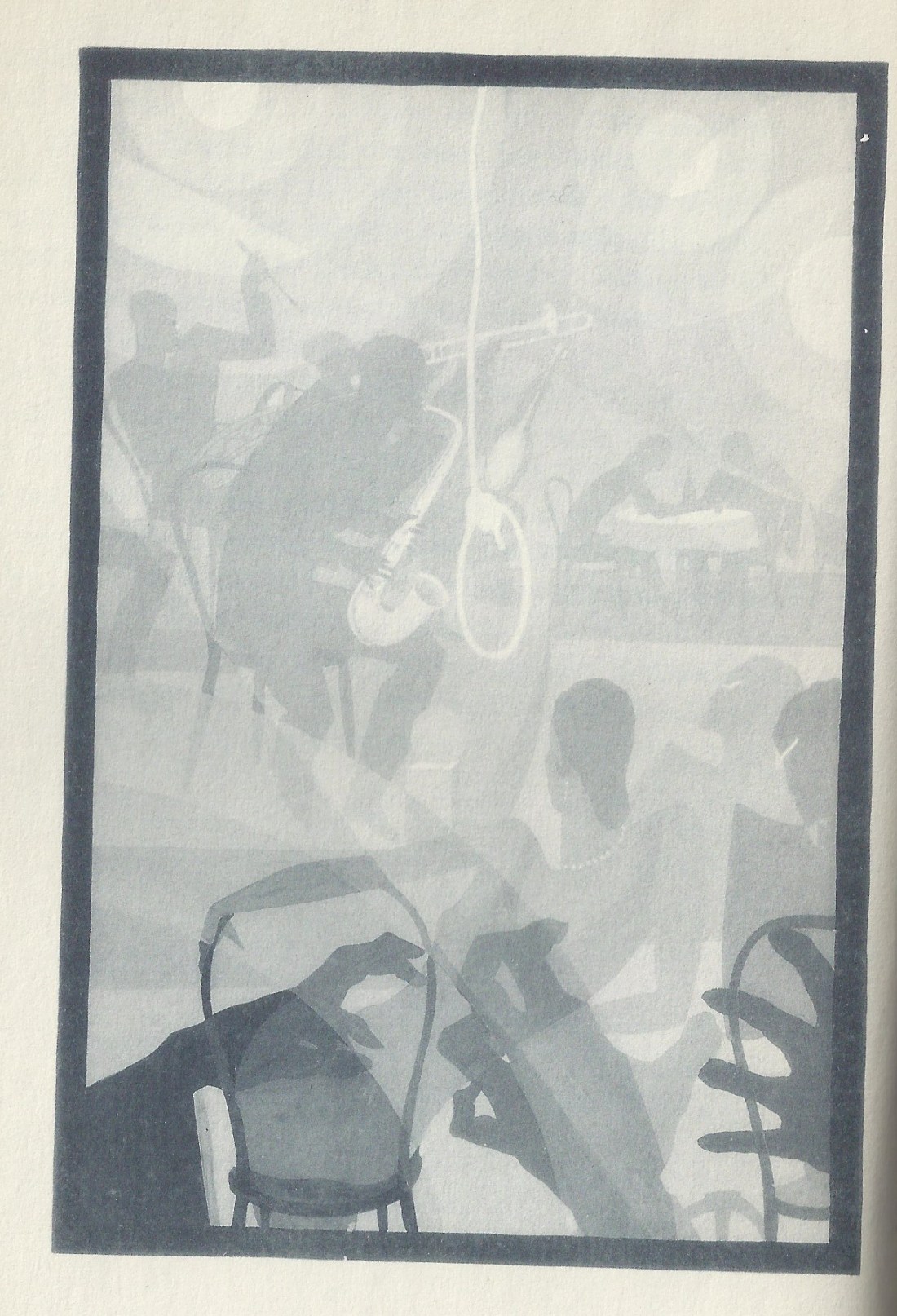
If these stories seem horrible to you just from the quotes and synopses, if you wonder at the implicit and explicit racism of the person that wrote them—remember that Morand’s book was not some penny-a-word cheap entertainment churned out for a pulp magazine. Black Magic was viewed as literature, reviewed and commented on in literary circles, which spurred debate and controversy over Morand’s portrayals of black people. The artist who did the black and white plates for the book—which are undoubtedly the best part of the whole production—was Aaron Douglas, part of the Harlem Renaissance.

Black Magic was high brow, at a time when pulps were low brow. Both could be, and were, racist. Race prejudice cut across delineations of class; and Morand shows they often cut across nationality as well. So when we look at the portrayal of black people in “Medusa’s Coil” or “The Call of Cthulhu”—when we think of Lovecraft in the context of his own period, the books and stories he would have read and drawn from—Black Magic is a hallmark. Lovecraft and Morand were separated in nationality, wealth, literary market…but both of them were drawing from similar views of race, expressed in their own way, and for their own purposes.

To say that Lovecraft was “a man of his time” is not an excuse for his racism. James F. Morton was a contemporary, and he opposed Lovecraft’s views on race, as discussed in “Concerning the Conservative” (1915) by Charles D. Isaacson. Discussing Lovecraft in the context of his time is to say: these prejudices did not come from nowhere, they were part of an ongoing discussion of race and portrayal of black people in literature that both the readers and writers of that period were having. Readers today do not always catch all the nuances of that conversation, because we see only a slim part of it. So when we consider “Medusa’s Coil,” is may help to keep in mind “Excelsior” or “Goodbye, New York!”—and remember that both Lovecraft and Morand were operating within a tradition of fiction about passing, not staking out new racist literary territory. 


Bobby Derie is the author of Weird Talers: Essays on Robert E. Howard & Others (2019) and Sex and the Cthulhu Mythos (2014).
“In the Gulf of N’Logh” (193?) and “Lair of Fungous Death” (193?) by Hazel Heald


Hazel Heald has the distinction of being Lovecraft’s most prolific weird revision client, their works together being “The Man of Stone” (1932)“The Horror in the Museum” (1933)“Winged Death” (1934)“Out of the Æons” (1935), and “The Horror in the Burying-Ground” (1937). While much of their relationship remains obscure, and the accounts of Muriel E. Eddy in The Gentleman from Angell Street (2001) not always entirely reliable, an inquisitive Lovecraft fan might wonder if they had any unpublished revisions which did not see the light of day—and the answer is: maybe.

Sorry I can’t dig up any more material at the moment—am wallowing in a morass of tasks & staggering under what seems like a variant of grippe. Hope you can assemble sufficient copy for #1, & am glad you have an illustration for future issues.[…] Glad you’ve received at least some material from those I recommended. Come to think of it, you might get a short story (fairly long as such things go) from Mrs. Hazel Heald, 15 Carter St. Newtonville, Mass. Ask her for “In the Gulfs of N’Logh” or some other tale which didn’t land professionally.
—H. P. Lovecraft to John Weir, 28 Jan 1937, MSS. John Hay Library

He was dying. A young fan named John Weir was putting together a new fanzine, to be entitled Fantasmagoria. The fanzine lasted five issues, from 1937 to 1940, probably in a very small number of copies. Issues one and two have been scanned and are available to read online; the second issue promising in upcoming numbers:

Fantasmagoria July 1937

Yet “In the Gulfs of N’Logh” never appeared in Fantasmagoria, or anywhere else. Weir obviously followed Lovecraft’s suggestion and wrote to Hazel Heald asking for the story, and she replied:

Please find enclosed my “In the Gulfs of N’logh”. It was rejected by Wright as being unsuitable for his magazine.
—Hazel Heald to John Weir, 10 Feb 1937, MSS. John Hay Library

In a letter to his collaborator John Baltadonis, Weir says of his fanzine:

Those that have contributed are Lovecraft, Rimel, Stickney, Kuttner, Heald, and Lowndes. [….] Lovecraft told me that Mrs. Hazel Heald might send me a story called “In the Gulfs of N’Logh”. Well, she sent me it and I almost fainted. It takes up thirty-three (sides) typewriter pages! You can bet that I’m not putting that in the small issues. I’m going to wait till I increase the pages and then I’ll run it as a serial. Can you imagine, though, Thirty-three pages! Whew!
—John Weir to John Baltadonis, 15 Feb 1937, MSS. John Hay Library

A month later, Weir would write to fellow fan and Lovecraft correspondent Willis Conover, most remembered in weird circles today for Lovecraft at Last (1975), where in discussing their collections Weir says:

I have a manuscript that almost beats yours. This is “In the Gulfs of N’Logh” by Hazel Heald. Besides that I’ve got an old poem of Lovecraft’s and another Hazel Heald story. The first story by Heald is composed of Thirty-two typewritten sheets.
—John Weir to Willis Conover, 16 Mar 1937, MSS. John Hay Library

Unknown to both Conover and Weir, H. P. Lovecraft had died the day before. As soon as he heard, August Derleth immediately set about writing to Lovecraft’s known correspondents, planning a posthumous publication of his work and letters. This included Hazel Heald, who wrote:

I have had several rejected tales I passed on to J. James Weird [sic] who is starting a new fan magazine. HPL advised me to keep myself in the public eye as much as possible. I am typing a tale now which I hope Wright will accept.
—Hazel Heald to August Derleth, 31 Mar 1937

Weir was obviously still in contact with Heald at this point, and must have passed on his assertion that “In the Gulfs of N’Logh” was too long for the fanzine to publish in a single issue, as she wrote in a subsequent letter:

I have a lot of rejected mss. and have given two to a fan magazine that will be printed soon. One of the tales will be used as a serial. John Weir is the editor. HPL recommended him to me.
Hazel Heald to August Derleth, 14 Apr 1937

The other story that Heald refers to was apparently “The Heir of the Mesozoic”, which was published in two parts in Fantasmagoria #4 (1938) and #5 (1939/1940). She was obviously keen to hear about these stories, because she wrote to Weir about them on May 18 1937, and then again later that year:

Will you please tell me if you have published my “An Heir of the Mesozoic” and “In the Gulfs of N’logh”? I haven’t heard from you since last Spring. If you aren’t going to use them please send them back as I have others who want them.
—Hazel Heald to John Weir, 21 Sep 1937, MSS. John Hay Library

The extant correspondence appears to end there. Weir never published “In the Gulfs of N’Logh,” probably due to its length, and appears to have returned the manuscript to Heald at some point. The manuscript itself appears to no longer be extant.

So what are we to make of “In the Gulfs of N’Logh”? Obviously, Lovecraft was aware of it; it was a weird tale, because it was submitted to Weird Tales and rejected by Farnsworth Wright sometime before January 1937, and it was fairly long—33 (or 32) pages is ~16,000 words, a genuine novella. The title “N’Logh” could allude to a location in Africa (like “Winged Death”), or equally a fantastically Lovecraftian location like R’lyeh. Was it an actual unsold Lovecraft revision? Unless the manuscript comes to light, we may never know.

In her letters to August Derleth, Hazel Heald mentions other stories which appear lost to time, though submitted to (and rejected by) Weird Tales and other pulps. The titles are not promising: “The Devil’s Jigsaw” and “Terror by Moonlight” do not seem particularly Lovecraftian. One story which did receive a bit more attention was “Lair of the Fungous Death.”

Do you think that WEIRD TALES would accept my “Lair of the fungous death” now? He rejected it several years ago as he said it was not up to my standard. I never could understand it for Mr. Lovecraft considered it very good. I sent it to you once to read, and your comments were favorable. I hate to have it rejected again, but on account of the war, and perhaps a shortage of writers, I thought it might be more acceptable. He might have forgotten by now that I ever sent it to him.
—Hazel Heald to August Derleth, n.d. (c. 1944)

Farnsworth Wright had been fired from his position as editor of Weird Tales in early 1940, and died soon after. His position at the helm of “The Unique Magazine” was taken by Dorothy McIlwraith, and Derleth undoubtedly told Heald of that:

Am sending my LAIR OF THE FUNGOUS DEATH to Weird Tales today. Hope she will like it.
Hazel Heald to August Derleth, 19 Sep 1944

I sent my story “The Lair of Fungous Death” to the editor of “Weird Tales” about a week ago, but haven’t heard anything as yet. Is she slower than Farnsworth Wright about her decision? I hope it is accepted, for money is an important factor with me as everyone else.
—Hazel Heald to August Derleth, 30 Sep 1944

At this time, Derleth was getting permission from Heald to include “Winged Death” and “The Man of Stone” in Marginalia (1944) as Lovecraft revisions; like some of the other Lovecraft revision clients, Heald was insistent on her own authorship of the stories, prevailing evidence notwithstanding. Which may be why she wrote to Derleth:

I have not heard from Miss McIlwraith as yet. I hope that my story will meet with her approval. Wright nearly accepted it, but might have been overcrowded with manuscripts at that time. HPL read it but did not revise it, but his comments on it were very favorable. I was discouraged at the rejection and just threw it in a drawer and forgot about it. Some time ago, I found it and sent it to several of the WEIRD TALES authors to read, and they did not recommend any changes.
—Hazel Heald to August Derleth, 6 Oct 1944

We don’t have good data on how long it took McIlwraith to make a decision on such things; but the weeks and months ticked by:

I haven’t had my story rejected as yet, so hope it will please the editor.
—Hazel Heald to August Derleth, 13 Oct 1944

How does a woman happen to take Wright’s place? I suppose on account of the shortage of men. How long does she usually take to make a decision on a story? I hope she will take mine. It is nearly three weeks since I submitted it.

Several years ago a man wrote to me and said he would like some of my unpublished tales for a book he was going to publish, and though he did not pay for them, it would be good advertising. I did not regard them as worth printing, but he insisted. I even forgot his name and thought no more about it until I received a letter saying they would be printed soon. From that day to this I have heard nothing. Do you think he was trying to get plots for stories, and went about it in that way? I did not care anything about the tales as I have carbon copies somewhere, but it seemed like a strange request, didn’t it?
—Hazel Heald to August Derleth, 14 Oct 1944

The latter comment is, in hindsight, almost certainly a reference to John Weir and Fantasmagoria, which had after a long delay published the shorter of two stories she had sent as “The Heir of the Mesozoic” in two parts.

How long does Miss McIllwraith take to make a decision on a story? If she isn’t considering it at all, do you get it back within a few weeks, or do you have to wait months? I know you said she was slow, but there must be some sort of time limit.
—Hazel Heald to August Derleth, 21 Oct 1944

Whether McIlwraith finally rejected the story or Heald simply gave up on hearing back from her, we hear no more on the matter. Divorced and unable to support herself with her writings, Hazel Heald took whatever work she could find to earn a living—but she never gave up on the dream of writing, and enrolled in a writing course to improve her skills. However, instead of focusing on original composition, she dug out the old typescript:

I went to school Thursday night and liked it very much. He wants us to bring manuscripts next time and he will correct them, so I am taking my “Lair of the Fungous Death.”
—Hazel Heald to August Derleth, 6 Nov 1944

Thanks very much for suggestions about my story. Would you like to see it first, or had I ought to send it to the magazines you mentioned? I know you are very busy but I dislike rejections perhaps more than an established writer, and get so discouraged I feel like giving up the ghost. If your opinion is that it is not worth sending, I will junk it. HPL read it and thought it OK, and didn’t think it needed revising, but Mr. Chadwick told me it should be cut down, and recommended cutting out some scenes entirely. He said in conclusion I didn’t explain everything. HPL said to keep the reader guessing, and let him use his own imagination. Mr. C. said it stretched the reader’s imagination too much, and also that I talked too much about the horror of the whole thing. HPL said to keep it alive in the reader’s mind. I feel as though I was between the Devil and the dark blue sea! I don’t think that a writer who doesn’t write weird stories themselves can understand another’s style.
—Hazel Heald to August Derleth, 29 Nov 1944

Am sending my story along as you suggested. I can’t see any great mistakes in it as Chadwick did. If HPL liked it, it must be OK. “Weird Tales” rejected it because it was too long. Chadwick said it was too impossible, and said no one liked to read impossible things. I may be a moron belonging to that “certain class” he mentioned, but I certainly like to read tales that stretch the imagination. He said, “You and I certainly wouldn’t read such stuff, would we?” and I told him I most certainly would! I didn’t go last Thursday night. HPL was so kind and understanding, and though he made me write things over and over, he was always ready to praise if I deserved it. Chadwick says that any branch of story would be more liable to sell than weird tales. I couldn’t write a love story to save my life for I am too cynical in that line. A detective or wild west story wouldn’t interest me, so how could I write one? I guess I have a one-track mind. […] I didn’t retype my story, but will if you think I should.
—Hazel Heald to August Derleth, 4 Dec 1944

We can empathize with Heald here, as she is basically defending Lovecraft’s position on weird fiction against what must have been a very condescending attitude toward the weird tale by Chadwick.

Derleth’s assessment of the story doesn’t survive, but we can imagine his hopes might have been moderated: a weird story from Hazel Heald that Lovecraft had at least passed his eye over, even if she insisted he hadn’t revised it, and which had been considered and rejected by Farnsworth Wright for Weird Tales on account of length—probably not unlike “In the Gulfs of N’Logh”—and the word fungous in the title, which recalled Lovecraft’s fungi from Yuggoths and other growths. If there was even a hint of Lovecraft in the story, it could probably have been salable—or at least publishable in an Arkham House book, as he had done with Marginalia. Heald’s last comment on the matter:

I know that I am “NG” now for I am entirely out of practice, for “The Horror in the Burying Ground” was my last real attempt. Guess its no use to try for you thought my tale I sent you a complete flop.
—Hazel Heald to August Derleth, 1 Feb 1945

This is not quite the end of the story. Apparently sometime in the late 1950s, Lovecraft collector Jack Grill managed to contact Hazel Heald and persuaded her to sell him a couple of manuscripts. The account is contained only in George Wetzel’s “A Memoir of Jack Grill”:

Two of the items were to have been unpublished stories by Hazel Heald—The Basement Room and Lair of the Fungus Death, 5 PP and 25 pp respectively, that Jack had purchased from Miss Heald along with a one page criticism of them by Derleth. 

“Re Hazel Heald stories—I gotta hunch that the Eddys, H. Heald & their writer friends follow yr HPL articles. Please don’t write up her stories until the old gal kicks the bucket, unless favorably. Perhaps she don’t give a damn what anybody thinks of her stories…[“]

As Douglas A. Anderson points out in The H. P. Lovecraft Collection of Jack Grill and (later) Irving Binkin” these two manuscripts and Derleth’s criticism are not listed among the other items in Grill’s catalog of Lovecraftiana. “The Lair of the Fungous Death,” like “The Lair of N’Logh,” has disappeared—though if some collector bought it, there remains at least the chance that it will appear again at some point.

The big question for most people is: were either of these actual Lovecraft pieces? Maybe. It is well-known that later in life Lovecraft’s stories were getting longer, which made them more difficult to sell to pulps; it wouldn’t be impossible for Lovecraft to have revised a couple stories for Heald which didn’t place for whatever reason—he spoke relatively little about any of the Heald stories in his letters unless they had sold.

Given her relatively precarious financial condition later in life, it seems unlikely that Hazel Heald might have entertained any thoughts of a collection of stories akin to Zealia Bishop’s The Curse of Yig (1953, Arkham House)—but if some of those rejected manuscripts had actually sold, or if Derleth had seen something in them that warranted preservation, perhaps we might have seen a second woman’s collection of Mythos tales in the 1950s.

It is easy to speculate about undiscovered Mythos tales, but for me the interest in these rejected stories is less “what might have been” and more what it tells us about those involved. Their existence points to a more complicated relationship between Heald and Lovecraft than the five submitted and accepted stories labeled as Lovecraft revisions or ghostwritten tales suggest. It suggests that the commercial aspect of their business would have had its highs and lows, above and beyond whether Heald was able to pay Lovecraft for his revision services, with stories written, revised, rewritten, submitted, and rejected again and again. Likely there is some truth that like Zealia Bishop, Heald saw Lovecraft as more of a teacher than a ghostwriter, and that the image of Lovecraft as the principal author of the revision tales may owe a bit more to August Derleth’s salesmanship in the 1940s and 50s than is commonly credited.


Bobby Derie is the author of Weird Talers: Essays on Robert E. Howard & Others (2019) and Sex and the Cthulhu Mythos (2014).

“Down into Silence” (2018) by Storm Constantine

We know the secrets of Innsmouth, or what the alleged witnesses told us were true so long ago. Nearly a hundred years has passed. […] Maybe none of it was true. The surviving records sound like witch trials to me, more imagination than fact. Yet standing here on the bridge over the tumbling River Manuxet, gazing out to sea, I wonder. The fact is, I want it to be true, all of it.
—Storm Constantine, “Down into Silence” in 
What October Brings: A Lovecraftian Celebration of Halloween 19

Salem, Massachusetts proudly advertises itself today as Witch Country. The 1692 trials have become fodder for tourists, something for the ancient city to hang its hat on. Sightseers gawk at Gallows Hill, take pictures of the Witch House to post on the internet. Lovecraft did some of that himself, nearly a hundred years ago, and it’s only gotten more commercial, more elaborate.

What if that happened to Innsmouth?

Kenneth Hite in his essay “Cthulhu’s Polymorphous Perversity” in Cthulhurotica commented on the advent of Cthulhu kitsch:

But Cthulhu is not unique in this. Everything that can be sold in the modern age will be sold, and in every form possible. Count Dracula, after all, not content with great movies, novels, mediocre movies, nonfiction tie-ins to novels, debunkings of non-fiction tie-ins to novels, worse movies, superb comic books, and the entire Romanian tourist industry, appears thinly disguised as a fictional children’s rabbit (Bunnicula) and a molar-corroding breakfast cereal (Count Chocula). There are bobble-heads, and illiterate T-shirts, and clever board-games, and plastic toys, and ridiculous cameo appearances devoted to Dracula, and James Bond, and Batman, and every other figure of modern myth. (You can also get a plush Cthulhu dresses as Dracula or James Bond.) (291-292)

We live in the now of Cthulhu kitsch; 3D-printed idols and plushies, action figures and posters, cereals and soda and beer. But we do not live in a world with a real Innsmouth, where the Gilman Hotel has been refurbished and dressed with Hallowe’en decor for the kind of guests that like seeing strands of dried corn and pumpkins strewn about the lobby for that Authentic Old New England™ flavor. How would that work, exactly, if you could read “The Shadow over Innsmouth” and then go drive to Arkham and Innsmouth in your car? If Robert Olmstead, instead of living forever in glory, died of a brain tumor in a sanitarium after publishing his narrative?

This is the kind of mood that Storm Constantine explores in “Down into Silence.” The desire for something real, something dark and magical, and being sold instead the licensed, authorized version of the experience. It is in many ways something of the other side of “The Nyarlathotep Experience™” (2019) by Miguel Fliguer, where we see someone trying to craft that kind of experience for others.

At the same time, it is also an interpretation of “The Shadow over Innsmouth”—and not necessarily a cynical one. What if there was some truth to the story? Not everything, not nearly everything. What would Innsmouth be like, if it had been a real place, a small town with an Esoteric Order of Dagon and a Devil’s Reef, and the g-men had come and there had been blood in the streets? What would it look like, if the town had survived that, and bore the scar proudly, and charged people to take photographs of it?

“If it hadn’t been him, then it would have been someone else, Kezia. Innsmouth couldn’t have stayed hidden for ever. The modern world doesn’t allow that. If Innsmouth had—or has—an enemy it is time, the changes in society, not merely the word of one man.”

“He was bitter,” Kezia says, in a voice craving for vengeance. “He wanted to be here, he was one of them, but he ruined it. They chased him out and then, like a mean little boy, he told tales.”
—Storm Constantine, What October Brings 32

Is Storm Constantine’s Innsmouth your father and mother’s Innsmouth? No. It’s a mark of a more mature phase of Lovecraftiana. You need a certain hit of commercialization and nostalgia, like Hallowe’en itself has become, to appreciate what she’s driving at. Before you could have “Down into Silence,” you needed the Cthulhu kitsch zeitgeist. So it has, and so here she is.

In the sense that Innsmouth is a real place—in the sphere of human ideas, not the physical world—it took a Lovecraft to mark it on the map. Once, perhaps, it was a bit of a secret. Fans of weird fiction were few, they shared their pleasure of discovery with each other…and word got out. Now everyone knows about Innsmouth, it seems. There are comics and erotica, entire anthologies dedicated to Innsmouth and its diaspora. Like a tattoo that fades in time, but keeps getting re-inked, the memories of the old lines distorted but still there like a shadow, adding depth. Innsmouth is in the now, constantly re-discovered, re-invented, re-visited—and the Mythos needs that to stay relevant, to grow and change rather than stagnate and sink into decay. Fans need not fear the tourists, the new readers attracted by films like Dagon or Innsmouth. New blood, new ideas, new media to keep the old concepts alive for another generation. Just so that one more crop of visitors can find Innsmouth, and leave wanting more of that strange town with its weird shadows and furtive mysteries.

“Down into Silence” was published in What October Brings: A Lovecraftian Celebration of Halloween (2018).


Bobby Derie is the author of Weird Talers: Essays on Robert E. Howard & Others (2019) and Sex and the Cthulhu Mythos (2014).
Her Letters to Lovecraft: Unnamed Salem Witch Descendant

The old gentry, representing the two or three armigerous families which came from Salem in 1692, have kept somewhat above the general level of decay; though many branches are sunk into the sordid populace so deeply that only their names remain as a key to the origin they disgrace. Some of the Whateleys and Bishops still send their eldest sons to Harvard and Miskatonic, though those sons seldom return to the mouldering gambrel roofs under which they and their ancestors were born.
—H. P. Lovecraft, “The Dunwich Horror” Weird Tales April 1929

Among the Salem witches in 1692, ‘this Rampant Hag, Martha Carrier, was the person, of whom the Confessions of the Witches, and of her own Children among the rest, agreed, That the Devil had promised her, she should be Queen of Hell.
—Margaret Murray, The Witch-Cult in Western Europe (1921) 47

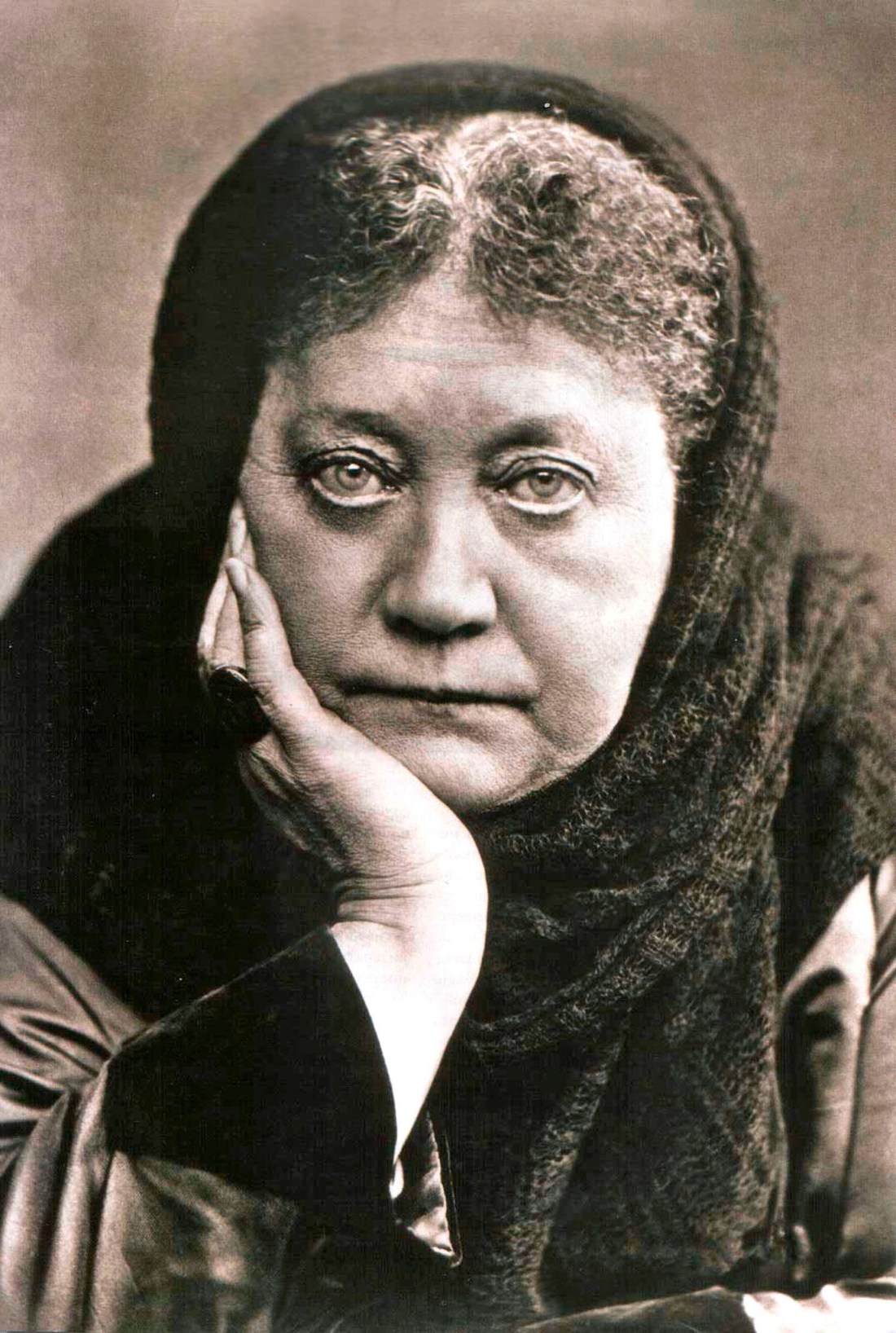
Since 1924 when he first read Margaret Murray’s book on witches, H. P. Lovecraft had believed in the reality of the witch-cult, and that it had an American coven in Salem which had precipitated the famous witch-trials. So too, Lovecraft began to connect his stories with a fictional Salem diaspora, which included Joseph Curwen (“The Case of Charles Dexter Ward”), the ancestors of Randolph Carter (“Through the Gates of the Silver Key”), Richard Upton Pickman (“Pickman’s Model”) and the unnamed narrator of “The Festival.” Lovecraft even hinted at the events in his “History of the Necronomicon.” Yet when Lovecraft wrote “The Dunwich Horror” and “them witch Whateleys” little did he know that he was about to have an encounter with a real-life descendant of Salem.

By the way—that tale has just earned me a highly interesting letter from a curious old lady in Boston, a direct lineal descendant of the Salem witch Mary Easty, who was hanged on Gallows Hill Aug. 19, 1692. She hints at strange gifts & traditions handed down in her family, & asks me if I have access to any ancient secret witch-lore of New England. Also, she wants to know if Dunwich & Arkham are real places! I shall answer the letter, & see if I can get the good old soul to relate some of the whispered witch-traditions! A story of Salem horror based on actual “inside dope” from a witch-blooded crone would surely be a striking novelty!
—H. P. Lovecraft to Clark Ashton Smith, 22 Mar 1929, Dawnward Spire, Lonely Hill 171

Mary Towne Eastey (or Este, Easty, & other variations) was 58 when she was hanged for witchcraft. Her case is less famous than some of the other victims; Arthur Miller barely names her in The Crucible (1952). Two of her sisters were accused as well, with Rebecca Nurse hanged a few months earlier, but Sarah Cloyce was released the following year. Among the victims of the Salem Witch Trials, Mary Eastey was remembered as one of the most pious and eloquent, and in the end begged the court not for her own life, but for the lives of her fellow accused.

Before she died, Mary Eastey had eleven children, and many grandchildren—and in the 237 years between her death and the letter that H. P. Lovecraft received from “a curious old lady in Boston,” there is room for hundreds of potential descendants. Lovecraft never identifies his correspondent by name, nor does he appear to have kept any of her letters, so this particular correspondent has never been identified, and may never be, so brief was their relationship—so as with many of his lesser-known correspondents, we have to piece together what we can not from the letters themselves, but from Lovecraft’s references in his letters to others.

By the way—the publication of “The Dunwich Horror” has just earned me a curious & interesting letter from an old lady in Boston, a direct lineal descendant of the Salem witch Mary Easty, who was hanged on Gallows Hill Aug. 19, 1692. She claims to have heard some strange traditions handed down in the family, & to possess certain powers of peering into the future which she cannot explain. A quaint old soul, apparently—I shall write & see if any of her “inside” witch traditions have fictional value. She wants to know whether Dunwich & Arkham are real places, since they don’t appear on ordinary maps of Massachusetts!
—H. P. Lovecraft to August Derleth, c. 22 Mar 1929, Essential Solitude 1.189

It is likely that like many fans she wrote at first by way of Weird Tales, and that the editor Farnsworth Wright had forwarded the letter to Lovecraft, much as he would do with Robert E. Howard’s letter to Lovecraft the next year. Weird Tales had never shied away from tales of the Salem Witch Trials; Seabury Quinn had covered the trials in his series of nonfiction articles titled Servants of Satan, beginning with “The Salem Horror” (WT Mar 1925). Quinn, like Lovecraft in “The Dunwich Horror,” mentions tourists—Salem in the 1920s was beginning to appreciate its reputation as “witch country,” though not quite to the extant that it one day would.

While Quinn paints the victims of the Salem witch hysteria as innocent here, in his fiction he was more than happy to hint at real witches caught and burned by the trials. Lovecraft was far from alone in imagining a Salem witch diaspora, which caught on in the public imagination with films like I Married A Witch (1942) and eventually the television show Bewitched (1964-1972) and characters like Sabrina Spellman (Archie’s Mad House #22, Oct 1962). But at the time, these “real” witches of Salem were often depicted less positively, such as in Robert Bloch’s short story “Satan’s Servants” (written c. 1935) which Lovecraft had a slight hand in.

Yes—I may call on that venerable & genial witch-descendant before long. She is certainly the epitome of thoughtfulness & generosity—no sooner had I chanced to mention casually my long desire to read “The Wind in the Rosebush”, than the good soul sent it along as an unsolicited loan—she having owned it these 25 years, ever since it was published!
—H. P. Lovecraft to August Derleth, 1 Apr 1929, Essential Solitude 1.190

While we don’t know for certain what Lovecraft’s letter contained, his first letter would not doubt disabused her that any of his artificial mythology—including Arkham and Dunwich—were real, as this is what he always did whenever anyone asked him about the reality of of the Necronomicon, Cthulhu, et al. It is curious that Lovecraft would mention such a scarce volume as Mary Eleanor Wilkins Freeman’s The Wind in the Rose-Bush and Other Stories of the Supernatural (1903), but given that the unnamed correspondent was a reader of Weird Tales, it suggests she had some tastes in weird fiction, and Lovecraft had recently published his “Supernatural Horror in Literature” (1927), which mentioned Freeman’s book, so perhaps that formed a point of discussion.

Yes—that letter from a witch-descendant was rather unusual, & I am still hoping for dark data when she gets ready to unfold some real family history. It appears that her forbears were well acquainted with the Marblehead witches Edward Dimond & his daughter Moll Pitcher, (whose home, “The Old Brig”, still stands on Burying Hill) & that she herself, through the Easty or Este line, is a scion of the D’Estes of Ferrara, Italy, & a descendant of no less a malign character than Lucrezia Borgia! Some ancestry! The wildest progenitors on my own family charts seem pretty tame besides this array of glittering sinistrality.
—H. P. Lovecraft to Clark Ashton Smith, 14 Apr 1929, Dawnward Spire, Lonely Hill 172

Marblehead, Massachusetts, neighboring Salem, was a model for Lovecraft’s Kingsport just as Salem (or Salem Village, modern day Danvers) was the basis for “witch-haunted Arkham.” Edward Dimond was known as “the Wizard of Marblehead” or “Wizard Dimond”; his granddaughter Moll Pitcher gained some fame as a fortune-teller in nearby Lynn, and was the subject of a poem by famed poet John Greenleaf Whittier.

I’ve heard more from the Boston witch-descendant, who likewise turns out to be a lineal scion (through the Massachusetts Eastys, who were originally D’Estes of Ferrara, Italy) of Lucrezia Borgia & Pope Alexander the Sixth! Likewise, her forbears were intimately acquainted with Old Diamond & Moll Pitcher of Marblehead, about whom I told you some time ago. She has not yet related any specific dark tales transmitted down her family line, but still promises to do so.
—H. P. Lovecraft to Elizabeth Toldridge, 15 Apr 1929, Letters to Elizabeth Toldridge & Anne Tillery Renshaw 56

The connection with the House of Este of Ferrara appears fanciful—many amateurs in genealogy make assumptions based on common names. If that is fancy, or an error, it may be that the entire witch-genealogy of this unknown correspondent was so. Certainly, it doesn’t appear that the “dark lore” was apparently ever passed to Lovecraft, or at least he makes no mention of further correspondence with her after 1929, nor are there any specific mentions of his visiting her in Boston at any point. There is one likely reference to her in a letter from Zealia Bishop to Lovecraft:

The Boston witch-lady & the Maine wizard prove rather interesting—the latter in a somewhat amusing way.
—H. P. Lovecraft to Elizabeth Toldridge, 4 May 1929, Letters to Elizabeth Toldridge & Anne Tillery Renshaw 61

“The Maine Wizard” was a male occultist who corresponded with Lovecraft at roughly the same time and for roughly the same purpose: asking after the genuine lore behind the Necronomicon and all that. As with the “Boston witch-lady,” Lovecraft never gives his name, though the very few descriptions suggest he was not William Lumley, another occultist of Lovecraft’s acquaintance. The correspondence did not last:

As for my spectrally affiliated New England correspondents—I have not again heard from the grotesque Maine person, but hear frequently from the old lady descended from Salem witches. She sent several moderately gruesome legends lately, but in general I find it more natural to invent cosmic horrors of my own than to utilise actual folklore incidents.
—H. P. Lovecraft to Elizabeth Toldridge, 24 Oct 1930, Letters to Elizabeth Toldridge & Anne Tillery Renshaw 162

Both of these correspondents have in common that they wrote to Lovecraft, probably via Weird Tales, as essentially “serious fan letters”—and we might imagine their thrill at receiving a response from the author, even as we imagine their disappointment when Lovecraft revealed that it was all made up after all. In the case of the Salem witch descendant, the correspondence appears to have continued for some time, turning to other subjects. While we never learn her name, we do learn her ultimate fate:

An old lady in Bostom whom I knew—& who died just a year ago—was a direct descendant of Mary Easty, one of the Salem witches hanged in 1692—& therefore a collateral descendant of the more famous Rebecca Nurse (Mrs. Easty’s sister), whose ancient house (built 1636) in Danvers, Mass. [near Salem—formerly called Salem-Village] is still in existence & open as a public museum (I saw it in 1923).
—H. P. Lovecraft to R. H. Barlow, 19 Mar 1934, O Fortunate Floridian! 116

You perhaps did not remember that I sent The Mound to Sonny Belknap over two years ago—in fact immediately after the old Boston lady—I’m grieved to learn of her death—returned it.)
—Zealia Bishop to H. P. Lovecraft, 26 May 1934, The Spirit of Revision

One thing we can be relatively sure of is that Lovecraft did not have her copy of The Wind in the Rose-Bush in later years, because he did not have a copy when Samuel Loveman gifted one to him in 1935. Lovecraft tended to be punctual in such things, and his last published recollection of his former correspondent shows it is no longer in his possession:

It’s an achievement nowadays even to read “The Wind in the Rosebush”, for scarcely any library has a copy. I never saw it till a year & a half ago, when a nice old lady in Boston lent a copy to Munn & me.
—H. P. Lovecraft to August Derleth, 14 Apr 1932, Essential Solitude 2.472

H. Warner Munn was a fellow weird taler from Athol, Massachusetts who had famously written “The Werewolf of Ponkert” (WT Jul 1925) following a suggestion from Lovecraft; the Rhode Islander also noted Munn’s extensive weird library. Curiously, when Loveman gifted Lovecraft with a copy of the rare book, he noted:

Loveman brought me a copy of “The Wind in the Rosebush” which he had promised me so long. Now you, Munn, & I are all equipped!
—H. P. Lovecraft to R. H. Barlow, 5 Sep 1935, O Fortunate Floridian! 291

Where did Munn get his copy? Did he have a bit of luck and buy one in the book store or—perhaps—was he one of those bastards that borrow a book and never give it back? We don’t know; perhaps she sold or gifted the copy to Munn.

Even after his death, Lovecraft’s friends remembered her through his letters:

Another, a woman claiming descent from infamous New England witches and also from Lucretia Borgia, offered HPL some inside dope on the witch cult and its practices.
—Clark Ashton Smith to August Derleth,13 Apr 1937, Eccentric, Impractical Devils 256

That is all there is on Lovecraft’s correspondence with the unnamed descendant of Mary Towne Eastey, that innocent old woman killed in the witch-hysteria that gripped Salem Village in 1692. Seabury Quinn in “The End of the Horror” called the whole episode absurd and a tragedy, and so it was. Yet reading these lines over, I am given to wonder if in their brief correspondence Lovecraft might have touched on Mary Eastey’s sister Rebecca Nurse—and maybe he recalled a very singular experience he had in a trip to Danvers some years prior, before he read The Witch-Cult in Western Europe:

I now put the aera of Colonial refinement behind me, and hark’d back farther still to an age of darker and weirder appeal—the age of the dreaded witchcraft. Leaving Danvers, I struck out along the roads and across the fields toward the lone farmhouse built by Townsend Bishop in 1636, and in 1692 inhabited by the worthy and inoffensive old widow Rebekah Nurse, who was seventy years of age and wished no one harm. Accused by the superstitious West Indian slave woman Tituba (who belong’d to the Reverend Samuel Parris and who caused the entire wave of delusion) of bewitching children, and denounced blindly by some of the hysterical children in question, Goodwife Nurse was arrested and brought to trial. Thirty-nine persons sign’d a paper attesting to her blameless conduct, and a jury render’d a verdict of “not guilty”; but popular clamour led the judges to reverse the verdict (as was then possible), and on 19 July 1692 the poor grandam was hang’d on Gallows Hill in Salem for a mythological crime. Her remains were brought back from Salem and interred in the family burying-ground—a ghoulish place shadowed by huge pines and at some distance from the house. In 1885 a monument was erected to her memory, bearing an inscription by the poet Whittier.

As I approach’d the spot to which I had been directed, after passing through the hamlet of Tapleyville, the afternoon sun was very low. Soon the houses thinn’d out; so that on my right were only the hilly fields of stubble, and occasional crooked trees clawing at the sky. Beyond a low crest a thick group of spectral boughs bespoke some kind of grove or orchard—and in the midst of this group I suddenly descry’d the rising outline of a massive and ancient chimney. Presently, as I advanced, I saw the top of a grey, drear, sloping roof- sinister in its distant setting of bleak hillside and leafless grove, and unmistakable belonging to the haunted edifice I sought. Another turn—a gradual ascent—and I beheld in full view the sprawling, tree-shadowed house which had for nearly three hundred years brooded over those hills and held such secrets as men may only guess. Like all old farmhouses of the region, the Nurse cottage faces the warm south and slopes low toward the north. It fronts on an ancient garden, where in their season gay blossoms flaunt themselves against the grim, nail-studded door and the vertical sundial above it. That sundial was long concealed by the overlaid clapboards of Gothic generations, but came to light when the house was restored to original form by the memorial society which owns it. Everything about the place is ancient—even to the tiny-paned lattice windows which open outward on hinges. The atmosphere of witchcraft days broods heavily upon that low hilltop.

My rap at the ancient door brought the caretaker’s wife, an elderly unimaginative person with no appreciation of the dark glamour of the ancient scene. This family live in a lean-to west of the main structure—an addition probably 100 years less ancient than the parent edifice. I was the first visitor of the 1923 season, and took pride in signing my name at the top of the register. Entering, I found myself in a low, dark passage whose massive beams almost touched my head; and passing on, I travers’d the two immense rooms on the round floor—sombre, barren, panell’d apartments with colossal fireplaces in the vast central chimney, and with occasional pieces of the plain, heavy furniture and primitive farm and domestick utensils of the ancient yeomanry. In these wide, low-pitch’d rooms a spectral menace broods—for to my imagination the 17th century is as full of macabre mystery, repression and ghoulish adumbrations as the 18th century is full of taste, gayety, grace and beauty. This was a typical Puritan abode; where amidst the bare, ugly necessities of life, and without learning, beauty, culture, freedom or ornament, terrible stern-fac’d folk in conical hats or poke-bonnets dwelt 250 and more years ago—close to the soil and all its hideous whisperings; warp’d in mentality by isolation and unnatural thoughts, and shivering in fear of the Devil on autumn nights when the wind howl’d through the twisted orchard trees or rustled the hideous corpse-nourish’d pines in the graveyard at the foot of the hill. There is eldritch fascination—horrible buried evil—in these archaic farmhouses. After seeing them, and smelling the odour of centuries in their walls, one hesitates to read certain passages in Cotton Mather’s strange old “Magnalia (which you, little Belknap, shall see when you come to visit your old grandpa) after dark. After exploring the ground floor I crept up the black crooked stairs and examin’d the bleak chambers above. The furniture was as ugly as that below, and included a small trundle-bed in which infant Puritans (even as you, children) were lull’d to sleep with meaningless prayers and morbid hints of daemons riding the night-wind outside the small-paned lattice-windows. Poor little creatures! […]

I saw old Rebekah’s favourite chair, where she used to sit and spin before the Salem magistrates dragged her to the gallows. And the sunset wind whistled in the colossal chimney, and ghouls rattled ghastly skeletons from unseen attic rafters overhead. Tho’ it was not suppos’d to be open to the public, I persuaded the caretaker to let me ascend to that hideous garret of century’d secrets. Thick dust cover’d everything, and unnatural shapes loom’d on every hand as the evening twilight oozed though the little blear’d panes of the ancient windows. I saw something hanging from the wormy ridge-pole—something that swayed as if in unison with the vesper breeze outside, tho’ that breeze had no access to this funereal and forgotten place—shadows … shadows … shadows… And I descended from that accursed garret of palaeogean arcana, and left that portentous abode of antiquity; left it and went down the hill to the graveyard under the shocking pines, where twilight shew’d sinister slabs and rusty bits of fallen iron fence, and where something squatted in shadow on a monument—something that made me climb the hill again, hurry shudderingly past the venerable house and descend the opposite slope to Tapleyville as night came.
—H. P. Lovecraft to Frank Belknap Long and Alfred Galpin, 1 May 1923, Letters to Alfred Galpin & Others 247-249

What might she have made of that, if Lovecraft cared to retell that particular tale? Perhaps it would have thrilled her…or perhaps she would have taken more comfort in the lines of Whittier that adorn Rebecca Nurse’s monument:

O, Christian martyr! who for truth could die,
When all about thee owned the hideous lie!
The world, redeemed from superstition’s sway,
Is breathing freer for thy sake today.


Bobby Derie is the author of Weird Talers: Essays on Robert E. Howard & Others (2019) and Sex and the Cthulhu Mythos (2014).

“The Star that is Not a Star” (2016) by Lucy Brady

It all revolves around that star, and a damned thing it is! A star beyond the material universe, beyond space and time and all that is made by God. ‘The star that is not a star.’
—Lucy Brady, “The Star that is Not a Star” in Cthulhu Lies Dreaming 80

Accursed forevermore is Yamil Zacra, star of perdition, who sitteth apart and weaveth the web of his rays like a spider spinning in a garden. Even as far as the light of Yamil Zacra falleth among the worlds, so goeth forth the bane and the bale thereof. And the seed of Yamil Zacra, like a fiery tare, is sown in planets that know him only as the least of the stars ….
     —Fragment of a Hyperborean tablet
—Clark Ashton Smith, “The Infernal Star”

Spy fiction is a close cousin to Mythos fiction; they share a common descent from the detective fiction of Edgar Allan Poe, and a common concern with the keeping and discovery of secrets. Betimes these cousin modes of fiction have come together: “The Unthinkable” (1991) by Bruce Sterling; “The Courtyard” (1994) by Alan Moore; Delta Green (1997), a branching-off of the Call of Cthulhu Roleplaying Game where the players are agents for government intelligence organizations, their skills and focus shifted to esoteric matters; David Conyer’s Harrison Peel series, including The Spiraling Worm (2007); the Laundry Series by Charles Stross beginning with The Atrocity Archives in 2004 (or, for an earlier variant, his novella A Colder War in 2000) which in turn spawned its own roleplaying game The Laundry (2010); Caitlín R. Kiernan’s Tinfoil Dossier series beginning with Agents of Dreamland (2017). Expand beyond the strictly Mythos-influenced spy fiction, and you run across gems like Tim Powers’ Declare (2000).

Call it cloak-and-tentacle, if you’d like.

The form of the fiction is often a kind of investigation. Think back to “The Call of Cthulhu,” presented to the reader as a series of nested narratives and documents. It isn’t spy fiction, in that the occult groups and secretive individuals involved are not part of any government service above the level of the local police; there are no politics at play in Lovecraft’s story, not really. The G-men make an appearance in “The Shadow over Innsmouth,” and there we can catch a glimpse of the origins of Alan Moore’s “The Courtyard.” Yet for the most part, the Mythos remains unknown to the world and its government powers at large; the mysteries uncovered, no matter how global or cosmic their import, are intensely personal to the initiated investigator in Lovecraft’s fiction.

The trick is to marry the two frames of reference. The investigator is still the main focus or protagonist, but now their actions take place within a broader geopolitical framework—and for the Len Deighton-influenced fiction, a government bureaucracy that’s designed to compartmentalize and contain secrets, to constrain actions. They may be Cold War warriors or those whose small talent in languages brings them in to the orbit of a larger mystery; part of the game is often that the agent or spy can never comprehend the whole of the thing, can never know the whole truth.

Secrets that possess a certain magnitude seem to have their own affinity with one another.
—Lucy Brady, “The Star that is Not a Star” in Cthulhu Lies Dreaming 85

“The Star that is Not a Star” is not explicitly Mythos fiction in any sense; whatever tomes, entities, cults, etc. that Brady employs, they aren’t connections forged with Lovecraft’s corpus or the expanded Cthulhu Mythos. Nor is it a traditional spy-thriller; but that is a large part of the charm. It’s an investigation that spans years and continents with a kind of ennui, and the statement of Natasha Klein—addressed to whom, and why?—is a record of a woman who, after picking up the pieces of the story for a decade, has found her own kind of truth.

Which is a good enough place for an ending as any, in a story like this. It is moody; there is a lot that has to be inferred, and in the end the narrator herself begins to become unreliable, relying on dream-evidence to fill in the gaps. Which all fits. Detectives know not every case has a satisfactory conclusion, and Mythos investigators are often left with scraps of a story told in newspaper clippings and journals, unable to touch the terrible powers at work in the world, burdened by the knowledge of things that they know exist but are impotent to affect.

“The Star that is Not a Star” was published in Cthulhu Lies Dreaming (2016); Lucy Brady’s other Lovecraftian work includes “The Body Electric” in Dreams from the Witch House (2016).


Bobby Derie is the author of Weird Talers: Essays on Robert E. Howard & Others (2019) and Sex and the Cthulhu Mythos (2014).
“Cindy: Scrub-Lady in a State Street Skyscraper” (1920) by H. P. Lovecraft

Ethel: Cashier in a Broad Street BuffetCindy: Scrub-Lady in a State Street Skyscraper
Beautiful and calm and proud,
Only Ethel’s soul seems bowed;
Throngs may pass her, kind or curt,
They can neither heal nor hurt;
There she sits with manner strange,
Taking checks and making change!

Eyes are dark, but something fled
Leaves them heavy as the dead;
Brow is white, but something there
Lingers like an old despair;
Lips are sweet, but coldly curled—
Oh, so weary of the world!

Ethel’s always dressed in black;
Parting thus may leave its track.
Ethel’s always wan and pale;
Pining is not known to fail.
Though a life or love you rue,
Ethel, how I pity you!

—Randolph St. John
Black of face and white of tooth,
Cindy’s soul has lost its youth.
Strangely heedless of the crowd,
O’er her mop forever bow’d:
Eyes may roll and lips may grin,
But there’s something dead within!

Brow serene—resign’d to Fate—
Some three hundred pounds in weight—
Cindy wields a cynic’s broom,
Thinking not of hope or doom.
For the world she cares no more—
She has seen it all before!

Cindy’s always dressed in red,
With a kerchief round her head.
What may blight the damsel so?
Watermelon, work, or woe?
Tho’ her days may placid be,
Glad I am, that I’m not she!

—L. Theobald, Jun.
The Tryout no. 6, June 1920

We are spoiled for lore with regard to Lovecraft; because he left such a paper trail, because conscientious individuals like R. H. Barlow, August Derleth, and Donald Wandrei worked to preserve his letters, and then Arkham House, Necronomicon Press, Hippocampus Press, et al. to see them published, we know more about Lovecraft and his thoughts on things than almost any other pulp writer. However, he didn’t make a habit of leaving a trace for every bit of verse he left scattered in every amateur journal.

“Cindy: Scrub-Lady in a State Street Skyscraper” by H. P. Lovecraft (writing under his pseudonym Lewis Theobald, Jun.) appeared as above, opposite “Ethel: Cashier in a Broad Street Buffet” by his friend Rheinhart Kleiner (writing as Randolph St. John) in the same issue of the amateur journal The Tryout. The two poems are obviously a set, with the exact same number of lines, common meter and subject. Beyond that, there is nothing more known about the background of the poems except what is contained in the text; no letter survives regarding their genesis, publication, or reception in Lovecraft’s Letters to Rheinhart Kleiner or any other volume of Lovecraft’s published letters.

The setting is presumably in Providence, R.I. (which has both a Broad St. and State St.); although Kleiner being a New Yorker, there’s the possibility they were writing from their respective locations. Kleiner wrote a handful of brief memoirs of Lovecraft without mentioning these poems, but in “A Memoir of Lovecraft” (1948) he wrote what might conceivably be their genesis, a trip to Providence that Kleiner took in 1917 with the express purpose of visiting Lovecraft:

On our way back to his home, and while we were still downtown, I suggested stopping in at a cafeteria for a cup of coffee. He agreed, but took milk himself, and watched me dispose of coffee and cake, or possibly pie, with some curiosity. It occurred to me later that this visit to a public eating-house—a most unpretentious one—might have been a distinct departure from his own usual habits.
Lovecraft Remembered 196

Yet without any more specific reference to go on, we are in speculative territory. We don’t know if this was part of a contest, a jest, or an old shame for the both of them.

It can be clearly seen that this is a lighter bit of verse. Both Lovecraft and Kleiner are being melodramatic about their subjects to the point of parody. The poets were still relatively young (Lovecraft was 30 in 1920, Kleiner was 28) white men who took as their subject two apparently older working women, and finding something dreary and dead in their countenance. Kleiner appears authentic (“I pity thee!”), while Lovecraft is obviously having a bit more fun, which given his subject and the way her frames it, makes a rather forgettable bit of verse come off nastier to readers today. This wasn’t untypical of Lovecraft’s satirical verse, and Kleiner would write in “A Note on Howard P. Lovecraft’s Verse” (1919):

As a satirist along familiar lines, particularly those laid down by Butler, Swift, and Pope, he is most himself—paradoxical thought it seems. In reading his satires one cannot help but feel the zest with which the author has composed them. They are admirable for the way in which they reveal the depth and intensity of Mr. Lovecraft’s convictions, while the wit, irony, sarcasm, and humour to be found in them serve as an indication of his powers as a conversationalist. The almost relentless ferocity of his satires is constantly relieved by an attendant broad humour which has the merit of causing the readers to chuckle more than once in the perusal of some attack levelled against the particular person or policy which may have incurred Mr. Lovecraft’s displeasure.
Lovecraft Remembered 402

The only thing that makes “Cindy” really stand out among the mass of Lovecraft’s poetry is that it is his only poem that takes as it subject a black woman. It isn’t clear that this is a specific individual or a kind of archetype; “Cindy” in this sense has to be taken as short for “Cinderella,” a shorthand pseudonym for any cleaning woman. The traits that Lovecraft assigns to her: dark-skinned, white teeth, overweight, dressed in red, with a kerchief around her head suggests the “mammy” archetype, which was popular in the United States from the 19th century and on through the 20th century in advertising (Aunt Jemima being one prominent example), and as a stock character in fiction and film (Hattie McDaniel’s characters in Gone with the Wind (1939) and Song of the South (1946) as examples).

Lovecraft’s poem appears to be a response to Kleiner’s; the meter, length, and the shared details (Ethel as being dressed entirely in one color, both women are world-weary, etc.) definitely suggest this relationship. Give the quasi-seriousness of Kleiner’s effort, I suspect Lovecraft wrote his poem as a jocular rejoinder, satirically poking fun at his friend’s effort to pity and commiserate with someone he shared so little in common with. That is speculative, but it would certainly have been apt if Kleiner wrote his poem of the “wan and pale” Ethel, dressed in black, and Lovecraft countered with the exact racial opposite—a black Cindy, dressed in red.

The nastiness of Lovecraft’s poem stems largely from his reliance on stereotype. His major negative inference on Cindy’s appearance is her obesity (“Some three hundred pounds in weight”), and this is in keeping with Lovecraft’s general attitude, as he disliked fat—to the point that when he himself began to push 200 pounds during his marriage in the mid-1920s (the result of his wife’s cooking and eating out), he took to a strenuous “diet” that saw him shed the “excess” weight—and established the poor eating habits which would stick with him all of his life. This is compounded when Lovecraft ascribes one of the potential “blights” on Cindy’s life as “watermelon”—he’s basically using both a racial stereotype (that African-Americans love watermelon) to suggest that Cindy’s weight is a result of gluttony, rather than, say, a poor diet and chronic lack of sleep caused by working long hours for low pay.

The watermelon stereotype was extremely common during the period—at least one of the many postcards Lovecraft sent that survive might serve as an example of how ubiquitous it was, and how innocuous and “self-evident” it might have seemed at the time to Lovecraft. Lovecraft also liked watermelon, hence the annotation at the bottom of the card.

watermelon

The major question with this poem might well be: how racist is it? That it is racist isn’t arguable; Lovecraft clearly uses the racial stereotypes of the 1900s in its depiction of an African-American woman. Beyond those images though—it’s hard to say if this rises about the racist background count of the 1920s. It is certainly not a specifically positive view of a working-class African-American woman; and it is probably damning with faint praise to say that it doesn’t call for violence, use a racial pejorative, or ascribe any negative attribute or predilection to Cindy based on race beyond a hypothetical fondness for watermelon. In that sense, Lovecraft was contributing to the overall stereotypes regarding black people, but the best that can be said is he doesn’t appear to have been particularly malicious in their use. The most honest aspect of the poem is undoubtedly the last line, where Lovecraft writes: “Glad I am, that I’m not she!”

Readers might also ask how misogynist these poems are. We don’t get a lot of context for the poems except that these are two working-class women, black and white, employed in relatively menial positions, and we can assume that they have to work for a living and have done for some indeterminate but long period of time. The depictions aren’t entirely negative, but both also assume that whatever spark of joy life had for these women is gone, and that is what makes them pitiable, or at least sympathetic. However, the perspective is very much through the eyes of the someone else—the women don’t get to talk about their experiences in their own voice, we get no peek into their inner life.

The poems, basically, tell us more about the poets than their supposed subjects.

“Cindy: Scrub-Lady in a State Street Skyscraper” has been published in a number of collections of Lovecraft’s poetry; Kleiner’s “Ethel: Cashier in a Broad Street Buffet” is a bit more scarce, being rarely republished since its initial appearance in The Tryout. Both are in the public domain, and both have been reprinted in the appendices to Letters to Rheinhart Kleiner.


Bobby Derie is the author of Weird Talers: Essays on Robert E. Howard & Others (2019) and Sex and the Cthulhu Mythos (2014).

“Scritch, Scratch” (2014) by Lynne Hardy

Scritch, scratch, see the rat,
Bright eyes and twitching tail,
Scritch, scratch, chase the rat,
‘Cross hill, and stream, and dale.
—Lynne Hardy, “Scritch, Scratch” in Cthulhu Lives! 158

In the April 1924 issue of Weird Tales a story appeared by H. P. Lovecraft titled “The White Ape.” It wasn’t Lovecraft’s title. In conscious imitation of Edgar Allan Poe, Lovecraft’s original title had been “Facts Concerning the Late Arthur Jermyn and His Family.” An annoyed Lovecraft explained to the editor Edwin Baird on “The White Ape”:

I wish I could convert you to my point of view regarding the annoying literalness and flaccidity of that latter title…but all I can do is say that it is the only title which I could never possibly have applied to that particular tale; that it is at war with the spirit and internal harmonies of the narrative, and clashes fearsomely with the effect of the opening paragraph. One thing—you may be sure that if I ever entitled a story The White Ape, there would be no ape in it. There would be something at first taken for an ape, which would not be an ape. But how can one ever get those subtleties across?
—H. P. Lovecraft to Edwin Baird, 3 Feb 1924, Selected Letters 1.294

The problem with “The White Ape” is that it gives the game away at the start. For Lovecraft, the point was to stave off the moment of ultimate revelation, to let the reader’s imagination fill in the details while building up the events, letting things sink in. Readers can certainly read “Arthur Jermyn” more than once, and appreciate what Lovecraft does with the story, but the revelation can only really be experienced once.

The effectiveness of this approach can be seen in another of Lovecraft’s stories: “The Rats in the Walls” (Weird Tales Mar 1924). The title might be the greatest trick that Lovecraft ever pulled: there are no rats in the story, not a one, though the narrator reads of them, dreams of them, and thinks he hears them scurrying about. The rats, it turns out, are not the ultimate horror of it all…

…which brings us to Lynne Hardy and her story. Which isn’t about rats either, exactly.

“Scritch, Scratch” works as much as it does because it is essentially an update on the old moral about progress sweeping away old traditions which ought not to be fucked with, and that hoary old Aesop slots well into a Lovecraftian milieu. Readers can sense what’s coming, the only question is the specifics, and Hardy delivers without either rushing it or drawing it out too long.

The story is an appropriate “eldritch tribute” to Lovecraft without falling into the domain of pastiche. Hardy hints, but doesn’t show her hand; there are no gods with strange names, no tentacles, not even any cults or strange tomes, as such. It is close to folk horror, and with a little bit of work could easily have become a full-blown part of the Mythos and a pastiche. Genre-savvy readers could easily see an investigator dropped into the strange goings-on, more of the history of the strange little church and its carvings discovered, some solution discovered before the end…

That would be a very different and less effective work of fiction. It might make for a decent game.

Hardy has a long history with roleplaying games, having written extensively for the Cthulhu Mythos Roleplaying Game and Achtung! Cthulhu. In 2018 for Free RPG Day she and Chaosium released a version of “Scritch, Scratch” adapted for play, which readers can download for free. It’s worth pointing out that what works for a standalone Lovecraftian story doesn’t necessarily work for a roleplaying game: the story itself doesn’t have a protagonist as such, while the player characters in the game very much like to think of themselves as protagonists and want to accomplish something. In that regard, Call of Cthulhu cases like “Scritch, Scratch” (2018) become interactive storytelling experiences: the players aren’t just reliving the events of “Scritch, Scratch” (2014), they get to have a say in events.

The basis for this scenario came about as the result of a bit of an emergency. I was just about to set off to the airport for a convention when I received a message from the organizer—one of their guests was no longer able to attend, but was supposed to be running a tailor-made Call of Cthulhu scenario for a Kickstarter backer. Could I step into the breach?

So, on the plane, I got my head together with my husband, Richard, and, after batting a few ideas around, decided to base it on a short story I’d written for the Cthulhu Lives anthology, published by Ghostwoods Books. Not exactly the same—that wouldn’t work—but looking at the events from a different viewpoint. Following its successful premiere at OrcaCon, the scenario has been run at a number of conventions with the pre-generated investigators provided. It’s always great fun to see how different groups tackle the character interaction and their investigators’ fate.

I hope you enjoy it, too.
—Lynne Hardy, “Foreword” in “Scritch, Scratch” (2018)

The scenario has to go into a little more explicit detail than the story. Readers who enjoy the mystery should probably give it a pass; some of the glamour of the Mythos tends to be lost when it’s packed into the relatively dry explanations that are sort of necessary. While readers of the story don’t need to know what’s going on to appreciate Hardy’s prose, gamemasters who are supposed to be running the event absolutely do.

“Scritch, Scratch” was published in Cthulhu Lives!: An Eldritch Tribute to H. P. Lovcraft (2014). It has not yet been reprinted.


Bobby Derie is the author of Weird Talers: Essays on Robert E. Howard & Others (2019) and Sex and the Cthulhu Mythos (2014).
The Gentleman from Angell Street (2001) by Muriel E. Eddy & C. M. Eddy Jr.

I have, I may remark, been able to secure Mr. Baird’s acceptance of two tales by my adopted son Eddy, which he had before rejected. Upon my correcting them, he profest himself willing to print them in early issues; they being intitul’d respectively “Ashes”, and “The Ghost-Eater”. In exchange for my revisory service, Eddy types my own manuscripts in the approv’d double-spac’d form; this labour being particularly abhorrent to my sensibilities.

But I must give over these my remarks, for I must take a nap against the afternoon; when (tho’ ’tis devilish cold) I am pledg’d to visit my son Eddy in East-Providence, & help him with his newest fiction, a pleasing & morbid study in hysterical necrophily, intitul’d “The Lov’d Dead”.
—H. P. Lovecraft to James F. Morton, 20 Oct 1923, Letters to James F. Morton 57

The Gentleman from Angell Street: Memories of H. P. Lovecraft (2001) is a collection of the reminiscences of H. P. Lovecraft by the Eddy family, who lived in East Providence and first became acquainted with Lovecraft while he lived at 598 Angell St. in Providence, Rhode Island. All of the non-fiction pieces in this slim collection had been previously published, but all of them had been out-of-print for decades, so the slim collection was a bit of boon to researchers in not having to pay collectors’ prices to read them.

Muriel Elizabeth (Gammons) Eddy and Clifford Martin Eddy, Jr. were married in 1918; they were both writers, in various genres, and Muriel in particular would be president of the Rhode Island Writers’ Guild for over 20 years, while Eddy would have a pulp career that included three stories revised in part by their Providence neighbor H. P. Lovecraft, which were published in Weird Tales—and much else that Lovecraft never had a hand in besides. Students of Lovecraft’s letters will remember the way Lovecraft pleaded with another revision client, Zealia Brown Reed, to give Eddy the job of typing her manuscripts as the Great Depression set in and pushed the Eddys to the brink of poverty.

While Lovecraft was closest to C. M. Eddy, Jr., to the extant of calling him one of his “adopted” sons or grandchildren, it was Muriel E. Eddy that wrote the most about her family’s relationship with H. P. Lovecraft. Her first memoir, “Howard Phillips Lovecraft” was published in Rhode Island on Lovecraft (1945) alongside “Lovecraft and Benefit Street” (1943) by Dorothy C. Walter and other works. In 1961 she expanded that essay into “The Gentleman from Angell Street”, and wrote several other short pieces, some privately printed, including H. P. Lovecraft Esquire: Gentleman (no date), The Howard Phillips Lovecraft We Knew (n.d.), “Memories of H. P. L.” (1965), “Lovecraft’s Marriage and Divorce” (1968), Howard Philips Lovecraft: The Man and the Image (1969), and “Lovecraft: Among the Demons” (1970). In addition to this, she wrote a number of letters, some published and some surviving at the John Hay Library where she weighed in on the early biographical sketch of Lovecraft by Winfield Townley Scott and Sonia H. Davis’ memoir of her former husband.

The rest of the family was rather more limited. C. M. Eddy Jr. published “Walks with H. P. Lovecraft” in The Dark Brotherhood and Other Pieces (1966, Arkham House), and their daughter Ruth M. Eddy wrote “The Man Who Came At Midnight” (1949).

The activeness of Muriel E. Eddy in publishing and discussing her experiences with Lovecraft from the late 1930s until her death 1978 means that she had a rather substantial influence on Lovecraft scholarship during that period. To illustrate this, L. Sprague de Camp’s critical H. P. Lovecraft: A Biography (1975) cites seven of Muriel E. Eddy’s publications, plus C. M. Eddy and Ruth M. Eddy’s contributions. In general, these memoirs can be said to be honest and valuable contributions to the understanding of Lovecraft’s life…but are they accurate?

The accuracy of memoirs is important; human memories are imperfect, and tend to fade and distort over time or under influence. Yet these accounts are often all we have to go on for many events and details of life. The more accurate a memoir is, that is the more of it that we can verify according to other documents of the period (Lovecraft’s letters, census data, city maps and directories, etc.), the more we can count the memoir as a reliable source of data for the information that cannot be so independently verified. With some of these memoirs, written decades after the events…and given that they are often the sole source for some of the anecdotes regarding Lovecraft, it is important to look at some of these sources critically.

C. M. Eddy’s “Walks With Lovecraft,” describing their gambols and hikes together in and out of the city, can be said to be reasonably accurate and reliable, insofar as the details of Lovecraft jive with what we know from his lettersthere is, for example, an extended account by Lovecraft of their search for “Dark Swamp,” which agrees fairly closely with C. M. Eddy’s version. There are one or two spots where Eddy may be mistaken, but overall it is a solid essay.

Muriel E. Eddy’s memoirs are a bit more complicated to deal with. The 1945 version “Howard Phillips Lovecraft,” written less than a decade after the subject’s death, is relatively straightforward and accuratethough with little slips here and there; she recalled the Dark Swamp adventure, but referred to it as Black Swamp. Still, it provides a good bit of detail on their association, including some unique insights on the revision-work that Lovecraft did for C. M. Eddy, Jr. and many notes on Lovecraft’s habits and character traits that jive exactly with his letters. The later, expanded version that is “The Gentleman from Angell Street” and appears in the eponymous booklet adds much interesting detailbut the accuracy of this new information, and thus the reliability of the whole account, is less.

For example, Muriel E. Eddy wrote:

Our acquaintance with the Lovecraft family stemmed through my husband’s mother having once met Sarah Lovecraft at a “Women Suffrage” meeting,… although I never learned whether or not Howard’s mother really believed believed in equal rights for women.
—Muriel E. Eddy, The Gentleman from Angell Street 4

This is an intriguing detail, since we know so little (relatively speaking) about Sarah Susan Phillips Lovecraft, and far from impossible. It might explain some of Lovecraft’s attitudes towards women and women’s rights as expressed in his life and letters. However, the memoir also includes a number of small speculations and anecdotes, and these tended to get more evident the further into the expanded essay the reader gets. Some of the anecdotes are likely true, but are strongly influenced by Muriel’s rosey-hued nostalgia; for example when she wrote:

Mrs. Gamwell also gave the children about a hundred picture postcards that Sonia had mailed to Howard. These all held loving, spirited messages to H.P.L. from his sweetheart in New York. Not knowing their possible value in the far-away future, I did not hold on to any of these cards bearing Sonia’s signature, written in her breezy, happy handwriting. It was plain to be seen, from the messages on the cards, that this pretty woman of writing ability—among her other gifts—really liked our H.P.L.! And the strange part of it all was that he had not once mentioned his love affair to us…and we were his very good friends.

The children played for hours with the cards, and they eventually went the way all children’s toys go…in the ash-heap! (ibid. 17)

If a reader traced Muriel’s accounts of Lovecraft over the years, some details shift in the telling. Notably, her account of the extant of Lovecraft’s revision of “The Loved Dead” changes over time, and is a bit at odds with her husband’s own account, given in the Summer 1948 issue of the Arkham Sampler; her insistence on C. M. Eddy Jr.’s sole authorship was likely a response to August Derleth and Arkham House’s publication of stories which Lovecraft had revised or ghostwritten with the emphasis on Lovecraft’s contribution. So too, her references to Lovecraft’s mother seem to shift to reflect views on Susan Lovecraft in line with other memoirs—and this kind of “alignment” of views can easily distort the historical picture, since it appears that several contemporary memoirs are supporting the same image, when in reality later sources may be partially based on earlier ones. A tricky knot to untangle when a memoir is “revised” as “The Gentleman from Angell Street” was.

The most substantial difference between the 1945 and 1961 essays however is the section dealing with Lovecraft’s revision client Hazel Heald.

In this same year, 1932, I formed a little New England writers’ club of my own, and one of my members, a divorcee was very anxious to succeed in the weird writing field. She sent me an original manuscript with a very passable plot, yet told unconvincingly and amateurishly. I let Lovecraft read it when next he came over to our house on Pearl Street, and he agreed that it did have possibilities. (ibid, 22-23)

This is the start of Muriel E. Eddy’s account of “The Man of Stone” (1932) by Hazel Heald & H. P. Lovecraft. For quite a long time, this was the only such account; Lovecraft wrote little about much of his revision work, and Heald’s own version of events is largely unpublished, although she makes an allusion to the Eddys in a letter:

About HPL and whether he was separated or divorced—I am certain he was divorced but have written to someone I know who will give me all the facts as her husband signed certain papers at that time.
—Hazel Heald to August Derleth, 7 Apr 1937

C. M. Eddy Jr. is claimed to have signed the Lovecrafts’ divorce decree as a witness, though Lovecraft himself did not sign it. So while Heald does not give the exact circumstances of her and Lovecraft coming together, there is nothing to directly counter Muriel E. Eddy’s version of events. At the same time, there is every evidence that Muriel E. Eddy’s version of events was including some information from her friend Hazel Heald, at second- or third-hand.

A skeptical scholar might thus wonder how much of it that Muriel E. Eddy knew and neglected to tell in 1945, versus how much of it she heard about later and incorporated into her expanded memoir—and on top of that, how much Muriel E. Eddy’s rose-tinted spectacles were skewing her account. Particularly notable in “The Gentleman from Angell Street” is her suggestion that Heald held a romantic interest in Lovecraft, and:

With a little encouragement, I am convinced that H.P.L. and Hazel might have married, and they would have made a good pair. But Lovecraft knew his health was failing, and perhaps he did not feel like taking a chance on another marriage, seeing that his first one had failed so miserably.
—Muriel E. Eddy, The Gentleman from Angell Street 26

This kind of speculation, and the obvious incorporation of second-or-third-hand information that fed into it, make “The Gentleman from Angell Street” less reliable of a source than it could have been. Which is unfortunate, given that we otherwise have little information on the Heald-Lovecraft stories besides the brief mentions in Lovecraft’s letters, and the sparing accounts given in Heald’s surviving correspondence with August Derleth.

An addendum to “The Gentleman from Angel Street” published in 1977 discusses the death of Sonia H. Davis and August Derleth; these memories are brief, vivid, and fairly accurate. She ends with the rather bittersweet yet hopeful note:

Thus the original Lovecraftian circle has been dwindling, and yet, a new one grows in ever widening arcs among the interest generated by fanzine magazines, biographies of HPL, and the eternal works and character of the man himself. (ibid. 29)

Ruth M. Eddy was born in 1921; she would have been only about two years old when Lovecraft met her parents and first visited their house in 1923, and five when Lovecraft returned to Providence after his stay in New York City. Her brief memoir of his visit was published in 1949, and it may be wondered how much of this she actually remembered at such a young age…but some things do stick in the memory, long after children grow up. So she wrote “The Man Who Came At Midnight:”

Gaslight flicked eerily through the crack in my bedroom door. It was Halloween, night of the supernatural, and long past midnight. I had drifted off to sleep with visions of hobgoblins and Jack-o’-lanterns drifting through my childish mind. Suddenly, as in a dream, I heard a sepulchral voice saying, “Slithering…sliding…squealing…the rats in the walls!”

Half-asleep, half-awake, I lay in the darkness for a moment, and then shouted for my mother as loudly as I could. She came into my room and spoke softly, “Everything’s all right, dear. It’s just Mr. Lovecraft telling us about the new story he’s writing. Don’t be afraid. Go back to sleep…[“]
—Ruth M. Eddy, The Gentleman from Angell Street 59

Ruth’s accounts jive with her mother’s memoir of Lovecraft’s early visits; from Lovecraft’s letters, we know “The Rats in the Walls” was written at about the time he met the Eddys, so it would not be surprising if he read his story aloud to his new friends. Given that this was published after Muriel E. Eddy’s account, there’s also the strong possibility that Ruth was influenced by her mother’s memoir, or at least her parent’s version of events.

There is not much in “The Man Who Came At Midngith” for scholarly interest; no new tidbit of information to seize on—but most memoirs aren’t written for academia, as a record of key facts and vital statistics, or even to set the record straight. They are simply a record of impressions and anecdotes, to keep the memory of the individual from being forgotten as those who knew them in turn grow old and die. Sometimes entertaining, sometimes insightful or gutwrenching—when the person is gone, a life is made of such moments, recalled and set down by those they touched. Or if not a life, then the first step from a pallid ghost to becoming a living myth.

Not a Halloween has passed since Lovecraft’s death in 1937 without my family fathering for the reading aloud of a weird story by our favourite author—now internationally famous as a writer in the genre—although our eloquence cannot compare with his masterful interpretations. (ibid. 61)

The Gentleman from Angell Street: Memories of H. P. Lovecraft was published in 2001 by Fenham Publishing, founded by Jim Dyer, the grandson of C. M. Eddy Jr. and Muriel E. Eddy.


Bobby Derie is the author of Weird Talers: Essays on Robert E. Howard & Others (2019) and Sex and the Cthulhu Mythos (2014).

“Nora” (2019) by Angela Oddling

I asked all our contributors to choose a god from Lovecraft’s pantheon and tell a story about them. It could be a horror story, sure. But it could also be sci-fi, fantasy, action, comedy or anything in between, as long as it focused on the gods of Lovecraft…or in some instances a new Lovecraftian god they created.
—Russel Nohelty, Cthulhu Is Hard To Spell

There is no wrong age to discover Lovecraft.

Anecdotally, a lot of fans discover Lovecraft when relatively young; twelve or thirteen is a common age given. Old enough for a childhood love of monsters to graduate toward some of the more literary horrors, where happy endings need no longer be expected as default. Everyone has their first exposure somehow: a comic book, a tatty paperback, the helpful librarian, a passing reference in a cartoon that leads to clicking through a link on a wiki article and then…

In a lot of ways, Lovecraft’s body of work is almost all-ages. There’s no explicit sex, and not much violence and gore. There is the very occasional N-word, but the same could be said of Mark Twain and Huckleberry Finn. The four-letter word scale of expletives tops out at “damn” and “hell.” Lovecraft didn’t need to say “fuck” to communicate his horrors. You don’t need to be nasty or profane to be Lovecraftian; though some authors have found it effective.

You can see this generally in the number of Mythos works which are produced for all different ages. There are hardcore adult pornographic Mythos works and there is C is for Cthulhu. While they share an inspiration, the age range of the audiences they’re going for are completely different. Other products are more ambiguous. They try to hit the sweet spot of being for both young adults and older adults; scary stories that can be read in the dark and enjoyed by anyone.

Which is the basic mentality behind the comics anthology Cthulhu Is Hard To Spell (2019), and its first entry “Nora” by Angela Oddling. Hitting that sweet spot between growing up and grown up. The book contains works suitable for…not all ages, but most ages. No nudity or nipples, no gore and not much blood, but not shying away from the suggestion of sex, violence, or blood. Art and storytelling that varies between the comedic to the serious and back again. It’s a good mix.

“Nora” by Angela Oddling is a story that might strike readers initially as aimed at the teenager or adolescent end of the spectrum. The art is polished, but “cartoony” rather than realistic; the character has big eyes and big fangs and only four digits on each hand—the same coding for the characters on The Simpsons or Mickey Mouse. It’s easy to mistake that kind of visual rhetoric as code that something is “for kids” rather than “for adults”—but as Matt Groening’s Life in Hell and Family Guy should show, that kind of coding can be deceiving. Disney’s Mickey is an anthropomorphic mouse, but so are the Jewish characters in Art Spiegelman’s Maus. It’s what the creator does with those characters that tells you what audience they’re aiming for…

Nora

Oddling hits the “sweet spot” for both young adults and older adults. Her story has overtones of Lovecraft’s “The Outsider” to it, and it works for much the same reason. Human beings are social animals. Conscious of their need to belong. To find their tribe. It’s not a deep or complex story, but at 8 pages long it is just as long as it needs to be to make its point, without feeling rushed or stretched out. There’s a Sarah’s Scribbles-esque quality in how it addresses an anxiety that is at once shared by someone growing up, and someone that is already considered a grown up in society.

In this sense, the “simplified” art works well to not limit or define the audience; we all can see ourselves as monsters, and see ourselves in monsters. Oddling’s palette is deliberately restrained: the white and blue and black make the pale yellow “pop” with emphasis on the page, and highlight the transitions from cold/alone to warm/together…and finally the very last panel, with its balance of colors, to show the strange acceptance. Not a complicated visual language, but again, it doesn’t have to be: a simple idea well-executed can be tremendously effective in communicating ideas visually, to complement the text of the story.

“Nora” was created by Angela Oddling and published in Cthulhu Is Hard to Spell (2019, Wannabee Press), edited by Russell Nohelty. The book was originally launched on Kickstarter, though you can still buy hardcopies on etsy and digital editions are available on Kindle/Comixology.


Bobby Derie is the author of Weird Talers: Essays on Robert E. Howard & Others (2019) and Sex and the Cthulhu Mythos (2014).

Monster Girl Encyclopedia II (2016) by Kenkou Cross (健康クロス)

Eldritch Fappenings

This review deals with a work of erotic content, and the history of erotic art and writing. As part of this review, selected art displaying cartoon nudity will be included.
As such, please be advised before reading further.


Monsters once were ghastly beasts that devoured the flesh and blood of human beings. However, since the ascension of the new Overlord, a succubus with godlike power, monsters have taken on utterly different, bewitching, and fantastic forms resembling those of alluring women. These outward changes have been accompanied by dramatic shifts in their ways of life, patterns of behavior, and values.
—foreword to Monster Girl Encyclopedia Vol. II

The Monster Girl Encyclopedia (魔物娘図鑑, 2015) by Kenkou Cross (健康クロス) is a variation on the popular pseudobiblia bestiary genre. In the Dungeons & Dragons-inspired fantasy setting that Kenkou Cross has created, a succubus has risen to the position of evil Overlord, and turned all the monsters into, essentially, nubile female forms obsessed with sex. The second volume in the series (魔物娘図鑑 II, 2016) has introduced some Mythos-related entities including the shoggoth, and the series has gone on to generate a good deal of fanfiction, dōjinshi (同人誌, fan-created artwork, comics, etc.) and expanded media, which varies from the sedate to the outright pornographic…and these two works have been translated into English by DK with “English Adaptation” by Harriet Fray.

To really understand and appreciate what Kenkou Cross has done, we have to look at how they got here.

Dungeons & Dragons was published in 1974, a collaboration between Gary Gygax and Dave Arneson and published by TSR, Inc. The original boxed set included a Monsters & Treasure booklet which had brief descriptions of and rules for iconic fantasy monsters—and these were, for the most part, taken from generic fantasy (The Hobbit and The Lord of the Rings, Greek mythology, the 1,001 Nights, etc.); there weren’t much in the way of “original” monsters. In 1977 a revised and expanded edition of the game was published which included a much expanded Monster Manual, which included not only more monsters and illustrations on the monsters, but details on their culture, life, habits, etc. These were still pretty scanty, but from this humble beginning nearly every other roleplaying game has developed their own bestiary or critter compendium. In 1980, TSR Inc. published Deities & Demigods by Jim Ward, which included the first published bestiary of the Cthulhu Mythos.

1-a97fbbd69f

This led to a little kerfuffle; the author had gotten permission from Arkham House to use the Mythos in the book, but Arkham House had also just granted a license to Chaosium, Inc. to develop a roleplaying game based on the Mythos, and they were also developing an RPG based on the Elric stories of Michael Moorcock (who had done basically the same thing as Arkham House). No harm was done, and in the book’s third printing TSR Inc. dropped the two sections with a brief notice.

Chaosium, Inc. itself would take a different approach to its monsters. Efforts to categorize the entities in the Mythos dated back to the 1930s efforts of R. H. Barlow and the 1940s efforts of August Derleth and F. T. Laney, whose critical essay “The Cthulhu Mythos: A Glossary” was published in Beyond the Wall of Sleep (1943, Arkham House). So while the new Call of Cthulhu Roleplaying Game (1981, Chaosium, Inc.) did contain a very Dungeons & Dragons-style bestiary section in the main roleplaying book, it also produced a pair of very novel products that were different than anything TSR, Inc. had done to that point: S. Petersen’s Field Guide to Cthulhu Monsters: A Field Observer’s Handbook of Preternatural Entities (1988) and S. Petersen’s Field Guide to Creatures of the Dreamlands (1989).

These were lavishly illustrated books which hewed closer to Barlowe’s Guide to Extraterrestrials (1987) in design and format than the “standard” roleplaying game bestiary, providing lavish full illustrations for each monster in forms that would go on to be iconic, and solely dedicated to the identification, habits, culture, etc. of the various entities within, instead of game stats. All the stats for these creatures were in the Call of Cthulhu Roleplaying Game book itself, and the books have become so iconic that the latest (7th) edition of the game has produced a brand new version, S. Petersen’s Field Guide to Lovecraftian Horrors (2016).

81QwaubiTNL

The Call of Cthulhu Roleplaying Game was not just released in English, however. It was translated into several languages, including Japanese—and the game proved to be a major hit in Japan. More products were translated, including the ’88 and ’89 S. Petersen’s Field Guides (a combined edition was published by Hobby Japan in 1994), and the company and fans in Japan began to produce original material for the game, both official and unofficial—dōjinshi.

One of these dōjinshi products was the Dunwitch IX Field Guide to Cthulhu Monstergals. This was essentially a fan-created spoof of the S. Petersen guides, right down to the format, except that the familiar Cthulhu Mythos entities were replaced by monster girl versions of themselves.

1263599

Monster girls are a Japanese cultural phenomenon where a normally frightening monster is replaced with a moe (萌え) version of itself; moe being a term that designates a feeling of strong affection and cuteness, and is often combined with non-anthromorphic entities or concepts to create a (typically) young and attractive female character to personify the normally unrelateable. The juxtaposition might be near-sacrilegious to folks that like to keep the Mythos scary, but should be understood as a product of Japanese fan interpretation, all in good fun. Monster girls have been the focus of “monster girlfriend” manga and anime, including “The Elder Sister-like One, Vol. 1” (2016) by Pochi Iida (飯田ぽち。)…and the Monster Girl Encyclopedia which was published in 2015.

Sometimes, artists go beyond the bounds of “cute” and clean, relatively innocent and positive sexual attraction implied by moe and venture into actual hardcore erotic artwork and writing. This twist often makes the cute girls the victims of the now much more traditionally monstrous monsters. An example of this is Shindo L (新堂 エル)’s Bestiary series which so far as three volumes (2011-2015); the third volume includes a section on the Deep Ones, who in Shindo L’s setting are quite literally rapacious towards human women.

2113850

Which brings us back to Kenkou Cross and the Monster Girl Encyclopedia. This book is not a roleplaying game product, although it is derived from and uses some of the same tropes. There is no game system specified, no statistics or mechanics for the monsters like in Dungeons & Dragons. Instead, it is purely a pseudo-literary production, an “in-character” scholarly manuscript from the setting that the monster girls are from, much like the S. Petersen’s guidebooks. Aside from the artwork, which is generally PG-13 (bare female breasts, but no genitalia), the text itself shows a lot of thought and effort that has gone into the monsters, how the change to be part-succubi has effected them, feeding and mating habits (basically the same thing in this case), etc.

The Lovecraftian references are few, and include the iconic D&D monster the Mindflayer, the Wendigo (loosely connected to August Derleth’s interpretation of Ithaqua), the spider-creature Atlach-Nacha (created by Clark Ashton Smith, already the focus of a Japanese game and associated media) and most especially the Shoggoth.

Shoggoth

The interesting thing about the Shoggoth entry is that Kenkou Cross has reinterpreted their position as “servitors” to the Elder Things in At the Mountains of Madness to coincide with the Japanese pop-culture archetype of the maid—in particular, the conception of the “French Maid” outfit popularized in Victorian and Edwardian fiction (and associated pornography) and the act of being subservient in a sense that approaches (and sometimes sublimates into) domination-subjugation fantasies. “Maid-play” need not be violent, as the position can hold a great potential for sexual subtext and power fantasies without crossing the line into rape, but the formal nature of the attire and the potential power imbalance makes maids, butlers, etc. popular characters in Japanese anime and manga.

Shoggoths are slime monsters with amorphous bodies. They were created long ago to serve monsters of the untold nether reaches, but upon acquiring intelligence and emotion with the rise of the current Overlord, they are thought to have fled their once-masters.
—foreword to Monster Girl Encyclopedia Vol. II, 167 

Which makes the Monster Girl Encyclopedia incarnation of the Shoggoth both somewhat kinky, and probably the most sex-positive possible spin on the original source material, is that the (now female) Shoggoth feels the need to fulfill this position, but is not actually enslaved and still holds a great deal of power in the relationship, which is basically entered into of their own will (although the Overlord’s influence certainly gives them a push). Needless to say, the various authors of Monster Girl Encyclopedia-derived dōjinshi take whatever tack fits the needs of their particular work, ranging from the benign monster girlfriend romantic comedy to explicit erotica (within the limits of Japanese censorship laws, for works produced in Japan).

Kenkou Cross doesn’t delve deep into the Mythos in this volume; the Lovecraftian entities are hinted at being separate from many of the other monsters under the Overlord’s direct control, but Cthulhu and Shub-Niggurath are not named explicitly. In much the same way, Dungeons & Dragons has largely eschewed using the Lovecraft Mythos directly since Deities & Demigods (1981), although they have Lovecraftian critters in the form of mindflayers, aboleths, and other “aberrations.” Much of the Monster Girl Encyclopedia world remains a very vague fantasy kitchen sink; quasi-medieval in the Dungeons & Dragons manner with adventurers, quests, etc. It is testament to the wide and pervasive influence of Western (particularly British and American) on Japanese contemporary pop culture.

It might be difficult for some Mythos fans to think of shoggoths as basically sex-obsessed slime-girl maids, but that’s where the route of transmission, derivation, and development sort of become important. Because Kenkou Cross’ interpretation of the Shoggoths, for their setting, is really no different or less than any other interpretation of the Lovecraftian entity, from Robert Bloch’s “Notebook Found In A Deserted House” (1951) to “Shoggoths in Bloom” (2008) by Elizabeth Bear. And the MGE version of shoggoths is not restricted to Japan, but has filtered back into English through translation and derivation. 

Monster Girl Encyclopedia II (魔物娘図鑑 II) by Kenkou Cross (健康クロス) was first published in 2016; it was translated and published in English by Seven Seas in 2016.


Bobby Derie is the author of Weird Talers: Essays on Robert E. Howard & Others (2019) and Sex and the Cthulhu Mythos (2014).