Posts

“Scarlet Dream” (1934) by C. L. Moore

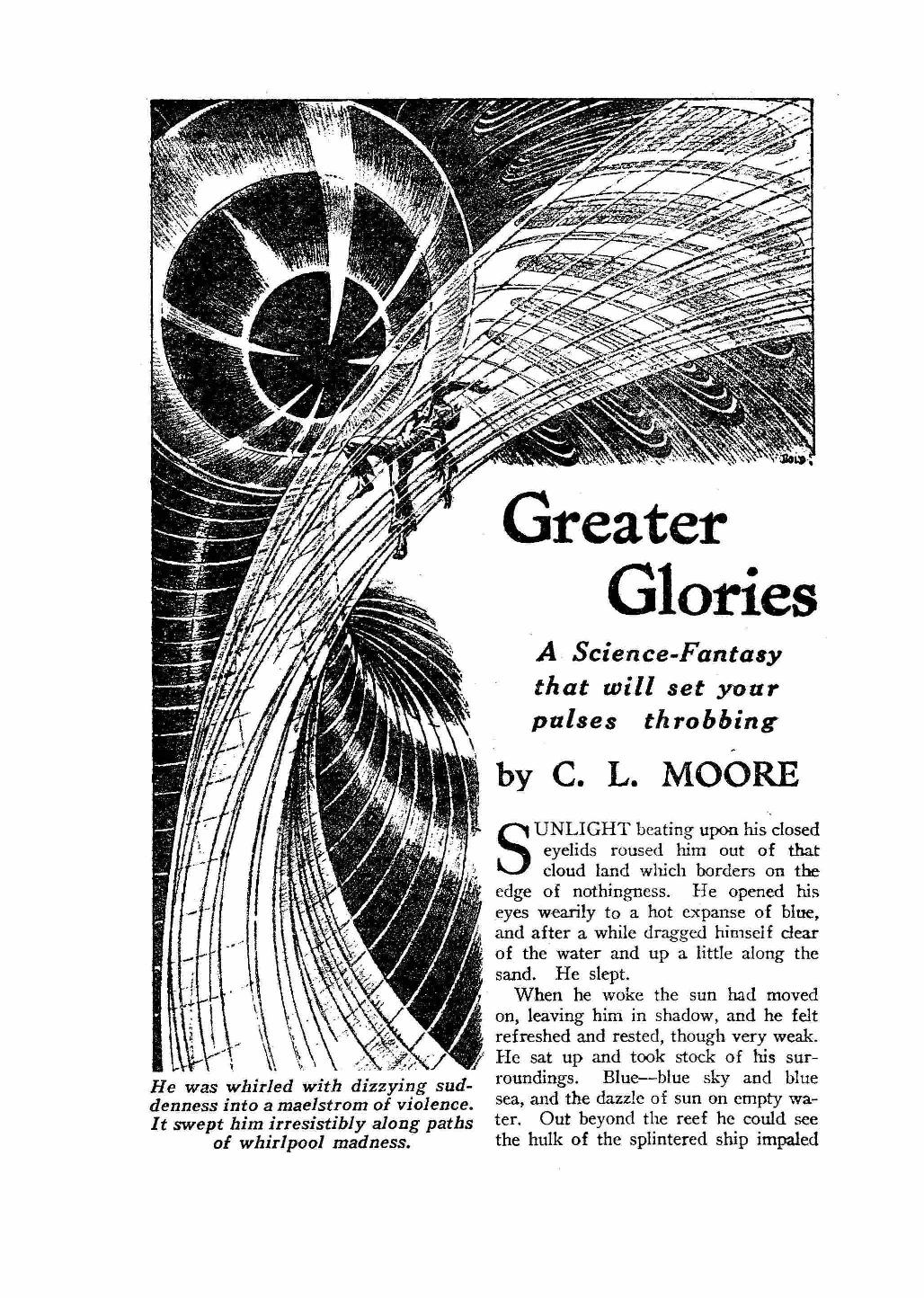
And speaking of Cabell, wait till you read my May story! I hadn’t realized until I read over the proof-sheets they sent me last week how closely it follows the Cabell-Dunsany phraseology. For instance “—so it might have been no mortal twilight, but some strange and lovely evening in a land where the air was suffused with colored mists, and no winds blew”. It’s almost trite, it’s so Cabellian-Dunsanyesqe. (Heavens! Excuse that! I didn’t mean to coin words so flagrantly.)
—C. L. Moore to R. H. Barlow, 28 Apr 1934 MSS Brown Digital Repository

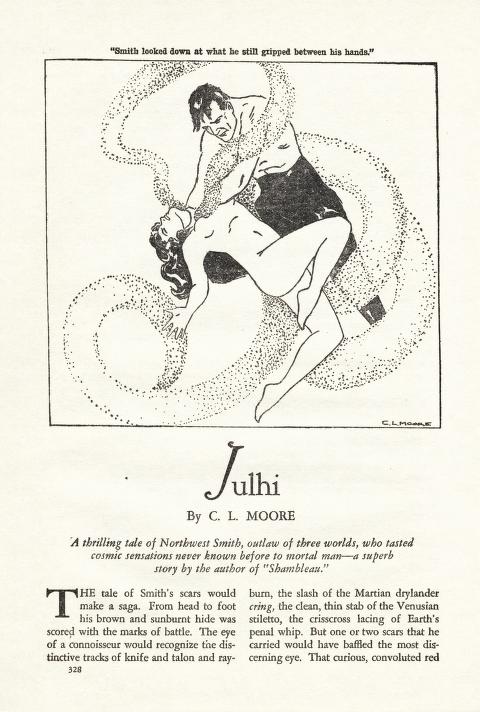
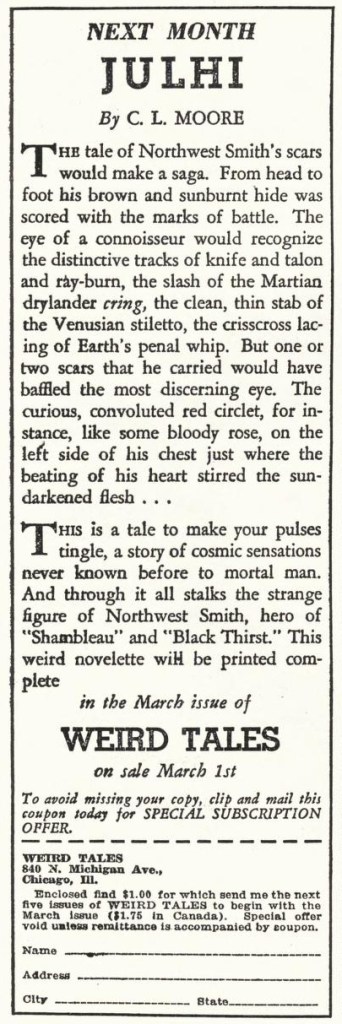
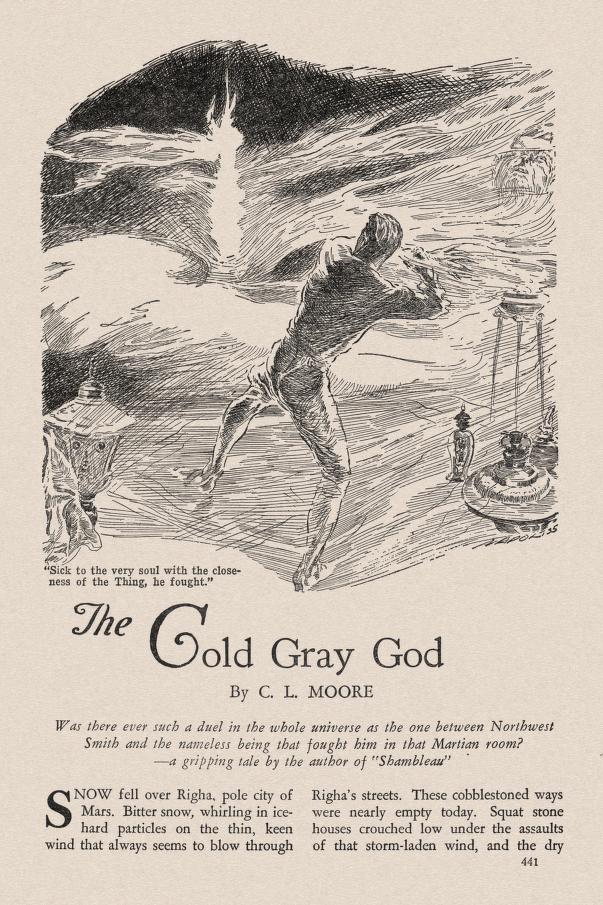
The third tale of Northwest Smith after “Shambleau” (Weird Tales Nov 1933) and “Black Thirst” (WT Apr 1934) followed in the very next issue after the second episode, appearing in the May 1934 issue of Weird Tales. Smith is once again on Mars, though at this point there is no strict chronology in the series, no reference to previous episodes. Each is essentially a standalone story, a separate episode in Smith’s checkered career, much as Robert E. Howard’s characters Conan the Cimmerian and Solomon Kane did not have episodes that followed in any strict chronological order.

In gist, “Scarlet Dream” follows several familiar tropes: an exotic market, a strange purchase, a fabulous dream. Yet the tropes are those of fantasy, adapted to the science fiction setting. There are hints of worldbuilding—a Martian emperor, ivory from Jupiter’s largest moon, a unit of currency called a cris that is more than five dollars—some of which have appeared in previous stories and will appear in future ones, and others which are throwaway details. The idea of a cloth or pattern as a focus of strangeness was nothing new either: “The Yellow Wallpaper” (1892) by Charlotte Perkins Gilman, “The Diary of Mr. Poynter” (1919) by M. R. James, and “The Cloth of Madness” (1920) by Seabury Quinn all being iterations of that idea.

Yet for Northwest Smith, the cloth does not bring madness, but transportation. This was the first of Moore’s stories that would feature the protagonist on a journey to a different world in the sense of another dimension rather than just another planet; a transition fundamentally different from rocketships and standard interplanetary tales fare. However, it is couched in the sort of imagery of Dunsany or Lovecraft’s Dreamlands tales, like “The Silver Key” (1929):

“There are many dream countries,” she said, “many nebulous, unreal half-lands where the souls of sleepers wander, places that have an actual, tenuous existence, if one knows the way. . . . But here—it has happened before, you see—one many not blunder without passing a door that opens one way only. And he who has the key to open it may come through, but he can never find the way into his own waking land again. Tell me—what key opened the door to you?”
—C. L. Moore, “Scarlet Dream”

There’s a woman; nameless and beautiful, tragic and doomed. While many fans and critics will point out the women in Howard’s Conan tales, Northwest Smith is seldom at a loss for a beautiful woman, whether human or otherwise, though his relationships tend to be brief and often marked by strangeness, she was not averse to the possibilities of romance that Lovecraft shunned in his own fiction, nor prone to the kind of nudity, bondage, or flagellation that marked the stories of Seabury Quinn and Robert E. Howard when they sought to make the cover of Weird Tales with a particularly enticing scene.

The nameless Thing that stalks the dream-world, preying as it will, recalls in part Robert E. Howard’s “The Slithering Shadow” (WT Sep 1933), where the amorphous Thog preys upon the dreamers of the city of Xuthal. Whether that was direct inspiration or coincidence, Moore never makes clear in any letter. It is interesting to think of this story as a kind of complement to Howard’s tale; as Conan deals with a city of sleepers and the horror that stalks them, Northwest Smith deals with a dreamer and the shadowy predator that hunts them, and both find a way to hurt their foe, and to escape. Yet it would probably be more accurate to say that without deliberately tying her Northwest Smith story to any Mythos of Lovecraft or Howard’s, Moore was drawing on familiar elements in crafting her own unique tale.

The fan-response was, once more, very positive, though there was a slight trend against interplanetary stories—the criticism being aimed more at Edmond Hamilton than C. L. Moore. “Scarlet Dream” was voted the favorite tale of the issue, beating out Robert E. Howard’s Conan tale “Queen of the Black Coast.” Among her writer peers, H. P. Lovecraft noted the story’s excellence in brief:

“Scarlet Dream” is also the real stuff—full of the tension & mystery needed by a weird tale.
—H. P. Lovecraft to Clark Ashton Smith, [May/June 1934], Dawnward Spire, Lonely Hill 557

The May W T was much above the average, with “Scarlet Dream”, “Queen of the Black Coast” & “The Tomb Spawn”.
—H. P. Lovecraft to Duane W. Rimel, 1 Jun 1934, Letters to F. Lee Baldwin, et al. 180

The plot of “Scarlet Dream” is relatively slight, though evocatively written; if there’s a criticism to be made, then it has to do with the episodic nature of what was now quite clearly a series. All three stories feature broadly the same three-act structure: Northwest Smith is minding his own business; falls into some strange business involving a beautiful woman, has a horrific encounter with some alien entity; and then emerges with the woman dead and Smith strangely affected by an experience beyond normal human ken. Beauty and vampirism are recurring themes. Something that her fellow-Weird Talers noticed:

I can’t get excited over Moore; too feminine stories, for one thing, and the effect rests too much on being outside this earth.
— August Derleth to CAS, 22 May [1934], Eccentric, Impractical Devils 221

Personally, I rather like the Moore stories; though I notice that the three already published all have the same recipe of ingredients. The ray-gun stuff is a drawback. What I do like is the hint of unearthliness. After all, very few writers achieve anything that even suggests the possibility of non-terrestrialism; and I admit that I value this particular imaginative quality.
— Clark Ashton Smith to August Derleth, 4 Jun 1934, Eccentric, Impractical Devils 222-223

Not that there’s anything wrong with that; far from it. The stories had sold and been well-received by fans. Formula by itself is often misinterpreted as a drawback, which it is when someone tries to define and follow it too rigidly. Moore was taking inspiration from her favorite weird fiction and filtering it through her own imagination. What she was concerned about, however, was growing stale.

I was tremendously pleased at your confidence about Mr. Lovecraft’s flattering opinion of me. So much so that I’m ashamed to have you read the sort of stuff I’m turning out now. Those first three of mine I did think were pretty fair, but I just don’t have ideas like that all the time, and meanwhile have got to eat, you know. I mean that quite literally.
—C. L. Moore to R. H. Barlow, 1 Jun 1934, MSS Brown Digital Repository

Farnsworth Wright, editor of Weird Tales, was apparently pleased with what he had read and published so far, and another Moore story would be published just a few months later.

C. L. Moore’s “Scarlet Dream” can be read for free online here.


Bobby Derie is the author of Weird Talers: Essays on Robert E. Howard and Others and Sex and the Cthulhu Mythos.

Deep Cuts in a Lovecraftian Vein uses Amazon Associate links. As an Amazon Associate I earn from qualifying purchases.
Deeper Cut: Lovecraft & Hokusai

As reckoned among the race-stocks of the world, the Indian is certainly not inferior. Neither, for that matter, is the Mongolian race as a whole. It is simply our reaction against the alien and the unaccustomed—together with the circumstance that our immigrant specimens are generally of a low type—which causes us to look down on the Chinese and Japanese. Both of these races, as rationally judged by their history, literature, philosophy, and art, are among the superior biological focus of the planet—and no one who is acquainted with their better classes is ever able to retain that feeling of repulsion which the ordinary American, Australian, or New-Zealander usually feels.
— H. P. Lovecraft to Robert E. Howard, 7 Nov 1932, A Means to Freedom 1.481-482

The 1853 Perry Expedition forcefully ended Japanese political isolation, and during the 19th and early 20th centuries cultural and technological exchanges with the rest of the world profoundly affected both Japan and the rest of the world. The Tokugawa Shogunate was overthrown, and a new government overtook Japan—one dedicated to rapid industrialization and militarization, which in practice meant increasing Westernization. The successful adoption of Western military technology and tactics became clear during the Russo-Japanese War (1904-1905), in which Japan’s surprise victory over Russia fueled racist fantasies of the Yellow Peril.

While Westerners feared the rising military might and aggressiveness of Japan, many were simultaneously drawn to Japanese art and culture. Japanese woodblock prints (ukiyo-e) covered a vast range of material, from purely ornamental to combinations of image and text that illustrated stories and scenes; from depictions of ordinary life and nature studies to erotica and supernatural creatures. Western interest in these woodblock prints is evident from before the U.S. intervention, but after trade was forcefully opened, the prints became much more accessible and inspired a Japonisme style in European art during the late 19th century, as well as collections and reproductions.

By the 1930s, Japanese prints collections were being displayed in U.S. museums, and the names of popular and notorious artists like Hokusai Katsushika (葛飾 北斎, 1760-1849) and Hiroshige Utagawa (歌川 広重, 1797-1858) were being bandied about by newspapers. In June 1934, Providence native Abby Aldrich Rockefeller (wife of John D. Rockefeller, Jr.) donated her collection of Japanese prints to the Rhode Island School of Design.

Japanese Prints Given by Mrs. Rockefeller, Jr.
PROVIDENCE, R.I., June 7—(AP) The Rhode Island School of Design yesterday announced that a rare collection of Japanese prints had been presented by Mrs. John D. Rockefeller, Jr. The 623 prints, devoted chiefly to plant, bird, fish and insect life, are by the country’s greatest masters. L. Earle Row, director of the school museum, said that in accordance with Mrs. Rockefeller’s wishes the collection will be shown in selected groups changed at frequent intervals.
Springfield (MA) Evening Union, 7 Jun 1934, p13

That is where and how H. P. Lovecraft came to be familiar with Japanese prints.

Another event was the display of the choicest of the 717 Japanese prints just acquired by the local art museum. This is a really important accession—placing our museum in competition with Boston’s . . . . which boasts of having the finest Japanese print collection outside of Japan itself. The Providence collection is of the first quality, involving large numbers of items by Hokusai, Hiroshige, & kindred standbys.
—H. P. Lovecraft to Richard F. Searight, 22 Dec 1934, LPS 343

Another event was an exhibition of Japanese prints—part of 700 magnificent specimens (Hokusai, Hiroshige, & all the rest) just acquired by the local art museum. This acquisition will bring Providence into competing distance of Boston—whose Museum of Fine Arts boasts the finest collection of Japanese prints outside of Japan itself.
—H. P. Lovecraft to August Derleth, 22 Dec 1934, ES 2.671

More or less joined to this “art week” stuff was the first display of a choice array of the 717 Japanese prints just acquired by the local museum. This gave me quite a kick, since I am rather an enthusiast concerning Sino-Japanese art. The prints are of the finest quality, with plenty of Hokusais & Hiroshiges. A couple of weeks ago an expert lectured on the making of Japanese prints, & exhibited some of the delicately carved blocks used in their preparation.
—H. P. Lovecraft to E. Hoffmann Price, 30 Dec 1934, LPS 159

It isn’t exactly clear when Lovecraft gained his appreciation of Japanese art, although it seems likely he would have encountered specimens among his visits to art museums in Boston and New York in the 1920s.

Providence Journal, 16 Feb 1935, p18

The RISD celebrated its recent acquisition with an exhibition of the works and a lectures, open to the public—which Lovecraft attended, as he often took advantage of the free lectures on art and science offered by the local universities.

Saw a fine exhibition of Hokusai’s prints—with explanatory lecture—at the museum yesterday.
—H. P. Lovecraft to F. Lee Baldwin, [13 Feb 1935], LFB 123

Saw a splendid exhibition of Hokusai’s prints—with explanatory lecture—at the museum yesterday.
—H. P. Lovecraft to J. Vernon Shea, [19 Feb 1935], LJS 254

Some darned good lectures & exhibitions at one of your two local almae matres—the School of Design. Last week they featured Hokusai—& last night there was an illustrated discourse on Soviet art (in Memorial Hall) which would have had Sonny Belknap jumping up & down & piping!
—H. P. Lovecraft to Wilfred B. Talman, [19 Feb 1935], LWT 253

Providence Journal 24 Feb 1935, p55

The Bulletin of the Rhode Island School of Design (Jan 1935) was entirely dedicated to the gift of the prints and their subsequent display, as well as providing some background on Japanese art. Lovecraft was so impressed that he couldn’t help but grab a few copies to send to friends.

This month there was a splendid lecture & special exhibition pertaining to my favourite Hokusai, & the entire quarterly bulletin was devoted to the subject of Japanese prints. The article was so fine, & the illustrations so graphic, that I could not resist getting several extra copies to send to especially appreciative persons. Note one mistake—on p. 19, with illus. On p. 22—where a Hokusai fan print of hibiscus flowers is erroneously attributed to Hiroshige. I wouldn’t have spotted this if I had not seen the original prints & their authentic labels in the museum.
—H. P. Lovecraft to Elizabeth Toldridge, 27 Feb [1935], LET 298

Later in February I heard an excellent discourse on Hokusai in connexion with an exhibition of his prints at the local art museum. Japanese art certainly appeals to me as few other aesthetic forms succeed in doing. The current museum bulletin was devoted to this subject, & contains so fine an article—together with so many excellent reproductions—that I can’t resist sending you a duplicate under separate cover.
—H. P. Lovecraft to R. H. Barlow, [16 Mar 1935], OFF 221-222

Of lectures there may be noted a highly interesting address on Japanese prints in general & good old Hokusai (1760-1849) in particular, held at the local museum in connexion with an exhibition of the prints. Great stuff—I have always been exceedingly fond of the delicacy, tranquility, & exquisite harmony of Sino-Japanese art. Enclosed are some cuttings illustrative of this event—which ably supplements similar events of last December.
—H. P. Lovecraft to Helen V. Sully, 5 Mar 1935, LWT 404

While the clippings don’t survive, several relevant items in the Providence Journal from the period stand out as likely inclusions:

Lovecraft makes several other brief references to his trips to see the Hokusai prints to various correspondents throughout 1935:

More recently I heard a fine discourse on Hokusai (an old favourite of mine) at the art museum in connexion with an exhibition of his prints. Sino-Japanese art has always fascinated me extremely, & I wish I could afford a Japanese print collection of my own.
—H. P. Lovecraft to Richard F. Searight, 5 Mar 1935, LPS 360

Heard some good lectures recently—a reading by the poet Archibald MacLeish, a discourse on the Japanese artist Hokusai (1760-1849) in connexion with an exhibition of its prints at the art museum, & an account of contemporary Russian soviet art.
—H. P. Lovecraft to Duane W. Rimel, 10 Mar 1935, LFB 261-262

Regarding recent events—possibly I told you of the lecture on Hokusai in connexion with an exhibition of his prints. Great stuff—I’ve always been a devotee of Sino-Japanese art.
—H. P. Lovecraft to J. Vernon Shea, 13 Mar 1935, LJS 262

Heard some good recent lectures on Hokusai, contemporary Soviet art, & the mosaics of St. Sophia in Constantinople.
—H. P. Lovecraft to E. Hoffmann Price, 14 Mar 1935, LPS 173

I thought the Japanese print bulletin especially delightful–you may recall that Hokusai’s “Cranes on Snow-Laden Pine” was one of the things I especially liked in the exhibition last December. I was glad to get so good a reproduction of it. Another captivating print is the one of the cat watching the butterflies—which reminds me that the local feline family is now narrowed down to the mother & one coal-black kitten . . .  a delectable duplicate of the lamented Sam Perkins.
—H. P. Lovecraft to Elizabeth Toldridge, 25 Mar 1935, LET 300

I managed to get out to several lectures—poetry readings by Susanna Valentine Mitchell & the famed Archibald Macleish—author of “Conquistador”—& an excellent discourse on Hokusai at the local museum, in connexion with a notable exhibition of his prints. Japanese art certainly appeals to me as few other aesthetic forms succeed in doing.
—H. P. Lovecraft to Clark Ashton Smith, [26 Mar 1935], DS 598

The RISD exhibition seems to have inspired Lovecraft to seek out more of Hokusai’s work, when available. Later in 1935 when traveling in Philadelphia, he stopped in at the Philadelphia Museum of Art, which was also having an exhibition of Japanese prints:

I also visited the art museum, where an especially fine temporary exhibit of Japanese prints (including the entire Fujiyama, bridge, waterfall, & poem series of my favoruite Hokusai) was on display.
—H. P. Lovecraft to Helen V. Sully, 23 Sep 1935, LWT 438

Despite Lovecraft’s claims to have always appreciated Sino-Japanese art, the specific interest in the prints of Hokusai seems to have come very late in life, driven by the sudden availability of these materials at a local museum. Lovecraft lamented that he could never own a collection of such prints, and in truth there were relatively few published reprints available in the mid-1930s. Buying originals was a game for collectors, and museums were an invaluable resource for those who wished to experience art that they could never afford.

It is important when reading these brief appreciations to understand how thoroughly Lovecraft had absorbed the Orientalist ideas of his day. Racially, the Japanese were other, yet the stereotypes surrounding them were conflicting, covering both admiration for the exotic culture that seemed keenly tied to nature and their own distinct customs, and repulsion at the looming military threat they posed, and their adoption of Western ways. Lovecraft would remark:

After all, as much as the modernisation of Japan is destroying, it may be that the innate aestheticism of the Japanese mind will manage to salvage more from the past than the western world can.
— H. P. Lovecraft to Elizabeth Toldridge, [8 Jan 1930], LET 121

Japanese culture will be hybridised with westernism—more & more as Japanese conquest increases the nation’s contacts with the west. It is a pity, because Japanese aesthetic traditions are among the finest in existence.
—H. P. Lovecraft to Donald A. Wollheim, 9 Jul 1935, LRB 305

The fascination with Hokusai and Japanese prints was one facet of Lovecraft’s fascination with Japanese (and to an extent, Asian cultures) as a whole. It was not an exception to his prejudice, but another aspect of a complex set of views that reflected both the deep cultural fascination with Japan and the Yellow Peril racial fearmongering that informed some of his own fiction. Nor did it begin and end with Hokusai; there is plentiful evidence in Lovecraft’s letters of interest in Japanese art and culture before and after…including Japanese poetry.

Let me endorse the Mocratic recommendation to obtain a free subscription to Travel in Japan. I have done so, & am thoroughly enthusiastic over the charm of the publication—its illustrations of Japanese scenery & architecture, its sidelights on Japanese art & design, & its glimpses of Japanese thought & feeling—musical, poetic bits like the extract cited. Mr. Moe has certainly not overrated the charm of this material—& I am led to wonder whether some English or American translator has prepared the visible text of the various articles & poems from originals in Japanese. In the Spring 1936 issue there is an article on the Japanese spring which well matches the earlier autumnal article. In it is quoted a very fine & typical hokku by the poet Saigyo Hoshi—

“Oh, would that I could
Split myself into many,
And, missing not a twig,
See all the glory of the flowers
In all the unnumbered hills.”

—H. P. Lovecraft to the Coryciani, 14 Jul 1936, ML 340

So when we read about Lovecraft and Hokusai, we are reading one thread of a continuing and complex interaction. Lovecraft was not quite a Japanophile, and his knowledge of Japan was imperfect and heavily influenced by the popular culture of his day, which presented views of Japan that were selective and not representative of the whole of Japanese culture. Yet these exposures to other cultures, however imperfect, did spark admiration and interest in Lovecraft—and readers today can see what Lovecraft saw, and perhaps will likewise come away with an appreciation for these Japanese artists and their work.

Rockefeller’s donated Japanese prints are still held by the Rhode Island School of Design, and many of them can be viewed for free online.

Lovecraft & Erotic Japanese Prints

Readers familiar with Hokusai will probably note an absence in the above descriptions of Hokusai’s work: the lack of erotica. The Rockefeller collection consisted primarily of nature studies, animals, plants, etc.; as far as I have been able to determine, none of Hokusai’s erotic works—such as the infamous “Diver with Two Octopi” (蛸と海女), more popularly known as “The Dream of the Fisherman’s Wife”—were included. Very likely, Lovecraft had no idea about this phase of Hokusai’s career, and possibly had no idea of erotic Japanese prints whatsoever.

Which is not to say that Japanese tentacle erotica had no effect on Lovecraft, only that it likely had no direct effect. Japanese erotic prints (shunga) were popular and influential among European artists in the late 19th century, works like Erotic Japonisme by Ricard Bru and Secret Images: Picasso and the Japanese Erotic Print trace this influence, and in particular how the erotic tentacle motif became established in science fiction art through works like Henrique Alvim-Corrêa’s The Martian Claims a Victim (1906) from his illustrated edition of The War of the Worlds.

Among the many influenced by Japonisme and Japanese print artists such as Hokusai was Aubrey Beardsley, the famous illustrator of the Yellow Book magazine and the first edition of Arthur Machen’s The Great God Pan and The Inmost Light (1894). (For more on which, see Linda Gertner Zatlin’s Beardsley, Japonisme, and the Perversion of the Victorian Ideal (1997).) The image of the tentacle as an alien force spread through the decadent 1890s into the early weird fiction of M. R. James and Arthur Machen as well as the science fiction of H. G. Wells, and by the time of H. P. Lovecraft and his peers the pulp magazines were well-accustomed to this image, and used it in their own work—not generally to penetrate in a sexual manner (that would come later), but as a symbol and motif of corruption and degeneration.

This is the side of Hokusai that Lovecraft very likely never got to see and wasn’t even aware of. The way in which these ideas and images spread and change over time is fascinating and worthy of study.

Providence Journal, 3 Nov 1935, p70

Bobby Derie is the author of Weird Talers: Essays on Robert E. Howard and Others and Sex and the Cthulhu Mythos.

Deep Cuts in a Lovecraftian Vein uses Amazon Associate links. As an Amazon Associate I earn from qualifying purchases.
“Black Thirst” (1934) by C. L. Moore

JE: Did the success of “Shambleau” generate numerous requests for additional stories?

CLM: No, not really. The editor of Weird Tales, Farnsworth Wright, simply told me that he would like to see more of my work. No other editors, at the time, wrote to me requesting additional stories. My success in the science-fiction field came gradually and only after the publication of several other stories. […] I didn’t want it to be known at the bank that I had an extra source of income. I wrote “Shambleau” in the midst of the Depression. The bank was a very paternalistic organization. It was already firing those people whose services weren’t really needed. I had the feeling that they might have fired me had they known that I was earning extra income. So I kept it a deadly secret. Using my initials was simply a means of obscuring my identity.
—“C. L. Moore: POET OF FAR-DISTANT FUTURES” by Jeffrey M. Elliot in Pulp Voices (1983) 46-47

“Shambleau” (WT Nov 1933) struck like a lightning bolt—boldly original, and meeting almost universal acclaim. Yet the pages of Weird Tales are littered with one-hit wonders, authors who sold a single story and never made another sale, or who did sell again but could never recapture the power and promise of that first story. With C. L. Moore’s second tale, readers would find out whether “Shambleau” was a lucky accident or not. Within a few months, they found out.

BLACK THIRST
by C. L. Moore

Another weird and thrilling tale about Northwest Smith, by the author of “Shambleau”—an astounding story of ultimate horror.
—”Coming Next Month,” Weird Tales Mar 1934

Between November 1933 and March 1934, C. L. Moore had not been idle. The Great Depression was still raging, she was still working in her secretarial position in Indianapolis, and she now had a new, unexpected source of income if she could continue to sell stories. According to a 1976 interview with Chacal, her second story, “Werewoman,” was rejected; whether or not this was quite the order of events is unclear as some of her later interviews are contradictory on this matter, but it seems clear that she was emboldened to write several new stories and submit them to Weird Tales; editor Farnsworth Wright bought some of them and relatively quickly brought them to press.

“Black Thirst” appeared in the April 1934 issue of Weird Tales. It is the second published tale of Northwest Smith; the one-off space outlaw was now officially a series character. Set on Venus rather than Mars, with Earth as no more than a green star in the sky, it follows a similar mix of beauty mingled with horror, ray-gun action, and alienation—not repeating the plot of “Shambleau,” but strongly evocative of the elements that had made that story work, somewhat remixed. From some subsequent comments, it is apparent that Moore was at this point more likely to write by the seat of her pants than plot, and take advantage of sudden bursts of inspiration:

You ask for manuscripts. If what you mean is the original draft, all scribbled over, the only one I have now is the medieval-lady opus. I’ll enclose it when I return your magazines. It’s not a very accurate original, tho, for when I typed it for publication I made a good many changes as I went along. And as I remember, I changed my mind in the middle a couple of times, and deflected the course of the story. You see, I never know until I’m half-way through how it’s going to end, and usually have to go back and alter the first a little to hitch up with the last. I was nearly thru with SHAMBLEAU before I had the remotest idea how I was going to rescue Smith from her clutches. And in BLACK THIRST the Alendar’s relapse into primeval ooze was as much of a shock to me as to any of the characters in the sotry. I didn’t know until I had actually begun that scene on the edge of the underground sea how I was going to overcome the Alendar. Smith’s hairbreadth escapes were quite literally harbreadth, for I’m usually breathless with apprehension as I snatch him just in time from the awful dangers that beset him. Tho that’s all past tense now, I suppose.
—C. L. Moore to R. H. Barlow, 1 Jun 1934, MSS Brown Digital Repository

By the way, speaking of the Alendar, I wonder how other people find the odd names they want for characters. I usually glance around ind esperation and seize on the first hting I see. Alendar is simply Calendar with the C left off. And N. W.’s friend Yarol is a transpostion of the name on the Royal typewriter I wrote the story on.
—C. L. Moore to R. H. Barlow, 10 Sep-9 Oct 1934, MSS Brown Digital Repository

There is also a suggestion that Farnsworth Wright, following his editorial habits (see “Bat’s Belfry” by August Derleth), was revising Moore’s manuscripts as they came in. The exact nature of these revisions is unclear, though typically he asked writers to tighten up overwordy passages or would silently remove references to sex.

I trust your revisions may make Mrs. Moore’s second story as striking and interesting as this one.
—H. P. Lovecraft to Farnsworth Wright, 21 Nov 1933, Letters to Woodburn Harris 86

The story is slightly more daring than typical Weird Tales entries. The third paragraph includes a bald reference to “Venusian street-walkers,” and the story deals with human-trafficking and eunuch-guarded harems in a way strongly reminiscent of Yellow Peril stories of white slavery and seraglios, an alien eugenics that treats the breeding of human beings like humans breeds cows or cats, and an almost homosexual element when the Alendar considers Northwest Smith:

“I realized how long it had been since I tasted the beauty of a man. It is rare, so different from female beauty, that I had all but forgotten it existed. And you have it, very subtly, in a raw, harsh way…”
—C. L. Moore, “Black Thirst”

More than “Shambleau,” the expanding Interplanetary setting that C. L. Moore sketches echoes fantasy as much or more than science fiction. She speaks of the three planets (Mars, Venus, and Earth), but there are kings, castles, courts, and courtesans; payment is expected in gold coins; and Smith looks for swords and daggers as much as rayguns. If “Shambleau” was drawing heavily on Westerns, then “Black Thirst” seems to draw as much from her quasi-medieval fantasy setting in her pre-pulp writing. If there is a criticism to the story, it might be that it hews a little too close to the plot of “Shambleau.” Once again, Northwest Smith finds himself facing an almost spiritual as well as physical peril from a vampiric alien. While not quite formulaic, readers could definitely see how strongly it echoed some of the notes of Moore’s first tale.

Yet they loved it.

Donald Allgeier, of Springfield, Missouri, writes: “This letter is written primarily because of Black Thirst. I have a thirst (black or not) for more like it. I hope the next story by Moore is as good as this. . . . Who is C. L. Moore, anyway? Surely he’s not a brand-new author—not when he can write as he does. Could he perhaps be a new pseudonym for some famous writer? I thought he had just about reached the ultimate in his first story, but the second proved my mistake. Most authors would carefully avoid description of all those beautiful girls, but Moore handles it beautifully, delicately, and marvelously. The Alendar, too, is a worthy creation. I’d like to see a novel by Moore.
—”The Eyrie,” Weird Tales June 1934

There were many more fan-comments in that vein, and Wright had already seen the promise of his new discovery and bought more stories from Moore–and Wright was careful at this point to follow her wishes and not reveal her gender, though that bit of gossip would soon make the rounds in fan-circles. Even her pulp peers were impressed by Moore’s sophomore effort; Lovecraft praised it to many of his friends. Though most of Lovecraft’s comments are brief, a few are fuller:

The present issue, I think, is far above the average—with your tale, the splendid Bruks reprint, the powerful Smith yarn with self-drawn illustration, and the strikingly potent, original, and distinctive “Black Thirst”.
—H. P. Lovecraft to Robert E. Howard, 3 Apr 1934, A Means to Freedom 2.727

The recent WT is distinctly above average—“Black Thirst” perhaps leading because of the utter originality of its conception, the vividness of its unfolding, & the ever-brooding air of hidden, transcendent horror just beyond one’s sight. A little less conventionality of the popular-romance setting & mood would increase the power of the tale.
—H. P. Lovecraft to R. H. Barlow, 10 Apr 1934, O Fortunate Floridian 129

“Black Thirst” has a lot of conventional stuff, but the atmosphere of utterly unknown evil & menace is extremely distinctive.
—H. P. Lovecraft to Clark Ashton Smith, [13 Apr 1934], Dawnward Spire, Lonely Hill 552

In 1935 when R. H. Barlow was thinking of re-printing the story for Moore through his small press, he apparently considered revising the tale—which Lovecraft disagreed with:

As for revision—some of the tales would take careful thought indeed. “Black Thirst” couldn’t be revised except by striking at its very core—cutting out the vapid idea of human-looking beauties on another planet (unless descent from a remote terrestrial source is suggested, &c.), &c. It might be wisest to let some of the tales alone, & hope that later specimens will avoid the flaws which they possess. But all that is for later consideration.
—H. P. Lovecraft to R. H. Barlow, [25 Mar 1935], O Fortunate Floridian 229

As a young man, Lovecraft had grown up on adventurous “planetary romances” like Edgar Rice Burrough’s A Princess of Mars, which featured lots of action and improbably human-looking aliens with princesses that could procreate quite readily with Earth-born heroes. Biologically, this is as bunk as Star Wars and Star Trek‘s rubber-forehead aliens, and as an adult Lovecraft was very critical of the idea of Earth-like worlds that evolved Earth-like humanoids, as expressed in Lovecraft’s “Some Notes on Interplanetary Fiction.” So Lovecraft was not strongly drawn to the Burroughs-esque elements that may have appealed to Weird Tales fans; for him, it was the sheer alien weirdness and horror that was the true appeal of Moore’s first couple stories.

There is every indication that Wright knew he had another hit on his hands with “Black Thirst,” because he had already bought other stories that was destined to appear in subsequent issues of Weird Tales. Yet the Unique Magazine brought with it more than acceptances and (eventually) welcome checks; Moore also made new friends, as fan-letters from Weird Tales turned into correspondences with folk like R. H. Barlow.

I hope you will not be too much disappointed in the stories that follow. Perhaps, when you have read those appearing in the April and May issues, you will write again to tell me what you thought of them.
—C. L. Moore to R. H. Barlow, 8 Mar 1934, MSS Brown Digital Repository

Through Barlow, Moore would come to correspond with Lovecraft, Robert E. Howard, and Clark Ashton Smith, among others. It connected her to a wider community of writers, whom she would both influence and be influenced by. If “Shambleau” marked C. L. Moore’s arrival on the scene, “Black Thirst” helped her swiftly gain acceptance into the world of weird and science fiction pulp writers.

C. L. Moore’s “Black Thirst” can be read for free online here.


Bobby Derie is the author of Weird Talers: Essays on Robert E. Howard and Others and Sex and the Cthulhu Mythos.

Deep Cuts in a Lovecraftian Vein uses Amazon Associate links. As an Amazon Associate I earn from qualifying purchases.
“The Corpse That Wouldn’t Die!” (1953) by Jack Cole

I have given the whole of a cloudy Sabbath to finish my dismembered corpse story—“The Return of Helman Carnby”. I shall enclose the carbon with this; and I hope you will like it. The thing became a sizable yarn, with all the details that I worked out . . . It goes to “Ghost Stories”, then to W. T.,—both of which will doubtless reject it. But I think myself that the tale is a pretty fair literary beginning for the New Year. I like to picture it in the sunny and lightsome pages of the “Ladies’ Home Journal.”
—Clark Ashton Smith to H. P. Lovecraft, c. early Jan 1931, Dawnward Spire, Lonely Hill 290

Needless to say, I perused the monstrous narrative of Helman Carnby with the most acute & shuddering admiration; &, having made the verbal changes indicated in your supplementary note, have forwarded to Derleth with instructions for return to you through Wandrei. It is certainly a great piece of work, & I am extremely flattered by the prominent part played therein by the Necronomicon. But God! If there is still a copy of the original Arabic version in existence, what safety can we guarantee for this unhappy planet? Is it not true that no copy was found when the police entered the seemingly deserted mansion of Carnby & observed those hideous & inexplicable conditions which the newspapers were not allowed to print? What of that utterly unthinkable foot-mark which seemed to be burned into the floor? But one must not think of such things! Anyway, it’s a great yarn, & the cumulative suspense & malign suggestiveness of the earlier parts are enough to set any outfit of teeth—even false ones on a dentist’s cupboard shelf—chattering! It looks to me quite all right as it is—if there were any way of piling on another shudder, I’d say it would be by veiling the final horror a little more obscurely from actual sight, & trying to hint or imply the blasphemous abnormality which sent the secretary fleeing from that accursed habitation. I certainly hope that the tale will find a typographical haven.
—H. P. Lovecraft to Clark Ashton Smith, c. 18 Jan 1931, Dawnward Spire, Lonely Hill 293

Ghost Stories did not take “The Return of Helman Carnby,” not even after Smith re-wrote the ending and sent it back for another look; nor was it published by Weird Tales. The story was published in Strange Tales of Mystery and Terror (Sep 1931), under the title “The Return of the Sorcerer.” This is arguably Smith’s most distinctly “Lovecraftian” story, being an explicit extension of Lovecraft’s Mythos rather than involving any of Smith’s own fabulous settings and entities, and one of the first uses of the Necronomicon outside of Lovecraft’s own works (compare “The Were-Snake” (1925) by Frank Belknap Long, Jr. and “The Picture” (1939) by Robert D. Harris).

“The Return of the Sorcerer” was reprinted in Smith’s first Arkham House collection Out of Space and Time (1942), and anthologist August Derleth selected it for inclusion in Sleep No More (1944), which meant it was included in the Armed Services Edition of that book issued to soldiers during World War II. One can just about imagine a marine en route across the Pacific Ocean idling away a sweltering hour reading of the dismembered corpse crawling from the grave. By the 1950s, however, “The Return of the Sorcerer” had been out of print for years—though not forgotten.

Web of Evil was a horror comic published by Quality in the years immediately before the formation of the Comics Code Authority, and which ran 21 issues. The product was typical of the era: often shoddy artwork and simple, quick stories that emphasized grue and taboo, shock and suspense. The stories were often unsigned and the creators weren’t above lifting a plot from an old pulp magazine from time to time.

“The Corpse That Wouldn’t Die!” in Web of Evil #2 (Jan 1953) by artist Jack Cole is very clearly based on “The Return of the Sorcerer.” The names were changed to hide the plagiarism, and the unnamed Necronomicon is in Sanskrit rather than Arabic, but the essentials of the story are clearly recognizable. It may no longer be a Mythos story, but for all that it has a distinct charm for those that recognize that Cole is, at least, lifting from the best.

At six pages, the action moves fast—and in almost every panel, Cole tries to add some dramatic element of lighting or motion to capture the eye or set the tone, which often leads to near-comical exaggeration. Though there is not so much grue as there might have been: after all the corpse of the deceased sorcerer is still intact when it returns from the grave.

Lifting stories from pulp writers was not unusual in the 50s, and “The Corpse That Wouldn’t Die!” sits neatly among the Pre-Code Lovecraftian Horror Comics. The tale has been reprinted a number of times, including a version in Tales of Voodoo vol. 5, no. 2 (Mar 1972), where the art was reworked by Oscar Fraga and the result retitled “The Deadly Corpse” (sample pages below). Fraga’s rework updates the art to match the sensibilities of Eerie Publications in the 70s, but doesn’t add anything new to the story itself.

The original Web of Evil version can be read for free at Comic Book Plus.


Bobby Derie is the author of Weird Talers: Essays on Robert E. Howard and Others and Sex and the Cthulhu Mythos.

Deep Cuts in a Lovecraftian Vein uses Amazon Associate links. As an Amazon Associate I earn from qualifying purchases.
“Lockbox” (2015) by E. Catherine Tobler

There are not a vast number of women mentioned in H. P. Lovecraft’s “The Rats in the Walls.” However, two stand out:

The worst characters, apparently, were the barons and their direct heirs; at least, most was whispered about these. If of healthier inclinations, it was said, an heir would early and mysteriously die to make way for another more typical scion. There seemed to be an inner cult in the family, presided over by the head of the house, and sometimes closed except to a few members. Temperament rather than ancestry was evidently the basis of this cult, for it was entered by several who married into the family. Lady Margaret Trevor from Cornwall, wife of Godfrey, the second son of the fifth baron, became a favourite bane of children all over the countryside, and the daemon heroine of a particularly horrible old ballad not yet extinct near the Welsh border. Preserved in balladry, too, though not illustrating the same point, is the hideous tale of Lady Mary de la Poer, who shortly after her marriage to the Earl of Shrewsfield was killed by him and his mother, both of the slayers being absolved and blessed by the priest to whom they confessed what they dared not repeat to the world.
—H. P. Lovecraft, “The Rats in the Walls”

While it wouldn’t be quite accurate to say that Lovecraft scholarship has ignored these women, it would be accurate to say that the picklocks of literary critics and historians haven’t turned up any particular connections or likely historical or literary inspirations for Margaret Trevor and Mary de la Poer. While we know Lovecraft drew inspiration for this tale from Sabine Bearing-Gould’s “S. Patrick’s Purgatory” in Curious Myths of the Middle Ages, and while there is no lack of mysterious ladies therein, one stands out as a possible inspiration:

It is worthy of remark that the myth of S. Patrick’s Purgatory originated among the Kelts, and the reason is not far to seek. In ancient Keltic Mythology the nether world was divided into three circles corresponding with Purgatory, Hell, and Heaven ; and over Hell was cast a bridge, very narrow, which souls were obliged to traverse if they hoped to reach the mansions of light. This was—

“The Brig o’ Dread, na brader than a thread.”

And the Purgatory under consideration is a reflex of old Druidic teaching. Thus in an ancient Breton ballad Tina passes through the lake of pain, on which float the dead, white robed, in little boats. She then wades through valleys of blood. (248-249)

This is speculative; Lovecraft borrows some of the imagery for “The Rats in the Walls,” and it includes a woman recalled in a ballad associated with pain and blood, which may have been the seed from which Margaret Trevor and Mary de la Poer (and their respective ballads) grew. One might also wonder if the legend of Elizabeth Bathory worked on Lovecraft’s imagination, or any of the prospective cultists included in Margaret Murray’s The Witch-Cult in Western Europe, and these are certainly possible. The image is, in both cases, of women of the line who do not shrink away from the family cult, but become active participants.

Trish Thawer in The Witches of BlackBrook (2015) famously wrote: “We are the daughters of the witches you weren’t able to burn.” While that may not be historically true (convicted witches during the Salem Witch hysteria were hung, not burned at the stake), there is a sentiment that applies to readers and writers in Lovecraft’s Mythos: who are the daughters and granddaughters of Lovecraft’s women cultists, who had such a bad reputation that they haunted the ballads of the country for centuries thereafter?

Which is the theme that E. Catherine Tobler assays in “Lockbox,” one of the stories in She Walks in Shadows. The brief story is a return to Exham Priory by a female descendant of the de la Poer (or Shrewsfield) line and her not-quite-trustworthy lover…and the thing that makes the story work is that it is her story, her reconnection with this ancestor and all the mystery and horror that Margaret Trevor of Cornwall represents, not as a member of the cult she was marrying into, but as a black saint in her own right:

The worst thing was, despite the horrors around her, Margaret Trevor was something to be worshipped, a glory even in the blood and ruin that streaked her. The stories said that she loved the old cults well, but had taken a passive role beside her husband. But here, in the horrible cellar with the collapsing girders, she was a gold-and-silver goddess while her husband cowered.
—E. Catherine Tobler, “Lockbox” in She Walks in Shadows 94-95

The story is told with many footnotes, many caveats, things that cannot be said and perhaps dare not be remembered. It gives the suggestion of a maddening experience that has snapped a thread of sanity and memory, but the title is the crux of the story, because it is a mystery and a memory that the narrator can choose to recall whenever she wishes—whenever she is ready to leave her placid isle of ignorance and remember what really happened down there, in the buried ruins of Exham Priory.

“Lockbox” by E. Catherine Tobler was first published in She Walks in Shadows (2015) and its reprints, and was also reprinted in Wilde Stories 2016: The Year’s Best Gay Speculative Fiction.


Bobby Derie is the author of Weird Talers: Essays on Robert E. Howard and Others and Sex and the Cthulhu Mythos.

Deep Cuts in a Lovecraftian Vein uses Amazon Associate links. As an Amazon Associate I earn from qualifying purchases.

The Long Shalom (2023) by Zachary Rosenberg

People have such queer ideas about private detectives.
—Raymond Chandler, The Long Goodbye (1953)

Hardboiled detective fiction has never ignored the existence of ethnic minority, BIPOC, and LGBTQ+ characters. The representation often wasn’t great; prejudices were common, and sometimes a plot point. Genre-blending mixes with hardboiled fiction tend to follow similar lines. In the made-for-tv movie Catch A Deadly Spell (1991), for example, a key plot point is that the man who stole the Necronomicon is in a relationship with a transwoman.

There has been a trend in contemporary works, however, to swing the other way. Instead of token diversification or showcasing prejudices while fixing on a white cisgender heterosexual viewpoint, there are stories that focus on minority viewpoints, and in particular on intersectional experiences. Winter Tide (2017) by Ruthanna Emrys has as a protagonist an Innsmouth woman during the 1950s, but her group includes two gay men, a brother and his Black girlfriend, and a Japanese-American woman; Ring Shout (2020) by P. Djèlí Clark focuses on a group of Black women, one of whom is gender-nonconforming and homosexual, another mixed-race; The City We Became (2020) by N. K. Jemisin has a group as cosmopolitan as New York itself.

The Long Shalom by Zachary Rosenberg is another entry in that mode—I asked a few folks for a pithy descriptive term, and they suggested “wokepunk” and “diversifiction”—focused on protagonist Alan Aldenberg, a bisexual Jewish WW1 veteran and ex-mob gunsel, now wise-cracking private detective, who ends up dealing with a Lovecraftian supernatural threat. Aldenberg teams up with his half-Japanese/half-Jewish bisexual ex-girlfriend and two fellow WW1 veterans: an African-American man and a transwoman.

Yet the most important thing about The Long Shalom isn’t the cast of characters; it’s how the story is fundamentally based on their experiences and the discrimination they face. As in Ring Shout, the racial, ethnic, and gender discrimination they face becomes embodied as both traditional and supernatural threats. These individuals, who each have to deal with intersectional discrimination for their particular identities, also now have bigoted cosmic horrors to deal with.

Which leads to a certain aspect of the protagonists taking these new horrors in stride. There is more to the complex interplay of identity as Alan, long non-practicing, returns to the Jewish neighborhood and finds himself an outcast among outcasts, than there is to him confronting an ancient horror that seems immune to bullets. As the fantasy aspects increase—thanks to ancient scrolls and some very Innsmouthian-flavored Jewish women in a remote seaside community—the impression becomes closer to a retelling of a game of Harlem Unbound (2017), albeit with more of a Jewish than Black focus, and the mundane antagonists become almost cartoonish in their bigotry.

Yet that is kind of the point: as much as some of these characters feel like a caricature, the real thing, whether they were police uniforms or Klan robes, was if anything more explicit and violent. Racism and prejudice is seldom nuanced or interesting at base; it’s dull, ugly, and stupid, a combination of ignorance and stereotypes, hot points of emotions that can flash into bursts of unbelievable violence over almost nothing.

Alan clenched his teeth, fighting for something inspiring to say and coming up emptier than a wine bottle after Purim.
—Zachary Rosenberg, The Long Shalom 90

While the novel is short and the fantastic elements get away a bit from the more grounded characterizations, Rosenberg does have a certain style and authentic understanding of the characters and their cultures, which is appealing. Like Ring Shout, the threat is Lovecraftian without being based explicitly on Lovecraft’s Mythos; this is fundamentally an effort to write a Jewish horror story, with a hardboiled setting and more than a taste of pulp action—and it succeeds at that.


Bobby Derie is the author of Weird Talers: Essays on Robert E. Howard and Others and Sex and the Cthulhu Mythos.

Deep Cuts in a Lovecraftian Vein uses Amazon Associate links. As an Amazon Associate I earn from qualifying purchases.
Deeper Cut: How to Read One Who Walked Alone by Novalyne Price Ellis

How to Read One Who Walked Alone by Novalyne Price Ellis
by
Bobby Derie

While they were acquainted for only about 22 months between the autumn of 1934 and the summer of 1936 (with a brief meeting in 1933), Ellis’ remembrance of Howard is the longest and most intimate memoir from anyone who personally knew him to be published. By the time that Howard scholarship focused on trying to record the memories of Howard’s friends and relatives, many had died, others were attempting to recall events from forty or fifty years before, and relatively few had intimate knowledge of Bob’s life and work.

All of which makes Novalyne Price Ellis’ One Who Walked Alone, published in 1986, an important resource for Howard studies. The book-length memoir of her on-again, off-again relationship with Bob Howard from 1934-1936 also gives a picture of life as a schoolteacher in a small Texas town, and the community of Cross Plains during the Great Depression, providing additional context to the narrative of her life and relationship with Bob.

The question scholars have to ask themselves before they use One Who Walked Alone is: how to read it? Can we read it strictly as nonfiction, or should it be considered closer to a work of fiction strongly drawn from real life, like Robert E. Howard’s semiautobiographical novel Post Oaks & Sand Roughs? What are Novalyne Price Ellis’ intentions and biases in writing this book, and how do these affect the final work? Perhaps most importantly, what does Ellis not address in One Who Walked Alone, and what can we read from those gaps?

These aren’t easy questions to answer because with Mrs. Ellis is deceased, and her original source materials have never been made available. However, we do have access to contemporary newspaper articles, memoirs about Robert E. Howard, and Howard’s own collected letters, which we can compare against the text and use to verify specific dates and events. We also have access to some of Novalyne Price Ellis’ own statements and letters, both during the period when she was writing and editing her manuscript for publication, and afterwards when she answered questions from fans and scholars. 

By combining these materials, a close reading of One Who Walked Alone reveals more about the nature of Novalyne’s book and how we should read it. When it comes to evaluating memoirs as historical documents, we must trust the authors to be honest—but verify as much as we can.

To begin with the text itself, in her foreword Novalyne Price Ellis reveals that the text began with “old diaries and journals I had kept from 1934 to 1936 (OWWA 11); in her preface, she reveals that “two names in the book […] were changed in order not to embarrass anyone still living” (OWWA 12). This by itself makes evident two important facts: that this memoir is drawn from her journals (and in fact takes the form of entries from those primary source documents), and that they have been edited or altered.

In fact, a look at Novalyne Price Ellis’ letters from 1978-1986 gives an idea of her process in writing and editing One Who Walked Alone. Early letters suggest she began simply transcribing her handwritten diaries and journals, typing them out to make them legible, e.g.:

Several years before I met Bob I was interested in writing, and I kept diaries and journals. Because of my interest in drama, I wrote conversations I had with people including those (many of them) that Bob and I had. The last few months Sprague de Camp has been urging me to write about Bob. If I could publish the diaries exactly as I wrote them, I would do so. Then people would know that Bob was neither crazy nor a freak. I am trying to type up the diaries and journals this summer before I begin another year of teaching.
—Novalyne Price Ellis to Glenn Lord, 3 Jul 1978, Selected Letters 2.3

However, it quickly becomes clear that Ellis wasn’t just transcribing the diaries and journals, but was also rewriting portions of the text:

Last week, I finished a section of my book that I have rewritten twice, and I still don’t like it. Some of the things I wrote in 1934 were pretty bad. I couldn’t decide what to do with it—whether or not to throw it away entirely, but I couldn’t do that, because it was something that had to be in the book.
—Novalyne Price Ellis to L. Sprague de Camp, 5 Aug 1979, Selected Letters 1.30

What exactly this rewriting consisted of is unclear—presumably changes of phrasing, silently correcting spelling errors, making entries stylistically consistent, etc. Some of the changes were clearly done on Ellis’ part to reflect the interests of people still living and, possibly, confidences once entrusted to her:

About four weeks ago, I was going through some material and I came across these words of Bob’s: “I’ll say this to you, but I wouldn’t say it to anybody else.” Where does that put me? He made that statement several different times. Am I still bound by that confidence? I wonder.
—Novalyne Price Ellis to Glenn Lord, 11 May 1980, Selected Letters 2.41

Also incorporated into the book were drafts of articles that were likely also drawn from the diaries and journals, to whit:

There are two chapters in the first 135 pages I do like, and I think Donald wanted to cut them. One of them described my trip to Cross Plains to apply for the job, and the other was the first faculty meeting. I think both of those chapters tell a lot about Cross Plains. They are the chapters I called you and Kirby about to ask if you didn’t think they should be left in, because they formed a background for Bob’s town, and both of you agreed with me. Both of them had been first drafts of articles about school teaching.
—Novalyne Price Ellis to Glenn Lord, 18 Mar 1984, Selected Letters 2.121

Mrs. Ellis also makes it clear that she was attempting to stick closely to the original diary and journal entries, sometimes to the detriment of readability:

While I was working on it and before I read it, all I could think of was that it does tell a lot more about Bob Howard the man than anyone else has written. What I didn’t realize was that in most cases, I stuck too close to the old diaries and journals; consequently, I wanted to cry while I went over the first 135 pages. How in the world could I fail to see that I was overwriting?
—Novalyne Price Ellis to Glenn Lord, 18 Mar 1984, Selected Letters 2.120

There are (depending on how you count) 78-80 entries, ranging in length from less than half a page to 11 pages in length. While predominantly told in the first person from Ellis’ perspective in a diary style, she does sometimes include fragments of dialogue and bits of conversation she had with others, in a more novel-esque fashion, which presumably came from her journal entries, as she was in the habit at the time of recording conversations in her journal to practice dialogue technique (SL1.26).

The first entry is dated 1933, and the last is in 1936, after Robert E. Howard’s death. The sequence of entries appears to be linear and some entries are specifically dated while others are vague. Ellis herself admitted that “The diary has a few dates—not enough” in a letter to Glenn Lord (SL2.46). Attempting to map the book directly onto a calendar doesn’t work, and the timeline is alternately compressed or decompressed depending on how prominently Robert E. Howard features in the narrative. We can assume entries not featuring him were edited out or combined, and this, combined with Ellis’ inconsistent tendency to date her entries, is why some of the dating is ambiguous. However, by correlating the events in One Who Walked Alone with other sources, we can map out a rough timeline for the book that corresponds closely with what we know of Novalyne and Bob’s lives in 1933-1936.

For example, we know from newspaper sources and yearbooks that Novalyne Price Ellis graduated from Daniel Baker College in May 1933, and that she was elected to teach at Cross Plains High School in August 1934, the school year beginning 10 September, which agrees with the beginning of One Who Walked Alone. When Novalyne mentions “We had such a large crowd that people had to be turned away” on page 118 agrees with the account given of the Hallowe’en frolic in the Cross Plains Review for 2 November 1934. When Novalyne writes “Bob is still in Temple” on page 182, we can confirm from Howard’s own letters that Bob and Hester Howard spent a month in Temple, TX for medical treatment (A Means to Freedom 2.838).

Further interpreting the content of One Who Walked Alone requires understanding the context of its publication and what other works may have influenced Novalyne Price Ellis’ manuscript, consciously or unconsciously. Interest in Robert E. Howard had begun to revive in the 1950s with the hardback publication of his Conan fiction by Gnome Press, and then seemed to explode in the 1960s and 70s with paperback publication. Science fiction and fantasy fandom, which had long neglected Robert E. Howard, began to organize with fanzines like Amra and The Howard Collector by Glenn Lord, and organizations like the Hyborian Legion and the Robert E. Howard United Press Association. Critical interest in Howard’s fiction led to scholarly interest in Howard the person, and finally, attention was given to his surviving friends, neighbors, relatives, and colleagues to learn more about Bob Howard.

According to her letters, Novalyne Price Ellis had conceived of a book-length memoir of Bob Howard shortly after his death in 1936:

I have always felt that I owed it to Bob to write about him as a person. After his death in 1936, I began organizing the things I’d written while we were going together and writing new things. However, I only wrote about 30 or 40 pages. I’m sure the book was more about me than about Bob, but I called it THE NEW HAMLET . . . YOUNG AND TRUE. There are a number of reasons I did not finish it: writing it was painful, I was still going with Truett and liked him, but mostly because I have always liked teaching better than writing.
—Novalyne Price Ellis to L. Sprague de Camp, 20 Aug 1977, Selected Letters 1.14 

She certainly still had interest in the subject in the 1940s, as shown by her radioplay “Day of the Stranger” (1947). However, she was at that point employed full time as a teacher with many extracurricular activities, married, and a mother; the project lapsed. Mrs. Ellis came to the attention of fandom and scholars in the 1970s, including correspondence with L. Sprague de Camp and Glenn Lord. According to her letters, the contact with these scholars and interest in Howard and ongoing publications about his life and work, along finally Mrs. Ellis’ retirement from teaching in 1979, encouraged her to revive her project.

At the time she was writing and editing (~1978-1982), the vast majority of Robert E. Howard’s correspondence had not yet been published. Many of the memoirs from Howard’s friends had only been published in various fanzines, some quite rare and obscure. Novalyne Price Ellis did read a few of these things:

I have read very few things about Bob—sometimes a book review or comment—and what I did read didn’t seem to me to be exactly what should have been said. I read one short biography that was filled with what I felt were inaccuracies.
—Novalyne Price Ellis to Glenn Lord, 1 Aug 1979, Selected Letters 2.10

In a later letter, she says this was a book published by Arkham House, which would be Literary Swordsmen and Sorcerers (1976) by L. Sprague de Camp, whose biographical chapter on Robert E. Howard is “The Miscast Barbarian.” We also know that Ellis read Harold Preece’s article “Women and Robert Ervin Howard” in Fantasy Crossroads #3 (May 1975), because she mentions it in her letters (ibid.), there are also references to her having read pieces on Robert E. Howard by E. Hoffmann Price and an individual named Troll (SL2.19).

The major accounts of Howard’s life that were relatively available were E. Hoffmann Price’s stories of his two visits to Robert E. Howard in Cross Plains in 1934 and 1935; Tevis Clyde Smith’s Frontier’s Generation, which included an essay on Bob in the enlarged 1980 edition; Glenn Lord’s The Last Celt: A Bio-Bibliography of Robert E. Howard (1976); and a series of biographical works by L. Sprague de Camp: The Miscast Barbarian (1975), a chapter in Literary Swordsmen & Sorcerers (1976), and Dark Valley Destiny (1983), written with his wife Catherine Crook de Camp and Jane Griffin. These are the sources that Mrs. Ellis would most likely have had access to and be influenced by.

Smith was a personal friend of Ellis going back to the 1930s; it is impossible to discount the possibility that his memories or memoirs of Bob Howard influenced her own, and she references his book in One Who Walked Alone (11, 52, 170). While there aren’t any specific incidents that seem drawn from Smith’s memoirs, we can assume any influence was baked in, as he both wrote the introduction and directly influenced the editing. She wrote that when the book was finished:

As you know, I wanted Clyde Smith to read what I had written about Bob before anyone else read it. I visited with him and his wife Rubye in early 1980. 
—Novalyne Price Ellis to Thomas W. Collins, 10 Nov 1988, Selected Letters 1.47

According to Ellis, when Smith reviewed the manuscript, he said: “Novalyne, you’ve got me saying ‘God damn’ too much.” Ellis’ reply was: “I laughed and agreed to cut some of them out.” (Report on a Writing Man & other reminiscences of Robert E. Howard 6). In One Who Walked Alone, Smith never swears worse than “damn.”

E. Hoffmann Price’s memoirs are functionally brief, and while they offer good detail on Robert E. Howard and, to a lesser extent his family, offer little detail on the town or its inhabitants. While she never met E. Hoffmann Price during his 1934 or 1935 visit or afterwards, she does mention that she had heard of the visit (OWWA 114-116, 263). While there are no direct anecdotes repeated in their respective memoirs, there are some interesting parallels. For example, both Price and Ellis mention how Hester Howard acted as a filter on the phone, keeping young women from talking to Bob Howard (The Acolyte Fall 1945, 32; OWWA 41). Likewise, both Price and Ellis discuss Bob talking about enemies (BOD 74, OWWA 257), and both mention that Howard kept a firearm in the glovebox of his car (The Acolyte Summer 1944; OWWA 73).

Ellis entered correspondence with Glenn Lord in the late 1970s, and The Last Celt contained biographic materials including essays by Howard’s friend Harold Preece and E. Hoffmann Price. Regarding this and other of Lord’s publications on Howard, Ellis politely declined to read them:

Thank you for telling me about your book—THE LAST CELT. I haven’t looked for a copy yet because I am busy with my own story about Bob. I don’t want to read anyting [sic] of anyone else’s until I finish. Whatever value my book will have will be Bob as he impressed people in Cross Plains and as I knew him. Naturally, I sincerely feel I knew the real Bob Howard.
—Novalyne Price Ellis to Gleen Lord, 18 Jul 1978, Selected Letters 2.5-6

However, in later letters, Mrs. Ellis does mention Preece’s biographical essay on Bob in The Last Celt (SL2.16, 19). Regarding E. Hoffmann Price’s essay:

 In The Last Celt, I thought Price was unnecessarily harsh about Bob too. Consequently, I had wanted my book to present him as he was—a good, kind man, who—if he was a little peculiar—had a right to be under the circumstances.
—Novalyne Price Ellis to Glenn Lord, 27 May 1984, Selected Letters 2.125

Some parallels are to be expected when discussing the same subject, so this doesn’t mean that Mrs. Ellis was cribbing notes off Price but it is important to note those parallels because sometimes knowledge of other memoirs or scholarship can creep into a work. Novalyne Price in 1934-1935, for example, could not know that Robert E. Howard would commit suicide; yet there are passages in One Who Walked Alone which can clearly be read as foreshadowing. For example, there is an encounter with Dr. Howard in what would be about November 1934, on One Who Walked Alone 181-182:

Dr. Howard straightened his shoulders, and his voice was stronger.

“Robert will be all right now, I think.”

That surprised me. “Has he been sick, too?”

Dr. Howard looked closely at me for a moment before he answered. He shook his head. 

“No. Not sick. He is very close to his mother.”

So that is unique? I thought, irritated slightly. I thought of my own mother and grandmother, and wondered how I could ever get along without them. 

“All of us are close to our mothers,” I said. “Somehow we manage to make it without them, I suppose.”

Dr. Howard sighed and looked toward the street at the passing cars. He didn’t see me. “Yes,” he said. “We manage.”

If this exchange happened when the text indicates, it is a significant foreshadowing of events. Mrs. Ellis, compiling and editing the work in the 1970s, clearly realized in hindsight how significant such a conversation would be. Yet we have no way of knowing if this exchange actually take place, when and where and how Novalyne Price Ellis indicated, or if it was fabricated to better fit the narrative. Some evidence in her letters suggests that Ellis definitely moved things around to fit her narrative:

Another thing I want to comment on is the first 168 pages that I have already sent to you. I want to cut some of the things in them for two reasons: 1) I think some later material concerning Bob is more important than some of that presently included. 2) I found a few things that I think should be included in the first part of the book. Some of the things can fit in anywhere, but one or two really need to be included early.
—Novalyne Price Ellis to Glenn Lord, 8 Dec 1980, Selected Letters 2.50

Dark Valley Destiny makes a particularly interesting point of comparison because one of the sources for that first full biography of Robert E. Howard was Mrs. Ellis herself, and was also drawing on E. Hoffmann Price’s memoirs and correspondence. Novalyne and the de Camp’s correspondence reveals a complex relationship, as the de Camps were very interested in her as a source of information about Robert E. Howard but were keen to interpret that information through their own lens when writing about him. For her own part, Novalyne was very aware that the de Camps were writing a biography about Bob at the same time that she was writing a memoir. The result was a kind of cagey rivalry, neither side wanting to give up too much data or make concessions on what material they would or would not use in their own book.

As a consequence, while Dark Valley Destiny covers Bob and Novalyne’s relationship, there are some subtle differences between the two works, both in detail and especially in interpretation. Several exchanges mentioned in both books are given slightly differently (cf. OWWA 39/DVD 314, 317; OWWA 54/DVD 315; OWWA 82/DVD 314-316). The reason for the discrepancy may be a factor of different routes of transmission (Ellis had her journals and her own memories, the de Camps only their conversations and correspondence with Ellis) or different editorial preferences. In some cases, the distinction represents an expansion that might be beyond the original journals. For example, in One Who Walked Alone 160 she says Robert E. Howard “talked about Atlantis,” but in Dark Valley Destiny she is quoted quoting Bob:

“Look, girl! Once upon a time, long ago, there was this vanished civilization of Atlantis, on an island in the ocean….”

In another instance, in One Who Walked Alone, Ellis quoted Howard:

“The Cro-Magnon man had it all over us modern men. He saw a woman he wanted, grabbed her by the hair of the head and dragged her back to his cave.”

In Dark Valley Destiny, Ellis is quoted quoting Howard:

“Look, girl, if this were Conan, he’d bat you down and drag you by the hair in the dust!” (DVD 319-320)

The phrasing echoes Bob’s dialogue in One Who Walked Alone, even though it doesn’t appear there. Were these passages from the journals that didn’t make the cut, something Ellis remembered but wasn’t included in the journals, or a paraphrase of something Bob said? We have no way to know.

If we compare Robert E. Howard as he appears in One Who Walked Alone versus the Howard that emerges from de Camp’s efforts at biography, the results are more subtle than profound. Her approach differs from others: while Bob Howard is presented as somewhat quirky and eccentric, but also a basically decent and normal human being. Ellis does not attempt to provide any of the pseudo-psychological analysis that characterizes de Camp’s works and paints Howard as an emotionally immature man-child with an unhealthy fixation on his mother or latent homosexual.

Novalyne Price Ellis makes no startling or easily falsifiable claims about Bob’s character or history. Neither does she discuss particular anecdotes of which she should have no knowledge, or events that are solely discussed in Dark Valley Destiny et al. and nowhere else. While it isn’t possible to prove Ellis was not influenced by Howard scholarship at the time she compiled and edited One Who Walked Alone, neither are there any red flags that suggest she was definitely drawing on any particular source. 

We’ve already seen how Ellis admitted using pseudonyms for some individuals still alive at the time the book was written, and how the arrangement of the entries suggests that they have been edited to emphasize Robert E. Howard, which affected the timeline of the narrative. There are indications, like the foreshadowing, that some conversations may have been emphasized, moved, paraphrased, or fabricated for narrative purposes.

When Glenn Lord approached Donald M. Grant about publishing One Who Walked Alone, the response he received was:

Grant replied that, while it was interesting, he felt she emphasized herself too much and did not put enough Howard into her work. He wanted her to rewrite and emphasize Howard. At first Novalyne was hesitant about whether she could do it. I encouraged her to try, she knocked out the work, it was acceptable to Grant, and thus we have the result today.
—Glenn Lord to the Cimmerian, 2008; Selected Letters 1.38n39

This broadly matches what we see in the text of One Who Walked Alone; many entries that were largely about Novalyne herself were probably excised to focus on Bob.

There are also many aspects of Ellis’ life that aren’t included in the book. While we do get an account of Ellis’ illness at one point, the book doesn’t cover her general health to any degree of detail; we never know if she’s on her period or feeling a bit under the weather, because these aren’t necessary to the narrative. She never mentions physical intimacy with Robert E. Howard beyond some kissing; is that because their relationship really was chaste, or because she didn’t feel it appropriate to discuss such things (keeping in mind her husband was still alive and well)? We can perhaps judge how much self-censorship Ellis engaged in when she writes in one letter:

It occurred to me that Sprague had probably written something derogatory about Bob and me, for Catherine had asked me (you won’t believe this) if I objected to people reading my diaries and journals because they contained sex! I tried to assure the evil minded woman that such an idea was preposterous!
—Novalyne Price Ellis to Glenn Lord, 22 Apr 1982, Selected Letters 2.86

It is also worth noting that Ellis fully expected that the book would be cut after she submitted the manuscript and before publication. She even asked directly about this:

Will I be given the privilege of cutting some of the first portion of the manuscript which I have already sent in? After I cut it, the editor can cut what he pleases; however, I should like to discuss the cuts with him. I am particularly interested in making a few cuts and adding a couple of paragraphs. Recently, I found an old diary that I’d been looking for and part of an old scrap book.
—Novalyne Price Ellis to Glenn Lord, 30 Jun 1980, Selected Letters 2.46

One segment we know she wrote but cut was the original introduction to the book (SL2.50). Other changes were likely corrections or proofing changes, for example:

Also, I wanted to ask you to delete the word lustful on page 582. I think it’s better not to use that word because I couldn’t think of a word then or now to describe my feelings about Bob’s overwhelming sense of duty to his mother and father. I should like to just put a comma after the word say. Sometimes it’s hard to describe a situation.
—Novalyne Price Ellis to Glenn Lord, 10 Aug 1981, Selected Letters 2.68

How much was cut from the initial manuscript is unclear, although one letter suggests Donald said “at least 100 pages should be cut” (SL2.87), and that Ellis ultimately cut 125 pages (SL2.90, 110), and then an additional 32 pages on a subsequent editorial pass (SL2.124). Other people who saw the manuscript apparently also suggested changes, although what these are exactly is unclear. Ellis wrote:

When James Turner of Arkham House refused the bookscript about Bob, he took the time to edit it and he also made several suggestions. He said that one incident I had described did not tell anything about the town or about Bob, but that it had so much delightful humor in it he didn’t think any editor would want to delete it. (SL2.95)

Every document is produced for a purpose, stated or unstated, every author has their bias and their blindspots, and some disagreement between sources should be expected, simply because different people recalling the same events at different times and from different perspectives are going to remember things differently. Based on Novalyne Price Ellis’ letters and other writings, One Who Walked Alone was her honest effort to present Robert E. Howard as she had known him—but what it is not is an exact transcription of primary source materials.

In the end, Ellis’ work might be more properly categorized as creative nonfiction than as either a straight memoir or a work of semiautobiographical fiction like Howard’s Post Oaks & Sand Roughs. Its purpose is to accurately represent a certain time, place, persons, relationships, and events. Yet to do that, Ellis had to go beyond just a dry recitation of facts or or raw transcriptions from her diaries and journals; she constructed and presented a narrative for readers, and while that narrative is based in fact, it still represents her particular take on events, and should be read as such. Scholars can still cite and draw from One Who Walked Alone, but they should do it with an understanding that what they are citing has been filtered, rewritten, edited, and presented to depict a particularly human image of Robert E. Howard, as a direct counter to some of the depictions of Howard as mentally ill or freakish.

When she saw how the de Camps were using the information she provided them to depict Bob Howard in a way she did not agree with, Novalyne Price Ellis noted:

I, who have always liked biographies, feel now that biographies are about the feelings and emotions of the people writing them instead of the subject.
—Novalyne Price Ellis to L. Sprade de Camp, 20 Aug 1977, Selected Letters 1.14

Which is demonstrably true, and in One Who Walked Alone, she makes no attempt to conceal her own feelings and emotions. 

Originally presented as part of the Glenn Lord Symposium at Howard Days 2025.


Bobby Derie is the author of Weird Talers: Essays on Robert E. Howard and Others and Sex and the Cthulhu Mythos.

Deep Cuts in a Lovecraftian Vein uses Amazon Associate links. As an Amazon Associate I earn from qualifying purchases.
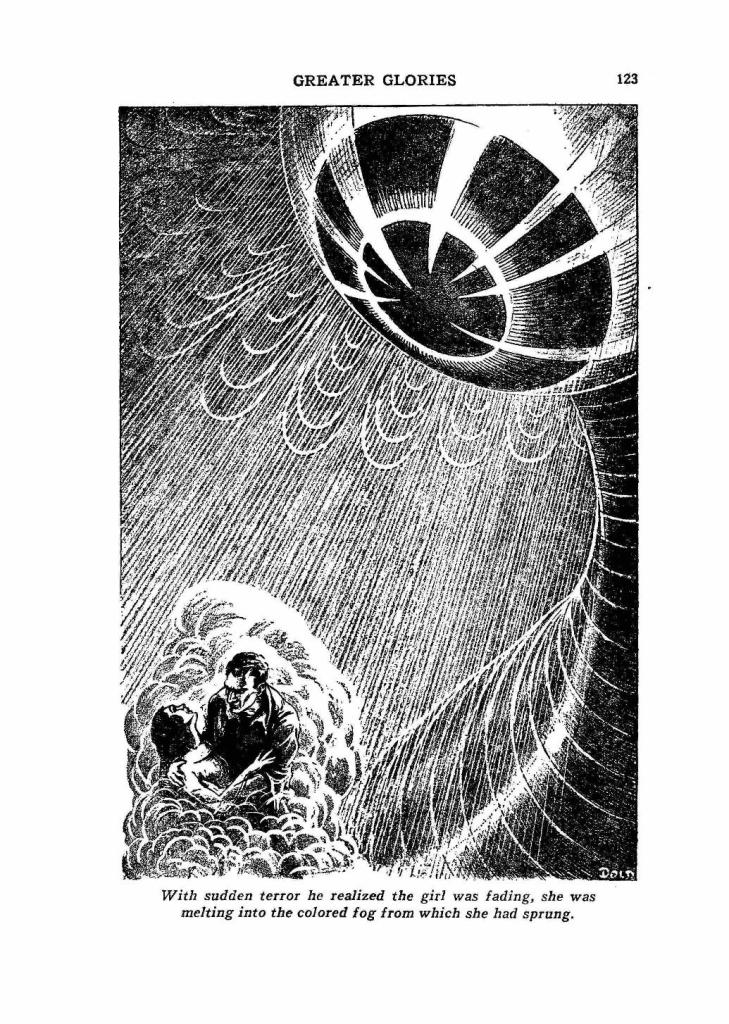
Conan de Cimmeria (2021) by Ángel Gª Nieto, Julio Rod, & Esteban Navarro

Derivative works all share a connection with the parent work. Every story with Cthulhu derives, directly or indirectly, from Lovecraft’s “The Call of Cthulhu.” Every story with Conan the Cimmerian derives from the original stories written by Robert E. Howard. From the humble pages of Weird Tales have spun out thousands of creative works in a dizzying array of media—short stories, novels, comics (strips, books, magazines, and graphic novels), cartoons, live-action and animated films, music, paintings, sculptures, toys, video games—and one of the key thing to remember about these works is that they aren’t being created in a vacuum, but in communication with one another.

The Atlantean sword in the film Conan the Barbarian (1982) owes nothing to anything in the stories of Robert E. Howard; the closest the Texas pulpster managed to a special weapon was in the first Conan tale, “The Phoenix on the Sword,” and that sword was broken in the course of the story. Some of the pastiche tales and comic book stories that followed included magic weapons, but none of them served as the immediate inspiration for the Atlantean sword in the film either. Nevertheless, the sword featured extensively in the poster and marketing materials for both Conan the Barbarian and its sequel Conan the Destroyer (1984)—and, unsurprisingly, was represented fairly faithfully in the Marvel Comic adaptations of the films.

Art by Bob Camp

For many years, outside the movie continuities, the Atlantean sword was not a key feature of most Conan media. While it continued to have lingering appeal because of the tie to the film—including multiple weapon makers providing official or bootleg versions of the sword for fans and collectors—publishers like Marvel and Dark Horse did not lean into that aspect of the film iconography.

More recently, however, the iconic Atlantean sword has seen increased placement in both official and unofficial Conan media. The latest Conan comics published by Titan have deliberately leaned into a melding of the iconic looks of previous incarnations of the Cimmerian, drawing both from the John Buscema/Ernie Chan era of Marvel Comics as well as the 1982 film. It’s little surprise that when Conan does actually go to Atlantis in Conan the Barbarian #11, the Atlantean sword—or at least a good facsimile—makes an appearance.

Art by Roberto de la Torre, Color by Diego Rodriguez

Outside of the official comics, works produced in areas where the Conan the Cimmerian stories by Robert E. Howard have fallen into the official domain have had fewer qualms about borrowing the iconic imagery of the Atlantean sword. Such is the case for Sangre Bárbara (2021) by El Torres, Joe Bocardo, & Manoli Martínez, and such is also the case for Conan de Cimmeria (2021) by the creative team of Ángel Gª Nieto (writer), Julio Rod (artist), & Esteban Navarro (colorist).

Hace mucho tiempo, en una era no soñada, caminó Conan, el Cimmerio, que a lo largo de su turbulent existential vivió multiud de fastuosas adventuras.

Dejadme que os cuente cual cronista de un tiempo olvidado sus grandes y magníficas hazañas, que lo convertieron en Leyenda.
Long ago, in an age undreamed of, walked Conan the Cimmerian, who throughout his turbulent life lived a multitude of magnificent adventures.

Let me tell you like a chronicler of a forgotten time his great and magnificent exploits, which made him a Legend.
Conan de Cimmeria, Back cover copyEnglish translation

Conan de Cimmeria is a standalone Spanish-language graphic novel that tells three original stories based on the Conan character created by Robert E. Howard, each one telling a brief adventure of the Cimmerian at a different point in his career. It is essentially identical in general form and intent to the majority of comics produced officially by the owners of the Conan trademarks, just produced independently. The prominent usage of the Atlantean sword in the first story, “La Forja del Destino” (“The Forge of Destiny”), is perhaps the most notable artistic callback to other Conan-related works, but the book also appears to draw inspiration from the classic Marvel comics, while still taking the opportunity to present an original—if recognizable—version of the barbarian.

The stories are a bit more violent and bloody than the classic Marvel Comics, but not so gore-filled as to detract from what are essentially pulpy adventure tales; there is one scene with the topless corpse of a woman, but other than that, there is no nudity or sex. It is the kind of Conan comics that could please everyone from 13 to 93 in terms of being exactly what it sets out to be: the kind of broad-appeal Conan comic that is reminiscent and evocative of what has come before, but which is distinctly original, an addition to the Conan cycle that is respectful of the source material.

In an era when properties falling into the public domain often leads to a splurge of derivative trash that pays little to no respect for the original, it’s nice to find examples of works where the creators basically want to use the stories to create new tales of character they like, int he style in which they’d like to read them.


Bobby Derie is the author of Weird Talers: Essays on Robert E. Howard and Others and Sex and the Cthulhu Mythos.

Deep Cuts in a Lovecraftian Vein uses Amazon Associate links. As an Amazon Associate I earn from qualifying purchases.
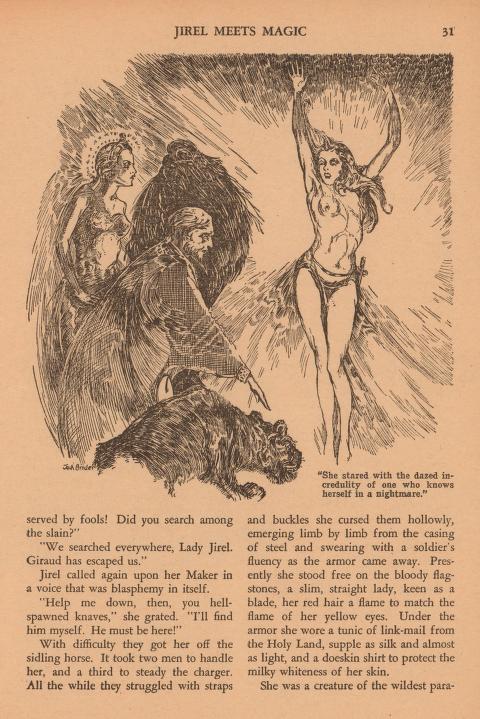
Her Letters to Robert E. Howard: Edna Mann

Among Robert E. Howard’s papers are several lists of addresses. One such list includes the entry:

Miss Edna Mann
Bagwell, Texas.
Collected Letters 3.483

Bagwell is a small, unincorporated community in Red River County, bordering Oklahoma. According to Howard scholars like Patrice Louinet, the Howard family had lived in Bagwell from ~1913-1915; it was in Bagwell that a young Howard would have attended school for the first time, when he was eight years old, and it was in Bagwell that a young Howard listened to the stories of former slave Mary Bohannon.

A single letter from Howard to Edna Mann survives, written from Brownwood, TX, dated 30 Oct 1926, and beginning:

Dear Friend;

As usual I have to start my letter with an apology, but I’ve been kept busy
what with lessons, risings on my arm and rotten eyes.

I don’t know if you’re still at the same address, but if not, I suppose this
letter will be forwarded to you. The days are getting cooler. Believe me, if I ever
get wealthy, I’ll go to some country where they have summer the year round.
—Robert E. Howard to Edna Mann, 30 Oct 1926, Collected Letters 1.110

The brief letter covers what Howard has been up to (he was at the time taking a college-level bookkeeping course), the poem “The Campus at Midnight,” and signs off asking if she has seen any good American football games lately, noting “Your hometown always had a good team.”

There are no other mentions of Edna Mann in Howard’s extant letters. So, who was Edna Mann?

On the Texas Digital Newspaper archive, The Detroit (TX) News-Herald, which covers several communities in Red River County, has several mentions of a “Miss Edna Mann” in the period of 1929-1931 (e.g. 10 Jul 1930). The 1930 Federal census lists an Edna Mann, age 28, widowed with one child and working as a telephone operator living in Red River Country, Texas. A little digging through the genealogy databases turns up Myttie Edna Smith, born 19 May 1901 in Van Alstyne, TX—another newspaper account says she has relatives in Van Alstyne (23 Jan 1930). In 1919, she married Valda Jewell Mann; and gave birth to a daughter Tina Lareda on 17 Mar 1920. Valda Mann died in 15 May 1923. Edna Mann died on 1 Jan 1986, and is buried in Val Alstyne Cemetery.

Many questions remain regarding Edna Mann and Robert E. Howard. We have no idea, for example, how they became acquainted or how long their correspondence ran. It seems reasonable to surmise that they probably began correspondence between 1923 and 1926, as he addresses her as “Miss Edna Mann,” not “Mrs. Edna Mann” or “Miss Edna Smith.” Beyond that, we can only speculate.

Howard scholar Rob Roehm has suggested that Edna Mann was the “young mother” he mentioned in his semi-autobiographical novel Post Oaks & Sand Roughs (2019):

[…] Violet, the chief soda jerker, a rather pretty little blond who hummed the latest song hit while she worked and flirted with some of the customers […]

As for Violet, Steve supposed that she was merely a flapper working for the purpose of having some spending money, until one day he noticed a small child following her about, and asked:

“That’s your little sister?”

“My daughter.”

“My God, how old are you?” asked Steve bluntly.

“Twenty-five—don’t I look it?”

“Good Lord, no. I thought you were about my age.”

He never questioned her regarding her past, but gathered from remarks that she dropped that she had been supporting herself ever since she was old enough to work, that she had a husband somewhere in Oklahoma, and that she had worked in offices and jerked soda “all the way from the Great Lakes to the border of Mexico.”

More driftwood, following the oil booms. Steve felt remarkably young and inexperienced beside the girl. (170-171)

There is a little more on Violet in the short novel, but how much is fact or fiction is impossible to say.

Thanks to Dave Goudsward and Rob Roehm for their help.


Bobby Derie is the author of Weird Talers: Essays on Robert E. Howard and Others and Sex and the Cthulhu Mythos.

Deep Cuts in a Lovecraftian Vein uses Amazon Associate links. As an Amazon Associate I earn from qualifying purchases.
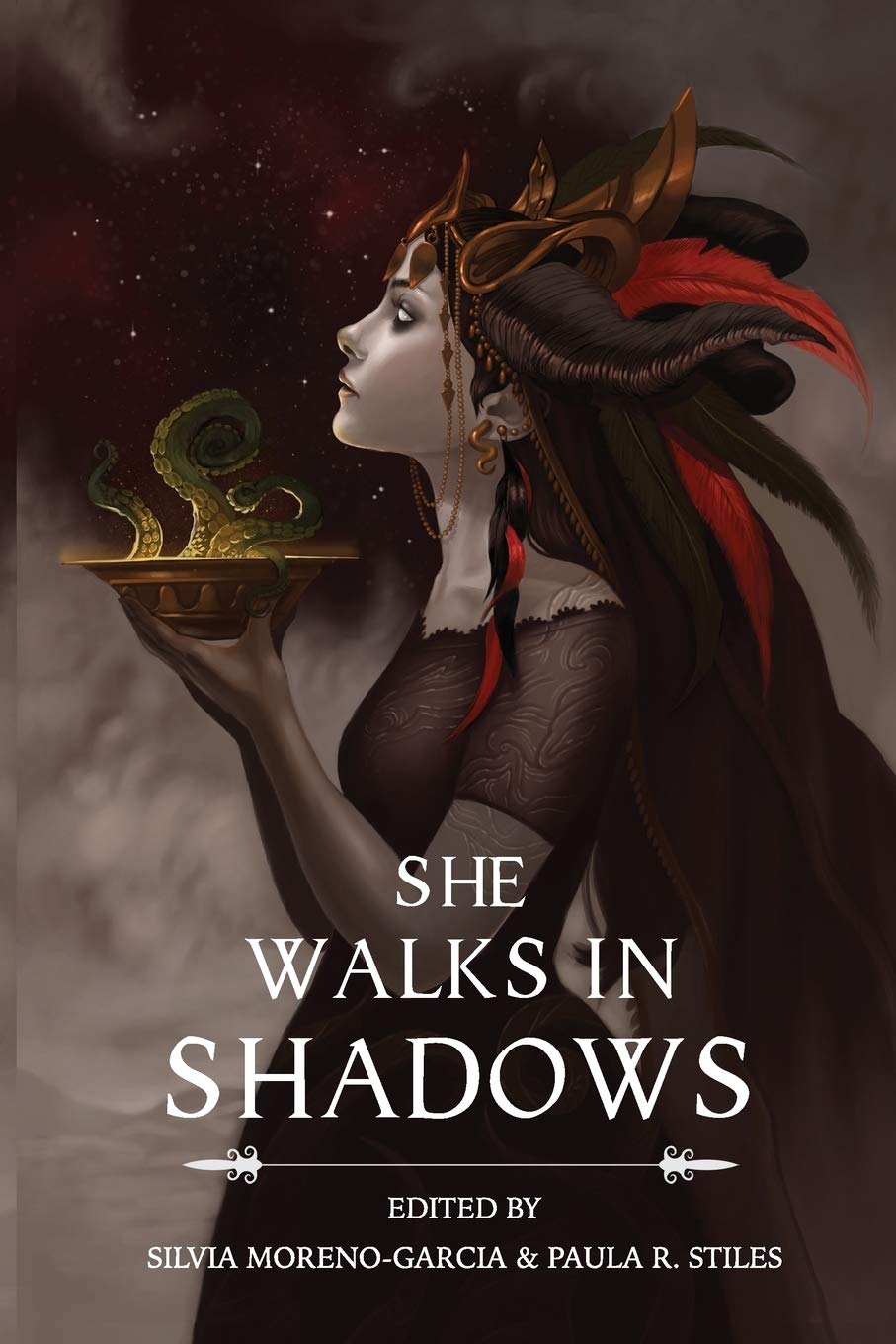
Her Letters to Robert E. Howard: Lexie Dean Robertson

In 1920, Lexie Dean Robertson (25 Jul 1893 – 16 Feb 1954) and her husband James Franklin Robinson moved to the small town of Rising Star, about 12 miles East of Cross Plains, TX. She was a schoolteacher and poet, whose work was gaining wider publication in newspapers and poetry journals through the 1920s and 30s, including the publication of her 1928 collection Red Heels. In 1939 Lexie Dean Robertson was named the Poet Laureate of Texas, the first native Texan to be awarded that honor. Given that Robertson lived right down the road from Robert E. Howard, who was also a published poet, fans might wonder if the two had ever met or corresponded.

The best answer I can give is: maybe.

There are no overt references to Lexie Dean Anderson or her poetry in the surviving letters of Robert E. Howard; nor is her address included on any of Howard’s surviving address lists. The only mention of Rising Star in Howard’s letters is in reference to a car accident when, in late December 1933, he struck a traffic light that had been set up in the middle of the street. However, there are some scraps of evidence in other sources that suggest they might have met or corresponded, at least briefly.

He also says that he can’t find Cross Plains in the atlas but wants to meet
me when he comes to Dallas in October to lecture on modern poetry — a kind
of lecture tour over the country, I gather.
—Robert E. Howard to Tevis Clyde Smith, c. July 1939, Collected Letters 1.349

“He” was Benjamin F. Musser, a poet from Atlantic City, New Jersey, and editor of Contemporary Verse and JAPM: The Poetry Monthly, who was headed West in mid-late 1929. In the September 1929 issue of Contemporary Verse, he gave one address stop as “c/ Mrs. J.F. Robertson, Box 303, Rising Star, Texas, no later than October 12.” This wouldn’t be strange, Robertson was a contributor to Musser’s poetry magazines, just as Robert E. Howard himself was. Some years later, Howard seems to allude that he met Musser:

I once met a noted poet, who had been kind enough to praise my verse most highly, and with whom I’d had an enjoyable correspondence. But I reckon I didn’t come up to his idea of what a poet should be, because he didn’t write me, even after he returned East, or even answer the letter I wrote him. I suppose he expected to meet some kind of an intellectual, and lost interest when he met only an ordinary man, thinking the thoughts and speaking in the dialect of the common people. I’ll admit that after a part-day’s conversation with him, I found relief and pleasure in exchanging reminiscences with a bus driver who didn’t know a sonnet from an axle hub.
—Robert E. Howard to H. P. Lovecraft, 6 Mar 1933, Collected Letters 3.25

Howard did not buy his first car until 1932, so the bus would be the logical means of transport to and from Rising Star, unless he hitched a ride. That Lexie Dean Robertson entertained in Rising Star seems is apparent from a passage in a letter from Howard’s friend Harold Preece to his sister Lenore Preece:

[Robert E. Howard] did meet at least one professional writer—Lexie Dean Robertson, the versifier, who lived over at Rising Star in the same county. But I regarded Lexie as a nice, big fat gal with cultural interests rather than as a poet. Yet, who couldn’t help but like her?
—Harold Preece to Lenore Preece, 16 Jan 1965, The Howard Collector 234-235

This assertion that Howard met Lexie Dean Robertson was repeated by another of Howard’s friends:

“Bob, I heard that the poet, Lexie Dean Robertson, invited you over to her house for a dinner. She wanted you to meet some of her friends who are writers. She wanted you to be in a writer’s group she was trying to organize.”

Bob looked at me frowning. “That little woman in Rising Star?”

“Yes. She’s a nice little person. I know her. Did she invite you over one time?”

Bob groaned. “One time? Hell, I only went once, but I seem to remember she had a dozen pink-lace parties she tried to invite me to.”

“You only went once?”

Bob became exasperated. “Yeah. Once. Damn it, girl, if you make a living writing for the pulps, you don’t have time to go to pink teas.”
—Novalyne Price Ellis, One Who Walked Alone 179

The idea that Howard knew Lexie Dean Robertson, or at least knew of her and was familiar with some of her work, has been strengthened by Howard scholar Rusy Burke, who pointed out that both Robertson and Howard had poems titled “Recompense” with similar rhyme schemes. Robertson’s poem appeared in her collection Red Heels, which Howard’s is undated but first appeared in Weird Tales (Nov 1938). Burke has suggested that Howard’s poem may be a response to Robertson’s.

Taken together, there is reasonable evidence that around October 1929, when Ben Musser stopped over in Rising Star with the Robertson’s, Robert E. Howard accepted her invitation to her little literary salon. If we take Novalyne Price Ellis’ exchange at face value this might have been one of several invitations, that given the distance, were likely sent via post. It seems fairly evident from the lack of references in Howard’s letters that such correspondence is apocryphal at best, and probably did not cover much beyond invitations and polite refusals.

The reference to “pink teas” is a disparaging one, referring to a then-popular style of formal social gathering which came to be associated with superficiality and effeminacy. “Pink tea poets,” a term attributed to Texas writer J. Frank Dobie (though I have not been able to find where he ever used the term), was applied to middle-aged women poets whose verse was considered inconsequential, more interested in the social aspect of being a poet—poseurs, for lack of a better word. Howard does use the phrase in his letters, e.g.:

I want to send a copy, for one thing, to the editor of the Poet’s Scroll, who used to reject my verse because he said it was not rhythmic, whereas he didn’t have the guts to admit the real reason — which was that it was entirely too brutal for him and his pink tea laureates.
—Robert E. Howard to Tevis Clyde Smith, c. Oct 1931, Collected Letters 2.208

Looking back at his friendship with women poets and his discussions of the same in his letters, it seems likely that Howard did not disrespect Robertson as a poet, but probably felt uncomfortable (even disdainful, if Novalyne Price Ellis’ account is taken at face value), with the particular atmosphere of such decorum as a formal tea party. One might well imagine him as the barbarian among the lace doilies, at least in his own mind.

For her part, it seems likely that if Lexie Dean Robertson did extend an invitation to Howard, it was probably a sincere one. It was a lonely country for writers and poets of any stripe, and being so close geographically, it seems a pity that the two of them were not closer socially as well. Alas, some connections don’t click.


Bobby Derie is the author of Weird Talers: Essays on Robert E. Howard and Others and Sex and the Cthulhu Mythos.

Deep Cuts in a Lovecraftian Vein uses Amazon Associate links. As an Amazon Associate I earn from qualifying purchases.