Posts

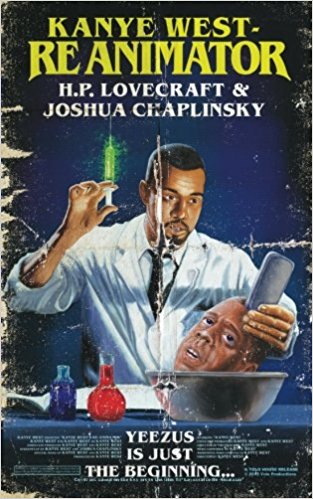
“Kanye West—Reanimator” (2015) by Joshua Chaplinsky vs. “Herburt East: Refuckinator” (2012) by Lula Lisbon

Of Herbert West, who was my friend in college and in after life, I can speak only with extreme terror. This terror is not due altogether to the sinister manner of his recent disappearance, but was engendered by the whole nature of his life-work, and first gained its acute form more than seventeen years ago, when we were in the third year of our course at the Miskatonic University Medical School in Arkham. While he was with me, the wonder and diabolism of his experiments fascinated me utterly, and I was his closest companion. Now that he is gone and the spell is broken, the actual fear is greater. Memories and possibilities are ever more hideous than realities.
—H. P. Lovecraft, “Herbert West—Reanimator”

Of Herburt East, who was my lover in college and in after life, I can speak only with extreme arousal tinged with terror. This fear-tainted arousal is not due altogether to the sinister manner of his recent disappearance, but was engendered by the whole nature of his life-work, and first gained its acute form more than seventeen years ago, when we were in the third year of our course at the Peniskatonic University Medical School in Jerkham. While he was with me, the wonder and diabolism of his experiments fascinated me utterly; no less also did our two lean masculine bodies entwined in illicit passion, and I was his closest companion. Now that he is gone and the spell is broken, the lust is less blinding, and the actual fear is greater. Memories and possibilities are ever more hideous than realities.
—Lula Lisbon (“D. P. Lustcraft”), “Herburt East: Refuckinator” (emphasis mine)

Of Kanye West, who was my friend in college and after he dropped out, I can speak only with extreme sadness. This dysphoria is not due altogether to the sickening manner of his recent disappearance, but was engendered by the whole nature of his life-work, and first gained its acute form more than twenty years ago, when we were in the first year of our course at the Chicago State University in Illinois. While he was with me, the wonder and diabolism of his musical experiments fascinated me utterly, and I was his closest companion. (Some would say too close. There was much speculation regarding the nature of our partnership, but Kanye was a very private person and I didn’t dare betray his confidence.) Now that we are no longer friends and the spell is broken, my side of the story can finally be told. The actual pain is far greater now than it was then. Memories and possibilities are ever more melancholic than the realities.
—Joshua Chaplinsky, Kanye West—Reanimator (emphasis mine)

While many writers have attempted to pastiche or parody the work of H. P. Lovecraft, few writers have gone so far as to take advantage of the fact that many of Lovecraft’s works are in the public domain, so as to directly rewrite, add on to, and edit his text in such a way as to create a new and original work of fiction. Joshua Chaplinsky’s Kanye West—Reanimator (2015) and Lula Lisbon’s “Herburt East: Refuckinator” (2012) both take as their source text Lovecraft’s early serial “Herbert West—Reanimator” (1922), but are set in widely different genres, and the artistic choices that the two writers reflect interestingly both on what they are writing, and how they choose to interpret Lovecraft’s original work.

Chaplinsky’s take on the concept is of a literary mashup, echoing efforts like Seth Grahame-Smith’s Pride and Prejudice and Zombies (2009). The success of the story lies in the careful attention to detail, weaving factual elements of Kanye’s life and attitude into Lovecraft’s prose while keeping the exuberance and hyperbole of both. Kanye West really did drop out of Chicago State University to pursue his music career, so reflecting that aspect of his life in place of Herbert West’s attendance at medical school is both accurate and requires changes to the narrative—but just as much of Kanye’s life is twisted to more closely resemble Herbert’s, the key change being when Kanye decides to use his music to reanimate the dead. The fun of the story is not just in the pastiche of Lovecraft’s prose or the parody of Kanye’s antics, but those occasional perfect moments when the two blend together:

To the vanished Herbert West and to me the disgust and horror were supreme. I shudder tonight as I think of it; shudder even more than I did that morning when West muttered through his bandages, “Damn it, it wasn’t quite fresh enough!”
—H. P. Lovecraft, “Herbert West—Reanimator”

To the vanished Kanye West and I the disgust and horror were supreme. I shudder tonight as I think of it; shudder even more than I did that morning when Kanye muttered through his bandages, “Damn it, the track wasn’t quite fresh enough!”
—Joshua Chaplinsky, Kanye West—Reanimator (emphasis mine)

Where Kanye requires grafting on considerable material to the original, Lula Lisbon’s homoerotic re-visioning of Lovecraft’s story requires a shift in genre as well as tone. Where Chaplinsky seeks to draw fiction and reality closer together, so the two Wests’ paths coincide at key narrative moments, Lisbon seeks to inject the erotic into the horror narrative—and the key device by which she accomplishes this takes a decidedly more mystical bent:

He revealed to me one night that through his sizable member coursed a most rare and precious gift: his semen was a re-animating solution, blessed through an incident in which a love-smitten demi-goddess had granted an ancestor the power of bestowing immortal life by way of his seed.
—Lula Lisbon, “Herburt East: Refuckinator”

Like many erotic parodies, the focus of this text is often the insertion of an erotic scene not included in the original. This is a practice of some long standing, with examples in the horror literature genre including The Adult Version of Dracula (1970) and The Adult Version of Frankenstein (1970), both by Hal Kantor. Part of the skill of the author is in how these scenes are woven into the narrative; whereas Kanye replaces Herbert West, and the narrative is basically his own retold in the frame of Lovecraft’s prose, Herburt East follows substantially the same plot, only with many homoerotic additions.

Both texts take the opportunity to play on the outrageousness of the original, which is itself a kind of parody of the lurid supernatural thrillers of the period, and written by Lovecraft strictly as a potboiler:

In this enforced, laboured, & artificial sort of composition there is nothing of art or natural gracefulness; for of necessity there must be a superfluity of strainings & repetitions in order to make each history compleat. My sole inducement is the monetary reward […]
—H. P. Lovecraft to Rheinhart Kleiner, 7 Oct 1921, Letters to Rheinhart Kleiner 219

The serial nature of “Herbert West” possibly makes it more attractive for parody, as the story is broken into distinct episodes which permit changes of scene and characters and keeps up the narrative pace. Certainly both authors were at pains to keep the character of both of the chapter openings and closing—and perhaps surprisingly, both kept in versions of what is probably the most problematic scene in Lovecraft’s story.

The match had been between Kid O’Brien—a lubberly and now quaking youth with a most un-Hibernian hooked nose—and Buck Robinson, “The Harlem Smoke”. The negro had been knocked out, and a moment’s examination shewed us that he would permanently remain so. He was a loathsome, gorilla-like thing, with abnormally long arms which I could not help calling fore legs, and a face that conjured up thoughts of unspeakable Congo secrets and tom-tom poundings under an eerie moon. The body must have looked even worse in life—but the world holds many ugly things.
—H. P. Lovecraft, “Herbert West—Reanimator”

Few of Lovecraft’s stories have black characters, and this is arguably his most racist depiction of an African-American character, emphasizing the prejudice of the day that black people were quite literally lower on the scale of evolution, closer to apes and gorillas. That such depiction were not uncommon in pulp fiction, such as in Seabury Quinn’s “The Drums of Damballah” (1930) does not excuse it here. The description does serve two important narrative points. The first is to emphasize the physical power of the character, the second is to emphasize the racial prejudice of the unnamed narrator. One of the key moments of this episode in “Herbert West” is that the narrator and West try their reanimation fluid on it an “it was wholly unresponsive to every solution we injected in its black arm; solutions prepared from experience with white specimens only”—in other words, they assume a biological difference in race to be at fault. However, they later discover that the reanimation serum did work (ironically, given Lovecraft’s sentiments in his letters, proving that there is no biochemical difference between white and black people)…but that the subject had also devolved into cannibalism (violence being characteristic of the reanimated, regardless of race).

Lisbon preserves most of Lovecraft’s original text for this episode, with the main interjection being an extended erotic scene between West and the narrator: she chooses to focus on the “fire all six shots of a revolver” from the opening of the episode and counterbalance it with sex ejaculations. Chaplinsky’s take is more baroque; although he retains a surprising amount of the original text, the black boxer is replaced with Biggie Smalls. Both of them retain, substantially unchanged, the final visual of the episode.

For that visitor was neither Italian nor policeman. Looming hideously against the spectral moon was a gigantic misshapen thing not to be imagined save in nightmares—a glassy-eyed, ink-black apparition nearly on all fours, covered with bits of mould, leaves, and vines, foul with caked blood, and having between its glistening teeth a snow-white, terrible, cylindrical object terminating in a tiny hand.
—H. P. Lovecraft, “Herbert West—Reanimator”
(text identical in Lula Lisbon’s “Herburt East: Refuckinator”)

For that visitor was neither forgetful employee nor policeman. Looming hideously against the spectral moon was a gigantic misshapen thing not to be imagined save in nightmares—a bug-eyed, ash-grey apparition, covered with sewage and fecal matter and caked with blood, and having between its glistening teeth a snow-white, terrible, cylindrical object terminating in a tiny hand.
—Joshua Chaplinsky, Kanye West—Reanimator (emphasis mine)

The repetition of the text is an acknowledgement of the importance of this specific scene, that Lovecraft had captured a powerful visual in the horrible evidence of cannibalism (it being remembered that this was long before zombies craved the flesh of the living in popular fiction). The differences too are telling: in Lovecraft’s original story, there is implicit bias against the ethnic Italians whose child is kidnapped and eaten; Chaplinsky replaces them with studio assistants, which is in its own way a comment (whether intentional or not) on the attitudes toward the lowest-paid members of the production process. Lisbon’s leaving these elements unaddressed feels like a missed opportunity to address some of the subtext or context in Lovecraft’s work—but that may simply be because she was focusing on other aspects.

One aspect that both Chaplinsky and Lisbon both address is the idea of a homosexual reading or subtext to Lovecraft’s original work. “Herbert West” involves the eponymous mad scientist partnered for considerable periods with an unnamed but presumably male associate who narrates the text; this is in a way a direct parallel in many ways to Sir Arthur Conan Doyle’s Sherlock Holmes and his chronicler Dr. Watson, and their strong homosocial bond is reflected in several of Lovecraft’s other works, such as “The Statement of Randolph Carter” and “The Hound.” Yet to contemporary audiences, such close friendships between men are often misconstrued as having homosexual connotations, as was discussed in “Gilgamesh in the Outback” (1986) by Robert Silverberg. Chaplinsky chooses to address this aspect up front, writing in the first paragraph:

Some would say too close. There was much speculation regarding the nature of our partnership, but Kanye was a very private person and I didn’t dare betray his confidence.

This is neither a confirmation nor a denial, but an aspect of Kanye and the narrator’s relationship which he plays with throughout the story, letting the readers choose how to interpret certain scenes while never explicitly confirming or denying Kanye’s sexual preferences or whether their relationship is intimate. Lisbon chooses to emphasize and make explicit the homoerotic relationship between East and the narrator, and strives to capitalize on aspects of Lovecraft’s text which highlight the intimacy of their relationship. Other writers have made similar, if less overtly erotic, interpretations of Lovecraft’s relationships—The Chronicles of Dr. Herbert West comic book written by Joe Brusha and Ralph Tedesco has the narrator as a woman, in a romantic relationship with West; “Houndwife” (2010) by Caitlín R. Kiernan similarly makes a female of one of the two male characters from “The Hound.”

Neither Lisbon or Chaplinsky were looking to supplant or provide another episode to an existing work, but to re-imagine that work for their own ends, and as far as those aims go, they both succeeded. Lisbon’s expansion of Lovecraft’s narrative is played for laughs as much as titillation, and veers toward the campier end of homoerotic Lovecraftian horror narratives, something in the vein of David J. West. Chaplinsky’s narrative is much more ambitious, but also ultimately much more period-driven: one day, Kanye will die (though probably not by being decapitated by a reanimated Jay-Z), and his star will fade so that the clever pop-culture references will fade.

How many ages hence
Shall this our lofty scene be acted over
In states unborn and accents yet unknown!
—William Shakespeare, Julius Caesar, Act III, Scene I

One of the critical attractions of Lovecraft’s work is being in the public domain, where anyone can play with the material. For most pasticheurs and parodists, this does not mean literally rewriting Lovecraft’s plots or recycling large sections of his text—but those are valid creative approaches to the material, and should be understood and appreciated as such. These variations-on-the-text are as much a part of keeping Lovecraft’s work alive and relevant in the present day as any other.

Erotica author Lula Lisbon originally published the episodes of Herburt East under the name “D. P. Lustcraft”, the complete ebook of “Herburt East: Refuckinator” (2012) is still available for sale, although Lisbon appears not to have published anything since 2015.

Joshua Chaplinsky originally published Kanye West—Reanimator through Yolo House in 2015. He has since slightly revised and expanded the book, adding a foreword and the story “Beyond the Wall of Sleep in Redhook, Brooklyn” in Kanye West—Reanimator: the Re-Reanimated Edition (2018).


Bobby Derie is the author of Sex and the Cthulhu Mythos (2014)

“Gilgamesh in the Outback” (1986) by Robert Silverberg

The two of them had been journeying across the interminable parched wastes of the Outback for many days now—how many, not even the Elder Gods could tell. They were ambassadors, these two: Their Excellencies Robert E. Howard and H.P. Lovecraft of the Kingdom of New Holy His Diabolic England, envoys of his Britannic Majesty Henry VIII to the court of Prester John.
—Robert Silverberg, “Gilgamesh in the Outback” in Rebels in Hell (1986) 79

Even before he was dead and could not offer any protest, H. P. Lovecraft was represented as a fictionalized version of himself in Robert Bloch’s “The Shambler from the Stars” (Weird Tales Sep 1935). Lovecraft even gave his friend permission to kill him off in the story, and returned the favor by killing off a fictional Bloch in “The Haunter of the Dark” (Weird Tales Dec 1935). This began a literary tradition of using Lovecraft and his friends and contemporaries a fictional characters, which continues to this day.

The genre varies from weird fiction like Fritz Leiber’s “To Arkham and the Stars” (1966) to historical fiction such as Peter Cannon’s The Lovecraft Chronicles (2004) to erotic horror including Edward Lee’s Trolley No. 1852 (2009), but what all of these stories have in common is that the characterization of Lovecraft is informed by what is known of his life and thought, and the same is true for the other historical personages. Robert E. Howard, for example, appears in both Richard Lupoff’s novel Lovecraft’s Book (1985), Rick McCollum’s Ashley Dust (1994), David Barbour’s Shadow’s Bend (2000), and Robert Silverberg’s novella “Gilgamesh in the Outback” (1986).

The story takes place in the Heroes in Hell shared universe; a series of anthologies such as the Man-Kzin Wars and Thieves’ World where multiple authors write stories in a common setting, usually sticking to their own characters but collaborating to a degree on the development of the common background, and possibly referencing each other’s additions and the events in their stories. The whole concept is similar to how comic book shared universes work, and of course is a somewhat more structured and organized version of how the Cthulhu Mythos came to be. In Heroes in Hell, all the great figures of history go to their infernal rest—so that Cleopatra, Machiavelli, Benito Mussolini, Che Guevara, et al. can all interact. The device which allows the meeting of disparate historical figures is the crucial attraction of the setting, and Silverberg takes advantage of this in his story by having Gilgamesh meet H. P. Lovecraft and Robert E. Howard.

The attraction of placing Lovecraft and Howard together is in large part because they were friends during the 1930s, and experienced a publication boom in the 60s and 70s as their work was printed and reprinted in affordable paperbacks. Though they never met, they carried on an extensive correspondence, much of which has survived and which saw publication, starting with some of Lovecraft’s letters to Howard in the Selected Letters from Arkham House during the 1960s and then more in fanzines, small scholarly journals, and other publications until the full correspondence was finally published as A Means to Freedom: The Letters of H. P. Lovecraft and Robert E. Howard in 2009.

In addition to their published letters and fiction, both Lovecraft and Howard received scholarly attention which was largely lacking for their fellow pulp writers—at the time Silverberg was writing “Gilgamesh in the Outback,” he could draw on two biographies written by L. Sprague de Camp: Lovecraft: A Biography (1975) and Dark Valley Destiny: The Life of Robert E. Howard (1983, written with Catherine Crook de Camp and Jane Whittington Griffin). While these biographies were often the standard work on their subjects for several years, both books faced considerable criticism for de Camp’s treatment of his subjects, which often involved a kind of post mortem psychoanalysis. Nor was de Camp alone in such questionable assessments of his subjects:

The article [“The Psychological Conan” by John Strnad] goes in for all the superficial, mechanical application of static psychoanalytic labels, without any dynamic clinical evidence: Conan’s broadsword is, of course, a “standard phallic symbol”, his armor is “an extensive erogenous zone”, he is alleged to suffer from an unconscious “not resolved castration complex”, his attitude towards his companions and women shows “tendencies toward homosexuality”. his investigating and exploring of tombs and secret passages shows a “desire for heterosexual relations.”

Psychoanalysis of living people and of literary figures requires not the labeling with Freudian terms but an interpretation based on concrete data. This article represents a misunderstanding of both psychoanalysis and Conan. Howard and Conan deserves better.
—Frederic Wertham, Amra vol. 2, no. 58 (1973), 12

Other writers did not mince words; Harry Harrison in Great Balls of Fire! An Illustrated History of Sex and Science Fiction (1977) included an entire chapter titled “Is Conan Dating Clark Kent?” and states boldly:

Howard did identify with his hero, Conan, and admitted as much many times. […] I find it hard to agree when [Wertham] insists that this was all done consciously by the author. Conan is a crypto-homosexual and the entire school of sword-and-sorcery reflects this fact. (85)

These particular impressions of Robert E. Howard and his creation Conan, often seen as an alter ego, are important because they provide the context within which Silverberg operated and would have understood the basis for the character he was creating. So as the two pulpsters-turned-ambassadors drive through Hell in a Land Rover, they stop and encounter Gilgamesh—to who Howard has a peculiar reaction:

“By Crom,” he muttered, staring at the giant. “Surely this is Conan of Aquilonia and none other!” He was trembling. He took a lurching step toward the huge man, holding out both his hands in a strange gesture—submission, was it? “Lord Conan?” Howard murmured. “Great king, is it you? Conan? Conan?” And before Lovecraft’s astounded eyes Howard fell to his knees next to the dying beast, and looked up with awe and something like rapture in his eyes at the towering huntsman.
—Robert Silverberg, “Gilgamesh in the Outback” in Rebels in Hell 84

Gilgamesh is, as the title suggests, the main protagonist and focus of Silverberg’s novella. In choosing the most ancient hero in literature, Silverberg can set Gilgamesh in contrast to all the more recent dead celebrities, letting the king of Uruk express a very different take on death, damnation…and homosocial attitudes. Gilgamesh greatly misses the company of his “brother” Enkidu, a relationship which is presented as strictly non-sexual but also fundamental to both men. It is paralleled, in a way, with the friendship of Lovecraft and Robert E. Howard—but the latter’s response to Gilgamesh reveals a strange twist in Silverberg’s characterization of Conan’s creator.

Howard’s initial mistake of Gilgamesh for Howard’s own fictional creation Conan the Cimmerian, and the continuing response of Howard to Gilgamesh, highlight some of the sexual interpretations of the Texas pulpster as they existed at the time—and give Silverberg the opportunity to expressly state that Gilgamesh of Uruk is not a homosexual:

And that glow in the fellow’s eyes—what sort of look was that? A look of adoration, almost the sort of look a woman might give a man when she has decided to yield herself utterly to his will.

Gilgamesh had seen such looks aplenty in his day, from women and men both; and he had welcomed them from women, but never from a man. He scowled. What does he think I am? Does he think, as so many have wrongly thought, that because I loved Enkidu with so great a love that I am a man who will embrace a man in the fashion of men and women? Because it was not so. Not even here in Hell is it so, said Gilgamesh to himself. Nor will it ever be. (92)

As Robert E. Howard’s comes face-to-face with an individual that is in many ways the archetype of his most famous hero, he reacts as a fanboy might—and Gilgamesh completely fails to understand the hero-worship for what it is, mistaking it for sexual interest. The strenuousness of the denial, and Gilgamesh’s gauging of Howard’s reaction, both speak to the sexual psychology of the day. Gilgamesh is expressing an attitude of 80s machismo, and the subject of his objections is the creator of a genre of American fantasy which Harry Harrison accused of “crypto-homosexuality” because it commonly glorified the male form—as exemplified by Arnold Schwarzenegger’s casting in the lead of Conan the Barbarian (1982) and the half-naked, muscled figures that dominated Frank Frazetta’s covers of the Conan paperbacks.

Lovecraft, by contrast, plays the straight man (except when he in is turn is allowed a few moments of exuberance). Gilgamesh’s analysis of him, expressed later, jives strongly with interpretations of Lovecraft in the 80s:

[…] he is weirdly remote and austere, is apparently quite as crazy, but he too give the impression of being at war with himself, int error of allowing any sort of real human feeling to break through the elaborate facade of his mannerisms. The poor fools must have been scared silly when the serving -girls started tripping them and pouring warm milk over them and stroking their bodies. (122)

The creator of Cthulhu’s composure balances out Howard’s burst of eccentricity, and within a few pages everyone is set straight regarding the small error of identity. This does, however, give Howard time for a bit of introspection:

But this other business—this sudden bewildering urge to throw himself at the giant’s feet, to be wept up in his arms, to be crushed in a fierce embrace—

What was that? Where had that come from? By the blazing Heart of Ahriman, what could it mean? (98)

If Gilgamesh’s reaction to the idea of being the subject of homosexual attraction is an expression of 80s masculinity; Howard’s own confusion at feeling homosexual attraction is in turn an expression of a kind of crisis of masculinity verging on homosexual panic. Silverberg’s interpretation of Howard’s character was reinforced by borrowing an episode from Robert E. Howard’s 5 Sep 1928 letter to his friend Harold Preece, as well as referencing other details from Howard’s published correspondence and the sometimes erroneous scholarship. When Silverberg writes:

The desire of men for men was a mark of decadence, of the decline of civilization. He was a man of the frontier, not some feeble limp-wristed sodomite who reveled in filth and wanton evil. If he had never in his short life known a woman’s love, it was for lack of opportunity, not out of a preference for that other shameful kind. (99)

He is not directly quoting any particular passage from Howard’s writings; though the pulpster would write of “decadence,” he never spoke directly of male homosexuality in his published letters. The idea that Howard died a virgin is an idea promoted in de Camp’s biography:

While it is not impossible that, on some unaccompanied visit to Brownwood, his friends there took him to “Sal’s House,” as one of the the three local whorehouses was called, the weight of such evidence as we have makes it more than likely that he died without ever having enjoyed the pleasures of sex.
Dark Valley Destiny 140

While Howard never explicitly mentions any sexual encounter in his letters (and why would he?), there is circumstantial evidence to suggest he did in fact make use of prostitutes, so the de Camps were likely wrong on that score—but the facts of the matter are less important than the context: Silverberg, based on the then-current scholarship, was trying his best to build the character of Howard for his story.

Between Gilgamesh’s reaction and Howard’s, the portrayal of homosexuality in the story is not a positive one. It is rather the spectre of homosexuality which haunts the characters in this story, and Gilgamesh and Howard alternately deny and deride it in their internal monologues. For men so concerned with their masculine identities, the prospect of not being or being perceived as strictly heterosexual is a considerably upsetting prospect to both men—and Howard for his part immediately works to suppress these unfamiliar emotions, falling straight into the Kübler-Ross model.

While the characterization of homosexuality and masculinity might strike many contemporary readers as awkward or regressive, it is probably more accurate to say that it was period-appropriate. Silverberg has, throughout a long career in science fiction, addressed issues of gender and homosexuality in many different stories, notably Son of Man (1971), and popular attitudes on homosexuality have shifted dramatically over the course of his writing career. “Gilgamesh in the Outback” is an artifact of how homosexuality and masculinity were viewed in the 1980s, and this is very much expressed in the finale:

She-it, Howard though. A man don’t cry. Especially in front of other men.

He turned away, into the wind, so Lovecraft could not see his face.

“Bob? Bob?”

She-it, Howard thought again. And he let the tears come.  (137)

The fragile masculinity expressed by the statement that “a man don’t cry” is as close to the the fundamental philosophy of Silverberg’s story as anything else. Is Howard-the-character not a man just because he lets out a few tears? Is he less of a man for having felt an homoerotic attraction to Gilgamesh?

To say that this is a story about men and of men is accurate: aside from a few unnamed handmaidens, there are no female characters that appear on the page, though Queen Elizabeth I and Anne Boleyn are mentioned, they are not present. All of the major and minor characters are men, and this story is about their relationships with each other. It is a story fundamentally steeped in men desiring the friendship of other men, but profoundly uncomfortable and unwilling to consider the implications of a sexual dimension to that friendship—not for any pressing religious reason (they’re already in hell), or any social more (nobody besides Gilgamesh or Howard ever bring homosexuality up), but simply as an internal struggle.

Readers might reflect on how the characters of Lovecraft, Howard, and the rest reflect on the real men that inspired them. As detailed in “Great Phallic Monoliths Lovecraft and Sexuality”, literary interpretations may be valid even if the facts don’t support them—readers upset that the Robert E. Howard of “Gilgamesh in the Outback” is a 1 instead of a 0 on the Kinsey Scale can be reassured that this is just fiction, and at that fiction based upon “scholarship” from 30-40 years ago which misapplied Freudian analysis. Readers that are open to the a less unilaterally heterosexual Howard are free to run with it. As far as the literary game goes, the characterization of historical persons is free game, so long as they remain identifiable to the audience and fit the needs of the story.

“Gilgamesh in the Outback” was first published in Rebels in Hell (1986) and Isaac Asimov’s Science Fiction Magazine (July 1986); Silverberg won the Hugo Award for Best Novella in 1987. It was reprinted in The New Hugo Winners, Volume II (1992), Novel Ideas: Fantasy (2006), and The Collected Stories of Robert Silverberg, Volume Six: Multiples 1983-1987 (2011). Silverberg wrote two sequels, “The Fascination of the Abomination” in Angels in Hell (1987) and “Gilgamesh in Uruk” in War in Hell (1988), which were later stripped of the Heroes in Hell-specific setting material combined into the novel To The Land of the Living (1989). Lovecraft and Howard do not appear in the later stories.


Bobby Derie is the author of Sex and the Cthulhu Mythos (2014)

“Collector the Third: Charles Wilson Hodap (1842-1944)” (1995) by Kenneth W. Faig, Jr.

And it was then that Nyarlathotep came out of Egypt. Who he was, none could tell, but he was of the old native blood and looked like a Pharaoh. The fellahin knelt when they saw him, yet could not say why. He said he had risen up out of the blackness of twenty-seven centuries, and that he had heard messages from places not on this planet. Into the lands of civilisation came Nyarlathotep, swarthy, slender, and sinister, always buying strange instruments of glass and metal and combining them into instruments yet stranger. He spoke much of the sciences—of electricity and psychology—and gave exhibitions of power which sent his spectators away speechless, yet which swelled his fame to exceeding magnitude. Men advised one another to see Nyarlathotep, and shuddered. And where Nyarlathotep went, rest vanished; for the small hours were rent with the screams of nightmare.
—H. P. Lovecraft, “Nyarlathotep”

Tales of the Lovecraft Collectors by noted Lovecraft scholar Kenneth W. Faig Jr. is very much in the vein of “Nautical-Looking Negroes” (1996) by Peter Cannon & Robert M. Price in that it is a piece of fictional scholarship as much as anything else. The four stories in the collection are “what ifs?,” imagining chapters of Lovecraft’s life that could have been, as discovered some decades later by dedicated scholars like Faig. The stories are all generally plausible, and present less a “what might have been” than an alternate viewpoint on their subject—H. P. Lovecraft.

Not many now living will recall the Egyptian vogue of the eighteen-seventies…fifty years before King Tut and his curse fixed their hold upon the popular imagination…but a few of our older citizen will recall the famous Black or Nigger Hotep who held the audiences of at Olney’s Opera House spellbound with his Egyptian regalia and bizarre contraptions in those day. How Charles Wilson Hodap became the Black Hotep is a story which I cannot relate to you […]
—Kenneth W. Faig, Jr., “Collector the Third: Charles Wilson Hodap (1842-1944) in Tales of the Lovecraft Collectors 31.

The third tale recounts the discovery and tracking-down of biographical information of Charles Wilson Hodap, an African-American stage magician who performed under the title “Black Hotep,” with an Egyptian theme. The narrator is ostensibly David Parkes Boynton, a (fictional) very early and enthusiastic Lovecraft collector, but this is really a device of Faig’s. The narrative is primarily a combination of correspondence and interviews, with a little exposition mixed in. More than enough for readers to follow the chain of evidence as Boynton investigates whether it was this “Black Hotep” that inspired H. P. Lovecraft to create Nyarlathotep.

Nyarlathotep is one of Lovecraft’s most ambiguous creations. In the prose-poem “Nyarlathotep” and sonnet XXI of the “Fungi from Yuggoth,” Nyarlathotep is a kind of showman-prophet of doom; in “The Rats in the Walls” he is a “mad, faceless god” at Earth’s center; in The Dream-Quest of Unknown Kadath he is the “soul and messenger of the Outer Gods,” the crawling chaos; in “The Dreams in the Witch House” he is one with the Black Man of the Witch Cult; and he is mentioned in passing in “The Whisperer in Darkness,” “The Haunter of the Dark,” “The Shadow out of Time,” “The Mound,” and “The Last Test” as part of the Mythos. Other writers would expand considerably on Nyarlathotep, explaining away his varied appearances as avatars or “masks,” but the initial presentation that many readers receive of Nyarlathotep from Lovecraft’s stories is that of a dark-skinned man, at least when the crawling chaos is in human form:

And at the last from inner Egypt came
The strange dark One to whom the fellahs bowed;
Silent and lean and cryptically proud,
And wrapped in fabrics red as sunset flame.
—H. P. Lovecraft, “Fungi From Yuggoth Sonnet XXI. Nyarlathotep”

Then down the wide lane betwixt the two columns a lone figure strode; a tall, slim figure with the young face of an antique Pharaoh, gay with prismatic robes and crowned with a golden pshent that glowed with inherent light. Close up to Carter strode that regal figure; whose proud carriage and swart features had in them the fascination of a dark god or fallen archangel, and around whose eyes there lurked the languid sparkle of capricious humour.
—H. P. Lovecraft, The Dream-Quest of Unknown Kadath

The evilly grinning beldame still clutched him, and beyond the table stood a figure he had never seen before—a tall, lean man of dead black colouration but without the slightest sign of negroid features; wholly devoid of either hair or beard, and wearing as his only garment a shapeless robe of some heavy black fabric. His feet were indistinguishable because of the table and bench, but he must have been shod, since there was a clicking whenever he changed position. The man did not speak, and bore no trace of expression on his small, regular features.
—H. P. Lovecraft, “The Dreams in the Witch House”

“Black” or “svart” in this context does not necessarily mean that Nyarlathotep’s human form took on the appearance of sub-Saharan African or African-American, and Lovecraft’s description in “The Dreams in the Witch House” in particular is explicitly not, and with the rest of the apparatus of the witch-cult inspired by Margaret Murray’The Witch-Cult in Western Europe (1921), where the Devil is often described as appearing dressed in black clothing, and with cloven hooves; a “black man” connected with witchcraft also appears in Arthur Machen’s “The White People”, which influenced Lovecraft.

Whether or not Nyarlathotep’s human appearance is “black” (or Arabic, or anything else) in the sense of race is largely irrelevant to the plot of the stories he appears in, though in the poems it adds an exotic element to his history, a suggestion of otherness. But when readers are aware of Lovecraft’s prejudice against black people, they may interpret the stories differently—and later writers and artists are forced to consider the issue of how to depict Nyarlathotep, and in human form that at least implicitly means discussing the physical features associated with race—even Lovecraft feels the need to specify the Black Man of the Witch Cult is “not Negroid.” Adding a racial dimension to the characterization means addressing racial prejudice. Is Nyarlathotep an example of Lovecraft’s racism?

Probably not—at least, there is no indication in Lovecraft’s letters that he ever intended such a characterization of the crawling chaos—but such issues must underlie and inform Faig’s narrative of Charles Wilson Hodap. Boynton detective work slowly unveils more information about the life of this African-American entertainer, and finally hit upon the crucial connection with a young, enthusiastic audience: a six-year old Howard Phillips Lovecraft. Here, Boynton believes he has found the inspiration for at least one of Lovecraft’s iconic creations: a hardworking, kindly black entertainer.

The conceit works to the extant that it is a neat solution; Faig, being the Lovecraft scholar her is, ties it in with Lovecraft’s life and the history of Providence. It is an ultimately believable and perhaps a touch mundane revelation, one which requires no grimoires or neuroses. The final pages detail a scholar’s best wishes for such a discovery, with articles published, associated materials related to Hodap’s life found and deposited with an appropriate library, and funds raised to place a proper marker on the graves of Hodap and his wife. It is as warm and fuzzy an ending as one might hope for in such a story.

The shadow of Lovecraft’s racism remains, hovering over the narrative, and the question to ask is: is Faig attempting to downplay or whitewash Lovecraft’s racism? Certainly he is playing with the idea that Nyarlathotep as conceived by a young Lovecraft was “black” in a racial sense. The text, aside from a couple incidents of “Nigger Hotep” is markedly limited in its depiction of period racism.

Accompanying the advertisement was a line drawing of Hotep himself, sketched against a background of a fantastic array of mirrors and strange-looking apparatus. Naked from the waist up, Hotep’s flesh was inked in the blackest ebony, forming a stark contrast with the white of the strange-looking turban which crowned his head and the loose, skirt-like garment which fell from his waist. From hi features, so far as I could tell from the drawing, I judged him to be a Negro of the purest Nubian type.
—Kenneth W. Faig, Jr., “Collector the Third: Charles Wilson Hodap (1842-1944) in Tales of the Lovecraft Collectors 31.

Young Lovecraft himself never appears on the page to give a personal opinion. The idea of a positive relationship with an African-American is probably out of context for most readers aware of Lovecraft’s prejudices, but not necessarily inaccurate to life. If it were true—if Black Hotep had existed and inspired Lovecraft’s Nyarlathotep—would that change anything of the readers’ opinions of Lovecraft himself? Would it inform or influence how they viewed appearances of Nyarlathotep when they read his stories again, seeing the vaguely sinister figure in a more theatrical bent, like William Marshall in Blacula?

Without addressing these subjects directly, Faig’s tale is in many ways a reflection on the nature of Nyarlathotep, H. P. Lovecraft, and the readers’ relationship with both. Just as readers’ interpretation of Nyarlathotep can shift when they are aware of Lovecraft’s racism, so can readers be made to question that interpretation by presenting a kind of counter-example: a Lovecraft who instead of being afraid of black people, found inspiration in at least one black entertainer, whose legacy lives on through his work.

Of course, Charles Wilson Hodap never existed; Faig’s story is a work of fiction, and Lovecraft scholars have posited other origins for Nyarlathotep. Is this then a story of an alternate timeline, or an idealized timeline? This kind of biographical fiction focused around Lovecraft or other authors is its own kind of metafictional biography, perhaps best represented by works like Peter Cannon’s The Lovecraft Chronicles (2004).

It does not seek to rewrite the past, exactly: the Lovecraft who encounters Faig’s Black Hotep is still presumably the Lovecraft that grows up to argue for the necessity of segregation and the biological inferiority of black people. Yet it present an example of an African-American that had a positive, and perhaps essential, effect on Lovecraft—and while that may not counterbalance everything Lovecraft wrote and said on the subject of race, it is difficult not to see it as inviting reflection along those lines.

The Tales of the Lovecraft Collectors were first published from 1979 to 1988 in the Esoteric Order of Dagon amateur press association. They were collected in a limited edition and published by Moshassuck Pres in 1989, and then revised and published by Necronomicon Press in 1995. Faig has published numerous other works about Lovecraft and the Mythos.


Bobby Derie is the author of Sex and the Cthulhu Mythos (2014)

“Nautical-Looking Negroes” (1996) by Peter Cannon & Robert M. Price

The professor had been stricken whilst returning from the Newport boat; falling suddenly, as witnesses said, after having been jostled by a nautical-looking negro who had come from one of the queer dark courts on the precipitous hillside which formed a short cut from the waterfront to the deceased’s home in Williams Street.
—H. P. Lovecraft, “The Call of Cthulhu”

The title is a provocation. “Negro” is still more tolerable in American society than the other N-word, but has largely passed out of polite usage, except in some noteworthy relicts like the United Negro College Fund. By selecting this title, the authors are deliberately invoking the specter of Lovecraft’s racism: the cult of Cthulhu in his most seminal story is deliberately multi-ethnic and multiracial, and this brief reference was meant by Lovecraft to imply to readers that a black seaman connected with the cult was responsible for the death of Prof. George Gammell Angell. As with “I Had Vacantly Crumpled It into My Pocket … But By God, Eliot, It Was a Photograph from Life!” (1964) by Joanna Russ, the title immediately invokes certain elements of Lovecraft’s fiction, prepping the reader for what they are about to read. That “Nautical-Looking Negroes” is going to be concerned strongly with race is reinforced by the opening quotation from Bierce’s sardonic The Devil’s Dictionary (1906):

Negro, n. The pièce de resistance in the American political problem. Representing him by the letter n, the Republicans begin to build their equation thus: “Let n = the white man.” This, however, appears to give an unsatisfactory solution.
—Ambrose Bierce

The authors know what they were doing. Both Peter Cannon and Robert M. Price were prominent in Lovecraft studies, having published many essays on Lovecraft, his fiction, and surrounding matters since the 1970s. “Nautical-Looking Negroes” is  included among parodies and pastiches, it is probably closer to the mark to describe it as a lengthy literary in-joke, a variant account of the events of “The Call of Cthulhu” from the perspective of James F. Morton, a real-life friend of Lovecraft, and notable as an early member of the National Association for the Advancement of Colored People and author of the tract The Curse of Race Prejudice (1906).

The blend of fact, fiction, and metafiction is probably lost on anyone that isn’t a terminal Lovecraft aficionado. In a strange turn of events, Inspector Legrasse and Morton end up looking for black sailors that might be connected to or know of the Cthulhu cult—and of course find them:

Legrasse was soon surrounded by a gang of blacks, who muttered menacingly in their dark language while keeping a respectful distance. When the detective asked if they had recently run into another white man who was wise in the ways of Cthulhu, or “Tulu,” eyes rolled. “That thing there’s bad magic, suh,” one of the Negroes said. “You best done throw it in deh harbor.”
—Cannon & Price, “Nautical-Looking Negroes” in Forever Azathoth (2011) 206

The prose of “Nautical-Looking Negroes” is deliberately done as a pastiche, mimicking the form of Lovecraft’s style (without the amateur error of turning purple prose ultraviolet with an overabundance of adjectives); Price in particular has made something of a hobby of pulp pastiches, or original stories which read in the same vein as pulp fiction from the 1920s and 30s. While there is a commendable skill involved in capturing the correct tone, this approach has its drawbacks: notably, the stereotype-laden portrayals of non-white characters which were acceptable in original 1930s fiction are generally not acceptable today—nor should they be.  Charles Saunders wrote of pulp authors like Lovecraft:

It is true that these men were products of their time, as we are products of ours. This argument can explain the racism of the Thirties. But it doesn’t justify it.
—Charles Saunders, Die, Black Dog! A Look At Racism in Fantasy Literature

Saunders was specifically taking aim at L. Sprague de Camp and Lin Carter, two latter-day writers of pulp-ish fair, including Robert E. Howard’s Conan stories and the Cthulhu Mythos, and decried their use of racist pulp stereotypes as throwbacks unconscionable in contemporary fiction.

The same argument applies to Cannon & Price. It is one thing to present the characters within a story as racist, especially when set in a historical period. George Macdonald Frasier’s Flashman is rather notorious for his authentic depiction of bigotry during the Victorian era, for example, but these are presented as the main character’s prejudices, not as unfiltered truth. There is some of that in “Nautical-Looking Negroes” when the character of Legrasse observes “fine-looking Nordic fellows, tall and fair,” or when Captain Baker dismisses a sect of the Cthulhu cult as “reserved for coloreds.”

The depiction of the actual black seamen is more problematic, at least on a surface level. The dialectic speech may be an example of staying authentic to Lovecraft: few of his black characters have speaking roles, but in “Medusa’s Coil” Sophonisba speaks in a very stereotypical Southern black dialect, and Lovecraft imitated such speech in some of his letters. Epithets like “dark language” and the general superstitious characterization of the black seamen are unnecessary, but deliberate echoes of Lovecraftian pulp. If there’s any faint praise to damn the authors with, it is that the black seamen do not appear to be part of the actual Cthulhu cult (though aware of it), nor are they in any way malicious.

A large chunk of the second part of the story is given over to a religious schism regarding points of doctrine within the cult—Price’s fingerprints, as a theologian and Doctor of Philosophy in theology and the New Testament, with a penchant for dragging (and dragging on) religion in his Mythos fiction—which is intimately bound up with an obscure piece of Mythos-lore, and serves as a tie between “The Call of Cthulhu” and an earlier Lovecraft tale, “Polaris”. This story contains elements of the Yellow Peril fiction prevalent around the turn of the century:

That night had the news come of Daikos’ fall, and of the advance of the Inutos; squat, hellish, yellow fiends who five years ago had appeared out of the unknown west to ravage the confines of our kingdom, and finally to besiege our towns. Having taken the fortified places at the foot of the mountains, their way now lay open to the plateau, unless every citizen could resist with the strength of ten men. For the squat creatures were mighty in the arts of war, and knew not the scruples of honour which held back our tall, grey-eyed men of Lomar from ruthless conquest.

Cannon & Price chose in “Nautical-Looking Negroes” to leave out the dog whistle and say the quiet part out loud: the “good-looking Nordics” (i.e. white people) explicitly are the Lomarians, out to defeat the Inutos (literally the Inuit in this case). The connection is helped by the fact that in “The Call of Cthulhu” the original Cthulhu idol is stolen from “a singular tribe or cult of degenerate Esquimaux”; equating these with the Inutos has a sort of logic to it, from a Mythos scholar point of view, but the implications are rather ugly…the Lomarians commit genocide against the Inutos’ women and children…and the joke is only slightly turned on its head at the end of Legrasse’s statement, when the cartoon cannibal cooking pot comes out.

It is difficult to say how much of this race-baiting was deliberately intentional for the purpose of parody. Certainly, when the “Lomarians” opt to sacrifice Inspector Legrasse under the rationale that he “is of Mediterranean descent,” they are clearly following the lines of 1920s racialism rather than some obscure point of Mythos lore. The title and opening quotation are a knowing wink that says they are aware of what they are doing by directly incorporating and addressing some of the elements of racism in Lovecraft’s fiction into their parody. The issue is lampshaded with a return to Morton’s point of view at the end:

I have, for example, campaigned for Negro rights all my life. The treatment of these poor suffering people is a national disgrace, from the stereotypical darkies of pulp fiction to publicly sanctioned lynchings. They are human beings like the rest of us, and it is only through the sheerest ignorance and the blindest prejudice that so many otherwise intelligent and decent white folk view them as inferior—like my writer friend in Providence, with whom I’ve exchanged some heated words on the subject. If only they would get to know educated Negroes as I have, then they might regard the whole matter differently. But I’m afraid I’ll be long gone before there’s any real progress on this front, so ingrained is the antipathy to the black race in the American character.
—Cannon & Price, “Nautical-Looking Negroes” in Forever Azathoth (2011) 225-226

In the penultimate chapter, Cannon & Price decide to bring it yet one more thread from Lovecraft: Swami Chandraputra from “Through the Gates of the Silver Key” (a collaboration with E. Hoffmann Price). The appearance of the “Swami” is more in the way of a knowing wink than any comment on race; readers familiar with Lovecraft & Price’s tale might recall that it was one of the only Lovecraft stories where race prejudice was explicitly made an ugly, negative thing. Yet the encounter sets up the final and concluding pun, as a black merchant marine ends a story which an encounter with a black seaman began.

The nature of parody is exaggeration for comic effect; “Nautical-Looking Negroes” is firmly parody, although getting the layers of jokes requires a fair familiarity with Lovecraft’s life, fiction, and prejudices. For the jokes they hope to achieve, the authors tread a very fine line, seeking to exaggerate and emphasize the ridiculousness of racism both in Lovecraft’s fiction and in the real world. Yet to achieve the effect Cannon & Price play up to pulp stereotypes of race and racism. It is a tricky proposition: humor is an effective weapon to point out the illogical aspects of racism, but the danger is always that someone won’t get the joke, and a straight reading of the text up to Morton’s final statement can be pretty ugly, including as it does fantasy Aryanism, stereotypical racist depictions of black people, the genocide of a village of indigenous Greenlanders by blond conquerors with superior weaponry, and two white men being cannibalized by an indigenous tribe.

This is probably why in the final chapter James F. Morton is brought in to lampshade that the preceding stereotypes were stereotypes, to clue readers in that this is a joke rather than the throwback literature Charles Saunder decried. Morton the character is, as he was in real life, one of those individuals that turned out to be on the right side of history. His lack of prejudice saves him from the same fate as Legrasse and the self-declared Men of Lomar. It is through the character of Morton that Lovecraft’s original insinuation about a “nautical-looking Negro” is transformed into the “Nautical-Looking Negroes” of the title: what began as a discriminatory remark in “The Call of Cthulhu” ultimately inspires a white man and a black man treating each other as equals.

As a comment on racism and pulp fiction, Cannon & Price’s “Nautical-Looking Negroes” is an effort through fiction to address the issue of Lovecraft’s racism, and especially how that racism is expressed in his Mythos fiction. The story is notably a refutation, rather than a defense, of Lovecraft’s prejudices, both explicitly through Morton’s statement in the final chapter and through the exaggerated racism intended to highly the silliness of the beliefs. How effective this is arguable: anyone deep enough into reading the Cthulhu Mythos to get most of the jokes has already been faced with Lovecraft’s prejudices repeatedly.

It is worth asking the question whether half of the writing team, Dr. Robert M. Price, would have collaborated on the same story today. In recent years, Price has been more vocal regarding his conservative political views, which have shifted farther to the right and included opposition to the Black Lives Matter movement, controversial views on Islam (which features in one or two of his Mythos stories), and the keynote speech that Price gave at NecronomiCon 2015, which included the comments:

Lovecraft envisioned not only the threat that science posed to our anthropomorphic smugness, but also the ineluctable advance of the hordes on non-western anti-rationalism to consume a decadent, Euro-centric West.

Superstition, barbarism and fanaticism would sooner or later devour us. It appears now that we’re in the midst of this very assault. The blood lust of jihadists threatens Western Civilization and the effete senescent West seems all too eager to go gently into that endless night. Our centers of learning have converted to power politics and an affirmative action epistemology cynically redefining truth as ideology. Logic is undermined by the new axiom of the ad hominem. If white males formulated logic, then logic must be regarded as an instrument of oppression.

Lovecraft was wrong about many things, but not, I think, this one. It’s the real life horror of Red Hook.

Price’s conservative turn is compounded by the partisan politics of the United States of America in recent years, where conservative politics especially have become a haven for white supremacists, dog-whistle racism, and the politics of hatred and fear. Even if his intellectual position were unassailable, equating his position with one of Lovecraft’s most xenophobic, anti-immigrant stories, with its shades of Yellow Peril, should have given Price pause. The prejudices of the 1920s led to outright discrimination, including the Immigration Act of 1924 (the “Asian Exclusion Act”), and contributed to the Japanese Interment Camps during World War II.

It is not to lambaste Robert M. Price or to attempt to offer a full rebuttal of his views that I bring this matter up: the point is that the views of the author can influence and find expression through their fiction, and that knowledge of the author and their views can in turn influence how readers interpret and appreciate their fiction. This is as true with Lovecraft and his views on race in “The Call of Cthulhu” as it is for Price’s views in “Nautical-Looking Negroes.” Price’s more vocal political opinions force a re-evaluation of his Mythos fiction.

In this specific case of collaboration, it is helpful to look at each writer’s contribution to the final piece. Peter Cannon writes in his introduction to Forever Azathoth:

A two-page outline by Robert M. Price helped inspire “Nautical-Looking Negroes,” a sequel to “The Call of Cthulhu.” Bob’s theological musings, in particular his book Beyond Born Again: Toward Evangelical Maturity, were also an influence. In addition, I owe Bob thanks for suggesting Captain Baker’s exhortation to the crew of The Polestar before their attack on the fiendish Inutos. This novelette is my attempt at an old-fashioned pulp adventure tale, complete with racist white males […]

“Nautical-Looking Negroes” was first published in Lore #5 (1996) under the byline of Peter Cannon and Robert M. Price. It was collected in Cannon’s Forever Azathoth (Tartarus Press, 2005), which collection was reprinted by Subterranean Press (2011) and Hippocampus Press (2012). Cannon and Price have written dozens of Mythos stories between them, and previously collaborated on “The Curate of Temphill” (1993).


Bobby Derie is the author of Sex and the Cthulhu Mythos (2014)

“A Coven in Essex County” (2016) by J. M. Yales

Thirteen women in shadowy Innsmouth, brides of arranged marriages to the inhuman denizens of the neighboring reef, are bound by the will of their male relatives, until they pursue revenge.
—J. M. Yales, A Coven in Essex County | Prologue

“A Coven in Essex County” is a rare example of serial Mythos fiction, told in 18 monthly episodes on The Visitant. The story that develops focuses on perspective and impact—readers are presumably already initiated into the mysteries of Innsmouth, they know the big secret that the nameless protagonist in Lovecraft’s tale uncovered from the drunken lips of Zadok Allen. What Yales zeroes in on is not the terrible threat of the Deep Ones, or even the fact of their existence; not the aftermath of the story, as with Ruthanna Emrys’ “The Litany of Earth”, or the possible variations such as “Take Your Daughters to Work” (2007) by Livia Llewellyn or “Objects From the Gilman-Waite Collection” (2003) by Ann K. Schwader—no, Yales wants to present the story of the women of Innsmouth, the wives and daughters who grow up in this strange, twisted society—and the expectations that are placed on them.

As background: there is an inherent imbalance in the gender dynamics of “The Shadow over Innsmouth.” Human men marry female Deep Ones, then their hybrid children—primarily women—are apparently married off. The focus of Lovecraft’s story is on the nameless narrator protagonist, whose great-grandmother is a Deep One, and whose grandmother was one of these Innsmouth brides, “married off on a trick” to an Arkham man. Lovecraft’s initial notes for the “Innsmouth” suggest a more complicated and subplot that didn’t make it into the drafts:

All opponents killed off—many women commit suicide or vanish. Things refuse wholly to leave the town. Horrible incidents—hybridisation. Marsh dares not call in outside world—Things threaten to rise in limitless numbers. Compromise reached—secret habitation, since they would prefer to avoid general war.
—H. P. Lovecraft, “Notes to ‘The Shadow over Innsmouth'”, Collected Essays 5.249

Some of this never made it into the finished version of “The Shadow over Innsmouth,” where Lovecraft focuses on one family line. Implicit but unspoken is that regardless of the offspring the Deep Ones never stop intermarrying…and as his notes hint, these are not implied to be marriages of love and mutual attraction. Read between the lines as Yales must have, and the picture gets grim and depressing: the women of Innsmouth have been raped…and this has been going on for a long time. Long enough to have become part of the social structure of the town. Parallels might be drawn to the child brides and forced marriages of certain patriarchal religious sects, or the system of concubines in Margaret Atwood’s The Handmaid’s Tale (1985); the disenfranchisement of the Innsmouth women, who are trapped in a system that does not recognize or reward their agency, recalls Nathaniel Hawthorne’s The Scarlet Letter: A Romance (1850). The author certainly takes the concept farther than Lovecraft ever dared to, as the women become literal commodities, bodies and lives traded away for Innsmouth gold.

In the decades since Lovecraft wrote, many gender and sexual permutations of Deep One/human relations have been explored, sometimes in pornographic detail, but the particular dynamics of those relationships—and the society that permits and encourages the relationships—is rarely explored. Ann K. Schwader’s “Mail Order Bride” (1999) makes the females the dominant sexual partner, using unsuspecting human males as essentially sperm donors and providers; the graphic novels Neonomicon (2010) and Witch Doctor, Vol. I: Under the Knife (2011) suggest that a quirk of biology is to explain for why normally only male human/female Deep One result in viable offspring.

Sex in all three cases is rarely forced: it is generally presented that the male humans are willing to have sex with female Deep Ones, just as it is generally presented that female humans aren’t willing to have sex with male Deep Ones. (Homosexual and transsexual variations on the theme, such as Caitlín R. Kiernan’s “Pages found among the effects of Miss Edith M. Teller” (2005) and Monique Poirier’s “The Flower of Innsmouth” (2011), are another barrel of fish entirely.) The systemic “marriage” of human women to male Deep Ones, by force or coercion, and the effects that would have on those women is largely unexplored. Many have found sympathy for the devil, but few besides Yales have looked into the hardened souls of the traumatized women of Innsmouth—an issue made more complicated because the women are yet divided by social convention and personality as well. To achieve redress, they have to overcome their differences and unite…and they have one very good reason to come together.

To bait fish withal: if it will feed nothing else, it will feed my revenge. He hath disgraced me, and hindered me […] If you prick us, do we not bleed? if you tickle us, do we not laugh? if you poison us, do we not die? and if you wrong us, shall we not revenge? […] The villany you teach me, I will execute, and it shall go hard but I will better the instruction.
—Shylock in William Shakespeare’s The Merchant of Venice Act III, Scene I

“A Coven in Essex County” is experimental fiction, and one of the most difficult and important parts is the beginning of the penultimate chapter, “A November Wedding.” Throughout the story, the character of Cora speaks in a kind of glossolalia, languages coming together in almost Joycean runs, bits of English, German, pidgin languages, R’lyehian, folding together, syllables merging, alphabets converging as they sought to express meaning…and perhaps all the better, when in this section they hit upon the inexpressible, the unnameable. The obscured climax is in its was as effective as the italicized culminating revelation of Lovecraft’s stories.

However, this is not a story about revelations, either cosmic or personal. It is about impact. Yales’ story is not so much about the act of marriage as how it impacts the women forced into these arranged unions:

Something happened after the wedding night to women of Innsmouth that erases what in other places would signify them as women. There is a gravity about them, an otherworldliness as much attributable to their exotic looks as to the fact that none of them quite focus on any one thing with their eyes. They seem always to be elsewhere, and absent the calculating intelligence of the gentler sex.
—J. M. Yales, A Coven in Essex County | A November Wedding

Just so, the last leg of the story is not on the moment of revenge as how it impacts the women who perform it. After the deed, these women’s story does not end. The society of Innsmouth was built on this system of arranged marriages, now that they have transgressed, they enter into an unfamiliar social territory. Familiar ground for many women over the last century, as the slow struggle for women’s rights and place outside the home has caused a shift in societal norms—but then, the suffragettes of Lovecraft’s era never had to deal with covenants with the Deep Ones.

Josephine Maria Yales published “A Coven in Essex County” over a period of 18 months from 2016 to 2017 on the Visitant. She has published a good deal of nonfiction pertaining to women, gender, and horror.


Bobby Derie is the author of Sex and the Cthulhu Mythos (2014)

“Cthulhu’s Mother” (2015) by Kelda Crich

C’TTAR: Nobody said anything about his mother.
TERRY: Makes you think, eh?
—Kelda Crich, “Cthulhu’s Mother” in Dreams From the Witch House 168

That squelching sound you hear is Kelda Crich (Deborah Walker) driving the knife in. Mind the blood.

Sacred cows exist to be butchered, and the Cthulhu Mythos is no exception. There are entire anthologies devoted to humorous takes and takedowns of Lovecraft, his peers, heirs, and their varied collections, and the tradition of Lovecraftian humor is at least deserving of respect as the main branch of Lovecraftian horror it draws upon. Even Lovecraft would chime in on the subject:

Such writing, to be sure, has its place, as has the conventional or even whimsical or humorous ghost story where formalism or the author’s knowing wink removes the true sense of the morbidly unnatural; but these things are not the literature of cosmic fear in its purest sense.
—H. P. Lovecraft, Supernatural Horror in Literature

“Cthulhu’s Mother” is just such a knowing wink. The reader is treated to a juxtaposition of the seriousness of the Mythos and the informal mundanity of an (apparent) homemaker treating Cthulhu as an oversleeping teenager. The flash fiction story is written as a dialogue, the pompous language of the priest with its talk of strange aeons and sacred this-and-that running up hard against the much more informal and relaxed speech of the Mother. The result is a bit deflating—which is the whole point.

In the harsh light of day, a lot of the tropes of the Mythos seem ridiculous. Suspension of disbelief and appreciation of the subtler horrors requires a process of initiation: you have to read the stories, work your way up to the final, culminating revelations that Lovecraft and his heirs so liked to italicize. Yet like all good humor, the witticisms are only effective because of a bit of cutting insight. Crich can only put in the knife by knowing where to put it:

LENG PRIEST: Women aren’t usually part of the mythos. Except as virgin sacrifices, of course.
—Kelda Crich, “Cthulhu’s Mother” in Dreams From the Witch House 168

H. P. Lovecraft actually did toss a couple references to sacrificing young men and maidens into “The Shadow over Innsmouth” and “Out of the Aeons,” but the whole “virgin sacrifice” trope is, like a lot of the Cthulhu Mythos, a later growth. The broader part is somewhat more accurate: Lovecraft included fewer female characters (and female horrors) than explicitly male ones. Shub-Niggurath and Mother Dagon; Lavinia Whateley and Mamie Bishop, Keziah Mason, Marceline Bedard, T’la-Yub, the Ape Princess, and Aesnath Waite…along with a number of smaller roles. More than most readers might remember at first, but still a minority over all.

“Women aren’t usually part of the mythos.” could apply as well to women authors of Mythos stories, of course.

The mother of Cthulhu is never mentioned by Lovecraft in his fiction. It seems a curious omission, unless you realize that Lovecraft had little interest or desire in creating a sprawling, cohesive family tree of a pantheon to rival the Greco-Roman gods—that was the work of later hands, embellishing and restructuring the Mythos, establishing relationships, filling in “gaps” real of perceived. Hence the creation of Cthylla, the daughter of Cthulhu. The whole foundation of “Cthulhu’s Mother” is based on that possibility space: by first establishing that Cthulhu has a mother, and that this is a surprise to the cultists (Cthulhu having a mother is not a guarantee in every interpretation of the Mythos).

The pivot to commentary on women in the Mythos as a whole is Crich twisting the knife a little. A knowing wink to the reader about how much of Mythos fiction is built from tropes, expectations, and prejudices—not in the sense of bigotry, but in the sense of judging Mythos fiction by what has come before, and wanting more of the same rather than new voices and new takes. The readers of Lovecraftian fiction often know what they want, be it pastiche or cultists or an ominous pregnancy, and that slow fossilization of tropes, concepts, and authors is part of what has defined the Mythos over the last four decades, for good and bad.

Fans of Lovecraftian fiction need to be able to laugh at themselves and their works—and maybe reflect on what they read, and why. Because there is more to the Mythos than just the old favorites, fresh voices with fresh perspectives that deserve to be heard.

“Cthulhu’s Mother” was published in Dreams From the Witch House: Female Voice of Lovecraftian Horror (2015). Other Lovecraftian works include the poem “Stone City, Old as Immeasurable Time” (2011).


Bobby Derie is the author of Sex and the Cthulhu Mythos (2014)

“The Elder Sister-like One, Vol. 1” (2016) by Pochi Iida (飯田ぽち。)

My days with her were everything to me.
—Pochi Iida ( ぽち小屋。), The Elder Sister-like One, Vol. 1

Ane Naru Mono / The Sister of the Woods with a Thousand Young / The Demon Who Became My Sister (姉なるもの), translated and published in the United States as The Elder Sister-like One is an ecchi manga written and drawn by female writer/artist Pochi Iida (ぽち小屋。), translated into English by Sheldon Drzka with lettering by Phil Christie. Th story follows the day-by-day life of Yuu, an adolescent orphan who inadvertently summons Shub-Niggurath, the Black Goat of the Woods with a Thousand Young, and makes a pact with her…to become his big sister. The goddess takes a (mostly) human form and calls herself Chiyo, and strives to honor her obligation.

Adaptation and translation always carry with them layers of interpretation and reinterpretation, and the original syntax is often lost or re-envisioned, refitted to the appropriate cultural context. So Pochi’s take on the Cthulhu Mythos in this manga is definitely in the tradition of the supernatural/monstrous girlfriend trope of manga like Monster Musume (モンスター娘のいる日常) or Oh My Goddess! (ああっ女神さまっ), and the re-casting H. P. Lovecraft’s dark fertility goddess as a buxom young woman recalls works like the manga Fight! Iczer One (戦え!!イクサー1 ), the visual novel Demonbane (デモンベイン), and the light novel Nyaruko: Crawling With LoveHaiyore! Nyaruko-san (這いよれ! ニャル子さん) and their various incarnations as anime, manga, video games, etc.

What largely sets Pochi’s work apart from others is the bittersweet undercurrent that runs throughout the work. Told as a series of chapters (“First Night,” “Second Night,” etc.) the attitude of the first volume is one of discovery, as Chiyo adapts to the human world and strives to be a good big sister to the lonely Yuu, who is sometimes frightened by the glimpses of her inhumanity…and yet is so desperately happy to no longer be alone. Yet from the very start, we know that this happiness is to be somewhat fleeting. From the very first page, the reader is told that this co-occupation is only temporary. In the beginning, the seeds of the end are sown.

The bitter reminder is offset by the sweetness, however, and most of volume one is very light, and full of fanservice. Chiyo is buxom, and when she remembers to wear clothes tends to wear things that emphasize her breasts or curves, and Yuu is often faced with unexpectedly close circumstances (such as Chiyo hiding Yuu’s head under her skirt, giving him a point-blank view of her panties). Such fanservice is almost slapstick compared to the hints of a darker world which he story gives the reader as it progresses, but the balance and pacing are such that the themes blend together very satisfyingly. Readers will likely warm up to Chiyo and Yuu’s relationship as their attraction and understanding grows. All the more precious with the knowledge that summer must one day end.

It is worth mentioning that the story is published simultaneously in two separate “continuities.” The ecchi form above has plenty of exposed skin, but never any full frontal nudity or actual sexual contact—the attraction between Chiyo and Yuu is teased and developed along the lines of an eromanga where a teenaged boy might develop a crush on his kindly big sister. The hentai form released from the circle Pochi-Goya (ぽち小屋。) follows the same basic storyline but is sexually explicit, with Chiyo’s tentacles getting into all sorts of places and her relationship with Yuu being much more intimate (although censored in accordance with Japanese laws regarding depictions of genitalia, etc.) The dual release is a relatively mature approach to publishing: save the sex for the readers that are interested in it.

The actual Mythos elements are fairly light in the first volume. Chiyo is by and large the only blatant supernatural element, though at one point it is made clear that other monsters do exist in the world. There is no mention of the various tomes, Lovecraft country, other Mythos entities, etc. The question might be reasonably asked then: why use the Mythos at all?

The value may be that Lovecraft’s artificial mythology is explicitly inhuman, with only peripheral connections and parallels to traditional Buddhism, Shinto, and Christianity. If Chiyo was a succubus from a Judaeo-Christian Hell, or a traditional Japanese goddess or monster, the reader would have different expectations of behavior or interactions with humans, which would probably have to be explained away. Being Shub-Niggurath frees the character from those conceptual constraints or hurdles, allowing the emphasis is on personal development rather than world development, so that the story remains very focused on its two main characters.

Elder Sister-like One was first serialized in Dengeki G’s Comic in 2016, volume 1 and volume 2 have been translated and released in English in 2018 by Yen Press in both print and electronic format. Hentai volumes are released individually in Japanese by Pochi-Goya.


Bobby Derie is the author of Sex and the Cthulhu Mythos (2014)

“Take Your Daughters to Work” (2007) by Livia Llewellyn

And then when I was maybe around eleven years old, my mother took me to Mr. Monk’s Antique Store, in a little suburb of Tacoma. Mr. Monk, a sweet man who was around eighty years old, led me to a back room filled with dusty furniture and a single bookcase crammed with horror, fantasy and science fiction novels and anthologies. Apparently my mother had decided that I could graduate to “adult” fiction – probably she was tired of my throwing fits in the stacks because she wouldn’t let me read novels like The Exorcist – and she trusted his judgment. I picked out five books (which I still have to this day), and on the way out of the store, Mr. Monk slipped a few extra paperbacks into the bag – one was a collection of Lovecraft’s stories. Naturally, I read it and promptly went insane with joy. And that was it. Lovecraft led directly to my discovery of the horror and weird fiction writers I love so much.
Interview: Livia Llewellyn and the Weird

Some of the best Mythos fiction is not very long: it doesn’t need to be. One of the advantages of an existing mythology is the ability to build and riff of it, to say and imply much more with a single word or phrase than could otherwise be expressed. “Take Your Daughters to Work” is Livia Llewellyn expressing that economical philosophy: four pages of razor-edged ideas, shiny and new, that cut to the core.

Sadie adjusts the heavy gold at her throat—her mother gave it to her this morning. It’s been in the family at least a thousand years.
—Livia Llewellyn, “Take Your Daughters to Work” in The Book of Cthulhu II 69

Our protagonist is Sadie, the eldest daughter of the man that runs the company. When and where are never expressed directly; though readers know this is not Innsmouth, not as Lovecraft or any of those that followed his portrayal slavishly ever painted it. Sadie moves within a deliberately Victorian milieu, the Industrial Age, with all its implications of class and behavior, servants in livery, and the vast machinery of the ever-expanding factory. Like an H. R. Giger biomechanics landscape reproduced in brief, but tied together with all the hallmarks of massive industrialization—the poisoned sky, smokestacks that belch ash and metal filings, looming edifices that block the horizon… In many of Lovecraft’s stories, the environment itself is a character, Innsmouth itself an indelible part of the narrative of “The Shadow over Innsmouth”; so it is here.

Sadie has never seen the sea. None of the daughters have. The aspect of a descendant of the Deep Ones that is purposely kept from the water is a reoccurring image in Mythos fiction, a trope that suggests the unnatural separation and longing, as in “The Doom That Came to Innsmouth” (1999) by Brian McNaughton & “The Litany of Earth” (2014) by Ruthanna Emrys and “Objects From the Gilman-Waite Collection” (2003) by Ann K. Schwader. The reuniting of these lost descendants of Innsmouth to the ocean is not always possible—Brian Lumley explores such a situation in “The Gathering” (2017)—nor is it always happy.  There is a very good reason the fathers have taken their daughters to work at the New Y’hanthlei Steelworks today—and Llewellyn packs in a few more surprises, no Chekov’s gun left unfired.

“Take Your Daughters to Work” was first published in Subterranean #6 (2007), reprinted in Llewellyn’s collection Engines of Desire: Tales of Love & Other Horrors (2011), and The Book of Cthulhu II (2012). Livia Llewellyn’s other Lovecraftian fiction includes Her Deepness (2010), “The Girls of the World” (2012), “Lord of the Hunt” (2012), “Allocthon” (2014), and “Bright Crown of Joy” (2016).


Bobby Derie is the author of Sex and the Cthulhu Mythos (2014)

“L’Image due Monde: Myrrour of the Worldes” (2014) by Carrie Cuinn

In the darkness there flashed before my mind fragments of my cherished treasury of daemoniac lore; sentences from Alhazred the mad Arab, paragraphs from the apocryphal nightmares of Damascius, and infamous lines from the delirious Image du Monde of Gauthier de Metz.
—H. P. Lovecraft, “The Nameless City”

The early Mythos was in many ways a literary game, where writers created new entities, tomes, and locations for the general milieu—and the interplay and connections, elaborations, variations, and glosses surrounding these works have raised the stakes to a metafictional level. Entire books have been written about the subject, such as Ex Libris Miskatonici (1993) by Joan C. Stanley, and many writers have made their additions to the eldritch corpus over the years, such as the Aegrisomnia in “The Land of the Reflected Ones” (1995) by Nancy A. Collins. In 2014, PS Publishing published an original anthology of mock-bibliographies for these dread grimoires and strange titles: The Starry Wisdom Library, edited by Nate Pedersen.

Lovecraft, however, wrote the early Mythos tales with all the skill that would go into generating a genuine hoax: the half-fabulous tomes that he would list in the libraries of various sorcerers, or allude to in asides, were not all the product of his own imagination. Gautier de Metz really existed, as does his encyclopedic poem L’Image du Monde. Carrie Cuinn, who had the task of writing up L’Image du Monde for The Starry Wisdom Library, is thus forced to walk a finer bibliographic line than many of the other authors in the story: she cannot make things up entirely out of whole cloth, not if the entry is to be authentic and believable. The real question is, where would she squeeze the Mythos in?

Cuinn’s solution is both clever and workable: the Starry Wisdom edition is a variant text, an unknown translation of the original 13th century poem into early English, in which many verses are altered, omitted, and added. Readers familiar with rare books, or perhaps who have enjoyed Old Books, Rare Friends: Two Literary Sleuths and their Shared Passion (1997) by Leona Rostenberg and Madeleine B. Stern will appreciate the subtle details which show that for old books, those which have withstood the test of centuries, are very often unique. They may be bound or re-bound, damaged and repaired, annotated or censored. Cuinn keeps her descriptions fairly succinct, and as such the entry is much more believable for being more mundane. A good hoax, after all, should never try to be too impressive.

The Mythos material is likewise seemingly slight on the surface, and thus works better: a minor tome is easier to fit into the collective mindspace of the Mythos than yet another massive, shelf-breaking, all-important grimoire which surprisingly no one has ever heard of until this story. The few lines she quotes are likewise evocative, for instance:

side ways to our seeing as a
paper monster traveling flat-
facing until turning the
front, its depth all dimensions at.
—Carrie Cuinne, “L’Image du Monde” in The Starry Wisdom Library 106-107

Not only touches on the multidimensional (in a mathematical sense) nature of some Lovecraftian entities, but may be evocative of similar mysteries, such as the paraelemental bookwife in Fritz Leiber’s Our Lady of Darkness (1977). It’s a nice touch in a solid piece in a very competent anthology.

Carrie Cuinn is the editor of Cthulhurotica (2011), and her Mythos fiction includes “CL3ANS3” (2013) and “No Hand to Turn the Key” (2014).


Bobby Derie is the author of Sex and the Cthulhu Mythos (2014)


“The Devil’s Hop Yard” (1978) by Richard Lupoff & “The Cry in the Darkness” (2011) by Richard Baron

The only persons who saw Wilbur during the first month of his life were old Zechariah Whateley, of the undecayed Whateleys, and Earl Sawyer’s common-law wife, Mamie Bishop. Mamie’s visit was frankly one of curiosity, and her subsequent tales did justice to her observations […]

Through all the years Wilbur had treated his half-deformed albino mother with a growing contempt, finally forbidding her to go to the hills with him on May-Eve and Hallowmass; and in 1926 the poor creature complained to Mamie Bishop of being afraid of him.

“They’s more abaout him as I knows than I kin tell ye, Mamie,” she said, “an’ naowadays they’s more nor what I know myself. I vaow afur Gawd, I dun’t know what he wants nor what he’s a-tryin’ to dew.”
H. P. Lovecraft, “The Dunwich Horror”

Mamie Bishop is one of the minor supporting characters in “The Dunwich Horror,” the closest thing to a friend that Lavinia Whateley has in the story and a source for information into the reclusive Whateleys. Her character development is minimal, not even rating a physical description, but her name places her among the old families of Dunwich (probably the “decayed” Bishops), and with her position as Earl Sawyer’s common-law wife defines as much of her backstory and connections as needed: cohabitating in a prolonged relationship but never formalized by a priest or clerk of the court, no great Dunwich scandal that. Still, raw material to hang a story on…and at least two authors have done just that.

“The Devil’s Hop Yard” (1978) is at once a sequel to and something of a pastiche of “The Dunwich Horror.” A decade following the destruction of Wilbur Whateley and his unnamed twin, Mamie Bishop and Earl Sawyer split up:

It was therefore a source of much local gossip and a delight to the scandal-mongers when Earl Sawyer abandoned Mamie Bishop, his common-law wife of twenty years’ standing, and took up instead with Zenia Whateley. […] The loafers and gossips at Osborn’s General Store in Dunwich were hard put to understand Earl Sawyer’s motives in abandoning Mamie Bishop for Zenia Whateley. Not that Mamie was noted for her great beauty or scintillating personality; on the contrary, she was known as a meddler and a snoop, and her sharp tongue had stung many a denizen hoping to see some misdemeanor pass unnoted. Still, Mamie had within her that spark of vitality so seldom found in the folk of the upper Miskatonic, that trait of personality known in the rural argot as gumption, so that it was puzzling to see her perched beside Earl on the front seat of his rattling Model T Ford, her few belongings tied in slovenly bundles behind her, as Sawyer drove her to the dust-blowing turnpike to Aylesbury, where she took quarters in the town’s sole, dilapidated rooming house.
—Richard Lupoff, “The Devil’s Hop Yard” in The Dunwich Cycle 178-179

This quiet expansion of Bishop’s character and history is a preliminary to the plot of the story, as the local cult repeat the cosmic impregnation with Zenia Whateley in place of Lavinia. Once again, Bishop herself serves as a primary source of information at a few key points, through her penchant for gossip. Zenia did not survive the childbirth, and Mamie Bishop was fetched back to Dunwich shortly thereafter, to once again take on her position in the Sawyer household—only this time also as nursemaid and guardian to young Hester Sawyer.

Whether “The Devil’s Hop Yard” could be written today without charges of pedophilia being leveled at the author is arguable, though Lupoff’s intentions seem perfectly innocent: Hester was in many ways an inversion of Wilbur Whateley. Where “Lavinny’s black brat” was dark, hulking, and inhuman, the “white brat” Hester was fair, tiny, and unusually beautiful—but taken to the same extremes as Wilbur’s, the effect is no less monstrous:

Hester was astonishingly small for a child of four. She was hardly taller than a normal infant. It was as if she had remained the same size in the four years since her birth, not increasing an inch in stature. But that was only half the strangeness of Hester’s appearance, for while her size was the same as a new-born infant’s her development was that of a fully mature and breathtakingly beautiful woman! […] Her face was mature, her lips full and sensual. And when a sudden gust of wind pressed her baggy dress against her torso this showed the configuration of a Grecian eidolon.
Richard Lupoff, “The Devil’s Hop Yard” in The Dunwich Cycle 186

Mamie Bishop, in taking on something of Lavinia’s role in the care and raising of an unnatural child, ends up with a similar fate: locked in the house as the cultists take Hester Sawyer up to the Devil’s Hop Yard, afraid of what they are doing. State police interrupt the ceremony, and when Mamie is discovered hiding in Earl Sawyer’s house, her hair has turned as white as Lavinia’s…and ends up, in cliche fashion, in a mental hospital. Lupoff may not have invented the idea that all Mythos tales end with those involved becoming dead or mad, but he certainly played to it.

“The Cry in the Darkness” (2011) by Richard Baron comes from an identical starting point: a sequel to “The Dunwich Horror” which re-visits the plot of a cosmic impregnation and birth, with Mamie Bishop in a more prominent role. Where Lupoff’s efforts of pastiche re-iterated elements of Lovecraft’s style in the presentation of the piece, and make constant reference to or expansion of elements from the original story, Baron gives the narrative from Earl Sawyer’s point of view…and could probably have stood to read the story again to refresh his memory.

Mamie Bishop and I had been courting for a number of years before I proposed. […] She became withdrawn, her skin affecting a sickly pallor. More than once she was found walking alone in the hills at night, her head tilted up to the sky as though she was searching for some sign or movement in the clouds. naturally, I became concerned, and after ushering her back to her parents’ home following one of those midnight jaunts, I sat her down and poured out my heart.
—Richard Baron, “The Cry in the Darkness” in Cthulhurotica 57

It is difficult to reconcile the Earl Sawyer and Mamie Bishop of “The Dunwich Horror” with “The Cry in the Darkness”: Lovecraft presents Sawyer and Bishop as common law man-and-wife, Baron presents them as courting, with Sawyer afraid to give her the child she craves without the sacrament of marriage, and apparently the two living apart. None of Bishop’s talent for gossip is evident, though Baron includes some gossip that Bishop herself played a more intimate role in “The Dunwich Horror” than seen on the page. If the characterization of Mamie Bishop is off, however, it is nothing compared to the characterization of Dunwich itself:

Our courtship was no secret but a swell in her belly would inevitably raise questions in town. Unbetrothed women bearing children were not only frowned upon in Dunwich, but shown the kind of disgust usually reserved for the diseased and the mad. Through the years I had seen young girls, barely budding into womanhood, removed from their place amongst our population, sometimes by physical force. Confused and tearful, these unwanted mothers were forced to walk shamefacedly past as their neighbors, and sometimes their own flesh and blood, poured scornful epithets upon them.  Those who did not leave peacefully were dragged from their homes and pushed out toward the hills in the middle of the night. I know not what befalls these poor creatures […]
—Richard Baron, “The Cry in the Darkness” in Cthulhurotica 58-59

Strange words regarding a town where “The Great God Pan” would be regarded as “a common Dunwich scandal!”—especially considering that this story is nominally set in 1928; an illegitimate child might be cause for social ostracism, but no bodily expulsion was practiced against Lavinia Whateley.

The marriage of Mamie Bishop and Earl Sawyer here serves the same purpose as the marriage of Zenia Whateley and Earl Sawyer: a polite social cover for the conception and birth of yet another monstrous hybrid like Wilbur Whateley. Aside from the slight shuffling-around of characters in the plot, the difference is that this time Mamie Bishop is the force behind the plot, with Sawyer an ignorant dupe—and perhaps earning the dubious distinction of being cuckolded by Yog-Sothoth. Likewise deviating from Lovecraft, Baron does not turn a blind eye to the impregnation of Mamie Bishop atop Sentinel Hill, as witnessed by a peeping Earl Sawyer, but lets the narrative trail off with the confirmation of her successful conception.

Both stories take as their launching point the sole female contact of Lavinia Whateley; and from that association they spin tales which are essentially retellings or variations on “The Dunwich Horror,” only with a slight shift in focus. The degree to which both Lupoff and Baron strive to make Mamie Bishop a substitute for Lavinia, both in terms of narrative device and literally within the context of the story, is telling: in both stories, Bishop becomes initiated (somehow) into the local cult, takes on some attributes of Lavinia’s behavior or appearance, and assumes a mother-like position regarding the new hybrid. Why?

The neatest answer is probably because Mamie Bishop was one of the few female characters mentioned by name in “The Dunwich Horror,” the others being Sally Sawyer and Selina Frye, who were both killed in the course of events, and Mrs. Corey; that Mamie had a personal connection with Lavinia Whateley, and also an intimate relationship with Earl Sawyer, who is another prominent supporting character for local color and events.  Mamie Bishop was, to put a point on it, a convenient womb, ideally placed if one were to pick up a game using the pieces on the board. Baron certainly appears to have used this approach:

What inspired your story? I’ve always liked stories in which the female has the upper hand so when thinking about what to write for Cthulhurotica this was my starting point. I had just read ‘The Dunwich Horror’ and remember thinking to myself ‘How did these events effect the people there?’ The story grew naturally out of that.
Interview: Richard Baron

Yet that raises another question: why does Lupoff introduce a new character in Zenia Whateley, instead of doing as Baron did and have Bishop conceive the child herself? The whole affair of Sawyer dismissing Bishop and then fetching her back is something of a needless complication to the whole plot of “The Devil’s Hop Yard.” There is a certain narrative logic to it: a pregnant Mamie Bishop would not raise as much comment if she was the common-law wife of Earl Sawyer, and Lupoff’s story, following Lovecraft’s, was built around rumors and recollections; likewise the introduction of a hitherto unknown Whateley would strengthen parallels with Lovecraft’s story.

Another, more interesting possibility occurs though: perhaps Mamie Bishop did not agree to go through with it.

The focus on impregnation of female characters has been noted as a theme in Mythos fiction, especially pastiche, and features in stories such as “In His Daughter’s Darkling Womb” (1997) by Tina L. Jens and “Prey of the Goat” (1994) by Margaret L. Carter; these authors riff off of Lovecraft’s focus on cosmic miscegenation and hybridity, and Lovecraft himself was paying homage to and in the tradition of works like Arthur Machen’s “The Great God Pan” (1894) and Algernon Blackwood’s Julius LaVallon (1916). In earlier works, the horror is not focused on the pregnancy and circumstances of conception (which probably couldn’t have been printed), but in the “monstrous aftermath,” focusing as Lovecraft does on the children birthed of the strange unions. It is only relatively recently that authors would have a free hand to depict impregnation, and to focus on the potential terrors, dangers, and emotional trauma of childbirth.

Impregnation in Lovecraft’s work is usually accomplished by force or coercion; the circumstances of Lavinia’s conception are left unspecified, but she seems exceptional in that it is implied she was a willing participant, as are Baron’s version of Mamie Bishop and Lupoff’s Zenia Whateley. Whether they could actually be said to have consented, since all three seem to have been mentally unwell to some degree, is an issue not addressed. Yet the method of conception, whatever it is, is not without its dangers: Zenia Whateley dies during childbirth, and Lavinia’s travail was accompanied by “a hideous screaming which echoed above even the hill noises[.]”

Lupoff’s Mamie Bishop, though was sane at the beginning of “The Devil’s Hop Yard.” What if she simply chose not to participate? It would not necessarily have been out of character: there is no indication that Bishop and Sawyer have any previous children despite their cohabitation, perhaps implying one of them was sterile or they used contraception, although this is “reading in” quite a bit to the few references in Lovecraft’s story. Still, Mamie Bishop among all other women would have some idea of what the birth was like for Lavinia Whateley; she may have had good personal reasons not to put her body and mind through such an ordeal.

“The Devil’s Hop Yard” and “The Cry in the Darkness” make for interesting comparison simply because of their shared source, and for the different paths the authors took from there. They are incompatible paths from the same fork in the road. Yet at the crux of both stories is the characterization of Mamie Bishop: a minor character who served her brief purpose well, and found second and third life in pastiches. It is understandable but perhaps somewhat unfortunate that both authors chose to develop her as a kind of stand-in for the missing Lavinia Whateley, rather than investigate what the Dunwich Horror and its aftermath looked like from her point of view.

“The Devil’s Hop Yard” was first published in Chrysalis, vol. 2 (1978), and has been reprinted in Chaosium’s The Dunwich Cycle (1994) and several of Lupoff’s collections: Claremont Tales II (2002), Terrors (2005), and The Doom That Came to Dunwich (2017), which collects some of Lupoff’s Mythos fiction. His other Mythos work includes “Discovery of the Ghooric Zone — March 15, 2337” (1977), “Documents in the Case of Elizabeth Akeley” (1982), “The Turret” (1995), “Lights! Camera! Shub-Niggurath!” (1996), “The Doom That Came to Dunwich” (1996), “The Adventure of the Voorish Sign” (2003), “The Peltonville Horror” (2004), “Brackish Waters” (2005), “The Secret of the Sahara” (2005), and “Nothing Personal” (2010).

“The Cry in the Darkness” was first published in Cthulhurotica (2011). It has not been reprinted.


Bobby Derie is the author of Sex and the Cthulhu Mythos (2014)