up 8 p.m.—Read Mysteries of Udolpho—retire 9 a.m. Friday
H. P. Lovecraft’s 1925 diary, entry for 3 December, Collected Essays 5.173
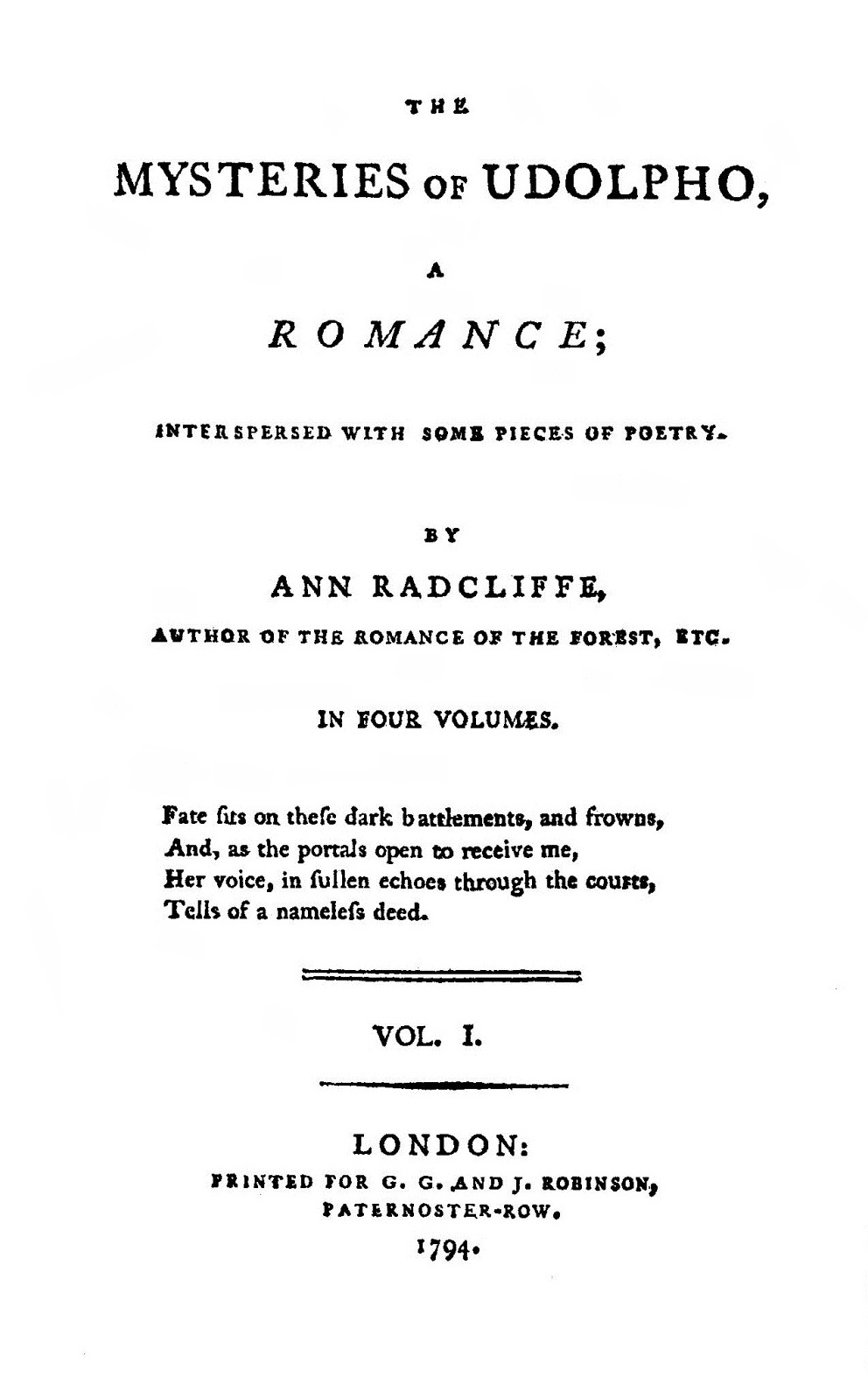
Fate sits on these dark battlements, and frowns,
Epigraph to Ann Radcliffe’s The Mysteries of Udolpho
And, as the portals open to receive me,
Her voice, in sullen echoes through the courts,
Tells of a nameless deed.
In 1764, Horace Walpole kicked off the Gothic novel craze with The Castle of Otranto: A Gothic Story. Thirty years later, Otranto would serve as the blueprint for Ann Radcliffe’s fourth novel, The Mysteries of Udolpho, A Romance (1794). Radcliffe had begun her literary career in 1789 at age 25, first publishing anonymously, and then eventually using her own name as her novels grew in popularity and commanded higher prices from publishers. Immensely popular during her own life despite only publishing five novels in that time, Udolpho which would go on to rival Otranto as the archetypical Gothic novel, to the point of being satirized in Jane Austen’s Northanger Abbey (1817).
To H. P. Lovecraft, Radcliffe was essential reading in the history of horror literature; although he did not first encounter her by reading the whole novel:
Belknap, having sharper eyes than his old Grandpa, picked up a book which I would have given much to have seen first—”Tales of Mystery”, composed of extracts from the most celebrated horror novelists of the 18th century—Walpole, Mrs. Radcliffe, Lewis, &c. He will later lend his prize to me—just as I am lending him my own prizes.
H. P. Lovecraft to Lillian Clark, 29 Sep 1922, Letters to Family & Family Friends 1.80
Tales of Mystery (1891) was an anthology edited by George Saintsbury collecting excerpts from the Gothic romances of Radcliffe (including bits of Udolpho), Matthew Gregory Lewis, and Charles Maturin. Frank Belknap Long, Jr., who had spied the book first at a bookstall during Lovecraft’s trip to New York, would later gift it to his friend as at Christmas 1922:
I’ve been eating up Gothick stuff lately—all the posterity of “Otranto”. Miss Reeves’ “Old English Baron” (1777) is infernally tame, but in damned good Georgian English. Radcliffe stuff is vastly—immeasurably—superior in interest & atmosphere, though the language is more stilted. (And yet beats Reynolds by a mile!) I’m reading that volume of selections which Little Belknap picked up right under his Old Grandpa’s nose at the shop in Vesey-Street, & which he magnanimously gave the poor old gentleman as a Christmas gift.
H. P. Lovecraft to James F. Morton, 5 Apr 1923, Letters to James F. Morton 35
In 1925, now living in New York, Lovecraft was asked by W. Paul Cook to write the article that would become “Supernatural Horror in Literature.” While Lovecraft would learn relatively heavily on The Tale of Terror (1921) by Edith Birkhead for his section on Gothic novels, among the books we know he read was The Mysteries of Udolpho. He later noted that his friend, the bookseller Goerge Kirk, gave him a copy of Udolpho (LWP 180), and his diary entry for 9 May 1925includes the notation “GK call—Udolpho” (CE 5.158), which may be when he received his copy, although he didn’t devour the noel until December:
I waded through the whole of “Udolpho” last week, & am now on the hunt for Maturin’s “Melmoth”.
H. P. Lovecraft to Clark Ashton Smith, 12 Dec 1925, Dawnward Spire, Lonely Hill 92
From this reading, Lovecraft would write:
[…] all existing lamps are paled by the rising of a fresh luminary of wholly superior order—Mrs. Ann Radcliffe (1764–1823), whose famous novels made terror and suspense a fashion, and who set new and higher standards in the domain of macabre and fear-inspiring atmosphere despite a provoking custom of destroying her own phantoms at the last through laboured mechanical explanations. To the familiar Gothic trappings of her predecessors Mrs. Radcliffe added a genuine sense of the unearthly in scene and incident which closely approached genius; every touch of setting and action contributing artistically to the impression of illimitable frightfulness which she wished to convey. A few sinister details like a track of blood on castle stairs, a groan from a distant vault, or a weird song in a nocturnal forest can with her conjure up the most powerful images of imminent horror; surpassing by far the extravagant and toilsome elaborations of others. Nor are these images in themselves any the less potent because they are explained away before the end of the novel. Mrs. Radcliffe’s visual imagination was very strong, and appears as much in her delightful landscape touches—always in broad, glamorously pictorial outline, and never in close detail—as in her weird phantasies. Her prime weaknesses, aside from the habit of prosaic disillusionment, are a tendency toward erroneous geography and history and a fatal predilection for bestrewing her novels with insipid little poems, attributed to one or another of the characters.
H. P. Lovecraft, “Supernatural Horror in Literature”
Mrs. Radcliffe wrote six novels; The Castles of Athlin and Dunbayne (1789), A Sicilian Romance (1790), The Romance of the Forest (1791), The Mysteries of Udolpho (1794), The Italian (1797), and Gaston de Blondeville, composed in 1802 but first published posthumously in 1826. Of these Udolpho is by far the most famous, and may be taken as a type of the early Gothic tale at its best. It is the chronicle of Emily, a young Frenchwoman transplanted to an ancient and portentous castle in the Apennines through the death of her parents and the marriage of her aunt to the lord of the castle—the scheming nobleman Montoni. Mysterious sounds, opened doors, frightful legends, and a nameless horror in a niche behind a black veil all operate in quick succession to unnerve the heroine and her faithful attendant Annette; but finally, after the death of her aunt, she escapes with the aid of a fellow-prisoner whom she has discovered. On the way home she stops at a chateau filled with fresh horrors—the abandoned wing where the departed chatelaine dwelt, and the bed of death with the black pall—but is finally restored to security and happiness with her lover Valancourt, after the clearing-up of a secret which seemed for a time to involve her birth in mystery. Clearly, this is only the familiar material re-worked; but it is so well re-worked that Udolpho will always be a classic. Mrs. Radcliffe’s characters are puppets, but they are less markedly so than those of her forerunners. And in atmospheric creation she stands preëminent among those of her time.
It is easy to see both what Lovecraft would have enjoyed and deplored in Radcliffe’s Udolpho, which was the only complete novel of hers he had read at the time of writing. The moralistic tone of the story with its sappy ending and romances were largely anathema to his aesthetic style. Many characters, not least of them the heroine Emily, are prone to fainting and melodramatics, the story is peppered with bits of verse, quotes from Milton and Shakespeare, and some convoluted linguistic expressions typical of the period which probably earned a bemused smile from Lovecraft. Yet there are also many vivid descriptions hinting of terrible horrors and revelations to be made, of castles and battlements, and old family histories with their buried secrets.
For critical analysis, Lovecraft would have had The Tale of Terror, and it was from Birkhead that he probably drew his facts about Radcliffe’s life and her other novels, but his impressions appear to be his own. The note about her “insipid little poems” is interesting in particular because Radcliffe later wrote an essay “On the Supernatural in Poetry” (1826), which Lovecraft apparently never read, where she wrote:
The wild attire, the look not of this earth, are essential traits of supernatural agents, working evil in the darkness of mystery. Whenever the poet’s witch condescends, according to the vulgar notion, to mingle mere ordinary mischief with her malignity, and to become familiar, she is ludicrous, and loses her power over the imagination; the illusion vanishes.
A sentiment that echoes some of Lovecraft’s sentiments in “Supernatural Horror in Literature,” and which he might well have appreciated. As it was, at the time Lovecraft had read only Udolpho and some excerpts from Radcliffe’s other novels, and his literary opinion was set on that…although it was sufficient that when August Derleth was looking for recommendations, he would write:
Incidentally—have you read other early horror work? If not, let me advise the following as worthy ingredients (if only for historical reasons) for any fantaisiste’s library:
H. P. Lovecraft to August Derleth, 2 Sep 1926, Essential Solitude 1.34
Mysteries of Udolpho (1793) by Anne Radcliffe
The Monk (1795) by Matthew Gregory Lewis
In other letters, Lovecraft gives a few more details on his private thoughts on Radcliffe and Udolpho, spurred in large part by a course on Gothic fiction that Donald Wandrei was taking:
As to “Melmoth”—of course it dags in places, like all the interminable novels of its time; but it seems to me to hold a certain convincing kinship with horrors beyond the veil which we find lacking in its predecessors—such as “Udolpho”, “The Monk”, &c.
H. P. Lovecraft to August Derleth, 7 Nov 1926, Essential Solitude 1.47
You’re lucky to get hold of “The Romance of the Forest”—the only Radcliffian oeuvre which I’ve ever seen in toto is “Udolpho”, now being lent to Dwyer. Yes—her gentle melancholy is certainly both romantic & hydraulic!
H. P. Lovecraft to Donald Wandrei, 22 Oct 1927, Letters wth Donald and Howard Wandrei 172
Of the Goths, only Maturin had the sense of unholy outsideness developed to any considerable degree—you couldn’t bribe me to swallow all the sobbing Radcliffery which your course is forcing upon you. The few selections in an anthology by George Sainstbury are all I want—though I have read Udolpho through. (Just now, by the way, I’ve lent it to Dwyer.)
H. P. Lovecraft to Donald Wandrei, 3 Nov 1927, Letters wth Donald and Howard Wandrei 179-180
Dwyer is just forming the acquaintance of our gushing friend Mrs. Radcliffe through my copy of “Udolpho”, & expresses the opinion that she is unsurpassed in imparting horror to a frowning castle landscape. Cook is going to lend me “The Italian” shortly.
H. P. Lovecraft to Donald Wandrei, 25 Nov 1927, Letters wth Donald and Howard Wandrei 184
Your Radcliffian satiation is scarcely an encouraging emotion to confront me as I stand on the brink of “The Italian” & “The Romance of the Forest”—lent me by Cook—but I do not think I shall let it deter me from at least a skimming. The author of a standard treatise on supernatural horror in literature ought to read—as a matter of duty—one or two of the volumes he has analysed & appraised so sagely. You & Dwyer can work up an interesting controversy about the sombre & sentimental Mother Anne, for “Udolpho” had made him a shouting Radcliffe-fan of the first & foremost order. He is, of course, right so far as the sheer weaving of vague, terrible impressions of cyclopean mystery & imminent nightmare is concerned; & we ought not to let the peterings-out or the salt lakes of “poetic” sensibility deter us from giving credit where credit is due.
H. P. Lovecraft to Donald Wandrei, 19 Dec 1927, Letters wth Donald and Howard Wandrei 189
Lafcadio Hearn averred that Gothic cathedrals frightened him with their bulk and mystical design. They seemed to him about to rise from the ground. Of this quality of size-terror I fancy Mrs. Radcliffe is, as you say, the chief exponent. Certainly, it recurs throughout her work.
H. P. Lovecraft to Bernard Austin Dwyer, 14 Feb 1928, Letters to Maurice W. Moe and Others 469
Lovecraft did eventually read Radcliffe’s novels The Romance of the Forest (1791) and The Italian (1797), which were lent to him by W. Paul Cook in 1928, noting:
I have also read lately those old Radcliffe standbys—”The Italian” & “The Romance of the Forest”—neither of which is really weird according to my standard.
H. P. Lovecraft to August Derleth, 20 Aug 1928, Essential Solitude 1.153
In truth, the supernatural element in Radcliffe’s novels was always a false one, like the ghosts and ghouls in the typical Scooby Doo episode, at the end the mask will come off and a rational explanation offered. Yet she showed great skill in the build-up of such terrors, and this is nowhere as prominent as in The Mysteries of Udolpho. Lovecraft, to his credit, appeared to recognize that Radcliffe had earned her place in the pantheon of weird fiction authors for her work:
Also—are you familiar with the so-called “Gothic” novels of the later 18th & early 19th centuries—Mrs. Radcliffe’s “Udolpho”, Lewis’s “Monk”, Maturin’s “Melmoth”, &c? Some years ago I wrote an article on the history of the weird tale, mentioning the titles of things which had particularly impressed me. If you’d like to see this as a guide to weird reading I might be able to dip up a duplicate to lend you.
H. P. Lovecraft to Robert Bloch, 22 Apr 1933, Letters to Robert Bloch & Others 20
It is difficult to say how much Lovecraft was influenced by The Mysteries of Udolpho; there is certainly a deliberate echo of the Gothic manse in “The Rats in the Walls,” which was written after he read the Saintsbury Tales of Mystery but before he read the full novel. It might be fair to say that Lovecraft’s study of the Gothics confirmed in him the lessons of what not to do. No fainting heroines, little to no romances, something more than drafty castles at work. Nor did Lovecraft follow Radcliffe in explaining away every mystery with a rational explanation:
“I perceive,” said Emily, smiling, “that all old mansions are haunted; I am lately come from a place of wonders; but unluckily, since I left it, I have heard almost all of them explained.”
Ann Radcliffe, The Mysteries of Udolpho, Vol. 3, Chapter XII
The syntax of horror shifts through the years, decades, and centuries; in Lovecraft’s day, the old familiar terrors of Radcliffe’s Udolpho no longer held the same power as they did when they were fresh and new in the late 18th century—yet they were a part of the legacy of horror to which Lovecraft was an inheritor, and so too are both Radcliffe and Lovecraft part of the genealogy of horror fiction today, literary ancestors whose works have been often lampooned and satirized, adapted and criticized, but still read, still relevant to us today.
What better measure of their power and influence?
Bobby Derie is the author of Weird Talers: Essays on Robert E. Howard and Others and Sex and the Cthulhu Mythos.
Deep Cuts in a Lovecraftian Vein uses Amazon Associate links. As an Amazon Associate I earn from qualifying purchases.
 Deep Cuts in a Lovecraftian Vein