“Was it because of the Desert’s curse?” I asked. And he said, “Partly it was the fury of the Desert and partly the advice of the Emperor Thuba Mleen, for that fearful beast is in some way connected with the Desert on his mother’s side.”
—Lord Dunsany, “The Hashish-Man” in A Dreamer’s Tales (1910)
To properly review “The Message of Thuba Mleen” (1911) by Aleister Crowley requires a little background on Crowley’s relationship with the Cthulhu Mythos and Lovecraft’s references to Crowley in his letters. Since this background is a bit long with numerous quotes, some handy links are provided above to help readers navigate to whichever section they want to go to.
Crowley & Cthulhu
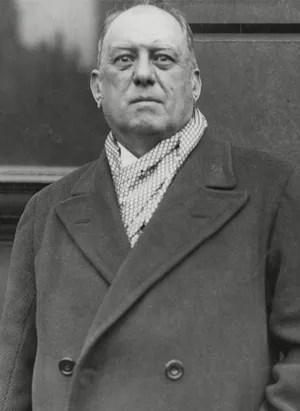
Aleister Crowley (1875-1947) never met H. P. Lovecraft (1890-1937) in life. Crowley was an English occultist, writer, poet, and artist who became notorious both for personal life and his mystical philosophy, which coalesced into the development of Thelema in the early 20th century. After his death, his systems of ceremonial magic and philosophy were developed by various successors and fed into the growing interest during the post-WWII spiritual awakening. Notably, his secretary Kenneth Grant worked to expand and integrate Crowley’s system of “magick” with other esoteric practices and even fictional material from writers like H. P. Lovecraft.
Although Lovecraft seems to have been unacquainted with Crowley’s work, it is evident that both were in touch with a source of power, ‘a prater-human intelligence’, capable of inspiring very real apprehension in the minds of those who were, either through past affiliation or present inclination, on the same wavelength. Whether this Intelligence is called Alhazred or Aiwaz (both names, strangely enough, evoking Arab associations) we are surely dealing with a power that is seeking ingress into the present life cycle of the planet.
— Kenneth Grant, “Dreaming Out of Space” in Man, Myth, and Magic (1970), vol. 23, 3215
Grant wasn’t the first to draw associations between weird fiction and magic; Le Matin des magicians (1960) by Louis Pauwels and Jacques Bergier referenced the perceived connection between Arthur Machen’s fiction and his membership in the Hermetic Order of the Golden Dawn (an occult organization of which Crowley was also a member). However, Grant did more than draw parallels; in his writing, he directly associated his understanding of Lovecraft’s Mythos into his exegesis of Crowley’s magick.
Fiction, as a vehicle, has often been used by occultists. Bulwer Lytton’s Zanoni and A Strange Story have set many a person on the ultimate Quest. Ideas not acceptable to the everyday mind, limited by prejudice and spoiled by a “bread-winning” education, can be made to slip past the censor, and by means of the novel, the poem, the short story be effectually planted in soil that would otherwise reject or destroy them.
Writers such as Arthur Machen, Brodie Innes, Algernon Blackwood and H. P. Lovecraft are in this category. Their novels and stories contain some remarkable affinities with those aspects of Crowley’s Cult deal with in the present chapter, i.e. themes of resurgent atavisms that lure people to destruction. Whether it be the Vision of Pan, as in the case of Machen and Dunsany, or the even more sinister traffic with denizens of forbidden dimensions, as in the tales of Lovecraft, the reader is plunged into a world of barbarous names and incomprehensible signs. Lovecraft was unacquainted both with the name and the work of Crowley, yet some of his fantasies reflect, however, distortedly, the salient themes of Crowley’s Cult. The following comparative table will show how close they are:
— Kenneth Grant, The Magical Revival (1972), 114
Grant then followed with a table of correspondences he perceived between Crowley and Lovecraft. A similar, though distinct, table was also included in the Necronomicon (1977) written by “Simon.” This was the first commercial hoax Necronomicon which was also explicitly a grimoire, something that was intended to mimic other collections of ceremonial magic rites, sigils, lore, etc. intended for use by practicing occultists. The introduction by “Simon” leaned heavily on the supposed correspondences between Lovecraft’s Mythos and Crowley’s magick.
We can profitably compare the essence of most of Lovecraft’s short stories with the basic themes of Crowley’s unique system of ceremonial Magick. While the latter was a sophisticated psychological structure, intended to bring the initiate into contact with his higher Self, via a process of individuation that is active and dynamic (being brought about by the “patient” himself) as opposed to the passive depth analysis of the Jungian adepts. Lovecraft’s Cthulhu Mythos was meant for entertainment. Scholars, of course, are able to find higher, ulterior motives in Lovecraft’s writings, as can be done with any manifestation of Art.
— “Simon” (Peter Levenda), Necronomicon (1977) xii
The ceremonial magic presented in the Simon Necronomicon was distinct from that in Grant’s system derived from Crowley; though they shared some common references in Lovecraft and Crowley’s respective mythos & magick. This unexpected complexity invited comparison, and sometimes fusion. From a metafictional perspective, it became the beginning of a parallel body of literature alongside the growing body of Cthulhu Mythos fiction: a Lovecraftian occult scene. One that started to flower when another Necronomicon, edited by George Hay, was published in 1978:
I had also been reading the works of Aleister Crowley—collected by my friend Roger Staples of Michigan University—and found the parallels so striking that I owndered if Lovecraft and Crowley had been acquainted.
Derleth was positive that they had never met—in fact, he doubted whether Lovecraft had ever heard of ‘the Great Beast’. If he had, Derleth seemed to think, he would have dismissed him as a charlatan and a poseur.
— Colin Wilson, “Introduction,” The Necronomicon: The Book of Dead Names (1978), 14
Wilson refers to a meeting with Derleth in 1967; later in the same introduction, he cites Grant’s merging of Lovecraftian Mythos with Crowleyian magick. The introduction was written with all the care of a good hoax; starting from a basis of facts and gradually weaving in fictional elements, to build up to the idea that Lovecraft’s Necronomicon wasn’t just a fictional book, but had been based on a genuine occult document from the Middle East—which is what the Hay Necronomicon was presented as.
So as the 1980s dawned and the Simon Necronomicon became available in an affordable paperback edition to grace New Age shelves forevermore, would-be Lovecraftian occultists had at least three separate sources to draw upon. All of them tried to tie H. P. Lovecraft to Aleister Crowley. The two men, who had never met in life, found elements of their legends entwined posthumously.
With the advent of the internet, it became easier for misinformation to spread. Colin Law’s Necronomicon Anti-FAQ (1995) was, like Wilson’s introduction, just a bit of fun—but it fostered certain misconceptions about Crowley and Lovecraft, despite repeated debunkings:
In 1918 Crowley was in New York. As always, he was trying to establish his literary reputation, and was contributing to The International and Vanity Fair. Sonia Greene was an energetic and ambitious Jewish emigre with literary ambitions, and she had joined a dinner and lecture club called “Walker’s Sunrise Club” (?!); it was there that she first encountered Crowley, who had been invited to give a talk on modern poetry. […]
In 1918 she was thirty-five years old and a divorcee with an adolescent daughter. Crowley did not waste time as far as women were concerned; they met on an irregular basis for some months.
In 1921 Sonia Greene met the novelist H.P. Lovecraft, and in that same year Lovecraft published the first novel where he mentions Abdul Alhazred (“The Nameless City”). In 1922 he first mention the Necronomicon (“The Hound”). On March 3rd. 1924, H.P. Lovecraft and Sonia Greene married.
We do not know what Crowley told Sonia Greene, and we do not know what Sonia told Lovecraft.
Edwin C. Walker (1849-1931) was a radical liberal who founded the Sunrise Club in 1889; this interracial club held dinner meetings at which speakers were invited to discuss on a wide range of topics. According to L. Sprague de Camp’s H. P. Lovecraft: A Biography (1975), Sonia joined the club c. 1917 (160-161); and there is a reference to Sonia’s membership in one of Lovecraft’s letters (LFF 1.83). I have yet to find any reference to Crowley addressing or attending the club. Given he lived in the United States from 1914-1919 and was often living in New York City at the time, it is possible, if not necessarily plausible that he could have attended some evening.
There is no reference to Crowley in any of Sonia’s surviving letters, essays, or autobiography; no mention of grimoires or the Necronomicon. The idea that Lovecraft got the idea of the Necronomicon from Crowley by way of Sonia is unsupported by any evidence and relies on the idea that the Necronomicon bears some similarity to Crowley’s The Book of the Law—the same supposition pushed by Grant and Simon, among others. It is rather telling that nothing in Crowley’s own writings supports his meeting with Sonia either, and that all references to the idea of their meeting ultimately derive from Low. For more on this and other Necronomicon-related hoaxes and occult history, see The Necronomicon Files by Daniel Harms & John W. Gonce III.
It’s easy to go on, although facts and fiction get furiously muddled. Despite Grant’s assertion that Lovecraft had never heard of Crowley and Derleth’s assertion (as related by Wilson) that Lovecraft may not have heard of Crowley and certainly never met him, fictional meetings between the writer of the weird and the prophet of Thelema have increasingly featured in books and comics, one notable example being The Arcanum (2007) by Thomas Wheeler. Yet my favorite hypothetical meeting is a 1927 chess game between Aleister Crowley and Wilbur Whateley:
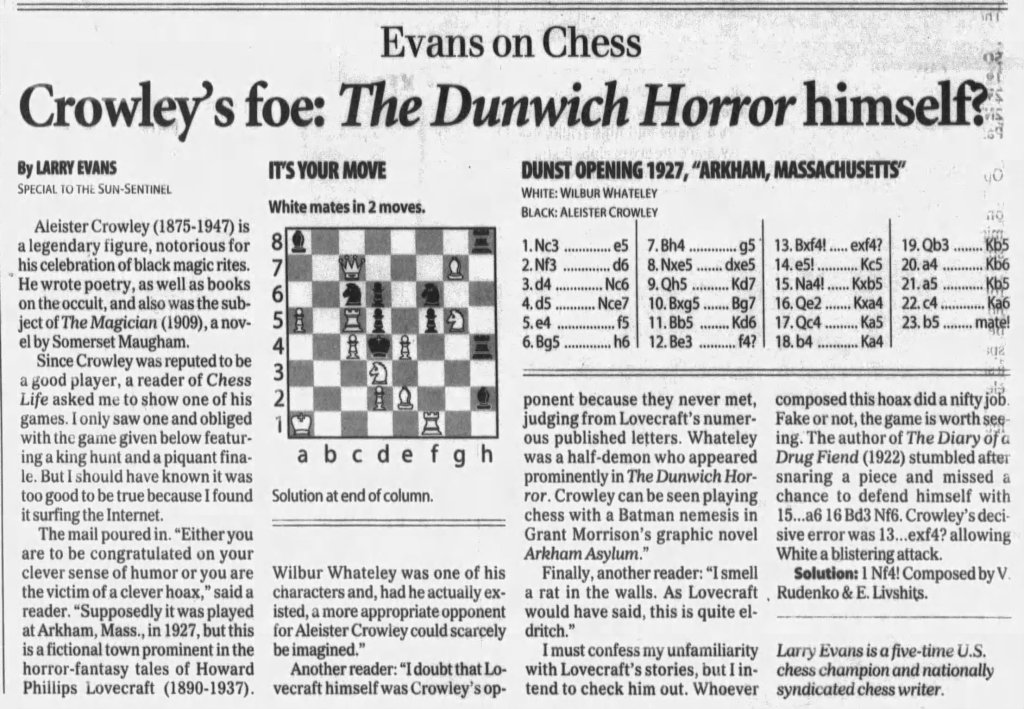
If Derleth did tell Colin Wilson that he doubted Lovecraft had ever heard of Crowley and this wasn’t another part of the hoax, then he was badly mistaken and should’ve known better. Lovecraft’s letters give considerable detail on his thoughts regarding Aleister Crowley.
H. P. Lovecraft on Aleister Crowley
The Crowley cutting is interesting. What has the poor devil-worshipper been up to now? When I was in Leominster (near Athol) with Cook & Munn last month, calling on a bookseller, I saw a copy of a book by Crowley—“The Diary of a Drug-Fiend.” The merchant informed me that it has been suppressed by some branch of the powers that be—though he agreed to part with his copy for three thalers. I did not take him up—but I told Belknap about the offer.
–H. P. Lovecraft to Wilfred B. Talman, [8 Jun 1929], LWT 114
In 1929, French authorities deported Crowley, which led to sensationl articles (Why France Finally Kicked Out the High Priest of the Devil Cult), and a similar cutting was no doubt passed to Lovecraft. From this first reference in Lovecraft’s letters, it isn’t clear when exactly the Old Gent from Providence became aware of Aleister Crowley, but the suggestion seems to be that Lovecraft was at least passingly familiar with the magus by the late 1920s, probably from similar newspaper clippings. From Lovecraft’s comments, his friend Frank Belknap Long, Jr. had an interest in Crowley…a greater interest than Lovecraft himself had:
Aleister Crowley still keeps in the news! Don’t take any especial trouble to send the clipping unless you find it lying around, for my interest in the gent is perhaps less intense than Belknap’s.
–H. P. Lovecraft to Wilfred B. Talman, [7 Jul 1929], LWT 116
In 1930, Percy Reginald Stephensen’s The Legend of Aleister Crowley: Being a Study of the Documentary Evidence Relating to a Campaign of Personal Vilification Unparalleled in Literary History was published, ostensibly to ameliorate Crowley’s reputation. Lovecraft apparently caught a few reviews:
And speaking of your precious files—have you seen reviews of the new book about that suave diabolist Aleister Crowley? Belknap sent me a cutting from the Tribune. The biographer—abetted by the reviewer—(Hebert S. Gorman, who claims to have dined with Crowley) tries to depict the reputed ally of Satan as a much-wronged and basically blameless poet—whose eccentricities are merely the harmless foibles of genius!
–H. P. Lovecraft to Wilfred B. Talman, [Sep 1930], LWT 133-134
Years passed. Crowley’s infamy was such that he served as the basis for several fictional magicians, most notably the character of Oliver Haddo in Somerset Maugham’s The Magician (1908); the black magician Oscar Clinton in H. R. Wakefield’s “He Cometh and He Passeth By” (1928) (and later, Apuleius Charlton in “The Black Solitude” (1951)); and, though Lovecraft never lived to see it, Rowley Thorne in the stories fellow Weird Tales writer Manly Wade Wellman, in one such story, “The Letters of Cold Fire” (WT May 1944), Thorne attempts to obtain a copy of the Necronomicon!
Lovecraft had not read Maguham’s novel, but was aware of its association with Crowley:
I’ve never seen the Ramuz & Maugham items. Poor old Crowley figures more than once in fiction—for I believe it is her upon whom the villain in Wakefield’s “He Cometh & He Passeth By” is modelled.
–H. P. Lovecraft to Richard Ely Morse, 22 Mar 1932, LHB 42
“Ramuz” may be a reference to C. F. Ramuz La Regne de l’esprit Malin (1917) tr. by James Whitall as The Reign of the Evil One (1922). The novel seems to draw no direct inspiration from Crowley, being about a stranger (who might be the devil himself) who comes to a small Swiss town and turns it into hell.
Lovecraft did read Wakefield, however, and was appreciative.
Wakefield’s stuff is generally very good, & I’m glad you’ve had an opportunity to read it. Of the tales in the first book my favourites are “He Cometh & He Passeth By” (the villain in which is a sort of caricature of the well-known living mystic & alleged Satanist Aleister Crowley), “The Red Lodge”, “The 17th Hole at Duncaster[“], & “And He Shall Sing”.
–H. P. Lovecraft to Robert Bloch, [22 Jul 1933], LRBO 62Glad to see the item about Crowley. What a queer duck! He is the original of Clinton in Wakefield’s “They Return at Evening.”
– H. P. Lovecraft to Clark Ashton Smith, [14 Dec 1933], DS 507Wakefield is pretty good—I’ll enclose “They Return at Evening” as a loan in the coming shipment. You’l probably find at least four of the tales especially absorbing—“The Red Lodge”, “He Cometh & He Passeth By” based on Aleister Crowley), “And He Shall Sing”, & “The Seventeenth Hole at Duncaster.”
–H. P. Lovecraft to Clark Ashton Smith, [Jan 1934], DS 515
Clark Ashton Smith, when he read the “He Cometh and He Passeth By,” gave his own opinion to Lovecraft:
I read one of the Wakefield stories last night—“He Cometh and he passeth by—” and found it excellent, especially in the suggestion of the diabolic Shadow. Crowley is surely a picturesque character, to have inspired anything like Clinton! I know little about Crowley myself, but wouldn’t be surprised if many of the more baleful elements in his reputation were akin to those in the Baudelaire legend . . . that is to say, largely self-manufactured or foisted upon him by the credulous bourgeoisie.
– Clark Ashton Smith to H. P. Lovecraft, [Jan 1934], DS 520
Lovecraft’s reply reveals something new—an acquaintances of his had actually met Crowley:
As for Aleister Crowley—I rather thought at first that his evil reputation was exaggerated, but Belknap says that Harré has met him & has found him indescribably loathsome in mind, emotions, & conduct. This from Harré is quite a damning indictment, for Belkanp tells me that T. Everett himself is far from squeamish or fastidious in his language & anecdotes when amidst the sort of company that dissolves inhibitions. But Crowley was too much for him. He didn’t relate particulars—but said that the evil magus made him so nauseated that he left abruptly. I guess Crowley is about as callous, unclean-minded, & degenerate a bounder as one can often find at large—though he undoubtedly has talents & scholarship of a very high order. It seems to me I heard that he is in New York now—London won’t stand him any longer. And this reminds me that I forgot to return that old cutting of yours which mentions him—permit me to repair the omission now.
–H. P. Lovecraft to Clark Ashton Smith, [11 Feb 1934], DS 525
In 1933-1934, Crowley appears to have primarily been in London, dealing with a libel suit (which he lost). I have not discovered anything to suggest he went to New York at this time. However, Harré’s papers contain a folder associated with Aleister Crowley, so they may well have met or interacted at some point. It is also known that Harré and Crowley were published together in The International in 1915, so possibly the meeting occurred over a decade and a half earlier, when Crowley was in New York, and Lovecraft misunderstood.
Smith responded:
Judging from Harré’s reactions, it would appear that Aleister Crowley is a pretty hard specimen. I had discounted the legends on general principles, knowing nothing whatever about the mysterious magus.
–Clark Ashton Smith to H. P. Lovecraft, [Mar 1934], DS 536
At this point, Crowley became a reference point for diabolists and occultists of all stripes.
The case of the Boer lady—Mevrouw van de Riet—certainly offers dark food for the imagination. She seems to be a sort of female Aleister Crowley—or a striga, lamia, empusa, or something of the sort.
–H. P. Lovecraft to Clark Ashton Smith, [18 Nov 1933], DS 479
The subject would next come up when Lovecraft began corresponding with the young fan Emil Petaja in 1935, when the subject turned toward the Black Mass, Satanism, and the occult. Lovecraft was an atheist and materialist, but he had read something of the occult for research purposes over the years, and picked up other tidbits:
In the 1890’s the fashionable decadents liked to pretend that they belonged to all sorts of diabolic Black Mass cults, & possessed all sorts of frightful occult information. The only specimen of this group still active is the rather over-advertised Aleister Crowley . . . . who, by the way, is undoubtedly the original of the villainous character to H. R. Wakefield’s “He Cometh & He Passeth By.”
–H. P. Lovecraft to Emil Petaja, 6 Mar 1935, LWP 414
Petaja apparently pursued the subject with Lovecraft, who responded at greater length, apparently still under the misconception that Crowley was in New York:
Regarding the Black Mass & its devotees—it is really even more repulsive than fascinating. The whole thing is described minutely in Joris-Karl Huysmans’ “Las Bas”—which was posthumously translated into English in 1923 & promptly suppressed. The Black Mass consisted in general of a malevolent & incredibly obscene parody on the Catholic Mass—involving public actions & natural substances almost impossible to describe in print. It originated in the Middle Ages, & has [ev]er since been secretly celebrated by groups of half-crazed, psychologically degenerate sensation-seekers—largely in the great metropolitan centres. Paris, Berlin, London, & New York are probably its greatest centres today. It seems to draw its devotees almost equally from the decadent artist class & from the general run of over-sophisticated psychopathic personalities. Aleister Crowley is a now-elderly Englishman who has dabbled in this sort of thing since his Oxford days. He is really, of course, a sort of maniac or degenerate despite his tremendous mystical scholarship. He has organised secret groups of repulsive Satanic & phallic worship in many places in Europe & Asia, & has been quietly kicked out of a dozen countries. Sooner or later the U.S. (he is now [in] N.Y.) will probably deport him—which will be bad luck for him, since England will probably put him in jail when he is sent home. T. Everett Harré—whom I have met & whom Long knows well—has seen quite a bit of Crowley, & thinks he is about the most loathsome & sinister skunk at large. And when a Rabelaisian soul like Harré (who is never sober!) thinks that of anybody, the person must be a pretty bad egg indeed! Crowley is the compiler of the fairly well-known “Oxford Book of Mystical Verse”, & a standard writer on occult subjects. The story of Wakefield’s which brings him in (under another name, of course) is in the collection “They Return at Evening”, which I’ll lend you if you like.
–H. P. Lovecraft to Emil Petaja, 5 Apr 1935, LWP 420-421
The Oxford Book of English Mystical Verse (1918) was compiled by D. H. S. Nicholson and A. H. E. Lee; but the book contains three poems by Crowley. The reference to “phallic worship” suggests that Harré may have confided something to Lovecraft about Crowley’s practice of sex magick, but this is as close as Lovecraft would ever come to mentioning the subject. Lovecraft apparently lent Petaja a cutting about Crowley:
Keep the review of the O’Donnell book—& here’s another from the Times. I’d like to see the Crowley one again—though there’s no hurry.
– H. P. Lovecraft to Emil Petaja, 31 May 1935, LWP 433
Elliott O’Donnell was a well-known collector of ghost and haunted house stories.
As it turned out, Lovecraft wasn’t the only one who knew someone that knew Crowley:
Conversation with one who has known the fabulous Aleister Crowley must surely have been interesting! I’ve seen several articles on this curious & repulsive entity, & am familiar with the portrayal in “He Cometh & He Passeth By”—though I have not read Maugham’s “Magician.” One other side-light comes from the amiable & picturesque source T. Everett Harré—editor of “Beware After Dark.” Harré has met Crowley; & although himself something of a specialist in corpological diction & anecdote, avers that the Hellish Archimage actually sickened him with the tone & subject-matter of his conversation. And anything or anybody capable of sickening the hard-boiled & perpetually pickled T. Everett must be—in the language of Friend Koenig—pretty strong meat! Crowley is evidently a tragic example of diseased & degenerate development in certain lines. Whether such a mass of psychological putrescence ought to be allowed at large is a sociological question too tough for a layman to tackle. The answer would really depend upon just how much social effect he has. But in any case he is obviously one of those “gamey” specimens who are much pleasanter to read & speculate about than to meet! Of his genius—of a sort—there can be no doubt. I believe he is an important contributor to a standard anthology which I’ve never read—“The Oxford Book of Mystical Verse.”
–H. P. Lovecraft to Richard Ely Morse, 25 Apr 1936, LHB 125
This is Lovecraft’s final published letter on Aleister Crowley—and it’s interesting to note that Lovecraft’s information is entirely second- or third-hand. At no point does he give any indication of having read any of Crowley’s prose or poetry, much less any of his magickal writings. To Lovecraft, Crowley was already essentially a living legend. There is no indication that any information passed between them.
Which doesn’t mean there isn’t a connection between Aleister Crowley and the Lovecraft Mythos.
“The Message of Thuba Mleen” (1911)
Many believe that it was a message from Thuba Mleen, the mysterious emperor of those lands, who is never seen by man, advising that Bethmoora should be left desolate.
—Lord Dunsany, “Bethmoora” in A Dreamer’s Tales (1910)
In 1911, Aleister Crowley was in France, writing prolifically as he finished the books of Thelema, a considerable body of poetry, and the occasional review. One work that particularly caught his imagination was A Dreamer’s Tales (1910) by Lord Dunsany. This was the fourth collection of Dunsany’s fantasies, and a strong influence on H. P. Lovecraft. Crowley was inspired by the book to write a review titled “The Big Stick,” published in his own magazine The Equinox in 1911. Appended to the review is Crowley’s poem “The Message of Thuba Mleen.”
※
The Message of Thuba Mleen
I.
Far beyond Utnar Véhi, far beyond
The Hills of Hap,
Sits the great Emperor crowned with diamond,
Twitching the rosary in his lap—
The rosary whose every bead well-conned
With sleek unblinking bliss
Was once the eyeball of an unborn child of his.
II.
He drank the smell of living blood, that hissed
On flame-white steel.
He tittered while his mother’s limbs were kissed
By the fish-hooks on the Wheel
That shredded soul and shape, more fine than mist
Is torn by the bleak wind
That blows from Kragua and the unknown lands behind
III.
As the last flesh was flicked, he wearied; slaves
From bright Bethmoora
Sprang forward with carved bowls whose crimson craves
Green wine of hashish, black wine of datura,
Like the Yann’s earlier and its latter waves!
These wines soothed well the spleen
Of the Desert‘s bastard brother Thuba Mleen.
IV.
He drank, and eyed the slaves “Mwass, Dagricho, Xu-Xulgulura,
Saddle your mules!” he whispered, “ride full slow
Unto Bethmoora
And bid the people of the city know
That that most ancient snake,
The Crone of Utnar Véhi, is awake.”
V.
Thus twisted he his dagger in the hearts
Of those two slaves
That bore him wine ; for they knew well the arts
Of Utnar Véhi—what the grey Crone craves!—
Knew how their kindred in the vines and marts
Of bright Bethmoora, thus accurst,
Would rush to the mercy of the Desert’s thirst.
VI.
I would that Māna-Yood-Sushāī would lean
And listen, and hear
The tittering, thin-bearded, epicene.
Dwarf, fringed with fear,
Of the Desert’s bastard brother Thuba Mleen!
For He would wake, and scream
Aloud the Word to annihilate the dream
※
Thuba Mleen appeared in two of the stories in A Dreamer’s Tales: “Bethmoora” and “The Hashish Man.” Lovecraft never used the mysterious emperor directly, but Bethmoora appeared in a long list of names and places:
I found myself faced by names and terms that I had heard elsewhere in the most hideous of connexions—Yuggoth, Great Cthulhu, Tsathoggua, Yog-Sothoth, R’lyeh, Nyarlathotep, Azathoth, Hastur, Yian, Leng, the Lake of Hali, Bethmoora, the Yellow Sign, L’mur-Kathulos, Bran, and the Magnum Innominandum—and was drawn back through nameless aeons and inconceivable dimensions to worlds of elder, outer entity at which the crazed author of the Necronomicon had only guessed in the vaguest way.
—H. P. Lovecraft, “The Whisperer in Darkness” (1931)
So it was that Crowley and Lovecraft shared at least one influence; and in Lord Dunsany they both found inspiration, and they both created new works that tied into his dreamer’s tales—and by extension, because they were both building off Dunsany’s Dreamlands, so did their own dreams touch, or were in communion, all unknowing. “The Message of Thuba Mleen” stand easily with any of the other dream cycle stories and verses inspired by Dunsany and Lovecraft, with their strange names and dark, suggestive hints.
Many occultists looked for a common source between the two, and sought to create a shared origin for the Necronomicon and the Book of the Law; to tie Crowley to Cthulhu, and Magick to Mythos. Yet the shared Mythos was there all along, in a half-forgotten poem. The two were not tied together by any dark secret or occult truth, but by an appreciation for the great fantaisiste, Lord Dunsany.
And always will be, ’til wakes Māna-Yood-Sushāī.
Bobby Derie is the author of Weird Talers: Essays on Robert E. Howard and Others and Sex and the Cthulhu Mythos.
Deep Cuts in a Lovecraftian Vein uses Amazon Associate links. As an Amazon Associate I earn from qualifying purchases.


 Deep Cuts in a Lovecraftian Vein