Did Black people read Weird Tales during its golden age (1923-1940)?
At least some Black people in the United States wrote and read science fiction and weird fiction. W. E. B. DuBois published “The Comet” in his 1920 collection Darkwater: Voices from Within the Veil, Zora Neale Hurston’s “Spunk” (1925) appeared in Opportunity, A Journal of Negro Life, and George S. Schuyler’s novella Black Empire (1936-38) was serialized in the Pittsburgh Courier, to give just three examples. Black people’s quarters spent as well as anyone else’s at the newsstands.
There is no reason to believe that Black people did not read Weird Tales during the period. Proving that, however, is a bit tricky. Weird Tales never ran a demographic survey of readers. When researchers want to get a glimpse at who was reading the Unique Magazine, they need to look at more indirect data: who was writing letters that appeared in The Eyrie, and (after the departure of editor Farnsworth Wright in 1940, when Dorothy McIlwraith took the editor’s chair) whose names were listed as members of the Weird Tales Club? Unfortunately, names don’t generally give any hint of race—at best, it might give an overview of the gender balance of the readership (which are interesting in itself, see They Were Always Here on Turnip Lanterns).
Lacking the data to answer the question adequately, a deep dive into the archives of pulpdom suggests that while we can’t say how many Black people made up Weird Tales‘ readership, we can say that they certainly read weird fiction by some of Weird Tales‘ writers. A case in point is Edward Podolsky and “The Mummy’s Jest.”
Dr. Edward Podolsky (1902-1965) was a doctor and pulp writer whose early work included two stories in Weird Tales: “The Figure of Anubis” (WT Feb 1925) and “The Masters from Beyond” (WT Sep 1925). Both of these were fairly slight potboilers that failed to catch the reader’s attention; even Lovecraft doesn’t refer to them in his surviving letters, even though he had stories in both issues. Later, Podolsky would write science fiction stories and essays for science fiction pulps, and like his fellow weird tales writer Dr. David H. Keller, made money writing sex education books for an eager audience.
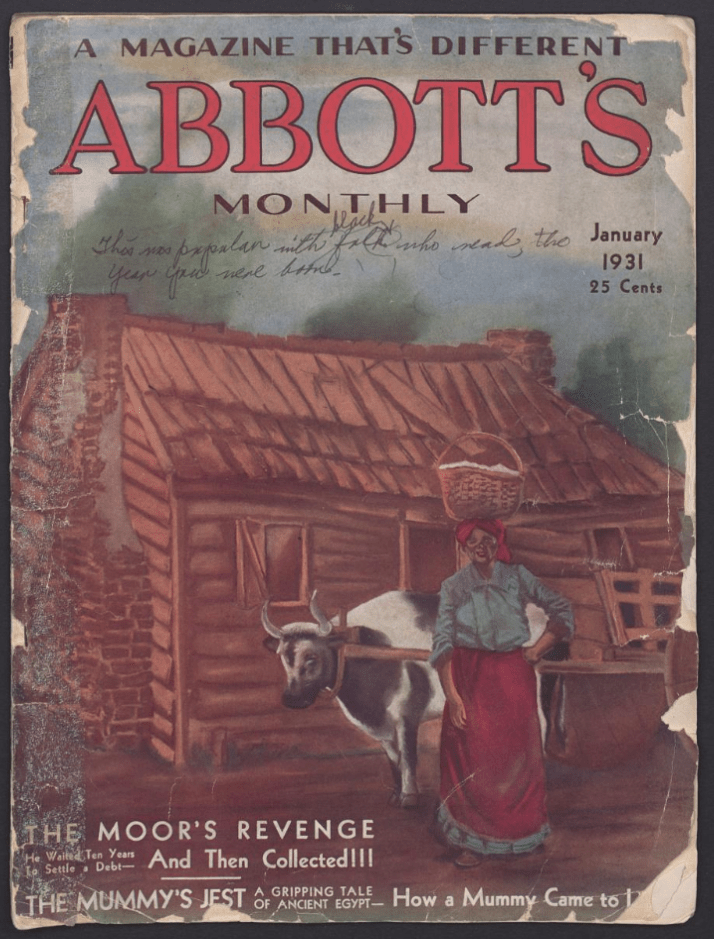
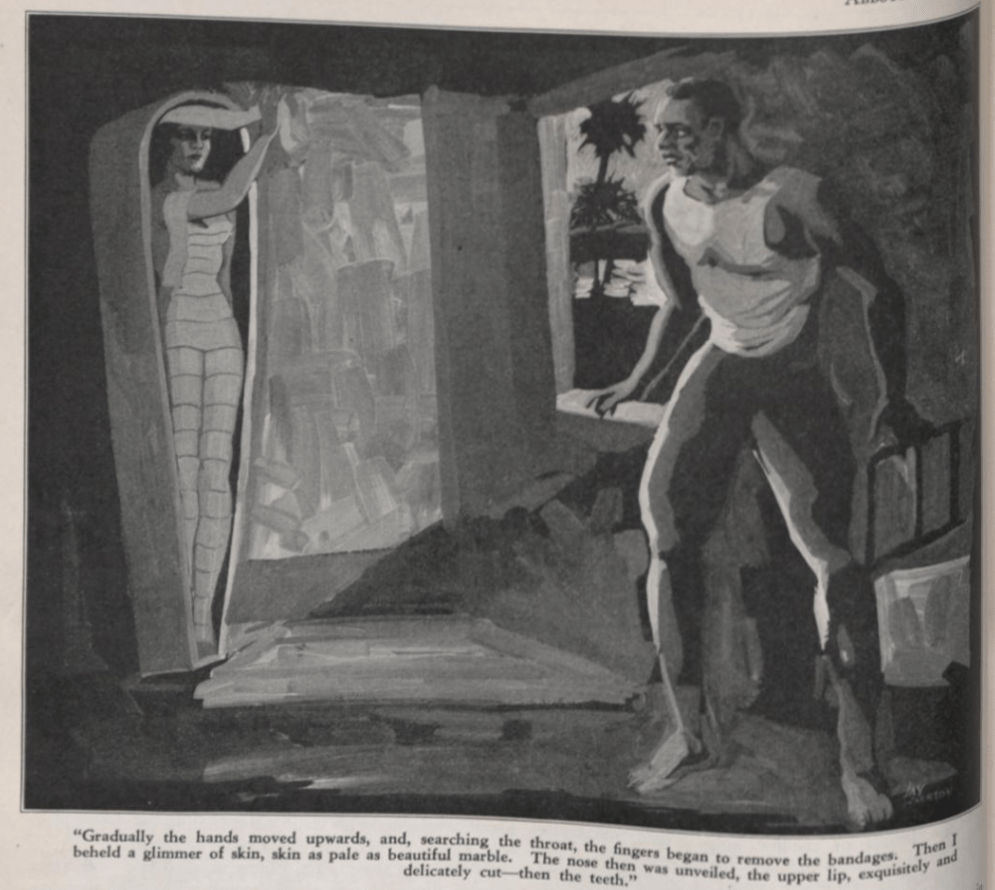
Among Podolsky’s fiction in the ’30s is “The Mummy’s Jest” (1931) for Abbott’s Monthly. Robert Sengstacke Abbott was a Black lawyer and newspaper publisher who founded The Chicago Defender in 1905; and later Abbott’s Monthly (1929-1933, changed name to Abbott’s Monthly Illustrated News, folded in 1934), a magazine combining a combination of news, fiction, and illustrations. This was a magazine primarily intended for a Black audience, and this shows in several of the topics addressed, the figures of the illustrations, etc. The illustrations for “The Mummy’s Jest,” for example, are by frequent Chicago Defender artist Jay Jackson and show a Black protagonist:
As it turns out, “The Mummy’s Jest” is well-named, and here’s the joke: give or take the occasional word, “The Mummy’s Jest” is “The Figure of Anubis,” reprinted almost verbatim from the pages of Weird Tales. Whether editor Lucius C. Harper knew he was buying an old story, or if Podolsky pulled a fast one and sold the same story twice to two different magazines isn’t clear, but I suspect the latter.
There is nothing about the text of the story to suggest a Black protagonist; Podolsky changed barely a word besides the title—and those changes that do exist between the two stories could reflect the different editorial choices of Farnsworth Wright and Lucius C. Harper in how they ran their respective magazines. So there is that sleight-of-hand there which the editor accomplished: by adding Jackson’s illustrations to Podolsky’s story, he could suggest and imply things to his presumably mostly-Black audience that aren’t in the story.
It is particularly notable that the figure of the mummy in both recensions of the story is described as having, when the bandages fall away, “skin as pale as beautiful marble.” In Weird Tales, where the default audience might expect the protagonist to be white, the discovery of a beautiful Caucasian princess from Egypt is a matter of course; it happens all the time, such as in Seabury Quinn’s “The Jewel of Seven Stones” (WT Apr 1928). In Abbott’s Monthly, however, this adds a certain frisson: the suggestion that the Black protagonist’s lost love was also white, and that they were in an interracial relationship.
It is difficult to express, at this remove, the degree to which the legal and social discrimination influenced science fiction and weird fiction in the United States during the Jim Crow period. No law expressly forbid people of one race from buying Weird Tales or Abbott’s Monthly, but the inherent biases of editors, writers, artists, and readers all factored in to influence how weird fiction was written, read, and received. “The Figure of Anubis”/”The Mummy’s Jest” is a good example of how with a little change of context, the whole reading of the story can change.
At the very least, however, while we can’t say whether anyone who picked up Abbott’s Monthly also read Weird Tales, we can definitely say that they read at least one story from the pages of the Unique Magazine.
“The Figure of Anubis” can be read here, and “The Mummy’s Jest” can be read here.
In November 1930, Fawcett Publications released a new pulp: Mystic Magazine. This lavishly illustrated, large-size pulp covered all manner of mystical phenomena, from seances to mediumship, palmistry to graphology, astrology to vampirism. In content, Mystic Magazine was a mix of nonfiction articles and the occasional story, written in the confessional style of Ghost Stories. In tone, the pulp seemed to cater more toward women—there was a kind of spiritualist lonely hearts column, regular features about what numerology or astrology said about your husband or love prospects, and the stories tended to have a romantic bent.
The pulp ran for four issues. With the fifth issue, Fawcett changed the title and approach; it became True Mystic Crimes (April 1931), adding in sensationalist material about Chinese tongs in San Francisco, murders caused by cults or solved by dreams or clairvoyance, zombies in Haiti, and all that sort of thing. Complete as the change was, the pulp still failed to find an audience among the crowded newsstands. The pulp ended there, to be no more than a rare collectible for pulp aficionados.
August Derleth earned his Bachelor of Arts from the University of Wisconsin in 1930. Derleth’s earliest letters from Clark Ashton Smith, addressed to him in Milwaukee in November 1930, occasionally touch on Mystic Magazine. Despite not being listed on the masthead, Derleth was an associate editor for the magazine, and published at least three stories and articles in Mystic under the byline “Tally Mason.” Still, the writing for the pulp was on the wall:
Dear Smith. In view of the fact the Fawcetts have discontinued Mystic together with its editor, my address after 17 February will be Sauk City, Wisconsin.
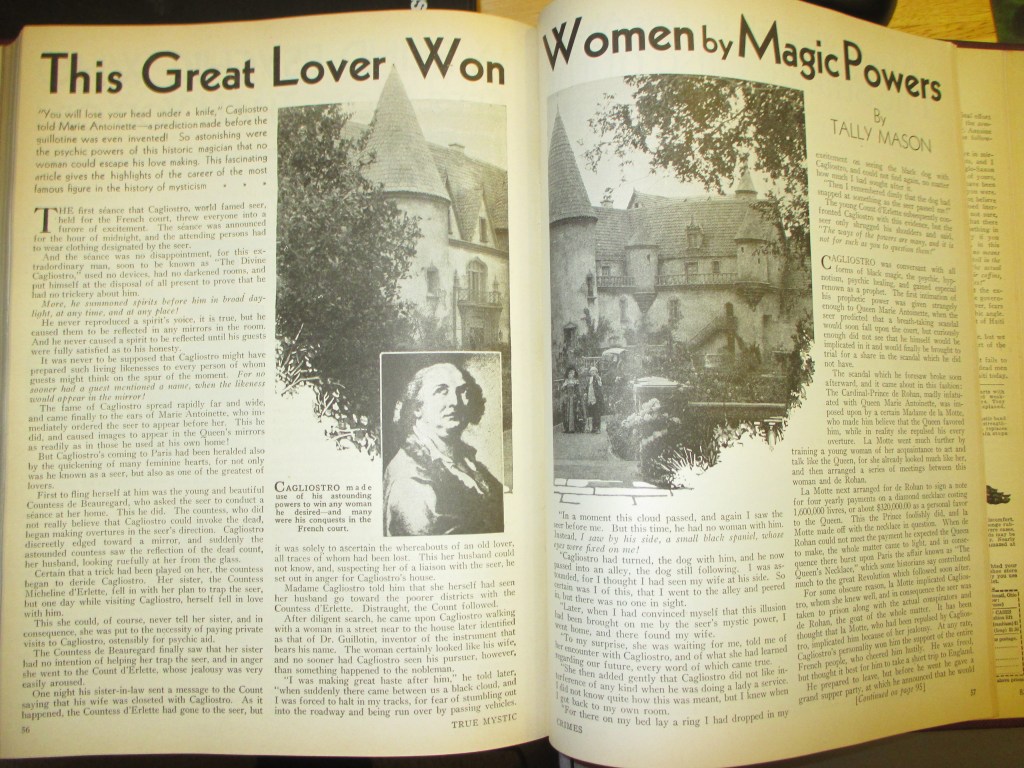
Back in his native Sauk City, August Derleth would begin writing for a pulp magazine titled Weird Tales. The date of his departure suggests the Fawcetts might have let him go before the transition to True Mystic Crimes—but that issue still contained two pieces from “Tally Mason,” whose manuscripts still survive among Derleth’s papers at the Wisconsin Historical Society. Both pieces were nominally nonfiction articles; “Your Picture Can Be Your Death Warrant” was about how images could contain a mystical link to their original subject, citing The Portrait of Dorian Gray as one example; the second, “This Great Lover Won Women by Magic Powers” was about the 18th-century occultist Alessandro Cagliostro, whose reputation and infamy has, over the centuries, become the stuff of legend and a great deal of fiction.
Yet “This Great Lover Won Women by Magic Powers” is interesting because of one particular thread that Derleth wove into the mix of facts and fiction:
But Cagliostro’s coming to Paris had been heralded also by the quickening of many feminine hearts, for not only was he known as a seer, but also as one of the greatest of lovers.
First to fling herself at him was the young and beautiful Countess de Beauregard, who asked the seer to conduct a séance at her home. This he did. The countess, who did not really believe that Cagliostro could invoke the dead, began making overtures in the seer’s direction. Cagliostro discreetly edged toward a mirror, and suddenly the astounded Countess saw the reflection of the dead count, her husband, looking ruefully at her from the glass.
Certain that a trick had been played on her, the countess began to deride Cagliostro. Her sister, the countess Micheline D’erlette, fell in with her plan to trap the seer, but one day while visiting Cagliostro, herself fell in love with him.
This she could, of course, never tell her sister, and in consequence, she was put to the necessity of paying private visits to Cagliostro, ostensibly for psychic aid.
The Countess de Beauregard finally saw that her sister had no intention of helping her trap the seer, and in anger she went to the Count d’Erlette, whose jealousy was very easily aroused.
One night his sister-in-law sent a message to the Count saying that his wife was closeted with Cagliostro. As it happened, the Countess d’Erlette had gone to the seer, but it was solely to ascertain the whereabouts of an old lover, all traces of whom had been lost. This her husband could not know, and, suspecting her of a liason with the seer, he set out in anger for Cagliostro’s house.
Madame Cagliostro told him that she herself had seen her husband go toward the poorer districts with the Countess d’Erlette. Distraught, the Count followed.
After diligent search, he came upon Cagliostro walking with a woman in a street near to the house later identified as that of Dr. Guillotin, inventor of the instrument that bears his name. The woman certainly looked like his wife, and no sooner had Cagliostro seen his pursuer, however, than something happened to the nobleman.
“I was making great haste after him,” he told later, “when suddenly there came between us a black cloud, and I was forced to halt in my tracks, for fear of stumbling out into the roadway and being run over by passing vehicles.
“In a moment this cloud passed, and again I saw the seer before me. but this time, he had no woman with him. Instead, I saw by his side, a small black spaniel, whose eyes were fixed on me!
“Cagliostro had turned, the dog with him, and he now passed into an alley, the dog still following. I was astounded, for I thought I had seen my wife at his side. So certain was I of this, that I went to the alley and peered in, but there was no one in sight.
“Later, when I had convinced myself that this illusion had been brought on me by the seer’s mystic power, I went home, and there found my wife.
“To my surprise, she was waiting for me, told me of her encounter with Cagliostro, and of what she had learned regarding our future, every word of which came true.
“She then added gently that Cagliostro did not like interference of any kind when he was doing a lady a service. I did not know quite how this was meant, but I knew when I got back to my own room.
“For there on my bed lay a ring I had dropped in my excitement on seeing the black dog with Cagliostro, and could not find again, no matter how much I had sought after it.
“Then I remembered dimly that the dog had snapped at something as the seer passed me!”
The young Count d’Erlette subsequently confronted Cagliostro with this evidence, but the seer only shrugged his shoulders and said, “The ways of the powers are many, and it is not for such as you to question them!“
A sequel to this episode quickly followed, on the occasion of Cagliostro giving a dinner-party after the Affair of the Diamond Necklace, just before leaving France for England. Once again, the Count d’Erlette featured prominently:
[Cagliostro] followed this prediction with that of the fall of the great French prison, the Bastille, and the creation of July 14 as National Day.
At this point, the Count d’Erlette asked rather scoffingly whether Cagliostro could see into his future and tell him what would become of the house of Erlette in the Revolution.
Cagliostro nodded and replied, “First, I see your father dead in this bed of heart failure at the same time that the mob is clamoring at the gates of your house in Paris.
“Then, I see the lovely Countess, your wife, killed by order of the provisionary government.”
“And me?” Asked the Count jovially. “What is to become of me?”
“You will flee with your son, Michel, but not before you have seen your younger brother, Auguste, killed by the mob. You will go to the German countries; I see you in Bavaria. Only for a short time will you be there. Your son will wed, and in turn have a son named Michel. Both you and your son will return to Paris during the time of Napoleon, but your grandson will remain in Bavaria.
“The House of Erlette will come to being once more during a decade many years from now, but the line that you represent will never again return to Paris. Your grandson, Michel, will go to America, and his sons will Iive there for all time. I see your grandson buried near the great American river called ‘Father of the Waters!'”
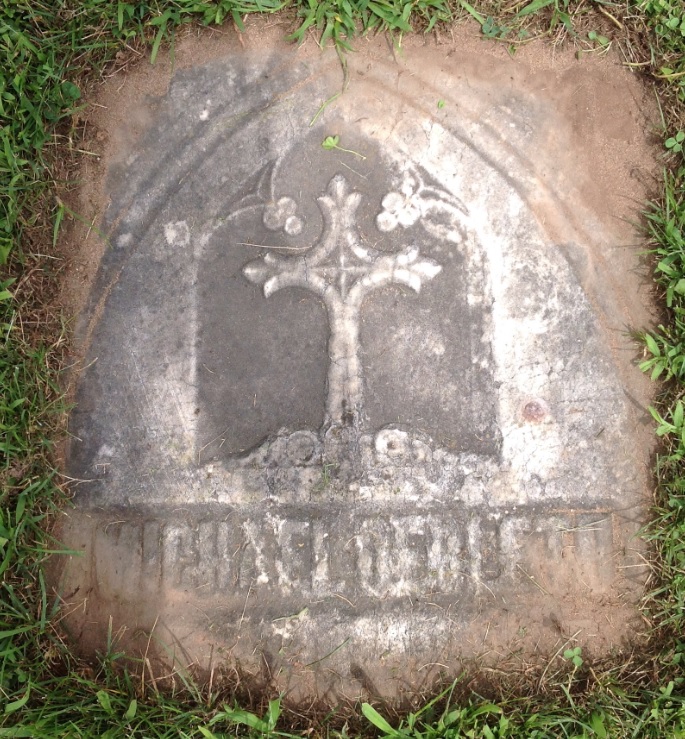
This Count d’Erlette ridiculed word for word, but every pronouncement came to pass, and even to this day the grave of Michel, the grandson, may be seen in a small town in southern Wisconsin.
For readers familiar with Mythos fiction, the name “d’Erlette” might ring a bell.
Only a wizard would possess those mouldering, maggoty volumes of monstrous and fantastic lore; only a thaumaturgical adept would date the darker mysteries of the Necronomicon, Ludvig Prinn’s Mysteries of the Worm, the Black Rites of Luveh-Keraph, priest of Bast, or Comte d’Erlette’s ghastly Cultes des Goules.
Lovecraft would shed some light on this little mystery in a letter:
Comte d’Erlette’s Cultes des Goules? An invention of Bloch’s. The name Comte d’Erlette, however, represents an actual (& harmless) ancestor of August W. Derleth’s, who was a royalist emigré from France in 1792 & became naturalized in Germany under the slightly Teutonised name of Derleth. His son, emigrating to Wisconsin in 1835, was the founder of the Derleth line in America.
The letter in which August Derleth revealed this heritage to Lovecraft does not appear to survive, but in their correspondence, Lovecraft begins to refer to him as “Auguste-Guillaume, Comte d’Erlette” (ES 2.455) in February 1932, so the subject probably came up in early 1932 or late 1931. Lovecraft would refer to Derleth as the “Comte d’Erlette” in his letters occasionally from then on, and the Cultes des Goules was added to the shelf of eldritch tomes that appear in his stories, and that of their contemporaries and literary heirs, though Bloch’s choice of attributing the volume to d’Erlette sometimes led to some confusion as to who actually invented it.
Derleth himself never chose to expand on his fictional ancestor in any of his Mythos fiction, though in his Solar Pons story “The Adventure of the Six Silver Spiders” (1950), the premise of the story is a Mythos red herring involving the sale of the private library of Paul Guillaume, the Comte d’Erlette, which reads in part:
I glanced at several of the other titles listed—d’Erlette, Paul Henri, Comte de: Cultes des Goules, Rouen, 1737; Prinn, Ludvig: De Vermis Mysteriis, Prague, 1807; Liber Ivonis (Author Unknown), Rome, 1662;—all manifestly occult literature.
August Derleth, “The Adventure of the Six Silver Spiders,” The Solar Pons Omnibus 2.848
Solar Pons is quick to point out to his companion Parker that the whole catalogue is a hoax.
“But the Count d’Erlette?”
“Erlette is a provincial name in France. The family existed in some numbers before the Revolution, but the last member to carry a title died in 1919.[“]
August Derleth, “The Adventure of the Six Silver Spiders,” The Solar Pons Omnibus 2.849
Derleth was not the only one to have a bit of fun with his fictitious ancestor, as many subsequent writers did write about the author of Cultes des Goules and his family.
It is not too much to say that “Tally Mason’s” article on Cagliostro is part of the secret history of the Mythos—not a direct part of the web of interconnecting stories that Lovecraft & Co. wrote, but a precursor and bit of background. One has to wonder if Derleth ever showed the piece to Lovecraft.
Weird Racism Historical racism can take some strange turns when expressed through fantasy, horror, and science fiction, and the result can be more disturbing or offensive to some readers than “normal” racism. As such, please be advised before reading further.
Whitehead—to whose other distinctions I find that of Reverend or ex-Reverend added—has just started a tale from an idea of mine which he is suggesting that I finish as a collaborated work—but I may pass it up because of inability to do justice to the West Indian locale he has seen fit to choose. I am the sworn enemy of armchair exoticism, & believe in writing about things one personally knows—except of course in the case of Dunsanian phantasy or cosmic infinity.
The Reverend Henry S. Whitehead was an Episcopal priest and pulp writer who contributed to magazines such as Weird Tales and Strange Tales of Mystery and Terror. Before retiring to Florida, Whitehead had spent summers down in the U. S. Virgin Islands, soaking up the local atmosphere, culture, and folklore, and set many of his tales in this milieu, often in stories involving his character Gerald Canevin. H. P. Lovecraft had fallen into correspondence with Whitehead, and the two formed a convivial bond.
Lovecraft kept a commonplace book with ideas and plot germs, some of which he used and many of which never materialized but were borrowed or developed by others. The plot seed that inspired Whitehead was apparently this one:
[133] Man has miniature shapeless Siamese twin—exhib. in circus—twin surgically detached—disappears—does hideous things with malign life of his own.
Collected Essays 5.227
The entry is dated 1925, and R. H. Barlow, who was Lovecraft’s literary executor, added the notation “HSW—Cassius” to this entry. Whitehead took Lovecraft’s basic idea and applied it to his West Indian milieu to craft another Canevin tale. While Whitehead urged collaboration, however, Lovecraft begged off:
Whether I do anything with that Whitehead tale depends on how eager he is about it—for I hate being churlish & uncivil. He says he has it all started, & that he has prepared some guiding notes on the chosen West-Indian background.
H. P. Lovecraft to August Derleth, 17 Feb 1931, Essential Solitude 1.321-322
As for collaboration—though I’ve done it in scores of ghost-writing cases, I think I’ll dispose of the Whitehead case by keeping things in the air till he writes the whole thing himself.
Which is ultimately what Whitehead did. The story that developed, “Cassius” is essentially pure Whitehead in terms of plot and development, and aside from being set in the West Indies and starring his series character Canevin, also continues certain themes that he had developed in earlier tales.
For example, the tale “The Lips” (Weird Tales Sep 1929), a Black woman on a slave ship to the West Indies curses one of her white captors so that black mouths grow from his flesh, whispering the word “L’kundu”—this was a riff off Edward Lucas White’s story “Lukundoo” (1925), where a white man in colonial Africa wrongs an indigenous woman and is cursed to Lukundoo, where miniature, chattering Black heads grow from his flesh. In another tale, “Passing of a God” (Weird Tales Jan 1931), a white man with a large growth in his abdomen goes to the West Indies and falls in with voodoo; the growth is surgically removed and revealed to have been a parasitic twin that the cultists believed to be an incarnate god.
As those brief synopses indicate, there is a strong racial component to these stories; while the Virgin Islands was much less racially segregated than the mainland United States, Whitehead’s perspective—and his audience—was very much of the white mainland majority, and the characterization of BIPOC characters in his West Indies stories, while rarely mean-spirited, tend to be expressions of particular stereotypes and prejudices. So it is in “Cassius,” where a light-skinned biracial man named Brutus Hellman.
Brutus, it appeared, had need of a minor operation, and, Negro-like, the two of them, talking the matter over between themselves, had decided to ask me, their present patron, to arrange it.
The operation had been the removal of a growth from Brutus’ groin or side—a parasitic twin which would go on to hunt and haunt Brutus Hellman in revenge. Except that the miniature human being thus freed is darker-skinned than Brutus, and possesses a kind of ancestral memory, reproduced African hut and spear in miniature as it carries out its campaign of terror. Whitehead offers a pseudoscientific explanation:
The well-established ethnic rule,the biological certainty in cases of miscegenation between Caucasians or quasi-Caucasians and the Negro or negroid tpes is tha the offspring is never darker than the darker of the two parents. The ‘black-baby’ tradition, as a ‘throw-back’ being produced by mulatto or nearly Caucasian parents is a bugaboo, Canevin, sheer bosh! It doesn’t happen that way. It cannot happen. it is a biological impossibility, my dear man. […] since Brutus is very ‘clear-colored,’ as the Negroes would say, that one of his parents was black; the other very considerably lighter, perhaps even a pure Caucasian. […] The mother—she was, undoubtedly, the black parent—proud of her ‘clear child’, would favor it,nurse it first.
Even in 1931, this “scientific” explanation wouldn’t hold water, but the point was to try and give an explanation for why Cassius was both darker-skinned that Brutus, and why the miniature stereotype was running around stabbing lighter-skinned Black people with spears made from knives, building “African” style huts out of discarded pencils, and the like. Totally aside from the explicit and implicit racism (scientific and otherwise) in “Cassius,” the story ends rather anticlimactically, and even Lovecraft wasn’t very impressed with the result:
About “Cassius”—It is hard for me to give an unbiased judgment, since the development is so antithetical to that which I had in mind when offering the central idea. To me it seems that a vast number of atmospheric & other horror-possibilities have been left unrealised, & that the typically bland, urbane, & almost unctuous style (the stereotyped Kipling tradition) wrecks the sort of hideous tensity really needed. Yet on the other hand I can see where Whitehead has used a fertile cleverness in incident-devising that I could never have approached. The chief scientific objection is, of course, the part played by “hereditary memory”—a thing wholly repudiated by responsible biologists, though still favoured by weird writers. I’d call “Cassius” a typical anthology item—for “sophisticated” professionals love that unctuous urbanity which to me is so markedly unsatisfying.
Whitehead and Lovecraft did eventually meet in Florida, and would collaborate on another Canevin tale, “The Trap.” Yet in a later letter, Lovecraft would reveal a little more about the origin of the tale:
I gave H S W the idea for “Cassius”—at first he wanted me to collaborate, but our styles & approaches were so different that I couldn’t. It all came from a freak I saw in a dime museum—an Italian with a rudimentary twin growing out of his abdomen. Some time I’ll tell you how I had meant to develop the theme—I may do it yet.
In a sense, Lovecraft had already played with the twin theme in at least two tales: “The Dunwich Horror” (Weird Tales Apr 1929) and The Case of Charles Dexter Ward (written early 1927, unpublished during Lovecraft’s lifetime). Ward with its near-identical ancestor-descendent pair recalls one of Lovecraft’s earliest recorded stories, now lost:
One long-destroyed tale was of twin brothers—one murders the other, but conceals the body, & tries to live the life of both—appearing in one place as himself, & elsewhere as his victim. (Resemblance had been remarkable.) He meets sudden death (lightning) when posing as the dead man—is identified by a scar, & the secret finally revealed by his diary. This, I think, antedates my 11th year.
Lovecraft would refer to this idea in commenting on a similar story, “The Man Who Was Two Men” by A. W. Bernal in Weird Tales Apr 1935 (Letters to Robert Bloch and Others 233). Yet neither of these stories really involves a parasitic twin, and the idea that Lovecraft got the idea from a real performer he saw at a human oddity exhibition is intriguing. We know from Lovecraft’s letters, for example, that in 1925 (from when the entry in the Common Place book is dated), Lovecraft and his wife visited such an attraction in Coney Island.
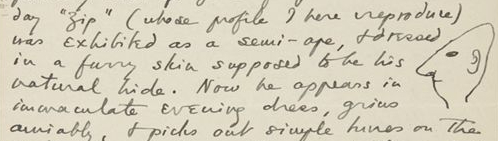
We then called in for a fitting of the suit, & took an open car for an evening ride to Coney Island. We had not intended to get off at all; but finding the resort phenomenally uncrowded, we did—incidentally patronising some of the assorted freak shows. In one of them there still survives P. T. Barnum’s original “Zip, the What-is-It”—now probably over 90 years of age. In Barnum’s day “Zip” (whose profile I here reproduce) was exhibited as a semi-ape, & dressed in a furry skin supposed to be his natural hide. Now he appears in immaculate evening dress, grins amiably, & picks out simple tunes on the violin & xylophone. The age is too sophisticated for Barnum’s charlatanry, & “Zip” chiefly interests people as having been part of the great showman’s entourage. This creature is really a semi-idiotic Andaman Islander—one of a dwarf Malay stock inhabiting the East Indies. He was picked up as a boy by a seaman long before the Civil War, & has since vegetated in one freak show after another. Living feebly & lightly, he does not show his years; & will probably excite the smiles of still another generation.
Lovecraft is credulously repeating the popular billing; “Zip the Pinhead” was William Henry Johnson, born to a Black family in New Jersey, and was in his late 60s when Lovecraft saw him, though he would die the following year.
It is not clear if the performer who inspired Lovecraft’s commonplace book entry was seen during this excursion or another, but Lovecraft went into great detail about the idea and its potential development; for ease of reading, this long section of a letter has been broken up into several sections:
About the twin—I was divided between two plans of development. One would have had the monster escape as Whitehead had it—but would have had it much more terrible & much less human. I would have had it grow in size, & frighten people much more terribly than “Cassius” did. Indeed, I would have tried to convey the implication that some Outside force or daemon had taken possession of the brainless, twisted body—impelling it to strange acts of apparently deliberate but plainly non-human motivation. The climax would have consisted of some dramatic & unmistakable revelation of this Outside tenancy—probably connected with the spectacular destruction of the thing in one way or another. My story would have had none of the lightness, sauvity, & humour of Whitehead’s, but would have been grim & terrible all through. So much for one plot.
This is the development that most closely resembles the unnamed twin in “The Dunwich Horror”—and perhaps too closely resembles the parasitic twin in Whitehead’s “Passing of a God.” Assuming that Whitehead wrote that story before he received Lovecraft’s plot germ—and perhaps it is what prompted Lovecraft’s sharing of his own vaguely similar idea—he might have felt inclined to develop the parasitic twin idea in a different way in “Cassius” so as to avoid repeating himself. The other plot idea was far less cosmic and, like Whitehead’s, more science fiction:
The other plot I had in mind was much more human—not supernatural at all, in fact. The idea was to have the connexion of the man & his miniature twin much more complex & obscure than any doctor had suspected. The operation of separation is performed—but lo! An unforseen horror & tragedy results. For it seems that the brain of the twin-burdened man lay in the miniature twin alone . . . . so that the operation has produced a hideous monster only a foot tall, with the keen brain of a man, & a handsome manlike shell with the undeveloped brain of a total idiot. From this situation I planned to develop an appropriate plot, although—from the magnitude of the task—I had not progressed very far. I had an idea of having the midget monster assume the guardianship of his handsome, brainless twin & endeavour to hypnotise it in such a way that it could do his talking for him & act as his substitute in the outside world. I meant to have him succeed, so that after about a year there appears in society a handsome, brilliant man who always carries a satchel, & who displays vast alarm when there is any danger of his being separated from it. This, of course, is the brainless twin—who now serves as the mouthpiece & exterior facade of the intelligent monster, who rules him by hypnotism from the shelter of the satchel. From then on I had decided nothing. One idea was to have an accident destroy the satchel, causing the idiot to collapse helplessly & perhaps die. Another was to have the man gain fame—but finally to have the idiot body die in such a way that the death can hardly be concealed. The intelligent twin still lives—but how can he now keep his secret? He may be able to hide bodily, but how can he continue the work which brought him fame (say as a writer or painter or scholar) when the famous man is supposed to be dead? I had not progressed to the point of solving that problem—or even deciding whether I’d have such a problem—when Whitehead began urging the collaboration & I finally gave him the plot to develop in his own way. Hence “Cassius”.
This “double life” plot is obviously a continuation of Lovecraft’s earliest twin theme story idea; yet the idea of a miniature parasitic twin with its own independent intelligence is clearly what inspired Whitehead’s “Cassius.” Yet the whole process of thinking over the plot germ led Lovecraft in a third direction:
Now—after years—another alternative occurs to me. I might have the death of the handsome idiot-body concealed, & have the intelligent monster embalm it & display it seated in a chair—ostensibly still alive but paralysed. he would have it appear to speak—in a feeble, alien voice supposedly due to the paralysis—through the clever practice of ventriloquism. Then some awful climax of revelation could occur—any one of a dozen hideous sorts. The embalming could be imperfect, so that the supposedly living man would display signs of decomposition. Or notice could be attracted by its failure to age through the passing years. In writing such a story, I’d probably begin near the end—that is, have the bulk of the action concern the final phase, when the supposed paralytic begins to arouse suspicion. The antecedent history—the operation &c—would be subtly worked in as backflashes. I would make the revelation very gradual & suspense-filled—& at the last might leave the reader in some doubt of what the truth really was. Whether I shall ever do this or not remains to be seen. It certainly wouldn’t be duplicating “Cassius”—for the whole spirit & emphasis of my conception is antipodally alien to Whitehead’s. Whitehead urged me to go ahead & try—but I thought some time had better elapse in any case.
While Lovecraft would never develop this explicit idea, the image of the ventriloquist act would be used in “The Whisperer in Darkness” (Weird Tales Aug 1931). The narrative development of beginning at the end and then working back to how this came to pass is a familiar part of Lovecraft’s style. Yet as for where Lovecraft got the idea in the first place:
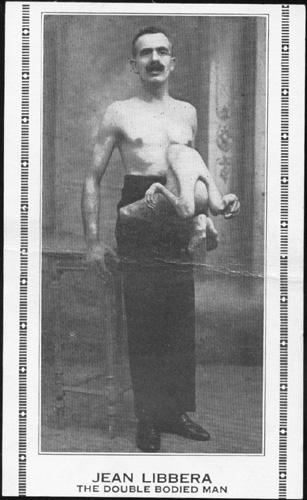
I believe I mentioned that my idea came from seeing an actual case of the undeveloped-twin anomaly in a freak shew (Hubert’s Museum in W. 42nd St.) in New York. The man in question–an intelligent Italian who for some reason billed himself under the French name of “Jean Libera”—had a little anthropoid excrescence growing out of his abdomen which looked hellishly gruesome when uncovered. Cothed, he looked merely like a somewhat “pot-bellied” individual. So far as I know, he is still living & on exhibition. He looked so essentially refined & high0gade that I wondered at this willingness to be exploited as a freak, & speculated as to what he would do if a stroke of luck removed him from the need of such an ignominious occupation. The first thing he would do, I argued, would be to have the excrescence cut off—& then & there the idea of the story came. This was in 1924 or 1925. Now the odd & amusing thing is this. Years afterward—after I had given the idea to Whitehead & was awaiting the appearance of “Cassius”—I chanced to mention the matter to my old friend Arthur Leeds of New York, who has had extensive dealings with freaks & other amusement enterprises. Fancy my surprise when he told me that he knows Libera well—that the man’s real name is Giovanni Libera, that he is an Italian of great intelligence, that he is interested in everything weird, & that (believe this or not—it’s actual truth!) he is especially fond of my work in W.T.!!!! Talk about coincidence! Leeds was going to tell him about “Cassius”, but I told him not to, since he might feel some delicacy (despite his occupation) about being used in that way. At the time (1930) Leeds was going to introduce me to Liebra; but something prevented, so the meeting never came off. It certainly would have seemed odd to meet one of my plot-germs in the flesh . . . . the flesh of two bodies, or a body & a half, at that!
Giovanni Libbera was an Italian performer who toured the United States, sometimes billed as Jean or Jean and Jacques Libbera. Lovecraft’s 1924 and 1925 letters do no mention Hubert’s Dime Museum or Libbera by name, and trying to figure out exactly where Libbera was under contract during that period is difficult, but there are newspaper advertisements that show Libbera was employed at Hubert’s during some periods. J.-M. Rajala in “Locked Dimensions Out of Reach: The Lost Stories of H. P. Lovecraft” (Lovecraft Annual #5, 2011) suggests it may have been during a 15 July walk to Times Square recorded in Lovecraft’s 1925 diary.
Which is the long and rather weird root to how a chance encounter with a human oddity led to a story in Weird Tales…and, perhaps, sheds some light on Lovecraft’s plotting and development of story ideas, and how that differed from his colleagues. It is notable, for instance, that Lovecraft’s original plot-germ and all of its developments is totally agnostic in terms of race. The plot has nothing to do with the twins being white, Black, or anything else, while Whitehead in transferring the plot to the West Indies makes it entirely about race, or at least about certain preconceptions about race. This makes fair sense when it is considered that Whitehead’s stories frequently dealt with BIPOC characters in a setting where they predominated, while Lovecraft stuck mostly with familiar New England settings with relatively fewer BIPOC folk.
No—I shan’t let your gargoyle tale cut mine off . . . . any more than I shall let Whitehead’s “Cassius” suppress my future tale of the amputated Siamese twin.
The legacy of “Cassius” is a bit harder to track. While no one has, to the best of my knowledge, written a direct sequel, however there are two stories by members of Lovecraft’s circle of correspondents that might continue some of the themes and ideas.
“The Mannikin” (Weird Tales Apr 1937) by Robert Bloch is about a man with a parasitic twin growing from the left shoulder that is both intelligent and has a distinct interest in Mythos lore; as in Lovecraft’s second plot development, the parasite manages to gain control of its brothers body for a time.
“It Will Grow On You” (Esquire Apr 1942) by Donald Wandrei is a kind of spiritual sequel that combines elements of “Cassius,” “The Lips,” and “Lukundoo.” A white man among the islands gets a native woman pregnant, and when he threatens to leave she curses him. A small female form then grows from his thigh. A surgeon attempts to remove the growth, but the curse transfers to the surgeon.
In all of these stories that have been discussed, there is a fascination with both bodily deformity—many of the stories are effectively early examples of what today would be termed body horror—and with the idea of a kind of twisted morality play. Giovanni Libbera did nothing wrong, committed no crime or sin, he was simply born the way he was. Individuals in stories like “Lukundoo,” “The Lips,” and “It Will Grow On You” all receive their horrific transformations from some terrible crime, and like a rapist who catches an STD, have to live with the consequences. In “Passing of a God,” “Cassius,” and “The Mannikin” it is the parasite that is evil…something to be cut from the body if possible, endured if not.
None of the characters seek to capitalize on their odd status as Libbera did; these are not stories about the practical difficulties of the life of a performer making the best of an unusual physical condition, like David Lynch’s The Elephant Man (1980). There is a very distinct prudishness and shame regarding their physical bodies which is reflected in Lovecraft’s emphasis on Libbera’s “ignominious occupation.” Yet that was a mentality that went far beyond just Lovecraft himself, and found expression in many authors during the period. Sideshows and dime museums may have come and gone, yet the repulsion at that which is different—and the fascination with the same—remains.



 Deep Cuts in a Lovecraftian Vein