Was there ever such a duel in the whole universe as the one between Northwest Smith and the nameless being that fought him in that Martian room?—a gripping tale by the author of “Shambleau” —Epigraph to “The Cold Gray God” in Weird Tales (Oct 1935)
Summer in the Midwest, before the widespread adoption of air conditioning, could be sweltering. The very air gets sticky, even nights could be stifling and sweaty. C. L. Moore hadn’t been slacking during the summer of 1935, but Northwest Smith had been absent from the pages of Weird Tales. Wright had the story that would be “The Cold Grey God” on hand at least as early as March, but he sat on it, apparently waiting for the right time, and thinking of the right title. That came with the October 1935 issue.
And WT is publishing in July either the Smith story which Wright has entitled THE COLD GREY GOD, all about a lovely Venusian named Judai, or else a Jirel story we have been revising for months. He hasn’t decided yet which to use. —C. L. Moore to R. H. Barlow, 20 Mar 1935, MSS Brown Digital Repository
On the subject of titles, I envy you your ability. The most painful part of writing, so far as I’m concerned, is naming the stories. Mr. Wright more or less takes it out of my hands sometimes, as in the case of a story scheduled for mid-summer sometime, which he is calling “The Cold Gray God”. I’m getting a regular spectrum of colored gods, staring with black and working slowly upward thru grey toward goodness knows what. —C. L. Moore to H. P. Lovecraft, 7 May 1935, Letters to C. L. Moore and Others 34
The story starts with snow on Mars. A femme fatale. Northwest Smith, unable to repress his curiosity, goes to her house. The aesthetic borrows aspects of hardboiled fiction, of Oriental stories, the details adapted to the extraterrestrial setting. The idea of an ancient religion buried in the hearts and minds of an exotic culture was not uncommon in stories like Robert E. Howard’s “Skull-Face” (WT Oct-Nov-Dec 1929) and Robert W. Chambers’ The Slayer of Souls (1920); here it was applied to Martians.
“The Cold Gray God” is not set up as an archaeological horror; it’s set up as a weird heist story, in the strange criminal underworld of Mars. As in “Dust of the Gods” (1934), he’s hired to do a not-quite-legal job. Unlike in that story, the job itself isn’t the problem. A noirish sensibility of a web of secrets unfolds the narrative, and once again ensnares Northwest Smith in a plot of ancient space gods, strange survivals from a dim and distant past, and one with an unspeakable name:
And he knew why the men of Mars never spoke their cold god’s title. They could not. It was not a name human brains could grasp or human lips utter without compulsion from Outside. […] Nor was the name wholly gone, even now. It had withdrawn, for reasons too vast for comprehension. But it had left behind it shrines, and each of them was a little doorway into that presence; so that the priests who tended them furnished tribute. Sometimes they were possessed by the power of their god, and spoke the name which their devotees could not hear, yet whose awful cadences were a storm of power about them. And this was the origin of that strange, dark religion which upon Mars has been discredited for so long, though it has never died in the hearts of men. —C. L. Moore, “The Cold Gray God” in Weird Tales (Oct 1935)
Which is a neat way to get around coming up with a mouthful of letters like Cthulhu or Tsathoggua. While C. L. Moore never deliberately added to the Mythos of the Necronomicon and Unaussprechlichen Kulten, she very much absorbed the ideas of Lovecraft and co., and adapted those tropes to her own use. This is not unlike Northwest Smith’s version of “The Call of Cthulhu,” or an homage to the same. The stars were right—then came the raygun.
If there’s a criticism of the story, it’s that it is very similar to Smith’s other adventures. This isn’t the first god he’s faced down, or the first time he’s struggled against an alien will. It is a standalone episode; while there are elements of the setting that are shared with other stories, there is still no continuity. This encounter does not cause Smith to reflect on any other encounters; this experience does not hinge on any previous one. So while the setting expands a bit with each story, the series itself maintains the same episodic nature as that other great stalwart of Weird Tales, Jules de Grandin. Readers weren’t looking for character development, no origin or ending, and writers weren’t going for character arcs for the most part.
“The Cold Gray God” is well-written, a good example of a Northwest Smith story. It just lacks a bit of novelty.
Nor did readers complain about that, although they complained about other things:
I read “Cold Gray God” last night, and liked it good. My only objections are personal: I don’t like “cooed” as a word; and I can’t stand “clean death”. For some obscure reason, I don’t fancy a girl cooing; whilst during the past year or so it seems to me all the fictional characters have gone overboard about having a “good, clean death”—by a “cool, clean sword”, “clean, consuming fire”…or good clean, clean, clean—like a clank, clank, clank—will drive me clean coo-koo, so help me, if I come across it about oncemore!!! —Forrest J. Ackerman to C. L. Moore, 2 Oct 1935
Readers in “The ‘Eyrie'” were more positive, with one writing simply:
I surely enjoyed The Cold Gray God by C. L. Moore. I like stories of Mars. —Orby Martin, Weird Tales Dec 1935
Among Moore’s pulp peers, H. P. Lovecraft counted it among the best stories in the issue. A typical version of his response:
W T is rather lousy of late. In the Sept. issue “Vulthoom” & “Shambler from the Stars” barely save it from being a total loss, while “Cold Grey God” & “Last Guest” perform a similar service for the Oct. number. —H. P. Lovecraft to Lee McBride White, 28 Oct 1935, Letters to J. Vernon Shea et al.362
If he noted the similarity to some of his own ideas, it hasn’t survived in any letter that’s seen print. At some point, Lovecraft conveyed the essence of this to Moore herself:
I’m so glad you approved of my “Cold Grey God” (which is Wright’s title, not mine.) —C. L. Moore to H. P. Lovecraft, 16 Oct 1935, Letters to C. L. Moore and Others 68
One thing seems clear: both the readers and Lovecraft had come to appreciate Moore as a reliable writer, one of Weird Tales‘ more familiar and recognizable names for quality. Farnsworth Wright, the editor, was content to keep buying her stories. With this, her 13th published story in a pulp magazine or fanzine, Moore herself seems to have achieved a comfortably high level of confidence and competence.
I wrote a story once, which I don’t believe you ever saw—starting out as my story “Greater Glories” started with a man lost in the interior of a giant body, being swept into its brain-chamber and finding himself in the presence of a god whose people have almost completed their race-goal. The people are of peculiar physical structure which permits their amalgamation into one immense and rather horrid-looking mass, like a great vine budded with individuals who by now have sunk their individuality into the whole, being drawn together by a common race-love which through the millennials [sic] of life has grown out of and taken the place of all other forms of attraction between individuals. The race has become a unit, but incomplete as the god is incomplete, because each lacks the essential attributes of the other. They are reaching their ultimate goal, which is the union of god and united people, into a perfect whole which is to go on, perhaps, as no more than an atom at the bottom of some tremendous scale of unknown evolution—somewhere. I didn’t sell the story, and finally cut it up into “Greater Glories” and “Bright Illusion” and another mass which I haven’t tried to recast. —C. L. Moore to H. P. Lovecraft, 7 Dec 1935, Letters to C. L. Moore et al. 87-88
Did I ever show you that story I wrote called TO WHAT DIM GOAL? I think I did. Anyhow, it wouldn’t sell so I cut it up into gruesome little pieces and each piece grew into another story. GREATER GLORIES, BRIGHT ILLUSION and another yet unfinished were portions of that dead tale, and I found ideas out of it cropping up in SHAPE OF DARKNESS. No doubt that murdered story will haunt everything I write for years to come, coloring with its dismembered theme all sorts of tales that have no connection with it whatever. —C. L. Moore to R. H. Barlow, 12 Dec 1935, MSS. Brown Digital Repository
Readers would be forgiven for not being familiar with C. L. Moore’s “Greater Glories.” It was first published in Astounding Stories Sep 1935, and only reprinted twice—an uncredited (probably unauthorized) translation in Los Cuentos Fantásticos, No. 25 (1950), and in the reprint volume Miracle in Three Dimensions(2008). For all of its obscurity, “Greater Glories” represents another important early step in Moore’s career, a science-fantasy story for Astounding that tiptoed on the line between science fiction and weird fiction.
The story opens much like “The Bright Illusion,” with a random man alone in a wild desolation, this time framed as a traditional castaway story. The familiar setup falls away to weirder fare as the unnamed protagonist finds something in the jungle, and falls into another, stranger place—and here we get the next piece of Moore’s lost story:
AND THEN it came to him what this great hall had been built to represent. A heart. That tube corridor along which he had come was shaped into an artery-this chamber was a ventricle of a mighty heart. Even that tumult which had flung him headlong into the place was the valve-action controlling the inflow. —C. L. Moore, “Greater Glories” in Astounding Stories Sep 1935
The prose is lush with sensual detail, but also with the sense of unseen things beyond the normal senses. At one point, the protagonist remembers a bit of verse:
A being who hears me tapping The five-sensed cane of mind Amid such greater glories That I am worse than blind.
This is a slightly inaccurate rendition of the final verse of “Blind” (1920) by Harry Kemp, and serves to give the story its name and theme.
There is a woman; again, many of Moore’s women at this stage of the career, she is a being devoted to or under the influence of some greater being. An ephemeral yet poignant focus of intense romantic focus. A microcosm of tragedy unfolds, between the desire of the unnamed male protagonist and the woman called up into existence before her time, not yet ready for life or love. It feels like that should be a metaphor, perhaps for Moore herself—who was still stuck in that limbo place between her day job and her career as a writer, engaged to a fiancé she dare not marry for fear of financial ruin.
Art by Elliott Dold
The denouement is not quite as romantic as “The Bright Illusion.” The nameless protagonist is still castaway; the implication is given that perhaps it was all a dream, a hallucination. It is not much of a science fiction story by the standards of the time, since there is little hard science in it; “Greater Glories” is a mood piece, a work of wonder, emotion, and sensations. Which is how many fans ultimately read it:
So few people can wrap a dream in star dust, breathe fairy life into it, and set it to the music of the spheres that C. L. Moore’s stories are always more than we dared hope. For sheer suggestive beauty and lingering memories of things that never were, this writer is equaled only by A. Merritt. Need I say I liked the story? —Ramon F. Alvarez del Rey, ‘Brass Tacks’ in Astounding Nov 1935
Arch-fan Forrst J. Ackerman was uncharacteristically generous with his praise, possibly because he was still hoping she would collaborate with him on further stories:
Re paragraf four—a command from Moore: I shall clothe myself in a cloak of cosmic vibrations while reading GREATER GLORIES, so that none may disturb my marveling mind. Hail to Catherine, Queen of Queer-tales! —Forrest J. Ackerman to C. L. Moore, 31 Jul 1935
Haven’t you read that story you wrote, GREATER GLORIES? How could ever just a girl write such! Why, you make my English become just gibberish, trying to discuss it. Are you indeed not an Other World Entity, taken on a feminine form to come to earth and astound the senses of, say, a Scientifictionist? Cather, how could you write such a story as GREATER GLORIES?
You don’t doubt I liked your dream-tale, do you? I graded it “A”, and rusht my rating airmail to FANTASY. But that is little. Perhaps this will better bolster your belief I thot it was awamzing: I quote, following, a note I dasht off to Gilbert Brown, columnist of the L.A. Evening Post-Record. The paper has 77,000 circulation and Brown has thirce in print published his praises of the works of A. Merritt. So, “Brown,” I wrote, “If you would read a manuscript marvelous as a Merrittale, step to the nearest newsstand and purchase the Sept. Astounding. The spell-binding story is GREATER GLORIES. A first-water fantasyarn, incredible, staggering, overwhelming—Dizzily, FJAckerman.” I hope you don’t think my “first-water fantasy” line is hokumn, because I have used it several times; I really don’t know any other way to describe those stories of yours that hit me so hard. SCARLET DREAM is still my favorite, but GREATER GLORIES comes very close. I shall, of course, by ultra-happy about Nyusa, the Nymph of Darkness whom we created together. —Forrest J. Ackerman to C. L. Moore, 27 Aug 1935
Anyway, you deserve an extra “a” in your name for such outstanding and A-1 stories as SCARLET DREAM and GREATER GLORIES. That’s a swell title, I think, by the way, Crawford has chosen for the book form of your series “The Saga of Northwest Smith”. Right in the center of the book, about, I calculate, will be our co-creation, the nymph Nyusa. […] I don’t know whether the newspaper columnist read GREATER GLORIES, as per my recommendation, or not; I thot he might mention it in his column, but just after I wrote him, he left the paper on vacation, and hasn’t been back since. —Forrest J. Ackerman to C. L. Moore, 2 Oct 1935
Lovecraft did not take Astounding regularly, and so apparently missed “Greater Glories,” though she described the story it grew from. Why it lay forgotten among some of her earlier stories for so many decades is unknown—perhaps it was too close to “The Bright Illusion,” or too slight a story in retrospect, and definitely much weirder than the usual “thought-variant” story taken for Astounding. Yet it is an outgrowth of that ur-story, that original idea that Moore had that was too big for any one tale to contain—and for that, at least, it has historical interest.
So too, while “Greater Glories” may seem out of place among Astounding, it does have a certain resemblance to the science fiction that would be published by Unknown in the 1940s. The emphasis on concept and emotion, wonder and the human element, are much more in line with the more humanistic science-fantasy of the 1940s than the space operas and gadget stories of the 1930s. In that sense, “Greater Glories” is something of a dry run for Moore’s later, more mature science-fantasies of that period, lacking a bit of the humor but with a poignant note that readers of her midcentury work will find familiar.
“Greater Glories” was published in the September 1935 issue of Astounding Stories. Scans of this issue are available on the Internet Archive.
For readers who want to read more about the origin of “Greater Glories” and its origins, Marcos Legaria has a detailed article: “C. L. Moore’s “To What Dim Goal” and Its Progeny” in Penumbra: A Journal of Weird Fiction and Criticism, 2023. Thanks to Marcos for his help with this one.
And WT is publishing in July either the Smith story which Wright has entitled THE COLD GREY GOD, all about a lovely Venusian named Judai, or else a Jirel story we have been revising for months. He hasn’t decided yet which to use. —C. L. Moore to R. H. Barlow, 20 Mar 1935, MSS. Brown Digital Repository
Farnsworth Wright, editor of Weird Tales, chose “Jirel Meets Magic,” the third published adventure of Jirel of Joiry, for the July 1935 issue. The story itself is a standalone adventure, making no direct reference to the previous episodes, “Black God’s Kiss” (WT Oct 1934) and “Black God’s Shadow” (WT Dec 1934), though Jirel notes that “She had met magic before.” It opens on an action-filled scene as Jirel invades a castle, seeking the wizard Giraud…who has fled in a most peculiar manner:
Feet had trodden in that blood, not the mailed feet of armed men, but the tread of shapeless cloth shoes such as surely none but Giraud would have worn when the castle was besieged and failing, and every man’s help needed. Those bloody tracks led straight across the room toward the wall, and in that wall—a window.
Jirel stared. To her a window was a narrow slit deep in stone, made for the shooting of arrows, and never covered save in the coldest weather. But this window was broad and low, and instead of the usual animal pelt for hangings a curtain of purple velvet had been drawn back to disclose shutters carved out of something that might have been ivory had any beast alive been huge enough to yield such great unbroken sheets of whiteness. The shutters were unlatched, swinging slightly ajar, and upon them Jirel saw the smeaar of bloody fingers. —C. L. Moore, “Jirel Meets Magic” in WT Jul 1935
The idea of a massive piece of ivory recalls Lord Dunsany’s “Idle Days on the Yann” and Lovecraft’s “The Doom That Came to Sarnath”; the overall plot of a sorcerer escaping through a door or window, followed by their avid pursuer into a strange world, strongly recalls Clark Ashton Smith’s “The Door to Saturn” (Strange Tales of Mystery and Terror Jan 1932)—and it has to be admitted, fits a formula for the Jirel and Northwest Smith stories, which often see the protagonists head into other dimensions.
Yet Moore puts her own spin on things. For the first time, she gives Jirel a woman antagonist in the sorceress Jarisme, and the utter cattiness of the first encounter emphasize’s Jirel’s imp of the perverse.
“I am the sorceress Jarisme, and high ruler over all this land. Did you think to buy me, then, earth-woman?”
Jirel smiled her sweetest, most poisonous smile.
“You will forgive me,” she purred. “At the first glance at you I did not think your price could be high….” —C. L. Moore, “Jirel Meets Magic” in WT Jul 1935
It is worth noting that while fans often refer to Jirel and Conan together, Jirel is not a barbarian. She is strong, obstinate, determined, vengeful, and bold, but not a barbarian, nor does Moore develop the themes in her stories in quite the way Robert E. Howard does. “Jirel Meets Magic” is simply a journey for vengeance in a magical land, swordswoman versus sorceress, but it is not couched as part of some greater conflict or some historical or philosophical clash, only a conflict of personalities.
Jirel’s quest for vengeance has the outlines of familiar quest-narratives from heroic fantasy, overcoming obstacles through cleverness, luck, a swift blade, and sheer bloody force of will. There’s also a prophecy, though that comes so late in the story as to be almost an afterthought. It is a competent enough story, and the many details of Jirel’s encounters with magic do much to make it an enjoyable one, though it lacks a touch of the originality of the “Black God’s Shadow,” being essentially yet another quest for vengeance, this one more bloody and less intimate.
Weird Tales readers seemed to appreciate “Jirel Meets Magic,” which placed as the #3 favorite story in the issue. One reader noted:
C. L. Moore, with a long line of successes already to her credit, certainly gave us the best to date in Jirel Meets Magic. Moore’s stories are following, more and more, a trend toward sheer fantasy, of which there is a pitiful lack in present-day fiction. Parts of this story were strongly reminiscent of A. Merritt’s imaginative descriptions, and I hardly believe a better compliment could be given a writer than to compare one with the incomparable. —B. M. Reynolds, “The Eyrie,” WT Sep 1935
The comment is accurate; while Moore’s Northwest Smith stories were very much science-fantasy, with gods and magic impinging on an interplanetary setting, science fiction was not impinging on the adventures of Jirel of Joiry at all. She was not traveling to different planets, and the sorcerers and wizards were not using sufficiently advanced technology; this was sorcery more akin to something out of Bullfinch’s Mythology, with a healthy dose of imagination.
It is a distinction that arch-fan Forrest J. Ackerman probably appreciated, since he was usually disinclined to fantasy splashing over into science fiction:
Just liked your JIREL MEETS MAGIC. It is unfortunate I have to read a number of stories in snatches; so that I had to cut off, and continue later, about five times on MAGIC. As it was almost entirely strange-sensations and alien-vistas—little action—I found it rather hard to get into the story anew each time. but even at that, I completed it last nite and rate it Good. —Forrest J. Ackerman to C. L. Moore, 6 Jul 1935
It is probably notable that in their future collaborations, the emphasis was on the sci-fi, not the magic. H. P. Lovecraft was also a bit more stinting in his praise:
Read July W T recently—a distinctively mediocre issue, even though Hectograph Eddie [Edmond Hamilton] does get hold of another old plot to run into the ground. The translation from Meyrink has a great idea—& the Moore item presents excellent dream material. — H. P. Lovecraft to August Derleth, 15 Jul 1935, Essential Solitude 2.704
July W T is pretty mediocre—though it was refreshing to see Hectograph Eddie with a new plot. The Moore item was excellent—even though it seems to shew a tendency of C L M’s to drop into a rut. — H. P. Lovecraft to Duane W. Rimel, 4 Aug 1935, Letters to F. Lee Baldwin et al. 281
“Jirel Meets Magic” was written at a time when series characters rarely experienced much in the way of character growth, and plots were not always developed over multiple episodes. It is very much a story written that could have been Jirel’s last, if the reader response was weak, and C. L. Moore was obviously still plotting on a story-by-story basis, not looking ahead to long narrative arcs, or to develop a distinct setting in the way Howard was doing with his Conan tales. We never get the backstory of where Guichard is in relation to Joiry, or why Giraud decided to ambush her men, for example.
Which may be why “Jirel Meets Magic” seems, in hindsight, like an example of a very generic heroic fantasy story, years before these things became common. The story is a solid, enjoyable potboiler. It’s unfortunate we don’t have more information on why Wright sent it back for revision. Not enough plot? Too explicit, with the naked dryad dying? Something obviously didn’t click, the first time he read it. But the readers like it, and clamored for more. So C. L. Moore would give them more…and, in time, it would even inspire a bit of fan-art.
Mr. Wright has accepted the new story, JULHI. (Pronounce it! I can’t.) All about a very peculiar one-eyed female of a hitherto unknown race, with an immovable mouth perpetually stretched open in a heart-shaped arch, thru which she speaks by humming in various keys and intensities. You’ve heard people make a violin talk, haven’t you? Saying “I don’t know,” and “What?” and that sort of thing, the way one does without opening the mouth. Well, anyhow, she lives on sensation, somewhat as the Alendar lived on beauty. Then there’s a city which exists simultaneously in two worlds thru some obscure sort of magic. Only in one world time moves faster than in the other, so , if you know the way, you can step out of crumbling ruins into the same city still standing in the other plane. All very complicated. —C. L. Moore to R. H. Barlow, 10 Sep-9 Oct 1934, MSS. Brown Digital Repository
By 1935, C. L. Moore was fairly well-established at Weird Tales, having placed 5 stories in 1934 and establishing two series characters, Northwest Smith and Jirel of Joiry, both of whom were well-received by both the general readership and among her peers. At the same time, Moore was now in contact with R. H. Barlow, Lovecraft, Forrest J. Ackerman, and others in pulp circles, and receiving conflicting advice. The Great Depression was still going, she still needed to bring in money with her writing, but Lovecraft and Barlow were talking about her development as an artist.
The fifth published adventure of Northwest Smith, “Julhi,” seems another concession to Farnsworth Wright’s demand for more Northwest Smith stories than a tale that demanded to be told. Moore even provided one of her own illustrations for the story:
I’ve just sent in a drawing for JULHI which I really do think is good. Don’t know if he’ll take it, but darnit, it is one of the best I’ve ever done. She said modestly. —C. L. Moore to R. H. Barlow, 10 Sep-9 Oct 1934, MSS. Brown Digital Repository
The story itself shows Moore’s continued flagrant flouting of any division between science fiction and fantasy. The opening is almost that of a hardboiled detective tale or Oriental adventure: back on Venus once more, Northwest Smith has been kidnapped and awakes, unarmed and with a local girl in the ancient ruins of Vonng, a city raised by sorcery. There is a distinct echo with “Black Thirst” and other Northwest Smith stories—the doomed young woman Apri; the supernatural alien Julhi with her strange, vampiric hunger; and Smith as the fly in the ointment.
Like every Northwest Smith story so far, this is a standalone episode; there is no reference to the events of “Shambleau” or “Dust of the Gods,” no comparison to Smith’s other weird adventures. There is a lot of exposition and little enough plot; long paragraphs of description and sensuous language, but not surfeit of characters and events. Names and details suggest a broader setting; perhaps not as coherent as Robert E. Howard’s Hyborian Age or Clark Ashton Smith’s Averoigne, but fairly consistent. And at the end, Smith has won the battle and lost the girl, so to speak.
There is a strong echo of stories like A. Merritt’s “The Metal Monster” (1920) in this comparatively brief tale—while Moore gets Smith into the action swiftly, once Smith crosses over to the other side, he acts as witness to something alien, beyond his understanding, and serves as the audience’s surrogate as he learns something of the secret of Julhi and ancient Vonng—the was Julhi’s vampiric qualities take on the shape of some new and unguessed cosmic sin or taboo. Even for readers who have already read similar confrontations in “Shambleau” and “Black Thirst,” it works:
And then — Julhi, by that writer of writers, C. L. Moore. The plot is terrible, yes — it smacks of his other stories — but oh ! the way in which Julhi is written! Of any stories of Mr. Moore’s I’ve read, Julhi — for its beautiful prose — certainly is a masterpiece. I’ve read it over several times, and every time I find more beautiftd phrases than before. Mr. Moore writes in such a quiet yet vivid style. One realizes that he is not showing off his use of an exceptional vocabulary, but that he writes naturally, easily and gracefully. I give Julhi my vote for first choice in the March issue of Weird Tales.” —Michael Liene, ‘The Eyrie’ in Weird Tales May 1935
Reader response for “Julhi” was less universally positive than for previous tales, but all the more interesting for all that. Several readers had picked up on Moore’s use of ancient gods and alien terrors and made comparisons to the work of Lovecraft and other Mythos writers, such as Mrs. E. W. Murphy:
I have gotten so that I am even a little tired of the Old Ones, the whole family of them; and I am sincerely sorry, because so many of the best writers write about them. An exception is the Northwest Smith series; when Northwest encounters an elder race, it is not a formless, dark mind or a weird beast, but it is something unique. —Mrs. E. W. Murphy, ‘The Eyrie’ in Weird Tales May 1935
One of the more interesting responses was from a young Henry Kuttner, who in 1936 would break into Weird Tales, and in five would marry C. L. Moore.
Best story was the shortshort, What Waits in Darkness by Loretta Burrough. Second best is C. L. Moore’s yarn. I note especially the great part adjectives play in Moore’s stories. Oddly, while they help achieve a weird effect, I chose Burrough’s story for the simple, direct manner in which the good story was told. […] There is a wealth of top-notch material waiting to be converted into modern stories, as Cahill did with an old legend in his recent yarn, Charon, Maybe I’ll write one myself and send it to you. After all, C. L. Moore was your ‘find’ for 1934, and you’ll need a new find for the new year, won’t you? —Henry Kuttner, ‘The Eyrie’ in Weird Tales May 1935
I also read “Julhi”, which is better than the B.I., though a bit sentimentalised, clogged by direct, continuous explanatory matter, & inclined to repeat the Shambleau formula. Klarkash-Ton isn’t greatly stuck on it, & expresses a fear that Catherine the Great may develop into a single-plot artist like Ed Ham, Ward, & Morgan. —H. P. Lovecraft to R. H. Barlow, [16 Mar 1935], O Fortunate Floridian 218
Kuttner’s note of the difference between her style and Burrough’s would somewhat reflect the difference between Moore’s style and his own—though they would, as a writing team, learn to marry their personal strengths together as well.
In the Lovecraft circle, “Julhi” elicited several longer comments from H. P. Lovecraft than usual, who noted:
“Julhi” is pretty much a formula yarn, despite Miss Moore’s undeniable power to [evoke utter] strangeness, & to suggest monstrous ____________[. However,] Wright’s propaganda in favour of popular action stuff, plus the author’s own weakness for 1900-esque romantic slush, are combining with deadly effect—so that perhaps another single-plotter is to be added to the ranks already adorned by Messrs. Hamilton, Ward, Morgan, et al. Little Ar-E’ch-Bei—the premier Moore fan—is quite concerned about the slipping of the new luminary; & is urging the gang to find some excuse to shoot her tactful words of advice counteracting the tradesmanlike recommendations of Satrap Pharnabozus . . . . . & the philistinic suggestions of Prince Effjay of Akkamin, who has been volunteering collaboration! —H. P. Lovecraft to Clark Ashton Smith, [26 Mar 1935], Dawnward Spire, Lonely Hill 595
(The letter was somewhat damaged, henced the blanks.) Ar-E’ch-Bei is R. H. Barlow; Satrap Pharnabozus is Farnsworth Wright, editor of Weird Tales; Effjay of Akkamin is Forrest J Ackerman; and the authors are Edmond Hamliton, Harold Ward, and Basset Morgan. Farnsworth Wright did indeed appear to be leaning more into pulpish weird-adventure stories in 1934 and 1935, and Lovecraft and Barlow feared that Moore was following suit.
If “Julhi” is a formula yarn, however, it was Moore’s own formula, which even Lovecraft would admit:
Regarding “Julhi”—I wouldn’t tend to give it an extreme classification in either direction. It certainly displays very well the author’s peculiar power to evoke images & conceptions of utter strangeness, & to suggest monstrous gateways from the tri-dimensional world to other spheres of entity, yet somehow doesn’t have quite the concentrated explanation, & the central idea is largely a repetition of “Shambleau” & “Black Thirst”. There is too much literal & concentrated power of the Shambleau them. I would tend to rate it above “Black God’s Shadow”, but below “Black God’s Kiss”. It is hard to measure a story absolutely—there are so many points to consider. The real test is simply that of ability to awake & sustain a certain mood in the discriminating reader. “Julhi” falls short of certain other Moore yarns because there is something just the least expected about the various twists & touches—of course a sort of conventional romanticism hovers over the whole thing. However—the story of course rises miles above the lifeless, mechanical tripe forming the bulk of W T’s contents. As for the illustration—it is of course nothing notable, though it would have to go a long way to take the cellar championship from some of the other “Art” work in the magazine. —H. P. Lovecraft to William F. Anger, 27 Mar 1935, Letters to Robert Bloch et al. 230
Even with Lovecraft’s reservations, he rated it one of the best stories in the issue, second only to Robert E. Howard’s Conan yarn “Jewels of Gwahlur”:
March W T is pretty fair on the whole—honours divided among “Jewels of Gwahlur”, “Julhi”, & “The Sealed Casket”. — H. P. Lovecraft to Duane W. Rimel, 16 Apr 1935, Letters to F. Lee Baldwin et al. 268
Because Moore was drawn into the circle of correspondents of Lovecraft and Weird Tales, we sometimes get details on her from other sources than her direct correspondence. E. Hoffmann Price, a friend of Lovecraft and Howard who had been trying to make ends meet as a full-time pulp writer, informed Lovecraft that Moore was considering joining the American Fiction Guild:
Also got a line from C.L. Moore in response to my solicitation in behalf of the American Fiction Guild. A very pleasant young lady, judging from her letter; and if she turned her talents to more profitable fields, I doubt not that she could do well—though I feel that a bit of discipline in plotting, in writing a “tighter” story would help. Still, I remember Shambleau as one of the outstanding weird tales, and N.W. Smith as one of the few interplanetary characters I can remember more than .0005 part of a second. And doubtless she knows what she is doing. But if she has any any [sic] ambitions to be a fictioneer—which I think she has—she would do well to make herself a few other markets to guard her against the day when the weird tales gods will boot her into the outer darkness and she will find out that writing and selling and living by the sweat of one’s typewriter is tough stuff, when one has become deeply rutted in the weird tales method of story telling. Somehow, one can’t very long do both kinds of fiction, and one can’t live on weird tales a-tall! Not unless some people get very much more “preferred” rates than I ever got! —E. Hoffmann Price to H. P. Lovecraft, 19 Apr 1935, MSS Brown Digital Repository
Price was at this point a bit sour on Weird Tales for personal and professional reasons, especially how little they paid and how late they were in paying it. To which Lovecraft responded, in exactly the opposite attitude.
And so Miss Moore is considering the A.F.G.? Young Bobby Barlow is afraid she’ll go commercial & lose the potency & freshness which come of spontaneous, non-formula writing—which may be so, especially since she uses stock romantic characters & situations anyhow, as a result of a womewhat unclassical taste. Her work seems to be like that of Two-Gun Bob in spirit—accidentally suited to the herd’s taste, yet motivated by a genuine self-expressive instinct. If she became a general fiction-factory she’d lose the distinctive merit she now has—though possibly turning out an acceptable grade of formula-junk. One can never tell in advance about any given case. —H. P. Lovecraft to E. Hoffmann Price, 4 May 1935, Letters to E. Hoffmann Price etc. 179
Moore was being tugged in different directions by several well-meaning but philosophically antipodal friends. The interplay of influences—from Barlow and Lovecraft on one hand, and Price and Ackerman on the other—would help shape her subsequent fiction as she struggled to find her own path between commercial necessity and artistic expression.
Whatever else was going on, everyone wanted to see what C. L. Moore would write next.
C. L. Moore (1911-1987) made her debut in Weird Tales with “Shambleau” (1933); and her stories were immediately lauded for their vivid language and distinctive imagination. With her marriage to Henry Kuttner in 1940, Moore would appear to vanish from the scene—she and her husband formed a prolific writing team, with most of their shared output published under his name or one of their joint pseudonyms. Yet during that period when Moore was on her own, she also collaborated on a round robin titled “The Challenge From Beyond” (1935) with A. Merritt, H. P. Lovecraft, Robert E. Howard, and Frank Belknap Long, Jr.; “Quest of the Starstone” (1937) with Henry Kuttner; and two stories with Forrest J Ackerman: “Nymph of Darkness” (1935) and “Yvala” (1936).
Forrest J Ackerman (1916-2008) was the early archfan of science fiction; he became heavily involved in organized science fiction fandom (notably engaging in a brief flame war with Clark Ashton Smith and H. P. Lovecraft in the pages of The Fantasy Fan), a cornerstone of the Los Angeles Science Fiction Society, and closely involved with science fiction and fantasy filmmaking and reporting in Hollywood—notably as editor of Famous Monsters of Filmland (1958-1983). He also co-created the character of Vampirella and was very briefly editor of a revamped Weird Tales in 1984.
Forry had the advantage over Moore in that he lived longer, and had more opportunities to weigh in on their collaborations in the 1930s. Yet from what has emerged, we can see that it was an interesting—if brief—partnership, which Ackerman continued to capitalize on for decades.
“Nymph of Darkness” (1935)
I’ll send you a drawing I’ve just made for FANTASY MAGAZINE. In collaboration with Forrest J. Ackerman, who’s been writing to me for some time, I’ve written a story for them, and Mrs. Schwartz, who edits the magazine, is going to fix things up so he can publish the illustration for it to. All this gratis, of course, for the WT issue of FANTASY. Mr. Ackerman’s idea was so good I just had to write the story. He seems to be bulging with good ideas, and wants to team up with me for WT, but I won’t be able to. Have so little time to write I have to cash in on every minute of it, and as long as I have ideas of my own can’t afford to use someone else’s and split the profits.
Let’s see now. That’s the JULHI drawing, BRIGHT ILLUSION and NYMPH OF DARKNESS I’ve promised. If I can find them. You can keep them all if you want. All three will be the original trial drawing, so I shan’t have any copy of my own, and I suppose you’ll return them if by any remote chance I need them again. I’m far too lazy to make copies of them, and anyhow will be glad to get rid of the things. They just clutter up my already unspeakably cluttered files (what I need is a nice, neat-minded secretary) and [. . .]
C. L. Moore to R. H. Barlow, 31 Dec 1934 – 11 Feb 1935, MSS. John Hay Library
“Nymph of Darkness” by C. L. Moore and Forrest J Ackerman first appeared in Fantasy Magazine April 1935, the Weird Tales special issue. Fantasy Magazine was a neatly-published semiprozine put together by Julius Schwartz (who would go on to become Lovecraft’s agent, and later an editor of DC comics), the same that would publish “The Challenge from Beyond.” It isn’t clear when exactly Moore and Ackerman came into correspondence, although it was probably 1934, possibly through The Fantasy Fan or another fanzines, possibly through Farnsworth Wright at Weird Tales, who sometimes forwarded fan mail to authors.
It was probably Ackerman that had the idea for a collaboration; while he was an avid fan of science fiction and wrote considerable prose, he wasn’t particularly noted as a fiction writer, and he had managed to collaborate with other writers by providing an initial idea and criticism on the work—while the writer did all the writing. Ackerman confirmed this as the general process in a letter:
Thank you for your complimentary remarks about NYMPH OF DARKNESS, which was from my plot. I contrived Nyusa, and her pursuer, and Dolf, et.c, and sent suggestions as Catherine while she was working on the story. After it was all finished and in New York and I had an autographed copy, I thot of the part at the conclusion about Nyusa giving NW a kiss, and C. was so enthusiastic about it and said it gave the story just the proper punch, etc., that she typed an extra page-insert about it and rusht off to FM.
Forrest J Ackerman to Mrs. Burnhill, 7 May 1935
In a 1948 issue of Ackerman’s fanzines Shangri-LA #4, he published “The ‘Nymph’ o’ Maniack,” which reprints some of Ackerman and Moore’s correspondence involved in the process. While labeled as being from 1936, these letters were probably from early 1935:
“Dear Forrie: Happy New Year. And by the way, if you heard a new year’s horn blowing extra loudly just at midnight, your time, and couldn’t locate it—that was me. I blew a special blast for you at about 2:00 a.m. or thereabouts, as nearly as I can remember now—of New Year’s morning just as the radio announced that it was at that moment midnight in Los Angeles. I never quite believe things like that—different times, I mean. Of course, know that you lose a day going round the world, and all that—but somehow can’t quite [268] believe it anyway. I read a story somewhere once in which someone in New York phoned someone in London, and over the wire ‘the late afternoon New York traffic vibrated weirdly in the stillness of the London night.’ It seems impossible, if you see what I mean.
[. . .]
Here is the outline I sent to Catherine when she was living in Indianapolis and working in a bank vault:
THE NYUSA NYMPH—One short and exciting experience in the adventure-filled life of Northwest Smith . . . Of a fleeing figure in the nite that bumped into NW at the Venusian waterfront—an unseen form—that of Nyusa, the girl who was born invisible! Further details: The business of the squat creature who came swiftly slinking thru the street, short on the heels of the figure in NW’s arms, with the strange lite-tube in its hands flashing from side to side (it would have caused Nyusa to become visible, you know—the lite from the tube) . . . and of Nyusa, whose abnormally high body-temperature kept her comfortable free from clothing; so that invisible she remained, as born—And from what she fled, and how NW was of service to her, etc.—I will leave to you.
MOORE to Ackerman: I think I know why the pursuer’s flash made Nyusa visible. Did you ever notice the peculiar colors one’s skin turns under different lights? A violet-ray machine turns lips and nails—as I remember—a sickly green, adn the blue lights they use in photographers shops, sometimes, make you purple. I once figured out why, but can’t remember and haven’t time now to go into it. Something about complementary colors and mixing yellow and blue, and whatnot. Well, you remember in Bierce’s The Damned Thing his invisible monster was a color outside our range of perception. Coudln’t this flash-light be of some shade which, combined with Nyusa’s peculiar skin-tone, produce a visible color? * And Venus is the Hot Planet anyhow, so no need to increase her body temperate above normal tomake it possible fo there to run about in the altogether. * Smith had met her in the absolute black dark of the starless Venusian night. She came tearing down the street and bumped into him, and, tho considerably astonished to find his arms full of scared and quite unadorned girl, he of course didn’t realize her invisibility then. Afterward came this squat, dark pursuer, flashing his greenish glowing ray to and fro. When he’d gone by she heard another sound—origin yet unknown, to me or anyone else—which [269] so alarmed her that she pulled Smith into a run and guided him at top speed thru [the spellings “thru” & “tho” are Catherine’s] devious byways and into an unlighted room. “Lift me up,” said she, “so I can reach the light.” ANd when it goes on he realizes that he is holding in midair a beautifully muscular, firmly curved armful of nothingness. He had just dropped her onto the floor and staggered back, doubting his sanity. What happens next I don’t know. * If you have any more ideas, they’ll be welcome. This is the stage of a story when I usually sweat blood for several days, racking an absolutely sterile brain for ideas. Thens something takes fire and the whole story just gallops, with me flying along behind trying to keep up with it. Very strenuous. & Think hard and see if you can find any possible reasons, sane or insane, as to what the noise was she had heard, why it alarmed her so, whether she is invisible just by a freak of nature or whether by some mysterious mastermind’s intent. I suspect she is in the power of some insiduous villain, but I don’t know yet. * All thru the preface of the story I’ve made some veiled hint about the nameless horrors which stalk by night along the waterfront of Ednes, that said villain might be almost anything—some horror out of the ages before man, or some super-brain of the far advanced races we know nothing of, or an unhappy medium like the Alendar. (That reminds me—Vaudir is the infinitive of–as I remember my college days—the French verb wish. I presume Nyusa is purely original with you, so you deserve more credit than I, for it’s a grand name.) [“Thank you kindly, ma’am,” said the 18-year-old lad. “There is no truth to the rumor that I made it up from the initials of our major metropolis, N.Y. U.S.A.”]
[…]
MOORE to Ackerman: Thanks for the further suggestions. I had already gone on past my stopping point when I wrote you, so can’t use all your ideas, but have incorporated Dolf and the dancing-girl idea. It seems Nyusa is—sorry—really innately invisible, being the daughter of a Venusian woman and a Darkness which is worshipped by a queer race of slug-like, half-human beings which dwell under the Venusian city of Ednes. (Incidentally, Ednes, the city where in the Minga stood, is simply lifted bodily out of the middle of Wednesday.) Anyhow, Nyusa is forced by the preists to dance in their ritual worship under a peculiar light which renders her visible in a dim, translucent way. And because of her mixed breed she has access into other worlds from which her masters bar her out by their own strange mental powers because she’d never return to dance for them if she once got away. Dolf guards her for the same reason. I think now that Nyusa’s captors drive her too far sometime, and she realizes that after all she is half divine, and calls upon the strain of Darkness within her to burst [270] the bonds they have imposed. Smith, attacked by Dolf as he hides in their temple watching the ritual dance, fights with the worshippers and kills the high priest, whereupon their power over Nyusa is weakened and she exerts her demi-divinity to escape. Thus, tho Smith doesn’t get the fortune you suggested, he at least is spared the expense of buying her any clothes, which was a very practical idea on your part.
ACKERMAN to Moore: I have a suggestion about the ending. Shambleau stunned Smith; to this day he had probably not forgotten “it.” Sweet, was the girl of the Scarlet Dream. While in the Black Thirst, he gazed upon beauty incredible. But Shambleau was to be shunned; and the girl of the Dream . . . Vaudir dissolved. So, let the Nymph—Nyusa—just before she escapes . . . couldn’t she—kiss Smith? A kiss never to be forgotten: a kiss . . . so cool, with a depth drawn out of Darkness. And yet, a kiss of fire—from her Venusian strain—hot, alive, searing Northwest’s lips. A kiss, of delicious semi-divinity . . . a fond caress of frozen flame. Making it, under your care, Catherine, a kiss smothering with extra-mundane emotion, leaving the readers gasping. Smith’s reward, the kiss becomes famous and concludes the story.
MOORE to Ackerman: I do wish I had had your suggestion about the parting kiss before I finished. I wasn’t able to expand the idea as fully as I’d have liked to, both because of the space-saving necessity and because to give it the attention it deserved I’d have had to write the story toward it from the beginning. It was a grand idea and would have given the story just the punch it needed at the end. Oh well, no story of mine is complete unless I leave out some major point until too late. I meant to make Shambleau’s eyes shine in the dark, and to play up the idea of the Guardians in Black Thirst.
Conceived and plotted in my den of scientifiction in San Francisco, the actual writing was done by Catherine Moore 3000 miles away at lunchtime in the vault of the bank where she worked as a clerk. (76)
It is not too much to say that Forry’s version of events has essentially been the only one put forward…but there is a bit more to the story. The initial reaction to “Nymph of Darkness” in Fantasy Magazine wasn’t entirely positive:
I read “Nymph of Darkness” in Leedle Shoolie’s mag, & wonder how much Price had to to with it. Full of hokum, & inclined to repeat parts of “Black Thirst”, yet not without a touch of the vividness & originality which one may regard as typically Mooresque.
“Price” is E. Hoffmann Price, a fellow-pulpster, friend, and correspondent of H. P. Lovecraft, C. L. Moore, Clark Ashton Smith, Robert E. Howard, and others. Unlike Lovecraft, who was an auteur, Price in the 1930s dedicated himself to becoming ap professional pulp author who could make a living off of his fiction writing—reasoning that you cannot eat artistic sensibilities. While that commercial mindset served him for a while, it came at the detriment to his fiction; Lovecraft worried about Price’s influence on the young and impressionable Moore, who showed tremendous promise as a writer.
After Lovecraft’s death in 1937, Weird Tales editor Farnsworth Wright arranged with August Derleth to publish some of Lovecraft’s fiction that had appeared in fan magazines. Due to copyright law at the time, this work was technically in the public domain, but the modest sum would go toward Lovecraft’s surviving aunt. Seeing these stories published gave Ackerman the idea that maybe there was an opportunity to earn a few bucks on his own:
How’s about submitting Nymph of Darkness to Weird Tales? I’ll supply U a copy, if U’r in accord; I suggest the title b changed to Nyusa (like Yvala), I want my name to appear without the period after “j”, & I’d recommend, in order to enhance the value of the original, that U do not include Ur illustration for Nod’s first public appearance. Now . . . as for the check (if any): Accurately as I can recall U were responsible for about 4/5ths the story—so simply a proportionate 20% to me?
Forrest J Ackerman to C. L. Moore, 2 August 1938 (draft letter)
“4e” had a fondness for simplified spelling.
What kind of arrangement Moore and Ackerman came to is not clear, but Wright apparently accepted it by September 1938, and “Nymph of Darkness” was published in slightly expurgated form over a year later in Weird Tales December 1939—one of Wright’s final issues. While there are a few changes in formatting, punctuation, and spelling between the Fantasy Magazine and Weird Tales versions, the most notable difference between the two texts is a handful of changes to remove reference to Nyusa’s nudity:
Fantasy Magazine
Weird Tales
His startled arms closed about a woman—a girl—a young girl, beautifully made, muscular and firmly curved under his startled hands—and quite naked.
His startled arms closed about a woman—a girl—a young girl, beautifully made, muscular and firmly curved under his startled hands.
I did not know you, save that I think you are of Earth, and perhaps—trustworthy.
I did not know you, save that I think you are of Earth, and perhaps trustworthy.
“No. But a Martian, or one of my own countrymen, would not so quickly have released a girl who dashed into his arms by night—as I am.”
In the dark Smith grinned. It had been purely reflexive, that release of her when his hand realized her nudity. But he might as well take credit for it.
“No. But a Martian, or one of my own countrymen, would not so quickly have released a girl who dashed into his arms by night.”
In the dark Smith grinned.
It was a blasphemy and an outrage against the eyes, against all that man hopes and believes and is. The darkness of the incredible, the utterly alien and opposed.
It was a blasphemy and an outrage against the eyes, against all that man hopes and believes and is; the darkness of the incredible, the utterly alien.
The readers of Weird Tales received this new Northwest Smith story more positively, but possibly Moore sided more with Lovecraft—or simply didn’t care for the collaboration. It is notable that “Nymph of Darkness” was not included in any of the English-language collections of Moore’s Northwest Smith stories during her lifetime, and really only reprinted near the end, in the Denvention II program book, where Moore was scheduled as a guest of honor.
After Moore died in 1987, Ackerman and others published the story (which was in the public domain) more widely; and in most instances the text used was the unexpurgated version from Fantasy Magazine, with afterword and explanatory essay by Forry. In Sci-Fi Womanthology(2002) and Expanded Science Fiction Worlds of Forrest J Ackerman and Friends, Ackerman even managed to finally give it the title he wanted: “Nyusa, Nymph of Darkness.”
As far as the story itself…to say that the idea of a lithe, naked, invisible young woman that falls into the hero’s arms is a very Ackerman conceit would be an understatement. Forry would revisit the idea several times in other stories, most notably in “The Girl Who Wasn’t There” (1953) by Tigrina & Ackerman, and “The Naughty Venusienne” (1956) by Morgan Ives (Marion Zimmer Bradley) and “Spencer Strong” or “Otis Kaye” (Ackerman), depending on the publication. The idea is fairly fannish, forcing a slightly antiheroic sci fi series character into close quarters with a naked young woman.
The prose, however, is all Moore’s, and Moore takes the idea and runs with it. While not as original as many of her other stories from the 30s, “Nyusa” falls firmly into the science-fantasy field, where a rogue of the space ways might well encounter the cult of an obscure god and the hybrid child. While it isn’t quite “Northwest Smith goes to Dunwich,” there are broadly similar ideas that are being repurposed into a space opera concept, and Moore does her best with the bare bones of a plot that Forry provided.
“Yvala” (1936)
Unlike “Nymph of Darkness,” C. L. Moore’s Northwest Smith story “Yvala” was first published in Weird Tales February 1936 issue—and under her own byline, with no mention of Ackerman’s involvement. Unlike “Nymph of Darkness,” “Yvala” made the cut for the 1954 collection Northwest of Earth that collected most of Moore’s other non-collaboration Smith stories, and it was reprinted several times during her lifetime. We get a hint of Ackerman’s involvement in “Yvala” from his 1938 letter to Moore above (“suggest the title b changed to Nyusa (like Yvala)”). After Moore died in 1987, Ackerman wrote:
En passant, it is a virtually forgotten fact—except by Sharane Yvala Dewey, a woman I knew as a little girl, who was so named by her science fiction author father G. Gordon Dewey, who was captivated by the name of A. Merritt’s heroine in The Ship of Ishtar and the Yvala of Catherine Moore’s Northwest Smith adventure of the same name—it is a practically unknown fact that I created the character (pronounced Ee-vah-lah). I hope it’s not unchivalrous to suggest it, with dear Catherine so mentally decimated by Alzheimer’s disease that she has not known me or herself of what she wrote for two years or more (1987), but reflecting on the origin of the story it occurs to me I might retroactively be entitled to a byline on “Yvala” because in retrospect I feel I contributed about as much inspiration and plot gimmick to it as I did to “Nymph.” I will not belabor the point, however, since Catherine’s memory is a blank book and she is in no position to agree or disagree with my observation.
A decade and change later, Ackerman published the story as by “C. L. Moore and Amaryllis Ackerman,” and slightly expanded on this explanation:
Amaryllis? I confess: ’tis I, FJA. Had I been born a girl, that is the name my parents had selected for me. So what is my byline doing on this strange interplanetary story from the pages of Weird Tales in 1936? Because I have just walked up to the realization, 66 years later, that I was as much a collaborator on this story as on “Nyusa, Nymph of Darkness”! I contacted Catherine, under the spell of the Russian screen siren Anna Sten, and outlined the plot and named the character. Some years later when I met a Mr. & Mrs. G. Gordon Dewey, I recognized the name of one of their daughters, Julhi, as being a CLMoore name, but the middle name of Sharane (Merritt’s The Ship of Ishtar heroine) beffled me. “Eve-uh-lah? How do you spell that?” “Y-v-a-l-a.” “Ee-vah-la!” I exclaimed. “Why, I made up that name!” Today Sharane Yvala Dewey is nicknamed Syd and is a grandmother living in the Hawaiian islands. Yvala’s inspiratory, glamorous Anna Sterm (whose first husband was an Esperanto korespondanto of mine in Kiev)—ascended to anglehood several years ago—but not before being on all-fours in my living room playing with out cat Meetzi.
No details on the inspiration or writing of “Yvala” have appeared in any of Moore’s surviving correspondence that I have seen, so we really have only Forry’s word on it. Reading the story, it is difficult to pick out Ackerman’s influence, except possibly by the seediness—Smith and Yarol are hired to go to an alien planet to kidnap women into sex slavery. That slavery exists in the Northwest Smith series was firmly established in “Black Thirst,” so that’s not necessarily unusual; but where that was something like an Oriental harem out of the Thousand and One Nights set, this one is closer to a sex trafficking tale of the more unpleasant pulp variety. There is something of “Black Thirst” too in the character of Yvala, a kind of embodiment of the inhuman beauty sought by the Alendar in that tale.
What saves “Yvala” is pure description and characterization; Moore throws herself into the description of Smith, the spaceport, and the strange alien world they land on. The climactic battle of wills echoes similar contests in “Shambleau,” “Werewoman,” and other stories. If it isn’t one of Moore’s better stories of the period, it is only because it is a little too derivative in the nature of the threat and the final conflict, which Northwest Smith once again barely survives.
We do not know why the “collaborations” did not continue, although the date “Yvala” was published might give a clue: February 1936 was when C. L. Moore’s fiance died from a self-inflicted gunshot wound to the head, and she was depressed and unable to write for some months afterward—and then she came into correspondence with Henry Kuttner.
A Word on Forrest J Ackerman & #MeToo
In 2018 during the #MeToo movement, allegations surfaced of Forrest J Ackerman sexually harassing female fans, at least some of whom were underage. Given some of Ackerman’s proclivities over the decades, including his preference for young and scantily-clad or unclad women, this doesn’t really come as a huge surprise in hindsight. At the time it came as a shock to many that “Uncle Forry,” who had long been a public face for fandom of science fiction and monsters in general, subjected women and girls to unwanted sexual touching and other forms of harassment.
Does this knowledge change how we read “Nymph of Darkness,” “Yvala,” and the whole relationship of collaboration between a young Forrest J Ackerman and C. L. Moore? Is there a certain additional skeeviness to the depiction of Nyusa, whose age is never given, as being naked all the time…or is that a more garden-variety bit of taboo-daring sensuality that Moore was happy to roll with? Given that Ackerman had several more decades to put forth his narrative on these stories, we may never know the full details of their collaboration, whether Ackerman’s account is accurate, or what other interactions they had when they met in person or through continued correspondence.
[“C. L. Moore.” Perret, Patti. The Faces of Science Fiction: Intimate Portraits of the Men and Women Who Spahe the Way We Look at the Future. New York: Bluejay Books, 1984.] (Ackerman ghosted this piece for the then-ailing Moore.)
The page in question can be viewed online. I don’t know O’Brien’s source for this claim, though it is believable. Moore suffered terribly from Alzheimer’s in her last few years, with failing memory; Ackerman also has a piece in the book; and Moore’s piece itself seems to be stitched together from bits and pieces of what she had written elsewhere about herself over the years, not really adding anything new. Yet even if written with the best of intentions, it showcases the way in which Forry was still shaping the narrative, and it adds a layer of distrust.
We know so little of Moore’s later life, that we have no idea what her actual relationship with Forry was like after the 1930s. Whether they had a falling-out or drifting-apart, if they remained friends, if he did something inappropriate…we don’t have Moore’s side of the story. Lacking that, and with Ackerman’s own known proclivities to emphasize his part, and even to put words in Moore’s mouth—how much do we really know about these stories and their collaboration at all?
Historical Antisemitism Warning Some quotes in this article contain antisemitic sentiments from translations of stories written in the 1920s. These quotes are included as part of a discussion of the historical context of antisemitism in relation to weird fiction and Weird Tales. Reader discretion is advised.
The shortest tale, John Flanders’ Nude With a Dagger, was a peach. Let’s hear more from him.
The November 1934 issue of Weird Tales featured a cover by Margaret Brundage illustrating a scene from E. Hoffmann Price’s “Queen of the Lilin”; Robert E. Howard’s latest serial of Conan the Cimmerian, “The People of the Black Circle,” came to its conclusion; and familiar names like August Derleth, Dorothy Quick, Kirk Mashburn, Arlton Eadie, and Paul Ernst all made an appearance. A highlight for many readers was a reprint of “The Music of Erich Zann” by H. P. Lovecraft—and right before it, a new author, one John Flanders with the provocatively-titled “Nude with a Dagger.” Lovecraft must have seen the story, and probably read it, though he made no comment on it at that time. Yet it was not the last time John Flanders would appear in Weird Tales…and Lovecraft would take note of him.
Raymundus Joannes de Kremer (8 July 1887 – 17 September 1964) was a Belgian (Flemish) writer born in Ghent. His first book of weird fiction, Les Contes du Whisky (“Whisky Tales,” 1925) published under the pen-name Jean Ray garnered immediate praise; critic Gérard Harry dubbed him “the Belgian Edgar Allan Poe.” This literary fame was brief; de Kremer was arrested and convicted for embezzlement in 1926, and served two years in prison. On his release, de Kremer wrote to live in multiple languages and under many pseudonyms—weird fiction and detective stories in French as Jean Ray, boy’s adventure stories in Dutch as John Flanders, etc.
The United States possessed both a tremendous appetite for fiction and a considerable production capacity; millions of words were being written every month for pulp magazines in the United States in the 1930s, and some of those magazines were being distributed internationally, or repackaged and produced in localized versions, as sometimes happened in the United Kingdom and Canada. Translations both into and out of English also occurred; a savvy pulp writer who sold only the North American serial rights to a story could have their agent sell the story to international markets. The payments for translation rights were often less than the original sale, but the same story could be sold multiple times to different language markets and make a decent profit. The same was true, to a smaller extent, for stories translated into English for the pulp market. The only trick was finding a pulp willing to pay for them.
Weird Tales represented an unusually approachable market for non-English fantastic fiction. Fantasies and exotica translated into English was nothing new; the 1,001 Nights filtered into English originally from French editions, and Greek and Roman ghost stories would be familiar to Classics students. In his essay “Supernatural Horror in Literature” H. P. Lovecraft noted the fame of certain German and French writers of the weird whose work had filtered into English translation, as well as Lafcadio Hearn whose Kwaidan (1904) had helped to popularize Japanese ghost stories and folk tales. Weird Tales had included occasional translations from as early as 1923, under Edwin Baird, and editor Farnsworth Wright continued the practice—not always regularly, but occasionally. This included works like “Fioraccio” (WT Oct 1934) by Giovanni Magherini-Graziani and “The Violet Death” (WT Jul 1935) by Gustav Meyrink…and de Kremer, aka Jean Ray, aka John Flanders.
English-language readers first encountered Jean Ray’s fiction in the 1930s, when Roy Temple House, the founding editor of Books Abroad, translated seven stroeis fro the American pulp magazines Weird Tales, Terror Tales, and Dime Mystery. These works all appeared under the Flanders pseudonym. […] House translated other authors from French and German for Weird Tales during the mid-1930s, most notably Gustav Meyrink, but Jean Ray’s ales appear to have dominated his efforts for the pulps. These early translations of the author’s work are competent and flow smoothly. House tok some liberties with his source material: he made significant changes in at least one case, and the titles are often complete different, though to what extant these English titles were his doing or the results of editorial decisions is unclear. His versions are faithful to the overall content, however, if not always down to the level of the sentence or word. A more incisive criticism might be that House did not choose the best of Jean Ray’s material in print by that point, though perhaps not all of it was available to him.
It was in these translated stories in Weird Tales in the mid-1930s that Lovecraft got his only taste of Jean Ray’s work—and even filtered through Roy Temple House’s translation and Farnsworth Wright’s editing, he found them worth commenting on, at least in passing. For fans of Lovecraft or Ray, it is worth considering each of these translations in turn.
The old money-lender bumped into a weird problem that all his hardness could not penetrate.
Weird Tales Epigraph
This story first appeared in Les contes du whisky (1925) under the title “Le Tableaux” (“The Portrait”). Scott Nicolay noted that Jean Ray’s collections work on themes, which are often lost when stories are taken out of that context. In this case, the tale of a pawnbroker and the dead man’s vengeance echoes several other tales in the same book, variations on a theme of supernatural comeuppance. The thrust of the plot is well-worn; Lovecraft assayed something thematically similar in “In the Vault” (1925), and usurers and pawnbrokers are familiar villains from Shakespeare’s Shylock on down. The degree to which translators can take liberties with the original might be glimpsed by comparing two translations:
Gryde chuckled. Having noticed me, he motioned for me to examine a medium-sized canvas standing in the library. I had a moment of astonishment and admiration. I had never seen anything so beautiful before.
It was a large figure of a nude man, godlike in beauty, approaching from some far-off realm of clouds and distant thunderstorms, of night and flames.
Gryde sneered. When he noticed me, he called my attention to a moderately large painting which stood against his bookcase. When I caught sight of it, I started with surprize and admiration. It seemed to me that I had never seen anything so perfect.
It was a life-sized nude, a man as handsome as a god, standing out against a vague, cloudy background, a background of tempest, night and flame.
“The Portrait,” trans. Scott Nicolay, Whiskey Tales144
In his notes to the translation, Nicolay notes the provocativeness of the title, and suggests a “bait-and-switch,” a shock to readers expecting a female nude. What strikes me, however, is the last part of the title—”with a dagger” is more than a slight foreshadowing of the story’s end, almost giving the game away, as happened when H. P. Lovecraft’s “Facts Concerning the Late Arthur Jermyn and His Family” was published in its pages as “The White Ape.” Weird Tales had a habit of “spoiling” stories a bit in this way, which as much as anything suggests that editor Farnsworth Wright may have had a hand in the title.
Lovecraft never referred to this tale in any of his published letters, though he could hardly have missed it. Weird Tales readers seemed divided on it, with one reader noting it “falls into the class of the stale plot”; another simply called it “rank.” In truth it probably isn’t that bad, but as a small and homely tale of spectral vengeance, it is a little too familiar in outline and bereft of style to have much impact on veteran Weird Tales readers.
The tale of a ghastly horror that stalked at night through the cemetery—a blood-chilling story of the Undead
Weird Tales Epigraph
“Le gardien du cimetière” (“The Cemetery Guard”) first appeared in abridged form in Ciné (30 Nov 1919), the complete version in Le journal de Gand (3 Aug 1920), at which journal Ray would be part of the editorial staff in the 1920s, and it was included in Les contes du whisky. Once again, Weird Tales does not go for subtlety: the title, opening illustration, and epigraph all more than hint at the nature of the story and the eponymous duchess. Yet for all that, like many of Jean Ray’s other stories in Whiskey Tales, while the subject matter isn’t terribly original, there is a charm in the manner of the telling, and the manner of the ending fits well with similar stories in Weird Tales. Most of the comments in the Eyrie concerning this issue are taken up with Robert E. Howard, Clark Ashton Smith, and the sensational debut of C. L. Moore, but reader Fred Anger wrote:
John Flanders’ The Graveyard Duchess was next in line; despite its briefness, it was well written, and the hackneyed vampire plot was given a new twist. More from Flanders.
Another reader who enjoyed “The Graveyard Duchess” was H. P. Lovecraft:
The Derleth-Schorer & Byrne stories are both good of their kind, while “The Graveyard Duchess” is really excellent.
While Lovecraft was not over-fond of vampire tales, he did appreciate those that approached the old idea from a different angle, like “The Canal” (1927) by Everil Worrell. In that respect, “The Graveyard Duchess” as it develops is almost a psychological horror tale until the end, and in the manner of its narration—a frame-story of explaining matters to the authorities—it shares the same basic approach that Lovecraft would take in stories like “The Statement of Randolph Carter” and “The Thing on the Doorstep.” Also like the latter story, the ending essentially involves emptying a revolver into an undead corpse.
The brevity of the story was probably a plus for Wright, who would often be stuck trying to fill the pages between longer stories.
A story of the grim and terrible conflict that took place one night in a pawnbroker’s shop
Weird Tales Epigraph
“Josuah Güllick, Prêteur sur gages” (“Josuah Güllick, Pawnbroker”) was first published in L’Ami due livre (15 Apr 1924); a slightly revised version appeared in Les contes du whisky the next year. This was the story most altered between its initial French version and the English translation that ran in Weird Tales; while readers might guess with the given name “Josuah” or “Joshua” who was depicted as a greedy pawnbroker was intended as a Jewish stereotype character, in the original there is no question of the antisemitism:
When whiskey unlocks the magnificent door to the City of Dreams, I envision myself in a room piled high with all the luxuries I have glimpsed in museums, in the displays of fine department stores, and pictures in fancy books. A huge fireplace surrounds me with its friendly glow, a club chair soothes my limbs, the heavenly liquor casts strange flames at the whims of crystal decanter, and upon the dark marble of a high, high chimney, bold letters are inscribed:
May God punish the Jews!
Alas, all my wealth is there, in the City of Mirages. My stove is more often red with rust than with flames, and the inscription of my contempt is not in golden letters in the beautiful polished stone of a fireplace, but in the aching flesh of my heart—and each night my prayer carries to God the cry of my singular hatred:
May God punish the Jews!
“”Josuah Güllick, Pawnbroker”,” trans. Scott Nicolay, Whiskey Tales144
Almost twenty years after the Dreyfus affair and eight years before Adolf Hitler would become Chancellor of Germany, antisemitism was still rife in Europe. This style of fantastic tale that centers around prejudice wasn’t unknown in French-language literature at the time; Black Magic (1929) by Paul Morand being another example focused more on anti-Black prejudice and stereotypes. The surprise is not that these words were written as much as that somewhere between Ghent and Chicago, where Weird Tales had its offices, someone had the good sense to strike out these two passages and every other overt bit of antisemitism in the story. There were other, smaller changes to the story, too. Originally the gem set in the ring is an “Inca jewel”; presumably “Aztec” had a bit more familiarity and cachet, and so it became the new title, taking further attention away from the original subject.
Without those passages, the story turns from an explicitly antisemitic morality play to a more generalized anti-usury story—very much in the vein of “Nude with a Dagger.” Readers gave it faint praise, noting “The Aztec Ring was very good of its type.” Lovecraft was more blunt:
“The Aztec Ring” & “The Man Who Could Not Go Home” are routine stuff.
Lovecraft, who increasingly copied portions of his letters to multiple correspondents to help deal with his massive correspondence, said the same thing to Emil Petaja (LWP429). It is perhaps worth noting that this was the second time Jean Ray and Lovecraft appeared together in Weird Tales though neither under their real name: Lovecraft was represented by “Out of the Æons” as by Hazel Heald.
“Le Dernier Voyageur” (“The Last Guest” or “The Last Traveller”) was first published in La Revue Belge (1 May 1929), and then republished in the collection La croisière des ombres: Histoires hantées de terre et de mer (“The Shadow Cruise: Haunted Tales of Sea and Air,” 1932). These were the stories that came out of Jean Ray’s two years of incarceration, where his mind could roam free, even if his body could not. As with Whisky Tales, the collection has a theme that works better together, one story dovetailing with another, than apart. In truth, the stories in La croisière des ombres verge much more closely on the kind of fiction that William Hope Hodgson and Algernon Blackwood would write than the earlier stories of supernatural vengeance and comeuppance; it would have been fascinating to get Lovecraft’s comments on Jean Ray’s “The Mainz Psalter”—but instead, the last tale of John Flanders that Lovecraft read was “The Mystery of the Last Guest.”
In the original French, there is a certain playfulness and precision of language that is lost; set as it is in an English seaside resort, some of the original lines were in English, and the names like Buttercup and Chickenbread are, as Nicolay points out, very Dickensian. Like “The Graveyard Duchess,” the horror is initially very much psychological rather than supernatural, only at the end does Ray leave some evidence to suggest the unseen reality. Unlike that earlier tale, his development of the plot is slower and more careful, the tension building steadily to a revelation …and then a kind of afterthought or meditation. It is without question the weirdest of the four John Flanders stories, and even in House’s translation probably scans the best. Readers of Weird Tales appear to agree when they wrote:
The Mystery of the Last Guest left me all goose-pimples. Flanders is always good. […]
The Mystery of the Last Guest by John Flanders is an excellent tale of a dreadful menace, which is suggested, making the story extra creepy. […] My selections for first, second, and third places are, respectively, The Mystery of the Last Guest, The Cold Grey God, and In a Graveyard.
Despite the accolades, the praise for Flanders was entirely overshadowed by praise for C. L. Moore, Robert E. Howard, Clark Ashton Smith, and other popular and prolific writers. While Farnsworth Wright wouldn’t give up on using the occasional translation in Weird Tales, the experiment with John Flanders seems to have run its course by the end of 1935. Whether this was a matter of cost or lack of reader response or both, no one can say now. It probably didn’t help that Jean Ray happened to hit the page at the same time as startling new talents like C. L. Moore.
The first note Lovecraft received on “The Mystery of the Last Guest” came from Price:
In my hasty critique of WT shorts, I overlooked John Flanders’ story—I hereby make an amendment of the blanket indictment. His drawing of the characters was quite delightful and the ending—striking, when it got under one’s skin.
The Flanders story is really quite notable—with some actually convincing atmospheric touches. I’ve seen fairly good stuff of his before—especially a yarn called “The Graveyard Duchess.”
W T of late has been lousy. “Vulthoom” & the Bloch item only decent Sept. features, & Oct. saved only by “Cold Grey God” & a tale by one John Flanders.
W T is rather lousy of late. In the Sept issue “Vulthoom” & “Shambler form the Stars” barely save it from being a total loss, while “Cold Grey God” & “Last Guest” perform a similar service fro the Oct. number.
Oct. W T certainly beat the Sept. issue. I liked the Flanders tale exceedingly, & believe the author will be worth watching. He had another good thing some months ago—“The Graveyard Duchess.”
The pithy comments on the contents of Weird Tales were typical of Lovcraft’s letters; he rarely went into great detail about the stories he enjoyed or why he enjoyed the, although those occasional discussions are a real treat. In the case of John Flanders, he appears to have made enough of an impression to have been more than a blip on Lovecraft’s radar—but there would, sadly, simply be nothing more forthcoming from John Flanders in Weird Tales.
Dime Magazine and Terror Tales
Jean Ray had three other stories published in American pulps during this period:
“A Night in Camberwell,” Terror Tales (Sep 1934): “La nuit de Camberwall” first appeared in L’Ami du Livre (15 Nov 1923), collected in Les contes du whisky. A noir-esque vignette with no supernatural element.
“If Thy Right Hand Offends Thee,” Terror Tales (Nov 1934): “La dette de Gumpelmeyer” (“Gumpelmeyer’s Debt”) first appeared in Le journal de Gand (11 Oct 1922), collected in Les contes du whisky. A Jewish jeweler accidentally cuts off a hand; guilt or something more weighs on him. An antisemitic parable-cum-conte cruel in line with Ray’s other stories of the period, but notable for the image of severed or disembodied hands that reoccurs in his work.
“The Broken Idol,” Dime Mystery Magazine (Jul 1935): “Le singe” (“The Monkey) first appeared in Le journal de Gand (18 Mar 1921), collected in Les contes du whisky. A collector has bought an ivory statue of Hanuman, but does not heed the warning and suffers the consequences. Of a piece with “The Aztec Ring,” minus the antisemitism.
Terror Tales and Dime Mystery Magazine were both entries into the “shudder pulps” or “weird menace”; they rarely dealt with supernatural or super-science threats, but often included stories of weird crimes, bondage, torture, sadism, and excessive violence and cruelty. They formed minor competitors to Weird Tales, which sometimes dabbled in publishing weird menace stories itself. Given that several of the tales in Les contes du whisky have no supernatural element, if Weird Tales rejected them then the weird menace pulps may have been the only likely market—or vice versa.
There are no comments about these stories in Lovecraft’s letters, and he generally didn’t take these magazines. However, Lovecraft claimed to have purchased the first (Sep 1934) issue of Terror Tales (ES2.655, LPS127, 326), so he probably did read at least “A Night in Camberwell.” This piece is unlikely to have raised Lovecraft’s appreciation for John Flanders.
Recommended Further Reading (in English)
While there are many excellent books collecting Jean Ray’s work, and critically analyzing his life and fiction, in French, Flemish, or German; sources in English tend to be more scarce. The best and most complete translations currently available is the six-volume series from Wakefield Press translated by Scott Nicolay, who also provides informative introductions and afterwords, beginning with Whiskey Talesand Cruise of Shadows.
Hubert Van Calenbergh’s “Jean Ray and the Belgian School of the Weird” was first printed in the (now scarce and expensive) My Own Private Spectres (1999, Midnight House), but was also published in Studies in Weird Fiction #24 which may be more accessible.
Glad you enjoyed the Witch House and Museum story. Another tale which I revised for the “Museum” author, and which Wright has accepted, brings in von Juntz and his black book as almost the central theme. It concerns a mummy found in the crypt of a Cyclopean stone temple of fabulous antiquity; volcanically upheaved from the sea. —H. P. Lovecraft to Robert E. Howard, 24 Jul 1933, A Means to Freedom2.619
Regarding the scheduled “Out of the Æons”—I should say I did have a hand in it…..I wrote the damn thing! The original museum-mummy story submitted for revision was so utterly lousy (some crap about a Peruvian miner trapped underground) that I had to discard it altogether & prepare a fresh tale. But it’s really foolish to attempt jobs so extensive, when with the same amount of work one could write an acknowledged story of one’s own. This is the last collaboration of the sort I shall ever attempt—indeed, I’ve turned a deaf ear to all further suggestions from Sultan Malik, Mrs. Heald, Kid Bloch, & others. —H. P. Lovecraft to Clark Ashton Smith, 26 Mar 1935, Dawnward Spire, Lonely Hill 594
Glad you like “Out of the Æons”—which is, as I may have mentioned, virtually an original story of mine. All that survives from the initial Heald outline (worthy Mme. H. never bothered to write out any actual text for it!) is the basic idea of a living brain discovered in an ancient mummy. —H. P. Lovecraft to Clark Ashton Smith, 11 Apr 1935, Dawnward Spire, Lonely Hill 603
I enjoyed very much the story “Out of the Eons”. It might as well have carried your name beneath the title, for it was yours, all the way through. —Robert E. Howard to H. P. Lovecraft, May 1935, A Means To Freedom 2.851
“Out of the Æons” (also “Eons” and “Aeons” depending on the edition) was H. P. Lovecraft’s penultimate revision for Hazel Heald. Her part in this story appears to be comparatively less than that of “The Horror in the Museum” and “Winged Death”, and Lovecraft’s fleeting reference to “some crap about a Peruvian miner trapped underground” suggests a very different kind of story; as with other revision-clients, Lovecraft was taking increasing liberties in his ghost-writing to create a tale which was essentially his.
Hazel Heald’s own version of events is a little difficult to reconcile with Lovecraft’s:
I was a beginner and happened to be lucky enough to find HPL who certainly was the best to be found. he was a severe critic but I knew that if I finally suited him in my work that the editor would usually accept it. for example— I had to rewrite “Out of the Eons” six times to before he was completely satisfied! […] My “Out of the Eons” was inspired by trips that we had to taken [sic] to Boston and Cambridge museums together to visit any museum with HPL was certianly enough inspiration to write many tales. —Hazel Heald to August Derleth, 25 Mar 1937
The first part is difficult to reconcile with Lovecraft’s claim to have ghostwritten the piece, unless perhaps “Out of the Æons” had a very long development. More interesting is the latter comment in the letter which discusses their time together. Lovecraft’s 1932 trip is detailed in the entry for “The Man of Stone”, at least as far as Muriel Eddy and W. Paul Cook were aware of it, since Lovecraft never mentioned it in any published letter. Heald adds her own response to Cook’s piece:
I was interested in Paul Cook’s account of lovecraft’s Boston visit, and how he made him rest up before coming over to my house. He certainly did not act tired, and ate very well, although Cook said her gave him a good meal before he came. I wonder if he thought that he would be starved at my house? He seemed to enjoy himself a lot. Soon after that he came again, and we visited all of the museums together. That was where I conceived the idea for OUT OF THE EONS. —Hazel Heald to August Derleth, 14 Oct 1944
It is not clear which museums they might have visited, or when this might have occurred, although both the Museum of Fine Arts in Boston and the Semitic Museum in Cambridge, Massachusetts are possibilities, with collections of Egyptian artifacts and mummies that might have inspired the fictional Cabot Museum.
Muriel Eddy, who considered the divorced Mrs. Heald and Lovecraft a possible couple, commented on the story and ruminated on the match not working out:
One of these stands out vividly in my memory, “Out of the Eons”, a story of an Egyptian mummy inspired by a trip Hazel and H. P. L. took to a Boston museum, during which they stared at many mummies and geot steeped in Egyptian lore. […]
She confided in me that Lovecraft was truly a wonderful man, a real gentleman in every sense of the word. Schoalrly, precise, polite, grateful for her friendship…she was fast learning to like him a great deal. What should she do about it? Ah, that was the question!
She asked me to “drop a hint” when he visited our house…suggesting that Hazel was indeed a very lonely person, as most writers were, and enjoyed his company so much. I tried my best to have them both come to my house at the same time, but it never seemed convenient. He was really a busy man, with many commitments in the writing field, and this she could not understand. Gradually, his visits to Cambridge became less frequent. But she told me once that he sent her almost daily letters and many, many postcards […]
With a little encouragement, I am convinced that H.P.L. and Hazel might have married, and they would have made a good pair. But Lovecraft knew his health was failing, and perhaps did not feel like taking a chance on another marriage, seeing that his first one had failed so miserably. —Muriel M. Eddy, The Gentleman From Angell Street24-26
Lovecraft’s letters do not mention any romantic or quasi-romantic relationship with Hazel Heald; nor is it likely they would even if he was so inclined—which he probably was not. Neither Heald nor Eddy would have been aware that Lovecraft had never signed the papers to finalize the divorce with his wife Sonia. Heald gives little evidence to support Eddy’s assertions of possible matrimony, although some years later when Sonia’s account of their marriage “Howard Phillips Lovecraft As His Wife Remembers Him” was published, she wrote to comment:
It is possible that Eddy mistook the relationship between Heald and Lovecraft for more than it was; perhaps Heald did as well. Whatever the case, the story was written and submitted to Farnsworth Wright at Weird Tales, who accepted and published it in the April 1935 issue.
In content, the story is much like “The Mound” in that Lovecraft takes the opportunity to write an extensive addition to his mythos, with entities and locations new and old, ties to his past work (both under his own name and that of his revision-clients; Yig from “The Curse of Yig” appears, for example), and reference is made to the works of Clark Ashton Smith (Tsathoggua) and Robert E. Howard (von Junzt and his Black Book). Portions of the story have a much more pulpy atmosphere than usual for Lovecraft’s work, and T’yog, high priest of Shub-Niggurath’s dealings with those Muvian gods “friendly” to humanity (Shub-Niggurath, Nug and Yeb, and Yig) have a very high-fantasy cast; the whole story approaches a parody of Lovecraft’s typical work.
“Out of the Æons” is also notable for introducing Ghatanothoa, an entity described as “gigantic—tentacled—proboscidian—octopus-eyed—semi-amorphous—plastic—partly squamous and partly rugose”—who dwells in the Pacific Ocean and is served by “widespread secret cults of Asiatics, Polynesians, and heterogeneous mystical devotees.” Robert M. Price in “Lovecraft’s ‘Artificial Mythology'” argues that this is “really a new version of Cthulhu,” but later authors such as Lin Carter in his Xothic Cycle would make Ghatanothoa a son of Cthulhu, which would in turn lead to an expansion of the Cthulhu family tree along the style of Greek and Roman gods (eventually including Cthylla).
Despite all of its Lovecraftian excesses—or perhaps because of them—the story ended up being voted the best in the issue. Letters from readers in ‘The Eyrie’ praised it, and Heald:
Like a Lovecraft Masterpiece
John Malone, of Jackson, Mississippi, writes: “How does Hazel Heald do it? ‘Out of the Eons’ was like a masterpiece by H. P. Lovecraft. Hardly any of the horror was pictured, most of it was suggested, until the climax, when the revelation came!
Out of the Eons
Lewis F. Torrance, of Winfield, Kansas, writes: “‘Out of the Eons’ was the most remarkable, the best, the greatest, et al, narrative it has ever been my good fortune to read in Weird Tales. It seems to have that indefinable something that science-fiction has been lacking. Yours for more Hazel Heald.
In Praise of Mrs. Heald
B. M. Reynolds, of North Adams, Massachusetts, writes: “The April number was a treat. I cannot say enough in praise of the work of Hazel Heald. She is veritably a female Lovecraft. Her ‘Out of the Eons’ is a masterpiece…. I almost expected that Mr. Lovecraft himself would stroll into the museum and take a hand at deciphering the hieroglyphics on the scroll and cylinder. Let’s have more like this from Mrs. Heald…
—Weird Tales, “The Eyrie” June 1935
The frequent references to Lovecraft suggest that at least a couple of readers were in on the joke, and had guessed that this was really a Lovecraft piece under a pseudonym—a common enough practice in the pulps. Lovecraft took this in stride with good humor.
August Derleth and Arkham House republished the story in Beyond the Wall of Sleep (1943), and it has enjoyed an active literary afterlife, having been reprinted many times. The main historical import of the story, as with “The Horror in the Museum” was in the way it deftly expanded the awareness of the Mythos, since more stories by more authors in Weird Tales were using the same strange names and books of lore.
For those interested in Hazel Heald, however, the most interesting part of it must remain the story behind the story—for while we may never know exactly what inspiration she provided to Lovecraft, it was clearly their association and their relationship that provided the crux of the tale.
“Out of the Æons” may be read for free online here.
Didn’t the F. F. [sic] “Challenge from Beyond” turn out well, considering? Yours was by far the best installment insofar as originality and workmanship are concerned. You had the hardest section, too—having to explain all the unconnected ramblings of your predecessors. Several of the installments, including mine, were carelessly written and loosely phrased, but yours, as usual, was a miracle of exact wording. And wasn’t it interesting to see how the personality of each writer colored his installment.
—C. L. Moore to H. P. Lovecraft, 11 Dec 1935, Letters to C. L. Moore and Others87
Catherine Lucille Moore was one of the most prominent female writers at Weird Tales during its heyday, a contemporary and correspondent to H. P. Lovecraft, Robert E. Howard, and others in “the circle,” who praised her fiction. Several of her stories have definite aspects reminiscent of the nascent Cthulhu Mythos: Moore’s “Shambleau” (Weird Tales Nov 1933) and Robert E. Howard’s “The Slithering Shadow” (WT Sep 1933) both feature tentacled aliens who carnally assault their victims; the strange angles and dimensions of the tunnel in the depths of Joiry Castle in “Black God’s Kiss” (WT Oct 1934) and “Black God’s Shadow” (WT Dec 1934) are reminiscent of Lovecraft’s non-Euclidean geometries. Moore was introduced to her future husband and writing-partner Henry Kuttner through Lovecraft, and Kuttner made his own contributions to the Mythos, such as the Book of Iod.
Moore never participated directly in the collaborative universe of H. P. Lovecraft, Robert E. Howard, Clark Ashton Smith, August Derleth, and others—made no addition to the library of eldritch titles, no strange god with an unspeakable name, there was no road from Joiry to Averoigne or Arkham, Hyboria or Hyperborea. Neither did Lovecraft or the others reference her fiction in their own works. This was not in itself exceptional—other writers in “the circle” chose not to participate, or participated only through collaboration, like E. Hoffmann Price, who together with Lovecraft wrote “Through the Gates of the Silver Key” (WT Jul 1934), but who by himself never wrote a Mythos story, nor had any of his works referenced by his contemporaries in their Mythos stories. Moore was much the same; a colleague but not a co-conspirator… except for in one thing.
“The Challenge from Beyond” was the brainchild of Julius Schwartz, the teenage editor of the Fantasy Magazine; for the third anniversary issue of the fanzine, he had cooked up the idea of two round-robins, both titled “The Challenge from Beyond,” one being weird fiction and the other being science fiction. Schwartz successfully managed, after some effort and shake-ups, to attract a solid line-up for both; for the weird, C. L. Moore, A. Merritt, H. P. Lovecraft, Robert E. Howard, and Frank Belknap Long each wrote a section, building on each other’s efforts. Moore started it off.
Julius Schwartz has inveigled me into one of these chain-story things in which you are also scheduled to be drawn. I wrote a first installment and mailed it to him on the 18th. Certainly not a brilliant thing by any means—it’s hard to get very brilliant in three pages, especially if they’re chiefly devoted to setting the stage—but the best I could think of just then If it comes to you next, as I think it will, perhaps you can do better on the second installment. If you want to be bothered.
—C. L. Moore to H. P. Lovecraft, 22 Jul 1935, Letters to C. L. Moore and Others53
I hope you haven’t had too much trouble over your installment. Mr. Schwartz asked me to be as weird and original as possible in starting it out, and I was notably neither. At least there was a vast expanse of room for improvement as the story advanced. Frankly, if I’d been able to think up something strikingly weird and new I wouldn’t have given the idea away for nothing. Anyhow, it will be interesting to see what the others have done with such a poor start.
—C. L. Moore to H. P. Lovecraft, 22 Jul 1935, Letters to C. L. Moore and Others 62
Self-effacing to a fault, Moore’s section of “The Challenge from Beyond” is, despite her mea culpas, perfectly competent. True, not much happens and there is no mention of fantastic monsters, evil sorcery, lost races, or aliens from another planet or dimension—but it manages to hint of otherness, and establishes tone, character, setting, and subject, staying true to the basic premise while providing an obvious hook for the next writer. For 857 unpaid words, that’s not bad—and while dwarfed by Lovecraft (2,542) and Howard’s (1,037) sections, it is the third-longest section overall.
But is it a contribution to the Cthulhu Mythos?
And yet—that writing. Man-made, surely, although its characters were unfamiliar save in their faint hinting at cuneiform shapes. Or could there, in a Paleozoic world, have been things with a written language who might have graven these cryptic wedges upon the quartz-enveloped disc he held? Or—might a thing like this have fallen meteor-like out of space into the unformed rock of a still molten world? Could it—
—C. L. Moore, “The Challenge from Beyond”
Moore’s section was followed by a rather generic entry by A. Merritt—and it was up to Lovecraft to tie together the elements from their respective sections and actually begin to weave a story out of the thing. In Lovecraft’s section, Moore’s queerly-marked cube becomes an alien artifact, mentioned in the Eltdown Shards—a Mythos tome created by his correspondent Richard F. Searight. This is essentially the single element that ties “The Challenge from Beyond” into the larger collaborative universe that Lovecraft and his contemporaries were creating.
Reaction to the story in the letters of Lovecraft et al. is fair, with most of the focus on the interplay between Lovecraft and Howard’s sections—Lovecraft swapping the mind of Moore’s geologist with that of a sentient extraterrestrial worm on a distant world, and Howard deciding that said geologist rather liked being an alien worm and developing a desire to conquer this new planet—but this amusing juxtaposition of style could never have taken place without Moore’s initial contribution.
Debating C. L. Moore’s place as one of the early contributors to the Cthulhu Mythos is a strange hair to try and split, though I have done it myself in discussing “I Had Vacantly Crumpled It into My Pocket … But By God, Eliot, It Was a Photograph from Life!” (1964) by Joanna Russ. Moore wrote an idea, Lovecraft picked it up and ran with it, and any ties to the Mythos are through Lovecraft’s efforts. This was typical: Lovecraft’s previous collaborations with Anna Helen Croft, Winifred Virginia Jackson, his wife Sonia H. Greene, Clifford M. Eddy Jr., E. Hoffmann Price, R. H. Barlow, etc. had involved him expanding on the ideas of others, while adding his own. The difference here is that we know exactly where Moore’s prose ends and Lovecraft’s begins, because of the nature of the round-robin; in general collaborations, Lovecraft had a tendency to re-write much of the prose himself, muddying the issue of exactly how much each writer contributed in terms of pure wordcount and conception.
Whether or not you agree that Moore should be counted amid the co-creators of the Cthulhu Mythos, she was one of the peers in the circle of Weird Tales pulpsters and her contribution should not be neglected.
“The Challenge from Beyond” was first published in the Fantasy Magazine Sep 1935; it has been republished and recollected numerous times since then. It is out of copyright and may be read for free online.
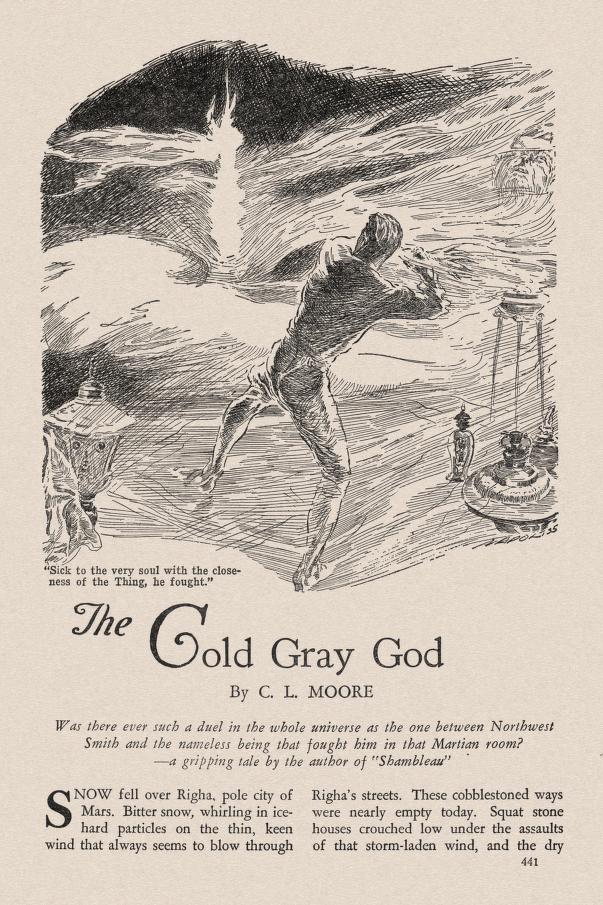
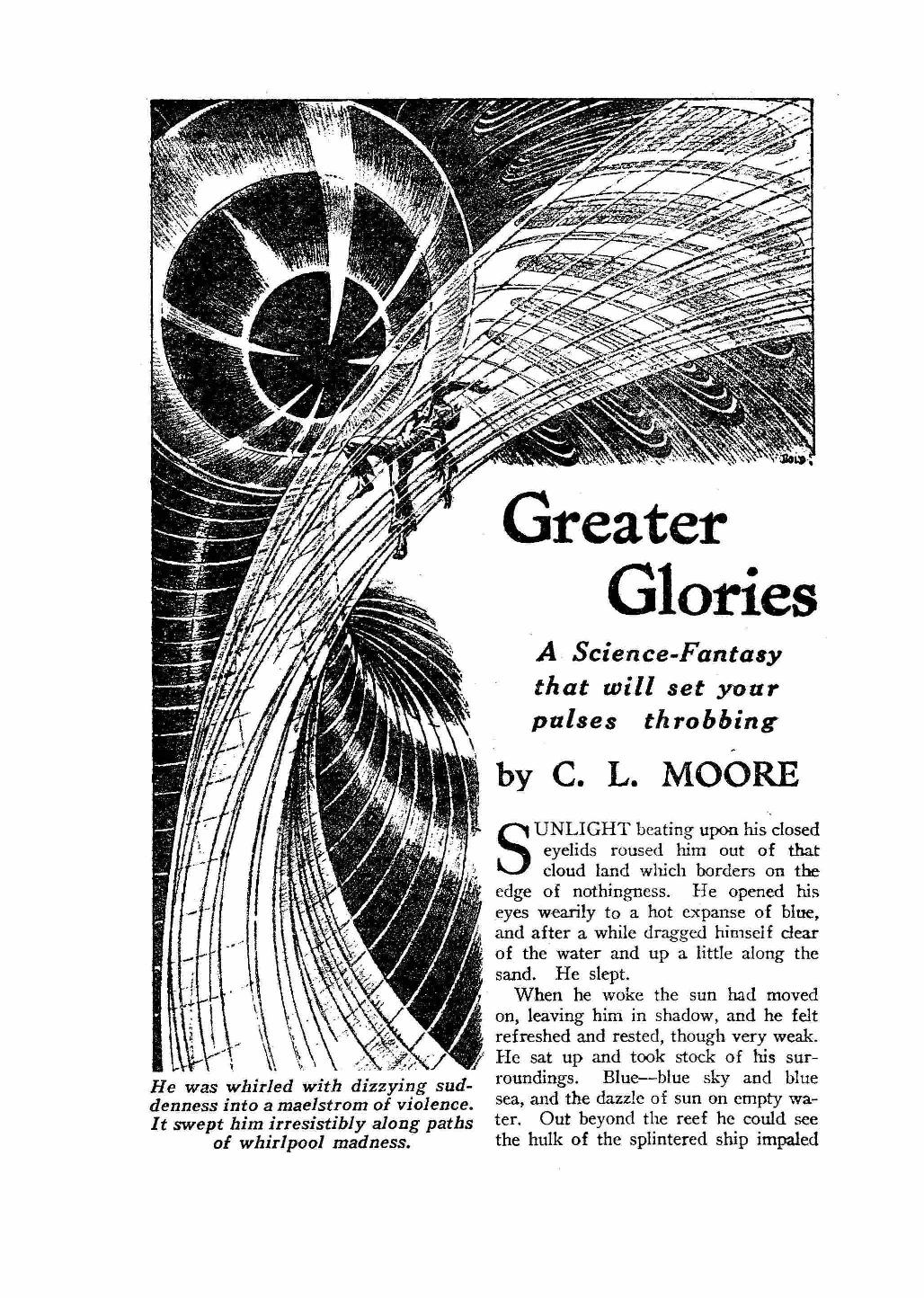
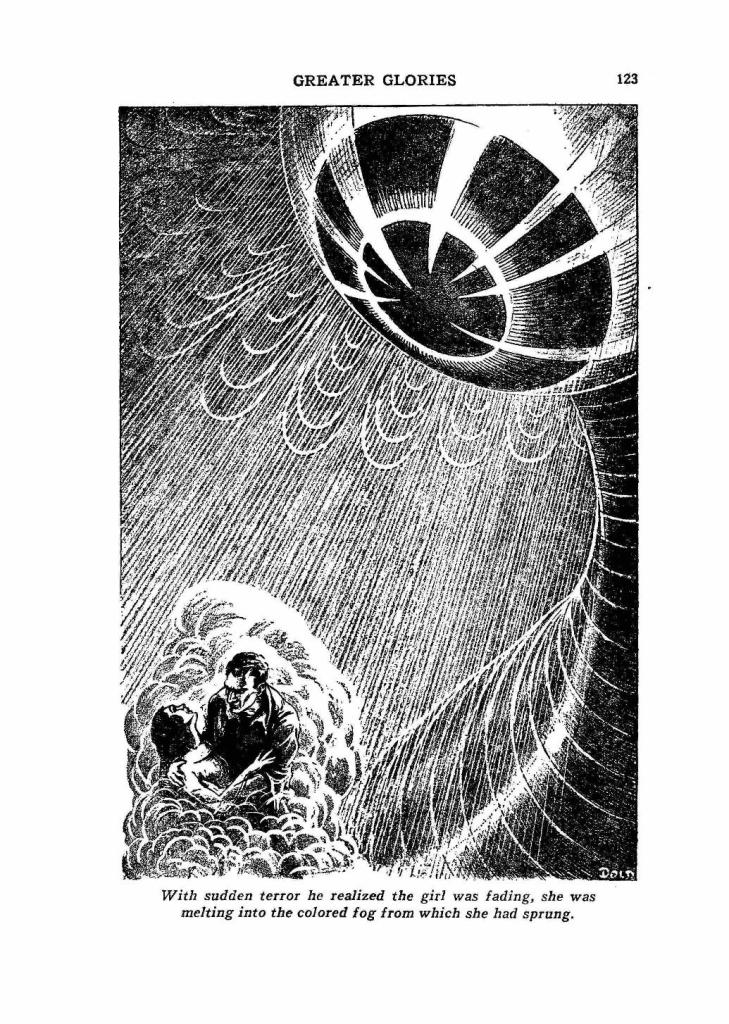
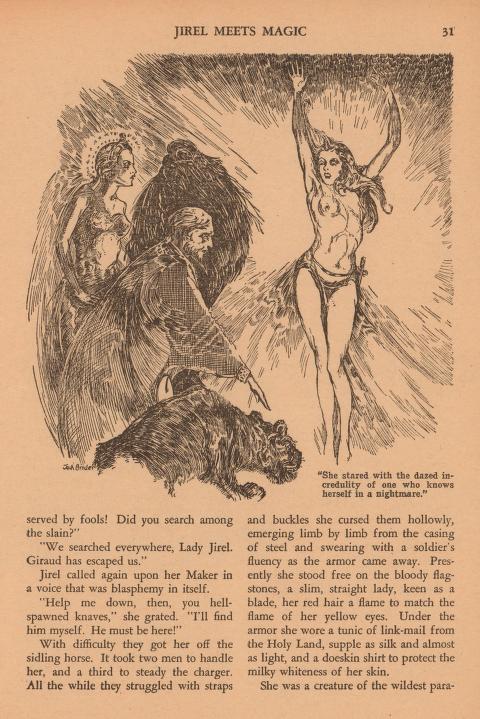
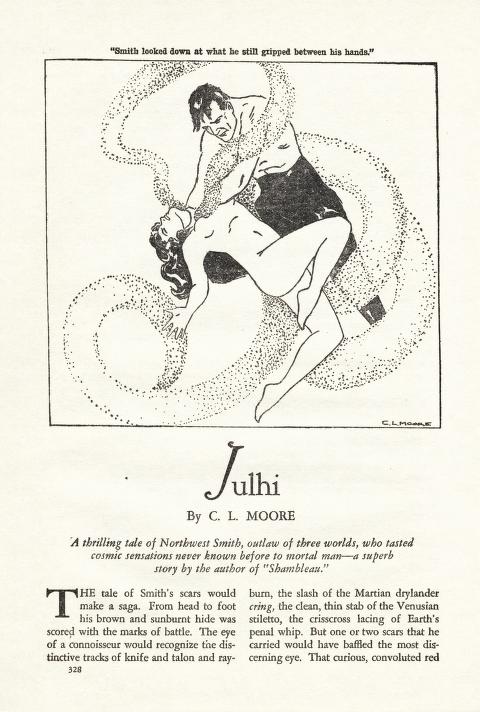
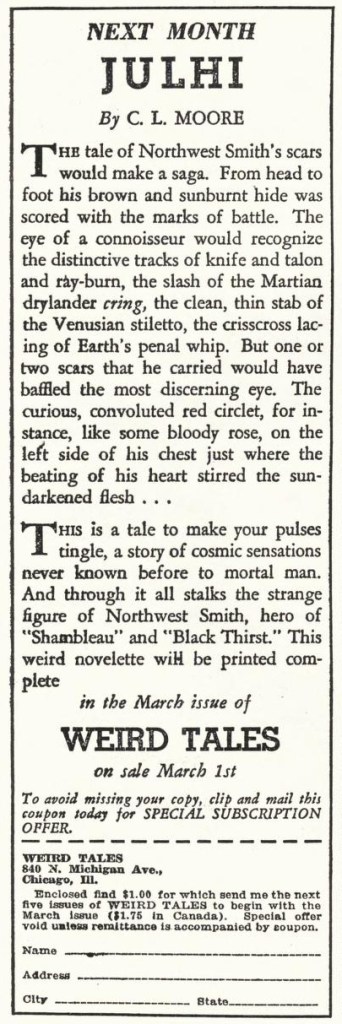
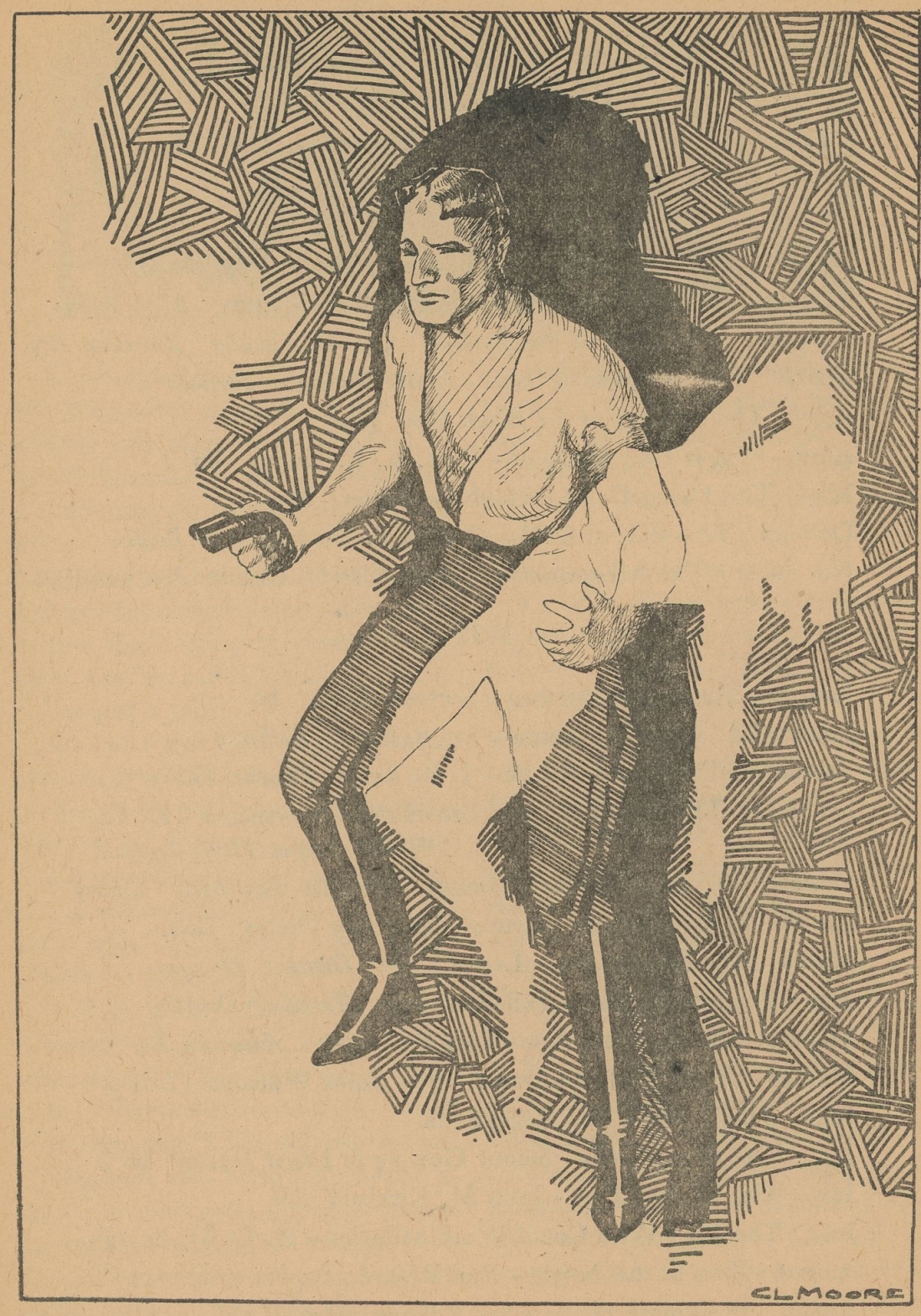

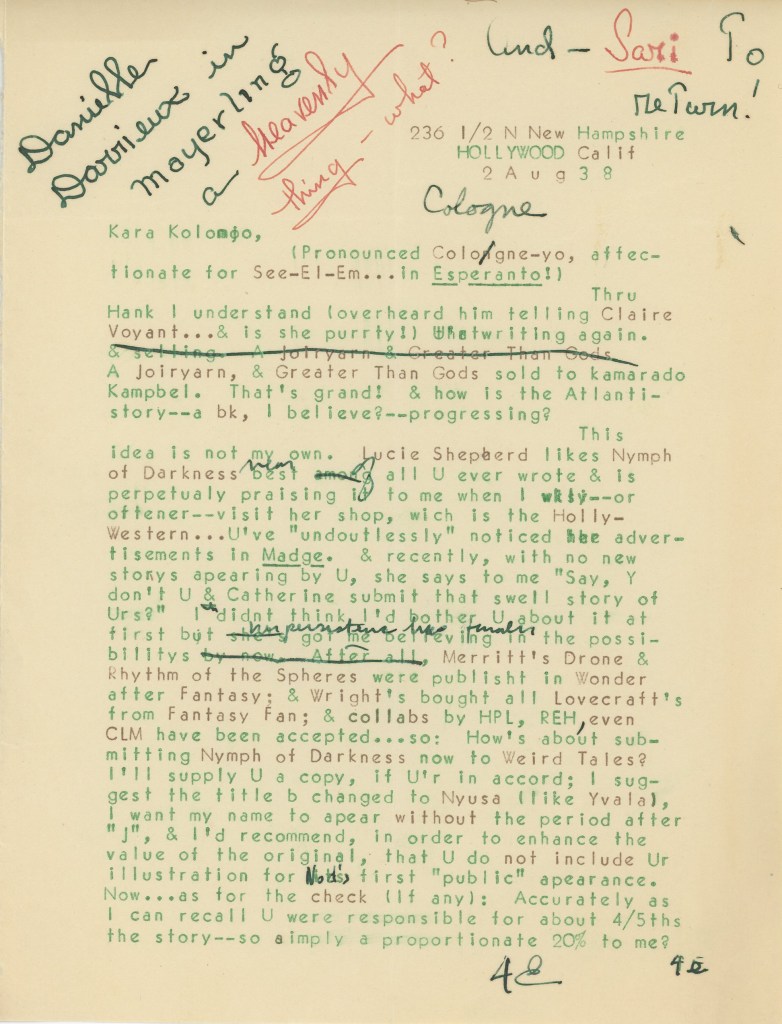
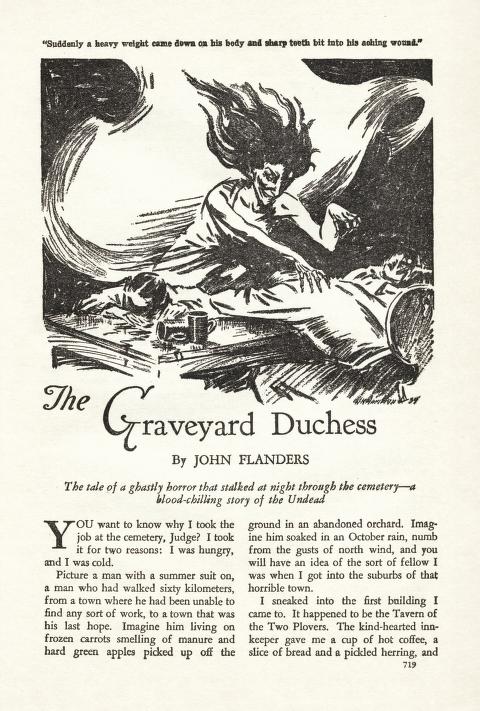
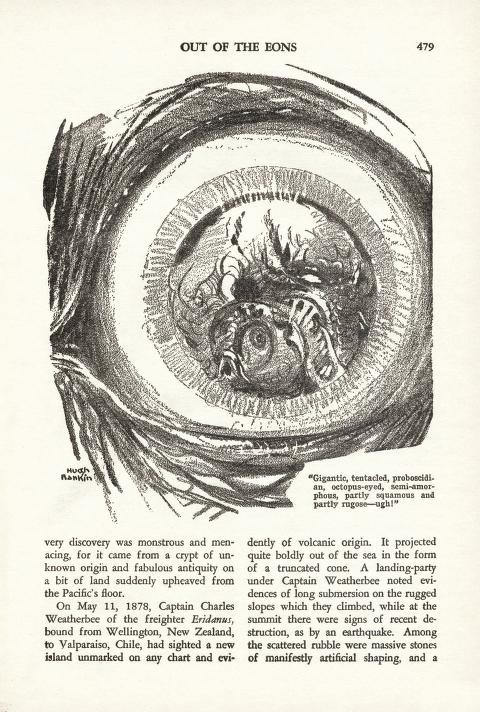
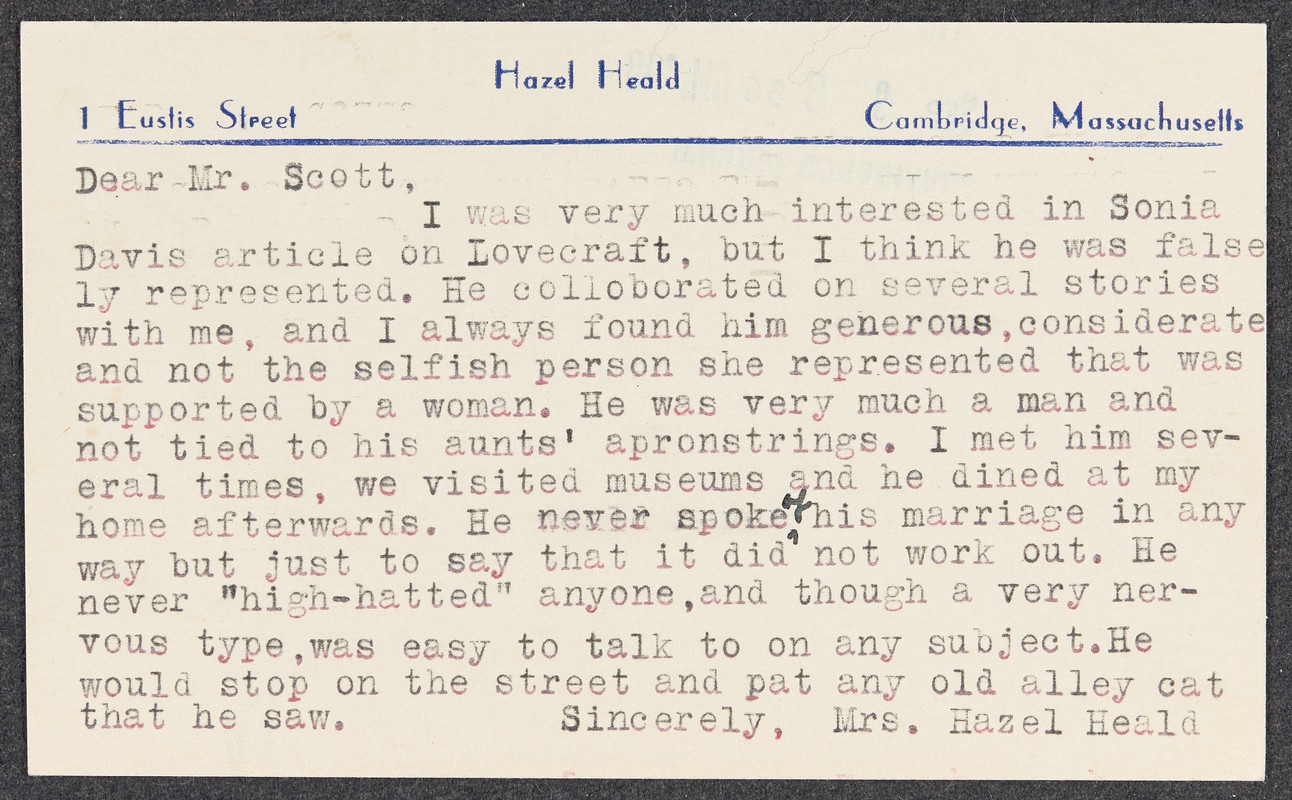

 (2014)
 Deep Cuts in a Lovecraftian Vein