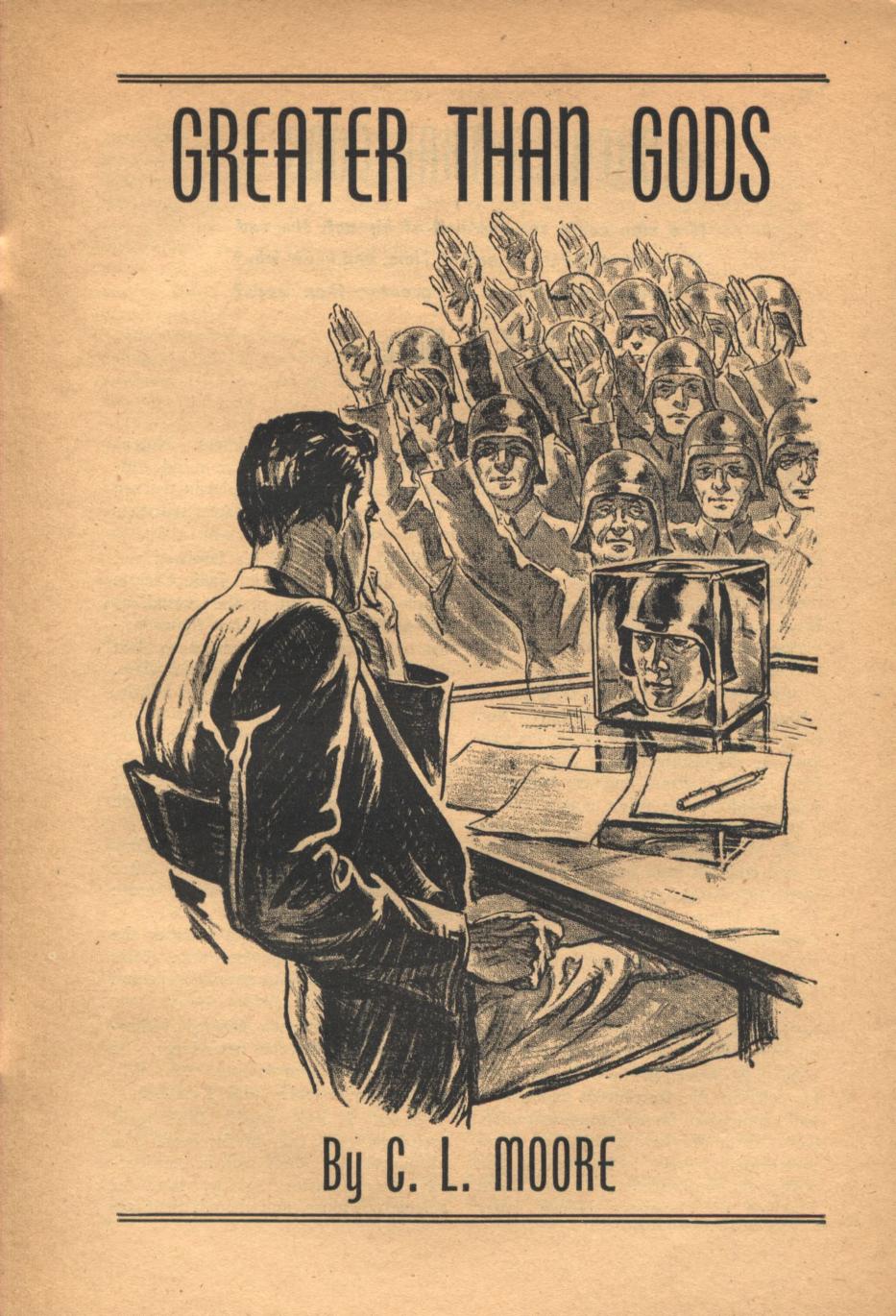
“Greater Than Gods” (1939) by C. L. Moore

If a man could see the end of his act, the end that comes at the far end of Time, and know what it meant—would men be greater than gods?
—Editor’s opening to C. L. Moore’s “Greater Than Gods” in Astounding Jul 1939

C. L. Moore had cut her teeth on interplanetary fiction. Yet the syntax of science fiction was changing, and her approach was shifting with it. Instead of the grungy spaceports of Northwest Smith or the alien cosmic soul-mates of “The Bright Illusion” (1934), “Greater Than Gods” opens up with a Science City divided into separate houses (including Telepathy House), and a very ancient, prosaic situation: a man torn between two women.

The story seems to be a further extrapolation of “Tryst in Time” (1936), working through another iteration of time travel theory:

I think of the future as an infinite reservoir of an infinite number of futures, each of them fixed, yet malleable as clay. Do you see what I mean? At every point along our way we confront crossroads at which we make choices among the many possible things we may do the next moment. Each crossroad leads to a different future, all of them possible, all of them fixed, waiting for our choice to give them reality.
—C. L. Moore, “Greater Than Gods” in Astounding Jul 1939

However, it’s also a kind of a gadget story. The protagonist, William Cory, head of Biology House, was on the trail of figuring out sex determination:

The pups were the living proof of Bill’s success in prenatal sex determination—six litters of squirming maleness with no female among them. They represented the fruit of long, painstaking experiments in the X-ray bombardment of chromosomes to separate and identify the genes carrying the factors of sex
determination, of countless failures and immeasurable patience. If the pups grew into normal dogs—well, it would be one long, sure stride nearer the day when, through Bill’s own handiwork, the world would be perfectly balanced bebetween male and female in exact proportion to the changing need.
—C. L. Moore, “Greater Than Gods” in Astounding Jul 1939

The problem that comes as Cory looks down the trousers of time, as Terry Pratchett put it, is that slowly more and more women were being born. The story becomes a thought-experiment on gender politics. Quite literally:

Women in public offices were proving very efficient; certainly they governed more peacefully than men. The first woman president won her office on a platform that promised no war so long as a woman dwelt in the White House.

Of course, some things suffered under the matriarchy. Women as a sex are not scientists, not inventors, not mechanics or engineers or architects. There were men enough to keep these essentially masculine arts alive—that is, as much of them as the new world needed.
—C. L. Moore, “Greater Than Gods” in Astounding Jul 1939

There are parallels here with David H. Keller’s “The Feminine Metamorphosis” (1929); a blatant, naked sexism that was not uncommon to the time. However, and here is the second twist, Bill Cory gets a glimpse down the other trouser-leg of time, into a world where his own experiments led to a eugenic future:

The first “X-ray” babies began to be born. Without exception they were fine, strong, healthy infants, and without exception of the predetermined sex. The Council was delighted; the parents were delighted; everyone was delighted except Bill.
—C. L. Moore, “Greater Than Gods” in Astounding Jul 1939

Both futures have their flaws, which is the point. It’s a moral conflict, the results deliberately exaggerated. The solution, when Cory arrives at it, is almost ludicrous—a polite fiction on the standards and morals of the age, when proposals were made and accepted more seriously—but it works, it’s true to its own internal logic.

The weird irony to the tale, the search for a third option when presented with an impossible choice, is very much in the vein of 1940s science fiction. How much influence, if any, Henry Kuttner had on this tale is impossible to tell; it has only ever been published under Moore’s name. Yet if she wrote it all on her own, then Moore had fully absorbed the influence of how science fiction was trending. It is a story that speaks to what her future work would look like.

“Greater Than Gods” was published in the July 1939 issue of Astounding. Scans of this issue are available on the Internet Archive.


Bobby Derie is the author of Weird Talers: Essays on Robert E. Howard and Others and Sex and the Cthulhu Mythos.

Deep Cuts in a Lovecraftian Vein uses Amazon Associate links. As an Amazon Associate I earn from qualifying purchases.
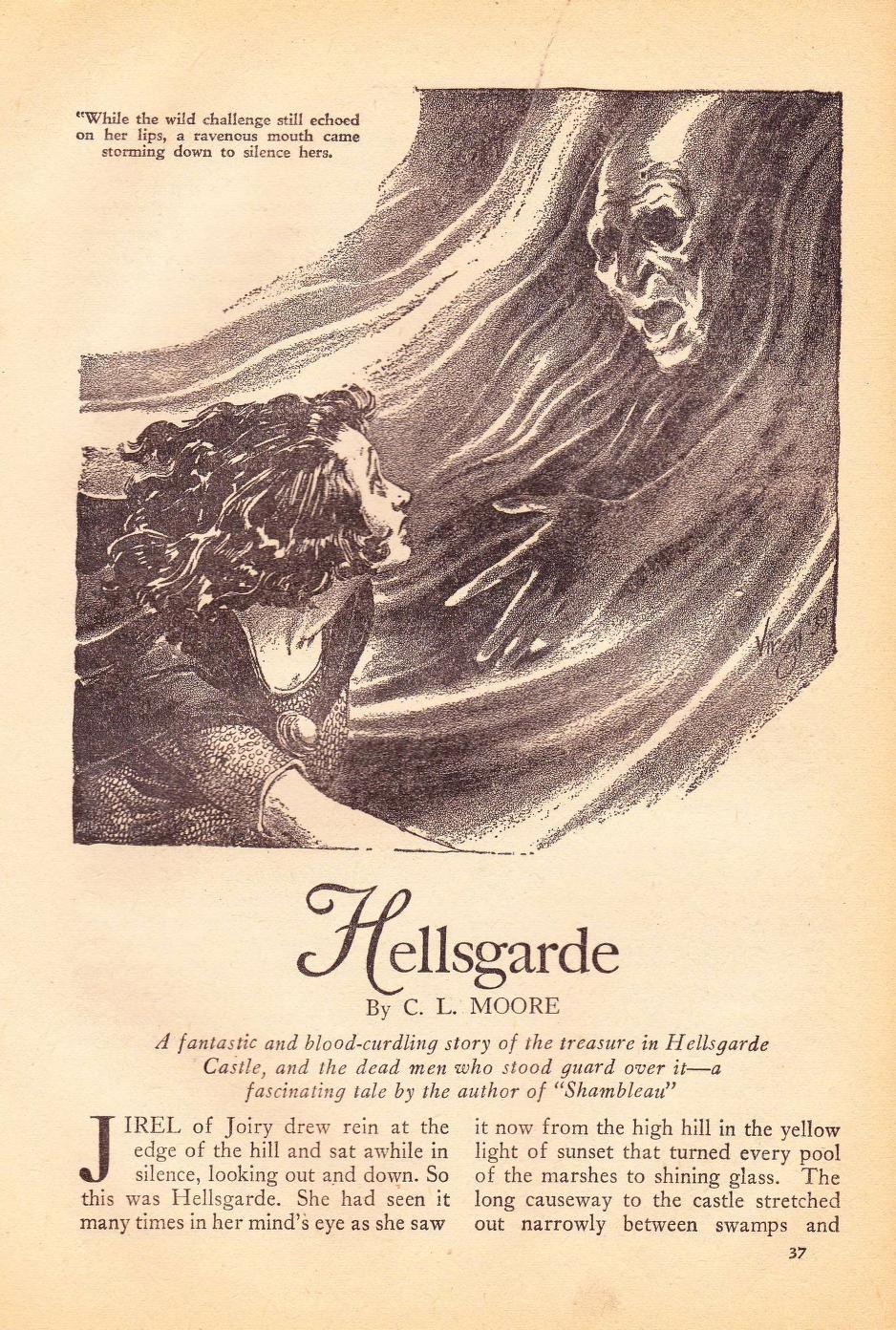
“Hellsgarde” (1939) by C. L. Moore

“You’ll find it by sunset only, my lady,” Guy of Garlot had told her with a sidelong grin marring his comely dark face. “Mists and wilderness ring it round, and there’s magic in the swamps about Hellsgarde. Magic—and worse, if legends speak truth. You’ll never come upon it save at evening.”
—C. L. Moore, “Hellsgarde” in Weird Tales (Apr 1939)

The last Jirel of Joiry story came out 15 months after the previous story, “Quest of the Starstone.” In that time, Moore had been publishing less. The market was changing. New fantasy and weird fiction magazines were out, Weird Tales had been sold and the offices moved to New York City; the editor Farnsworth Wright would soon be fired and, in 1940, would die. Moore’s connections to the magazine were fraying. But there was this one last hurrah.

While it wouldn’t be quite correct to say that the Jirel of Joiry tales to this point were formulaic, they did share very similar plots: Jirel would travel to some other land or dimension, face a supernatural peril, and overcome it through ingenuity and sheer spirit. The details varied, and sometimes she faced sorceresses or wizards and other times alien spirits and gods, but it was a common theme, one largely shared with several early Northwest Smith yarns. “Hellsgarde” still has that theme, but it is developed in a very different way, and with much more style and plot, than the previous tales—and for a good reason.

This is a horror story.

There are strong Gothic setting elements, and readers might well see it as an old dark house tale, with the decaying castle and the creepy family. Yet without sacrificing any of the adventurous elements—Jirel of Joiry is a woman of action, even when trapped in a cell, and her escape is murderous and bloody—this is definitely a story that emphasizes the creepy above the fantasy. It is the darkest of the original Jirel stories, and with neither a typical ghost or typical ghost-hunters, but something much more deliciously weird.

“With the passage of years the spirits of the violent dead draw farther and farther away from their deathscenes. Andred is long dead, and he revisits Hellsgarde Castle less often and less vindictively as the years go by. We have striven a long while to draw him back— but you alone succeeded. No, lady, you must endure Andred’s violence once again, or—”
—C. L. Moore, “Hellsgarde” in Weird Tales (Apr 1939)

The peril to Jirel in this story is exquisite. Once again, she is in a scenario where swordplay is of limited use. She is bound by loyalty to her retainers, she is physically trapped in the castle by the hunters after Andred’s spirit, and her vitality is a beacon to Andred’s ghost itself. It isn’t the first time that something about Jirel’s violent life has attracted supernatural attention (cf. “The Dark Land” (1936) by C. L. Moore), but the threat is more visceral this time, more rapacious. That adds a sense of personal danger, a threat of sensual violence to a tale that is already designed to unnerve. And like a great writer of the weird, C. L. Moore knows enough to leave the last horror unknown, only hinted at.

It’s a wonderful story, and the readers thought so too:

Hellsgarde was the most welcome story of the current issue, for it has the qualities one associates with C. L. Moore: beauty of style, an owtré air, and narrative unpredictability […]
—J. Vernon Shea in “The Eyrie,” Weird Tales (Jun-Jul 1939)

Hellsgarde was a superb, grand and everything else kind of story; I loved it to the very last exciting word.
—Ethel Tucker in “The Eyrie,” Weird Tales (Jun-Jul 1939)

And C. L. Moore gives us the one and only Jirel of Joiry! Boy! Whatanissue! I hope that C. L. Moore delights us in future issues with more stories of Northwest Smith and Jirel.
—John V. Baltadonis in “The Eyrie,” Weird Tales (Jun-Jul 1939)

You do give us thrill-mad fans such nice ‘oogy’ stories. Look at Jirel of Joiry—she certainly does get around. How about getting her and Northwest Smith to meet again. They did quite some time ago. They should get better acquainted, don’t you think?’
—Elaine McIntire in “The Eyrie,” Weird Tales (Jun-Jul 1939)

There would be no sequel. Jirel of Joiry had run her course under Moore, and there was little left of Northwest Smith. Which doesn’t mean that the story of “Hellsgarde” ends here.

In 1967, “Hellsgarde” was reprinted in The Man from U.N.C.L.E. Magazine (Nov 1967). This digest was published by Leo Margulies, who had bought the rights to Weird Tales, and edited by Cylvia Kleinman Margulies, his wife. Back numbers from Weird Tales tended to fill out the issues in the “Department of Lost Stories.” However, probably for reasons of space, when “Hellsgarde” was reprinted it was significantly abridged, and in parts rewritten. This was likely done by the editor, as reprints of “Hellsgarde” in Moore’s own collections follow the 1939 text.

Did Moore intend “Hellsgarde” as a send-off for Jirel? Did she lose contact with the character, after so many years and stories? Or was it just that she lost contact with Weird Tales, and focused her energies on the future—to her upcoming marriage with Henry Kuttner, and the career they would build together? We may never know.

“Hellsgarde” was published in the April 1939 issue of Weird Tales. Scans of this issue are available on the Internet Archive.

A comparison of the 1939 vs. 1967 texts of “Hellsgarde” is also available on the Internet Archive.


Bobby Derie is the author of Weird Talers: Essays on Robert E. Howard and Others and Sex and the Cthulhu Mythos.

Deep Cuts in a Lovecraftian Vein uses Amazon Associate links. As an Amazon Associate I earn from qualifying purchases.
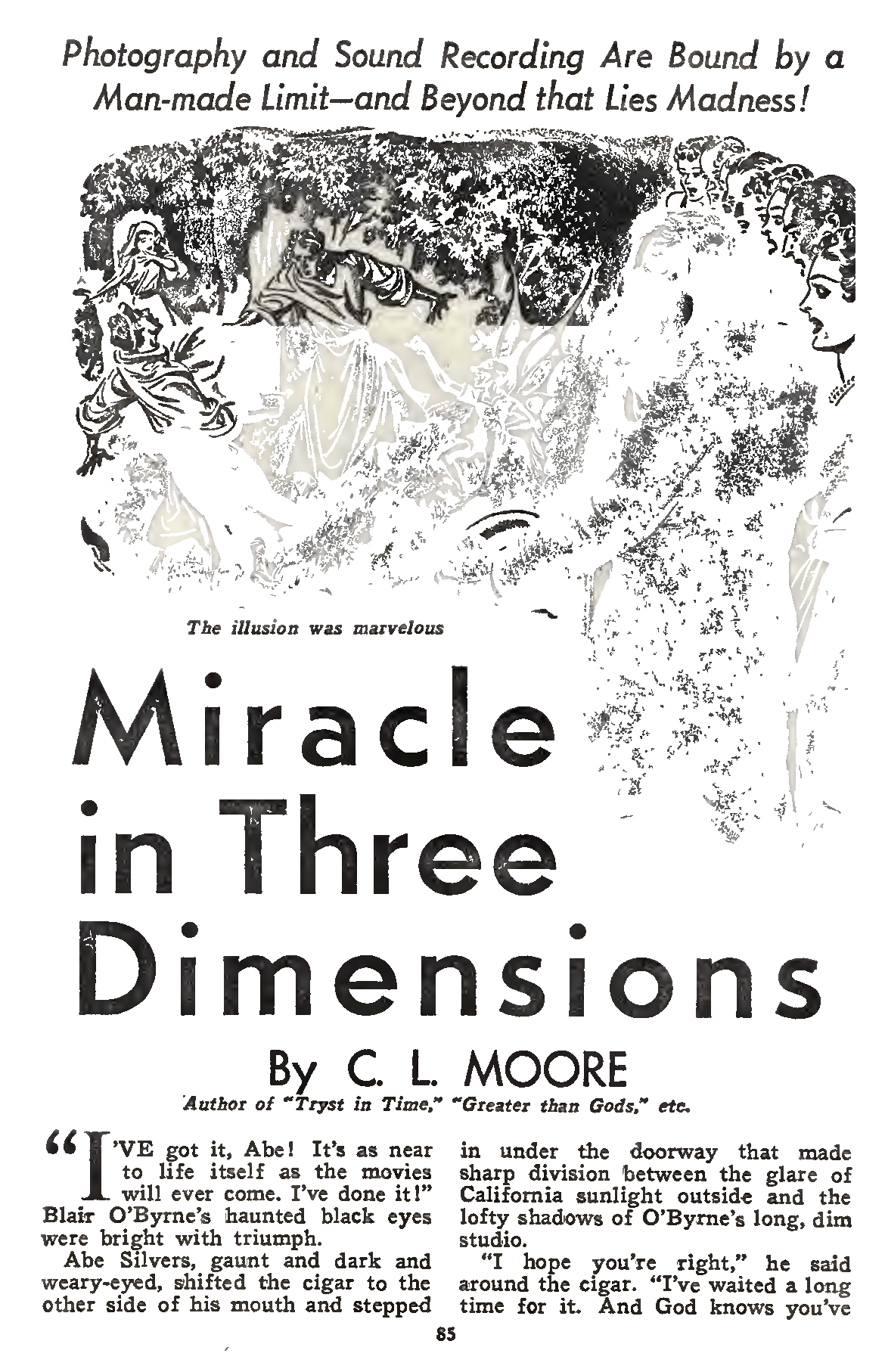
“Miracle in Three Dimensions” (1939) by C. L. Moore

Strange Stories (1939-1941) was one of the rivals that rose during a fantasy boom in the waning years of Farnsworth Wright’s term as editor of Weird Tales. While many of the rivals had little in the way of style to offer, there was one thing they did that WT didn’t—pay. The magazine had gone a long period delaying payment, even to its most prolific and popular authors, while other pulp magazines often paid at least as well and often sooner than WT did. While we don’t know if that was a consideration for C. L. Moore, it might explain why she was writing a science fiction tale for one of Weird Tales‘ rivals instead of another Northwest Smith or Jirel of Joiry tale.

Strange Stories, of all the rivals, seemed to have collected Weird Tales‘ also-rans, and only ran for 13 issues. Most of the stories are nearly forgotten today, but a few have been reprinted, by dint of their authors’ later fame as their individual quality. Such is the case with “Miracle in Three Dimensions” by C. L. Moore, which was never quite a lost story, although seldom reprinted and never in any of her own collections during Moore’s lifetime.

Fundamentally, “Miracle in Three Dimensions,” published in the Apr 1939 issue of Strange Stories, is a gadget tale: inventor Blair O’Byrne has developed a prototype of the Star Trek holodeck, a kind of three-dimensional motion picture. Harboiled movie mogul Abe Silvers finds himself projected into Shakespeare’s A Midsummer Night’s Dream. Wright, a great Shakespeare fan who had tried to publish a pulp library of Shakespeare plays a few years before—of which A Midsummer Night’s Dream was the only one to make it to print—might have shown interest in the scenario, if he had seen it.

Yet the way that Moore develops the story is very different from any of her previous tales, even science fiction stories like “Greater Glories” (1935) and “Tryst in Time” (1936). While framed as a science fiction story, it has a certain fantasy logic:

Did you ever hear—” broke in Blair softly, as if he were following some private train of thought and had not heeded a word of Silvers’ harangue—”of savages covering their faces when explorerers bring out their cameras? They think a photograph will steal their souls. It’s an idea so widespread that it can’t have originated in mere local superstition. Tribes all over the world have it. African savages, Tibetan nomads, Chinese peasants, South American Indians. Even the ancient Egyptians, highly civilized as they were, deliberately made their drawings angular and unlifelike. All of them declared and believed that too good a likeness would draw the soul out into the picture.”
—C. L. Moore, “Miracle in Three Dimensions” in Strange Stories (Apr 1939)

Colonialist rhetoric aside, that particular style of writing, the combination of science fiction trops, fantasy logic, and contemporary setting, is something that would become very characteristic of the early 1940s pulp magazines like Unknown. It is a remarkable shift away from her previous style that the question must be asked: is this even a C. L. Moore story?

A glance at the names on the table of contents of Strange Stories (Apr 1939) includes familiar names like Henry Kuttner, August Derleth, Robert Bloch, Tally Mason, Marc Schorer, and Tarleton Fiske. Except…Tally Mason was one of Derleth’s pseudonyms. Tarleton Fiske was one of Bloch’s pseudonyms. Marc Schorer was a writing partner of August Derleth, and was republished in their collection Colonel Markeson and Less Pleasant People (1966) as by both. The use of pseudonyms by authors to fill out a table of contents and make it look like more writers were contributing than there were is an old pulp trick. Since Kuttner was already in the book with a story of his own, I suspect what happened is that they left his byline off of “Miracle in Three Dimensions,” and that this is actually the second Moore/Kuttner collaboration to see print. More was, as noted elsewhere, sometimes somewhat reluctant to reprint collaborations.

Was that the case here? Maybe, maybe not. There are no definite answers forthcoming, unless more evidence comes to light. So, whether the shift in style represents collaboration with Kuttner, or Moore’s own developing style in that direction is difficult to distinguish. Certainly, there’s a touch of the old sword-&-sorcery even in this tale which may have come from either:

Puck lured the spell-bewildered lovers into the fastnesses of the forest. They went stumbling through the fog, quarreling, blinded by mist and magic and their own troubled hearts. Swords flashed in the moonlight. Lysander and Demetrius were fighting among the veiled trees. Puch laughed, shrill and high and inhuman, and swept his brown arm down. And from Lysander came a choked gasp, the clatter of a fallen sword.
—C. L. Moore, “Miracle in Three Dimensions” in Strange Stories (Apr 1939)

Not quite Robert E. Howard, but then Moore and Kuttner seldom wrote gruesome or fierce action scenes.

The hybrid nature of the tale works; the ability to enter and leave the Shakespearian setting predates works like the Harold Shea stories of L. Sprague de Camp and Fletcher Pratt. It is, more importantly, a step away from the style of fiction of Weird Tales; there’s nothing really of Lovecraft, Robert E. Howard, Clark Ashton Smith, or A. Merritt in this tale. Whatever influences Moore (or Moore & Kuttner) had drawn from these authors, this story was now pushing into a new era, which would be dominated by writers like Ray Bradbury, Robert Bloch, and Margaret St. Clair, who straddled science fiction, fantasy, and horror, but often with a more ironic tone and contemporary viewpoint.

“Miracle in Three Dimensions” was published in the April 1939 issue of Strange Stories. Scans of this issue are available on the Internet Archive.


Bobby Derie is the author of Weird Talers: Essays on Robert E. Howard and Others and Sex and the Cthulhu Mythos.

Deep Cuts in a Lovecraftian Vein uses Amazon Associate links. As an Amazon Associate I earn from qualifying purchases.

“The Picture” (1939) by Robert D. Harris

What was the first Canadian Cthulhu Mythos story?

Well-read weird fiction aficionados might point to Algernon Blackwood’s “The Wendigo” (1910), though that story was essentially grandfathered into the Mythos when August Derleth identified his creation Ithaqua with Blackwood’s wendigo in “The Thing That Walked on the Wind” (Strange Tales of Mystery and Terror Jan 1933). But as far as the first story written as a Mythos story, written and set in Canada…well, weren’t there Canadian fans? During the interwar period U. S. pulps were sold on both sides of the border, and even after wartime paper restrictions prevented such traffic, from 1942-1951 Canada produced its own localized edition of Weird Tales. Canadian fans like Nils Frome were well-known. So where is the Canadian Mythos fanfiction?

Sasha Dumontier discovered “The Picture” (1939) by Robert D. Harris in the online newspaper archive of The McGill Daily, which is the daily college newspaper of McGill University in Montreal. The short story ran in the 24 November 1939 issue; Dumontier also found Harris published at least two other stories (“Pen and Ink,” 8 Feb 1939 and “Winter Twilight,” 20 Dec 1939) and a few poems and letters to the editor in The McGill Daily. Both stories are short and straightforward weirds, though neither has any Mythos elements.

Robert Dresser Harris was born in 1920 in Island Pond, Vermont; the 1920 U.S. Federal census records both his parents as born in Canada. The family shortly moved to Asbestos, Quebec (now known as Val-des-Sources). Harris attended McGill University and graduated in 1940. After graduation, Harris worked as a cordite chemist supporting the wartime industries, but in 1942 he joined the Royal Canadian Air Force. A card at McGill University sketches out his service, but details on his later life and career are a bit sketchy without access to Canadian census records. A memorial notice shows Harris died in Toronto in 1991.

That Harris was a fan of weird fiction is obvious from his work published in The McGill Daily; whether he had any connection with other Canadian fans is unknown. Canadian fandom was not well-organized in the late 1930s, and the Canadian Amateur Fantasy Press was founded in 1942, after Harris had graduated and joined the war effort. Still, he may have some distinction at least in writing and publishing “The Picture,” which deals with an eldritch tome familiar to every Lovecraft fan…

The Picture

Garland hardly needed the picture on his bureau, for he could call up mentally with amazing clarity the image of Peggy’s face at any time. It was, however, a concrete symbol of what seemed to him the main reason for existence, and he appreciated it accordingly. it was Peggy at her very best with that singularly sweet expression which had first caused him to notice her. But strangely enough, there was no studio name on the picture anywhere and when he asked Peggy where it came from, she could not remember the exact place. From the best photographer in the city, it would have been a masterpiece; from an unknown, it was astonishing.

At times, something about the photo seemed to bother him. He would be working at something when he would feel irresistably that someone was staring at him intently; he would resist it as long as he could, and then swing round, to meet its gaze. On first sight, he always felt revulsion; it looked at him so devotedly—almost sickeningly so—and yet so possessively; certainly not like Peggy. The queer thing was, that other times it looked quite normal.

One night, Wilson dropped in, and as Garland scraped into the debris on his desk for an ashtray, Wilson said “That’s a nice picture there—queer expression, though, somehow quite malevolent. Not like Peggy at all, that way. You know I could swear the eyes followed you, as you walk around, just as though it’s watching you; trick of the light, I suppose.”

“You’ve noticed it too?” Garland asked, trying to keep his voice steady. “Weird thing, but it’s just coincidence, of course.”

†††

But after that, the picture came more out into the open with it. The night he came dejectedly home, after a good-sized row with Peggy, the picture first leered at him, but when he looked again, it was smiling sympathetically; there was no mistake about it, it was the truth. At Christmas, when we went home, it was especially bad. He took the picture with him, and all the holidays it wore that happy, possessive look, as though it were saying, “Now I’ve got you all to myself, she isn’t around any more. Just you and I, Brad.”

It was true, the thing was infernally jealous of its prototype. It knew what had happened, every time he came in from being with Peggy. The night of the Formal, when things really occurred, he didn’t get home till five; and the picture seemed to know that he and Peggy had left the dance at two. The thing fairly gibbered at him with rage; the whole face was distorted, the lips slightly drawn back, the brows contracted—it was horrible. He tossed it into the drawer with a shudder; he couldn’t possibly sleep with that looking at him.

He confided in Wilson, who, having seen the picture, was not inclined to laugh. “I don’t even know what the thing wants me to do.” he said. “I can’t very well make love to a picture—but even if I knew, I wouldn’t let it scare me into it.”

“I wonder how it works,” Wilson mused. “If we knew, we might be able to do something about it. Apparently, someone’s got hold of a way of photographing character. If you can get a distortion in physical appearance you can distort the character of the picture, too. If it’s deliberate, I’d say the man was a wizard, meaning just that.”

“Would you destroy the picture?” Garland asked.

“Not yet,” Wilson answered. “It’s very interesting, and you’ll never see anything like it again. Of course, if you feel you can’t stand it—”

“That’s all right,” Garland broke in. “I’ll see what happens.”

†††

The situation got no worse, but it was still bad enough to prey on Garland’s nerve. This continued for about a month, and then matters took on a worse appearance. At first, the picture had tried to get its way by a nauseating amative coaxing, but now its aspect was positively menacing. Strange, vague figures began to appear in the background, and those took on a sharper outline as the days passed.

Then Garland began having nightmares, of the most macabre sort, in which the face in the portrait played a large part. Several times, just as he awoke from a troubled sleep, he heard rustlings in the room, as if numerous little beings were making for the bureau, on which the picture stood.

One night, he woke up suddenly from a worse dream than usual. The full moon was shining in brightly, and in its light, he saw several black shapes moving and flowing about on the walls and ceiling.. With a courage I can only admire, he managed to persued himself that the shapes were only spots on the wall, and that the deceptive moonlight made them appear to move. However, in the morning, the wall was perfectly blank.

There was a little blood on the pillow. “Queer,” he thought. “I don’t remember cutting myself when I shaved last night. However—”

A sudden thought seized him, and he swung out of bed, and over to the bureau. There was blood on the cover, small blobs of blood scattered over the background of the picture, but the largest smear was right on the mouth of the portrait.

He wiped it off. The picture smiled sweetly back at him, but when he picked it angrily up, the features twisted to a look of dismay and rage. The eyes were horribly distended, but worst of all was the ghastly sound when he ripped it across. It certainly did not sound like tearing paper; to him, it sounded like a human scream, but that was probably due to his imagination.

In disgust and terror, he hurriedly held the fragments to a lighted match, and dropped them into the waste-basket. Then, without looking for coat or hat, he ran from the room.

†††

Garland had no more toruble from that source, but there is a sequel. The next day, he saw Peggy, and asked again about the source of the photo.

“Oh, yes,” she said. “I’d written the address down, and I found it a few days ago. It’s blotted, but it’s either 383 or 385 Ste. Clarisse.”

Garland made a point of investigating these two addresses. 383 was closed, and he could not get in, and the other was merely a rooming house; on inquiry he found that no photographer had ever had a studio there, at least for some years.

I told this story to give point to a little discovery of my own. A friend of mine last week showed me a book that was found on demolishing a row of buildings along Ste. Clarisse and Devraux streets. It is a huge tome, bound in leather, and completely illegible, except for a few words here and there. The name, which conveys nothing to me, is “Necronomicon.” There are several pages of cabalistic symbols, which make it probably a mediaeval book on Alchemy, Black Magic, or some such subject. It is hand-written, in a fluid which resembles very much deteriorated red ink; however, a reputable chemist tells me that it is almost completely of organic origin, which eliminates any theory that it might be ink. The pages, are quite dry and cracked, but I think, like everyone else who has seen it, that they are of human skin.

Found along with the book were several containers for Mazda No. 2 Photoflood Bulbs, and in another corner of the room was a blue silk screen.

— Robert D. Harris

As a story, “The Picture” is little more than a sketch, with underdeveloped characters and a bit of a rushed ending. Yet Harris manages to tell his story, even if the ending would be obscure to anyone that wasn’t fairly well-read in Weird Tales or managed to get a copy of some early Arkham House books from across the border. If it is a little ungainly in its telling, there are some elements that have the ring of real college life—like staying out ’til 5AM with a girlfriend, when they’d left the dance at 2AM—and readers could only imagine what happened in the intervening three hours unaccounted for.

The most notable element is the description of the Necronomicon; while Lovecraft had hinted at a “portfolio, bound in tanned human skin” in “The Hound,” in none of his writings had he suggested that the Necronomicon itself was bound in human leather, or that the pages were made of human vellum or inked with blood (or at least, a mostly-organic reddish substance). The popular association of the Necronomicon with anthropodermic bibliopegy and being written in blood came from the Necronomicon ex Mortis featured in Evil Dead II (1987) (and for more Necronomicon lore, see The Necronomicon Files by Dan Harms & John W. Gonce III). So Robert D. Harris was certainly ahead of the game in that respect.

“The Picture” by Robert D. Harris is ultimately just a bit of fanfiction, with the inclusion of the Necronomicon just a nod in Lovecraft’s direction—but who else in Canada was that in 1939?

The original text of “The Picture” was taken from The McGill Daily 24 Nov 1939.

Thanks to Sasha Dumontier, who found “The Picture,” did the initial research on Harris and his publications in The McGill Daily, and was kind enough to bring it to my attention. Thanks too to Dave Goudsward for his help on Harris’ vital statistics.


Bobby Derie is the author of Weird Talers: Essays on Robert E. Howard and Others and Sex and the Cthulhu Mythos.

Deep Cuts in a Lovecraftian Vein uses Amazon Associate links. As an Amazon Associate I earn from qualifying purchases.

“Medusa’s Coil” (1939) by Zealia Bishop & H. P. Lovecraft

I shall watch for the tale, “Medusa’s Coil,” you mentioned. Regardless of the author, if you instilled into the tale some of the magic of your own pen, it cannot fail to fascinate the readers.
—Robert E. Howard to H. P. Lovecraft, Sep 1930, A Means to Freedom 2.43

Zealia Margaret Caroline Brown was born in Asheville, NC in 1897; in 1914 she married James Reed, and the couple had a son James. At some point in the 1920s the couple divorced, and Zealia Brown-Reed supported herself and her son in Cleveland, OH by writing articles and short stories, and working as a court reporter while taking correspondence courses from Colombia University and the Home Correspondence School.

In 1927, Zealia wrote to H. P. Lovecraft, inquiring into his revision services, beginning a correspondence that would see Lovecraft ghost-write three stories for her: “The Curse of Yig” (1928), “The Mound” (1929), and “Medusa’s Coil” (1930). In 1930, she would marry D. W. Bishop, and Zealia’s correspondence with Lovecraft appears to taper off, although it continued through at least 1936.

In her memoir “H. P. Lovecraft: A Pupil’s View” (1953), Zealia is appreciative of Lovecraft’s efforts advice and erudition—although in their letters, published in The Spirit of Revision (2015) it is evident that they had very different interests in terms of writing. Zealia’s interest apparently lay in confession pulps and love stories (“light, domestic fiction in the popular vein”); Lovecraft tried and failed to bend her toward weird fiction. The limit of their meeting-of-the-minds in this regard appears to be their collaborations: Zealia would supply the idea for a story, which Lovecraft would flesh out into a detailed synopsis and then write.

Their first such ghostwriting venture, “The Curse of Yig” was a success, and appeared in the Nov 1929 issue of Weird Tales. The next story however, the lengthy novelette “The Mound,” was rejected by Weird Tales editor Farnsworth Wright, and was rejected again after Frank Belknap Long abridged it to make it more salable to the pulp market. While little correspondence regarding the story survives, this also appears to have been the likely fate of “Medusa’s Coil”—which Lovecraft recalls writing in the summer of 1930:

Have no record of dates of “Mound” & “Medusa’s Coil”, but am tolerably certain the former was written in 1929 & the latter in 1930. Indeed, I know the latter date is right, because I did most of the job in Richmond on one of my trips—afternoon after afternoon in Maymont Park. And 1930 was the only time I ever spent a liberal period—nearly a fortnight—in Richmond.
—H. P. Lovecraft to R. H. Barlow, 24 May 1935, O Fortunate Floridian! 276

In November 1930, Lovecraft mentions the rejection of a revision story in a letter to Clark Ashton Smith, which is presumably “Medusa’s Coil.” (Dawnward Spire, Lonely Hill 280). It was, from all evidence, their final collaborative effort. Zealia Bishop had a bill for Lovecraft’s revision services which she would pay slowly over the next few years, but the two stories he had ghostwritten for her had not sold.

As for the origins of “Medusa’s Coil”:

[…] I had picked up as an idea from a Negress who did some  housecleaning for me and expanded into a story similar in treatment to my earlier horror tale.
—Zealia Bishop, “H. P. Lovecraft: A Pupil’s View” in Ave Atque Vale 259-260

The letters to and from Lovecraft concerning the tale do not survive, but Lovecraft’s notes for the story do and read in part:

(1.) Son kills wife with hastily seized machete, hacks off hair in savage rage since he dems this the cause of Marsh’s attraction & also connects it with her hideous nature & malignly magical affiliations—also, with her newly discovered racial identity. But the hair* slithers out of the room of its own volition, as if transformed to some monstrous black snake. At this sight son goes half mad. follows hair up to studio, & sees it coil itself around the slowly recovering Marsh. Hair strangles Marsh—the evil voodoo sorceress having recognised M. as an enemy when she saw the manner in which he had painted her. Son, witnessing this, goes wholly mad. Cowers & mutters around room till father enters. Then the shrieking explanation & the struggle. Son either kills himself or is killed by father. (Attempts to kill both father & self because he thinks family blood contaminated by his marriage to negress.) Father left alone with portrait & bodies & hair. Buries victims of tragedy in cellar & settles down to live as hermit. Picture affects him strangely—he cannot break away from it. He fears hair will emerge vampircally from Marsh’s grave. Sophonisba is sullen—continually wanders into cellar & haunts Marsh’s secret grave, though the servants are not supposed to know that anyone has died there. Marsh, son, & wife supposed to have gone away. Later freed hands servants & chauffeur all changed, money wanes, Sophinisba refuses to leave. Finally dies on Marsh’s cellar grave, muttering. […] Symbols of horror—voodoo—black mass—Cthulhu-cult—&c. &c.—Hair alive with independent life—woman revealed as vampire, lamia, &c. &c.—& unmistakably (surprise to reader as in original text) a negress.
—H. P. Lovecraft, notes for “Medusa’s Coil” in Collected Essays 5.243

As with Lovecraft’s previous ghostwriting job for Zealia, “The Mound,” this story contains explicit references to the Mythos that Lovecraft had created in his own fiction, and which he was encouraging writer-friends like Clark Ashton Smith and Robert E. Howard to use. It is set in southern Missouri, far away from Lovecraft’s typical haunts, and is a story that deals very directly with the mores regarding interracial sex in Southern culture:

Romantic young devil, too—full of high notions—you’d call ’em Victorian, now—no trouble at all to make him let the nigger wenches alone.
—Bishop & Lovecraft, “Medusa’s Coil”

Shorn of the weird elements, the story boils down to something like a confession-story: the young heir of a Southern plantation goes off to school and returns with a beautiful and vain wife, and a visit by an artist friend sets the stage for what might be a triangular love affair—and it is worth noting what a departure this work was from Lovecraft’s previous fiction. The whole beginning plot is dependant on human relations, love, courtship and marriage; the spectre of infidelity that lingers between Marceline and Marsh is a very human conflict. Even the macabre twist of murder and worries of revenge from beyond the grave is a Poe-esque touch.

Except for the final, culminating revelation.

It would be too hideous if they knew that the one-time heiress of Riverside—the accursed gorgon or lamia whose hateful crinkly coil of serpent-hair must even now be brooding and twining vampirically around an artist’s skeleton in a lime-packed grave beneath a charred foundation—was faintly, subtly, yet to the eyes of genius unmistakably the scion of Zimbabwe’s most primal grovellers. No wonder she owned a link with that old witch-woman Sophonisba—for, though in deceitfully slight proportion, Marceline was a negress.
—Bishop & Lovecraft, “Medusa’s Coil”

“Medusa’s Coil” is a horror story about a mixed-race woman passing in white society. As a plot germ, that by itself is not particularly novel in American literature: Mark Twain examined the cultural and personal impact of the “one drop rule” directly in his novel Pudd’nhead Wilson (1894); Eli Colter’s more macabre story “The Last Horror” about a genius black surgeon who flayed white captives and grafted their skin over his own was published in the Jan 1927 issue of Weird Tales. 

Passing is very specifically a horror aimed at a white audience—and “Medusa’s Coil” is not a nuanced or clever take on the subject. The very mundanity of the reveal undercuts whatever weird atmosphere that Lovecraft had built up at this point. Terminal revelations in stories like “The Dunwich Horror” (written 1928) and “The Whisperer in Darkness” (written 1930) add depth to the horror, the last little piece of information that casts the events of the story in a terrible new light. In “Medusa’s Coil” the reveal bombs completely…although not for lack of trying.

When “Medusa’s Coil” is read with foreknowledge of the ending, it becomes clear that Lovecraft attempted to build up to Zealia’s revelation throughout the story. Her reluctance to speak of her origins, ties to the French colony of Martinique in the Caribbean, and association with African religion all hint at her secret without revealing it. Yet for all that Marceline Bedard comes onto the stage as a femme fatale and sorceress or priestess, her real motivations appear to be exceptionally mundane, straight out of a Brontë novel: to marry into wealth and settle into life as a gentlewoman.

The problem is, Marceline is not Keziah Mason or Asenath Waite; she might be a strange young woman in the household and the servants don’t like her, but she doesn’t appear to actively do anything malicious, or have any particular nefarious plot or intentions, aside from possibly designs on infidelity. Conventional romanticism is only undercut by recurrent mention of how subtly disturbing or off her appearance is to the older de Russy—at least until the affair bloodily ends, and a supernatural element finally enters the picture. The ending is reminiscent of both The Picture of Dorian Gray (1890) and “Pickman’s Model” (1927): in art is truth revealed.

We can only guess at how much of the plot was Lovecraft’s own contribution. Certainly he wrote the actual text, and all the references to Cthulhu, Clark Ashton Smith, and Great Zimbabwe in the story are characteristic of his tastes and such matter from his letters. It could well be that the bulk of the macabre elements of the plot were his conception…and whether or not it was contained in Zealia’s initial idea, the final execution is purely Lovecraft’s prose.

There is, at this late date, no point in assigning fault. Zealia apparently suggested an idea starkly mundane and rooted in cultural fears of miscegenation, Lovecraft apparently was willing to pick up that idea and try to write to it. Neither, apparently, was conscious enough of the realities to consider the story from Marceline’s point of view—or perhaps Lovecraft’s efforts to build her up as a genuine supernatural threat simply fall apart when cosmic horror is married so directly, and effectively dependent upon, racial discrimination…and it is worse, in hindsight, when seeing de Russy’s response:

“‘She thought we couldn’t see through—that the false front would hold till we had bartered away our immortal souls. And she was half right—she’d have got me in the end. She was only—waiting. But Frank—good old Frank—was too much for her. He knew what it all meant, and painted it. I don’t wonder she shrieked and ran off when she saw it. It wasn’t quite done, but God knows enough was there.

“‘Then I knew I’d got to kill her—kill her, and everything connected with her. It was a taint that wholesome human blood couldn’t bear. There was something else, too—but you’ll never know that if you burn the picture without looking.
—Bishop & Lovecraft, “Medusa’s Coil”

The straight reading of this is that there was something more to the revelation than just Marceline being mixed-race; that perhaps is the “something else, too” Denis de Russy refers too. But knowing the end, it’s impossible to draw a clear distinction from where Marceline’s connection to the Mythos ends and the racial discrimination begins.

Lovecraft himself apparently didn’t think much of the result, although the typescript was shared with his young friend and correspondent R. H. Barlow, who was a collector of pulp manuscripts:

Do you suppose Mr. Barlow would be interested in reading Medusa’s Coil?
—Zealia Bishop to H. P. Lovecraft, 26 May 1934, The Spirit of Revision 177

Of course, “Medusa’s Coil” is a matter wholly separate from “The Mound”. It isn’t much of a story anyhow. If I were you I’d read it & send it back to Mrs. B. for the present, so that she can experiment with it as she likes. If she places it, well & good. You can get whatever it appears in. If she doesn’t, you can renew negotiations for the MS.—which she’d probably sell at a reasonable figure….although I wouldn’t give a dime for it myself. As you know, it isn’t a first draught or anything with any associational value.
—H. P. Lovecraft to R. H. Barlow, 26 Jun 1934, O Fortunate Floridian! 143

“Medusa’s Coil” was not published during Lovecraft’s lifetime. After his death, Farnsworth Wright made an effort to publish stories and pieces from Lovecraft—even collaborations and ghostwritten works—and in 1939 finally paid Zealia Bishop $120 for the privilege. However, the story that was published was not as Lovecraft had written it.

No wonder she owned a link with the old witch-woman Sophonisba—for, though in deceitfully slight proportion, Marceline was a loathsome, bestial thing, and her forebears had come from Africa.
H. P. Lovecraft Collected Fiction A Variorum Edition Vol. 4: Revisions and Collaborations 298

The original manuscript of “Medusa’s Coil” is not extant. The surviving typed manuscript shows evidence of two different hands (presumably Frank Belknap Long and R. H. Barlow), with pencil edits by August Derleth dating to 1937—including the final line of the story. Bishop & Lovecraft’s original ending would not be read by the public until 1989, when the text restored by S. T. Joshi was published in the revised The Horror in the Museum and Other Revisions.

It is an interesting edit, if for no other reason than all the other references to race in the story—more than is typical for Lovecraft, including some fairly lengthy bits of what are supposed to be African-American dialect by Sophonisba, and instances of the N-word—are all left intact. At best, it can be seen as a half-hearted amelioration, an effort to retain the substance of the terminal revelation without the specificity. Maybe that level of overt racial discrimination was too much, even by 1939 standards…or maybe it was simply an unsatisfying ending to a weird tale. We will never know.


Bobby Derie is the author of Weird Talers: Essays on Robert E. Howard & Others and Sex and the Cthulhu Mythos (2014).