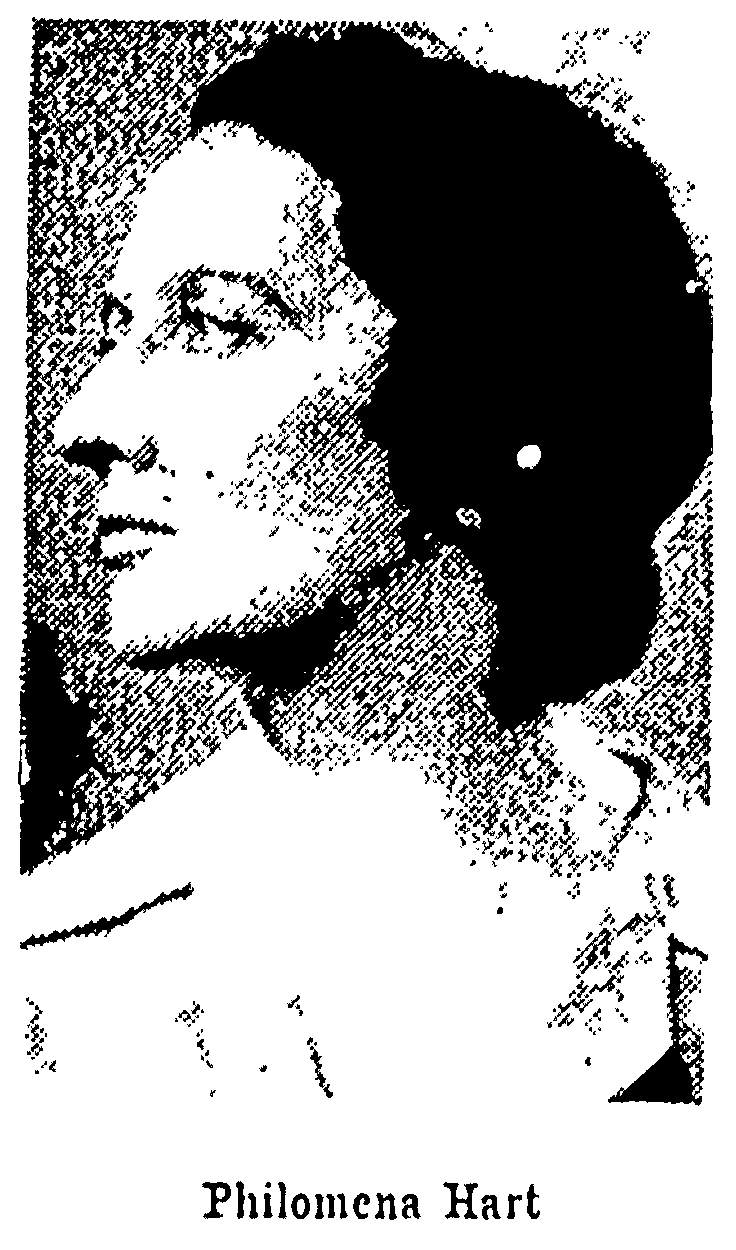
Winfield, do you ever think of Philomena Hart? She used to be so interested in H.P.L. and many’s the letters we exchanged…re: him. I always had the greatest of respect for BOTH the Harts … B.K.H. was HPL’s good friend. (By mail, at least. HPL used to adore BKH’s column.)
—Muriel E. Eddy to Winfield Townley Scott, 23 Sep 1947, Brown Digital Repository
Mary Philomena Hart (née Kelly) (1894-1944), journalist and book reviewer, was the wife of Bertrand K. Hart (1892-1941), who for many years was the literary editor of the Providence Journal. Betrand Hart had a long-running article series titled “The Sideshow,” known colloquially in Providence as “bekes” according to H. P. Lovecraft, because he would sign each article “B. K. H.” Sideshow articles tended to be relaxed, positive, and centered on small affairs local to Providence and Massachusetts (where the Harts made their home).
H.P.L. and B.K.H. became friends by mail. In 1929, “The Sideshow” had a discussion about the weirdest tales, and Lovecraft couldn’t resist writing in. Letters went back and forth, and excerpts from some of them ended up in “The Sideshow”; these are all reproduced in Miscellaneous Letters. Following B.K.H.’s death in 1941, his widow Philomena edited a collection of these columns into book form, published as The Sideshow of B. K. Hart (1941).
She didn’t stop there.
It is the business of the living to keep on living, and so Philomena Hart continued her own column in the Providence Journal. On 9 January 1944, a few months before her own death, she published an article on H. P. L. and B. K. H.:
A Lovecraft Postscript Based on Barnes Street Letters.—The Providence Poe and His Decade of Mail to “The Sideshow”
Of all the fascinating mail which made its way through the years to the desk of “The Sideshow” there was nothing more exciting than the frequent postcards and letters that carried the initials, “H. P. L.” Winfield Scott and I talked at length about them when he was preparing his rewarding paper on Mr. Lovecraft for the Book Page a fortnight ago. They were written in tiny, clear script, their message was always pertinent to something that had appeared in B. K. H.’s column and usually they dealt with the eldritch, the supernatural, the oblique.
Mr. Lovecraft hoped one day to compile an anthology of horror-tales meeting his own exact requirements. “I fight shy,” he wrote in a long letter on the theme, “of tales dependent on a trick ending. Best horror dwells in atmosphere—even in language itself—and not in obviously stage-managed denouments and literary cap-pistol shots.” Once he wrote for B. K. H. a Providence ghost story of such eerie wonder that speaking of it the next morning in the Journal B. K. H. said “Personally I congratulate him up on the dark spirits he has evoked in Thomas Street but I shall not be happy until joining league with wraiths and ghouls I have plumped down at least one large and abiding ghost by way of reprisal upon his own doorstep on Barnes Street. I think I shall teach it to moan in a minor dissonance every morning at three o’clock sharp with a clanking of chains.
* * *
Only a couple of days later came Mr. Lovecraft’s answer to this threat in the form of a sonnet dedicated to B. K. H.
“The Thing, he said, would come that night at three
From the old churchyard on the hill below.
And, crouching by an oak-fire’s wholesome glow
I tried to tell myself it could not be.
Surely, I mused, it was a pleasantry
Devised by one who did not truly know
The Elder Sign bequeathed from long ago
That sets the trailing forms of darkness free.
He had not meant it—no—but still I lit
Another lamp as starry Leo climbed
Out of the Seekonk and a steeple chimed
THREE—and the firelight faded bit by bit—
Then at the door that cautious rattling came
And the mad truth devoured me like a flame.”* * *
It was an oddly enduring friendship, that of B. K. H. and Lovecraft, for they met only through correspondence. There was never through the years even a telephone conversation though they must have often been at shouting distance from one another. Sometimes there would be post-cards nearly every day, occasionally two long arresting letters in one week coming from Barnes Street, then when matters discussed in “The Sideshow” were out of the range of Mr. Lovecraft’s particular interests there would be a spell of silence. Then suddenly some allusion in the column, some provocative line would start the welcome flood in motion again.
B. K. H. always valued Lovecraft highly, always felt that one day our Providence Poe would meet the recognition he so richly deserved. B. K. H. would have been delighted indeed that the present literary editor of the Journal saw fit to devote an article to the personality and the writings of H. P. Lovecraft.
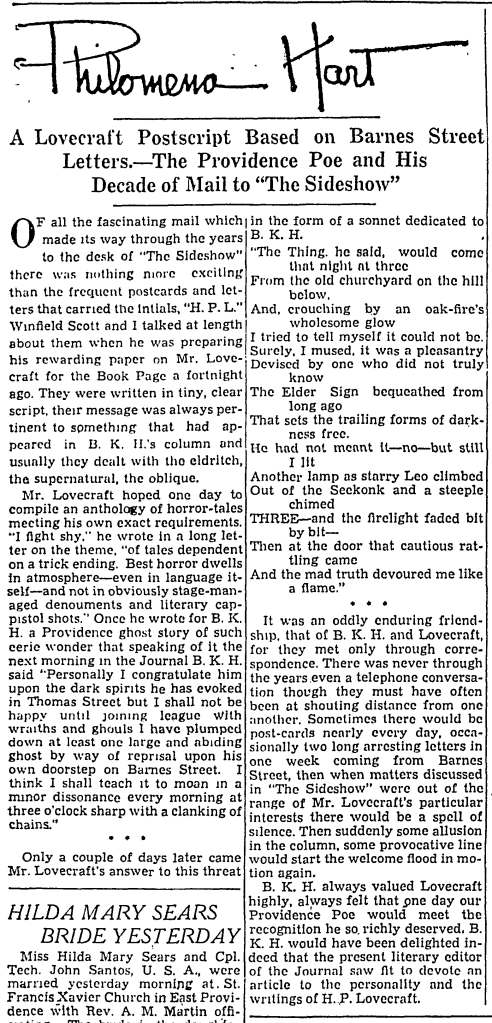
The correspondence did not last a decade; Lovecraft was only at 10 Barnes Street from 1926-1933, when he moved to 66 College Street, and the last “Sideshow” to mention Lovecraft was published in 1931. The excerpts from Lovecraft’s letters, and the poem “The Messenger,” are all borrowed from B. K. H.’s columns.
Winfield Townley Scott, the literary editor of the Providence Journal, had published “The Case of Howard Phillips Lovecraft of Providence, R. I.” on 26 Dec 1943, an extensive review of the first two volumes of Lovecraft’s fiction from Arkham House, The Outsider and Others (1939) and Beyond the Wall of Sleep (1943). Scott would go on to write the first extensive biographical treatment of H.P.L.: “His Own Most Fantastic Creation: Howard Phillips Lovecraft” (1944).
It is always the unexpected that jars loose old memories, and sometimes sets one to sit down and write it out before they are forgotten again. So it seems to have been with Philomena Hart, who recalled happier days when her husband was still alive, and strange letters and postcards would come in the mail to brighten their life.
Bobby Derie is the author of Weird Talers: Essays on Robert E. Howard and Others and Sex and the Cthulhu Mythos.
Deep Cuts in a Lovecraftian Vein uses Amazon Associate links. As an Amazon Associate I earn from qualifying purchases.
 Deep Cuts in a Lovecraftian Vein