“Amb la tècnica de Lovecraft” (1956) by Joan Perucho

The works of H. P. Lovecraft have never entered another language wholesale; they tend to trickle in, translated a story here and a story there, or at best one collection at a time. Tracing the spread and influence of Lovecraft’s work in languages other than English thus becomes doubly tricky. A Spanish translation might have first been published in Barcelona, Mexico City, or Buenos Aires, just as an English edition might be published in New York, London, or Brisbane, and by what paths a copy in one nation might end up in the hands of a reader in another…well, the distribution is ultimately uneven.

According to S. T. Joshi’s H. P. Lovecraft: A Comprehensive Bibliography (2009), Lovecraft began being translated into Spanish in the 1940s, although publication was largely piecemeal until the 1980s (which in Spain, at least, may have been in part due to the Francoist regime), and regional languages like Galician and Catalán have their own publication histories that largely start in the 1980s and 1990s. However, when it comes to the history of Lovecraft in Catalan and Spanish, there is at least one really interesting outlier, which has been largely overlooked in much English-language histories of Mythos fiction.

Joan Perucho Gutiérrez (1920 – 2003) was a noted writer and poet in the Spanish and Catalán languages in Spain, who wrote under the pen-names Joan Perucho (Catalán) and Juan Perucho (Spanish). In 1956 he published his first short fiction, “Amb la tècnica de Lovecraft” (“In the style of Lovecraft”) in the Catalán publication Els Quaderns d’atzavara (“The Agave Notebooks”). Perucho must have been a precocious writer indeed, because Lovecraft was far from a household name in Spain at the time, and this is sometimes credited as Lovecraft’s introduction to Catalán audiences—a claim I cannot verify or deny.

In 1969, Perucho translated “Amb la tècnica de Lovecraft” into Spanish, where it was published in the newspaper La Vanguardia Española (16 Aug 1969, p.9) under the title “Magia Negra” (“Black Magic”), and in the anthology Los Mitos de Cthulhu (Alianza Editorial) under the more well-known title “Con la técnica de Lovecraft” (“In the style of Lovecraft”); the two Spanish versions have some minor differences, particularly in the beginning of the text. Largely because of its inclusion in that important Spanish-language Mythos anthology, Perucho’s story has gained a degree of notability, if not exactly acclaim, and has been republished a few times. However, it has largely gone without comment in English.

The following translation is taken from the “Magia Negra” Spanish version of the piece:

TRADUJO el texto, hace aproximadamente diez años, el poeta José Corredor Matheos, en homenaje a Philip Howard Lovecraft, escritor de «science fiction» que murió perseguido por los seres invisibles. Sólo entonces se supo la verdadera relación de los hechos y que, en un momento impreciso, el automático de la gramola se disparó; hizo un ruidito y lentamente bajó el disco. Hubo uno pausa. Alguna cosa, como una corriente de aire casi imperceptible, fue creciendo en intensidad; entreabrió una puerta y descendió unos escalones que daban a un patio interior; tropezó con algo sólido y opaco, y blasfemó en vox baja; después se dirigió a un pequeño pasadizo, al otro lado del patio, y allí se arremolinó. La música se oía ahora lejana, sorda, filtrada. Era una noche silenciosa y tranquila, de una gran suavidad, con el aromo de la primavera que descendía de los árboles.

La magia de la boca desapareció debajo de las pequeñas placas de la sífilis en los labios y en el paladar. Eran unas luces rojas y verdes, en el interior de las cuales podía verse perfectamente su imagen con un rictus de ironía amarga y de decepción. Ironía nacida de la desesperación y de la muerte, más allá de las cuales, débiles ráfagas de aire descansan en el interior de los vasos abandonados, llenos de ceniza y agua pútrida; o dentro de la caja de resonancia de los pianos «Chassaigne», modelo 1906, esperando la oportunidad del conducto sutilísimo que les una, con unas cuantas palabras no pronunciadas, al oído del caballero momificado o de la dama solitaria. Formas gastadas de vida o de muerte, de nacimiento mecánico en un dolor visceral; de vómitos que se suceden implacables (o que por lo menos atormentan con la angustia del espasmo que ha de venir y que siempre, siempre desemboca en una suerte de abismo, y en el sudor, y en los cabellos enganchados) y de pequeñas crisis de histeria, y de dientes que se carían y que la lengua percibe voluminosos y febricitantes.

No era esto. Sólo la quemadura gélida de un «thoulú», uno di aquellos seres informes y terribles que ya había descrito minuciosamente en el siglo XII el árabe Al-Buruyu en su tratado «Los que vigilan». La evidencia de las cosas surgía de improviso con mil y una significaciones aterradoras y alusivas. No había fuerza humana capaz de conjurar lo inevitable, de alejar el dogal que ceñiría al elegido, el cual, por un impulso misterioso, sería arrastrado al sacrificio, al aniquilamiento de lo propia personalidad, y se convertiría en algo horrible y sin nombre. Abominable concepción ésta, fruto de las nupcias del cielo y del infierno. No era otra cosa lo aparición de señales en todas las habitaciones de la casa, y aquellos restos de cuerpos extraños, hallados en el patio una mañana, y que se volatilizaron misteriosamente una hora después. El magisterio de Al-Buruyu se presentaba como una fuerza maléfica, anticipándose a los siglos; como un ojo impasible y escrutador; y con una voz caligráfica y cabalística que iba avanzando como una risa en la noche, sobre la nieve surcada de pisadas deformes y con alaridos alucinantes cerca de las rejas de los manicomios.

Se oyó la bocina de un automóvil. La presencia, inquieta, se distendió. Murmuró unos sonidos ininteligibles y se insinuó —leve fosforescencia apenas— en el fondo del pasadizo, entre inmundicia y botellas de licor vacías. Se encendió una luz en una ventana vecina y poco después se apagó. La primavera respiraba afuera.

El tiempo se acumulaba en el cerebro y en la sangre en pliegues suavísimos y turbadores, en los cuales se percibía la claridad solar. Había cortezas y una materia rugosa, resquebrajada por surcos sin dirección precisa, que parecía calcinada por un contacto satánico o sordamente enfurecido. O bien una superficie enharinada con polvos de arroz, debajo de la cual, latían, vívidas y sensibles, amplias llagas supuradoras, como bocas martirizadas y ocultas, como flores monstruosas y sonámbulas que súbitamente se agrandaban inflándose, tensando su estructura íntima hacia un delirio febril. Era demasiado tarde para el antídoto: la invertida esvástica de plata, que traería ecos de los cantos litúrgicos hasta la huida de la estepa y la venida de la savia vivificadora. El vuelo de las hojas era un vuelo de bronces, enlutado y solemne, sobre una tierra árida y espectral. Apenas se podío entrever, con un supremo esfuerzo, la risa de un niño vestido de marinero, medio nublada por el dolor; o la triste tenacidad del hombre que medita hasta altas horas de la madrugada, y que se veía ahora bajo el peso de una lágrima; o la inútil trenza perfumada, aire de una mirada que alimentaba el deseo. La carne había comenzado a corromperse, todavía con la presencia de la vida, y exhalaba una pestilencia indefinible que lo impregnaba todo. Lentamente se inició el éxodo, e incluso la araña huyó, con su perezosa pero terrible seguridad, abandonando el refugio de su vida feliz. Entreveía lecturas de íncubos y súcubos, formulas mágicas dé la muerte y del diablo, traspasando todo vestigio de razón, viéndose hojear la «Dissertation sur les apparitions des anges, des demons et des esprits et sur les revenants et vampirs», del monje Calmet, que ponía en evidencia la realidad de la fría certeza de Al-Buruyu. Ya Angela Foligno había revelado al comentarista que al principio «non est in me membrum quod non sit percussum, tortum, et pœnatum a dœmonius, et semper sum infírma, et semper stupefacta, et plena doloríbus in omnibus membris vivís». Existía también un flotar sobre la realidad, un ir a la deriva a través de paisajes inexistentes, de algas mortecinas que se crispaban airadas y amenazadoras al contacto más leve, y manubrios que giraban vertiginosamente dentro del cráneo, con un alboroto insufrible de timbres y altavoces disporados, para desaparecer después en un angustioso silencio de tumba.

Se alisó el cabello con la mano, despacio y maquinalmente. Bebía con delectación y a pequeños sorbos una copa de auténtico «scotch» Forrester, y se encontraba seguramente a diez millas de la costa y con una tempestad de todos los diablos. Una muchacha rió, con la risa provocadora di Jane Rusell, y se aproximó desde la barra. Llevaba la boca pintada de un rojo intenso, color de sangre de buey, y un jersey que le ceñía apretadamente el busto. Le hizo una caricia en la mejilla y le murmuró algo afectuoso, mientras rozaba con su cara la de él. Había una atmósfera densa y enturbiada por el humo del tabaco, y algunos invitados se habían quitado la chaqueta. Otra muchacha, que movía las ancas como una estrella de Hollywood, cantaba con éxtasis lánguido y sensual que se adhería a la piel.

Creía que no lo volvería a ver. De pronto se le ocurrió ponerse a reír delante de aquel niño vestido de marinero, pasado de moda y ridiculo. Lo relacionó con muchas otras cosas, como el banderín de un club de hockey clavado en alguna pared, una desteñida fotografía que fijaba unos rostros ausentes en una lejana excursión a Bañólas, un día de mucho frío; o en un pequeño bar del Paseo de Gracia, mucho tiempo después, cuando ella ya preparaba el equipo de novia y le regalaba corbatas el día de su santo.

La cantante agradeció los aplausos con una sonrisa. Ahora la gente intentaba bailar, excepto un grupito que bebía y conversaba con el camarero y con la muchacha, que ya había concluido su número. Había una media luz, sucia y gastada.

Penetrado por las sombras, detrás del gran monumento a Napoleón, detrás de las campanas de los tranvías, bajo los burdeles de todas las ciudades del mundo, en el último momento lúcido, necesitaba ahora buscar la luz, engañar a la presencia, acercarla si era preciso, de la manera que fuese, a la luz limpia y purificadora, a la luz que a veces rasgaba las tinieblas. Debía haber luz en algún sitio. Así se lo parecía a él.

Muy lejos, seguramente a diez millas de distancia, alguien o algo reptaba por la alfombra. Dejó atrás las dos butacas y se incorporó poco a poco. Era como un babear o como un ruido inconfesable. Se hizo una claridad lívida. Como una alucinación de Lovecraft.


Juan PERUCHO
I TRANSLATED the text, about ten years ago by the poet José Corredor Matheos, in homage to Philip Howard Lovecraft, a science fiction writer who died persecuted by invisible beings. Only then did the true story become known, and that at an imprecise moment, the jukebox automatically triggered; it made a little noise and slowly lowered the record. There was a pause. Something, like an almost imperceptible current of air, grew in intensity; it half-opened a door and went down some steps that led to an inner courtyard; it stumbled against something solid and opaque, and cursed in a low voice; then it went to a small passageway on the other side of the courtyard, and swirled there. The music now sounded distant, muffled, filtered. It was a night silent and calm, of great softness, with the aroma of spring descending from the trees.

The magic of the mouth disappeared beneath the small syphilis plaques on the lips and palate. They were red and green lights, inside which one could perfectly see his image with a rictus of bitter irony and disappointment. Irony born of despair and death, beyond which, weak gusts of air rest inside abandoned glasses, full of ashes and putrid water; or inside the sound box of the “Chassaigne” pianos, model 1906, waiting for the opportunity of the subtlest conduit that would unite them, with a few unspoken words, to the ear of the mummified knight or the lonely lady. Worn-out forms of life or death, of mechanical birth in visceral pain; of vomiting that follows one another relentlessly (or that at least torments with the anguish of the spasm that is to come and that always, always ends in a kind of abyss, and in sweat, and in tangled hair) and of small hysterical crises, and of cavities in teeth that the tongue perceives as voluminous and feverish.

It was not this. Only the icy burn of a “thoulú”, one of those formless and terrible beings that the Arab Al-Buruyu had already described in detail in the 12th century in his treatise “Those Who Watch”. The evidence of things emerged suddenly with a thousand and one terrifying and allusive meanings. There was no human force capable of adjuring the inevitable, of removing the noose that would bind the chosen one, who, by a mysterious impulse, would be dragged to sacrifice, to the annihilation of his own personality, and would become something horrible and nameless. Abominable conception this, fruit of the marriage of heaven and hell. It was nothing else than the appearance of signs in all the rooms of the house, and those remains of strange bodies, found in the courtyard one morning, and which mysteriously vanished an hour later. The teaching of Al-Buruyu presented itself as an evil force, anticipating the centuries; like an impassive and scrutinizing eye; and with a calligraphic and cabalistic voice that advanced like a laugh in the night, on the snow furrowed with deformed footprints and with hallucinatory screams near the bars of the asylums.

The sound of a car horn honked. The presence, uneasy, became relaxed. It murmured some unintelligible sounds and insinuated itself—barely a faint phosphorescence—at the end of the passage, among filth and empty liquor bottles. A light came on in a neighboring window and shortly after went out. Spring was breathing outside.

Time accumulated in the brain and blood in soft and disturbing folds, in which the light of the sun could be perceived. There were crusts and rough matter, cracked by furrows without a precise direction, which seemed calcined by a satanic or dully enraged contact. Or a surface floured with rice powder, beneath which, vivid and sensitive, wide suppurating sores throbbed, like martyred and hidden mouths, like monstrous and somnambulistic flowers that suddenly enlarged and inflated, straining their intimate structure towards a feverish delirium. It was too late for the antidote: the inverted silver swastika, which would bring echoes of liturgical chants until the flight from the steppe and the coming of the life-giving sap. The flight of the leaves was a flight of bronze, mournful and solemn, over an arid and spectral land. It was only with a supreme effort that one could make out the laughter of a child dressed as a sailor, half clouded by pain; or the sad tenacity of the man who meditates until the early hours of the morning, and who now saw himself under the weight of a tear; or the useless perfumed braid, the air of a look that fed desire. The flesh had begun to rot, still with the presence of life, and exhaled an indefinable stench that permeated everything. Slowly the exodus began, and even the spider fled, with its lazy but terrible security, abandoning the refuge of its happy life. He glimpsed readings of incubi and succubi, magical formulas of death and the devil, transcending all vestiges of reason, seeing himself leafing through the “Dissertation sur les apparitions des anges, des demons et des esprits et sur les revenants et vampirs” [1], by the monk Calmet, which highlighted the reality of the cold certainty of Al-Buruyu. Angela Foligno had already revealed to the commentator that at the beginning “non est in me membrum quod non sit percussum, tortum, et pœnatum a dœmonius, et semper sum infírma, et semper stupefacta, et plena doloríbus in omnibus membris vivís.” [2] There was also a floating above reality, a drifting through non-existent landscapes, through dying algae that twitched angrily and threateningly at the slightest touch, and handlebars that turned vertiginously inside the skull, with an unbearable uproar of ringing bells and loudspeakers, to then disappear in an agonizing silence of the grave.

He smoothed his hair slowly and mechanically. He sipped a glass of genuine Forrester scotch with delight and in small sips, and was probably ten miles from the coast and in a hell of a storm. A girl laughed, the provocative laugh of Jane Russell, and came over from the bar. Her mouth was painted a deep red, the color of oxblood, and her sweater cinched tight around her bust. She caressed his cheek and murmured something affectionate as she brushed her face against his. The air was thick and clouded with tobacco smoke, and some of the guests had taken off their jackets. Another girl, who moved her haunches like a Hollywood star, sang with a languid, sensual ecstasy that clung to the skin.

He thought he would never see her again. Suddenly it occurred to him to laugh in front of that boy dressed as a sailor, old-fashioned and ridiculous. He connected it to many other things, like the pennant of a hockey club nailed to a wall, a faded photograph that showed some absent faces on a distant excursion to Bañólas, one very cold day; or in a small bar in Paseo de Gracia, long after, when she was already preparing her bridal outfit and giving him ties on his saint’s day.

The singer acknowledged the applause with a smile. Now people were trying to dance, except for a small group that was drinking and talking with the waiter and the girl, who had already finished her number. There was a half-light, dirty and worn.

Penetrated by the shadows, behind the great monument to Napoleon, behind the bells of the trams, beneath the brothels of all the cities of the world, in his last lucid moment, he now needed to seek the light, to deceive the presence, to bring it closer if necessary, in whatever way, to the clean and purifying light, to the light that sometimes pierced the darkness. There had to be light somewhere. It seemed so to him.

Far away, surely ten miles away, someone or something was crawling across the carpet. He left the two armchairs behind and slowly sat up. It was like drooling or an unutterable noise. It became a livid clarity. Like an hallucination of Lovecraft.

[1] French: “Dissertation on the apparitions of angels, demons and spirits, and on ghosts and vampires”
[2] Latin: “There is not a member in me that is not struck, twisted, and punished by the devil, and I am always sick, and always astonished, and full of pains in all my living members.”

Juan PERUCHO
Transcribed from La Vanguardia Española (16 Aug 1969, p.9) English translation

“Magia Negra” / “Con la técnica de Lovecraft” is more of a prose poem than a short story; a collection of images and ideas meant to invoke the mood and style of Lovecraft more than a pastiche like “Celui qui suscitait l’effroi…” (1958) by Jacques Janus. It isn’t clear what exactly Perucho had read of Lovecraft at this point, but several themes are and ideas are evocative of Lovecraft’s Mythos tales without being direct references to any specific story.

We have a strange Arab author (“Al-Buruyu” instead of Abdul Alhazred), and his mysterious book (Those Who Watch, rather than the more familiar Necronomicon). There is no Cthulhu but there are the strange and formless “thoulú.” Was this deliberate, mangling things like Howard Phillips Lovecraft’s name for effect, or the result of a botched translation from English into another language? I suspect the cumulative differences represent Perucho’s innovation and playing of the Mythos game, mixing fact and fiction. Which is very Lovecraftian.

The work remains a liminal entry, a Catalán introduction to an English-language author that was later translated into Spanish for a wider audience, even as Lovecraft himself began to enjoy wider translation in Spanish-language markets. It is easy to see how it might have frustrated early readers of Los Mitos de Cthulhu (1969); it doesn’t fit neatly into the Mythos like many early pastiches. The very ambiguity gives it character, however; so few early efforts to write in Lovecraft’s style try to capture the essence. While I don’t think Perucho really nailed it—like the pasticheurs, he tends to focus on the more obvious elements—it’s an interesting experiment, and strikes an interesting contrast with some of the other Lovecraft-inspired works in the 1950s and 60s.

Thanks to Mariano Villarreal ( literfan@yahoo.es ) for his help and assistance; all the errors in the translation are mine.


Bobby Derie is the author of Weird Talers: Essays on Robert E. Howard and Others and Sex and the Cthulhu Mythos.

Deep Cuts in a Lovecraftian Vein uses Amazon Associate links. As an Amazon Associate I earn from qualifying purchases.
“Message in Stone” (1956) by Muriel E. Eddy

His funeral was held at High Noon at a funeral home, and, though the little gods of fate seemed to will that we should arrive there too late for the services, we did visit Swan Point Cemetery, with its many tombs, winding lanes and exquisite monuments—and did I imagine it, or did the spirit of our late beloved friend and fellow-writer hover over us as we bowed our heads in reverence and respect to the memory of one of the finest men—yes, and greatest geniuses, who ever walked this earth? A man little-known, perhaps, by the majority, but a man who, to those who came in more than casual contact with him, exemplified all that is fine and good in a fellow human being.
Muriel E. Eddy, “Howard Phillips Lovecraft” in Rhode Island on Lovecraft (1945) 21-22

From the very first, Muriel E. Eddy’s memoirs of H. P. Lovecraft were fairly rose-tinted—and, occasionally, given to flights of imaginative fantasy like the above. The Eddys did not make it on time to Lovecraft’s funeral; such things happen, but they did apparently visit his grave periodically. Lovecraft’s grave, initially unmarked, was not the point of pilgrimage for fans and admirers that it is today; but he had long known and expected this to be the resting place for his mortal remains, in the family plot, and it is clear from Lovecraft’s letters to the Eddys that they were well aware of that.

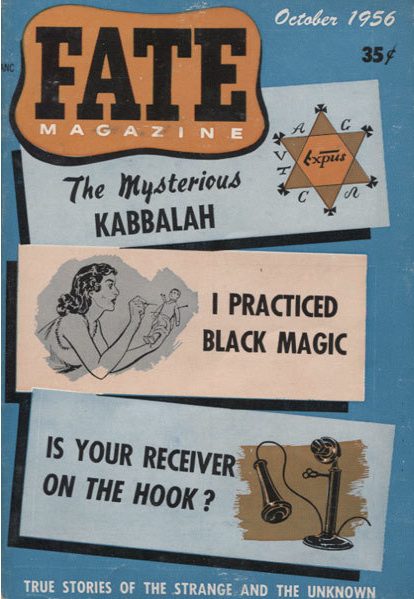
H. P. Lovecraft was an atheist and materialist; he had no expectations for survival of consciousness after death. His afterlife, as it is, lay in the publication of his work, the memories of his friends, and increasingly his appearance as a fictionalized character in various works. Muriel E. Eddy was, apparently, not a materialist, and was at least open to the idea of ghosts or consciousness that survived after death. At least, she was willing to write about it for Fate Magazine, which offered $5 for tales of evidence of existence after death. This was not exactly new territory for Muriel, who had sold a “psychic experience” to The Occult Digest in 1939. So it was that in the October 1956 issue of Fate, “Message in Stone” appeared.


Message in Stone

We were greatly saddened when Howard Phillips Lovecraft, the famous Rhode Island writer of weird and uncanny tales of the unknown, died in March, 1937. Mr. Lovecraft had been a friend of the family for years. He often had brought his weird writings, still in manuscript form, to our house, reading them aloud in his sepulchral voice and awaiting our approval or disapproval. He considered the Eddy family “good critics.” I still can see him, sitting in our humble abode and reading his famous horror tale, “The Rats in the Walls,” which has been reprinted frequently since his untimely demise.

We often discussed the mystery of death and one night Lovecraft expressed the opinion that the human brain was practically indestructible. He believed that, whether or not his body was embalmed, his brain would continue to function. He said that if his brain continued to “work,” as he believed it would after death, he would send a message in some material form that we could understand.

At that time he was in excellent health and death seemed distant. However, shortly afterward Howard Phillips Lovecraft suddenly became seriously I’ll and died in Jane Brown Hospital in Providence, R.I., in March, 1937. He was only 47 years old.

After the funeral I often visited his grave and placed floral offerings there. The grave is in Swan Point Cemetery and is marked by a tall granite shaft.

One night in September, 1937, I had a very vivid dream about Howard Phillips Lovecraft. In my dream I visited his grave, now covered thickly with grass, and was on my knees, parting the grass as I hunted for something.

My dreams haunted me and early the next day, a Sunday, I drove out to the cemetery. I felt driven by an invisible force.

As I stood beside Lovecraft’s grave, I seemed to hear his sepulchral voice again, intoning the words, “If my theory is correct, if my brain continues to function after my death, I will send you a message in some material form that you can understand.”

My eyes scanned the grass on the burial plot, still wet with dew, and then I glimpsed something white shining on Lovecraft’s grave. Stooping, I parted the heavy growth with my hands and picked up a heart-shaped stone, as smooth as satin and about two inches across. It was milky white and looked oddly like a quarried stone of the translucent variety. I recalled that Lovecraft’s grandparents, long dead, had owned a stone quarry in East Providence.

How the stone happened to be lying on Lovecraft’s grave may be only a matter of conjecture. However, he had known that I collected odd-shaped natural specimens, such as unusual shells, odd bits of wood and minerals, especially stones and rocks of unusual formation.

I could find no stone in the cemetery that resembled even remotely the one I found on Lovecraft’s grave. —Providence, R. I.

[Fate Magazine (Oct 1956), 103-105


Some of the details in the piece are correct, others likely honest mistakes. The description of the grave is accurate; at the time, there was no individual marker for HPL, only the granite shaft for the family plot. Lovecraft was 46 at the time of his death, but if Muriel E. Eddy was counting by year, it’s an easy mistake to make. The Phillips did not own a quarry in Providence, but they owned a small mortgage on such a quarry, and in Lovecraft’s letters he talks about sometimes getting mineral samples from there for his friend James F. Morton, who was curator of a museum of geology in New Jersey.

As for the more imaginative part of the Fate piece—there is no account in Lovecraft’s letters or other memories of him hoping for the functioning of his brain after death. However, it is notable that several of his stories for Hazel Heald, notably “Out of the Æons” (1935) and “The Horror in the Burying-Ground” (1937) both deal with a kind of living death, with the mind functioning in a paralyzed or petrified body. Muriel E. Eddy claims to have introduced Heald to Lovecraft, and Heald features prominently in Eddy’s later memoirs, so possibly she remembered either the stories or Lovecraft writing or talking about the stories.

Another likely influence on “Message in Stone” is the magician Houdini, whom both Lovecraft and her husband C. M. Eddy, Jr. had worked with:

I remember Mr. Eddy’s painstaking revision of Houdini’s “Thoughts and Feelings of a Head Cut Off”….an experience which the master magician had undergone in his youth. Harry Houdini said in his story that somewhere in his travels he came across an ancient supersitition that if a head was severed quickly and unexpectedly from a body, the brain in the head kept on thinking for several seconds! […]

I am quite sure this story was never offered for sale by Harry Houdini, as it lacked the ring of veracity . . . perhaps it was somewhat exaggerated! When we told H.P.L. about it, he exclaimed, “Oh, what I could have done with that story, but perhaps Houdini wouldn’t have liked it if I’d changed it too much. I took a lot of liberties with his ‘Pharaoh’ story and he seemed satisfied, but this one!” And a far-away look was in his eyes. . . .

Later on, were were discussing the possibility of the truth of a brain functioning after death, and Lovecraft averred that perhaps the brain did function . . . for a few minutes after the death of one’s body. It was a weird subject, and there I ended! I sometimes wondered what Lovecraft’s true feelings regarding this matter really were. […]

My husband spent some time investigating Spiritualism at Lake Pleasant, Massachusetts, for Harry Houdini, and when he returned home with much data about some of the mediums he’d met, Lovecraft came over to see us and seemed much interested in the subject. He scoffed at the idea of communion with the dead, and said that, in his opinion, death was the absolute end.
—Muriel E. Eddy, “A Gentleman from Angell Street” (1961) in A Gentleman from Angell Street 20-21

The Harry Houdini Circumstantial Evidence blog relates a possible manuscript related to this story, titled “Thoughts and Visions of a Head Cut Off.” Houdini is an important connection as well because of a tradition that began after his death; his wife Bess began to hold séances annually on Hallowe’en, in an attempt to contact her husband’s spirit. Muriel was aware of this:

By the way, Houdini’s last desire was that on every Hallowe’en his resting-place should be visited by friends to see if his (Harry Houdini’s) ghost appeared. . . . he made light of ghosts and Spiritualism, you jnow. As Lovecraft was a “ghost-writer” also for Harry Houdini . . . . . . well! Mrs. Harry Houdini . . . and Harry’s brother Hardeen . . . have joined the ranks of every human’s ultimate glory . . . . could not supervise the weird visition at Houdini’s grave this Hallowe’en. I supose that trek will now be abandoned . . . . Houdini proved his own point . . . he STAYED dead! Somtimes, in a joking mood, Lovecraft used to say that . . . . . PERHAPS . . . . the human brain NEVER stopped functioning . . . . . even after death. A weird thought, and, visiting H. P. L.’s grave one day recently . . . . . your friends the Eddys . . wondered . . . just vaguely. But OF COURSE H.P.L. was just joking!
—Muriel E. Eddy to Winfield Townley Scott, 2 Nov 1945, MSS. Brown Digital Repository

Muriel’s information was a little out of date; while Bess Houdini died in 1943 and Theodore Hardeen in 1945, Bess had passed the séance tradition on to Walter B. Gibson in 1936, who in turn would ask Doroth Dietrich to carry on the tradition, which is still ongoing.

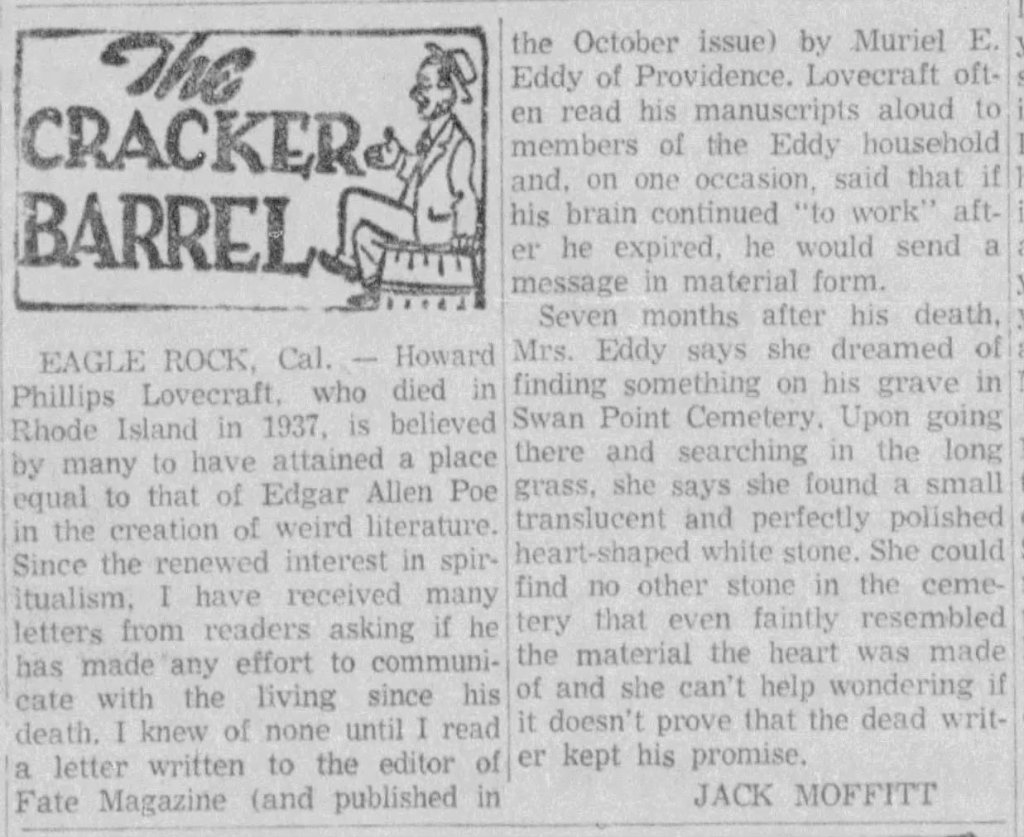
Something said in jest would definitely be more in keeping with what we know about Lovecraft, and of course Muriel E. Eddy would have had to play up the belief in his posthumous existence to get published in FATE Magazine. Her account, minor enough as it is, caught the attention of at least one journalist, who distilled it for a fluff piece to fill a few column inches:

The Register, Santa Ana, CA, 11 Oct 1956, p50
This item was reprinted in other papers as well.

“Message in Stone” was never republished, and the whole incident is largely ignored in Muriel E. Eddy’s most well-known memories. Yet in H.P.L.: The Man and The Image (1969), she ends a rambling collection of memories with the note:

On one of my visits to H.P.L.’s grave, I found a heart-shaped stone. I wondered if he had seen it there, what type of storey might have been concocted by his fertile brain.


Bobby Derie is the author of  Weird Talers: Essays on Robert E. Howard and Others  and  Sex and the Cthulhu Mythos .

Deep Cuts in a Lovecraftian Vein uses Amazon Associate links. As an Amazon Associate I earn from qualifying purchases.

“The Rats in the Walls” (1956) by H. P. Lovecraft

Racist Language

The following article deals explicitly with racist language in a historical context. Frank discussion of these matters requires the reproduction of at least some samples of these pejoratives. As such, please be advised before reading further.


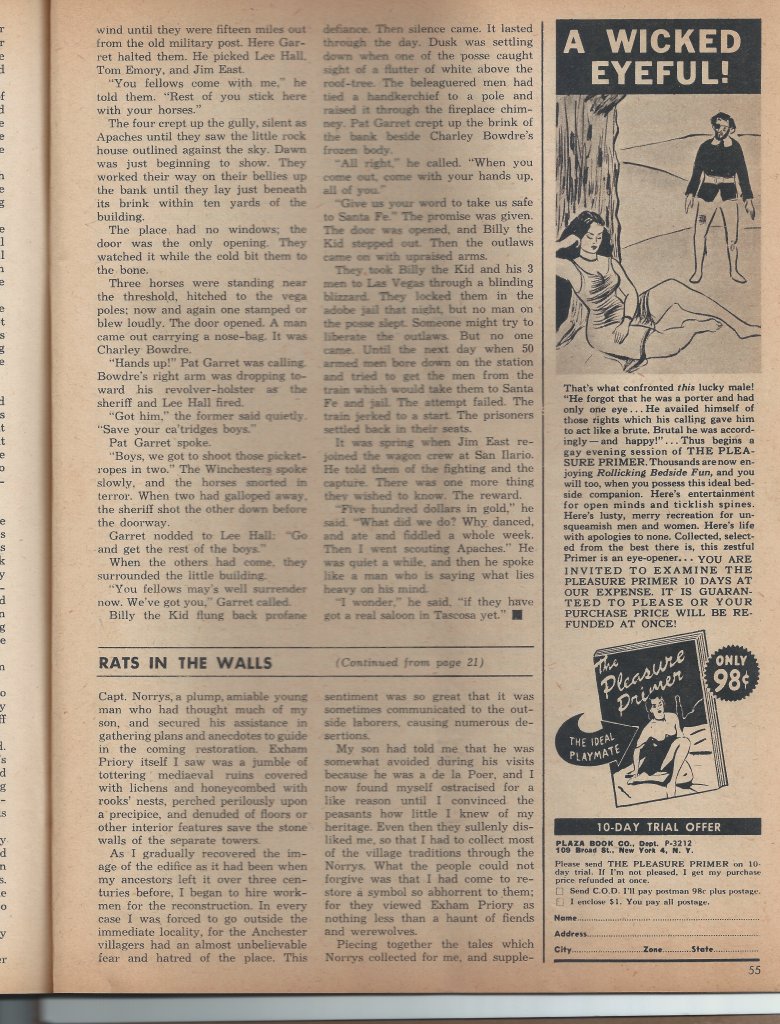
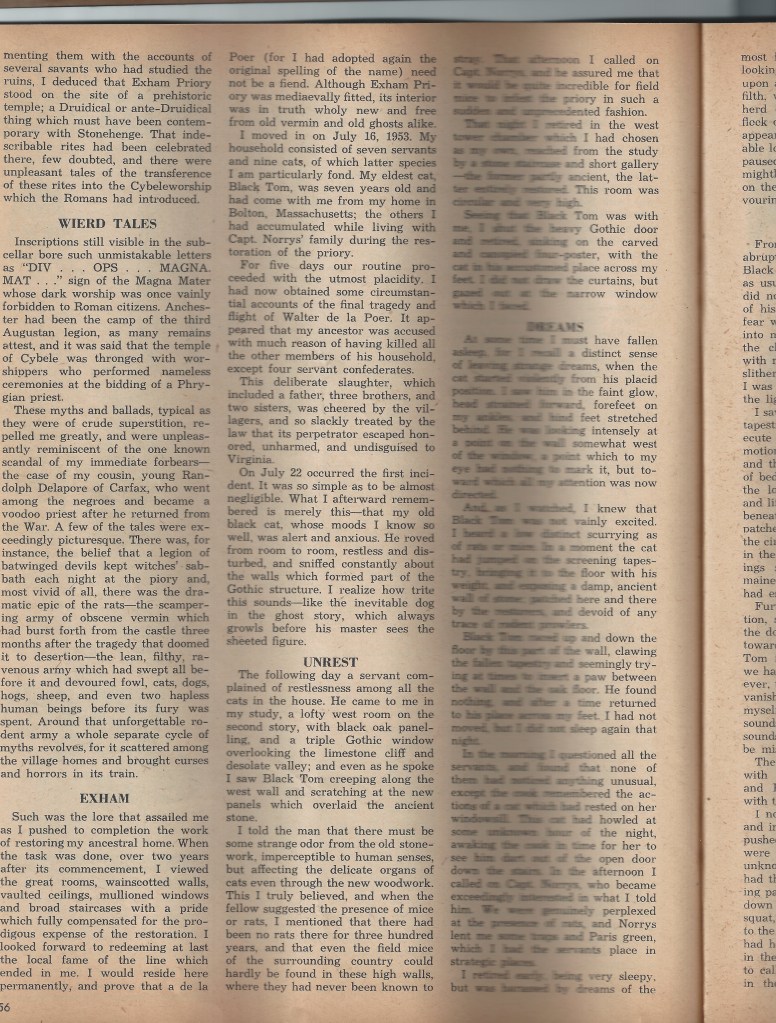
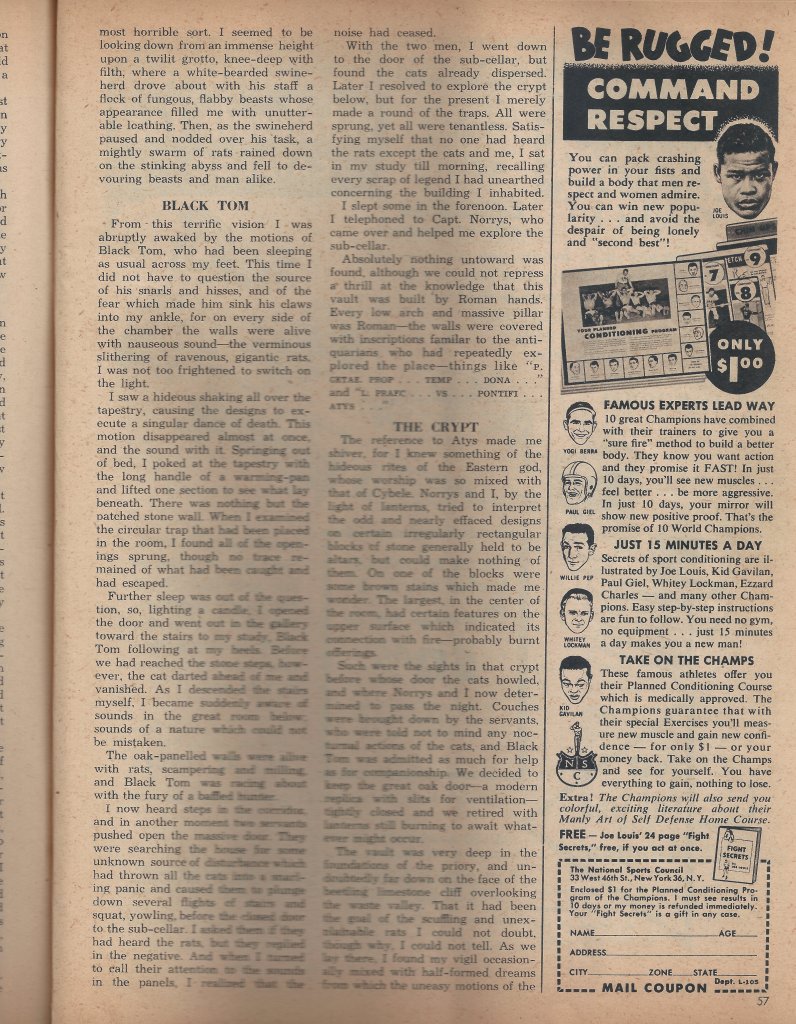
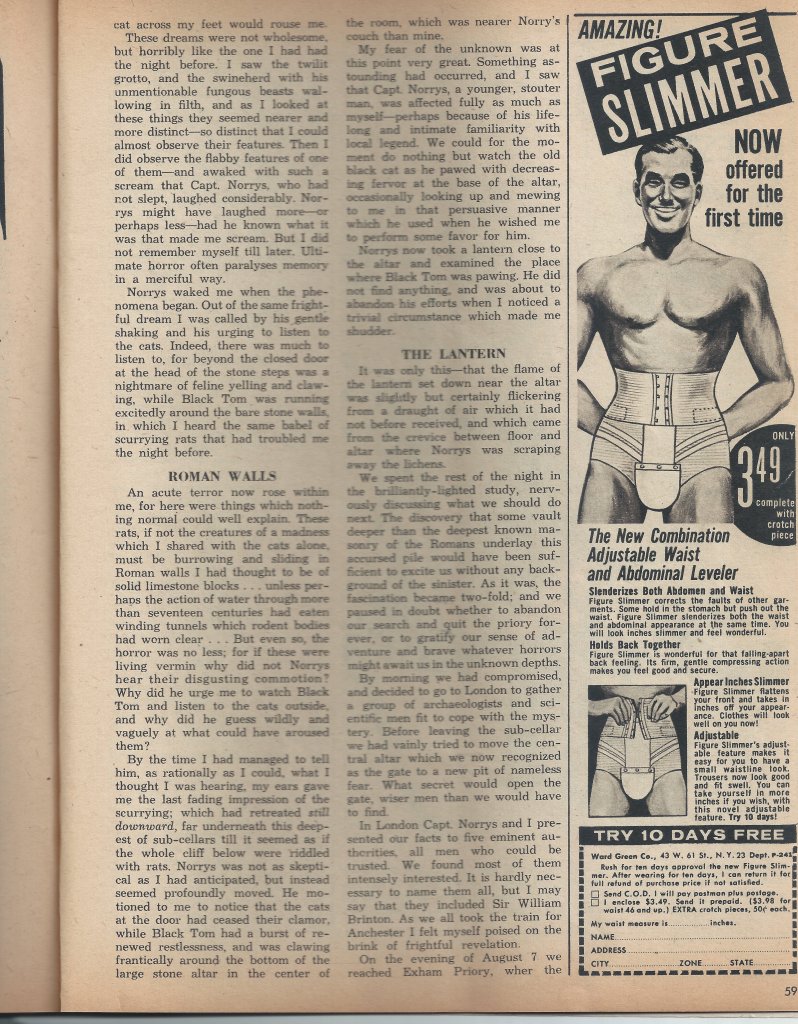
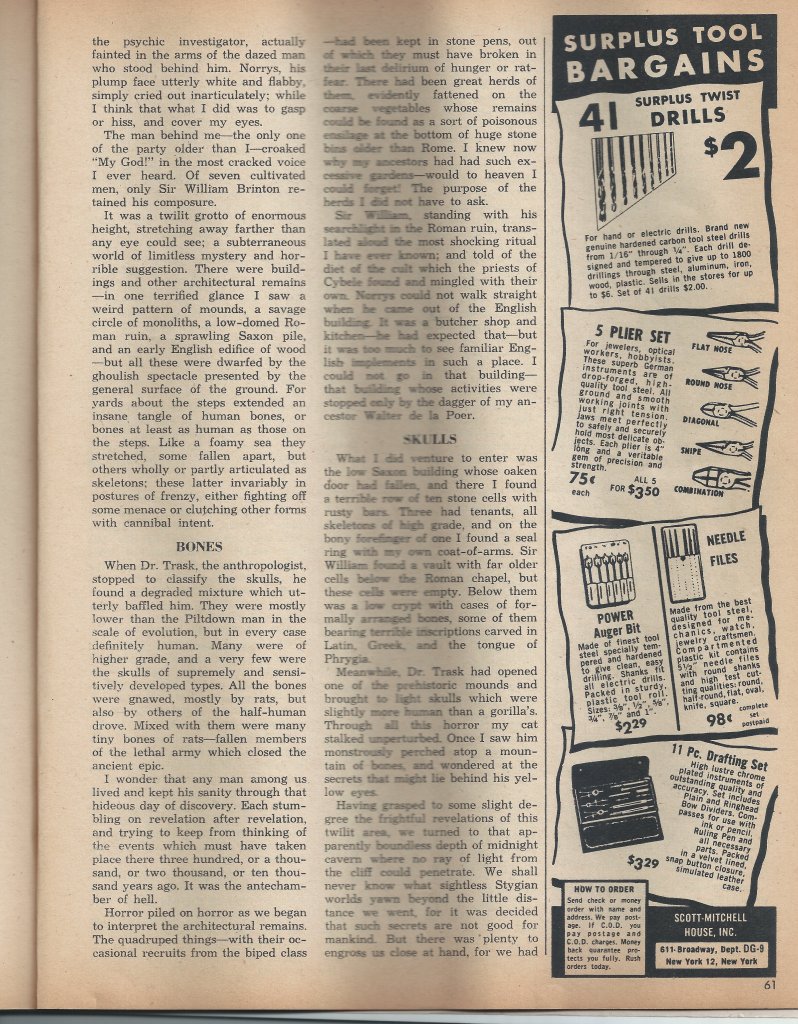
As I have said, I moved in on July 16, 1923. My household consisted of seven servants and nine cats, of which latter species I am particularly fond. My eldest cat, “Nigger-Man”, was seven years old and had come with me from my home in Bolton, Massachusetts; the others I had accumulated whilst living with Capt. Norrys’ family during the restoration of the priory. I moved in on July 16, 1953. My household consisted of seven servants and nine cats, of which latter species I am particularly fond. My eldest cat, Black Tom, was seven years old and had come with me from my home in Bolton, Massachusetts; the others I had accumulated while living with Capt Norrys’ family during the restoration of the priory.
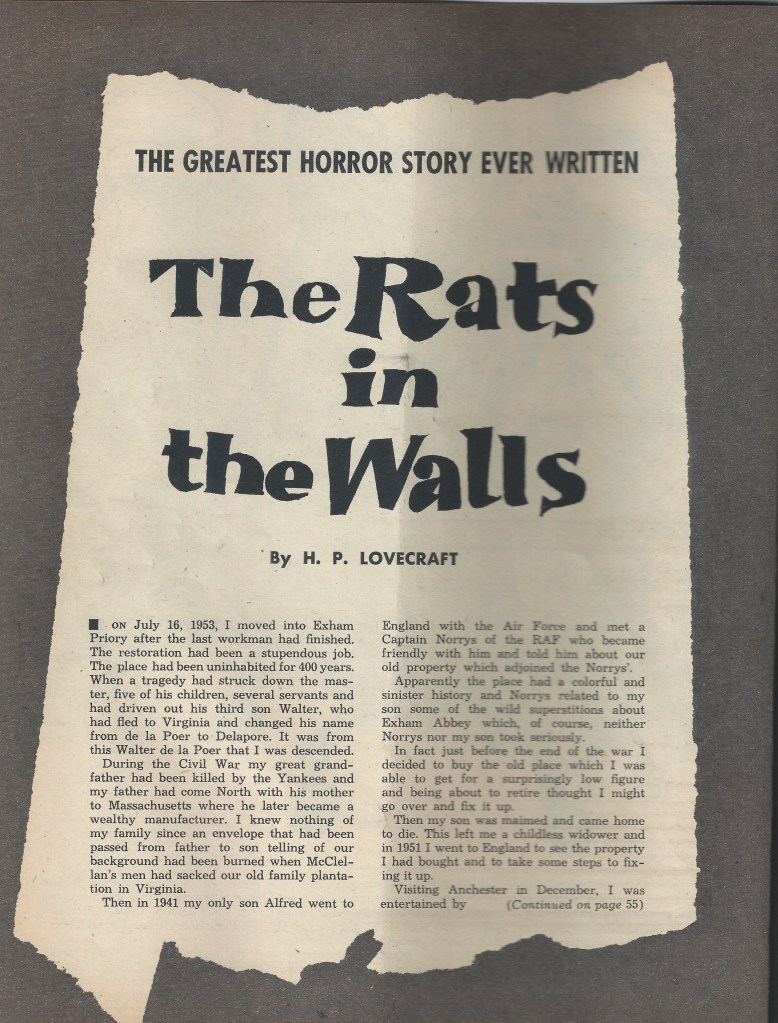
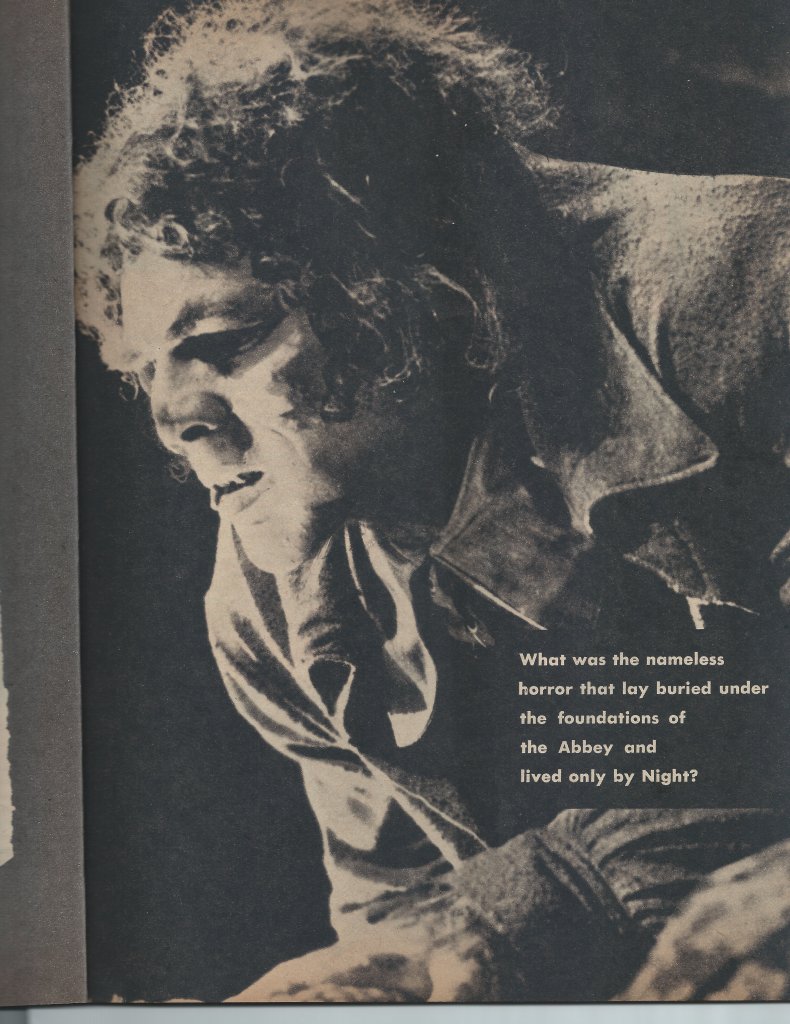
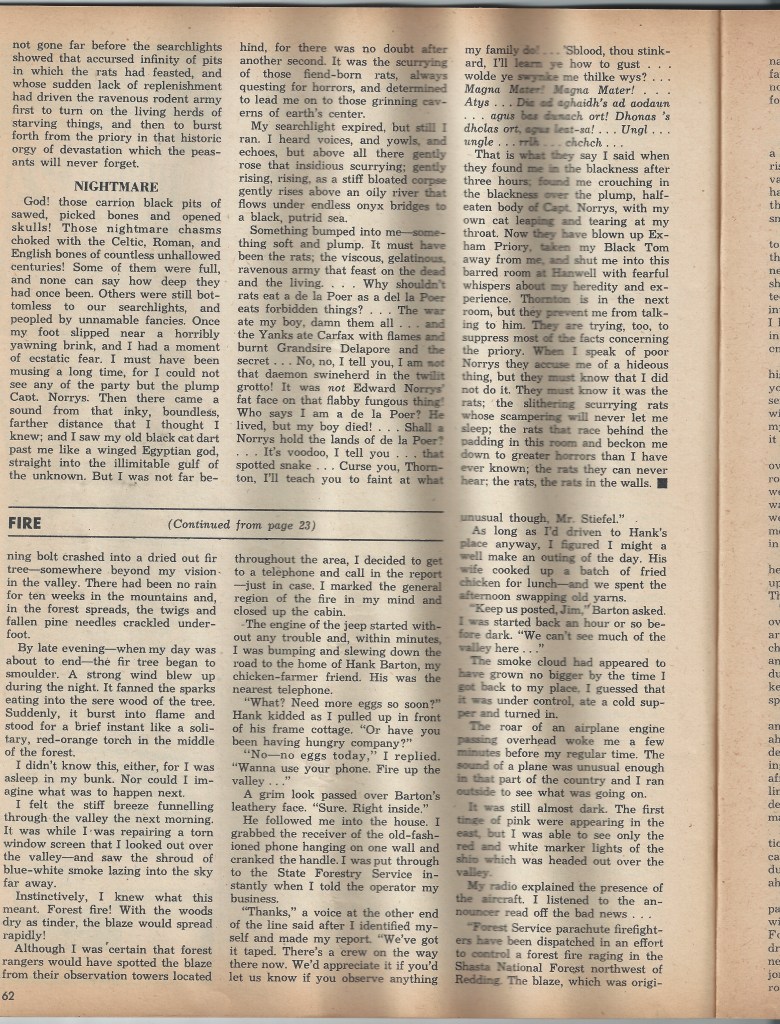
“The Rats in the Walls” (Weird Tales Mar 1924)“The Rats in the Walls” (Zest Jan 1956)

In January 1956, the premiere issue of Zest: The Magazine for Men debuted on the newsstands of the United States. Zest was one of a crowd of men’s magazines, from the upscale Playboy (which featured nude photographs of women) to men’s adventure pulps like Cavalier and Swank. Weird fiction in these magazines wasn’t unknown; Playboy had reprinted William Hope Hodgson’s “The Voice in the Night” in the July 1954 issue. The point of such magazines was not just titillation, but adult entertainment of a broad, masculine stripe—everything from frank articles about sex to lurid tales of escapes from Nazi death camps, real and imagined.

In that context, the decision of a new men’s magazine with a broadly scattershot tabloid approach to content reprinting an H. P. Lovecraft story isn’t necessarily that odd. “The Rats in the Walls” was broadcast on the cover as “The greatest horror story ever told!” and the copyright notice was to H. P. Lovecraft—by then dead almost 19 years, and with August Derleth and Arkham House acting in de facto control of the estate. Presumably, Derleth would have been happy to let them reprint the story for a modest fee.

What sets the 1956 version of “The Rats in the Walls” apart, however, is not the simple fact of its publication but the editorial changes that went along with it. The story was initially set in 1923, the year it was written, and features as background the Great War. In the Zest version, the setting is shifted to 1953, post-World War II. The story was also abridged, jettisoning some of Lovecraft’s verbiage, taking a hatchet to his paragraphs so that they would more easily fit in the three-column magazine format, and perhaps most notably, changing the name of the cat from “Nigger-Man” to “Black Tom.”

For all that Lovecraft has a reputation as a racist, much of that reputation is based on his private letters rather than his published fiction. Lovecraft used the word “nigger” just 31 times in five stories—”The Rats in the Walls” (19), “Medusa’s Coil” (6), “Winged Death” (3), “Through the Gates of the Silver Key” (2), and “The Picture in the House” (1)—although he occasionally used other similar terms (“Nig” for the black cat in The Case of Charles Dexter Ward, “darky” and “darkies” once each in “Medusa’s Coil,” etc.). More important than how often or not Lovecraft used these terms was why and how he used them; in many instances, the terms are used by racist characters, and we know they’re racist because they use those terms; the use of pejoratives was a way for Lovecraft to establish that part of their character.

In the case of “The Rats in the Walls” and The Case of Charles Dexter Ward, however, things are different. The use of the terms “Nig” and “Nigger-Man” are very specific references to black cats, and rather than being narrative contrivances to announce a character as being racist, they are expressly drawn from Lovecraft’s own life:

I can assure you that Nigger-Man is (or was, alas!) a glorious and purring reality!

H. P. Lovecraft to Edwin Baird, 3 Feb 1924, Letters to Woodburn Harris and Others 49

Nigger-Man (or Nig) had been the name of Lovecraft’s own childhood pet, a black cat that the family had adopted and named at an unknown point. The first reference to “Nig” is in a letter from Whipple Phillips (Lovecraft’s grandfather) to a young HPL in 1895. We don’t know if a young H. P. Lovecraft named the cat himself, or if one of the adults named it. We do know that whoever named it, the adults apparently tolerated the name, which wasn’t an unusual name for an animal with black coloring at the time; the cat aboard the Terra Nova during Robert Falcon Scott’s 1910-1913 Antarctic expedition carried the name, for example. It isn’t clear when the use of the word declined as a pet name in the US, but anecdotal evidence suggests after WW2.

In later life Lovecraft would refer to black cats by similar names:

When I speak to little Sam I call him all sorts of things—“Little Black Devil”, “Old Nigger Man”, “Spawn of the Shadows”, “Little Piece of the Night”, “Old Black Panther”, “Little Onyx Sphinx”, “Child of Bast”, & so on, & so on ….. Not excluding the succinct & universal “kittie”!

H. P. Lovecraft to Duane W. Rimel, 10 Aug 1934, Letters to F. Lee Baldwin, etc. 200-201

The cat vanished in 1904, the tumultuous year that saw the death of Lovecraft’s grandfather, which forced Lovecraft and his mother to move from the family home into reduced quarters, and began the long slide into genteel poverty. Lovecraft never again could afford a true pet, though he enjoyed neighborhood kitties like the above-mentioned Sam Perkins and remembered his former cat for the rest of his life.

Editor Edwin Baird had already published stories that contained the word “nigger” in Weird Tales, and the use of the name for black-furred pets was so common during the period as to be almost innocuous; no doubt he didn’t think twice about publishing “The Rats in the Walls” in 1924. Nor did editor Farnsworth Wright, who succeeded Baird, change the cat’s name when he reprinted “The Rats in the Walls” in the June 1930 issue of Weird Tales. Twenty-six years later, however, the editor at Zest apparently thought differently. So it was that the 19 instances of the cat’s name were deftly replaced.

It would not be the last time.

In terms of textual traditions, the Zest text of “The Rats in the Walls” is largely a dead end, rarely reprinted and largely ignored by both scholars and readers, a curiosity for collectors but not much more. None of Arkham House’s reprints of “The Rats in the Walls” ever replaced the cat’s name. Three years later when another men’s magazine, Sensation, reprinted “The Rats in the Walls” it was somewhat garbled and chopped-up, but the cat’s name was intact. The main textual tradition of “The Rats in the Walls” kept the cat’s name, even as societal views on the acceptability of that name gradually shifted.

Before 1971, the resistance to changing the name came from Arkham House, who insisted they owned the copyrights to Lovecraft’s fiction and who handled licensing and reprints; after the death of August Derleth in 1971 the control Arkham House used fell apart—and, more importantly, a “pure text” movement grew within the burgeoning community of Lovecraft fans and scholars. They wanted to read what Lovecraft actually wrote, warts and all, rather than what editors had made of his stories. For example, the ending of “Medusa’s Coil” (1939) by Zealia Bishop & H. P. Lovecraft was bowdlerized in its first publication, changing Lovecraft’s “a Negress” to “a loathsome, bestial thing, and her forebears had come from Africa.”

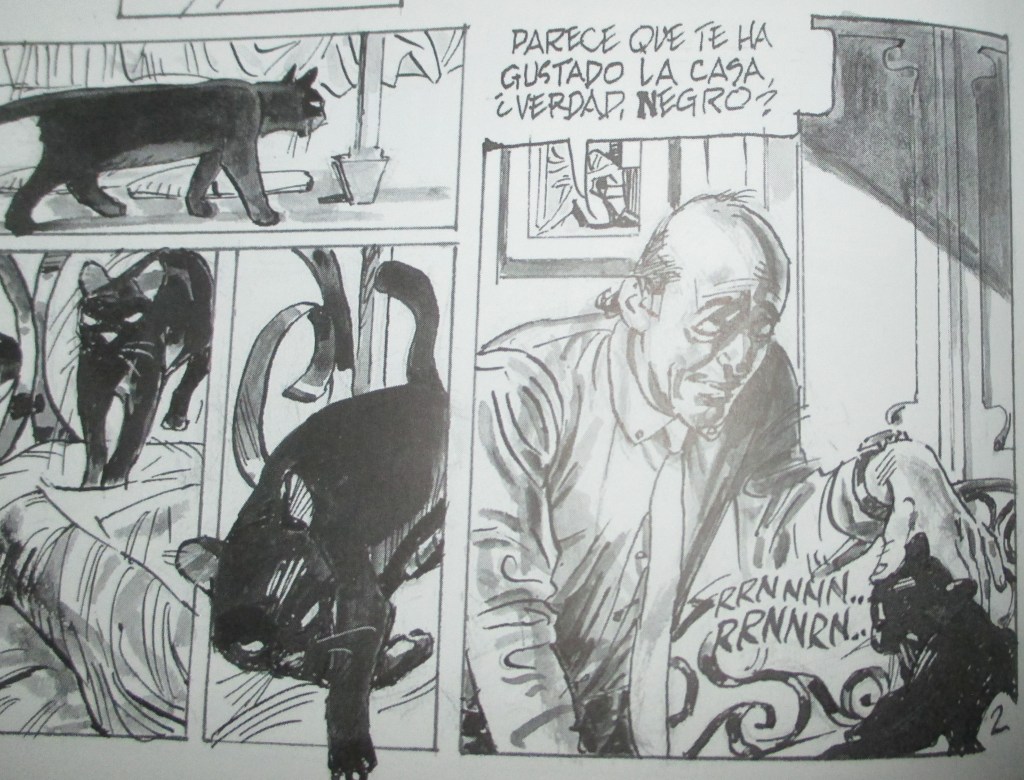
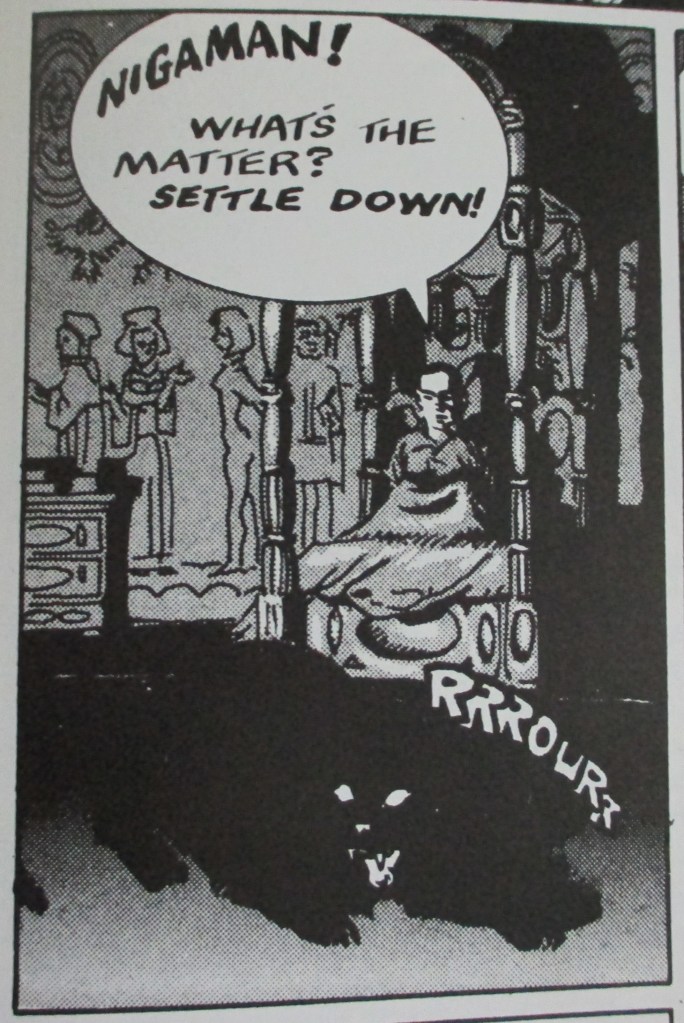
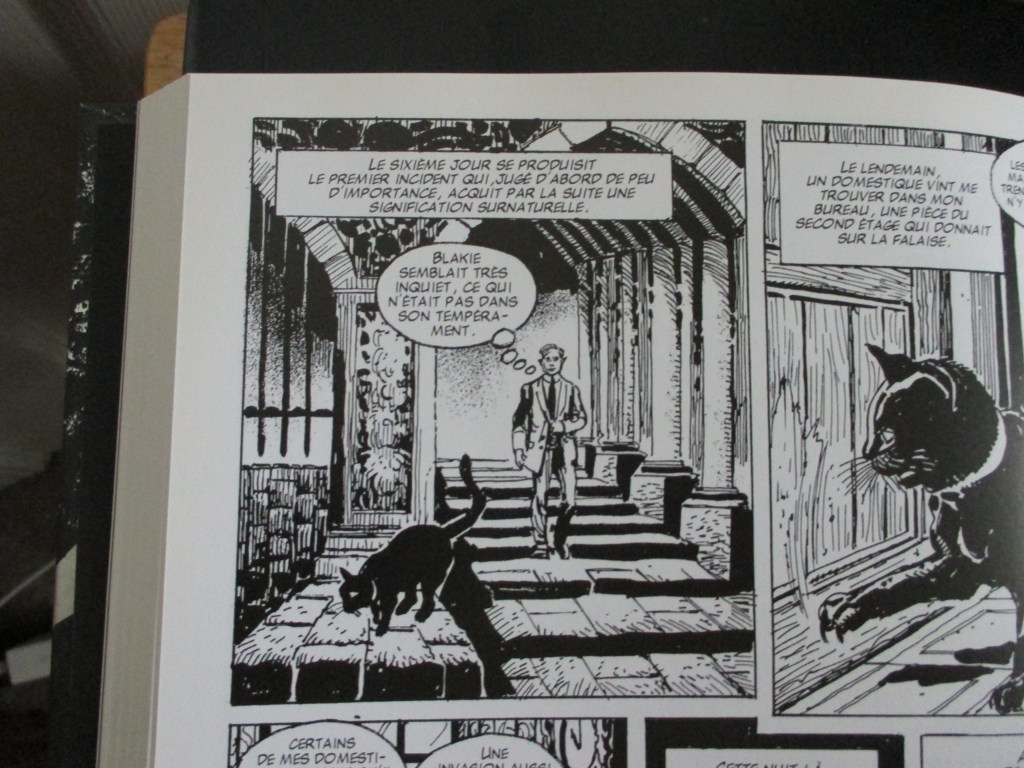
In adaptation and translation, however, English-language scholars and editors had less sway, and subtle shades of meaning came into play. In Maria Luisa Bonfanti’s Italian translation “I ratti nel muro,” the cat becomes Moro (“Moor”) and Jacques Papy’s French translation “Les rats dans les murs” calls it Négrillon (“Pickaninny”); Bob Jennings in adapting “The Rats in the Walls” to comics for Creepy #10 (Jul 1968) re-named the cat Salem; Richard Corben in Skull Comix #5 (1972) it was Nigaman; Vicente Navarro and Adolfo Usero in Lovecraft Un Homenaje en 15 Historietas (2013) it was Negro (“Black”); and Horacio Lalia in Le Manuscrit oublié (2000) used “Blakie” or “Blackie.” Dan Lockwood in The Lovecraft Anthology Vol. 1 (2011) simply left the cat’s name out, though the puss otherwise retains its accustomed role. The picture is further complicated when various of these adaptations are themselves translated into other languages, but the examples illustrate the very general point: some translators and adapters attempt to capture the essence of the name, some deliberately sidestep or avoid the issue.

This idiosyncratic approach to handling Lovecraft’s material is understandable. In the context of the story, the name has no particular significance to anyone except Lovecraft himself, it doesn’t matter whether the cat even has a proper name, as far as its narrative purpose is concerned. Where translators and adaptors have kept the name or something close to it, the reason must be a very conservative approach to the material—a desire to be as true to Lovecraft’s original text as possible.

There are those for whom that represents a fundamental issue. For example, when compiling a collection of Lovecraft’s most Gothic tales, “The Rats in the Walls” was left out. The reasoning given was:

[…] some of his most famous Gothic stories, such as ‘Herbert West—Reanimator’ (1922) and ‘The Rats in the Walls’ (1924), are disfigured by casual racist remarks or allusions that make contemporary reprintings problematic.*

*It is broadly acknowledged, even by his fas, that Lovecraft espoused racist views in his writing; and there are references in this collection which readers are likely to find offensive. Their inclusion in this edition in no way implies endorsement by the editor or publisher.

Xavier Aldana Reyes, introduction to The Gothic Tales of H. P. Lovecraft (2018) xi

“Problematic” in this context has to be read as “potentially offensive to today’s audience”; it cannot mean “an actual difficulty in reprinting the story” because “The Rats in the Walls” is one of Lovecraft’s most-reprinted stories, and is now in the public domain and freely available to read on the internet (link). There has been considerable clamor on the internet lately about the censoring or sanitization of works by dead authors—Roald Dahl, Ian Fleming, and Agatha Christie have all come up—and each case is a little different. For example, Christie authorized some changes to her works while still alive—it being remembered that the original title of And Then There Were None (1939) was Ten Little Niggers, named after an 1869 minstrel song, and that the original title persisted until 1980 in some editions.

What these authors share with Lovecraft is literary longevity. They were all born in a world where racism, antisemitism, and sexism were much more prevalent, pervasive, open, and accepted; these views influenced their work. Unlike many of their contemporaries that work is still being published and read. Though they have all long since given up the ghost, their literary works are still in print, still marketable, and still in demand by new generations of readers. Editors of new editions who cover up or erase the racism and antisemitism of yesterday are not doing the historian’s duty to preserve and accurately represent the past…but neither are they historians: they’re businesspeople, trying to sell a product to the widest possible market, and to give that market what they think it wants.

As the Zest version of “The Rats in the Walls” shows, such efforts do not tend to amount to much in the long run. Well-meaning as folks like Reyes might be in their effort to protect the innocent eyes of contemporary readers from historical racism, failing to reprint Lovecraft’s most Gothic story in a collection of Gothic stories is simply an act of cowardice. If editors and publishers, scholars and critics, are to be good stewards of the past and honest with the reading public, then we have to deal with historical racism honestly and openly—and if the words and themes are offensive, to explain their original context, and why and how Lovecraft used them, and how his original audience would have read and understood them.

Reprinting Lovecraft’s “The Rats in the Walls” is an educational opportunity to teach readers more about this story and Lovecraft. Removing the cat’s offensive name removes the opportunity to engage with that aspect of the text. At the same time, now that the story is in the public domain, anyone can play with the text freely. Scholars and fans will no doubt continue to strive for accuracy to Lovecraft’s original, but there is no reason why anyone appropriating the text of the story of its characters cannot make their own decisions about what is appropriate in this day and age—if anyone has a desire to write the further adventures of Black Tom.


Bobby Derie is the author of Weird Talers: Essays on Robert E. Howard & Others (2019) and Sex and the Cthulhu Mythos (2014).

Deep Cuts in a Lovecraftian Vein uses Amazon Associate links. As an Amazon Associate I earn from qualifying purchases.