Red Sonja and Conan: Hot and Dry (1977) by Randy Crawford

Eldritch Fappenings

This review deals with a work of pornography, and the history of erotic art and writing. As part of this review, selected images with cartoon depictions of genitalia and/or sexually explicit contact will be displayed.
As such, please be advised before reading further.


It was a woman, dressed as von Kalmbach had not seen even the dandies of France dressed. She was tall, splendidly shaped, but lithe. From under a steel cap escaped rebellious tresses that rippled red gold in the sun over her compact shoulders. High boots of Cordovan leather came to her mid-thighs, which were cased in baggy breeches. She wore a shirt of fine Turkish mesh-mail tucked into her breeches. Her supple waist was confined by a flowing sash of green silk, into which were thrust a brace of pistols and a dagger, and from which depended a long Hungarian saber. Over all was carelessly thrown a scarlet cloak.
—Robert E. Howard, “The Shadow of the Vulture” (The Magic Carpet Magazine Jan 1934)

In his stories, Robert E. Howard had written a number of warrior-women. Bêlit, the eponymous Queen of the Black Coast; Valeria, the pirate; Dark Agnes de Chastillon, who rejected the role of woman in medieval France to take up the blade; and Red Sonya of Rogatino, a fiery-tempered mercenary in the wars against the Ottoman Empire.

In February 1973, Marvel Comics’ Conan the Barbarian was coming close to the end of its second year. Writer Roy Thomas had freely adapted some of Howard’s Conan stories, and written some original stories of his own, generally following the outline of Conan’s career. Now, with issue #23, Thomas and artist Barry Windsor Smith (inked by Sal Buscema, John Adkins, and Chic Stone, adapted one of Howard’s non-Conan tales—”The Shadow of the Vulture” as a Conan tale, following the example provided by L. Sprague de Camp. Where “The Shadow of the Vulture” was set during the Siege of Vienna in 1529, Thomas borrowed from Howard’s references to Turan in stories like “The People of the Black Circle” and set it during a series of Turanian wars.

So Red Sonya of Rogatino was re-envisaged as Red Sonja of Hyrkania.

Conan the Barbarian #23 (1972)

Only a couple of pages later, Red Sonja turned up—dressed in a mailshirt and something which can only be described as red “hot pants,” a type of skimpy garment worn briefly (in every sense of the word) by young women in the early 1970s. This wasn’t the way I had seen Red Sonja in my mind, but Barry was the artist, and I didn’t feel like second-guessing him. Besides, he was a good enough artist to pull it off.
—Roy Thomas, Barbarian Life: A Literary Biography of Conan the Barbarian, Vol. 1 (2018) 134

The new character elicited interest, with issue #24 titled “The Song of Red Sonja.” Then, she and Conan parted. She would not reappear until 1974, in the first issue of The Savage Sword of Conan, a full-sized comic magazine—where she played a prominent role. The cover features Conan and Red Sonja by Boris Vallejo; the first story “The Curse of the Undead-Man” was adapted by Roy Thomas from Robert E. Howard’s “The Mistress of Death” (a Dark Agnes fragment), with art by John Buscema, inked by Pablo Marcos, featured Sonja as a supporting character, and later on Red Sonja appeared in her first solo adventure “Red Sonja” written by Roy Thomas, and illustrated by Esteban Maroto, with inks by Neil Adams and Ernie Chau (often credited as Ernie Chan). Only this time, Red Sonja’s outfit had changed:

Maroto had never done any work for Marvel (he would later contribute to Vampire Tales #s 3 and 4), but he clearly admired its books and had seen the two issues of Conan the Barbarian in which Sonja had made her debut. maroto was fond of drawing fantasy women in revealing outfits and decided to send an illustration of Sonja, rendered in this fashion, to the Marvel offices. The response was huge, and Thomas saw no reason why Sonja couldn’t wear a chainmail bikini if Conan paraded around in a lioncloth. In terms of the practicality of it, Thomas “came up with a mildly twisted rationale for her wearing clothing that deliberately tempted men when of course she’d cut off their fingers if they tried to go touchy-feely on her” (“A Fond Look Back at Big Red”). […]

Thanks to his unsolicited illustration, Maroto was assigned the penciling chores of Thomas’ Sonja story, which featured the She-Devil’s new duds and was simply called “Red Sonja.”
—Matthew Stephen Sunrich, Drawn Swords: An Unauthorized Exploration of Red Sonja and the Artists Who Brought Her to Life (2017) 14

So Red Sonja traded her mail-shirt and hot-pants for what would become an iconic chainmail bikini. She also gained a vow:

Savage Sword of Conan #1

Sonja would continue to reappear periodically in the pages of Conan the Barbarian, Savage Sword of Conan, and the short-lived Kull and the Barbarians both as a recurring character with Conan and in solo stories like “Episode” in Conan the Barbarian #48 (script by Roy Thomas, art by John Buscema, inked by Dick Giordino) but while she had received a great deal of character definition—an iconic outfit, and non-romantic foil to Conan who could fight as well as he could but didn’t let him or anyone else manhandle her—she hadn’t developed much backstory or lore. Like Jirel of Joiry, Red Sonja’s adventures were fantastic and at the same time disjointed. Any fan could pick up any comic with a Red Sonja story and need not have read any of the others. Yet between the cheesecake outfit and serious attitude, Red Sonja developed a fanbase.

So it was that in Marvel Feature #1 (1975), “Red Sonja” by Thomas and Maroto was reprinted in color, with a new story “The Temple of Abomination” written by Roy Thomas with art by Dick Giordino (backgrounds inked by Terry Austin, colors by Michele Wolfman) to fill out the issue. These were still random episodes from an adventurous life, and most of the rest of the stories in Marvel Feature, which despite the title was essentially a soft-launch of a Red Sonja solo comic, are the same: random sword & sorcery adventures with little connective tissue to each other or the wider Hyborian world—except when Conan makes a guest-appearance in her comic for a change!

Yet in Kull in the Barbarians #3, Red Sonja got an origin story in “The Day of the Sword,” with a plot by Roy Thomas, script by Doug Moench, and art by Howard Chaykin. It’s not a pretty story: Sonja’s family is murdered, she’s raped, and then a goddess grants her the power for revenge…at a price. She cannot know the love of man unless defeated in battle. The origin of the vow mentioned back in Savage Sword of Conan #1.

Much ink has been spilled over this decision over the years. The rape-revenge origin was probably only possible because Kull and the Barbarians was a magazine and not a comic book, and so didn’t need to go through the Comics Code Authority; the divine vision is reminiscent of Joan d’Arc, the heroine of France, and there’s a touch of Dark Agnes in Sonja’s early desire to not be treated just like any other woman. The vow of chastity probably seemed like a good idea at the time, but it is needless to say the men writing and drawing Red Sonja probably didn’t ask any women what they thought of the idea.

In the years and decades to follow, Red Sonja’s origin—like her outfit—would be both iconic and problematic, and subject to redesign and reinterpretation from generations of creators, including Gail Simone, Nancy Collins, and Christopher Hastings. Through different series, Sonja has been both sexually active and celibate, worn the iconic chainmail bikini and exchanged it for different outfits, been saved by a goddess and saved herself without any divine help. Fans have alternately applauded Red Sonja’s strength and independence and lamented the focus on her sexuality, and the explicit idea that the only way to have sex with her was through violence.

The second issue of Marvel Feature (1976) was much of the same as the first, with a new Red Sonja story titled “Blood of the Hunter,” scripted by Bruce Jones with all art by Frank Thorne. As the series went on, Thorne would write as well as illustrate most of the Red Sonja stories for the remainder of Marvel Feature‘s 7-issue run. When the character got her own ongoing series Red Sonja in January 1977, it was Thorne who drew her—and would continue to do so through issue #11, when he left the series.

Thorne’s run on Red Sonja is notable for not using much of what was established in “The Day of the Sword,” and for his strong involvement with the Red Sonja fanbase, dressing up as a wizard at conventions and judging cosplay contests. Thorne’s Sonja doesn’t dwell over much on her origin or her oath, and continues on fighting monsters and more human villains, kicking ass and looking good while doing it. Thorne’s artistic take on Sonja was marked by eyes that seemed rimmed with kohl, and a warrior who was both vicious and voluptuous, but with a flirtatious sense of humor.

His last feature was “The Wizard and Red Sonja” in Savage Sword of Conan #29 (1978), a rather bizarre out-of-continuity story where a wizard (modeled on Thorne himself) accidentally summons several different versions of Red Sonja.

Savage Sword of Conan #29

This is, in part, meta-commentary, noting the many different ways that Red Sonja had been written and drawn at this point. She had been conceived without a real character arc, without even a comic of her own, and while she was popular, Red Sonja’s stories outside of her interactions with Conan had little continuity. Random fantasy adventures, often wildly different in tone and style.

Red Sonja #11 was Frank Thorne’s final issue; he left the series, and worked on others for which he had more creative control and artistic license…including Ghita of Alizarr, a fantasy swordswoman who was in many ways Red Sonja without the oath of celibacy and with graphic sexuality.

1984 issue 7

If Ghita of Alizarr was an X-rated Thorne’s Red Sonja with the copyrighted and trademarked serial numbers filed off, well…he wasn’t the only one thinking along those lines.

THORNE:  One of the prouder moments is when some guy advertised an eight-page Tijuana bible of Red Sonja in The Buyer’s Guide. [Groth laughs]. I ordered a dozen! [Laughs.]

The title: Red Sonja and Conan, Hot and Dry.

GROTH: [Laughs.] That’s great.  

THORNE: I keepin the first of my really big scrapbooks. I’m just finishing filling up the fourth. These scrapbooks are like two by three feet and two inches thick. Sonja got a ton of media attention.

—Gary Groth, “The Frank Thorne Interview”

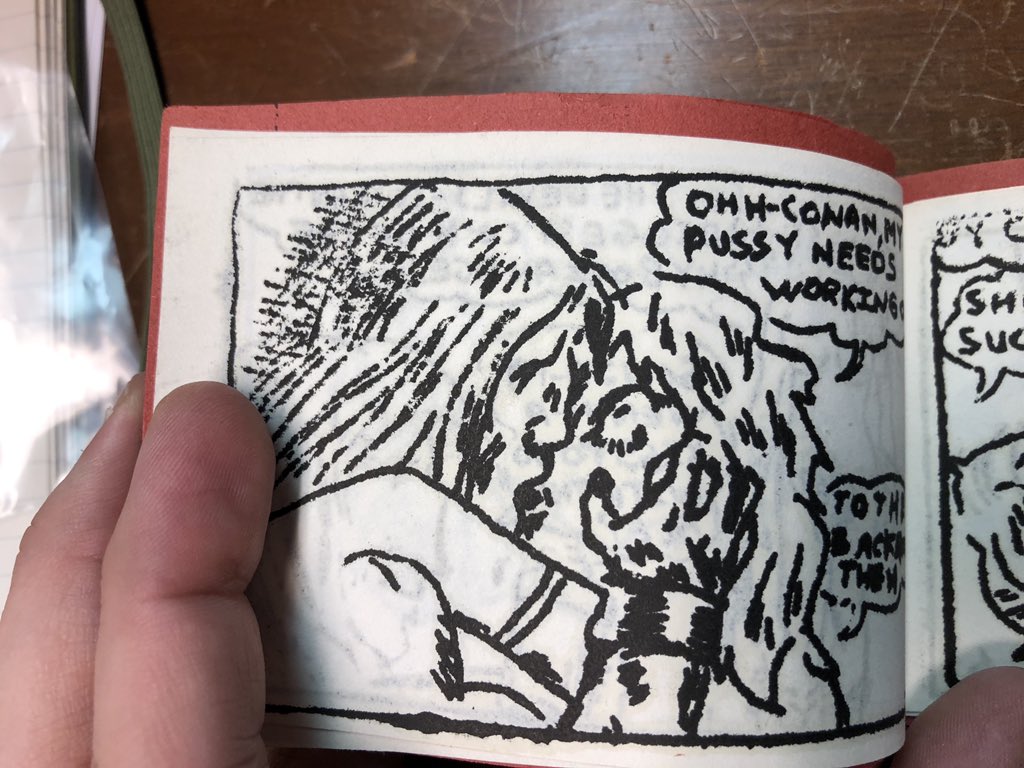
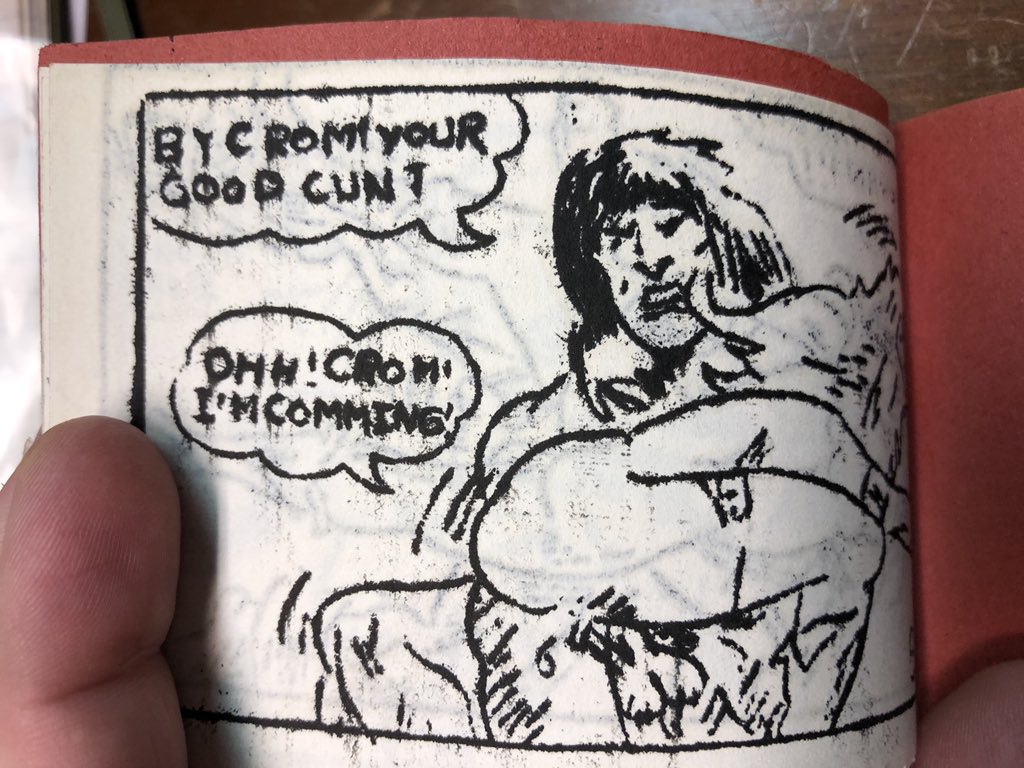
Red Sonja and Conan: Hot and Dry was an 8-pager (also called a Tijuana bible or bluesie) put together by Randy Crawford, who released a number of other parody sex comics in 1977 including Star Trek: Spock in Heat and a Plastic Man 8-pager. Tijuana bibles had first emerged in the 1930s, often crudely written, drawn, printed, and bound together with a staple or two—but these sexually explicit comics were incredibly popular. They often featured the unlicensed use of existing comic strip characters, popular athletes, Hollywood stars, and politicians, and even early comic book superheroes like Superman, Batman, and the Captain Marvel family.

Interest and production waned during the 1940s and 50s, but still carried on sporadically; the later Tijuana bibles published after the institution of the Comics Code Authority often seem to have crossover with underground comix, and might feature established characters such as Captain Ameria, Jacqueline Kennedy Onassis, and the Archie gang, but publication and distribution were shifting. Within a year or so of Marvel publishing Conan the Barbarian in 1970, the first pornographic parody “Gonad the Barbarian” appeared in the San Francisco Ball, an adult-oriented underground newspaper in mocking parody of the San Francisco Call.

Red Sonja took a little longer. It’s clear from the cover image that Randy Crawford was looking at the Marvel Feature/Red Sonja (vol 1.) Frank Thorne-era Red Sonja for inspiration, with the straps, armlets, gloves, and pauldrons which would gradually be dropped from her wardrobe. There’s no mention of her origin, oath, goddess, or need to battle before the action begins.
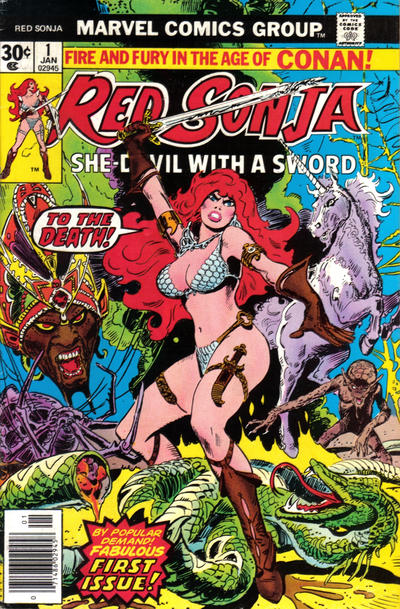
Red Sonja #1 (1977)

Conan is an even rougher figure, although clearly John Buscema’s take on the character. Something of the notched nose and posture recalls Conan’s second meeting with Red Sonja.

Savage Sword of Conan #1

Readers can judge for themselves. Sorry for the roughness of these photos, these are the only ones I could get.

Erotica tends to be ephemeral: only 1,250 copies of Red Sonja and Conan: Hot and Dry were published, and they very rarely come onto the second-hand marketplace. Many have no doubt been lost or discarded, or damaged because of their fragile construction. Yet the crude content and art are the point. While today with the internet readers can find dozens of pornographic comics featuring Red Sonja, some lovingly rendered by digital artists, in the 1970s this kind of erotic fan-product was not just illegal (copyright violation, and possibly deemed obscene depending on the jurisdiction), it was representative of a seriously fringe commercial activity.

How the hell do you advertise a Red Sonja/Conan Tijuana bible? Without getting caught?

Randy Crawford apparently published an ad in the Comic Buyer’s Guide, but this was the sort of thing that would probably have been sold under the table at conventions, or by mail-order in severely plain envelopes. It was illicit fare for the true post-pubescent comic nerds to geek out over. It represents almost the opposite of Frank Thorne’s approach with Ghita of Alizarr—none of the characterization, the beautiful artwork, the erotic atmosphere—just a gonzo narrative, straight to sex and ending with a climax.

Frank Thorne, no doubt, got a good laugh out of it. Yet he was an artist; he may have wanted to see his favorite flame-haired swordswoman in flagrante delicto…but he also wanted to do right by her as a character. Nothing quite illustrates the difference between an avid fan’s pornographic fantasy and a dedicated artist’s erotic epic than to look at something like this, and see how crude the work could be, tossed out quick and printed on the cheap to make a few bucks.


Bobby Derie is the author of Weird Talers: Essays on Robert E. Howard and Others and Sex and the Cthulhu Mythos.

Deep Cuts in a Lovecraftian Vein uses Amazon Associate links. As an Amazon Associate I earn from qualifying purchases.

“Two Fungi From Yuggoth” (1977) by Alice Briley

Sonnets, it seems to me, are preëminently the medium for complete ideas—in short, for a poetry as nearly intellectual as poetry can be without ceasing to be poetry. There is something inherently reflective and analytical about the very form of the sonnet.
—H. P. Lovecraft to Frank Belknap Long, 25 Feb 1924, SL1.317

The Fungi from Yuggoth is a sonnet-cycle by H. P. Lovecraft which has become, post-mortem, his most-remembered and celebrated work of poetry. As David E. Schultz deftly traces in “Dim Essences: The Origins of The Fungi from Yuggoth” in The Fungi from Yuggoth: An Annotated Edition, most of the sonnets were composed in a forty-day burst from December 1929-January 1930, but their numbering and publication proved complicated during Lovecraft’s lifetime, with various sonnets appearing in different amateur journals and Weird Tales, sometimes labeled as part of the cycle and sometimes not, often with different numbering. Never published as whole during his lifetime, the full sonnet cycle was finally compiled in Beyond the Wall of Sleep (1943, Arkham House), and has been reprinted in whole and in part many times in the decades since, as well as analyzed, illustrated, set to music, and even adapted to comics.

More than that, “The Fungi from Yuggoth” sonnets have inspired generations of writers and artists. One somewhat infamous project was Alan Moore’s Yuggoth Cultures, a novel of short pieces inspired by Lovecraft’s sonnets. Most of that work was lost, but of the ones that survive “The Courtyard” was adapted to comics and launched a body of related works, notably its sequels Neonomicon and ProvidenceOther works were in a more poetical vein, such as the anthology More Fungi from Yuggoth (2000), and Starry Wizdom’s “Night Gaunts, Too (On reading sonnet XX in H.P. Lovecraft’s *Fungi from Yuggoth* cycle)” from Walk on the Weird Side (2017).

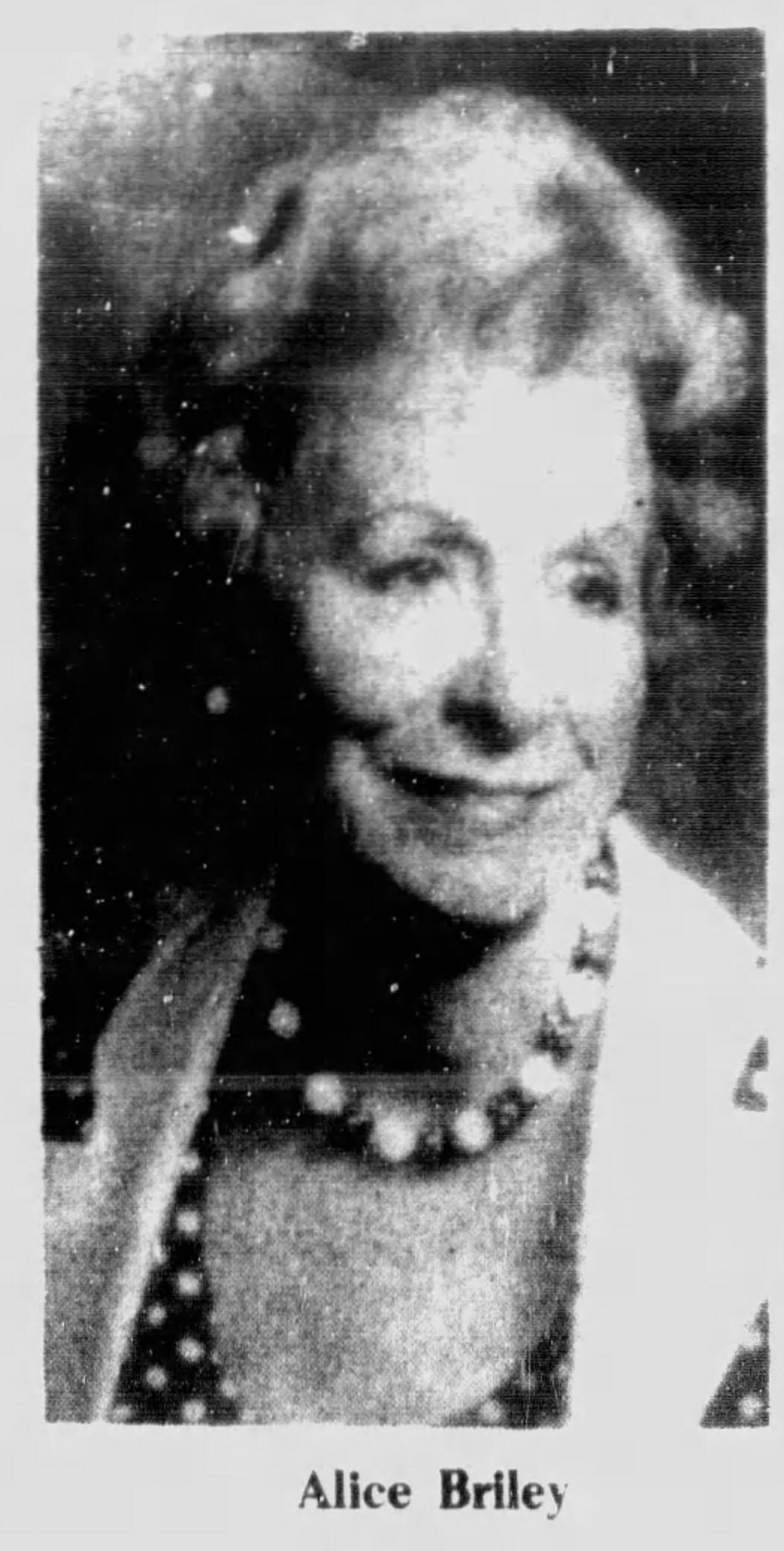
Alice Briley’s “Two Fungi from Yuggoth” (“in the manner of H. P. Lovecraft”) are a little more obscure. How and why she was inspired to write them isn’t clear. Briley was a noted poet associated with both state-level and national-level poetry organizations, and was no doubt at least aware of August Derleth through his poetry publications: in addition to publishing fantastic poetry through its regular imprint, Arkham House had a poetry-only imprint titled Hawk & Whipporwill. She could have read Lovecraft’s Fungi in the Arkham House Collected Poems of H. P. Lovecraft (1960), or the Ballantine paperback Fungi from Yuggoth & Other Poems (1971).

Whatever the case, in 1977 two sonnets labeled “Fungi from Yuggoth” appeared in her collection From A Weaver’s Shuttle. Newspaper accounts in ’77 and ’78 show Briley won awards from the National Federation of State Poetry Societies, possibly for that volume; the August Derleth Society Newsletter (vol. 4, no. 3, 1981), which reprinted the two Fungi claimed the poems won the August Derleth Memorial Award—unfortunately, the newspapers failed to list what awards that Briley won, and there are no lists of awardees for the NFSPS that far back currently available online, so it is hard to give specifics. The last publication of Briley’s Fungi I have been able to find is in a small pamphlet titled Weird Sonnets (1981, Owl Creek Press), which is described by one review as not a sequel to Lovecraft’s Fungi, but a collection of works that “belongs to the same loose tradition.”

Which is as accurate a description of Alice Briley’s Fungi as anything.

Her sonnets consist of “I. The Elder One” and “II. Arkham Hill.” They follow the form of Lovecraft’s Fungi, being 14 lines each; they are technically correct in terms of rhyme and meter, but probably aren’t the more beautiful lines she ever produced. The last lines to “The Elder One” for example are a bit clunky:

A feathered thing that bore a human face
Came swooping toward me in a wild descent,
and clutch me tightly in a foul embrace.
Not heaven’s herald, but from its fetid breath,
An Elder One more primative [sic] than death.

“More primitive than death” is an odd image. The rhyme works, but one wonders what exactly she was thinking of, since the “Elder One” reads more like a harpy or some fallen angel than most of Lovecraft’s creations.

“Arkham Hill” is a bit more promising, in that at least it establishes a stronger narrative and an effort at an original creation with ties to Lovecraft’s setting. The witch Eliza Pruitt lived by Arkham Hill, and many sought her until:

Until that fearful twilight when she found
Those mushrooms she had never seen before,
At dawn, they found her writhing on the ground
“Fungi from Yuggoth!” she screamed. Then said no more.

Again, not a great deal of familiarity is shown with Lovecraft’s fiction; at least, nothing to show that she had read anything beyond The Fungi from Yuggoth. Yet even that little exposure appears to have stirred her imagination, and she sought to expand on Lovecraft’s horrors in her own way. Yuggoth spores that took root in a fertile imagination and sprouted, however briefly, some fruiting bodies.

Given the decades since their last publication and Alice Briley’s demise, whether these particular Fungi will spread once again is unclear. Under current U.S. law, the work is almost certainly protected by copyright…but they are possible orphan works where determining who owns those copyrights and getting permission may be difficult and more costly than it is worth. This is an ongoing issues with many minor Mythos works, akin to some of the issues involved with fanfiction—and there is a danger that such works may be forgotten or lost with time before they can enter the public domain. Even digital archiving can be difficult without the proper permission from the copyright owners.

Alice Briley’s “Two Fungi from Yuggoth,” then, represents both the fecundity and the fragility of the Cthulhu Mythos: while Mythos works are in no immediate danger of dying out, who knows what works have already been lost, crumbling away in some forgotten fanzine? 


Bobby Derie is the author of Weird Talers: Essays on Robert E. Howard and Others and Sex and the Cthulhu Mythos.

Deep Cuts in a Lovecraftian Vein uses Amazon Associate links. As an Amazon Associate I earn from qualifying purchases.
“The Book of the Forgotten Ones” (1977) by Nema Andahadna

There cometh the Book of the Forgotten Ones. This shall be for the priests of Maat.
In the name of creation and that which is before it, Aumgn!
—NAHADA 62, “The Forgotten Ones”
The Cincinnati Journal of Ceremonial Magick, Vol. I, No. II, 59

If a reader were to browse through the chapter on Lovecraftian magick in Robert North’s New Flesh Palladium (2006, 4th edition) or The Book of Lies: The Disinformation Guide to Magick and the Occult (2008), or peruse Kenneth Grant’s later Typhonian Trilogies, especially Outside the Circles of Time (1980), they would come across references to a supposed Lovecraftian occult text or work called The Book of the Forgotten Ones. One of the rituals is discussed briefly in The Necronomicon Files (2003). Yet unlike Necronomicon Gnosis: A Practical Introduction (2007) by Asenath Mason, you cannot exactly go online and buy a nice hardcopy edition of this particular occult text.

Some years ago I received a communication from the Maatian gestalt via the mediumship of Soror Andahadna (Nema).
—Allan Holub, “The Second Book of the Forgotten Ones”
The Cincinnati Journal of Magick, Vol. II, No. VI, 33

The Book of the Forgotten Ones is a channeled text, received by the medium Soror Andahadna (Nema, Maggie Ingalls). The reception of texts from a divine or supernatural source is accepted by many religions and occult groups, examples include Joseph Smith and the Book of Mormon or Kenneth Grant and the Book of the Spider. One can even draw a Lovecraftian parallel with the images of Cthulhu created by sensitive artists in “The Call of Cthulhu.”

Nema was a practitioner of Thelema, the system of ceremonial magick created by Aleister Crowley and extended by Kenneth Grant and others, and in 1974 had channeled the book Liber Pennae Praenumbra: The Book of the Foreshadowing of the Feather, which established her own “Maat” current, based on Thelemic principles. She joined the Bates Cabal in Ohio, helped write and publish The Cincinnati Journal of Ceremonial Magick in 1976, co-founded the Horus-Maat Lodge in 1979, and published a number of works on her Ma’atian magick. She was a member of Kenneth Grant’s Typhonian Order for several years, and alongside Michael Bertiaux became one of Grant’s favorite examples of Lovecraftian occults in his Typhonian trilogies.

Soror Andahadna, a contemporary priestess of Maat, has received snatches from beyond the Abyss, and they comprise The Book of the Forgotten Ones. It contains allusions to mysteries that first appeared in the writings of Frater Achad [Charles Stansfield Jones]. It would appear that there exists just without the circle of mundane awareness a complete grimoire of magical formulae. It is perhaps from this lost grimoire that artists and poets have been drawing with increasing frequency over the past century, or since the ‘first whirlings’ of the New Aeon were adumbrated more than four hundred years ago in the writings of Rabelais, and earlier initiates.
—Kenneth Grant, Outside the Circles of Time 46-47

“Snatches” is perhaps the best description of it, because if The Book of the Forgotten Ones has ever been a single complete text, I’ve found no record it. What we have are three separate chapters which were published over the space of a decade in the Cincinnati Journal of Ceremonial Magick, alongside much other Thelemic and Ma’atian material by Nema and the Bates Cabal.

The first chapter is “The Forgotten Ones,” published in Vol. 1, no. 2, pp.59-63 as by NAHADA 62. The text is dated 16 July 1971, which would make this earlier than the Liber Pennae Penumbra, and contains no overt references the Lovecraft Mythos, being for the most part a long series of short declarative sentences and instructions, for example:

Ye know Me, though my name be forgotten, in the dread of impending events. I am the motion of a leaf blown down an empty street. I am the sender of omens.

Chant the incantation of My Name.

It will destroy you. Pronounce My Name aloud, in repetition—it will banish all but pure Awareness.

Descend into My Temple, meet yourself. Bear thence the Wand of the Papyrus, and the sword, the shield of mine devise, and the eye Globe. Ye are twain therein, and learn the Alchemy and Mass of No*.
—NAHADA 62, “The Forgotten Ones”
The Cincinnati Journal of Ceremonial Magick, Vol. I, No. 2, 60

These could be taken as instructions for a ritual, couched in symbolic language for adepts. As to who the “Forgotten Ones” are, Nema would later expand on that slightly in her work Maat Magick: A Guide to Self-Initiation (1995), with a bit of a Jungian approach:

I call our survival urges the Forgotten Ones (FO) because our intellects tend to forget them or to trivialize them. Our individual and collective Egos are artifacts of intellect; it’s ego’s vanity that blinds intellect to the power of the FO. […] The Forgotten Ones include, but are not limited to, the instincts of hunger, sex, fight-or-flight, clanning, communication, curiosity, altruism and religion, all those imperatives or actions ensuring survival of self, offspring, and species. The gods our ancestors worshipped are rooted in the Forgotten Ones, given typical human personalities, then made larger and more powerful than humans. […] The gods and goddesses of the old pantheons gained independent life through centuries of worship and did play a directing role in the spiritual, moral and social lives of their devotees.

The second chapter is “Return of the Elder Gods: An Invocation of the Forgotten Ones” in The Cincinnati Journal of Ceremonial Magick vol. 1, no. 3, pp.17-26 (1978), as by “Nema and the Shadow.” Unlike the previous chapter, this is a completely different style, much more expositional and less ceremonial; it discusses the Elder Gods, their relation to the Forgotten Ones, and how (and why) to invoke the latter to aid against the invasion of the former. This is the ritual discussed in The Necronomicon Files (2003, 120-1); the paragraph in The Book of Lies 145 seems based directly on The Necronomicon Files. In one of those “as above, so below” turnabouts, it seems that:

In the Macrocosm, these forces are the Elder Gods; in the Microcosm, they are the Forgotten Ones. to  our present Consciousness, these gods are Qlipothic, constituting the Dark aspects of the anti-Universe and the human Unconscious respectively. Admittedly, there is a certain danger inherent in contact them; but there is sure disaster in neglecting to do so.
—Nema and the Shadow, “Return of the Elder Gods”
The Cincinnati Journal of Ceremonial Magick, Vol. I, No. 3, 17

While not explicitly Mythos-related (unless you count the term ‘Elder Gods’ in a sense Lovecraft never used), there are details of the work that suggest Nema was definitely being inspired by the work of Kenneth Grant, particularly Cults of the Shadow (1976) and Nightside of Eden (1977). It is notable that in Maat Magick, Nema writes:

Mr. Grant expresses a dangerous experience in Nightside, one that can be approached “in person” only from above the Abyss. […] He speaks more eloquently on the subject than anyone since H. P. Lovecraft. Unlike H.P. L., Mr. Grant is a conscious adept and priest of the eldrich [sic] dark; rather than speak of unspeakable horrors, he presents useful information about the denizens of the tunnels and the dangers of the Nightside. (209)

What really brought all this together was “The Second Book of the Forgotten Ones” in The Cincinnati Journal of Magick vol. II, no. 6, pp.33-53 (1988) by Allen Holub. This essay is an exegesis on Nema’s channeled text, along with a channeled text of his own received 7 January 1976, and directly connects these workings with the Lovecraft Mythos…sortof:

By way of introduction; this essay discusses a collection of forces deemed variously the Elder Gods, the Old Ones, and the Forgotten Ones. The two former names are unfortunate as they associate these forces with the writings of H.P. Lovecraft. Though Lovecraft may or may not have been in contact with these beings, his fearful ravings are of little use to the practicing magician. As far as I can determine, the forces discussed below have no relation whatever with the begins contacted by Lovecraft, even though some of them bear the same names. This similarity of nomenclature may be attributed to Lovecraft having indeed reached the Portal, that is, the verge of true communication with the Dark Forces. However, instead of communicating with them, he was eaten by them. The forces Lovecraft represents in his stories are not the true Elder Gods at all but are the shadows of the Elder Gods distorted to the point of unrecognizability by madness. For these reasons, the forces here will be called the Forgotten Ones, a name they choose for themselves. These are not the gods of the Lovecraft Mythos.
—Allen Holub, “The Second Book of the Forgotten Ones”
The Cincinnati Journal of Magick, Vol. II, No. VI, 33-34

Holub’s forceful assertion that the Forgotten Ones/Elder Gods are not the same as any entities in Lovecraft’s fiction appears to be a direct confirmation that some people did see the connections. Kenneth Grant appears to blithely ignore this entirely in his chapter on “The Forgotten Ones” in Outside the Circles of Time, and given the relative scarcity of the original journals, it’s possible few people were the wiser. Whether Holub was ever speaking for Nema on the matter is unknown.

In content, these snippets of The Book of the Forgotten Ones are both disappointing and interesting. The original channeled text and ritual by Nema appear to represent her genuine spiritual and occult leanings and practice, related as they are to the Ma’at current; Holub and Grant both seized on these as inspiration and raw material for their own expansion of the material. In the case of Kenneth Grant—who was apparently eager to seize on any magical practice vaguely related to his own Lovecraftian leanings—this resulted in the rather wider dissemination of The Book of the Forgotten Ones than it would otherwise have gotten.


Bobby Derie is the author of Weird Talers: Essays on Robert E. Howard & Others (2019) and Sex and the Cthulhu Mythos (2014).

“The Discovery of the Ghooric Zone” (1977) by Richard Lupoff & “In The Yaddith Time” (2007) by Ann K. Schwader

He had seen Yaddith, yet retained his mind,
And come back safely from the Ghooric zone,
—H. P. Lovecraft, “Alienation,” Fungi from Yuggoth XXXII

This is the first appearance of the terms “Yaddith” and “the Ghooric zone” in Lovecraft’s work; though references to the former alien world would appear in his collaboration with E. Hoffmann Price “Through the Gates of the Silver Key,” and a few other places. Neither exactly captured the popular imagination in the same way as R’lyeh or Yuggoth, Carcosa or Innsmouth. Yet this one sonnet served as inspiration for several notable works.

“Discovery of the Ghooric Zone — March 15, 2337” (1977) by Richard Lupoff owes more to New Wave science fiction than Lovecraftian horror or sensibilities; it is the Mythos as space opera, as an epic of an unseen future, an exploration of the solar system as pure as any Golden Age sci fi epic, a looking-forward to cyberpunk, but it is also a literal and literary homage to H. P. Lovecraft—the man, the myth, the legend.

It opens up with what the first interracial LGBTQ+ threesome in Mythos fiction.

They were having sex when the warning gong sounded, Gomati and Njord and Shoten.  […]

Njord Freyr, born in the Laddino Imperium of Earth, had retained his masculinity even as he had undergone the customary implantations, excisions and modifications of pubescent cyborging. […]

Sri Gomati, of Khmeric Gondwanaland, had similarly retained her female primary characteristics in function and conformation even though she had opted for the substitution of metallic labia and clitoris, which replacement Njord Freyr found at times irritating.

But Shoten, Shoten Binayakya, fitted with multiply-configurable genitalia, remained enigmatic, ambiguous as to his or her own origin […]
—Richard Lupoff, “The Discovery of the Ghooric Zone”

Readers today might smile at Njord’s private crisis of masculinity, reminiscent of the same issues apparent in “Gilgamesh in the Outback” (1986) by Robert Silverberg, but the delineation of gender roles echoes in a very real way the alienation of Lovecraft’s poem. Njord clings to his masculine identity while at the same time feeling inadequate compared to the cybernetically enhanced Shoten:

Njord, the male crew member, cursed, distracted by the radar gong, angered by Gomati’s inattention, humiliated by her amusement and by her drawing away from himself and Shoten. Njord felt his organ grow flaccid at the distraction, and for the moment he regretted the decision he had made prior to the cyborging operations of his adolescence, to retain his organic phallus and gonads. A cyborged capability might have proven more potently enduring in the circumstances but Njord’s pubescent pride had denied the possibility of his ever facing inconvenient detumescence. (ibid.)

The attention on biological gender, gender transition surgery, and polyamory in general may seem unnecessary in a Mythos story, but in the case of “The Discovery of the Ghooric Zone” the trio are representatives of their respective future states as well as plot points along a gender spectrum; their interactions echo the places and peoples that they represent, all of future humanity striving together for this voyage of exploration. And, at the same time, the difference between 1977 and 2337 was never so vast as in the openness in sexuality…to which Lupoff wrote:

Cut to logo representing sex.

The major sexual attitude of the time was androgyny, rivaled but not equaled by the cult of pan-sexuality. Androgyny implies recognition of the full sexual potential of each individual. Former distinctions were abandoned. It was no longer regarded as improper to pursue a relationship of male to male or female to female; nor was it required to have two partners in a relationship. Practices ranging from onanism to mass interplay became acceptable.

The pan-sexualists held that androgyny was needlessly limiting in scope. If one could relate to any man or woman—why not to a giraffe? A condor? A cabbage? A bowl of sand? A machine?

The ocean?

The sky?

To the cosmos?

To God? (ibid.)

The format of the “cutscene” is cinematic; Lupoff draws out the action with excerpts on the history of the last four hundred years, anecdotes, personalities, commentaries on culture reminiscent of Dune (1965). It looks forwards and backwards at the same time; the Apollo 11 mission that landed humans on the moon occurred only seven years prior, in 1969, and yet:

Why has it taken until 2337 to reach — Yuggoth? When space flight began almost as long ago as the era Sri Gomati babbles about. The first extraterrestrial landings took place in 1969. Mars thirty years later. Remember the stirring political slogan that we all learned as children, as children studying the history of our era? Persons will set foot on another planet before the century ends! That was the twentieth century, remember?”

“Every schoolchild knows,” Shoten affirmed wearily.

Gomati, recovered from the shock of Njord’s blow, spoke; “We could have been here two hundred years ago, Njord Freyr. But fools on Earth lost heart. They began, and lost heart. They began again—and lost heart again. And again. Four times they set out, exploring the planets. Each time they lost heart, lost courage, lost interest. Were distracted by wars. Turned resources to nobler purposes. (ibid.)

There are more explicit Mythos references; and more explicit references to Lovecraft too. The story is set on the four hundredth anniversary of the death of H. P. Lovecraft, and if the future history is fantastical and impossible, it is also fascinating, an extended meditation that seeks to bridge past and future, weird fiction and New Wave, in a way no other author at the time did—and would be the spiritual precursor to works of Lovecraftian space opera such as Elizabeth Bear & Sarah Monett’s trilogy “Boojum” (2008)“Mongoose” (2009), and “The Wreck of the Charles Dexter Ward” (2012).

Yet those three do not come back safely from the Ghooric zone.

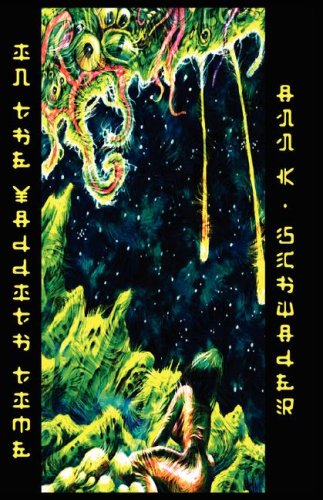
Three decades later, Ann K. Schwader published In the Yaddith Time (2007), a sonnet-cycle deliberately patterned after and echoing Lovecraft’s “Fungi from Yuggoth.” It begins with a quotation from “Alienation,” and continues on a similar theme to Lupoff’s—humanity’s faltering voyage into the unknown solar system, and into familiar territory:

[…] Our captain pointed
us toward the chaos framed beyond that stone
“Through there,” he cried, “awaits the Ghooric zone!”
—Ann K. Schwader, “Sacrifice Eyes,” In the Yaddith Time 14

The literary DNA has echoes of 2001: A Space Odyssey (1968), Alien (1979), Event Horizon (1997), and Ghosts of Mars (2001), the strange extraterrestrial relics left in space for humans to find, the madness overtaking captain and crew. Yet Schwader’s vision is an exploration of Lovecraft’s Mythos, told through her own imagery and captured in her own verse, and again there is that weird echo of Lupoff’s novella:

Writ strange, Earth’s chronicle was what we saw.

Past bled into the present, then ran on

down corridors torn deep in living stone,

revealing future horrors still unspawned

which showed mankind had never been alone.
—Ann K. Schwader, “The Walls of Prophecy,” In the Yaddith Time 26

The specific image here recalls Robert Bloch’s “Fane of the Black Pharaoh” (1937), but it echoes the secret history which underlies Lovecraft’s fiction, and Lupoff’s secret future unveiled piecemeal to his readers: humanity has never been alone, and never will be…

Schwader goes farther than Lupoff, at least in terms of distance; her astronauts go beyond Yuggoth, to the library of Celano, to Carcosa and the Lake of Hali, and finally to Yaddith. In conceptual terms, she travels less far: the bones of the story are old as sailing ships, captains gone mad, visiting places that test the imagination, loyalties tested beyond endurance by death and travails. No playing with gender, and indeed few references to how Earth had changed in whatever span of time separates the “now” of our contemporary period with the “then” of her sonnet-cycle. It is timeless in its futurity, and for her the focus is on the moment, the alien worlds to be explored, not the Earth left behind…except once, and that in a dream.

[…] Sudden night

spread shadowwings in one vast inky smear,

erasing daylight as a shriek of fear

arose from every throat: the stars turn right!
—Ann K. Schwader, “A Dream of Home,” In the Yaddith Time 28

Both “The Discovery of the Ghooric Zone” and In the Yaddith Time remains true to the Mythos as Lovecraft conceived it, the weird forces beyond human ken; what they are faced with when they travel out beyond the safe borders of the known into the outer dark. Yet both also go beyond Lovecraft: these are stories of exploration, in a sense which Lovecraft could only vaguely imagine. Space travel was never a reality for him, but Lupoff and Schwader lived through that—and could extrapolate that much further.

Richard Lupoff’s “Discovery of the Ghooric Zone — March 15, 2337” was first published in Chrysalis (1977), and republished in Tales of the Cthulhu Mythos (1990, Arkham House; 1998, Del Rey) and his collection Claremont Tales (2001, Golden Gryphon Press).

Ann K. Shwader’s In the Yaddith Time was published in 2007 by Mythos books. It has been reprinted in her collection Twisted in Dream: The Collected Weird Poetry of Ann K. Schwader (2011, Hippocampus Press).


Bobby Derie is the author of Weird Talers: Essays on Robert E. Howard & Others (2019) and Sex and the Cthulhu Mythos (2014).