“Their religion? You mean, they have one of their own?”
“The Reformed Order of Dagon. It’s a branch, or a schism of a church that was founded in Massachusetts about a hundred and fifty years ago. As I understand it, the main body of the church was stamped out by some pretty high-handed federal action back in the nineteen-twenties. But they never got around to bothering the Squampottis bunch, either because they’re so isolated, or because cooler heads prevailed in Washington. The thing in Massachusetts was remarkably well hushed-up. All the relevant government records have been destroyed.”
—Brian McNaughton, Tide of Desire (1983)
The very first erotic novel to deal with the legacy of Innsmouth came from the typewriter of Brian McNaughton. Active as a fan during his teenage years in the 1950s, McNaughton was briefly a journalist before turning his hand to erotic novels, starting with In Flagrant Delight (1971). His “break” came in the late 70s when he began producing erotic horror novels, starting with Satan’s Love Child (1977)—the publisher’s title, not his—which included elements of or references to the Cthulhu Mythos. It was successful enough to merit several other books, and McNaughton transitioned back over into doing mainstream horror in Weirdbook and other publications, and won the World Fantasy Award for Throne of Bones (1997).
Erotic horror wasn’t exactly new, as Grady Hendrix notes in Paperbacks from Hell: The Twisted History of ’70s and ’80s Horror Fiction, sex has long been a selling point and those two decades saw a boom in erotic horror and horror erotica. Still, this was a decade before Ramsey Campbell’s Scared Stiff: Tales of Sex and Death (1987) or the anthology Hot Blood (1989), and erotic horror fiction of the period tended to work off existing properties like Universal Monsters or classic horror novels—The Adult Version of Dracula (1970) and The Adult Version of Frankenstein (1970) being exemplary of the latter trend. By comparison, Lovecraft was largely a virgin field for erotic horror, or at least not entirely played out.
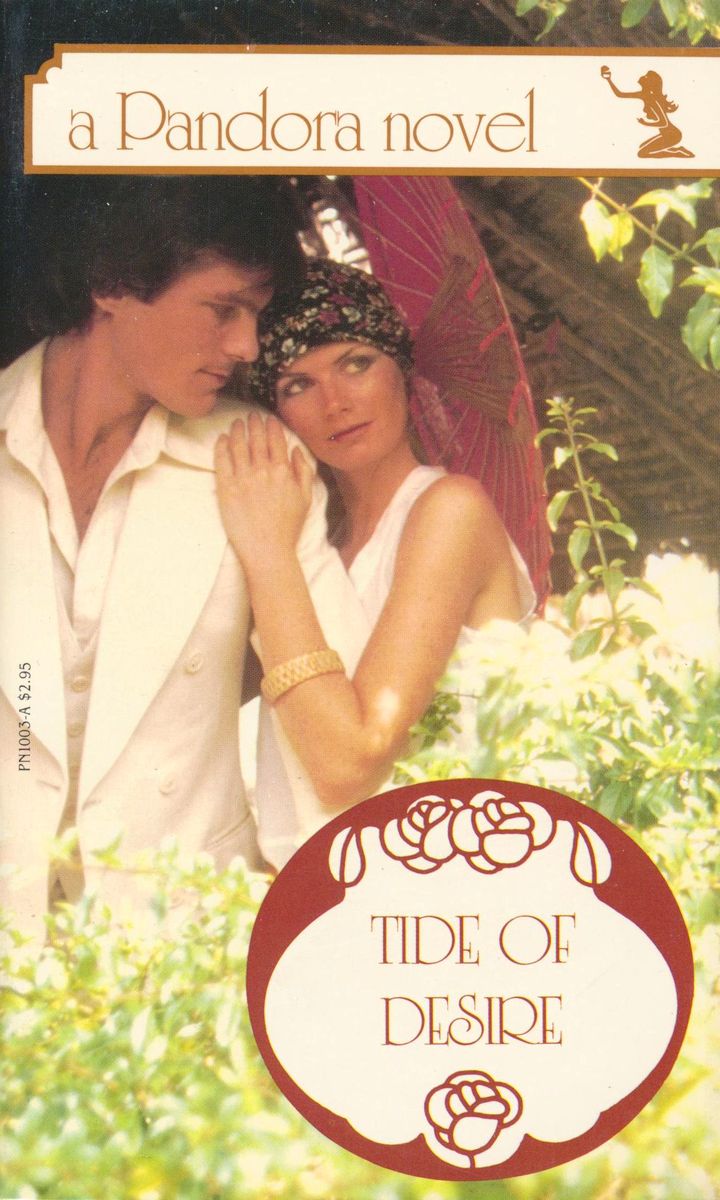
Beginning in the early 1980s, McNaughton wrote a series of erotic novels for Tigress Books. These were written under the pseudonym “Sheena Clayton,” and the line itself may have been aimed more at a female audience than typical adult novels of the period, a more hot-blooded and explicit counterpart to mainstream romance novels. The books tend to feature female protagonists and writers with female names, and the relatively sedate photo covers give the impression. On the name, McNaughton once wrote:
Sheena Clayton was the illegitimate daughter of Sheena, Queen of the Jungle, and
John Clayton, Lord Greystroke. I channeled her in several novels, of which TIDE OF
DESIRE may have been the best. (Sex and the Cthulhu Mythos 202)
These novels were Love and Desire (1982), The Aura of Seduction (1982), Tide of Desire
(1982/3), Danielle Book Two (1983), There Lies Love (1983), and Perfect Love (1983). All of these to greater or lesser extant contain references to the Mythos. For example, Edward Pickman Derby appears briefly as a member of a “Rats in the Walls”-esque Magna Mater cult in Love and Desire; Ramsey Campbell’s Lovecraftian fictional grimoire Astral Rape from his novel The Parasite (1980) is prominent in Danielle Book Two; and the cult in Perfect Love was founded by a Rev. H. P. Whateley from Arkham, Massachusetts.
Inside the door, Cthulhu ran up with a hearty meow, and he seemed just as glad to see Melisande as herself. The girl was quite indifferent to him, however, perhaps even a bit impatient with his rubbing against her ankles.
“Scat!” Antonia cried, moving him along with a nudge of her toe. “Cthulhu doesn’t normally take to strangers.”
“Who?” The girl seemed startled, even shocked.
“Cthulhu. That’s the cat’s name.”
—Brian McNaughton, Tide of Desire (1983)
The style of the novel partakes strongly of the Derlethian combination that Lovecraft’s fictional works exist in the world of Tide of Desire, and that the stories chronicle at least partially real events, so that the Mythos definitely exists. A good point of comparison might be Robert Bloch’s novel Strange Eons (1979). More interesting for fans of McNaughton’s later Mythos fiction is that several of the concepts for the Deep One culture are carried over between the novel and his story “The Doom That Came to Innsmouth” (1999). For example, the idea of a Deep One hybrid transitioning from land to water is called “Passing Over”:
“Dagon flay me alive! Ye be right! What an old ninny I be! Our Caleb’s daughter, she passed over a good ten-fifteen years ago. I ain’t seed her lately, but she be down there, don’t you worry. You look like her; that got me all confused. You look like her before she passed over, I mean. I never seed her before she passed over, of course, but I got her picture as a girl someplace. Our Caleb sent pictures of him and his mainland wife and all their kids to prove that the kids didn’t have the look, no more’n he did. But that girl sure did, all right. Poor Caleb. He was right about hisself, he never passed over, but he never told his daughter a word about the Blessing of the Deep Ones. So there she lied, passing over in the middle of nowhere, miles from the sea, and not knowing what the hell were happening to her.”
Mrs. Nicker mumbled to herself as she debated the whereabouts of the photograph she’d mentioned. Then she said to Antonia: “But by pure luck-or more likely it were the hand of Dagon stretching out to help her-there were this colored man from New Orleans who knew somewhat about the doings of the Deep Ones, and he told her she had better get herself to the sea, fast. She paid him to help her, and he took her to… where? To Charleston, South Carolina, that’s right! So she got there just in time to pass over. Then she come to Squampottis and told us all about it. It were the most exciting thing happened on this here island since the visitation of Shug-N’gai, just after the federals smote all them blasphemers and heretics at Innsmouth. That were in nineteen-and-twenty-eight, I do believe. Who says my memory ain’t perfect, hey? Don’t you try to tell me about our Caleb, boy. You wasn’t even borned then.”
—Brian McNaughton, Tide of Desire (1983)
The gist of the novel is that the protagonist, Antonia Shiel, is herself a descendant of the Deep Ones whose body is preparing to “cross over,” encountering a splinter sect of the Esoteric Order of Dagon on Squampottis Island—and realizing too late that she herself has the “Squampottis look.” the changes in herself adding a touch of body horror to the novel as her hair falls out and her feet swell…all of which are undone by the ending.
“Your hair seems to be thicker all of a sudden,” he noted admiringly. “That lovely pubic patch is just like a beautiful young woman’s, and not bare like a child’s. And the hair on your scalp looks thicker already.” (ibid)
The novel comes to an abrupt, jarringly disconcerting “happy ending” very atypical for McNaughton’s novels, as the novel was bowdlerized badly by the editors. McNaughton found the original ending and was revising Tide of Desire for eventual publication at Wildside Press, under the title Riptide. However, McNaughton’s untimely death in 2004 appears to have ended any plans to republish the novel. We can only speculate what the original ending would have been, but given that the story as a whole is a kind of contemporary, sexually explicit update to “The Shadow over Innsmouth,” it would have been both appropriate and in keeping with the tone of the novel if Antonia had “passed over” and joined the Deep Ones.
It would be wrong to say that Tide of Desire, or any of the Sheena Clayton novels, were influential. Pornography is ephemeral literature, and the novels didn’t make much of a splash in Lovecraftian circles when they came out. Which is unfortunate because, as Matthew Carpenter notes in his own review and synopsis, this is actually a very competent Mythos novel, and presaged some of the ideas developed independently by later writers. Sonya Taaffe in “All Our Salt-Bottled Hearts” (2016) wrote about some hybrids that don’t make the transition, and McNaughton wrote:
“It’s me that’ll die, it’s me that’ll be dumped into the ground like dead meat.” She began to sob bitterly, clawing at the arms of the chair with abnormally large hands. “Oh, you should see Rev. Preserved. He’s like an angel! Just last month I seed him in all his glory at Marsh Cove, taking no less than a dozen of our maidens, and our Melly one of them. Whether she be carrying his child or not, I don’t know, it be too soon to tell. When Rev. Preserved told me to have faith, I nearly believed it. He were like a god walking on earth. He said I’d pass over yet, but I don’t believe him now. Dead meat in the churchyard, that’s where I be bound.” (ibid.)
Tide of Desire is not quite the spiritual ancestor of erotic Deep One works such as The Innsmouth Porno VHS (2014), Innsmouth After Dark (2014), Taken By The Deep Ones (2015), Ichythic in the Afterglow (2015), and The Pleasures Under Innsmouth (2020). There is rather less sex, and that less explicit, than one might think; there are no sexual encounters such as in Alan Moore and Jacen Burrows’ Neonomicon (2011).
Which makes sense, because Brian McNaughton was not writing an erotic story dealing primarily with sexual encounters with Deep Ones, a horror story not afraid to go into details like mature sexual relationships, body image issues over breast size and pubic hair, etc. Vulgar terms for genitalia are completely absent. One of the more explicit passages in the book is almost sedate by contemporary standards:
She’d had only two hours of fitful sleep, sleep plagued by distorted versions of her conversations with the Boggs boy and Rev. Marsh and Mrs. Nicker; by dreams in which she gazed on a hostile world through a black veil, where she lay wheezing in a dark bedroom in Hamlen, where a long-dead minister pinned her against the Joyful Pillar in the town square with ravaging thrusts of his phallus while Melisande Seale looked on with demonic glee. (ibid.)
More of a dry (wet?) run for the paranormal romance novel genre, in many respects.
Whatever the initial print run was, Tide of Desire did not become an instant collector’s item. Very few copies of any of the Sheena Clayton novels appear to survive, with Tide of Desire being noted as especially rare…at last in the English version.

By a quirk of fate, Tide of Desire actually got a Japanese translation and publication in 1984. 謎に包まれた孤島の愛 was one of a number of erotic novels translated into Japanese for mail order. Although out-of-print, copies may still be available today on the second-hand market.
For those who do desperately desire to read this novel, while the paperback is long out of print, ebook editions (really text files, but beggars cannot be choosers) of the Sheena Clayton novels are available from Triple X Books.
Bobby Derie is the author of Weird Talers: Essays on Robert E. Howard & Others (2019) and Sex and the Cthulhu Mythos (2014).
 Deep Cuts in a Lovecraftian Vein