
Only a fraction of the comics that Japan produces are ever translated for English-language markets. As a consequence, Anglophones miss out on a lot of great—and sometimes terrible—manga, and sometimes get a misleading impression of the diversity and quality of Japanese comic art and writing. There is far more to horror manga, for example, than luminaries like Junji Ito and Gou Tanabe.
Monthly Halloween (月刊ハロウィン, 1985-1995) was a monthly horror comics anthology publication focused on the shōjo (teenaged girls) market; horror movies being popular among that demographic at the time. It was the first such shōjo horror magazine, but quickly inspired many imitators, and among its publications were the first appearance of Junji Ito’s Tomie. While it wouldn’t be exactly analogous to say Monthly Halloween was like Weird Tales aimed toward Japanese teenage girls, it wouldn’t be entirely inaccurate either. The tales within varied in theme from traditional Japanese ghost stories to ripped-from-the-latest-horror-film-from Hollywood. For great overviews, check out Renzo Adler’s Monthly Halloween: How American Horror was Translated for Shoujo Manga (2021) and kevndr’s Halloween Hijinks: Hollywood Horror in Japanese Comics (2022).
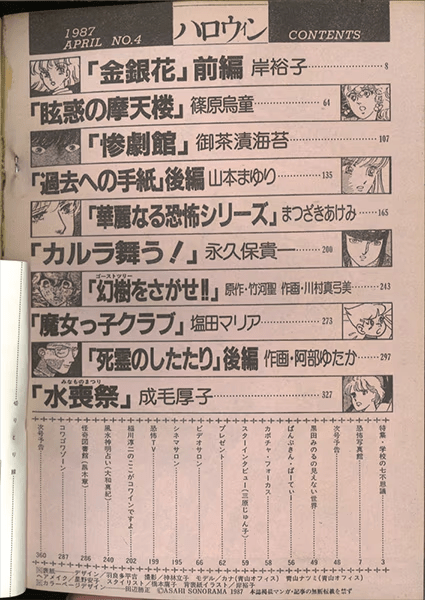
Herbert West can be seen, second row from bottom.
Director Stuart Gordon’s Re-Animator (1985) arrived in Japan on 14 March 1987 under the title “ZOMBIO/死霊のしたたり” (“Zombio/Dripping of the Dead”). Not coincidentally, in the March and April 1987 issues of Monthly Halloween, the story was adapted to manga by Abe Yutaka (阿部 ゆたか), probably better known to US audiences for his work on Detective Conan, who had previously adapted Day of the Dead (1985) for the magazine, which also had its Japanese release around the same time. The 64-page adaptation follows the film fairly closely, with a few artistic concessions given the intended audience, the younger characters (Herbert West, Dan Cain, and Megan Halsey) given more stereotypical teenaged appearances compared to the older characters.

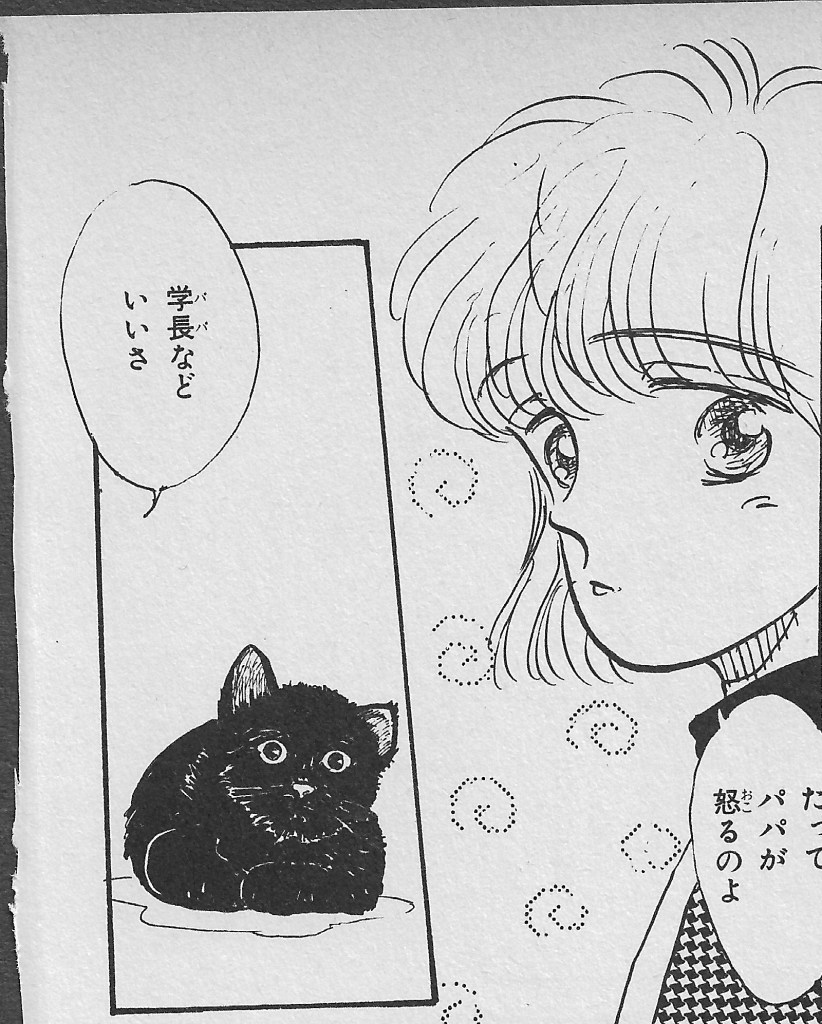
The nuances of the actors’ performances don’t really translate, but the somewhat slapstick action does, aided in no small part by an unflinching ability to depict a bit of gore and some common manga visual rhetoric that helps sell frantic energy and motion.
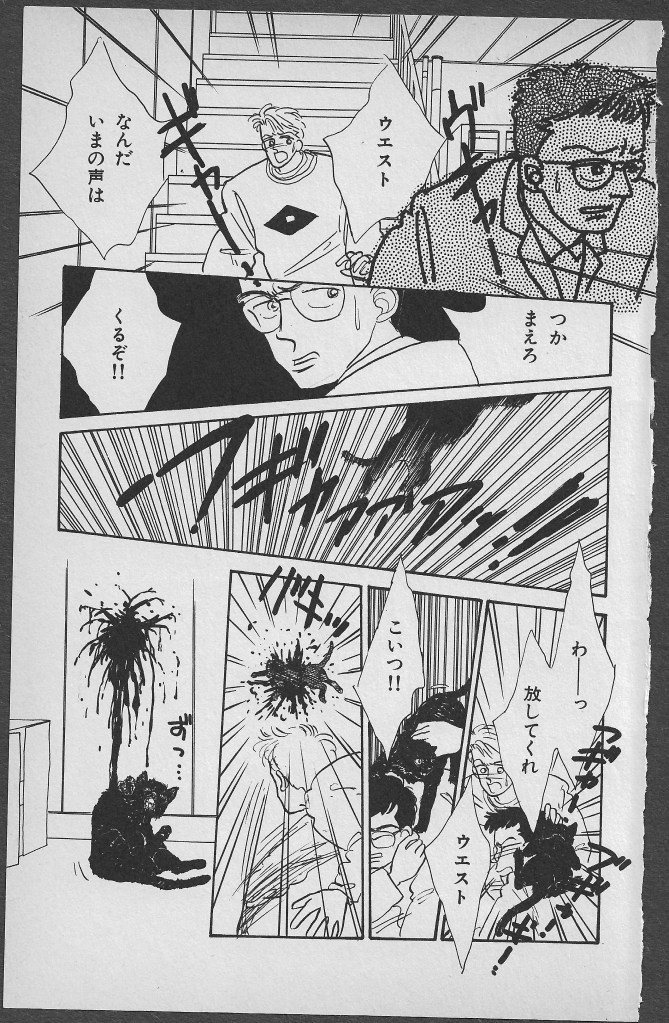
Top Panel:
Dan Cain: West! What is that sound?Second Panel:
Herbert West: Grab it! Here it comes!Third Panel:
<<Scream>>Bottom row, right to left:
West: Ouch! Let go of me!
Dan: West!
West: Damn thing!
<<Splat>>
The pacing is also kept up fairly well; while there might be a bit more emphasis on the Re-Animator sub-plot where Dr. Carl Hill is trying to convince Dean Halsey to give him Megan, balancing that romance angle, they don’t skimp on the actual reanimation, even if it lacks some of the visceral oomph of the film.
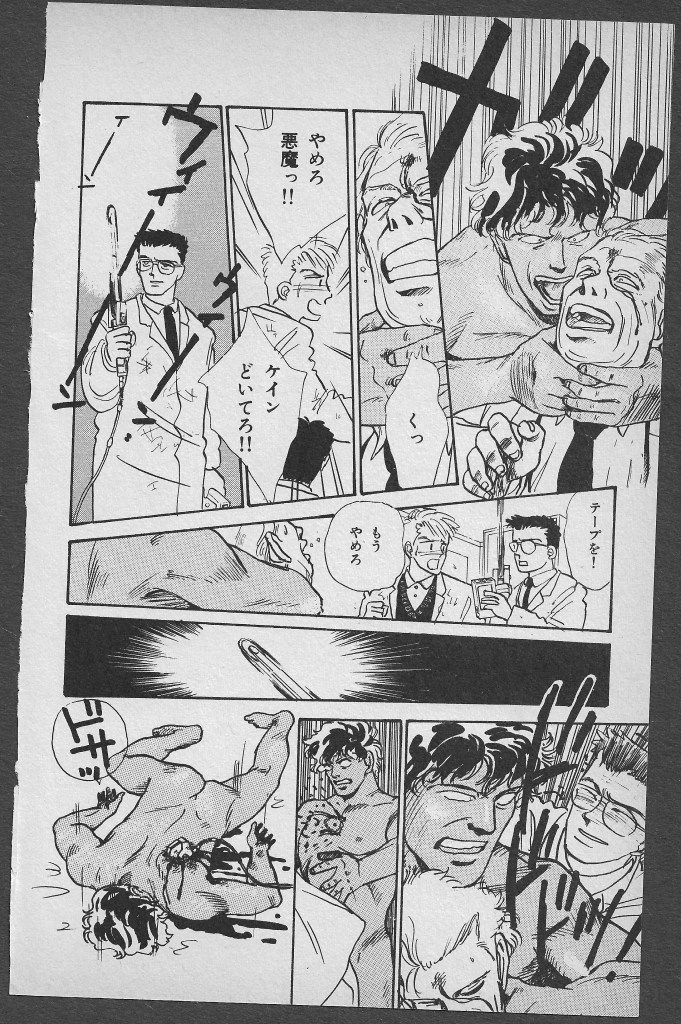
Top row, right to left:
<<choking sound>>
<<gulp>>
Dan: Get off him!!
West: Move aside, Cain.
<<buzz>>Second row:
West: Keep the tape running! Take it, man.Bottom row:
<<cutting noises>>
While the likenesses of the leads aren’t particularly close to the original actors, the faces are expressive and convey a lot of the emotion of the scenes, and Abe made sure to include many of the now-iconic shots from the film.
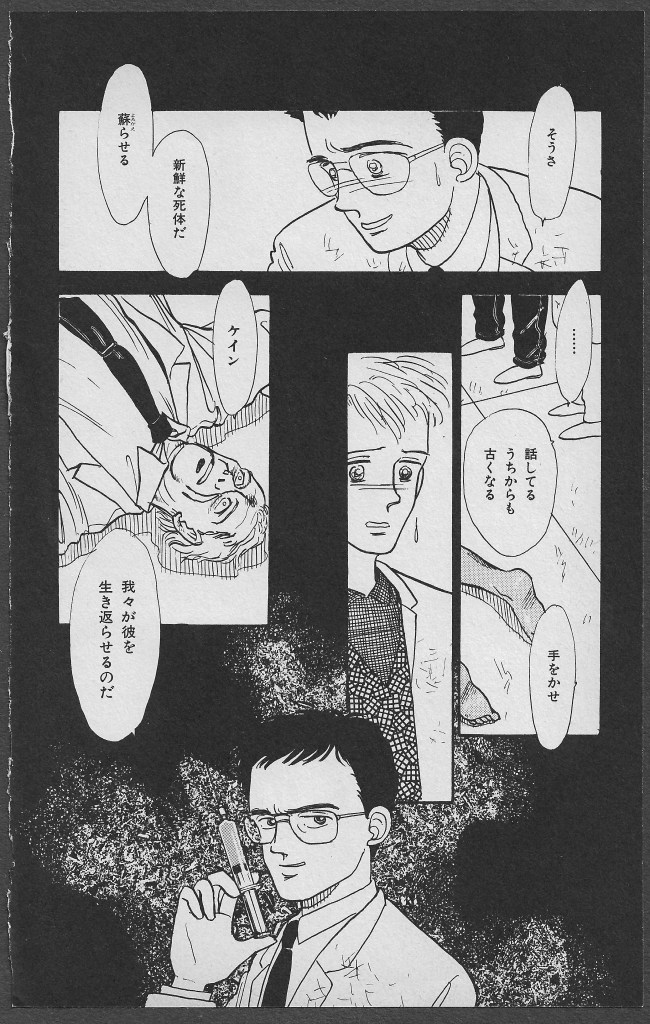
Top row, right to left:
West: You know… this is a fresh corpse. Let’s revive it.Middle row, right to left:
West: As we speak, the corpse gets older. So give me a hand.
West: Cain. We will bring him back to life.
Omissions, there are a few. The infamous visual pun of the “head giving head,” which featured so prominently on some of the Japanese posters for the film (and the Ghana hand-painted equivalents) was rendered inert by keeping Megan Halsey fully clothed.
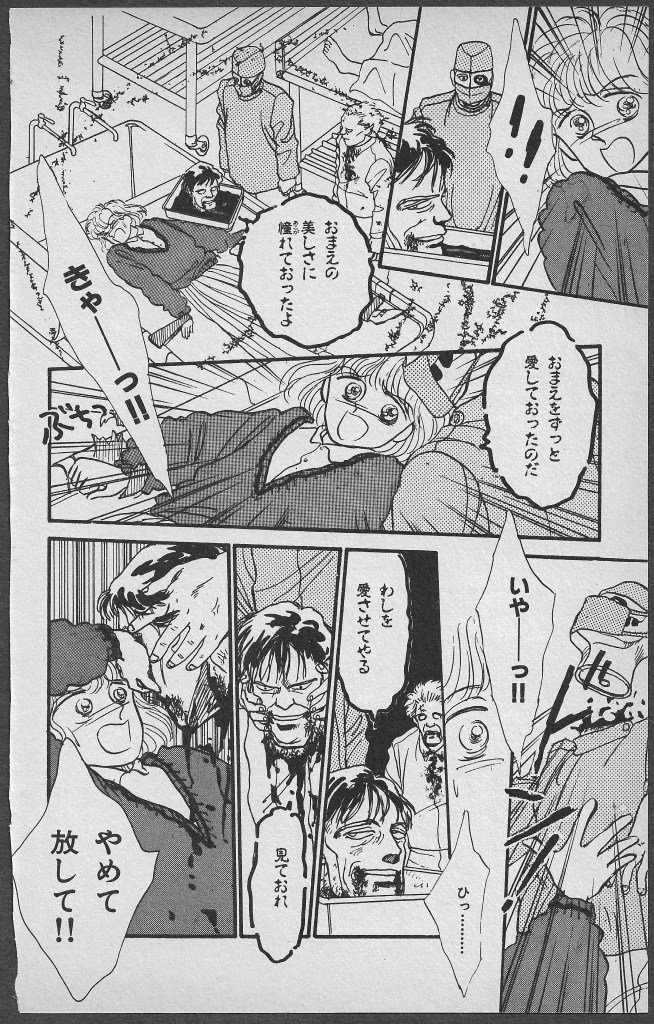
Top row, right to left:
Megan Halsey: !!
Dr. Carl Hill: I was always attracted to you…
Megan: NOOO!!Middle row:
Hill: I have been in love with you for a long time!Bottom row, right to left:
Megan: No!! Please…
Hill: Let me love you.
Hill: Look.
Megan: Stop it! Let me go!!
The emphasis on looking into Hill’s eyes is a reflection of a sub-plot in the film that is sometimes overlooked, that Dr. Hill has developed the power of mesmerism or hypnotism. A bit corny, but it gives him more agency than just as a disembodied head, and is implicitly how he can control his headless body through sheer will. It’s easy to see how the emphasis on the quasi-love triangle between Megan, Hill, and Dan might have appealed in adapting this story to an intended audience of young Japanese women.
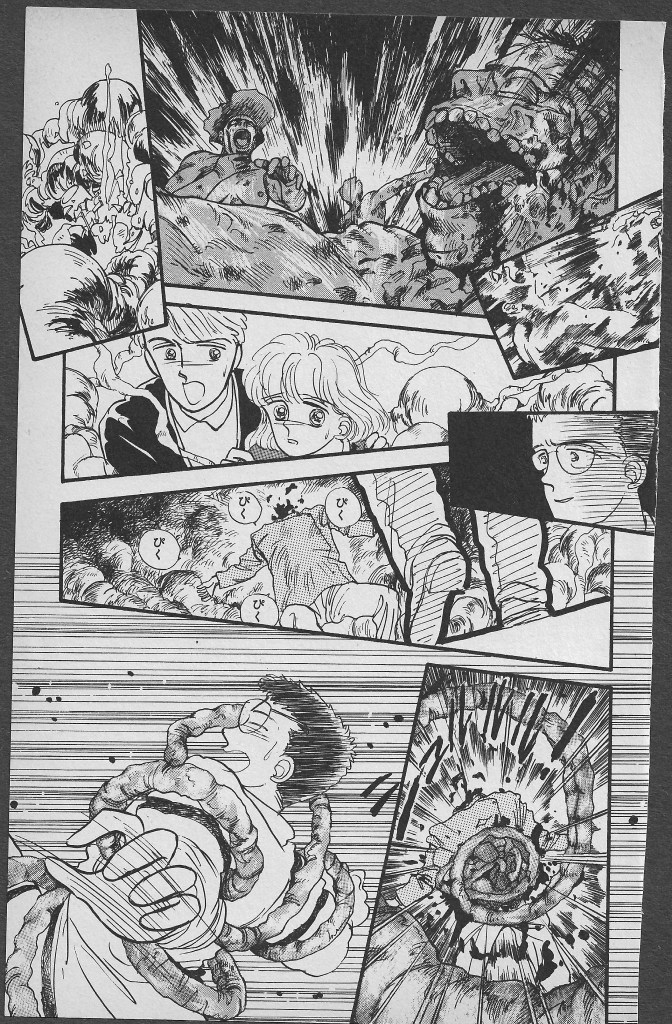
The big action scene in the morgue is a bit perfunctory, although Abe covers all the critical moments:
Fortunately, Abe and the editors of Monthly Halloween didn’t try to bowdlerize the ending. As in the original film, Dan Cain is left with a dead girlfriend and a choice:
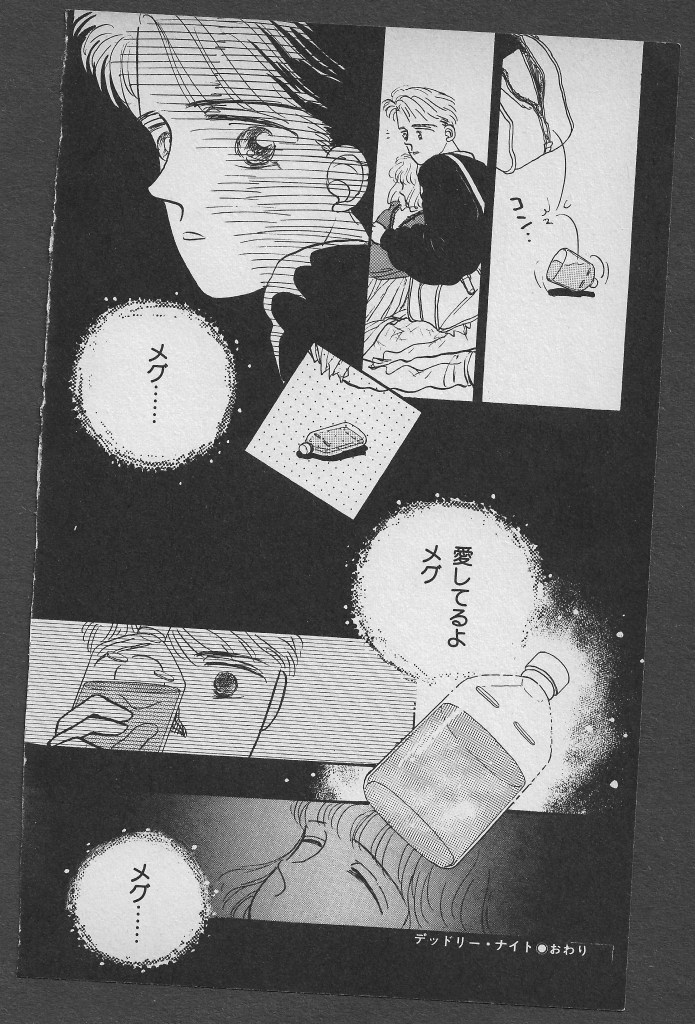
Top to bottom, left to right:
<<tink>>
Dan: Meg…Dan: I love you Meg.
Dan: Meg…
Given the limitations of the medium—it would have been nice if they could afford a splash of luminescent green for the reanimation serum—this is a very solid adaptation of the film. There isn’t any indication that Abe Yutaka had access to the 1985 novelization of the film by Jeff Rovin, and it predates the first English-language Re-Animator comic adaption from Adventure, which ran in three issues in 1991, and had the advantage of a larger page size and color.
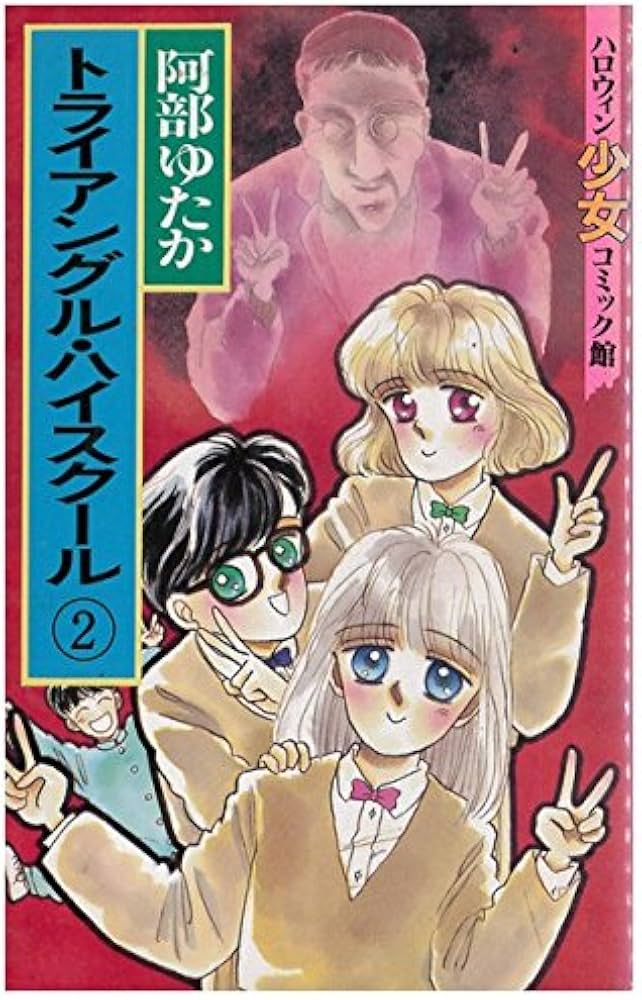
“ZOMBIO/死霊のしたたり” was reprinted in the back of トライアングル・ハイスクール 2 (Triangle High School 2), which collects another of Abe Yutaka’s series from Monthly Halloween; the first volume also collects Abe’s adaptation of Day of the Dead. Other than that, however, the Japanese manga adaptation of Re-Animator doesn’t seem to have been reprinted; it has never been officially translated into English, although raw scans have circulated on the internet for years.
With thanks and assistance to Dr. Dierk Günther of Gakushuin Women’s College for assistance and translation of the Japanese original.
Bobby Derie is the author of Weird Talers: Essays on Robert E. Howard and Others and Sex and the Cthulhu Mythos.
Deep Cuts in a Lovecraftian Vein uses Amazon Associate links. As an Amazon Associate I earn from qualifying purchases.

 Deep Cuts in a Lovecraftian Vein