Historical Racism
This miscellany includes excerpts from period newspapers, one of which (“Iwo Jima & Innsmouth”) contains historical racism and racist language. As such, please be advised before reading further.
Any tool is also a toy. The only question is whether you’re using it for work or for play. When it comes to online newspaper archives, they are a wonderful tool that has made available a vast amount of minute detail of the past that would otherwise be inaccessible to the average researcher. They are also, however, vast fun if you’re in the right mindset—because newspaper writers are inherently creative, highly literate, hungry for content, and often have a wonderful sense of humor. The result is bits and pieces that are often bizarre or brilliant, though sometimes sober and horrific.
Most of them are effectively noise when considered in terms of “serious” research into Lovecraft’s life, but as a reflection of the growing popularity of Lovecraft and the influence of his work, they stand out as tide water marks: examples of the spread of awareness of Lovecraft and his work. They are sometimes incredibly fun, if only because of how weird they are. I’ve culled out a dozen of the best clippings to showcase the wacky and sometimes fascinating Lovecraftian oddities that have appeared in newspapers over the past century.
Quick links for readers who want to jump to a particular clipping:
- The Wood Demon (1930)
- A Quote from the Necronomicon (1937)
- Robin Hood, Bran Mak Morn, and Cthulhu (1937)
- Lovecraft & Whippoorwills (1945)
- Iwo Jima & Innsmouth (1945)
- Lovecraft & Hitler (1945)
- Lovecraft’s Men From Pluto (1955)
- Apocryphal Alhazred (1960)
- A Lovecraftian Cipher (1968)
- Necronomicon For Sale (1972)
- Old Ben Lovecraft (1978)
- Lovecraft, C. M. Eddy, Jr., and Dark Swamp (1995)
The Wood Demon (1930)
Bangor Visitor Tells Odd Yarn Of North Woods
“Are strange stories ever enacted in the North woods? repeated an old-time lumberman from the Ashland district, who has been spending a few weeks in Bangor. “Well, I know one—as weird a yarn as ever was told. If you print it, people will say either that I tried to ‘kid’ you or I should be examined by an alienist; and yet, in my own mind, I believe it true.
“I can’t say from personal experience, for it happened at least 75 years ago. but it’s a tradition among some of the old lumbermen, and it’s been handed down from father to son. Personally, I’m not imaginative, and I don’t believe in any kind of ghosts. I never read Edgar Allen [sic] Poe or Ambrose Bearce [sic] or Harold [sic] Lovecraft. Yet here, as I heard it from many lips, was a tale like Bearce’s [sic] ‘Damned Thing’ and Lovecraft’s ‘Dunwich Horror’ rolled into one.
“Seventy-five years ago, then, in the lumber camps of the great woods and on lonely, outlying farms, hroses and cattle were being slaughtered in considerable numbers. Always it was done in the same way—their throats were ripped open, as though from the teeth of some savage dog or wild animal. And yet gradually, through the countryside, there spread a belief that it was not an animal at all. Tracks sometimes were left near the stables or tie-ups—tracks something like those of a man’s bare foot, and yet were not a man’s. Sometimes a shadowy form, ape-like and hairy, was seen gliding through the darkness—or so imaginative persons said. But the cries of the cattle were real and tangible; and the following morning—for few dared venture out in the dark—always disclosed that the ‘wood demon’, as some called him, had been at his deadly work.
“Finally there arose one who loudly announced he didn’t care for man or devil; he was going to get to the bottom of the mystery, if it was the last thing he did in the world. I don’t recall just what led this man to suppose that, on a certain night, he was due for a visit from the strange marauder. But the story goes that he insisted on staying in the tie-up, and so became the one human witness of the horror that followed.
“The hours passed; nature had never been more placid or calm. And the man was about to return to camp, laughing at himself for having believed in old wives’ tales, when—the thing happened.
“It was a clear night, and a ray of moonlight fell through a hole chopped in the roof that the steam rising from the cattle might escape—a crude but popular system of ventilation in those days. And through this hole, filtering through the moonlight and the shadows, came as strange an object as ever found its way from the Inferno. It was like a huge ape, yet the man swore it was not an ape; it was like a man yet it was not a man; it had hairy, strangely contorted limbs, and cruel teeth that gleamed in the darkness—for the man had put a burlap bag over the lantern he carried.
“It sprang upon the cattle, ripped open their throats, drank of their blood, and disappeared through the roof—as an ape might have done. But, as I have told you, it was not an ape. And the man who had said that he feared nothing in the world just stood there in a corner, a high powered rifle in his hand, too paralyzed by fright to so much as stir. He said afterward that, even had the Thing turned and attacked him, he couldn’t have moved a muscle.
“What was the thing? I don’t know! I never heard how the story ended; but I believe the mystery was never solved. if there is any moral, it is simply that it points the truth of what Hamlet said: ‘There are more things in Heaven and earth, Horatio, than are dreamt of in your philosophy.'”
One seldom thinks of vampiric sasquatch as having anything to do with H. P. Lovecraft. Yet vampirism of animals is a key plot point of “The Dunwich Horror” Weird Tales (Apr 1929); just as an orangutan formed an essential feature of Edgar Allan Poe’s “The Murders in the Rue Morgue” (1841), and an unseen menace is the key to Ambrose Bierce’s “The Damned Thing” (1893). One suspects that the errors in the names of Edgar Allan Poe, Ambrose Bierce, and Howard Phillips Lovecraft are probably intentional, to give an air of rusticity to a tale that is probably fabricated out of whole cloth. No name is given for the author of the piece, and it may have been a friend or friend-of-a-friend of Lovecraft. Whoever it was had at least a modest affection for weird fiction.
A Quote from the Necronomicon (1937)
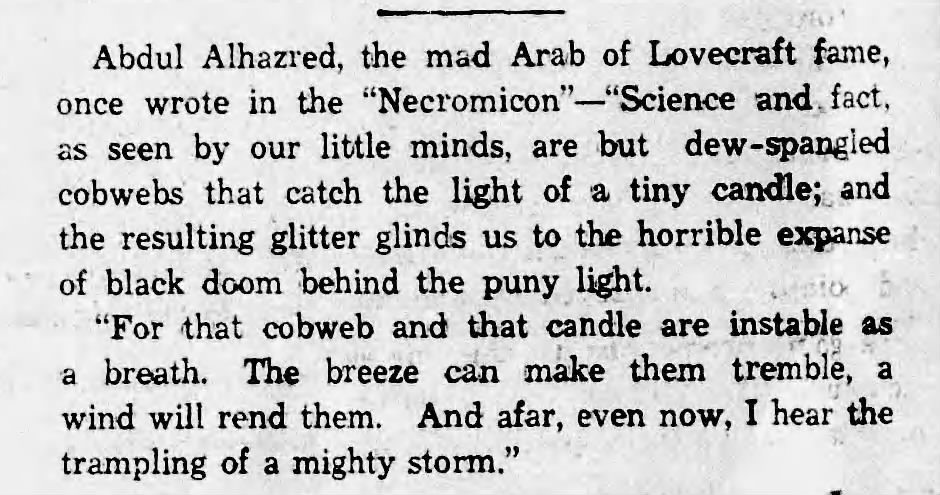
Abdul Alhazred, the mad Arab of Lovecraft fame, once wrote in the “Necro[no]micon”—”Science and fact, as seen by our little minds, are but dew-spangled cobwebs that catch the light of a tiny candle; and the resulting glitter [b]linds us to the horrible expanse of black doom behind the puny light.
“For that cobweb and that candle are instable as a breath. The breeze can make them tremble, a wind will rend them. And afar, even now, I hear the trampling of a mighty storm.”
The Knob Noster Gem was a small local paper; Dan Saults was the publisher, editor, and probably wrote a good chunk of the daily output. Judging by this little space-filler figment, he was also a Lovecraft fan.
Robin Hood, Bran Mak Morn, and Cthulhu (1937)
Friar Haw Foresees The Twentieth Century
As Robin Hood’s Prophet Might Have Outlined The Ills Of Our Day
by L. W. S., Eaton, O.
Sherwood forest was aflame with the torches of autumn, bringing all of its robust life. Robin Hood and his merry men had cast aside every care and fathered again beneath the mighty brown oaks and beeches. The silver tang of life was in the air and lusty merriness was in the hearts of Robin’s men.
Of course they were spilling great quantities of the favorite cool brown ale down their throats and singing its praises until the song rang and echoed far down the dark rows of mossy tree trunks, as jolly Friat Truck continually banged his tankard on the rough oak table, swinging his head from side to side.
And brawny Little John Arose, flinging the rumble of his deep bass into the depths of Sherwood forest:
So, laugh lads, and quaff lads
‘Twill make you stout and hale,
Thro’ all my days I’ll sing the praise
Of brown October ale.Really Robin Hood had called his men together for the purpose of hearing once again the strange prophecies of Friar Haw, but he always had to allow them their little fling first, as a prelude. The men had arrived at some degree of respect for the words of Friar Haw, and they usually sat engrossed. Even the snorts of Friar Tuck had grown fewer.
Friar Haw, grim and ascetic, had been taking Robin’s men into the dream-world of the 20th century. Today he had sat oblivious of the roistering men, his face like a white autumn sickle moon. The men could see that he wasn’t going to talk today about streamlined chorus girls and elaborate movies.
He arose. “Few people,” he began, “who shall live in the 20th century shall realize fully the abysmal depths to which the world conflict in the early part of that century shall plunge the races with the blood of long centuries in theri veins. yea, dark forces of life, far more ancient than the ancient oaks of Sherwood, as ancient as the ideas of Chthulhu [sic], Yog Sothoth, Gol-goroth and the blood of the Gaelic, Cymric and Teutonic. The king of the Dark Empire of the Stone Age, covered so long by the imposition of a new god called Reason, shall break loose again in the emotional abandon of those dark years of 1914-18, and shall continue long afterwards.
“The surface of the collective civilized mind shall be torn adunder and the long-buried emotional elements of the days of a Bran Mak Morn shall break loose, and the 20th century would shall be puzzled and at a loss to understand what forces are driving men.”
“And,” interposed Little John, who had a common sense kind of mind, “what are you driving at, or trying to say? It sounds crazy to me.”
“Oh, doubtless!” said Friar Haw, his sickle face growing a shade colder. “Yet the original minds of the 20th century shall see that strange things are happening. Now, in the country called Germany, age-old psychic forces break loose again. Wotan, who is half rage and frenzy and half seer who understands ‘the runs and interprets destiny.’ Wotan shall be personified in a man named Hitler, a strange figure whose reasoning shall be guided by very, very ancient emotional forces.
“You are to remember that men taken collectively in a nation are not dominated by reason. A wise man of that century shall say: ‘Where the mass rather than the individual is in motion, human control ceases. And at at that point the archetypes begin to operate.'”
“In Germany the stormy personality of Wotan shall come to life again in the youth movement. The waking will be celebrated with the slaughter of more than one sheep. Aye, men called Nietszsche, Schuler, Stephen George and Klages shall anticipate the waking, as shall one called Richard Wagner put it into his music.
“But I have taken only Germany as one example in the Old World, where the 20th century shall see the troubled awakening on every hand of the most ancient archetypes, the most powerful emotional forces. Frightened men shall shout ‘Peace! Peace!’ where there shall be no peace. men shall come to understand somewhat the things that Wotan whispered through Mimir’s head. mean shall come to appreciate what Valhalla means, and the Valkyries and the Fylgjur.”
Whereupon Robin Hood jumped to his feet and shouted: “Engouh for today! I’d rather go and rob a bishop. This chatter makes me uneasy inside.”
“Yes,” came from the sickle autumn moon face of the prophet, “it is a far cry from your simple Sherwood forest and your October ale drinking. yet it shall be the sap in the roots of your Sherwood conflicted with a conflict of world cultures.”
This is fanfiction. Yet L.W.S. (Leonard W. Sharkey) of Eaton, Ohio must have been a serious fan indeed, to weave references to Lovecraft (Cthulhu, Yog-Sothoth) and Robert E. Howard (Gol-goroth, Bran Mak Morn) into his narrative of Robin Hood in Sherwood Forest, on the run-up to World War II. A likely inspiration for these references is “The Children of the Night” (Weird Tales Apr-May 1931) by Robert E. Howard—which is probably the only story at the time that mentions Cthulhu, Yog-Sothoth, Gol-goroth, and Bran Mak Morn all in the same tale. Sharkey did at least one more Robin Hood/Friar Haw tale, albeit without Mythos references (The Camp of Robin Takes A Forward Look).
Lovecraft & Whippoorwills (1945)
Whip-poor-wills will remind some readers of the stories of the late H. P. Lovecraft.
You never heard of Lovecraft?
Many persons have not, but they will, in time, and all through the affectionate remembrance of two young men in Wisconsin.
They founded a press to put his stories sold to pulp magazines into book form. Extremely limited editions have made these books collectors’ items.
Lovecraft’s tales are somewhat Poe-like in character. They are laid in New England, and bring in visitors from “the outside,” strange beings always ready to push into our own known world.
Some of the stories incorporate the whip-poor-wills, which set up a constant cry, according to legend, every time one died.
If they missed getting his soul, they screamed unusually loudly, and then died out. In this way it was possible to tell what happened to the departing soul.
In 1939, August Derleth and Donald Wandrei founded Arkham House in Wisconsin to publish the work of H. P. Lovecraft in book form. It was a beginning to establish Lovecraft’s literary legacy, and awareness of the Providence-born horror writer was slowly trickling out into public awareness, although this was slow going, and involved many misunderstandings.
Whippoorwills are a key example. They only feature in one of Lovecraft’s stories, “The Dunwich Horror”; but the idea seems to have appealed to August Derleth, who incorporated the idea of the whippoorwill as psychopomp in several Cthulhu Mythos stories, notably the novel The Lurker at the Threshold (1945). Derleth’s repetition of the idea—and articles like this one—contributed to the spread of certain basic conceptions (and misconceptions) of what Lovecraft wrote.
Iwo Jima & Innsmouth (1945)
Journalettes
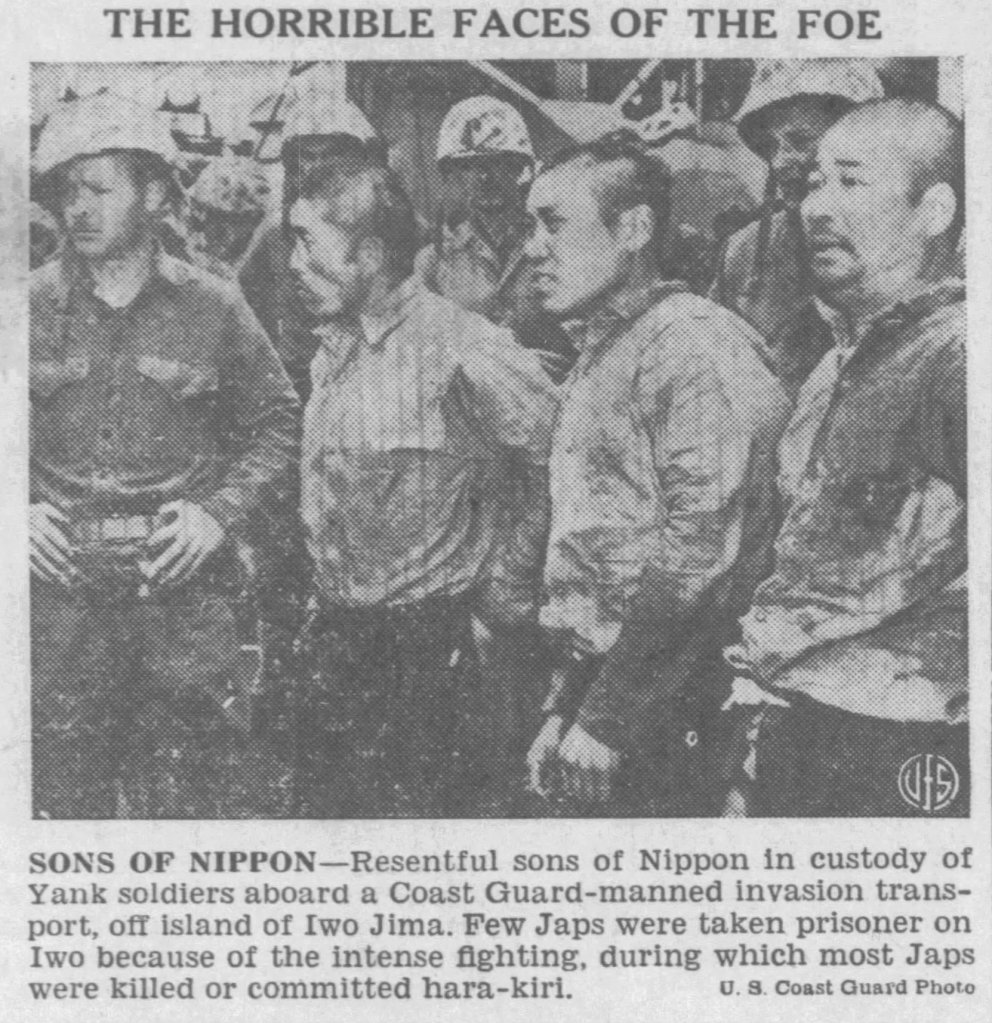
by Charles B. GordonFriday, this newspaper used a cut of three Japanese prisoners, taken on Iwo Jima, and their American guards. The three Japs were three of the most repulsive looking human beings whose faces we have ever gazed upon.
. . . — V . . . —
We think he’s dead now, but some years ago, there was a writer named H. P. Lovecraft. This voracious reader made acquaintence with his works through the current 25-cent pocket books, but it is our belief that most of his output was printed first in pulp “horror” magazines. At any rate, he was the greatest master of the “horror[“] story specializing in stories about beings, things, or whatever you might want to call them, which emerged from places under the earth, under the water, or from ages thousands of years past, but were generally possessed of at least a few human qualities, enabling them to “get by” on the earth of the present day.
. . . — V . . . —
The pictures of those Japs taken on Iwo Jima gave us for the first itme a partial realization of what the creatures of such books of Lovecraft’s as “Weird Shadow Over Innsmouth” and “The Dunwich Horror” must have resembled.
War doesn’t just breed prejudice, it encourages its expression. The enemy is described in terms that downplays or denies their humanity. As things instead of people. The bloody battle of Iwo Jima ran 19 February–26 March 1945. Casualties were horrific, especially on the Japanese side; of 20,933 troops, only 216 Japanese were taken prisoner from the main battle, with an additional 867 taken prisoner post-battle. A photo of three such prisoners was made available to the press—men who, like their counterparts in the US military, had served their country, be it right or wrong, and lived through a terrible and terrifying conflict.
The racist depiction of Japanese military and civilians was sadly common—though as far as I have found, this is the first and only instance where they were compared directly to Lovecraft’s Innsmouth folk during the conflict.
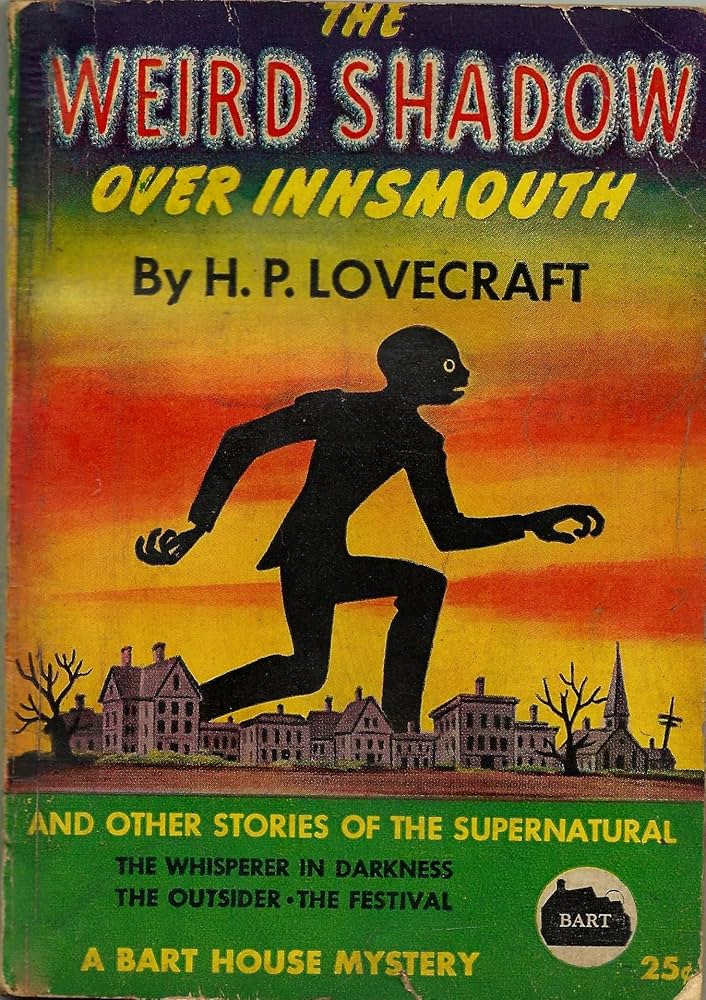
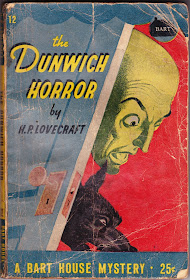
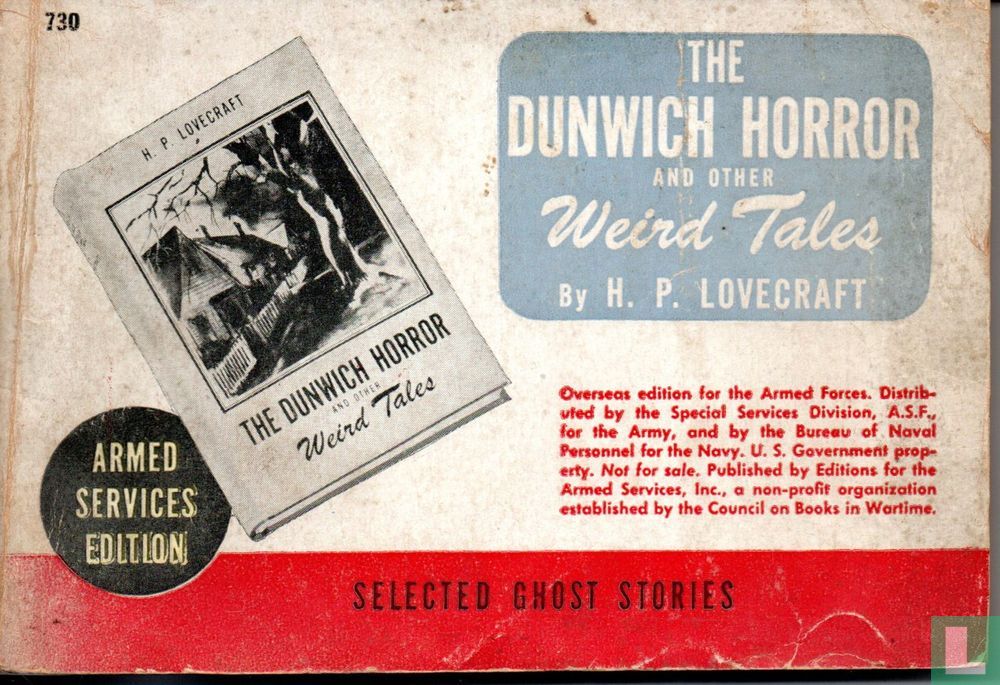
Paper shortages during World War II put a severe crimp in the publishing plans of Arkham House, but also opened up other opportunities. Bartholomew House was a small New York publisher that put out two cheap (25 cents) paperback editions of Lovecraft with the permission of Arkham House: The Weird Shadow over Innsmouth (1944) and The Dunwich Horror (1945). Another cheap paperback readily available to the military was the Armed Services Edition of The Dunwich Horror and Others (n.d., 1945?). These books helped spread the word of Lovecraft during the war years—and beyond.
Lovecraft & Hitler (1945)
Two pieces appeared in the Chicago Tribune in April 1945 which tied Lovecraft to the ongoing world war.
Werewolf Hunt
The werewolf myth, which the frenzied and frightened Nazis threaten to revive as a romantic disguise for a post-war assassination cult, has haunted hte lower levels of the human mind since the era of the cavemen. Its roots are in primitive cannibalism. The word means man-wolf; that is, a betwitched creature which has human form by day and lupine hide, teeth, and appetite by night. The superstition is one of the unwholesome ideas that have survived from pre-history among European peasants to provide material for folklorists and themes for authors who have a bent toward the weird, grotesque, and horrible.
* * *
Hitler, whose career has a werewolfish flavor, comes froma stock in which this notion was likely to breed and influence character. We quote from his best and msot objective biographer, Konrad Heiden, who says in “Der Fuehrer” while discussing his pedigree:
“The Waldviertel in lower Austria, from which both the Hitler and Pölzl families came, is a gloomy, remote, impverished section; like many such regions it has no lack of superstitions and ghost stories. The ancestors were mostly poor peasant people; ‘small cottager’ often stands in the church records.”
* * *
The myth is closely related to the vampire bugaboo, and, therefore, in the novel called “Dracula,” a veritable case book of vampirism, you will find werewolves as auxiliary phantoms. The anthologies of terror stories which ahve become quite an article of commerce in the war time book trade contain numerous examples of werewolf tales. We expect to find out in “Best Supernatural Stories of H. P. Lovecraft,” edited by August Derleth and new on the counters.
* * *
To kill a werewolf according to the folklore formula, yo umust use a gun that has been blessed at a shrine of St. Hubert and fire a silver bullet.
In this, the unnamed newspaper writer would be disappointed. Vampires and werewolves were not Lovecraft’s normal schtick. However, we know that they did read the new collection—and the horrors in those pages probably compared to those that came in over the news wire. U.S. forces liberated the Buchenwald concentration camp on 11 Apr 1945.
Powers of Darkness
The lifting of the curtain on the massive horrors of Germany’s prison and concentration camps recalls the supernatural tales of H. P. Lovecraft, a writer who was relatively unknown until August Derleth undertook his popularization. To conjure up the mood of unearthly terrors, Lovecraft invented the mythology of Cthulhu in which there are many monstrous spirits of evil, forever seeking to take possession of this planet.
* * *
Lovecraft wrote of his work: “All my stories, unconnected as they may be, are based on the fundamental lore or legend that this world was inahbited at one time by another race hwo, in practicing black magic, lost their foothold and were expelled, yet live on outside, ever ready to take possession of this earth again.”
* * *
Perhaps Cthulhu has come back, thru the cracks in Hitler’s mind. Lovecraft, who died in 1937, would be staggered by the revelation.
* * *
During his lifetime, Lovecraft’s work appeared in pulp paer magazines, chiefly in Weird Tales. Arkham House of Sauk City, Wis., a publishing enterprise over which August Derleth presides, has been assembling this scattered material and putting it between covers in limited editions. A collection of 14 tales, regarded as the best of Lovecraft’s 50-odd, was recently issued by the World Publishing company. Derleth, its editor, says in his introduction:
“The weird tradition was particularly his. In the scarcely two decades of his writng life he became a master of the macabre who had neither peer nor equal in America. . . . It has been said of ‘The Outsider’ that if the manuscript had been put forward as an unpublished tale by Edgar Allan Poe, none would have challenged it.”
—Chicago Tribune, 27 Apr 1945, p14
Lovecraft never wrote that “black magic” quote. The unnamed author of this little piece is drawing on The Best Supernatural Stories of H. P. Lovecraft (1945). To place Lovecraft’s horrors with those of Nazi Germany is understandable, journalists must have grasped for any straw of comparison. Three days after this was published, Adolf Hitler committed suicide.
Unlike many of these small newspaper pieces, another journalist picked up on this thread and glossed it in another paper:
Powers of Darkness
The lifting of the curtain on the massive horrors of Germany’s prison and concentration camps recalls the supernatural tales of H. P. Lovecraft, a writer who was relatively unknown until August Derleth undertook his popularization, says a Chicago Tribune column. To conjure up the mood of unearthly terrors, Lovecraft invented the mythology of Cthulhu in which there are many monstrous spirits of evil, forever seeking to take possession of this planet.
Lovecraft wrote of his work: “All my stories, unconnected as they may be, are based on teh fundamental lore or legend that this race [sic] was inhabited at one time by another race who, in practicing black magic, lost their foothold and were expelled, yet live on outside, ever ready to take possession of this earth again.”
Perhaps Othulhu [sic] has come back through the cracks in Hitler’s mind. Lovecraft, who died in 1937, would be staggered by the revelation.
It is like a telephone game, as Derleth’s jumbled quote gets increasingly jumbled with every step. Yet the tying-together of Lovecraft and Hitler in this instance shows how relevant Lovecraft’s fiction could be, how plastic and adaptable his work was to a new syntax—and how new editions helped spread knowledge of Lovecraft and the Mythos to new audiences.
Lovecraft’s Men From Pluto (1955)
Space Travel
Friday Dr. Wernher von Braun, an expert in the field of astrophysical and astronomical lore, spoke at Rensselaer Polytechnic Institute. he talked chiefly of efforts being made to study the areas beyond the earth’s atmosphere. he talked of artificial satellites and of space travel, topics which tickle the imagination of young and old alike in these days of scientific discussion.
Dr. von Braun asserted that there was no doubt of the capacity of man to leave earth, point toward the moon, circle it and return to earth again. As one who is an expert in the designing of rocket propellants and in all the developments in this sphere he speaks with authority. He insists that we know enough now to launch a space ship and be reasonably sure of its safe voyage moonward and its return.
To the layman all this is fantasy. How can man survive in the intense heat which must exist beyond the atmosphere? How can direction be assured where there is no air friction against which rudders can press when a craft is to be turned? We have to ahve water to direct a ship, air to direct a plane. What possiblity of management exists in the ether where every object runs free?
And to make such a voyage the start must be swift. Through the great spaces where there is no atmosphere presumably the speed would not generate sufficient heat to decompose the ship. But what about the start and the finish? How can the ship begin its flight without at least a speed of 5,000 miles an hour? And how can it be toned down to reason when it returns to the lst hundred miles of its voyage?
We are still skeptics on the whole matter. Those who say such a trip to the moon is possible are the delight of the small boy and the radical scientist. but to the down-to-earth citizen, accustomed to keep his feet on the ground or rise only moderately above it, the natural comment is a Bronx cheer. If such a voyage is possible today, as Dr. von Braun asserts, let’s get at it and stop expending our energies in talk.
The usual reply from the space scientists to such suggests is that the cost is tremendous and there is no source for the funds. That is a complete answer, the best in the world if discussion is preferable to achievement. We have heard people say you could abolish certain diseases in the world if had ten or fifteen billions to spend on them. We have noted those who think permanent peace could be achieved by the careful expenditure of a few hundred billions. The poist that there isn’t any such money so it is easy to talk about it.
If a space ship would cost a few billions there can be no space ship. it would not be worth the price. The scientists, instead of telling us such a craft is possible today, might better expend their time and energy in seeking ways of bringing their creations down to the possible range of expenditure. Otherwise space travel lies in the same domain as the weird tales of Jules Verne, Lovecraft’s story of the men from Pluto who visited earth or Wells’ novel about the coming of the Martians.
The Luna 3, the first spacecraft to manage a successful circumlunar trajectory, did so in 1959; the first manned trip in lunar orbit, however, was Apollo 8 in 1968. It turned out, probably much to the anonymous author’s chagrin, that there actually were billions of dollars to spend on the space race.
The reference to “Lovecraft’s story of the men from Pluto” is a bit bizarre; as near as I can tell this has to be a reference to “The Whisperer in Darkness” (Weird Tales Aug 1931), which featured the Fungi from Yuggoth. Who were about as far from the stereotypical 1950s humanoid aliens as one might imagine—but this is a good example of a typical misreading or misunderstanding. I wonder how many science fiction fans wondered where they could read about Lovecraft’s men from Pluto?
Apocryphal Alhazred (1960)
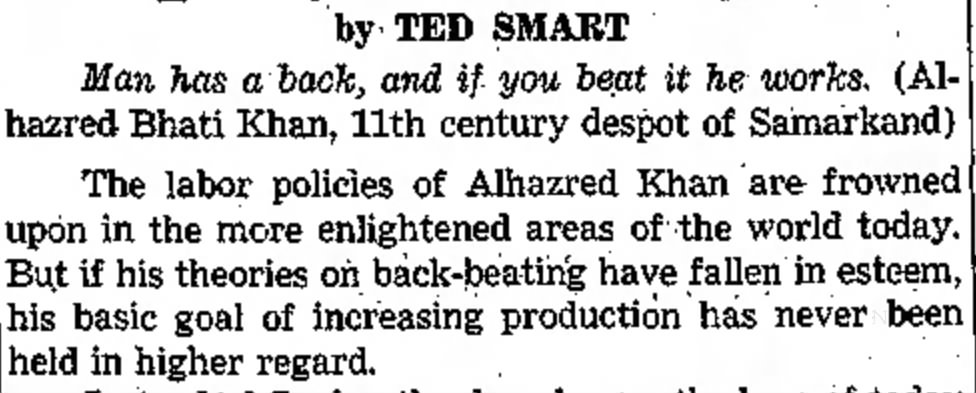
Man has a back, and if you beat it he works. (Alhazred Bhati Khan, 11th century despot of Samarkand).
The labor policies of Alhazred Khan are frowned upon in the more enlightened areas of the world today. But if his theories on back-beating have fallen in esteem, his basic goal of increasing production has never been held in higher regard.
The actual title of the piece was “Bosses ‘Whip’ Workers With Musical Gimmicks,” and it was about how employers use new psychological tools to manipulate the workplace and motivate their employees. However, the author Ted Smart apparently thought it needed a hook, and so created Alhazred Bhati Khan—who never existed—presumably by combining Lovecraft’s Alhazred, the Hindu word bhati (भाटी), and the Turkic or Mongolian title khan. Samarkand was a reality, however, and if anybody ever checked to see who was ruling it in the 11th century, they did more work than Ted Smart did. I have to wonder if any Lovecraft fans noticed.
Aside from the appearance in the Chicago Daily Herald, the article also appeared in the Arlington Heights (Illinois) Herald, 21 Jan 1960, p27, and possibly ran in other local papers in Illinois.
A Lovecraftian Cipher (1968)
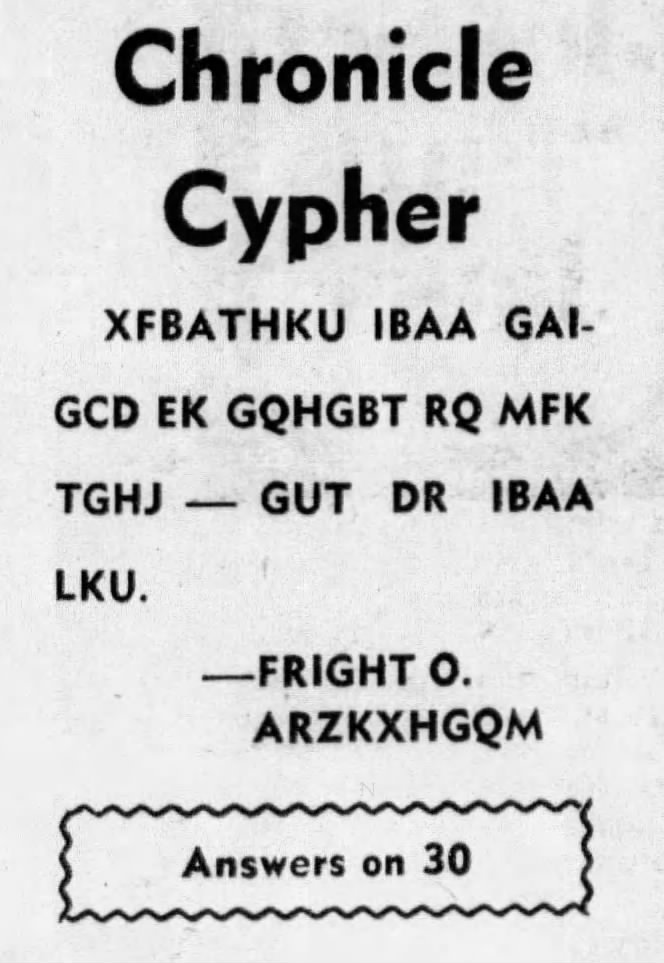
Cipher puzzles are fairly common amusements in newspapers, and have been for decades. As an exercise, they’re fairly simple substitution ciphers: each letter of the alphabet is replaced by another letter, to render what appears on the surface is gibberish. However, the relationship between the letters remains; and there are only 26 letters in the alphabet. Figure out a word or two, either by frequency analysis or trial and error, and the rest of the cipher alphabet falls in place pretty easily. In this case, the puzzle designer has been a little clever: one word has been encoded as the English word FRIGHT, which gives a hint to the solution of the puzzle.
The answer, on the other hand, is a bit of a cheat:
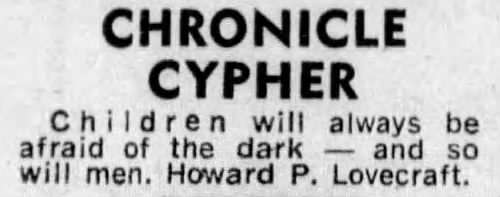
The answer is a cheat because this isn’t a real Lovecraft quote, but a highly abridged version of a line from Lovecraft’s “Supernatural Horror in Literature”:
Children will always be afraid of the dark, and men with minds sensitive to hereditary impulse will always tremble at the thought of the hidden and fathomless worlds of strange life which may pulsate in the gulfs beyond the stars, or press hideously upon our own globe in unholy dimensions which only the dead and the moonstruck can glimpse.
The reason why the full quote isn’t used is pretty obvious: space. While not intellectually any more challenger than the briefer text to decipher, 59 words is a lot more daunting in terms of sheer volume of words to be deciphered. On the plus side, at least Lovecraft wasn’t reminding the readers of the San Francisco Examiner to drink their Ovaltine.
Necronomicon For Sale (1972)
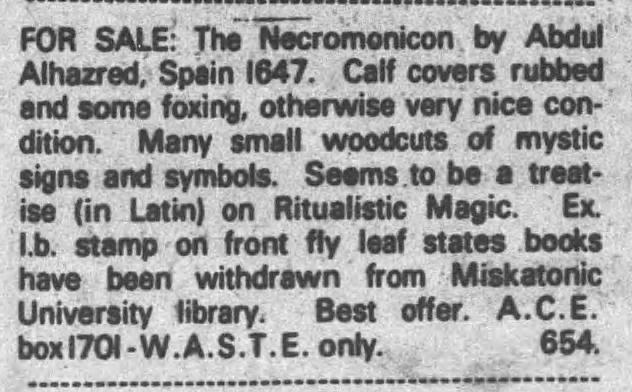
Tucked in at the end of a column of classifieds ads, just above a threat from the Mafia against a fratboy, this is one of a number of ads for a copy of the Necronomicon for sale that have cropped up here and there. Such hoaxes are classics of fan-activity, and vary from carefully-constructed and believable to error-ridden and silly. This one is fairly restrained and detailed, and the writer probably was familiar with Lovecraft’s “History of the Necronomicon,” which had been most recently republished in The Necronomicon: A Study (1967).
Such ads seem to have become rare after the first widely-available commercial Necronomicons began to hit the market in the 1970s.
Old Ben Lovecraft (1978)
Mulligan’s Stew
by Hugh A. Mulligan
AP Special CorrespondentRIDGEFIELD, Conn. (AP)—My old aunt used to say you never really know who your neighbors are until one day you read about them in the paper being appointed to the White House transportation staff or taken off in the patrol wagon for wife-beating or graduating with high honors from welding school.
And, by George, she was right.
This town, for instance, is chock full of interesting people, what you might call real characters just waiting to be discovered by some sharp-eyed reporter or a playwright in search of a sequel to “Our Town.”
Over on Ludlow Hill there’s a man who never in all his born days has seen a flying saucer. Old Ben Lovecraft has lived in these rocky, rolling hills of Connecticut for nigh onto half a century, since moving up from the Bronx, without catching so much as a glimmer of an outer world touchdown on his two acre zoned spread there behind the town dump.
The other night he thought he saw an eerie light reflecting from an elliptical shaped object in his driveway that wasn’t there when he took in the cat and turned off the carriage lamps. he put on his new Christmas cardigan, grabbed a flash light from the hall closet and made his way stealthily along the hedges bordering the garage. he could hear chattering and the sound of equipment being unloaded.
There in the moonlight, he saw five tiny creatures no bigger than a breadbox with enormous shiny eyes filing out of an aluminum cylinder. They fled in panic the instant his beam hit them.
“You know how racoons scamper after they’ve tipped over a garbage can to get at a turkey carcass,” Ben drawled in his matter of fact way. “I called the Air Force and they didn’t want to hear about it. They already had four people on hold with positive sightings.”
Fascinating fellow, Ben. A real skeptic. He’s seen “Star Wars” twice and “Close Encounters of the Third Kind” three times and doesn’t believe a word of either of them. […]
At the time of this writing, there are 91 hits for “Old Ben Lovecraft” on newspapers.com. The Associated Press spread the “Mulligan’s Stew” humor column far and wide. While some of the other bits and pieces mentioned above are diamonds in the rough, this is closer to what constitutes noise in search results. Half the country might have read about “Old Ben Lovecraft” between March and April 1978, when the article ran. Perhaps a few had a chuckle; the flying saucer craze of the 50s had given birth to the impressive big box-office sci fi spectacles of Star Wars (1977) and Close Encounters of the Third Kind (1977). No doubt a lot of the country had no idea why some folks got so excited.
Why Lovecraft? I suspect it was simply because Lovecraft was still known as a science fiction writer, and the “Old Ben” part was borrowed from “Old Ben” Kenobi in Star Wars. It’s also possible that the author simply wanted a distinctive name and typed out the first that came to mind; certainly a fan would probably have added a reference to Cthulhu in there at some point.
Lovecraft, C. M. Eddy, Jr., and Dark Swamp (1995)
What happened that night in the swamp?
Editors: I am in my 75th year of life as I write this, and I do not wish to allow a few things to pass unnoticed before I go. My mother, Muriel Eddy, was a gifted author; for several years she was the poet laureate of Rhode Island, the state in which we lived.
My father was also an author—of uncanny horror stories. he had a buddie named H. P. Lovecraft, the famous author of many books about strange things.
Lovecraft was a night person, and back in 1922 and 1923 he and my father would often walk through Providence’s Chinatown at midnight. One night they decided to go into the woods of the “great swamp” of Chepatchet, R.I., because they had heard that “It” (a ghost or monster) had been seen there.
Nobody knows whether or not they encounted the “It” being; they did survive their night in the great swamp, but neither would talk about it. I wonder to this day what they saw.
Clifford Eddy
Macon
Clifford Myron Eddy (1918-2003) was the only son of Clifford Martin Eddy, Jr. and Muriel Elizabeth Eddy. He was about 3-5 years old when H. P. Lovecraft came to the Eddys’ house, located a few miles away from his own in Providence, R.I. Too young, probably, to have much in the way of direct memories of Lovecraft, though no doubt he heard and read his mother’s and father’s stories, in works like The Gentleman from Angell Street (2001) by Muriel E. Eddy & C. M. Eddy Jr. and “Message in Stone” (1956) by Muriel E. Eddy.
Perhaps that telephone-game is why his facts are slightly garbled. For while Lovecraft and C. M. Eddy, Jr. did certainly survive the Dark Swamp in Chepatchet, they weren’t exactly silent about it. We have first-hand accounts from Lovecraft’s letters, a memoir by C. M. Eddy, Jr., and memoirs from Muriel E. Eddy, who would have had the facts from her husband. Unfortunately, the accounts do not all agree.
Lovecraft’s Version
In four letters written c. Oct-Dec 1923, Lovecraft mentions Eddy and Dark Swamp. These are the only accounts that were published at the time of the trip, and Lovecraft goes into some considerable detail.
I find Eddy rather a delight—I wish I had known him before. Next Sunday we are going on a trip which may bring you echoes in the form of horror-tales from both participants. In the northwestern part of Rhode Island there is a remote village called Chepachet, reached by a single car line with only a few cars a day. Last week Eddy was there for the first time, and at the post office overheard a conversation between two ancient rustic farmers which inspired our coming expedition. They were discussing hunting prospects, and spoke of the migration of all the rabbits and squirrels across the line into Connecticut; when one told the other that there were plenty left in the Dark Swamp. Then ensued a description to which Eddy listened with the utmost avidity, and which brought out the fact that in this, the smallest and most densely populated state of the Union, there exists a tract of 160 acres which has never been fully penetrated by any living man. It lies two miles from Chepachet—in a direction we do not now know, but which we will ascertain Sunday—and is reputed to be the home of very strange animals—strange at least to this part of the world, and including the dreaded “bobcat”, whose half-human cries in the night are often heard by neighbouring farmers. The reason it has never been fully penetrated is that there are many treacherous potholes, and that the archaic trees grow so thickly together that passage is well-nigh impossible. The undergrowth is very thick, and even at midday the darkness is very deep because of the intertwined branches overhead. the description so impressed Eddy that he began writing a story about it—provisionally entitled “Black Noon”—on the trolley ride home. And now we are both to see it . . . we are both to go into that swamp . . . and perhaps come out of it. Probably the thing’ll turn out to be a clump of ill-nourished bushes, a few rain-puddles, and a couple of sparrows—but until our disillusion we are at liberty to think of the place as the immemorial lair of nightmare and unknown evil ruled by that subterraneous horror that sometimes cranes its neck out of the deepest pot-holes . . . It.
—H. P. Lovecraft to Edwin Baird, c. Oct 1923, Letters to Hyman Bradofsky & Others 45
Lovecraft’s letters to Baird was published in Weird Tales (Mar 1924), and forms the first account in print.
My next trip, on which I had as a companion my new adopted son Clifford Martin Eddy, Jr., was on Sunday, Novr. 4; and led thro’ much the same territory as did my trip of Septr. 19 with out amiable confrere Mortonius. It was a quest of the grotesque and the terrible—a search for Dark Swamp, in northwestern Rhode-Island, of which Eddy had heard sinister whispers amongst the rusticks. They whisper that it tis very remote and very strange, and that no one has ever been completely thor’ it because of the treacherous and unfathomable potholes, and the antient trees whose thick boles grow so closelytogether that passage is difficult and darkness omnipresent even at noon, and other things, of which bobcats—whose half-human howls are heard in the night by peasants near the edge—are the very least. It is a peculiar place, and no house was ever built within two miles of it. the rural swains refer to it with much evasiveness, and not one of them can be induc’d to guide a traveller through it’ altho’ a few intrepid hunters and woodcutters have plied their vocations on its fringes. It lies in a natural bowl surrounded by low ranges of beautiful hills; far from any frequented road, and known to scarce a dozen persons outside the immediate country. Even in Chepachet, the nearest village, there are but two men who ever heard of it. Eddy discover’d its rumour at the Chepachet post office one bleak autumn evening when huntsmen gather’d about the fire and told tales and express wonder why all the squirrels and rabbits had left the hills and fled across the plain into Connecticut. One very antient man with a flintlock said that IT had mov’d in Dark Swamp, and had cran’d ITS neck out of the abysmal pothole beneath which IT has ITS immemorial Lair. And he said his grandfather had told him in 1849, when he was a very little boy, that IT had been there when the first settlers came; and that the Indians believed IT had always been there. This antient man with the flintlock was the only one present who had ever heard of Dark Swamp.
So on that Sunday my son and I took the stage for Chapachet, and in due time alighted before the tavern. In the tap-room they had never heard of Dark Swamp, but the landlord told us to ask the Town Clerk, two houses down the road beyond the White Church, who knows everything in the parish Upon knocking at this gentleman’s pillar’d colonial house, we were greeted by the genial owner him self; a prefect rural magnate and Knight of the Shire, than whom Sir Roger himself cou’d not be more oddly humoursome. he told us, that the Dark Swamp had a very queer reputation, and that men had gone in who never came out; but confest he knew little of it, and had never been near it. At his suggestion we went across the road to the cottage of a very intelligent yeoman nam’d Sprague, whom he reported to have guided a party of gentlemen from Brown-University thro parts of the swamp in quest of botanick specimens, some twelve years gone. Sprague dwells in a trim colonial cottage with pleasing doorway and good interior mantels and panelling;a ND tho’ it turn’d out that ’twas not he who guided the gentlemen, he prov’d uncommon genial and drew us a map by which we might reach the house of Fred Barnes, who did guide them […] After a long walk over the same highroad travers’d by Mortonius and me, we came to Goodman Barnes’ place; and found him after waiting Al of thirty-five minutes in his squalid kitchen. When he did arrive, he had not much to say; but told us to find ‘Squire James Reynolds, who dwells at the fork of the back road beyond the great reservoir, south the the turnpike. Again in motion, we stopt not till we came to [Cady’s] Tavern, built in 1683 […] The tavern lyes on the main Putnam Pike; but shortly after quitting it and passing the reservoir we turn’d south into the backwoods, coming in proper season to Squire Reynolds’ estate. We found the gentleman in his yard; a man well on in years, and having a very market rural speech which we had thought extinct save in stage plays. he told us, we had better take the right fork of the road, over the hills to Ernest Law’s farm; declaring, that Mr. Law owns Dark Swamp, and that it was his son who had cut wood at the edge of it. Following the Squire’s directions, we ascended a narrow rutted road betwixt picturesque woods and stone walls; coming at last to a crest […] We found Mr. Law […] He inform’d us, that Dark Swamp lyes in the distant bowl betwixt two of the hills we saw; and that ’tis two miles from his house to the nearest part of it, by a winding road and a cart0path. He said, the peasants have a little exaggerated its fearful singularities, tho’ it is yet a very odd place, and I’ll to visit by night. We thanked him greatly for the civilities he had shewn us, and having complimented him on the fine location of his seat, set out to return to town with the information we shall use upon our next trip.
—H. P. Lovecraft to Frank Belknap Long, Jr., 8 Nov 1923, Selected Letters 1.264-267
[…] setting a time and place of next meeting December 2nd, 6:45 a.m., west facade of the Federal Building—whence leaves the coach for Chepachet and the Dark Swamp.
—H. P. Lovecraft to Maurice W. Moe, 24 Nov 1923, Letters to Maurice W. Moe 137
We were on a still hunt for the grotesque & the terrible—the ghoulish & the macabre—in the form of a hideous locality which Eddy had heard certain rusticks whispering about . . . . . Dark Swamp. The peasants had mutter’d that it is very remote & very strange, & that no one hath ever been completely across it because of the treacherous & fathomless potholes, & the ancient trees whose thick boles grow so closely together that passage is difficult & darkness omnipresent even at noon, & other things, of which bobcats—whose half-human cries are heard in the night by cotters near the edge—are the very least. It is a very peculiar place, & no house was ever built within two miles of it. The rural swains refer to it with much evasiveness, & not one of them can be induc’d to guide a traveller thro’ it. It lies near where we were lost south of the pike—there & westerward—& probably brushes the foot of Old Durf himself. Very few know . . . . or admit they know . . . . of it. Eddy discover’d its rumour at the tavern in Chepachet one bleak autumn evening when huntsmen gather’d about the fire & told tales. One very ancient man said that IT dwells in the swamp . . . . & that IT was alive even before the white man came.
Well, anyway, we took the nine-twenty-five for Chepachet on Nov. 4, & wasted all the noon period getting shunted from one villager to another for directions. One bimbo—a bearded chap named Sprague, who lives in a colonial house—was especially valuable, & gave some extra tips on Durf. […] The last Swain we were directed to was Ernest Law, who owns Dark Swamp, & who was reached by a rutted road that climbs upward betwixt woods & stone walls. […] He told us how to reach Dark Swamp, & inform’d us it is a very odd place, tho’ the peasantry have a little exaggerated its fearful singularities. We thank’d him for the civilities he shew’d us, & having congratulated him on the fine location of his seat, set out to return to town with the information we shall use upon our next trip. […]
—H. P. Lovecraft to James F. Morton, 5 Dec 1923, Letters to James F. Morton 58-59
“Durf” in this case is Durfee Hill, the second-highest point in Rhode Island, located near Chapechet. On 19 September 1923, Lovecraft and James F. Morton had gone to Chapechet to climb the hill, as detailed in a letter to Frank Belknap Long, Jr. (Selected Letters 1.250), which makes no mention of Dark Swamp. According to Lovecraft, C. M. Eddy, Jr. heard about Dark Swamp in Autumn (say, October), they went there on 4 November 1923, but couldn’t find it, though they got directions to find it next time, made plans for such a trip in December—and ultimately never returned to Chepachet.
One unanswered question is what Eddy was doing in the Chepachet post office to overhear these rumors of Dark Swamp. We know Lovecraft was in Chepachet in September, but why would Eddy be there? Stephen Olbrys Gencarella in “Lovecraft and the Folklore of Glocester’s Dark Swamp” (Lovecraft Annual #16) notes several other discrepancies in Lovecraft’s account that suggests that whatever the original story, HPL elaborated the tale with subsequent telling.
Ken Faig, Jr. in “Searching for Dark Swamp” in Lovecraftian Voyages, traced through old maps and records and confirmed much of the geography and named personages that Lovecraft mentions in his letters regarding the search for Dark Swamp, which he believes is currently inundated and forms the northern part of the Ponaganset Reservoir.
C. M. Eddy, Jr.’s Version
In 1966, Eddy’s brief memoir “Walks With Lovecraft” was published in The Dark Brotherhood by Arkham House. Near the end of the memoir, Eddy recalled the trip to Chapachet:
One other jaunt with Lovecraft is retained rather vividly in memory, for all that it was in a way a frustrating one. It was a trip made into the country in August 1923, in search of a blighted area called the “Dark Swamp”—a place of such stygian darkness that the sun reputedly never shone there, never penetrated its fastnesses, even at high noon. Lovecraft had no very clear idea of its setting, but had been told that it was located off the Putnam Pike, about halfway between Chepachet, Rhode Island, and Putnam, Connecticut.
The day we set out was blisteringly hot; though we took the first trolley in the morning to the end of the line in Chepachet, it was already very warm at that hour. In Chepachet, we started out on foot on the road toward Putnam. The heat increased as the day wore on. We had brought sandwiches with us, and from time to time we stopped at farmhouses along the way for water and to inquire about Dark Swamp. But no one seemed to have heard of it, and after four miles, Lovecraft, considerably wilted by the heat, decided reluctantly that we would have to give up the quest. So we found some reasonably comfortable stones at the side of the road and sat there until one of the Putnam-Providence cars stopped for us and put an end to our search. We never afterward took it up again, though, despite the discomfort of the summer day, it was as rewarding as any walk with Lovecraft, in that he found many of the old farm buildings fascinating and conveyed that fascination to me.
—C. M. Eddy, Jr., “Walks With Lovecraft” (1966)
in The Gentleman from Angell Street 49-50
The most immediate discrepancy between the two accounts is that while Lovecraft places the search for Dark Swamp in early November 1923, Eddy places it in August. The comments about the heat make sense if it was a summer hike, but in the autumn?. Lovecraft doesn’t mention the heat in his own accounts, but did allow that he was “monstrous weary, and cou’d scarce stand” at the end of the hike (SL1.267), which would jive with Eddy’s account (though Lovecraft avers that they hiked 17 miles around Chepachet, not 4 miles).
Granted that Eddy was remembering back ~43 years, so some details could be hazy; Lovecraft mentions they were walking about noon, and if it was an All-Saints summer, perhaps that might account for Eddy’s memory of summer heat. More odd is that Eddy makes no mention that he was the originator of the search; by his account, it was Lovecraft that had been told about the swamp, rather than Eddy that told Lovecraft about it. However, we know Lovecraft had been in Chapechet before; perhaps it was Lovecraft who heard of Dark Swamp when he went to Chepachet with Morton, and later asked Eddy to go with him to find it.
Muriel E. Eddy’s Version
There are three versions of the story in Muriel Eddy’s memoirs of Lovecraft, two published before C. M. Eddy’s 1966 memoir and one after. All versions agree largely with each other, and more with C. M. Eddy’s version than with Lovecraft’s—this makes sense given that all of Muriel’s information probably came from her husband or memories of what Lovecraft mentioned about the trip. Though Selected Letters 1, with Lovecraft’s lengthy account of the trip to Long, was published in 1965, the Eddys do not seem to have referred to it.
It was during the hot summer months that Lovecraft expressed the desire to have Mr. Eddy accompany him on a quest to find a so-called “Black Swamp” somewhere, it was said, in the wilds of Chepachet, R.I.—a swamp so overhung with trees that no sunlight ever penetrated it. Always on the lookout for oddities of nature, the idea of seeing such a swamp intrigued Lovecraft to such an extent that he took the whole day off, leaving his writings, as eager as any schoolboy to witness nature’s phenomenon. The whereabouts of that swamp—if such a swamp truly exists—is still a msytery—at least, it was never located, and Mr. Eddy almost had to carry Lovecraft back from the rural excursion, at least a mile, to the trolley line, for, unaccustomed to such vigorous jaunts at that time, the writer of tales macabre soon became so exhausted he could hardly move one foot after the other. It was a great disappointment to Lovecraft that the trip was failure, as far as finding the swamp was concerned; but the rural characteristics of the village delighted him, and found place, I am sure, in many of his later stories.
—Muriel E. Eddy, “Howard Phillips Lovecraft” in Rhode Island on Lovecraft (1945) 18
It was during the summer of 1923 that Lovecraft expressed the desire to have Mr. Eddy accompany him on a quest to find a so-called “Black Swamp” somewhere near the small village of Chepachet, Rhode Island. It was said to be a swamp so overhung by trees that sunshine never penetrated it.
The thought of visiting such a swamp intrigued H.P.L. and he discarded his habit of staying in during the bright hours of the day to join my husband in the long hike. They took a trolley to Chepachet, and from then on they were on their own. It was a long walk to any kind of swamp land from the civic center of the community, and hours later, after viewing several small swamps but not finding any to answer the description of Black Swamp, they were about to turn back when Lovecraft suggested that they stop in and rest at one of the farmhouses dotting the section. besides, he averred, some of the farmers in that region might possibly know where (and if) there was such a swamp in the vicinity.
The wife of one farmer invited them into the kitchen and offered refreshment in the form of a glass of milk and gingerbread. H.P.L. eagerly accepted it, and he listened attentively as their hosts assured them that Black Swamp was virtually unknown to them, and it must have been a pipe dream somebody had, writing up a non-existent place. There were plenty of swamps, but none, they were sure, through which sunlight never filtered. Sometimes their cows got lost in the swampland, but they always found them sooner or later.
Lovecraft, later, jotted down in a little notebook he carried, tidbits of their quaint Yankee talk, saying the trip was not entirely a failure, as he had gleaned quite a bit from hearing the antiquarians converse. It would come in handy when he wrote his next story, he assured my tired-out husband.
—Muriel E. Eddy, “The Gentleman from Angell Street” (1961)
in The Gentleman of Angell Street 11-12
My husband often accompanied Howard on trips to get new ideas. One day they took a trolley car from Providence to the village of Chepachet, Rhode Island, to find a black swamp. it was said to be so overhung by trees that sunshine could not penetrate it.
They hiked for hours, and saw several swamps, but found nothing to answer the description.
But H.P.L. made many notes for future reference. He told Cliff that no trip was ever wasted.
Although Howard never wrote a story about the non-existent swamp, my husband used this as a basis for the last story he wrote during his retirement. Entitled “Black Noon,” it will be published in 1970 by August Derleth of Arkham House, Sauk City, Wis.
—Muriel E. Eddy, H.P.L. “The Man and the Image” (1969) 4
Later revised as “Lovecraft Among the Demons” (1970)
in The Gentleman from Angell Street 54
Muriel E. Eddy’s accounts add certain details lacking in both Lovecraft and her husband’s accounts, such as being served milk and gingerbread by a farmer’s wife (perhaps while waiting in the kitchen of Fred Barnes?) which might be authentic; others might be invented (no notes related to Dark Swamp are in Lovecraft’s Commonplace Book) or the result of the telephone game from husband to wife (neither of them mention any smaller swamps, either).
Both Lovecraft and Muriel Eddy reference “Black Noon,” a story begun by C. M. Eddy, Jr. If the story was begun in 1923, as Lovecraft suggests, it was not completed at that time. C. M. Eddy, Jr. attempted to complete the story in the 1960s, but ill-health made it difficult to impossible for him to write, and the story went unfinished at the time of his death in 1967. In the Arkham Collector Summer 1968, August Derleth announced “Black Noon” would appear in the forthcoming anthology Dark Things, but Derleth died in 1971, before this fragment could be published, and it was not included in Dark Things. “Black Noon” was eventually published in Eddy’s posthumous collection Exit Into Eternity (1973).
“Black Noon” is set in Eddy’s fictional Fenham, with a thinly-disguised Weird Tales (as Uncanny Stories), Lovecraft (as Robert Otis Mather), and Dark Swamp (as Witches’ Swamp). Although little of their adventure features in the fragment, some of the description of the swamp echoes Lovecraft’s:
[…] the trees on either side of this new construction had grown so close together that their trunks touched one another, and so tall that their leafy branches had interlocked to form a well-night impenetrable covering. In addition, hybrid vines, whichh grew rampant in the swamp, had over-grown both oaks and branches to eliminate all light from the canopy thus formed. The only thing that could find a way through this natural barrier was the fog which, during the early Fall, hung over the entire swampy area!
Even at high noon, the portion of the road was black as a moonless midnight! (117-118)
Neither of the Eddys ever mention Lovecraft’s “IT”; whether this was an invention of Lovecraft’s or a local legend that he picked up on but the Eddys failed to mention is unclear. Thomas D’Agostino in “Dark Swamp’s IT” (2020) leans into local legends; Stephen Olbrys Gencarella in “Lovecraft and the Folklore of Glocester’s Dark Swamp” (Lovecraft Annual #16) goes even deeper, and critically analyzes D’Agostino’s claims. Personally, I’m inclined to agree with Gencarella that Lovecraft may have been pulling his correspondent’s legs a bit—whether or not there was a germ of local lore at the heart of it, Lovecraft let his imagination elaborate with each telling.
However, it is interesting that Clifford Myron Eddy mentioned “IT,” when his parents did not. Did the elder Eddys decide it was more believable to leave out the legendary critter, or did the younger Eddy read Lovecraft’s account in his letters? Alas, we may never know. All we are left with is an intriguing bit of data, and it isn’t clear if it is fool’s gold or the real thing; if it is just a bit of glitter among the dross of clippings, or a valuable addition to Lovecraft studies. All researchers can do is sieve through the data.
Lucky for some of us, it is good fun to pan for digital gold in newspaper archives.
Bobby Derie is the author of Weird Talers: Essays on Robert E. Howard and Others and Sex and the Cthulhu Mythos.
Deep Cuts in a Lovecraftian Vein uses Amazon Associate links. As an Amazon Associate I earn from qualifying purchases.





 (2014)

 Deep Cuts in a Lovecraftian Vein