“Re-Quest Denied” (1998) by Stanley C. Sargent

Dedicated to W.H. Pugmire, the culprit concealed behind every bush of Sesqua Valley.
—Stanley C. Sargent, “Re-Quest Denied” in Mythos Online, Vol. 1, #8 (Feb 1998)

In 1996, Stanley C. Sargent wrote “For Wilum, Gent.,” published in the obscure journal Leathered in Crimson #1. In 1997, Sargent reviewed Tales of Sesqua Valley by W. H. Pugmire; it was Pugmire’s first fiction collection. In 1999, Sargent co-edited and illustrated Dreams of Lovecraftian Horror, Pugmire’s next collection. They were friends, they were admirers of each other’s work. And in 1998, Sargent penned a small tribute to his friend.

“Re-Quest Denied” is a rare tale of Sesqua Valley written by someone other than Pugmire himself, and interestingly it parallels some of the themes expressed in “Vyvyan’s Father” (2013) by Jayaprakash Satyamurthy. Both stories essentially deal with an escape into disenchantment, the refusal of the call of beauty and emotion to focus on logic, rationality, mundanity, dullness—and both ultimately come to regret that choice and embrace what they had once rejected.

There is a question as to how much of Sargent himself went into this story. Not in the exact details, but in the emotions. In his own brief bio, he wrote:

Born at high noon on the summer solstice, 1950, in Ohio, Stanley C. Sargent grew up near his grandparents’ 200 acre farm. He populated three large, abandoned gravel pits on the farm with prehistoric and mythological beasts only he could see.

At age 18, Stan pulled up stakes and moved to San Francisco, where he could live as he liked and be openly gay. He attended a conference on Mayan hieroglyphs in Guatemala City in the mid-1970’s, and he spent a month in Iran in 1979. He worked for many years for corporate law firms, as word processing department supervisor.

In 1991, Stan abandoned the business world. He continued his long-time interest in and production of art (ink pointillism and later airbrush painting); in 1999, he completely illustrated a paperback book by W.H. Pugmire. At age 44, he began writing horror fiction inspired by the style of H.P. Lovecraft.

Compare that to:

Victor had dedicated every moment of his waking life to work, to the exclusion of all else. He had never even stopped long enough to get married. Emotions, longings, and his natural romantic lean had been suppressed and ignored completely. The result had been a brilliant career as advisor to the most powerful men and women on Earth; all the world had known and honored him. Now he was retired, and none of it meant anything to him.

At age sixty-five, Victor felt his life had been wasted. Without the endless distractions he had always known, a tidal wave of emotion rose up from deep within his soul, overwhelming him with the realization that, regardless of his worldly success, his life was a total failure.

He had lived a one-sided existence devoid of love and passion. He had spent his life building a magnificent palace in which he dwelled alone; in all his years, he had never found anyone with whom to share the love or passion that resided within him. And now that he was an old man, overweight and wrinkled, loosing his hair, it was too late.

Likewise, it seems clear that “Pug” is inspired by W. H. Pugmire, even if it isn’t meant to be him. A sort of idealized Pugmire, the eternal youth that echoes the kind of masculine beauty that written about in stories like “Pale, Trembling Youth” (1986) by W. H. Pugmire & Jessica Amanda Salmonson. Pug is a dream, a promise, a part of Sesqua Valley made flesh, the fire the moth is drawn to.

In terms of writing, this is one of Sargent’s minor works; the prose is straightforward, a bit basic, the plotting fairly straightforward and heavy with foreshadowing. Readers might compare it to The Substance (2025), only in reverse. Perhaps wisely, Sargent doesn’t step on Pugmire’s toes, doesn’t add much to the lore of Sesqua Valley. A single legend, a couple of inhabitants. Nothing that Pugmire would have to write around or contradict in his own works, but also not much to tie it in except for Mt. Selta itself.

“Re-Quest Denied” is far from a lost work, although it remains fairly obscure. Originally published in the now-defunct Mythos Online webzine in 1998, it was reprinted in the print journals Al Azif #3 (May-Jun 1998), Dreaming in R’lyeh #1 (2003), and Tales of the Cthulhu Mythos: Cthulhu’s Creatures (2007), all of which are long out of print. Unfortunately, Sargent never included it in any of his own collections; even more unfortunately, the original art that accompanied this work (titled “Pug” and with the alt text: “Yet it was the nude youth of breathtaking veauty that was the true centerpiece of Victor’s dreamlike vision.”) appears to be lost, as it wasn’t captured by the Internet Archive.

Alas.


Bobby Derie is the author of Weird Talers: Essays on Robert E. Howard and Others and Sex and the Cthulhu Mythos.

Deep Cuts in a Lovecraftian Vein uses Amazon Associate links. As an Amazon Associate I earn from qualifying purchases.

“A Loobelier Licking” (1998) by Maxi Dell

Lois Gresh writers her erotic fiction under the nom de plume Maxi Dell. […] She says about her story: “Perception marks the boundaries of reality. What seems strange to us, what we fight the most, may be the only thing that matters. In a world of cold darkness the heat of love ignites sex even if the lover is a so-called demon.”
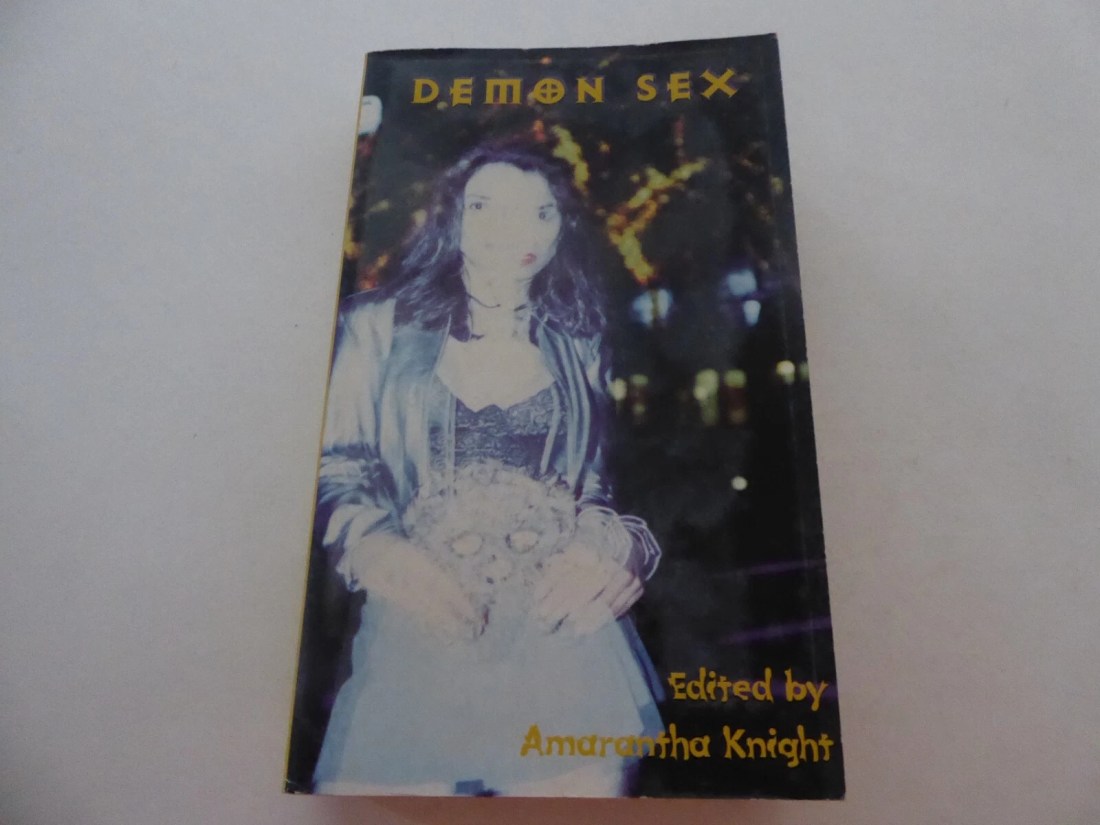
Demon Sex (1998), 45-46

Some writers of Cthulhu Mythos fiction approach the project with the care of a pasticheur working another episode into a series of canonical tales—like writing an unofficial sequel to a classic Sherlock Holmes story, they might write “what happened next” for Lovecraft’s “The Dunwich Horror” or “The Shadow over Innsmouth”; such is the case with “The Shuttered Room” by August Derleth. Other writers prefer to reinterpret the story, providing an alternate take on what really happened, this is what you see with “The Black Brat of Dunwich” (1997) by Stanley C. Sargent.

In her Mythos fiction career, Lois H. Gresh’s approach is closer to that of a DJ, remixing familiar songs and beats but putting her own spin on it. She doesn’t re-tell old stories, she doesn’t try to abide by anyone’s canon, and the result is something that at once has a lot of familiar elements, but is nothing like what you’ve heard before—and perhaps not what you would expect, either. None of which is a bad thing, unless you go into her stories expecting something else.

You’ll be twenty tomorrow, Emilie. It’s time for us to share The Gift.” Rolfe’s voice was hoarse, gravel grating against the fishdead air.

She said, “The Gift is something I definitely don’t want for my birthday. How about if we just say here in Innsmouth and never have sex?”
—Maxi Dell, “A Loobelier Licking” in Demon Sex 48

The story is set in Innsmouth, though not quite the same Innsmouth readers will find familiar. It deals with Yog-Sothoth and Eihort, the latter an eldritch entity that was created by Ramsey Campbell for his Mythos stories. Emilie and Rolfe are best friends, 19 years old, irrepressibly horny, outsiders among outsiders—and is stuck in a tricky situation. Emilie is the cosmic equivalent of an ugly duckling, physically unlovely and ostracized because she carries the genes of a Great Old One. The Innsmouthers want to kill her. The brood of Eihort, the Loobeliers, Yog-Sothoth, and most especially her friend Rolfe want to impregnate her.

Except if she gets pregnant, she dies and Cthulhu gets loose and ends the world.

If that sounds a little complicated—well, yes. It’s also sexually explicit, more than slightly surreal, and probably doesn’t make too much sense if you think about it too long. Emilie’s negative body image, search for love, and the apparent fact of her imminent demise or translation to another reality if she gives in to her teenage lust plays as very nearly a parody, a kind of cosmic teenage sex comedy. While it plays a little more serious than that (at least from Emilie’s point of view), in an era when “monsterfucker” is a tag for a vast swathe of fiction, I think audiences today might have more sympathy for Emilie.

It’s not just that she wants to get laid. She wants love, too.

Rolfe, on the other hand, is utterly inept. By his logic, he and Emilie are two of a kind, and he’s the only option for her to survive—his every effort to get laid, however, reinforces the problem. In the end, he’s been friendzoned so hard the reader would almost feel sorry for him, if he wasn’t so utterly without romance.

[“]Our only chance is to mate with each other before they get to you.”

He was being ridiculous. As if her only choices were sex with Rolfe or sex with a fish. What an absurd thought. Of course, if it came down to it, she’d choose Rolfe. He wasn’t a fish, after all, and he did have a certain raw masculinity that she found appealing. Plus, she’d known him since they were children, and he was her only friend. But still…

Maybe it was the way he put it: mating.
—Maxi Dell, “A Loobelier Licking” in Demon Sex 49

(Readers may, at this point, wonder what the heck a loobelier is. As near as I can tell, they appear only in this story and nowhere else, so it would be a terrible spoiler to reveal that. Trust me, knowing what they are does not significantly make much more sense in context.)

As an erotic horror story, if you don’t invest too much time in thinking about it, this is fun. Gresh has a knack for entertaining prose and slightly surreal situations (see “Showdown at Red Hook” (2011) by Lois H. Gresh), and this is no exception. While probably never going to appear in any list of canonical Innsmouth tales, I think the subversion of expectations, as much as the anticipation of Emilie’s final decision, is what makes this story work.

“A Loobelier Licking” as by Maxi Dell was published in Demon Sex (1998). It has not been reprinted.


Bobby Derie is the author of Weird Talers: Essays on Robert E. Howard and Others and Sex and the Cthulhu Mythos.

Deep Cuts in a Lovecraftian Vein uses Amazon Associate links. As an Amazon Associate I earn from qualifying purchases.
“The Tale of Toad Loop” (1998) by Stanley C. Sargent

When I first began writing weird fiction, just under a decade ago, I never expected any of my stories would see print. I wrote tales that I, as a reader, would like to read but could rarely find.
—Stanley C. Sargent, “Author’s Preface” in Ancient Exhumations +2 (2004) x

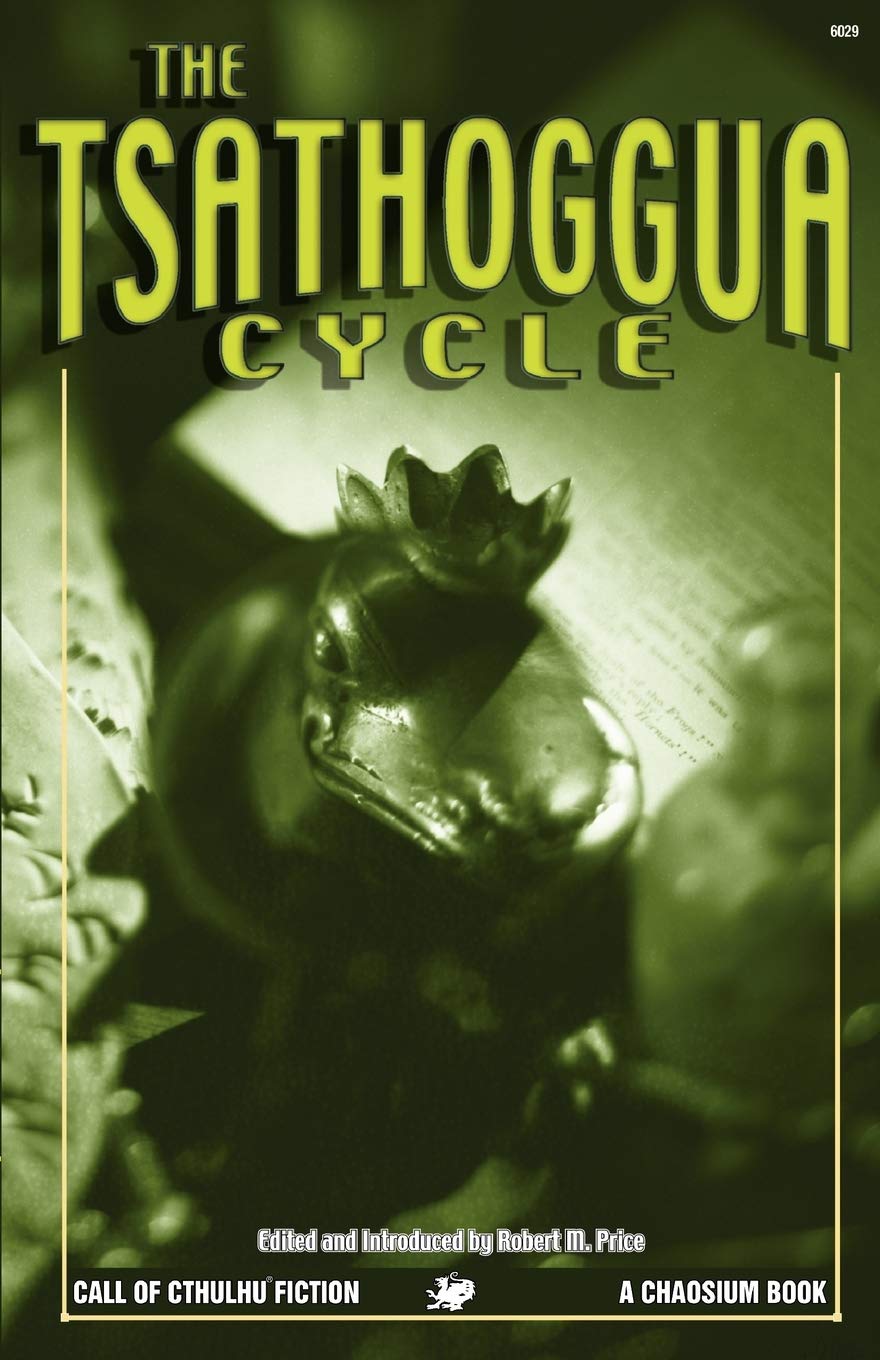
“The Tale of Toad Loop” is one of Sargent’s most-reprinted tales. It was first published online in the webzine Nightscapes (January 1998), and later that year in the print magazine Dark Legacy (August 1988). It featured in his first collection of stories, Ancient Exhumations (1999), and its slightly expanded sequel Ancient Exhumations+2 (2004). The anthology Eldritch Blue: Love & Sex in the Cthulhu Mythos (2004) reprinted it, and the year after that it appeared in The Tsathoggua Cycle: Terror Tales of the Toad God (2005).

The relative success of the story in the early 2000s, and the reason why it’s been mostly forgotten by editors since is fairly straightforward: “The Tale of Toad Loop” might be the quintessential Mythos pastiche.

Which is not in any way a negative criticism. The story is not poorly written, it does not focus solely on the surface aspects of Mythos fiction, makes no effort to ape Lovecraft’s style, nor does it overload the reader with dozens of references to other stories. It is not bad pastiche. Yet it is also recognizable as a work in a distinct tradition, in a certain style, in imitation of what has come before.

“Toad Loop” owes its existence to “The Shadow over Innsmouth” and “The Dunwich Horror” by H. P. Lovecraft, August Derleth’s novel The Lurker at the Threshold (or at least, the fragment “The Round Tower” by Lovecraft which Derleth incorporated into the story), and through that snippet Clark Ashton Smith’s Tsathoggua. It has a style reminiscent of Derleth’s “The Shuttered Room” or “Witches’ Hollow,” the idea of carving out a new corner of the Mythos with connections to the old familiar stories. Familiar themes in unfamiliar places. Old wine in new bottles.

When read in the context of those stories, “The Tale of Toad Loop” stands out as perfectly competent and of a piece with those works. It fits into the Mythos neatly as a lost puzzle piece, lending a slightly new outline to the picture. Sargent is not an eager fanboy expounding some pet theory of the Mythos. The prose is slightly more explicit than Lovecraft or Derleth would have used in terms of language, gore, and sexuality, but otherwise it has the same feel of a piece that was written in those decades between the death of Lovecraft in 1937 and the first non-Arkham House Cthulhu Mythos anthology, The Disciples of Cthulhu, in 1976.

Tastes change.

Like “The Devil’s Hop Yard” (1978) by Richard Lupoff, Sargent’s story is essentially a rehash of a familiar Mythos narrative: a rural locale, a sorcerer that is a little too successful at summoning, a young woman who ends up conceiving the inconceivable. In this case, Pritchy Kwik stands in for Lavinia Whateley, and is given even less agency—not even a line of dialogue—and there are a few other criticisms that might be leveled against the plot:

The Injuns claimed the Circle was built for some kind of unearthly critter that come down from the sky on occasion. Toadaggwa, they called it, sayin’ it put the stones to questionable uses at certain times of the year. Truth is, they were scared shitless of the place without really knowing why. They gave the Loop the widest possible berth, swearin’ the stones were the works of demons here long before any of the tribes. None of the whites confessed to belief in such savage superstitions, yet we all steered clear of the Loop just like the redskins did.
—Stanley C. Sargent, “The Tale of Toad Loop” in Ancient Exhumations +2 (2004) 109-110

It is weird to think about writing “Injuns” and “redskins” in the 1990s. Rationally, Sargent was trying to keep within the vocabulary and viewpoint of a rustic yokel in Madland County (based on southern Ohio), at some unspecified date (references to “Captain Marsh” of Innsmouth suggests the 1850s). It is the kind of reference that wouldn’t have raised an eyebrow for decades in the United States…but cultural syntax shifts. Would an editor let “Injuns” pass today?

In the broader context of the story, this is an incidental detail. Yet it is symptomatic of the issue for the story as a whole. “The Tale of Toad Loop” is a perfectly competent little tale, but it broaches no new ground, not in the characterization, or the storytelling style. It is a variation on a very familiar theme, but the theme is too familiar, and while there’s a twist in the end and the framing, it doesn’t stand out as particularly genius or original in the sense of Sargent’s “The Black Brat of Dunwich” (1997).

While “The Tale of Toad Loop” more or less fits in Eldritch Blue, it would feel old-fashioned and out of place in Cthulhurotica or Conqueror Womb: Lusty Tales of Shub-Niggurath. There are any number of tales of cosmic miscegenation in the Mythos already; it is hard to see what Sargent adds to the subject that is new, novel, revolutionary, or thrilling in that particular. Neither the sex nor the gore rises to the level of notability in a market with extreme horror, erotic horror, and splatterpunk. It is hard to judge the shift in the tastes of consumers of Mythos fiction, but it is usually excellence of ideas as much as excellence of prose that makes tales stand out, and “The Tale of Toad Loop” may be doomed to future obscurity simply because it was too successful at being excellent pastiche of an older style of Mythos fiction which has largely fallen out of fashion.

It is worth pointing out that “The Tale of Toad Loop” is not exemplary of all of Sargent’s fiction. He was a creative and capable writer who experimented with style and subject, continuing to grow and develop throughout his literary career. “The Black Brat of Dunwich” (1997) and “The Insider” (1998) are both good stories that still deserve to be read.

Readers interested in determining for themselves whether Sargent’s style is out of step with the current vogue of Mythos fiction, the story may be read for free at Nightscapes.


Bobby Derie is the author of Weird Talers: Essays on Robert E. Howard & Others (2019) and Sex and the Cthulhu Mythos (2014).

“Paedomorphosis” (1998) by Caitlín R. Kiernan

“Oh,” Annie said and sat down on the rug, grateful for something between her and the concrete. “Where are you from, anyway?”

The loose flap of cloth falling back in place, once again concealing the crack, and “Massachusetts,” Elise replied, “but no place you’ve probably ever heard of.”
—Caitlín R. Kiernan, “Paedomorphosis” in Song of Cthulhu 93

Music, lesbians, a muggy Georgia summer, and white blind things in the dark. “Paedomorphosis” is a story of mood and affect, intimation almost to the point of deliberately hiding things. If it wasn’t published in a Mythos anthology…if it wasn’t published by Caitlín R. Kiernan…there are certain connections which might not be made at all. Like “She Flows” by Takeuchi Yoshikazu (竹内義和) the story lives in that liminal space between telling and showing and knowing. It’s not a horror story by any stretch, but there are the bones of horror story technique there: the way the story and characters are built up, like fossils emerging from dry rock of an ancient river bed, and there are only a few people that can read those old bones and reconstruct something of what happened.

To a degree, all stories are reflections of their authors. We read about Lovecraft’s life and we look for the echoes of events and ideas in his fiction; as his life becomes more well-known through biographies, Lovecraft himself has become a kind of character in the fictional universe, fragments of his life and thought cropping up here and there in stories, some more explicit than others.

With “Paedomorphosis,” readers may well ask how much of Kiernan herself is reflected in the story. The setting of Athens, Georgia, where she lived. Elise-from-Massachusetts with her interest in paleontology; Kiernan herself a paleontologist. The imagery of drowning, repeated in some stories, especially her later novel The Drowning Girl: A Memoir (2012). The lesbian characters and her own sexuality.

“I thought dykes were supposed to be all tough and fearless and shit,” she said.

Annie shook her head, swallowed before she spoke. “Big ol’ misconception. right up there with the ones about us all wanting dicks and pickup trucks.”
—Caitlín R. Kiernan, “Paedomorphosis” in Song of Cthulhu 93

The story has the feel of something cribbled together from bits of life; people and places known rather than imagined. A bit of sexual longing, fulfilled. Drugs and rock and roll. And it takes Annie…and the audience…somewhere they never expected, gives them a glimpse of a world they never imagined might exist, those strange caverns measureless to man, the porous world spoken of so cryptically in “Machines Are Digging” (2009) by Reza Negarestani.

The title is never explained; look up the definition on your own time. The story ends with, of all things, a quote from Tolkien:

There are strange things living in the pools and lakes in the hearts of mountains…
—J. R. R. Tolkien, quoted in “Paedomorphosis” in Song of Cthulhu 98

But not the whole of it:

There are strange things living in the pools and lakes in the hearts of mountains: fish whose fathers swam in, goodness only knows how many years ago, and never swam out again, while their eyes grew bigger and bigger and bigger from trying to see in the blackness; also there are other things more slimy than fish. Even in the tunnels and caves the goblins have made for themselves there are other things living unbeknown to them that have sneaked in from outside to lie up in the dark.
—J. R. R. Tolkien, The Hobbit, Chapter V “Riddles in the Dark”

The story captures a mood, but the mood itself is almost inexpressible in anything less than the story. There are things to think about, long after the last page is turned. What might have happened, if Annie had been fearless enough to take the plunge? Who is the subject of paedomorphosis in the story? These are questions that Kiernan doesn’t answer in this story…but in some of her other stories, we catch hints of what might have happened, in love affairs that lasted a little longer and got a little weirder.

“Paedomorphosis” was first published in The Urbanite #10 (1998), it has been reprinted in Kiernan’s collection Tales of Pain and Wonder (2000, 2002, & 2008); Song of Cthulhu (2001); and Rock On: The Greatest Hits of Science Fiction & Fantasy (2012).


Bobby Derie is the author of Weird Talers: Essays on Robert E. Howard & Others (2019) and Sex and the Cthulhu Mythos (2014).

“Cthulhu Sex (ahem!)—a poem—” (1998) by Katherine Morel

Katherine Morel is a painter, an aspiring mad scientist, and an honorary saint of Thud, bestower of the sacred word, obsquatulate. She is currently bruised and swollen due to extra grey matter being inserted into the space between her brain and skull and hopes to sleep it off in time to be in attenance at the marriage that changed over the millennium.
Cthulhu Sex Magazine, Vol. I, Issue 13

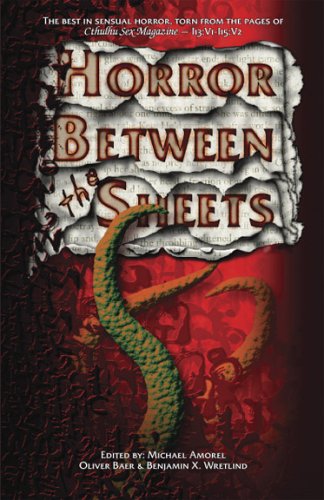
Cthulhu Sex magazine was the brainchild of Michael Morel, and graduated over the course of its run from a small black-and-white chapbook illustrated with crude, pixelated images of sperm to a slick, full-sized semi-prozine with color covers, photographs, and digital artwork. A collection of material from the magazine was issued in 2005 as Horror Between the SheetsIn the first issue and that final collection is printed (with slight changes) “Cthulhu Sex (ahem!)—a poem—” by Katherine Morel.

The poem is an almost perfect encapsulation of the magazine as a whole. While Cthulhu is in the title, it never appears in the body text. The tone is light, the verses violent, darkly humorous, and sexually explicit.

Twas through their connection she passed her infection
—Katherine Morel, “Cthulhu Sex (ahem!)—a poem—”, Horror Between the Sheets 36

Poetry has a long history among creators and admirers of the Mythos; H. P. Lovecraft, Robert E. Howard, Clark Ashton Smith, August Derleth, and Frank Belknap Long were all notable poets, and some of their poetry was directly related to the Mythos. So too, some of the first fan-additions to the Mythos were poems, such as “Shadow Over Innsmouth” (1942) by Virginia Anderson & “The Woods of Averoigne” (1934) by Grace Stillman.

In the 1990s, poetry would continue to play its part in fandom, being featured in prominent ‘zines & journals such as the Arkham Sampler and Crypt of Cthulhu—but there were editorial limits to what those ‘zines would publish. Hardcore horror, the splatterpunk style of violent and gory horror fiction that took its cues from slasher and exploitation films (and, reaching back into the dim mists of time, the weird terror pulps), had few outlets.

To see her reflection,
Caused him an erection,
Yet something seemed the slightest bit weird. (ibid.)

Cthulhu Sex became an outlet and medium for fiction and art that couldn’t be posted elsewhere. Not much of it dealt explicitly with Cthulhu, Lovecraft, or the Mythos; it didn’t have to. The title was a statement and a challenge, just as it is in Katherine Morel’s poem. The title gives context to the text.

In 1998, people could still remember when HIV was a death sentence and not one to be long-deferred. Japanese tentacle erotica had hit the shores of the United States with  Maeda Toshio’s Urotsukidōji and La Blue Girl, and were already the subject of jokes about “naughty tentacles” on the nascent internet. There was a zeitgeist there, mostly untapped as yet… until Katherine Morel’s “Cthulhu Sex.”

she scratched her complexion,
so that bloody tentacles appeared. (ibid.)

The tagline for Cthulhu Sex was “Blood, Sex & Tentacles.” Katherine Morel’s poem was an anthem for the magazine, an invocation for what was to be from 1998 to 2007. She captured, however briefly, the mood and attitude, right at the outset.


Bobby Derie is the author of Weird Talers: Essays on Robert E. Howard & Others (2019) and Sex and the Cthulhu Mythos (2014).

“Are You Loathsome Tonight?” (1998) by Poppy Z. Brite

Now the stage is bare and I’m standing there
With emptiness all around
And if you won’t come back to me
Then they can bring the curtain down
“Are You Lonesome Tonight?”

Not many writers would say that Elvis Presley had much to do with Lovecraft; the few who would are like to take a comedic bent, as Yvonne Navarro did in “WWRD” (2018). Yet if a writer were to step back away from the Mythos and look at the themes and ideas expressed by Lovecraft in his fiction—there is a horror story to be woven from the life of Elvis, one as terrible and inevitable as all human stories are.

Poppy Z. Brite (Billy Martin) is better-known in Mythos circles for “His Mouth Will Taste of Wormwood” (1990), which has been reprinted many times, including in the seminal Cthulhu 2000: A Lovecraftian Anthology (1995).  “Are You Loathsome Tonight?” gets far less attention, and far fewer reprints. The lack of response is probably because it is not what people expect, when they come to a “Lovecraftian” story: no Mythos, no tentacles or eldritch tomes. Parts of it are passages taken directly from books about Elvis’ life, and death, interspersed with stories about snakes which intersect oddly with the rest—they fit, like pieces of a puzzle where the larger picture is still obscure. It’s Lovecraft credits are boiled down to a single quotation, appended at the very end of the text:

Atmosphere is the all-important thing, for the final criterion of authenticity is not the dovetailing of a plot but the creation of a given sensation.
—H. P. Lovecraft, Supernatural Horror in Literature

Like “Hypothetical Materfamilias” (1994) by Adèle Olivia Gladwell and “Commencement” (2001) by Joyce Carol Oates, this is a story which stretches the bounds of “Lovecraftian.” It is a work patently informed by something Lovecraft wrote, yet not dependent on any of his individual creations. The narrative is nontraditional, the atmosphere it develops is one of slowly growing disquiet, rather than cosmic horror.

Images, interposed, become conflated by context. The roiling bolus of snakes in a mating ball. The terribly swollen megacolon of Elvis as he sits on his jet-black throne, drugs slowing his digestive system to a terrible crawl. It takes the imagination of the reader to fit the pieces together, to suggest a greater horror than reality…and there is an art and skill in the arrangement of those pieces, to make readers take that approach. The terrible inevitability of the piece lends a sense of apprehension to the whole affair—because most everyone should know how this ends. Elvis, even in death, is a figure larger than life, his semiotic ghost pervading the popular culture.

The craft of the story can be seen especially in the beginning and the ending; the title and the closing quotation of Lovecraft. The title is a reference to Elvis’ 1960 hit, yet with the twist: what is loathsome? Is it what Elvis would become, as years of abuse took its toll? The title sets up the sense of apprehension, the situation-normal-all-fucked-up; it hints at the reader what to expect—and Lovecraft, at the end, tells them what they just read. What the reader sought, or experienced, whether or not they recognized it at the time.

“Are You Loathsome Tonight?” was first published in the collection of the same name, and has been reprinted in Self-Made Man (1999), The Children of Cthulhu (2000), and is available on kindle. Poppy Z. Brite/Billy Martin currently has a GoFundMe campaign.


Bobby Derie is the author of Sex and the Cthulhu Mythos (2014) 


“The Insider” (1998) by Stanley C. Sargent

Unhappy is he to whom the memories of childhood bring only fear and sadness.
H. P. Lovecraft, “The Outsider”

The conceit of “The Insider” is that it is a prequel to Lovecraft’s “The Outsider.” Although both stories stand well enough on their own, once you get the idea the slight aping of Lovecraft’s diction and the general direction of Sargent’s story takes on a new dimension. It’s a solid, well-written Mythos tale, clever without being extravagant or feeling the need to explain everything, with a satisfying ending.

“The Insider” is not one of Sargent’s better-known tales; his claim to fame, if any, probably rests on the story “The Black Brat of Dunwich” (1997) and his essay “Howard Phillips Whateley, An Observation” (1999, rev. 2002), both of which focus on alternative interpretations of Wilbur Whateleywho, like the eponymous Insider/Outsider, is marked from birth as one apart. It’s a subject that Sargent, growing up as a homosexual, could and did empathize with. It was Sargent who has made the strongest, or at least most elegant argument that Lovecraft himself might have been a closeted homosexual:

I read “The Outsider” when I was about 14 and beginning to realize there was something very different about me, my deep dark secret.  We are talking about growing up in the farm country of Ohio in the early ’60s here.  When I read “The Outsider,” I felt convinced the author had gone through the same situation I was going through, the abject horror of recognizing you are gay in a very anti-gay world.

Years later, I tried to find an alternative reason for HPL considering himself such an extreme “outsider,” but I discovered no plausible other reason for such an extreme feeling of being an isolated monster.  I didn’t really care a whit about HPL’s sexual orientation (I am not trying to claim him as one of “us”), so at the time it occurred to me that I might be projecting a bit.

Yet, as I read more about HPL’s life, I began to see that all the ingredients were there.  His upbringing with a dominant, overly protective mother (who dressed him as a girl for the first few years of his life) and the nearly total absence of a father is the classic formula for a male child being gay. Although he declared his distaste for homosexuals, in particular effeminate males, he was often described as effeminate himself.  Plus he was a close friend with Samuel Loveman for many years and Loveman was hardly in the closet about his activities.  Finally, I can come up with no other logical explanation for HPL’s close relationship with the teenage Barlow during the last years of his life, to the point of making Barlow his literary executor.

Don’t get me wrong, I don’t believe HPL was able to cast off the conventions he clung to so desperately enough to actually “come out.”  I think HPL saw in Barlow the self-accepting talented writer he had always wanted to be himself but couldn’t be.  I wouldn’t be surprised if Barlow had discussed his own “outsiderness” with a very understanding HPL, but I doubt HPL could have ever brought himself to own up to his own similar orientation.

It all makes even more sense if you interpret “The Dunwich Horror” as an autobiographical cloaked confession of his dilemma.  Wilbur obviously represents HPL, all the way down to HPL believing his own appearance was “hideous” (again, thanks to mom), and I believe the twin brother was the a symbol of the homosexual desires HPL so desperately tried to suppress.  No one could see the monster and it was essentially so evil that it had to be contained.  Yet it kept growing and even Wilbur feared it would someday break out (read “come out”) and destroy the world (Lovecraft’s little conservative world).  That thought terrified him as being gay went against everything he believed in; it must have been awful for him.  He surely married Sonia, a mother figure, in hope of changing his orientation, a very common and futile mistake.  If he didn’t confess his problem to her, she undoubtedly guessed and was sympathetic.

I suppose I’ll be up for a lynching when die-hard Lovecraftians read this, but I’m convinced I’m right.  Even my friend Wilum Pugmire disagrees with me strongly on this point.  Lovecraft would certainly have equated his unnamable secret with Wilde’s unspeakable love.
Stanley C. Sargent, interview with Peter A. Worthy (1998)

Whether or not readers agree with Sargent’s interpretation as fact, from a literary standpoint the idea has a degree of merit: it is possible to engage with Lovecraft’s creations from that viewpoint…and why not? It’s a fair cop. Robert M. Price engaged with the idea in his essay “Homosexual Panic in ‘The Outsider'” (1982). It was probably not Lovecraft’s intent in this case to provide such an interpretation…but readers are free to interpret an author’s work as they would.

Knowing Sargent’s thoughts on “The Outsider” can in turn influence a reader’s response to “The Insider.” The theme of the lonely, ostracized young man that resorts finally to cutting as a release from the stigma of being different—only to be further punished and set apart for his behaviorresonates. Lovecraft’s “The Outsider” is designed to provoke empathy in the readers, and “The Insider” is both a response and an echo to that. “The Insider” need not be an allegory for homosexuality per se, any more than “The Outsider” must be read in such light; both stories focus on both external appearance and the desire for acceptance, aspects of human experience which are adaptable to many different syntaxbecause we all live in a world where discrimination is real, be it based on age, gender, sexuality, physical appearance or ability, race, or faith.

Have we not all been an Insider/Outsider at some point, if only in our own heads?

“The Insider” was published Tales of Lovecraftian Horror #8 (1998), and was republished in Sargent’s collection The Taint of Lovecraft (2002).


Bobby Derie is the author of Sex and the Cthulhu Mythos (2014)