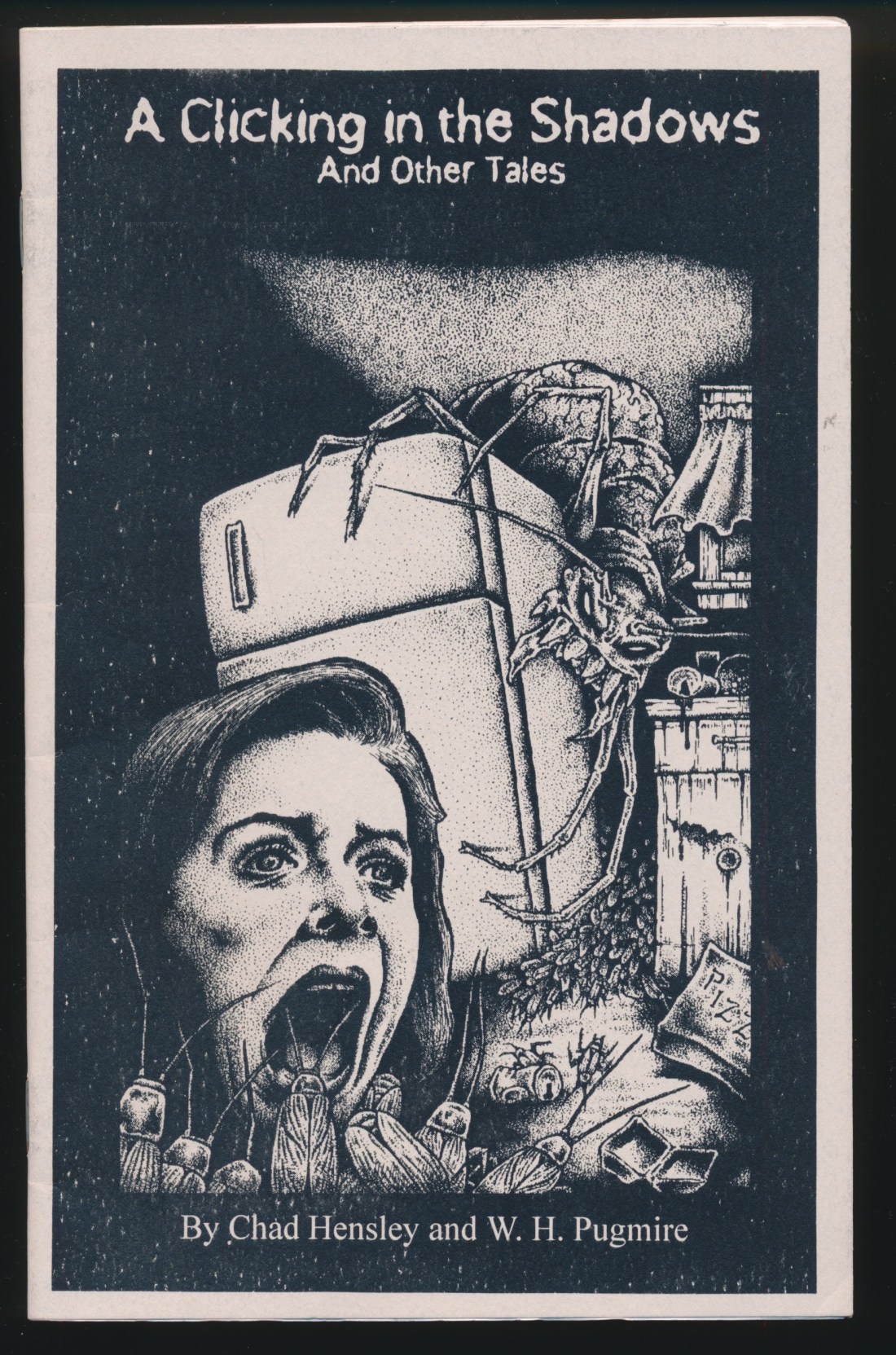
Roach smell is distinctive. A kind of sickly, musty reek that clings to places; sign of the often unseen dwellers in darkness. At night, sometimes, you can lie awake, dreading the skitter of tiny feet. Knowing they’re there. Knowing they could appear anywhere. On your toothbrush. On the ceiling. Walking across your face… and they often incite a visceral reaction, these alien creatures which cohabit the welcoming space that is human habitation. A kind of horror that has nothing to do with grimoires or ancient gods, but of much more mundane and realistic issues of filth, disease, and the invasion of personal space.
What a wonderful idea for a story, they must have thought, before writing “A Clicking in the Shadows.”
“Can you smell them? Yep, they’re nearby now, right enough. By their stench shall ye know them! Tryin’ to squeeze through the spaces, sure enough. They stink to all-mighty heaven.”
—Chad Hensley & W. H. Pugmire, “A Clicking in the Shadows” in
A Clicking in the Shadows and Other Tales (2002) 7By Their smell can men sometimes know Them near, but of Their semblance can no man know, saving only in the features of those They have begotten on mankind; and of those are there many sorts, differing in likeness from man’s truest eidolon to that shape without sight or substance which is Them.
—H. P. Lovecraft, “The Dunwich Horror”
W. H. Pugmire was one of the most evocative voices in Lovecraftian horror from about the 1970s until his death in 2019. Chad Hensley is probably better known as the editor of EsoTerra: The Journal of Extreme Culture than as a horror writer, though he’s put out a fair bit of work over the years. The two writers collaborated together, and “A Clicking in the Shadows” is the premiere piece in their (now very obscure) joint collection A Clicking in the Shadows And Other Tales (2002).
From 1997 until 2003, I lived in Seattle, Washington. Wilum Pugmire lived down the street from me. So it was easy to meet up, critic each other’s fiction, as well as collaborate. We’ve written one poem and three short stories together, one of which wound up in the mass market paperback anthology The Darker Side: Generations of Horror. Wilum and I also collaborated on a chapbook of short stories titled A Clicking in the Shadows and Other Tales published in 2002. The lead story received an honorable mention in Year’s Best Fantasy and Horror. I’m really pleased and proud to have collaborated with Wilum and hope to do so again one day.
—Madhouse Introduction: Meet Chad Hensley (6 Apr 2014)
Oftentimes with collaborations, one name may be more recognizable than the other, and gain the bulk of the attention from critics. In this case, Pugmire is certainly the more well-known in Lovecraftian circles, and in his introduction to A Clicking in the Shadows, Robert M. Price writes:
All seven of their tales herein contained seem to take place in Sesquas Valley or at least in a kindred state of mind. In fact, a perfect image for the mood of these stories would have to be the scene in “A Clicking in the Shadows” where one character frantically wields a can of poison bug-spray to whelm a looming tide of horrific vermin. The spray itself is as poisonous as the I’ll it aims to eradicate, and one is not sure whether its intended path to relief is to destroy the pests or to put the pestered out of their worldly misery! Such is the desperate, sweetly poisonous atmosphere through which we move in these stories. (4)
I don’t think that’s strictly accurate. While one story in the collection, “Hairs of the Mother” by Hensley, is explicitly set in Sesqua Valley, none of the others are. “A Clicking in the Shadows” is set in Mississippi, far from the Pacific Northwest where Sesqua Valley is located, so from a purely pedantic geographical point, it doesn’t hold up. The question of whether it occupies a bit of psychogeography akin to Sesqua Valley is more subjective. Pugmire’s bit of personal Lovecraft country is aggressively rural or semi-rural; there are houses, a small town, but it’s the unmanaged wilderness that is the Valley itself. Hensley’s stories, at least in this slim volume, tend to more urban locales; nor is Hensley building a mythology. Some of the stories in A Clicking in the Shadows are explicitly or implicitly part of the Arkham myth-cycle, but they’re not the legends of some particular eldritch entity or place, but it is primarily an aesthetic anthology. Two different voices that sometimes work in harmony.
“A Clicking in the Shadows” is an effective bit of harmony. The story is brief, and holds to a very down-to-earth horror vibe until near the end, when things ratchet up from the realistic to the uncanny to the frankly eldritch. It reminds of another collaboration, “Pale, Trembling Youth” (1986) by W. H. Pugmire & Jessica Amanda Salmonson, where the resulting product is reminiscent of the work of both authors but also finds its own voice, which isn’t quite the same as either on their own.
Late in the night, Thorp was awakened by an itch on his nose. Numbly, in groggy stupor, he clumsily scratched at his face. His fingers found a small, flattened body that squirmed in his hand as he grabbed it.
—Chad Hensley & W. H. Pugmire, “A Clicking in the Shadows” in
A Clicking in the Shadows and Other Tales (2002) 8
It would be nice if, one of these days, a new collection were issued with all of Pugmire’s collaborations. Maybe it would lead more readers toward Chad Hensley; maybe not. Certainly, such a collection would be worth reading, if only to showcase the talents involved.
“A Clicking in the Shadows” was first published in A Clicking in the Shadows And Other Tales (2002); it was republished in Inhuman #6 (2015).
Bobby Derie is the author of Weird Talers: Essays on Robert E. Howard and Others and Sex and the Cthulhu Mythos.
Deep Cuts in a Lovecraftian Vein uses Amazon Associate links. As an Amazon Associate I earn from qualifying purchases.

 Deep Cuts in a Lovecraftian Vein