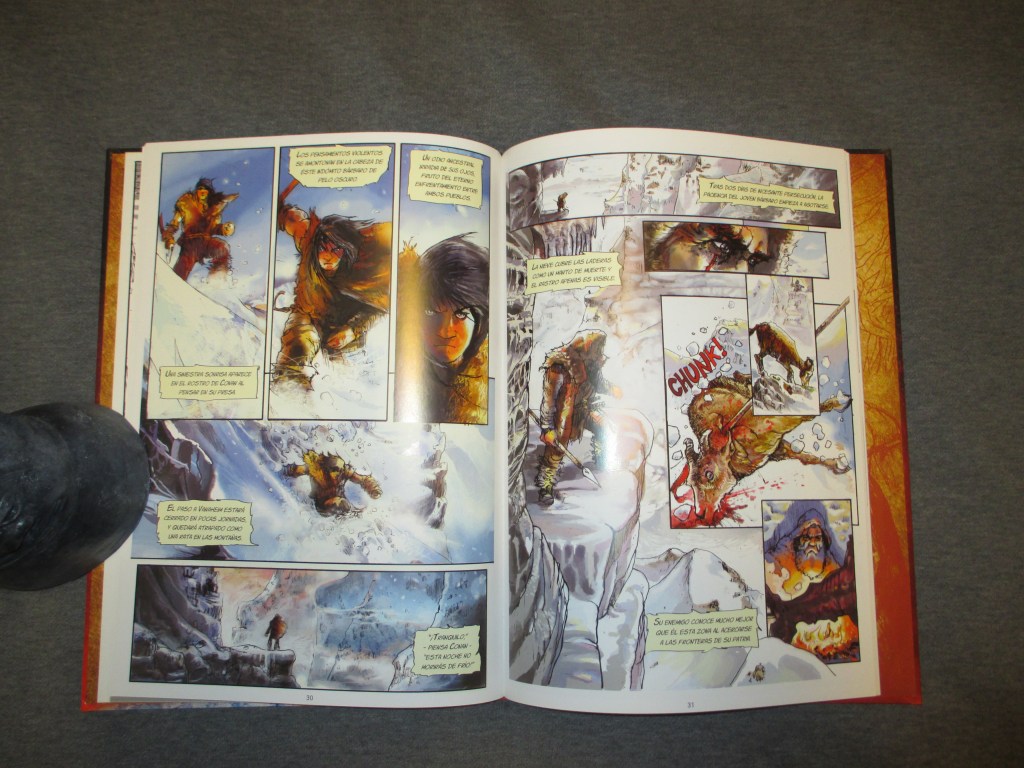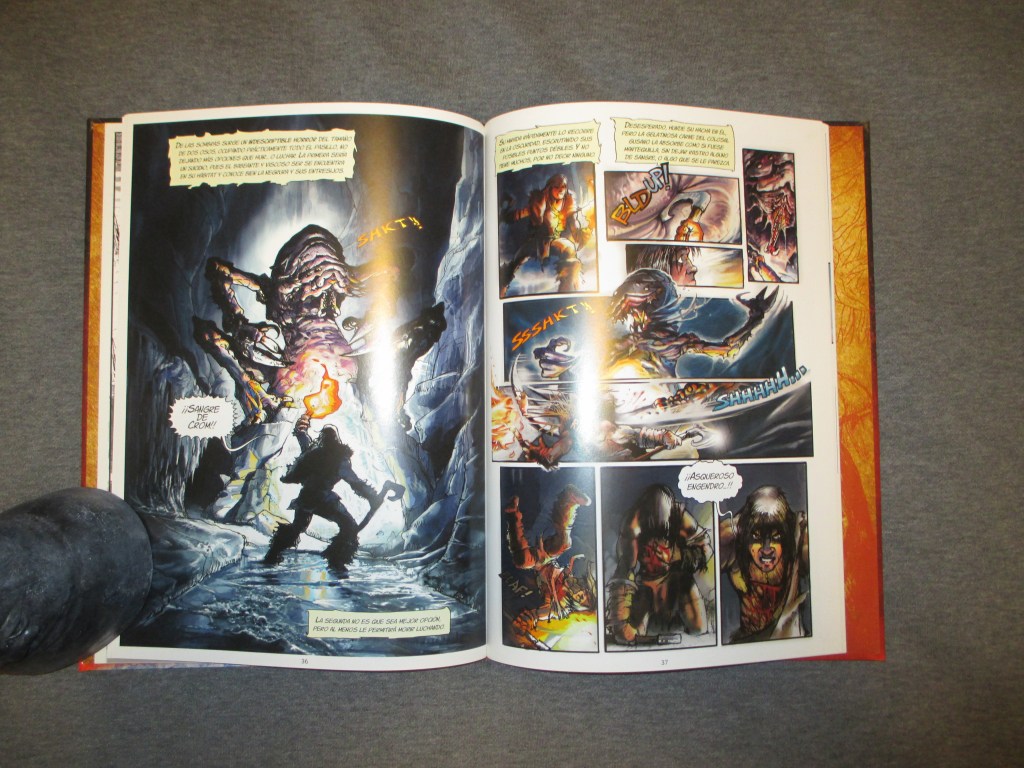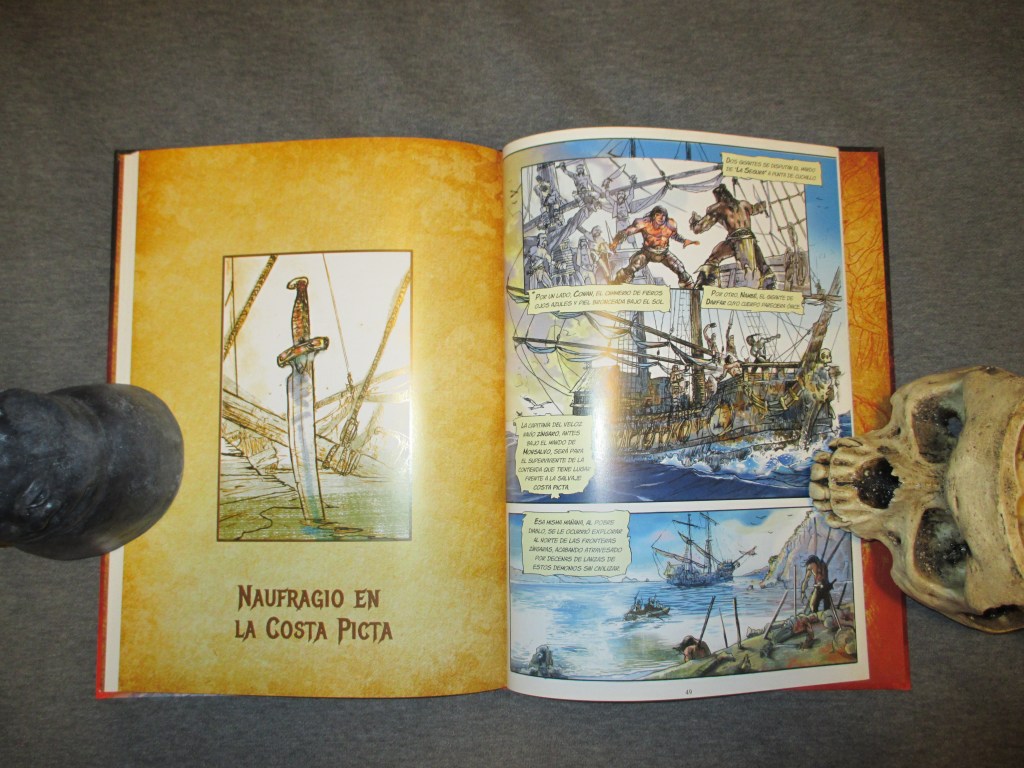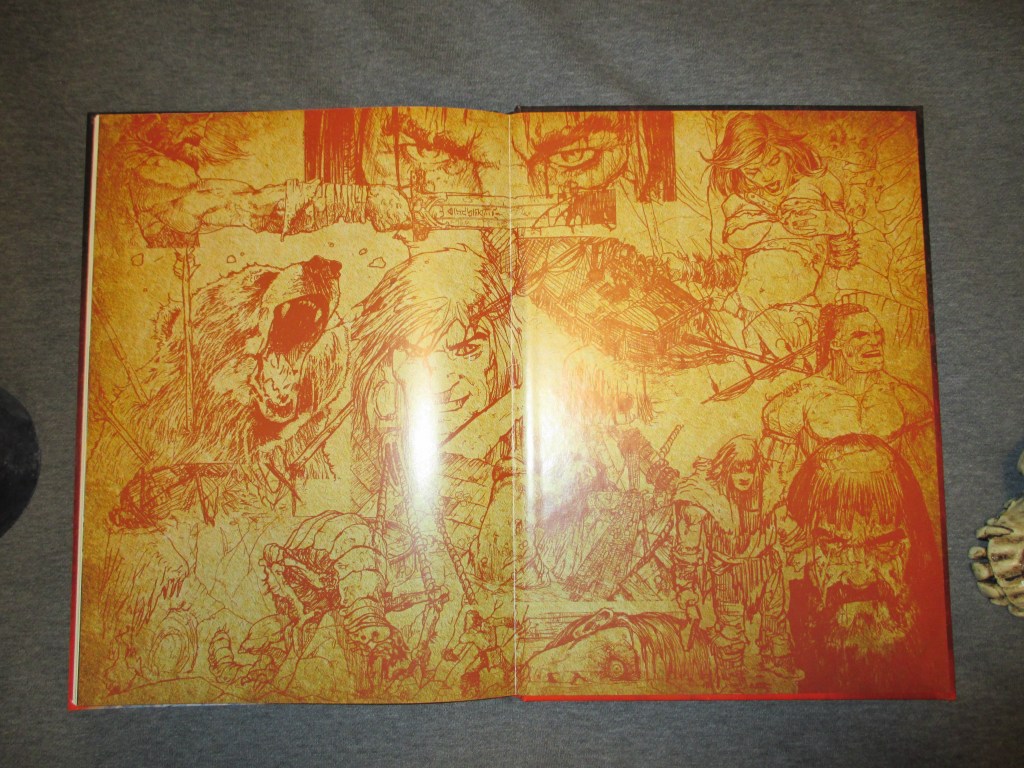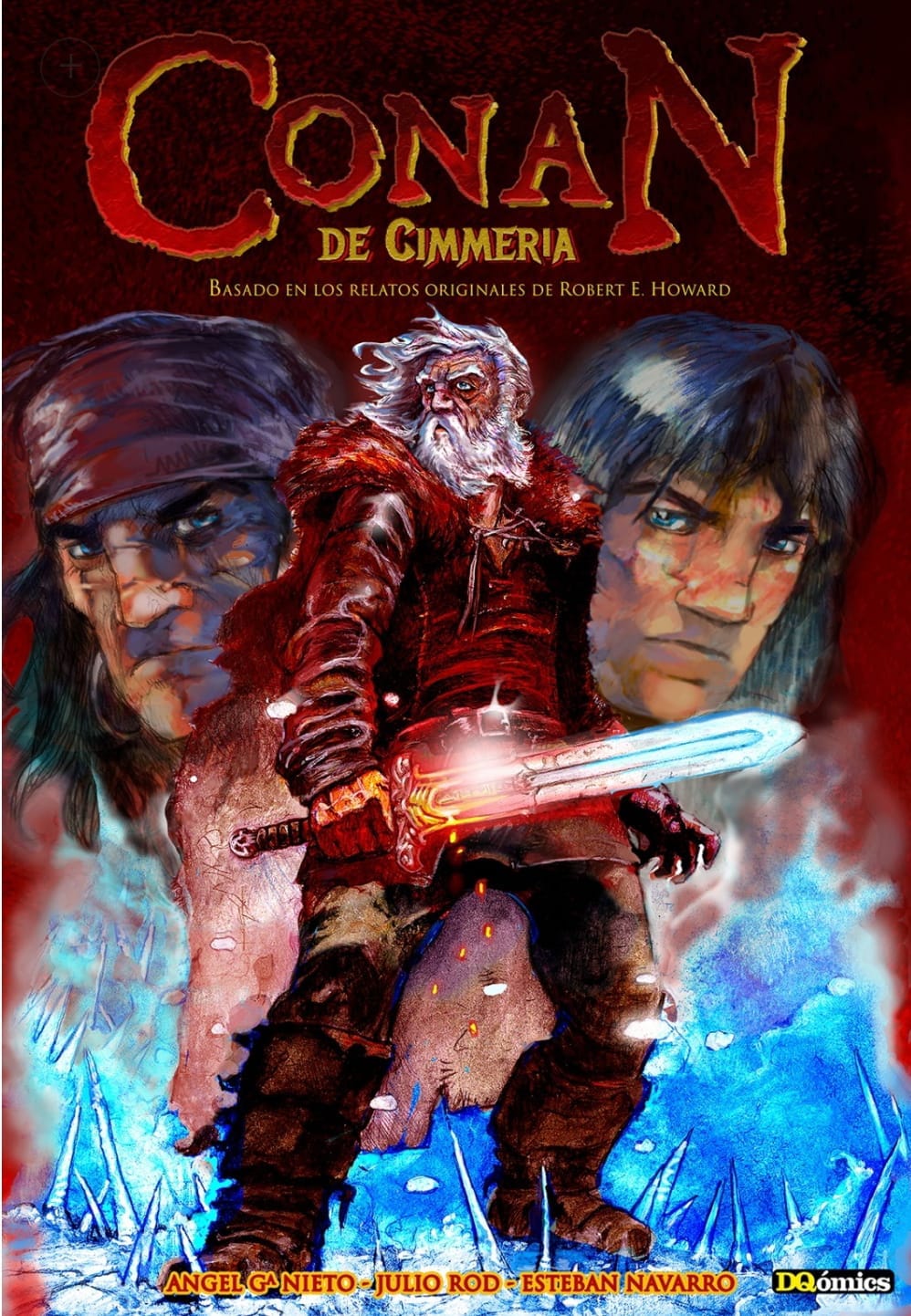
Conan de Cimmeria (2021) by Ángel Gª Nieto, Julio Rod, & Esteban Navarro

Derivative works all share a connection with the parent work. Every story with Cthulhu derives, directly or indirectly, from Lovecraft’s “The Call of Cthulhu.” Every story with Conan the Cimmerian derives from the original stories written by Robert E. Howard. From the humble pages of Weird Tales have spun out thousands of creative works in a dizzying array of media—short stories, novels, comics (strips, books, magazines, and graphic novels), cartoons, live-action and animated films, music, paintings, sculptures, toys, video games—and one of the key thing to remember about these works is that they aren’t being created in a vacuum, but in communication with one another.

The Atlantean sword in the film Conan the Barbarian (1982) owes nothing to anything in the stories of Robert E. Howard; the closest the Texas pulpster managed to a special weapon was in the first Conan tale, “The Phoenix on the Sword,” and that sword was broken in the course of the story. Some of the pastiche tales and comic book stories that followed included magic weapons, but none of them served as the immediate inspiration for the Atlantean sword in the film either. Nevertheless, the sword featured extensively in the poster and marketing materials for both Conan the Barbarian and its sequel Conan the Destroyer (1984)—and, unsurprisingly, was represented fairly faithfully in the Marvel Comic adaptations of the films.
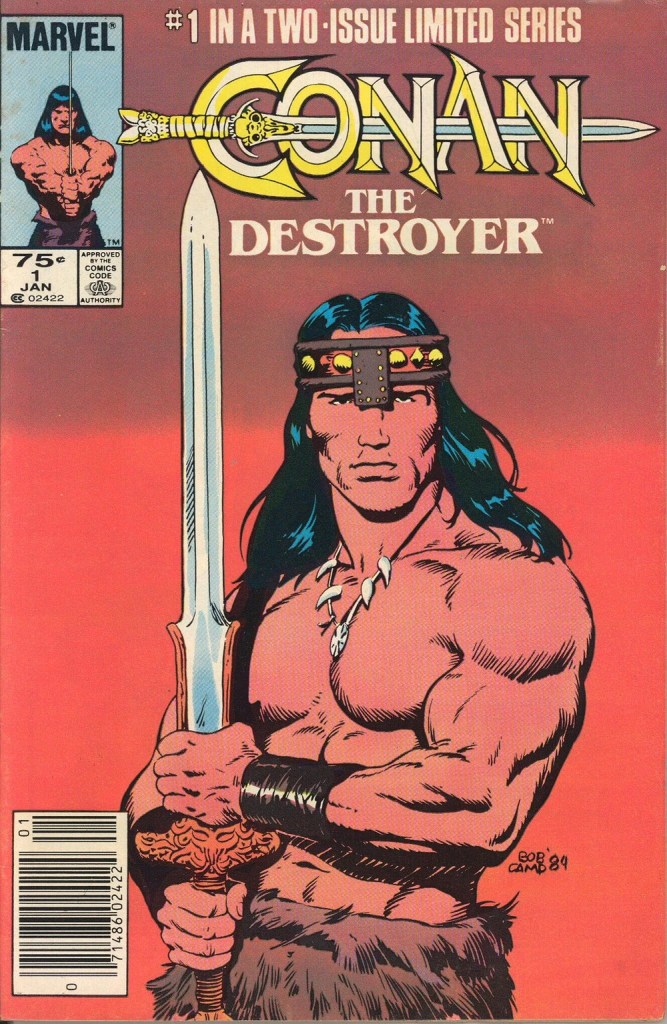
Art by Bob Camp

For many years, outside the movie continuities, the Atlantean sword was not a key feature of most Conan media. While it continued to have lingering appeal because of the tie to the film—including multiple weapon makers providing official or bootleg versions of the sword for fans and collectors—publishers like Marvel and Dark Horse did not lean into that aspect of the film iconography.

More recently, however, the iconic Atlantean sword has seen increased placement in both official and unofficial Conan media. The latest Conan comics published by Titan have deliberately leaned into a melding of the iconic looks of previous incarnations of the Cimmerian, drawing both from the John Buscema/Ernie Chan era of Marvel Comics as well as the 1982 film. It’s little surprise that when Conan does actually go to Atlantis in Conan the Barbarian #11, the Atlantean sword—or at least a good facsimile—makes an appearance.
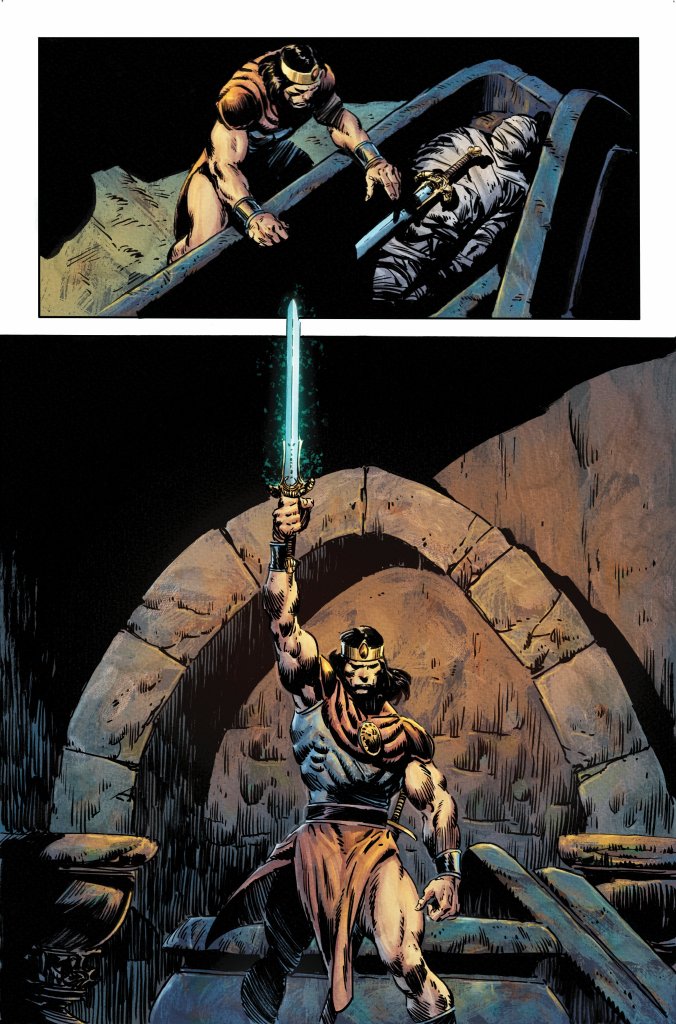
Art by Roberto de la Torre, Color by Diego Rodriguez

Outside of the official comics, works produced in areas where the Conan the Cimmerian stories by Robert E. Howard have fallen into the official domain have had fewer qualms about borrowing the iconic imagery of the Atlantean sword. Such is the case for Sangre Bárbara (2021) by El Torres, Joe Bocardo, & Manoli Martínez, and such is also the case for Conan de Cimmeria (2021) by the creative team of Ángel Gª Nieto (writer), Julio Rod (artist), & Esteban Navarro (colorist).
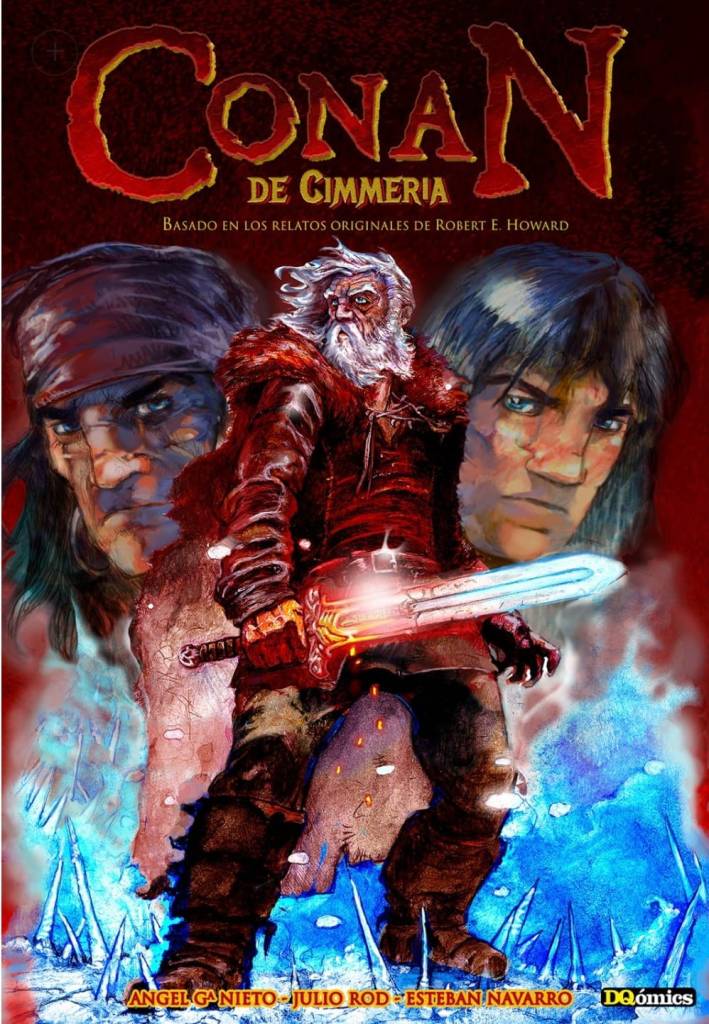
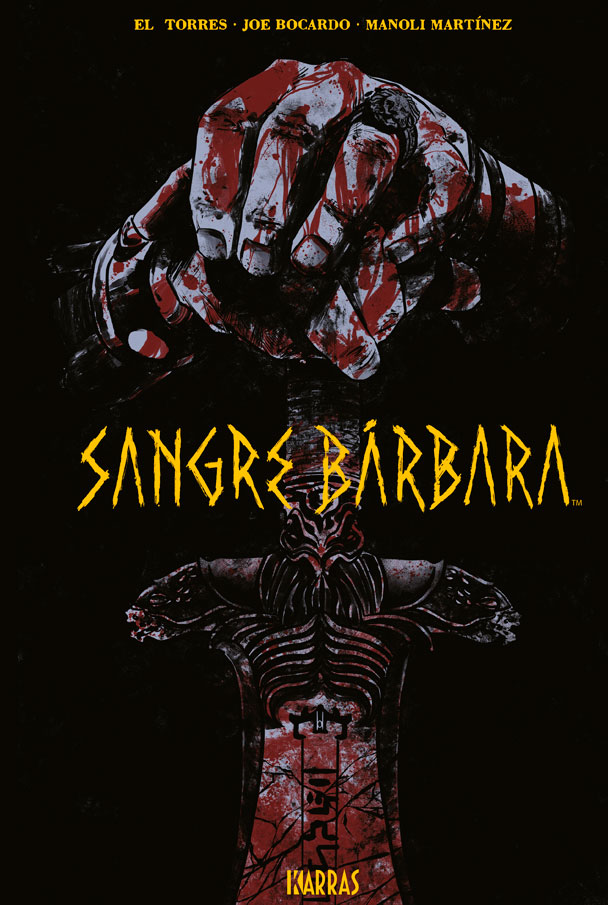
Hace mucho tiempo, en una era no soñada, caminó Conan, el Cimmerio, que a lo largo de su turbulent existential vivió multiud de fastuosas adventuras.

Dejadme que os cuente cual cronista de un tiempo olvidado sus grandes y magníficas hazañas, que lo convertieron en Leyenda.
Long ago, in an age undreamed of, walked Conan the Cimmerian, who throughout his turbulent life lived a multitude of magnificent adventures.

Let me tell you like a chronicler of a forgotten time his great and magnificent exploits, which made him a Legend.
Conan de Cimmeria, Back cover copyEnglish translation

Conan de Cimmeria is a standalone Spanish-language graphic novel that tells three original stories based on the Conan character created by Robert E. Howard, each one telling a brief adventure of the Cimmerian at a different point in his career. It is essentially identical in general form and intent to the majority of comics produced officially by the owners of the Conan trademarks, just produced independently. The prominent usage of the Atlantean sword in the first story, “La Forja del Destino” (“The Forge of Destiny”), is perhaps the most notable artistic callback to other Conan-related works, but the book also appears to draw inspiration from the classic Marvel comics, while still taking the opportunity to present an original—if recognizable—version of the barbarian.
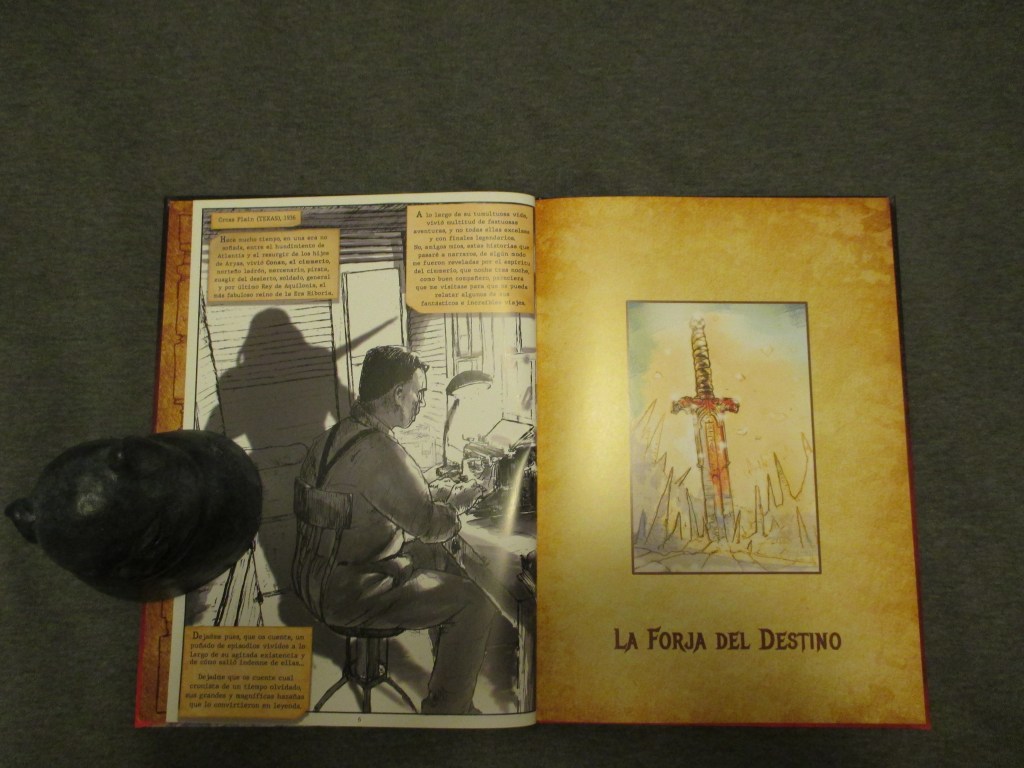
The stories are a bit more violent and bloody than the classic Marvel Comics, but not so gore-filled as to detract from what are essentially pulpy adventure tales; there is one scene with the topless corpse of a woman, but other than that, there is no nudity or sex. It is the kind of Conan comics that could please everyone from 13 to 93 in terms of being exactly what it sets out to be: the kind of broad-appeal Conan comic that is reminiscent and evocative of what has come before, but which is distinctly original, an addition to the Conan cycle that is respectful of the source material.

In an era when properties falling into the public domain often leads to a splurge of derivative trash that pays little to no respect for the original, it’s nice to find examples of works where the creators basically want to use the stories to create new tales of character they like, int he style in which they’d like to read them.


Bobby Derie is the author of Weird Talers: Essays on Robert E. Howard and Others and Sex and the Cthulhu Mythos.

Deep Cuts in a Lovecraftian Vein uses Amazon Associate links. As an Amazon Associate I earn from qualifying purchases.
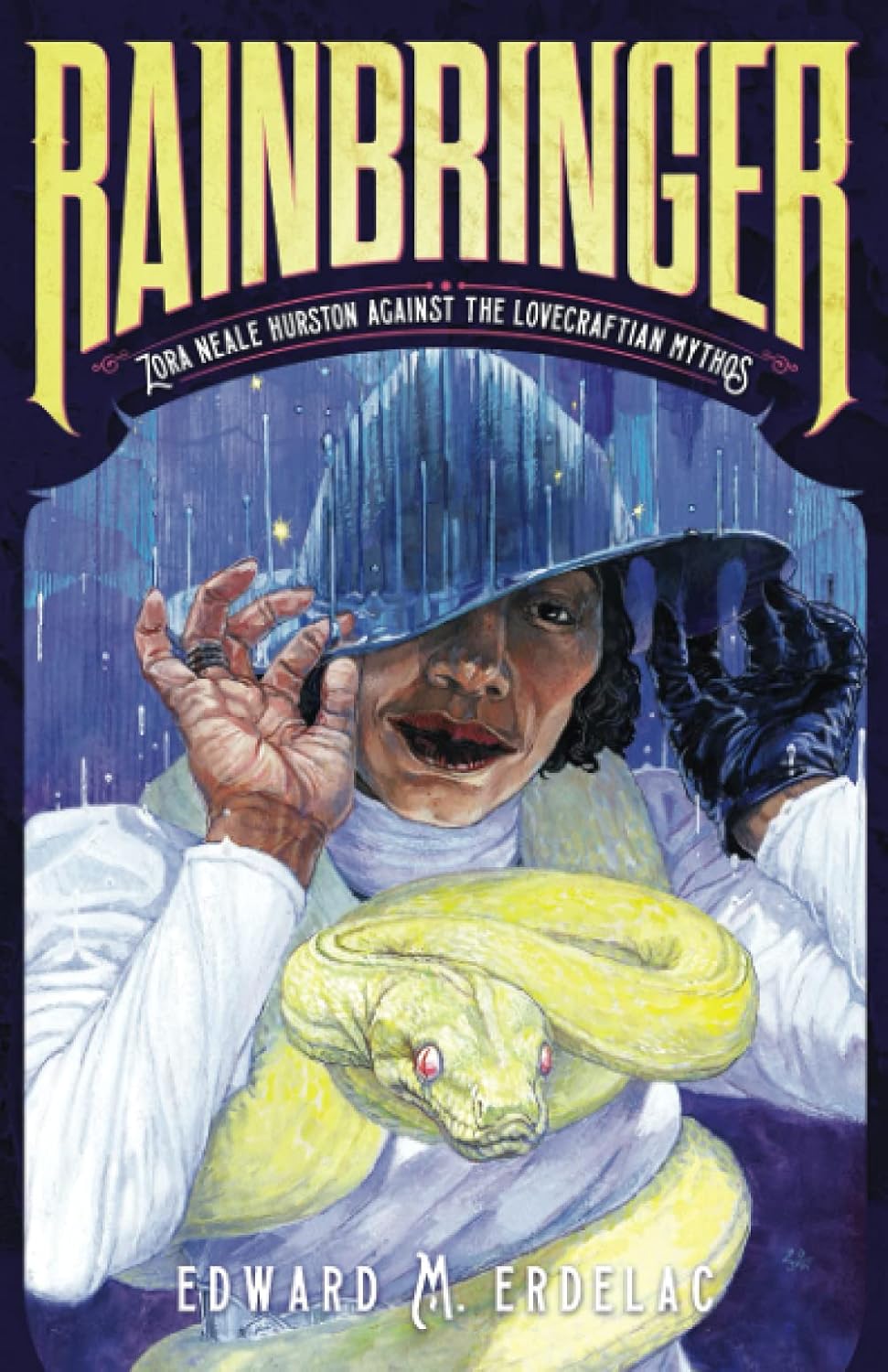
Rainbringer (2021) by Edward M. Erdelac

If you stay in Haiti long enough and really mingle with the people, the time will come when you hear secret societies mentioned. Nobody, of course, sits down and gives lectures on these dread gatherings. It is not in any open way that you come to know. You hear a little thing here and see a little thing there that seem to have no connection at first. It takes a long time and a mass of incidents before it all links up and gains significance.
—Zora Neale Hurston, Tell My Horse (1938)

William Seabrook’s The Magic Island (1929) was the book that launched the craze for Haitian Vodun and zombies in the United States, the direct inspiration for the film White Zombie (1932) and stories in pulp magazines like Strange Tales of Mystery and Terror such as August Derleth’s “The House in the Magnolias” (ST Jun 1932). Lovecraft read Seabrook’s book on a visit to Florida, and seems to have largely lost interest in voodoo, though he praised tales like “Mother of Serpents” (1936) by Robert Bloch.

Seabrook, however, was not the only one writing about African diaspora religions or African-American folklore. Zora Neale Hurston seems to have completely missed Lovecraft and his immediate contemporaries. In part, this was just a matter of timing; Lovecraft was dead by ’38 when Hurston’s book on Haitian Vodun, Tell My Horse, was finally published. In part, it was a reflection of segregation: as a Black woman, Hurston struggled seemingly her whole life against the prejudices of white editors and white audiences. Voodoo as a theme for Mythos fiction did not die off after the ’30s, but the Hollywood tropes of pins in dolls and zombies as reanimated corpses tended to overshadow authentic anthropology and folklore research.

Zora Neale Hurston never really got a chance to go up against the Mythos. Not until 2021, when Edward M. Erdelac, author of the Merkabah Rider series, published Rainbringer. In this episodic novel, Erdelac wears together fact and fiction, interpolating encounters with the Mythos into Hurston’s already busy and adventurous life. Her particular career of poking her nose into hoodoo, Vodun, and other systems of belief provide a good excuse for her to stumble across the much weirder cults and entities of the Cthulhu Mythos, and the stories are inflected in their interpretation and depiction of the Mythos to reflect Hurston’s own writings.

Erdelac took pains to present a period-accurate but not discriminatory view of Black people during the period; the word “Negro” was in common use at the time, without any pejorative association. Gullah speech is presented with fair accuracy. Most of Hurston’s investigations into insular African-American communities are played straight, and the joy of exploration and discovery, the use of her wits and charisma, her respect for the people she meets and their beliefs all lend verisimilitude to the stories. Then things get a little Lovecraftian.

“An Old One?” I said, folding my arms, and thought to myself, Lord God and Papa Yig, not these motherfuckers again.
—Ed Erdelac, “Ekwensu’s Lullaby” in Rainbringer 57

Yig, in the context of the fictional Zora Neale Hurston’s career, is cast as her hoodoo patron, the figure who presided over her initiation into the occult. Yet stories like “Ekwensu’s Lullaby” are not an effort to cast African diaspora beliefs into a Mythos mold; rather, it is a story about African diaspora religion and strange survivals in an out-of-the-way place, in a universe that is Mythos-inflected.

This is much more believable, and therefore more interesting, than if Zora Neale Hurston were trying to fight Cthulhu by her lonesome. The approach is reminiscent of “Jeroboam Henley’s Debt” (1982) by Charles R. Saunders, “Hairwork” (2015) by Gemma Files, and Ring Shout (2020) by P. Djèlí Clark in that the stories are very much grounded in the African-American and African-Caribbean experience, the echoes of slavery and discrimination that have left their mark on bodies, minds, souls, and cultures. In a system of belief that already accepts the supernatural, the existence of Yig & co. doesn’t have the same sanity-blasting effect.

Erdelac was strongly inspired by Hurston’s fieldwork in writing these stories, as he mentioned in his interview Cthulhu in the Deep South on Tentacle Talk, but there is a second vein trying to balance out in these stories, and that’s weaving Zora’s adventures into the Mythos with the skill of a pasticheur. If the whole book had only been about Hurston’s dealings with Yig as her patron, that might have been interesting but slight from a Mythos perspective. However, she also encounters the Dreamlands, the “King in Yeller,” Tsathoggua, and other eldritch entities. Which sometimes adds spice to the gumbo, and sometimes is a bit of an overpowering flavor.

The strength of each episode is really in how well the story hangs together more than how many references to Hurston’s work of Lovecraft’s Mythos he can stir in. The more spiritual and dream-like episodes are balanced out with shoot-’em-up pulp action sequences, and the balance of elements shifts from episode to episode, reflecting changes in both Hurston’s real life and whatever Mythos threat Erdelac wants to put her against next. The result isn’t an exhaustive Mythos biography of Zora Neale Hurston, by any means. I could easily see Erdelac writing another story that fits in between the existing episodes, as the plot occurs to him.


Bobby Derie is the author of Weird Talers: Essays on Robert E. Howard and Others and Sex and the Cthulhu Mythos.

Deep Cuts in a Lovecraftian Vein uses Amazon Associate links. As an Amazon Associate I earn from qualifying purchases.
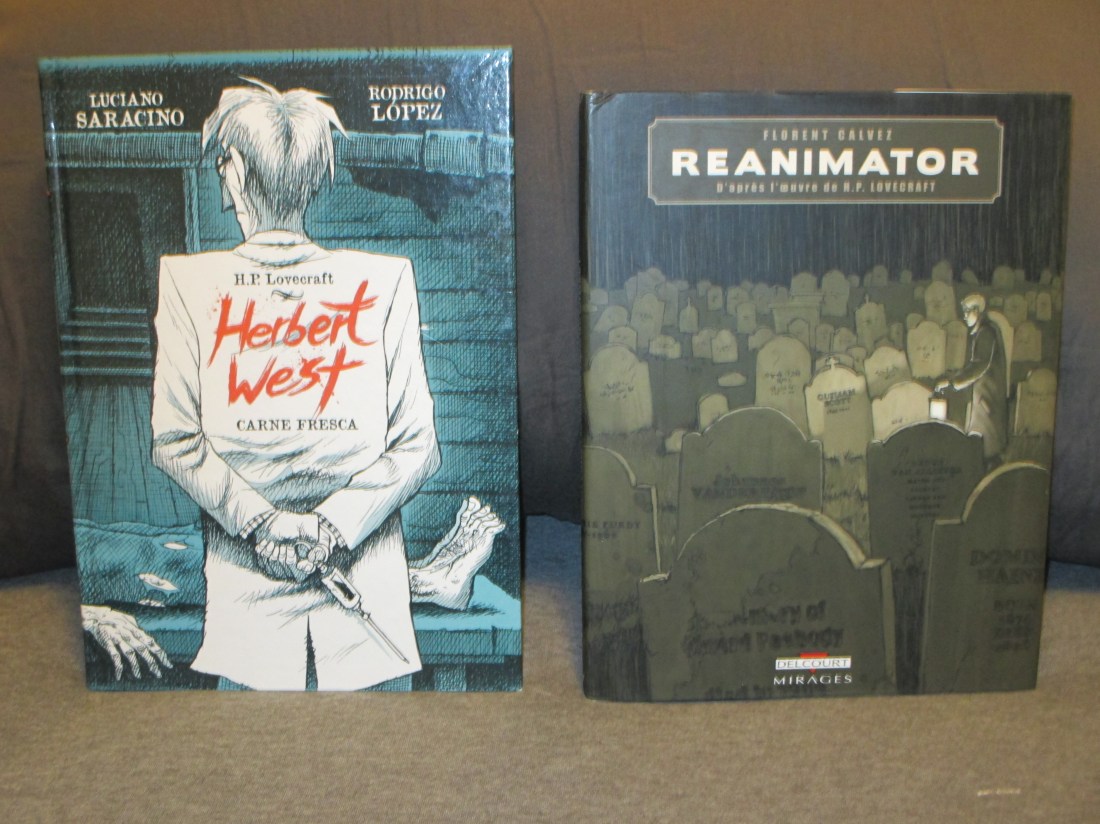
Reanimator (2008) by Florent Calvez v. Herbert West: Carne Fresca (2021) by Luciano Saracino & Rodrigo López

Not all of H. P. Lovecraft’s works are of equal merit, or of equal attractiveness to readers, artists, and writers. While some stories have been adapted many times in different media, others languish in relative obscurity—reprinted in Lovecraft’s collections, but rarely in anthologies, and with less impact on popular culture. The whys and wherefores differ with each tale; generally, such works were not popular during Lovecraft’s lifetime and may have only been published after his death, have little or no direct connection to the Mythos, or represent some difficulty due to changing tastes or the prejudices expressed in the story.

As something that represents all three of these categories, “Herbert West—Reanimator” is an unexpected posthumous breakout hit for Lovecraft. Initially published as a series of six interconnected short tales in the pages of Home Brew, and not published more widely until after Lovecraft’s death when Weird Tales reprinted them, “Herbert West—Reanimator” has only slight connection to Lovecraft’s wider Mythos with the Arkham/Miskatonic University setting, and contains a chapter with one of the most baldly racist characters and characterizations in Lovecraft’s oeuvre. Written as Lovecraft’s first attempt at commercial fiction, it isn’t really typical of his later style or efforts at all.

Yet…there is something about Dr. Herbert West that has thrilled audiences and inspired writers and artists for decades. The 1985 film Re-Animator spawned a small film franchise, a novelization, comic books, and merchandise; helped launch the Lovecraftian film careers of Stuart Gordon, Brian Yuzna, Jeffrey Combs, and Barbara Crampton; and even a hardcore pornographic film: Re-Penetrator (2004). Beyond this, many writers have taken a stab at the Re-Animator, including the anthology Legacy of the Reanimator (2015), Peter Rawlik’s Reanimators (2013) and Reanimatrix (2016), “Herbert West in Love” (2012) by Molly Tanzer, “Kanye West—Reanimator” (2015) by Joshua Chaplinsky, “Herburt East: Refuckinator” (2012) by Lula Lisbon, “(UN)Bury Your Gays: A Queering of Herbert West – Reanimator by H.P. Lovecraft” by Clinton W. Waters, and “Herbert West and the Mammaries of Madness” (2015) by Dixie Pinoit, “Albertina West: Reanimator” by TL Wiswell—among many others.

Comic and graphic adaptations of “Herbert West—Reanimator” are especially fascinating, because on those rare occasions where readers get two full adaptations, of approximately equal length, for side-by-side comparison, you can see how very different two adaptations can be of the same material—and how much work goes into turning a prose text into a comic script.

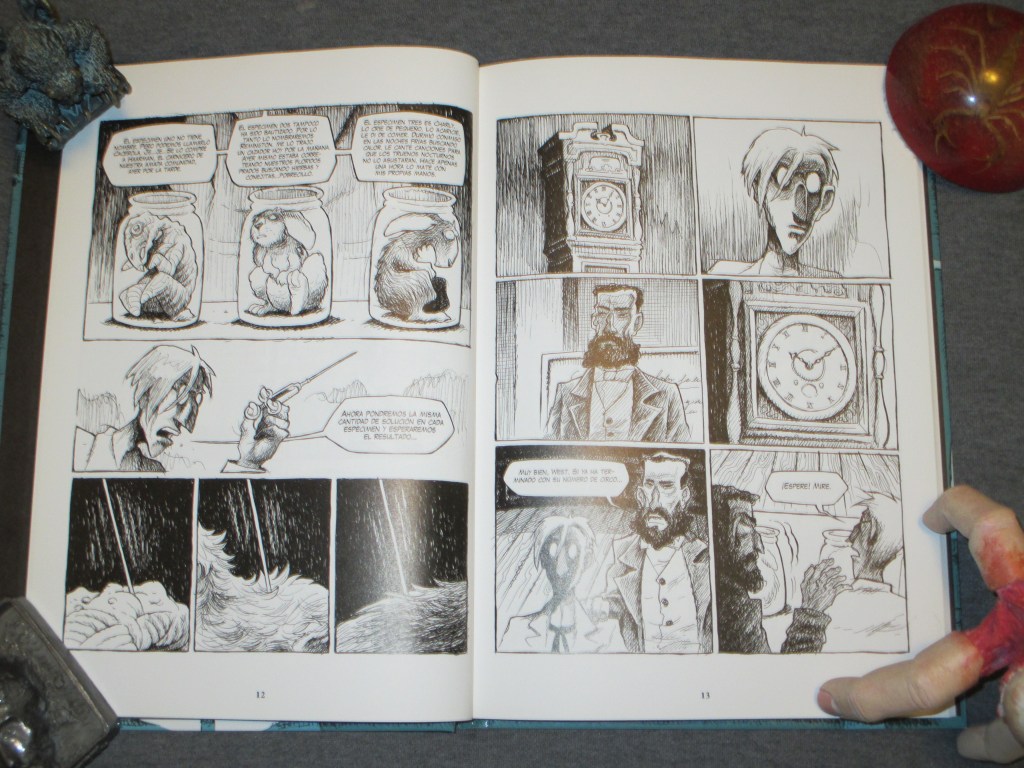
Such an opportunity presents itself with Reanimator (2008) by Florent Calvez, a hardbound 112-page French-language bande dessinee published by Delcourt, and Herbert West: Carne Fresca (“Fresh Meat”) (2021) by Luciano Saracino (script) and Rodrigo López (art), a 96-page Spanish-language hardbound album published by Dolmen. Both of these works adapt the full six episodes of “Herbert West—Reanimator” fairly faithfully—but how they do it and what they choose to emphasize is very different.

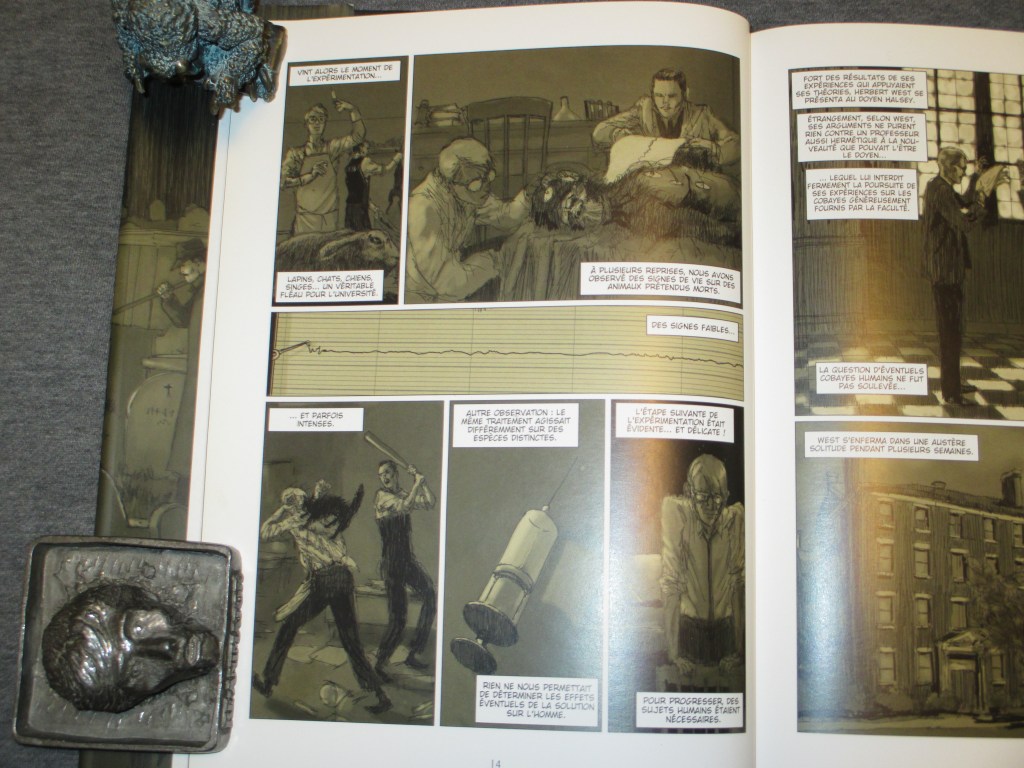
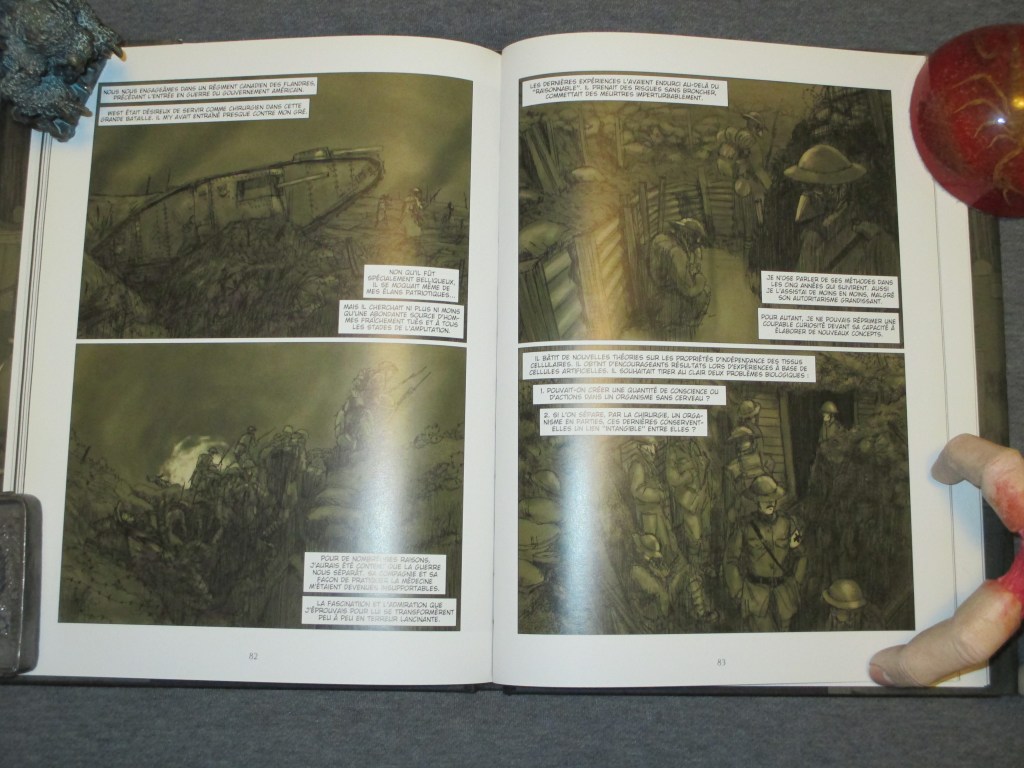
Calvez’ Reanimator is a sepia-toned period piece, starkly realistic. Unlike many later works, there are few if any visual cues or references to the 1985 film; Herbert West is blond, for example, as Lovecraft’s narrator described him, not a brunet like actor Jeffrey Combs. The most notable reference to the film is the brief shot of West being attacked by a reanimated black cat, a scene made infamous in the movie.

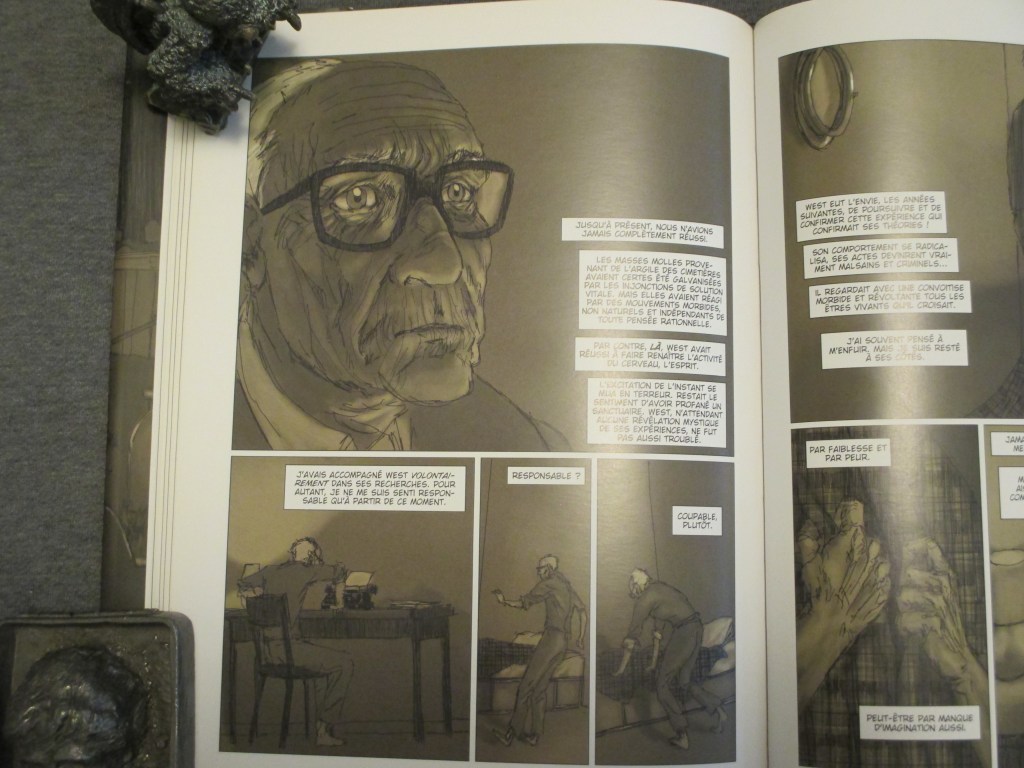
The main departure from Lovecraft’s story is that Calvez provides a framing narrative: the nameless assistant, older now, and visually similar to William S. Burroughs, is writing down his account of events on a ship. This wraparound segment helps give shape to the narrative as a Memoir, which features little speech and a great deal of exposition translated directly from Lovecraft’s text.

The stark realism of the work helps make the horrors stand out. There’s not a lot of gore in the traditional sense; the world of Reanimator is dark, murky, washed out like the sepia photographs of long-ago atrocities. Care and attention to detail are everywhere apparent: the details of costume and press, the architecture of houses, bits of English on newspapers and gravestones for the scenes set in the United States. It is a testament to Calvez’ skill and dedication to get the details right.

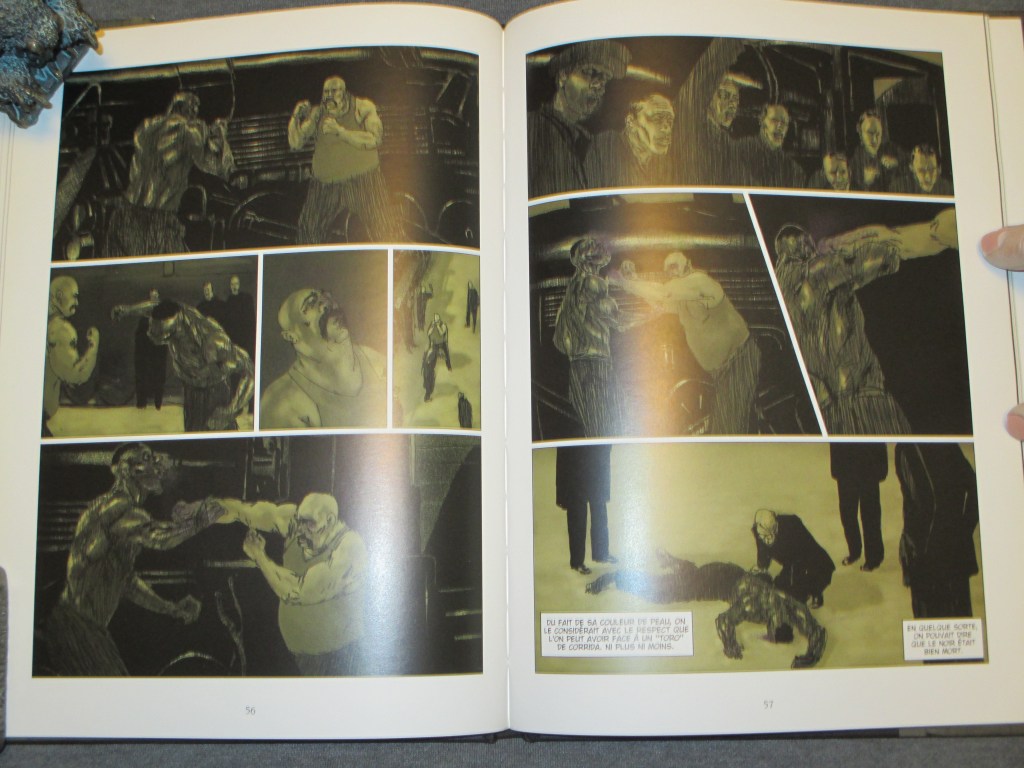
In Lovecraft’s story, we don’t see the boxing match, only the aftermath. Calvez has taken another liberty here: “Kid O’Brien” is implicitly a Jewish boxer under an Irish name, while “Buck Robinson, ‘The Harlem Smoke'” is almost a caricature of Black boxers like world heavyweight champion Jack Johnson. Boxing was a major national sport, and while Lovecraft may have cared little for it, he was certainly aware of some of the major boxers of his era, including Jackson.

The narrator’s prejudices that depicted the dead boxer in animal-like terms, and wondered if some obscure biological difference between white and black caused the failure of the reanimation experiment, Calvez leaves out. Their absence isn’t particularly noticeable, unless you know to look for them. It does not diminish the horror that marks the climax of the episode.

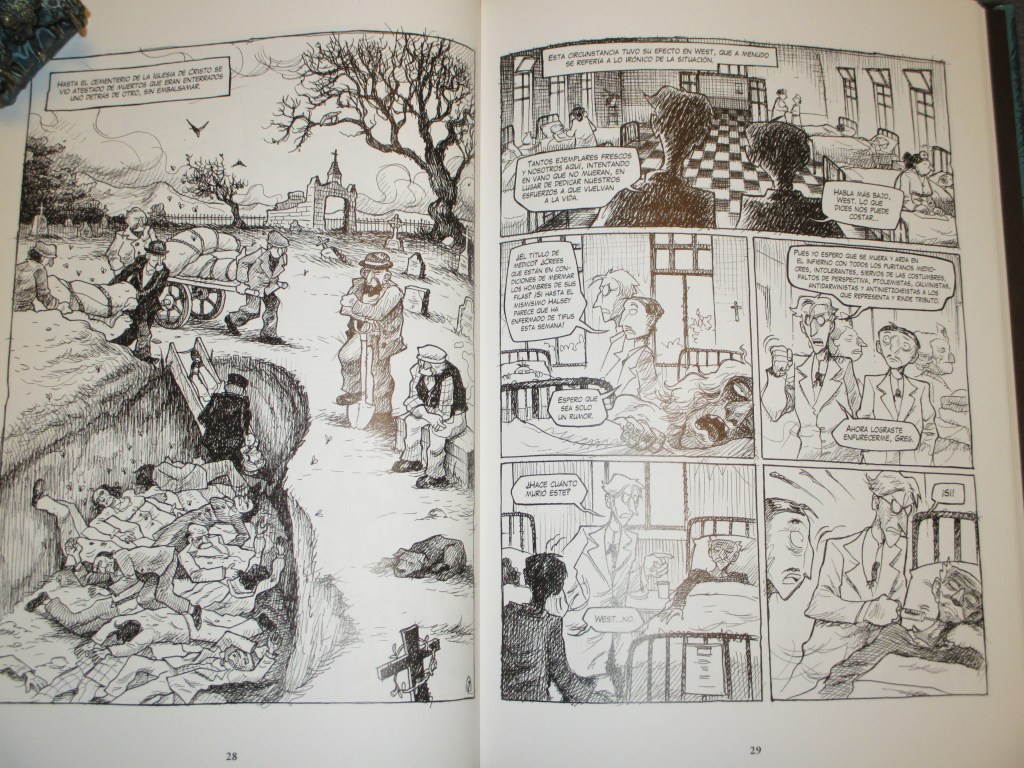
Saracino and López take a slightly different approach to Herbert West. The art style, in black and white, is more stylized. There is still great care and attention to detail, but the pages tend to more standard layouts, based around a six-panel grid, and there is much more dialogue. Herbert West himself is allowed to speak in his own words, instead of being relayed through his assistant.

So instead of doing a lot of telling, which Lovecraft was more or less forced to do by the nature of his medium, we get a lot more showing. Instead of a wraparound segment, we get more of an extended prologue, a demonstration of West’s experiments with animals.

West’s assistant gets a name and an identity beyond memoirist: Gregory Carter is a fellow medical student at Miskatonic University—and swiftly becomes West’s accomplice in his experiments—but here at least we get to see more interaction between the two. This isn’t Carter writing what has happened; the reader watches over his shoulder, so to speak, as events unfold.

Rodrigo López’ style shows a certain European influence; while the architecture, the dress, and the hairstyles are all very specifically old-fashioned in accordance with the setting, there are details that are more reminiscent of and older Europe than an older New England. There are roofs that look more like tile than anything you’d see in a New England winter, churches without steeples, police officers in kepi hats. A subtle transmigration of atmosphere that doesn’t change much of anything in the story, but reinforces the idea that this is not just an adaptation—it’s a localization.

Probably López’ best moments are when he gives himself a full page to really go while and showcase a scene, often from above to capture some of the landscape, to really play with broad white empty spaces and dark shadows. There’s a very Edward Gorey-like character to this splash pages. As always though, the horror is lurking near the climax of every episode.

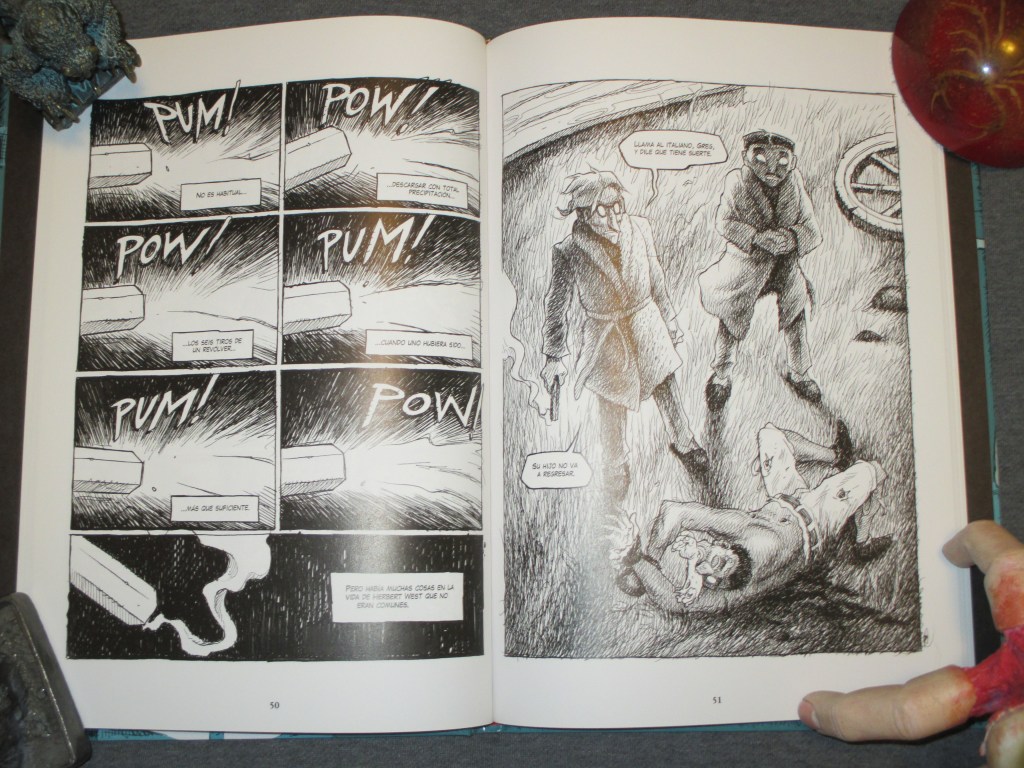
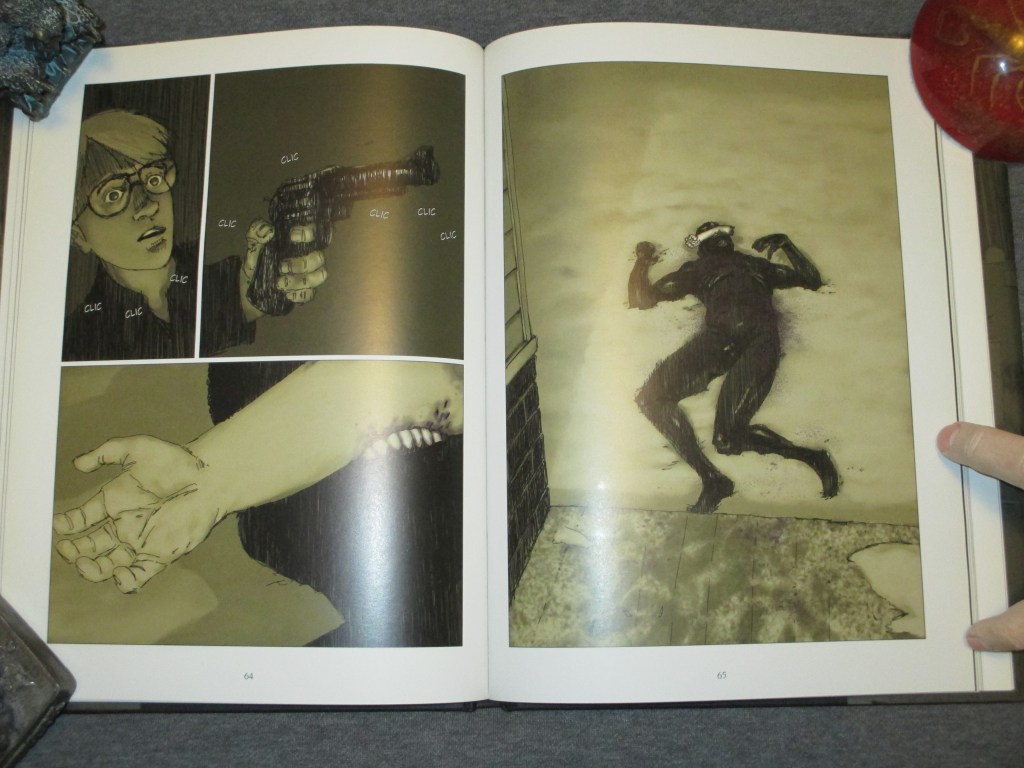
As with Calvez, Saracino & López gently excise the racism expressed by the narrator. It is enough that initial injections of the reanimation serum have no effect, the body is disposed of…and it comes back.

It is interesting how both artists focused on this moment as the climax of the episode; both were determined to present the stark horror, the rare bit of action and excitement in these stories, the most arresting visual image in perhaps the whole story. Yet they do it very differently; the reanimated corpse of Robsinon here is still half-dressed, more human-like, and despite the hatching, not as dark in complexion compared to the other characters (a common issue with black-and-white, which needs hair, facial features, and other cues to help delineate race to the audience visually).

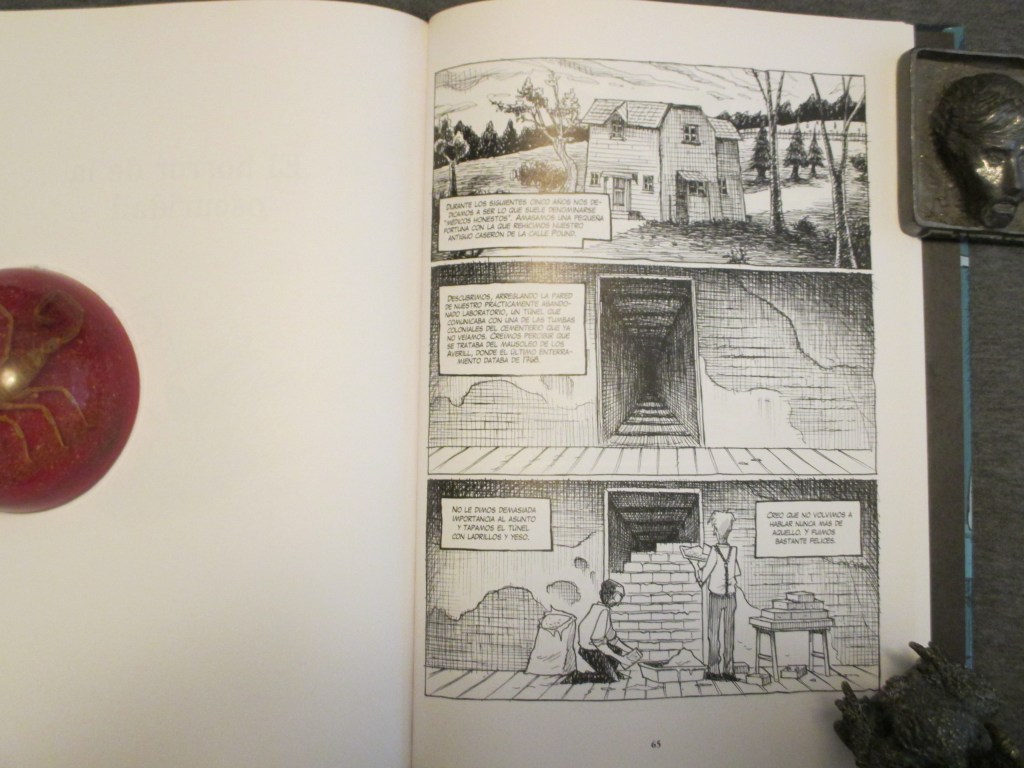
Both stories approach the end with characteristic foreshadowing. Yet in this instance, López’ formatting standardization helps set up the scene better. We see the passage that leads from the old funeral home’s basement to the nearby cemetery; we see Carter and West bricking it up. Centrally placed, a Chekov’s gun loaded and with safety off.

When you’ve read “Herbert West—Reanimator” and seen so many different adaptions and variations on it over the years, there’s rarely any surprise in the ending, just as there is no real shock when Godzilla goes on a rampage through a city. The cities in Godzilla films are there to be squashed. Yet there is an aesthetic appreciation for how the job is done, how well the adaptation captures something of the tone and feel of the story, what grue the artist can supply—and how the writer and artist together choose to portray events.

It is not a question of whether Reanimator or Herbert West: Carne Fresca is the better adaptation: they each have their strengths, and they each have their differences. To convey the geographic setting, the period, the tone and atmosphere all requires going beyond just the words printed on the page in Lovecraft’s story. The adaptors need to block out the story, episode by episode, scene by scene, finally page by page and panel by panel. How to establish where the events take place. Leaving room for dialogue, for exposition. Finding the balance between showing and telling—and, in some cases, what not to say, to remain faithful to the spirit of the text without offending present audiences with old prejudices.

Neither of these works has been translated into English; non-English adaptations of Lovecraft rarely are. Yet there are few if any graphic adaptations of “Herbert West—Reanimator” in English to really equal them.

Reanimator (2008) by Florent Calvez is available in hardcopy and as a Kindle ebook.

Herbert West: Carne Fresca (2021) by Luciano Saracino and Rodrigo López is available in hardcopy.


Bobby Derie is the author of Weird Talers: Essays on Robert E. Howard and Others and Sex and the Cthulhu Mythos.

Deep Cuts in a Lovecraftian Vein uses Amazon Associate links. As an Amazon Associate I earn from qualifying purchases.
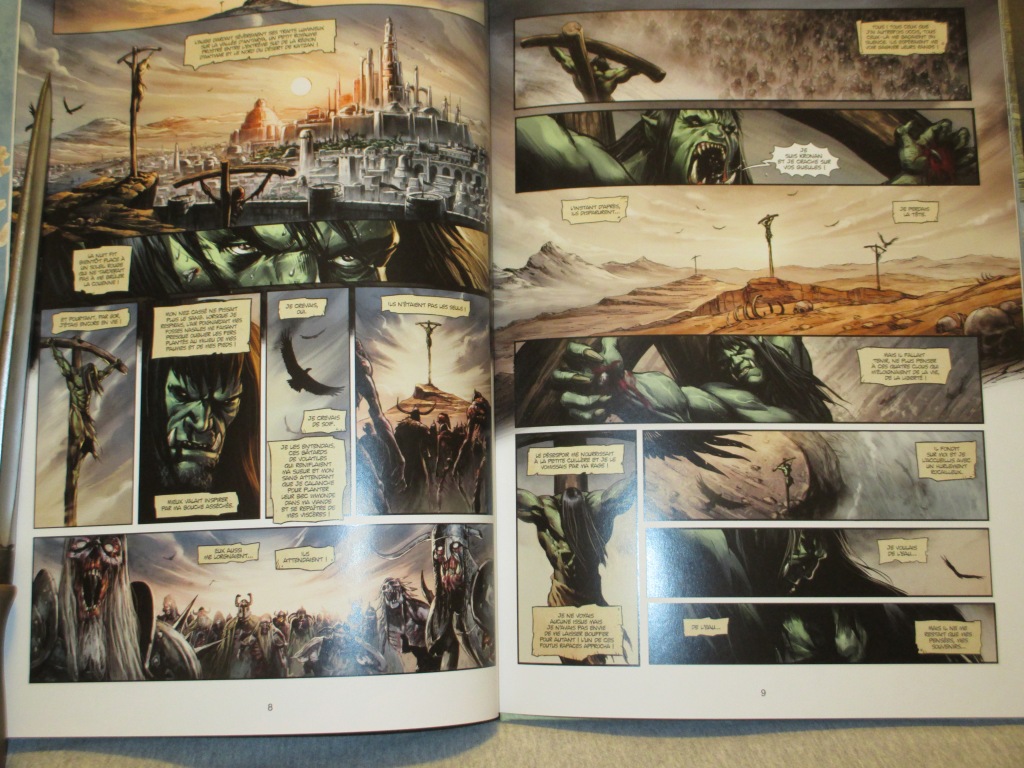
Orcs et Gobelins T11: Kronan (2021) by Jean-Luc Istin, Sébastien Grenier, and J. Nanjan

Antarya traverse une crise des plus graves depuis que la reine Nawell a perdu la raison. Lors d’une trahison de haut vol, elle fait exécuter ses soldats. L’orc Kronan, capitaine de sa garde en réchappe. Pour lui, celle qui dit se nommer Nawell est une usurpatrice et il compte bien le prouver mais aussi se venger. Et quand Kronan se venge, il trace toujours un sillon de sang sur son chemin.Antarya is going through a serious crisis since Queen Nawell lost her mind. In a high-level betrayal, she has her soldiers executed. The orc Kronan, captain of his guard, escapes. For him, the woman who says her name is Nawell is a usurper and he intends to prove it but also take revenge. And when Kronan takes revenge, he always leaves a trail of blood in his path.
Back cover copy for Orcs et Gobelins T11: KronanEnglish translation

The publication of J. R. R. Tolkien’s works The Hobbit (1937), The Lord of the Rings (1954-1955), and The Silmarillion (1977, with Christopher Tolkien and Guy Gavriel Kay) fundamentally changed the landscape of contemporary fantasy. Not just because of what J. R. R. Tolkien created and its enduring popularity, but because his approach to fantasy races and world-building set a high standard which many writers then took as a template for their own works. While Tolkien was not alone in creating fantasy worlds—Lord Dunsany’s The Gods of Pegāna (1905), E. R. Eddison’s The Worm Ouroboros (1922), and Poul Anderson’s The Broken Sword (1954) all preceded The Lord of the Rings—Tolkien’s conception of elves, dwarves, hobbits, ents, orcs, goblins, et al. strongly influenced the public imagination. This can especially be seen in tabletop games like Dungeons & Dragons and Warhammer Fantasy, computer games inspired by those works such as World of Warcraft, and novels such as Dennis L. McKiernan’s Mithgar series.

Robert E. Howard’s fantasy in the pages Weird Tales in the 1920s and 30s represents a very different kind of fantasy. There are fewer distinct fantasy races in Howard’s work; there are no elves and goblins per se. The Children of the Night from “Worms of the Earth” (Weird Tales Nov 1932) and other tales are inspired by the Little People stories of Arthur Machen, but shaped by Howard’s correspondence with Lovecraft, have taken a very different form. They are not servants of a Satanic Morgoth or Sauron, nor are they corrupted elves or even inherently evil in a purely good-and-evil sense. The morality of Howard’s tales is always murkier, the racial politics more complicated, and that tarnished air, that hardboiled sensibility where there is no true good and evil, no ultimate victory for the forces of light or darkness, just men and women and things beyond human ken interacting according to their own needs and desires is part of what sets Howard’s fantasy distinctly apart from Tolkien.

Whether you call it sword & sorcery, heroic fantasy, or something else, Howard’s bloodier, grimier, but very approachable brand of fantasy had an equal influence with Tolkien on later writers. Tolkien may have helped define orcs, elves, and dwarves for a few generations, but Howard helped define the thief, barbarian, and mercenary man-at-arms as iconic roles. They both had their own contributions in terms of magic rings and magic swords, and they had a penchant for taverns and themes of kingship. While their ethos and style sometimes clash, their joint influence on fantasy is undeniable…and sometimes more strongly felt together.

In 2013, French comics publisher Soleil began producing a series of bandes dessinées: Elfes Tome 1: Le Crystal des Elfes Bleus was published in 2013, and became popular enough to become an ongoing series. These were set in a very generic Dungeons & Dragons-derived fantasy world called Arran. The series was popular enough to merit several spin-off series of various levels of popularity: Nains (Dwarves, 2015), Orcs & Gobelins (Orcs and Goblins, 2017), Mages (2019), Terres d’Ogon (Lands of Ogon, 2022), and Guerres d’Arran (Wars of Arran, 2023). As with D&D itself, this is very specifically riffing off of the popular conception of fantasy races derived from Tolkien, but the world is grimier, more visceral, a bit more hardboiled—Tolkien as filtered through Howard, in a sense.

Jean-Luc Istin is a veteran of the series, having written several of the preceding volumes of Elfes and Orcs & Gobelins, and for the 11th tome in the O&G series, he partnered up with Sébastien Grenier (artist) and J. Nanjan (colorist) to produce something kind of special: a re-telling of Robert E. Howard’s “A Witch Shall be Born” (Weird Tales December 1934) set in the world of Arran, and starring not Conan the Cimmerian, but Kronan the Orc.

Copyright law in France works a little differently than in the United States. During Robert E. Howard’s lifetime, the Berne Convention would guarantee his works would remain under copyright for at least 50 years after his death (since Howard died in 1936, that would mean 1986); in France, the general term is 70 years after the author’s death (i.e. 2006). Either way, Howard’s works are generally considered in the public domain in France (although international trademarks may still apply). Even if copyright was an issue, Kronan might still pass as an homage…but not a parody.

While the concept of Conan as an orc might sound silly, the creative team between Kronan plays it very straight. Kronan is a hulking, musclebound figure that takes very strong artistic influence from the fantasy bodybuilder culture that Frank Frazetta’s paperback covers, John Buscema’s comic book Conan for Marvel, and Arnold Schwarzenegger’s turn as Conan in Conan the Barbarian (1982) all helped to inspire, and readers can clearly see in the absolutely ripped muscles, the deep-set eyes, and long hair various influences from all three mashed together. Yet this is not just Conan with tusks and green face paint.

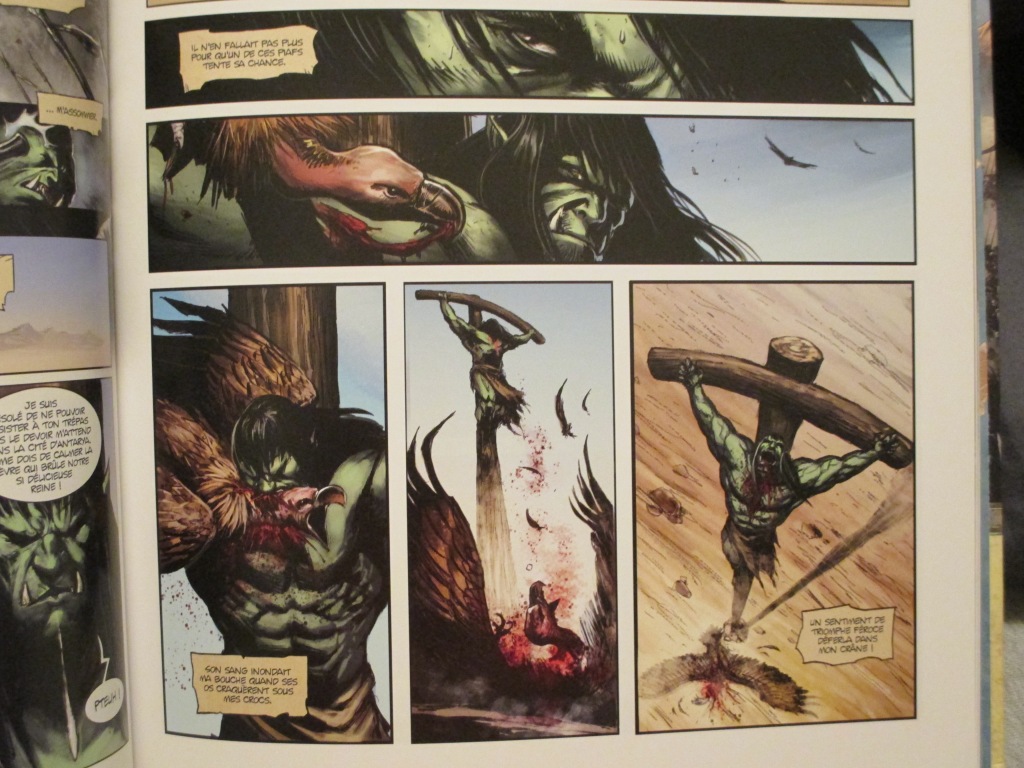
While Kronan follows the general outline of Howard’s story, and includes adaptations of many of the famous scenes—including Kronan on the cross, which was borrowed into the 1982 film—in adapting the story from Hyboria to Arran, the creators have shifted many of the details to fit the new setting. Instead of Crom, Kronan swears by the Orc deity Gor, for one example. In adapting the prose text to comic format, they’ve also veered away from some of the hallmarks of Howard’s narrative style in this story.

It is a weird penchant in Howard’s works that in several of the Conan stories, Conan himself takes a while to appear. The first chapter of “A Witch Shall Be Born” doesn’t mention Conan at all; it features Queen Taramis in her bed chamber, confronted by her twin sister. When Conan is first mentioned in chapter two, it is just that—a mention. The soldier Valerius is telling his sweetheart what happened. So we don’t actually see Conan in the story proper until he is crucified and on the cross.

In Kronan, by contrast, the narrative device is shifted: it is an older orc on a throne that is telling the story. We skip the bedroom scene with the queen (Nawell in place of Taramis) and see her attack her loyal army and citizens, and has Kronan crucified (as seen in a flashback-within-a-flashback). Where Howard had chapter 3 as a letter written to Nemedia about what all has happened, in the comic Kronan meets someone who tells him some these things, and we get a glimpse of Kronan doing some investigations of his own, breaking into a library to learn a bit of eldritch lore at knife-point.

Some aspects of the story are removed or simplified; we don’t actually see Kronan pull the nails out of his own flesh, as we did when Roy Thomas and John Buscema first adapted “A Witch Shall Be Born” to comics in Savage Sword of Conan #5 (1975); the crystal ball and acolyte by which the witch surveys the battle doesn’t feature either. Much of the architecture and landscaping is, for lack of a better term, more generically fantasy in aspect, with huge towers and walls, vast arched libraries carved into the solid earth, huge domed chambers like pagan cathedrals, etc. Arms and armor are likewise much more generic fantasy in design, less realistic than Howard’s descriptions, but more in keeping with the setting of Arran.

Eldritch entities are decidedly less toad-like.

However, we do get some rather inspired artistic decisions. Kronan is the only Orc in the entire book, much as Conan was the only Cimmerian in Howard’s series; the one greenskin among a group of otherwise human characters makes him stand out all the more. Also, the occasional epic page-spread that really gives a sense of scale worthy of the series.

Taken together, the changes streamline the story and focus it more on Kronan himself. A lot of the exposition where a character talks about Conan become tales told to Kronan, or scenes that the reader sees directly; Kronan takes a more active and central role in unraveling the central mystery of the witch in the narrative, and there are fewer secondary characters to keep track of. The bones of Howard’s story are there, but Kronan is much more the focus, and the world is much more one familiar to gamers and Tolkienian fantasy fans than the Hyborian Age.

Yet for all that, it’s fun. There’s never been an adaptation quite like this, and never one that didn’t veer into winking at the reader or lapsing into parody, as when Mark Rogers adapted Howard’s Conan tale “Beyond the Black River” (Weird Tales May-Jun 1935) as “Beyond the Black Walnut” in The Adventures of Samurai Cat (1984). It is faithful to the mood and tone of Howard’s story, and Howard’s conception of Conan, while also making allowances for the different medium, the different setting, and the artistic allowance where a fantasy orc barbarian can ride a massive horned ox into battle while wielding a fifty-pound sword one-handed.

To the memory of Robert E. Howard.

Perhaps needless to say, this is also fun. Sébastien Grenier’s art hits that sweet spot between the almost self-parody of Warhammer Fantasy and the more realistic tone or the Dungeons & Dragons 3rd edition Player’s handbook. J. Nanjan’s coloring work is solid; while I might like to see what a black & white version looks like some day, the vividness of the colors used on the cover really makes the banners pop, and the use of light and darkness on the interiors in muted tones really works. I think a different colorist would have been tempted to make things brighter or darker, which would have ruined the effect and made the whole work much too cartoonish.

While the series has begun to be translated into English, Orcs & Gobelins Tome 11: Kronan is still available primarily in French.


Bobby Derie is the author of Weird Talers: Essays on Robert E. Howard and Others and Sex and the Cthulhu Mythos.

Deep Cuts in a Lovecraftian Vein uses Amazon Associate links. As an Amazon Associate I earn from qualifying purchases.
“In the Name of Cavities” (2021) by Rajeev Singh

Eldritch Fappenings
This review deals with works of erotica, and the history of erotic art and writing. As part of this review, selected passages involving sexually explicit activites will be included.
As such, please be advised before reading further.


The nature of the said delights was a mystery that was sealed off with a picture of a nude, big-breasted woman lying prone on a greenish stone slab, her butt lifted up by an imposing figure in shadows, who seemed to be wearing some kind of costume and a cape that spread out like wings. A themed orgy? It had intrigued her to no end, the goblet of her unmet desires begging to be filled with a wine she had never tasted.

Rajeev Singh, “In the Name of Cavities” in Lustcraftian Horrors (2021) 239

Lovecraftian erotica is the fiction of transgression. Folks generally don’t write about the perfectly normal sex life of Edward Pickman Derby and Asenath Waite, or the raunchy but otherwise unremarkable wet dreams of Walter Gilman and the coeds he spied in the shower. When Innsmouth and R’lyeh come into play, people expect—not unfairly—for things to get properly weird. What qualifies as “weird” depends on your starting point. How much pornography and erotic fiction have you already consumed, how many sexual encounters have you had? What exactly is left that will shock you? What boundaries do you have left to transgress?

In that respect, the quest for greater titillation parallels and can overlap the quest for knowledge that marks much of Lovecraftian fiction. Protagonists draw closer to the central mystery, led there by an insatiable curiosity. Libido sciendi, the desire to know. Jaded seekers of the ultimate thrill who stumble onto the Mythos are an entire mode of Lovecraftian erotica. In that respect, “In the Name of Cavities” is part of a literary tradition with Robert M. Price’s “A Thousand Young” (1989). Except instead of a jaded libertine seeking greater carnal desires, it’s a bored housewife answering an internet advertisement for some excitement in a sexless marriage.

Any road up, as the saying goes. Rajeev Singh’s premise and characterization work in large part because they do start out very much with the starting point of utter mundanity: the neglected housewife decides to cheat. Yet this isn’t a morality play on the consequences of adultery; by chance, Anaïs has stumbled onto something more than the Eyes Wide Shut-style party she’d maybe hoped for.

Which is an aspect of the story that Singh doesn’t dwell upon: how much contemporary media has shaped our idea of what transgressive erotica really is. When we see the BDSM playroom in From Beyond and Barbara Crampton dawns her leather apparel, the audience is supposed to recognize that as a corruption of the character, or at least an awakening of darker sexual desires than missionary position with the lights off. Real bondage play, and the communities that develop around those desires, are strange and alien by comparison to those depicted in works like Fifty Shades of Grey, dealing as they do with issues of consent, safety, and roleplay.

So how much of what Anaïs saw should she have recognized? How much should the readers have recognized? When you read a passage like:

At first, she couldn’t say for sure but yes, the business end of each arm or tentacle did resemble a hard penis. And they weren’t just showpieces, those erections. Many of the feelers were busy plunging in and out of cavities all over a woman’s body as she lay flat on a green stone slab, similiar to what Anaïs had seen on the internet, only butt-downward.

Rajeev Singh, “In the Name of Cavities” in Lustcraftian Horrors (2021) 239

Anaïs does not make the immediate connection to Japanese hentai, works like La Blue Girl or Urotsukidoji. Naughty tentacles have become a trope in some circles for so long that the shock value has largely worn off…but the idea still has legs. Readers already familiar with works like Booty Call of Cthulhu (2012) by Dalia Daudelin and “The Flower of Innsmouth” (2011) by Monique Poirier probably won’t be shocked, but they might still be appreciative of the execution. Jaded sensibilities mean there are very few erotic impossibilities that haven’t shown up somewhere, in some media, and that is reflected in the frustrated Lovecraftian sex-quest.

It is very difficult to come up with something completely new and original.

To take another example from the story, Singh’s use of “cavities” is strongly reminiscent of Graham Masterton’s short story “Sex Object” (originally published in Hottest Blood, and then adapted to comics in Verotika #7), or even of the comic series Stranger Kisses. It’s hard to point out these works as inspirations, many writers stumble upon the same ideas completely independently of one another.

As a work of Lovecraftian fiction, “In the Name of Cavities” lives in a little universe of its own, relatively self-contained…but that’s okay because the last few pages take that idea and run with it, projecting the lusty present out into a post-apocalyptic future. That extension of the idea far beyond the length of the encounter, the duration of a climax, is a pleasant surprise…and a possibility that works within a Lovecraftian premise better than it does with most other erotic works.

“In the Name of Cavities” by Rajeev Singh was published in Lustcraftian Horrors: Erotic Stories Inspired by H. P. Lovecraft (2021).


Bobby Derie is the author of Weird Talers: Essays on Robert E. Howard & Others (2019) and Sex and the Cthulhu Mythos (2014).

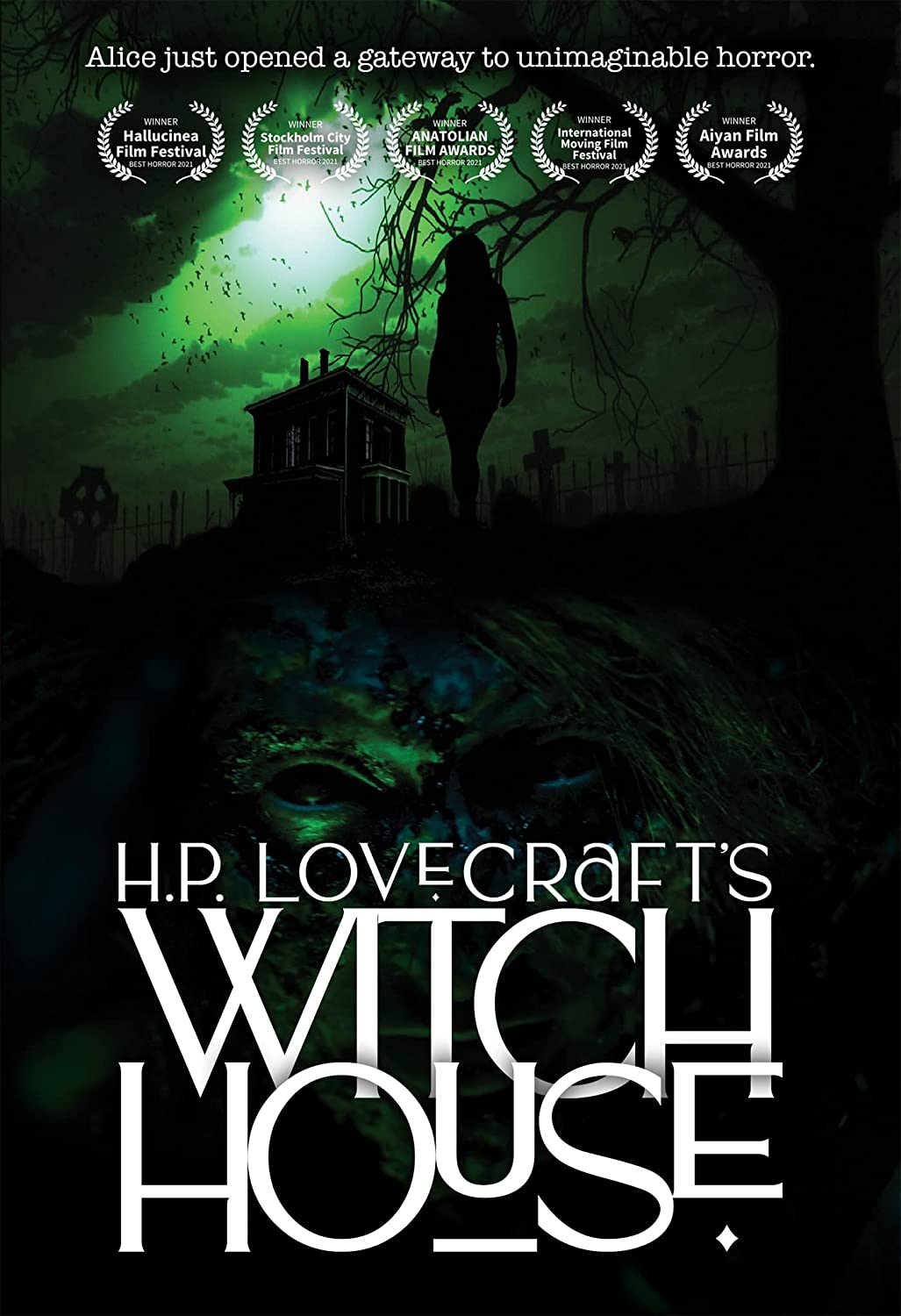
H. P. Lovecraft’s Witch House (2021)

After that he killed the time at a cheap cinema show, seeing the inane performance over and over again without paying any attention to it.

H. P. Lovecraft, “The Dreams in the Witch House”

Lovecraftian cinema is a diverse body of work, from short films to feature-length presentations to episodes of television or streaming shows; live-action to animation; zero-budget schlock and student films to big-budget Hollywood productions; from works that strive to adapt Lovecraft’s stories to the screen with various degrees of fidelity to more original presentations that take inspiration from or make reference to things Lovecraftian but seek to tell their own stories and focus on their own characters. In brief, Lovecraftian cinema is simply an extension of the Mythos into another media, with all of its own quirks and conventions.

H. P. Lovecraft’s Witch House (2021), directed by Bobby Easley, is loosely inspired by “The Dreams in the Witch House,” but with several twists. Mathematics graduate student Alice Gilman (Portia Chelleynn) is fleeing an abusive relationship and boards in an old house (the historic Hannah House in Indianapolis), which has a dark history involving the witch Keziah Mason (Andrea Collins), and whose odd angles and witchcraft tie in to Gilman’s own theories about other dimensions—and as the bodies pile up, Gilman learns that Mason and her coven are still very much active…

When compared to other productions of this type and covering this sort of material, H. P. Lovecraft’s Witch House is firmly in the middle of the pack of independent film festival fare such as The Last Case of August T. Harrison (2016), H. P. Lovecraft’s Two Left Arms (2017), H. P. Lovecraft’s The Deep Ones (2020), and Sacrifice (2020). All of these films pay more than lip-service homage to Lovecraft and the Mythos, are produced on modest budgets, and are serious efforts at a dramatic storyline and low-key horror rather than campy horror-comedies (e.g. The Last Lovecraft: The Relic of Cthulhu (2011), Killer Rack (2015)), arthouse reimaginings (e.g. Herbert West Reanimator (2018)), or reboots of previous franchises (e.g. Castle Freak (2020), The Resonator: Miskatonic U (2021)).

Individual performances, writing, cinematography, special effects (practical and CGI), score, and sound design vary—every film has its high points and low points, and if none of these seem destined right now for classic or break-out-hit status alongside films like Reanimator (1985), neither are they completely without merit or enjoyment. For most of these films, the problems they run into isn’t low budget or bad actors but poor writing: these are the cinematic equivalent of Cthulhu Mythos pastiche stories, and it shows in every familiar plot point and trope. The creators probably mean well by incorporating the Simon Necronomicon and its symbols, or by referencing Lovecraft and how his Mythos is really real…but these are both very old hat, and less clever than they might think.

Still, if nothing else, it’s fun to see how different creators approach the same material, like new wine in old bottles, and how far a given director or actor or special effects unit will go in pursuit of giving the audience something they haven’t seen before. For H. P. Lovecraft’s Witch House, there are a few pleasant surprises: Alice Gilman might be the first bisexual character in Lovecraftian cinema, and her brief love scene was probably the first live-action, non-pornographic lesbian love scene in a Mythos film. The dream sequences in particular are rather effective, and the lead actress Portia Chelleynn turns in a very competent performance.

Using you as a vessel for the birth of the antichrist.

H. P. Lovecraft’s Witch House

If there is a criticism to be leveled against H. P. Lovecraft’s Witch House, it’s the emphasis on Satanic witchcraft and the recycling of plot elements of Rosemary’s Baby into its Lovecraftian framework…and that requires a bit of explanation for why it might look like it would work, and why it really doesn’t.

The Salem Witch Trials were the belated American expression of a centuries-long persecution by civil and religious authorities of an imagined Satanic conspiracy. The Witch-Cult in Western Europe (1921) by Margaret A. Murray recast this as an imagined pagan religious conspiracy, and this was the form of the “witch-cult” which H. P. Lovecraft understood, believed, and worked into his stories. The diaspora of the Salem witch-cult is referenced in The Case of Charles Dexter Ward, “The Festival,” “The Dunwich Horror,” “The Dreams in the Witch House” and other stories. Following Murray, Lovecraft eschewed Satanism in his witchcraft—rather than something as prosaic as Christianity, Lovecraft was developing his own artificial mythology that was outside the narrow confines of God and Satan.

Likewise, Satanism had nothing much to do with Lovecraft, at least while he was alive and for some decades thereafter. In 1966, Anton LeVay founded the Church of Satan, a non-theistic religious philosophy that took the theatrical trappings and some of the rituals which literature—including accounts of the witch trials—associated with Satanism in the early modern period. The founding was propitious; Ira Levin’s novel Rosemary’s Baby came out in 1967, and the award-winning film was released in 1968. LaVey published The Satanic Bible in 1969, William Peter Blatty’s novel The Exorcist came out in 1971, and in 1973 was also adapted to the screen. Bands like Black Sabbath (1968) and Coven (1967) adopted elements of Satanism and occultism in their acts, laying some of the groundwork for what would become black metal.

It was the start of a Satanic pop culture renaissance, one that borrowed from and built on earlier ideas of Satanism, but took it in a new direction, some more theatrical and some more serious; sometimes both. Despite his dearth of Satanic connections, Lovecraft had his part too. Lovecraftian references appear in The Satanic Rituals (1972), notably “The Ceremony of Nine Angles” and “The Call of Cthulhu”; The Dunwich Horror (1970) deliberately echoed many of the beats of Rosemary’s Baby, with Nancy Wagner (Sandra Dee) serving in the role of Rosemary, complete with weird dreams, cultic conspiracy, and infernal impregnation. From there, parallel paths developed: Satanists and occultists borrowing Lovecraft into their rituals, philosophy, and theology, and pop culture confusing the Lovecraftian Mythos with Satanism as they sought to borrow on the dark appeal of both for black metal music, horror films, comics, and other media.

In the case of H. P. Lovecraft’s The Witch House, it’s easy to see where the writers were coming from and what they were going for: Keziah Mason was intended to be the genuine Salem Witch in Lovecraft’s story, and accused witches were believed to be associated with Satanism. It isn’t much of a stretch to give Keziah Mason a Satanic coven, or a typically Satanic goal…it’s just not a very Lovecraftian take on the subject. Quite the opposite of Lovecraft’s very non-Satanic take on witchcraft, really. It’s not even how most contemporary non-theistic Satanists and occultists would integrate Lovecraft’s Mythos into their beliefs and practices.

Which isn’t quite a damning indictment of the film as a whole, but it emphasizes the issue with Lovecraftian film pastiche: the people writing these movies and putting them together mean well, but are largely aping the most obvious aspects of Lovecraft’s Mythos stories without understanding the underlying ideas and mood that make those work. In “The Dreams in the Witch House,” the ultimate revelation was that the horrors were real…that there was a cruel reality that lay behind the Salem witch accusations, that the accused were not just innocent victims of religious mania; something a bit closer to The Lords of Salem (2012).

On its own merits, as a part of the Lovecraftian cinematic oeuvre, H. P. Lovecraft’s The Witch House isn’t a terrible film—but it is exemplary of an approach that misses the mark of what can make a really great Lovecraftian film, focusing on obvious surface elements and easy references, like Miskatonic University hoodies instead of making a film that captures the feel of a Lovecraft story.

H. P. Lovecraft’s Witch House was released in 2021 and is available on DVD and streaming.


Bobby Derie is the author of Weird Talers: Essays on Robert E. Howard & Others (2019) and Sex and the Cthulhu Mythos (2014).

Devil’s Due: A Transgender Tale (2021) by Diane Woods

It began with what has been called Cancel Culture, I suppose. Without much warning, I was subjected to a number of public accusations by various women of my alleged misdeeds. These accusations were largely unsubstantiated and were simply the public revenge of various disgruntled and jilted former lovers and employees.

But the resulting furor was considerable. I was dropped by my long-time publisher, in a very public manner. My book sales, which had been very considerable (and some quite lucrative movie development deals) quickly began to evaporate. […]

I spent a small fortune on lawyers. It was not successful. And in the court of public opinion, I was tried and convicted in short order. And so, it was in the depths of despair that I somehow found a most unusual, a most intriguing, website for someone or something called “The Repairer of Reputation”.

Diane Woods, Devil’s Due: A Transgender Tale (2021)

“The Repairer of Reputations” is the first, weirdest, and arguably most important tale in Robert W. Chamber’s 1895 collection The King in Yellow. It is also the hardest to actually follow up: Chambers had set the scene thirty years in his future, in the manner of future war stories like H. G. Wells’ “The Land Ironclads” (1903). The narrator is unreliable, as is Mr. Wilde, the eponymous Repairer of Reputations, which adds to the mystery and disquiet of the story—how much of this is true, and how much is madness?

While a few works like Alan Moore & Jacen Burrows’ Providence have deliberately woven some elements of that story into their own, this is rare. Most who draw on The King in Yellow focus on the Yellow Mythos surrounding the play, such as “Cordelia’s Song from The King in Yellow” (1938) by Vincent Starrett & “Evening Reflections, Carcosa” (2011) by Ann K. Schwader rather than the events of the story. So there is a certain cleverness in how Diane Woods takes the idea of the Repairer of Reputations and gives it the perfect contemporary context: who would be in more need of such a service than someone who has been canceled?

Political partisans can be relieved that this book is not about cancel culture, either for or against. The social ostracism is the catalyst for the events of the story, and Woods never goes into vast detail about how true the allegations are or whether the outrage is justified or not. This is, as the story suggests, a transgender tale: the way that the protagonist’s reputation is repaired involves becoming someone else.

Impossibly, my transformation was complete. This was monstrously alarming, of course, but Tanya assured me that this need not be a permanent change. For my own personal reasons, this felt deeply ironic to me. At the same time, deeply erotic.

Since my adolescence, I had been obsessed with the idea of a male being transformed into a female. And since my teens, I had compulsion to periodically dress in the clothes of a female. This has been my most closely guarded secret, of course. But it may help explain what happened next.

Diane Woods, Devil’s Due: A Transgender Tale (2021)

Fantasy gender-bending stories are nothing new. H. P. Lovecraft had body-swapping in “The Thing on the Doorstep,” Bergier used Mythos magic in “Celui qui suscitait l’effroi…” (1958), John Blackburn had a surgical solution in Dagger of Blood (1997), and so on. The method varied, but the result was often the same: a gender transition that was often swift and total. The reality of transition is much longer, messier, and more difficult, involving various degrees of psychiatric evaluation and therapy, hormone treatments, and possibly surgery—and accompanied by legal and bureaucratic hurdles, healing times, side effects from medication, and social ostracism.

Transgender fantasies cut past many of the real-life difficulties to focus on the drama—and sometimes wonder—of the transformation itself, and in many ways are probably closer to transformation erotica than to any desire to live vicariously through someone else’s transition. In this respect, many such “gender bender” tales are closer to a fetishization of the idea of gender transition, titillating readers with the taboo of crossing that imaginary definitive line between male and female, rather than any effort to create an authentic transgender character.

Devil’s Due: A Transgender Tale is not King in Yellow erotica in the usual sense, however. There are a few scattered erotic scenes in the book, but those hoping for a version of the King in Yellow to appear with a three-foot penis will be sadly disappointed. Fantasy transition tales like this one have a body of tropes of their own, involving how willing the participant is, how they come to accept or reject their new gender, etc.; if the physical transition is swift, the mental transition and acceptance of new gender—and often new sexuality—takes longer, and Diane Woods plays with some of the familiar tropes, but shies away from going into lengthy and explicit sex scenes as the protagonist, now a woman, has to find out if she is a lesbian or bisexual.

While the premise of the story is focused on the repairing of the protagonist’s reputation, and the gender transition is a part of that, the plot gets a little messier. Rather than keep strictly to the Yellow Mythos, Wood brings in elements of the Cthulhu Mythos including Randi Carter (a transitioned Randolph Carter) and Nyarlathotep; the relatively magical physical gender transition is accompanied by a science fiction hypnosis/brainwashing device that facilitates the mental transition and sets up a somewhat Twilight Zone-esque ending. It is far more Mythos material than is strictly necessary for the plot, and gives the story a bit of a fanfiction feel which it didn’t need to accomplish some of the plot twists—but some of the twists themselves aren’t bad.

It is important to note that Devil’s Due does not tackle a difficult subject via the medium of the Mythos in the manner of “Koenigsberg’s Model” (2011) by Peter Tupper & “The Ape in Me: A Tale of Lovecraftian Lust” (2016) by Raine Roka; that is, Woods is not using the story to address any social theme or element in Chambers or Lovecraft’s fiction, or any such theme or element in their personal prejudices. Devil’s Due is a transformation story that uses the Mythos for inspiration and aesthetics, but there’s not any deeper message about how Lovecraft felt about gender or how Chambers depicted gender in his stories.

Which is fair: not every latter-day Mythos story has to be a commentary on what has gone before. Devil’s Due is a competently-written fantasy transformation story; the riff off of “The Repairer of Reputations” helps it stand out from the dozens of other titles involving gender transformation on the Amazon ebook stocklist, and that is no doubt the point. If anything, it perhaps reads a bit closer to some of the older, less sexually explicit transvestite and transgender stories edited by Sandy Thomas.

Devil’s Due: A Transgender Tale (2021) by Diane Woods is available on Amazon Kindle, it was briefly available as a paperback.


Bobby Derie is the author of Weird Talers: Essays on Robert E. Howard & Others (2019) and Sex and the Cthulhu Mythos (2014).

“Phantasmagore” (2021) by H. K. Lovejoy

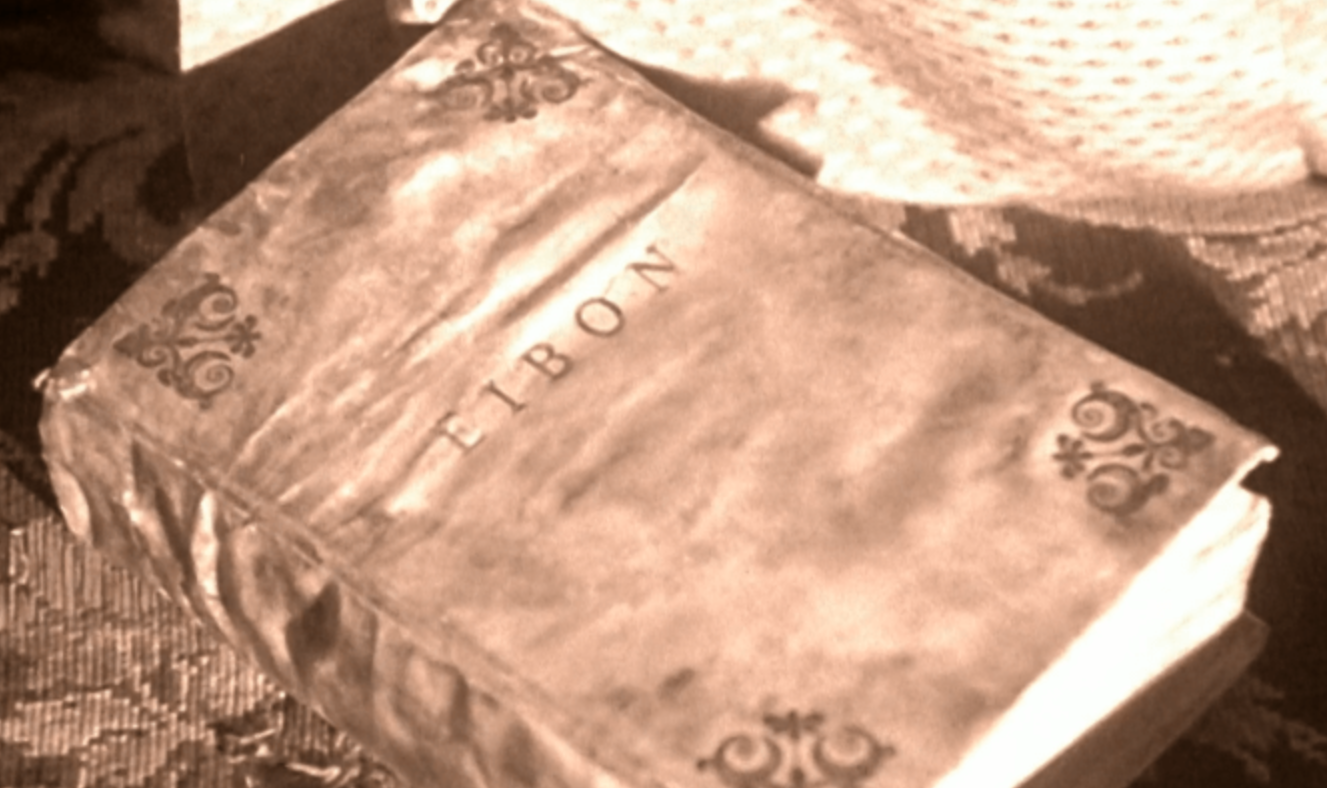
She gently unrolled the parchment, staining its edges with her filthy hands, then did her best to recite the strange serpentine text with the same guttural intonation the witch was so fluent with. She remembered the book this passage had been transcribed from, and that stark silver word embossed on its greasy black cover: Eibon.
—H. K. Lovejoy, “Phantasmagore” in Beyond the Book of Eibon 192

Eibon

The Book of Eibon in The Beyond (1981)

In 1980, Italian filmmaker Lucio Fulci directed City of the Living Dead (Italian title: Paura nella città dei morti viventi), the first of what would become known as his “Gates of Hell Trilogy,” the other two films of which are The Beyond (1981, …E tu vivrai nel terrore! L’aldilà) and The House by the Cemetery (1981, Quella villa accanto al cimitero). The films share little continuity of plot or setting: all involve one of the doorways to hell opening, resulting in hauntings, baroque and gory deaths, and the undead, and all contain references to or elements of the Mythos—the eponymous “City of the Living Dead” is Dunwich, and the Book of Eibon appears to prophesy or predict some of the events of the films.

Even these references are very slight; Fulci wasn’t quite trying to bring Lovecraft or Clark Ashton Smith directly to the big screen, and the films do not reference each other and can be viewed standalone. What unites them is Fulci’s style: visceral, weird, almost poetic compositions of color and sound. He was fond of eye trauma and smoking acid dissolving faces, but largely avoided sexual exploitation or the mondo excesses of, say, Cannibal Holocaust (1980).

Fulci’s trilogy became cult favorites among the horror movie buff scene, and remain so even today with remastered re-releases and commentaries. They’ve also inspired some other media, notably a series of comic adaptations form Eibon Press, and fiction including The Final Gate (2021) by Wesley Southard and Lucas Mangum, and the anthology Beyond the Book of Eibon (2021) edited by Perry Ruhland and Astrid Rose for Death Wound Publishing. Unfortunately, the latter company appears defunct so if you missed the kickstarter, finding a copy might be quite difficult.

“Phantasmagore” by H. K. Lovejoy is the final story in Beyond the Book of Eibon. The tale is brief, and Lovejoy enjoys an elaborate and detailed style reminiscent of Smith or Lovecraft’s more ultraviolet prose:

Mounds of her honey hair fell in an exquisite latticework across her bare breasts and stomach, only to be gently reshuffled by her lover.
—H. K. Lovejoy, “Phantasmagore” in Beyond the Book of Eibon 193

In the context of Fulci’s trilogy, however, it works. It evokes something of his style, of the artistry of horror, the beautiful moments that then break into desolation and decay. As with the films, the story is set in their orbit but independent of their plots: a Dunwich affair leads to ghastly supernatural revenge via the Book of Eibon. Lovejoy isn’t afraid to go full Fulci when it comes to describing the culmination of the affair, doesn’t let the reader’s eye drift away from the page. Which is, again, quite fitting.

Her eyes had reduced to frothing pools of blood, allowing the brains, which had taken on a gelatinous state, to plunge through her sockets from the blind momentum of nightcrawlers.
—H. K. Lovejoy, “Phantasmagore” in Beyond the Book of Eibon 194

“How Lovecraftian (or Klarkash-Tonian) is ‘Phantasmagore’?” is an interesting question. Fulci’s films themselves borrow little from the Mythos, and have their own aesthetic entirely. There are few explanations in Fulci’s films, and it is up to the reader to theorize and interpret the images and events that appear on screen, to try and make sense of what are ultimately irrational happenings. Lovejoy’s story is more straightforward than Fulci’s films, and outside the context of the anthology in which it appears could easily be taken as a brief Mythos tale—there, after all, is Dunwich, there is the Book of Eibon. You don’t need the whole eldritch pantheon in every story.

At the opening of the film Manhattan Baby (1982), Fulci gives an apocryphal (and most likely invented) quote from Lovecraft:

Il mistero non è attorno alle cose, ma dentro le cose stesse.
Mystery is not around things, but within things themselves.

Ultimately, it is up to the reader to decide where “Phantasmagore” lies…whether it “counts” as a Mythos story, or a story set exclusively in the Gates of Hell narrative universe, or perhaps neither or both at the same time. The story exists as its own work, and can be enjoyed as such; any greater meaning has to be supplied by someone else.

H. K. Lovejoy’s other writing includes The Black in Between (2020), and she is also a funerary artist; her website is https://www.charnelnectar.com/


Bobby Derie is the author of Weird Talers: Essays on Robert E. Howard and Others and Sex and the Cthulhu Mythos.

Deep Cuts in a Lovecraftian Vein uses Amazon Associate links. As an Amazon Associate I earn from qualifying purchases.
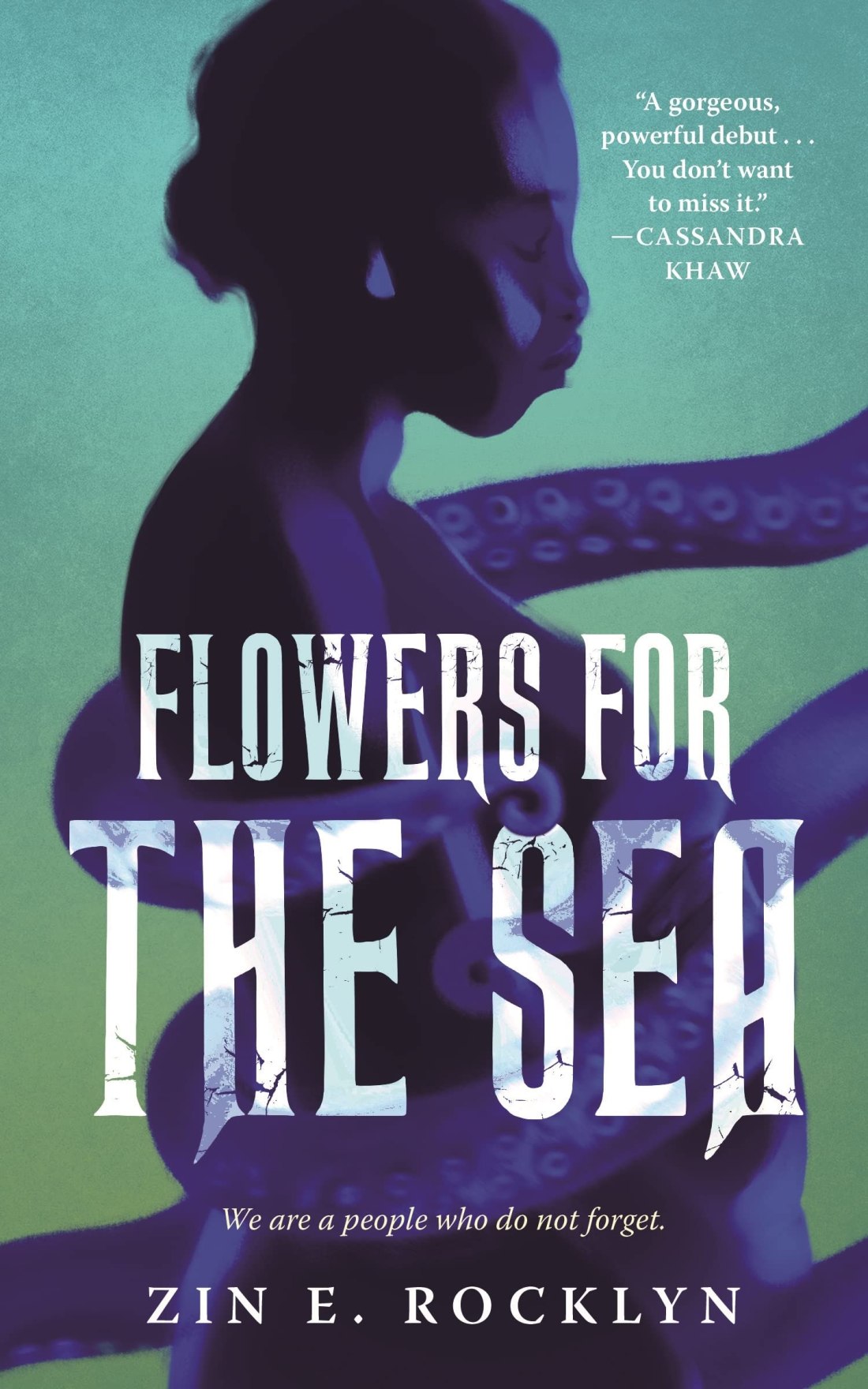
Flowers for the Sea (2021) by Zin E. Rocklyn

My stories always feature a Black woman lead, no matter how hard history tries to erase us and our contributions. I speak to my experiences in my stories as a way to flush them out as well as show the world that we are here, we matter, we are worthy.
Women in Horror Month Fiction Fragments: Zin E. Rocklyn (26 Feb 2021) by Michelle R. Lane

Perspective in any story is more than just the race or gender of the protagonist: it is a way of looking at the world. The history of slavery in the United States, for example, looks different from the perspective of the slave than it does from the perspective of the slaver and abolitionist. The experience and the stakes are different. It leaves its mark on individuals and generations in a way that is almost inescapable, and it shapes the way people understand and pass on their own stories and histories.

Persecution is not something Lovecraft thoroughly understood or expressed in his stories. While his life featured great hardships and poverty, he and his family never experienced systemic prejudice or discrimination. In stories like “The Festival,” he alludes to the hangings at Salem Village and the quiet diaspora of witches, but the witches are not sympathetic victims, even from the perspective of their descendants. There is no rancor at the injustice done, because to Lovecraft there was no injustice: they were witches, after all. Likewise, the fate of the people of Innsmouth is not presented as a crime amounting almost to genocide akin to the forced relocation of the Native Americans, though in all particulars it certainly approaches it.

Chronological distance offers one axis for reflection: “The Doom That Came to Innsmouth” (1999) by Brian McNaughton & “The Litany of Earth” (2014) by Ruthanna Emrys both shift the narrative on “The Shadow over Innsmouth,” seeing in the Innsmouth camps parallels to the Japanese internment camps and the Holocaust of World War 2. These stories deal with individuals who survived true persecution, the personal trauma and the breakup of families, and deal with the psychological and cultural consequences.

As a more diverse set of authors came to Lovecraftian fiction, they brought with them different points of view. The City We Became (2020) by N. K. Jemisin exists, in part, as a rejection and refutation of Lovecraft’s perspective and specific prejudices; “The Ballad of Black Tom” (2016) by Victor LaValle and “Jeroboam Henley’s Debt” (1982) by Charles R. Saunders focus on the perspective of the marginalized Black men who faced the discrimination in the 1920s and 30s that Lovecraft never knew or attempted to depict.

What Zin E. Rocklyn brings to her stories is not necessarily a need to counter, refute, reimagine, or even mention Lovecraft and his Mythos, but her existence and perspective as a Black woman writing weird fiction. As she puts it, when asked about whether she puts broader messages on race into her work:

By default, my presence within horror and writing horror is a message unto itself. Me showing up is message enough, so there’s no definitive way for me to divorce myself from that ongoing narrative.
Women in Horror Month Fiction Fragments: Zin E. Rocklyn (26 Feb 2021) by Michelle R. Lane

Which is absolutely the case for her short novel Flowers for the Sea (1921). Readers familiar with Lovecraft might well identify this story, which is set in an ambiguous time and place, as a left-handed descendant of “The Shadow over Innsmouth,” by way of ecological disaster fiction like “Till A’ the Seas” by R. H. Barlow with H. P. Lovecraft. Iraxi is one of the last survivors of a persecuted minority with rumored supernatual powers and ties to the sea, a literary cousin to the survivors of the Innsmouth diaspora in stories like “All Our Salt-Bottled Hearts” (2016) by Sonya Taaffe—but, the details aren’t quite right. There is a visceral reality to the persecution often missing from Innsmouth stories, ugly details like this one:

They called us nims. A word with hardly any meaning other than to spit upon its victim.

It morphed, much like forked tongues who spoke it, an encapsulating slure that reduced one to shreds, to the foam of the sea we feared, to nothing but the scent of a bowel movement.
—Zin E. Rocklyn, Flowers from the Sea 15

Slurs in science fiction and fantasy are not to be created lightly; too often they tend to mask real-world prejudices, and be substituted for them. Yet in this story, it serves the purpose of an introduction to the history of persecution that has brought Iraxi to this point, the beginning of the end of the pregnancy she didn’t want aboard a dying ship, hated by and hating those around her.

There is no calm, philosophical Lovecraftian indifference in this story. Anger is a major theme, sometimes ugly and sometimes righteous, but never unjustified. There is history behind that anger, long history, some of which is only hinted at…and it isn’t over. The people around her on the ship tolerate her, use her, but she is only and ever a resource to be managed, not a person to be respected…until, at last, it is too late.

Hate has its place in every life; it is a natural reaction to the pain of loss. An excess of hate can lead to terrible consequences; it is what leads to the transformation of Tommy Tucker in “The Ballad of Black Tom,” and nearly damns Maryse Boudreaux in her fight against the Ku Kluxes in Ring Shout (2020) by P. Djèlí Clark. Through Rocklyn’s prose, we get Iraxi’s struggle with her own hatred…but if she becomes a monster, it is because the monsters around her have made her one. The people that burned down her home, killed her family, called her people names for generations, and finally forced her to carry a child she didn’t want…it was their monstrous deeds that stoked the furnace of her rage and honed her cruelty to a sharp point.

There are counter-narratives that might be considered, since we only have Iraxi’s viewpoint for the whole novel. The ship is dying, women unable to bear children, and in this context Iraxi is an ungrateful madonna, given the best food while the others slowly starve. Should she not be thankful for the life she is to give birth to? Is she an unreliable narrator, self-centered and toxic, unable to appreciate what others sacrifice for her sake? Or how her individual sacrifice is for the greater good, for the survival of all?

The problem with these counter-narratives is that they run up hard against issues of bodily autonomy. How grateful should a slave be, to bear the child of her master to increase his wealth? Why should she submit herself and her own needs and desires for the good of a people who see her as little more than a particularly stubborn breeding cow? That is the presence Rocklyn brings to the tale. The arguments against Iraxi’s perspective are ultimately ugly because what Iraxi suffers is, by and large, an extrapolation of the horrors and indignities that women, especially Black women, have suffered for centuries in the United States and the Caribbean.

While we’re seen as sexual beings, we’re rarely seen as sensual beings. We’ve been used and abused for hundreds of years for the sake of personal slavery to the advancement of science, but never as human beings who own their bodies and their sexuality. Even in contemporary thought, there is the myth of the Strong Black Woman who needs no partner, no love, and it simply isn’t true. It’s a bastardisation of a mantra that means we won’t put up with bullshit. I want my fiction to make that distinction, that we crave and deserve love and nurturing.
Interview: Zin E. Rocklyn by Gordon B. White in Nightmare 107 (Aug 2021)

So it is with Inaxi, though her desire for love is never requited…hence the depth and intensity of her hatred. The issues of desire for love and bodily autonomy for women, especially within the context of pregnancy, are seldom made explicit in Lovecraftian fiction; stories like “In His Daughter’s Darkling Womb” (1997) by Tina L. Jens and “A Coven in Essex County” (2016) by J. M. Yales touch on them, but Flowers for the Sea is particularly vivid not only in its microscopic emphasis on the horrors of an unwanted pregnancy, approaching splatterpunk levels of grue when the chapter arrives for the birth, but in the implications. Iraxi is not just a Black Lavinia Whateley; her experience comes out of a very distinct experience of Black Womanhood.

Which is ultimately something that sets Flowers for the Sea apart from many other “Lovecraftian” tales. “The Shadow over Innsmouth” is not so much a distant ancestor as it is the raw material for a tube of Mummy brown that Rocklyn uses to paint her own distinct picture.

Flowers for the Sea by Zin E. Rocklyn was published in 2021 by Tor. Readers might also enjoy her fiction “teatime” (2020) and “The Night Sun” (2020).


Bobby Derie is the author of Weird Talers: Essays on Robert E. Howard and Others and Sex and the Cthulhu Mythos.

Deep Cuts in a Lovecraftian Vein uses Amazon Associate links. As an Amazon Associate I earn from qualifying purchases.
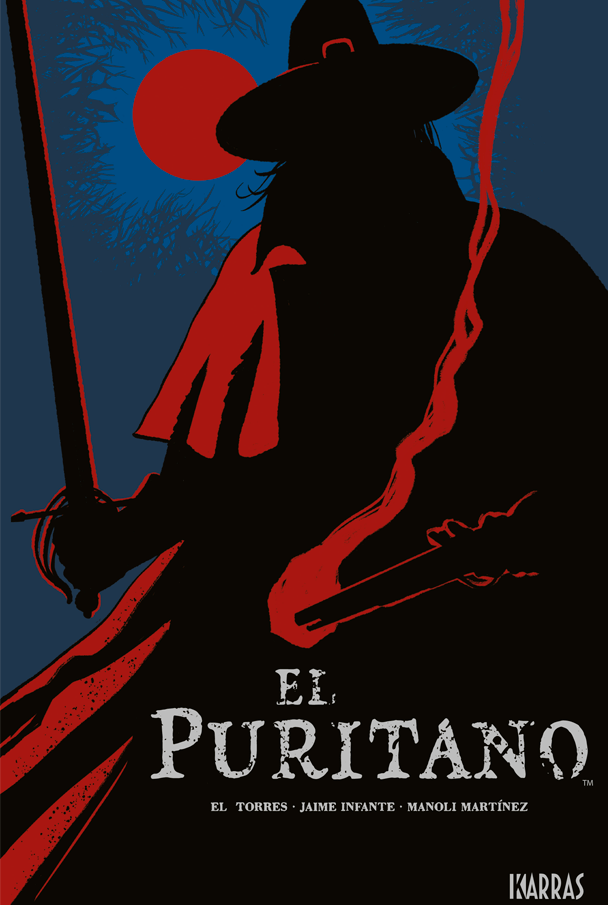
El Puritano (2021) by El Torres, Jaime Infante, & Manoli Martínez

¿Dónde está Bess?
El Puritano (2021)

“Where is Bess?” said Solomon Kane.
“Woe that I caused her tears.”
“In the quiet churchyard by the sea
she has slept these seven years.”
The sea-wind moaned at the window-pane,
and Solomon bowed his head.
“Ashes to ashes and dust to dust,
and the fairest fade,” he said.
—Robert E. Howard, “Solomon Kane’s Homecoming” (1936)

For any other pulp writer, Solomon Kane would be a breakout character. Robert E. Howard’s original pulp stories, even the unpublished drafts, fragments, and synopses, have been collected, published, translated into other languages, and recorded as audiobooks. Kane has been adapted to comics by at least Marvel, Blackthorne, Dark Horse, Diabolo Ediciones, and now Karras Comics. In 2009 a feature film titled Solomon Kane was released; no less an author than Ramsey Campbell handled the novelization, and Campbell had also previously completed some of Howard’s Solomon Kane fragments. There is a Solomon Kane roleplaying game, a Solomon Kane board game, toys and action figures, and bootleg t-shirts. Solomon Kane has even been borrowed into the work of other authors, like Paul Di Filippo’s “Observable Things.”

Few pulp characters can claim as much success in publication, commercialization, and longevity. Yet Robert E. Howard’s Solomon Kane has since the 1930s dwelled in the shadow of Conan the Cimmerian. While Solomon Kane was Howard’s first successful series character, Conan was easily his most popular, and the tales and poems of the Puritan swordsman are often discovered by readers after they have already been hooked by Conan.

El Puritano (“The Puritan,” 2021, Karras Comics) is an original graphic novel based on Robert E. Howard’s Solomon Kane, who has fallen into the public domain in Europe. The creators of this graphic novel are El Torres (script), Jaime Infante (pen & inks), & Manoli Martínez (colorist); the logo was designed by Ferran Delgado. While it is a standalone graphic novel in that the story is self-contained, the framing narrative makes this a kind of “second chapter” to Sangre Bárbara (2021) by El Torres, Joe Bocardo, & Manoli MartínezEl Puritano begins where Sangre Bárbara ends, with the former slave Mary Bohannon telling tales to a young Robert E. Howard, so while each stands on its own, taken together there is an episodic narrative…or perhaps it would be more accurate to say that Robert E. Howard’s own story, the narrative and mythology of his life, have been closely entwined with his characters so that he becomes the common bridging element between them.

Solomon Kane did not attract as much fan interest as Conan in the 1930s, ’40s, and ’50s, so there were fewer efforts to define a canonical chronology of his adventures—and indeed, Howard made no particular effort to set down a timeline; certain adventures clearly take place after others, because they refer to earlier events or Kane had acquired his strange cat-headed staff, but trying to fix real-world dates gets problematic. We never see Solomon Kane’s parents or home, we never get a fix for when he was born or how old he is; Kane steps onto the page, fully formed, and leaves the same way after completing his mission.

In El Puritano, El Torres and Jaime Infante have placed a much older but still spry Solomon Kane in the English colonies of North America. Various influences are at play here, some more obvious than others: Arthur Miller’s The Crucible (1956); Twins of Evil (1971), starring Peter Cushing as a witch-hunter; and The VVitch (2015) by director Robert Eggers all play their part in the mix, with little nods and homages to the various creators, actors, and storylines at play. Solomon Kane, the self-declared Puritan, is present in a colony of fellow believers, and yet he is apart from them. As it may be, since Howard noted:

All his life he had roamed about the world aiding the weak and fighting oppression, he neither knew nor questioned why. That was his obsession, his driving force of life. Cruelty and tyranny to the weak sent a red blaze of fury, fierce and lasting, through his soul. When the full flame of his hatred was wakened and loosed, there was no rest for him until his vengeance had been fulfilled to the uttermost. If he thought of it at all, he considered himself a fulfiller of God’s judgment, a vessel of wrath to be emptied upon the souls of the unrighteous. Yet in the full sense of the word Solomon Kane was not wholly a Puritan, though he thought of himself as such.
—Robert E. Howard, “Red Shadows”

The story that unfolds is a love letter to the character, with many references to past adventures without dwelling on them. Kane is faced once again with supernatural evil, and the need to defend an innocent young woman whose only crime may have been to love a witch. But Kane is also faced with his own conscience and past deeds—and how his own people, with all their superstition and ignorant faith, judge him and others. N’longa makes a surprising but very appropriate appearance, this time inhabiting the flesh of a Wampanoag woman, a kind of transgender experience that is at once novel and yet very fitting for the character.

Jaime Infante’s subdued, realistic artwork greatly compliments the script, and Manoli Martínez does some really notable work as a colorist, shifting the palette of the scenes to depict flashbacks, astral visitations, somber daylight, and vicious battle.

The story ends, not with Mary Bohannon talking to a young Robert E. Howard, but with Bob himself in his room, standing before the typewriter. The house still stands in Cross Plains, TX, now a museum with Bob’s room restored. You can see a Tour of the Robert E. Howard Home by Ben Friberg online, if you can’t get out there in person, and see it just as Infante tried to capture it on the page. Bob needs to write a story, and begins to type the opening words of “Red Shadows”…so it is both an ending and a beginning; what might be the last tale of Solomon Kane loops around as Howard records his legend. It begins and ends with Robert E. Howard.

El Puritano can be purchased from Karras Comics; they are working on other new works based on Robert E. Howard’s stories and characters as well.


Bobby Derie is the author of Weird Talers: Essays on Robert E. Howard and Others and Sex and the Cthulhu Mythos.

Deep Cuts in a Lovecraftian Vein uses Amazon Associate links. As an Amazon Associate I earn from qualifying purchases.