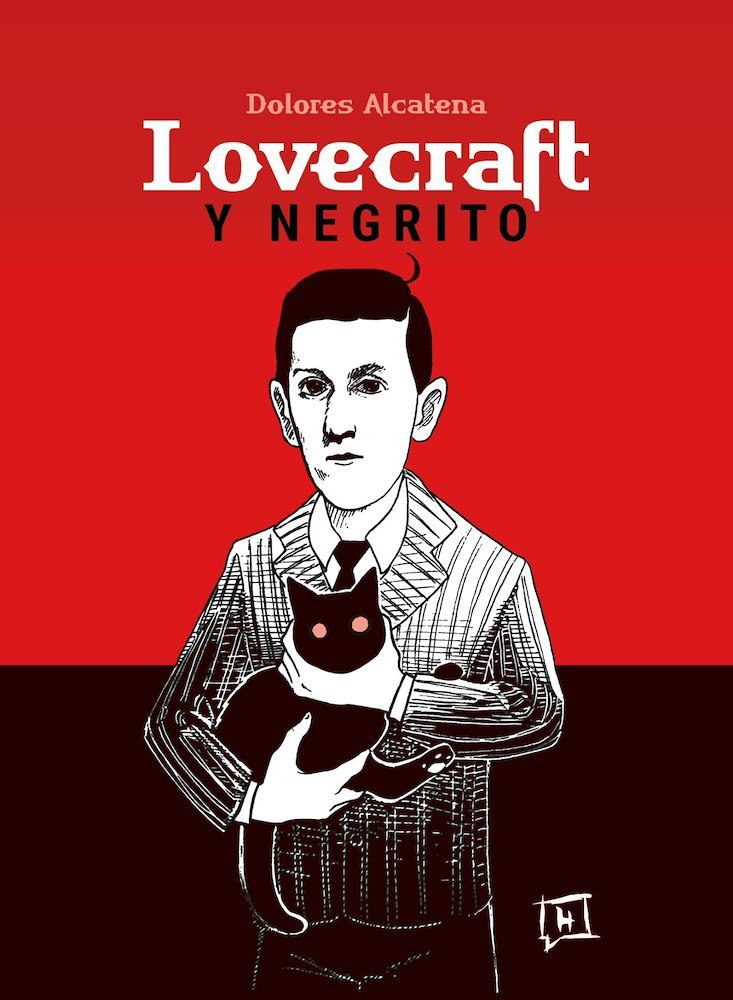
Lovecraft y Negrito (2023) by Dolores Alcatena

Racist Language
This review concerns H. P. Lovecraft’s cat, whose name was a racial slur against Black people.
As part of this review, the cat’s name and variations are included. Reader discretion advised.


The first known reference to H. P. Lovecraft’s cat was in a letter from his grandfather when Lovecraft was only 5 years old:

You and Dumplin Mama must keep the Barn shut every night and take care of Nig.
—Whipple Van Buren Phillips to H. P. Lovecraft, 17 Oct 1895, Letters to Family & Family Friends 2.1046

“Nig” was short for “Niggerman.” It was a black cat, at a time when the N-word was relatively common for pets with black coats. Whether it was Lovecraft who named the kitten, or a family member or friend, is not recorded in any of Lovecraft’s letters. It was his childhood pet—and, as it happened, the only pet he could afford during his life, although he retained a great fondness for cats throughout his life, often petting or playing with strays. In 1904, Whipple Van Buren Phillips died. Lovecraft’s family home was sold, he and his mother moved away from his childhood home, and the cat disappeared during the tumult, never seen again.

Lovecraft remembered his feline companion in later years, and based two cats in his stories on his lost pet: Niggerman in “The Rats in the Walls,” and Nig in The Case of Charles Dexter Ward. Neither appearance caused any particular outcry at the time of publication; Weird Tales was no stranger to the N-word and other terms, and it was not until “The Rats in the Walls” (1956) that any serious effort was made to censor or bowdlerize the cat’s name. Works in translation and adaptation were more likely to change the name; different languages, with different histories regarding race relations and Black slavery, have their own nuances of language to give shades of meaning or seek to avoid giving offense.

In 2023, Argentinian illustrator and writer Dolores’ Alcatena published Lovecraft y Negrito, a short graphic novel about Lovecraft’s friendship with his beloved pet. As she puts it in the opening:

Como amante de los gatos, Howard Philips Lovecraft frecuentemente incluía en sus relatos a estos elegantes y misteriosos animalitos. En su estilo deliberadamente desamorado y serio, los describía como símbolos de perfección, estética, libertad e independencia. Pero entre las cartas del escritor aparece Niggerman, un gatito negro que acompañaba a Lovecraft en su niñez. Al hablar de Niggerman (rebautizado ‘Negrito” para esta obra) las palabras del autor asumían un tono cálido, recordando con ternura cómo jugaban juntos en el jardín. Al hablar del gatito, el escritor no pudo, o no quiso, esconder sus sentimientos. El cariño que Lovecraft mantuvo a lo largo de su vida por Niggerman inspiró esta historia, permitiéndonos acceder a un costado más humano del gran autor del horror.As a cat lover, Howard Philips Lovecraft often included these elegant and mysterious animals in his stories. In his deliberately dispassionate and serious style, he described them as symbols of perfection, aesthetics, freedom, and independence. But among the writer’s letters appears Niggerman, a black kitten who accompanied Lovecraft in his boyhood. When talking about Niggerman (renamed “Negrito” for this work), the author’s words took on a warm tone, fondly recalling how they played together in the garden. When talking about the kitten, the writer could not, or did not want to, hide his feelings. Lovecraft’s lifelong affection for Niggerman inspired this story, allowing us to glimpse a more human side of the great horror author.
Dolores Alcatena, Lovecraft y Negrito (2023)English translation

“Negro” in Spanish is the color black, “-ito” is a diminutive suffix; context is important because in some usages “negrito” can mean bold type, or it can be a reference to certain Southeast Asian peoples, or a not-necessarily-kind reference to small Black children. In the context of this story, it might be best to think of it as a term of affection, like naming a black kitten “Blackie.”
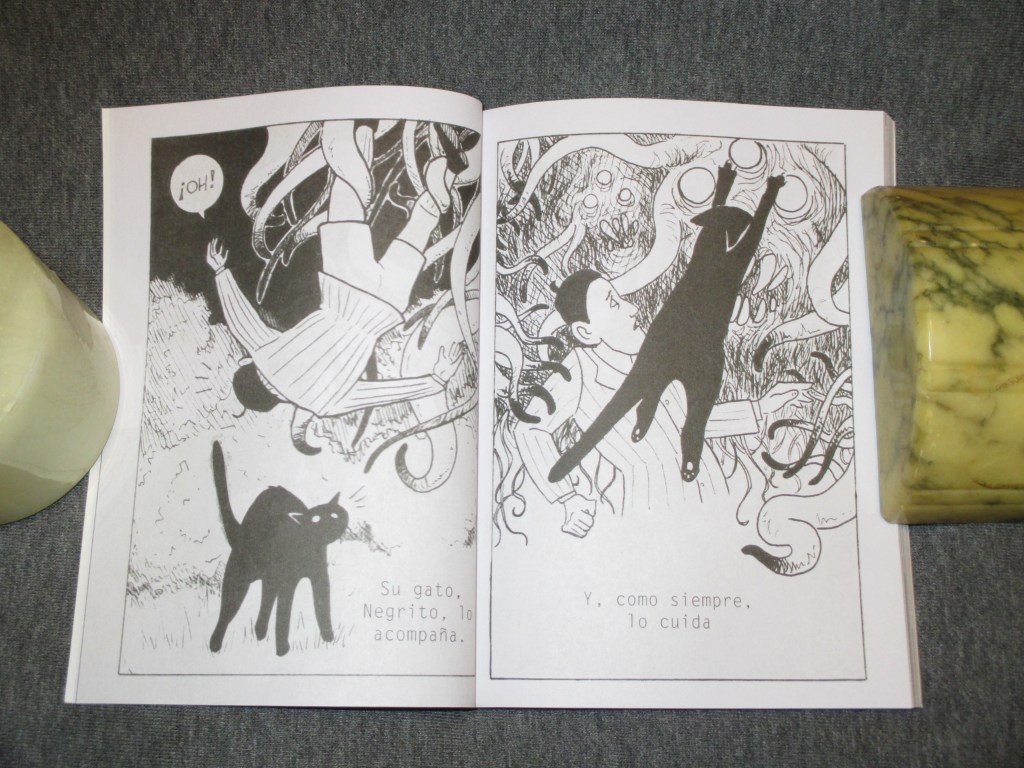
Su gato, Negrito, lo acompaña.

Y, como siempre, lo cuida.
His cat, Negrito, accompanies him.

And, as always, takes care of him.
Dolores Alcatena, Lovecraft y Negrito (2023)English translation

The story is told in black and white, mostly from Negrito’s perspective. The cat aids and protects Howard through his journeys, including the events that would inspire “The Cats of Ulthar” and “The Shadow over Innsmouth.” From a cat’s perspective, the cat-killing couple in Ulthar are particularly horrific.
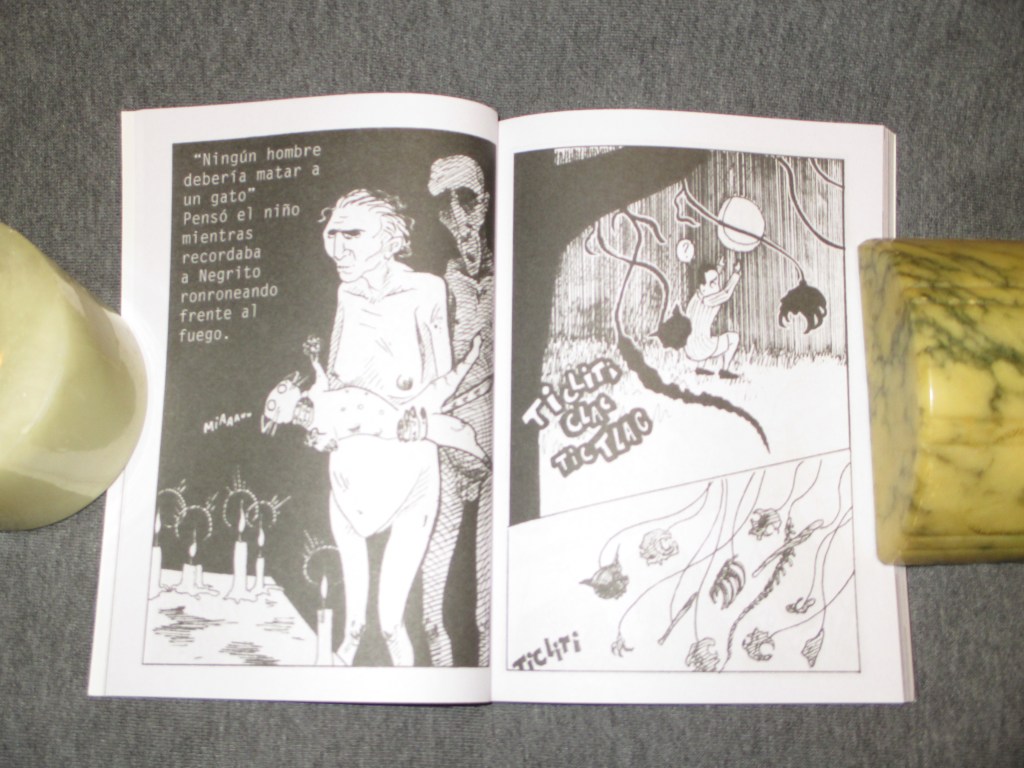
“Ningún hombre debería matar a un gato”
Pensó el niño mientras recordaba a Negrito ronroneando frente al fuego.
“No man should kill a cat,” the boy thought as he remembered Negrito purring in front of the fire.
Dolores Alcatena, Lovecraft y Negrito (2023)English translation

There is a somewhat fairy-tale quality to the retelling, the traipse through Lovecraft’s fiction. Most of Howard’s waking life we don’t see…but then his cat was not there to see that.
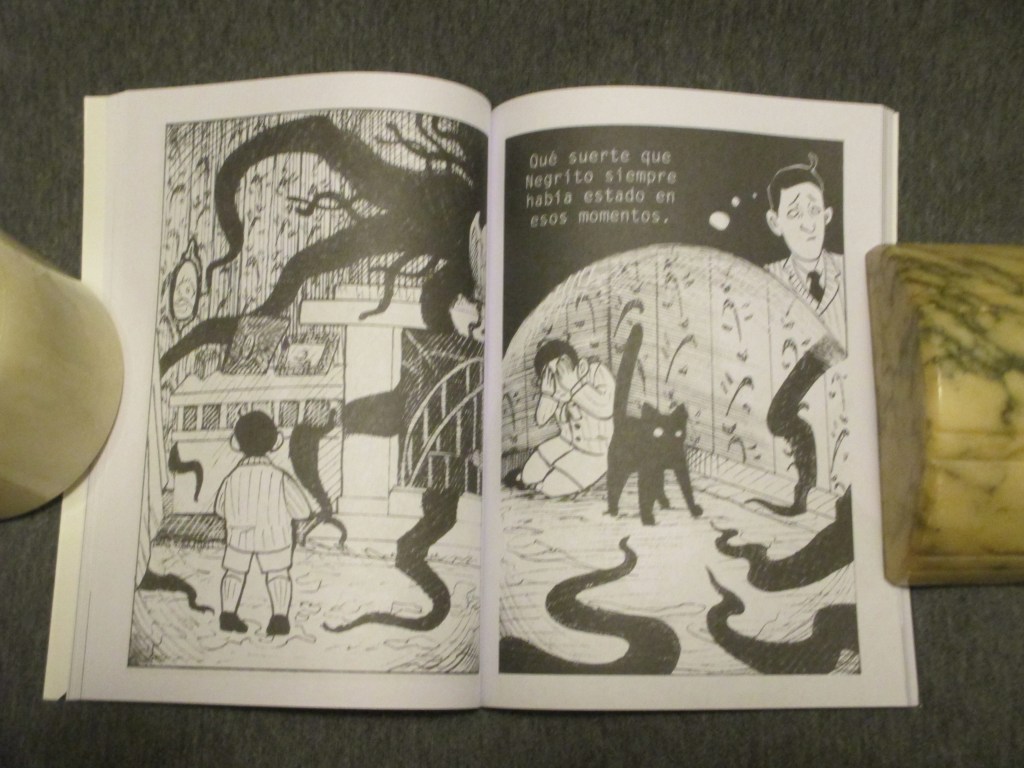
Qué suerte que Negrito siempre había estado en esos momentos.How lucky that Negrito had always been there in those moments.
Dolores Alcatena, Lovecraft y Negrito (2023)English translation

The Lovecraft of these stories is a scared, almost a traumatized kid, with Negrito as his only friend; parental figures are absent. It is a very sympathetic view of Howard as a child, but in comparison to El Joven Lovecraft by José Oliver & Bartolo Torres it does not show Lovecraft’s occasional joyfully morbid side. Readers are meant to empathize with a young Lovecraft.
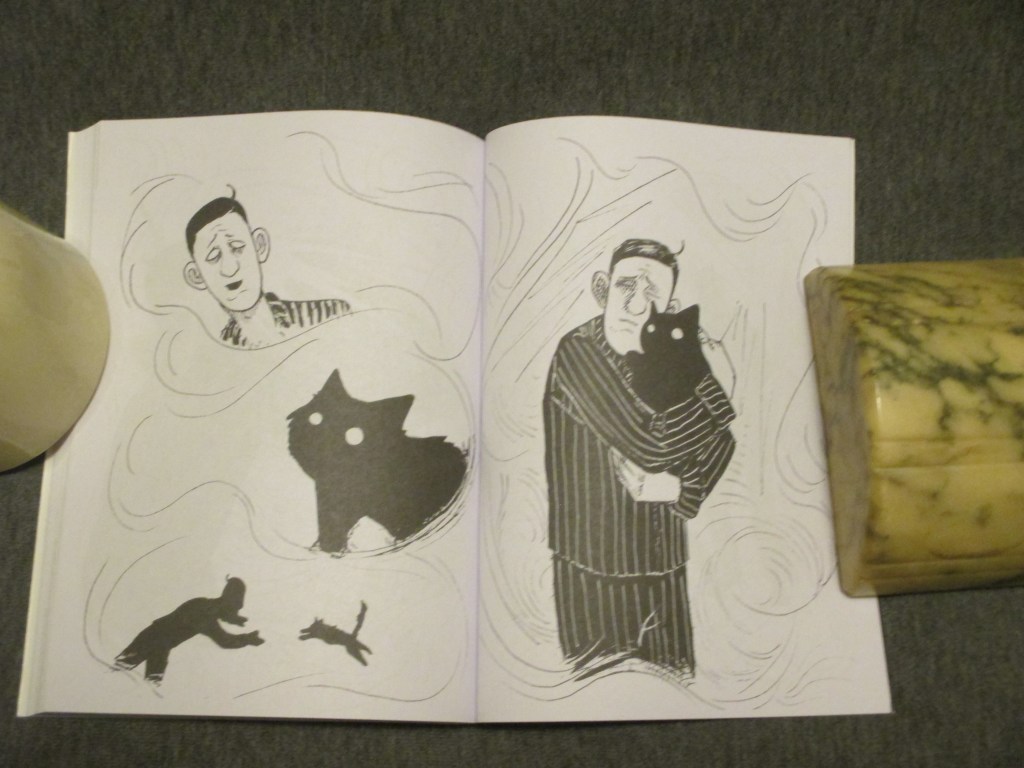
The ending, a wordless reunion between the dead Lovecraft and his lost cat, is the kind of afterlife that every cat-lover might wish to experience themselves someday.
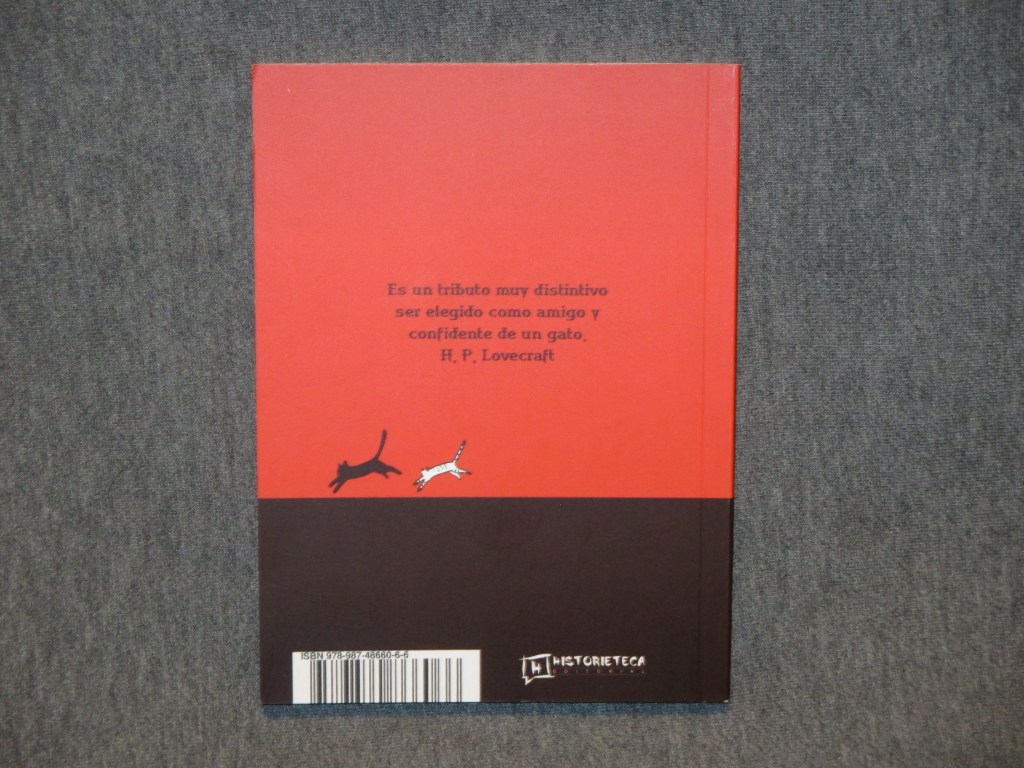
Es un tributo muy distintivo ser elegido como amigo y confidente de un gato.
H. P. Lovecraft.
It is a very distinctive tribute to be chosen as a friend and confidant of a cat.
H. P. Lovecraft.
 It is no compliment to be the stupidly idolised master of a dog whose instinct it is to idolise, but it is a very distinct tribute to be chosen as the friend and confidant of a philosophic cat who is wholly his own master and could easily choose another companion if he found such an one more agreeable and interesting.
Dolores Alcatena, Lovecraft y Negrito (2023)English translationH. P. Lovecraft, “Cats and Dogs”

Lovecraft y Negrito is a story about a boy and his cat. It is not a historical work that delves into the nuances of the cultural forces that went into such names, or how naming cats did or did not reflect Lovecraft’s racial prejudices in later life. If readers want a scholarly exploration of what we do and don’t know about the real animal, check out Ken Faig’s essay “Lovecraft’s Boyhood Cat” in Lovecraft Annual #19 (2025). If you want a heartwarming fantasy about Lovecraft and his beloved pet, which has gained a kind of literary immortality, then read Lovecraft y Negrito.


Bobby Derie is the author of Weird Talers: Essays on Robert E. Howard and Others and Sex and the Cthulhu Mythos.

Deep Cuts in a Lovecraftian Vein uses Amazon Associate links. As an Amazon Associate I earn from qualifying purchases.
The Long Shalom (2023) by Zachary Rosenberg

People have such queer ideas about private detectives.
—Raymond Chandler, The Long Goodbye (1953)

Hardboiled detective fiction has never ignored the existence of ethnic minority, BIPOC, and LGBTQ+ characters. The representation often wasn’t great; prejudices were common, and sometimes a plot point. Genre-blending mixes with hardboiled fiction tend to follow similar lines. In the made-for-tv movie Catch A Deadly Spell (1991), for example, a key plot point is that the man who stole the Necronomicon is in a relationship with a transwoman.

There has been a trend in contemporary works, however, to swing the other way. Instead of token diversification or showcasing prejudices while fixing on a white cisgender heterosexual viewpoint, there are stories that focus on minority viewpoints, and in particular on intersectional experiences. Winter Tide (2017) by Ruthanna Emrys has as a protagonist an Innsmouth woman during the 1950s, but her group includes two gay men, a brother and his Black girlfriend, and a Japanese-American woman; Ring Shout (2020) by P. Djèlí Clark focuses on a group of Black women, one of whom is gender-nonconforming and homosexual, another mixed-race; The City We Became (2020) by N. K. Jemisin has a group as cosmopolitan as New York itself.

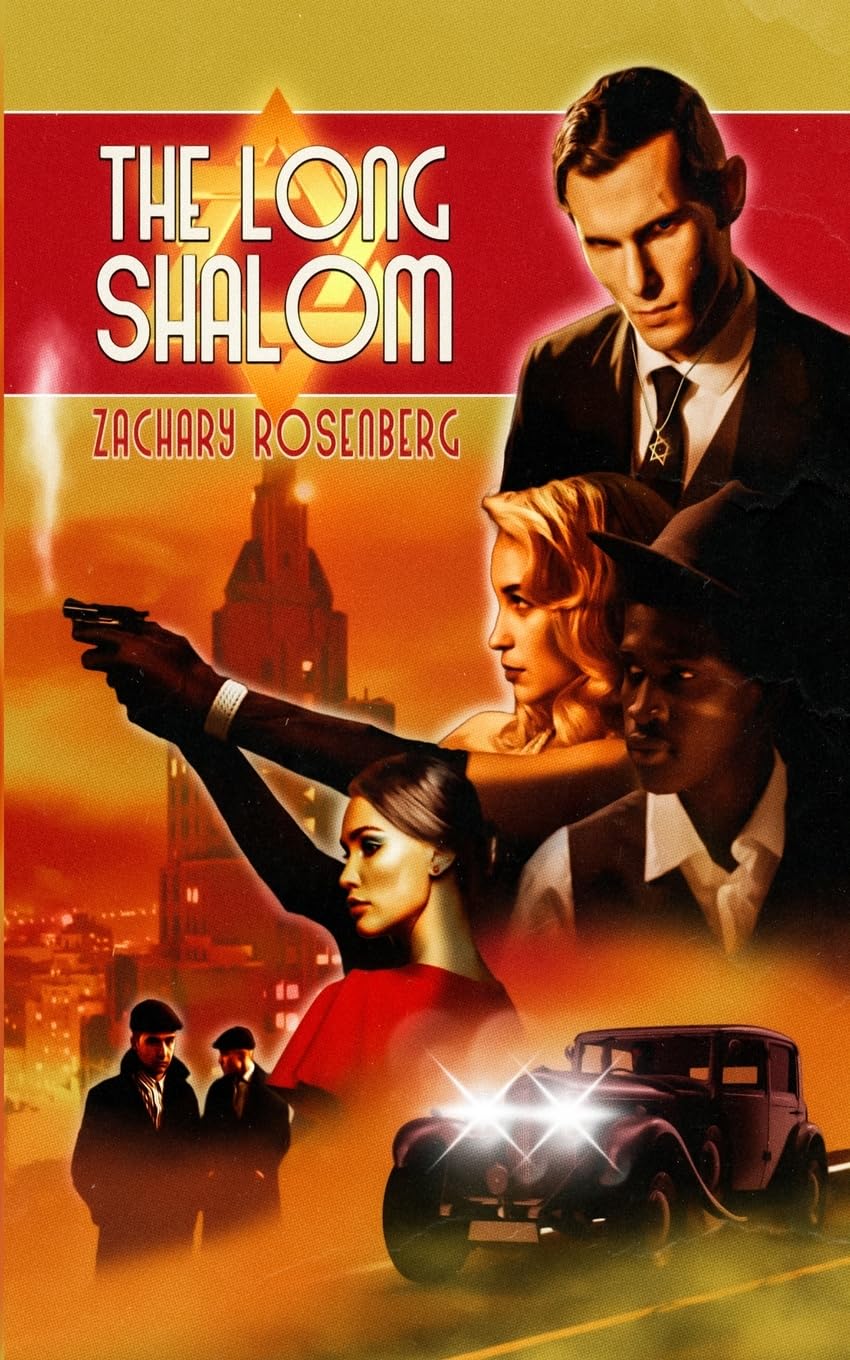
The Long Shalom by Zachary Rosenberg is another entry in that mode—I asked a few folks for a pithy descriptive term, and they suggested “wokepunk” and “diversifiction”—focused on protagonist Alan Aldenberg, a bisexual Jewish WW1 veteran and ex-mob gunsel, now wise-cracking private detective, who ends up dealing with a Lovecraftian supernatural threat. Aldenberg teams up with his half-Japanese/half-Jewish bisexual ex-girlfriend and two fellow WW1 veterans: an African-American man and a transwoman.

Yet the most important thing about The Long Shalom isn’t the cast of characters; it’s how the story is fundamentally based on their experiences and the discrimination they face. As in Ring Shout, the racial, ethnic, and gender discrimination they face becomes embodied as both traditional and supernatural threats. These individuals, who each have to deal with intersectional discrimination for their particular identities, also now have bigoted cosmic horrors to deal with.

Which leads to a certain aspect of the protagonists taking these new horrors in stride. There is more to the complex interplay of identity as Alan, long non-practicing, returns to the Jewish neighborhood and finds himself an outcast among outcasts, than there is to him confronting an ancient horror that seems immune to bullets. As the fantasy aspects increase—thanks to ancient scrolls and some very Innsmouthian-flavored Jewish women in a remote seaside community—the impression becomes closer to a retelling of a game of Harlem Unbound (2017), albeit with more of a Jewish than Black focus, and the mundane antagonists become almost cartoonish in their bigotry.

Yet that is kind of the point: as much as some of these characters feel like a caricature, the real thing, whether they were police uniforms or Klan robes, was if anything more explicit and violent. Racism and prejudice is seldom nuanced or interesting at base; it’s dull, ugly, and stupid, a combination of ignorance and stereotypes, hot points of emotions that can flash into bursts of unbelievable violence over almost nothing.

Alan clenched his teeth, fighting for something inspiring to say and coming up emptier than a wine bottle after Purim.
—Zachary Rosenberg, The Long Shalom 90

While the novel is short and the fantastic elements get away a bit from the more grounded characterizations, Rosenberg does have a certain style and authentic understanding of the characters and their cultures, which is appealing. Like Ring Shout, the threat is Lovecraftian without being based explicitly on Lovecraft’s Mythos; this is fundamentally an effort to write a Jewish horror story, with a hardboiled setting and more than a taste of pulp action—and it succeeds at that.


Bobby Derie is the author of Weird Talers: Essays on Robert E. Howard and Others and Sex and the Cthulhu Mythos.

Deep Cuts in a Lovecraftian Vein uses Amazon Associate links. As an Amazon Associate I earn from qualifying purchases.
“Neural Mechanisms of Analgesia” (2023) by Mary Hollow

Dear Ms. Hollow. You don’t know me, but you and I share a mutual acquaintance, through whom I had the opportunity to read the draft of your horror story about the exotic fruit that turns pain signals into pleasure. I much enjoyed the prose of your story, but I have some relevant information that I would like to share with you.
—Mary Hollow, No One Came For Me: Weird and Primal Horror Stories

Lines of literary descent are not always easy to trace. If a writer goes out of their way to mention Cthulhu or the Necronomicon, then we can say with some certainty that they’ve read Lovecraft, or that they’ve read somebody that read Lovecraft, and so on. Without such concrete citations, it can be tricky to assign influences with any certainty. Would we say that Jeff Vandermeer’s Annihilation owes a debt to H. P. Lovecraft’s “The Colour Out of Space?” Well, probably not within earshot of Vandermeer.

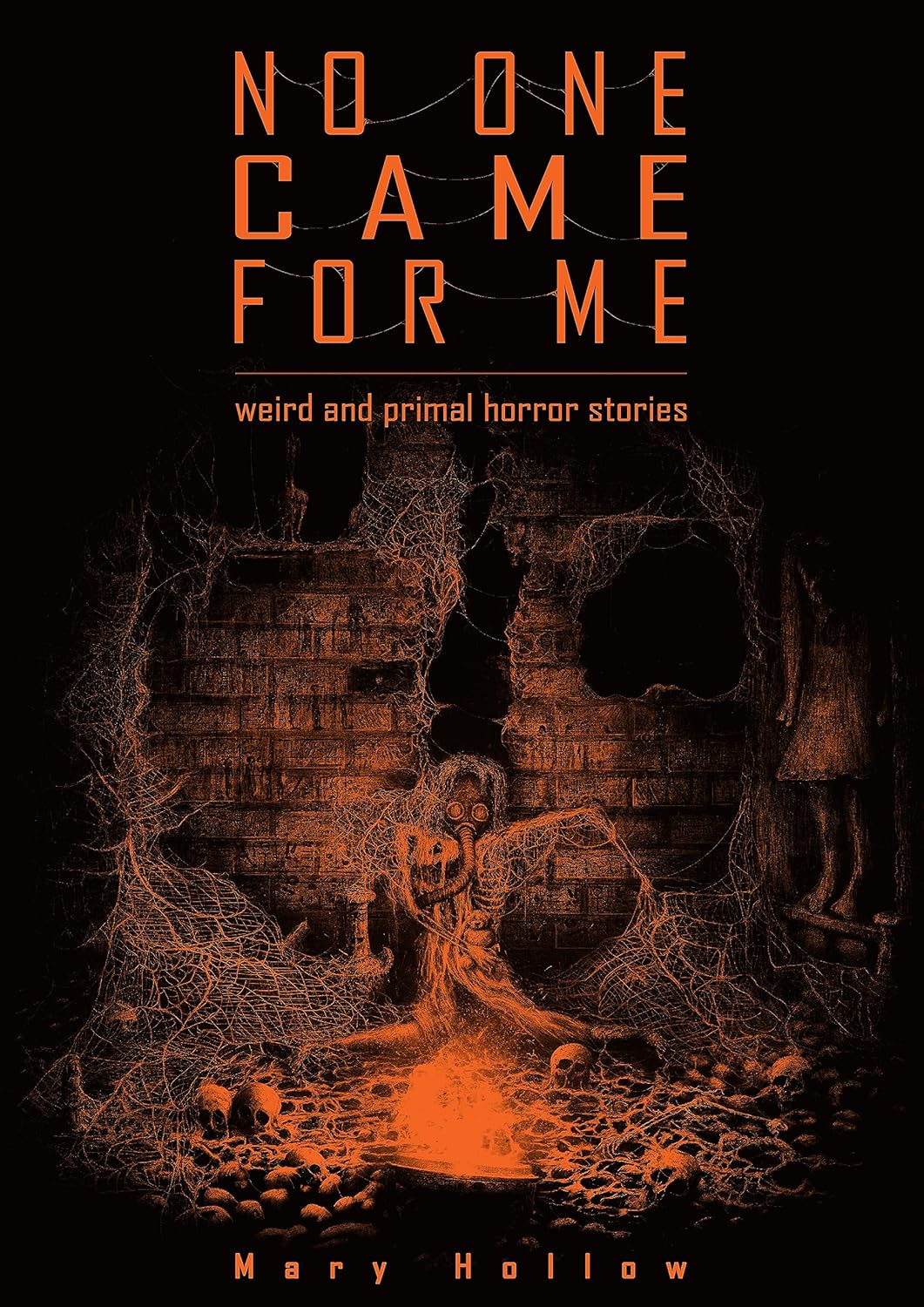
Fiction is like that. Writers can play with the same subjects, but may arrive at parallel approaches. We can only note the parallels. Fortunately, in this case, in the afterword to her collection, Mary Hollow gives thanks to Thomas Ligotti, so it is easy to say that yet, “Neural Mechanisms of Analgesia” (2023) is a story in the Ligotti lineage of weird fiction.

There’s a relation to Lovecraftian fiction, a similarity, but a distance as well. Hollow doesn’t cite the Necronomicon or Arkham, doesn’t try to fit her work into someone else’s mythology. As a medical horror, there is a distant echo of “From Beyond” and other gland stories, the clinical detachment that threads its way to a kind of sublime understanding regarding some fundamental function of life.

If you prick us, do we not bleed?
—William Shakespeare, The Merchant of Venus Act 3, Scene 1

The story takes the form of a letter to Hollow herself. The epistolary format offers some advantages; like with “Machines Are Digging” (2009) by Reza Negarestani, there is that fine frisson as scientific citation and rational argument segues into something else. That moves beyond science fiction and touches on something else, something that goes beyond science in a direction that approaches—not the mystical, but a kind of revelation that limits rather than expands the possibilities of life. The opposite of wonder is not terror, but a kind of disenchantment that negates wonder, cancels it out.

The book offers up the pholosophical conundrum of what it means to have an experience that evaporates as soon as it is over.
—Mary Hollow, No One Came For Me: Weird and Primal Horror Stories

There is that aspect of—not exactly pessimism, but the kind of microscopic focus of ultra-sanity that strips away the comforting illusions of life, or even of weird fiction. There is no Elder Sign to ward of the neurological realities of the pain response in humans, no resonator to smash to hide from what was always around us all the time. Imagination can offer no comfort, and when stripped away there is only a kind of philosophical numbness. The reader ends the story burdened with knowledge, but there is nothing to do with that knowledge.

Does it matter if Hollow draws from Lovecraft or Ligotti? Only insofar as we can recognize the connection, the thematic parallels with their works. Hollow is working in a tradition, though not borrowing from anyone’s mythology in doing so. A reminder that as fun as the Mythos is, there is much more to Lovecraftian literature than just the Mythos.

“Neural Mechanisms of Analgesia” is published in Mary Hollow’s collection No One Came For Me: Weird and Primal Horror Stories (2023). It has not yet been reprinted.


Bobby Derie is the author of Weird Talers: Essays on Robert E. Howard and Others and Sex and the Cthulhu Mythos.

Deep Cuts in a Lovecraftian Vein uses Amazon Associate links. As an Amazon Associate I earn from qualifying purchases.

Eldritch Witchcraft: A Grimoire of Lovecraftian Magick (2023) by Amentia Mari & Orlee Stewart

We are living in the only period in history in which it is considered fashionable to be a witch. Given this complete public acceptance, an understandable tendency towards fadism develops. The once-stigmatizing label of “witch” has become a title of positive intrigue and has attained a status never before realized.
—Anton Szandor LaVey, The Satanic Witch (1989), 1

In his book The Triumph of the Moon (1999), Ronald Hutton traces the history of modern pagan witchcraft, and how a combination of factors and personalities in the late 19th/early 20th century—the shift to urban living which caused a romantic attitude toward nature and rural areas, the spiritual awakenings that weakened the grip of Christianity and encouraged the spread of new religious movements and ceremonial magic, the anthropological re-evaluation of myth in George Frazer’s The Golden Bough (1890) which inspired The Witch-Cult in Western Europe (1921) by Margaret A. Murray—all came together in the mid-century as individual practitioners like Gerald Gardner and Doreen Valiente shaped the core practices that would characterize Wicca and other modern pagan witchcraft systems.

Lovecraftian witchcraft is an interesting concept. H. P. Lovecraft’s views on witchcraft were largely shaped by Murray’s Witch-Cult Hypothesis as set forth in The Witch-Cult in Western Europe; there’s no evidence he read her later book The God of the Witches, and while Lovecraft had some understanding of the history of ceremonial magic based on Éliphas Lévi’s The History of Magic (1922, trans. by A. E. Waite), he was never an occultist or member of any group like the Hermetic Order of the Golden Dawn. When asked by one Salem witch descendant for magical secrets hinted at in his fiction, Lovecraft had to politely confess he made it all up. While Lovecraft made much of the Salem witch diaspora in his stories, connecting characters like Keziah Mason (“The Dreams in the Witch House”), Joseph Curwen (The Case of Charles Dexter Ward), and the founders of Dunwich (“The Dunwich Horror”) among others with the cult, that religion is uniformly depicted as dark, secretive, and often violent and malevolent. Keziah Mason even sacrifices children, repeating the old blood libel.

Most of Lovecraft’s contemporaries and immediate followers were not much better. Robert E. Howard’s Stregoicavar in Turkey in “The Black Stone” (1931) is a degenerate, alien, bloodthirsty religion. Henry Kuttner’s “The Salem Horror” (1937) strongly echoes “The Dreams in the Witch House,” with Abigail Prinn standing in for Keziah Mason. The image of the witch as a positive figure for female empowerment hadn’t really formed yet, though it was on its way with novels like Conjure Wife (1943) by Fritz Leiber. Over the decades, as the image of witchcraft shifted, Lovecraftian media often shifted to reflect the syntax of the time.

When exactly modern witches began to incorporate Lovecraftian elements into their work is a matter of debate. Doreen Valiente’s first book, Where Witchcraft Lives (1962), includes an invocation of the Old Ones during a full-moon ritual, which Hutton notes is nowhere in Gerald Gardner’s Writings and is very Lovecraftian (321). Any prospective witch who picked up Anton LaVey’s The Compleat Witch (1971; later reprinted as The Satanic Witch), could have used the Lovecraftian rites presented for the Church of Satan in The Satanic Rituals (1972) a year later. Kenneth Grant, one of the heirs of Aleister Crowley, threaded the needle of working references to witchcraft and Lovecraft into his system of ceremonial magick in The Magical Revival (1972). In 1977, Schlangekraft published the Necronomicon by Simon, which included a very Murray-esque witch cult into its Lovecraftian version of magical history as well.

So from the mid-to-late 1970s at least, modern pagan witches have had a vast amount of Lovecraftian occultism and lore to potentially draw on and incorporate into their own practices, if they so choose. Most of them do not. Daniel Harms and John W. Gonce in The Necronomicon Files noted that Doreen Valiente was familiar with Lovecraft and Lovecraftian occultism because she published an article on it: “Necronomicon—the Ultimate Grimoire?” that appeared in Prediction magazine (Apr 1982), which referenced a few of Lovecraft’s occult connections but gave little shrift to the Necronomicon as a genuine reality. As Harms & Gonce put it:

Most present-day Wiccans won’t give the Necronomicon (Simon or anyone else’s) the time of day. Other members of the Neopagan community also seem to give the Simon book short shift. Many of them see themselves as followers of the Light just as much as Christians do, and have no use for a “dark” grimoire. (209)

Modern pagan witchcraft in general has sometimes been derided as “cafeteria paganism” where practitioners pick and choose elements of their personal religion, and replaced any effort toward authenticity with fantasy, but the high degree of individualism and adaptability is a genuine strength for the movement as a whole. There is no hard canon for most would-be witches to get hung up on, and syncretization of Wiccan practices with other themes, or the incorporation of different magical and ceremonial practices into a Wiccan framework is fairly common.

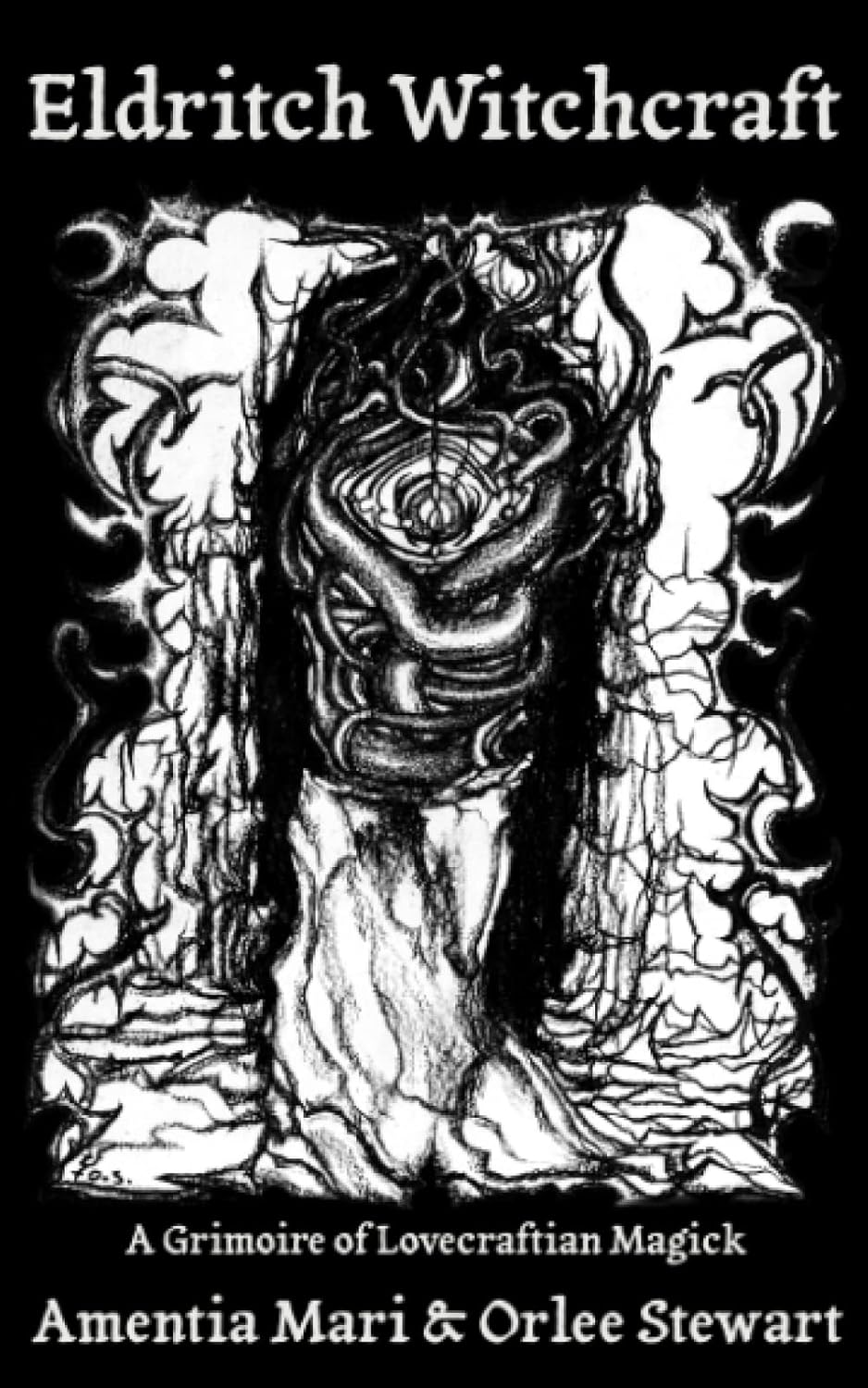
Which brings us to Eldritch Witchcraft: A Grimoire of Lovecraftian Magick (2023) by Amentia Mari & Orlee Stewart. This slim (38 pages) POD-published workbook is relatively light on Lovecrafian lore (a 3-page essay on “Eldritch Witchcraft” that discusses witches in some of Lovecraft’s stories, and mentions influential occultist Austin Osman Spare), and the rest of the book consists of magical recipes, rituals, sigils, and illustrations divided into five chapters:

  • Rite to Become An Eldritch Witch: A Lovecraft Mythos-themed rite for solo initiation.
  • The Eldritch Candle Prayer of Chaos: A variation on a prayer candle, with Lovecraftian trappings.
  • Calling the Outer Gods: Sigils and incantations to invoke various Lovecraftian entities (Azathoth, Yog-Sothoth, Nyarlathotep, Shub-Niggurath, and Nahab (Keziah Mason)).
  • Spells of Yog-Sothothery: Collection of recipes and charms: a ritual to consecrate your altar and tools, creating an amulet consecrated to Nyarlathotep, compounding a “witch’s unguent” of unspecified purpose, making the incense of Zkauba, making a dream pillow associated with Keziah Mason, and brewing dream tea. Many of the materials require the information from the previous two sections.
  • Heart of Stars Meditation: A meditation intended to provide contact with alien intelligences via automatic writing; uses some of the materials in the “Spells of Yog-Sothery.” Ends with a brief personal account by Orlee Stewart of her experiences using this ritual, including contact with an entity that she speculates might be Nyogtha from “The Salem Horror.”

As a workbook for solo witches go, this book presumes a level of familiarity with the terminology and basic practices of contemporary witchcraft. Probably many Wiccans could fold it into their practice fairly easily; the gist is basic enough and familiar enough to magical practices by Austin Osman Spare, Thelemites, etc. that many occultists would have little difficulty adapting it to their own practices as well (though the Heart of Stars Meditation, it should be added, is written only for women in its current form).

Perhaps surprisingly, Eldritch Witchcraft doesn’t borrow heavily from Aleister Crowley, Kenneth Grant, or the Simon Necronomicon; instead it takes inspiration from the Necronomicon (1978) edited by George Hay, which is presented as translations from a fictitious medieval grimoire that is claimed to be the original from which Lovecraft derived the Necronomicon in his fiction.

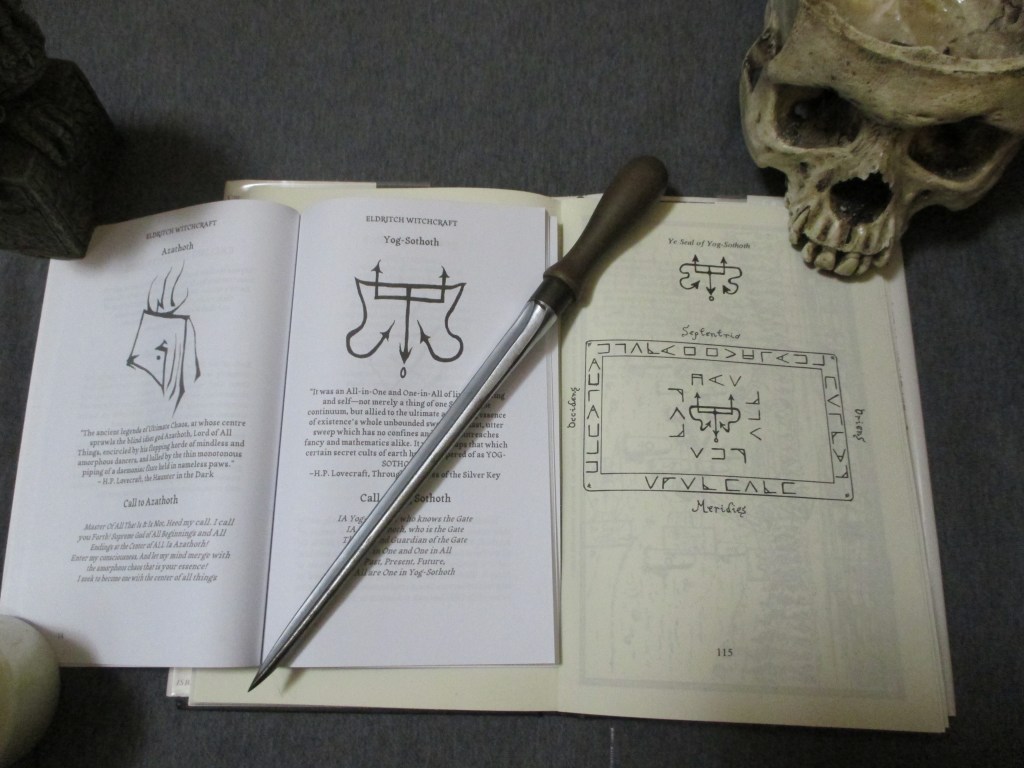
Right: Hay Necronomicon, showing various ritual gestures. Left: Eldritch Witchcraft, showing a subset of the same gestures.
Right: Hay Necronomicon showing the Seal of Yog-Sothoth. Left: Eldritch Witchcraft showing a very similar sigil for Yog-Sothoth.

Many elements from the Hay Necronomicon have proven popular among artists and creators and both been re-used and inspired similar depictions. While the majority of the sigils and all of the artwork in Eldritch Witchcraft is original, it’s clear that the authors were drawing on the Hay Necronomicon when developing some of their practices.

Perhaps most notably absent in Eldritch Witchcraft are the trappings and religious underpinnings commonly associated with contemporary pagan witchcraft; neither is there any extended effort to pronounce Lovecraft’s Mythos as real or his stories as representing literal truth. The direct use of fictional characters in place of more traditional deities and the prominence of Austin Osman Spare suggests the influence of chaos magick, and a certain level of pragmatism: this is a practical collection of spells and materials designed to build one on the other, not a quasi-philosophical work like Phil Hine’s Pseudonomicon or Scott R. Jone’s When the Stars Are Right: Toward An Authentic R’lyehian Spirituality. Readers get the how, but not necessarily the why.

Which leaves open the question: what is the viewpoint of a Lovecraftian witch? How would a contemporary pagan witch reconcile their ideology and practice Lovecraft’s Mythos? Which tradition(s), if any, do they blend into their own practices? Eldritch Witchcraft provides one possible answer to the latter, but the other questions the reader will have to figure out for themselves.


Bobby Derie is the author of Weird Talers: Essays on Robert E. Howard and Others and Sex and the Cthulhu Mythos.

Deep Cuts in a Lovecraftian Vein uses Amazon Associate links. As an Amazon Associate I earn from qualifying purchases.
“La Lámpara de Alhazred” (2023) by Manuel Mota & Julio Nieto

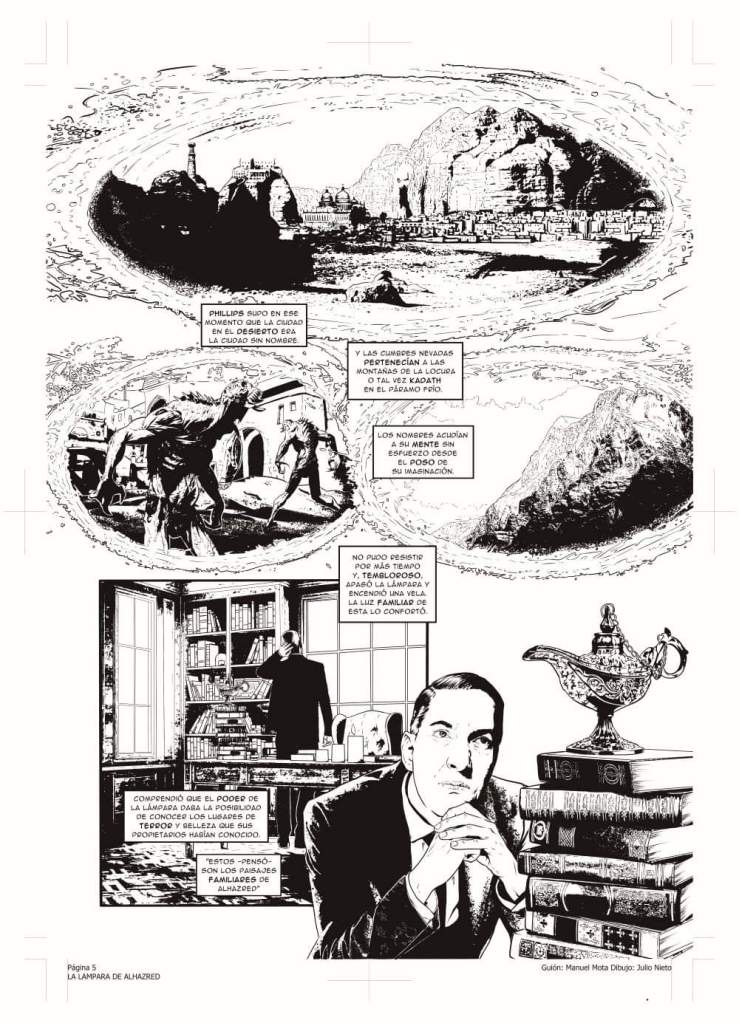
Habían pasado siete años desoe la desparaición de su abuelo Whipple cuando Ward Phillips recibió la lámpara.Seven years had passed since the disappearance of his grandfather Whipple when Ward Phillips received the lamp.It was seven years after his Grandfather Whipple’s disappearance that Ward Phillips received the lamp.
“La Lámpara de Alhazred” (2023) by Manuel Mota & Julio Nieto,
Cthulhu #28.5
English translationAugust Derleth, “The Lamp of Alhazred” (1957), The Watchers out of Time 114

Many of August Derleth’s “posthumous collaborations” with H. P. Lovecraft have been derided as pastiches. Yet “The Lamp of Alhazred” is more homage—and more accurately a collaboration than most of Derleth’s stories, since it incorporates a large chunk of text from Lovecraft’s letter to Derleth dated 18 Nov 1936, where Lovecraft described coming across a previously unknown wood west of Neutaconkanut Hill.

On Oct. 28 I penetrated a terrain which took me half a mile from any spot I had ever trod before in the course of a long life. I followed a road which branches north 7 West from the Plainfield Pike, ascending a low rise which skirts Neutaconkanut’s Western foot & which commands an utterly idyllic Vista of rolling Meadows, ancient stone walls, hoary groves, 7 distant cottage roofs to the west & south. Only 2 or 3 miles from the city’s heart—& yet in the primal rural New-England of the first colonists!He penetrated a terrain which took him almost a mile from any spot he had ever before trod in the course of his life, following a road, which branched north and west from the Plainsfield Pike and ascending a lot rise which skirted Nentaconhaunt’s Western foot, and which commanded an utterly idyllic Vista of rolling Meadows, ancient stone walls, hoary groves, and distant cottage roofs to the west and south. he was less than three miles from the heart of the city, and yet basked in the primal rural New England of the first colonists.
H. P. Lovecraft to August Derleth, 18 Nov 1936, Essential Solitude 2.756August Derleth, “The Lamp of Alhazred” (1957), The Watchers out of Time 119

Derleth also took inspiration from an entry in Lovecraft’s commonplace book:

From Arabia Ency. Britt. II.–255. Prehistoric fabulous tribes of Ad in the south, Thamood in the north, and Tasm & Jadis in the centre of the peninsula. “Very gorgeous are the descriptions given of Irem, the City of the Pillars (as the Koran styles it) supposed to have been erected by Shedad, the latest despot of Ad, in the regions of Hudramant, and which yet, after the annihilating of its tenants, remains entire, so Arabs say, invisible to ordinary eyes, but occasionally, and at rare intervals, revealed to some heaven-favored traveler.” Rock excavations in N. W. Hejaz ascribed to Thamood tribe.It had once been the property of a certain half-mad Arab, known as Abdul Alhazred, and was a product of the fabulous trident of ad—one of the four mysterious, little-known tribes of Arabia, which where ad—of the south, Thamood—of the north, Tasm and Jadis—of the center of the peninsula. it had been found long ago in the hidden city called Irem, the city of Pillars, which had been erected by Shedad, last of the despots of Ad, and was known by some as the Nameless City, and said to be in the area of Hadramant, and, by others, to be buried under the ageless, ever-shifting sands of the Arabian deserts, invisible to the ordinary eye, but sometimes encounter by chance by the favorites of the Prophet.
The Notes and Commonplace Book of H. P. Lovecraft 21-22August Derleth, “The Lamp of Alhazred” (1957), The Watchers out of Time 115-116

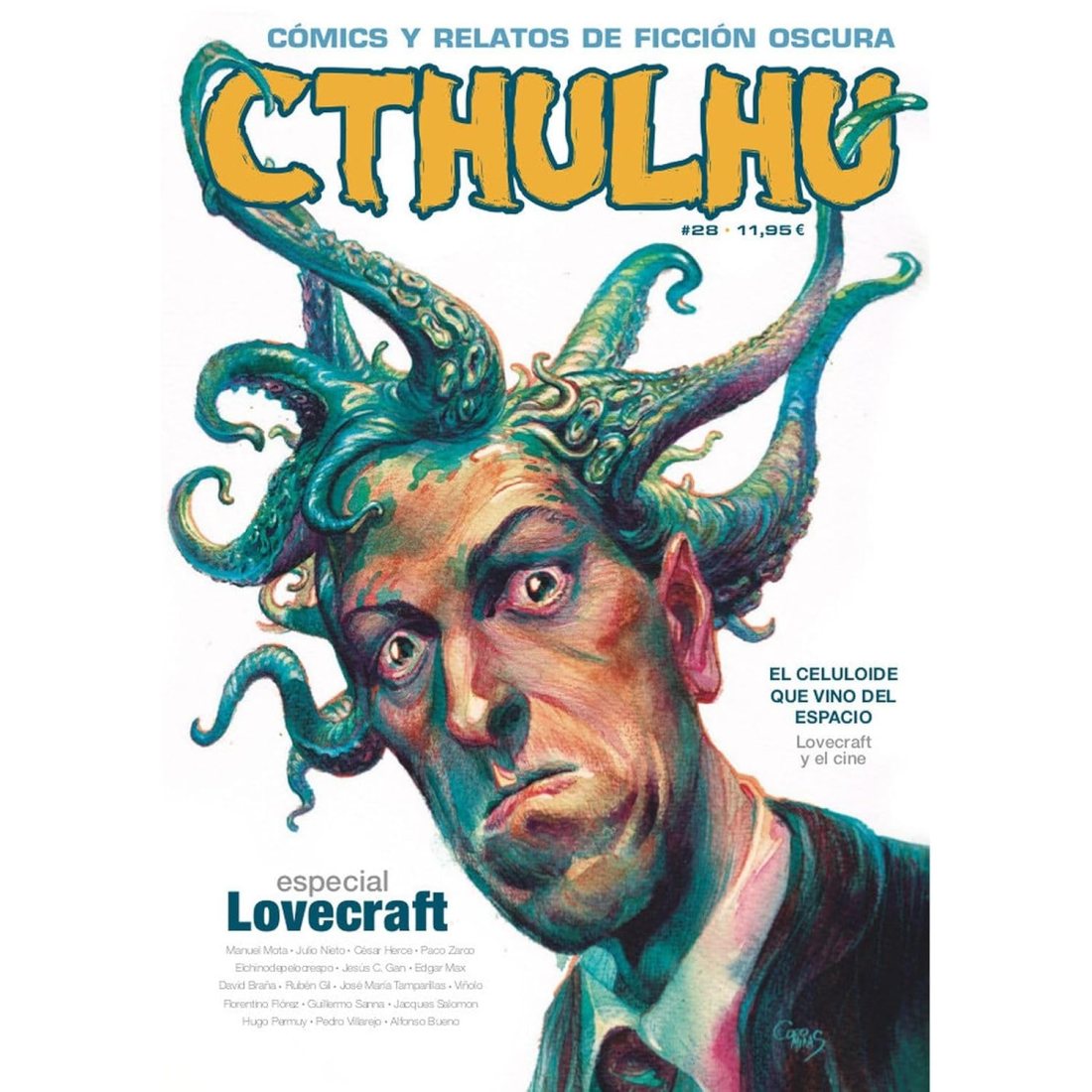
While nearly every Lovecraft story has been adapted to comics at some point, rather fewer of Derleth’s stories have attracted the same treatment. Yet it makes sense that Manuel Mota (script) and Julio Nieto (artwork) would adapt “The Lamp of Alhazred” for Cthulhu #28, the Lovecraft special issue. Because there are homages which capture as much of the pathos of H. P. Lovecraft as well as this one.

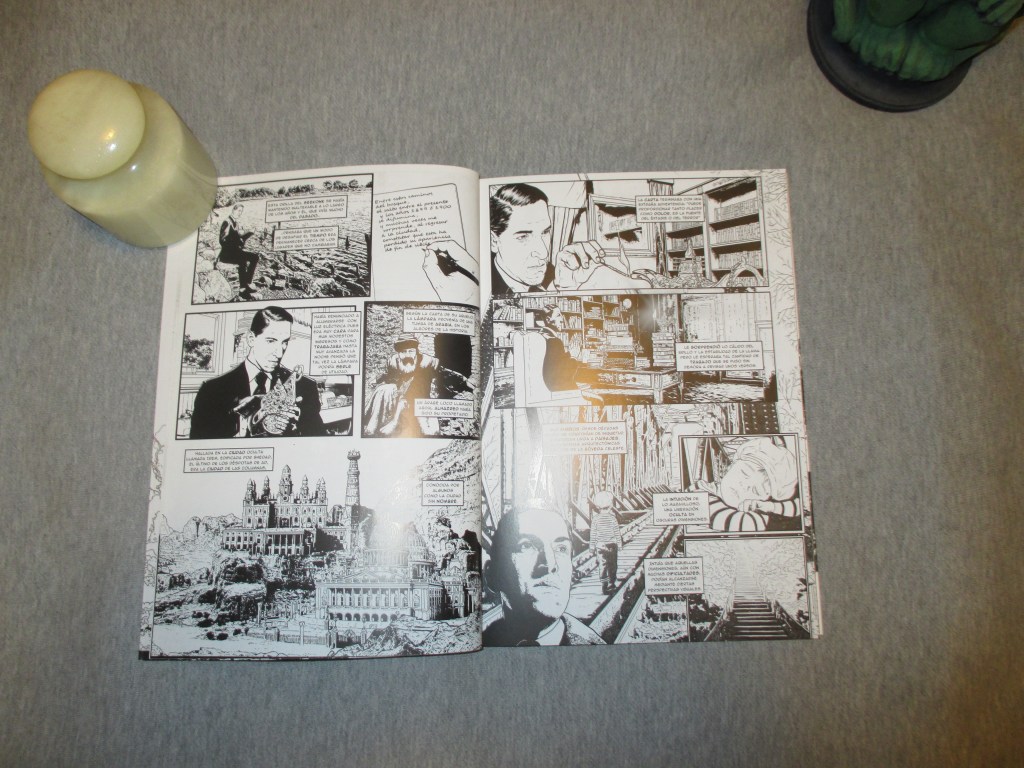
Manuel Mota’s script is a fairly straight translation of Derleth text, albeit truncated for space and with the illustrations serving in place of much of the description, which inadvertently cuts out most of Lovecraft’s text. Yet the presentation and framing of the words and Julio Nieto’s art does much to lend a sense of action to what is a largely contemplative story that draws on both Lovecraft’s life and the sentiment of “The Silver Key.” Readers feel Ward Phillips loss and loneliness, his refuge in his imagination, and the visions of other worlds, other times.

It is escapist in the most literal sense of the word, and one of several stories that reflect that quiet, profound desire to abandon the daily grind of life, with its quiet indignities, defeats, and injuries.

Nieto’s artwork is carefully realistic, the page layout traditionally grid-like; it is a straight-forward presentation that puts the more fantastic sequences, the break-outs where the panel cannot contain a wondrous scene, in context. The weirdness isn’t a part of Ward Phillips world; it is the way out.

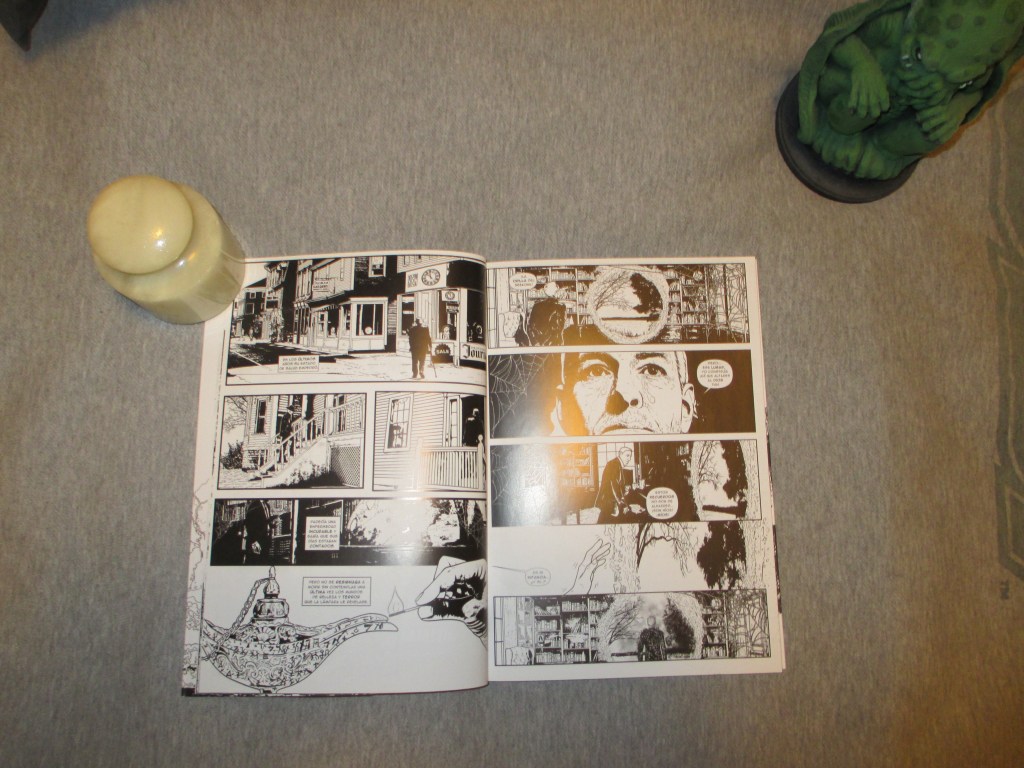
Jamás se encontro el cuerpo de Ward Phillips.

La policía aún espera queue sus restos aparezcan en Alguno de los lugares queue solía frecuentar en sus solitarios paseos.

Con el paso de Los años, la vieja casa fue derribada, la biblioteca adquirida por librerías anticuarias y lo queue quedó gue vendido como chatarra incluida una vieja lámpara Árabe a la que nadie encontró utilidad alguna.
The body of Ward Phillips was never found.

Police are still hoping that his remains will turn up in one of the places he used to frequent on his solitary walks.

Over the years, the old house was demolished, the library was acquired by antiquarian bookstores and what remained was sold as scrap, including an old Arabic lamp that no one found any use for.
Though desultory searching parties were organized and sent out to scour the vicinity of Nentaconhaunt and the shores of the Seekonk, there was no trace of Ward Phillips. The police were confident that his remains would some day be found, but nothing was discovered, and in time the unsolved mystery was lost in the police and newspaper files.

The years passed. The old house on Angell Street was torn down, the library was bought up by book shops, and the contents of the house were sold for junk—including an old-fashioned antique Arabian lamp, for which no one in the technological world past Phillips’ time could devise any use.
“La Lámpara de Alhazred” (2023) by Manuel Mota & Julio Nieto,
Cthulhu #28.14
English translationAugust Derleth, “The Lamp of Alhazred” (1957), The Watchers out of Time 123-124

It is a story that almost demands a familiarity with Lovecraft to truly appreciate; those who have read his letters, who knows what Lovecraft struggled with during his life, can recognize more of the man in Derleth’s framing of the Nentaconhaunt narrative. Mota and Nieto do well to capture and depict as much of this atmosphere as they can, and the sensibility of the story is necessarily both sad and romantic in the older sense—this is not a Mythos story, despite the name “Alhazred.” it is a fantasy, a myth, so much more elegant than the reality that saw Lovecraft end his days in pain in a hospital as the cancer consumed him.

“La Lámpara de Alhazred” (2023) by Manuel Mota & Julio Nieto is an excellent overall adaptation of Derleth’s homage to Lovecraft, one that captures the spirit of the original—the echo of Lovecraft, as it were—for a new medium and a new audience.


Bobby Derie is the author of Weird Talers: Essays on Robert E. Howard and Others and Sex and the Cthulhu Mythos.

Deep Cuts in a Lovecraftian Vein uses Amazon Associate links. As an Amazon Associate I earn from qualifying purchases.
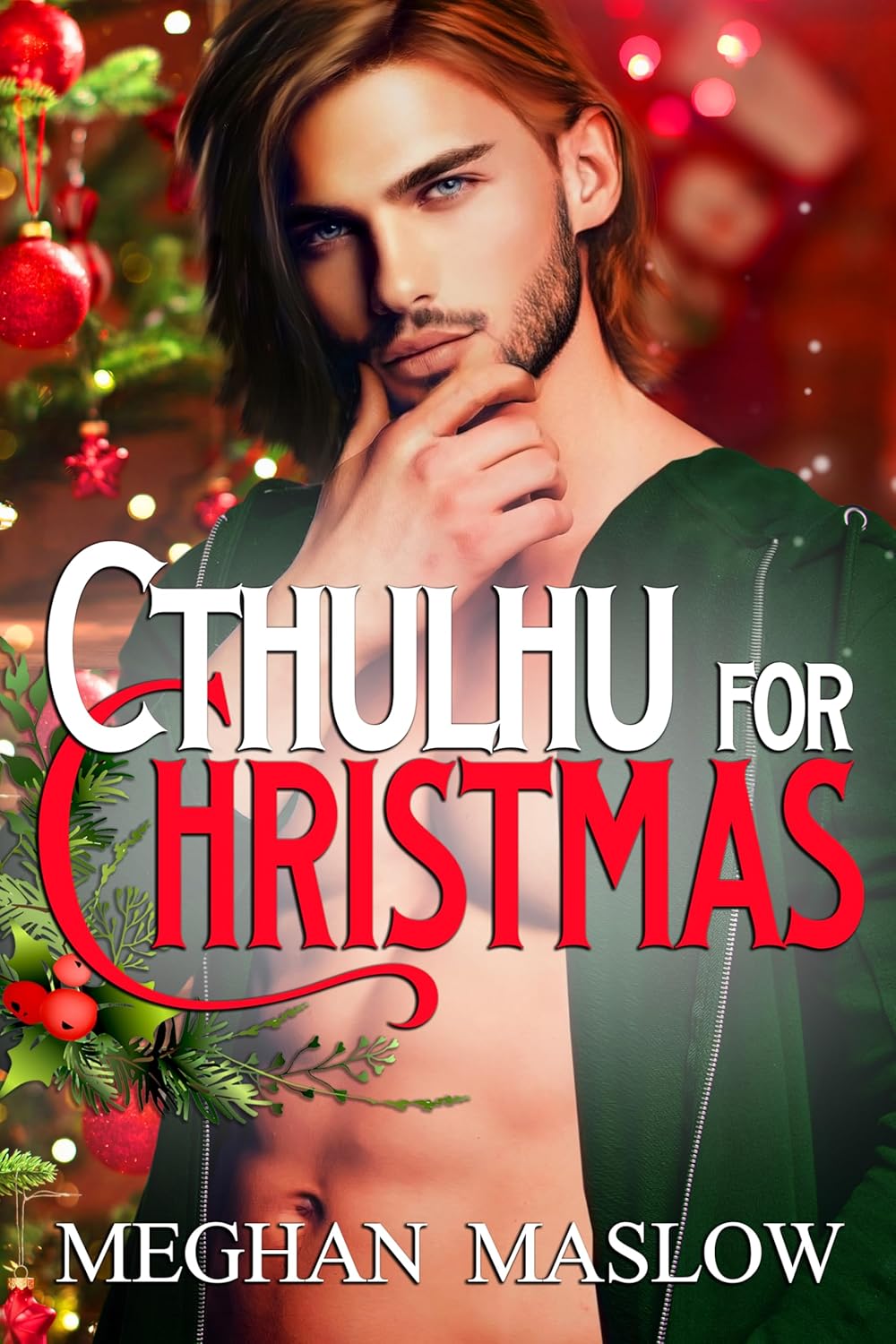
“Cthulhu for Christmas” (2023) by Meghan Maslow

Eldritch Fappenings
This review is of a homoerotic romance work which deals with mature themes and tentacle erotica.
Reader discretion advised.


Romance fiction is about the churn. Individual works often have minimal lasting value; only a rare few works of the sticking power or cultural cachet of Maurice (1971) by E. M. Forester. Yet the appetite for such works is constant. Consumers don’t just want porn, they want characters, settings, relationships, hardship, overcoming adversity, happy endings, unhappy endings—new stories, all the time. And creators need to eat, so they need to keep producing more and more to try and fill that demand.

Sometimes, this results in works that are less character-driven romance and more of erotica of dubious quality. Erotic ebooks like Booty Call of Cthulhu (2012) by Dalia Daudelin and its sequels might be produced rather quickly to hop on a trend. Creators might explore specific niches; Tentacles and Wedding Bells (2022) by Margaret L. Carter is about a young woman marrying into a family that just happens to be a bit inhuman, while Widdershins (2013) by Jordan L. Hawk explores a same-sex relationship in a fantasy steampunk setting, and “Moonshine” (2018) by G. D. Penman does much the same in a Prohibition-era gangster story.

There are times when a spate of Amazon erotic ebooks in a month are focused on bigfoot weddings, or older bosses (of either gender) seducing a new employee, or being isekai’d into a novel and now locked into a forbidden sexual relationship with a step-sibling. One month the flavor might be elves, another Regency-era settings, and sometimes a clever or ambitious author might combine the two. All’s fair in love and genre fiction.

Holiday-themed offerings are available in abundance. Hallowe’en, Thanksgiving, and Christmas are all well-represented…and probably also Boxing Day, Hanukkah, and Arbor Day too. Christmas, however, remains a particular favorite. There’s something about the immense cultural memeplex that extends far beyond the actual celebration of Christ’s birth. A jolly old elf has never stuffed so many stockings; kids who wished for new siblings for Xmas may well get them, Rudolf may be a well-hung were-reindeer with amorous intentions toward Mrs. Claus, and the mistletoe works overtime to trigger steamy kisses. The literary stakes of such works are often pitifully low, with writers and readers more or less satisfied so long as the product delivers the bare minimum of what it promises or hints at.

Content Warning: violence, mature content, brief discussion of child abandonment
—Meghan Maslow, “Cthulhu for Christmas” (2023)

To paraphrase Roger Ebert, I have a sneaky respect for anyone that goes much, much further than too far. With a premise that starts out with “Cthulhu-themed Christmas book” and then expands into: “A Winter Holiday MM Tentacle Romance,” it would have been easy—ridiculously easy—to do a minimalist job, check off the hashtags, and pump out a simple, quirky, and porntastic M/M tentacle erotica ebook in time for the Xmas sales boost. No one would have complained.

What readers get is so much more. Readers going in hoping to see tentacles stretch out holes like pre-lubricated o-ring orifices from page one will be disappointed to find themselves going through short chapters filled with with well-developed characters, in an interesting and evocative setting (with map!), as personal dramas and a murder mystery slowly unfolds. Many of the plot-beats might feel like a Hallmark Christmas movie mixed with your favorite detective show. Will gay cop Zen King tell his straight best friend he’s in love with him? What does Zak’s best friend Grey Criswell and his old money family have to do with the mysterious murder at Salem’s Tree Lot? And what the heck does any of this have to do with a break-in at the local library?

Cthulhu’s Compendium is a one-of-a-kind artifact. I can’t believe you glimpsed it! Please tell me you were able to read some of it! I’ve requested permission from the Special Collections numerous times, but they always inform me it doesn’t exist.”

“Cthulhu’s. Compendium.” Uh huh. “Like Lovecraft? It’s a work of fiction?”

I’d actually read some Lovecraft in high school when an emo kid recommended him.

She huffed. “It’s not fiction. And while it’s unsubstantiated, it’s well known that Lovecraft vacationed here on many occasions. Even visited the museum. You do the math.”
—Meghan Maslow, “Cthulhu for Christmas” (2023)

The Mythos elements of the plot don’t come exactly as a surprise (it’s in the title), but to Maslow’s credit the story takes the time to build up to the revelations. The tone is paranormal romance rather than horror—and because Lovecraft’s work is explicitly fiction within the setting, there’s room for Maslow to play fast and loose with what is “true” in terms of the Mythos. For the most part, that means that sometimes there are tentacles and sometimes they are frisky, though not always cooperative.

If you’d have told me I’d be cock-blocked by tentacles, I’d have laughed. But I wasn’t laughing now.

Fuck my life.
—Meghan Maslow, “Cthulhu for Christmas” (2023)

(For those interested in the steamier bits, the tentacles don’t cock-block for long. Quite the opposite.)

There’s a lot of little silly details that add up in the story to make it more charming. There’s a beaver that’s moved onto a houseboat like a stray dog. A pair of caribou driving a sleigh that work like a Uber service with an app called Caribou For You. An arranged marriage. An ugly sweater contest. If that sounds silly—that’s the point. Mundane weirdness tends to ground a story with more fantastical elements.

“Cthulhu for Christmas” (2023) by Meghan Maslow is not some quick and dirty romp churned out to meet a Yuletide theme and a couple keywords. There is a lot more heart to the story, and a lot more craft to the writing this tale of love, lust, and magic, than a reader might expect.

This story was written as part of a set of holiday-themed tentacle romance offerings: Tinsel & Tentacles.


Bobby Derie is the author of Weird Talers: Essays on Robert E. Howard and Others and Sex and the Cthulhu Mythos.

Deep Cuts in a Lovecraftian Vein uses Amazon Associate links. As an Amazon Associate I earn from qualifying purchases.
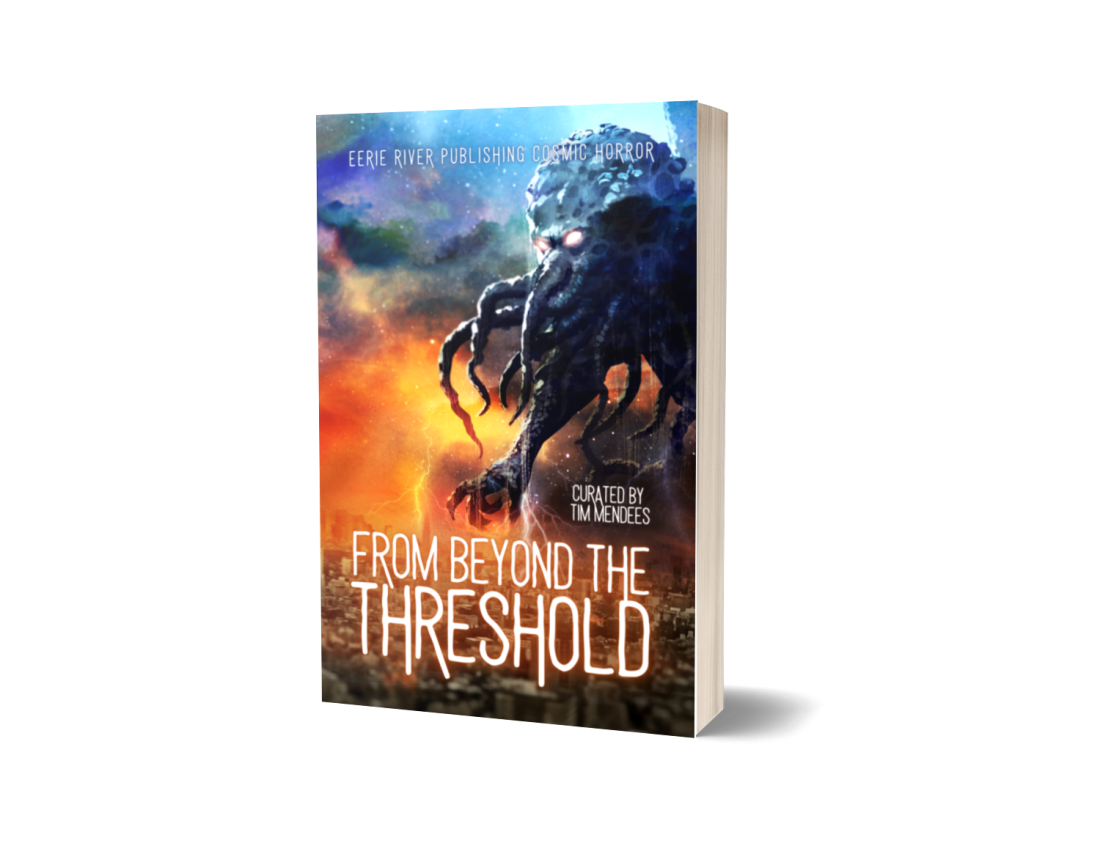
“The Well” (2023) by Georgia Cook

And the feasting shall begin anew.
—Georgia Cook, “The Well” in From Beyond the Threshold (2023) 69

In “The Things We Did in the Dark” (2024) by Julia Darcey, two women are isolated in a special place, to service the needs of an unseen god in the dark. In that story, their position is not voluntary. They are there as a punishment, and ultimately as a sacrifice, valued only for their bodies and the work they can do. Georgia Cook’s “The Well” in the 2023 cosmic horror anthology From Beyond the Threshold by Eerie River Publishing, the situation is almost the mirror opposite. Two women, a special place, an unseen god below—but this nameless pair have been called. They are there of their own free will. Cast off everything else to embrace a life of service to the dark.

They call through loss and sorrow.
—Georgia Cook, “The Well” in From Beyond the Threshold (2023) 65

Cosmic horror, at least as Lovecraft tried to define it in his essay “Supernatural Horror in Literature,” is a kind of inversion of religious awe. It is the dark twin to wonder and glory at the face of the divine, the elucidation and humility that comes from the revelation of cosmic mystery. The sure sense or knowledge that there is something more than this life, with all of its pains and disappointments; something that by its very revelation of existence upends how we think of the world and how it works.

Yet there are those for whom darkness is a part of them. Perhaps it completes them, in a very different way than others are fulfilled by faith. While some Lovecraftian protagonists go mad from the revelation—as the trope goes—others find a kind of acceptance in the new order that the truth reveals.

A very few embrace the revelation. This is part of the discussion in “The Book of Fhtagn” (2021) by Jamie Lackey; the question of why someone would become a cultist in service to an eldritch entity and the trappings of religion that have sprung up about them. The answer in that story is a kind of parallel to this one: having become aware of the dark truth, they do not fight it, reject it, go mad, or simply go through the motions of life under the knowledge that all is pointless. They welcome it. They want to be a part of it.

In the opening to Arthur Machen’s “The White People” (1904), the great Welsh horror writer presents an opening episode on the nature of sorcery and sanctity:

‘Yes, and of the sinners, too. I think you are falling into the very general error of confining the spiritual world to the supremely good; but the supremely wicked, necessarily, have their portion in it. The merely carnal, sensual man can no more be a great sinner than he can be a great saint. Most of us are just indifferent, mixed-up creatures; we muddle through the world without realizing the meaning and the inner sense of things, and, consequently, our wickedness and our goodness are alike second-rate, unimportant.’

‘And you think the great sinner, then, will be an ascetic, as well as the great saint?’

‘Great people of all kinds forsake the imperfect copies and go to the perfect originals. I have no doubt but that many of the very highest among the saints have never done a “good action” (using the words in their ordinary sense). And, on the other hand, there have been those who have sounded the very depths of sin, who all their lives have never done an “ill deed.”‘

In a Machenian sense, the women of “The Things We Did In The Dark” are not sinners, and those in “The Well” are. Not because the women on that windswept island with the well are having murderous orgies in the swamp like Lovecraft’s Cthulhu cultists, but because they are working in their slow and deliberate way, to serve an end. They’ve turned their back on the human race…and though they harm no one directly, in their service they have tossed away everything they once knew and loved.

“…I’m not afraid,” she whispers.

“Of course you ain’t,” the old woman snaps. “S’not right to be afraid.”
—Georgia Cook, “The Well” in From Beyond the Threshold (2023) 68

There is a parallel in both stories to cloistered nuns; and nunneries were sometimes used as prisons to dispose of unwanted daughters and those who fell out of accepted society. Yet in “The Well,” the Keepers have walked willingly into their prison. There are no walls, nothing to prevent them from escaping that we can see. No rules and no enforcers.

They’re there because they want to be there.

That’s a bit marvelous and horrific. The acceptance of the darkness within. The recognition of something greater than themselves. Women who have pushed through pain and loss and out the other side, and found a place and purpose there, in the chaos beyond their old lives and every human attachment that held them there.

“The Well” by Georgia Cook was published in From Beyond the Threshold (2023) by Eerie River Publishing.


Bobby Derie is the author of Weird Talers: Essays on Robert E. Howard and Others and Sex and the Cthulhu Mythos.

Deep Cuts in a Lovecraftian Vein uses Amazon Associate links. As an Amazon Associate I earn from qualifying purchases.
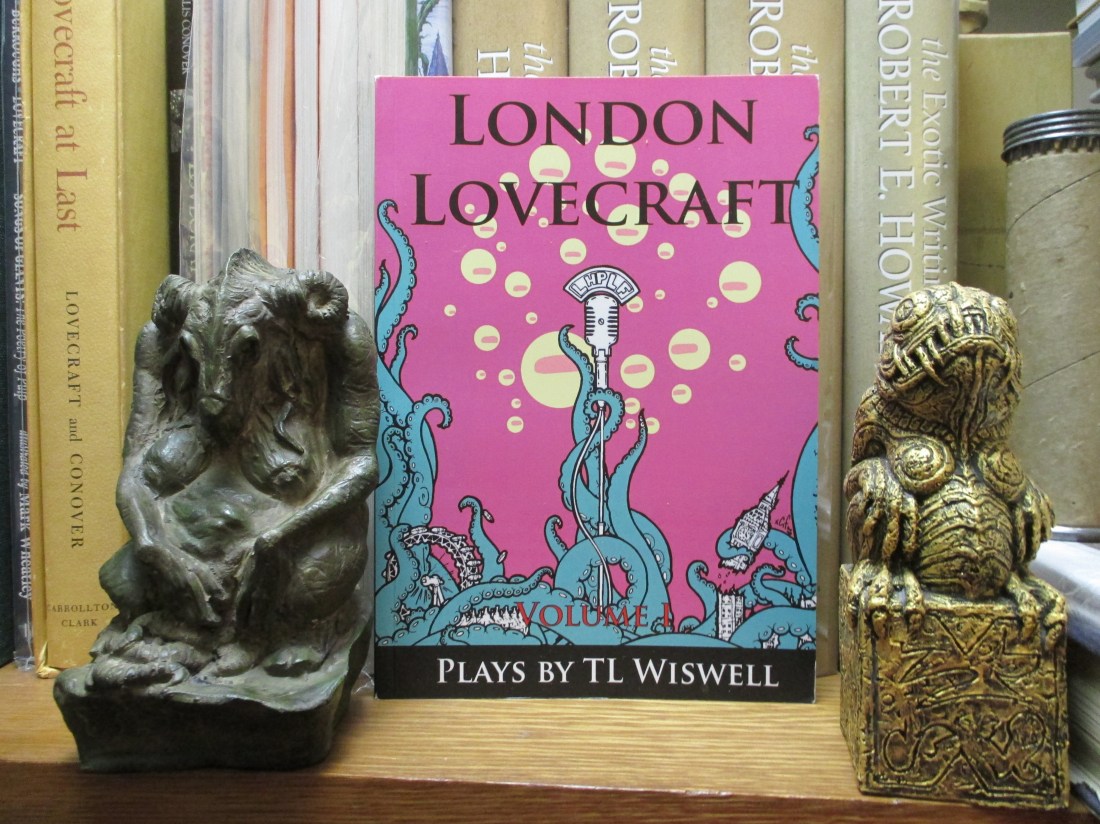
London Lovecraft: Volume I (2023) by TL Wiswell

Festival shows are, sadly, an ephemeral lot. While some lead to full length plays, TV shows, or even films, most of them rise and fall with their creators, and said creators’ energy and willingness to sacrifice time and money getting their works on stage. This is especially sad for fans of Lovecraft, who are most receptive to works that expand the canon. It is hoped that this slim book of scripts can in some way help these plays reach a larger audience that they were able to when they were originally performed.
—Introduction, London Lovecraft: Volume I, 4

The London Lovecraft Festival has been running since 2018, though the annual festivities were interrupted by the Covid 19 pandemic. A key part of the festivities are the dramatic or theatrical presentations, which expand on or re-cast Lovecraft’s familiar works in a new light. In 2023, four of these brief plays by LLF founding producer TL Wiswell were collected into an independently-published book by Vulcanello Productions.

Each of the four works is a specific riff off a familiar Lovecraft story, condensed and adapted into short plays with typically 2 or 3 main characters. The connecting theme is that the stories are altered to focus on the female characters, either expanding on the roles and thoughts of existing characters or by gender-flipping characters (so Herbert West may become Albertina, for example).

Other writers have had similar ideas, such as in HPL 1920 (2020) by Nick O’Gorman & Tales from the Cthulhuverse #1 (2020) by Zee Romero & Luca Cicognola, but the play as a format shifts how a story can be told, and tends to zero in on the relationship between the characters portrayed by the actors. It actually works rather well for Lovecraft’s fiction as passages of expository narration in his work can be just that, whereas in comics or film they tend to cutaway into flashbacks.

Much of the stories also have to be removed, the plot boiled down and simplified to what can feasibly be acted or narrated on a small stage at a budget. That kind of condensation is an art unto itself, and as adaptations go, Wiswell treads the fine line between faithfulness, practicality, and originality.

Mountains of Madness

CHARACTERS:
Dr Willa Dyer – Geologist
Dr Pomona Peabodie – Engineering
Frances Danforth – graduate student, engineering

Setting: 1928. A lecture hall at Miskatonic University, set up with a film projector and a gramophone. WILLA DYER is behind the podium addressing the audience as if they are the audience of her lecture. All people referred to are substantially only present in her memories: Peabodie is dead; Danforth has gone mad.
—Introduction, London Lovecraft: Volume I, 10

The Miskatonic University expedition to Antarctica in Lovecraft’s At the Mountains of Madness was implicitly all white men; the reimagined expedition of Wiswell’s play took place in the decade prior. The all-female expedition raises no more comment than the all-male one did for the bulk of readers. Much of the grand cosmic backstory of the Old Ones is truncated in summation—as it would be, during a lecture—and neatly bypassed Dyer’s exclamation “They were men!” in Lovecraft’s version.

Much of this short play consists of long monologues by Dyer and Peabodie, with brief interjections by Danforth; shifts in light and focus emphasize when one character is speaking from the past (as when a recording of the dead Peabodie “plays” on the gramophone). It is an effective truncation, and shows how gender need not shape every role in one of Lovecraft’s stories.

Asenath’s Tale

CHARACTERS:
Viola Danforth
Asenath Waite Derby

Setting: New England, 1962

Suggested stage setup: two armchairs with a table between them, upon which rests a phone.
—Introduction, London Lovecraft: Volume I, 28

“The Thing on the Doorstep” features one of the more famous of Lovecraft’s women characters, Asenath Waite—but the depiction is somewhat married because of the unique gender dynamics of Waite in that story, as discussed by Joe Koch in Must I Wear This Corpse For You?: H. P. Lovecraft’s “The Thing on the Doorstep” (1937), among others. Wiswell doesn’t shy away from this; rather, she puts Asenath’s identity as a woman, and her friendship with Viola Danforth, at the center of the story.

Reading about Asenath Waite as a child in Innsmouth, her relationship with her father and with the other children, an insight into her heritage in Innsmouth, provides a humanizing perspective that is completely absent in Lovecraft’s story—where the reader never “meets” Asenath as she was in youth, but only later, as an adult, with all that implies. Wiswell makes the most of the sexism expressed by Ephraim Waite in Lovecraft’s story to frame a contentious relationship between father and daughter that goes all too badly wrong.

There is something more poignant about “Asenath’s Tale” than “The Thing on the Doorstep.” Edward Derby is almost a born victim in Lovecraft’s story, and his final act of rebellion is late in the game. Wiswell’s story with its light-hearted banter becomes something more like a tragedy; the events unfold, unstoppable, and though the players on the stage can only read their parts, those who know in the audience can see their brief, fleeting happiness and friendship for what it is: the prelude to horror.

Albertina West: Reanimator

CHARACTERS:
Dr Albertina West
Dr Isabel Milburn
The Undead: The animated corpses of Major Sir Eric Moreland Clapham-Lee and others.

All scenes set in a laboratory with a dissecting table and a sitting room in front, in Scotland and France (or maybe Belgium)

Time: 1890-1922
—Introduction, London Lovecraft: Volume I, 50

From a narrative standpoint, “Herbert West—Reanimator” is really six brief episodes strung out like an old film serial; it’s why each individual episode ends with a mini-climax, and might be separated by months or years in time. Adapting that to the stage or screen is tricky; when Dennis Paoli, William J. Norris, and Stuart Gordon put together the screenplay for Re-Animator (1985), they ended up jettisoning entire episodes while burning through the plot to fit a tightly-paced 86-minute runtime.

Wiswell’s approach rearranges the episodes in favor of focusing on a narrower thread of plot: the friendship of West and her assistant Milburn, and reanimation of Major Sir Eric Moreland Clapham-Lee during World War I, and the aftermath. Zeroing-in on this particular plotline has a lot of benefit, because it gives West an effective antagonist to play against, a monster of her own creation, not unlike Frankenstein‘s Adam.

More than that, though, it gives Bertie West’s usually nameless, gormless, and racist assistant (and the narrator of the story in Lovecraft’s version) an identity. The fact that they’re women medical doctors during the late 19th and early 20th century actually gets a bit of attention, which is nice; while these are stories to address the gender gap in Lovecraft rather than historical societal trends to misogyny as a whole, Bertie’s nod to the National Society for Women’s Suffrage and the restrictions of women in higher education and medical practice is appropriate for the character and the setting.

Period prejudice with regard to race, on the other hand, is out. Much as with “Kanye West—Reanimator” (2015) by Joshua Chaplinsky vs. “Herburt East: Refuckinator” (2012) by Lula Lisbon, we get a version of the seen of a reanimated corpse with a baby’s arm dangling out of its mouth, but the race of the reanimated is not explicitly mentioned. Horror is mixed with bathos at this point, as Milburn and West trade quips and bon mots in a style that owes a bit more to a deranged P. G. Wodehouse than H. P. Lovecraft.

More than pretty much any other of Lovecraft’s stories “Herbert West—Reanimator” seems hard to play straight; the potential for over-the-top gore and dark humor has been made too apparent.

The Dreamquest of Unknown Kadath

Unlike the others, this adaptation of Lovecraft’s The Dream-Quest of Unknown Kadath was done in collaboration with experimental musician Shivers (Sam Enthoven) and takes the form of a puppet show, narrated and accompanied by music. An audio production of the production is available on Bandcamp.

Randolph Carter has become Miranda Carter, but the gist of the plot and the character are the same as in Lovecraft’s story—albeit with a little more humor.

As she turned to go, Carter wondered why the Zoogs had stopped pursuing her. Then she noticed all the complacent cats of Ulthar licking their chops. She recalled, too, the hungry way a young Zoog had regarded a small black kitten in the street outside. And because she loved nothing on Earth more than small black kittens, she did not mourn the Zoogs.
London Lovecraft: Volume I, 68

Puppetry, especially shadow puppetry, can be singularly evocative; action that could not be feasibly acted out can be implied, with the audience’s imagination filling in the gaps. As with most of the other stories, Carter’s gender plays little role in how the events play out; it’s a change of face, but the core of Lovecraft’s tale and characterization remains intact.

While all of these plays are competently written and I’d like to see them performed sometime, the best are doubtless “Asenath’s Tale” and “Albertina West: Reanimator” specifically because those are the two stories that diverge most from Lovecraft’s characterization, while keeping true to his plots, and thus add some new dimension to the old stories.

At the moment there does not appear to be any way to purchase copies of London Lovecraft: Volume I (2023) except directly from the author. TL Wiswell was kind enough to sell me a copy during their visit to NecronomiCon Providence 2024, and I appreciate the chance to add to my small store of Lovecraftian plays, alongside works like Lovecraft’s Follies (1971).


Bobby Derie is the author of Weird Talers: Essays on Robert E. Howard and Others and Sex and the Cthulhu Mythos.

Deep Cuts in a Lovecraftian Vein uses Amazon Associate links. As an Amazon Associate I earn from qualifying purchases.
Skinny Dipper (2023) by Sex and Monsters

Eldritch Fappenings

This review deals with a work of art that includes nudity. As part of this review, selected images with nudity will be displayed. As such, please be advised before reading further.


It was many and many a year ago,
   In a kingdom by the sea,
That a maiden there lived whom you may know
   By the name of Annabel Lee;
And this maiden she lived with no other thought
   Than to love and be loved by me.
—Edgar Allan Poe, “Annabel Lee” (1849)

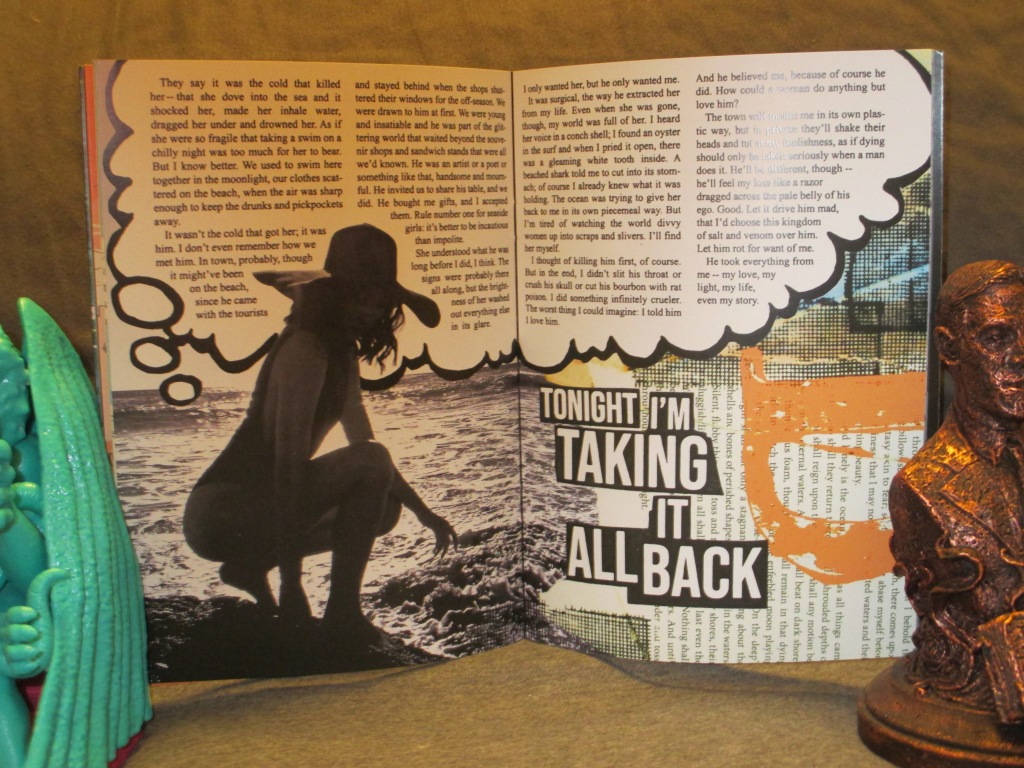
Skinny Dipper was a successfully crowdfunded multimedia project by Sex and Monsters, who are best known for their retro chic combinations of horror, pulp fiction, and tiki culture to produce works like the comic/cocktail booklet Tiki Surf Witches Want Blood.

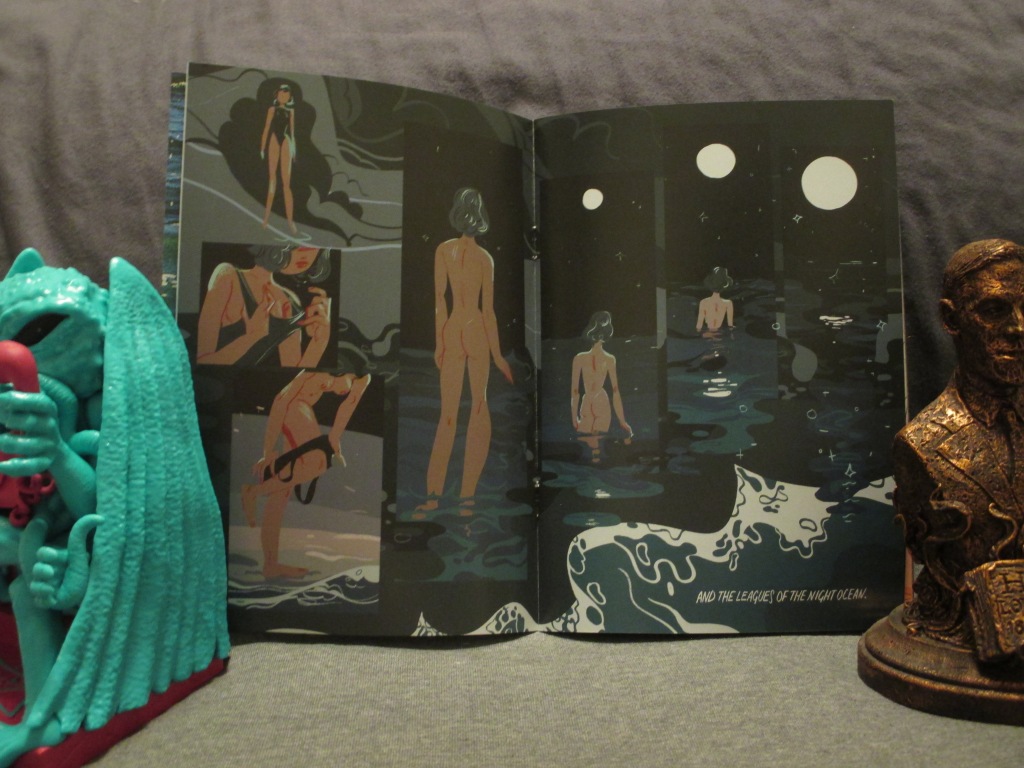
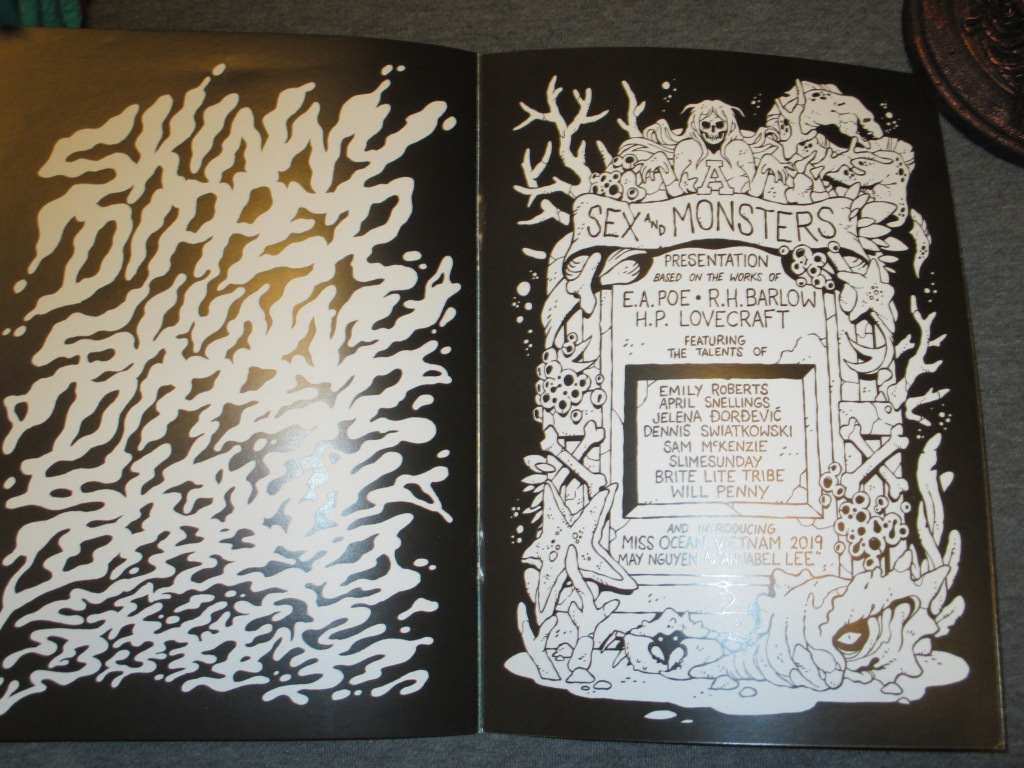
The form of this particular project is a 32-page mixed-media comic ‘zine that remixes Poe’s “Annabel Lee” and “The Night Ocean” (1936) by R. H. Barlow with H. P. Lovecraft, re-imagining them against a palette of mixed comic and photographic work by Emily Roberts, April Snellings, Jelena Đorđević, May Nguyen, Dennis Swiatkowski, Sam McKenzie, Slime Sunday, Brite Lite Tribe, and Will Penny; and a 7″ vinyl record by Nite Jewel that contains a soundtrack to accompany the piece. Various Kickstarter bonuses to the campaign add decals, instant film shots of May Nguyen, and other goodies.

The crux of the re-imagining is model May Nguyen, who appears both in photographs and as the character model for the character of Annabel Lee in the story. Told in sparse, evocative images, Annabel Lee shifts from the bright and crowded daylit beach to a lonely moonlit scene, to go skinny dipping alone in the night ocean.

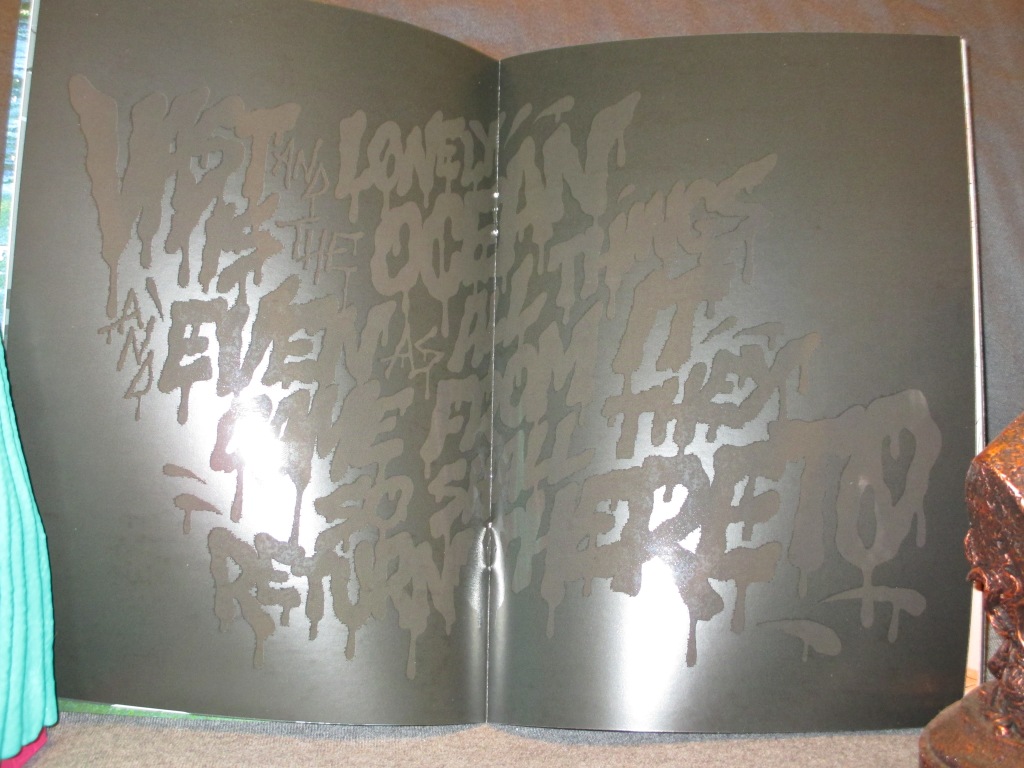
Chunks of Poe’s and Barlow and Lovecraft’s texts are taken out of context and reframed as poetry. The artists are each distinctive in their style and approach to the material; the center black-lettering on black-pages at the center of the story is incredibly evocative of the dark abysses hinted at in poem and short story, here rendered visually—and the combination of Poe’s verse and select snippets from Barlow and Lovecraft work well together with the visuals, terribly suggestive of far more than appears on the page.

Kitsch is a dirty word, but in this case the artists are trying to recapture specific moods and art styles, from the Charles Atlas bully-kicks-sand-in-your-face comics of the 50s to 80s glossy magazine photo spreads that are terribly suggestive of exotic vacations, where the sea foom can lap at your feet as you read and relax on holiday. It is a deliberate effort to reproduce an aesthetic that existed, even if that exact place never did.

One thing that both “Annabel Lee” and “The Night Ocean” capture is a sense of loneliness and longing; that may be why giving Annabel in Skinny Dipper such a distinctive face adds something to the text. May Nguyen provides a sense of reality that might have been missing if this a more traditionally-made comic book; there’s a fotonovella-style sense that these could be stills to some ancient straight-to-video movie that graced the shelves of mom & pop video stories.

It is not horror in any strict sense; not int he bloody bones and a shark coughing up a limb. It’s closer to a vacation where all the time away reminds you that the one thing ou can’t get a vacation from is yourself, can’t get out of your own head. That loneliness and the endless, ageless warm waters of the ocean might swallow you up forever, given half a chance.

Nite Jewel’s Skinny Dipper single is a soundtrack to the story; I’d call it synthwave or retrowave, while the tags for the album on call it chillwave and hypnogogic pop. Combined with the stylistic flourishes of the comic, it grounds the reader in that almost-never-when promised in a thousand 80s and early 90s magazines, comics, films, and music videos. The idea of the beach as this place of escape, the music a poppy invitation that’s a bit more upbeat than tiki exotica, but holds many of the same audio cues, just for a later generation.

At this time of writing, the album is the only thing available for direct purchase, although many stills and videos associated with the project are located on Sex and Monsters’ Facebook page.

Skinny Dipper is an interesting collaboration, one that showcases the abilities and visions of the individual artists that went into it. Copies are still available through the Kickstarter store (click “Order Now”), and will hopefully receive a wider release in the near future.


Bobby Derie is the author of  Weird Talers: Essays on Robert E. Howard and Others  and  Sex and the Cthulhu Mythos .

Deep Cuts in a Lovecraftian Vein uses Amazon Associate links. As an Amazon Associate I earn from qualifying purchases.
Conann (2023)

AIso I just thought it was interesting to make the character of Conan female to turn it on its head.
[Interview] Delving into the Surrealist World of SHE IS CONANN with Director Bertrand Mandico 

Conan the Cimmerian first appeared in “The Phoenix on the Sword” by Robert E. Howard in Weird Tales (Dec 1932); his immediate literary antecedents were Conan the Irish Reaver in “The People of the Dark” (Strange Tales of Mystery and Terror Jun 1932), and the Atlantean barbarian Kull, who last appeared in “Kings of the Night” (Weird Tales Nov 1930). Like most of Howard’s heroes, Conan was male, and the gender politics of the Hyborian Age tended to be a combination of 1930s Texas and various historical periods and cultures as Howard understood them. There were warrior-women in Howard’s stories: Bêlit, the Queen of the Black Coast; the Valeria of the Red Brotherhood; Red Sonya of Rogatino; and Dark Agnes de Chastillon—but savage as they might be with sword or pistol, these were not barbarians per se, and they were always exceptions in male-dominated settings.

Howard wasn’t alone in producing warrior-women for his fantasy and weird adventure stories, with C. L. Moore’s Jirel of Joiry (who first appeared in “Black God’s Kiss” (1934)) being a notable peer to Conan in the pages of Weird Tales. Yet the Cimmerian’s popularity won out, and influenced generations of later media, from pastiche stories and novels to comics, beginning with Marvel’s Conan the Barbarian in 1970, and film, with Conan the Barbarian starring Arnold Schwarzenegger in 1982.

Many of these adaptations included warrior-women as well. Red Sonja was created by Roy Thomas and Barry Windsor-Smith as a foil for the Cimmerian in the pages of Conan the Barbarian, and went on to an extensive career of her own. Valeria (played by Sandahl Bergman) in the 1982 film served as Conan’s ally and later lover. Later sword & sorcery works sometimes focused on female barbarians, such as Hundra (1983), Red Sonja (1985), Barbarian Queen (1985), Amazons (1986), Stormquest (1988), and Barbarian Queen II: The Empress Strikes Back (1990), but these were mostly poor pastiches that often captured the fur-bikini aesthetic but little to nothing of the character or power of Howard’s warriors, men or women.

So when French director Bertrand Mandico set out to make a film that took the popular conception of the ultramasculine figure of Conan and turned it on its head by making the barbarian female, that was an interesting premise. The resulting film is Conann, released to English audiences as She Is Conann, is a 2023 French-language film written and directed by Mandico.

However, the key aspect of this film is less Howard’s hero, and more Mandico’s definition of barbarism:

I wanted to make a film about barbarism, and tell what is for me the height of barbarism, it’s old age killing youth. So, in the figurative sense, physically, but at the same time, symbolically, by betraying convictions, etc. So I started with this idea and I invoked Conan, the character from Howard’s novels. I even went back to the source that inspired Howard. It’s a character from Celtic mythology named Conan with two n’s who was surrounded by dog-headed demons. I started from this mythology to traverse time, eras and to make a sort of survey of barbarism. All of this carried by a choir of actresses.
—Bertrand Mandico, interview with Sara Bradbury

In a purely factual sense, Mandico has erred here. The mythological Conann and the Cynocephali (Dog-Headed People) he refers to appears to be a reference to The Voyage to the Other World Island in Early Irish Literature by Christa Maria Loffler or equivalent source. In that work, Conann (or Conainn) is one of the Tuatha de Danann, and the Cynocephali are another name for the Fomorians whom the Tuatha de Danann overthrew in the conquest of Ireland, as recorded in works like the Book of Invasions. Howard was certainly familiar with some of the content of the latter, because he discusses it in letters to Lovecraft, but it isn’t clear that Howard ever read the Book of Invasions himself, and makes no reference to dog-headed people (or even Fomorians) in his stories of Conan.

Still, the point of this film is not pastiche of Howard, or even of the 1982 Conan the Barbarian film; it is a film concerned entirely with Mandico’s concept of the barbarian, which is radically different from Howard’s, and starring a largely female cast. The film stars Elina Löwensohn as Rainer; Julia Riedler as Sanja; and six actors that play the eponymous Conann at various ages: Claire Duburcq (15), Christa Théret (25), Sandra Parfait (35), Agata Buzek (45), Nathalie Richard (55), and Françoise Brion (Queen Conann and dead Conann).

The film “Conan the Barbarian” was the symbol of virilism, of virility. And I found it really interesting to take the complete opposite of this character. With “The Wild Boys” [“Les garçons sauvages”], I had already wondered about the masculine-feminine shift with fairly aggressive characters. And there, I wanted to work on this barbarity and make it feminine. Then also bring a great breath of romanticism. Because barbarism, in itself, does not interest me. What interests me is the contrast between barbarism and romanticism.
—Bertrand Mandico, Sur le tournage de Conan de Déviante, de Bertrand Mandico
cf. Le réalisateur Bertrand Mandico féminise « Conan le Barbare »

The Nanterre National Drama Center, well known for its hybrid and avant-garde exhibitions, will welcome the filmmaker from January to February 2021, for a theatrical performance on the border of living theater and cinema which “will also give birth to a film shot in film” , and “will invite the public to settle in the middle of its various paintings and stories, in a circus-hell of rocks studded with bursts of tears and blood”
Bertrand Mandico adapte « Conan le Barbare » pour le théâtre des Amandiers

While production details are a bit hazy, French media reports from 2020-2021 or so indicate that what would become Conann started out as much more focused on the 1982 film for inspiration, which can perhaps be seen in the first act with the 15-year-old Conann, which partially seems a response to the opening of the 1982 Conan the barbarian where Conan’s mother is killed and he is enslaved. The earlier version of what would be Conann seems to have been much more of a multimedia/performance space, which may have suffered delays or transformations due to COVID-19. Yet the final film(s) that resulted seem fairly true to Mandico’s original vision as expressed in interviews and press releases.

 I feel like a barbarian-adventurer myself in the way I built this project. As for Howard’s original novels, I have kept the esoteric impulse, the memory of an adaptation by Corben “Bloodstar,” but I especially see Conan as a pop figure, a war cry. In my project, Conan is girl(s) and woman(s), and they will evolve in a feminine world. I decided to offer actresses of all ages and all origins unusual characters and situations . There will be six Conans, as many as there are periods in his life. Each new Conan will come and kill the previous one because, for me, the height of barbarity is to kill one’s youth.
—Bertrand Mandico, « Conan la barbare » : Bertrand Mandico nous présente sa prochaine œuvre monstre

Mandico references Richard Corben’s novel Bloodstar, which is an adaptation of Robert E. Howard’s “The Valley of the Worm.” Understanding that Conann is not in any strict or even broadly metaphorical sense related to Howard’s Conan as put on paper is important, because viewers who go in hoping for something like an adaptation of Red Nails where a female Conan and Valeria might kiss are going to be disappointed.

Mandico’s approach to filmmaking is very much surrealist, gritty, and avant garde compared to Conan the Barbarian and its sequel and pastiches. Director Jim Jarmusch’s Dead Man (1995) has been described as an Acid Western, and Mandico’s Conann might be described as Acid Sword & Sorcery. It has that punk aesthetic, not just in the sets, the wardrobe, the props where swords look forged out of scavenged bits of rebar, but in the attitude of the characters, which is often nihilistic, focused on the moment, and ultimately self-destructive—just as the darkest part of punk has always been a disenfranchised generation preying on itself.

But is it any good?

I realized, almost while making this film, that it concludes a trilogy. A trilogy that began with “Les garçons sauvages” [The Wild Boys], and continued with “After Blue” [Paradise Sale/Dirty Paradise]. So “Les garçons sauvages” would be paradise, “After Blue” the purgatory, and “Conann” hell. So there’s hell in my paradise, but there’s also a romantic dimension in my hell.
—Bertrand Mandico, interview with Sara Bradbury

If you like Mandico’s other films, you’ll probably like Conann. If you haven’t seen his other films, it’s important to go into Conann with an open mind. There is a deliberate sense of theatricality: according to an interview, the sets were built inside a big warehouse in Luxembourg, and there’s a conscious sense that these are sets, not location shots. The camera moves, but it stays close, there’s no peeking around corners, and the narrative structure plays to that sense of place.

From the standpoint of pure cinematography, there are some beautifully shots, even when the subject is ugly; Mandico shot on film instead of digital camera, and that reality comes through in almost every frame. The contrast between the black-and-white and color segments works well. The practical effects come across very well, much like an 80’s horror film, and the visceral presence of the gore effects often blends with the rather surreal nature of the narrative. Costume and makeup deserve all due praise; the dog-like face mask of Ranier in particular is an effect that seems fundamentally simple but effective, as in the Twilight Zone episode The Masks. By contrast, the action sequences are not the best-choreographed; while there is plenty of bloodletting and bladework, the tone of the film and the shape of the narrative doesn’t build up much tension.

If there’s a major turn-off for audiences expecting something more akin to the nearly-dialogue-free first twenty minutes of Conan the Barbarian (1982), it is the script. There’s a lot of dialogue, a lot of philosophy, and a lot of narration, to the point where sometimes the best parts of the film are those rare moments when the characters stop talking and do something. Yet the philosophy is in a large sense why Mandico is here; the story is being told because this is how he puts barbarism—or at least his conception of it, the self-destructive Ouroboros that eats its own tail—on display. You either appreciate the film for what it is, or you don’t.

I want to adapt Conan the barbarian on stage. With only women. Several generations of women, who kill each other, fuck, betray each other, embrace, and love one another in a world doomed to disappear.
—”Rainer, A Vicious Dog in Skull Valley”

Filmed alongside Conann and featured on the BluRay as bonus features are “L’Emission a déjà commencé” (“The Show Has Already Started”), an introductory segment to three short experimental/surrealist/metafictional films: “Rainer, A Vicious Dog in Skull Valley”; “Nous le Barbares” (“We Barbarians”), and “The Last Cartoon -Nonsense, Optimistic, Pessimistic.” These are much more in the deliberately arthaus vibe, but can be seen as meta-commentary and interactive with Conann as a film. By their nature, they tend to showcase different aspects of the film and its lead actors’ performances. If you like Conann, it’s worth watching these short films too.

“Rainer, A Vicious Dog in Skull Valley,” for example, is a meta-commentary on the difficulties of filming during the COVID-19 pandemic. A director reading Lips and Conan (a fictional paperback) wants to produce a play and makes a deal with the dog-faced demon Ranier to produce Conann. “The show must go on. At all costs.” The short film can say outright things that the film itself cannot say without breaking character.

Conann is very consciously a queer narrative. The eponymous Conann, in all of her incarnations, is primarily sexually interested in women, but their sexuality is fluid, especially in the short films, with relationships marked by violence, death, and betrayal. While the majority of the cast are women, some of the cast is deliberately more ambiguous: Christophe Bier is presented in drag throughout; Elina Löwensohn’s Ranier is consistently described as male, and all of them have a sexuality, implicit or explicit.

The nudity in the film isn’t particularly egregious as far as Sword & Sorcery cinema goes, but unlike those films the titillation doesn’t seem to be solely targeted for the male gaze. Women aren’t stripped to show vulnerability, but to tease titillation with violence: a recurring image is a breast with a vicious spike growing from the nipple. Sex and violence are often combined, but not in the sense of rape, but more in a BDSM-inflected sense of pain as an enhancement or counterpart of pleasure. Mandico plays with certain fetishistic images, but steers clear of anything to explicit; whatever else Conann may be, it is not sexploitation.

Of all the weird cinema with some strand of Robert E. Howard in their literary DNA, Conann and its bevy of short films are probably the strangest to yet see widespread release—and it can be very difficult, if you haven’t gone back through the interviews and press-releases, to see how Bertrand Mandico got from Conan to Conann. Yet if you are willing to watch it with an open mind, and appreciate the spectacle and the craft, the performances and the ideas on display, then Conann is at least an interesting film, far more than just another Sword & Sorcery pastiche.


Bobby Derie is the author of  Weird Talers: Essays on Robert E. Howard and Others  and  Sex and the Cthulhu Mythos .

Deep Cuts in a Lovecraftian Vein uses Amazon Associate links. As an Amazon Associate I earn from qualifying purchases.