Deeper Cut: Lovecraft, the Rabbi, & the Historical Jesus

Charlie Brown: Isn’t there anyone who knows what Christmas is all about?

Linus Van Pelt: Sure, Charlie Brown, I can tell you what Christmas is all about.
A Charlie Brown Christmas (1965)

The true season of Christ’s nativity is not definitely known, that event having once been celebrated on the 6th of January in connexion with the feast of Epiphany. The selection of December 25th as Christmas day occurred in the fourth century, and was undoubtedly a result of a desire to make the celebration coincide with the ancient Roman Saturnalia, which was a development of the primitive winter festival called Brumalia. Many of our present Yuletide customs are derived from the winter festivals of the Druids and of our Saxon ancestors.
—H. P. Lovecraft, “The December Sky” (1914), Collected Essays 3.131

It was the Yuletide, that men call Christmas though they know in their hearts it is older than Bethlehem and Babylon, older than Memphis and mankind.
—H. P. Lovecraft, “The Festival” (1923)

As a child, H. P. Lovecraft went to Sunday school at the local Baptist church. These lessons (and mandatory church attendance) appear to have begun around age 5 and ended around age 12. From then on Lovecraft’s religious education happened on his own, in his readings of history and the Bible. Several books in Lovecraft’s library speak to at least a general interest in the history of Christianity, or as reference works including The Evolution of Christianity (1892) by Lyman Abbott, The Life of Christ (1874) by Frederic William Farrar, The Comprehensive Commentary on the Holy Bible (1835-1838) by William Jenks, An Epitome of General Ecclesiastical History, from the Earliest Period to the Present Times (1827) by John Marsh, A Summary of Biblical Antiquities (1849) by John Williamson Nevin, and Martin Luthor (1881) by John H. Treadwell, among others.

While happy to celebrate Christmas as a secular holiday (see Lovecraft’s Last Christmas and Her Letters To Lovecraft: Christmas Greetings), Lovecraft seemed to be weaker on theology. His dismissiveness of anything supernatural and lack of churchgoing apparently extended to being uninterested in the finer points of Christian metaphysics and doctrine. As an ardent materialist, his approach to Christianity was colored by his reading in anthropology and his prejudices against superstition and Jewish culture.

So when it came to the historicity of Jesus Christ—the question as to whether Jesus of Nazareth actually existed, as depicted in the gospels of the New Testament—Lovecraft took a euhemeristic approach:

The word “Christianity” becomes noble when applied to the veneration of a wonderfully good man and moral teacher, but it grows undignified when applied to a system of white magic based on the supernatural. Christ probably believed himself a true Messiah, since the tendencies of the times might well inculcate such a notion in anyone of his qualities. Whether his mind was strictly normal or not is out of the question. Very few minds are strictly normal, and all religious fanatics are marked with abnormalities of various sorts. It is well known that psychologists group religious phenomena with other and less divine disturbances of the brain and nervous system. Whether, as the novel of Mr. Moore implies, Christ was alive after his nominal execution; or whether the whole resurrection legend is a myth, is immaterial. Very little reliable testimony could come from so remote a province as Judaea at that time.
—H. P. Lovecraft to the Gallomo, Oct 1916, Miscellaneous Letters 35

This was in regard to The Brooke Kerith: A Syrian Story (1916) by George Moore, a novel about an historical and non-divine Jesus who did not die on the cross and was subsequently nursed back to health. A decade later, the subject arose again when Georg Brandes’ Sagnet om Jesus was translated and published in English as Jesus: A Myth (1926), which argued against the idea of a historical Jesus.

I assume that the “Jesus Myth” review touches on the late Georg Brandes’ recent book—a thing I mean to read some day. I’m frankly undecided about the possible historicity of any one character corresponding to the crucified saint of tradition. He may be only a cultus-figure like Atys or Adonis, as some contend; but the East is so full of preaching ascetics & mildly touched Gandhis & such messiahs that I almost fancy it’s easier to assume that the Christ tradition was built up around some actual one of the thousand itinerant exhorters of the period. The whole affair was really as insignificant to the civilized world as a local squabble among the Moros in the Philippines would be to use today, & on account of its obscurity—an obscurity overridden by some very amusing post-facto developments—we are never likely to get any conclusive data. Brandes can really prove little or nothing either way—but it will be interesting to see what he says.
—H. P. Lovecraft to Paul J. Campbell, 2 Mar 1927, Letters to Rheinhart Kleiner & Others 357

Lovecraft’s position is based on the relative paucity of contemporary or near-contemporary accounts of Jesus outside of the gospels, principally in the works of Flavius Josephus and Tacitus. The idea of Jesus as the latest embodiment of a common myth-cycle of death and resurrection was current in anthropological circles. Sir James George Frazer included Jesus, Attis, Adonis, Zagreus, Dionysus, and Tammuz in his work of comparative mythology The Golden Bough (1890/1922).

It has always seemed doubtful to me whether any one person answering to the traditional Jesus ever existed in fact. In many respects the forms of Christianity closely followed those of the popular mystery-cults of the period—Dionysiac, Apollonian, Pythagorean, etc.—which joined Oriental and Hellenic concepts in a variety of ways. With this cult-background (wherein the idea of sacrifice and atonement was so marked) to start with, and with the age-old Jewish idea of a messiah superadded, it would be easy to build up a religious and heroic myth around any one of the sporadic evangelists of the East—or around several of them, fusing their personalities into one idealiased hero or demigod. This, it seems to me, is what must have happened. The tissue of miracles and too-neatly-dramatic episodes undoubtedly represents the purely mythos element; but certain touches of verisimilitude now and then suggest a substratum of fact. Incidents in the lives of several rustic preachers may be involved—though possibly one figures more extensively than others. Just who this one was, and to what extent the padded and myth-decked Gospel narratives relates his actual history, it seems to me can never quite be settled except through the discovery of hitherto unknown source-material. Parts of the popular tale—sacrifice, resurrection, etc.—are obviously derived from the nature-myth of Linus, Dionysus or Zagreus. Other parts—trial, etc.—might be tested by certain comparisons with contemporary accounts. But the lack of really reliable sources is almost fatal. That is, so far as general scholarship knows.
—H. P. Lovecraft to Robert Hartley Michael, 20 Sep 1929, Miscellaneous Letters 217-218

Without going into detail, Lovecraft is touching on the contentious nature of Biblical scholarship. While there are Biblical literalists who believe that the 27 canonical books of the New Testament (and maybe some apochryphal gospels) are literal truth and may be taken as accurate historical accounts, discrepancies between Biblical accounts and non-Biblical historical records and archaeology have inspired much scholarship and debate that suggests a more complicated history. This has resulted in competing ideas of Jesus as a historical figure with mythical attributes grafted on posthumously, and of Jesus as purely a myth.

Lovecraft accepted the idea of Christianity as a syncretic religion, based in 1st century C.E. Judaism but incorporating ideas and materials from other Mediterranean cultures and religions as it grew and spread. The idea of Christianity co-opting elements of pagan holidays into Christmas, and therefore the distorted survival of some elements of ancient pre-Christian religion, featured in his tale “The Festival,” which was inspired by reading The Witch-Cult in Western Europe (1921) by Margaret A. Murray.

Regarding Jesus, Lovecraft would continue to hold to the same line a few years later:

This annual course of the sun, with its mark’d effects upon terrestrial life, seems to produce a wholly independent cycle of myth in which the central figure is not the sun-hero himself, but a weak, lovely youth typifying terrestrial fertility—Dionysus—Iacchus—Zagreus—Adonis—Linus—Hylas—Taummuz etc. etc.—who is annually slain but later resurrected from the tomb to a new and glorify’d existence. There is scarce any doubt but that this myth, engrafted upon the Jewish legend of a coming Messiah and the feminine ethical notions of Syria in the age of the earlier Caesars, form’d the basis of the Christ-legend which wove itself about some itinerant Syrian enthusiast or enthusiasts of the time of Augustus, Tiberius, Caligula, or Claudius—indeed, many of the earlier forms indicate the beautiful youth is meeting his cruel but temporary death for the sake of mankind; it being assumed that the perishing of autumnal things is needed for the new vivifying of the earth in the spring.
—H. P. Lovecraft to Maurice W. Moe, 18 Sep 1932, Letters to Maurice W. Moe & Others 339

For “Syrian” read “Middle Eastern,” or even more narrowly “Jewish.” “Syria” was historically applied to a wider region than just the contemporary country of the same name, and Lovecraft would use reference to Syria as general reference to the Middle East or to peoples historically associated with the region—including Jews. Muslims and Jews were often categorized as Oriental in origin and/or culture, and Nietzsche’s On the Genealogy of Morality categorized Christianity as sklavenmoral (slave morality), derived from Judaism. Lovecraft, in particular, often categorized Jews, Jewish culture and religion, and by extension Christianity in this context as an “Eastern” religion throughout his life, although there were some small shifts in his viewpoint as he met more Jews and learned a little more about Jewish life and culture, as when he saw The Dybbuk (1925) by S. Ansky.

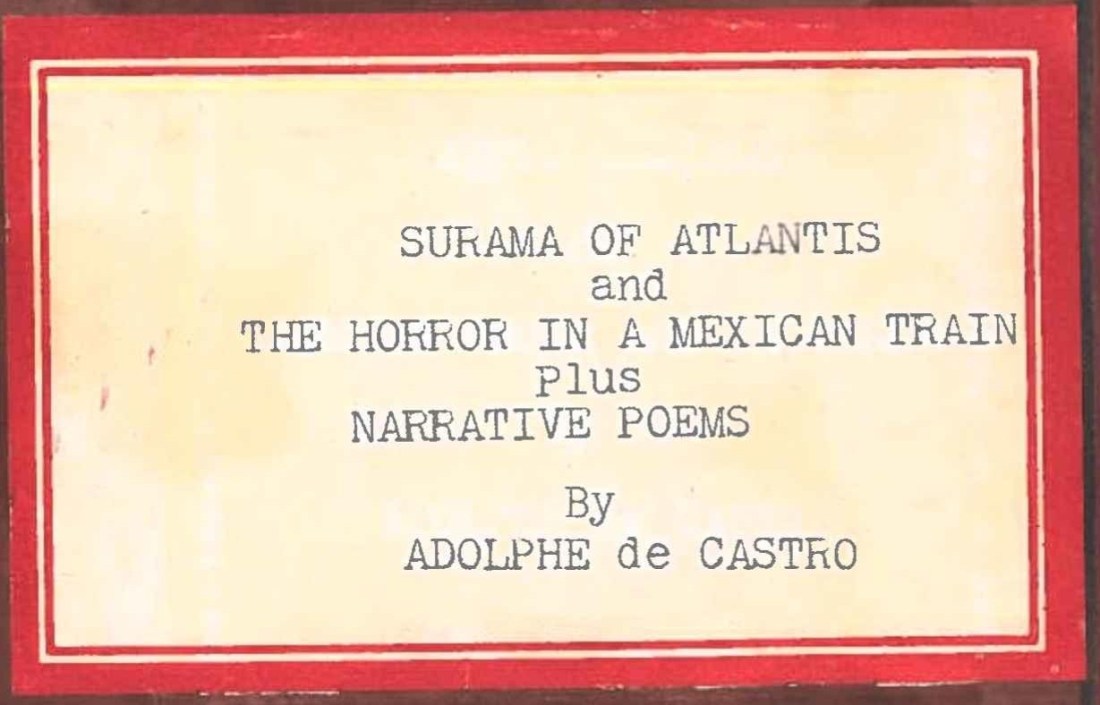
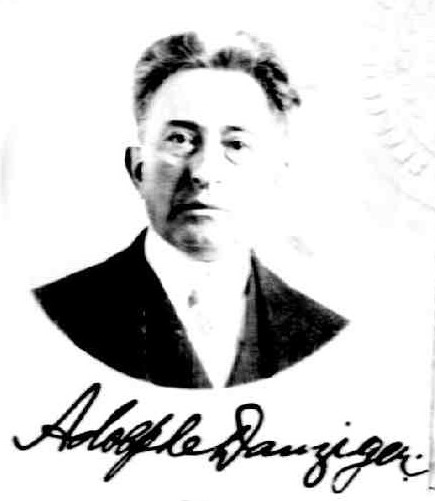
One of the Jews that Lovecraft met was Adolphe Danziger de Castro, an immigrant originally from Poland who came to the United States in the late 1800s. De Castro had an adventurous and slightly checkered life which saw him as a rabbi, journalist, dentist, lawyer, poet, writer, diplomat, and bigamist. Lovecraft would revise three stories for de Castro, two of which were published in Weird Tales: “The Last Test” and “The Electric Executioner,” though he would turn down the offer to revise Portrait of Ambrose Bierce (1929).

In 1934, de Castro had a new book he wished Lovecraft to revise: The New Way. Part of this dealt with the true paternity of Jesus Christ. Lovecraft brought his familiar views on the subject to bear, as tactfully as he could:

That this & the other books contain live material, as one could well doubt. Naturally much would be controversial—but that is all good advertising! Incidentally, I imagine that your genealogy of Jesus would draw challenges from many diverse sources—since the authenticity of all known ancient references to this shadowy figure is so doubtful. I believe it is fairly established that all allusions to Christ in Josephus & Tacitus are spurious interpolations, so that only the carefully & far from impartially edited gospels of the New Testament remain as even roughly contemporary accounts. And even they probably do not antedate in final form the latter part of the 1st century. It has always seemed doubtful to me whether any one person answering to the traditional Jesus ever existed in fact. In many respects the forms of Christianity closely floor those of the popular mystery-cults of the period—Dionysiac, Appollinian, Pythagorean, etc.—which joined Oriental & Hellenic concepts in a variety of ways. With this cult-background (wherein the idea of sacrifice & atonement was so marked) to start with, & with the age-old Jewish idea of a Messiah super-added, it would be easy to build up a religious & heroic myth around any one of the sporadic evangelists of the East—or around several of them, fusing their various personalities into one idealised hero or demigod. This, it seems to me, is what must have happened. The tissue of miracles & too-neatly-dramatic episodes undoubtedly represents the purely mythic element; but certain touches of verisimilitude now & then suggest a substratum of fact. Incidents in the lives of several rustic preachers may be involved—though possibly one figures more extensively than others. Just who this was, & to what extent the padded & myth-decked gospel narrative relates his actual history, it seems to me can never quite be settled except through the discovery of hitherto unknown source-material. Parts of the popular tale—sacrifice, resurrection, etc.—are obviously derived from the nature-myth of Linus, Dionysus, or Zagreus. Other parts—trial, etc.—might be tested by certain comparisons with contemporary accounts. But the lack of really reliable sources is almost fatal. That is, so far as general scholarship knows. The new sources you mention certainly sound exciting—although of course their authority in representing events which must vastly antedate them would have to be defended. Germanic lore would necessarily be purely oral as far back as the time of Christ—& anthropologists would see many opportunities for interpolation before it reached the written stage. Semitic lore, on the other hand, has been so carefully examined that any new interpretation would doubtless evoke a food of criticism from traditional academic quarters. Jewish allusions, I believe, are scattered, hostile, & fantastic—either reflecting the mythos of the gospels or enlarging upon them with matter equally improbable. Islamic references are all uncertain & derivative—merely echoes from already myth-strewn Christian & Jewish sources… & oral sources, at that. Of Pontius Pilatus singularly little is known from reliable accounts. Even his supposed suicide, I believe, has no better or earlier authority than the late christian writer Eusebius—a contemporary of Constantius. And of course the so-called “Acts, Epistola, Paradosis, & Mors Pilati” are all late concoctions—none of them antedating the 2nd century. Amidst this labyrinth of myth & forgery, the discovery of any really dependable source—a source that could prove its dependability both through internal evidence & through correlation with external evidence—would be a triumph indeed! So, as before mentioned, you certainly have a prize topic on your hands—* one which will bring plenty of debate. Tyrus of Mayence, I must admit, is a new figure to me. In the time of any grandfather of Christ, Mayence could have been no more than a crude wattled village of the Celts, for it was not until B.C. 13 that the Roman camp forming the nucleus of the classical & modern town was established by Drusus Claudius Nero. I know that links between the Celts & the Near East existed in & after the 3d century B.C., but I hardly though any relations with the homeland were maintained by the expatriate Galatians. I knew, though, that they retained their Gallic speech—even far into the Byzantine period. In any case your mention of a Tyrus of or from the Vangionian capital of Magontiacum on the Rhine excites my profoundest curiosity!
—H. P. Lovecraft to Adolphe de Castro, 14 Oct 1934, Letters to Alfred Galpin & Others 358-359

It is not clear exactly what sources de Castro was using. However, there was a tradition that gives Tyrus of Mayence (Mainz, Germany) as the father of Pontius Pilate. The legend is at least several centuries old, Thomas Decker’s early 17th century play Pontius Pilate relates one version of the story. Jesus (1868) by Charles F. Deems includes the passage:

The praenomen of Pilate is lost. Of his early history we have no authentic information. There is a German legend which represents him as the bastard son of Tyrus, king of Mayence. The story further goes that having been guilty of a murder in Rome, whither his father had sent him as a hostage, he was sent into Pontus, where, having subdued certain barbarous tribes, he rose to honor, received the name of Pontius, and was sent as procurator to Judea.

This legend, whatever its original source, was repeated, sometimes almost verbatim, sometimes with expansions, both in learned-sounding books like The Life of Jesus According to Extra-Canonical Sources (1887), A Dictionary of the Bible (1860), as well as numerous periodicals. The Voluminous podcast found a 1924 article “New Light on Pontius Pilate” by Henry W. Fisher, and we might add a 1924 newspaper clipping by Harry Stillwell Edwards and an anonymous newspaper clipping (The South Bend Tribune, 3 Apr 1928) that show a nearly identical legend. So there were numerous print accounts in English that de Castro might have run across at any point before 1934. The multilingual de Castro might even have read it originally in a German text.

So where does Jesus come in?

There are some possible references to Jesus in the Talmud, and the philosopher Celsus recorded a tradition informed by them that Jesus of Nazareth was actually the bastard son of a Roman soldier named Pantera (or Pandera, Pantiri, etc.). If de Castro combined the Tyrus/Pilate narrative with the Pantera/Jesus narrative by equating Pontius Pilate with Pantera, it would form the gist of the narrative of the “true” parentage of Christ.

Despite Lovecraft’s qualms, de Castro appears to have been adamant about the correctness of this narrative:

I judge from your letter that you would choose, as the first piece of revision, the section of your new book which treats of the possible parentage of Christ—plus perhaps the section on Wages; this text to be made self-sufficient & independent enough for separate publication if current opportunities dictate that and the most feasible policy. That choice, I imagine, is eminently sensible—particularly if you know of some publishing house especially receptive toward material of this kind. I sincerely hope that the project—either with the cooperation of some other reviser at the present time, or with my revision later on when I can handle more work. Of the possibilities of profit, I am of course too poor a business-man & judge. It is well, however not to be unduly optimistic; since even in case of publication a lucrative sale can by no means be counted on. Still, that would not form any good reason against the undertaking of the project if it were feasible; since the presentation of a powerful argument is indeed any enrichment of scholarship, is a primary end in itself. So, as indicated above, I’ll surely let you know whenever I can tackle any new task of the sort—unless previously notified that you have secured another collaborator. In any event I hope the ultimate outcome will be favourable.

Regarding the subject-matter of the book—I of course made no pretension to any sort of scholarship in stating what my vague & inconclusive guesses are. All that I have picked up are the odds & ends of common knowledge everywhere easily available. Perforce, I have to rely on the statements of others regarding the authenticity of this or that historical source. It is years since I have given this field any attention; & even in the past my attention was merely that of a superficial reader driven into occasional shallow dealings in order to justify my complete absence of all religious belief. Personally, I have not the slightest interest in any religion or its history; for I approach the whole problem of cosmic organization from a totally opposite angle—that of objective scientific analysis based on the evidence of the visible universe. Nothing seems more certain to me than that nature altogether lacks any indication of conscious governance. On the other hand, psychology & anthropology clearly explain why people in pre-scientific ages feal the so-called religious emotions & invented the various systems of poetic mythology to account for these emotions & to explain the then unknown phenomena of the earth & sea & sky around them. Although as technical disproof of a “cosmic mind” exists there are five almost indisputable reasons for not believing in such: first, the fact that it is the most awkward & least evidentially justified of all possible explanations of things; & second, that it is so obviously a human invention….a product of the animistic attribution of human qualities to the non-human & abstract. Thus to one all traditional considerations of religion seems essentially irrelevant, & even trivial except in connexion with historical & anthropological research. We can see too plainly behind all religions to take any of them seriously, or to prefer any one of them to any other except in terms of social, intellectual, & ethical effects. So far as truth or justification is concerned, they are all alike—hence I can look up their tales & characters…. Zeus, Brahma, Odin, Jesus, Gautama, Yahwe, Mohammad, Ahura-Mazda, Moses, Gitche Manitou, Quetzalcoatl, Mary Baker Eddy, Damballah, the angel Moroni, & all the rest…..only with such objective & analytical detachment as one finds in Frazer’s “Golden Bough.” What interests I have in the well-known religions of the ancient & modern world is purely historical—measured by their effect on the stream…or varied streams…of civilization. Thus Jesus & Yahwe—& all the folklore behind them— mean no more to me than Apollo or Thor or Mavors or Tanit or Huitzilopotchli; & do not command any more of my study & attention than do these fellow-objects of deific regard. Hence my lack of special scholarship in their direction. What interests me is the whole human pageant, & not any especial corner of it—except so far as environment & caprice have given me a particular concern for Anglo-Saxon civilization in the ancient world…a concern not exclusive enough to to destroy the scope & objectivity of any larger general perspective.

It is, then, only as an incident of history that the question of Christ’s personality, origin, existence, or non-existence interests me. I have not explored the subject in detail, & do not pretend to have any but casual, second-hand knowledge. When I have a guess, it was only a rough tentative one—based on what data are commonly floating around. In saying that a new theory would be hard to establish, I meant that there must be scholars who have minutely gone over all the available evidence many times before, & who would therefore challenge any interpretation of that evidence which might differ from their own interpretations…or from the interpretations of earlier scholars. In the case of obscure Jewish records, it is natural to assume that these must have been minutely explored by the vast number of profound Jewish scholars who have lived since the period of Christ. These scholars would have no motive for concealing any facts they might have discovered, or conclusions they might have reached, concerning the existence & parentage of Jesus. Standing outside the religion which seeks to make this figure a demigod or god, they would naturally be perfectly frank in setting down what they know of him—just as they would be in describing any figure whose significance is purely historical to them. Nay, more—they would probably be eager to bring forward any facts about Christ which would overthrow the claims of these who make a god-begotten Heracles or Theseus or Castor or Pollux of him. That the erudite Jewish scholars of nineteen centuries have not done this, despite their access to vast reservoirs of Hebraic traditional & records, would seem to indicate that the evidence on which any estimate of Christ’s parentage could be based is either newly discovered or else subject to controversy regarding interpretation. That is what I meant when I said a book containing a theory of this sort would have to withstand a general fusilade of debate. But of course you realize this yourself, & are doubtless prepared to welcome the discussion. If it turned out that your interpretation of Talmudic & other records could successfully establish itself against the negative interpretations of antecedent scholarship, your position could become one of vast importance indeed! My own opinion, as I have said, is in a state of flux—as all laymen’s opinions must necessarily be. All I can do is to judge at third or fourth hand relying on the extent to which real scholars agree or disagree—of the validity of the sources on which various historians base their arguments. I must endeavor to see a copy of your “Jewish Forerunners of Christianity”—which must be an extremely interesting & historically revealing book all apart from its framing on the present topic. Too bad it is out of print—or perhaps that is not so unfortunate after all, since you say that its method of approach to its theme is not what you would prefer to use today. I’ll see if any of the local libraries have a copy.

Regarding Moses here again is a figure which I have often felt must be at least partly mythical….a typical tribal hero around whom have clustered numberless legends, & to whom are perhaps attributed the deeds of many other heroes of many ages. I believe that some of the anecdotes related of him are clearly from Babylonian sources. But of course all my impressions are fragmentary & unsystematic. I shall be interested in seeing what your views on this shadowy figure are.

Yes—there surely is a curious irony in the series of accidents which have imposed upon the Western world a dominant faith of Semitic origin. Nietzsche, I believe, was the first of the moderns to point this out with emphasis. The general effect of this faith has been in part good—in that it has inculcated certain ethical factors more strongly than another faith might have done—& is part unfortunate, since it has raised certain demands &  expectations impossible of fulfilment by men inheriting the Western culture-streams. Itself springing out of the racial experience of a people vastly different from our own culture forerunners, it naturally fails to embody & express those deeply-grounded feelings & aspirations which are really ours. Embodying other feelings & aspirations which we cannot share except in a superficial & artificial way, it leads to a curious duality between formal ideals on the one hand, & real ideals & actual conduct on the other hands….a duality leading to wholesale & systematic hypocrisy. We pretend to follow a philosophy of justice, meekness, & brotherhood, while actually continuing to base our secret working standards on strength, personal inviolateness & unbrokenness, & the struggle for domination. We go to church on Sunday—yet continue to fight, grab, & exploit in the most approved pagan fashion. And the deep springs of action which really move us are never based on the weak Christian concept of virtue but always on the strength-prideful Teutonic concept of honour. We can laugh good-naturedly when anyone tells us we are unjust, vicious, or impious (i.e. delinquent in our relations to the governing forces of the universe), but are aroused to the fighting point when anyone dares question our honour (i.e., the straightforwardness of a man so strong that he has no need for subterfuge) or independence or courage. The difference in our instinctive emotions when confronted by these five different types of ethical attack is tremendously significant as regards the placement of our real & profound loyalties. Thus in spite of all the centuries of ostensible Christian belief we are not Christians except in name. It would have been more honest & less hypocritical if we had continued to adhere to the polytheistic pantheism which is our culture’s natural heritage, & which therefore more truly embodies & expresses what we really think & feel. A system synthesizing the God of Epicureanism & Stoicism would have served us much better than our accidental importation has done. It is, however, rather late in the day to change back—especially since the part played by any religion in the life of our civilization is rapidly waning. Forces & feelings far removed from the ecclesiastical are the things which really count in the crisis of transition around & ahead of us.
—H. P. Lovecraft to Adolphe de Castro, 22 Oct 1934, Letters to Alfred Galpin & Others 364-367

Jewish Forerunners of Christianity (1903) was one of de Castro’s earlier books, published under the name Adolph Danziger; chapter II discusses evidence of Jesus in the Talmud, but doesn’t dwell overlong on the parentage of Jesus. There are endnote citations for de Castro’s sources but, again, nothing really relevant to this new book.

Lovecraft’s lengthy reply was in keeping with his tendency to humor and encourage writers in his circle, even as he himself had no desire to take on a non-remunerative revision of such length and subject matter. In the later portion of the letter about Christian morals, Lovecraft is careful to tip-toe around actually badmouthing Jews or Judaism, focusing on the perceived hypocrisy of Christianity rather than critizing the Jewish religion that preceded it. In subsequent letters, Lovecraft continued to encourage de Castro in his writing:

I hope you will eventually prepare the life of Christ as once planned—it ought to have a wide appeal, & any points contrary to the orthodox case, thus could excite less opposition than they would have a few decades ago.
—H. P. Lovecraft to Adolphe de Castro, 14 Nov 1934, Letters to Alfred Galpin & Others 372

Because we lack de Castro’s letters for this part of the correspondence, there are many specifics about what specifically he wrote that aren’t entirely clear. Fortunately, Lovecraft was willing to describe it at length with another correspondent, which gives us much more insight into the subject:

About my current revisery work—I assume it is of the de Castro job which you wish to hear, since other odds & ends are of no distinctiveness at all […] Well—to begin with, I think I’ll have to refuse Old Dolph’s assignment—since he can’t pay in advance & since it’s so great a mess as to be virtually hopeless. What I will do—to cheer the old boy up amidst his present misery—is to touch up the phraseology a bit, & point out the more easily recognisable historical & scientific errors, & give some general critical advice. That will make it easier to revise later on if he ever finds anybody to do it. The MS. is a full-length book of miscellaneous social, political, & historical essays rather vaguely entitled “The New Way”, & has very little internal coherence. It appears to endorse the philosophy of Lenin & the bolsheviks, & in certain parts tries to give new & sensational interpretations of accepted history. In this latter field de Castro’s inescapable passion for charlatanry comes to the fore, & leads him into statements, theories, & alleged “discoveries” of every sort.

His climactic essay is a claim of having discovered the real facts concerning that most baffling of historico-mythical figures, Jesus Christ, including his true parentage on both sides. One can realise how important such a discovery would be, if it were true. Actually, we have so little reliable information about Christ that there is much doubt as to whether such a person really existed. Actually, we have so little reliable information about Christ that there is much doubt as to whether such a person really existed. Many of the stories told in the Gospels are old myths which have been told about others before. Probably there was some prophet or leader like Gandhi or Buddha at large in Judaea around the time of Tiberius, about whom a vast body of fabulous & ethical lore clustered, & whose legendary eventually became condensed into what we know as the New Testament. More than that it is unlikely that we shall ever know, since records are next to non-existent.

But old de Castro says he has all the unknown inside facts—which he claims he has discovered in “Germanic & Semitic sources.” According to him, Jesus was the illegitimate son of the imperial procrator Pontius Pilatus (who later tried him) by a Galilean gentlewoman named Mary, who later married the carpenter Joseph. Pilatus himself, continues Old Dolph, was likewise illegitimate—the offspring of a Roman named Tyrus & a German princess of Mainz, on the Rhine. As the story goes, Tyrus was a “king” or governor of Germany sent out by Augustus. At the capital Mainz he met & wooed the princess, but was forbidden to wed her by the Roman rule against the presence of wives abroad with proconsular officials. The result was Pilatus’ unsanctioned birth. Later the youth Pilatus went to Rome, killed a man in a duel, & was given a choice of two penalties by Augustus—to fight in the arena, or join a forlorn-hope expedition against a city called Pontus, where the Etruscans were in revolt. Choosing the latter, he behaved so bravely that Augustus gave him the complimentary name Pontius & appointed him a tax-collector in Syria. There at the age of 20 he met & courted the fair Galilean—who refused to wed him because he was a pagan idolater. Her delicate Judaic scruples did not, however, prevent her from giving rise to the anniversary about to be celebrated for the 1934th (or so) time. Pilatus, recalled to Rome, never knew that there had been a chee-ild until years later when—back in Iudaea as procurator—he condemned Jesus to death & learned only too late that he was his father! Such is de Castro’s dramatic story—offered as a true historic discovery. He isn’t very specific about his “sources”—& overlooks the fact that the German tribes had no written speech in Tiberius’ time, so that “Germanic sources” couldn’t be very first-handed at best. Also—who supposed that the Germans of that age gave a damn about what was happening in Syria? I can’t criticise his “Semitic sources” (the Jewish Talmud &c.) because I don’t know anything about them. But on the other hand, the yarn touches Roman history at several points—& there I have something to say. See how the “true historic discovery” stands up under the following undoubted facts:

  1. Tyrus is not a Roman name.
  2. Maguntiacum (mod. Mainz) was not the capital of any part of Roman Germany till later in the imperial age. It was an originally Celtic village, & was merely the tribal capital of the (probably Germanic) Vangiones in the Augustan period. It became the site of a fortified Roman post in B.C. 12.
  3. Augustus appointed no civil governors of Germany till A.D. 17. The rule against having wives with them did not apply to the military commanders who ruled Germany before it was a civil province—or pair of provinces. Thus Germanicus Caesar was accompanied by his wife, & their daughter Agrippina the younger was born in camp at Oppidum Ubiorum—later named Colonia Agrippinensis (Cologne) after her.
  4. Allowing for certain corrections in chronology, the date of the birth of Christ is traditionally set at what we now call B.C. 4. That would make it necessary for his father, if he begot him at the age of 20, to have been begotten at Mainz in B.C. 26. But there was no Roman occupation of Rhineland Germany till the expedition of Claudius Drusus Nero in B.C. 12. Prior to that date, all the fresh western conquests were below the Danube—Noricum, Rhaetia, & Pannonia (Tyrol, Austria, Hungary). In B.C. 26 the Rhineland was not subject to Roman rule—Caesar’s raids in B.C. 55 & 53 having come to nothing. Therefore Augustus could have appointed no governor there. As a matter of fact, there was never any Roman commander in Germany with any such name as “Tyrus”. The following are the only commanders appointed to Germany prior to the organisation of the civil provinces of Germania Superior & Inferior in A.D. 17:

    B.C. 12— Claudius Drusus Nero stepson of Augustus, brother of Tiberius, & father of the Emperor Claudius. he first brought the Roman power to the Rhine, & formed the string of forts now surviving as the cities of Coblenz, Bonn, Bingen, Mainz, etc.
    B.C. 9— Tiberius Caesar
    A.D. 9— Quintilius Varus massacred with all his army in the Saltus Teutobergiensis by the German leader Arminius or Hermann
    A.D. 14— Germanicus Caesar

    There were no others. “Tyrus” is obviously a myth.
  5. The duel did not exist in classical times.
  6. There is no town or city in Italy or elsewhere called Pontus. Pontus was a nation in Asia Minor or the Black Sea—famed for its Mithridatic kings.
  7. The Etruscans were never in revolt as late as the Augustan age. By that time they were cordially assimilated into the Roman people, so that Romans affected Etruscan fashions & boasted of Etruscan ancestry. G. Cilnius Maecenas was of Etruscan descent.
  8. The honorary surname bestowed for conquering a place called Pontus would never be Pontius. According to Roman usage, it would be PONTICUS. On the other hand, Pontius was a very common gens-name of Samnite origin. (cf. C. Pontius, who sent a Roman army under the yoke in B.C. 321, & Pontius Telesinus, who fell in the wars of Marius & Sulla B.C. 82.) The name Pilatus probably came from the word pileatus (from pileus, a freedman’s cap), signifying a freedman. Probably Pontius Pilatus, though himself an eques, was descended from some Fred slave of a Samnite named Pontius.
  9. There is no record of Pilatus’ ever having been in Syria before his appointment by Tiberius (through the pull of the infamous Aelius Sejanus) as procurator of Judea in A.D. 26. Very little is known of P.—all the accounts of his later life & suicide being definitely apocryphal. There is nothing of this short of thing antedating the biassed Christian writer Eusebius (A.D. 324).

In view of these things, you can judge for yourself what Old Dolph’s “historical discovery” really amounts to. It is, in truth, so crude that I have had to warn the old geezer that he can’t possibly get away with it. How a scholar of his calibre could be so ignorant of Roman history—or imagines others to be so—is quite beyond me. Whether he made the whole thing up himself, or found some crude German myth to base it on, I really haven’t the slightest idea. Of course, in discussing the matter with him I’ve had to be tactful & imply that his Germanic sources are unreliable. I can’t tell him to his face that he’s an old faker!  But I’ve warned him that the legend has fatal flaws.
—H. P. Lovecraft to F. Lee Baldwin, 23 Dec 1934, Letters to F. Lee Baldwin etc al. 116-119

Lovecraft was inadvertently correct in that it was the original legend de Castro relied on was the source of the errors, rather than de Castro himself. De Castro’s response is unclear, as he had other immediate concerns:

As for poor old de Castro—he couldn’t have seen us if we had called, for I’ve since learned that he was laid up all through January with a nervous breakdown—through worry over his wife’s illness. And to cap the climax, she died Jany. 23 at St. Joseph’s Hospital. We certainly do feel sorry fro the old cuss, for he is really an enormously likeable & generous chap aside from his incurable penchant for charlatanry. Hope he’ll gradually recover from the strain & bereavement. His chapter on the ancestry of Christ surely was grotesque & vulnerable.
—H. P. Lovecraft to F. Lee Baldwin, 16 Feb 1935, Letters to F. Lee Baldwin etc al. 124

Months later, de Castro seems to have recovered sufficiently from his bereavement to return to the topic:

The diverse losses I suffered, the grief that attacked me has not left my mind unscathed. I cannot for the moment lay my hands—or my memory—on the authorities I read (in German, Mommsen, Niebuhr, Ranke and others) not to mention Gibbon and others relative to my assertions. But there is a vast literature in ancient and modern Hebrew (I mean during the 8th century A.D.) that have a variety of suggestions—for you may believe me that I did not concoct this statement just to be “smart,” or sensational. If the suggestion is taken up at all, it will bring forth the originals. These are not from some unknown author, but, as I recall, by the great classical historians, whether in German, French, Spanish or any other of the languages I read for research purposes, I cannot at the moment tell.

[[See how old Dolph tried to bluff out the hilarious historical boners in his “parentage of Jesus” fake!]]

—Adolphe de Castro to H. P. Lovecraft, 24 Sep 1935, Letters to Alfred Galpin & Others 380

Lovecraft shared this letter with one of his correspondents, and the comments in [[brackets]] are Lovecraft’s annotations. The authorities de Castro cites are Theodor Mommsen, Bartold Georg Biebuhr, Leopold von Ranke, and Edward Gibbon, all historians who wrote extensively on the Roman Empire. Still, having received the letter, Lovecraft had to answer it—at length.

Regarding the historical points—I did not mean to imply that the account was concocted for purposes of sensationalism. I simply pointed out that, in present form, it might “go over” best if given the semblance of an historical novel. Just how the material could be given in any other way—lacking correction & verification from original authorities—I really can’t see. As you may readily perceive, this account states & implies dozens of things at direct variance with well-known historic facts—such as the presence of Roman rule in Germany before B.C. 13, the use of “Tyrus” as a Roman name, the location of provincial rule at Magontiacum at too early a date, the identification of Pontus as an Italian city, the idea of Etruscans in revolt after their full absorption into the Roman people, the false derivation of the common Samnite gens-name Pontius, the existence of the duel in pre-medieval times, & other points which could not pass inspection for a moment. No matter what original source supplied the general thesis, these specific points (& others like them) would cause it to be attacked at once—hence is is absolutely necessary to remove these obvious errors (however they may have crept in) before the text can go before the public. With these absolute & unmistakeable errors, the thesis could never be judged on its own merits. It would be dismissed at the outset because it would seem to rest on overt & flagrant contradictions of common fact. It is not fair to the thesis to offer it under such an insurmountable handicap—nor do I think that any publisher would be willing so to offer it. Thus it seems imperative at this stage to get the mistakes cleared up, so that the message will be in deliverable form.

I realise of course the difficulty of reassembling authorities when no notes have been kept—but how else is the original account to be rediscovered? The existing mistakes could not have been in any of the solid sources…so what was it that the solid sources really said? I can assure you that Mommsen, Niebuhr, & Gibbon do not sustain any contentions contrary to accepted history, for I have in my day read them (M. & N. in Eng. translation). In view of the bold & revolutionary nature of the assertions, it ought not to be difficult to narrow down the search for their origin by eliminating many of the standard authorities. In any case, you can see how impossible it is to present revolutionary claims without any visible sources—especially when linked with dozens of palpable errors.

Of course, the most important thing is to eliminate the flagrant errors. If that were done, the lack of accessible authorities would be a less immediate handicap—especially if the quasi-fictional style were adopted. But in the end, of course, the lack of visible originals would weigh heavily.

So it is clear that the one thing which must be done now is to clear up the errors. This might not need a consultation of the original sources—but could perhaps be done at once by yourself with the actual historic facts in mind. Remember that there was no Roman rule along the rhine till the time of Drusus Nero—B.C. 13-12, & that the region did not have a civil governor anyhow till A.D. 17, when the provinces of Germania Superior & Germania Inferior were formed. Remember also that Pontius was a common Samnite nomen—& that Pontus was a Black Sea province pacified long before & joined administratively with Bithynia…nothing to do with Italy or the Etruscans—the latter element being, by the way, fully absorbed by the Roman people. Surely the narrative could be re-cast in harmony with these absolutely certain & widely known historic truths.

I am sure you realise that all these suggestions of mine are made without any hyper-critical intent, & simply to aid the success of the book. It obviously cannot be published until the errors are straightened out—hence the one imperative thing is to get them straightened as soon as possible. And that is something which only you can do, unless your original authorities become accessible to others.

Of course, the entire omission of the historic chapters of the book at this time would be possible. Indeed, much might be said in favour of this—since they will clearly appear under a handicap until the sources are found. The time for publication is, very plainly, after all the knotty points are straightened out.

The necessary thing is to throw the controversy back from yourself to the authorities from whom you derived your narrative. Then you will not be responsible for the weaknesses in the account. It seems to me very probably that these stories originated in mediaeval times, when the sense of history was slight, & critical standards lax. Close examination of the account discloses such a theatrical quality that one can hardly doubt the development after the wide popularisation of the original New Testament narrative—adding a dramatic coherence & climax dependent upon the significance attached to the original tale. The element of coincidence involved in having the son of Pilatus tried before him is typical of the older school of dramatic construction. Now of course this was probably a natural growth over a long period—just like other folk-tales throughout the world. It may well recur in different mediaeval writings both Christian & Jewish—& Mohammedan also for that matter—as for other apocryphal legends. But the genesis of the tale as legend would of course form no guarantee of its genuineness as history. Still—this latter point need not bother you. Your purpose is to show that the legends exist—& once you do that, you can let the critics tackle the original legends as best they may. But you can do that only by rediscovering & citing your sources. Without such backing, you yourself instead of your sources will have to bear the brunt of the attack.

So my earnest advice is that you bend every effort toward the elimination of errors & rediscovery of sources before the account is again offered for publication. I’d recommend an easier & simpler course if I could, but I can’t see any, try as I may. You may get further suggestions from your agent, or from the publisher to whom he has submitted the book. And more—when you re-read the chapters in question more closely, you may recall the primary sources more readily than you could off hand. But remember also that the book would be quite suitable for submission without the debatable chapters. You could, if you wished, remove them for later investigation & verification.
—H. P. Lovecraft to Adolphe de Castro, 26 Sep 1935, Letters to Alfred Galpin & Others 381-383

To say that Lovecraft didn’t want to do the job of revising de Castro’s manuscript is putting it mildly; but his argumentsand critiques are well-meant. Lovecraft could foresee exactly the kind of attacks that would be made on de Castro’s claims, and Lovecraft was not even a specialist in early Christian history. Nevertheless, de Castro was dogged in the defense of his theory, and Lovecraft didn’t back down from the debate:

I am greatly interested in the researches you have made concerning those debate-filled historic chapters. I did not doubt but that the original sources would turn up in the end—after sufficient searching—& I trust that they will be duly cited in the final version of the text.

Vilmar is an authority unknown to me—but as you see, his account (if it is literally the same as that presented in the text) is obviously legendary. The stubborn fact remains, that no Roman occupation of the Rhineland existed until about 8 or 9 years before the traditional date of the birth of Christ…which is 4 B.C., as commonly reckoned. Also—even if certain writers refer to a rebellion in Pontus during the Augustan period, it is obvious that the Etruscans had nothing to do with it—since Pontus lies far off on the Euxine, while the Etruscans had long been assimilated into the Roman fabric. Just how this connexion of Pontus & the Etruscans could have arisen—except through the inaccurately (sic) associative process of mediaeval legend—I can’t imagine…unless perhaps the revolt mentioned involved troops or colonists in whom the Etruscan element was strong. Furthermore—the derivation of the name “Pontius” from Pontus is obviously false. All agree that the name as borne by anyone in the Roman world must have come from membership in the ancient gens Pontia—the Samnite family so frequently encountered in the history of the Republic. An honorary cognomen or “adnomen” bestowed for exploits in Pontus could have but one form—PONTICUS—according to the linguistic laws governing such formations.

I’ll look in Suetonius for the account of that earlier Syrian appointment of Pilatus. Curious that I don’t recall it—though it’s fully 30 years since I’ve read Suetonius—an author whom I unfortunately do not own. I really must pick up a copy when I find one reasonably priced. Regarding Tertullianus (yes—I recall his praise of Pilatus—”iam pro sua conscientia Christianum”) & the Talmud—of course the late dates of these writings causes them to be open to legends arising out of the earlier Judaeo-Christian accounts…legends consciously or unconsciously built dramatically from the first crop of mingled fact & myth, & coloured with religious zeal or prejudice one way or the other. As you know, Pilatus was an especially favoured subject of myth-making-Eastern & Coptic traditions giving him a Christian wife (Claudia Procala or Procia) who is to this day a Greek church saint, while the subjects of the just-now-limelighted Halie Selassie make Pontius himself a saint & Martyr! Then there are of course the apocryphal Acta Pilati, Epistola Pilati, Paradosis Pilati, & Mors Pilati (probably Judaeo-Christian)—full of fantastic tales of pilatus’ sight of the resurrection, of his trial & sentence by Claigula, his penitent conversion to Christianity, his suicide to escape sentence (which contradicts another legend that he was beheaded at Nero’s order), the removal of his body to Vienna (where a structure* called “Pilate’s Tomb” is still exhibited. The chronicler naively traces the name VIENNA to VIAGEHENNAE! This place also figures in legend as the seat of Pilatus’ banishment during his lifetime.) & later to a mountain pool near Lucerne because the Tiber & Rhine both refused to harbour it. (the site of this pool is now called “Mt. Pilatus,” & according to legend the water displays strange agitation if anything is thrown into it. The devil removes the still-preserved body of Pilatus each year—on good Friday—& forces it to go through a curious hand-washing ceremony on a throne.) These apocryphal books probably date from the 2nd century A.D. & afterward. Eusebius (circa 325 A.D.) in his famous [Ecclesiastical History] (& after exposure to all the current Christian legends) is the source of the statement (which may or may not have a basis in fact) that Pilatus was banished to Vienna by Caligula & committed suicide there because of various misfortunes. Regarding Talmudic sources—of which I have no knowledge—one may only point out that later recordings of lost records are often coloured with legendary which did not exist in the original versions. Obviously, only a profoundly erudite student of Jewish antiquities could form a just verdict on the extent to which fragmentary transcripts & recensions of these early Palestinian Evangels (themselves probably derived to some extent from purely oral legends of a century’s growth) can be accepted as historical. All that is beyond me. The remarkable thing is, though, that the indicated origin of Jesus has not been more widely accepted if the documents are generally regarded as dependable. One could understand a wish to suppress these documents in the Christian world—where the myth of a divine paternity was to be sustained at any cost—but I cannot see what reason the Jewish would would have to suppress them. The existence of a fanatical preacher of left-handed origin & wholly human parentage would mean nothing one way or the other to the Jewish religion. He would be grouped with other heretics who lived & founded false sects & died—& there would be no object in concealing any facts pertaining to him. And yet, so far as I know, the version here given is not endorsed by the main stream of Jewish scholarship. Though I have no exact knowledge of the views of Jewish historians, orthodox or otherwise, I seem to recall references here & there which indicate a conflict of opinion—some regarding christ as a local impostor while a few accept the cult idea & disbelieve in his objective existence. At any rate, I believe there is no attempt to take seriously the hostile & widely conflicting Talmudic references (none of which, so far as I know, mentions Pilatic parentage) which influenced Judaism in the late imperial & mediaeval periods. Just what modern Jewish scholarship thinks of christ could make an interesting subject for study—I must look it up some day in the Jewish Encyclopaedia, which is generally accessible in libraries. But I feel very sure that the Pontian theory would be more widely noted & cited if it were accepted by any responsible body of Jewish scholars & historians. In the absence of such general acceptance one is forced to the provisional conclusion that the legends in question are vague & apocryphal. At least, that is the conclusion of one without special information based on new historical discoveries.

The whole matter is certainly highly interesting, & I would indeed be glad to use the notes you have so generously offered to send. I may not be able to follow them up at once, for my programme is desperately crowded but I would be grateful for a copy to have on hand for gradual following-up. Probably most of the sources could be located in Providence libraries. I have Smith’s Bible Dictionary—but unfortunately an old abridged edition which sheds no light on the points in question. Meanwhile I must get a look at Suetonius somewhere—for I can’t recall any reference to the earlier service of Pilatus in Syria. The statement that he served under Archelans is also puzzling—insomuch as that tetrarch did not succeed in Judaean throne till after the birth of Christ according to the received account. Archelans’ father Herod the Great (who may or may not have conducted the “slaughter of the innocents”) was on the throne when Christ is said to have been born…. The Roman governor (legatus pro pratore) then being P. Quinctilius Varus, afterward so tragically overwhelmed by the Germans with his legion in the Saltus Teutoburgiensis (A.D. 8). Archelans became tetrarch during the first year of Christ’s reputed existence—Varus being then replaced as propraetor by the rather low-bown P. Sulpicius Quirinius, an ex-consul who had been proconsul of Africa. Varus was such a close friend of Archelans that Augustus didn’t dare to trust them in the province together—between them they’d have doubtless looted it completely. Later Archelans was banished to Vienna—a circumstance which may or may not have some connexion with the tale that Pilatus also was banished thither. With him ended the tetrarchate—the region of Syria Palestine being then (A.D. 6-7) organised as the imperial province of Judaea under a procurator. When, then, did the young Pilatus first serve in Syria? Before the birth of Christ under Herodes the Great, or after it under Archelans? Or did Archelans have some minor office wherein he was Pilatus’ chief prior to his accession to the tetrarchate? It is odd how every new angle of this legendry brings up some fresh problem. But I must get hold Suetonius & see what I have forgotten or overlooked.

I’m greatly interested to learn that you find grounds for believing the Christ reference in Josephus not interpolated. hitherto the tendency to reflect this—as well as a corresponding reference in Tacitus—has been well-nigh universal. An article on the subject alone, it seems to me, would be well worth writing.
—H. P. Lovecraft to Adolphe de Castro, 5 Oct 1935, Letters to Alfred Galpin & Others 384-386

If anyone ever asked St. Nicholas for a history of Christ-era Judea from the pen of H. P. Lovecraft, then their Christmas wish has been answered at long last. Lovecraft’s confession to a lack of knowledge of Jewish history and scriptures is honest—he had to consult the Jewish Encyclopedia to uncover the mystery of the mezuzah just the previous year (see The House of Rothschild (1934)), and elsewhere admitted to ignorance of basic matters such as what kosher meant. Much of his apparent erudition above probably came from encyclopedia articles and books from his library.

Whether de Castro finally took Lovecraft’s critique to heart or not, the subject appears to have passed out of their letters—though Lovecraft wasn’t above talking about it to others.

The author’s imagination has in these cases gone off on rather a romantic spree! In the climactic chapter on the parentage & ancestry of Jesus there are more historic boners per square inch than in any other historic hoax I have ever encountered! But for all that Old ‘Dolph is a good soul—& now & then an idea or synopsis of his might be well worth developing.
—H. P. Lovecraft to Rheinhart Kleiner, 16 Aug 1936, Letters to Rheinhart Kleiner & Others 234

The subject of the historicity of Jesus Christ does not come up often enough in Lovecraft’s letters to really track a change of opinion—by the time Lovecraft was an adult, he seemed fairly set that Christianity was primarily a superstition, and that a historical Jesus, if he existed, was no more than one of many evangelists in the Middle East during that period, who had by fluke of history inspired the religious movement that would dominate European (and, through colonization, world) history over the coming centuries.

In the strictest sense, Lovecraft did not believe in Christmas. He did not have faith that a messiah had been made manifest in human flesh, did not celebrate the miracle of the virgin birth, the symbol of hope for the redemption of sinful mankind. Yet the spirit of Christmas, the spirit of giving and fellowship, shorn of religious trappings—that Lovecraft believed in, and when he counseled Adolphe de Castro on his manuscript, it was not religious scruple or dogmatic belief that made him reject a heretical notion of Christ as a bastard and the son of a bastard, but because he wished to keep his friend from making mistakes that would open him up to harsher criticism and ridicule.

Late in life, when the subject of Christmas and Christ came up, Lovecraft would write:

The Jesus-myth always left me cold, & even my worship of beauty & mystery in the form of Apollo, Pan, Artemis, Athena, & the fauns & dryads ended when I was 8.
—H. P. Lovecraft to C. L. Moore, [7 Feb 1937], Letters to C. L. Moore & Others 222

Linus in A Charlie Brown Christmas (1965), gave an honest and scripturally accurate answer when asked what Christmas is all about. Lovecraft gave an honest Lovecraftian answer. For him, the holiday was not the celebration of a miraculous event; it was the remembrance of a long tradition that connected back into the hoary ages of things. A link to the ancient and forgotten past—and, as well, a time of thanksgiving to be shared with friends and family. That is what Christmas meant to H. P. Lovecraft.


Bobby Derie is the author of Weird Talers: Essays on Robert E. Howard and Others and Sex and the Cthulhu Mythos.

Deep Cuts in a Lovecraftian Vein uses Amazon Associate links. As an Amazon Associate I earn from qualifying purchases.
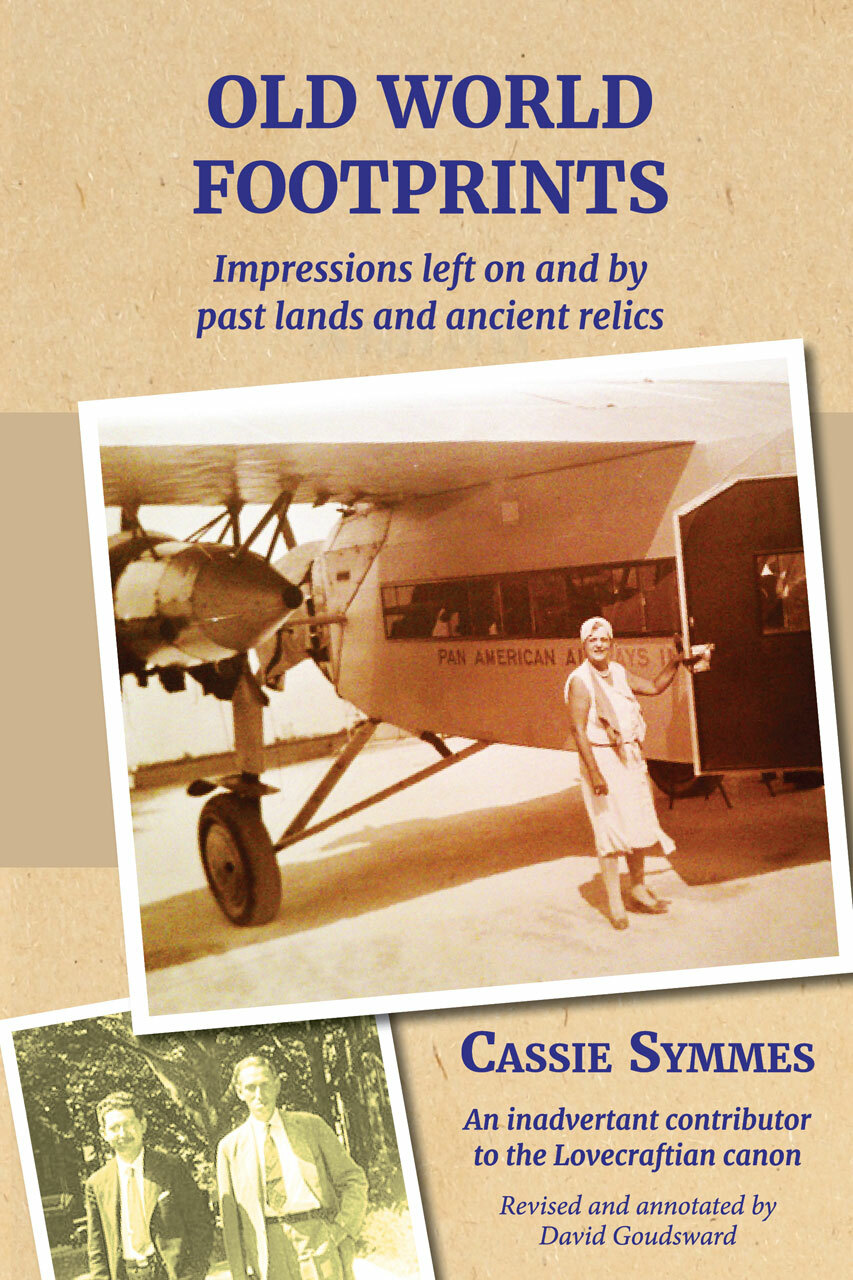
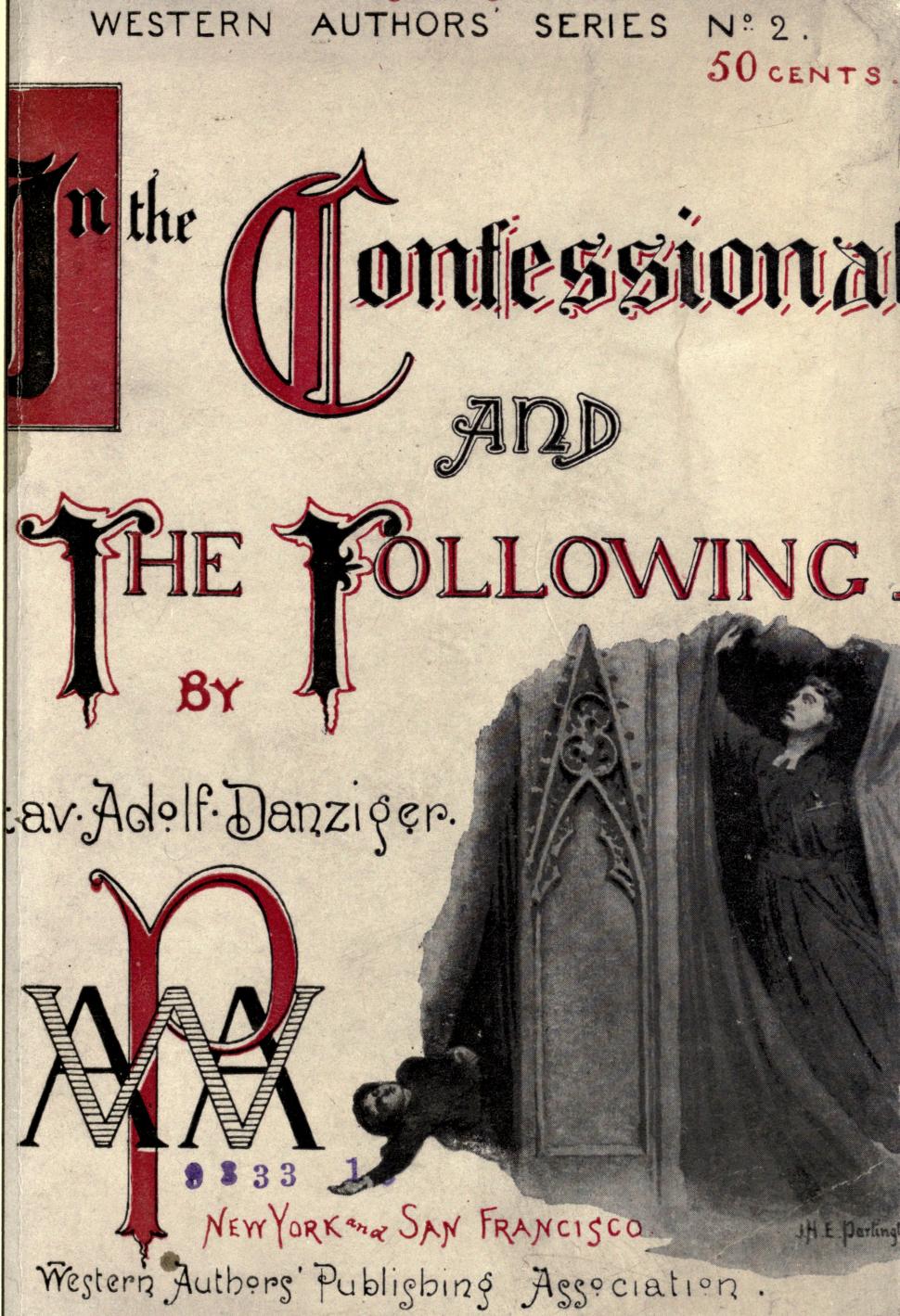
Old World Footprints (1928) by Cassie Symmes & Portrait of Ambrose Bierce (1929) by Adolphe de Castro

The fact that H. P. Lovecraft worked as a ghostwriter and reviser of other’s writing is common knowledge. Most of the work that receives attention is the weird fiction which he wrote for clients, to appear under their names in pulp magazines like Weird Tales and Wonder Stories, but Lovecraft’s revision services were much broader, covering everything from poetry (such as his work for David Van Bush and Josephine Evalyn Crane Blossom) to travelogues, such as European Glimpses (1988) by Sonia H. Greene.

Two of these works, Old World Footprints (1928) by Cassie Symmes and Portrait of Ambrose Bierce (1929) by Adolphe de Castro, are both connected with Lovecraft and his long-time friend Frank Belknap Long, Jr. By the late 1920s Long had set out to be a professional writer, and had published several short stories in Weird Tales, including “The Were-Snake” (1925), a book of poems, A Man from Genoa and Other Poems (1926). That book was underwritten by his aunt, Cassie Symmes, and printed by W. Paul Cook. Symmes was so impressed with the production that she hired Cook to produce a travelogue of her 1924-1927 trips to Europe, asking her nephew to provide the preface. Lovecraft was asked to correct the proofs.

Lovecraft did a little more than that. For many decades, Old World Footprints remained one of the rarest works of Lovecraftiana, but a 2021 reprint from Bold Venture Press has finally made it available to the average fan. Dave Goudsward tracks the history of Lovecraft’s involvement, including where and how Lovecraft touched up Symmes’ prose, to the extant that he basically ghost-wrote Long’s preface.

I concocted a euphemistic hash for young Long to sign—a preface to a tame travel-book by his aunt that bored him so badly he couldn’t think of anything to say! He didn’t want to turn down the request for a preface—so got me to cook up some amiable ambiguities for him.
—H. P. Lovecraft to Clark Ashton Smith, 19 Dec 1929, quoted in Old World Footprints (2021) 54

As the text of the travelogue itself is very short, the book is expanded with a biographical essay on Cassie Symmes, with focus on her involvement with all things Lovecraftian—she was, for instance, the person who gave Frank Belknap Long, Jr. a small statuette of the Hindu god Ganesa, which in turn inspired the figure of Chaugnar Faugn in Long’s novelette The Horror from the Hills (Weird Tales Jan—Feb-Mar 1931). The book also contains a collection of quotes from Lovecraft’s letters about Symmes and the book, making it a single point of reference for those who don’t own or wish to dig through multiple volumes of letters. Even for those not interested in the travelogue might yet find some interest in the light it sheds on Lovecraft & Long’s friendship.

I was asked to provide the foreword to this book, and one of the key points I made in that bears repeating here: even if you though you’d read everything Lovecraft had to offer, you almost certainly haven’t read this.

Long’s involvement with Portrait of Ambrose Bierce would be more substantial, while Lovecraft’s would be slighter. In 1927, Adolphe Danziger de Castro received some nationwide attention when an article he wrote supposedly giving some insight to how his one-time friend Ambrose Bierce had died was picked up by the Associated Press. De Castro sought to parlay this fifteen minutes of fame into an opportunity to revise and reprint some of his fiction, which was badly out of date, and he wrote to H. P. Lovecraft to do this. Lovecraft was willing to consider the revision work…and then de Castro made a further suggestion:

Now, to something else. you probably have seen the flash of publicity I have received lately with regard to Bierce. I have written the first part of a book, BIERCE AND I. It is the part relating to the west. I lost over two thousand letters of B. in the San Francisco fire. but the letters, 14 in all, he wrote me since 1900 I have and with these I am going to build the second part. Bob Davis assures me that he will get me a publisher at once. This means that I would be able to realize some money from the work. In this work, however, no revision as you suggest for the story is possible, for the reason that it my “I” that enters in the work and my style, with the exception of some expression here and there, is fairly well known. As these are purely reminiscences, even the aesthetic arrangement could not be changed. As the matter of the story is virtually settled—and it would please me if I could get it next week – what idea can you suggest about BIERCE AND I?
—Adolphe de Castro to H. P. Lovecraft, 8 Dec 1927, Letters to Alfred Galpin and Others 346

Lovecraft did revise some of de Castro’s fiction, and did so for “The Last Test” (Weird Tales Nov 1928), “The Electric Executioner” (Weird Tales Aug 1930), and a third revision. It appears during 1928 Lovecraft had recommended that Long might also help de Castro in some way, but de Castro was fixed on Lovecraft as a potential reviser or collaborator:

However, since I wrote you I added about fifty thousand words to the Bierce book, original matter written by Bierce and bearing on certain reminiscences I note.

The title of the book will not be BIERCE AND I but simply AMBROSE BIERCE. As I appear in the book a great deal as the teller of the story I deemed the former title over-descriptive.

What pains me, I frankly confess, is that there are probably many literary blemishes of which a book of this sort ought to be absolutely free. But I have written more than 115,000 words and have grown very tired. It is equally obvious that I cannot have the work done—as correctors might prove correctioners—spoiling the personal tone for an assumed form. It is not every one, my friend, who has your sure touch and is so sympathetic to the subject under discussion.

Albert & Charles Boni have the matter under consideration (this is in confidence, of course) but there are a number of publishers quite desirous of bringing out the book
—Adolphe de Castro to H. P. Lovecraft, 25 Feb 1928, Letters to Alfred Galpin and Others 351

It was at this point that Frank Belknap Long re-enters the picture:

Old Danziger-de Castro is now in touch with Belknap, & that little imp has just revised his memoirs of Bierce absolutely free of charge, in return for the privilege of prefixing a signed preface! Belknap thinks it will bear him onward toward fame to be thus visibly connected with a work likely to become a standard source-authority for future Bierce biographers. […] It seems that de Castro has written a great deal of more or less solid material, besides serving the government in several important capacities—consular & otherwise. Belknap says he is 62 years old, stout, & genial.
—H. P. Lovecraft to Donald Wandrei, 16 Mar 1928, Letters with Donald & Howard Wandrei 206

Ambrose Bierce in 1928 was much more famous than he is today, and the mystery of his disappearance—and the pop-culture trends that were already circulating regarding it; in 1932 Charles Fort’s book Wild Talents would propose the theory that someone was collecting Ambroses, which would enter the modern lore of conspiracy theory, pseudoscience, and UFO abductions. While today Mythos fans might recognize Bierce as the author of “An Inhabitant of Carcosa” (1886) and “Haïta the Shepherd” (1891), which Robert W. Chambers drew on for The King in Yellow (1895), in the 1920s Bierce occupied a position closer to that which Lovecraft himself would later occupy, recognized as a master of the weird tale with stories like “The Damned Thing” (1893) as a thematic precursor to Lovecraft’s own “The Unnameable” and “The Color Out of Space.”

So Long’s desire to attach his name to a piece of Bierce scholarship is a little more understandable in that context than it might be today. However, once de Castro got the preface and revised manuscript back, he wrote to Lovecraft again:

Now to something else…Belknap Long wrote a nice bit of preface to my Bierce book; but I’ll be this, that and t’other, if I like the book as I wrote it; although Belknap thinks it very good. There is something missing in it, something I could do if I were away from harassing conditions and disturbing elements. It has been read by three publishers and rejected on a certain expressed criticism and the adulti stulti seem not to comprehend that I know better than they what is the trouble. The book is written by the person who for more than twenty-five years was in closest touch with Ambrose Bierce with little confidences that no other human being knew or heard. Naturally it is written in the first person singular—how else could it have the personal touch? However, this makes it “reminiscent” rather than biographical, and they want a pure unadulterated biography—although not quite true, as one publisher expressed it; and this publisher actually offered a big advance royalty—what do you think of that? No wonder I am bewildered and don’t know how, where, and to whom to turn. nor have I put any great criticism of Bierce’s works in my book, but I have left out oceans of matter of most interesting personal character—not wishing to make the book too long.
—Adolphe de Castro to H. P. Lovecraft, 1 Apr 1928, Letters to Alfred Galpin and Others
 353-4

In his letters to de Castro, Lovecraft is unfailingly polite. In his letters to others, he is much more direct about the whole matter:

As for the memoirs themselves—alas! They are again set back to the raw material stage. Belknap did not take any job away from his old grandpa—he refused to consider it till old ‘Dolph stated positively that he could not have the work done by anybody on any cash basis whatsoever. But behold & lament! Though the job is done, yet it isn’t—for since the revision no less than three publishers have rejected the MS. on the ground that the style is still too crude, & the material still too ill-proportioned! I thought that Belknap must have made a rather light job of it when he said that he did that whole long book MS. in only two days—& lo! That is just about what did happen! Now old ‘Dolph is looking for a regular recasting in the slow, extensive, & painfully conscientious manner of Grandpa Nekrophilos—indeed, a suggestion from the third & latest rejecting publisher has led him to consider a radical change of plan, & an abandonment of the memoir style for a regular biographical treatise in the third person. This, of course, means a radical text-upheaval which really amounts to collaboration rather than revision. But—eheu!—though his ideas are bigger, his purse most infelicitously isn’t; so that he plaintively announces himself as ‘bewildered, & at a loss how, where, & to whom to turn’. He hems & haws & alludes delicately to the ‘almost certain’ profits of the biography if it can be properly formulated & launched—placing the likely receipts most alluringly at about $50,000.00. [Fancy!] What he is leading up to is undoubtedly a proposition for me to do the work on a speculative basis—i.e., for a certain percentage of the possible royalties—but right here is where Grandpa pauses for sombre reflection! As a piece of work—rightly done—it would be a staggering all-summer asphyxiation cutting off alike my immediately remunerative revision, & any possible original fiction I might wish to write. In exchange for this sacrifice I would have a double gamble, with two exceedingly doubtful spots—(a) whether any publisher would take the damn thing after all, & (b) whether, being published, it would really drag in enough to make a collaborator’s percentage anything more than a joke. Yes—the old gentleman will be very deliberate! Moreover—I don’t know how big a percentage a collaborator really ought to ask. And yet, at that, there’s certainly great stuff in the book; real source material that no future Bierce student (if such the coming years may hold) can afford to overlook. Belknap went wild over it—eating up every word so avidly that he didn’t see any mistakes at all until he started to go over it a second time with critical pencil in hand—& I shall be glad to get a chance to read the MS. myself. Old ‘Dolph still talks of making a stage-coach trip to Providence—& I shall certainly receive him with civility if he does. But in my opinion he’d better stick to Belknap—who is right on he ground for personal consultation, & who is willing to toil for fame alone—as his collaborator, telling him just how extensive he wants the changes, & giving him plenty of time to make a really thorough job. In recompense he ought to include the Child’s name on the title-page—”Ambrose Bierce: By Adolphe de Castro & Frank Belknap Long, Jun.” Just how much fame it would bring Belknap remains to be seen. The book is no mere controversial item—it’s a long string of general Bierce reminiscences—& now that a triple rejection has chastened him, Old ‘Dolph would probably be willing to cut down the [“Monk and the Hangman’s Daughter”] episode till it occupied a less disproportionate space in his whole oeuvre.
—H. P. Lovecraft to Donald Wandrei, 5 Apr 1928, LWP 209-210

There was a bit of back and forth, and Lovecraft & Long actually met with de Castro at the latter’s apartment in New York City. However, Lovecraft was less than hopeful about the outcome:

I’m afraid the old duffer can’t or won’t pay a decent advance price, hence I doubt if I take the revision job after all; though I shall read the book fully & prepare a helpful synopsis & list of suggestions. My own interest impels me to do this—& I  have promised him such a list by next Thursday.
—H. P. Lovecraft to Lillian D. Clark, 29 Apr 1928, Letters to Family & Family Friends 2.635

The next few months were trying; de Castro continued to pester Lovecraft to work on the book, and Lovecraft refused to do so for less than $150 up front—a sizable fee for a very sizable job, and less than de Castro had been paid for the stories Lovecraft had revised for him had sold for. Nevertheless, it seems like Lovecraft did send his promised list of suggestions, and Long did apparently do a light revision of the text, and eventually de Castro managed to sell it:

Old Adolphe de Castro has turned up again, & is pestering Belknap & me with dubious revision propositions. He says the Century Co. has just accepted his Bierce book, which is surely interesting if true. He claims to have just returned from a European trip.
—H. P. Lovecraft to August Derleth, 2/9/16 Nov 1928, Essential Solitude 1.167

Portrait of Ambrose Bierce (1929, Century Co.) was published in attractive hardcover, complete with photographic plates, a fold-out facsimile of Bierce’s “The Town Crier” articles of 1969, and a brief prologue by Frank Belknap Long (who signed himself, in James Branch Cabell’s fashion, as simply “Belknap Long.”) The extent of Long’s revision of the manuscript isn’t clear, a comparison of the table of contents for Bierce and I that de Castro had mailed to Lovecraft (LAGO 350) and the final table of contents of Portrait of Ambrose Bierce shows many of the chapters are nearly identical, so there was no major re-shuffling of the contents. Still, it appears de Castro might have taken some advice from Lovecraft:

Old De Castro’s book has been attacked quite violently by some reviewers—& not unjustly, since it is truly a slovenly & egotistical concoction which doesn’t give Bierce half his due. I have glanced through the printed copy, I see that the author took all of my advice regarding deletions, though giving me no credit therefor. Belknap’s preface opens with a misprint—Beaudlaire.
—H. P. Lovecraft to Clark Ashton Smith, 14 Apr 1929, Dawnward Spire, Lonely Hill 173

Aside from this, Lovecraft never claimed to have any part in the final text of Portrait of Ambrose Bierce, and in truth it’s difficult to see any part of the book he might have had a hand in. The tone throughout is from de Castro’s point of view, and one would be hard-pressed to find a word distinctive of Lovecraft’s vocabulary or philosophy, unless it be in Long’s own preface. Certainly, the book does not deal even cursorily with Bierce’s weird fiction; Lovecraft’s friend Samuel Loveman’s 21 Letters of Ambrose Bierce (1922) is cited in the bibliography, but under the wrong title. Certainly if Lovecraft did have any direct hand in the book, he would have striven to correct that error. When Long finally saw the finished product, he was nonplussed:

First we stopped at Kirk’s, where the Child took a look at De Castro’s Bierce book with his preface in it. The result was something of a shock; for there were many grave misprints, & old De Castro had interpolated a whole section of a personal letter which Belknap wrote him in praise of the volume. Sonny intends, however, to buy the book eventually. It was a cheap trick of old De Castro’s not to give us both free copies!
—H. P. Lovecraft to Lillian D. Clark, 28-29 Apr 1929, Letters to Family & Family Friends 2.761

Portrait of Ambrose Bierce was not the end of Lovecraft’s personal and professional relationship with de Castro, although it seems to have been the end of de Castro’s professional relationship with Long. The poor reception of the book seems to have negated any hoped-for recognition association with it might bring, and the book itself is of relatively limited value to Bierce scholars, since so much of the facts are filtered through de Castro’s own self-importance and determination to give himself what he felt was due credit—often at the expense of Bierce, and in the bibliography at the expense of Bierce’s friend the poet George Sterling, who had committed suicide in 1926. That was in exceptionally poor taste.

If it’s a failure as a work of biography, as an artifact, Portrait of Ambrose Bierce is interesting as another thread in the web of connections between two masters of the weird tale—aside from his association with de Castro (The Monk & the Hangman’s Daughter, Portrait of Ambrose Bierce), and Samuel Loveman (21 Letters of Ambrose Bierce), Lovecraft was also connected to Bierce through Clark Ashton Smith, whose mentor was George Sterling (and Sterling had actually commented on Lovecraft’s story “Dagon”). There are some more obscure connections, if you dig for them, in certain anecdotes in Lovecraft’s letters. Robert E. Howard ended up reading Portrait of Ambrose Bierce, and brought it up in is letters to Lovecraft (A Means to Freedom 1.453, 2.539).

Perhaps belatedly, the affair also cemented Lovecraft’s professional standing with regard to de Castro:

Just heard from old De Castro—he thinks his Bierce book would have been better received if I had revised it! Well—if he’d been willing to pay, I’d have been willing to work!
—H. P. Lovecraft to Clark Ashton Smith, 5 Jun 1929, Dawnward Spire, Lonely Hill 176

Lovecraft never would revise any full-length book for de Castro, although he did do a revision or two—cash up front.

What these two books show is that there was a lot more to Lovecraft’s career as a revisionist than just his weird fiction—and that when it came to revision, as opposed to fiction written for his own aesthetics, Lovecraft could be somewhat mercenary. Although he was always willing to help out a friend, Lovecraft couldn’t afford to take big revision jobs without the promise of pay—an attitude which would, eventually, see him get out of the revision business altogether.


Bobby Derie is the author of Weird Talers: Essays on Robert E. Howard & Others (2019) and Sex and the Cthulhu Mythos (2014).

“In the Confessional” (1892) by Adolphe Danziger de Castro

Not long after “The Electric Executioner” saw print, H. P. Lovecraft made a curious reference:

None of our firm has had very good success in placing clients’ manuscripts—though I did accidentally land Yig, and three tales of Old Dolph’s—but I am convinced that failures on the part of different members have been for almost opposite reasons.
—H. P. Lovecraft to Frank Belknap Long, 3 Nov 1930, Selected Letters 3.204

In late 1929 or early 1930, editor of Weird Tales Farnsworth Wright announced that the company would be launching a new magazine: Strange Stories.

By the way—Wright tells me he is about to launch another magazine, devoted to “stories which are truly strange & unusual in plot.” All subjects will be included—even weird stuff now & then. I don’t suppose this opening will mean much to me, but it ought to mean a new market for one of your versatility.
—H. P. Lovecraft to August Derleth, 25 Feb 1930, Essential Solitude 1.249

Farnsworth tells me that the company is going to publish another magazine this summer, using stories of all sorts, so long as they are somewhat out of the ordinary. I gather that they don’t have to be impossible, but just different from the general run of stories. I’m hoping to just about double my income from his company when that magazine comes out. Of course, I may not be able to sell them a blightin’ thing.
—Robert E. Howard to Tevis Clyde Smith, c. Feb 1930, Collected Letters 2.17

The issue is a little confused, since in June 1930 Wright announced yet another magazine, Oriental Stories, and Strange Stories was never published. Macfadden had published the short-lived pulp True Strange Stories (Mar-Nov 1929) and claimed rights to the title. Lovecraft and Robert E. Howard both comment on the legal dispute in their letters which dragged out for months. Lovecraft summarized things succinctly:

As for Wright’s projected third magazine—I am astonished that you have not heard of the plan before! The idea—broached first a year or more ago—was for a magazine to contain wildly unusual & bizarre stories, not excluding a few weird items; & it progressed to a stage where Wright actually began accepting tales for it. He took items from Belknap, & from my odd old Biercian client, Dr. Dangizer–de Castro. I had not known what the name was to be, until Robert E. Howard spoke of the conflict with Macfadden’s. I saw an issue or two of the defunct Macfadden thing a year & a half ago, when Vrest Orton tried to write for it; but did not know that the name remained a legal entity after the collapse of the venture itself. Now that the W.T. company is in such an evident mess, (did you receive the form letter urging patience about remittances?) I hardly expect the third magazine to be started at all. Just how serious Wright’s intentions ever were, one can’t be sure. I fancy it was always a vague future project with him.
—H. P. Lovecraft to Clark Ashton Smith, 25 Dec 1930, Dawnward Spire, Lonely Hill 285 

Nowhere in his correspondence does Lovecraft give the title of the third revision, and it isn’t clear when it was done, except that it must be between December 1929 (“two de Castro jobs” DS 285) and November 1930 (“three tales of Old Dolph’s” SL3.204); this could explain the long genesis of “The Electric Executioner,” if Lovecraft was actually revising two tales. The only reference to this third revision discovered so far are in the unpublished letters of Lovecraft’s literary executor R. H. Barlow:

How about The Electric Executioner & The Last Test? Old de Castro has an unpublished HPL “revision” – In the Confessional, which it might be well to harpoon.
—R. H. Barlow to August Derleth, 6 May [1937?]

I think I mentioned the unpublished MS about Poland, which he ghosted for old de Castro, & which remains in his possession. The Last Test & The Electric Executioner are absolutely HP’s, by his own admission.
—R. H. Barlow to August Derleth, 20 June [1937?]

“In the Confessional” was the title story of In the Confessional and the Following(1893), and concerns a Polish countess in Paris; it was first published in The San Francisco Examiner May 1892. It was from this volume that de Castro’s two other stories that Lovecraft revised, “A Sacrifice to Science” and “The Automatic Executioner”, are drawn.

What Lovecraft might have added to “In the Confessional” is mostly unknown, but in another letter he wrote:

I’ve put Yog-Sothoth and Tsathoggua in yarns ghost-written for Adolphe de Castro […]
—H. P. Lovecraft to Emil Petaja, 31 May 1935, Letters with Donald and Howard Wandrei and to Emil Petaja 437

Since Yog-Sothoth appears in “The Last Test” and “The Electric Executioner” but Tsathoggua does not, it is possible that Tsathoggua has a reference in the third revision…and that is all we know about that. It is not even clear if the story would be weird fiction at all, if the market was Strange Stories.

The only possible reference to this story in de Castro’s extent correspondence is this anecdote to John Stanton of Arkham House:

Lovecraft and the late Mrs. de Castro and myself were at dinner at the Styvensen in New York. He had been revising a short story for me, the scene of which was laid in my native land, Poland. There had been some difference of opinion regarding the plot—made by correspondence. In response to his last letter I—stante pede, as it were, made a new plot and sent it to him. Thereupon he flattered me by saying that it was not likely I had so quickly made so new and excellent a plot. My reply was, “come to New York and we’ll discuss it.” At an elaborate bit of dinner we talked the matter over.
—Adolphe de Castro to John Stanton, 9 Mar 1949

Much of the story of “In the Confessional” is set in Poland, in a flashback/embedded narrative. If de Castro’s account is at all accurate, it would suggest that the final version worked up by Lovecraft would have varied from the original. This does not, unfortunately, help us identify the third revision. It is not clear when this would have occurred; Lovecraft mentions having dinner with de Castro at least twice in his letters to Lillian Clark during his 1928 stay in New York, but the phrase “come to New York” suggests Lovecraft was not there—so possibly 1929.

The Adolphe de Castro papers at the Jewish American Archives contain typescripts related to the other two Lovecraft revisions. Of the third revision, there is no obvious sign; de Castro’s papers contain no typescript titled “In the Confessional,” or any other English-language manuscript which suggests the plot or characters of that story. However, there is an undated typescript in Spanish titled “La Confesión de La Condesa Valera” which is a translation and expansion of de Castro’s English-language story.

Lovecraft scholars have been looking for a revision to “In the Confessional,” here among Adolphe de Castro’s papers we have a revision of “In the Confessional,” is this a previously unknown Lovecraft revision?

Probably not.

La Confesión de La Condesa Valera” is without a doubt an expansion and revision of “In the Confessional.” However, we have no idea when it was written (the typescript is undated), and the text itself shows no evidence of any Lovecraftian input. In part, this may well be due to the translation from English to Spanish, which would require the whole text to be filtered through de Castro once again, but more than that the story lacks any weird element, although there is a touch of science fiction at one point. There is no reference to Lovecraft’s artificial mythology, even as a red herring or bit of color.

It is not impossible to completely rule out Lovecraft having some influence on the tale, but it must be remembered that the information we have on the third de Castro revision in Lovecraft’s letters is very slight—Lovecraft himself never names the story; that was provided by Barlow in a letter to Derleth, and Barlow may have got it wrong, or confused the name of the revision with the name of the book from which the stories originally came. So there is no guarantee that we are even looking in the right place when we look for a revision of “In the Confessional.”

With an eye toward the possibilities, and admitting that we are in the realm of speculation, “In the Confessional” might actually have been a candidate for Strange Stories with a bit of work. The mutilation of the Countess Wanda’s face would have fit rather neatly into the “weird terror” or “shudder pulp” vein that was gaining popularity at the time, and Weird Tales included a few stories of this sort such as Seabury Quinn’s “The House of Horror” (1926), and the tragic ending is suitably poetic and bloody; if the prose had been reworked and maybe expanded a little, it could probably have sold. Would Lovecraft have taken this route? He could work with grue (“Herbert West–Reanimator,” “In the Vault,” “The Loved Dead” with C. M. Eddy), although he usually didn’t. Likewise, Lovecraft did not exclusively write weird fiction (“Sweet Ermengarde” being the most notable example), although he usually did.

La Confesión” is a fairly substantial revision of the original story–but not on those lines. The scene is moved to World War I, and embeds the original narrative into a story about a hunt for a German spy in France, with a romantic subplot. The happy ending, where it turns out the “poison” that Valera took is nothing poisonous at all, is a far cry from the original conte cruel finale, which is probably one of the few parts of the story Lovecraft might have approved of (although we do not have his exact response to the original story, Lovecraft called the book “execrable.”) These could well be taken as examples of updating the story and modifying it to be more salable—for what market, we have no idea. The only really notably strange part is a small science fiction element, which appears early in the story and is never mentioned again:

El Cura era un hombre de ciencia, y en el corto periodo de tiempo que hacía estaba en París, había perfeccionado una serie de cometas, con un sistema de placas sensitivas afectadas por Ias corrientes de aire. Estos cometas el hizo remontar, y de este modo pudo descubrir la dirección del gran cañón con el que el enemigo hostilizaba a París.

Para estas observaciones aéreas, había organizado un pequeño grupo de mujeres de su parróquia, y estaban dispuestas de tal manera en la torre de la iglesia, que formaban una cadena viviente, pudíendo dar al instante, a las autoridades información de cualquier movimiento en el cielo, sea cual fuere la altura o la distancia.
—Adolphe de Castro, “La Confesión de Valera,” American Jewish Archives (MS-348)

The Priest was a man of science, and in the short time he had been in Paris, he had perfected a series of kites, with a system of sensitive plates affected by air currents. He made these comets soar, and in this way he was able to discover the direction of the great cannon with which the enemy was harassing Paris.

For these aerial observations he had organized a small group of women from his parish, and they were arranged in such a way in the church tower that they formed a living chain, and could instantly give the authorities information of any movement in the sky, whatever the height or distance.
—Rough translation, “The Confession of Valera”

The language and construction, however, remains very much de Castro’s rather than Lovecraft’s. The odd framing device of Valera in the confessional telling her story through dialogue (and then Wanda telling Valera her story in a mess of a nested narrative) is handled almost exactly as it was in the original story; Lovecraft had handled complicated narratives before with much more grace in “The Call of Cthulhu” (1928), and it is hard to believe that he would have not restructured the narrative more readably if he had taken the job. Also notably absent is any description of the architecture of Paris or any other location, which would be an odd lack in a Lovecraft story.

There does not seem any given point in “La Confesión” that can be pointed out as representing a definite, or even likely, survival of Lovecraftian influence. If anything, a comparison of “In the Confessional” and “La Confesión” versus “A Sacrifice to Science” and “Surama of Atlantis” or “The Automatic Executioner” and “The Automatic Electric Executioner” shows how substantially Lovecraft tended to rewrite these stories, compared to de Castro revising his own work, as is apparently the case with “La Confesión.”

So we are left with a story that is most interesting as a scholarly footnote: here it is, it exists, and there is little more to say about it. “La Confesión” in its current form does not appear to ever been published in English or Spanish, and may never be.


Bobby Derie is the author of Weird Talers: Essays on Robert E. Howard & Others (2019) and Sex and the Cthulhu Mythos (2014).

“Surama of Atlantis” and “The Automatic Electric Executioner” (1953) by H. P. Lovecraft & Adolphe Danziger de Castro

To say that “The Surama of Atlantis” and “The Automatic Electric Executioner” are discoveries is a bit of a misstep: they were never really lost. After de Castro’s death in 1959 his papers made their way to the Hebrew Union College-Jewish Institute of Religion, who in turn donated them to the American Jewish Archives in 1988 as Manuscript Collection No. 348. The excellent inventory of the de Castro collection by Chris Powell in 1996 notes both the existence of the texts and their relation to Lovecraft’s revisions. J.-M. Rajala noted in the 2011 Lovecraft Annual:

2 linear feet of de Castro’s papers, including unspecified manuscripts, are in the American Jewish Archives of the Hebrew Union College of Cincinnati (The Jacob Marcus Rader Center, MS-348), and I wonder if these have been carefully examined by anyone. (56)

Powell had, writing in “The Revised Adolphe de Castro” in Lovecraft Studies #36:

He minimally revised “The Electric Executioner” and retitled it “The Automatic Electric Executioner”. He also revised “The Last Test”, creating “The Surama of Atlantis”. He made minimal revisions to most of the story but made more substantial changes at the beginning to describe the origin of the shadowy character, Surama, and to the final outcome of the story. (24)

Powell also noted that:

“Surama of Atlantis” is planned to be included in The Nyarlathotep Cycle being edited by Robert M. Price for upcoming release by Chaosium. (24n14)

However, “Surama of Atlantis” and the other texts were not published in The Nyarlathotep Cycle or anywhere else, though Price thanks Chris Powell in his introduction. There is likely a story there, but the end is that “Surama of Atlantis” has remained in obscurity to the present day.

The original texts by Adolphe de Castro which Lovecraft worked from are those published within In the Confessional and the Following (1893). As is characteristic of Lovecraft, he completely rewrote both “The Automatic Executioner” and “A Sacrifice to Science.” Presumably this would also have been the case with the third revision, though no text of this revision is known to survive.

This work would initially have been done by hand; though no manuscript copies survive, and were later typed by someone (de Castro for “The Last Test,” Lovecraft for “The Electric Executioner”) for submission to Farnsworth Wright at Weird Tales. These final typescripts are also non-extant, so it is not clear what editorial changes, if any, that Wright made when they were published in the pages of Weird Tales. Martin Andersson has pointed out that there are also minor differences between the Weird Tales texts and the version of the stories published in Something About Cats and Others (1949, Arkham House); these differences are not reflected in the AJA texts, so we can be reasonably certain de Castro did not reference the Arkham House text.

For the three new typescripts, the variations from the Weird Tales text include variant titles, spellings (and misspellings), typographical errors, and changes in phrase and formatting that range from slight to rewriting entire paragraphs. The most substantial differences are with “Surama of Atlantis,” which is about 500 words longer, adding a relatively substantial beginning scene and slightly expanded ending, among other changes.

It is difficult to say who is responsible for the differences between the Weird Tales texts and the AJA typescripts; part of the differences (typos, dropped and repeated words, etc.) can be put down to typist error, but not the insertion or substitution of phrases and entire passages. As these do not appear in the Weird Tales texts, they are either survivals from a previous draft (Lovecraft was known to do multiple drafts of stories), or were added in afterwards (almost certainly by de Castro). The possibility of both cannot be ruled out; that is de Castro may have re-typed “Surama of Atlantis” from an older draft of “Clarendon’s Last Test” by Lovecraft and made his own alterations on top of that. The very-unLovecraft-like passage that ends “????” is almost certainly from de Castro.

The passengers on the Satsu Maru cascaded down the gang-plank, glad to be once more on American soil. There was a slight pause in the flow and then a tall thin man, wearing a gray ulster and a fedora hat that shaded his bespectackled eyes, short nose and bearded chin appeared.

Following him was a pretty young woman, dressed in gray with a large straw hat, the brim held down over the ears by a wide blue ribbon. Her left hand held the chain of a gold mesh bag, while her right clutched the collar around the neck of a magnificent St. Bernard dog.

Closely following them was an individual, tall beyond the ordinary, garbed in a long black cape that hung on his shoulders, and covered his entire body, what was seen of his face when the wind lifted the wide brim of his soft large slouch hat, was shocking; it indicated that the head had no hair. His eyes, like glinting black obsidian, were set so deep in the sockets that they seemed black pools in a cavernous skull. In fact, a closer view strengthened the assumption that it was a skull. there was no nose other than a depression and there were no lips over the large yellow teeth.

A moment he stood still, gazing at the sunlit wharf, at the people, and the large Hotel bus which was stationed a short distance from the gangplank.

As the black-clad skeleton halted, it irritated the bespectackled gentleman who turned and said, “What makes you so slow, Surama?”

The individual called Surama, grinned horribly and said, “Coming, doctor.”
—Adolphe Danziger de Castro, “Surama of Atlantis,” Jewish American Archives (MS-348)

What parts of “Surama of Atlantis” were written by Adolphe de Castro, and why? What parts might be strange survivals from an earlier Lovecraft draft? Is there any way to tell? Objectively, no. Without access to Lovecraft’s original manuscript, it is impossible to say definitively one way or another. Yet we can say a few things.

Lovecraft did not make any fuss over substantial errors when “The Last Test” was published, so we can assume the text in Weird Tales is predominantly as he wrote it in the final draft. Also, given that the first title Lovecraft mentions in his letters is “Clarendon’s Last Test,” it is apparent that “Clarendon” was not a change made by de Castro to the manuscript sent to Weird Tales. In “Surama of Atlantis,” the doctor’s last name is “Schuyler” rather than Clarendon. It is also notable that the name “Schuyler” does appear in the Weird Tales script, as Alfred Schuyler Clarendon and Frances Schuyler Clarendon both attest. This oddity could be the result if Schuyler was the original name, and that Clarendon was then added later—but this presumes two drafts, an early draft and a final one. In any case, it is notable that at no point does de Castro revert to the names in “A Sacrifice for Science” (i.e. Clinton for Clarendon/Schuyler, et al.)

The character of Surama evolved from the character of Mort in “A Sacrifice to Science,” but the Atlantean background was pure Lovecraft—“De Castro wanted it excluded at first—but as it turned out, that was the one thing which Wright singled out to mention in describing the tale!” (Dawnward Spire, Lonely Hill 165) Much of the variant material in “Surama of Atlantis” focuses on Surama, from the title and the opening scene to the bizarre ending. If we do accept the idea that there was a previous draft, and that “Surama of Atlantis” retains several features from it, the most obvious are the ones that describe turtle-like attributes to Surama. In “The Last Test” only a single such descriptor exists:

Unlike the ideal subordinate, he seemed despite his impassive features to spend no effort in concealing such emotions as he possessed. Instead, he carried about an insidious atmosphere of irony or amusement, accompanied at certain moments by a deep, guttural chuckle like that of a giant turtle which has just torn to pieces some furry animal and is ambling away toward the sea.

In “Surama of Atlantis,” however, numerous references of turtle-like characteristics are applied to Surama. The idea of Surama as a kind of monstrous turtle-man works within the logic of the story except for one part: the double-aftermath.

In the afternoon the leisurely firemen overhauled the ruins and found two skeletons—or rather one human skeleton with the skull intact with the frame; of the other only the skull—a very human skull, but with osseous outlines disturbingly suggesting a saurian of some sort. The skull reminded people of Surama, and only well-cut clothing could have made a body as indicated by the skeleton look like a man.

An added horror to the situation was a big hole found under the stout fence back of the destroyed building, and Pat McMonigall, the street car watchman, returning from his beat, assured neighbors that he had seen “a turtle as big as a house” ambling down the hill to the bay, a statement that was not take quite seriously, although Pat McMonigall was a rather abstemious chap. Did Surama go back to Atlantis????
—Adolphe Danziger de Castro, “Surama of Atlantis,” Jewish American Archives (MS-348)

It is completely incongruous for Surama to make his way back down to the sea and to leave behind a skull and skeleton for paleontologists to muddle over, at least not unless Surama was wearing the skull like a hat and peering out through the eye-sockets. If this is a survival from an earlier draft, it isn’t clear how this discrepancy might be resolved—either de Castro wrote the entire ending himself (the unLovecraftian line “Did Surama go back to Atlantis????” is almost certainly his; it reads like an annotation accidentally copied onto the line), or possibly de Castro borrowed verbiage from the Weird Tales version and grafted it onto the earlier draft to give a double-aftermath where there was only one before.

It is also worth noting that in the Weird Tales version, it is specified “that’s all that can reach him, James, unless you can catch him asleep and drive a stake through his heart.” A very vampire-like touch which is at odds with Surama as a kind of turtle, but also much simpler and perhaps more reasonable in keeping with his corpse-like appearance. This is changed in “Surama of Atlantis,” with the suggestion that no ordinary weapon can pierce his shell.

A less evident but more serious problem in “Surama of Atlantis” is the question of narration: who is the narrator? Lovecraft gives no specific identity, the story is related anonymously. Yet the beginning of “Surama of Atlantis” specifies that the narrator is a reporter who was injured by Surama and has not long to live, while the ending states:

Dalton probably gave Dr. Jackson an inkling of the truth, and that good soul had not many secrets from his son, who is the writer of these lines.” (ibid.)

It is a very unLovecraftian mistake; but is it the case of a botch in trying to merge an earlier draft with the later Weird Tales text, or de Castro failing to notice the discrepancy as he added his own additions to the story? Notably, there is a reporter who is injured (though not seriously) by Surama in the course of the story, who plays a key role in events; however, if Lovecraft provided such an opening, would he not have also included a suitable closing? It seems an odd plot hook to leave hanging.

It is important to note several places where the Weird Tales text has expanded on the same text in “Surama of Atlantis.” The appointment of Schuyler/Clarendon to San Quentin is given much more space in “The Last Test,” which foreshadows the governor’s political struggles and losing his appointment power. The benefits of Schuyler/Clarendon’s appointment are noted at greater length, as is the emotional argument when Dalton asks for Georgina’s hand in marriage. Instructing Dalton to blot out the Greek passages but send Miller the notebooks makes much more narrative sense than just telling Dalton to blot out and burn everything, as happens in “Surama of Atlantis.” These are the kind of changes which reinforce the narrative as a whole—and they are the kind of changes that one would expect to see between earlier and successive drafts.

It is the omissions as much as anything which suggests that de Castro was not working directly from a copy of Weird Tales. There does not seem to be any narrative reason to have not copied these sections as-is, since they have little overall impact on the other changes in the story. Yet this cannot be taken proof positive of an earlier draft; it could simply be that de Castro made all the changes on his own. It is notable that of the major changes, two—the extended opening and ending—provide an identity for the narrator of the story. The burrowing-turtle aftermath leaves the story open for a hypothetical sequel.

The rest of the changes are minor, and a couple are mysterious. “The Last Test” refers to the Royal Hotel, which burned down in 1906; “Surama of Atlantis” instead refers to the Phelan Building—which also burned down in 1906, but was then rebuilt in 1908 and still survives today; it’s not clear what benefit one has over the other, since both were still standing in the 1890s when the story takes place. The focus at on “microbio death” is a bit weirder:

“Don’t look so shaken up, old fellow! A veteran politician-fighter like you must have seen plenty of unmaskings before. I tell you, I never had even the start of a fever cure. But my studies had taken me into some queer places, and it was just my damned luck to listen to the stories of some still queerer people.
—Adolphe Danziger de Castro & H. P. Lovecraft, “The Last Test”

“Don’t look so shaken up, old fellow! A veteran politician-fighter like you must have seen plenty of unmaskings before. I tell you, I never had even the start of a fever cure. But my studies had taken me into some queer places, and it was just my damned luck to listen to the stories of some still queerer people who preach microbio death.
—Adolphe Danziger de Castro, “Surama of Atlantis,” Jewish American Archives (MS-348)

It seems to be an effort to provide some reason for Schuyler’s mania with watching people die from the black fever, but the phrase makes so little sense in context it’s hard to see what the author was getting at. If that phrase was a survival from a previous Lovecraft draft, dropping it for the simpler obsession on the power of life and death over a patient seems much cleaner.

The searchers had found the place only because of the chanting and the final cry. It had been close to five that morning, and after an all-night encampment the party had begun to pack up for its empty-handed return to the mines. Then somebody had heard faint rhythms in the distance, and knew that one of the noxious old native rituals was being howled from some lonely spot up the slope of the corpse-shaped mountain. They heard the same old names—Mictlanteuctli, Tonatiuh-Metzli, Cthulhutl, Ya-R’lyeh, and all the rest—but the queer thing was that some English words were mixed with them. Real white man’s English, and no greaser patter. Guided by the sound, they had hastened up the weed-entangled mountainside toward it, when after a spell of quiet the shriek had burst upon them. It was a terrible thing—a worse thing than any of them had ever heard before. There seemed to be some smoke, too, and a morbid acrid smell.

Then they stumbled on the cave, its entrance screened by scrub mesquites, but now emitting clouds of fetid smoke. It was lighted within, the horrible altars and grotesque images revealed flickeringly by candles which must have been changed less than a half-hour before; and on the gravelly floor lay the horror that made all the crowd reel backward. It was Feldon, head burned to a crisp by some odd device he had slipped over it—a kind of wire cage connected with a rather shaken-up battery which had evidently fallen to the floor from a nearby altar-pot. When the men saw it they exchanged glances, thinking of the “automatic electric executioner” Feldon had always boasted of inventing—the thing which everyone had rejected, but had tried to steal and copy. The papers were safe in Feldon’s open portmanteau which stood close by, and an hour later the column of searchers started back for No. 3 with a grisly burden on an improvised stretcher.
—Adolphe Danziger de Castro, “The Automatic Electric Executioner,” Jewish American Archives (MS-348)

Unlike “Surama of Atlantis,” the changes between the three texts of “The Automatic Electric Executioner”/“The Electric Executioner” are much more minor, although strangely a bit more complicated since there are three texts to work with, and in addition to the small but substantial changes, both of the typescripts in the de Castro Archive contain numerous typos and errors of spelling, as well as idiosyncratic formatting differences.

The 1930 text of “The Electric Executioner” in Weird Tales may be assumed to be the oldest of the texts; “The Automatic Electric Executioner” text is bound in a manuscript dated 1953, and may be assumed to be the newest. However, the undated, unbound typescript of “The Electric Executioner” does not sit neatly between the two; textually, the undated text and the Weird Tales text follow each other more closely than “The Automatic Electric Executioner” and the Weird Tales text, but the undated typescript contains several small but notable additions and rephrasing not in either of the other texts.

Most likely, this means that both “The Automatic Electric Executioner” and the unbound text of “The Electric Executioner” represent two different branches of transcription, both copied from the same source (either a copy of Weird Tales, or the typescript received from Lovecraft) and copied and altered at different times, without reference to one another. This would explain the differences and similarities between the three texts without requiring any hypothetical earlier drafts. (Why de Castro would type out “The Automatic Electric Executioner” fresh without making reference to the undated typescript, which has differences from the published version, is another questionbut not one with any ready answers.)

Of the substantial differences, they are few: the title of “The Automatic Electric Executioner” is a combination of “The Automatic Executioner” and “The Electric Executioner”; the story is set in 1899 in the standalone typescript of “The Electric Executioner” and 1889 in the others; the discovery of the body scene in “The Electric Executioner” is a bit longer, and there are some minor geographical differences.

S. T. Joshi in his annotations for this story notes that the San Mateo Mountains are actually in New Mexico; and this is apparently an error on Lovecraft’s part. De Castro’s “The Automatic Executioner” has the protagonist go to Mexico City, and from there towards Orizaba which is in the Sierra Madre Oriental range, although it is never named. “The Electric Executioner” standalone typescript has the nameless narrator headed both to Guadalajara and via Guadalajara to Mexico City—it isn’t clear why the change was made, but was obviously a bit of geographic confusion. In one text the narrator goes to the The Fonda Nacional (“National Inn”) and in the other to the Hotel Interbide; both were hotels in Mexico City. Why the change from one to the other is also unclear.

Something perhaps notable is that all three texts retain the odd racism against Mexicans expressed by Arthur Feldon in the story, which reflects something of Lovecraft’s own prejudices and understanding regarding Mexicans and Native Americans—a combination of racial and class prejudice. From De Castro’s other writings, he either agreed with these generally or at least appears to have felt no need to alter them, as the key phrases (“I hate greasers but I like Mexicans!” etc.) remain intact in every textual variation. Treatment of Mexican characters in “A Sacrifice to Science” (right down to using the slur “greaser”) would seem to suggest no major disagreement between de Castro and Lovecraft on the matter.

Aside from noting how difficult some of the Nahuatl and quasi-Nahuatl names appear to have been for de Castro to type, the most interesting part about the variations on “The Electric Executioner” is simply their existence. There isn’t any evidence that the undated typescript came from Lovecraft’s typewriter (at least, the number of typos would seem to argue against it, given Lovecraft’s punctiliousness), and the variations between the texts are comparatively minor. While it is not impossible that Lovecraft was responsible for some of the bits that don’t appear in the Weird Tales text, the changes are so small and affect so little of the story, compared to “Surama of Atlantis” that like as not the average reader would miss them on a read-through unless specifically pointed out.

As a point of hardcore Lovecraftian scholarship and nerdism, “Surama of Atlantis” and “The Automatic Electric Executioner” provide interesting insight on how changes to Lovecraft stories can not work, and perhaps reflect on the difficult process of drafting and revision. That these stories have gone unpublished is perhaps not surprising; the audience for a variorum of such texts is small, and the rights would presumably remain with de Castro’s estate. But that they exist at all should interest and thrill Lovecraft fans: who knows what else may yet remain, in some dusty archive, or in an amateur journal not yet thoroughly picked-over?


Bobby Derie is the author of Weird Talers: Essays on Robert E. Howard & Others (2019) and Sex and the Cthulhu Mythos (2014).

“The Automatic Executioner” (1891) & “A Sacrifice to Science” (1893) by Adolphe Danziger de Castro

Dear Sir,

My friend, Mr. Samuel Loveman, was kind enough to mention that you might be inclined to aid me in bringing out one or the other of my labors which sadly need revision.

If you can, please let me know and under what conditions we can co-operate. 

Yours sincerely,

—Adolphe de Castro to H. P. Lovecraft, 20 Nov 1927,
Letters to Alfred Galpin & Others
 341

In 1927, an article was published in the Associated Press proposing new evidence for the demise of Ambrose Bierce. The source was Dr. Adolphe Danziger de Castro, who had picked up the gossip while down in Mexico. De Castro and Bierce had been friends for twenty-five years, and had collaborated on a translation of The Monk and the Hangman’s Daughter (1891), and the Western Author’s Publishing Association which published de Castro’s collection of stories In the Confessional and the Following (1893), some of which had been previously published in newspapers and magazines. The friendship ended rather badly, with Bierce breaking his cane over de Castro’s head—but the article on Bierce achieved wide circulation, and de Castro smelled an opportunity:

Years and years ago I published a volume of short stories (now not to be had at any price, and Uncle Sam and myself are the only ones who have copies of the same) and if these stories could be licked into shape, I am certain they would be published. It all depends upon my literary godfather. Suppose I send you part of one of these stories just for a passing judgment whether you could be inclined to consider the matter, if all things become equal?
—Adolphe de Castro to H. P. Lovecraft, 25 Nov 1927, LAG 342

Lovecraft in 1927 was in Providence, Rhode Island; his effort to make his way in New York had failed, and so had his marriage, although his wife would not press him for a divorce until 1929. With no steady employment, Lovecraft and his friend Frank Belknap Long, Jr. did revision work for clients, re-writing stories and offering advice for modest fees. Their friend Samuel Loveman was not officially an agent, but steered potential clients their way: Zealia Brown Reed (Spirit of Revision 8-9) and Adolphe Danziger de Castro.

Initially, de Castro was looking for one or two books of stories to be revised; there are some calculations on a letter from de Castro to Lovecraft dated 5 Dec 1927 to this effect (LAG 345). This quickly expanded as he suggested Lovecraft assist him in writing a memoir or biography titled Bierce and I, mentioned in a letter dated 8 Dec 1927. Lovecraft was wary: de Castro had no money to pay up front, and Lovecraft was in no financial position to take work on a speculative basis. At this point (December 1927), Lovecraft claims:

He’s too gordam fussy to make his work a paying proposition for me—for his fiction is unspeakable, his paying ability meagre, and his demands for revisions—after his first version—extensive. I about exploded over the dragging monotony of a silly thing which I renamed Clarendon’s Last Test; and after I wearily sent in the result of a whole month’s brain-fog, (incurred for a deplorable pittance!) the old reprobate shot it back with requests for extensive changes (based wholly on the new ideas I had injected!) which would have involved just as much work again, and without any additional fee. That was too much. I hurled the whole Hastur-hateful thing back at him—together with his measly cheque and a dollar bill to cover the postage he’d expended—but he took it all in good part, and returned the cheque and dollar with a laudably generous gesture! Now—after thinking it over—he decided to use the tale just as I fixed it up. Vaya con Dios, Don Adolfo—he’s one reviser who won’t raise any controversy by claiming authorship of the beastly mess! But I can’t tackle any more of his fiction. It raises a choking kind of mental “complex” preclusive of effort. I’ll consider his straight prose memoirs, but nothing where constructive art is concern’d.
—H. P. Lovecraft to Frank Belknap Long, January 1928, Selected Letters 2.207-208

A letter from de Castro to Lovecraft dated 4 February 1928 confirms Lovecraft’s claims (LAG 347-348), and returns the check (for $16), begging Lovecraft to accept it.

The story in question began as “A Sacrifice to Science”; de Castro claimed:

Thinking back to the fate of “The Last Test,” I recall its first publication in 1889, then titled, “Dr. Clinton’s Discovery.” In 1893, I published a volume of short stories, incorporating “Dr. Clinton” but had changed his name to Dr. Calrendon [sic]. The issue of seven thousand copies, paper-covered at 50 cents, sold out in record time. I think I am the only person who has a copy of the volume. In 1900 I went from San Francisco to New York. There I re-wrote the story and named it “The Last Test.” Excepting the introductory paragraph to the story which I wrote in New York, the body of the tale suffered no change from that published in the collection.
—Adolphe de Castro to August Derleth, 20 November 1949

The actual publishing history appears more complicated. No publication under the title “Dr. Clinton’s Discovery” has been found; the earliest publication for “A Sacrifice to Science” is in The Californian vol. III, no. 2 (January 1893); it was then subsequently published in In the Confessional and the Following (1893), with minor changes in the text. The Photoplay Weekly for August 1915 includes the snippet:

[Danziger] has completed many scenarios, including The Ghetto Apostate, The Human Devil-Fish, The Fatal Love Letter, and Dr. Clarendon’s Discovery, all of which are feature productions.

This screenplay appears to be non-extant. In any case, for the 1928 version de Castro had provided Lovecraft with the 1893 text.

For most readers, the interest in “A Sacrifice to Science” is as the bones on which “The Last Test” is built, and from that lens, the story is especially interesting because it is rare for us to have the “before” of a Lovecraft revision; most of his clients provided either only a plot-germ or synopsis, or the story is based on a draft that does not survive. Here, we have both the original story (in two texts) and the revision to compare.

“A Sacrifice to Science” is a turn-of-the-century thriller (that is isn’t very thrilling), very vaguely in the line of Robert Louis Stevenson’s more fantastic and better-composed tale of mad science such as Strange Case of Dr Jekyll and Mr Hyde (1886), which had inspired Arthur Machen’s “The Great God Pan” and “The Inmost Light” (1894) or “The Novel of the White Powder” (1895). There is a germ of a solid idea there, but the plot and writing don’t develop any tension in the reader. The skeleton-like character of Mort feels almost allegorical—Death always at the doctor’s side—but he is ultimately very mortal indeed, and far less interesting in his role as Igor to Clinton’s Dr. Frankenstein.

In comparing the 1892 and the 1893 texts, it is apparent that despite the small spelling and formatting changes, a number of passages and even entire paragraphs have been cut; all references to the “Typhus Clintoni” were excised. It isn’t clear why this should be so—one would assume that since In the Confessional and the Following would not have a strict word-limit. The most interesting detail is the bare sketch of a background on Mort, and the implication of testing on prisoners in the West Indies, making Dr. Clnton even more diabolical.

In comparing “A Sacrifice to Science” and its revision, the surprising thing is how much of the essential story and its details Lovecraft retained as he transitioned it to the form of weird pulp fiction. All of the essentials of the plot are reproduced, only with more detail and drama given to events, and perhaps surprising for those who think them Lovecraft’s weakest points as a writer, more attention and focus on character motivation and dialogue. Many of the fine details are kept as well, such as the sister referring to the assistant as the doctor’s “evil genius,” and the outbreak of fever among the Mexican population—which is, perhaps surprisingly, more developed in de Castro’s original.

Study of this story also shows where some of the less Lovecraftian story beats in “The Last Test” come from. Georgina’s tendency to faint—a trait Lovecraft decried in Gothic heroines—comes from Alvira’s episodes. The jealous romantic triangle began with de Castro, it was Lovecraft that gave it the “Fall of the House of Usher” proportions of “The Last Test.” The curious reticence of Surama to handle the afflicted Dick must have its origins in Mort’s complaint at the toll taken on his dogs.

As was also typical, Lovecraft sent a handwritten manuscript, and wished for no changes to what he wrote, to which de Castro wrote in reply:

I haven’t as yet had the time to look up Mr. Long. And mentioning Mr. Long recalls that I have never asked you if, in your opinion “Clarendon’s Last Test” is likely to have a market. I shall not make any changes in the story, but when it is typewritten I shall send it on its rounds, and le bon Dieu peut savoir if it will find some one to take it. The horror story isn’t much in demand now, I fancy.

—Adolphe de Castro to H. P. Lovecraft, 7 Feb 1928, LAG 349

Despite this promise to not make any changes, apparently de Castro did:

Dear Mr. Lovecraft,

With my own suffering fingers I finished last night the copying on the typewriter of THE LAST TEST, and don’t know whether to send you an abrazo – a brotherly embrace – or, you, being so much younger than I, to give you my fatherly blessing for what you did for me; for the more I read the story the more I find that it has “workmanship” and a masterly touch.

For a moment I wanted to send you the story as I copied it, thinking you might perhaps elect to change a word here and there, as your own judgment should direct, and then I said to myself “Lovecraft’s eye has missed little as he went over it ‘scratching'” and I sent the story to “Weird Tales” at Indianapolis.

You will notice that I underscored the words “as I copied it”, meaning thereby that I took the liberty to write a phrase or use a word as I had been taught by Ambrose Bierce. These are: the word ‘persons’ for people. The latter referring to the people of a city, county, state or nation, the former referring to individuals, – “there were a number of persons” and not “people”; or many people for many persons. The second is a Biercean doctrine that a sentence ought never to begin with a negative assertion of something denoting a positive, and vice versa, such as: “I don’t believe Jim cares for it”; whereas it should be “I believe Jim doesn’t care for it”, which is really the essence of the assumption or belief. In other words: we believe a thing is or is not, it is our attitude in the matter, but if we say we don’t believe, we establish a non-attitude (although it might equally be a non-believing attitude) in the case where a positive is concerned.

I am very eager to hear your opinion in the matter, comprehending, of course, that idiomatic form or usage is, excepted.

I confess that your entire review of the matter relative to the story is correct, although I do not regret to have written you as I did, since it brought forth your most illuminative letter. And what is more, Egad! I really like the story.

—Adolphe de Castro to H. P. Lovecraft, 1 Apr 1928, LAG 353

Lovecraft’s chagrin at this turn of events must be imagined; his response does not appear to survive. As Lovecraft’s manuscript does not survive, it is not clear what changes de Castro made, although it seems it was he who changed it from “Clarendon’s Last Test” to “The Last Test.” Farnsworth Wright, editor of Weird Tales, could likely not help but notice the references to Lovecraft’s Mythos embedded in the story. Nevertheless, the story was accepted for $175.00, and duly appeared in the November 1928 issue of Weird Tales. Whatever the changes de Castro introduced, they could not have been extensive, for Lovecraft commented:

Old de Castro’s story that I revised is in the current Weird Tales. It doesn’t look so bad now. The element of Atlantean mystery is wholly of my own introducing. De Castro wanted it excluded at first—but as it turned out, that was the one thing which Wright singled out to mention in describing the tale!
—H. P. Lovecraft to Clark Ashton Smith, 27 Oct 1928, Dawnward Spire, Lonely Hill 165

In June 1929, de Castro was again asking Lovecraft to revise his 1893 stories (ES1.196), and as before, eventually agreed to Lovecraft’s terms of cash in advance:

I am just now confronting a damnable revision job from old De Castro—the Bierce satellite & biographer—who has made delay impossible by paying in advance! Consider me, then, as lost in chaos & woe for the next couple of weeks. It is like what I did for him in 1927-8—doctoring up some fictional junk he wrote in 1893. The old boy is going abroad on the 10th, & wants the work delivered while he is in London.
—H. P. Lovecraft to August Derleth, 8 Jul 1929, Essential Solitude1.200

The de Castro story in question was “The Automatic Executioner,” which was first published in The Wave, 14 Nov 1891. As before, Lovecraft completely rewrote the story, although keeping the essential plot and most of the names, and hewing closer to de Castro’s original plot, Lovecraft still added in references to his artificial mythology.

In one sense, “The Automatic Executioner” is an example of one of the earliest and most prominent modes of science fiction: gadget fiction. Thomas Alva Edison was still the wizard of Menlo Park in the 1890s, inventors like Alexander Graham Bell were honored as heroes. Jules Verne and H. G. Wells postulated on technological advances and their potential impact, and the basic idea of a new invention that revolutionizes the world—and the inventor that receives fame for it—was still current well into the 1920s and 30s, when writers like Robert E. Howard tried their hand at it with stories like “The Iron Terror.”

At the same time, the story is not strictly gadget fiction. The invention (Chekov’s noose, as it were) is only one part of a story which involves suggestions of hypnotism and astral projection, relatively occult concepts for what otherwise might be a “pseudo-scientific” story in 1920s pulp parlance. When compared to “A Sacrifice to Science,” it makes a kind of sense that Lovecraft had far less to add or change to the original tale—his principal changes being to turn the “automatic electric executioner” from an electric noose down to a portable electrocution device, and to transform the nature and depiction of Feldon’s madness. In this, Lovecraft incorporated elements of indigenous Mexican religion, his own artificial Mythos, and a curious encounter that Lovecraft himself had on a train:

The journey was made amusing by the presence in the seat beside me of a slightly demented German—a well-drest and respectable-looking fellow whom I had observ’d at the tavern reading a German paper before the start of the coach. He shew’d no signs of his affliction till we reach’d a sort of stagnant mill-pond near Newark, in New-jersey, when suddenly he burst forth the the question, “iss diss der Greadt Zalt Lake?” deeming the inquiry address to me, I reply’d that I scarcely thought his identification correct; whereupon he reliev’d me of all responsibility by remarking in a far-off, sententious voice—“I vassn’t talkingk to you; I vass shooter leddingk my light shine!” Properly rebuk’d for my officious desire to give information, I held my peace and permitted my seatmate to illuminate without hindrance. After a time he became vocal again, confiding to the empty air ahead, “I’m radiating all der time, und nopotty knows it!”
—H. P. Lovecraft, “Travels in the Provinces of America” (1929) in Collected Essays 2.34

Lovecraft also expanded upon Feldon’s motivations for stealing the papers, which de Castro does not go into, an attempt to provide at least a moderately stronger explanation for the experience in the train car, and Feldon’s death—since de Castro leaves him alive at the end, while Lovecraft makes sure the executioner executes. What Lovecraft probably didn’t know is that de Castro was himself an inventor—he had patents for incandescent electric lamps and X-ray tubes—so possibly de Castro knew something of the paranoia of the inventor at getting scooped, and the singular obsession that Feldon expressed, the pride in the technical details of its working. More curious are the bits that Lovecraft left out: the name of the protagonist and his betrothed (and her position as editor of a newspaper, if that was not a spur-of-the-moment lie) and Feldon’s background so that he was never a sheriff in Montreal.

Being a nebulous mix of genres, it’s possible that de Castro could have sold this story to The Black Cat in the 1910s, or even possibly the earliest issues of Amazing Stories or Weird Tales—but there is no denying that the language is often stilted, and by the late 1920s badly needed the updated that Lovecraft provided if it was to have any hope of getting published. That Lovecraft wrote it with Weird Tales in mind seems almost certain; it might have found a home at Wonder Stories, but that would have meant dealing with Hugo Gernsback, whose reputation for non-payment Lovecraft was well aware of by 1929.

“The Electric Executioner” was accepted rather promptly by the end of February 1930 (ES1.249), and would be published in the August 1930 Weird Tales. This caused at least one reader to inquire:

Adolph de Castro, I note, mentions these gods, places, or whatever they are, only the spelling is different, as Cthulhutl, Yog Sototl. Both you and he, I believe, use the phrase fhtaghn.
—Robert E. Howard to H. P. Lovecraft, 9 Aug 1930, A Means To Freedom 1.37

The reasons for its echoes in Dr. de Castro’s work is that the latter gentleman is a revision-client of mine—into whose tales I have stuck these glancing references for sheer fun.
—H. P. Lovecraft to Robert E. Howard, 14 Aug 1930, A Means To Freedom 1.40

Lovecraft apparently also explained this to Farnsworth Wright:

I suppose he was curious about getting stories from several authors—Heald, de Castro, Reed &c (besides parts of mss. From Barlow, Bloch, Rimel, &c)—which contained earmarks of my style.
—H. P. Lovecraft to William Lumley, 14 Nov 1935, Selected Letters 5.207

Lovecraft did apparently revise a third tale for de Castro, and it was sold to Farnsworth Wright for Strange Stories, a magazine projected to be published alongside Weird Tales, much as Oriental Stories/The Magic Carpet would be, but legal troubles with the name prevented the magazine from coming out, and this revision is believed to be lost.

Since their publication in 1928 and 1930, the only extant versions of “The Last Test” and “The Electric Executioner” have been the versions published in Weird Tales, which were eventually published in Something About Cats and Other Pieces (1949, Arkham House), and afterward became accepted publicly as Lovecraft revisions or ghostwriting jobs and subsequently reprinted in many other places.

However, this was not quite the end of the story. In 1953 when de Castro was 94 years old, he had bound a typed manuscript titled Surama of Atlantis and The Horror In A Mexican Train Plus Narrative Poems; the two lead stories “Surama of Atlantis” and “The Automatic Electric Executioner” are variants of “The Last Test” and “The Electric Executioner,” respectively, differing sometimes slightly and in other places markedly from the Weird Tales text. De Castro’s papers, now at the American Jewish Archives, also contain an undated typescript of “The Electric Executioner” with small variations from both “The Automatic Electric Executioner” and the Weird Tales text. For more on these, please see the companion post on “Surama of Atlantis” and “The Automatic Electric Executioner” (1953) by H. P. Lovecraft and Adolphe Danziger de Castro.

“A Sacrifice to Science” and “The Automatic Executioner” are in the public domain, and the 1893 versions may be read online for free here; the 1892 version of “A Sacrifice to Science” is also in the public domain, and may be read online for free here. They have also been reprinted in the variorum edition of Lovecraft’s Collected Fiction, Vol. 4 (Revisions and Collaborations) (2017), alongside “The Electric Executioner” and “The Last Test.”


Bobby Derie is the author of Weird Talers: Essays on Robert E. Howard & Others (2019) and Sex and the Cthulhu Mythos (2014).