I wasn’t afraid of the storms or earthquakes that visited the bay. I wasn’t afraid of the depths of the sea or the dark things that swam there. The shadows in our house made me anxious. They came out of the corners when my mother sang and knit, and flew across her face and hands. She sang about shepherds and Hastur and the sweet smell of lemon trees at night.
Amelia Gorman, “Bring the Moon to Me” in She Walks in Shadows 31
One of my favorite early pieces of Lovecraft criticism is the very brief essay “Cosmic Horror” (1945) by Dorothy Tilden Spoerl, who discovered that knitting was a cure to the eldritch horrors of H. P. Lovecraft. Amelia Gorman has taken that idea and inverted it: instead of exorcism, an invocation.
As a story, there is a vast amount that remains unsaid. The core is as perfectly beautiful and simple as Arthur C. Clarke’s “The Nine Billion Names of God” (1952), but it is framed through women’s history. Knitting was often relegated to women’s work. So was computing. As Margot Lee Shetterly wrote about in Hidden Figures (2016), it was women at NASA who checked and double-checked the calculations and code for the early space missions. You the reader don’t need to know that to understand the story, but it may deepen their appreciation to know that this isn’t some random programmer; this is a story implicitly set in that point of history where women’s work was transitioning outside the home or the factory and into government offices and research labs. Education was becoming more available, and while glass ceilings and discrimination still existed, the women were in the workforce to stay after World War II, as old trades died away and new careers in computing were just beginning to take shape.
The Mythos elements in this piece are few. Hastur’s appearance is an old, old call back to an often-forgotten aspect of his artificial mythology. Before August Derleth made him a counterpart to Cthulhu; before Robert W. Chamber’s borrowed some names for The King in Yellow (1895), Hastur was a god of shepherds in Ambrose Bierce’s “Haïta the Shepherd” (1891). Shepherds have sheep, sheep make wool. It is the kind of idea so obvious you might wonder why nobody thought to put the pieces together before.
Drawing down the moon is a Wiccan practice. Witchcraft was often seen as the domain of women as well…and while the unnamed protagonist and her mother are not skinning down to dance around outside, or making candles of unbaptized baby fat, there is a current of witchy thought to the whole story. The way that women of two different generations finally learn to communicate, despite the disconnect between their lives; the passing on of secret knowledge, the suggestion of how this knowledge and power can be used against those who discriminate against them because of their gender, all partake of the idea of witchcraft without breaking out a broomstick or pointy hat or Book of Shadows.
It’s a story that works on so many different levels, but perhaps most surprisingly, it’s a story that only really works because it’s told from a woman’s perspective. A young man working as a programmer at NASA talking to his father about weaving fishing nets isn’t facing the same prejudices, the same societal expectations; “the context wouldn’t work nearly so well.
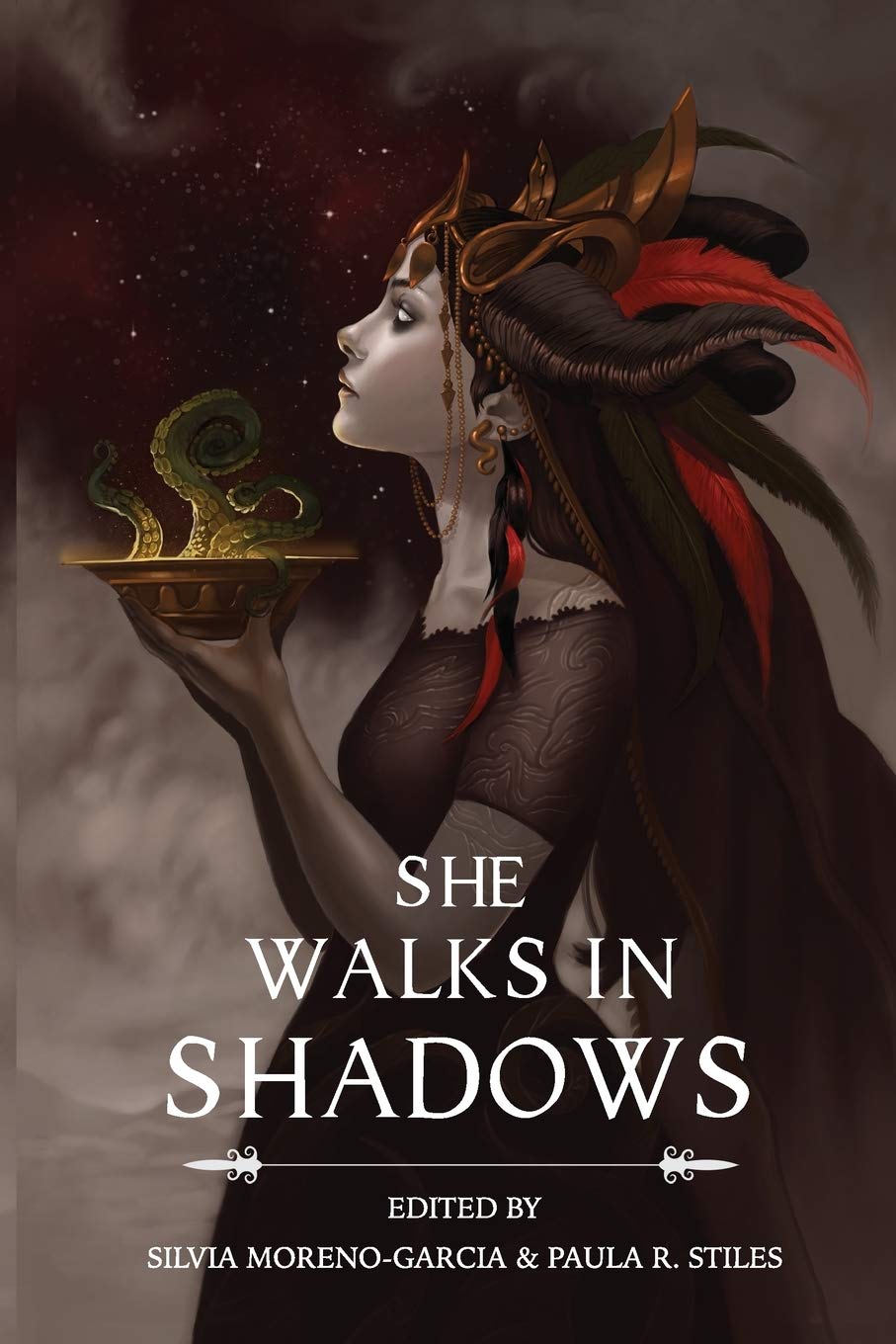
“Bring the Moon to Me” by Amelia Gorman was published in She Walks in Shadows (2015) and its paperback reprints; it was adapted as an audiobook on PseudoPod #538 in 2016.
Bobby Derie is the author of Weird Talers: Essays on Robert E. Howard and Others and Sex and the Cthulhu Mythos.
Deep Cuts in a Lovecraftian Vein uses Amazon Associate links. As an Amazon Associate I earn from qualifying purchases.
 Deep Cuts in a Lovecraftian Vein