While going through the letters from Muriel E. Eddy to August Derleth, one passage caught my eye:
Dear August Derleth,
The moment I saw this article I knew I had to send it to you! Her memories of H. P. L. do not coincide with ours—neighter of us remember that H. P. L. wore a black cloak (shades of Dracula!) or a wide-brimmed hat! Also, that he sat often in the railway station. (Only when he was about to meet one of his literary friends!)
—Muriel E. Eddy to August Derleth, 4 Jun 1967, MSS. Wisconsin Historical Society
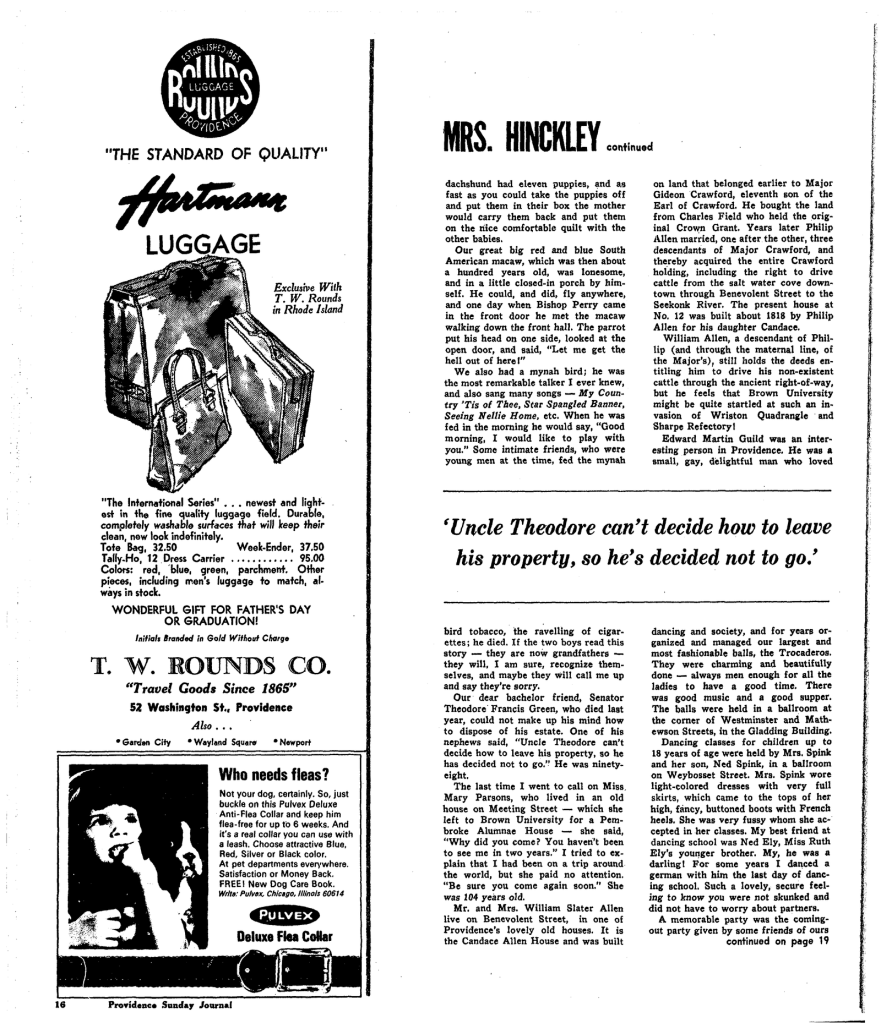
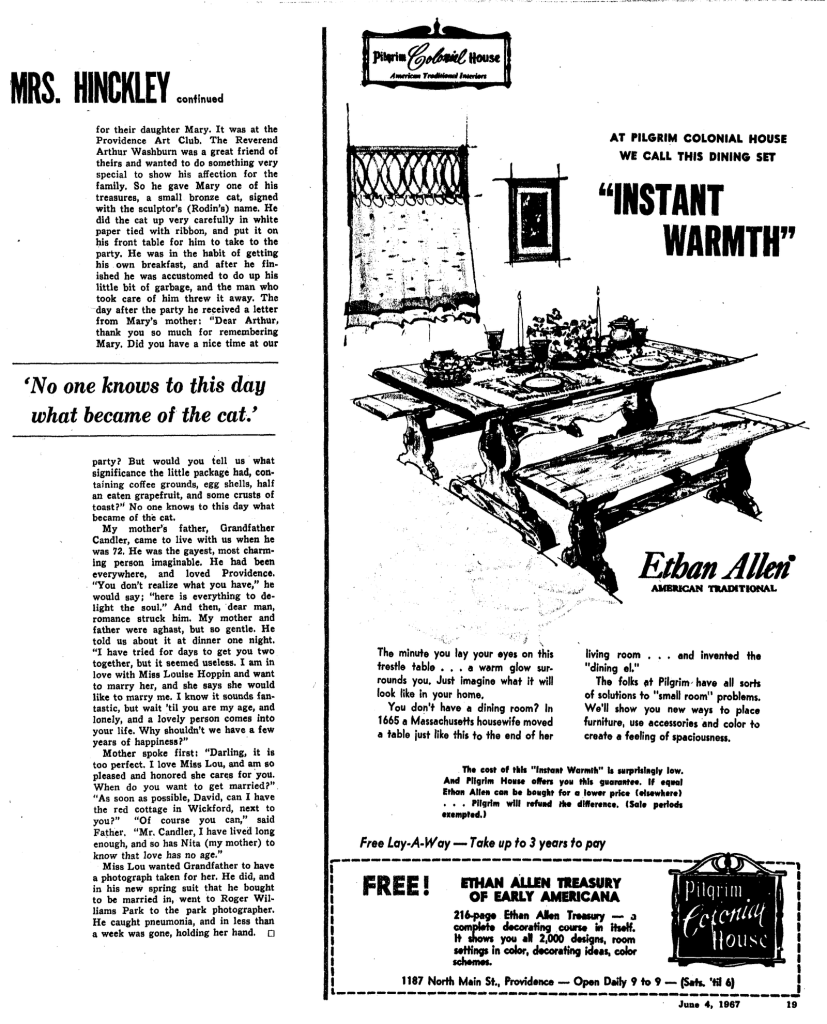
The brief description was unfamiliar; I knew of no such published account of Lovecraft. The enclosure did not survive in the file, however Muriel often sent Derleth clippings from local papers. An online search quickly located the article she discussed: “Mrs. Hinckley’s Providence,” which ran in the 4 Jun 1967 issue of the Providence Sunday Journal. Running for six pages (with ads and photographs), this article consists of a slightly rambling memoir of Rhode Island native Anita Wheelwright Hinckley (1884-1972), who wrote a number of memoirs of Rhode Island, including Wickford Memories (1972).
Lovecraft fans will note many familiar street names as Mrs. Hinckley reflects on the changes that the city went through over the course of her life, including Angell St. and Benefit St. She was most definitely familiar with the same geography of where Lovecraft lived and worked, and reference to the Providence Art Club suggests their families probably moved within the same general social circles.
But what did Mrs. Hinckley have to say about Lovecraft?
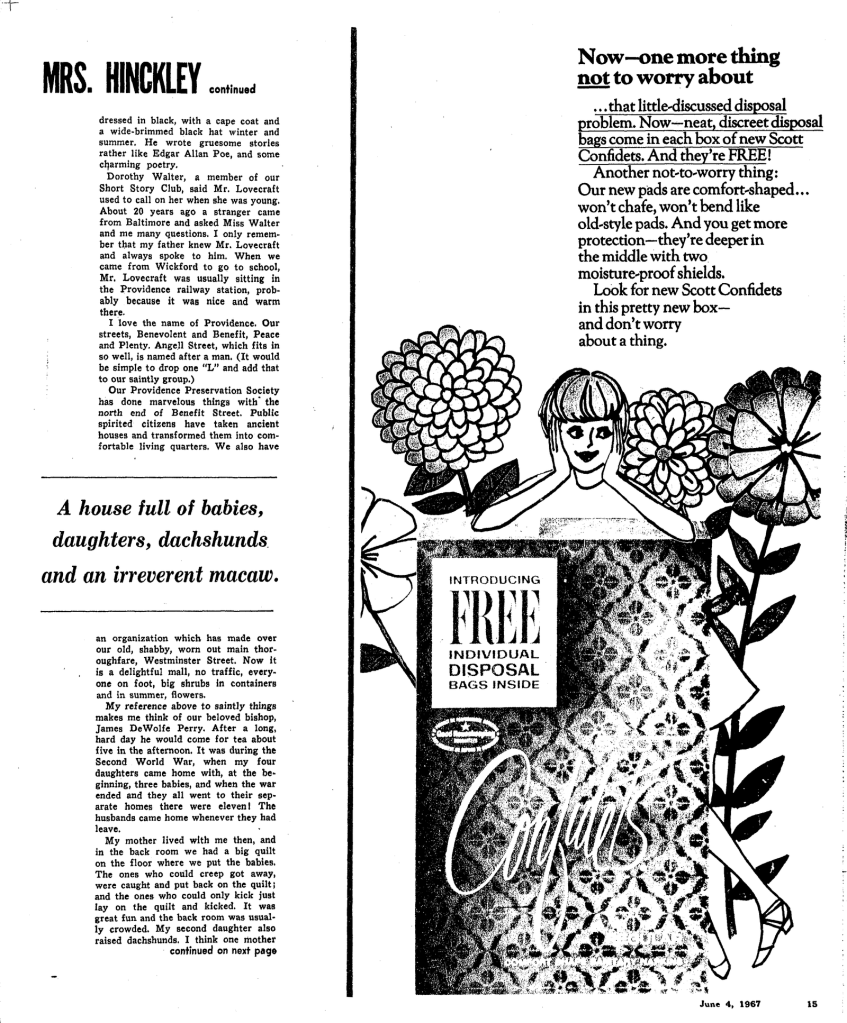
Before I forget it I want to write about Mr. Lovecraft. He was an unusual person, medium height, always dressed in black, with a cape coat and a wide-brimmed hat winter and summer. He wrote gruesome stories rather like Edgar Allan Poe, and some charming poetry.
Dorothy Walter, a member of our Short Story Club, said Mr. Lovecraft used to call on her when she was young. About 20 years ago a stranger came from Baltimore and asked Miss Walter and me many questions. I only remember that my father knew Mr. Lovecraft and always spoke to him. When we came from Wickford to go to school, Mr. Lovecraft was usually sitting in the Providence railway station, probably because it was nice and warm there.
It isn’t clear when Mrs. Hinckley saw H. P. Lovecraft. The 1910 Federal Census has her living in North Kingston, Rhode Island; but that same year she married Frank Hinckley of Providence, and their first child was born there in 1911. On the face of it, Mrs. Hinckley’s residence in Providence seems to have covered most of Lovecraft’s adult life. Yet the recollection “When we came from Wickford to go to school” recalls one of her other memoirs:
One day a week [George Cranston] would go to Providence to replenish his stock. He went on the early train, the one we children took to go to school spring and fall, and the one my father always took as long as we lived in Wickford. Winters, when the weather was bad, we had governesses and studied at home.
—Anita W. Hinckley, “Wickford Tales” (1965)
This suggests that a school-age Hinckley saw Lovecraft at the train station in Providence sometime in the 1890s or early 1900s (her father died in 1906, and she would have graduated high school in 1902). The problem is that Hinckley is older than Lovecraft; unless she saw him hanging out at the train station when he was 10-12, it seems unlikely.
When comparing Mrs. Hinckley’s account, written thirty years after Lovecraft was in his grave and probably at least 60 years after she saw him, we can confirm very little and might wonder at the accuracy of her memory. Lovecraft wasn’t known to go about in a cape coat and wide-brimmed hat, though a 1905 photograph does show Lovecraft in a dark coat and hat, so it isn’t improbable that he could have been wearing something similar.

Dorothy C. Walter (1889-1967) was the author of “Lovecraft and Benefit Street,” which appeared in The Ghost and Rhode Island on Lovecraft (1945), and “Three Hours with Lovecraft” in The Shuttered Room and Other Pieces (1959). Walter doesn’t mention Hinckley in those pieces, but there’s not necessarily any reason why she would. Nor is there any mention in Lovecraft’s letters of David Sherman Baker (1852-1906), whom Mrs. Hinckley claims knew Lovecraft—but, then again, since Mr. Baker died when HPL was only 16, before we have many letters, that might be understandable. The inquisitive stranger might have been science fiction fan and Lovecraft scholar George T. Wetzel (1921-1983) of Baltimore, although the description is scanty.
Ultimately, there is very little we can confirm from Mrs. Hinckley’s brief memoir. Yet there is no reason to think it is a deliberately false or exaggerated account, as with “The Ten-Cent Ivory Tower” (1946) by John Wilstach. While Mrs. Hinckley may not have had much insight to give on Lovecraft’s life, tidbits like this are an example of the little invisible connections and influences that folks have on each other all the time.


Bobby Derie is the author of Weird Talers: Essays on Robert E. Howard and Others and Sex and the Cthulhu Mythos.
Deep Cuts in a Lovecraftian Vein uses Amazon Associate links. As an Amazon Associate I earn from qualifying purchases.
 Deep Cuts in a Lovecraftian Vein