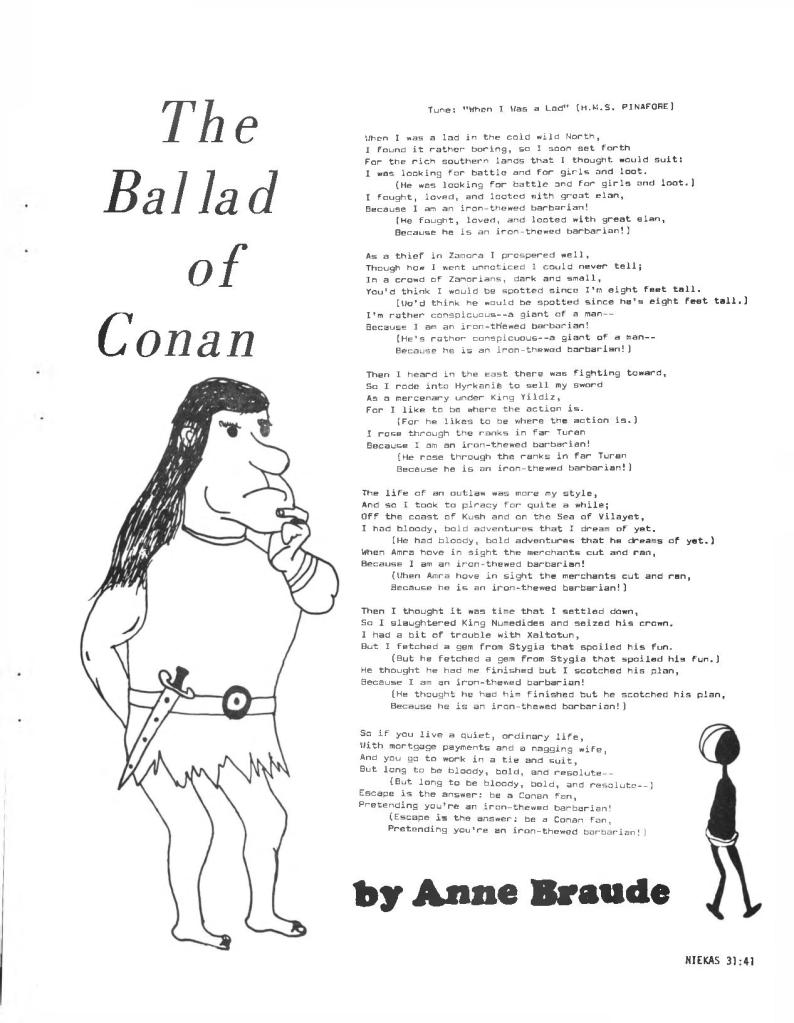
Tune: “When I Was A Lad” (H. M. S. Pinafore)
—Anne Braude, “The Ballad of Conan” in Niekas #31 (1983), 41
The first fandom of Robert E. Howard’s Conan of Cimmeria arose in the 1930s, when the adventures of the barbarian were published in the pages of Weird Tales. Some fans, including R. H. Barlow, Emil Petaja, Charles B. Hornig, Alvin Earl Perry, and P. Schuyller Miller wrote to Howard—and the Texas pulpster wrote back, answering questions, sometimes gifting manuscripts of his stories, subscribing to fan publications like The Fantasy Fan, and providing unpublished stories and poetry for fanzines like The Phantagraph to publish as well.
This early interaction with fandom endeared Howard to his fans, and helped provide the basis for the first fan-publications, like Miller & Clark’s “A Probable Outline of Conan’s Career” in The Hyborian Age (1938), a one-shot zine published after Howard’s death by eager fans and containing Howard’s worldbuilding-essay of the same name. However, early desires to publish a collection of Howard’s Conan stories came to naught in the 30s; while the Texan had fans, he lacked anyone with the entrepreneurial spirit to start their own publishing business like August Derleth and Donald Wandrei did when they established Arkham House in 1939 to print the work of H. P. Lovecraft, who died the year after Howard passed away.
Following Howard’s death in 1936, his works passed to his father, Dr. I. M. Howard, who survived his son; Dr. Howard largely entrusted his son’s literary legacy to his agents, the Otis Adelbert Kline Agency, and several previously unpublished works appeared in the pages of Weird Tales, which continued to pay Dr. Howard the monies they owed his son. Still, within a few years publications dwindled, and no new Conan material was forthcoming in the 1930s. One by one, the first caretakers of Howard’s legacy passed: Farnsworth Wright, editor of Weird Tales, died in 1940; Dr. Howard joined his wife and son in 1944; Otis Adelbert Kline passed away in 1946. Dr. Howard willed the rights to his son’s material to his friends the Kuykendalls, and Kline’s agency was taken up by his associated Oscar Friend. Slowly, new published opportunities emerged.
In 1946, Arkham House published the collection Skull-Face and Others, and in 1950 Gnome Press published Conan the Conqueror, the first in a series of Conan titles. These collections in hardcovers weren’t just found new fans—and a more organized fandom. The first fanzine devoted to Howard’s creation was Amra, which began publication in 1956, and fan Glenn Lord got the ball rolling on Howard scholarship with The Howard Collector, founded in 1961. In the late 1960s and 70s, paperback reprints of these books exploded in popularity, part of the rise in paperback fantasy that included the Hobbit and The Lord of the Rings by J. R. R. Tolkien, and the Ballantine Adult Fantasy series that began in 1969.
In 1970, Marvel Comics published the first Conan the Barbarian comic, adapting and expanding his adventures into a new medium. The series and its sister magazine title Savage Sword of Conan would run for decades, drawing comic fans to read the stories as much as they drew fans of Howard’s fiction to buy the comics. In 1982 when the film Conan the Barbarian starring Arnold Schwarzenegger in the title role appeared on screens, it was swiftly followed by a tie-in comic from Marvel’s Conan creative team.
All of this increased fan activity, such as the Hyborian Legion and the Robert E. Howard United Press Association (founded in 1972). Conan was no longer an obscure hero from the pages of Weird Tales; the Cimmerian had become a staple of science fiction and fantasy, an archetype of barbarians, fighters, and rogues, a multi-media figure well-known and established in fandom—and the serious critical study of Robert E. Howard’s life and fiction were picking up, echoing the scholarly interest that Lovecraft had attracted a decade earlier.
Which is where things stood when fan Anne Braude wrote the jocular (but largely accurate) “Ballad of Conan” for the Conan-heavy issue of the fanzine Niekas in 1983. Drawing on the canonical Conan tales then widely available in paperback, rather than the comics adventures or the recent film. Unlike “I Remember Conan” (1960) by Grace A. Warren, this is tongue very much in cheek, showing someone familiar with the material but decidedly irreverent. All in good fun.
Bobby Derie is the author of Weird Talers: Essays on Robert E. Howard and Others and Sex and the Cthulhu Mythos.
Deep Cuts in a Lovecraftian Vein uses Amazon Associate links. As an Amazon Associate I earn from qualifying purchases.
 Deep Cuts in a Lovecraftian Vein