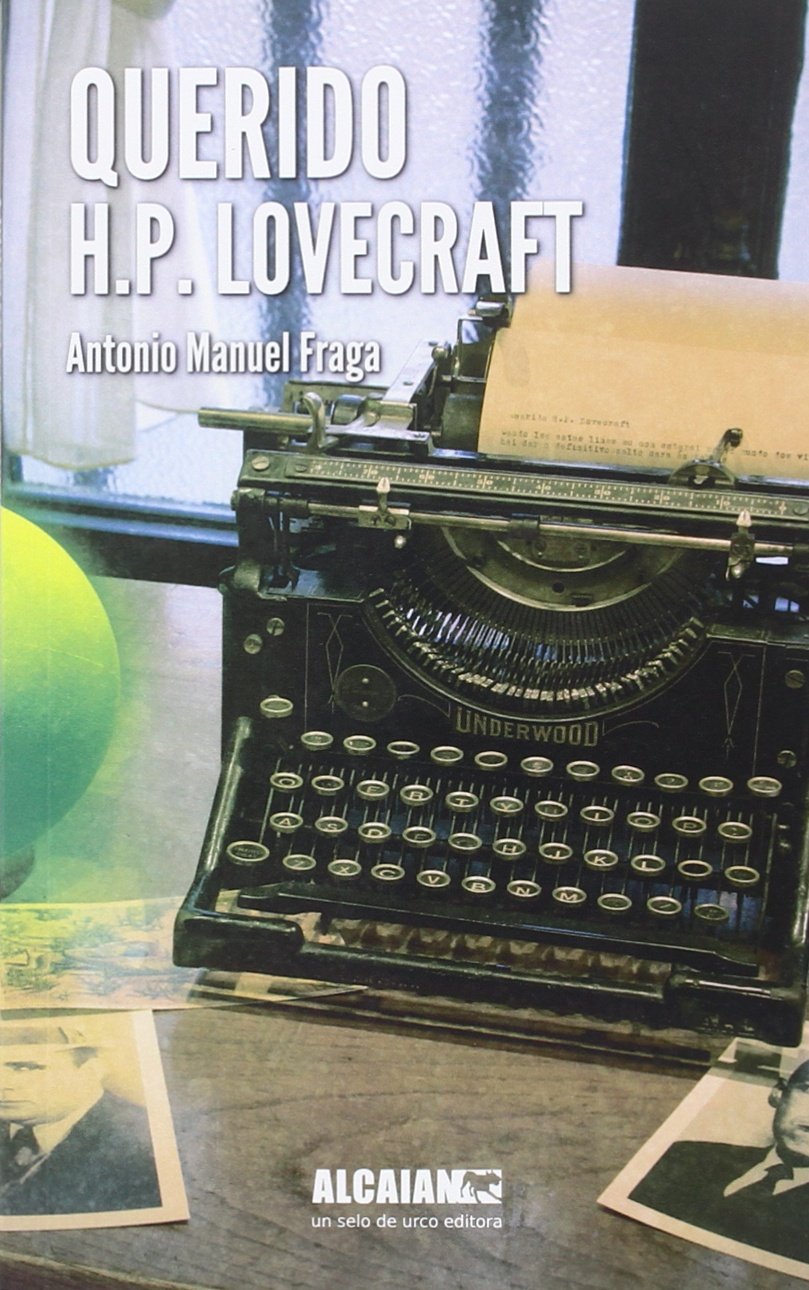
| Querido H. P. Lovecraft: Cuando lea estas lineas yo no estaré ya en el mundo de los vivos . . . Con estas palabras comienza la carta que Robert E. Howard envía a su amigo, mentor y famoso escritor. En un escrito delirante el auto tejano describe su progresivo descenso al infierno de la locura y la desesparación después de visitar una antiqua tumba india sita en el interior de una cueva. En la narración se mezclan los sueños con la realidad, la escritura, la relación con los amigos y su novia, la salud de la madre y su dependencia de ella . . Sin salida, totalmente acorralado por sus miedos, Howard debe buscar una solución, una huida, un sacrificio . . . | Dear H. P. Lovecraft, When you read these lines, I will no longer be in the world of the living . . . With these words begins the letter Robert E. Howard sent to his friend, mentor, and famous writer. In a delirious letter, the Texan author describes his gradual descent into the hell of madness and despair after visiting an ancient Indian tomb located inside a cavern. The story mixes dreams with reality, writing, his relationship with his friends and girlfriend, his mother’s health and his dependence on her… With no way out, completely cornered by his fears, Howard must find a solution, an escape, a sacrifice… |
| Querido H. P. Lovecraft (2017, Spanish), back cover copy | English translation |
Rusty Burke, a scholar of the life and work of Robert E. Howard, has noted that REH was one of H. P. Lovecraft’s major correspondents—but that HPL was Howard’s major correspondent. The bulk of the surviving letters we have from Robert E. Howard are to Lovecraft; and while many of Howard’s other letters—to Clark Ashton Smith, Farnsworth Wright, C. L. Moore, Novalyne Price, etc. are important, none of them really cover the same breadth and depth as Howard’s letters to Lovecraft. Nor, in many cases, have we much of the other side of the conversation. In the collected correspondence of both men, at least as much as survives, we gain a deeper understanding and appreciation for the push and tug of the conversation.
This literary friendship has extended far past the limits of the grave. Novalyne Price Ellis mentioned it in her memoir One Who Walked Alone (1986); “Gilgamesh in the Outback” (1986) by Robert Silverberg sees the two palling around the underworld together. The semiotic ghosts of both men have followed each other into novels and comic books, from Rick McCollum’s Ashley Dust (1996) to Lovecraft’s Book (1985) by Richard Lupoff, later restored as Marblehead (2006). Howard makes an appearance in most of the biographical graphic novels that have come out about Lovecraft, and every biography of Howard cannot avoid mentioning their “civilization vs. barbarism” argument in letters that winged their way from Providence, R.I. to Cross Plains, TX and back again.
It is this relationship that Antonio Manuel Fraga has attempted to capture in his novel Querido H. P. Lovecraft (2016, “Dear H. P. Lovecraft), which was written and published in Galician. The novel was then translated into Spanish (Castilian) by Mercedes Pacheco Vázquez and published, also as Querido H. P. Lovecraft, in 2017. It has not yet been translated or published in English, but in brief the novel takes the form of a classic epistolary novel, like Dracula, but consisting of several fictional letters between H. P. Lovecraft, Robert E. Howard, and Dr. Isaac M. Howard (REH’s father, with whom HPL corresponded after REH’s death in 1936). The bulk of the novel consists of Howard’s final letter to Lovecraft, detailing the supernatural curse that descended upon him and the real reason he took his life that day.
| De ROBERT ERVIN HOWARD para H. P. LOVECRAFT 10 de junio de 1936 Sr. H. P. Lovecraft 66, College Street. Providence, R.I. Querido H. P. Lovecraft: Cuando lea estas líneas no estaré ya en el mundo de los vivos, pues pronto daré el definitivo salto hacia las tinieblas. Sin otra salida, y después de lo vivido, espero que la muerte se abra a mi como una madre redentora, un pecho cálido que me ampare y silencie los horripilates alaridos que no dejan reposar mi mente, cansada y enferma. Puede que este testimonio, dictado por la urgencia y la necesidad de purga, me sirva también para comprender mejor toda esta atrocidad, o por lo menos para distinguirla de un modo más global. Hace dos semanas me acerqué a Brownwood, donde compré tres tumbas en su camposanto. Los miembros de mi exiqua familia tendrán así cada uno su trozo de tierra donde reposar, donde olvidar tanto dolor embalsamados en la archilla arenosa de Texas. Las raíces de nuestros padecimientos se entredan en el pasado, se mezclan y alimentan de las mismas sales, pero sus tallos crecen independientes hacia un sol que es fuego fatuo, sin bndad ni compasión. En el caso de mi madre, la desgraciada Hester, hablamos de una vida marcada por la enfermedad propia y ajena –si como enfermeded se puede calificar mi mal, que después expcliaré detalladamente. ¡Tiempo habrá!–. El padecimiento de mi padre, el viejo doctor Howard, tiene el sabor de la ceniza del desprecio de su compañera. Durante toda su vida fue un imán para las malas inversiones, en las que dilapidó los escasos ahorros de la familia. ¡Y bien que se lo reprochó Hester! Esa fue una de las causas del désden de su mujer, pero no el único ni el más importante. En esa guerra fue un titán. Por el contrario, sospecho fundadamente que no resistirá el trance de nuestra partida. Ojalá me equivoque. Y por último está mi padecimiento, el del necio Bob, el torpe ignorante. Afortunademente, pronto será silenciado por este colt que ahora siento en el muslo y que se convertirá en mi redentor, reverendo y verdugo. | From ROBERT ERVIN HOWARD to H. P. LOVECRAFT 10 June 1936 Mr. H. P. Lovecraft 66 College Street, Providence, R.I. Dear H. P. Lovecraft: When you read these lines, I will no longer be in the world of the living, for I will soon take the final leap into darkness. With no other way out, and after what I have experienced, I hope that death will greet me like a redeeming mother, a warm breast to shelter me and silence the horrifying screams that keep my tired and sick mind from resting. Perhaps this testimony, dictated by the urgency and necessity for a purge, will also help me better understand this whole atrocity, or at least to distinguish it in a more comprehensive way. Two weeks ago, I went to Brownwood, where I bought three graves in the cemetery. The members of my tiny family will each have their own piece of land to rest in, where they can forget so much pain, embalmed in the sandy Texas clay. The roots of our sufferings are buried in the past, they mix and feed on the same salts, but their stems grow independently toward a sun that is a will-o’-the-wisp, without kindness or compassion. In the case of my mother, the unfortunate Hester, we are talking about a life marked by her own and other people’s illnesses—if my illness can be described as illness, which I will explain in detail later. If there is time! The predicament of my father, old Dr. Howard, tastes like the ashes of his companion’s contempt. Throughout his life he was a magnet for bad investments, in which he squandered our family’s meager savings. And well did Hester reproach him for it! That was one of the causes of his wife’s disdain, but not the only one, nor the most important. In that war he was a titan. On the contrary, I strongly suspect that he will not be able to withstand our departure. I hope I am wrong. And finally there is my suffering, that of the foolish Bob, the ignorant bumbler. Fortunately, he will soon be silenced by this colt that I now feel in my thigh and that will become my redeemer, reverend and executioner. |
| Querido H. P. Lovecraft (2017, Spanish) 20-21 | English translation |
Perhaps surprisingly given how prominently the letters formed their relationship—Lovecraft and Howard never met, though they corresponded from 1930 until Howard’s death in 1936—the epistolary format has featured less prominently in their fictional afterlives. In fiction, at least, the two men would get the chance to meet as they never did in life. So too, that way the writer isn’t forced to write as many letters to and from Lovecraft and Howard from the other’s perspective, which would require more than a passing familiarity with both men’s life and letters to convincingly nail the voice and knowledge of each.
It is difficult to judge how well Antonio Manuel Fraga has captured their voices. That Fraga did some research into Robert E. Howard’s life is evident, he obviously read at least the flawed biography Dark Valley Destiny (1983), or Mark Finn’s Blood and Thunder (1st ed. 2006/2nd ed. 2013), which emphasizes the sometimes conflicted family dynamics among the Howards. Some of the choices (filtered, admittedly, through two layers of translation) strike me as unlikely; Robert E. Howard would probably not have referred to his mother by her given name, for example, and never had anything but praise for his father in his letters to Lovecraft. There are a few other details that are “off” in the short novel, but to try and catalogue them would be pedantic. This is a fantasy novel, and some allowances have to be given.
As a novel, Querido H. P. Lovecraft is an interesting example of a familiar idea: the author becoming the character. The Robert E. Howard of this book is not the same REH that comes through in his letters to Lovecraft, but he is recognizable as an interpretation of that person. What it reveals is less about Howard and Lovecraft than it does about Antonio Manuel Fraga—what Fraga has taken away from his research about Howard, the aspects of his life and relationships that he wished to emphasize in telling his story.
Is it a story worth telling? As an exercise in fantasy, it’s fine. There have been innumerable stories that mingled H. P. Lovecraft’s death with his Mythos, that have blurred the lines between reality and fantasy, for fun if nothing else. In that sense, Querido H. P. Lovecraft is something of a fanfic novel, a great and impossible what if, the kind of cache of letters that Lovecraft and Howard fan-scholars might dream of coming across, like the scholarly protagonists of a ghost story that find the document that explains it all at last.
What we cannot forget, however, is that this is not about how Robert E. Howard lived and died, but the stories and interpretations that have grown up around it.
The death Robert E. Howard is tinged with tragedy. This was a man whose life has sometimes been described as a trajectory toward his inevitable demise, with biographers and critics looking back across the whole of his existence for signs that would point to his self-destruction. Howard’s suicide is a part of his mythos, as explored in works like “El guardian” (2010) by Enrique Balmes & Roc Espinet and “Life After Death” (2010) by David Güell, so the focus on his crucial final days isn’t unusual. The addition of a supernatural element throws off the narrative of inevitability; it emphasizes Howard as more of a victim and cheapens a tragic affair by diluting his own agency. He goes out not as the cipher, the man who had reached his hidden limit and came to the final step, but as a haunted man who suffers under persecutions the novel details all too well.
It would be interesting, someday, to read this in a proper English translation. To see what niceties of language I’ve missed, what nuances may come out from having someone fluent translate Fraga’s prose. While I doubt the translation would capture Howard or Lovecraft’s voice in their letters, there are a lot of nods to people, stories, and events in Howard’s life that would get a nod from Howard and Lovecraft aficionados.
Bobby Derie is the author of Weird Talers: Essays on Robert E. Howard and Others and Sex and the Cthulhu Mythos.
Deep Cuts in a Lovecraftian Vein uses Amazon Associate links. As an Amazon Associate I earn from qualifying purchases.
 Deep Cuts in a Lovecraftian Vein