Lovecraft had a rare faculty for beginning with something commonplace and building up an overwhelming aura of horror that left his readers hanging onto the ropes. In that sense, I can’t think of anyone who could surpass him. He had a knack of delving into man’s subconscious, untranslated fears—putting them into an appreciable form, giving them appealing names and personifying one’s own, inmost, half-comprehended, even personal nightmares.
—Bruce Bryan in “The Eyrie,” Weird Tales (Jul 1937)
H. P. Lovecraft created Yig for “The Curse of Yig” (WT Nov 1929), ghostwritten for Zealia Bishop. Yig is also mentioned as “Niguratl-Yig” in “The Electric Executioner” (WT Aug 1930), ghostwritten for Adolphe de Castro; and “The Father of Serpents” in “The Whisperer in Darkness” (WT Aug 1931); “Yig the Serpent-God” in “Out of the Æons” (WT Apr 1935), ghostwritten for Hazel Heald, and “Mother of Serpents” (1936) by Robert Bloch. Five appearances over the course of eight years, all in the pages of Weird Tales, and to the casual reader all by different authors.
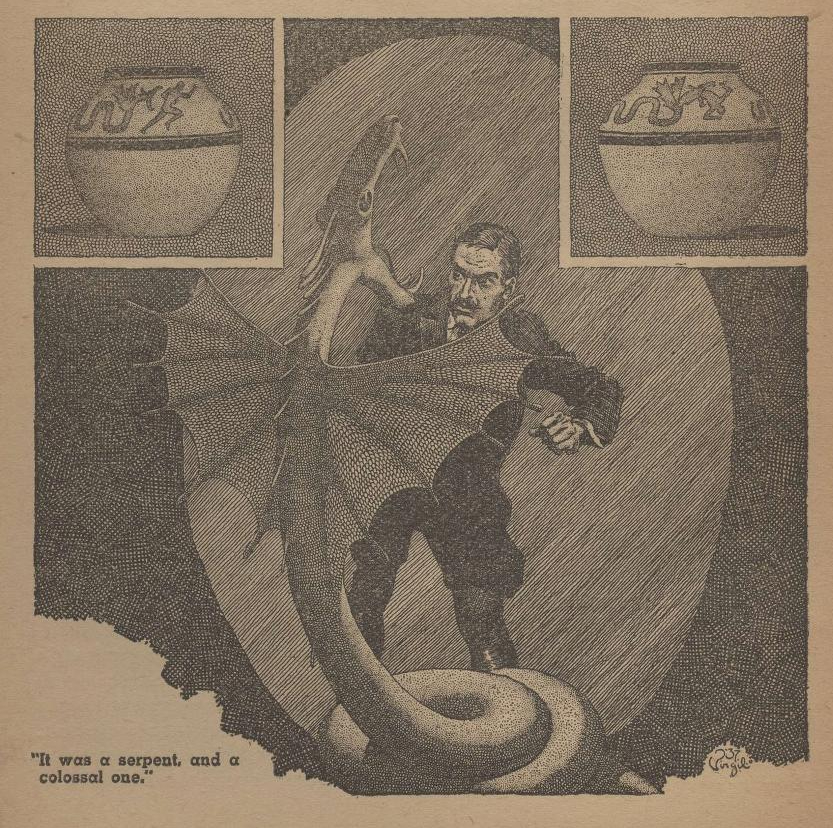
Perhaps that is why in 1937 professional archaeologist and pulp author Bruce Bryan borrowed Yig—here under the name “Yig-Satuti”—for his archaeological horror yarn, “The Ho-Ho-Kam Horror,” which ran in Weird Tales Sep 1937 issue.
“On the Mountain-That-Is-Heaven,” he hissed fiercely, “the white man is a trespasser. Yig-Satuti does not welcome visitors who come to dig up his secrets. It is bad medicine for those who seek to disturb the ancient dwelling-place of the god.”
—Bruce Bryan, “The Ho-Ho Kam Horror” in Weird Tales (Sep 1937)
G. W. Thomas has described “The Ho-Ho-Kam Horror” as “an unnoticed Cthulhu Mythos sequel” (Snake Gods & Were-Serpents), and he’s largely correct. Dedicated fans recognized the reference to Yig at least as early as the 1950s, when George Wetzel included it in one of the listings in his The Lovecraft Collector’s Library (1955); the story is also listed in Chris Jarocha-Ernst’s mammoth A Cthulhu Mythos Bibliography & Concordance (1999). However, the story has never been reprinted outside of its original appearance, not in a random Mythos anthology or anywhere else, contributing to its overall obscurity and lack of recognition.
Even for dedicated Mythos-hounds, the story is easy to miss. Bruce Bryan was never a member of Lovecraft’s circle of correspondents, and outside of the reference to Yig, the story has no other connections to the Mythos—nor many to its probable inspiration, “The Curse of Yig.” For one, the story is not set in Oklahoma, but in Superstition Mountain in Arizona; the Native American groups involved thus shift in relation to that portion of the Southwest, and the mythology shifts with it, becoming associated with the Hohokam culture. Bizarrely, even though Yig-Satuti is depicted with wings, Bryan makes no effort to connect it with Queztacoatl as Lovecraft had done.
The story takes on a more familiar shape than Lovecraft’s “The Curse of Yig,” echoing “Sunfire” (1923) by Francis Stevens, “The Monster-God of Mamurth” (1926) by Edmond Hamilton, and “The Thing on the Roof” (1932) by Robert E. Howard among others—all stories where in an ancient and deserted city or temple, the monstrous god of the forgotten people remains to be discovered by archaeologists or treasure-hunters. While there’s a certain Lovecraftian touch in the framing of the story, since the last of it is told through a diary the protagonist discovered and the final sentence is an appropriately italicized culminating revelation, it is otherwise a bit crude. The pot that prognosticates the archaeologist’s doom, for example, is never explained in any detail.
By far the most substantial difference between Bryan and Lovecraft, however, might be in their treatment of Native American characters and culture.
Few would consider Lovecraft an exemplar when it comes to the accurate or sympathetic portrayal of Native Americans in his fiction. While there are sparingly few references to Native Americans in his corpus, the one Native American character who is named and speaks is Grey Eagle in “The Curse of Yig” and “The Mound,” and he is basically a walking stereotype of the Old Native American Chief, complete with the kind of English patois that Barbra A. Meek in “And the Injun Goes ‘How!’: Representations of American Indian English in white public space” (2006) called “Hollywood Injun English.” Yet for all that, Lovecraft obviously did research for his stories set in Oklahoma, accurately names the Native American peoples that would have been there, and references some of their genuine beliefs, like Tiráwa. The worst negative stereotype Lovecraft indulges in is depicting the Native Americans with a penchant for alcohol.
Bruce Bryan did his research too—albeit, a few folks wrote in to Weird Tales to correct a few points:
I read with much enjoyment Bruce Bryan’s story The Ho-Ho-Kam Horror. I lived near Superstition Mountain for about eight years, and learned to speak the Pima dialect fairly well. Naturally, I took quite an interest in the Indians, their legends and the ruins of the Hohokam. Little is known of the Hohokam, but there were a few errors in the story which I think the author should have corrected. ‘The Hopi and Smoki Indians do not live near Superstition Mountain, nor do they get their snakes for the rain dance there. I doubt if they know of the existence of the place. The story is based on legend, apparently, and legend has it that the Hohokam did not live on Superstition Mountain; the ancestors of the Apache Indians lived in that vicinity, and the Hohokam, who are apparently the ancestors of the Pimas (although this is not certain), lived and farmed the Gila River valley when the valley was not such a desert as it is now. The Casa Grande ruins (a four-story adobe structure) were built by the Hohokam who continually warred with the Apaches of Superstition Mountain. The Pimas and Apaches don’t get along any too well today, as far as that goes. In regard to the Hohokam-built ruins, the age of these ruins is probably more than two thousand years. At that time (when the Hohokam lived there) they irrigated the land with water from the Gila. Some of the ditches are filled with lava. It must have been quite a while ago that the volcanoes in Arizona erupted. […] Little can be said of Superstition Mountain. In the present century no white man has climbed it alone and come back, although a few have tried. Planes can’t fly very low over it, due to strong and gusty updrafts. An exploring party recently made a trip over part of the mountain to try to discover the cause of loud and thunderous noises, like the reports of guns, but found nothing.
—Paul Smith in “The Eyrie,” Weird Tales (Nov 1937)
However, the issue has less to do with Bryan’s anthropology of the deceased Hohokam culture and geography than his depiction of the living Native Americans and their culture. Lovecraft kept the Native Americans almost always off the page, talked about rather than depicted directly interacting with the white viewpoint characters, and while Yig is depicted as part of their belief-system, but is not necessarily evil nor was his worship all-encompassing. Bryan has the Native American characters much more present, and the white viewpoint characters interact with them directly—which means there’s a lot more room for stereotyping, especially within the already hackneyed scenario of one lone white man with a group of Indigenous laborers.
The only one named is Jim Red-Cloud, who becomes the mouthpiece for the Native American viewpoint:
“Don’t be ridiculous, Jim!” I snapped angrily. “You’re not a superstitious child. You went to the white man’s schools. And you’ve been with me a long time. Tell me, just what or who is this Yig-Satuti?”
The Pima winced at my words, as if they expressed some damnable blasphemy. In the smoldering depths of his eyes modern teachings seemed to struggle with the antique lore of his savage forefathers.
“Some things the white man’s schools do not teach,” he whispered almost fearfully. “Some things they do not know. Yig-Satuti is the Indian’s god beyond all other gods. It is not well to speak his name, for he is jealous of his secrecy. Those who know, worship him in hidden places that the white man does not suspect. It is better so. Yig-Satuti is older than the earth itself, and all wisdom is his heritage. Here on his mountain we are trespassers. Much evil will come if we do not go.”
—Bruce Bryan, “The Ho-Ho Kam Horror” in Weird Tales (Sep 1937)
Before long, the “rational” white archaeologist who ignores the warnings to the curious offered by Jim Red-Cloud. The nameless, faceless indigenous laborers are demeaned as superstitious and primitive children, whom the white man tries to coax with money and then threatens with implied violence. It is little surprise when the white man ends up alone and eaten by the ancient horror his excavation has unearthed.
A very old-fashioned story, one where none of the characters come out looking good.
In terms of Native American representation, the Yig Cycle stories—whether written by Lovecraft or anyone else—often suffer from difficulties in their portrayal and presentation of indigenous peoples and their culture. Part of this is due to ignorance, part of this is due to stereotypes, and part of this is just the lens of the storytelling. The default perspective is of voyeuristic outsiders to an indigenous culture poking around where they are not invited and don’t belong. It is a Colonialist narrative, told from the standpoint of the colonizer, and even when bad things happen to said colonizer, it does so by representing the indigenous culture as exotic, secretive, and dangerous. Reiterating and reinforcing stereotypes.
Not all Yig Cycle fiction is like that; “The Head of T’la-yub” (2015) by Nelly Geraldine García-Rosas for example provides a very different viewpoint, and the approach is much more respectful with regards to depicting Native American characters as possessing agency, and of how and why they integrate indigenous beliefs with the Cthulhu Mythos. If there’s a lesson to be learned from “The Ho-Ho-Kam Horror” by Bruce Bryan, it might be to listen more, keep an open mind, and try to see things from someone else’s perspective.
If nothing else, it would make a more interesting story if it had been written from Jim Red-Cloud’s point of view.
Bobby Derie is the author of Weird Talers: Essays on Robert E. Howard and Others and Sex and the Cthulhu Mythos.
Deep Cuts in a Lovecraftian Vein uses Amazon Associate links. As an Amazon Associate I earn from qualifying purchases.
 Deep Cuts in a Lovecraftian Vein