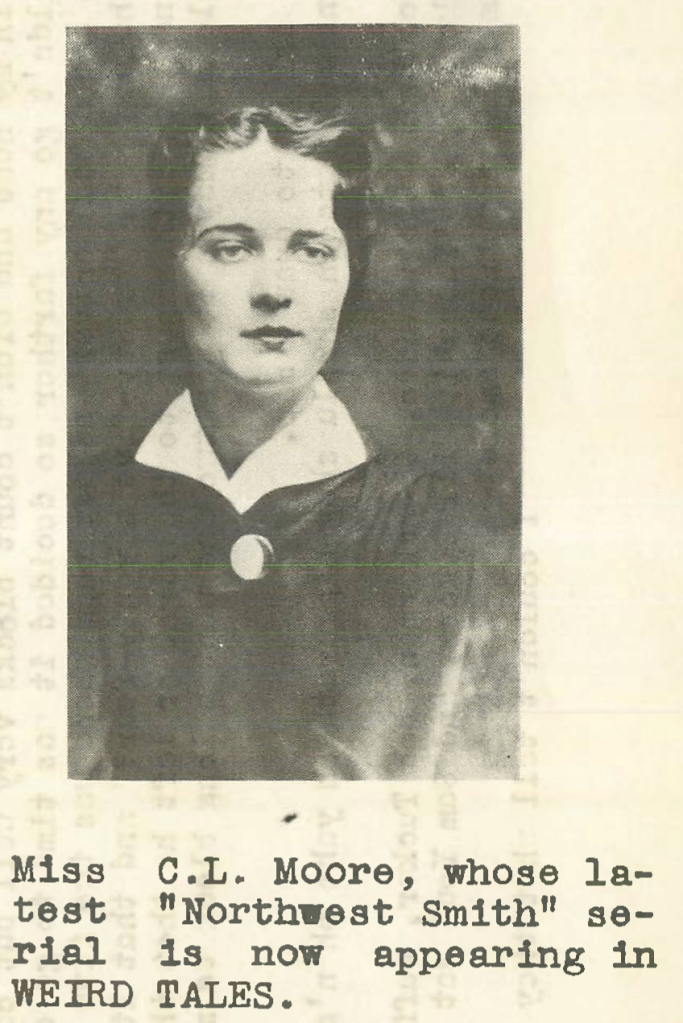
Deeper Cut: C. L. Moore Early Career Retrospective

The writing life of Catherine Lucille Moore (24 Jan 1911 – 4 Apr 1987) can be roughly divided into five periods, dominated by major life events:

  • C. L. Moore Before The Pulps (1911-1930): Her juvenilia and early amateur work that ran from her childhood through her second year at Indiana University, when she had to withdraw and begin working to support her family.
  • Early Career (1933-1940): C. L. Moore’s first professional publication, from her first appearance in Weird Tales through her marriage with Henry Kuttner in 1940.
  • Professional Writer (1940-1958): C. L. Moore and Kuttner as a prolific writing team, for pulps, novels, fanzines, and television, all through World War II and afterward into Kuttner’s teaching career, only ending with his death in 1958.
  • Late Career (1958-1963): C. L. Moore’s late career was dominated by scriptwriting for television. It ended with her marriage to Thomas Reggie in 1963.
  • Twilight years (1963-1987): With C. L. Moore’s second marriage and her early onset of Alzheimer’s disease, output practically ceased. The period saw the consolidation and republication of her work, as well as interviews and biographical materials. It ended with her death.

Of all the periods of Moore’s work, her early career gets the most attention. It is dominated by her output at Weird Tales, and to a lesser extent at Astounding, and follows her transition from weird fiction to the characteristic fantasy and science fiction that marked Unknown in the 1940s. This retrospective takes a look at what C. L. Moore was writing and publishing, and why and how the events of that period shaped the writer she was—and would become.

1933

[…] it was a rainy afternoon in the middle of the Depression, I had nothing to do—but I really should’ve looked busy because jobs were hard to get! I didn’t want to appear that I wasn’t earning my daily keep! To take up time, I was practicing things on the typewriter to improve my speed—things like ‘the quick brown fox jumped over the lazy dog.” That got boring, so I began to write bits of poetry I remembered from my college courses…in particular, I was quoting a poem called “The Haystack in the Flood.” […] The poem was about a woman in 13th century France who is being pursued by enemies of some kind…she was running across a field and these men were after her. I had misquoted a line in my mind, as well as on the typewriter, and referred to a “Red, running figure.” […] At the time I thought, “Ha! A red, running figure! Why is she running? Who is she running from and where is she running to? What’s going to happen to her? Strangely enough, I just swung from that line of poetry into the opening of “Shambleau.”
⁠—Interview: C. L. Moore Talks To Chacal in Chacal #1 (1976), 26

The Great Depression had ended C. L. Moore’s attempt at college, and with it her opportunities to publish her stories. She worked as a secretary at the Fletcher Trust Company in Indianapolis, where her fiancé also worked as a teller. Her spare dimes and quarters went to issues of Amazing Stories, Wonder Stories, Astounding, and Weird Tales, and at last she mustered up the courage to submit a story unlike anything else on the stands. The effect on the fans was electric, the effect of the check for the story no less so on C. L. Moore—it was her first professional sale and publication. By the time “Shambleau” hit stands, there are indications she was already writing sequels:

I trust your revisions may make Mrs. Moore’s second story as striking and interesting as this one.
—H. P. Lovecraft to Farnsworth Wright, 21 Nov 1933, Letters to Woodburn Harris 86

Moore would, from her reading, be aware of the possibilities of a series character like Northwest Smith. Farnsworth Wright, editor of Weird Tales, was willing to work with new writers. So it is not surprising that following stories followed Smith’s adventures, with little continuity but often featuring the same vivid imagery and ideas that marked “Shambleau.”

1934

I hope you will not be too much disappointed in the stories that follow. Perhaps, when you have read those appearing in the April and May issues, you will write again to tell me what you thought of them.
—C. L. Moore to R. H. Barlow, 8 Mar 1934, MSS. Brown Digital Repository

Both Farnsworth Wright and the fans of Weird Tales were pleased with Moore’s work, and 1934 became a busy year, with three further adventures of Northwest Smith appearing in quick succession ( “Black Thirst,” “Scarlet Dream,” and “Dust of the Gods”). Through Weird Tales, Moore also came in touch with pulp fans like R. H. Barlow and Forrest J. Ackerman. Her “secret” identity was swiftly revealed in the May 1934 issue of The Fantasy Fan, though many pulp readers would not learn this for years.

Yes, I do much more revising that I care about. Have to, tho it simply sickens me, and I hate everybody in sight while laboring away at the disgusting job. A story of mine which I’ve just sold to ASTOUNDING and which will appear in Oct. is really a third of one original N.W.Smith tale. I had that almost finished when I saw that it was two stories, and split it apart. Then the half I got to work on began to show amoeba-like tendencies toward division, and the third attempt resulted in THE BRIGHT ILLUSION, which I’ve sold, to Astounding. The other two nuclei are still simmering gently in the back of my mind, and may emerge some day.
—C. L. Moore to R. H. Barlow, 5 Jul 1934, MSS Brown Digital Repository

While it may have looked like Moore was selling everything she could write to Weird Tales, the truth was more complicated. Some stories didn’t work out, and Farnsworth Wright apparently rejected some stories and sent others back for revision. This was the unglamorous work of pulp writing, and Moore was learning the ropes of the trade, including rewriting stories to send to other magazines, which is how she splashed Astounding.

Near the end of the year, feeling that the Northwest Smith stories were growing stale, Moore tried another character on Farnsworth Wright: Jirel of Joiry. The character arose from some of Moore’s pre-pulp world-building, given a new life in Weird Tales:

Long, long ago I had thoughts of a belligerent dame who must have been her progenitor, and went so far as to begin a story which went something like this: “The noise of battle beating up around the walls of Arazon castle rang sweetly in the ears of Arazon’s warrior lady.” And I think it went no farther. So far as I know she stands ther eyet listening to the tumult of an eternal battle. Back to her Jirel of Joiry no doubt traces her ancestry.
—C. L. Moore, “An Autobiographical Sketch of C. L. Moore,” Echoes of Valor 2, 37-38

As with Northwest Smith, the fan response was extremely positive. More swiftly followed up “Black God’s Kiss” with a direct sequel, “Black God’s Shadow,” that was published before the end of the year.

1935

Now a fairly well-established author at Weird Tales, Moore began correspondence with other authors, including E. Hoffmann Price, Robert E. Howard, and H. P. Lovecraft. From the surviving correspondence, we can see that all of these individuals had their influence on Moore’s writing practice: Lovecraft’s considered criticism, Price’s practical pulp-writing advice, and Howard’s encouragement and sharing of his own swordswoman stories all entered into consideration.

From a publication viewpoint, 1935 was probably a letdown, Moore only sold and saw published four professional tales: two Northwest Smith yarns (“Julhi,” “The Cold Gray God”), including one with an illustration by Moore, and a Jirel story (“Jirel Meets Magic”) to Weird Tales, and another “thought-variant” story for Astounding (“Greater Glories”). Reading between the lines, the implication is that Wright was getting more selective about what he bought from Moore. For her own part, Moore’s interest in fandom and the pulp community was increasing, as marked by a collaboration with arch-fan Forrest J Ackerman (“Nymph of Darkness”) and taking part in a round-robin tale with A. Merritt, H. P. Lovecraft, Robert E. Howard, and Frank Belknap Long (“The Challenge from Beyond”) for Fantasy Magazine.

These were Moore’s first collaborations with other writers since childhood, and were, perhaps, important lessons in what worked and what didn’t. In “The Challenge from Beyond,” it was clear how each writer was working the parts on their own, often with drastic shifts in style and tone, not making a cohesive whole. With “Nymph of Darkness,” Moore was working from Ackerman’s ideasbut even if they shared the brainstorming, she was clearly doing all the actual work of writing.

1936

Glad you liked “The Dark Land”. I made the drawing a long time ago, and wrote the story so I could bring it in, with the addition of a cadaverous head and a swirl of vagueness.
C. L. Moore to H. P. Lovecraft, 30 Jan 1936, Letters to C. L. Moore 108

The year started out wellthe new issue of Weird Tales was on the stands with a Jirel story (“The Dark Land”), with a drawing by C. L. Moore to boot. The next month would see another Ackerman collaboration on a Northwest Smith tale (“Yvala”), and two more would be published by the end of the year (“Lost Paradise”, “Tree of Life”). Tragedy, however, would quickly mar the year.

On 13 February 1936, Moore’s fiancé (Herbert) Ernest Lewis died from a self-inflicted gunshot wound to the head; the newspapers presented it as an accident while cleaning his rifle, which was stored in the bank vault, Lewis being part of a shooting club that used a nearby range. Moore was desolate and took some weeks off work to mourn, traveling by bus with her mother to Florida. Lovecraft kept up a steady stream of letters to keep her mind occupied during the period of mourning. Only a few months later, on 11 June 1936, her friend Robert E. Howard took his own life with a self-inflicted gunshot wound to the head. Moore spread the news to Lovecraft, who spread it to others.

At this time, Moore was in contact with the literary agent Otis Adelbert Kline (former agent for Howard and Price), and was trying to expand her writing markets, but neither was quite to her tastes and apparently came to nothing.

My recent writings seem to have bogged down completely. In the last five months I have produced one trashy horror which Kline ages ago asked me to rewrite, thinking he could sell it in a revised form and which I haven’t touched since, and a drippy love-story which languished away and ceased half-finished some six weeks ago. The weather is partly responsible, but I must admit a sort of mental vacuum which shows no promise of change. I devote seven and a half hours daily to my secretarial duties and spend the rest of the time sewing desultorily, knitting a very handsome afg[h]an, attending about three movies weekly, induling in endless gossip with friends. How long this cloistered and nun-like seclusion will continue I wish I knew. I suspect that if my brain were functioning I would find myself bored to a horrible death, and rather dread the awakening. A few non-commercial attempts which I mentioned I should be very happy to have you read if I could ever get them finished to my satisfaction. I am writing and rewriting them over and over, in moments of comparative consciousness, and am far from satisfied even yet. However, to quote Mr. Penner once again, There’ll come a day.
—C. L. Moore to H. P. Lovecraft, 24 Jun 1936, Letters to C. L. Moore 143

She did manage a sale to Astounding (“Tryst in Time”), which may have begun as a rejected Northwest Smith yarn, Wright apparently still being more critical about which stories he would accept.

1937

Glad to hear that you & C L M are collaborating on a dual masterpiece. The result certainly ought to be powerful enough! Staging a meeting betwixt the mediaeval Jirel & the future Northwest Smith will call for some of your most adroit time-juggling—but with two keen imaginations at work no obstacle is likely to be unsurmountable. Good luck to both of you aesthetically & financially!
—H. P. Lovecraft to Henry Kuttner, 8 Feb 1937, Letters to C. L. Moore 262

In May 1936, Lovecraft had introduced Moore and Kuttner through mail. Their correspondence developed, and eventually led to collaboration. At this point, one of our best sources on C. L. Moore (her letters with Lovecraft) dries up, due to Lovecraft’s death on 15 March 1937. So too, Moore’s publications in the pulps dry up. She was, very probably, busy with work, caring for her family, and managing a burgeoning romance with Kuttner.

It was in 1937 that Moore made her first trip to Los Angeles, California, where she and a friend met Kuttner in person—and another Kuttner collaborator, Robert Bloch (Fanscient #8).
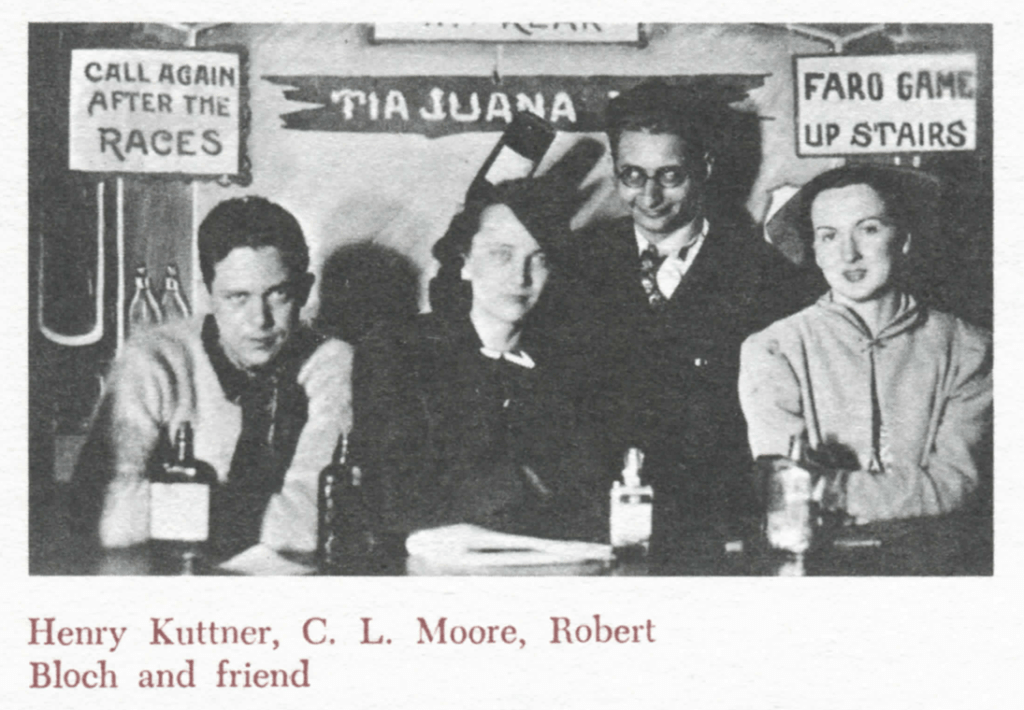
CA: You met Mr. Kuttner, then, through your writing?

MOORE: Yes. We corresponded for a while, and then I came out with a friend for my first visit to California and we met. He moved to New York shortly after that. Then He made several trips to Indianapolis, where I was living, and eventually he persuaded me that it would be a good idea to get married. He was perfectly right. We had a fine marriage.
Interview with C. L. Moore in Contemporary Authors vol. 104, 326

1938

No, I haven’t yet beaten my typewriter into knitting needlesI have beaten it much more lucratively in the process of hammering out a tale for Astounding in my usual vein, to be known as GREATER THAN GODS and to be publishedsometime. They just accepted it the other day. And a new story about a maidenwell, a femalenamed Jirel of Joiry has just gone off to Wright in the hope that he realizes as well as I do how badly he needs it.

[…] I look forward to LEAVES, not for Werewoman’s sake but for the pleasure I expect to derive from reading it.
C. L. Moore to R. H. Barlow, 13 Jul 1938

Moore appears to have done little writing in 1938; or at least, nothing that was published. “Werewoman” was an early, rejected Northwest Smith story. It was published, finally, in her friend R. H. Barlow’s amateur journal Leaves. E. Hoffmann Price’s memoir Book of the Dead also recalls Moore traveled to California in 1938 (262).

We can presume that she hadn’t given up writing, but was probably still busy with her job, Henry Kuttner, and possibly her mother’s growing illness.

1939

Farnsworth Wright was not yet out as editor at Weird Tales, but the magazine had been sold and relocated to New York. Moore’s last contributions to the Unique Magazine appeared in 1939: her final Jirel of Joiry tale (“Hellsgarde”), and an expurgated version of a Northwest Smith tale previously published in a fanzine (“Nymph of Darkness”).

If Moore’s relationship with Weird Tales was coming to an end, however, she was pursuing new opportunities with other magazines (“Miracle in Three Dimensions,” “Greater Than Gods”). These stories mark a definite shift in style, possibly due to unspoken collaboration with Henry Kuttneror at least, from his influence. She was moving into the lighter style of science fiction that would become a hallmark of their work in the 1940s.

Maude Moore, mother of Catherine, died of colon cancer on 8 Oct 1939.

1940

Moore’s job at the Fletcher Trust Company was implicitly dependent on her remaining single; in the sexist environment at the time, married women were expected to be supported by their husbands. In 1940, Moore took a tremendous plungeshe left her job, left Indianapolis, and moved to New York City, where on 7 June 1940 she married Henry Kuttner. It was the start of a new chapter in her life and her professional career, one where the “C. L. Moore” byline largely disappeared, as she and her husband wrote almost everything together, but published largely under his name or shared pseudonyms.

The final Northwest Smith tale (“Song in a Minor Key”) appeared in the fanzines Scienti-Snaps; Farnsworth Wright was no longer editor of Weird Tales, and would soon be dead, and the new editor Dorothy McIlwraith had no relationship with Moore and was moving the magazine in a different direction from interplanetary stories or sword & sorcery. Instead, Moore and Kuttner turned their attention to a new fantasy magazine, Unknown, which pointed the way to the future (“All Is Illusion,” “Fruit of Knowledge”).


The hallmarks of Moore’s early career were stories that straddled genres. Northwest Smith’s tales have an interplanetary setting, but he often faces alien gods, sorcerers, and psychic vampires of various stripes. The Jirel of Joiry stories are nominally sword & sorcery, but there is little swordplay and many of the strange worlds she encounters are better seen as other dimensions. Her early protagonists regularly face experiences that pass beyond the normal sensory experience, dealing with beings and sensations that strain their minds and senses to their hiltyet the characters themselves have an almost hardboiled aspect to them, adventurers and outlaws.

Over the course of those seven years, Moore received feedback from editors, agents, fans, and fellow writers. Some of them, like Lovecraft and Barlow, encouraged Moore’s artistic creativity; others like E. Hoffmann Price emphasized the practical necessities of pulp fiction. Moore absorbed all of this influence, and when the initial spate of her stories falters in 1936 after the tragedies of her fiancé and Robert E. Howard’s death, one gets the sense that Moore had realized her own limitations. Even her non-series stories in Astounding were, ultimately, developed from initial ideas intended for Northwest Smith.

The lack of published work in 1937 and 1938 should not be taken as evidence that Moore wasn’t writing. More likely, she had ceased selling. When she does emerge back into professional publication in 1939 and 1940, her work shows a definite maturity in plotting and characterizationher last tales of Jirel of Joiry and Northwest Smith are some of her best of the series.

The end of Moore’s early career dovetails into her next period. The collaboration with Kuttner that began with “Quest of the Starstone” did not lead immediately to a slew of new stories, but Kuttner’s influence on her style and thinking are obvious in the 1940 stories, and while not often quite as recognized, some of Moore’s style is evident in a few of Kuttner’s stories from the same period. Their marriage may have formalized their writing partnership, but it seems clear that Moore and Kuttner were working together, unofficially at least, during 1937-1940and perhaps some of the stories normally attributed to Kuttner alone are possibly collaborations as well.

The seven years of Moore’s early career mark her journeyman period. She had emerged from writing just for herself and stepped into the professional arena, where she learned both discipline and disappointment; she had to suffer rejection and revision; made friends and lost them; worried over her creativity and received tremendous encouragement from people she admired and respected. Hard financial necessities and the social mores that bound single women in society shaped some of her decisions, but the voice she found was her owneven if, as desires and circumstances dictated, her own byline was largely lost as she focused on collaboration with Kuttner.

C. L. Moore was not just another pulpsmith, churning out endless variations on the same storythough she definitely ran her own themes through several variations as she learned the business of pulp fiction writing. Her early attempts at series characters, Northwest Smith and Jirel of Joiry, were incredibly well received by fans, but the series were not really written as a series of connected episodes, and that may be why Moore ultimately abandoned her early creations to focus on new characters and different stories. Others might have given up; Moore embraced the changes she needed to make. First, for the sake of her family and financial well-being, and then for love and the chance at a new life.

It was Moore’s early career that laid the groundwork for acclaimed stories like “The Twonky” (1942), “Mimsy Were the Borogroves” (1943), “No Woman Born” (1944), “Vintage Season” (1946), “Daemon” (1946), “Two-Handed Engine” (1955), and novels like Judgment Night (1952).


Bobby Derie is the author of Weird Talers: Essays on Robert E. Howard and Others and Sex and the Cthulhu Mythos.

Deep Cuts in a Lovecraftian Vein uses Amazon Associate links. As an Amazon Associate I earn from qualifying purchases.
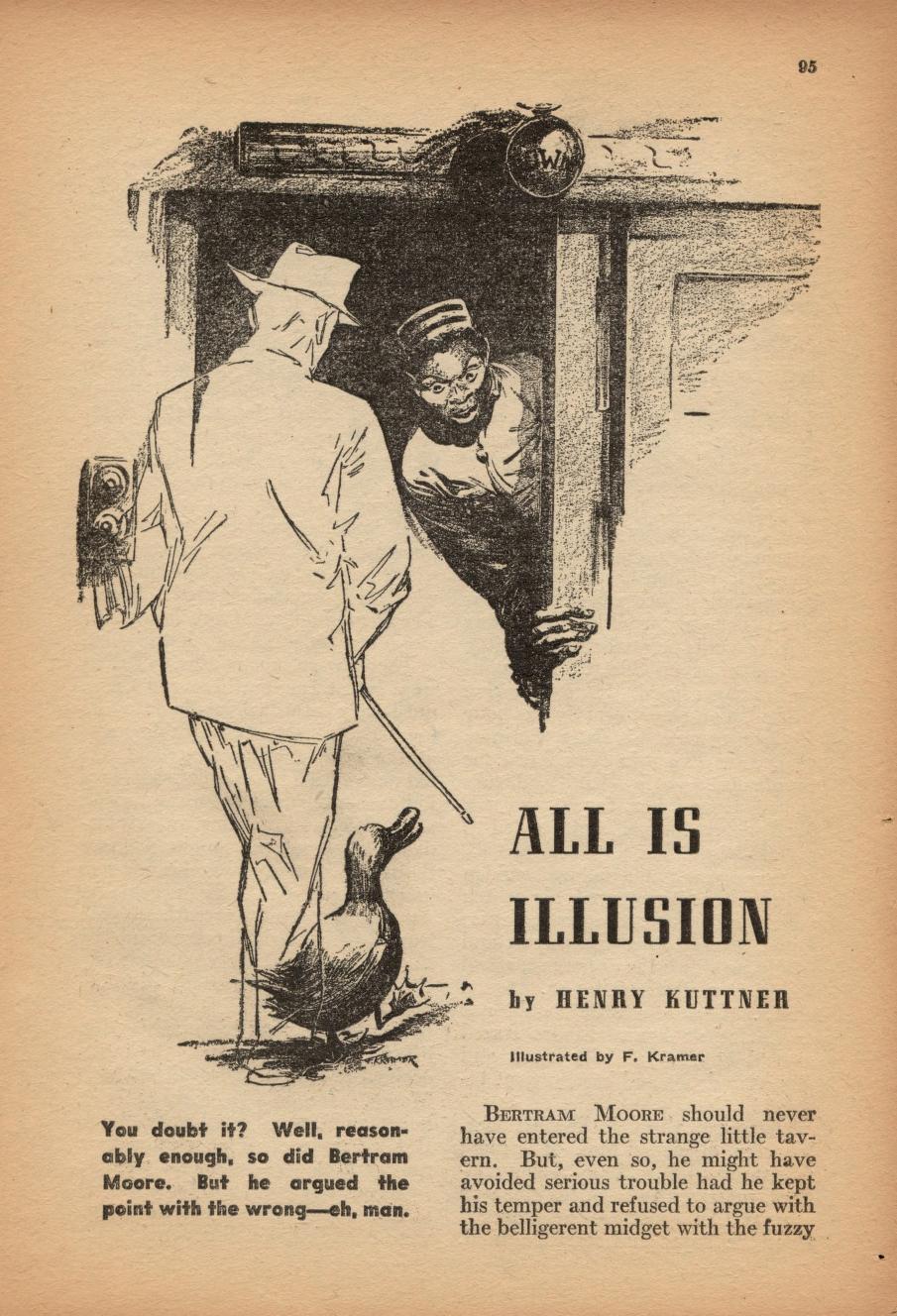
“All Is Illusion” (1940) by C. L. Moore & Henry Kuttner

Four years after H. P. Lovecraft introduced them by mail, on 7 June 1940, Henry Kuttner, Jr. married Catherine Lucille Moore in New York City. Kuttner was 25, Moore was 29. The witnesses were Mrs. Beverly Claire Finlay (wife of the Weird Tales artist Virgil Finlay) and Mrs. Annie Kuttner (the groom’s mother). It would mark both a new personal and professional chapter in the life of both writers.

Moore no longer had her job. Kuttner had no other source of employment; his draft registration card, filed in 1940, lists him as self-employed, and his agent Julius Schwartz as his next of kin. They both needed to buckle down to write, and having already completed their first collaboration in “Quest of the Starstone” (1937), they may well have continued. Certainly, after their marriage, they formed one of the most formidable writing teams in pulp magazine history:

Chacal: Did you ever have any reservations about collaborating with Kuttner? 

Moore: Nope. “The Quest of the Star Stone,” our first, worked out well enough to show us we could do it and after that we never gave it much thought. We just went ahead and wrote, either separately or together, depending on how that particular piece of work progressed. Remember, we weren’t turning out stories for posterity, but for this month’s rent. I so often hear of collaborators who tear down each other’s work—even successful, long-established collaborators. We didn’t have time for that kind of nonsense. We just traded typewriters; when one got stuck the other took over with a minimum of rewriting. Often none at all. Usually none at all. With us, at least, it worked out fine. It was also very nice to have somebody who could take over when the other guy got stuck. We sincerely loved each other’s writing and enjoyed tremendously what came out of the other guy’s typewriter. It was a fine relationship.
“Interview: C. L. Moore Talks To Chacal” in Chacal #1 (1976), 30

One friend of the married couple actually got a chance to witness this in practice:

Hank came feeling his was downstairs, and, as he located the coffee, the typewriter upstairs began to make noises. One half hour, maybe three-quarters, we’d had our morning coffee, and Hank said something about going upstairs and getting dressed. He disappeared.

They didn’t pass each other on the stairs, but Catherine turned up very shortly afterward, reconstructed the coffee, which Hank and I had finished, and I had my second wake-up with her—with the typewriter going on at the same rate upstairs. Once more, say three-quarters of an hour passed, and Catherine said something about getting into day clothes, and disappeared. Hanke came down, dressed, and said something cheerful about breakfast—with the typewriter going on as usual. This went on. They worked at it in shifts, in relays, continuously, until about two o’clock that Saturday afternoon, when the one downstairs did not go upstairs when the one upstairs came down. This time the typing stopped.

[…] I learned later, from John [Campbell], that they always worked that way, and worked so well at it that the only way he could tell who had written what was if the word ‘gray’ came in the story. One of them habitually spelled it ‘grey.’
—George O. Smith, The Worlds of George O. Smith (1982) 31

“Grey” is the preferred British spelling, and Moore had a tendency to use it in her private letters (although in publication, editors had their own way, e.g. “The Cold Gray God” (1935) by C. L. Moore). Moore commented on their differences in writing:

CA: People have trouble, don’t they, identifying which stories are yours and which are collaborations?

MOORE: Well, mine were probably a good deal more verbose, and I tended to have compound sentences. Henry wrote very tersely. That’s about the only difference, except that I was greatly prone to adjectives and so forth, and he got his effect over without quite so much embellishment. There was a distinct difference, but in most cases I think not enough for the general reader to be aware of.
Interview with C. L. Moore in Contemporary Authors vol. 104, 327

Kuttner’s view on Moore’s style is paraphrased by Guy Amory:

Kuttner likes the way C. L. Moore writes (and who doesn’t). He wishes he could write like her—but claims that when he tries imitating it comes out so much trash. If you’ve read any of his stories you realize that Hank is a master of the bingety-boom type of fiction—but with feeling! He puts more Incident in ten pages of Elak than any other author in WEIRD, and makes you feel it. He paints his picture with masterfully abrupt dabs, while Moore lays on her horror with the touch of a mosaic master, building up. Kuttner knocks you down and keeps you bouncing. Moore swirls you in cobwebs and totes you away into infinity. Combining their efforts in ’37 for QUEST OF THE STARSTONE they turned out something to remember … with Hank’s flair for lightning pace and Moore’s for description they went to town.
Guy Amory, “Is It True What They Say About Kuttner?”
in Future Fantasia (1939) vol. 1, no. 2

Because of the way they worked, it isn’t possible to discern, after 7 July 1940, which stories were written by husband or wife; they both collaborated so intimately that most stories are attributed to them both, even if they appeared under the byline Henry Kuttner. The exception is stories that appeared under C. L. Moore’s own byline, these are believed to be largely or entirely her own work. While everyone has their theories, attributing stories like the Hogben Chronicles to Kuttner or “The Twonky” to Moore, there isn’t any real way to tell. With this marriage of personalities and talents, Moore had ended the first stage of her professional career and entered a new one.

“All Is Illusion” was first published in Unknown Apr 1940, as by Henry Kuttner. It has sometimes also been credited to Moore-and-Kuttner, and not unreasonably so: there’s no reason to suspect that Moore and Kuttner weren’t collaborating before their marriage, and the strong shift in Moore’s later science fiction in stories like “Miracle in Three Dimensions” (1939) and “Greater Than Gods” (1939) show at least Kuttner’s influence on her style, if not some active cooperation. So what can we say about who wrote “All Is Illusion” for Unknown?

Moore looked around for the waiter, but could not locate him in the swirling gray smoke.
—”All Is Illusion” in Unknown Apr 1940

The comment on “gray” vs. “grey” might be seen as a clue, but unfortunately, that only works if we have the original manuscript to work with. Editors tend to impose their own spellings on stories that appear in their magazines, and most American editors during the period preferred “gray.”

The story itself is, if not a shaggy dog story, then something very closely akin to it. To work, it requires a certain suspension of disbelief and a familiarity with at least the broad outlines of Classical mythology, such as Ovid’s Metamorphoses, because it is framed as an anecdote and presented as an intrusion of fantasy into a contemporary setting. There is no world-building as such, and very little explanation; the story even borrows on some of the most well-worn tropes available for such a tale:

Moore turned.

The tavern was gone. Only the empty lot remained.
—”All Is Illusion” in Unknown Apr 1940

This intrusion of familiar fantasy in a contemporary setting with the addition of a strong comedic tone, rather than being played for horror or moralism, is a Hallmark of the 1940s fantasy published in Unknown. Darker shades of similar ideas would be played with by Ray Bradbury and Robert Bloch, and more serious attempts would be the playground of L. Sprague de Camp and Fletcher Pratt, but here in this story we get the surreal, the fantastic, the hallucinatory all in a setting of very firmly established reality.

There is little about this story that screams “C. L. Moore wrote me.” The early fantasy section, with the disappearing tavern inhabited by the mythological figures, I can easily believe might have been a C. L. Moore section; so too, the reference to Midsummer Eve echoes “Miracle in Three Dimensions” (1939) and the transformations in Shakespeare’s play A Midsummer Night’s Dream. The details about New York read more like the kind of thing Henry Kuttner would pick up on. Humor and ridiculous happenings were not a strong aspect of C. L. Moore’s early work, but both are strongly present here. The prose itself does not read hugely different from either of their individual works from the period.

There is no strong reason to either suspect or deny C. L. Moore’s involvement in this story. It was credited to Henry Kuttner on publication, and is only co-credited to Moore afterward because of the revelation of the nature of their collaboration, but the seamless nature of that collaboration means trying to pick and choose between whether a story is a Moore tale or a Kuttner tale is ultimately a false choice. The two writers came together during the late 1930s, and the fusion of their work in 1940 gave way to something new and largely indistinguishable from its parts.

The fat old man arose and went toward the back. He passed close to Moore’s table, and, glancing aside, said in a kindly voice, “All is Maya—illusion.” He hiccuped, drew himself up in a dignified manner, and hastily continued his journey into the smoke.
—”All Is Illusion” in Unknown Apr 1940

Scans of “All Is Illusion” are available online at the Internet Archive.


Bobby Derie is the author of Weird Talers: Essays on Robert E. Howard and Others and Sex and the Cthulhu Mythos.

Deep Cuts in a Lovecraftian Vein uses Amazon Associate links. As an Amazon Associate I earn from qualifying purchases.
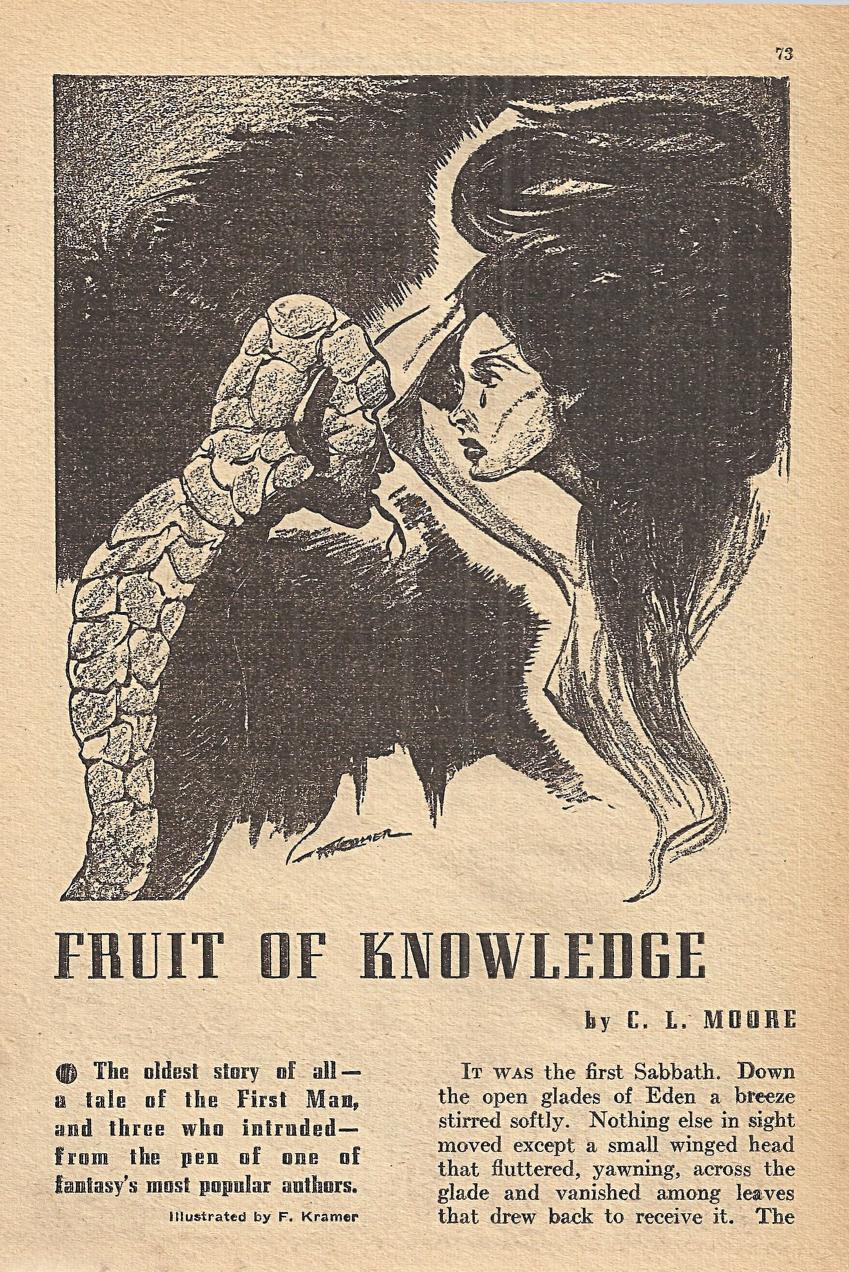
“Fruit of Knowledge” (1940) by C. L. Moore

By the way, I suppose they warned you about the Tree?
—C. L. Moore, “Fruit of Knowledge” in Unknown Oct 1940

After her marriage to Henry Kuttner on 7 June 1940 in New York City, C. L. Moore’s byline appears only sporadically in magazines and novels. Most of their work, written together, would appear under his name, or that of a shared pseudonym such as Lewis Padgett. It is impossible, at this point, to say who wrote what—with one notable exception: the stories still published under Moore’s name are agreed to have been primarily, if not entirely, her own work with little involvement from her husband and writing partner.

The first story published under C. L. Moore’s own name after her marriage is “Fruit of Knowledge” in Unknown Oct 1940, and it is a major departure from Moore’s previous and much of her future work as far as content. The scene is a retelling of a part of the book of Genesis from the Old Testament, about the creation of Eve and Tree of Knowledge of Good and Evil. As such, the general gist of the plot is familiar to most readers; they have heard this story before and know how it ends. This is a story where all the attraction is in the telling of the tale.

In telling this tale, Moore reaches outside the Christian Bible and borrows the character of Lilith from the Jewish Talmud and folklore. Lilith was something of a favorite of the Weird Tales crowd, with Moore’s friend and fellow Lovecraft correspondent E. Hoffmann Price having written stories like “Queen of the Lilin” (Weird Tales Nov 1934) and “Well of the Angels” (Unknown May 1940), and others composing poems to her. A quintessence of evil and femininity, which are both alluring on their own, but together are especially powerful.

The story that unfolds is primarily from Lilith’s point of view, and holds many of the hallmarks of Moore’s style: the beauty of both men and women are emphasized, the characters driven by strong emotions, the prose sensuous, and there is that subtle ironic humor which had increasingly become prominent in Moore’s writing, the element that draws her more in line with Kuttner and the 1940s style of fantastic fiction which Unknown would become known for.

The re-use of a familiar story, retold in a very contemporary way, is somewhat similar to “Miracle in Three Dimensions” (1939), but here Moore needs no special device to lay the scene. She simply dives right in, and the characters speak in familiar accents, not attempting Biblical diction of the King James Version, so that characters say “you” and not “thou” or “thee” (with a few exceptions when Moore is taking the words more or less directly from the Bible.) If it is slightly blasphemous—God is not depicted as either omniscient or omnipotent—it is still an effective little drama, where the characters have their clear motivations and struggles, their plans and plots, their complications and upsets. Even knowing how it’s going to end, the story is told well enough that readers might want to see how, exactly, things play out.

“The woman thou gavest me—he began reproachfully, and then hesitated, meeting Eve’s eyes. The old godlike goodness was lost to him now, but he had not fallen low enough yet to let Eve know what he was thinking. He could not say, “The woman Thou gavest me has ruined us both—but I had a woman of my own before her and she never did me any harm.” No, he could not hurt this flesh of his flesh so deeply, but he was human now and he could not let her go unrebuked. He went on sulkily, “—she gave me the apple, and I ate.”
—C. L. Moore, “Fruit of Knowledge” in Unknown Oct 1940

Moore doesn’t seek to soften the essentially patriarchal nature of the Biblical story, though neither is this a proto-feminist take. Lilith is essentially deceitful, jealous, possessive, and finally vindictive; then again, when the bloom is off the rose, Adam blames Eve like a little boy pointing to his sister and saying she did it. Eve herself gets far less character development than Lilith, being largely passive, reactive, manipulated, and a possession to be granted where Lilith is proactive and makes more of her own choices. As a biblical commentary it might not have much to add, but as an entry in the seemingly interminable corpus of “fictional reimaginings of Biblical tales,” it’s not bad.

There is no indication of when Moore wrote this story or why; a story could take months to be published in a pulp magazine, and she might have written it before or after her marriage. Maybe it was that life event that spurred her interest in the old tale, or a chance to reframe the old story through her own eyes. We don’t know. Yet for a while, it was the last that the pulp magazines would see of C. L. Moore byline—on her own.

Scans of “Fruit of Knowledge” are available online at the Internet Archive.


Bobby Derie is the author of Weird Talers: Essays on Robert E. Howard and Others and Sex and the Cthulhu Mythos.

Deep Cuts in a Lovecraftian Vein uses Amazon Associate links. As an Amazon Associate I earn from qualifying purchases.
“Song in a Minor Key” (1940) by C. L. Moore

Well, here was Earth beneath him. No longer a green star high in alien skies, but warm soil, new clover so near his face he could see all the little stems and trefoil leaves, moist earth granular at their roots.
—C. L. Moore, “Song in a Minor Key”

“The Green Hills of Earth” is as close to an anthem as C. L. Moore gave to Northwest Smith. His adventures take place almost exclusively on alien worlds. He is an outlaw, an adventurer, a hard man and not necessarily a noble one, but not without his honor or his principles. Raymond Chandler wrote in “The Simple Art of Murder” (1944) that the protagonists of hardboiled tales must be “the best man in his world and; a good enough man for any world.” He didn’t write that about Northwest Smith, but he might have.

What is “Song in a Minor Key?” It is the last of Moore’s works about Northwest Smith. It might have been a fragment of a story never completed, it might have been a coda. In a series that is never marked by any particular notions of continuity or character development, it offers both. Not a reflection on Smith’s adventures, but of the mysterious past never really spoken of elsewhere, and of a future: Smith is back on Earth. He’s there amid his green hills at last. Why, and for how long, we don’t know.

In a way, “Song in a Minor Key” is reminiscent of H. P. Lovecraft’s “The Silver Key.” Both are stories that deal with a reflection on childhood, happier times, but where Randolph Carter’s dream is to retrieve that key and relive the past, Northwest Smith’s approach to such nostalgic wishing is harsh. He knows who he is and what he has done; he knows, too, that he could not have done anything different. Faced with the same circumstances, even with all the knowledge of twenty years on the run, he would kill again—and end up right where we saw him, in dingy Martian spaceports or hunkering in a Venusian alley, exploring dead cities and strange worlds.

Maybe this was a goodbye to the character that had launched C. L. Moore into her pulp career, even though it feels like the opening of a new adventure. Which, perhaps, is fitting. Series characters in the pulps rarely had arcs; they rarely had a definite retirement or death. When Robert E. Howard wrote the adventures of characters like Solomon Kane, Kull of Atlantis, Bran Mak Morn, and Conan the Cimmerian, he never wrote their deaths—he might jump back and forth to different points in their lives, show Conan as a brash young thief in one tale and a conquering monarch in the next—and there was the certain sense that in the fullness of time these men were mortal and they would die. We even see the cult of Bran Mak Morn rise up, with the knowledge that he died on some ancient battlefield. But we never see it, we never get the send-off, the heroes do not ride off into the sunset and tell us that this is the end.

For the readers of Weird Tales who thrilled to the adventures of Northwest Smith for six years, the tales just…stopped. There were no more. The magazine itself changed its focus. “Song in a Minor Key” was published in the fanzines Scienti-Snaps (Feb 1940). She was still Catherine Lucille Moore when this was published; she would marry Harry Kuttner on 7 June 1940, in New York City. Moving on into the next phase of her life, and her writing career. Much of what she wrote from this point on would be with Kuttner, her husband and writing partner, and would appear under his name or a shared pseudonym. Relatively few works were signed C. L. Moore after 1940.

This was one of the last pieces we can say was truly her own voice, unalloyed.

Scans of the original publication of “Song in a Minor Key” are not currently available, but the text is available at Project Gutenberg.


Bobby Derie is the author of Weird Talers: Essays on Robert E. Howard and Others and Sex and the Cthulhu Mythos.

Deep Cuts in a Lovecraftian Vein uses Amazon Associate links. As an Amazon Associate I earn from qualifying purchases.
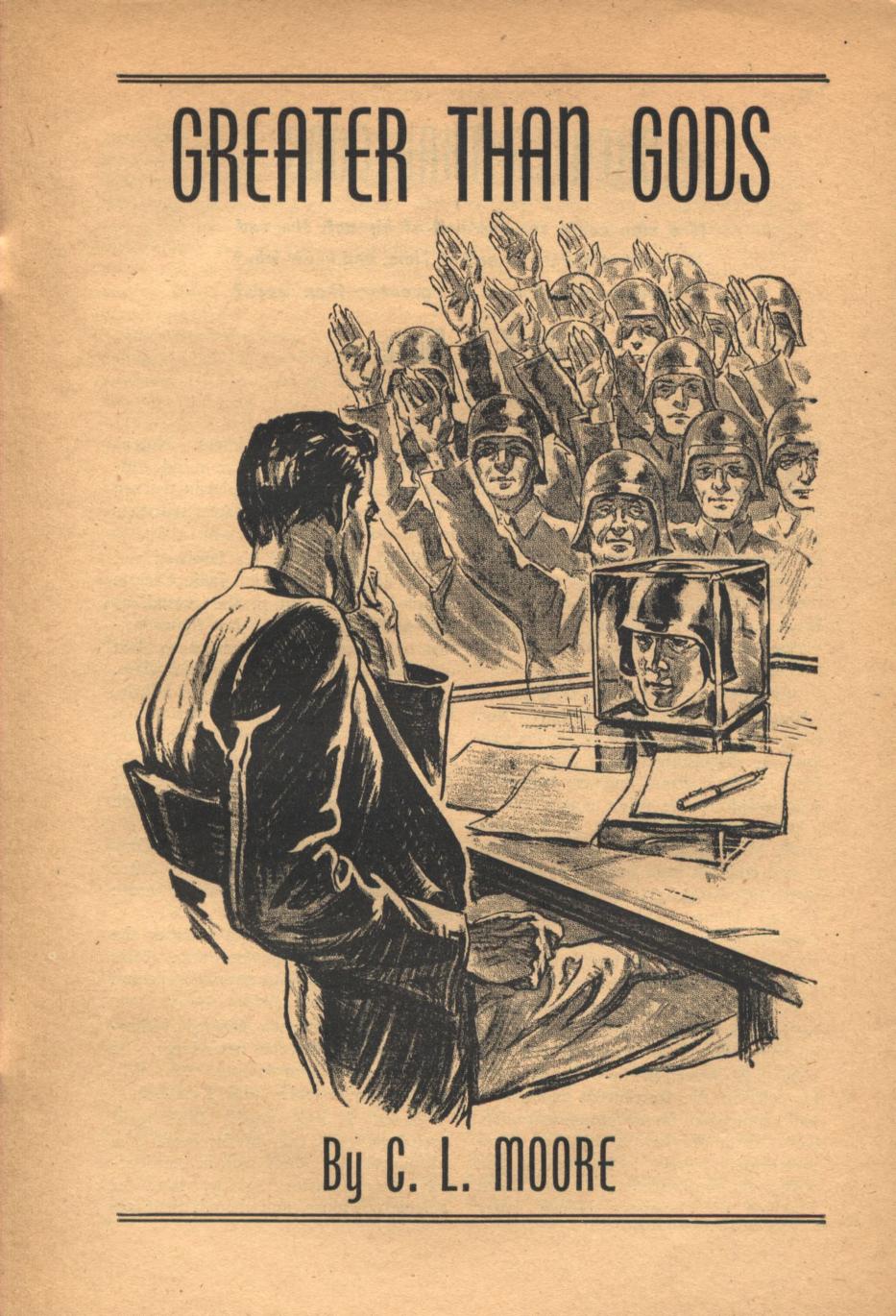
“Greater Than Gods” (1939) by C. L. Moore

If a man could see the end of his act, the end that comes at the far end of Time, and know what it meant—would men be greater than gods?
—Editor’s opening to C. L. Moore’s “Greater Than Gods” in Astounding Jul 1939

C. L. Moore had cut her teeth on interplanetary fiction. Yet the syntax of science fiction was changing, and her approach was shifting with it. Instead of the grungy spaceports of Northwest Smith or the alien cosmic soul-mates of “The Bright Illusion” (1934), “Greater Than Gods” opens up with a Science City divided into separate houses (including Telepathy House), and a very ancient, prosaic situation: a man torn between two women.

The story seems to be a further extrapolation of “Tryst in Time” (1936), working through another iteration of time travel theory:

I think of the future as an infinite reservoir of an infinite number of futures, each of them fixed, yet malleable as clay. Do you see what I mean? At every point along our way we confront crossroads at which we make choices among the many possible things we may do the next moment. Each crossroad leads to a different future, all of them possible, all of them fixed, waiting for our choice to give them reality.
—C. L. Moore, “Greater Than Gods” in Astounding Jul 1939

However, it’s also a kind of a gadget story. The protagonist, William Cory, head of Biology House, was on the trail of figuring out sex determination:

The pups were the living proof of Bill’s success in prenatal sex determination—six litters of squirming maleness with no female among them. They represented the fruit of long, painstaking experiments in the X-ray bombardment of chromosomes to separate and identify the genes carrying the factors of sex
determination, of countless failures and immeasurable patience. If the pups grew into normal dogs—well, it would be one long, sure stride nearer the day when, through Bill’s own handiwork, the world would be perfectly balanced bebetween male and female in exact proportion to the changing need.
—C. L. Moore, “Greater Than Gods” in Astounding Jul 1939

The problem that comes as Cory looks down the trousers of time, as Terry Pratchett put it, is that slowly more and more women were being born. The story becomes a thought-experiment on gender politics. Quite literally:

Women in public offices were proving very efficient; certainly they governed more peacefully than men. The first woman president won her office on a platform that promised no war so long as a woman dwelt in the White House.

Of course, some things suffered under the matriarchy. Women as a sex are not scientists, not inventors, not mechanics or engineers or architects. There were men enough to keep these essentially masculine arts alive—that is, as much of them as the new world needed.
—C. L. Moore, “Greater Than Gods” in Astounding Jul 1939

There are parallels here with David H. Keller’s “The Feminine Metamorphosis” (1929); a blatant, naked sexism that was not uncommon to the time. However, and here is the second twist, Bill Cory gets a glimpse down the other trouser-leg of time, into a world where his own experiments led to a eugenic future:

The first “X-ray” babies began to be born. Without exception they were fine, strong, healthy infants, and without exception of the predetermined sex. The Council was delighted; the parents were delighted; everyone was delighted except Bill.
—C. L. Moore, “Greater Than Gods” in Astounding Jul 1939

Both futures have their flaws, which is the point. It’s a moral conflict, the results deliberately exaggerated. The solution, when Cory arrives at it, is almost ludicrous—a polite fiction on the standards and morals of the age, when proposals were made and accepted more seriously—but it works, it’s true to its own internal logic.

The weird irony to the tale, the search for a third option when presented with an impossible choice, is very much in the vein of 1940s science fiction. How much influence, if any, Henry Kuttner had on this tale is impossible to tell; it has only ever been published under Moore’s name. Yet if she wrote it all on her own, then Moore had fully absorbed the influence of how science fiction was trending. It is a story that speaks to what her future work would look like.

“Greater Than Gods” was published in the July 1939 issue of Astounding. Scans of this issue are available on the Internet Archive.


Bobby Derie is the author of Weird Talers: Essays on Robert E. Howard and Others and Sex and the Cthulhu Mythos.

Deep Cuts in a Lovecraftian Vein uses Amazon Associate links. As an Amazon Associate I earn from qualifying purchases.
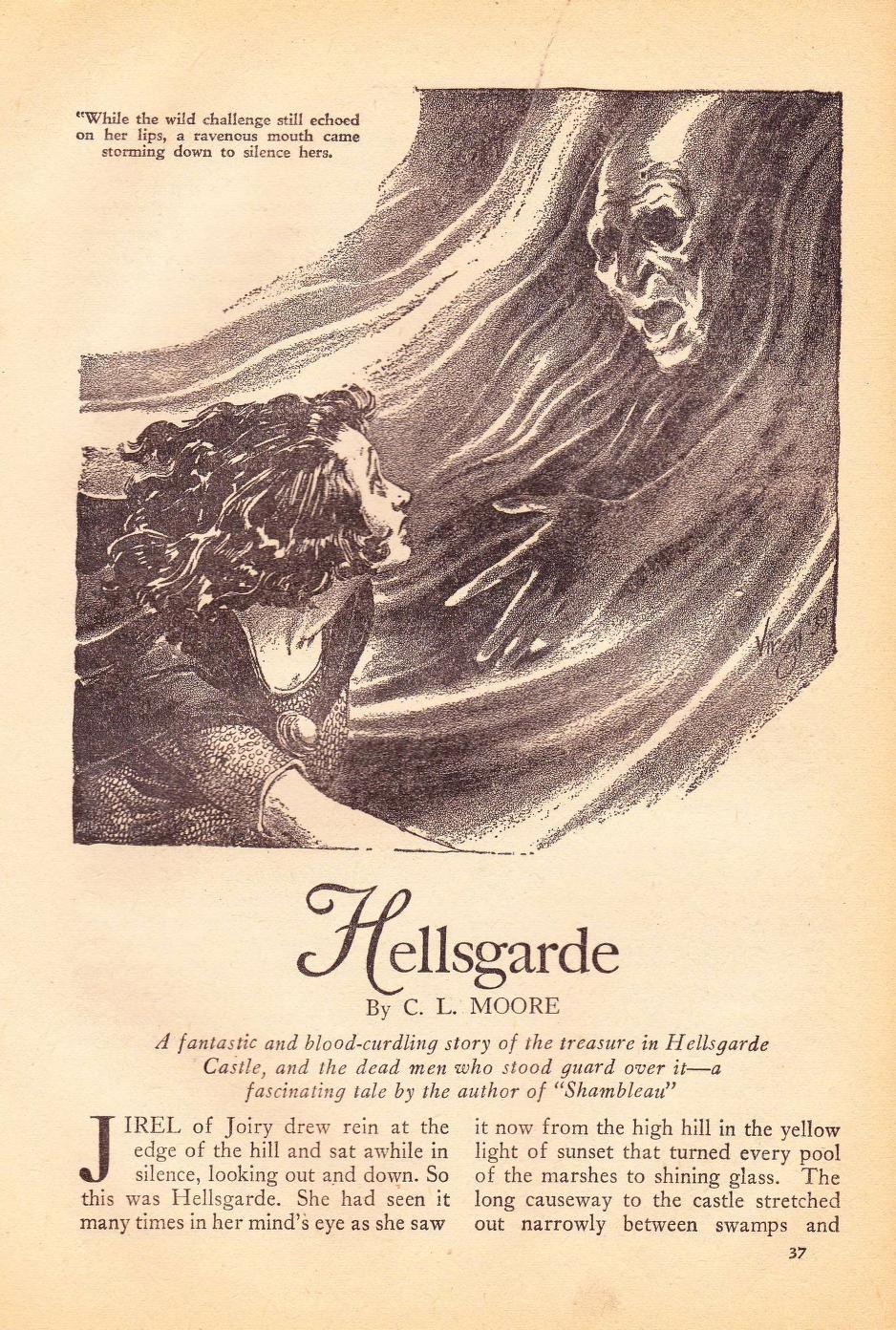
“Hellsgarde” (1939) by C. L. Moore

“You’ll find it by sunset only, my lady,” Guy of Garlot had told her with a sidelong grin marring his comely dark face. “Mists and wilderness ring it round, and there’s magic in the swamps about Hellsgarde. Magic—and worse, if legends speak truth. You’ll never come upon it save at evening.”
—C. L. Moore, “Hellsgarde” in Weird Tales (Apr 1939)

The last Jirel of Joiry story came out 15 months after the previous story, “Quest of the Starstone.” In that time, Moore had been publishing less. The market was changing. New fantasy and weird fiction magazines were out, Weird Tales had been sold and the offices moved to New York City; the editor Farnsworth Wright would soon be fired and, in 1940, would die. Moore’s connections to the magazine were fraying. But there was this one last hurrah.

While it wouldn’t be quite correct to say that the Jirel of Joiry tales to this point were formulaic, they did share very similar plots: Jirel would travel to some other land or dimension, face a supernatural peril, and overcome it through ingenuity and sheer spirit. The details varied, and sometimes she faced sorceresses or wizards and other times alien spirits and gods, but it was a common theme, one largely shared with several early Northwest Smith yarns. “Hellsgarde” still has that theme, but it is developed in a very different way, and with much more style and plot, than the previous tales—and for a good reason.

This is a horror story.

There are strong Gothic setting elements, and readers might well see it as an old dark house tale, with the decaying castle and the creepy family. Yet without sacrificing any of the adventurous elements—Jirel of Joiry is a woman of action, even when trapped in a cell, and her escape is murderous and bloody—this is definitely a story that emphasizes the creepy above the fantasy. It is the darkest of the original Jirel stories, and with neither a typical ghost or typical ghost-hunters, but something much more deliciously weird.

“With the passage of years the spirits of the violent dead draw farther and farther away from their deathscenes. Andred is long dead, and he revisits Hellsgarde Castle less often and less vindictively as the years go by. We have striven a long while to draw him back— but you alone succeeded. No, lady, you must endure Andred’s violence once again, or—”
—C. L. Moore, “Hellsgarde” in Weird Tales (Apr 1939)

The peril to Jirel in this story is exquisite. Once again, she is in a scenario where swordplay is of limited use. She is bound by loyalty to her retainers, she is physically trapped in the castle by the hunters after Andred’s spirit, and her vitality is a beacon to Andred’s ghost itself. It isn’t the first time that something about Jirel’s violent life has attracted supernatural attention (cf. “The Dark Land” (1936) by C. L. Moore), but the threat is more visceral this time, more rapacious. That adds a sense of personal danger, a threat of sensual violence to a tale that is already designed to unnerve. And like a great writer of the weird, C. L. Moore knows enough to leave the last horror unknown, only hinted at.

It’s a wonderful story, and the readers thought so too:

Hellsgarde was the most welcome story of the current issue, for it has the qualities one associates with C. L. Moore: beauty of style, an owtré air, and narrative unpredictability […]
—J. Vernon Shea in “The Eyrie,” Weird Tales (Jun-Jul 1939)

Hellsgarde was a superb, grand and everything else kind of story; I loved it to the very last exciting word.
—Ethel Tucker in “The Eyrie,” Weird Tales (Jun-Jul 1939)

And C. L. Moore gives us the one and only Jirel of Joiry! Boy! Whatanissue! I hope that C. L. Moore delights us in future issues with more stories of Northwest Smith and Jirel.
—John V. Baltadonis in “The Eyrie,” Weird Tales (Jun-Jul 1939)

You do give us thrill-mad fans such nice ‘oogy’ stories. Look at Jirel of Joiry—she certainly does get around. How about getting her and Northwest Smith to meet again. They did quite some time ago. They should get better acquainted, don’t you think?’
—Elaine McIntire in “The Eyrie,” Weird Tales (Jun-Jul 1939)

There would be no sequel. Jirel of Joiry had run her course under Moore, and there was little left of Northwest Smith. Which doesn’t mean that the story of “Hellsgarde” ends here.

In 1967, “Hellsgarde” was reprinted in The Man from U.N.C.L.E. Magazine (Nov 1967). This digest was published by Leo Margulies, who had bought the rights to Weird Tales, and edited by Cylvia Kleinman Margulies, his wife. Back numbers from Weird Tales tended to fill out the issues in the “Department of Lost Stories.” However, probably for reasons of space, when “Hellsgarde” was reprinted it was significantly abridged, and in parts rewritten. This was likely done by the editor, as reprints of “Hellsgarde” in Moore’s own collections follow the 1939 text.

Did Moore intend “Hellsgarde” as a send-off for Jirel? Did she lose contact with the character, after so many years and stories? Or was it just that she lost contact with Weird Tales, and focused her energies on the future—to her upcoming marriage with Henry Kuttner, and the career they would build together? We may never know.

“Hellsgarde” was published in the April 1939 issue of Weird Tales. Scans of this issue are available on the Internet Archive.

A comparison of the 1939 vs. 1967 texts of “Hellsgarde” is also available on the Internet Archive.


Bobby Derie is the author of Weird Talers: Essays on Robert E. Howard and Others and Sex and the Cthulhu Mythos.

Deep Cuts in a Lovecraftian Vein uses Amazon Associate links. As an Amazon Associate I earn from qualifying purchases.
“Miracle in Three Dimensions” (1939) by C. L. Moore

Strange Stories (1939-1941) was one of the rivals that rose during a fantasy boom in the waning years of Farnsworth Wright’s term as editor of Weird Tales. While many of the rivals had little in the way of style to offer, there was one thing they did that WT didn’t—pay. The magazine had gone a long period delaying payment, even to its most prolific and popular authors, while other pulp magazines often paid at least as well and often sooner than WT did. While we don’t know if that was a consideration for C. L. Moore, it might explain why she was writing a science fiction tale for one of Weird Tales‘ rivals instead of another Northwest Smith or Jirel of Joiry tale.

Strange Stories, of all the rivals, seemed to have collected Weird Tales‘ also-rans, and only ran for 13 issues. Most of the stories are nearly forgotten today, but a few have been reprinted, by dint of their authors’ later fame as their individual quality. Such is the case with “Miracle in Three Dimensions” by C. L. Moore, which was never quite a lost story, although seldom reprinted and never in any of her own collections during Moore’s lifetime.

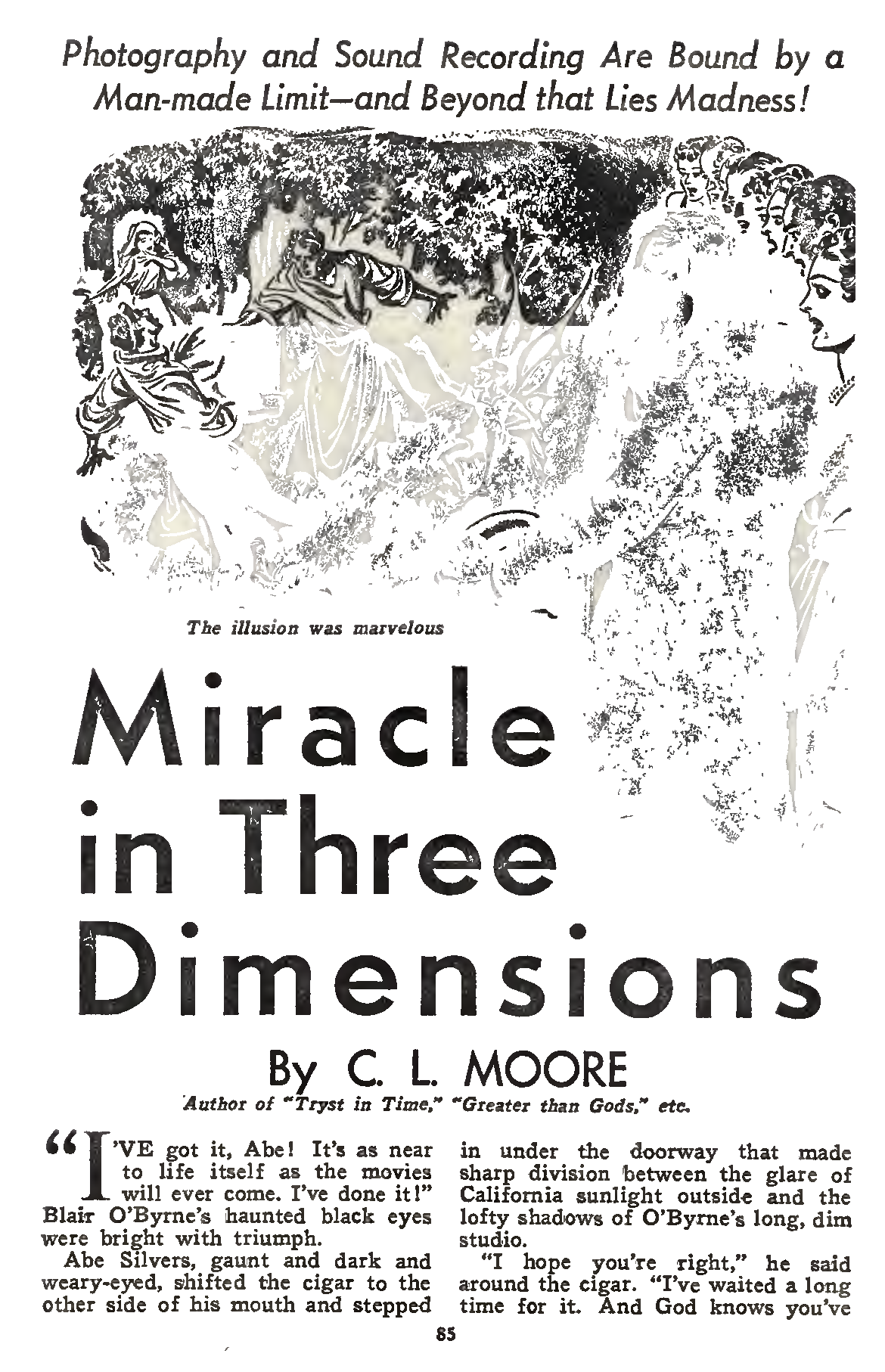
Fundamentally, “Miracle in Three Dimensions,” published in the Apr 1939 issue of Strange Stories, is a gadget tale: inventor Blair O’Byrne has developed a prototype of the Star Trek holodeck, a kind of three-dimensional motion picture. Harboiled movie mogul Abe Silvers finds himself projected into Shakespeare’s A Midsummer Night’s Dream. Wright, a great Shakespeare fan who had tried to publish a pulp library of Shakespeare plays a few years before—of which A Midsummer Night’s Dream was the only one to make it to print—might have shown interest in the scenario, if he had seen it.

Yet the way that Moore develops the story is very different from any of her previous tales, even science fiction stories like “Greater Glories” (1935) and “Tryst in Time” (1936). While framed as a science fiction story, it has a certain fantasy logic:

Did you ever hear—” broke in Blair softly, as if he were following some private train of thought and had not heeded a word of Silvers’ harangue—”of savages covering their faces when explorerers bring out their cameras? They think a photograph will steal their souls. It’s an idea so widespread that it can’t have originated in mere local superstition. Tribes all over the world have it. African savages, Tibetan nomads, Chinese peasants, South American Indians. Even the ancient Egyptians, highly civilized as they were, deliberately made their drawings angular and unlifelike. All of them declared and believed that too good a likeness would draw the soul out into the picture.”
—C. L. Moore, “Miracle in Three Dimensions” in Strange Stories (Apr 1939)

Colonialist rhetoric aside, that particular style of writing, the combination of science fiction trops, fantasy logic, and contemporary setting, is something that would become very characteristic of the early 1940s pulp magazines like Unknown. It is a remarkable shift away from her previous style that the question must be asked: is this even a C. L. Moore story?

A glance at the names on the table of contents of Strange Stories (Apr 1939) includes familiar names like Henry Kuttner, August Derleth, Robert Bloch, Tally Mason, Marc Schorer, and Tarleton Fiske. Except…Tally Mason was one of Derleth’s pseudonyms. Tarleton Fiske was one of Bloch’s pseudonyms. Marc Schorer was a writing partner of August Derleth, and was republished in their collection Colonel Markeson and Less Pleasant People (1966) as by both. The use of pseudonyms by authors to fill out a table of contents and make it look like more writers were contributing than there were is an old pulp trick. Since Kuttner was already in the book with a story of his own, I suspect what happened is that they left his byline off of “Miracle in Three Dimensions,” and that this is actually the second Moore/Kuttner collaboration to see print. More was, as noted elsewhere, sometimes somewhat reluctant to reprint collaborations.

Was that the case here? Maybe, maybe not. There are no definite answers forthcoming, unless more evidence comes to light. So, whether the shift in style represents collaboration with Kuttner, or Moore’s own developing style in that direction is difficult to distinguish. Certainly, there’s a touch of the old sword-&-sorcery even in this tale which may have come from either:

Puck lured the spell-bewildered lovers into the fastnesses of the forest. They went stumbling through the fog, quarreling, blinded by mist and magic and their own troubled hearts. Swords flashed in the moonlight. Lysander and Demetrius were fighting among the veiled trees. Puch laughed, shrill and high and inhuman, and swept his brown arm down. And from Lysander came a choked gasp, the clatter of a fallen sword.
—C. L. Moore, “Miracle in Three Dimensions” in Strange Stories (Apr 1939)

Not quite Robert E. Howard, but then Moore and Kuttner seldom wrote gruesome or fierce action scenes.

The hybrid nature of the tale works; the ability to enter and leave the Shakespearian setting predates works like the Harold Shea stories of L. Sprague de Camp and Fletcher Pratt. It is, more importantly, a step away from the style of fiction of Weird Tales; there’s nothing really of Lovecraft, Robert E. Howard, Clark Ashton Smith, or A. Merritt in this tale. Whatever influences Moore (or Moore & Kuttner) had drawn from these authors, this story was now pushing into a new era, which would be dominated by writers like Ray Bradbury, Robert Bloch, and Margaret St. Clair, who straddled science fiction, fantasy, and horror, but often with a more ironic tone and contemporary viewpoint.

“Miracle in Three Dimensions” was published in the April 1939 issue of Strange Stories. Scans of this issue are available on the Internet Archive.


Bobby Derie is the author of Weird Talers: Essays on Robert E. Howard and Others and Sex and the Cthulhu Mythos.

Deep Cuts in a Lovecraftian Vein uses Amazon Associate links. As an Amazon Associate I earn from qualifying purchases.
“Quest of the Starstone” (1937) by C. L. Moore & Henry Kuttner

Glad to hear that you & C L M are collaborating on a dual masterpiece. The result certainly ought to be powerful enough! Staging a meeting betwixt the mediaeval Jirel & the future Northwest Smith will call for some of your most adroit time-juggling—but with two keen imaginations at work no obstacle is likely to be unsurmountable. Good luck to both of you aesthetically & financially!
—H. P. Lovecraft to Henry Kuttner, 8 Feb 1937, Letters to C. L. Moore & Others 262

In May 1936, just three months after the death of C. L. Moore’s fiancé, H. P. Lovecraft wrote to his correspondent Henry Kuttner and asked if he could forward some material to C. L. Moore. This began a correspondence between Kuttner and Moore that would, in 1940, lead to their marriage. Yet during Lovecraft’s brief time together, he heard about their forthcoming collaboration—even if he didn’t live to see it.

The collaboration came at an odd time in both of Kuttner and Moore’s careers. Moore’s output for Weird Tales was declining; the last Jirel of Joiry tale was “The Dark Land” (WT Jan 1936), the last Northwest Smith story was “Tree of Life” (WT Oct 1936). So when “Quest of the Starstone” was published in Weird Tales Nov 1937, it had been over a year since either character had appeared. A year since C. L. Moore had graced the Unique Magazine.

Kuttner got his professional start in the pulps in 1936. In the space of less than two years, 27 stories from him appeared in the pulp magazines, 11 in Weird Tales. In his early career, Kuttner struggled to find his own voice; while prolific, he put out pastiche work like “The Salem Horror” (WT May 1937), riffing off of Lovecraft’s Mythos, and collaborated with Robert Bloch on “The Black Kiss” (WT Jun 1937). It was Kuttner, devoting much of his time to writing, who recommended the collaboration with Moore:

Chacal: Rumor has it that you didn’t particularly care for the story in which Jirel met Northwest, “Quest of the Star Stone.” Could you give us a little background on the tale: the how and why of it? 

Moore: I’d forgotten that I maybe like “Quest of the Star Stone ” least—that doesn’t mean dislike. If I said so, I expect it’s true. And if true, my guess would be that in this first Kuttner/Moore collaboration the machinery of working together had to be refined and worked over more before it functioned well. Hank and I had met, I think, a short time before this. Or had we met at all? Or only corresponded? Anyhow, he was urging me to do another Jirel and sent on a kind of opening situation to see if I would feel any interest. I did and we sent the ms. back and forth to the best of my very dim recollection until we were ready to submit it. Remember this was all 40 years ago and a lot has happened since.

[…]

Chacal: Did you ever have any reservations about collaborating with Kuttner? 

Moore: Nope. “The Quest of the Star Stone,” our first, worked out well enough to show us we could do it and after that we never gave it much thought. We just went ahead and wrote, either separately or together, depending on how that particular piece of work progressed. Remember, we weren’t turning out stories for posterity, but for this month’s rent. I so often hear of collaborators who tear down each other’s work—even successful, long-established collaborators. We didn’t have time for that kind of nonsense. We just traded typewriters; when one got stuck the other took over with a minimum of rewriting. Often none at all. Usually none at all. With us, at least, it worked out fine. It was also very nice to have somebody who could take over when the other guy got stuck. We sincerely loved each other’s writing and enjoyed tremendously what came out of the other guy’s typewriter. It was a fine relationship. 
—”Interview: C. L. Moore Talks To Chacal” in Chacal #1 (1976), 30

Crossovers of series characters were rare in the pulps, but not unheard of. Robert E. Howard’s Kull of Atlantis and Bran Mak Morn had met in “Kings of the Night” (WT Nov 1930). This crossover, however, also involved a collaboration, and ends up somewhat disjointed. The opening rhyme is uncharacteristic of Moore’s work, while the Jirel segment is very characteristic of stories like “Jirel Meets Magic” (1935). However, there are references there which seem to owe more to Kuttner than Moore:

“Bel’s curse on you, Joiry! […] Me you may not fear, Joiry,” the wizard’s voice quavered with furty, “but by Set and Bubastis, I’ll find one who’ll tame you if I must go to the ends of space to find him—to the ends of time itself![“]
—C. L. Moore & Henry Kuttner, “Quest of the Starstone” (WT Nov 1937)

Bel and Set were gods from Robert E. Howard’s Hyborian Age stories of Conan the Cimmerian. The Egyptian god Bubastis were notably used in the early Mythos fiction of Kuttner’s collaborator Robert Bloch, especially in “The Brood of Bubastis” (WT Mar 1937). The second section, with Northwest Smith and Yarol on Mars, drinking segir-whiskey and listening to The Green Hills of Earth was certainly in keeping with Moore’s style for stories like “Dust of the Gods” (1934)—but how much of that was driven by Moore’s habit, or Kuttner’s more fannish tendencies to repetition? It’s hard to tell; Moore was still herself, and Kuttner an effective mimic. Working as they did, their styles tend to blend.

The story moves fairly quickly, establishing the essential conflict, introducing the leads, and then effecting the meeting of the dual protagonists in short order via a bit of magic. Unusually for a Jirel story, it is peppered with bits of French—for all that it is set in medieval France about the year 1500 (the only time we get a hard date), Moore rarely bothered with trying to insert the language into the stories. There is a certain fun interplay here; neither Smith or Jirel are stupid, both are formidable, and both are, in their way, rogues. It is neither love or hate at first sight, but a kind of chess match of greed and wits.

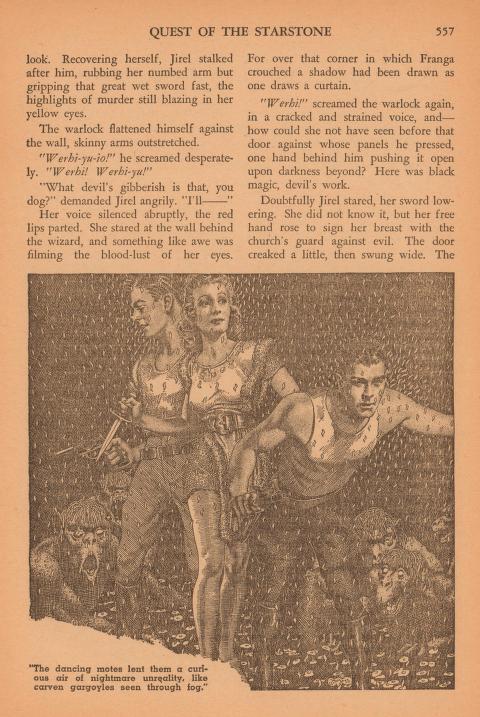
Then they are somewhere else, in one of those transports to other dimensions that showcases so many stories of Jirel and Smith. Perils are faced and overcome, a warlock gets their just desserts, a macguffin is unleashed, and it all ends, if not happily, then with a kind of melancholy correctness of everything back in its accustomed place. Unusually for a Northwest Smith story, Jirel survives—or at least, presumably goes back to her own time and place, as Smith did. Yet in the end he thinks:

Behind the closed lids flashed the remembrance of a keen, pale face whose eyes blazed with some
sudden violence of emotion, some message he would never know—whose red streaming hair was a banner on the wind. The face of a girl dead two thousand years in time, light-years of space away,
whose very dust was long lost upon the bright winds of earth.
—C. L. Moore & Henry Kuttner, “Quest of the Starstone” (WT Nov 1937)

Well, light-minutes, but that’s a quibble. While technically a story where fantasy meets science fiction, where Northwest Smith learns a spell but still carries a raygun, the story leans more heavily toward magic; and while the viewpoint switches, it is mostly a Northwest Smith story in which Jirel appears, since most of the viewpoint is Smith’s. Maybe that is part of the reason it feels “off” compared to the previous Jirel stories. Or maybe it’s just the literal deus ex machina, as the Starstone gives up its secret.

When compared to “Tryst in Time” (1936), Moore’s previous time-travel story, there are certain similar elements in common: an adventurer is bored, an offer is made and accepted, a trip through time results in an encounter with a beautiful woman—but here, there is no instant bond, no sense of soul-mates or reincarnations. Jirel and Smith are alike and respect each other, but there is no sense that they complete each other or need each other. It is a meeting of equals.

Gertrude Hemken, one of the most vocal fans and a prolific letter-writer to Weird Tales, praised the story:

The story of the issue is all I’ve expected it to be—and more. I’ve been curious all these months to learn by what methods and under what circumstances would Jirel and Northwest Smith meet. The story is somewhat lovely—seems as though I awakened from a fantastic dream after I had read it. The abstract lives bro’t to mind the yarns of Aladdin’s lamp and its genie. The illustration is superb. Jirel looks like a screen heroine—and the two men seem rather 20th Century in attire and general aopearance. The dancing flame-stars seem like a very strange rain. Needless to say—The Quest of the Starstone is outstanding, in my opinion.
Weird Tales Jan 1938

Clifford Ball, who had published some sword & sorcery stories for Weird Tales himself, added:

The Quest of the Starstone was a fast-moving, interest-holdiqg, well-balanced piece of work and easily the best story in the current issue even if the famed charaaers of Smith and Jirel are possibly unknown to the later readers. I trust these two authors will be encouraged to continue their partnership. They have the knack of producing masterpieces. But I wish to humbly suggest that
they do not attempt to bring N. S. or J. J. together again, for that might spoil the superb effect of this last story. Not that I mean they should discontinue the characterizations; either one is too magnificent to allow extermination.
Weird Tales Jan 1938

How little he knew. “Quest of the Starstone” was voted the best tale in the November 1937 issue, and readers wanted more. Well, they would get more of Moore & Kuttner—this collaboration proved that they could work successfully together, combining his swift plotting and Moore’s imagination and style—but not much more of Jirel of Joiry or Northwest Smith.

“Quest of the Starstone” was published in the November 1937 issue of Weird Tales. Scans of this issue are available on the Internet Archive.


Bobby Derie is the author of Weird Talers: Essays on Robert E. Howard and Others and Sex and the Cthulhu Mythos.

Deep Cuts in a Lovecraftian Vein uses Amazon Associate links. As an Amazon Associate I earn from qualifying purchases.
“Tryst in Time” (1936) by C. L. Moore

This is an odd reference in one of C. L. Moore’s letters, about a story never published:

Well, have just received my first flat rejection from Wright. A harmless little fable about a sorcerer king of antediluvian times, his mysterious witch-queen and a time-traveler with a startling resemblance to a certain Mr. Smith whom I may have mentioned once or twice before, tho no names were named in the story. Ah, well, life is full of disappointments.
—C. L. Moore to R. H. Barlow, 31 May 1935

We get no more than that—though Northwest Smith would eventually star in a time-travel story, “Quest of the Star-Stone” (Weird Tales Nov 1937), written with Henry Kuttner. However, before she collaborated with Kuttner, Moore published another time-travel story, one which features a very Northwest Smith-like protagonist: Eric Rosner, hard-bitten adventurer and world-traveler:

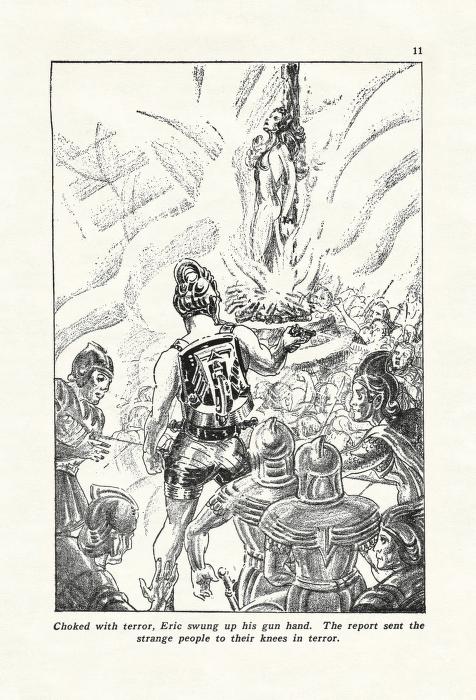
ERIC ROSNER at twenty had worked his way round the world on cattle boats, killed his first man in a street brawl in Shanghai, escaped a firing squad by a hairbreadth, stowed away on a pole-bound exploring ship.

At twenty-five he had lost himself in Siberian wilderness, led a troup of Tatar bandits, commanded a Chinese regiment, fought in a hundred battles, impartially on either side.

At thirty there was not a continent nor a capital that had not known him, not a jungle nor a desert nor a mountain range that had not left scars upon his great Viking body. Tiger claws and the Russian knout, Chinese bullets and the knives of savage black warriors in African forests had written their tales of a full and perilous life upon him. At thirty he looked backward upon such a gorgeous, brawling, color-splashed career as few men of sixty can boast. But at thirty he was not content.
—C. L. Moore, “Tryst in Time” (Astounding Dec 1936)

Did Moore take that rejected story and resubmit it for Astounding? Or did she just take the idea of the story and re-write it for the science fiction magazine (whose editor and fans were not fond of sorcerers and witch-queens)? There is a certain similarity between this tale and Moore’s previous work in Astounding, “The Bright Illusion” (1934) and “Greater Glories” (1935), a romanticism of a male protagonist finding or recognizing love under unusual and somewhat cosmically tragic circumstances. It wouldn’t be surprising if Moore had married the idea of a rejected tale to the general outline of what had sold successfully in the past.

The temporal physics behind the tale are no better or worse than that of many time travel stories, and if Moore isn’t necessarily erudite in physics, she is well-read in basic time travel literature, having no doubt read a great many stories in the pulps or elsewhere. When she writes, for example, of the idea of how moving through the fourth dimension (time) means the other three dimensions go along without you:

“Yeah, and find yourself floating in space when you let go.” Eric grinned. “Even I’ve heard that the universe is in motion through space. I don’t know about time, but I’m pretty sure space would block your little scheme.”
—C. L. Moore, “Tryst in Time” (Astounding Dec 1936)

Clark Ashton Smith had addressed just this problem in “The Letter from Mohaun Los” (Wonder Stories Aug 1932); Smith’s solution was that if you waited long enough, another planet would pass by the point in space you occupied and you’d have your adventure that way. She also addresses the idea of changing the past:

There must be many possible futures. The one we enter upon is not the only way. Have you ever heard that theory explained? It’s not a new one—the idea that at every point of our progress we confront crossroads, with a free choice as to which we take. And a different future lies down each.
—C. L. Moore, “Tryst in Time” (Astounding Dec 1936)

Murray Leister’s “Sideways in Time” (Astounding Jun 1934) had played with the idea of parallel timelines and alternate futures, so Moore wasn’t the first to address the idea, but the fact that she did further shows familiarity with the mechanics of time travel in fiction.

Moore squirms around that by letting Rosner stay on terra firma, even as the ages pass around him, skipping through time like a rock on a pond. The result is reminiscent of the Futurama episode “The Late Phillip J. Fry,” (or, if you prefer, the cyclical rise and fall of civilizations a la Olaf Stapledon’s classic Last and First Men (1930)), with Rosner zipping through future (and past) ages, from advanced civilizations to barbarisms and back again. At least one scene may involve a tongue-in-cheek poke at a certain Providence gentleman she corresponded with, who had a tendency to use the word “Cyclopean”:

Even at this distance he recognized those darker blotches upon the tremendous walls as the sign of a coming dissolution. It was a city more awfully impressive than any he had ever dreamed of, standing gigantic under the low, gray sky of this swamplike world—but its glory was past. Here and there gaps in the colossal walls spoke of fallen blocks and ruined buildings. By the thick, primordial air and the swamp smell and the unrecognizable architecture he knew that he gazed upon a scene of immortal antiquity, and his breath came quicker as he stared, wondering where the people were whose Cyclopean city this was. what name they bore and if history had ever recorded it.
—C. L. Moore, “Tryst in Time” (Astounding Dec 1936)

For the most part, however, this is a piecemeal narrative, a succession of brief, fragmentary scenes and images punctuated by a character that reappears, again and again—a woman, Maia, who is always separated from Eric Rosner by something. Until the end. Without ever using terms like “reincarnation” or “soul mate,” there is a distinct and heavy hint that these two were meant to be together, and that they will be—eventually.

While the story isn’t bad, it also apparently involved some editorial interference and a couple of cuts, which she complained about to her friend in Providence:

Which bring us to the memory of your distress over the butchery of your two tales in that magazine. I ahd somewhat miraculously escaped much injury in my experiences with them up to the publication of my last story, “Tryst in Time” which was so mangled and dismembered that I could scarcely bear to look upon the bleeding remnants. Typographical errors ranged from the careless to the ludicrous—I remember a brook ‘tickling’ through a meadow, for one. And with the most uncanny precision they eliminated and ruined the only two parts of the story for which I felt real affection. My paragraph referring to the mysterious urge which drives races upon migration was left out entirely. I had mentioned the great prehistoric hegiras of our remote fathers across vast areas of Europe, perhaps over the land-bridge into America, the recent fever to “Go West” that burned in our immediate ancestors, and hinting wisely that mayhap the fever which my hero felt to travel in time might be the beginning of a new race-migration somewhere. It didn’t mean anything much, but it was kinda fun and I bitterly resented its omission. And in the last of the story a sentence whose “well-greased perfection”, to quote yourself, gave me a great joy was utterly butchered. I had it, “Wherver you adventured the knowledge of my presence tormented  you, and through all my lives I waited for you in vain.” Perhaps it verges on blank verse in its extreme unctuousness, but who are they to cut it in their vandalism to—“Wherever you adventured the knowledge of my presence tormented you—and I waited in vain!”??? If they don’t like the way I write why don’t they go back where they came from? I am burning up.
—C. L. Moore to H. P. Lovecraft, 24 Oct 1936, Letters to C. L. Moore 195

“Race-migration” was a popular historical concept during the 1930s, and makes its appearance in stories like Robert E. Howard’s “The Children of the Night” (Weird Tales Apr/May 1931). The reference to time travel as a form of race-migration might be a nudge-wink-nudge reference to Lovecraft’s “The Shadow Out of Time” (Astounding Jun 1936). The cuts might have been for space, or because the editor disagreed with the ideas expressed—there are many possibilities, but no firm answers. Pulp editors could be merciless and incomprehensible.

There isn’t much feedback on this story; Lovecraft apparently never read it, or at least doesn’t mention it in surviving letters. Fans, however appreciated it, with one fan letter noting:

I was glad to see Miss Moore has begun to write ‘science-fiction. Everything else I have read by her was purely weird. Her story seemed real and plausible, in spite of the unusual plot.
—Richard Creecy, Astounding Feb 1937

Which shows how Moore’s reputation was developing.

“Tryst in Time” was published in the December 1936 issue of Astounding Stories. Scans of this issue are available on the Internet Archive.


Bobby Derie is the author of Weird Talers: Essays on Robert E. Howard and Others and Sex and the Cthulhu Mythos.

Deep Cuts in a Lovecraftian Vein uses Amazon Associate links. As an Amazon Associate I earn from qualifying purchases.

“Tree of Life” (1936) by C. L. Moore

C. L. Moore is an extremely gifted young woman of 25—a fact as well as fiction writer. Her stories are rivaled (now that Bob Howard is dead) only by Klarkash-Ton’s, & contain a highly unique element of convincing unreality—which could be still better but for a certain stereotyped romanticism & occasional concession to the pulp ideal.
—H. P. Lovecraft to Virgil Finlay, [25 Sep 1936], Letters to Hyman Bradofsky & Others 447

“Tree of Life,” published in the October 1936 issue of Weird Tales, isn’t technically the last of the Northwest Smith stories. Yet for many readers, it would have been seen as practically the last. Smith would not appear in print again until “Quest of the Starstone” (WT Nov 1937), a full year later, and the final brief coda “Song in a Minor Key” would only see print in a fanzine in 1940. So too, Moore’s star at Weird Tales was waning. This would be her 13th story published at Weird Tales in just three years, but in the next four years she would publish only three more stories in the magazine.

What changed? The death of Moore’s fiancé in early 1936, her ongoing need to provide for her family with her real job, Weird Tales‘ slow payments and her shift to other pulp markets likely all had their part to play. Yet that was in the future. For now, readers could enjoy this tale and imagine the many other adventures of Northwest Smith that the future might hold for them.

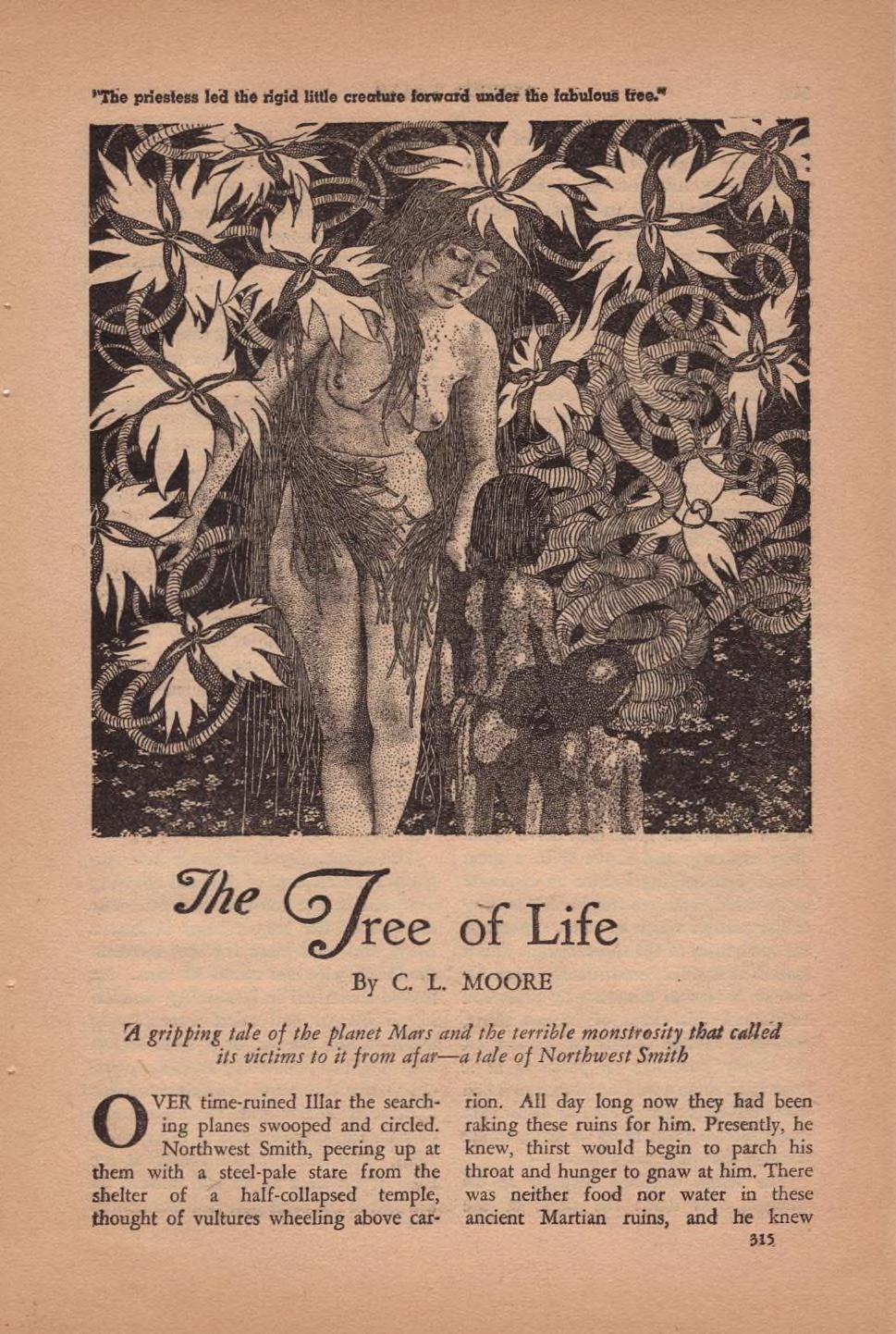
It was an unusually elaborate well, and amazingly well preserved. Its rim had been inlaid with a mosaic pattern whose symbolism must once have borne deep meaning, and above it in a great fan of time-defying bronze an elaborate grille-work portrayed the inevitable tree-of-life pattern which so often appears in the symbolism of the three worlds. Smith looked at it a bit incredulously from his shelter, it was so miraculously preserved amidst all this chaos of broken stone, casting a delicate tracery of shadow on the sunny pavement as perfectly as it must have done a million years ago when dusty travelers paused here to drink.
—C. L. Moore, “Tree of Life” (WT Oct 1936)

In broad strokes, “Tree of Life” looks like several other Northwest Smith stories. The opening is reminiscent of “Werewoman” (1938), with Smith on the run. A ruin that rests between two worlds, as in “Julhi” (1935). A pattern that transports Smith between worlds, as in “Scarlet Dream” (1934). The story lives in that space that Moore carved out between science and sorcery, between the interplanetary tale and sheer fantasy.

One of the things that stands out in the story is the strange and terrible Thag—who is reminiscent, thematically, of the monster Thog in Robert E. Howard’s “The Slithering Shadow” (WT Sep 1933), who likewise keeps an entire population in fear. So what are the odds of Robert E. Howard calling one of his tentacled horrors
Thog, and C. L. Moore calling one of hers Thag? Is it just coincidence, or was one borrowing from the other?

In many ways, Robert Ervin Howard and Catherine Lucille Moore were operating on the same wavelength. While he wrote for Weird Tales earlier and more prolifically, both of them had a way of lighting on similar themes. Erotic tentacles appear in Howard’s “The Slithering Shadow” (WT Sep 1933) and in Moore’s “Shambleau” (WT Nov 1933). Both would conceive of French swordswomen in “Black God’s Kiss” (WT Oct 1934) and “Sword Woman” (written c.1934, but not published until after Howard’s death), and create series characters that would be remembered by generations of Weird Tales fans

Technically they were in competition from 1933-1936, but in reality Howard wrote more, and sold more, during that period. Moore had a day job, while Howard was a full-time writer. They admired one another, and had similar themes. C. L. Moore’s “science fiction” stories of Northwest Smith, while set on distant planets and involving force-guns and spaceships, were written like fantasies with ancient gods, sorcerers, and creatures from Outside. Howard’s fantasies, by contrast, sometimes came up very close to science fiction: the city of Xuthal in “The Slithering Shadow” is lit by radium-lamps, and golden wine quaffed by Conan recalls super science medicines as much as some alchemical potion

Howard’s Thog is not exactly cast in the mode of any earlier entity, but the name might have been influenced by weird precursors like H. P. Lovecraft’s Yog-Sothoth and Clark Ashton Smith’s Tsathoggua; a similar entity named Thaug appeared in another Conan tale, “A Witch Shall Be Born” (WT Dec 1934). He would also use similar names for entirely different creatures, the ape-man Thak in “Rogues in the House” (WT Jan 1934), and the god Thak, the Hairy One, in the posthumously published Almuric (WT May-Jun-Aug 1939)—so perhaps he derived the name, or simply came up with it on his own and liked the sound of it.

If “Thog” and “Thaug” were inspired by Tsa-THOG-ga, it would not be a great surprise. Many of names in the early Mythos fiction invoke some of the same elements; the “-oth” ending for example appears in Sheol-Nugganoth (Lord Dunsany); Yog-Sothoth, Azathoth, Rhan-Tegoth, shoggoth (Lovecraft); Abhoth, Rlim Shaikorth (Smith); Gol-goroth, Bal-Sagoth (Howard). Lovecraft, Howard, and Smith also made a particular habit of working variations on their names—in Howard’s case, in “The Moon of Skulls” (WT Jun-July 1930) the ancient god is Golgor, in “The Children of the Night” (WT Apr-May 1931) and “The Gods of Bal-Sagoth” (WT Oct 1931) the god is named Gol-goroth.

C. L. Moore left no record of similar-sounding names for her horrors; her approach to naming was by her own account more spontaneous. She also did not, except for one round-robin story, play the kind of game that Lovecraft, Smith, and Howard did by putting references to one another’s works in her fiction of Northwest Smith or Jirel of Joiry. Yet at the same time, if Moore drew some thread of inspiration from that game and worked up a similar-named entity for her own fiction—she did make it her own.

While Thog and Thag both prey on their captive populations, that is about where the similarities end. Thog is monstrous but definitely material, able to be cut and chopped and stabbed, while Thag is something altogether weirder, vulnerable at only a single point. While both stories may be classed as science-fantasy, “The Slithering Shadow” leans more toward sword-and-sorcery than “Tree of Life”; as outclassed as Conan and Northwest Smith might be, there is more of a focus on battle and human drama in Howard’s story. Northwest Smith destroyed or defeated Thag, but Conan made Thog bleed.

Read together, the choice of names is less interesting than how each writer pursued a similar theme, each in their own way…and showcased how these two writers could, coming at similar ideas from different perspectives, create two different but equally enjoyable narratives—and in the end Northwest Smith returned to Mars, to live and fight another day.

I was glad to see the return of Northwest Smith.
—John V. Baltadonis, The ‘Eyrie’ in Weird Tales (Dec 1936)

Moore never disappoints, having that rare gift of imagination inexhaustible which keeps this author’s yarns different.
—B. M. Reynolds, The ‘Eyrie’ in Weird Tales (Dec 1936)

Fan response was positive, based on the letters published in The ‘Eyrie.’ Lovecraft’s appreciation was more muted, but honest:

C L M’s “Tree of Life” adheres more or less to her formula, though it has effective atmospheric touches
—H. P. Lovecraft to R. H. Barlow, 31 Sep 1936, OFF 367

“Tree of Life” runs a bit to the Moore formula, but is distinctive for all that.
—H. P. Lovecraft to Duane W. Rimel, 24 Oct 1936, LFB 334

Moore item is average, & “House of Duryea” has a clever ending.
—H. P. Lovecraft to August Derleth, 24 Oct 1936, ES2.752

In Oct. the high spots were C L M’s “Tree of Life” & Bloch’s yarn—the Quick, Peirce, & Kuttner efforts deserving honourable mention.
—H. P. Lovecraft to Richard F. Searight, 19 Nov 1936, LPS 432

Lovecraft, who was still corresponding with C. L. Moore all through the turmoil of 1936, probably had a better idea of what she was going through than most. It’s not clear what impact their correspondence had on Moore’s writing—was Lovecraft’s gentle suggestion to pursue writing for artistic sake rather than commercial reasons part of the reason why Moore would cease writing Northwest Smith and Jirel of Joiry? We may never know. Yet to describe “Tree of Life” as an “average” Moore story for the period is no insult. It is still a solid piece of writing, reflecting Moore’s interests and personality, showcases her effort to straddle the lines of multiple genres to produce something truly weird.

“Tree of Life” was published in the Oct 1936 issue of Weird Tales. Scans of this story are available on the Internet Archive.


Bobby Derie is the author of Weird Talers: Essays on Robert E. Howard and Others and Sex and the Cthulhu Mythos.

Deep Cuts in a Lovecraftian Vein uses Amazon Associate links. As an Amazon Associate I earn from qualifying purchases.