Imagine yourself in the United States of America, 1965. The children born of the baby boom in World War II are teenagers now. A television in nearly every home. The pulp magazines have been dead for a decade. Garish paperbacks reprint the contents of old Weird Tales. Arkham House celebrates its 26th year of operation—and a long-promised project finally saw fruition. The first volume of the Selected Letters of H. P. Lovecraft was shipped out to connoisseurs of the weird, like you. The kind of project normally reserved for much more important and successful authors. It was, though few understood it at the time, the birth of Lovecraft scholarship. Readers could finally learn something more about Lovecraft’s life, in his own words. One passage might have raised a moment of interest:
But one thing Mme. Greene says quite desolates me—she avers that her fair and frivolous offspring is not to be captivated by the charms of any highbrow, not even the otherwise irresistible Bolingbroke!
—H. P. Lovecraft to Rheinhart Kleiner, 30 Aug 1921, Selected Letters 1.149
Thirty-one pages later, you would have found out her name:
At dinner—about one-thirty—were Loveman, Theobald, Long, Mme. Greene, and the latter’s flapper offspring, yclept Florence—pert, spoiled, and ultra-independent infant rather more hard-boiled of visage than her benignant mater.
—H. P. Lovecraft to Maurice W. Moe, 18 May 1922, Selected Letters 1.180
That would, very likely, be the last that you would have read about Florence Carol Greene (19 Mar 1903 – 31 Mar 1979), the daughter of Sonia H. Greene, for another decade. She does not appear in Lovecraft’s Selected Letters again, not even after Howard and Sonia married. L. Sprague de Camp in Lovecraft: A Biography (1975), describes her as the sole surviving child of Sonia’s first marriage; Frank Belknap Long in Howard Phillips Lovecraft—Dreamer on the Nightside (1975) gives a little anecdote from when they met:
Sonia’s daughter was very pretty, with freckles that met across the bridge of her nose, and blonde hair and a waist so slim it seemed a little unreal. Unfortunately she was soon to leave New York, to be with a young man to whom she had recently become engaged. (50)
Sonia herself was reticent in writing about her daughter; her memoir of her marriage with Lovecraft barely mentioned the child, never the woman she became. In part, this is understandable: by the time Sonia and Howard married in 1924, Florence was apparently out of the house, living on her own, and she and her mother had some fundamental break that never really mended. Astute readers would have realized that H. P. Lovecraft had, at least technically, a step-daughter from his brief marriage—but who was she?
R. Alain Everts had cultivated a friendship with Sonia H. Davis, the former wife of H. P. Lovecraft, in her later years. Their correspondence, interviews, conversations, as well as written material and photographs from her formed the basis for several of Everts’ essays, articles, and publications, including “Mrs. Howard Phillips Lovecraft” (1973), “Howard Phillips Lovecraft and Sex” (1974), Winifred Virginia Jackson—Lovecraft’s Lost Romance (1976), and Alcestis: A Play (1985) by Sonia H. Greene & H. P. Lovecraft, the latter published by Everts’ imprint The Strange Company.
Readers never really get an idea of how much material from Sonia that Everts had; whether those represent all he had gathered and was willing to share, or if there was more unpublished, possibly because it was of little interest outside a specialized circle of Lovecraft fans and scholars.
That specialized circle had a name: the Esoteric Order of Dagon Amateur Press Association. Modeled on the same amateur press associations that Lovecraft had been a member of, the EOD was (and as of this writing, still is) an organization where a select group of Lovecraftian fans and scholars connect and share their latest writings, discoveries, and analyses through periodic zines. Everts was a member for a long time, and while he is best known to fans through the works he published through The Strange Company and articles that were published in commercially-available magazines, the zines he put together for EOD are an often fascinating look at what was the bleeding edge of Lovecraftian research.
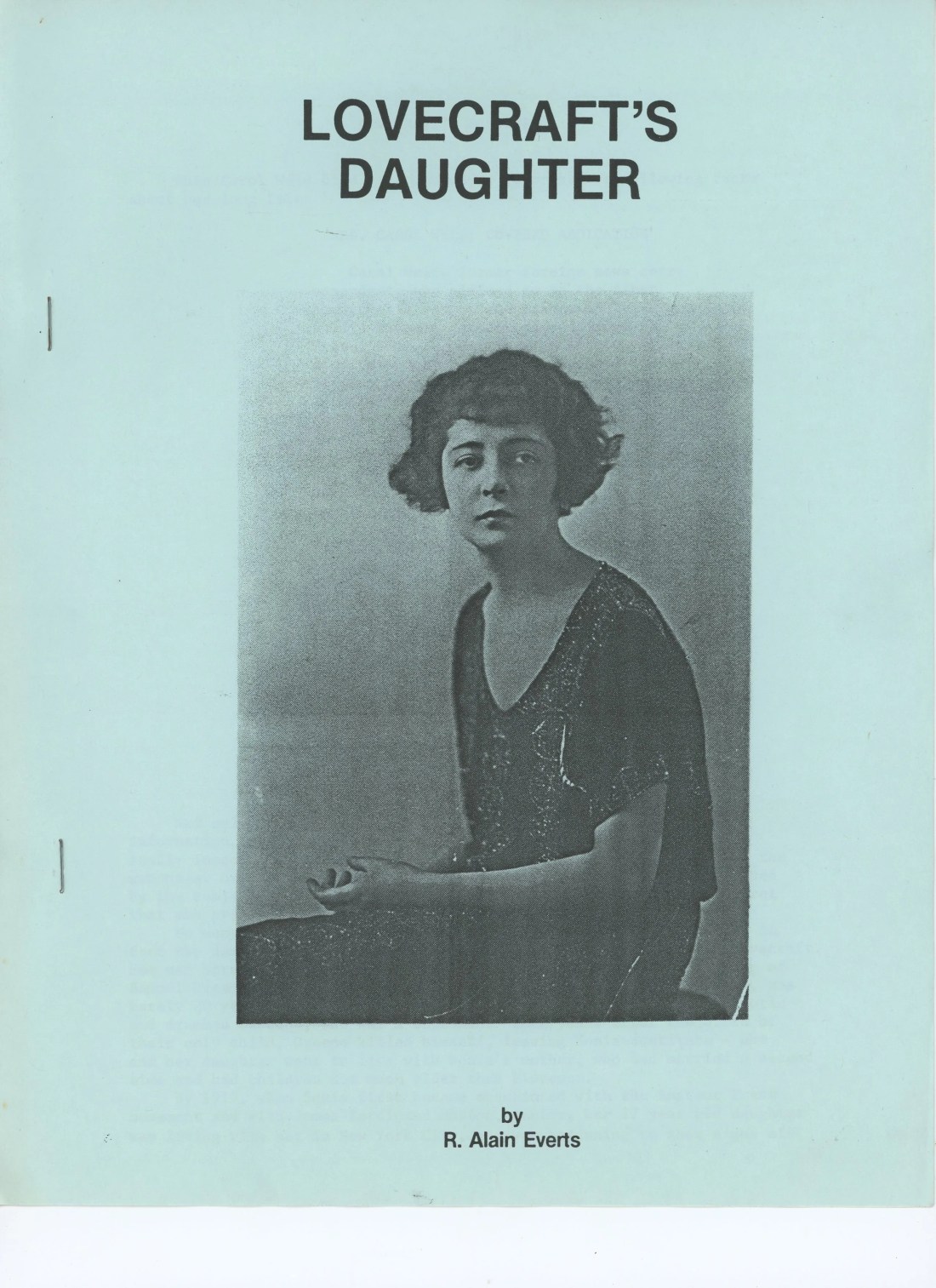
In 1983, Everts issued three thin stapled pamphlets titled Lovecraft’s Daughter, Lovecraft’s Daughter II, and Lovecraft’s Daughter III as part of his contributions to the EOD mailings, summarizing and synthesizing his research on Florence Carol Greene—better known in her adult and professional life as Carol Weld. These pamphlets were never collected, never reprinted, never made available to the wider public, except when a member of the EOD sold part of their collection or died, and their heirs offered it for sale. They are hen’s teeth, and it is difficult to assess their impact. Certainly, later biographies of Lovecraft like S. T. Joshi’s I Am Providence have a bit more to say about her, but her connection to Lovecraft is so tangential and tenuous that tracing her life may seem a digression.
Monica Wasserman, who edited Sonia’s autobiography Two Hearts That Beat As One (2024), doesn’t think so. In her own page on Florence Carol Greene, Wasserman correlated the contents. The only child of immigrant parents in the U.S.; her father out of the picture, her mother raising Florence by herself as a single mother, with the aid of her own mother (who was busy raising two half-siblings). Florence was intelligent, probably feisty, likely stubborn, and independent. What she thought of Lovecraft or her mother’s remarriage is unknown, but Florence’s relationship with her nominal stepfather appears to have been nonexistent.
Everts’ pamphlet Lovecraft’s Daughter is relatively accurate on the biographical details, and some of his information came directly from Sonia:
Sonia recalled to me various dinners at her apartment with both Lovecraft and Samuel Loveman present, where she and Florence would host them for an evening of food and conversation. On some occasions, Sonia and Florence would disagree so strongly that they would fight in front of their guests.
The break between mother and daughter was apparently total. Everts noted that:
When I wrote on Sonia’s behalf in 1967 to Carold Weld (as she then styled herself), the letter was returned to me, opened, with a handwritten message that the envelope had been opened by mistake. I will never forget Sonia’s expression when I showed her this enveloped, and she replied sadly that the handwriting was Florence’s.
There are many reasons why adult children might go “no contact” with their parents, and we don’t have Carol Weld’s side of the story. We only indirectly have Sonia’s through a few writings and Everts’ account in Lovecraft’s Daughter. Unfortunately, the latter is responsible for at least one rumor that has proven hard to kill:
Some years earlier, I believe Sonia mentioned to me that Florence was about 18, she had fallen in love with a nice man with background credentials of impeccable quality – they should have been, for the man was Sonia’s half-brother, by her mother’s second marriage.
Monica Wasserman noted that this was probably a point of confusion, as Sonia’s half-brother Sydney married a young woman named Florence Stone in 1923, and Everts may have easily mistaken one Florence for another, especially with Long’s comment about an engagement, which may have hinted that her daughter was intending to marry, either to someone Sonia didn’t approve of or simply to escape her mother’s household. Whatever the truth, Florence Carol Greene would marry John Weld in 1927, and thereafter be known as Carol Weld.
Today, Lovecraft’s Daughter and its sequels, rare and obscure, aren’t of much interest for its raw information on Carol Weld. Digital genealogical records, newspaper archives, and the collections of the mother and daughter’s papers in their respective archives give access to more information than Everts had access to in 1983. Its interest lies in its expression of Everts’ continued use of his time with Sonia, how he found ways to express that information to an audience of Lovecraftian fans and scholars. This is how information got promulgated before the dawn of the internet, and this is also how rumors start.
Which is why it is important not to rely exclusively on these old fanzines, but to try and view them in their appropriate historical context, and with a critical eye toward not only their sources for information, but how they are synthesizing that information and presenting it to others. Historical data is valuable, but it must also be re-assessed, especially when new information becomes available. Lovecraft’s Daughter was a step on the path of gaining greater insight into who Carol Weld was, and how her story and Lovecraft’s connected; it is an essential part in understanding Sonia’s life and the realities she faced as a single mother in New York. That it has been superseded by later sources isn’t a surprise or a detraction.
Bobby Derie is the author of Weird Talers: Essays on Robert E. Howard and Others and Sex and the Cthulhu Mythos.
Deep Cuts in a Lovecraftian Vein uses Amazon Associate links. As an Amazon Associate I earn from qualifying purchases.

